|
Dedicated to the memory of my father CHARLES HOOKS HARRIS |
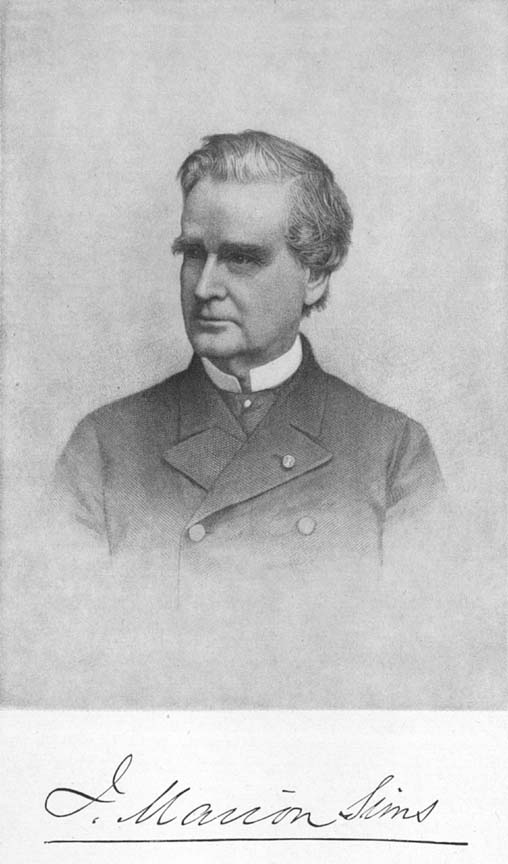
No adequate account of Marion Sims's childhood and youth could be written without heavy dependence upon his The Story of My Life, first published by Appleton in 1884. This lively and unconventional autobiography was a best seller in its day and went into three printings, but as source material for a comprehensive chronicle of its author's career it has certain serious limitations, attributable largely to the fact that Sims began dictating his memoirs only a short time before his death and never had an opportunity to complete or to correct them. Hence his narrative comes to an abrupt halt leaving no account of the last twenty years of his life. It is, besides, marred by numerous errors in names, dates, and other details. Even with these defects, however, the primary acknowledgment of assistance rendered in the preparation of the present biography must go to Dr. J. Marion Sims himself for providing so many interesting reminiscences of his life between 1813 and 1863.
Because of the autobiography's failure to cover many important phases of the great gynecologist's life the first concerns of today's biographer have been to try to find authentic material to fill in those conspicuous blanks and to piece together a picture of Sims's hitherto unrecorded later years. In the search for this material, extending with varying intensity over a period of nearly five years, many persons, organizations, and publications have been notably helpful.
First of all among these must be mentioned Dr. Sims's grandson and granddaughter, Mr. Marion Sims Wyeth of New York and Palm Beach and Dr. Alice Gregory of New York, who have responded patiently to repeated calls for information concerning their family's personal history and have furnished many of the photographs used as illustrations. Also of significant value have been the reminiscences contributed by Mrs. George Waller (Susie Theresa Jones WaIler) of the American Legation in Luxembourg, Mrs. Sims's niece and namesake, who was one of the very few persons encountered in the course of these researches who actually knew the Simses well and remembered them vividly. Other members of the Sims family to whom queries have been addressed include Mr. Joseph Cottrell of Pensacola, Florida, Sims's grandnephew; Mrs. Ernest F. Tyler of New York, his granddaughter; and Miss Jane McLean of New York, his great-granddaughter.
Outstanding assistance was rendered by Dr. J. G. de R. Hamilton and Mrs. Lyman Cotten of the Department of History and Archives at the University of North Carolina, which possesses in its Southern Historical Collection at Chapel Hill a treasure trove of Sims memorabilia. Other original sources, though less extensive, have been consulted in the state archives of Alabama and of South Carolina.
Since Marion Sims's history is bound up indissolubly with that of the Woman's Hospital of New York it is natural that a large proportion of the material dealing with that institution's founding and early days should have been obtained through the courtesy of the Woman's Hospital itself, with the especial co-operation of Dr. George Gray Ward, Dr. Albert K. Aldridge, Dr. J. P. Marr, and Dr. Karl S. Klicka.
Another person who was very helpful is Mrs. B. C. Hough, Jr., of Lancaster, South Carolina, for she has shown an especially active interest in providing information concerning the background of Sims's early years in Lancaster District. Others who have furnished valuable aid include: Dr. W. G. Harrison and Dr. M. Y. Dabney of Birmingham, Alabama; Mrs. Marie Bankhead Owens, Dr. R. S. Hill, and Mr. J. C. Stanley of Montgomery, Alabama; Dr. Irvin Abell of Louisville, Kentucky; Dr. Rudolph Matas and Miss Mary L. Marshall of New Orleans, Louisiana; Mr. A. S. Salley and Dr. William Weston of Columbia, South Carolina; Drs. Lynch, Waring, Smith, and Wilson of the Medical College of Charleston, South Carolina; Dr. Stuart McGuire of Richmond, Virginia; Dr. Wingate Johnson of Winston-Salem, North Carolina; Dr. Frank Boland of Atlanta, Georgia; Mr. Henry S. Wheeler, city clerk of Newport, Rhode Island; Mr. Herbert O. Brigham of the Newport Historical Society; Mr. Robert E. Grayson, director of reference of the New York Herald Tribune; Dr. Philip Van Ingen of the New York Academy of Medicine; Miss Grace M. Mayer, curator of prints of the Museum of the City of New York; Miss Dorothy Barck, librarian of the New York Historical Society; Miss Laura L. McDonald of New York; Dr. Hayes Martin and Dr. George Pack of the Memorial Hospital, New York; Dr. J. Harvey Flack of London, England; and Dr. J. W. McKee of the University of Glasgow, Scotland.
My son-in-law, John J. Keegan, and my daughter, Josephine, have read and reread my manuscripts and have made many corrections and suggestions for improving a number of chapters. Doctor M. Y. Dabney, distinguished gynecologist, has read the manuscript to ensure its technical accuracy. Likewise his talented wife, Eugenia Dabney, Associate Editor of the Southern Medical Journal, has given appreciated editorial assistance.
I also must express my gratitude to my associates, Dr. James F. Crenshaw and Dr. W. M. Woodall, Jr., for taking over my practice at various times when I was absent from the Clinic, working upon this biography. I am grateful to my faithful secretary, Miss Dorothy George, for typing many rewritings of a number of chapters and three revisions of the entire manuscript of this book.
Too much appreciation cannot be expressed to the Army Medical Library in Washington, D. C., and the Library of the College of Physicians in Philadelphia for making possible extensive research into the hundreds of medical books and journals which had to be consulted in the preparation of this book. Lesser research has been carried on in the Library of Congress; the public libraries of New York, Philadelphia, Los Angeles, and Edinburgh, Scotland; and the libraries of the following institutions: New York Academy of Medicine; Jefferson Medical College, Philadelphia; Medical College of Alabama, Birmingham; Los Angeles County Medical Society; Tulane University Medical School, New Orleans; Richmond (Virginia) Academy of Medicine; University of South Carolina Columbia; Medical College of South Carolina, Charleston; Toronto (Canada) Academy of Medicine; University of Glasgow, Scotland; Royal College of Surgeons, Edinburgh, Scotland; British Medical Association, Royal Society of Medicine, and Royal College of Surgeons, London, England; and Académie de Médecine, École de Médecine, Université de Paris, and Bibliothèque Nationale, Paris. The librarians of all of these institutions have been helpful.
Finally, mention must be made of two reference works which were used so constantly as to be indispensable: the Dictionary of American Biography and the Dictionary of American Medical Biography. The Columbia and Americana Encyclopedias were consulted freely, as were biographies or autobiographies of T. A. Emmet, S. D. Gross, John A. Wyeth, Lord Joseph Lister, Lawson Tait, Sir James Simpson, Sir Spencer Wells, Thomas Keith, Empress Eugénie, Lady Randolph Churchill, and numerous others. In the bibliography at the back of this book an effort is made to list these and the many other publications which have served in varying degrees as sources of material for this biography of Marion Sims.
I am under obligation most of all to my talented collaborator, Frances Williams Browin, without whose assistance this biography could not have been finished for several years. Whatever literary excellence this volume may have should be credited to Mrs. Browin, while I am responsible for the errors and mistakes that no doubt will be found by discerning readers.
SEALE HARRIS, M.D.
Birmingham, Alabama
"But who was Marion Sims?" That question is to be expected today, but when I was a boy it never would have been asked. In the early 1880's it was a rare person indeed who had not heard of Sims. Not only was he one of America's most famous physicians: he was an international legend, a controversial cosmopolite whose ability to blaze new trails and to effect remarkable cures kept him almost constantly in the limelight and brought him hordes of friends, not a few enemies, and a fabulous income wherever he went---which was practically everywhere.
My own interest in Sims, which has stayed with me all my life, first was aroused in the summer of 1885, when I was fifteen. My father was a physician whose practice fanned out into the countryside around the then small town of Cedartown, Georgia, and during my summer vacations from school I used to earn spending money by driving him on his daily rounds. He was an omnivorous reader, and with me as his driver he was able to indulge his hobby even when bowling along country roads behind his two spirited horses. His favorite reading matter in the summer of 1885 was The Story of My Life, the posthumously published autobiography of Dr. James Marion Sims, and while he was busy caring for his patients I sat in the buggy and read it too. The book had some defects, chief among which was the fact that it was far from completed when its author died; but its subject matter was so engrossing and it was so simply written, in a conversational, anecdotal style, that it fascinated and delighted me.
That summer, as we rode over the hills and valleys of Polk County, Georgia, my father told me of many episodes in Sims's life that were not mentioned in his uncompleted autobiography. He dwelt particularly on Sims's family life, the elegance of his home, his lavish hospitality, his adoration for his wife, Theresa, whom my father described as "the queenliest woman I have ever known." I remember his saying: "Not even rumor ever whispered of one marring act in the private life of Marion Sims." That statement has been verified by a number of my elderly friends who knew Sims, and the careful reading of the sometimes vituperous attacks on Sims by his enemies has revealed no suggestion of indiscretions in his private life.
My interest in Sims was heightened by the fact that my father, who had studied medicine in New York from 1855 to 1857, not only had been one of the many students and physicians who flocked to the Woman's Hospital to watch Sims performing his novel operations but also had had the privilege on several occasions of visiting the famous surgeon in his home. It was largely because of Sims's inspiring example that my father developed a particular interest in surgery and diseases of women.
When I graduated in medicine in 1894, eleven years after Sims's death, my father held him up as an ideal for me to emulate. He told me of Sims's sincerity, honesty, and integrity, and that he was a gentleman, always; of his industry and devotion to duty; and that the welfare of his patients was always his first and only consideration. He said that Sims gave more than half his time to treating charity patients, that he was as considerate of them, and was as conscientious in his efforts to relieve them, as he was when dealing with his wealthy patrons. He also mentioned the large fees which Sims received from his rich patients, but he stressed the fact that "Sims never practiced his profession for money."
I learned from my father that Sims had enemies who pursued him relentlessly. As he discussed the efforts of a few envious and jealous physicians to destroy "the man who dared to blaze the trail that led to the development of rational and scientific methods in treating diseases of women," he declared with indignation: "Marion Sims towered above his adversaries like Saul above Israel."
In my maturer years I learned that Marion Sims was one of a few outstanding nineteenth century pioneers who added more to the basic knowledge of medicine and surgery in three or four decades than had been accumulated in all the thousands of years preceding. Chiefly, however, he was the physician who brought new hope and new life to women, the surgeon who, more than any other, dispelled the age-old fatalistic belief that it was God's will for countless wives and mothers to go to an early grave or to suffer lifelong invalidism. Women worshipped Sims, and with reason. His handsome face, magnetic personality, and a professional manner which one of his British contemporaries described as "very nearly perfect," were all pleasant assets, to be sure. But it was not because of these characteristics that women were in the habit of traveling hundreds, or thousands, of miles to be examined and treated by him; rather it was because they knew that he, if anyone, could relieve the multitude of "female complaints" which until his time had been considered incurable.
Half a century ago it was the fashion to describe Marion Sims as "the father of modern gynecology," and even today there seems to be little doubt that he richly deserved that title. When he started to practice, back in the 1830's, treatment of the diseases of women was not even in its infancy; indeed, it had hardly been conceived as a separate and distinct aspect of medicine and surgery. There was a common prejudice against obstetric and kindred
arts among most physicians, who were inclined to believe that such subjects were beneath their dignity. Obstetricians were called "male midwives." It is true that their point of view had advanced perceptibly beyond that of the sixteenth century medical teacher and author who prefaced a celebrated treatise on poisons with the statement: "In this book I propose, with God's help, to consider diseases of women, since women are poisonous creatures. I shall then treat of the bites of venomous beasts." Yet, though the physicians who flourished in Sims's youth no longer accused women of being poisonous creatures, they did have a firm conviction that women were mysterious beings.
This attitude of mind existed also among students of Biblical history as shown by a story told by a bishop, a contemporary of Sims, who was celebrated not only as a pulpit orator but also as a raconteur. A fundamentalist minister was to preach a sermon at a boys' school one Sunday morning. The boys learned that preceding his sermon he intended to read a chapter of the Bible about Noah; and as a practical joke, they pasted two pages of the Bible together, so that the sequence of the ark story was disturbed. The old minister read at the bottom of the page, "When Noah was a hundred and twenty years old he took unto himself a wife, who was"---and then he turned two pages instead of one and read at the top of what he thought was the next page ---"three hundred cubits long, fifty cubits wide and thirty cubits high, built of gopher wood, and lined inside and outside with pitch."
The dumfounded minister read the passages over a second time, and then, thoughtfully, said: "My brethren I have been reading the Bible for more than fifty years, and I have never seen this description of Noah's wife before, but it is here as I have read it, and I accept it as divine evidence of the fact that woman is fearfully and wonderfully made."
The reasons for the conviction that "women are fearfully and wonderfully made" is not far to seek; because in the field of women's diseases physicians were blind men, working in the dark. Just how much in the dark they were is revealed by nineteenth century woodcuts portraying physicians examining their female patients. A picture of a lady on her medical adviser's table shows the patient not only fully clothed (and fully clothed was fully clothed in those days!) but with hat and gloves thrown in for good measure, while over her rear, from waist to feet, is draped a sheet, beneath which the unseeing physician extends his groping hands, struggling manfully to solve the mystery of her ailment.
To imply that Sims alone changed all this would be distinctly inaccurate. For nearly a generation before his time certain surgeons in France and Germany---and also a few in Great Britain and America---had been making cautious advances in their treatment of women whose organs had been damaged in the bearing of children. At the very beginning of the nineteenth century, Récamier of France, reviving the use of the medieval era's forgotten tubular speculum, had succeeded in exposing to some extent the hitherto hidden female tract. The visibility provided by his speculum, however, was too limited to provide any really adequate investigation or treatment of feminine disorders.
Then---out of the obscurity of a Southern pioneer town---along came Marion Sims to relieve physicians of their blindness. Along came Sims with his curved speculum through which he "saw everything as no man had ever seen before." Along came Sims with his extraordinary skill and his cunningly devised instruments with which he was able to repair gruesome aftereffects of childbearing formerly deemed incurable. Along came Sims with his burning belief in his own mission to establish a hospital where women's special diseases would be not mere sidelines, but the chief concern. Along came Sims with his peaceful conquest of the capitals of Europe, his transformation of the traditional role of the American physician abroad from that of humble student to that of honored teacher, his fabulous international reputation which enabled him to command an extensive practice in whatever country he chose to visit.
Out of Sims's triumphs, his teachings, his errors, and his squabbles, out of the fervid response he aroused in his worshippers and his detractors alike, the modern specialty of surgical gynecology was born. His was the satisfying experience---not too common among pioneers---of living to see the seeds he had planted bearing plentiful fruit. Not only did many of the surgical techniques he devised become common practice within his lifetime, but the revolutionary new Woman's Hospital which he established in New York City grew to be a great institution and the pattern for any number of similar hospitals for women throughout the United States and other lands---the fountainhead of gynecologic knowledge.
The early history of the development of modern gynecology ---which really is a part of the life story of Marion Sims---should be preserved for posterity. Not only the medical profession is interested in the treatment of diseases peculiar to women; but intelligent laymen everywhere should know that physicians have no secrets pertaining to the sex organs of genus Homo females. They should also be informed of the nature of the diseases afflicting women and of the revolutionary methods of treatment which Sims devised for their relief. The effort has been made to discuss subjects which were formerly taboo in plain scientific language that may be understood by men and women not familiar with medical terminology.
The story is told of a certain Mrs. Malaprop, who married into an old Virginia family in which genealogy was a subject of frequent discussion. In speaking of the husband's ancestry she said:
"You know the gynecology of my husband's family is most interesting." It is believed that the general subject of gynecology is interesting to the average layman; and it is hoped that this book, though primarily a biography, may have educational and historical values for interested readers.
In a world where great practitioners are seldom discoverers and where great discoverers are seldom outstanding practitioners Sims was one of those rare persons who are both. So solidly established on two continents was his fame that when he died, in 1883, laymen and medical men alike felt that only by building memorials to him in stone and metal could they express their sense of indebtedness for the immense change he had wrought in the health and life expectancy of millions of women. And yet today, except for a few common medical terms like "Sims's speculum" or "Sims's position," the name of Marion Sims is familiar to only a few. History remembers her soldiers and her statesmen, even when their contributions to civilization have done more evil than good, but the monumental contributions of medical men are likely to be absorbed so completely into the texture of progress that in short order they are taken for granted and forgotten.
It seems unfortunate that Sims should have to be forgotten, for, as Harper's Weekly said of him when he died, "There was a rapture in his work like that of a lover's pursuit or a great artist's creation." Perhaps that is the difficulty. Rapture is a rare and precious quality, but an elusive one, almost impossible to preserve. If this biography cannot recapture the vital glow which made Marion Sims the beloved (and occasionally detested) medical prima donna of his day, it at least can try to restore to popular view some of the significant aspects of his life --- a life of great achievement, often touched by drama and always touched by zest.
SEALE HARRIS, M.D.
Birmingham, AlabamaChapter One