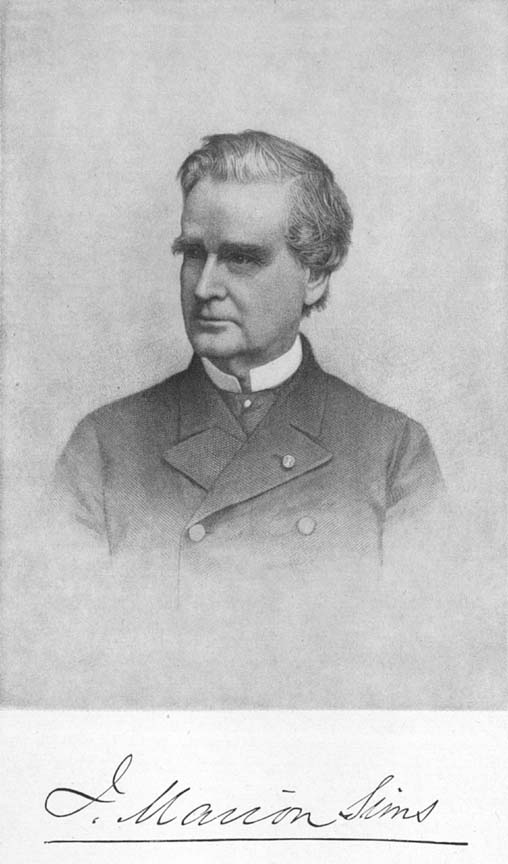
An ironic aspect of the acrimonious new controversy which was now about to break was the fact that it was immediately preceded by an idyllic interlude of intensive adulation. This feast of homage was the result of Sims's somewhat belated decision in the early months of 1877 to revisit at long last the scenes of his youth. On this sentimental journey he was accompanied by his wife and their two youngest children, Willie and Florrie (now both in their early twenties) and by Mrs. Sims's niece Susie Jones, who was returning home to Montgomery after a year spent at school in Brooklyn.
In view of the wide traveling Sims had done it seems almost incredible that in all the forty-odd years since his marriage he never had been back to his native Lancaster, and equally surprising that he had had no glimpse of his beloved city of Montgomery ever since ill-health had forced him to abandon it in 1853. Perhaps memory of the humiliation of the spirit he had suffered in the former place and fear of recurrence of the physical misery he had undergone in the latter had kept him away from both. So prolonged had been his absence that he had become almost a mythical figure in his former home communities, and when finally he did reappear his visit was hailed as a momentous event, and he was feted and extolled at every turn.
For Marion Sims and his Theresa the expedition to Lancaster---which, still untouched by any railroad, had grown but little since their own day---was a nostalgic rediscovery of all the memory-hallowed spots where their enduring romance had had its birth. Yet the sentiments aroused were sad as well as sweet, for on every side were visible the ruthless marks of time and change. Scars from the Civil War were all around, most of the old friends were gone, and practically all the members of the Sims and Jones families had died or moved away. Among the town's leading citizens, to be sure, there still were to be found many of Theresa's cousins; some of these, however, gave evidence of not having quite overcome even yet their old belief that Theresa Jones had married beneath her, even though they were properly grateful for her husband's several generous gifts to the county poorhouse and other worthy causes.
It was at Lancaster that Sims fell ill with the severe attack of bronchitis which dogged him for the rest of his journey and which served as a warning that the period of good health he had enjoyed for twenty years was nearing its end. (This was the illness responsible for delaying publication of his article on anesthesia in the Virginia Medical Monthly.) Upon his partial recovery he and his little party moved on to Columbia to attempt to recapture memories of college days. There too, even though he had the pleasure of hearing himself acclaimed as his college's most distinguished alumnus, the bitter was mixed with the sweet, for his friend Thornwell, who as star student, professor, and president had been his greatest link to the old school, was now dead, and, more than that, the institution itself appeared to be in grave danger of going out of existence. After its enforced closing during the war it had reopened bravely in 1865, with the ambitious new title "University of South Carolina" replacing the old "South Carolina College," but in the South's lean reconstruction days it was finding the going painfully hard, and it was doomed, a little while after Sims's visit, to close its doors for another three-year spell.
Whatever overtones of sadness may have shadowed the Lancaster and Columbia pilgrimages were more than atoned for by the re-entry into Montgomery, which was strictly a triumphal tour from beginning to end. A committee from the Medical Society met the Sims family on their arrival at the railroad station and escorted them to Rush Jones's home, where a second committee was waiting to extend a more formal and elaborate welcome. There was a lavish banquet, complete with floral tributes and equally floral oratory; there was a lecture delivered by the distinguished visitor in response to popular demand and attended by an overflow audience of admirers; there were glowing detailed newspaper accounts of every step of the hero's progress; there were fervid resolutions of praise and gratitude not only from Montgomery's doctors but also from its lawyers and merchant chiefs, with a liberal sprinkling of governors, ex-governors, judges, and military men thrown in for good measure. Altogether it was a reception worthy of a conqueror, and a reception which meant far more to the guest of honor than all the tributes he had received in the exalted places of Europe.
Perhaps the most touching thing about the Medical and Surgical Society's banquet for its erstwhile member was the speech of welcome given by the friend and colleague of Sims's youth, Dr. W. O. Baldwin. Baldwin was the only one left of all the galaxy of physicians who had been practicing in Montgomery when Sims first came there in 1840, and he was understandably nostalgic in his contemplation of the changes time had wrought. His address, though replete with the ornate and flattering oratory typical of his period and his region, was replete also with the real feeling and sincere emotion to which he was moved by the triumphal return of this beloved old friend from whom, until a few years ago, he had been so long and unhappily estranged. If his remarks were studded with somewhat fulsome references to Sims's vast genius and exalted worth as a benefactor of his race they also were studded with pleasant, homely touches which, far more than the floweriest rhetoric, were testimonials to the lasting hold which this man of world-wide fame had upon the affections of his former fellow townsmen. The attributes which constituted Sims's greatest charm and glory, according to Baldwin, were not so much his remarkable achievements as his perennial winsome humor, his spirit and pluck in the face of obstacles, his "simple, unaffected, kind, and genial qualities of the heart." Marion Sims, he observed, was a living demonstration of the fact that "the germs of great thought and inventive genius can as well be hid under a light, happy, careless, and sometimes seemingly thoughtless exterior as in the recesses of that grave mind whose outward look is that of stern and dignified reserve."
Precisely because these qualities of geniality and simplicity were so outstanding in Sims some of his friends were puzzled and disturbed by a certain mannerism he had acquired which gave him a distinct aspect of affectation. Why was it, they whispered among themselves, that he always kept his right hand thrust so imposingly into the breast of his high-buttoned black Prince Albert coat instead of using it for shaking hands as any honest, forthright American ought to do? Why did he insist on greeting people with a languid and apparently condescending left-hand gesture---a gesture so inconsistent with his generally friendly, easygoing ways? Some of his acquaintances longed to tell him that the highfaluting airs of France were ill-adapted to homespun Alabama, but they hesitated to mar the hero's welcome home by raising any questions about a mannerism which, however irritating, was after all comparatively trivial. Then one day the disturbing mystery was solved by a young girl---doubtless a spiritual descendant of that ingenuous child of fable who confounded the fawning courtiers by casually telling the king that he was naked. This unabashed young lady, on being introduced to the famous visitor, exclaimed: "But Dr. Sims, why don't you give me your right hand instead of your left? Is the right one injured?"
Sims greeted her query with a ready explanation. No, his right hand was not injured at all, but several years before, he said, "I was called to Texas to perform a capital operation. While preparing for it I was introduced to one of those brawny Texans who shook my arm almost from my shoulder. It was so severe I had to defer the operation until I recovered from the shock. From that time I have favored the right hand and arm, as my bread and meat come from them."
Whether the hand his well-wishers wrung was his left one or his right, however, they wrung it almost unceasingly during that Montgomery homecoming. There were calls from doctors and laymen without number, visits from former patients and former slaves, and---in order to accommodate the hordes who had no good excuse to pay personal calls upon the lion of the hour---there was a great public meeting at which he was asked to describe his experiences with the Anglo-American Ambulance Corps before an enthusiastic crowd who probably cared not at all what his subject was just as long as they could see him and hear him and have the right to tell future generations that they had beheld the famous Marion Sims in the flesh.
Sims's role as a conquering hero ended when he returned to New York, where new and disquieting developments transformed him suddenly from a benign and hallowed celebrity into a bitter wrangling disputant.
Since his break with the Woman's Hospital in 1874 Sims had been making a definite effort to keep himself entirely out of its affairs and to refrain from any overt criticism of his former colleagues. Probably it was his hope that in time his lamentable flare-up might be forgotten and he might be welcomed back into the fold. His professional relationships with Emmet, Peaslee, and Thomas had remained on the whole studiously correct; only a short while before his departure for the South, in fact, he and Emmet had found themselves sharing identical indignation at the attempt of certain domineering spirits on the Board of Lady Managers to force out of their ranks the guardian angel of the hospital's early days, Mrs. Doremus, at a time when that good lady was mortally ill. (Her death occurred, in fact, in the midst of the conspiracy against her.) Now that his Southern trip was over, however, he found that all his hopes for mutual forgiveness were in danger of being disrupted by the misdirected efforts of some of his admirers.
One of these admirers was that perennial enthusiast and promoter, Henri L. Stuart, who for years had been so zealous in Sims's behalf. The others were two practitioners of "reformed" or eclectic medicine, Dr. Robert S. Newton and Dr. Alexander Wilder, who headed the faculty of the New York Eclectic Medical College and were joint editors of a journal called the Medical Eclectica Journal that was beyond the pale of respectability in the eyes of orthodox physicians. Stuart submitted to Newton and Wilder a biographical sketch of Dr. Sims for publication in their journal. He informed them that it had been published in the Virginia Medical Monthly. He also mentioned that the article originally had contained a page or so delving deeply into the whole Woman's Hospital mess and casting sharp aspersions on the characters and motives of Peaslee, Emmet, and Thomas; but that Sims, on seeing this manuscript, had insisted that the derogatory portions be deleted.
The Eclectic's editors needed no further hints. Delightedly they seized upon the paragraphs Sims had banned, added a few flavorful touches of their own, and proudly published the result, confident that they were defending injured innocence, performing a public service, and (as a corollary) ensuring the focusing of a more than customary degree of attention upon their usually inconspicuous little journal.
In this last anticipation, at least, they were entirely correct. Through a grapevine-information process, medical men who never before had dreamed of reading the Medical Eclectic soon were having their attention directed to that slim publication and were perusing with amazement the words which Henri Stuart---who, as everyone knew, long had been a confidante of Marion Sims---had written. According to Stuart's account, Emmet, Thomas, and Peaslee had played the part of arrant cowards in the Woman's Hospital imbroglio of '74. Sims, Stuart maintained, was the hospital's sole creator---the pioneer who had taught the other surgeons all they knew; they, in turn, were ingrates who had spurred him on to defend their honor in public and then, ignominiously, had betrayed him in his hour of trial.
As a crowning touch---apparently in the fear that Stuart's charges were not sufficiently pointed and damning-Dr. Newton preceded the sketch with an editorial note declaring that the same malign forces which had ousted Sims had been responsible for the "contemptible" plot against the lamented Mrs. Doremus.
All of this happened just two weeks before Sims returned to New York from the South. When he reached home at the end of March, 1877, full of plans for leaving within a month or so for a long stay in Europe, he found himself---not for the first time in his life---a marked man. Among his medical brethren even some of those who had defended him loyally during his earlier controversies were inclined now to look upon him askance. It is true that Newton in his editorial note had assumed full personal responsibility for making several additions to Stuart's sketch ("We have taken the liberty" of doing this, he said, "of our own motion, trusting for justification to the merits and importance of the matter thus incorporated"); but a good many people were convinced that this declaration was merely a face-saver and that actually Sims himself was behind the whole thing. It was bad enough, they felt, for him to permit his biography to appear in a journal sponsored by a group so definitely outside the pales of conservative organized medicine; it was even worse for him to use such a medium for the purpose of making serious charges against his former colleagues.
Sims, completely innocent of any part in the whole affair and quite honestly as disturbed by the untimely public washing of dirty linen as anyone else possibly could have been, was sorely puzzled as to what course to adopt. Repudiation of Newton and Wilder and their journal would involve by implication a repudiation of Henri Stuart, to whom he and the Woman's Hospital both owed so much. His only choice, apparently, was to maintain a dignified silence which in time might demonstrate his innocence.
But ten days later he was confronted with a new provocation in the face of which his hot temper again gained ascendancy over the gentler side of his nature. It came just the evening before he was due to sail to Europe for a six-month absence in the course of which, he had let it be known, he planned to prepare a completely revised edition of his Clinical Notes on Uterine Surgery. The communication he received that evening caused him to cancel his passage, to remain three months longer in the United States, to postpone his projected rewriting of his book, to engage in a raucous and undignified controversy, to give way to emotions which were detrimental to his health, and to lose possession for a long time to come of that precious equanimity which he had been trying so hard to re-establish ever since December of 1874.
The bit of paper which had so profound an effect upon his life was a printed circular addressed "To the Medical Profession." It was signed by E. R. Peaslee, T. A. Emmet, and T. Gaillard Thomas, and bore the heading "Statements Respecting the Separation of Dr. J. Marion Sims from the Woman's Hospital, New York." Two copies of this document came to Sims on the evening before his projected sailing: one by messenger and one by mail. It was, in effect, a protest by Peaslee, Emmet, and Thomas against the popular view of Sims's break with the Woman's Hospital which tended to picture Sims as a martyr and themselves as ingrates, traitors, and villains. For two and a half years, they said, they had been suffering silently under such insinuations; now the direct and widely circulated charges in the Medical Eclectic article made it necessary for them to break their silence. Succinctly they reviewed the events leading up to Sims's stormy resignation, making public for the first time certain details of the controversy. The Medical Eclectic's allegations that they had spurred Sims on and then deserted him they branded as "unqualifiedly false.
"We could scarcely stultify ourselves so far as to defend him in his violent contradictions both of the letter and the spirit of the report of the Medical Board which he . . . had only twenty-four hours before agreed to in every particular. We could only deplore his inconsistency and regret its consequences, but not interfere, unasked, in his own business. If . . . Dr. Sims is to be a martyr in connection with this affair, we protest against his being regarded by the profession as one of our making."
To Marion Sims this document came as a terrific shock. What disturbed him about it almost more than its contents was its timing. The offending passages in the Medical Eclectic had been published two months ago; he himself had been back in New York for a month and a half; why, therefore, had his three critics waited so long to level their charges against him? He could not help concluding that they deliberately had postponed their fusillade because they believed that on the eve of his departure for a long absence he would be unable to make any effective reply. Himself a man of volatile emotions, as ready and magnanimous with his forgiveness as he was quick and biting with his imperious anger, he found it hard to understand that other people were likely to have reactions which, though less spectacular than his own, were far more lasting. As he perused the Peaslee-Emmet-Thomas statement, incredulously at first and then more and more angrily with each rereading, he was faced with the sickening realization that all his bright hopes for an early reconciliation with the hospital and with his former Medical Board associates were now in shreds. It was bad enough to have his dearest dream thus shattered; it was even worse to be branded publicly as a self-willed trouble-maker and, to all intents and purposes, as a liar. For the sake of his reputation, he decided, there was only one thing that he could do: fight back. He would use the same weapons his detractors had used, with no holds barred.
Accordingly he cancelled his passage for Europe, buried himself in his study in the company of his injured feelings and his towering rage, gave himself over to the task of authorship, and emerged a week later with a pamphlet of his own which made the manifesto of Peaslee, Emmet, and Thomas appear, in contrast, almost innocuous. He had written at white heat and with a pen loaded with vitriol, and he hastened to publish the result without giving himself any chance for sober second thought.
It was one of the unwisest things he ever did---even more ill-advised than his lashing out at Bozeman in his Academy discourse twenty years before. His pamphlet, entitled "The Woman's Hospital in 1874: A Reply to the Printed Circular of Drs. Peaslee, Emmet, and Thomas," was distributed widely, like the circular which had called it forth, to all the medical men in New York and to not a few elsewhere. It was a curiously uneven production, losing through its bombastic, overweening self-righteousness the very sympathy which it succeeded in arousing through its frank and rather endearing self-criticism. None but the most prejudiced reader could fail to be touched by Sims's castigation of himself for his gauche and thoughtless behavior in disturbing the pleasant harmony of the hospital's annual "mutual admiration meeting" (as he called it) in 1874 by a speech which was, in his own words, "inopportune," "inconsiderate," "a violation of good taste and propriety," and "the great regret of my life." Yet whatever adherents he may have gained by such manly confessions as this he must have alienated immediately by his orotund harping upon the purity of his motives and the superiority of his polemical tactics to those of his opponents. In view of the public attack which had been made upon him, he said, he no longer could remain silent, but in replying "I shall do my duty to myself, to truth, to justice, to honor, and to my profession. I shall use no disparaging epithets. I shall deal in no questionable innuendoes . . . . Such words as 'unqualifiedly false' do not belong in my vocabulary, and can, under no circumstances, be applied by me to any statement . . . made by a member of my profession, however far from the real truth his statements may seem. The instincts of my nature revolt at phrases of this kind . . . . I shall have the charity to say, in speaking of my late associates, that they are mistaken. I will not disgrace the profession by saying that their statements are 'false.'"
His sense of sharp personal affront at the "unqualifiedly false" label was somewhat puzzling in view of the fact that when Peaslee, Emmet, and Thomas used that phrase they had been referring not to any words of his but to certain statements made in Stuart's Medical Eclectic article and Newton's accompanying editorial, for which Sims himself disclaimed all responsibility, blaming them on "Mr. Stuart's unswerving attachment to me" which "sometimes overleaps the bounds of prudence." For the rest, his venture into paper warfare was devoted to a long and detailed review of the unhappy events preceding and following his resignation. That his memory of these events differed in a number of respects from that of his opponents is not surprising; the truth, as in most controversies, probably lay somewhere between the two versions.
What he accomplished by all this heated outpouring was, without question, more harm than good. His detractors found in his wordy outburst new fuel for their dislike, whereas it is unlikely that his well-wishers would have believed the charges against him anyway. Typical of the latter was James W. Beckman, who had served almost since the hospital's founding as president of the Board of Governors. Meeting one of Sims's daughters at a reception soon after the launching of the Peaslee-Emmet-Thomas attack, Beckman said: "My dear child, I wish you to tell your dear father that I love him and have always done so, . . . and that I think he has been treated most outrageously by all three of the boards of the Woman's Hospital, and that I and his friends will do our best to set him right." Two weeks later, however, Beckman followed Mrs. Doremus in death, and the Woman's Hospital was left without any of the triumvirate who had done so much to start it on its way twenty-two years before.
Peaslee, Emmet, and Thomas, meanwhile, quite as much bemused as Sims through anger, piled indiscretion on indiscretion by preparing and distributing yet another pamphlet proclaiming at some length how wrong Sims was and how right they were themselves. Here were four men who ranked at the very top of their profession behaving in a manner which must have caused the framers of the American Medical Association's Code of Ethics to turn over in their graves! It is not too surprising, perhaps, that Marion Sims, with his perennial distaste for certain aspects of that code, should have been willing to disregard its stern injunction to physicians not to air their private differences in public. But that his three opponents, all of them men normally more circumspect and less hot-headed than he, should have yielded to a similar temptation is testimony to the remarkably dislocating effect exerted by this bitter controversy which, for the time being, was dividing New York's---and, indeed, America's---medical world into two sharply opposed camps. Fortunately for everybody concerned, however, Sims had either the good judgment or the good fortune not to make any public reply to the second Peaslee-Emmet-Thomas pamphlet (unless interviews with him on the subject published in various pro-Sims journals could be considered replies), and, with no new fuel to feed on, the conflagration gradually died down.
The scars it left, however, were deep and lasting. Sims's spirit and his health were permanently damaged; the hospital suffered through the now-irretrievable loss of the most gifted of its surgeons; and all around the periphery of battle were numerous other evidences of damage. One of the innocent bystanders thus hurt was Harry Sims. This young man, now twenty-six, was suffering from the complaint so common to the sons of famous men: fear of his inability to live up to his father's reputation and expectations. These expectations included Marion Sims's fond hope that, even if he himself could not carry on at the Woman's Hospital, his son, at least, might do so in his stead. Ever since the ruction of 1874, therefore, and in the face of considerable tension, Harry had clung grimly (at his father's insistence) to his post on the hospital's medical staff. Now, however, his situation there became an intolerable one, and it began to be obvious that what he needed most was a chance to make a start in his profession in a field far away from the Woman's Hospital and from some of the unfortunate influences which had affected him in New York. His father, who had become a California enthusiast during his earlier visit there, promptly decided that San Francisco was the ideal place for Harry to begin building a new reputation around the name of Sims. Characteristically he took it upon himself to assume a personal responsibility for his heir's launching upon his new career, and before the ink was dry upon the second Peaslee-Emmet-Thomas manifesto he was on his way to the West Coast with the youth who was at once his hope and his despair.
In San Francisco---and, indeed, wherever he touched in his journey across the country---he was received as a popular hero and the idol of the hour. The renewed outbreak of the Woman's Hospital argument had aroused even more intense partisanship than the earlier one, and everywhere he went he was urged to tell his story and (as before) to start a new hospital in retaliation for his disownment. In St. Louis, indeed, his visit was made the occasion for the publication of an unprecedented extra issue, numbering 10,000 copies, of the St. Louis Clinical Record, devoted exclusively to an interview with Sims on the subject of his troubles with the hospital. For the benefit of any readers who, as a result of the Peaslee-Emmet-Thomas blasts (and, indeed, of Sims's own occasional intemperance in debate), might have been led to suppose that the celebrated visitor was something of a boor, the Clinical Record's editor prefaced his worshipful report by observing that "Dr. Sims was found to be a quiet, modest, unobtrusive gentleman, quite the reverse of the arrogant would-be despot he is pictured by his implacable enemies . . . . He bears his honors with unostentatious modesty . . . . If any were inclined to doubt his honor or his honesty before he came, they have been disabused of their unfortunate prejudices by meeting him, and he leaves St. Louis a city full of friends."(14)
This widespread and fervent espousal of his cause, pleasing as it was, could not help at this point being in the nature of an anticlimax. The transplanting of Harry from New York to San Francisco was the end of an era; all hope of a Sims dynasty at the Woman's Hospital was ended; and one source, at least, of the eternal spring of youth in Marion Sims was quenched forever. A perennially high-strung man, he had been living now for several months at a trying level of emotional tension, and when his decision to abandon the attempt to mold Harry to fill his own shoes finally had been made and executed he suddenly realized that he was very tired and very discouraged. Reaction came in the form of a heart attack in San Francisco---a brief attack, but severe enough to warn him that unless he heeded its signal something worse was bound to follow. His departure for Europe, already delayed more than three months by his attempts at self-vindication, must be delayed no longer. When he finally sailed in the autumn, it was with the determination that henceforth, if he was to live to enjoy the old age which was so fast approaching, he must learn to live a little less intensely.
In some ways this particular one in Sims's long series of hegiras from New York to France was a sad one, preceded as it was by bitterness, illness, and disappointment; but in certain other aspects it had its cheerful side. For one thing there was the assurance---provided by his recent skirmish---that all over the country were thousands of men and women who were his loyal supporters and admirers. For another there was the emergence, among these devoted hordes, of a number of young men upon whom he could count to carry on the work he had begun. He was fond of young men and loved to give them encouragement and help, and there were many of them---Mundé, Wylie, Van de Warker, Shrady, Howard, and a host of others, not only in gynecology but in other fields as well---who responded wholeheartedly to his enthusiasm. One of the latest additions to this band of followers was a youthful surgeon from Alabama named John Allan Wyeth who, as a newcomer to New York, had been so disturbed by the Peaslee-Emmet-Thomas charges that he had written Sims---whom he had never met---a letter offering assistance and support. This impulsive offer had an enduring sequel, for not so many years later Wyeth became the husband of Sims's youngest daughter, Florence.
In addition to these heartening evidences of personal affection, there was a dawning realization that some of the battles which had appeared to be lost (such as the treatment of cancer cases at the Woman's Hospital) might yet be won. Meanwhile, apparently, the thing for Marion Sims to do was to cultivate his leisure, rebuild his strained health, enjoy his family, and write the book on gynecology which he hoped to leave as his monument.
The book, be it said at once, never was written. How could it be when its would-be author lived a life so filled with professional and social engagements as to preclude the setting aside of any regular hours for writing? How could a man produce a textbook when he was spending his time jumping from Paris to Geneva to Germany to Norway to Edinburgh to Vienna to London to New York and back to Paris again? For the rest of his life Sims crossed the Atlantic twice or thrice each year, if not oftener, taking a long ocean journey almost as casually as a commuter takes his nightly trip on the 5:15. It was not so much that he was restless as that he found so many people and places of consuming interest; and so many people and places, in turn, kept beseeching him to visit them. Thus the next few months after his 1877 departure from New York found him swinging from one great European city to another: serving as an honorary president of the International Medical Congress at Geneva, attending a physicians' congress at Munich, demonstrating his methods at Vienna, reinforcing his already considerable reputation in the Scandinavian countries, hopping over to the British Isles to keep up to date on the operations of Thomas Keith and the antiseptic reforms of Joseph Lister. Between times he was basking anew in the well-loved atmosphere of Paris, perfecting new surgical techniques and instruments and making his home at 12 Place Vendôme a perpetual center of hospitality for visiting American physicians and others.
The Vienna expedition was one of his least fortunate undertakings. For years the physicians of the Austrian capital had been begging him to come there, and now at last when he accepted their invitation they asked him to operate on three patients suffering from advanced cancer of the womb. He performed the requested operations, and all three of his patients died of peritonitis a week or so afterward. This unhappy sequence of events was seized upon with some delight by a friend of Nathan Bowman's who happened to be serving as Viennese correspondent for several American journals, and soon the medical men of Chicago and Boston were learning from this correspondent's published letters that, in the opinion of Viennese doctors, the abilities of the famous Dr. Marion Sims had been vastly overrated. Sims himself, writing soon afterward of his cases in Vienna, confessed his failures frankly---as, indeed, he always did. The fatal peritonitis, he decided, must have been brought on by faulty methods of tamponing. (Sims did not mention that Lister's antiseptic methods were not used in Vienna hospitals and that the infection which caused the death of the three cancer patients most likely was due to faulty operating room technique.) It was a tragic postoperative sequel to which---because of his insistence on cleanliness and antiseptic methods---his patients usually were far less liable than those of most of his surgical contemporaries.
He was amazed and indignant to find that the medical profession as a whole, far from sharing his enthusiasm for "Listerism," still was generally unreceptive toward the ten-year-old doctrine and persisted in using old methods fraught with septic dangers. He believed, however, that his contemporaries' reluctance to embrace antiseptic practices was based not so much on stubborn resistance to innovations as on the fact that the new methods were so expensive, complex, and time-consuming as to intimidate the ordinary practitioner. When he saw Lister in London in 1877, therefore, he suggested to him that a simplification of his technique probably would result in the winning of many converts to the cause of antisepsis. His criticism was well founded, for orthodox Listerism of that period involved the use of a cumbersome donkey engine spewing forth a continuous curtain of drenching, odoriferous carbolic spray. Why, asked Sims, might not the system be made less intricate by more extensive employment of presterilized "cotton wool" and reduced emphasis on the awkward spray and messy carbolized muslin dressings which Lister up to now had considered essential? Within the ensuing decade Lister's technique was transformed substantially along the lines suggested by the American.
Quite as conspicuous as Sims in his reliance on Listerism was Thomas Keith, Edinburgh's gynecologic genius, who had compiled an unparalleled record of success for the perilous operation of removing diseased ovaries. Marion Sims's public and boundless admiration of Keith formed an effective reply to those of Sims's critics who considered him so determined to be cock of the walk in the field of gynecology as to resent any rival who threatened his leadership. His visit to Keith's private hospital in Edinburgh in the late '70's added new emphasis to this admiration. After looking on in wonder and delight as his host operated with complete success on several apparently hopeless cases he lost no chance to advertise the virtues of the Scotch surgical gynecologist who, in his opinion, was perfection itself. Thus when the Medical Record (published in New York) took a critical editorial viewpoint concerning the eulogies of Keith which had appeared in a Scotch journal, maintaining that it was indecorous and unethical to speak so enthusiastically of any individual surgeon's achievements, Sims leaped into the fray in Keith's defense with typical ardor (and, no doubt, with a consciousness that the comments applicable to Keith were equally applicable to himself). "I do not wonder that his countrymen are proud of his achievements," he wrote in a letter to the Medical Record, "for his record as an ovariotomist is simply marvellous. . . . If such work does not justify his countrymen in a little hero worship I should like to know what would. Must Thomas Keith die before we shall dare to speak his name above a whisper outside the ranks of the profession? In our country, yes. But not so in Great Britain, for there a man of Keith's modesty and merit is always fully appreciated by his brethren."
Not long after this Keith served as the unwitting subject of an incident revealing Sims's extraordinary ability for painting pictures with words. The man who had been so sure in his youth that he never could speak in public nor write a decent composition had developed into a speaker and writer of rare graphic skill. In addressing the Medical Society of the State of New York a year or so after his Edinburgh pilgrimage he gave a description of Keith's appearance and mannerisms which was so remarkably vivid that one of his hearers, on visiting Edinburgh the following summer and seeing a total stranger alight from a carriage, remarked (quite correctly, as he later discovered): "That must be Thomas Keith."
Sims's visits to New York, though frequent, grew shorter and shorter in duration as the years went by, for there could be no denying that the life he lived in Europe had many compensations, not the least of which were financial ones. In a single month's practice in France and Italy, he wrote a friend, he could earn as much as 20,000 dollars. In New York, for all that city's growing financial prestige, he could not hope to approximate this. Yet he would not have dreamed of giving up his New York home and office at 267 Madison Avenue, if for no other reason than that it was there that he had his weekly visits from his beloved Gregory grandchildren.
His contacts with the little Gregorys were marked by a special tenderness, for over their lives hung the shadow of a family tragedy. In the fall of '77, soon after Sims's departure for Europe, Fannie Gregory had given birth to her third little girl, and then ---far away from the father whose skill might possibly have saved her---she had joined the great army of women for whom the price of motherhood was death. If her loss was a grievous one for her three tiny girls and their widowed father it was almost equally grievous for the grandparents who already had lost two sons. From then on, whenever Dr. and Mrs Sims were in New York, they dedicated their Sundays to entertaining their motherless granddaughters. Promptly at one o'clock each Sabbath, Charles Gregory would lead his little brood up the brownstone steps of the Madison Avenue house and give the bell a special double ring. It was a prearranged signal. As soon as he heard the double ring Grandfather Sims would drop whatever he was doing and kneel in the hall to embrace the entering little girls on their own level. There always was a chance that dinner might be a little late, however, for Sims devoted his Sunday mornings to caring for charity patients, and often the meal had to be deferred until the last of the usual large crowd of waiting women had received the attention of their physician, whose concern for their ailments was quite as great at nothing a month as it was at twenty thousand. Once patients were gone and dinner was over, he was free to join his grandchildren in their frolics, which he did with a youthful abandon as spirited as their own.
Fannie Gregory was not the only person close to Sims whom death removed from the New York scene during his absences in Europe around this time. Another was the devoted Henri L. Stuart, who died while on a mission to Georgia in behalf of the memory of Crawford W. Long. (Long's demise had followed by only a year the new fame which Sims's article on the discovery of anesthesia had brought him.) Stuart, who had shared Sims's interest in the anesthesia controversy, had expanded his personal hero's niche to accommodate Long by Sims's side, and after Long's death he embarked on a campaign to make sure that his deceased hero was properly honored by his native state. As his contribution to the immortality of the discoverer of anesthesia he had a full-length portrait of Long painted in oil; then he journeyed to Georgia to arrange for the portrait's hanging in the State Capitol. While there he had the cerebral hemorrhage which killed him, and at the insistence of Long's grateful widow he was buried at the side of the man whose belated recognition he had done so much to censure. It may be assumed that if only Marion Sims could have been buried at Stuart's other side there would have been complete assurance of eternal bliss for this remarkable gentleman who had such a selfless gift for promoting the fortunes of others. Still another death was that of a man whose feeling for Sims was at the opposite extreme from that of Stuart: E. R. Peaslee. The dour, erudite Peaslee's passing at the height of his powers seemed at first glance to remove one of the outstanding obstacles to Marion Sims's reconciliation with the Woman's Hospital, but the men who controlled the hospital's destinies hastened to quash any such false hopes by appointing as attending surgeon in Peaslee's stead the one individual whose selection, more than any other, was designed to be a slap at Sims: Nathan Bozeman.
Bozeman had not softened in his attitude toward Sims, nor had he any intention of ever doing so. Eventually he advanced from excoriating Sims to disregarding his contributions entirely; thus in a paper on fistulas delivered some years later he spoke of the pioneer work of Jobert de Lamballe and of Mettauer, then jumped directly to his own work, giving the impression that no one in between had accomplished anything worthy of note in this field. Now it was sweet revenge---poetically perfect revenge---for all the slights Bozeman felt he ever had suffered to be able to perform the very operations Sims had performed in the operating room of the hospital Sims had founded, while Sims himself was on the outside looking in.
For the hospital's new surgeon and for the members of the governing boards who presumably had chosen him with the deliberate intent of turning the knife in Sims's wound the appointment of Bozeman may have seemed a happy thought, but to Thomas Addis Emmet the selection was not a welcome one. It is true that Emmet, under the influence of Peaslee and of his own hurt feelings at being supplanted, had undergone a longish period of hearty anger at Sims, but his distaste for Sims was as nothing compared with his distaste for Bozeman, whose bumptious and often unfounded claims to priority and supremacy in various fields had been a source of extreme irritation to him for a long, long time. As the years went by and as Emmet's own stature grew to such an extent that he no longer had cause to be jealous of any man he began to think nostalgically of the debt he owed to Sims and of their former pleasant father-and-son relationship. Recently he had been receiving much well-deserved credit in connection with his thoroughgoing new textbook on gynecology and his leadership in showing the medical profession how vesicovaginal fistula might be not only cured, but prevented. What Sims had started he had carried on, and, mellowed as he was by success, it worried him that the link between them had been broken. Emmet was not a particularly modest man, and sometimes he managed to give the impression that he himself had founded the Woman's Hospital and had discovered the means of repairing vesicovaginal fistula; but now, as he found himself thrown into continual close contact with Bozeman while the man who had taught them both had become almost a stranger, he began to be obsessed with a very real desire for reconciliation with Sims.
For the present there were too many tale-bearing intermediaries and unhealed sores to make such a reconciliation possible, yet it did seem rather ridiculous to remain technically at swords' points with a man as genial as Sims, whom perforce he had to encounter fairly frequently through their many mutual interests and associations. The American Gynecological Society, for example, in which Emmet took an extremely active part, had just chosen Sims as its president, despite the fact that he spent more time in Europe than he did in America. This election, coming as it did soon after Bozeman's appointment to the Woman's Hospital staff, may have been, like the American Medical Association presidency several years earlier, a reaction of protest by Sims's admirers against his opponents' renewed attempts to humiliate him.
As a matter of fact it was quite impossible to humiliate a man whose friends were numbered by the thousands and whose spirit was as ebullient as that of Sims. His visits in the United States, like his stays abroad, were now a crowded succession of events at which people vied to do him honor and at which he, in return, gave liberally of himself and of his skills---and also fairly spectacularly of his money. In that age of great extravagance and display, when millionaires were growing steadily richer, it was the custom for men of wealth or near-wealth to vie with each other in entertaining on a prodigal scale. Marion Sims, with his naturally openhanded instincts, was an outstanding exemplar of this tendency of his times, and if he never rolled up any great fortune it was largely because he was in the habit of spending money quite as profusely as he made it. What he especially liked to do was to give huge dinners for the men of the medical world whom he most esteemed. Thus there was the time in 1879 when Dr. John L. Atlee, the pioneer ovariotomist from Pennsylvania, happened to mention regretfully that he never had seen Marion Sims perform an operation. Immediately Sims set about making amends for this omission. He scheduled a series of varied operations for four successive days and asked the octogenarian Atlee to be his special guest at all of them; then, as the culmination of the Pennsylvanian's visit in New York, he invited some fifty or sixty distinguished physicians to attend a dinner at his home in Atlee's honor.
The Atlee dinner was only a small affair, however, compared with some of the others at which Sims played host whenever the impulse moved him. One of the most incredible of these, by the standards of today's less expansive age, was the supper and reception he tendered to Philadelphia's great professor of surgery, Dr. Samuel D. Gross, with whom (presumably to the disgust of Gross's ex-protégé Nathan Bozeman) he had built up a firm and mutually admiring friendship. This gathering was on such a grand scale that it bore more resemblance to a massive official reception than to a party given by one private citizen in honor of another. With 400 supper guests from a dozen different cities in attendance, even the hospitably elastic Sims home on Madison Avenue was unable to expand sufficiently to fill the bill, and the ballroom of the Hotel Brunswick had to be pressed into service. There (according to Gross's memoirs) "the entertainment was a charming one," with brilliant lights shining upon "a profusion of the choicest flowers, champagne corks popping in every direction [Sims the sumptuous host was not restrained by Sims the personal teetotaler] and a band of music stationed in the gallery discoursing delightful music."
The man who had watched in awe years before when Queen Victoria made her royal progress in Dublin was living now in a steady stream of something closely resembling royal progresses of his own. It was not surprising, perhaps, that he should be buried under acclaim when he visited such friendly places as Richmond, Philadelphia, and Montgomery, but it was distinctly remarkable that even in Boston he was given a regal welcome. New England's medical journals and organizations always had shown a tendency to be sharply critical of Sims, and there were any number of reasons potentially responsible for their attitude: his feud with Peaslee, his equivocal stand in the Civil War, his advancing of the claims of a Southerner against those of three New Englanders in the squabble over priority in anesthesia's discovery, his overshadowing of New England's own Hayward in the field of vesicovaginal fistula. In 1880, however, when for the first time in years Sims made a visit in Boston, all these old grudges apparently were forgotten. There was a gala reception given by Dr. Oliver Wendell Holmes and many others of Boston's medical great, there were triumphal tours of hospitals, public institutions, and neighboring towns and cities, there were honors everywhere. Yet best of all was the satisfaction of inspecting the Free Hospital for Women which had been founded years before by one of Sims's own disciples, Dr. William H. Baker, who had served an apprenticeship at the Woman's Hospital in New York and there had become fired with the ambition to provide similar specialized care for the women of his own Boston.
It was as Baker's guest, too, that he was asked to address a class at Harvard Medical School, where Baker was professor of gynecology. The Harvard students' reaction to him in his role as substitute teacher was related by one of them some forty years later. "We were familiar with greatness," he wrote, "but we at once recognized that we were listening to no ordinary speaker." The visitor's "sparkling eyes, incisive speech, melodious voice, and contagious enthusiasm held the rapt attention of the class while he discoursed on cancer of the uterus . . . . The bell rang for the close of the lecture, and the professor of obstetrics walked in, to be greeted with cries of 'Go on, go on!' That courteous gentleman promptly urged Dr. Sims to fill his hour, and he did. What lecturer before or since could hold a class of restless students for two hours? He bowed to us, the door opened, and he passed from our mortal vision forever. You remember when we used to read Virgil and Homer how the gods assumed the shapes of men and came down to talk to mortals. Their divinity was recognized only as they departed. So in a dim way we felt, as the door closed, that we had met face to face one who was endowed with the genius which made him one of the immortals."
Since his recovery, twenty-five years ago, from the illness which had dogged him for so long, Marion Sims had been too filled with zest for life to give much thought to the possibility of dying. He had every expectation of living to be ninety, as one of his grandfathers had done, and certainly he looked and felt youthful and vigorous enough to make this expectation seem a reasonable one. All his habits, indeed, were conducive to the preservation of his health; despite his delight in giving parties featured by an over-abundance of food and drink, his own daily life was a model of temperate simplicity. Regular hours, simple food, plenty of sleep, and complete abstinence from tobacco, alcohol, condiments, and even tea and coffee---these were the characteristics of his regimen.
Another safeguard of good health in which he placed great faith was fresh air---the colder the better. When first he had come North in the 1850's, sorely prostrated by what he believed to be heat-spawned miasmas, his condition had improved rapidly upon exposure to New York's frigid winters; accordingly he had come to associate cold weather with physical well-being. He gloried in exposing himself to it, insisting that the ice-bound temperatures were "bracing" and "life-giving." Perhaps this may have been true when he was a younger man, but in December of 1880, when he was a few weeks short of his sixty-eighth birthday, he exposed himself to winter's rigors once too often and nearly paid for his hardihood with his life. Late one snowy afternoon, while being driven home from a professional visit, he elected to ride upon the windswept box of his brougham with his driver, having given the sheltered seats inside to two ladies who had been caught in the storm. It was a gallant gesture, and it resulted in a racking ordeal of double pleuro-pneumonia.
For many weeks on end he lay in his Madison Avenue home in constant danger of death. Doctor Alfred L. Loomis, New York's leading authority on respiratory diseases, was placed in charge of his case; but Loomis found that Sims, like many another physician, was an extremely poor patient---so poor, in fact, that it became necessary for Loomis' efforts to be reinforced with those of two younger doctors who could be on the ground constantly. One of these watchful lieutenants, of course, was Gill Wylie, who shared Sims's New York practice; the other was Florence Sims's future husband, John Allan Wyeth, who in the last few years had become almost a member of the family.
Day and night, week in, week out, Wylie and Wyeth between them seldom let the patient out of their sight, and their task was not an easy one. If, when death seemed almost inevitable, Loomis ordained that oxygen be administered, Sims positively refused to inhale it. If Loomis prescribed medicines, Sims declined to take them, saying that he had no faith in drugs. If the pain became overwhelming, as frequently it did, he protested that he could not bear it and insisted that he be given morphine, even though Dr. Loomis had left positive instructions prohibiting opiates because of the patient's precarious condition. On one occasion, when Wyeth, quoting Loomis as his authority, refused to grant the balm of morphine, Sims raised so insistent a clamor that the younger man, fearing the weakening effects of such an emotional orgy, said: "Well, if you will have it you must, but you must relieve me of all responsibility."
"All right," replied Sims. "I'll do it."
Wyeth, having anticipated just such a contingency, already had filled his syringe with sterilized water. Picking up the bottle of Magendie's morphine solution, under Sims's watchful eyes, he now went through a careful pretense of filling the syringe, the contents of which he then injected into his rambunctious patient's arm.
A few minutes later there came another call from the invalid's bed. "How much Magendie did you give me?" Sims demanded.
Wyeth did not waver. "Six minims," he replied.
Sims might be semi-delirious and nearly moribund, but after forty-five years of medical practice he was not to be fooled by a fake opiate. He stared hard at his caretaker and then, by way of emphasis, pointed his finger at him too. "That's a lie, Wyeth," he announced, "and you know it."
Much of the time, of course, he was not so rational as this. In his delirium, which persisted for more than ten days, he constantly was contriving new instruments, going through the motions of surgical operations, and fretting over the work he had not finished. What worried him most was that despite his good intentions he had done nothing about revising and expanding his by now out-of-print book on uterine surgery, nor had he made any start on the autobiography his friends had been begging him to write. Now he was going to die---of that he was sure---and these important tasks would never be done.
He did not die, thanks to good care and a strong constitution, but neither did he seem able to find the road to recovery. After six weeks of desperate illness his fever started to mount daily higher and higher, and his physicians decided that only in a warmer climate could he hope to reach convalescence. So it was that his native Southland achieved at long last a happy revenge over the North which had taken him away. Early in February of 1881, with New York's temperature in the "life-giving" near-zero range and his own temperature hovering around 102 degrees, he was bundled into a private railroad car fitted up like a hospital and transported southward to a region of less "bracing" climates. This time it was the South, not the North, which possessed a healing touch, and after several months in Charleston and Florida he at last was sufficiently recovered to return to New York and to sail from there to Europe, where he hoped that in Italy and in the south of France he might regain in full the health which he had lost.
Or so he said. But his reason and his physician's instinct told him that his hopes had little chance of being realized. No more than he had been fooled when Wyeth tried to give him water instead of morphine was he fooled now by the feeble state of bare non-illness which was such a poor counterfeit of the abounding well-being he had known. His heart bothered him, and he tired easily, and he knew that his old dream of living to be ninety never was to be granted.
Haunted by these gloomy forebodings, his meditations lingered, as they had done more than once in recent years, upon the carrying on of his work and his name. The urge to found a family dynasty was strong within him. Granville, his first hoped-for link with the future, had died. His daughters were fine women, but their descendants would not bear his name. His only hope lay in his two remaining sons, Harry and Willie. Harry was back in New York now after his San Francisco exile, and his father, with a loving parent's fatuous blindness, once again was allowing himself to hope that this genial but weak young man even yet might prove to be a worthy successor to his own name and fame. As an optimistic step in this direction the younger Dr. Sims at this time had his name legally changed from the undistinguished "Harry Sims" to the more glamorous and evocative "Harry Marion-Sims," and his brother Willie promptly followed suit, becoming "William Marion-Sims." Willie was a gentle and delicate soul who, having lacked the ambition and strength to prepare himself for a career in medicine, now was out in St. Louis working as a clerk in a dry goods store in the hope of getting a start in the mercantile field. It seemed unlikely that even with the new hyphenated surname Willie ever would make an appreciable mark in the world, but his illustrious parent, touched and pleased by his sons' attempts to identify themselves with him, sailed for Europe comforted by the thought that, whatever happened to him, the name he had made famous would be carried on. (For his peace of mind and for purposes of convalescence it was just as well that he could not know that neither of his sons would leave either heirs or perceptible reputations.)
A memorable feature of that summer's recuperative sojourn in Europe was the momentous and perturbing bulletin which came over the cables soon after his arrival in Paris: President Garfield had been shot in the abdomen and now was lying in the White House, mortally wounded; his death was expected within a few hours. Sims, like all the other Americans in Paris, was horrified by this news; unlike most of the others, however, he had had personal experience in the handling of bullet wounds of the abdomen, and he had some very definite views on the subject. Most of his medical contemporaries, he was aware, did not agree with him in this viewpoint; they considered surgical invasion of the abdominal cavity practically equivalent to murder. The fact that a method he advocated was unpopular, however, never prevented Sims from championing it. Hence when a cabled request from America asked him to offer advice on treatment of the President's wound he promptly cabled back: "If the President has recovered from the shock, and if there is undoubted evidence that the ball has traversed the peritoneal cavity, his only safety is in opening the abdomen, cleaning out the peritoneal cavity, tying bleeding vessels, suturing wounded intestine, and treating the case as we would after ovariotomy, using drainage or not as circumstances require."
His advice was not followed, but its publication in the American newspapers provoked wide criticism, none the less. What right (asked the critics) had a gynecologist to intrude himself upon a case like this, so definitely out of his field? Didn't he know that blood poisoning was far more likely to result from all the cutting and probing he proposed than from the continued presence of the bullet? Did he want to kill the President by carving him open and handling him as he would handle a woman with an ovarian tumor? (Sims's reason for drawing the analogy with ovariotomy, incidentally, was his justifiable conviction that ovariotomy was the parent of abdominal surgery.)
When he returned to New York ten weeks later President Garfield was still alive, having confounded completely the doctors who originally had prophesied his death within a few hours. Newspaper reporters, remembering the furore which had followed the gynecologist's cabled suggestions, besieged him with requests for further opinions and recommendations. Sims, however, had none to offer, for from the past ten weeks' many conflicting reports on the ups and downs of the President's condition he had deduced that the wound was not a simple abdominal one, as had been stated at first, but something far more complicated, which by now most assuredly must involve septicemia. After Garfield's death, when the North American Review asked Sims and three other famous surgeons to contribute to its pages their opinions and criticisms concerning the handling of the case, he had no word of blame for the President's physicians, however incorrect their diagnosis may have been. (The autopsy showed that the bullet had penetrated the bony structure of the spinal column, producing a compound, commuted fracture with ensuing blood poisoning.) The wound, wrote Sims, was without doubt a mortal one of a type from which "our whole medical literature does not contain a single well-authenticated case of recovery . . . . It is uncharitable and ungracious to blame the surgeons . . . . They did all that men could do."
This handsome exoneration of the murdered Garfield's doctors did not mean, however, that Sims was weakening in his advocacy of the desirability of opening and exploring the abdominal cavity, under aseptic conditions, in the case of gunshot wounds. On the contrary, he was surer than ever that this was the proper procedure to follow.
The ancient Athenians, we are told, erected a statue to Time and gave it the inscription: "To him who vindicates." This was an inscription to whose truth Marion Sims could have testified abundantly from his own experiences. The vindication of some of his doctrines, such as this one concerning the treatment of abdominal wounds, he never lived to see, but in the case of a number of others he had the satisfaction of witnessing the many doubting Thomases in his profession come around to his viewpoint, however tardily. An extreme example of how very belatedly his doctrines might be accepted came to light about this time when J. F. Hartigan, Health Officer of the District of Columbia, reported that through a prolonged study of trismus nascentium he had proved conclusively the correctness of the theories on the cause and treatment of this disease which Sims had presented to a disapproving and unresponsive medical world thirty-five years before! Writing to inform Sims of his findings, the Washington Health Officer told how, some years before, he had been so distressed by the District's extensive mortality from convulsions among newborn infants that he had made a thorough search of all available medical literature on this ailment. In the course of his quest he had unearthed Sims's hoary discussion of the subject, which had impressed him so deeply that he had put the long-neglected thesis to an exhaustive six-year test in Washington, and as a direct result of his application of Sims's theory the District's large incidence of infant deaths from trismus had been almost completely eradicated.
This dilatory vindication was only one of many gratifying gestures which served to offset to some extent Sims's gnawing realization that he had but little longer to live. For one thing, he felt a solid satisfaction in his hearty if belated reconciliation with Thomas Addis Emmet---a reconciliation typical of the growing mellowness of spirit which enabled him to declare happily: "I have forgiven all my enemies but one." (Even in his most benign moods he could not bring himself to extend the hand of fellowship to Nathan Bozeman.) For another, he rejoiced in the successful fruition of the long-cherished plan of his future son-in-law, Dr. John Allan Wyeth, to create a graduate school where physicians and surgeons might receive intensive practical training to equip them for the responsibilities of practice. Sims, remembering ruefully his own lost feeling of complete ignorance and inadequacy when first he hung up his professional shingle in Lancaster, had given enthusiastic support to Wyeth's plan, and when the New York Polyclinic Medical School and Hospital finally came into being in 1882 he was one of the principal speakers at the opening ceremonies.
About this time Sims received two welcome tributes from the institution where he himself had studied so many years ago: Jefferson Medical College in Philadelphia. The first was the presentation to the college by its surgical staff of a bronze bust destined to familiarize many future generations of Jefferson students with the name and fame of Sims. The second was an invitation to fill Jefferson's professorship of gynecology. Some years earlier Sims would have accepted this with alacrity, no matter what the financial sacrifices involved, for (as such experiences as the one not long before at Harvard Medical School abundantly testified) he was a natural teacher with an instinctive gift for leading and inspiring young men, and his perennially unsatisfied yearning to pass on the torch to his own sons might have found an effective outlet in a professor's role. For years he had wished for just such a chance as this to teach in a medical school, but never before, amazingly enough, had he been offered a professorship. Now that the opportunity had come it was far too late for him to take on such an onerous task; his health would not stand it and he could not do justice to the post, so there was nothing he could do but refuse. Yet though this meant that his desire to hold a professor's chair was never to be granted, he had nonetheless the keen satisfaction of knowing, from the frequent testimony of many younger men at home and abroad, that they had learned nearly as much from hearing him talk and from watching his operations as they had from all their formal college courses.
Of all the gratifying happenings studding Sims's later years, however, the ones which pleased him most had to do with the Woman's Hospital. In December of 1881 the hospital's Medical Board, on the motion of Dr. Emmet, asked the Board of Governors to appoint Dr. J. Marion Sims to the post of Senior Consulting Surgeon, and the Governors promptly complied. Once again, Time, the vindicator, was busily at work.