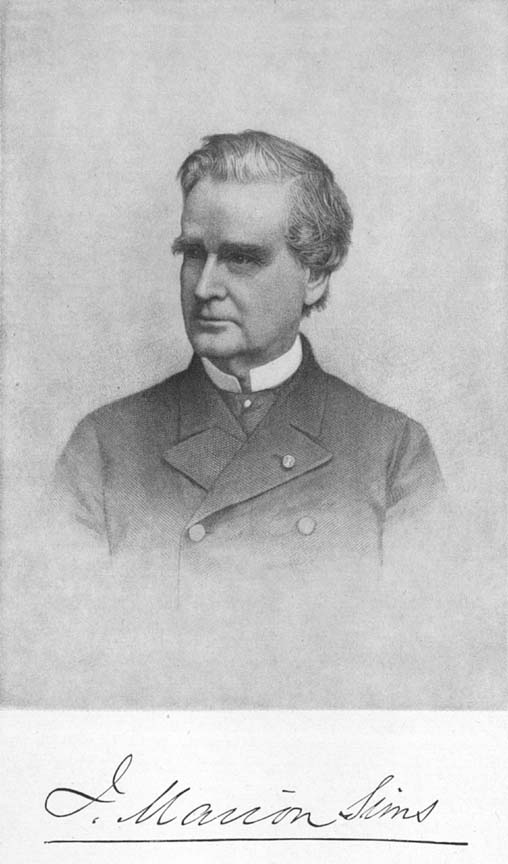
Marion Sims's surgical genius was never demonstrated to better advantage than when he was called in consultation to see an American woman in Paris in April, 1878. Since this case is so important in the history of gallbladder surgery it will be discussed in detail. The patient gave a history of having had recurring attacks of nausea, vomiting, and abdominal pain for several years. When Sims first saw her she had been profoundly jaundiced for several months and was suffering from intense itching all over her body. She also gave a history of having had intestinal hemorrhages at intervals for several weeks. On examination a large tender mass in the right upper quadrant of the abdomen was noted. A diagnosis of gallstones with obstruction of the common duct and dropsy of the gallbladder was made.
Sims aspirated the fluctuating mass and removed thirty-two ounces of dark bile from the gallbladder, but without any relief of symptoms. The patient was very weak and continued to have intestinal hemorrhages. It was evident that she was so thoroughly poisoned with bile that death was inevitable in a few days. Sims, the mature surgeon, reasoned in this case as he did when he was a young, inexperienced backwoods country doctor in the wilds of Alabama forty-three years before. He had felt a fluctuating mass in the abdomen of a farmer, and said, "There is matter in this belly and unless it is opened up and drained the patient will die." He operated and cured that patient of what he thought was an "abscess of the liver." Sims believed that the American woman in Paris was certain to die unless the fluctuating mass in her abdomen was opened and drained. With the operation the chances were a thousand to one that she would die; but, even with such odds against her, Sims believed that she should have that one chance to live. Therefore, as the last resort, Sims---never lacking in courage with a knife in his hand---operated, using Lister's method of preventing infection of the wound. He had to devise a new operation after he had opened up the gallbladder, which he emptied of its contents, including sixty gallstones and a large quantity of thick bile. He stitched the edges of the gallbladder to the upper part of the abdominal wound, inserted a glass drainage tube, and closed the abdominal wound with silver sutures, leaving an opening only large enough for the tube.
The woman recovered from the operation, but continued to have intestinal hemorrhages, and died on the eighth day. The autopsy proved that she had no peritonitis and that there was no infection of the wound. This was one of the cases in which the operation was a complete success, yet the patient died. But it is not possible to estimate the thousands and tens of thousands of persons whose sufferings have been mitigated and whose lives were saved because a courageous surgeon had dared to operate upon an almost hopeless case of gallbladder disease, and because he visualized the value of surgery for the relief of gallstones and other diseases of the gallbladder.
In his report of this case, Sims described the procedure, which he called cholecystotomy, that today is the operation of necessity for the relief of gallstones and chronic gallbladder disease in old people, and in cases in which the hazards from removal of a gallbladder are great. Cholecystectomy (removal of the gallbladder), however, is now the operation of choice in uncomplicated cases of gallbladder disease.
Sims summarized his conclusions regarding the surgical approach to gallbladder operations with a fervent appeal for exploratory laparotomy in suspected gallstones and certain other gallbladder and liver diseases. He said: "The great lesson this case teaches is this: In dropsy of the gallbladder, in hydatid cysts of the liver, in suspected abscess of the liver, and in gallstones we should not wait 'til the patient's strength is exhausted, or 'til the blood becomes poisoned with bile, producing hemorrhages; we should make an early abdominal incision, ascertain the true nature of the disease, and then carry out the surgical treatment that the necessities of the case demand. If this should be done under antiseptic precautions, I am sure that much suffering will be relieved, and many lives saved that otherwise would be lost. Without Listerism the operation would be hazardous."
Marion Sims attended the International Medical Congress in London in 1881. It was a gathering of the Aesculapian Olympians of the ninth decade in the Nineteenth Century. The greatest of the great in the entire history of medicine were there. The paper which provoked the most discussion among the surgically great in the Congress was by Lawson Tait, entitled "Recent Advances in Surgery." The young Birmingham (England) surgeon, then only thirty-six years old, startled the assembled surgeons by reporting five successful operations for gallstones and chronic gallbladder disease.
Mr. Tait in his opening remarks said: "Perhaps the first effort in this direction [advances in abdominal surgery] of a striking kind was made by Dr. Marion Sims in his operation of cholecystotomy, performed in Paris in 1878, which, however, had an unfortunate ending. His attempt emboldened me to perform the same operation in 1879, with a perfectly successful result, the patient remaining up to the present time [1881] in excellent health." Tait added: "The principle of the operation as advised by Dr. Sims was the opening of the cavity of the gallbladder, the removal of its contents (including stones), stitching the cyst [gallbladder] to the edges of the parietal wound by continuous sutures, and the subsequent drainage of its cavity." Tait then reported four other cases of gallbladder disease in which he had employed the Sims operation successfully.
Sims, in discussing the papers on abdominal surgery, said: "The papers read mark an era in the progress of surgery and lay the foundation for still greater results. Mr. Lawson Tait's paper is hardly open to criticism, or discussion. We simply have to accept the teaching of his experience as he has presented them." A few months later Marion Sims said: "Lawson Tait has gone ahead of us all in opening up new fields in the great domain of abdominal surgery. By his daring and skill he has made easy for us many things that were before attended with difficulty and danger."
It may be added that Lawson Tait disregarded Sims's advice to employ Listerism in abdominal surgery; but due to his fetish for surgical cleanliness, which approached our present aseptic technique, he reported a lower mortality in his surgery than most of the disciples of Lister. In 1884, of twenty-seven collected cases of cholecystotomies, Lawson Tait had operated upon fourteen with only one death; while there were seven deaths among the remaining thirteen operated upon by eleven different surgeons.
Gallstones and the symptoms produced by them had been known for more than four centuries before Sims decided to operate on a case in Paris in 1878. It will be recalled that few abdominal operations of any kind, except ovariotomies, had been performed before Sims's operation. After the discovery of anesthesia and antiseptic surgery it was inevitable that some of the pioneer surgeons of that period would operate for the relief of gallstones and that soon thereafter many surgeons would be performing the operation as a routine for the relief of such a painful condition.
Sims learned when he returned to New York that Dr. John S. Bobbs, a brilliant and fearless surgeon of Indianapolis, had explored, in 1867, an abdomen for a fluctuating mass which proved to be the gallbladder full of bile and gallstones. According to Sims's son-in-law, Dr. John A. Wyeth, after he heard of Bobbs's case he always gave him credit for having performed the first gallbladder operation. The report of Bobbs's case was published in 1868 in the Transactions of the Indiana Medical Association which were distributed only to Indiana doctors.
Bobbs's case was not a premeditated gallbladder operation. The patient, a woman aged thirty years, had a gradually growing tender mass in the lower right side of the abdomen. Bobbs did not agree with a previous diagnosis of ovarian tumor and advised an exploratory operation. He made an incision extending from the umbilicus to the pubes. It revealed adhesions of the omentum about an inch above the umbilicus. Bobbs extended the incision upward about an inch. He then tore through the adhesions and found a sac about five inches long. It proved to be the gallbladder from which, when opened, "a perfectly limpid fluid escaped, propelling with considerable force several solid bodies about the size of ordinary bullets." These proved to be gallstones. On the emptying of the gallbladder several more stones and fine sand were removed. The incision in the gallbladder was sutured and the abdominal wound was closed. The patient made a rapid recovery. Bobbs was a great and courageous pioneer surgeon who also operated successfully on a case of extrauterine pregnancy.
Unfortunately for many sufferers from gallstones, Bobbs's report was not published in a medical journal with wide circulation. There were few, if any, doctors in the United States outside of Indiana, and none in Great Britain or Europe, to whom the report of Bobbs's case was available. Certainly no one in England in 1879 could find any reference to Bobbs's case when Lawson Tait reported his first gallbladder operation at a meeting of the Royal Medical and Chirurgical Society. McKay, in his biography of Tait, said: "On this occasion one is struck by the fact that at least two of the speakers [who discussed Tait's paper] must have looked up the history of the operative treatment of gallbladder disease. Luckily for Tait none of the speakers appeared to know about Bobbs's case, or they could, and would, have used it with much effect to take the wind out of the sails of this presumptious provincial surgeon [Tait]."
McKay, after a thorough study of the literature on gallbladder surgery, including the report of Bobbs's case, concluded: "We think that a perusal of the facts brought out by the history of the development of the operation of cholecystotomy shows that the real founders of gallbladder surgery were Marion Sims and Lawson Tait."
It is interesting to note that in the United States it was sixteen years after Bobbs's gallbladder operation and four years after Sims's cholecystotomy before another American surgeon performed any operation on a gallbladder. On April 20, 1883, the elder Gross performed a cholecystotomy and the patient died. Keen followed with a fatal result after he performed the Sims operation June 19, 1883.
Ochsner of Chicago, in a state adjoining Indiana, evidently was unaware of the gallbladder operations performed by Bobbs and Sims, when he wrote in 1908: "Lawson Tait in 1879 performed the first successful operation of cholecystotomy, and to Tait, more than any other surgeon of this period, is due the credit of placing the surgery of the liver and gallbladder on a firm basis."
Tait also followed Sims in using drainage to prevent the accumulation of fluids in Douglas' pouch in operations on the uterus and adnexa, though when Sims first proposed the procedure Tait did not favor it.
McKay expressed his own, and Lawson Tait's, estimate of Sims's contributions to surgical gynecology as follows: "When the history of modern gynecology is written the work that McDowell did will be represented as the dawn; and the first bright planet that appeared in the dim light of that dawn was Marion Sims, whose light came to shine more brightly than that of any other star of the first magnitude in later days."
Tait, who was constantly in controversies with his great English and Scotch confreres, disagreed with his American competitor only one time---at least there is documentary evidence extant of just one criticism of Sims by Lawson Tait. Flack quoted Tait as saying: "I regard as most unfortunate the invention of the term vaginismus [a word coined by Sims], which is a cloak for ignorance and imperfect examination. I have seen many cases of so-called vaginismus, but I have always discovered some reason for the symptom. I do not believe in the spasmodic contraction of a muscle, which has its existence as a dissecting room curiosity."
There is no record of any reply by Sims to this criticism, but history favors Sims as being right in coining the word vaginismus. Every anatomist now agrees that vaginal sphincter muscles are normal in women; and all gynecologists know that women not infrequently suffer from spasm of those muscles, though they will agree with Tait---and Marion Sims---that thorough examination and careful history taking usually will reveal a physical or psychic basis for vaginismus, which is sometimes a most distressing condition.
Tait dedicated the fourth edition of his book on gynecology to Marion Sims. In his dedication he expressed his friendship for Sims and said that it was "an acknowledgement that much of the new work described is the outcome of your ingenuity."
Marion Sims and Lawson Tait probably never saw each other again after the adjournment of the International Congress on Surgery in the summer of 1881. Sims was sixty-eight years old at the time. Though he had not recovered his physical strength after his illness, he was mentally alert as shown by his discussions of a number of important papers read in the Congress. He returned to New York to prepare what proved to be his last, and possibly his greatest, contribution to the literature on surgery.
The International Medical Congress in London in 1881 was perhaps the most satisfactory medical meeting in the life of Marion Sims. There he became conscious of the fact that at the age of sixty-five, he had devised a new procedure in surgery which was more far-reaching, in its application for the relief of a larger class of sufferers, than his vesicovaginal-fistula operation.
The social side of the Congress also was enjoyed to the fullest extent by Marion Sims. The Honorary Secretary General of the Congress, Sir William MacCormac, had been his associate in the Anglo-American Ambulance Corps when they were risking their lives to serve the French at Sedan in the Franco-Prussian War. Sims knew more or less intimately all the greatest of the great who participated in the Congress.
Lord Lister's admiration of, and his friendship for, Sims is well known. Lister expressed his gratitude to Sims for being one of the first to accept and apply his antiseptic methods in surgery. He wrote his brother of his pleasure that his friends, Sims and MacCormac, would have the opportunity to apply his methods of preventing infections in war wounds; and he sent them a supply of antisepticized gauze bandages and other surgical dressings for use in the Franco-Prussian War. It is probable that Sims saw Lister for the last time at the Congress.
Sims saw much of his devoted friends, Sir Thomas Keith and Sir Spencer Wells, while in London. Sims was well known to the German delegation, Virchow, Koch, von Volkmann, and Czerny. His book on uterine surgery had been published in Berlin in 1866, and it was so popular that a second German edition was published 1870, and a third in 1873.
Sims enjoyed his association with his American confreres at the Congress. Samuel D. Gross and Sims had become intimate friends, though at one time the great surgical teacher had been on the side of Bozeman. Another of Sims's friends was Robert Battey, of Rome, Georgia. No doubt Battey's invitation to the Congress was initiated by Sims.
On the long voyage returning from Liverpool to New York, in the late summer of 1881, Sims had time to meditate over the past and present; but of the future, like Robert Burns, he could "only guess and fear." Nevertheless, though he believed his days on earth were numbered, and would end in the not-far-distant future, he could plan to accomplish in the precious time left him at least one more contribution to the advancement of surgery.
At the battle of Sedan in 1870 Sims had been horrified at the 100 per cent mortality from gunshot wounds in the abdomen. With Dr. MacCormac, Dr. Thomas Pratt, his son-in-law, and his son Harry Marion Sims, he performed autopsies on seven cases. Invariably they found the peritoneal cavity filled with bloody fluid. Since the French hospitals were, as Sims said, "completely septicized," all wounds were infected. He became convinced that the cause of death of the French and German soldiers who suffered abdominal wounds at Sedan was septicemia. Then and there, Marion Sims, the clear-thinking, surgical logician, formulated methods of procedure in treating gunshot wounds of the abdomen that he believed would prevent infection of the peritoneum in a large proportion of cases. The procedures in the treatment of gunshot wounds of the abdomen which Sims longed to try at Sedan, but could not because of conditions in the hospital, were simple. In his own words they were described as follows: "Open the abdomen promptly, arrest hemorrhages, clean out the peritoneal cavity, search for perforations, pare the edges, bring them together with sutures, and treat the case as we now do other cases involving the peritoneum."
Sims had advocated these principles ever since his experience at Sedan. Being a gynecologist he had applied them successfully in many cases of abdominal diseases in women; but since he was not a general surgeon, and had no hospital connections except on the staff of the Woman's Hospital, he had not had the opportunity to operate on cases of gunshot wounds of the abdomen. However his methods had been practiced as a routine in such cases by his friends, Samuel D. Gross of Philadelphia, Hunter McGuire of Richmond, Wright of Cincinnati, and other American surgeons. But even in 1881 there were few surgeons who were bold enough to explore the abdomen in such penetrating wounds.
Sims had announced his method of treating gunshot wounds of the abdomen when requested by cable to express an opinion regarding the treatment of President Garfield; and he had been severely criticized by American surgeons for advocating such radical surgery. Sims did not care about the criticism; but what did concern him most was that victims of gunshot wounds of the abdomen were being allowed to die when he believed their lives could be saved by immediate operations, carrying out the surgical principles which he advocated.
The crusading spirit was strong in Sims, even as he neared the end of his life. He realized that he could not hope to perfect any more new operations, nor devise any more new surgical instruments, nor coin more new medical terms; but he had the insatiable urge to crusade for prompt and rational surgery to save the lives of sufferers from intra-abdominal injuries and what he then believed to be surgical diseases of the abdomen. He selected the New York Academy of Medicine as the forum from which to deliver his valedictory address. He remembered his mistake in criticizing Bozeman in what should have been a strictly scientific address before the Academy of Medicine in 1857; and he had not forgotten that in 1870 he had had to defend himself at a meeting of the Academy, when charged by prejudiced confreres with unethical conduct for advertising. These memories made him cautious in his earnest desire not to say anything that could be misunderstood even by his enemies. He knew that he could not offend his friends.
Sims's thesis in his valedictory address---and such it proved to be ---was "Progress in Peritoneal Surgery." His devoted friend, Dr. Fordyce Barker, President of the Academy, presided. Dr. Sims prefaced his remarks by saying that he was prompted to discuss this subject because of what he had seen and heard in the surgical and obstetrical sections at the International Medical Congress. His object was to lay before the Academy a synopsis of the progress of peritoneal surgery as reflected at the Congress, and to answer the question, "Does it lead to a better treatment of gunshot and other wounds of the abdominal cavity?" In this address the physically afflicted sixty-eight-year-old pioneer surgeon was ardent in his plea for surgeons to adopt new methods---aseptic technique in particular---in dealing with wounds that invaded the peritoneal cavity. He pleaded for the adoption of Lister's principle for preventing infection in all wounds, particularly of the abdomen, because, as he said, operations on the abdomen were too hazardous to attempt without Listerism.
"Ovariotomy is the parent of peritoneal surgery," said Sims, and he gave credit to Ephraim McDowell and Washington Atlee, whom he called "the great ovariotomist." He also credited his former critic, Peaslee, and Sir Spencer Wells for their contributions to ovariotomy. In reviewing the literature on abdominal surgery he gave credit to Sir Spencer Wells for advocating the control of hemorrhages by ligature or by forceps; to Sir Thomas Keith for thorough cleansing of the peritoneal cavity before the abdomen is closed; to Chassaignac, the French surgeon, for the use of glass tubes in drainage after abdominal operations; to Samuel D. Gross, "the highest authority [in surgery] in our country" for advocating the closing of perforations of the stomach and intestines by continuous sutures, and for advocating the excision of the wounded part entirely and the uniting of the edges by sutures; and to Lawson Tait and other bold pioneers "for the incredible advances in surgery of the abdomen."
In his zeal to impress his hearers---and the readers of his address in American, English, and French medical journals---with their opportunities to save lives by early operations in gunshot wounds of the abdomen, Sims forgot to mention his own contributions to the field of abdominal surgery. The motif of his valedictory was a fervid plea for the immediate exploration of the abdomen in suspected perforation of the bowels, hemorrhages from extrauterine pregnancy, and other intra-abdominal accidents. He also advocated abdominal operations for "the extirpation of the uterus for bleeding fibroids," "extirpation of the cancerous uterus," and "extirpation of the spleen," when indicated. Sims concluded his final contribution to the literature on surgery with a prediction that came true: "Rest assured that the day will come, and it is not far off, when an accurate diagnosis in such cases [intra-abdominal injuries and diseases] followed by prompt action will save lives that otherwise quickly ebb away."
The discussion on Dr. Sims's address was friendly, but none was enthusiastic in endorsing what was considered radical surgery of the abdomen. The distinguished guests at the meeting were called upon first. Doctor Massey of Cincinnati said: "What can he say who cometh after the king?" Then he gave an account of "an abdominal wound inflicted on a woman by a bull which gored her so that her bowels fell on the ground. She gathered them up in her apron, went into the house and sent for the doctor. She recovered entirely."
Doctor Clinton Cushing of San Francisco advocated the removal of the uterus through the vagina when it was freely movable. He reported four cases in which vaginal hysterectomy had been performed successfully. Doctor James R. Wood, a leading New York surgeon, said: "I dislike to speak after the king. I dislike to take issue with him. He [Sims] has spoken as a surgeon who has had to do with the female organs of regeneration which he has treated so wonderfully well. But I am loath to endorse all that my dear friend Dr. Sims has said. I think that the surgeon should be careful how he invades the peritoneal cavity, unless he has made an accurate diagnosis, and to do this especially in gunshot wounds of the abdomen is almost impossible. With reference to reaching into the cavity of the peritoneum in search of bullets or injured parts, it is a very serious matter. While I would be extremely cautious about opening the peritoneal cavity, if I found the cavity penetrated, I should keep the entrance patent. Some of the surgeons here are not altogether behind the times, although the gynecologists are getting all the glory. I do not believe, however, that you, sir [Dr. Sims], get half as much as you deserve."
Doctor Leonard Weber said: "The only cases in which abdominal section could come into consideration were those in which abscess developed in consequence of perforation, especially perforation of the vermiform appendix." Doctor Weber called attention to a paper read before the Academy by Dr. Burchard, in which he proposed "an exploratory laparotomy in such cases, tie the appendix, cut off the diseased portion and introduce a drainage tube." This was five years before Reginald Fitz demonstrated the pathology of appendicitis.
Doctor Sims, in closing the discussion, thanked Dr. McBride for having yielded the evening to him and thanked his friends for their generous attention in listening to such a lengthy paper, particularly, "my friend Dr. Wood, who had so candidly presented his criticism from the standpoint of a justly eminent surgeon."
Doctor W. Gill Wylie, who was present, said later that Sims, in his valedictory address, "held a crowded house spellbound for three-quarters of an hour, by his eloquence and his masterly treatment of the subject."
That night, after the meeting, Sims and Wood, who were great friends, were walking arm in arm on their way home, when Dr. Wood said to Dr. Sims: "Sims, that was a great paper you read tonight. You gynecologists deserve a great deal of credit for the work you are doing, but you are going too far." Doctor Sims replied: "Jimmie, you and I are getting old, and we may not live to see it, but what I have said tonight will be accepted and will be the practice in time."
Sims, in crusading for early exploratory laparotomy, when the diagnosis is doubtful, in injuries to and diseases involving the peritoneal cavity, did not confine his efforts to his own country; he added further facts to the paper read before the New York Academy of Medicine and, under the title of "Gunshot Wounds of the Abdomen," it was published serially in four issues of the British Medical Journal. It also was translated into French and published in a French medical journal.
Doctor John A. Wyeth said: "Outside of his contributions to the subject of gynecology, probably the most important forecast of surgery of the future, and one designed to rank higher in professional literature, was the paper on the treatment of gunshot wounds of the abdomen in relation to modern peritoneal surgery, which was published only a short while before his death. It may safely be said that this paper was the starting point of a new field of surgery . . . . But the operation was not accepted until Dr. W. T. Bull of New York reported a successful case of intestinal suture for gunshot wounds, in which he demonstrated the value of exploration of the abdominal cavity under such circumstances beyond all controversy in 1885. From that date the operation has been frequently and successfully performed."
Doctor Paul F. Mundé's appraisal of Sims's contribution to the advances made in the management of gunshot wounds of the abdomen coincides with Dr. Wyeth's opinion. He said: "I well remember how vehemently his [Sims's] views were opposed by the leading surgeons in New York, who insisted that it was presumptuous of him---a surgeon in an entirely different line of practice to offer such radical suggestions to them. Twelve years later the correctness of his prophetic assertion is so well recognized that any surgeon who would fail to carry out Sims's advice to at once open up the abdominal cavity in case of injury by gunshot, or other perforating wound, and suture the wounded organs, would be considered criminally negligent."
It was no inconsiderable effort to prepare an address of the scope and magnitude of Sims's valedictory when it was imperative that he should conserve his strength and energy, as was necessary for a man with a badly crippled heart. That task over, Sims was confronted with pressing financial problems. He wrote from Paris to his friend Gross about that time, "No man [doctor] in our country, solitary and alone, ever made as much money as I have by my profession, except perhaps Dr. H., and yet I am comparatively poor and must work for my daily bread. I am not extravagant and never gambled. I have lived well and have educated a large family of children. I have only found out lately that my agent, who managed my business for the last four years, stole from me not less than $100,000. If I were to settle down here anywhere [in Europe] in a great ample centre, I am sure that I could make with ease $50,000 a year; so you see that my self-expatriation for health is justifiable." Sims realized that his economic independence was threatened, and though his physical reserve was limited, he was forced to consider ways and means of supporting his family in his declining years, and after his death, which he had reason to fear might occur at any time.
The aging Marion Sims had other unfinished tasks to accomplish before his working days ended: one of them he desired very much to complete was his autobiography, which he had promised his friends and family to write; and there were other personal problems on his mind which had to be left unsolved.
Though Marion Sims had been reinstated nominally as Consulting Surgeon of the Woman's Hospital the ban on cancer patients ---the real cause of his resignation---remained. Therefore, complete vindication could not come to him until he and other members of the surgical staff were permitted to treat cancer cases in the Woman's Hospital. Other New York hospitals were refusing to admit cancer cases, so that women afflicted with malignant tumors had to be treated in their homes. This attitude of hospital authorities did not affect Sims who, after his resignation from the Woman's Hospital, rented a house near his own home and opened a private hospital, where he could operate on cancer patients; but it did affect other surgeons, including Gaillard Thomas, who complained bitterly that he was denied the privilege of treating cancer patients in hospitals, but had to resort to operating upon them in their homes, without the benefit of trained operating room assistants.
Sims wanted desperately to devise methods of curing and alleviating the suffering of cancer victims, who at that time were doomed to die after months, or a few years at most, of agonizing pain. He believed in 1883 that early operation, "extirpation of the cancerous uterus" (hysterectomy), was the only method of curing uterine malignancy. He was distressed that the Woman's Hospital was depriving this class of sufferers of their only hope to live. It, therefore, was pleasing to the aging surgeon that one of his friends, through Mr. John E. Parsons, proposed to donate $150,000 to erect a pavilion for the exclusive care of cancer patients on the grounds of the Woman's Hospital. Mister Parsons submitted the offer from an anonymous donor to the Board of Governors on April 8, 1883, with the understanding that the proposal should be regarded as confidential. It was disconcerting to the donor, Mr. Parsons, Dr. Sims, and his friends, particularly one of the most active women on the Board of Lady Managers, who herself had incipient cancer of the uterus at the time and who was denied the privilege of being treated in the Woman's Hospital, that five days later the Board of Governors declined the offer, for the alleged reason that "it does not seem possible to assume the responsibility of accepting the proposal according to its terms."
On May 1, 1883, Mr. Parsons again submitted the offer of the anonymous donor to build a cancer pavilion on the grounds of the Woman's Hospital, with the request that a special committee be appointed from the Board of Governors and Lady Managers to study the proposal and report at a later meeting. Mister Parsons was made chairman, and Mrs. Cullom and Mrs. John Jacob Astor, known to be friends of Dr. Sims, were placed on the special committee. Friends of the proposal made every effort to persuade members of the Board to accept the offer before summer, but without success.
The proposal was pending in September when Mr. Parsons wrote to Dr. Sims, who was at Pittsfield, Massachusetts, engaged in writing his autobiography, requesting a statement from him regarding the proposed cancer pavilion. Mr. Parsons thought at the time that there was little chance of the Board's accepting the offer. Sims's reply, dated September 23, 1883, was eloquent and prophetic in the appeal to build "a cancer hospital, on its own foundation, wholly independent of all other hospitals." Sims had the broad viewpoint of a cancer hospital for all classes of patients. He said: "There should be a department for men and another for women. Its medical board ought to be men who go into it with zeal, determined not only to give temporary relief to human suffering, but to do something towards discovering better methods of treatment . . . . I would do everything to obtain practical knowledge on this subject, regardless of the source from which it emanated . . . . It is time we turn a listening ear to the cries of humanity. Build the cancer hospital, provide it with the necessary comforts and the highest skill in treatment. Rest assured that patients will come from all quarters, too glad to avail themselves of such kindness and care as your wisdom and generosity will provide for them. And if there are any who favor a special hospital for cancer (and I hope there are some) let me beg you to take steps at once to inaugurate a movement which must culminate in a great work so much needed here and now. The subject of cancer is too large and its interests too great to be lodged in a pavilion subsidiary to any other hospital, whether general or special."
The proposal of the anonymous donor to build a cancer pavilion on the grounds of the Woman's Hospital was pending, but temporarily quiescent, when Dr. Sims returned to New York in October; but it was comforting for him to know that the prospects were bright for the establishment, in the near future, of a cancer hospital, with a pavilion for women as its first unit. He realized, however, that the time had passed when he could hope to take any active part in the founding of a new hospital. He believed that from now on his stays in the United States were to become increasingly brief and far between; more and more he thought that Europe was to be the scene of his future activities.
In his plans for becoming once again a virtual exile from his native land Sims was actuated primarily by the desire to guard his failing health. Not only did he feel that New York's frigid winters were bad for him since his siege of pneumonia, but he knew that in Europe he could carry a much lighter schedule of work than at home and yet receive a far higher income. So it was that the last two years of his life he had spent only his summers in the United States, dividing his springs and falls between Paris and London, and escaping cold weather by wintering along the Riviera or in Rome, where the leisure he perennially hoped to have for writing was practically always obliterated by the urgent demands of women of wealth and title for his professional services.
It was hard for his patients and his friends to realize that he was not the same exuberant Sims they always had known, for at seventy he still was ruddy of complexion, brown of hair, quick and firm of step, erect and graceful of carriage, and almost boyish of action and expression. He himself, however, was very sure that he was not the same. Not only had he had a second, though milder, attack of pneumonia which had forced him to be hospitalized in London, but he was troubled frequently by severe pains around his heart; and although the specialists who examined him assured him that they could find no evidence of organic cardiac disease he put little faith in their verdicts, for his own judgment told him that there must be something radically wrong with his heart.
In one of the occasional moods of depression born of this conviction he wrote a friend that "I have given up the idea of longevity"; yet at the same time his naturally sanguine temperament made it impossible for him really to believe unreservedly that his remaining days upon earth were few. Thus when he returned to America in the summer of 1883 one of his two primary concerns was a long-term project which certainly indicated that he had every hope of living for many more years. What he planned to do, in fact, was to build a new house and to make it his permanent home.
The reason for this decision was his vague dissatisfaction with the nomadic way of life which, though pleasant and remunerative, exiled him so much of the time not only from his own country but also from the pattern of domesticity which he and his wife both loved. The way to overcome this difficulty, he decided, was to create for himself in America a new home where he could be near his friends and his major interests and yet could be spared the glacial severity of New York's diving thermometer. To meet these specifications he chose Washington, a city for which he long had entertained an affection. He had many friends there, both personal and professional; he liked the various things about it which reminded him of his beloved Paris---its wide vistas, its impressive architecture, and its internationally flavored social life; he relished the prospect of living at the crossroads between the North and the South between which for so long his interests and allegiance had been divided; and---in marked contrast to the many critics who decry the District of Columbia's stifling summers and slushy winters---he considered it one of the most healthful cities in the world, with a climate precisely to his liking. Altogether it seemed to him the very spot to which he would like to retire when he ceased active practice, as he planned to do within two or three years. Accordingly he purchased what one of his Washington friends described as "a most elegant site on Sixteenth Street," with the intention of erecting thereon a home where he and his beloved Theresa could enjoy the rest of their lives.
With this provision for the future attended to, he felt free to devote himself to another pressing concern: the writing of his autobiography. It was true that, strictly speaking, this was not the first item on his literary agenda. For years he had been proclaiming his intention of preparing a completely revised edition of his Clinical Notes on Uterine Surgery, for, recognizing certain faults and inadequacies in the earlier editions, he had allowed that unusual book to go out of print. Half a dozen times he had embarked on this project, but for a man in poor health who never had developed systematic habits of writing it was a forbiddingly exacting task, and certainly in this summer of '83 he did not feel up to it. Nor could he pin himself down to the onerous chore of writing another definitive work he had promised---a 25,000-word article on ovarian tumors for the monumental International Encyclopedia of Surgery which was being projected by the indefatigable S. D. Gross and others.
The autobiography, however, was a different matter. For this he need not wade through mountains of professional literature, delve into case histories and statistics, strain his flagging energies to describe intricate techniques in meticulous detail. All he had to do was to indulge himself in the luxury of exploring his own well-stored memory and to bring forth what he found there. He even was spared the labor of writing down his findings, for he had the good fortune to come in contact with a young man who had achieved mastery not only of shorthand writing but also of the ingenious machine---so recently put on the market---called the typewriter. To this young man, during a vacation at one of his wealthy Washington friends' summer home in Massachusetts, Sims dictated reminiscences of the first fifty years of his life.
He, had practically no notes nor written records to guide him, but---in the early part of his narrative, at least---this served as no deterrent to his fluency, for this was a project he long had contemplated, and the outlines of what he wanted to say were fairly clear in his mind. For years his admirers had been entreating him not to neglect to leave to posterity some record of the steps by which he had achieved his unique position. Although he had usually laughed off their suggestions he had been sufficiently influenced by them to prepare himself, perhaps unconsciously, for the task which they urged. Moreover, he had had under his care, only a few months before, a bedridden and suffering young woman whom he had made a point of visiting every day in order to draw her mind away from her own misfortunes by talking with her on topics of general interest. On one of these visits she had asked him a question about himself which he had answered by telling her an entertaining story of his childhood. From that day on the nature of his psychological therapy was fixed: nothing made the invalid girl so happy as to hear more of his reminiscences, and she begged for new installments on each of his visits. Day after day she catechized and cross-questioned him about his past; and he, being an amiable man intent on pleasing an unfortunate soul to whom many of life's pleasures were denied, obliged by her struggling to recall many details of his personal history which he had forgotten for years.
Thus it was that when he embarked upon the dictation of his memoirs in September of 1883 he was well prepared for his job, and at first everything went swimmingly. He reminisced concerning his ancestors and his youth with humor, charm, and admirably detached perspective. It is true that, trusting as he did almost exclusively to his memory, he made a fair number of errors in names and dates and kindred details. Possibly if he had lived to complete and revise the manuscript he would have corrected these, but just as possibly he would have overlooked them, for Marion Sims was never a man to be fettered in his creative flights by too meticulous concern for exact details. Yet even with its defects of careless and hurried composition his account of the early part of his life, up to and including his discoveries in the field of vesicovaginal fistula, developed into a lively, informative, and exceptionally entertaining document, far outranking in human interest the average autobiography of its period. With the pressure of engagements preceding his imminent return to Europe, however, he was unable to carry the dictation of his life story beyond a few disjointed recollections of his first two years abroad during the Civil War; the later years he hoped to cover after he was settled in Rome for the winter.
When the book was released for publication by Harry Marion Sims the year after his father's death it still was unfinished and virtually unedited, still full of errors, and yet with all its faults it presented a fascinating reflection of a gifted, intensely human personality. It was a curious thing, incidentally, that Harry Sims should have been the one to insist on publishing the rough draft of his father's memoirs in the face of his mother's and sisters' disapproval, for to the discerning reader there can be little doubt that the very last pages which Marion Sims dictated were aimed specifically, if somewhat obliquely, at Harry himself. These pages present at considerable length a sympathetic but apparently irrelevant account of the heartsick, joyless later years of Armand Trousseau, the eminent French physician. At first glance this lengthy digression appears to be merely a misplaced bit of garrulous reminiscence attributable to its author's advancing years, but a little reflection brings the realization that probably Sims included it for a very definite reason. Trousseau, it seems, though blessed with great wealth, universal admiration, and innumerable honors for his leadership in his profession, was a wretchedly unhappy man in his old age because "He had an only son who was a scapegrace. He was a gambler and everything else that was bad. His father was worried to death with his dissoluteness and foolish extravagance . . . . We are happy or unhappy in this life as our children choose to make us." Marion Sims, unlike Trousseau, was on the whole one of the happiest of men because, as he himself put it, "I am happy at home . If there is any real happiness in this world it must be in the family circle, and not alone in public applause." Sims adored his family circle, and obviously he was so much worried over the fact that an important link in that circle showed signs of weakness that he allowed his loving concern, thinly disguised, to creep into that very portion of his autobiography which, as fate would have it, was destined to be his swan song.
The occasional naive egotism of The Story of My Life may have presented a false picture of Sims's personality, as those who knew him well insisted that it did, yet there can be no denying that Marion Sims did place a high estimate on the value of his own work. Indeed, in view of the adulation with which he constantly was surrounded, it would have been most surprising if this had not been so. His contemporaries quite honestly considered him so extraordinary a personage that there was no conscious exaggeration in the remark one of them made, soon after his death, that "There is a sadness in viewing the elevation of any man to a plane so high above his fellows that he has no equals of whom to take council or for daily friendly intercourse."
This was not literally so, of course, however apt the sentiment may have seemed to its author. Sims had daily friendly intercourse with innumerable people, and even though some of his friends occasionally spoke of him---half in earnest, half in fun---as "the king," all the evidence indicates that he gave not the slightest sign of feeling that he was exalted above his fellows. Certainly he was accustomed to having people look up to him, and, surrounded as he was by constant manifestations of hero worship, he would have been superhuman if sometimes he had not allowed his own appraisals of himself to conform to the prevailing tone. Nowhere was he more a hero than at home; the old axiom that no man is a hero to his valet or to his family did not apply in his case. His children idolized him; and his sisters, with whom he maintained a devoted correspondence throughout his busy life, were almost worshipful in their attitude toward their famous eldest brother. It is true that he accepted all this adulation quite casually as his just due, but it is equally true that he always was eager to extend similar veneration to various other men who seemed to him worthy of honor. Indeed, one of the things which was occupying his time in the autumn of 1883, on the eve of his intended departure for a long European stay, was the planning for another of his mammoth supper parties---this one being a little affair for 200-odd guests in honor of Sir William MacCormac, who had been his chief assistant in the work of the Anglo-American Ambulance Corps in the Franco-Prussian War and who since then had become one of Great Britain's most famous surgeons. As one newspaper reported of this gathering: "Doctor J. Marion Sims fairly revels in entertaining his friends. No one ever did it more beautifully, for no one ever combined to a greater degree the kindly and thoughtful consideration for his friends with the skill and power of bringing them together in perfect harmony."
This hospitable gesture in MacCormac's honor had been intended to serve as Sims's temporary valedictory to New York, for he was scheduled to sail for England on November 8. At the last minute, however, he was prevailed upon to postpone his sailing for ten days in order to perform on November 12 an exceptionally delicate and difficult operation upon a woman of some prominence who felt that she would be safe in the hands of no one but Sims. The operation was a complete success, and he was as delighted with its results as if this had been the first time he had saved a woman's life and happiness, instead of the many thousandth. Its satisfactory outcome, combined with his gratification in knowing that the Woman's Hospital---now again his Woman's Hospital---was planning to unveil a bust of him the following month, led him to exclaim when he came home to dinner that night: "Well, this has been one of the happiest days of my life!"
This was a highly characteristic remark, for Sims had a strong and sentimental regard for red letter days. He always maintained that the two very happiest days of all had been the twenty-third of July, 1833, when Theresa Jones had given him a rosebud over the garden fence, and the twenty-first of December, 1836, when Theresa at last had become his wife. Now the carefully pressed rosebud was over half a century old, but the same devoted Theresa still reigned as the center of her husband's existence and still watched as tenderly over his health as she had done throughout all his early years of invalidism. Her wifely watchfulness never extended to the point of interfering with his professional duties, however, so when he felt it necessary to go out late that November evening to check on the condition of his day's operative patient she raised no objection, although when he returned home not long before midnight complaining of feeling a slight chill she did insist upon his taking a small drink of whiskey diluted with water. Sims's dislike for alcoholic drinks had not lessened with the years, despite his reputation as a giver of lavish parties, and when he finished consuming the mixture his wife had prescribed he made a wry face and declared emphatically: "You will never get me to take another dose of that abominable stuff as long as I live."
Forthwith he went to bed, but not to sleep, for his heart was beating too fast, he said, to let him rest. Therefore he sat up in bed making memoranda about his work, as often he did after he retired. Even after his Theresa turned out the light to guard him against overwork he continued with his writing, for long ago he had trained himself to make notes on a bedside pad as he lay in the dark. Three hours after midnight his watchful wife became conscious that his writing activities suddenly had ceased and that he had dropped back against the pillows. Within the instant she called their son Harry from the next room, but there was nothing that the younger Dr. Sims could do for his father. The last page of The Story of My Life had been written.