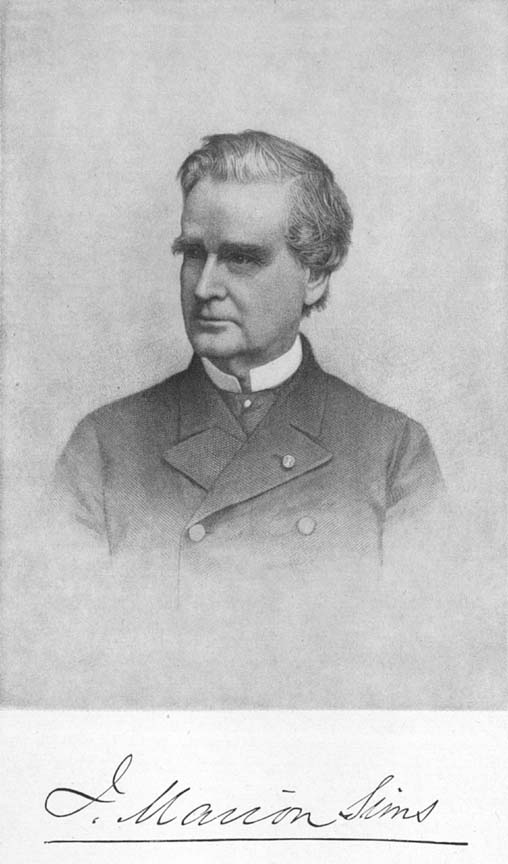
Autopsy. Marion Sims made medical history even after his life had ended. Physicians in New York, London, and Paris had assured their distinguished patient that they could find no evidence of any organic heart disease; but Sims, who had a premonition of impending death, was not satisfied with their diagnosis. Therefore, long before his death, he requested a post-mortem examination of his heart and lungs. He hoped that his devoted physicians might learn something from the autopsy findings in his case which they could apply in the management of future patients similarly afflicted.
The autopsy on Dr. Marion Sims was performed by Drs. Peabody and Welch. It was witnessed by Drs. Loomis, Wyeth, and Wylie, who attended Dr. Sims during the months of his attack of pneumonia and afterward until his death. The complete report of the autopsy on Dr. Sims has not been found; but Samuel D Gross, in his autobiography, gave a résumé of the post-mortem findings as follows: "The immediate cause of his [Sims's] death was obstruction of the circulation from atheromatous degeneration of the coronary arteries. The severe attack of pneumonia, which he experienced in the winter of 1880, left him with adherent pericardium and adherent pleura everywhere on the left side. Both ventricles were dilated and the left hypertrophied. There was also some fibrous myocarditis, with incipient aneurismal pouch in the left interventricular septum."
It will be noted that obstruction of the coronary arteries caused the sudden death of Dr. Sims. The first case of coronary occlusion reported in America was by Dr. A. Hamner, of St. Louis, in 1876. The diagnosis was confirmed by autopsy. Sims's case was the second reported death from coronary occlusion in the United States.
It is interesting to note that Dr. William H. Welch, professor of pathology in the Bellevue Hospital Medical College, 1879 to 1884, and later of Johns Hopkins, 1885-1941, was one of the pathologists who performed the autopsy on Dr. Sims. Doctor Welch had been trained in pathology in Berlin and Leipzig, 1876-1878, at the time when Conheim was working on coronary occlusion. Conheim concluded, from his necropsy studies and from experiments on dogs, that sudden occlusion of one of the large branches of the coronary artery would cause death in a few minutes.
In recent years, by the aid of the electrocardiograph, X ray, sedimentation rates, and other tests, coronary occlusion may be accurately diagnosed when there are few heart symptoms. This cardiac accident is now known to be the most frequent cause of sudden death in the United States.
The primary factor which caused the death of Marion Sims was pneumonia, with pleurisy and pericarditis as complications. With a badly crippled heart, due to adhesions of the pericardium (the sac surrounding the heart) as shown by autopsy, it is remarkable how much work Marion Sims accomplished during the last two years of his life. No doubt the distinguished physicians who treated Sims throughout his illness and after his partial recovery did learn lessons from the autopsy on their dead friend, which they applied later in treating other patients who had cardiac symptoms but no heart murmurs nor other evidence of organic heart disease.
The knowledge gained from many such autopsies is partly responsible for the recent progress in the prevention and treatment of heart diseases. The therapy of pneumonia has advanced a long way since Sims's death. With the miracle sulfa drugs and penicillin, the chances in a case like Sims's are ten to one that the pneumonia would have been cured in a few days without complications, or sequellae, such as pericarditis and changes in the coronary artery and its branches.
Funeral and Obituaries. The announcement of the sudden death of Dr. Marion Sims brought genuine grief to all classes of New Yorkers, and to thousands of his friends and admirers throughout the world. At a called meeting of the New York Academy of Medicine, resolutions of condolence were adopted. Doctor Fordyce Barker, President, proclaimed the first January session as a Sims memorial meeting, and appointed Dr. Thomas Addis Emmet to deliver an address on the life and achievements of Dr. Sims.
A special meeting of the Board of Governors of the Woman's Hospital was called and resolutions of bereavement over the death of Dr. Sims were adopted unanimously.
The funeral services, held in the Madison Square Presbyterian Church, were attended by the family, the Board of Governors of the Woman's Hospital in a body, the members of the New York Academy of Medicine, the members of the Madison Square Presbyterian Church, and invited friends. Sims's pastor, the eloquent Dr. Charles H. Parkhurst, officiated. He expressed what was in the hearts of his hearers, and a multitude of other friends who could not be seated in the Church, when he said: "An apostle in general terms is a man sent from God for man's deliverance---deliverance from pain and disease it may be. So Marion Sims was an apostle. Is it not worthwhile to be apostolic in the line of vocation where providence and circumstance have placed us? As we retire from this casket wherein sleeps the white-faced priest of science, and this silent apostle of beneficence, may we go back to our work charged with better impulses, larger loves and a holier daring, with earnest hands and fervid hearts give ourselves to the needs of suffering, and build ourselves into the lives Providence has placed in our reach."
In New Orleans, Father Henry Churchill Temple, S.J., of Loyola University, said of Dr. Sims: "Humility, and not philosophical, but Christian humility, based upon distinct knowledge of dependence on the Creator and Redeemer, was one of the most striking features of this magnanimous man who cared only for truly great deeds of virtue, which are worthy of great honor from God, and from the wise and good among men . . . . His charity was as striking as his humility. He died leaving only a competence instead of an immense fortune from the huge fees he received especially from European nobility." He quoted Dr. Sims as having said: "Money is trash and may be blown away by the wind. Honors are evanescent and may be snatched by another. Even reputation may be tarnished by the slanderous tongue of an envious villain. But the proud conscientiousness of rectitude, coupled with true benevolence, lives in the heart of its possessor, and is as immortal as the soul itself."
Judging from the space given his obituaries in daily papers, weekly, and monthly magazines and in medical journals, the death of Dr. Sims had greater news value than anything he did during life. Medical societies all over the world held memorial exercises, and a large proportion of the great doctors of the period delivered addresses, or made statements, appraising the achievements of Marion Sims.
Doctor Samuel D. Gross, of Philadelphia, the recognized greatest general surgeon of his time, wrote in his diary on November 16, three days after the death of Dr. Sims: "The announcement of the death of Dr. Sims, so sudden and unexpected, greatly shocked me. As soon as I recovered my surprise, I promptly wrote a letter of condolence to Mrs. Sims and sent a floral wreath for the coffin of my dead friend; but, alas, what is condolence under such affliction? The loving husband and the adored father is gone, and the mourners alone remain. 'The friendship of a great man is the gift of the gods.'
'His life was gentle, and the elements
So mix'd in him that Nature might stand up
And say to all the world, "This was a man!'"
Other distinguished contemporaries of Sims paid tribute to his great achievements. In his New York Academy of Medicine memorial address, Dr. Thomas Addis Emmet, his co-worker in the Woman's Hospital, said of Sims's book on uterine surgery: "Its publication was the turning point of modern gynecology, or more strictly speaking, American gynecology, of which he may be justly termed the father." Of the Sims speculum he added: "From the beginning of time to the present, I believe that the human race has not been benefited to the same extent and in a like period by the introduction of any other surgical instrument. Those who did not fully appreciate the value of the speculum itself have been benefited indirectly to an extent they little realize, for the instrument, in the hands of others, has probably advanced the knowledge of the diseases of women to an extent which could not have been done for a hundred years or more without it."
Another distinguished confrere in the Woman's Hospital, Dr. T. Gaillard Thomas, said: "If all that Sims has done for gynecology were suppressed we should find that we had retrograded at least a quarter of a century . . . . If I were called upon to name the three men who in the history of all times had done most for their fellow men, I would say George Washington, William Jenner, and Marion Sims."
The Journal of the American Medical Association closed its obituary of Sims by saying: "His memory the whole medical profession loves to honor, for by his genius and devotion to medical science and art he advanced it in its resources to relieve human suffering as much, if not more, than any man who has lived within this century."
The Boston Medical and Surgical Journal said in its obituary: "His kindness of heart, his uprightness of character, his geniality, his boundless generosity, and his personal magnetism, made him universally beloved and esteemed, and of scarcely any other American can it be said with equal truth that he created a new era in medicine."
The British Medical Journal expressed the European estimate of Dr. Marion Sims, as follows: "His achievements are written in imperishable letters in the annals of modern surgical practice, and there are thousands now living, and succeeding thousands in generations of women yet unborn, who will have reason to rise up and call him blessed. Originally a country practitioner in Alabama, he succeeded by sheer force of unaided genius, and by the characteristics of thoroughness, simplicity, and ingenuity of character and methods in introducing such improvements in the surgery of some of the most obscure and previously irremedial diseases of women, as to have brought about something like a revolution in the methods and results of practice . . . . The greatest success which any surgeon of genius can hope to achieve is to be able to definitely and largely add to the power of surgery to save life, to relieve misery, and to effect cure. This success Marion Sims attained in a degree which few can hope to attain. He was known in all the capitals of Europe and in all he has left an enduring monument and bequeathed a legacy for which suffering humanity will ever feel cause to feel grateful."
Monuments and Memorials. After the death of Dr. Sims a movement was begun by physicians to raise funds to erect a monument in his memory. Committees were appointed in various cities of the United States and in several European capitals to solicit subscriptions "mostly limited to one dollar" for this purpose. The chairman of the New York Committee was Dr. Fordyce Barker, Sims's devoted friend. Other members were Thomas Addis Emmet, Gaillard Thomas, and Paul Munde, disciples of Sims. Doctor William H. S. Wood was Treasurer. "Professional friends, loving patients, and admirers throughout the world" subscribed the funds for the monument. When completed it was erected in Bryant Park on Forty-second Street on the block containing the New York Public Library. The exercises when the monument was unveiled were held on October 20, 1894.
Doctor George F. Shrady, the distinguished editor of the New York Medical Record, delivered the first of the addresses. In speaking of Sims's achievements he said: "It is safe to say that Sims's name is associated with more original operations and more new instruments for making such operations successful than that of any other American surgeon . . . . His was the germinal thought implanted in a disposition for untiring work, which changed impossibilities into triumphs, restoring health and happiness to countless numbers of suffering womanhood."
Doctor Paul F. Mundé, the second speaker, said: "With Sims came the revolution which upset the conservative 'do little' methods, and opened wide the field of active, radical, scientific, and rational treatment by surgical means of diseases and malformations which formerly were merely palliated or left unrelieved. . . I must insist that the greatest triumphs in this specialty have been achieved since Sims taught us to use his speculum, the scissors, the knife, and the needle for the cure of diseases to which he paid particular attention. J. Marion Sims may therefore be called The Father of Modern Gynecology."
In New York, the city which profited most because of the achievements of Marion Sims, it required only two generations for his name to be almost forgotten. Forty years after this statue was erected, the city fathers of New York, to whom the name of Sims meant nothing, decided that the monument in Bryant Park was not sufficiently important, or ornamental, to remain as a city decoration. It therefore was carted away and placed in the city dump heap. Influential New York physicians, when they learned that the monument was in the scrap pile, rescued it; and the bronze statue of the most famous surgeon in the history of New York now stands in a niche in the Central Park wall on Fifth Avenue at 103rd Street, opposite the New York Academy of Medicine.
On the state capitol grounds at Columbia, South Carolina, stands another imposing monument erected to perpetuate the memory of Dr. Marion Sims. Appropriately the funds to erect this statue were raised by the women of the state of Sims's nativity, under the leadership of the Woman's Auxiliary of the South Carolina Medical Association.
While no landmark can be found to identify Marion Sims with present-day Lancaster, his spirit still lives in the new Marion Sims Hospital, the pride of its citizens. It is a handsome building, beautifully furnished and equipped with the best possible facilities needed to care for medical and surgical patients. In its portals is a portrait of Dr. Sims and a glass case containing many instruments which he devised and used. The Marion Sims Hospital is a fitting memorial to a native son, who founded a great hospital in New York, and who devoted his best efforts for forty-eight years to saving lives and alleviating human suffering.
In Alabama, the state of Sims's adoption, on the capitol grounds at Montgomery---which rightfully claims to be the birthplace of modern scientific gynecology---a bronze statue of Dr. Marion Sims was erected in 1939. The physicians of Alabama sponsored the movement and raised the funds to erect this memorial to Dr. Sims.
A bronze tablet at 21 South Perry Street marks the spot on which Dr. Sims had his office in Montgomery from 1840 to 1853, and to the rear of which stood the first hospital for women. Montgomery has not forgotten the heroic roles of the three slaves, Anarcha, Lucy, and Betsy, who suffered, not only that they themselves might be cured, but that women injured at childbirth in future generations might be saved from lives of misery and invalidism. A movement has been begun, sponsored by leading women in Montgomery, to establish a memorial to the three slave heroines.
Many other memorials have been established to commemorate the fame of Marion Sims. In far away Hungary, the gynecological ward of the teaching hospital in the University of Budapest is named in honor of Marion Sims. Duke University Hospital has named various wards in honor of great American physicians. Its gynecology ward is dedicated to the memory of Marion Sims.
Unfinished Biography. Dr. Sims's fame was so great that The Story of My Life was one of the most popular books published from 1884 to 1888, having been reprinted several times. The publishers wished to continue its publication, but Mrs. Sims and her daughters refused to give their consent. The reasons given were that Dr. Sims did not want his uncompleted memoirs published; that it contained material then considered to be of questionable propriety, which Dr. Sims would have deleted had he lived; and that Harry had published the book against the expressed wishes of his father.
It is regrettable that the publication of The Story of My Life was discontinued. Nevertheless its publication has given to posterity many of the important facts in the life of a pioneer surgeon whose achievements are an inspiration to young men and women to strive for high ideals.
Influence in Founding the New York Cancer Hospital. March 17, 1884, three months after the death of Marion Sims and five months after his historic letter urging the establishment of a cancer hospital was written, the cornerstone of the Astor pavilion---for the exclusive treatment of cancer in women---of the New York Cancer Hospital, was laid. On that occasion Mr. John E. Parsons significantly said: "If one hospital can be the mother of another, I look upon the Woman's Hospital as the mother of this." Doctor Hayes Martin, of the surgical staff of the Memorial Hospital, in reviewing the events which culminated in the founding of the New York Cancer Hospital, said: "Mr. Parsons was qualified to know whereof he spoke, for at that time, he had been a member of the Board of Governors of the Woman's Hospital for twelve years and had taken a leading part in the completed organization of the New York Cancer Hospital."
Mister Parsons also said: "This building is appropriated to the exclusive treatment of women who are afflicted with cancer. It is fair to say that the erection of this hospital is due to discussions which during many years have taken place in the Woman's Hospital. Many of those here this afternoon are connected with it. As far back as thirty years ago when Dr. Sims began the movement which ended in the organization of the Woman's Hospital, I believe that it was in his mind that cancer cases should be treated here."
Mister Parsons then read the now historic letter from Dr. Sims in which he said: "A cancer hospital is one of the great needs of the day . . . . A cancer hospital we must have . . . . Doubtful points of practice can be settled only in the wards of a great hospital. And success in treatment can only here be demonstrated. . . Rest assured that money will come (for its support) as soon as the community is made aware of the existence and objections of the hospital. There is only one cancer hospital in all Great Britain, and none in our own country."
If the Woman's Hospital is the Mother of the New York Cancer Hospital, she must have endured the agonizing pains of prolonged parturition in bringing forth her offspring. The offer of the money to build a cancer pavilion on the grounds of the Woman's Hospital was submitted to the Board of Governors on April 8, 1883. Despite the fact that influential proponents did everything possible to bring about its acceptance the proposal was pending on December 10, 1883, when the Board asked for an opinion of the surgical staff as to "whether or not cancer is contagious, or infectious, or could injuriously affect patients in other pavilions?"
Finally, the patience of the anonymous donor, and the members of the Boards of Governors and Lady Managers, who favored the project, was exhausted and on January 14, 1884, the proposition was withdrawn. Mister Parsons in his letter withdrawing the offer said: "Some of the doctors were committed adversely to the scheme on outside considerations---as its being against the charter, etc. Practically the scheme has been defeated without discussion. All that can be done is to withdraw the proposal. The withdrawal of the proposal, it should be understood, is coerced, not voluntary. I wish to put myself on record as protesting against the unwillingness to accept a gift of near $200,000 in the direction of legitimate work."
Think of the Board of Governors of a hospital spurning the offer of a gift of nearly $200,000, with prospects of more money to come from the same source!
"But man, proud man,
Drest in a little brief authority
Plays such fantastic tricks before high heaven
As make the angels weep."
Doctor Hayes Martin, in his exceedingly interesting notes on the first beginnings of the Memorial Hospital, brings out factual data that should be recorded in the archives of medical history. Since Marion Sims was indirectly connected with the establishment of a cancer hospital a brief summary of the facts brought out by Dr. Martin are not irrelevant in this biography. The credit for founding the cancer pavilion, a unit of the New York Cancer Hospital, should be given first to Mrs. Elizabeth H. Cullom, wife of Major-General George W. Cullom and a cousin of Mrs. John Jacob Astor, to Mrs. Astor herself and to John Jacob Astor, the anonymous philanthropist who offered to build a cancer pavilion for the Woman's Hospital. Mister John E. Parsons, first president of the New York Cancer Hospital, who represented Mr. Astor, was a man of unusual ability and prodigious energy. He also was a citizen of wide influence among the philanthropists of New York City. It was he who organized the New York Cancer Hospital.
Mister Parsons said of Mrs. Cullom: "Despite her deep convictions and untiring zeal she could never obtain the support of the majority of any of the Boards in her campaign to do something definite about the cancer problem." Then "early in 1883 Mrs. Cullom discovered that she had cancer of the uterus. Her son, aged 26, and only child, had died of cancer in May, 1882. These misfortunes immediately preceded Mrs. Cullom's intensified campaign at the Woman's Hospital and the anonymous offer by Mr. Astor." On February 7, 1884 (three weeks after the official withdrawal of the anonymous gift to the Woman's Hospital) Mrs. Cullom called a formal meeting at her home, 261 Fifth Avenue. On this occasion "the basic plans of the New York Cancer Hospital were completed." The following day the New York Times announced that a "project has been set on foot for the founding of a hospital and clinic for the treatment of cancer cases exclusively." About two months later, May 17, 1884, Mrs. Cullom laid the cornerstone of the Astor pavilion. Within a few days Mrs. Cullom, General Cullom, and Mr. and Mrs. John Jacob Astor sailed for Europe. Later in a memorial to Mrs. Cullom, Mr. Parsons said: "At the time [when she laid the cornerstone to the Astor pavilion] she was in the toils of an enemy that was sapping the foundation of her life. Three times already she had undergone operations . . . . She went to Europe to consult foreign specialists in a final desperate hope of obtaining relief from the ravages of uterine cancer. She returned to America in August after consulting with physicians in Germany, France and England, who gave her no hope of relief. Knowing that her days were numbered, Mrs. Cullom retired to her home in Newport where she died on September 15, 1884, of uterine cancer---four months after she laid the cornerstone for the Astor pavilion of the New York Cancer Hospital."
There are many reasons for believing that Marion Sims was Mrs. Cullom's physician. For years she had fought Sims's battles in trying to lift the ban on cancer cases in the Woman's Hospital, and when she developed symptoms of cancer it seems likely that she would have consulted the only man in New York whose work on cancer of the uterus was outstanding. She had been operated upon three times in New York and after Sims's death she went to Europe to consult European specialists.
After a careful investigation of documentary evidence concerning Mrs. Astor's illness, Dr. Hayes Martin concludes that it is probable that she too had cancer when the New York Cancer Hospital was established. She was too ill to attend the laying of the cornerstone of the Astor pavilion, on which occasion Mr. Parsons said: "In the recent year the disease [cancer] has touched many that were dear to us." A few days thereafter Mrs. Astor, with her husband and General and Mrs. Cullom, sailed for Europe presumably to consult European physicians. The nature of Mrs. Astor's illness was not revealed but it was apparently chronic and recurrent. She died three years later on December 12, 1887. In a memorial to her it was stated: "From the laying of the cornerstone down to her death, Mrs. Astor's health gradually failed. Long before the time to open the hospital we knew that she neither would be present nor was she ever likely to see the practical results of the beneficent bounty which she inspired . . . . The hospital has sustained the loss of two of its most valued friends, Mrs. Cullom and Mrs. Astor. Interest in the treatment of cancer brought them together in the formation of the hospital."
Mister Astor made repeated gifts to the New York Cancer Hospital, including $5,000 for a memorial window to Mrs. Astor, and $150,000 to erect a new pavilion named for her; and in his will he provided for an additional $100,000 for the hospital. His gifts to the new institution totalled over $500,000.
There is no documentary evidence to prove that Marion Sims was Mrs. Astor's physician. She had advocated, with Mrs. Cullom, provision for caring for cancer cases in the Woman's Hospital. The Astors lived at Newport in the summer when the Sims family were a part of the exclusive society there and Mrs. Astor was in Paris repeatedly when it was fashionable for women of wealth to consult Sims. Certain it is that after Mr. Astor's gift to the Woman's Hospital for a cancer pavilion seemed likely to be declined, the advice of Dr. Sims was sought for a new approach to provide hospital accommodations for cancer in women. The suggestions contained in the Sims letter were carried out, and a cancer hospital was established with a pavilion for women as the first unit. Ten years later a pavilion for men was the next addition to the New York Cancer Hospital.
It is significant that, after the Astor pavilion for the treatment of cancer in women was built, four of the six on its medical staff were Sims's friends: Dr. Fordyce Barker, Mrs. Astor's physician at the time of her death; Dr. Thomas Addis Emmet and Dr. Gaillard Thomas, surgeons of the Woman's Hospital; and Dr. George F. Shrady. It may be mentioned also that Dr. Nathan Bozeman, who at that time was an attending surgeon to the Woman's Hospital, was not appointed to the staff of the New York Cancer Hospital.
Doctor Hayes Martin in commenting on Dr. Sims's letter, which was read at the laying of the cornerstone of the New York Cancer Hospital, said: "Read this prophetic letter. It suggests much of the character of Marion Sims and his persistent, unselfish, and for many years almost single-handed, struggle for better facilities for the treatment of cancer patients." He called attention to two sentences (in the Sims letter) which he said "should have a familiar ring to all who knew James Ewing intimately: 'I would invite any man who claimed to have a specific [cure for cancer] to come and try his remedies . . . under supervision.' These were the professed views of James Ewing when he began the direction of the Memorial Hospital thirty years later."
Doctor Martin also commented on Sims's prophecy that funds to carry on a cancer hospital would be forthcoming The New York Cancer Hospital, now known as the Memorial Hospital, has, and has had, ample endowment for research; and it has accomplished more to advance the knowledge of the causes of, and cure for, cancer than any other institution in the world.
Doctor Martin concluded: "In my examination of old records relating to the history of Memorial Hospital my interest was aroused in the career of Dr. J. Marion Sims, his attitude towards and his influence on the development of the New York Cancer Hospital. In the records of the Woman's Hospital which he founded, in Sims's published writings, his autobiography and biographies of him, I discovered much. It even seems possible that without the inspiration of Sims's ideas and his previous efforts along those lines, the New York Cancer Hospital might not have been founded."
Bowman's Post-mortem Indictment. Nathan Bozeman's postmortem attack on the reputation of Marion Sims is one of the most astounding pieces of literature in the history of medicine. Dr. Bozeman's own reputation suffered from his failure to remember the old Roman aphorism: "Speak not ill of the dead."
He prefaced his paper of sixty-eight pages, which was published in the Transactions of the American Gynecological Society in 1884, by saying: "I have to regret that Dr. Sims never published the statistics upon which he claims to priority of successful treatment of vesicovaginal fistula . . . . It is true Dr. Sims is dead; but his words and sayings live and enter into the literature of the subject under consideration. The important questions for consideration are two: 'First, which is the better of the two procedures, one with the clamp suture, perfected by him in June 1849, without gradual preparatory treatment; or one with gradual preparatory treatment and the button suture perfected by me in 1855.'
Then throughout the rest of his indictment of a man who could not defend himself, he discussed Sims's mistakes and his own successes. He admitted that Sims cured Anarcha, Lucy, and Betsy, but added: "The writer is led to conclude that the fistulas in the outset were all of small size and favorably situated. It is to be regretted that Dr. Sims never made a detailed report of them!" Bozeman then reported cases of vesicovaginal fistulas, turned over to him by the senior partner of the firm of Drs. Sims and Bozeman, which Dr. Sims had failed to cure, only to be cured by his, Bozeman's, own methods. He then claimed superiority for his instruments---most of them devised by Sims and modified slightly by him, and called "Bozeman's speculum," etc. He further attempted to discredit the man who had sponsored him and taken him into partnership when he was beginning the practice of medicine in Montgomery, by referring to "LeVert's silver wire," and the advantages of Mettauer's simple interrupted lead sutures.
After delving into the records of the Woman's Hospital, Dr. Bozeman reported Sims's failures, and questioned Sims's integrity in his claim that he had cured thirty cases of vesicovaginal fistula without a failure. Bozeman concluded: "His cures exceeded very little, if at all, half the number stated." He then modestly asserted that in his own cases: "The treatment of severe fistulas of all classes yielded these results: Seven fistulas were all completely cured---100 per cent."
Bozeman was not present to read his paper at the meeting of the American Gynecological Society. His paper was "read by title" and published as the last article in the Transactions. It was followed by the obituary address on Marion Sims, delivered at the meeting, by a distinguished member of the Association, Dr. Ely van de Warker of Syracuse, New York. A beautiful half-tone engraving was inserted as the frontispiece of the eulogy. Dr. Van de Warker, who had never seen Bozeman's paper, opened his address by saying: "It does not appear to be overpraise to say that in the death of J. Marion Sims the art of gyniatrics [gynecology] closed the formation period of its history. He found it crude; he left it an art as nearly perfect as any in the whole range of surgery. In a large measure we owe this development to Sims. In a pre-eminent degree he possessed the faculty of drawing and holding to himself the attention of the world. To one having, as it were, a special mission this was a most fortunate factor in his career. To my mind, it had its origin in a very evident trait of his character---his simple, inborn sense of honesty from which sprang the firm faith in himself, which he could impart to others by sheer force of its intensity. There was no concealment. What he hoped and feared, what he failed to do, his mistakes were imparted to the reader with a candor that went direct to the convictions."
Dr. Van de Warker's eloquent words were the answer to Dr. Bozeman's long-drawn-out accusations against the dead man. He ended his eulogy by saying simply: "Sims's death was an ideal one for a doctor. To him was measured the fullness of years, and the highest of earthly honors. Upon him was the toil of but the day before, and death came while he was waiting but the dawn to renew his work. And the dawn came, and there was no further toil."
Bozeman resigned as attending surgeon to the Woman's Hospital in 1888 when he opened a private sanatorium in New York City. He died in 1905.
Empress Eugénie's Malady. Dr. Marion Sims never divulged the nature of the illness for which he treated Empress Eugénie of France. Neither did he ever even hint of his diagnoses in the cases of the Duchess of Hamilton of Scotland, or the Crown Princess (later queen) of Saxony, Adelina Patti, or other titled or celebrated women who had been his patients. Professional secrets were sacred to Sims, and there is no record of his ever having divulged even one of them. Since the death of Dr. Sims, however, a number of statements have been made by distinguished physicians regarding the diagnoses of the maladies of the celebrated women whom he treated. Dr. Toner of Washington said: "His skill and experience in the obstetrical art led to his engagement to attend the accouchement of the Empress of France." This statement is in error because Dr. Sims in The Story of My Life said: "I remained in St. Cloud [the palace of Emperor Napoleon III] a fortnight [in June, 1863]. During that time I had the supervision of the Empress' health; saw her every day and every evening. She was out riding every day." Certainly the Empress could not have given birth to a child during the two weeks when she was out riding every day. Besides the Empress had only one child, the Prince Imperial, who Sims said was seven years old at the time he was treating Eugénie.
An erroneous impression also prevails that Marion Sims performed his operation for vesicovaginal fistula upon Empress Eugénie. Perhaps the basis for this guess is the well-known fact that Eugénie was allowed to suffer the agonies of a prolonged and difficult birth when the Prince Imperial was born in 1857. Doctor Conneau, her physician, had been instructed to bring the Emperor's child into the world alive, and to accomplish this he allowed Eugénie's atrocious tortures to go on for three full days until she nearly died from exhaustion. Then the Emperor, to save the mother's life, ordered that the child should be taken from her---presumably by forceps. The accouchement forcé over at daybreak, Parisians heard the salute of 101 shots fired from the cannon at the Invalides, across the Seine, announcing the birth of an heir to the throne of France.
While the French were celebrating the birth of un fils, Eugenie, more dead than alive, went into a long profound sleep. Her convalescence was slow and painful; and when she was able to attend court functions, she was annoyed to find that the pituitary monstrosity, Victor Emmanuel, King of Sardinia, a notorious libertine, was a guest of Louis Napoleon. With Victor Emmanuel came the twenty-two-year-old Countess Castiglione, a famous Italian beauty, for the avowed purpose of seducing the French Emperor. "Eugénie, still ill after the birth of the Prince Imperial, very pale, nervous, and worried about her health, and her looks" witnessed the conquest of her husband by the designing countess. Then came other amorous adventures of Louis Napoleon, and the ailing Eugénie's jealousy almost wrecked her health. She tried, but failed, to hold the affections of the oversexed Emperor, who in utter abandonment, according to Eugénie's biographer Rita Weliman, "had girls everywhere, girls in the service, women of the court and outside it. He seemed to have lost all control, to become one of those men with whom it is a matter of any woman, anywhere, at any time."
Finally the Empress could not endure the Emperor's neglect any longer. She ordered that the Countess Castiglione be sent out of the palace of the Tuileries. She herself fled to Scotland, ostensibly to visit Lady Hamilton at Brodrick Castle, and to consult a physician (presumably Sir James Simpson) in Edinburgh. It was soon after Eugénie's return to Paris that Emperor Napoleon III called in Dr. Sims to treat her.
Undoubtedly Eugenie's ill-health dated back to the birth of her child; and it seems probable that there were lacerations of the birth outlet, which in healing left tender scars. This may have resulted in the exquisitely painful condition which Sims had described and had given the name vaginismus. This distressing condition, which has caused the wreck of many marriages, is now termed dyspareunia. Sims said of it: "No other disease is capable of producing so much unhappiness to both parties of the marriage contract." The diminutive speculum which Sims had made especially for use in Eugénie's case(15) suggests that she had this local condition which could not be treated with a speculum of the regular size. Certainly, judging from Sims's statement of the Empress' daily activities, she could not have had an operation for repair of the pelvic outlet resulting from injuries at childbirth. Whatever Eugenie's malady may have been she seems to have been cured by Dr. Sims. According to historians, Louis Napoleon did less "illicit roving" from about the time that Eugenie was restored to health.
Doctor Toner's statement that Dr. Sims treated the Empress of Austria is an error; because Dr. Sims never went to Vienna until 1878, and he was there then only for a very few days. Sims never mentioned the Empress of Austria in any of his writings.
A number of physicians in various parts of the United States are under the impression that Dr. Sims operated upon Queen Victoria. Sims admired the Queen and in his memoirs mentioned having seen her in Dublin in 1861. It is probable that if Sims had ever known her, he would have said so in The Story of My Life. Libraries in London were searched in vain for information to the effect that Dr. Sims treated the English queen. Victoria was operated upon by Joseph Lister, and in her gratitude she later made him a first baronet, when he became Lord Lister.
Sir Spencer Wells was physician to Queen Victoria, but no references could be found which indicated that he had called in his friend Marion Sims to see the Queen professionally. Medical historians in London all knew much about Marion Sims, but none of them had ever heard that the American surgeon had operated upon Queen Victoria. It may be stated as a settled fact that Marion Sims did not treat, or operate upon, either the Empress of Austria or Victoria Regina.
Surgical Successors. Marion Sims's dream of having a son as his successor in surgery and gynecology was never realized; but his son-in-law, Alabama-born John Allen Wyeth, whose office was near Sims's office, was becoming famous as a general surgeon when Sims died. No son was ever more devoted to a father than Wyeth was to his father-in-law. He carried on his work with Marion Sims's ideals and traditions. Much of Sims's surgical practice was inherited by Wyeth, who became one of the great surgeons in the generation following Sims.
Doctor Wyeth was an authority on surgery, which he became because of his monumental textbook on surgery. He also made notable achievements that advanced the science of surgery, the most outstanding of which were his bloodless hip joint amputation and his pioneer work in local anesthesia.
Wyeth, like Sims, was a builder and an independent thinker. He believed that New York City should become the center for postgraduate work in all branches of medicine. With that view he founded the New York Polyclinic, which soon attracted physicians from all over the world, the United States in particular. As a professor of surgery, Dr. Wyeth was a great success, not only because of his profound knowledge of surgery, but because of his appealing personality. His bedside manner, like Sims's, was perfect. He seemed almost to hypnotize his operative patients, and often he did not need the local anesthetic, which he used in all kinds of major surgery, including hernias, appendectomies, and gallbladder operations. While using local anesthesia he lectured to his class and kept the patients' minds diverted from the pain which they usually endured without complaint.
Florence Nightingale Sims, Dr. Wyeth's accomplished wife, was as beautiful and as queenly in appearance as Empress Eugénie. She was the worthy daughter of Theresa Jones Sims, than whom there has been no nobler woman in history. The Wyeth residence on Madison Avenue, near where the Simses lived, had all the charm and the abounding hospitality of the home graced by Marion and Theresa Sims. Once a week the Wyeths invited ten or twelve Polyclinic postgraduate students to dine in their palatial residence; and few physicians who visited New York from 1890 to 1915 failed to receive an invitation to spend an evening in the Wyeth home. It was an occasion which all of them remembered with pleasure for the rest of their lives.
A full-sized marble statue of Dr. John A. Wyeth stands near the monument of his revered father-in-law, Marion Sims, on the capitol grounds at Montgomery, Alabama.
Florence Nightingale Sims died in 1915, and Dr. Wyeth died in 1922. None of their children became physicians; but Marion Sims Wyeth, a celebrated architect of New York and Palm Beach, Florida, is a distinguished descendant of an illustrious father and grandfather.
Sims's daughter Fannie married Charles Gregory, a wealthy and celebrated New York attorney. Of their children, one of the daughters, Alice, a favorite of her grandfather, became a distinguished gynecologist. In her own right, because of her culture, professional attainments, and loveliness of character, Dr. Gregory is a worthy lineal descendant of the "father of modern gynecology." Doctor Alice Gregory has been a member of the Board of Governors of the Woman's Hospital in the State of New York for many years. Among her treasured possessions are medals which had been bestowed on her grandfather by the Emperor of France, the Kings of Italy and Belgium, and the Iron Cross from the Kaiser of Germany. The bust of Marion Sims, by DuBois, the celebrated French sculptor, graces her apartment on Lexington Avenue.
The Woman's Hospital of Today. The Woman's Hospital, which was founded by Marion Sims in 1854 "to serve suffering humanity . . . and to teach," has grown in size and usefulness as the science of gynecology has advanced. Today it is one of the great hospitals of the world; and it maintains its prestige as an institution for the cure, and relief, of suffering women and for teaching gynecologic surgery. In the year 1947, 8,477 women, of whom 1737 were free patients, were admitted to the Woman's Hospital and were treated at a cost of $1,111,714.27. An additional building to cost $3,000,000 has been planned and is needed for patients who cannot be cared for in the present hospital.
It is interesting to note that in the last report of the Woman's Hospital there are included in the list of papers published by members of the staff two articles on cancer of the cervix, one by Dr. G. G. Ward, Chief Surgeon Emeritus, and the other by Dr. A. H. Aldridge, Chief Surgeon. Very creditable studies on cancer of women have been carried on in the Woman's Hospital for a number of years, and one of the needs of the institution today is endowment for cancer research in the field of gynecology.
Sims's teachings have been carried out to perfection for many years in the hospital which he founded. Improvements on his methods have been made in the Woman's Hospital, and in many other hospitals; but the principles of gynecologic surgery which he advocated have not changed. Doctor William T. Kennedy, surgeon on the consulting staff of the Woman's Hospital, still uses silver sutures in his vesicovaginal-fistula operations with an improvement on Sims's technique by twisting the ends of the silver sutures three times instead of the more difficult procedure of holding them in place by compressed lead shot.
The Woman's Hospital of today is a foremost teaching center for gynecology. It no longer restricts the number of physicians who may witness an operation, but cordially welcomes all who may come to learn the latest and best methods of treating diseases of women.
Neither Marion Sims nor Thomas Addis Emmet have been forgotten in the Woman's Hospital. In its library there are memorials to both, a bust of Sims and a tablet to Emmet. There are many instruments which both Sims and Emmet devised and used, and there are the illustrated case histories which both kept of the first patients admitted to the hospital. There are also the minutes of the early meetings of the Board of Governors and the Board of Lady Managers, which make exciting reading to those interested in medical history.
Nor have the directly descendant legatees of the Father of Modern Gynecology neglected to write the history of the Woman's Hospital and the life story of its founder. Doctor George Gray Ward published an admirable biographical sketch of Marion Sims in 1906. In 1949 Dr. James Pratt Marr, present historian of the Woman's Hospital, published a beautifully written, condensed but comprehensive, biography of James Marion Sims, Founder of the Woman's Hospital in the State of New York.
Thomas Addis Emmet Era. The Marion Sims era in gynecology lasted from the founding of the Woman's Hospital in 1854 to approximately 1880. Even before the death of Marion Sims, Emmet was given the credit, which he well deserved, for improving on the methods of his former chief, and for his own many original contributions to gynecology. By May 1, 1868, Emmet had operated upon more than 300 cases of vesicovaginal and rectovaginal fistulas. His fame and usefulness increased to such an extent that gynecology then emerged from the Sims era into what maybe called the Emmet era, which lasted from 1881 to 1901. The Woman's Hospital continued as the foremost hospital for treatment of diseases of women in the entire world, and Emmet's operating room became the Mecca for students and physicians seeking knowledge of the new speciality.
Though Emmet's vast and lucrative private practice and his charity work in the Woman's Hospital were arduous, he found time to attend many medical meetings and to contribute important papers on various phases of gynecology to medical journals. Emmet revised his book on gynecology several times. He was generous always in giving credit to Dr. Sims for his pioneer work in many diseases and conditions which afflict women. In the index to Emmet's Gynaecology he listed the following contributions to gynecology by Sims, which he discussed in his book:
Sims on amputation of the cervix
Sims on cystocele
Sims on cystotomy
Sims on enucleation of fibroids
Sims on laceration of the perineum
Sims on normal ovariotomy
Sims on procidentia
Sims on retroversion from fibroids
Sims on silver sutures
Sims on vaginismus
Sims on vesicovaginal fistula
Sims on block tin rings
Sims on glass plug
Sims on self-retaining catheter
Sims on speculum.
Emmet's book, the accepted authority on gynecology for several decades, was far more comprehensive in its scope and was better written than Sims's book, which it superseded.
If Sims was the father of modern gynecology, Emmet nurtured it and was its leading exponent in the generation after Sims. Certainly Emmet advanced the art and science of gynecology more than any other man, next to Marion Sims. However, Emmet was not the only one who had been trained in the Woman's Hospital and who was prominent in the field of gynecology. Gaillard Thomas, Gil Wylie, William Rice Pryor, James Riddle Goffe, Paul Mundé, and others in New York made notable contributions to the new specialty in surgery. Disciples of Sims in the next generation of gynecologists in other American cities---Ely van de Warker of Syracuse, William H. Baker of Boston, William T. Howard of Baltimore, Landon Edwards of Richmond, Thadeus Reams of Cincinnati, Lewis McMurtry of Louisville, W. D. Haggard, Sr., of Nashville, Elias Davis of Birmingham, and many others from 1890 to 1920---by their brilliant achievements, aided in the development of surgical gynecology.
Howard A. Kelly Era. Following Emmet as the premier in the field of gynecology came Howard A. Kelly, and Johns Hopkins Hospital and Medical School in Baltimore assumed leadership in perfecting surgical methods for the relief of women's diseases. Kelly had far better training in surgery and gynecology than either Sims or Emmet. After graduating in medicine at the University of Pennsylvania in 1882, the year before Sims died, Kelly spent several years in postgraduate work in the German universities and hospitals at a time when Germany led the rest of the world in teaching the pathology of Virchow, the bacteriology of Koch, and in applying the principles of asepsis, discovered by Lister. The German gynecologists also were then making great strides in advancing the surgery of women. Kelly, Osler, Halsted, and Welch ("the big four") were given carte blanche in Johns Hopkins Hospital and Medical school to adopt and improve upon German methods of teaching medicine. The late Dr. W. H. Welch, the father of Johns Hopkins Hospital and Medical School, said: "In the early years of Johns Hopkins, Howard A. Kelly was the principal drawing card."
Kelly, who possessed great ability and had prodigious energy, set to work in 1889 to improve upon the methods of Sims, Emmet, and other American gynecologists, as well as the German and British surgeons whom he had seen operate. Kelly probably read, digested, and card-indexed the literature on surgical gynecology more thoroughly than any man who has lived. He had William H. Welch and his associates to develop the pathology of gynecology; he had a trained librarian to collect the most complete library on gynecology probably in the world, and he profited from the accumulated knowledge of the surgery of women during the Sims and Emmet eras. Kelly said: "My greatest contribution to Johns Hopkins was in bringing Max Brödel (German medical artist) to Baltimore." Max Brödel's illustrations of Kelly's articles and books on gynecology were perfection in black and white drawings and in the accurate portrayal of anatomical and pathologic detail of pelvic, abdominal, and female urologic operations.
Before Kelly left Philadelphia, where he was associate professor of obstetrics in the University of Pennsylvania, in 1888-1889, he devised the Kelly rubber pad for use in obstetrics and in surgical operations. Kelly also devised a cystoscope for the visual examination of the female bladder. He improved the artery forceps then in use; he devised catheters for ureteral catheterization, and wax bulbs on catheters for dilating strictures of the ureters. He also improved upon operative techniques and procedures in many pelvic and abdominal operations; and he had Max Brödel to make pictures of the fields of operations and of his procedures. Kelly and his associate, Burnham, were the first to use radium and X rays in pelvic therapy. At one time he owned more radium than any individual in the world, though several institutions possessed more. Kelly was a rapid, fearless, and skillful operator; and his aseptic technique was perfection itself. He advanced the art and practice of gynecology more than any other man in his generation. Through his books, illustrated by Brödel, he disseminated the newer knowledge of the surgery of women in what may be called the Kelly era in gynecology, from about 1901 to 1926. Kelly's two-volume textbook on Operative Gynecology was as far in advance of Emmet's Gynecology as Emmet's book was over Sims's Uterine Surgery. Kelly and Burnham's Diseases of the Female Kidney, Ureters and Bladder, illustrated by Brödel, still remains a masterpiece and work of reference.
Gynecology of Today. Another generation of gynecologists and surgeons has grown up since the Kelly era. They have been educated in medical schools as well equipped for teaching as Johns Hopkins, every one of which has a department of gynecology; and they have had surgical training in hospitals in which as good surgery of women is being practiced as in the Woman's Hospital in New York. They have had the benefits of good libraries, they attend gynecologic societies and the sections on gynecology and surgery of various state and national societies. Today there are hundreds of gynecologists, some in every state of the Union, who are skilled in surgery and in every way qualified to treat diseases of women. It will be recalled that Sims at one time was the only man in the world whose practice was devoted exclusively to diseases of women, and that no college in existence had a professor of gynecology when the Woman's Hospital was founded.
Gynecology, as well as the other branches of medicine and surgery, has become decentralized. Women who need surgery in Oregon, or Maine, or Texas, or in any other state in the Union, may be operated upon in their own state in well-equipped hospitals by skillful surgeons. But there never will be another Marion Sims because the days of pioneering in surgery and gynecology have passed. Sims had the talent and the opportunity to use it at the dawn of scientific surgery. He was a faithful servant, who did exceedingly well with his opportunities. The basic principles of surgery in women which Sims discovered, and which he taught, are now being practiced in every country in the world in which there are properly equipped hospitals and well-trained surgeons.
So long as there are good hospitals in the world, suffering women may be cured of many of their maladies by surgery. They, and the gynecologists who may operate upon them, though they may never hear the name of Marion Sims, will be the beneficiaries of the legacy left them by a pioneer surgeon, justly called the Father of Modern Gynecology.