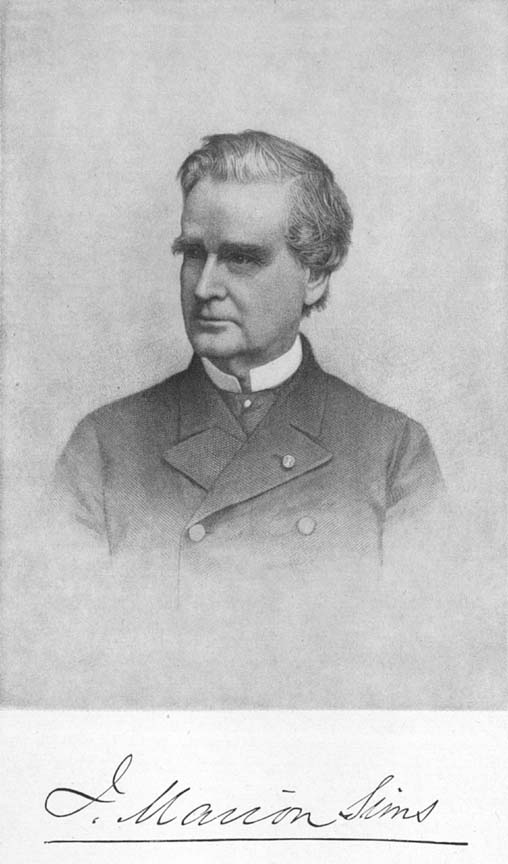
With maddening slowness the letters traveled back and forth from Paris to New York. To Marion Sims his amazing European triumph could not seem quite real until its every detail was shared with his wife. Nor could he dream of making any decision as to his next step until he had her opinion on each of a dozen questions. Should the whole family be transplanted to Europe? If so, where should they settle, and when could they make the move? What about their house in New York and the property they still owned in Montgomery? What about Granville, who was eager to cut short his medical education and go south to join the Confederate forces? What about the younger children's schooling? What about the Woman's Hospital? What about the new difficulty which had arisen in the months since Sims's departure from New York: the Federal Government's insistence that all citizens must take an oath of allegiance to the Union before being granted passports for travel either into or out of the country?
Theresa's letters, like her calm and loving presence, had the power to soothe her ebullient husband. Gradually their course of action was determined. He was to return to New York as soon as he could, settle his affairs there, gather up his family, and return with them to Paris. Paris was chosen in preference to London not only because it was the medical center of Europe but also because---despite the language barrier---Sims felt more at home there. English though his own inheritance was, his personality was rather more Gallic than British in its traits: his animation and emotional zeal, his rapturous delight in his work, his flair for the dramatic and spectacular, his quick angers and equally quick sympathies, his preference for the atmosphere of his own home over that of the all-male clubs so much beloved by Englishmen. In Paris he and his family could live in solid comfort far more cheaply than they could do in New York; better than that, they could find there, he was sure, a social life very much to their liking. Americans had warned him that it was not customary for Frenchmen to invite strangers to visit in their homes, but already he had been the recipient of many such invitations.
With his family established in Paris as headquarters he would be able to extend his practice to surrounding countries too; up till now, except for his excursions to the British Isles, he had been only to Belgium (at the special request of King Leopold's surgeon), but he had been asked to go to Germany and Austria and other lands as well. The breadth of the prospect opened up by the puissant Sims furore was, in truth, a trifle dazzling.
Reassuring though it was to know that he could command an even better practice in Europe than in the United States, he might not have been entirely happy about the situation if he had thought that the Europeans looked upon him solely as the surgeon who could heal vesicovaginal fistula. That was a noble enough mission, to be sure, and he was glad to help all victims of this affliction who were brought to him, but it was only one of many aspects of gynecology which interested him. In the Woman's Hospital in recent years he had been performing perhaps more operations for other ailments than he had for fistulas, and now he was glad to find that in Europe too he was not considered a surgeon with only one string to his bow. Much interest was being shown in the work he had done on vaginismus and dysmenorrhea and in the effect his operations for these complaints had had in curing sterility. Before the end of his first brief stay in France he had corrected through surgery several cases of painful menstruation, causing French surgeons to alter their established conviction that such operations were too dangerous to be practicable. There were two principal reasons why he succeeded in this field where they had failed: he insisted on rigid precautions of cleanliness and he speeded up the healing process by covering the cut surfaces with vaginal mucous membrane---a revolutionary idea at the time. Thus he was able to overcome almost entirely the hazard of erysipelas or other infection which had been such an ever-present threat in the past.
All of this meant that upon his return to France to live he could hope for a practice quite as varied and challenging as that which had served to lend such interest to his work at the Woman's Hospital. First, however, he must go back to New York, and going back to New York was not easy. The new requirement that he take an oath of allegiance to the Union in order to obtain a passport put him, as an honest man, decidedly in a predicament. For two months or more his homeward voyage was delayed while he himself in Paris and his wife in New York made call after call upon government officials and other persons of influence trying to find a way for him to get the necessary passport without declaring himself the enemy of all his relatives and friends in South Carolina, Alabama, and Texas. Many of his new acquaintances in France and England told him that he was foolish to think of going home and predicted that if he did go he would not be able to come back; others urged him to make his way into the United States surreptitiously by way of Canada, or to conceal his identity, adopt an assumed name, and use another man's passport. Such devious dodges were quite out of the question for a man as forthright as Sims. He admitted openly that "My father and all my family are rebels, they are fighting for the Confederate government, and I sympathize with them; if I did not I would be, as a man, totally unworthy of the confidence that . . . all the good people of New York have placed in me for the last eight years." But with this frank admission he coupled the staunch insistence that "However much of the rebel I may be at heart ... I am incapable of doing a traitorous act against the flag under which we live at the North."
All through October and November (he had left New York in July, intending to be gone only two months) he waited in Paris, hoping daily for a passport and never receiving it. Then toward the end of November came the news of the Mason-Slidell affair---the incident of a Yankee warship's forcible removal of Confederate commissioners from the English vessel Trent which caused excited talk of possible war between Great Britain and the United States. Many Frenchmen and some of the Southern refugees in Paris, hoping to profit by the catastrophe which a second war would bring to the Union, were anxious to see the rumor of a break in Anglo-American relations become an actuality. Among this group, however, Marion Sims definitely was not included. The threat of such hostilities reinforced his realization that above all he was not merely a Southerner or a Northerner, but an American. "If war comes between Great Britain and the United States," he wrote Theresa in deep concern, "I will make a straight shoot for home." It was difficult enough to try to play the part of a neutral in the struggle between the States; it would be quite impossible, he knew, for him to maintain such a role if another country should attack the Union.
Fortunately his resolution was never put to the test. The Trent affair blew over; British-American relations, though temporarily somewhat strained, remained unbroken; and Sims's minor crisis disappeared simultaneously with his country's major one, for while he was fretting in London and Paris at the enforced delay of his homeward voyage, his New York friends E. C. Benedict and Henry J. Raymond (the latter of whom was now a national Republican Party leader and one of Lincoln's advisers) were using their good offices to obtain for him the necessary passport. By then it was too late for him to spend Christmas with his family, and, homesick as he was to be with them, he had to comfort himself by such expedients as visiting the École de Médecine to admire a statue of a boy who reminded him of his own young son Willie.
When at last he did return to New York early in 1862, weighed down by belated Christmas gifts for his children, the New York Times heralded his arrival by a eulogistic account of his accomplishments during his eventful six-month absence. Such glowing bulletins of his activities, he now discovered, were nothing new; for months the Times's Paris correspondent---Sims's admiring friend Dr. W. E. Johnston---had been writing for his paper enthusiastic reports of his countryman's monumental triumphs in the hospitals of Paris. Other journalists, too, considering the French furore over Sims a newsworthy phenomenon, had sent occasional dispatches of similar purport to their papers in the United States. Sims himself, of course, had had nothing whatever to do with the preparation of this stream of complimentary publicity, and in his naiveté it never occurred to him that anyone could ever suspect or accuse him of such complicity; eight years later, however, he was to learn that in certain quarters all these press enconiums were being solemnly debited against him as evidence of unscrupulous professional practices.
Despite the newspapers' friendly attitude, the six months Sims spent in New York preparing for his prolonged absence in Europe were not a comfortable period. For the time being he was suspended in space, belonging neither in one place nor in the other. The Woman's Hospital, he found, had been having rough sledding. A state grant of funds for the proposed new building had expired because of the wartime impossibility of obtaining private donations to match it; even for day-to-day operation in the old building sufficient funds were hard to come by, and shortly before Sims's return the institution had had to be closed for three full months. Partly this was due to lack of money which not even the zealous and inspired begging of the devoted Mrs. Doremus could completely overcome; but partly, too, it was due to the panic which had seized the hospital's managers when Sims went away. For six years they had been so accustomed to looking upon him as the institution's guiding genius and central attraction that they simply could not visualize how it would be possible for the still comparatively new and wobbly venture to continue functioning in his absence. Emmet had tried to convince them that he was quite capable of carrying on alone and that he had shared with Sims the performance of many of the operations which had made the hospital famous, but for some time after Sims's departure the managers had looked upon him dubiously as a young and untried interloper and seriously had considered closing down entirely. By now Emmet's zealous and unremitting dedication to his work had convinced them that perhaps he was capable of holding things together temporarily, but even so he was still strictly on probation, and when the managers learned that Sims was planning another and even longer absence their sense of panic increased, and they insisted that the hospital could not go on without him.
For Sims this was a harrowing state of affairs. Both he and his wife were convinced that under prevailing conditions their wisest course was to move to Europe; yet if his going meant that the unique hospital he had fathered was to die he would be playing the part of a murderer, killing the thing that was dearest to him. His relief was great when at last the worried managers conceded the possibility of keeping the institution going without him, with Emmet at the helm. So instinctively did he view the hospital as his personal creation that it never occurred to him that Emmet, humanly enough, might not be enthusiastic over relinquishing his power and prestige later on whenever he himself saw fit to return to America to live.
For the present he had nothing but gratitude and sympathy for young Emmet, whose lot as a Southerner in New York was not an easy one. All through the past year, Emmet told him, his mail had been censored, his servants had spied upon him, and he never had been in the home of a Northerner except in a professional capacity. Under such circumstances of ostracism from social life he had devoted his nonworking hours to his favorite hobby: collecting historical materials. Among such materials, he believed, wartime posters, dodgers, and manifestoes rated high; and he developed the habit of going out at night under cover of darkness to remove samples of these coveted bits of paper from their places of display on the hoardings so that he might add them to his collection. Such mysterious goings on, while they served to give to Emmet himself that illusion of purposeful and somewhat hazardous activity so essential to the mental peace of a noncombatant in wartime, naturally did nothing to alleviate the Northerners' suspicions of his Southern sympathies; thus far, however-so remarkable was the tolerance displayed in New York---there had been no interference with his unorthodox avocation (which, in fact, he was allowed to pursue undisturbed for the duration of the war).
Emmet's ability to weather the storm doggedly in a hostile atmosphere was indicative of his temperamental contrast with Sims, whose instinctively affectionate nature suffered fresh dismay at each new evidence of animosity on the part of those whom he had considered his friends. There was, for example, the incident of his nomination as Knight of the Order of Leopold the First by the government of Belgium. When he had been in Brussels several months before he had been told that his name was being recommended for this honor; and soon after his return to New York he received word that the anticipated award had been duly conferred. There was a stumbling block, however: according to diplomatic custom the American minister to Belgium, Henry S. Sanford, was supposed to accept the Order's distinctive decoration on behalf of his compatriot; but Sanford sternly declined to do this on the ground that Sims, as presumably a Confederate sympathizer, was an enemy of his country.
Today, from the perspective of distance, the American diplomat's refusal to act as middleman for a suspected rebel, however distinguished, is quite understandable, for during the past year Sanford had been forced to stand by almost helpless while Southern agents and advocates had overrun Europe to the detriment of the Union cause; to Sims at the time, however, it appeared unduly arbitrary and cruel. In later years he was to receive many foreign decorations and honors, but this was the very first on the list, and he wanted it dearly. It seemed impossible to him that Sanford's decision should stand as final; all he needed to do, he thought, was to speak of the matter to his friend Henry J. Raymond, publisher of the Times and close associate of Secretary of State Seward, with whom he wielded great influence. In his optimism, however, Sims was reckoning without the bitterness induced by war, for when he broached his request to Raymond, the man who only a few years before had been so helpful to him in putting the Woman's Hospital on its feet, he was amazed to be told, in tones of no uncertain sharpness: "I don't think any man holding the sentiments you do has any right to expect any favors of any sort from the Government under existing circumstances."
That, then, was that. Not only did it mean no Belgian decoration until many years later; it meant also that as long as he remained in the United States during the war in the despised role of neutral he might expect one after another of his old friends to turn against him. If no other course had been open to him he might have learned, like Emmet, to bear it grimly; but with Europe beckoning so eagerly there seemed to be no point in lingering any longer in New York. Thanks to Emmet, who had learned so much under his tutelage, the Woman's Hospital and the remnants of his private practice could do without him. His other great concern, his family, would be far better off, he was certain, in a foreign land away from conflicting loyalties and hatreds.
In July of 1862, therefore, last good-byes were said to the house at 79 Madison Avenue which had been home for nine years, and all the Sims family (excepting Mary, the eldest, who stayed behind with her husband) embarked for their new world in the Old World, where, for the second time in less than ten years, they planned to begin life anew. This time, however, there was none of the sense of finality which had accompanied them when they left Montgomery. Before long, surely, the terrible war would be over, and then they would be able to come back home to New York.
The process of beginning life anew in Paris bore very little resemblance to the Sims debut in New York nine years before. Where the earlier venture had been characterized by loneliness, discouragement, poverty, and illness this one was distinguished by instant success in practically every aspect. Through the sensational reputation his operations of the year before had made and through the continued good offices of Sir Joseph Olliffe, whose social and diplomatic connections gave him a wide entree, Sims very speedily found himself possessed of a practice as wide as it was wealthy. The fact that he was a foreigner apparently was no handicap either professionally or socially, for this was the period when Paris was rising toward the height of its reputation as a cosmopolitan center where people from many lands might feel at home.
The Sims family, conditioned like many other New Yorkers of their era by a strong European influence in culture, cooking, manners, and modes, adapted themselves with ease and enthusiasm to their new milieu. The elder daughters, Eliza (whose name promptly was gallicized to Lisa) and Carrie, with their father's gilt-edged contacts easing their way, speedily were swept up by the gay social life which centered around the Imperial Court where Eugénie, the Empress, was inspiring occasional grumbling among her French subjects because of her conspicuous fondness for English and American associates. Second Empire Paris, the Sims girls discovered, was a wonderful place to be young and beautiful, vivacious and sought-after. They were enchanted to find themselves a part of its ceaseless, exciting pageant---its masked balls and charades, its enchanting cotillions and concerts, its daily ceremonial drive along the Champs Elysée, its fabulous shops and theaters and restaurants, its decorative Guardsmen and deliberately picturesque geniuses and near-geniuses.
In this colorful social round the rest of the family, being otherwise occupied, shared to a lesser extent. Granville was following up his New York medical education by studying surgery in the clinics of the Hôpital Charité. Fannie, who was not yet fifteen when the family left New York, was at school outside Fontainebleau; and the three youngest children-twelve-year-old Harry, eight-year-old Willie, and seven-year-old Florrie---were still far too young, of course, to take any part in the social whirl which engrossed their older sisters. As for their parents, they had brought with them from New York to Paris their happy gift for making their home a magnet for all kinds and conditions of people, and soon the Sims house on the rue de Balzac was the scene of hospitality quite as spontaneous and openhanded as that which had prevailed at 79 Madison Avenue. French, British, and Americans, as well as less numerous visitors from other lands, all felt at home there. With such a lively ménage, plus the satisfaction of new professional triumphs for the paterfamilias, there could be no chance for homesickness.
Not all of the Americans in Paris (and there were many hundreds of them) were faring as happily as they, and to these less fortunate souls among their fellow émigrés Marion and Theresa Sims served as friends in need. There was Edmond Souchon, for instance, the young medical student from New Orleans who had acted as middleman and interpreter for Sims in his first contacts with the great Velpeau. Souchon, all of whose funds from home had been cut off by the war, was in such desperate financial straits that he would have had to abandon his medical education had not Sims, suspecting his plight, insisted on helping him until he could obtain his degree, sending him every month for more than a year a check for forty-five dollars. (Sims had wanted to give sixty and Souchon had stoutly maintained that he could live on thirty, so the forty-five represented a compromise.) Even though Sims's practice carried him all over Europe these lifesaving checks never failed to materialize, no matter where their donor might be; if on rare occasions the contribution was a day or so late it always was accompanied by a note of apology from the sender.
Souchon was only one among many; hard-pressed Northerners as well as Southerners were beneficiaries of the ungrudging bounty of the Dixie-nurtured New Yorker who resolutely continued to count his friends in both camps, however bitter might be their feelings toward each other. By no means all of the Americans who spent the Civil War years in Paris were financially hard pressed, of course; there were a number of persons of wealth who elected to absent themselves from their country during the struggle because their sympathies were incompatible with those of their neighbors at home; and, in yet another category, there were brilliant scientists like Sims's friend Dr. Robert Ogden Doremus of New York, son of the Mrs. Doremus who had done so much toward developing the Woman's Hospital. Doctor Doremus' Parisian mission was a practically perfect example of the crazy-quilt pattern of confused relationships so characteristic of the era, for he had come to France at the request of Emperor Napoleon III in order to perfect a new compressed gunpowder cartridge. What this meant in effect was that Doremus, a loyal Northerner, was working under Louis Napoleon, an ardent supporter of the Confederacy, to devise a lethal weapon which might be used not only in America's Civil War but also, conceivably, in the future martial ventures of the Emperor himself, whose dreams of an empire were viewed with profound suspicion by Great Britain. Yet Britain, despite these suspicions, was co-operating with Louis Napoleon in doing everything possible, short of war, to aid the Confederacy against the Union! Sims, in short, was far from being the only one whose aims and motives were confused by the fratricide which was rending his homeland.
Whatever Sims's political situation, however, there was no trace of confusion in his professional aims. His intent was to bring to Europe the new gospel of surgical gynecology developed at the Woman's Hospital, and in the pursuit of this end it made little difference to him whether the women to be benefited were rich or poor---he wanted to treat them all. Just as on his first visit to Paris, he continued gladly to perform numerous charity operations, but these were more than counter-balanced by his large practice among an increasingly sparkling array of people of wealth and title who casually paid stupendous fees. Of these upper-crust patients, the one who served him best from the standpoint of august preferment was Princess Marie, the Duchess of Hamilton.
The Hamilton dukedom was a Scotch one, but the Duchess herself had been born a princess of the Germanic state of Baden, and she and her perennially philandering spouse spent most of their time in Paris, where she was a confidante of the Empress Eugénie. The two women had been drawn together in part, perhaps, by the common bond of suffering resulting from the extreme dissipation of their husbands. Eugénie, being a woman of spirit, sometimes staged brief revolts against the Emperor's conspicuous derelictions by escaping from France for incognito visits in other lands; and on the occasion of her most recent flight, involving a stay of some length in the British Isles, she had published as the ostensible reason for her absence her desire to consult the Duchess of Hamilton's physician (presumably James Y. Simpson) in Edinburgh. Now that Princess Marie herself was ill, however, she showed no disposition to return to her Edinburgh physician, but chose instead to take the advice of Sir Joseph Olliffe, who was close to the royal circle. Olliffe recommended Sims and thus precipitated his American friend into intimate association with the Second Empire's dominant figures.
In serving as physician for such a patient as the Duchess of Hamilton, Sims soon found (even as he had done a year or so before with his "little countess") that in ministering to a woman of privileged rank and title a medical man was expected to become practically a member of her family. It was taken for granted that Princess Marie's doctor should accompany her when she left Paris to spend the summer at her estate at Baden Baden, and since the doctor had domestic ties of his own it was arranged that he and his family should occupy a beautiful château close to the Duchess' own. Before leaving Paris, however, Princess Marie was anxious that the wonderful new physician who was doing so much for her should receive the official recognition which she considered his due. To this end she did two things: she arranged for him to meet the Emperor and she saw to it that he was granted a French diploma.
The primary purpose of his first meeting with the Emperor, held at the Tuileries in early May of 1863, was the making of arrangements for him to examine and treat the Empress. The interview was a mutually satisfactory one, concluding with an agreement that the American gynecologist would wait upon the Empress a few days later.
The next day, however, Eugénie fell ill with diphtheria, so not until two months had passed did Sims's projected attendance upon her actually take place. By that time various other events had happened: first, Napoleon III's Ministry of Public Instruction, at the instigation of the Duchess of Hamilton, had granted a special diploma authorizing "Dr. Marion Sims, doctor of medicine from the University of Philadelphia [no such university existed, of course, but Jefferson Medical College presumably was meant] to practice the art of healing throughout the Empire" on account of "qualifications which particularly recommended Dr. Sims to the Emperor's high favor." Second, Princess Marie had moved to Baden Baden for the summer and the Sims family had been installed in their château near by. And third, Sims had had his first encounter with the Empress, whom he met not as a patient but as a concerned visitor at the deathbed of a mutual acquaintance.
The mutual acquaintance was Princess Marie's husband, the Duke of Hamilton, whom Sims succinctly described as "a handsome likeness of Lord Byron; his whole life was Byronic, but unpoetical." On one of his unpoetical midnight escapades in Paris the Duke had fallen down a long flight of stairs, inflicting injuries which plunged him into a state of deep coma. When news of his accident reached Baden Baden the Duchess set out at once for Paris to be at his side; and since she was in poor health herself it was a matter of course that she should be accompanied on her doleful errand not only by her personal retainers but also by her physician. Empress Eugénie was a daily caller at the sickroom of her friend's husband, and when he died she urged his widow to visit her at St. Cloud, where she was summering.
Thus it was (for Princess Marie's condition was such as to require frequent professional care) that for several weeks in the summer of 1863 Marion Sims found himself installed in the vast palace at St. Cloud which Louis XIV had built two centuries before. Thus it was, too, that he found himself fulfilling his earlier compact with Louis Napoleon and serving as physician not only to the Duchess of Hamilton but also to the Empress of France. Whatever Eugénie's ailment may have been (it was a professional secret which Sims never divulged), it did not keep her from pursuing the strenuous life which she so much enjoyed---riding, driving, walking, dancing, playing active games, all undaunted by the handicap imposed by huge hoop skirts. What the Empress did, of course, all her retinue had to do too, however little they might feel like being energetic. For Marion Sims, however, her sustained vivacity was sheer enchantment. Representative though he was of a nation which had forsworn royalty and all its trappings, he was highly susceptible to the insidious intoxication of royal pomp and preferment, and each new instance of Eugénie's wit, versatility, and thoughtfulness moved him to rapturously uncritical admiration. He was no toady, of course; his innate adaptability made him fully capable of meeting courtiers and potentates on easy terms without servile bowing and scraping; but there could be no denying that he found something profoundly exciting about these contacts with royalty's luxury-laden world which had come about so miraculously by virtue of his professional skill. When the Duchess of Hamilton's return to Baden brought his stay at St. Cloud to an end he carried away with him a naive admiration of the Empress and a treasure-trove of memories of wonders far removed from the stern realities of life as he had learned them years before in Lancaster District, South Carolina.
Back at Baden Baden, where the fashionable world's summer season was in full swing, he devoted his time not only to attendance on his patroness and to unreserved enjoyment of his family's social pursuit, but also to two other principal concerns: the worrisome case of young Madame X and the attempt to fulfill at last the promises he had been making for years to write a book.
Madame X had been one of his patients in Paris the winter before. Childless and desperately eager for motherhood, she had come to him for an operation to relieve her sterile state. Three months after he performed it she became pregnant, and everyone concerned was filled with happiness. Soon this happiness turned to apprehension, however, for she vomited continually---not merely the normal, occasional vomiting of early pregnancy, but a relentless, repeated rejection of food which resisted all treatment and left her alarmingly undernourished. Sims's summer removal from Paris to Baden Baden had not interrupted his care of her, for she and her husband migrated to Baden too, and he was able to give her his concerned attention. Nothing he could do seemed to help her, however, and when he realized that under the circumstances continuation of her pregnancy was threatening her life, he went to her husband and told him that unless a miscarriage was brought about his wife was likely to die. The husband said that the decision was up to his wife; and she, absolutely determined to produce a child, refused to consider abortion.
This was the state of affairs when the young couple went back to Paris. The wife's health was steadily deteriorating, and Sims, feeling troubled and responsible, made the trip with them. Inasmuch as he had to return to Baden he turned his patient over to an outstanding obstetrician, to whom he confided his fears, again recommending abortion. The obstetrician, however, said he saw no danger and insisted that he could bring the patient safely through her full period of pregnancy. As a final measure before leaving Paris and washing his hands of the case, Sims repeated his warnings to the young woman herself and also to her mother, but both of them were horror-stricken at the idea of doing anything to prevent the birth of the much-wanted baby, so Sims departed for Baden in an anxious frame of mind. Less than two weeks later he received word that Madame X was dead.
After many years of practice a physician generally learns to steel himself against the tragic, but inevitable, fact that some of his patients must die, but in this case Sims's situation was rendered more difficult than usual by certain unfounded rumors which placed him in a most unhappy position. Madame X's untimely passing was a profound shock to society in the Faubourg St. Germain, where she had lived, and the newspapers of Paris, in reporting it, stated that her death had been caused by an operation for sterility performed by the American surgeon, Dr. Marion Sims, who therefore must be blamed for the tragedy. Normally Sims was not a man to accept unjust accusations humbly and patiently without fighting back, but on this occasion-actuated, probably, by his consciousness of being a comparative newcomer with a great deal to lose if he became embroiled in a name-calling quarrel---he was wise enough for once to hold his peace, working off his irritation by pouring his energies into a project he long had contemplated: the recording of some of his experiences and discoveries at the Woman's Hospital.
As a matter of fact he never did write the book he originally planned. What he had in mind was a thoroughgoing treatise on accidents of parturition, and through the years he had been accumulating quantities of notes and sketches which he intended to incorporate in such a work as soon as an opportunity appeared. But he was too popular a surgeon, too sociable a man, ever to develop the methodical habits of writing essential to the production of any notable volume of work. For years his associates---particularly the late Dr. Francis, who had raised the subject publicly every year at the annual meeting of the Woman's Hospital Association---had been telling him that he owed it to his profession and to posterity to publish details and results of the pioneer work which he and the hospital had been doing in the field of gynecology. To these repeated urgings Sims had been in the habit of replying that he had every intention of writing such a book as soon as he had an opportunity. Before he left the United States in 1862 he had assured publishers in London, Paris, and New York that the manuscript of his book would be ready for them soon, and he had engaged a French artist to prepare the illustrations. It was to be a comprehensive project, and certainly his long and leisurely stay at Baden Baden (the Duchess of Hamilton did not return to Paris until October) seemed like an ideal time to put it into motion.
Full of ambition, therefore, to carry out at last the great undertaking he had postponed so long, he set to work with a will one hot summer day. Out came all the miscellaneous bundles of notes he had been saving for years, out came the piles and piles of illustrations, out came the writing implements and the nice clean paper with which he was going to transform this miscellaneous mass into a systematic, compendious treatise designed to send his name ringing down to posterity as author of the best of all textbooks on women's diseases. It required only two days of conscientious classifying and arranging, however, to reveal to him what an interminable amount of dull and detailed work he had ahead of him, and he decided that he had made a serious error to embark on so long and tedious a task in such hot weather. The thing to do, obviously, was to put his plans for his major opus aside until fall, when cooler weather doubtless would make it easier to tackle such a long and steady grind. Meanwhile, during the summer, he would do a little writing of a kind that appealed to him more---nothing serious or detailed or systematic, but just a few informal notes concerning his experiences in the treatment and cure of sterility.
So it was that back into the never-never land of things to be done "some day" went the plans for the big and solemn book; and instead of struggling with the distasteful job of systematizing and presenting topics in exhaustive detail Sims spent a thoroughly enjoyable summer jotting down random notes and recollections concerning the cases he had handled at the Woman's Hospital. Such notes, he knew, never would do for a textbook, but they might make a nice and useful little pamphlet; and since nobody expected a pamphlet to be as awe-inspiring as a textbook he did not have to worry about trying to employ all the dry and dignified jargon which seemed to be expected of textbook authors. This was a great relief, for he had a marked distaste for ceremonious writing. For his pamphlet all he needed to do was to write as he would talk-informally, vigorously, and simply. He needn't even bother going into bothersome details; who expected details in a pamphlet? His main aim was to "show that it is possible, even in very difficult cases, to understand the obstacles to conception and to remove them by persistent continued effort." If one method would not work it was nearly always feasible (or so his own experience indicated) to devise another one which would.
Once he got started on this pleasantly casual project all his accustomed dread of writing vanished, for now he was not really "writing" at all---he was merely reminiscing on paper. He did not have to profess objectivity---a task which would have been well-nigh impossible for him; he felt free to boast about his successes and to tell quite frankly about his occasional tragic failures. When autumn came and it was time to leave Baden Baden for Paris he was surprised to find that his lightly projected pamphlet had begun to spread itself far beyond pamphlet length, and that still he had not finished all he wanted to say. Certainly he could not abandon it midway; apparently he would be well advised to postpone any sustained effort on his more serious work until he had completed this agreeable potboiler.
All through the next year, therefore, he kept building new additions onto his overgrown pamphlet; but even as he was striving to perfect this written link to posterity the human link upon which he had counted most was slipping from his grasp.
Granville Sims was an unhappy young man. It was all very well to be the son of the famous Dr. Sims, destined to aid his father in a brilliant international surgical practice, but how could an able-bodied twenty-three-year-old be expected to keep his mind on books and gynecology or even on the gay social life of Paris when overseas his countrymen were fighting a grim war? Ever since the conflict's beginning he had longed to serve the South, but in deference to his father's wishes he had stuck doggedly to his studies, first at the University Medical College in New York and then in the great hospital clinics of Paris. Now---except for the New York hospital experience which his father deemed essential---his studies were over, his medical diplomas achieved. There was every prospect that Marion Sims's long-standing dream of having his own son as assistant and heir apparent would soon be realized.
To Granville himself, however, it was revolting to think of settling down to such a favored and protected career when the Confederacy needed him. More and more, as the tides of war began to sweep against the South, he felt that he absolutely must do his part. From such sources as John Slidell, the Confederate commissioner in France, who was his father's good friend, Granville was able to get frequent and authoritative reports on the desperate straits of the cause which was so dear to his heart. With news of each recent adverse development his restlessness increased. It was particularly hard to remain passive and safe in France when his brother-in-law, Dr. Tom Pratt (to whom Lisa Sims had been married in the spring of '63) abandoned his promising Parisian medical career to return to the States and serve in the Army of Virginia. The last straw came in the summer of '64. The French press, which gradually was shifting its support from the side of the South to that of the North, reported in high excitement the sinking of the Confederate blockade runner Alabama by the Yankee steamer Kearsage directly off the coast of France. Granville could stand it no longer. While his parents went on vacation to Bad Kissingen in Germany he remained at home in the rue de Surène (where the family had moved from the rue de Balzac) to keep his eye on his father's office and to act as head of the household. Now, without the senior Sims's overpoweringly persuasive presence to weaken his resolution, he dared at last to take his stand. Steeling himself to overcome the hesitation born of years of compliance, he decided to declare his intentions by mail.
On his first attempt he could not quite make the grade. On July 19, 1864, he wrote a dutifully filial letter to Bad Kissingen, telling of messages and letters received, his sister Carrie's cough, his little brothers' anticipation of their approaching school vacation, and similar run-of-the-mill items; only in his final line did he summon up the nerve to say, "When I write again I want to ask you something."
Write again he did, two days later. "A gentleman has offered me my passage free of all expense from Liverpool to Galveston, Texas," he announced. "I have accepted. What I want to ask you is to give me fifty pounds or more if you can possibly do so. I am decided and do not wish you to oppose me, dear father. I know you will make a great many objections, but this time I am resolute, for it is time that I act for myself. I have been irresolute and dependent long enough. You wish me to go back to New York. I do not want to go and will not go, for if I go amongst those Yankees again I am sure of getting into some trouble, but---I will not go, and there it ends. Whereas, if I go to Texas I am independent and act myself.
"I will wait anxiously for your response. Write me fully what you think. I am willing to listen to all reasoning but not to be outdone in my resolution, for once in my life I am determined to be resolute. Excuse me, dear father, if I appear to be too dictatorial or strong in my language, but I am excited."
Granville's once-in-a-lifetime resolution prevailed over his father's anticipated objections, and within a month he had bid good-bye to the rue de Surène and set sail on the boat which, if it could succeed in piercing the Yankee blockade, should make it possible for him at last to realize his long-deferred ambition to serve the Confederacy.
His parents worried about him, of course, even as countless other parents worried about their sons who had gone to war, and even though recourse to memory must have reminded them that Marion Sims himself, at Granville's age, had been quite independent of his father for a year and had come safely through the Creek War, to boot. They had other things besides Granville's departure to give them cause for worry, however. Mary, their oldest daughter, who had stayed in America with her husband at the time of the Sims exodus two years before, now had joined her family in France, bringing with her a small daughter, Constance, and a baby son, Addi, named for Dr. Thomas Addis Emmet, who had been her invaluable friend in need when she finally had been forced to face the fact that her marriage to Charles Carr was a failure. In a home where exceptionally cordial marital felicity always had been a glowing reality this matrimonial disaster of a cherished daughter was a bitter blow, though it was atoned for, to some extent, by the joy which a still youthful pair of grandparents felt in having their grandchildren with them.
Beyond these family concerns there was the growing fear that the shadow of armed might which had darkened their own homeland might in time extend to cover even their beloved foster country, France. On the surface Paris was as gay as usual, but farsighted Frenchmen were feeling worried about the possible outcome of Louis Napoleon's ill-advised attempt to plant an outpost of the empire in Mexico under Maximilian, and even more worried about the bellicose rumblings coming over the border from Prussia, where the ambitious Prince von Bismarck was in the process of "achieving national unity" by gobbling up one independent German state after another. For the present, however, with the Emperor's "City of Light" growing more beautiful and cosmopolitan all the time and with the immediate glaring brilliance of Eugénie's court serving to distract the vision from more distant prospects, there were few who could see the ominous clouds forming on the horizon.
Not the least of the glories of the refulgent empire was its Legion of Honor---the highest order of distinction accorded to those who had served France supremely well. Only rarely was the knighthood of the Legion awarded to any but a Frenchman, but in November of 1864 an elaborately uniformed mounted dragoon from the French Empire's Office of State appeared in the rue de Surène, bearing a huge envelope embossed with many official seals. His destination was the home of Dr. J. Marion Sims, the American surgeon, to whom he presented his impressive envelope. It contained the French Government's brevet and decoration of Knight of the Legion of Honor-the first of a long series of such decorations which Sims was to receive from the governments of Europe in the years to come.
Such an extraordinary distinction was of course an occasion for family rejoicing, but it was rejoicing of brief duration, for the receipt of the large and many-sealed envelope preceded by only a few days the arrival of another envelope, plainer and smaller, and bearing news of a very different import. It contained a month-old letter written in Havana, Cuba, by a shipping agent. Several weeks before, according to this communication, Granville Sims had spent some time in Havana, where yellow fever was endemic, while awaiting passage to Galveston. "When your son left here," wrote the agent, "he complained of feeling a little unwell, but he did not think that it was anything serious. He was so very enthusiastic in favor of the South that all he seemed to desire was to get over to Texas to help the cause." He had succeeded in reaching Texas, the letter went on, but less than twenty-four hours after arriving at Galveston he had died of yellow fever. Now he was buried in the soil of the Confederacy he had been so eager to serve.
Far from the cemetery in Galveston, Granville Sims's father, wearing on his lapel the bright new ribbon of the French Legion of Honor, read the note from a stranger---a note which had been four weeks on the way. "Oh God!" he cried, then sobbed unashamed. "Granville is dead!"
To seek new surroundings when old ones arouse unhappy memories is a common human tendency, and after Granville's death the Sims family did just that. From Paris, where they had grown to feel so completely at home, they moved to the West End of London, where they would not be so constantly confronted by reminders of the eldest son who was gone.
England, no less than France, was filled with patients who sought Dr. Sims's services, and for the moment it had the added advantage of being the scene of serial publication of his first extended literary venture. The random notes which he had started to jot down at Baden Baden in the summer of 1863 had grown and grown until they had begun to take on the aspect of a full-length book, in volume if not in form. In the autumn of 1864 they began appearing serially in the Lancet of London, one of the oldest and most influential of British medical publications. Under the top-heavy general title "Clinical Notes on Uterine Surgery, with Special Reference to the Management of the Sterile Condition," installments were published regularly in every issue of the journal for the better part of a year, and they aroused so much discussion that their author found it stimulating to be located close at hand for convenience in exchanging thrusts and parries with his not infrequently critical readers.
Another attraction in London was the meetings of the Obstetrical Society, which had elected Sims as one of its few Foreign Honorary Fellows. At home in New York, preoccupied by other affairs, he had shown only a mild occasional interest in the programs of the various medical and surgical societies, and in Paris his still inadequate grasp of the French language had barred him from any active participation in such professional gatherings, but in London he soon developed the habit of taking a lively part in almost every session: reading papers, joining extensively in discussions, and presenting descriptions of the latest of his seemingly interminable flow of new inventions.(9) His hearers, most of whom had come to be regular users of his speculum, presented mixed reactions to his remarks. A common attitude was that the difficult and complicated operations which were so spectacularly successful when performed by Marion Sims might be far from safe if attempted by surgeons of lesser skill, and, similarly, that some of the ingeniously devised instruments (such as his new curette and his uterine guillotine) with which he executed his feats of legerdemain were potentially dangerous weapons in the less adept hands of others.
On the whole the debate which followed the publication of his Lancet articles was similar to the discussions accompanying his appearances before the Obstetrical Society---spirited but good-natured. Thus Spencer Wells, England's leading ovariotomist, surgeon to Queen Victoria and one of Sims's closest friends among the British, was inspired by one of the Lancet articles to write an animated protest concerning the American's insistence that for a vaginal operation it was just as necessary to obtain a full view of the operative scene (by way of the speculum) as it was to examine the throat meticulously before performing an operation on the pharyngeal tract. Wells (prefacing his remarks by the observation that Sims "is so thoroughly well able to hold his own that I feel certain he will be rather pleased than annoyed by a little discussion") asserted that the two cases were essentially different, for whereas a woman could have no possible objection to a surgeon's looking down her throat "it makes an immense difference in the sufferings of a modest woman if an operation can be done under the bedclothes without any exposure."
This objection, which had grown familiar to Sims through years of repetition, brought from him the comment that "The use of the speculum is delicate or indelicate only according to the manner of him who uses it." (In the two decades since his invention of the speculum he had become fully accustomed, incidentally, to criticism of the instrument not only on the grounds of its affront to female modesty but also because it required an assistant to hold and adjust it, thereby extending the scope of the patient's embarrassing exposure to a third party as well as to her physician. To this he had evolved a standard reply---that "It is much more delicate for a lady to be locked up in a room for half an hour with a doctor and a nurse than to be locked up with a doctor alone.")
To Dr. G. T. Gream of London, who commented disparagingly that "The treatment of sterility is but seldom called for except by those in the more wealthy classes of society, as the birth of children to persons amongst other classes is comparatively of less importance," Sims replied dryly: "I had thought that the wish for offspring was a deep-rooted sentiment -.. . not hidden away by Mammon in the balance-sheet of a bank account." And in response to Dr. Gream's shocked disapproval of his advocacy of a surgical operation for relief of dysmenorrhea he observed optimistically and a trifle maliciously: "I have still the hope . . . of seeing Dr. Gream change his mind on the subject of this operation. Like all sensible men he is open to conviction, and even to conversion. I once opposed, and very firmly, too, the operation of ovariotomy. I was then practically as ignorant on the subject as Dr. Gream now is on hysterotomy. Enlarged experience changed my views, and I . . . am not ashamed of the change . . . . Let me remind Dr. Gream that in 1849 [Sims evidently had been doing a little research into his critic's history] he wrote one of the most intemperate and violent philippics against anaesthesia in midwifery that can be found in the English language, and that Dr. Gream afterwards learned better."
Again, responding to extensive disapproval of one of his favorite and most effective operations advanced by the distinguished Dr. J. Henry Bennet, author of a widely used textbook on female diseases, Sims remarked cheerfully: "If I have had any misgivings as to the worth of my 'clinical notes' they may now be considered at an end. For when so many eminent men step out of the beaten track to discuss their soundness it is almost a guarantee that there is truth at the bottom, the whole of which they cannot at once accept because it does not tally with old preconceived notions. My friend thinks that he settled this question many years ago, but I shall be greatly surprised if it is definitely settled in the next generation." In Dr. Bennet's stern disapproval of the operation in question he found an analogy to all fears of the unknown. "Doctor Bennet has not seen it performed," he commented, "and draws on his imagination as to its terrors. I well remember how I held my breath in awful suspense when I first read the account of the passage of a freighted train of cars over the suspension bridge at Niagara Falls; but when I visited the place six months afterwards and passed over in person I had not the slightest feeling of dread. This was due to the difference between imagination and reality."
In short, he was having a wonderful time. This was the kind of writing which he enjoyed---brief, sprightly interchanges not too much weighed down by solemnity or detail. As a solid textbook author, however, his qualifications were debatable. When his Clinical Notes on Uterine Surgery appeared in book form in 1866 it immediately aroused a storm of controversy. Almost all of the critics recognized its forceful style, its hold upon the reader's interest, its abundance of bold and original thought, and its potentialities as a revolutionary influence in bringing effective treatment of sterility and allied ills within general reach. Arrayed against these favorable comments, however, were the animadversions of many who criticized the book for its casual and fragmentary nature, its complete absence of system, and, above all, its frank presentation of subjects theretofore considered taboo.
The aspect of the work which excited the most heated condemnation was Sims's forthright account of a number of experiments he had conducted in the field of artificial and instrumental impregnation of the human female. His reports of his methods and stratagems and of the results he had achieved were as strictly factual and unsensational as he could make them, but the very fact that he dared to experiment at all in such forbidden territory and to publish his findings was enough to arouse some of his readers to shocked indignation. That a supposedly reputable medical man should stoop to such practices, they protested, was incredible! Particularly distressing to the sensibilities of certain critics was his account of the way he had found it necessary in some instances to visit sterile married couples in their bedrooms and to apply there various measures (including, occasionally, etherization of the wife) to overcome the obstacles preventing conception. Concerning this the Medical Times and Gazette of London observed sourly: "Many things are here described on paper which have hitherto been veiled in Professional silence, even if they entered the imagination of Professional men . . . . We can but express an unfeigned regret that Dr. Marion Sims has thought proper to found an odious style of practice on such methods. If such practices were to be considered the business of the Physician there are a good many of us who would quit Physic for some other calling that would let us keep our sense of decency and self-respect. Better let ancient families become extinct than keep up the succession by such means."
As a crowning touch to its expression of outraged indignation at Sims's invasion of what it considered forbidden territory, the Medical Times and Gazette published a sardonic "Ode to Dr. Marion Sims":
Say, what is man? An atom at the first,
Waiting its nuptial atom in the womb;
Too oft, alas, by fate untimely curst,
In place of fostering home, to find a tomb.
Grieved at the thought, a tear thine eye bedims,
Great son of Aesculapius, Marion Sims.Swift to thine aid inventive genius brings
Persuasive tent or glistering hystrotome;
With these the obstructed portal open flings,
And guides the struggling sperm'tozoon home.
Thus may the wished-for union perfect be,
The mystery no human eye can see.Sims, should these fail, thou still wilt cherish hope
To find some other cause that breeds the ill;
With learned digit, searching microscope,
Or peering speculum, exploring still:
Nay, wizard-like, ethereal sleep wilt shed
To win thy point, e'en o'er the nuptial bed.
Since the Medical Times and Gazette was an influential and highly respected journal Sims was not a little disturbed by its virulent criticism of what it chose to call his "dabbling in the vagina with speculum and syringe" and its insistence that such tactics were incompatible with decency and self-respect. "For myself," he replied, in the course of one of his addresses some time later before the British Medical Association, "I see no indelicacy or impropriety in taking mucus from the vagina and uterus for microscopic examinations. It is no more indelicate, no more impure, than to investigate the character and properties of saliva, or bile, or urine, or feces, or pus. And where is the scientific physician, nowadays, who could or would dare to give an opinion on any obscure and complicated disease without some such investigation?"
It was a matter of considerable irony that so fervent a devotee of the prime Victorian virtues of domestic, marital, and sexual propriety as Marion Sims should be accused of licentiousness merely because he was somewhat ahead of his time in realizing that a frank study and understanding of the human reproductive system was far more wholesome and modest than the traditional attitude of keeping it veiled in mystery, ignorance, and shame. As a matter of fact the clinical descriptions to which the outraged critics took such violent exception were only a very minor part of Sims's book. The difficulty lay, perhaps, in the author's extraordinary vividness and simplicity of style. He believed sincerely in the wisdom of Biblical (and Victorian) admonitions concerning the desirability of extensive procreation, and he believed too that it was his duty as a physician not only to enable his own patients to have as many children as possible but also to instruct other and less enlightened physicians in the best ways of achieving the same laudable result. If he had presented his message in language as obscure and pedantic as that employed by many other medical writers he might very possibly have said precisely the same things without arousing any critical ire, but "he aimed always at banishing mystery," as one of his contemporaries said, and because he wrote so clearly and unaffectedly that the merest tyro could understand him he was subject to the accusation of catering to prurient tastes.
On the whole, however, the favorable reactions to his book overbalanced the unfavorable ones. It was original, it was bold, it was filled with new and constructive suggestions and with graphic case histories. Many old-school physicians regarded it with some distrust and incredulity, but the younger men, just venturing into the new field of surgical gynecology, took it to their hearts and made it their Bible. Up to the time of publication of Uterine Surgery the generally prevailing methods of gynecologic treatment, except in the comparatively limited areas where Sims's personal influence had reached, had been predominantly conservative; afterward-even among those who had disapproved and deplored Sims's theories---the old practice of letting nature take her course soon gave way to an active policy of surgical interference with nature's less beneficent processes. All over the world doctors read Sims's casual, chatty text and promptly revolutionized their treatment of women's ailments according to its precepts.
That the book should have wielded such an influence is really amazing in view of the fact that it was only a fragmentary piece of work---notably unsystematic, dealing with but a limited range of diseases, and even containing occasional inaccuracies (for, far removed as the author was from his original sources of material at the Woman's Hospital, he had to trust to his memory for numerous points which only the hospital records could have supplied in exact detail). These defects did not worry him particularly, to be sure, but they must have worried the host of other medical men who believed that only in extensive compendiums of statistics and annotations was truth to be found. Sims's own cavalier attitude toward such customary appurtenances of medical literature is indicated by his remark, after presenting some fairly extensive statistics concerning uterine tumors (practically the only statistics, incidentally, that the book contains): "I give these details simply because I have them, and not because I attach much value to such statistics." Elsewhere, in preparing to narrate one of his absorbing case histories, he observes nonchalantly: "I shall, as hitherto, avoid minute anatomical and histological detail, which can be better learned from any of our text-books."
In his behalf it may be said that no one knew better than he himself that his book was comparatively formless and incomplete. In his Preface he said: "Having an innate horror of writing, I have not tried to make a book; on the contrary, I have simply related in detail my various operations, . strung together in the form of these 'Notes.' . . . This collection . . . lays no claim whatever to the character of a systematic work. It is simply a voice from the Woman's Hospital which in all probability would never have been heard if I had remained at home." To "that noble charity, the Woman's Hospital," he added, "I owe all that I know, practically, of the subject herein treated."
This last statement is significant, because the book had nothing whatever to say about the one gynecologic theme---vesicovaginal fistula---concerning which he had known a great deal long before the Woman's Hospital ever was conceived. This surprising omission of the accidents of parturition, he explained, was "because I hope, if time and circumstance permit, to prepare, at no distant day, a fully illustrated monograph on these subjects." (Apparently time and circumstances never permitted, for no such book from his pen ever appeared. As one of his contemporaries wrote of him: "The difference between what Sims planned to do and what he actually did in the matter of literary work . . . was immense.")
Yet, despite all its omissions and defects, Uterine Surgery contained a vast amount of practical information and of solid, highly germinal advice. The young doctors who read it learned many things. They learned precisely how the master of surgical gynecology went about examining his patients and how by the use of his amazing sense of touch (or, as the Medical Times and Gazette's ode called it, his "learned digit") he was able to ascertain the answers to a long list of questions about the condition and relations of the vagina, womb and cervix. They learned how wary he was of the possible dangers connected with the use of metallic probes and how fanatically he believed in the necessity of adapting instruments to the peculiarities of individual cases. They learned how he considered it part of his (and, by implication, of any good surgeon's) province to devise new instruments and new operative procedures for cases which could not be handled by existing instruments and methods. They learned just why he believed it was far safer and more effective to treat certain uterine affections by surgical operations than by the customary (and, in his opinion, harmful) method of cauterizing with hot irons or powerful caustic solutions. They learned that he was opposed both to "operating on any rational being without first explaining what is to be done, and the wherefore" and to removing the uterus ---thus ending irrevocably all possibility of fertility---"till we have tried persistently and patiently every possible means" for restoring the organ to its normal functions.
Eternal patience and unceasing caution were, in fact, two admonitions stressed over and over again by this bold surgeon who, more than once, was accused by his contemporaries of being inclined to recklessness and impetuosity. His case histories, studded though they were with quick, brilliant, and dramatic cures, also presented frequent revelations of the tedious, repetitive, bit-by-bit therapy he practiced for patients whose ailments were not susceptible to amelioration by more rapid means. "It is better not to fatigue our patient too much," he observed, "and if we do not succeed today it will be as well to wait till tomorrow." Or, more ominously: "The young surgeon cannot be too careful, for if he should unfortunately cut too much there is no remedy for his mistake. It is far better to cut too little, even at the risk of being compelled to repeat the operation."
What Sims's book provided above all was a new and in most respects original method of uterine investigation, making it possible to determine morbid conditions with an ease and precision which (as one enthusiastic British reviewer said) "a few years since would have seemed not only marvellous but incredible." And, secondarily, it emphasized the author's discovery that practically all of these conditions had some bearing on the problem of sterility. On many occasions, Sims told his readers, he had achieved cures for sterility purely through accident---simply through the correction of any one of a dozen or more disabilities (all described in a long and engrossing series of case histories) in the patients who had come under his care at the Woman's Hospital.
"The Woman's Hospital"---that is the theme which recurs again and again in Uterine Surgery. Successfully transplanted though he seemed to be, separated though he was from New York by an ocean and by more than four years of triumphs abroad, Marion Sims still felt that his existence was inextricably bound up with that of the unique institution he had fathered, and that in publishing his clinical notes he was serving merely as the authorized voice of his beloved "noble charity," to which (the war now being over) he hoped that before long he might be able to return.