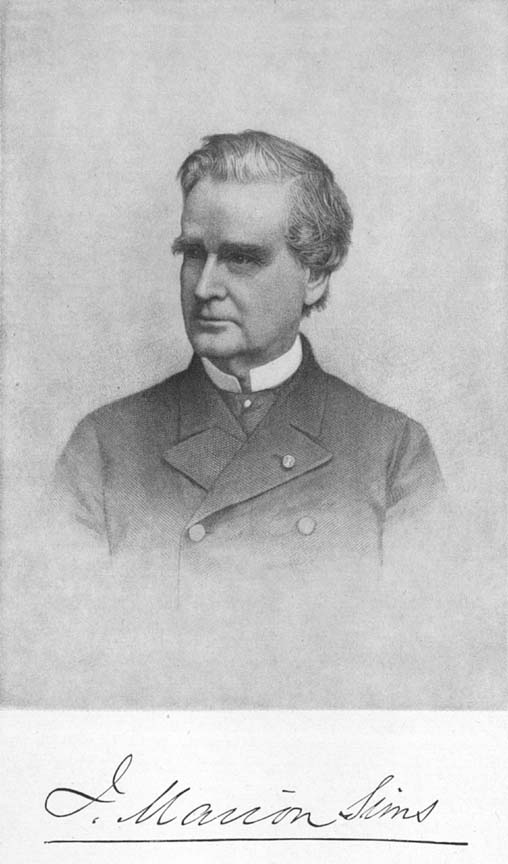
The war might be over, but the time for going back to the United States hardly seemed ripe as yet. All through the years of conflict Sims had tried to maintain an attitude of approximate neutrality, although it would have been a blind observer who could not have guessed that his deepest sympathies were with the Confederacy. Now that the South's crusade was a lost cause, however, with every eastbound boat bringing fresh tidings of desolation and despair in the territory of the vanquished, he felt himself so incontrovertibly a Southerner that he knew he would be ill-advised to settle again in New York until the angry passions of wartime had had an opportunity to cool. His position was made no easier by the realization that Americans on both sides of Mason and Dixon's line were united in a feeling of distrust for those of their compatriots who had escaped the rigors of war by migrating to the safety zone of Europe. In occasional letters and from other sources came hints that even in Lancaster, South Carolina, and Montgomery, Alabama, the citizens had lost much of their wonted pride in the achievements of their former fellow townsman, Marion Sims.
For resentment of this sort there was no recourse except to live it down and prove it undeserved. One point on which some of Sims's old acquaintances felt especially aggrieved was that he had been making money in unprecedented quantities while they themselves had been losing nearly all their resources. Lancaster, for example, was suffering not only from many deaths in battle and from the South's general postwar depression, but also from the depredations of a detachment of Sherman's raiders, who just before the war's end had passed through the town like a horde of locusts, setting fire to the courthouse and jail and committing divers other acts of pillage and destruction. Some months later, when Sims heard of this catastrophe and of his native town's ensuing destitution, he immediately sent a thousand dollars from France to help his quondam neighbors in their plight.
This was only one of many contributions he continually was making at this period to Southerners who had been less fortunate than he. The large sums of money he was earning so rapidly had a way of disappearing almost as quickly as they came. Europe seemed to be full of penniless refugees from the crushed Confederacy, and any of these who encountered Sims could count on him for aid. A typical example was that of the Confederate army surgeon who, with his world at home in ruins, had left the South to seek a new start abroad. He had worked his way to England as steward on a ship, but by the time he reached London his money, health, and courage all had given way, stranding him as a friendless wreck in a London hospital. Sims, learning of his presence there from one of the hospital's physicians, immediately visited the destitute Southerner, befriended him, discovered mutual Alabama acquaintances, installed him in his own home, saw to it that he was nursed back to health and confidence, and financed his return to the States and to a new medical career.
Yet even when he was displaying in this wise his affinity for the champions of the defeated South it was not in Sims's nature to feel any enmity for representatives of the North, many of whom continued to be among his good friends. Among these, ironically enough, was the former chief commander of the Union Army, General George B. McClellan, who had been living in Europe since his defeat for the presidency in the campaign of 1864. Sims remembered McClellan as the young son of the brilliant founder of Jefferson Medical College whose teachings and example thirty years before had had so much to do with his own first ambitions to become a surgeon; and the fact that the eight-year-old boy to whom he used to give candy had become in manhood one of the principal symbols of Northern arms could not dim the old affection in the heart of a Jefferson alumnus whose capacity for friendship was boundless and whose political tendencies, in an age of violent partisanship, were temperamentally nonpartisan.
As it was with McClellan so it was with great numbers of other Americans to whom the end of the war brought an opportunity to indulge their deferred passion for European sightseeing. To Sims, now living in Paris again, they were neither Northerners nor Southerners, but simply links with home. (Most of them, of course, were from the North, for the prostrate South had little cash to spend for travel.) To the American tourists, in turn, the American surgeon who had made such a name for himself abroad was distinctly one of the sights to be seen in Paris, along with the Louvre and the Bois de Boulogne and Napoleon Ill's great Exposition Universelle, where most of Europe's royal personages were disporting themselves during the summer of 1867. The visiting Americans, quite agape from catching glimpses of so many kings and queens and princes, were impressed to learn that their engaging compatriot, Dr. Sims, was on easy doctor-and-patient terms with several of these fabulous creatures, and that his lovely daughters were popular members of the charmed circle of glittering gallants and their ladies who flocked around the Empress Eugénie and helped to give her court its widespread reputation for verve and gaiety.
Among the handful of other Americans who played an active role in this circle were Mrs. Leonard Jerome of New York and her vivacious daughters, one of whom was destined to become the mother of a famous Englishman, Winston Churchill. Marion Sims quite unwittingly had served as the ostensible reason for Mrs. Jerome's migration to Paris from New York, where her wealthy husband's extramarital amorous involvements had made her life miserable. When Leonard Jerome's admiration for the young singer Adelina Patti had become so conspicuous as to be the talk of the town, he had come home after one escapade (as his daughter Jennie's biographer tells it) to find his wife red-eyed but determined. Her health, she said, was worrying her, and it was imperative that she should consult Dr. Sims (who had been her physician before his removal to Europe). Her husband was not in a strategic position at that particular moment to protest such an extended trip to a doctor, so the feminine Jeromes transplanted themselves to the friendly soil of Paris, where the medical man whom Mrs. Jerome had crossed the Atlantic to see found her health to be excellent.
Not the least piquant aspect of this episode was that the dulcet Patti, from whose devastating competition Clara Jerome had fled, soon transferred her own field of conquest from New York to Paris, and, as a crowning touch, also became a devoted patient of Dr. Sims. It was to Sims's home in the rue du Faubourg St. Honoré, in fact, that she came regularly to meet the dashing Marquis Henri de Caux who---thanks in no small part to the Sims's household's facilitation of their romance---soon became the first of her three husbands.
For many others among the numerous American women who now found themselves in the world's pleasure capital, however, Marion Sims represented not a pretext for flight nor a sponsor of romance, as he had in the Jerome and Patti incidents, but the one physician above all others whom they felt they must see in order to be restored to health. Soon it began to seem that T. G. Appleton's famous dictum that "Good Americans, when they die, go to Paris" had as its corollary that "American women, when they fear dying, go to Paris," for not a few of them made the voyage across the ocean for the express purpose of consulting Sims, who, they had heard, could relieve them safely of the severe disabilities which threatened or handicapped their lives. Time and again he performed with complete success the operations they desired, aided not a little in his exacting surgery by the fact that of late he had become a convert to the use of nitrous oxide gas. This form of anesthetic (commonly called "laughing gas") was nothing new, of course, in the United States, where it had been introduced more than twenty years before, but in Europe it seldom had been employed until the period of Sims's residence there, when the American dentists Colton and Evans, by popularizing its use in Paris, did so much to lessen the general fear of surgical operations. Since Sims always had had a profound distrust of chloroform he was eager to try nitrous oxide and was delighted with its results. It may be noted, however, that his satisfaction with laughing gas did not prevent his continually questing spirit from experimenting with various other anesthetic agents in the perpetual hope of finding a perfect one.
This same questing spirit led him to be among the first to espouse the antiseptic methods of Lister, which just had been presented---in their first crude form---to a skeptical world. Most physicians greeted with scorn or indifference Lister's contention that suppuration and infection of wounds---immemorial bane of hospitals and of surgery---might be overcome by using a carbolic acid spray to destroy the microscopic organisms which caused putrefaction. Marion Sims, however, promptly became one of the new doctrine's foremost disciples. His advocacy of the revolutionary antiseptic theory was based in some small part, perhaps, on his feeling of friendship for Lister as James Syme's son-in-law and of gratitude to him for his aid in popularizing silver sutures; but in the main it was dictated not by mere personal bias but by Sims's passionate conviction that here at last was the necessary weapon to slay the traditional enemy of successful surgery. He himself, because of his meticulous insistence upon cleanliness, had suffered far less than most of his contemporaries from septic sequels to surgery, but even with all his care he sometimes had had the bitter experience of performing a difficult operation with apparently complete success only to have the patient die a week or so later from peritonitis or septicemia. He knew all too well what entrenched opposition Lister was facing in trying to convince his medical brethren of the validity of his thesis on antisepsis, for he himself had been striving for nearly two decades, with indifferent success, to convert them to the far simpler doctrine that clean hands were an asset to a surgeon. So ineffectual had been his campaign on this score that when he was preparing his Clinical Notes on Uterine Surgery he had thought it necessary, in describing the method of making gynecologic examinations, to instruct the examining physician to "bathe his hands in warm water and wash them well. It may seem odd to insist upon this, but I do most earnestly; first, because it softens and warms the hands; second, because it insures their cleanliness; and third, because it assures our patient against any dread of contamination by the touch, a thing by no means to be despised."
For some time he had been acutely aware that a surgeon who came to an operating table fresh from making a post-mortem examination elsewhere, or from dressing erisypelatous wounds, was gravely endangering his patient's life; he had been long convinced, too, that it was as necessary for all the surgeon's assistants ---"even the meanest sponge-washer"---to be quite as free of contaminating influence as he was himself. Now at last Lister's method seemed to promise an assured way of achieving this freedom from contamination, wherefore it found a strong supporter in Marion Sims, who always had an open mind toward innovations---except, humanly enough, when they were innovations made by Nathan Bozeman in techniques which he himself had devised.
Bozeman was on his mind again now because he had had word from the United States that soon after the cessation of the war his erstwhile protégé, who had developed into such an implacable foe, had transferred his scene of activity from the South to New York, where he had opened a private hospital for women. Sims's supremacy in his particular field was strongly enough established so that he needed to have no fear of his fellow Alabamian's competition, but he found the news of Bozeman's New York venture definitely disturbing. That, combined with the further news from overseas that the Woman's Hospital, after all its wartime tribulations, at last had obtained the necessary funds to embark on construction of its new building, inspired him a year or so after the war's end to make a serious effort to wind up his affairs in Europe and to return to America. Every time he thought that he had his plans approximately in readiness, however, some tempting and pressing new request to employ his surgical skills in any one of half a dozen European countries would arise to delay him. The filling of some of these requests, such as that to perform an operation on the Crown Princess of Saxony, required him to demonstrate virtuosity not only in surgery but also in the arts of diplomacy and polite disputation.
The Crown Princess was the wife of that Prince Albert of Saxony who, only four years afterward, played such an important part in defeating the French army in the battle of Sedan, and who later was destined to serve as his country's king for nearly forty years. At the Crown Prince's request Sims twice made the 600-mile trip from Paris to Dresden in order to examine and operate upon the Princess and to give her essential aftercare.
Since the operation was completely effective in relieving its royal patient of a severe disability(10) might have gone unnoticed as simply another in Sims's long series of successes if it had not happened to occur at a difficult moment in Saxony's history. Immediately after Sims's second visit to the little Germanic kingdom, the Seven Weeks' War broke out between Bismarck's aggressive Prussia and the seven states of the Germanic Federation, of which Saxony was one. When the speedy Prussian victory was concluded, Saxony, unlike the other states which had sided with Austria, had the good fortune to escape the fate of being absorbed by Prussia; but the small kingdom's continued independence was secured only at the cost of a severe strain upon its financial resources which impelled the newly cautious Crown Prince to view with sour and sober second thought the agreement he had made a few months earlier to pay the eminent Dr. Sims $10,000 for his services to the Princess. The brief war's effect upon Saxony's treasury caused Sims's bill for this well-rounded fee to seem much larger to Albert in September than it had in June, and through his country's Envoy to Paris, Count Seebach, he embarked on a diplomatic campaign designed to persuade Sims that his charges were excessive, outrageous, and in need of reduction. Sims, in his replies, expressed his deep sympathy for the gloomy state of affairs in Saxony, but pointed out that no first-rate medical man of Paris could be expected to take the time necessary for traveling to Dresden and back for less than the fee he had quoted. (11)"I can hardly afford to deduct anything from this," he said, "but under all the circumstances I am willing to accept 1,000 pounds sterling" [or approximately half of his original figure], although "if His Royal Highness knew of the sacrifices I made and the losses I sustained in going to Dresden I am sure he would feel more like giving me an indemnity than asking a deduction."
With money rolling in at such a rate that $5,000 instead of $10,000 for a single operation seemed gross underpayment, with new invitations arriving constantly to perform surgical feats at fabulous fees or to accept the high honors and decorations of this or that European government, with his younger children thoroughly acclimated to European schools, and with his family very much a part of the sparkling social life of the French capital, it is not too surprising that Sims found it difficult to break away from Paris and return to New York. Yet a strong and constant counterpull was being exerted by his nostalgia for the United States and his obligations there. This quandary of divided allegiances was a problem which was to persist for the rest of his life.
One of the influences which was pulling him home was the desire to reach there before his father died. Old Colonel Sims, retaining far into his seventies his delight in vigorous exercise, had suffered a mentally and physically paralyzing stroke of apoplexy in the summer of 1867 as a result of overdoing his passions for riding and wood chopping on an extremely hot day. Since then he had been lying helpless for months on end at his daughter's home in Texas. Through the new transatlantic cable (one of whose lesser known promoters, incidentally, had been Sims's own former promoter, Henri L. Stuart) Colonel Sims's oldest son had been able to keep tolerably well informed on his father's condition. Through the cable, too, he had been able to keep in better touch than formerly with the other main reason for his wish to return---the Woman's Hospital.
The hospital had grown up by now. No longer was it restricted to the limited facilities of a single house on lower Madison Avenue. Instead it had become a large institution occupying an impressive new home at Fiftieth Street and Fourth Avenue especially built for its needs with state and city aid. For years Marion Sims had dreamed of that new hospital and had planned for it, and now that it had come into being without his active participation he would have been more than human if he had not felt a touch of jealousy tinging his gratification. All the honors that Europe could offer could not quite atone to him for his sense of being left out---left out through his own volition, to be sure, but left out none the less. When the new building had opened in the autumn of '67 he had hoped to be present, but so many pressing interests had conspired to keep him in Paris that he had had to let the great occasion pass without his participation. Now at the end of its first year at the new stand the hospital was to have an anniversary celebration, and for this occasion the institution's long-absent founder was invited to be the principal speaker.
Sims could postpone his return no longer. To lose all identification with the hospital he had fathered would be far worse than to lose touch with his new sphere of influence in Europe. In September of 1868, therefore, he made a trial flight to New York in an experimental mood somewhat like that which had led him first to venture to Europe in 1861. As on the former occasion, his family did not accompany him. His son Harry, now seventeen, already was in the States, having gone there a year or so before in order to attend Washington and Lee College in Virginia. Willie and Florrie, however, were still in European schools, and partly on that account it appeared desirable for the present to retain the house in the rue du Faubourg St. Honoré as the family headquarters, with Theresa in command. Sims planned to revisit it not infrequently himself, for with his son-in-law, Dr. Pratt, looking after his professional concerns in his absence it seemed possible that he might be able to maintain a fairly active practice on both sides of the Atlantic.
His return to the United States after an absence of nearly seven years was marked at its very outset by a touch of personal sorrow, for in at least one respect he had delayed his homecoming too long. His father's extended illness had terminated in death before his return, and he was confronted with the inescapable realization that now he himself, who always felt so young, had become a member of the older generation.
Big cities have short memories, and Marion Sims had been away for a long while. To most people in his native land he was more a myth than a reality. They looked upon him with some awe as the glamorous hero of a fairy tale who had won fame and honor and fortune abroad, but his absence from New York had been so extended that, though he was not exactly forgotten, the void he had left behind him seemed to have been filled. Particularly was this the case at the Woman's Hospital.
Many of the men and women who had worked with Sims to found the hospital---Dr. Francis, Dr. Mott, Dr. Green, Mrs. Codwise, and others---were dead, and those who had taken their places had a tendency to identify the hospital's creation and unique reputation not so much with Sims as with Thomas Addis Emmet. Among those who shared this impression was Emmet himself. All through Sims's lengthy absence he had worked tirelessly for the hospital; during the war years, in particular, because of his anomalous position as a Southerner residing in the North, he had given to it a passionate devotion akin to that which other men were giving to the Union or Confederate cause. Through his conscientious skill he had developed to a high degree of perfection the pioneering methods which Sims had inaugurated; Simultaneously he had developed a thoroughgoing conviction of his own importance and a propensity to resent any implications that if his former chief ever chose to return he himself might be reduced to his old status as second in command.
Sims, in Emmet's opinion, had deserted the hospital in its time of need in order to garner wealth and personal laurels in Europe. Emmet, himself, as a matter of fact, was not doing too badly in the matter of personal wealth, for through his reputation as Sims's successor he had been able to establish his own private hospital, where the high fees of numerous wealthy patients more than made amends for his unremunerative work at the Woman's Hospital. Certainly he deserved his new success, for his achievements were very genuine. Not only had he held the hospital together during the difficult war period and played a leading part in building it up to its new stature since the coming of the peace, but also he had achieved some notable advances in the field of surgical gynecology. Particularly was this so in the case of Sims's own first speciality, vesicovaginal fistula. There always had been a few complicated cases of fistula with exceptionally extensive tissue loss which Sims had considered incurable; Emmet, with his genius for painstaking persistence, had taken these cases and, by evolving new plastic methods, had found ways to make them whole. More than that, he had done what Sims had planned but never yet had taken time to do: used his meticulous records of the more than six hundred cases on which he had operated in the past six years as the basis for a comprehensive book. This work, entitled Vesico-Vaginal Fistula, summarized Emmet's experiences in the repair of accidents of parturition and presented for the guidance of other surgeons a minutely detailed analysis of his methods. The book was published just before Sims's arrival in America and gave full credit to the man whose creative leadership had made possible the author's intensive cultivation of his field. It was dedicated, in fact, "To J. Marion Sims, M.D., my instructor, and to the Lady Managers of the New York State Woman's Hospital."
Certainly no one reading that dedication or hearing that Emmet's first move upon Sims's return to New York had been to offer either to resign in the older man's favor as the hospital's chief surgeon or else to divide that office with him would have guessed that the Virginian had anything but the kindliest feelings toward his ex-mentor or toward the men and women under whose nominal authority he worked. Yet in both directions there were undercurrents of antagonism. For all his unquestioned merit, Emmet never had been able to wield over the Lady Managers and the male Governors of the hospital the magnetic sway which had characterized Sims's rule during the institution's first few years, and he had good reason to fear that with Sims's reappearance his own days of one-man control would be numbered. Temporarily, however, Sims relieved him of his worries by declining the invitation to resume his old position. Thereupon Emmet gratefully bestirred himself to find some other appropriate role in which his erstwhile chief might serve. During all the years of his absence Sims had been listed as one of the hospital's five consulting surgeons; now, at Emmet's suggestion, the Board of Governors gave him the honorary title of Chief Consulting Surgeon, while at the same time they elected him to membership in their own governing board.
Thus it was in the dual capacity of Chief Consulting Surgeon and member of the Board of Governors that Marion Sims returned to the Woman's Hospital in November of 1868 to make the principal address at the traditional anniversary love-feast. In rejecting the offer to take Emmet's place he had been actuated, presumably, by uncertainty concerning the duration of his stay in New York, but it seems likely that if he had been entreated with sufficient warmth to resume his old post he would have done so, for he instinctively thought of the hospital as his own handiwork, and now that he was in New York again it was hard for him to imagine not being recognized as its chief spokesman and directing head. With pride and excitement he had explored every nook and cranny of the fine new building he had helped to plan, finding it all to his liking. In his anniversary address he told of his profound gratification with it and with the fact that he was back at last in the surroundings that he loved. He had come home, he declared, to remain permanently, and he was eager to assist the hospital in any way that he could and to repay it in some part for paving his way to European renown. He insisted that all the honors he had received (and he was not noticeably bashful in relating them) belonged not to him but to the hospital, for which he merely had been serving in the role of foreign missionary.
It was somewhat disturbing, to be sure, to find that the wonderful new building already was proving inadequate to meet the growing influx of patients from all over the country, and that the immemorial need for greater financial resources was as pressing as ever, despite the efforts of the Lady Managers and the Board of Governors to supplement state and city appropriations through public appeals for funds or through benefit fairs. Sims ---accustomed by now to thinking in terms of large sums of money---saw this situation as primarily a challenge to the persons of great wealth whose number had multiplied so markedly within recent years, and he set himself the task of persuading some of these to come to the hospital's aid. "Let no rich man dare to die amongst us," he remarked, "without giving munificently to some of our great charities." (A year later, speaking again at the hospital's annual celebration, he thought it advisable to amplify this advice in a similar seriocomic vein: "I advised you all at our last anniversary meeting not to think of dying without giving something to the Woman's Hospital . . . . We have no objections to bequests; we beg you to remember us in your wills; but we wish you to know that you need not wait till you die to help us.")
Raising funds for the hospital, however, was only an incidental side line to Sims's main concern at this time, which was the rebuilding of his American practice. At the beginning he had to contend with pronounced opposition on the part of those who resented his having left the country to win fortune abroad at the time when many of his American colleagues were performing war services at severe financial sacrifices. More than offsetting this handicap, however, was the great advertising value of his tremendous foreign success, which caused most of the physicians who formerly had distrusted him as a reckless innovator to forget their earlier doubts and to refer to him any of their patients who seemed to be in need of his specialized services. Added to this was the fact that as a result of recent improvements in anesthetic techniques the lay public rapidly was losing its old terror of surgery; this was, indeed, the dawn of the era when it became both fashionable and popular to undergo operations. A large proportion of those who formerly had shunned surgery through dread of the pain and danger involved were sufferers from women's diseases; hence Marion Sims was one of the major beneficiaries of this trend. Soon his new consulting rooms at 13 East Twenty-eighth Street (just around the corner from his old home on Madison Avenue) were crowded with patients who came to see him from all over the country. His charges (rendered on de luxe engraved bill forms) were definitely high---almost astronomical, in fact, by then current American standards; but if a referring physician intimated that such fees might work a hardship upon the patient Sims usually volunteered to do the job for nothing. Particularly was this so in the case of patients from the South. "If you wish to send her to New York," he wrote one of his old colleagues in Montgomery, "don't let the consideration of my charges prevent you, for I could not have the heart to oppress any one of my poor countrywomen by enormous bills."
It was true that a number of Sims's Southern brethren had felt bitter toward him because of his apparent aloofness from their cause in the war, but there were few who had the heart to maintain any sense of enmity once they had had a chance to be touched again by the warmth and friendliness of his spirit. Among the old friends from the South whom he aided in their attempts to rebuild war-shattered lives was Dr. Josiah Nott, the eminent South Carolinian who had preceded him to Alabama and had established in Mobile a medical reputation even greater than that which he himself had achieved in Montgomery. The misfortunes suffered by Nott had been many. Not only had the war disrupted the Medical College of Alabama, which he had founded, but his family of eight children had been almost wiped out, two having been killed in battle and four having died in one of Mobile's recurrent epidemics of that very pestilence, yellow fever, whose cause he had tried so hard to determine. With an impressive reputation as physician, surgeon, author, and ethnologist but with no surviving means of livelihood in the prostrate South, Dr. Nott arrived in New York in 1868, hoping that there he might find a way somehow to reconstruct his damaged world. The return from Europe of his old friend Sims seemed for a while to point the way. Nott had little knowledge of gynecology, to be sure, but his personal prestige and general medical knowledge were both extensive, and Emmet, at Sims's prompting, offered him a post as physician in the Woman's Hospital's outpatient department.
Under the hospital's rules, however, Emmet's power of appointment was not final; his choices had to be approved by the men's and women's governing boards, and in the case of Nott the Lady Managers apparently felt that he was just one Southerner too many. (Certainly the fact that he had been Assistant Surgeon General of the Confederate Army cannot have helped to recommend him to them.) After several months of suspicion and espionage they reported that the patients were suffering severely from his experiments and rough treatments (according to Emmet he was the soul of gentleness) and that it would be a great mistake to give a permanent appointment to an outsider, however distinguished, who had not been trained in the hospital's methods. Nott, accordingly, had to go, and Sims---whose wishes in the matter had been flouted quite as much as Emmet's---began to feel a sympathetic interest in his successor's difficulties with a managerial board which was no longer willing to serve as an admiring chorus in support of the chief surgeon. It was disconcerting to find that even he himself, for all his vastly expanded reputation, seemed to have lost his former power to charm the Lady Managers into doing whatever he wanted. Apparently the child to which he had given birth had begun to grow up and, like many another adolescent, no longer regarded its father's word as law. A few years later this altered attitude was to play a leading part in one of the major sorrows of Sims's life, but for the present the first faint sign of an approaching storm went almost unnoticed in the midst of all the manifold distractions and invitations and speaking engagements which accompanied hero worship.
For there could be no doubt about it; Sims was now in the process of being lionized. Among the young men, in particular, he had become a demigod, just as he had in Paris upon his debut there. The new generation of doctors had been deeply impressed by his Clinical Notes on Uterine Surgery. Its vivid recitals of success along unconventional lines had emboldened them to try surgical experiments which otherwise they would not have had the courage to undertake. Now that the man who had inspired them was actually within their reach they flocked to hear him speak and to watch him operate, and they found themselves enchanted by his dashing enthusiasm, his boyish impulsiveness, and his ingenuous unaffectedness and accessibility. If they showed any signs of bashfulness in the presence of a physician who had hobnobbed with kings and queens and with medicine's immortals his warm and spontaneous cordiality quickly put them at their ease.
Most fascinating of all to this budding school of young surgeons who looked upon Sims as their prophet were his operations for incision and division of the cervix uteri for treatment of dysmenorrhea and sterility. When in his book on uterine surgery he first had described this technique(12) many a learned head had been shaken in disapproval, and even now there were not a few physicians (led by the distinguished E. R. Peaslee, who was one of the Woman's Hospital's consulting surgeons) who considered his methods fraught with peril. But in Sims's opinion the dangers of which they warned were largely exaggerated, provided the operation was performed with proper precautions against hemorrhage and infection. He had done it many hundred times and had lost but one patient, who had fallen victim to peritonitis. With such a small incidence of mortality---far below par in an era which persisted in turning a deaf ear to Lister's antiseptic teachings---he felt that the benefits to be derived from the operation far outweighed the infinitesimal risk. He was convinced (as his critics were not) of the complete inefficacy of the nonsurgical methods of treatment for sterility or painful menstruation employed by many of his contemporaries. "I have operated on a great number of such cases," he reported some years later, "that had been for months under the treatment of distinguished gynecologists who had been using douches and tents, and bougies and glycerine tampons, and nitric acid and iodine, and other useless and inappropriate remedies without the least benefit, when they should have seen that everything short of operation was absolutely futile, if not mischievous . . . . Let men learn to be honest and do the right thing or do nothing."
In the case of this particular operation he felt sure enough of his ground, despite dissenting voices, to speak thus sweepingly and positively. Dogmatism was not always characteristic of him, however; in approaching problems whose solutions still eluded him he customarily displayed a marked humility and an insatiable eagerness to be taught. This was his attitude toward the problem of cancer, which was beginning to occupy his thoughts more and more. Benign tumors---sometimes weighing as much as seventy pounds---he had been removing successfully for years; but when the growths were malignant he experimented (as have his successors ever since) with first one means and then another in the persistent hope that some new and assured way might be found to arrest the spread of the deadly neoplastic tissue. More than once he was sure that he had removed an epithelioma completely, only to have the disease burst forth again within a few weeks to run its course to a fatal termination as rapidly as if nothing had been done to check its progress.
Such failures he confessed frankly and humbly, expecting that everyone else would be as eager as he to keep on doing battle with this prodigious enemy until it could be defeated. In this expectation he was mistaken, however, for soon he discovered that cancer was looked upon with such profound horror that many hospitals---including, most importantly, his own---attempted to bar victims of the disease, contending that their presence endangered other patients' comfort and well-being. This disconcerting discovery, like the Lady Managers' attitude concerning Dr. Josiah Nott's presence on the staff, was a straw in the wind presaging future trouble, for Sims was temperamentally incapable of refusing aid, however temporary, to any patient simply because her disease showed evidences of malignancy; nor could he bring himself to accept the hospital's cancer ban as final, for he had learned to expect prolonged opposition to any new viewpoint. "It is ever so with any great truth," he told the members of the Medical Society of the County of New York in an address concerning his researches into the causes of sterility. "It must first be opposed, then ridiculed, after a while accepted, and then comes the time to prove that it is not new, and that the credit of it belongs to someone else." As it had been with Sims's investigation of sterility so it was to be with his investigation of cancer.
In this matter of ridiculing and proving "that the credit belongs to someone else" Sims's perennial adversary, Nathan Bozeman, was still showing himself an expert. If he had thought that by establishing himself and his private hospital in New York in his former master's absence he might achieve a strategic advantage in their prolonged warfare he was badly disappointed, but at least in his writings and occasional public speeches he was able to continue inflicting pinpricks which he hoped might have a deflationary effect upon the distasteful phenomenon of Sims's resurgent and ballooning popularity. Yet though he reiterated all his usual claims to superiority over Sims in operative methods and results his renewed attack was far less effective than it had been a dozen years before, for his old antagonist had learned at last not to bother replying to him, and many other physicians, though not unmindful of Bozeman's genuine abilities as a surgeon, had begun to grow quite as irked as Sims had been by his contentious spirit, bordering almost on megalomania. Soon he was to be embroiled in controversies concerning matters of priority and credit not only with Marion Sims but also with various others, including Thomas Addis Emmet, Josiah Nott, and Germany's eminent Gustav Simon.
Fortunately not all reminders of the old days in Alabama were as irritating as Nathan Bozeman. Far happier was Sims's long-delayed reunion with the closest friend of his Montgomery era, Dr. W. O. Baldwin, from whom he had allowed himself to become estranged through a trivial misunderstanding during the period of petulance accompanying his severe illness and enforced removal from Alabama to New York. Baldwin, now of sufficient national prominence in his profession to have been elected president of the American Medical Association, was visiting in New York when Sims returned from Europe in the fall of 1868. Not long thereafter both of them were invited to sit on the platform at the ceremonies marking the opening of the Bellevue Hospital Medical College, but neither knew that the other was to be present until Baldwin, while waiting with others in an anteroom for the signal to mount the rostrum, suddenly found himself the surprised recipient of a hearty bear hug accompanied by a fervent exclamation: "Baldwin, my old friend!" It was Sims, renewing thus casually, without explanatory palaver, a treasured friendship whose ill-advised lapse he had been regretting for nearly fifteen years. Both of them rejoiced in the reconciliation, and this time the friendship, close and satisfying, lasted until death.
With Baldwin and with various other old cronies from the South with whom he gradually regained contact Sims was able to confess to a certain doubt as to the felicity of the present state of the nation. He was glad to be at home again, yet he could not help feeling uneasy at the thought of settling again in a country where the South was so prostrate and the North seemed so vindictive. It was with some relief, therefore, that he escaped the social perplexities of "our miserable poor old country" (as he called it in a letter to a friend) by returning to France to spend the spring and summer of 1869 with his family. In deciding to pass half the year in Europe and half in the United States he was setting a pattern which he was to follow, with some variations, for the rest of his life.
As far as he himself was concerned this plan of living partly in one place and partly in another was a satisfactory one, for he liked Paris, he liked London, and he liked New York, and inasmuch as he seemed able to command an excellent practice in any one of the three he saw no reason for confining his restless spirit permanently to any one of them. From the point of view of his patients and of his professional colleagues, however, his nomadic habits were the source of some difficulty, for (as one of his contemporaries wrote after his death) "Those who had to take care of the patients Sims left behind him during his frequent trips abroad found it hard to fill his place and to give the moral and sustaining influence which Sims gave without effort." Women who had grown accustomed to Sims's genial personality and gentle skillfulness did not welcome his replacement by a substitute, yet inevitably they had to resign themselves to treatment by deputies unless they were prepared to follow him from one part of the world to another---which is precisely what some of them did.
One of the American women who consulted him in Paris that summer of '69 was Charlotte Cushman, the famous actress. The minor ailment which was worrying her was adjudged by Sims as of insufficient importance to warrant an operation, and he advised her to forget all about it. This trivial incident in a busy practice certainly would be too insignificant to deserve recording if certain events a few months later had not magnified it out of all proportion to its actual consequence. It became, in fact, one of the principal exhibits in a cause célèbre.
The cause célèbre was the New York Academy of Medicine's trial of Sims on the charge of breach of ethics. That the Academy should have entertained so serious an accusation against one of its most distinguished members was the result of professional jealousy---an emotion no less common in medicine than in other walks of life. The great majority of people were completely charmed by Marion Sims; a few others, however, were irritated to distraction by his naive and outspoken matter-of-factness about his fabulous success; they considered him overweeningly conceited. To such persons each new unguarded utterance of Sims and each ecstatic hymn of praise by his admirers seemed part of a deep-laid plot to elevate him unfairly above his brethren and to endow him with a stature undeserved. Such a viewpoint was in complete disregard of the obvious fact that---without need for resorting to unfair practices---Sims had far more work than he possibly could handle, but this inconsistency did not prevent it from exerting considerable influence.
One of the most ardent of the "Simsophobes" was Dr. T. C. Fennell, an obstetrician and pathologist who had served as a surgeon in the Union Army during the Civil War. Fennell always had taken an active part in the work of his profession's organizations, having been president not only of the New York Academy of Medicine but also of the New York County Medical Society and of the Medico-Legal Society. In the fall of 1869, while serving as a member of the Academy's Committee on Ethics, he noted with pained distaste that when Sims returned to New York from his six-months' visit to Europe his arrival was signalized by a glowing article in the Evening Mail singing his praises and expatiating upon the marvels he had performed. This was not the first time, Dr. Fennell's astute memory told him, that such laudatory items had crept into the newspapers. A week or so later his sense of outrage deepened when he noted in the correspondence columns of the Times a letter from Dr. Sims taking issue with one of the Times's English correspondents who had stated that Miss Charlotte Cushman recently had undergone a hopeless operation for a fatal disease at the hands of Sir James Young Simpson and was now at the point of death. Sims prefaced his letter by saying that he was writing to quiet the apprehensions aroused among the actress' innumerable American friends by the English correspondent's report. He told of Miss Cushman's call on him in Paris four months before and of her decision to undergo surgical treatment despite his advice. Her ailment was such a minor one, he explained, that a fatal result from the very simple operation involved would have been practically impossible unless perhaps erysipelas had set in. Even in that case, he pointed out, mortal illness was unlikely because erysipelas was a self-limiting disease which "would have terminated before this either in convalescence or in death. And as we have received no news by telegram of the latter [the English correspondent's letter had been written two weeks before its date of publication in the Times] the inference is clear to my mind that our gifted countrywoman is now convalescent. Let us hope for the best till we know the worst." (As a matter of record it may be noted that Sims's long-distance diagnosis apparently was correct, for Charlotte Cushman's death did not occur until 1876.)
For several months, while Sims continued to be bombarded---as he had been the year before---with assorted honors, distinctions, invitations, and patients, Dr. Fennell apparently brooded over this suspicious chain of events. It seemed obvious to him that this flamboyantly successful ex-Southerner who had fled the States during the war was guilty of two grave infractions of medicine's Code of Ethics: resorting to paid advertising and betraying the secrets of a patient. Finally he decided that his duty was clear: he must present formal charges. This placed him in a somewhat delicate position, since as a member of the Academy's Committee on Ethics it was his responsibility to sit in judgment on any charges leveled against his fellow Academicians, and thus he was confronted with the prospect of having to play the dual role of both accuser and judge. But in the face of such grave derelictions as those of which he fancied Sims to be guilty (and in the face, coincidentally, of the offender's persistent and annoying popularity) he was not a man to flinch. In the spring of 1870, therefore, Sims was astounded to receive an official document from the Academy charging him with violating the Code of Ethics by (1) writing, an "uncalled-for" communication to a newspaper about Miss Cushman's health; (2) deliberately procuring laudatory notices of himself from European correspondents for publication in the daily press of New York during his stay abroad from 1861 to 1868; and (3) arranging for the publication of numerous similarly eulogistic articles in the New York newspapers upon his return from Europe the preceding fall.
To Sims it seemed almost incredible that such damaging charges against him could be taken seriously by a group which less than two years before had welcomed him home from his long absence by passing special resolutions lauding his great services abroad ---resolutions proclaiming that "He has raised the character of American medical science and art to an eminence before unattained." Naturally enough, the doubts he had felt the year before about the desirability of resuming full-time permanent residence in America were intensified by this unpleasant experience. The Academy's disquieting communication had reached him not long prior to the time set for his annual visit to France, and just before sailing he submitted his defense with no little heat. During his sojourn abroad, he said, correspondents of British and continental newspapers had sent to their journals reports of the furore caused by his operations in Paris just "as they did all other news of interest, and it would have been a matter of surprise if the correspondents of American papers had ignored these labors of one of their own countrymen. . . Dr. Johnston . . . of the New York Times is the only one of our foreign correspondents that I ever knew, . . . nor did I know that he had written anything concerning me or my operations until it had been to New York and was returned to Paris. I never knew the correspondents of the other papers and have never had anything to do directly or indirectly with anything they have written. I am as innocent of these things as the man who makes the charges against me."
Concerning the accusation that he himself had been instrumental in procuring extravagantly favorable notices in the New York Mail and elsewhere he stated unequivocally: "This I simply and directly deny." It was quite true, he said, that upon his arrival from overseas the past autumn he had granted a requested interview to a certain reporter and had answered a number of the reporter's questions; but it also was true that he had been just as much disturbed by the "fulsome and disgusting eulogisms" in the subsequently published article "as any other member of the profession could have been."
Finally, to prove that his letter about Charlotte Cushman's health was not uncalled for, he reported not only that he had "received the thanks of the friends of Miss Cushman from all parts of the country for thus relieving their anxieties concerning her" but also that the Medical Times and Gazette of London (the journal which had been so sharply critical of his book on uterine surgery and which he described as "my persistent and untiring opponent") had gone out of its way to justify his stand in this case, having published in its columns the following comment: "Doctor Marion Sims has drawn down on himself the wrath of some of his New York brethren through having written to a public paper to say what he knew of the case of Miss Cushman and the probabilities of her death as reported. We have before now ventured to criticise Dr. Marion Sims, but we think that in the present case criticism is misplaced. It is not unbecoming in physicians to communicate information which may tend to allay a groundless panic as to the health of a popular personage, and certainly Dr. Marion Sims has no need to advertise himself."
His defense was buttressed by a letter written from Paris by his friend Dr. W. E. Johnston, whose flattering dispatches to the Times were in part responsible for the Academy's charge that favorable publicity from abroad had been instigated by Sims himself. Dr. Johnston's communication completely exculpated Sims and pointed out that laudatory notices of the type he had sent were accepted as a matter of course in France, where it was customary for the newspapers to publish weekly bulletins of all new discoveries and improvements in the fields of science and medicine.
Johnston's supporting plea had no more effect than Sims's own letter of defense, however, upon the Committee of Ethics and its not unprejudiced moving spirit, Dr. Fennell, who presumably was convinced that it was his righteous duty to put the widely glorified Sims back in his proper place. The Committee, on Fennell's own motion, found Fennell's charges "fully sustained" and recommended that "the mildest penalty . . . reprimand of the offender by the President of the Academy, be administered without delay." At the next general meeting the Academy's membership, acting on the assumption (as such bodies normally must) that the committee charged with safeguarding ethics had examined and weighed impartially all the evidence, voted in favor of the proposed reprimand of its most famous member. The Academy's president that year happened to be Dr. Henry D. Bulkley, who had been a friendly admirer of Marion Sims ever since the time in 1853 when the Medical Times under Bulkley's editorship had given the newcomer from Alabama his first favorable public notice in New York. None the less it now became Bulkley's unhappy duty to "reprimand" the man who, more than any other, was responsible for giving American surgery a new and lofty international eminence.
By the time the wheels of justice thus solemnly had turned and meted out their penalty to Dr. Sims for being too conspicuously famous the transgressor himself had said good-bye again to the native land which spiced its pride in him so sharply with distrust. Even at the risk of being accused of running away from a public spanking he could not possibly arrange to defer any longer his semiannual sailing, for his family was in France and, in this summer of 1870, France was in serious trouble, sorely needing help from all who loved her.
Louis Napoleon's declaration of war against Prussia in 1870 found most Parisians in a gala mood of optimism. The aggressions of Bismarck had been going on quite long enough, they felt, and it was high time for France to check his expansive tendencies. They had no doubt at all as to the ability of the French Empire's magnificent army to put the Germans to rout.
In the general eagerness to defend the French cause there were no patriots more ardent than the members of the numerous and well-to-do American colony. The best way for them to show their devotion to their beloved France, they decided, was to organize an American ambulance corps for service in the field; and the best way to ensure their ambulance corps' quality and prestige was to ask the renowned Marion Sims to serve as its leader.
Prompted partly by disturbing recollections of his much-criticized aloofness from his native land's own recent war, Sims, though he was fifty-seven years of age, was quite as anxious as any of his fellow expatriates to do his share for the country which had been his home for nearly a decade, but inasmuch as he had made definite commitments to return soon to New York he demurred at first when a committee of American residents presented their request. His wife, however, was insistent in reminding him that the hospitality he had received from France was so great as to deserve repayment at any cost, and, as so often happened, her good counsels prevailed.
No sooner had he agreed to serve than he began to find that organizing an ambulance corps of Americans was not so easy as it sounded. The trouble lay not in any lack of physicians and others eager to serve, but rather in the fact that at the moment France was in a mood to feel suspicious of all foreigners. At the war's outset the French Society for Aid to the Wounded announced that all foreign surgeons would be banned. Next the Emperor proclaimed that any British and American surgeons who cared to offer their aid would be welcomed, provided they would serve under French leadership in France's own military hospitals. The few outlanders who assented to these conditions, however, soon found their activities so uncomfortably restricted by French suspicions of espionage that they were forced to withdraw. Even when at last the French authorities agreed to accept the American offer to provide an ambulance corps the road was still not clear, for by then dissension had arisen between the American colony's committee and the group of physicians and aides whom Sims had enlisted. The committee maintained that the doctors should set up their tents in Paris and await the coming of the Prussians. Sims and his associates were shocked at this suggestion, insisting that their organization had been formed for the purpose of succoring the wounded on or near the field of battle, and therefore it was their duty to proceed at once to the front.
In the midst of this impasse there arrived in Paris a representative of the English National Society for Aid to the Sick and Wounded in War, armed with plenty of money and supplies, and quite as anxious as Sims and his young followers to reach the seat of war. Almost overnight a new line-up emerged. The American surgeons promptly decided to break away from the sponsorship of the hesitant American committee with which they had been bickering and to unite themselves instead with the doctors whom the British organization was supporting. Thus there was born the Anglo-American Ambulance Corps, composed of eight Americans and eight Englishmen, with Marion Sims as surgeon-in-chief and with Sims's son-in-law, Tom Pratt, and two young British physicians, Drs. Frank and MacCormac, as its other executives. (MacCormac later became one of England's most eminent surgeons.) Included among the eight Americans was young Harry Sims, now graduated from college and planning soon to embark on medical studies at the College of Physicians and Surgeons in New York.
The speed with which this new international organization went into action was in marked contrast to the obstacle-ridden delay of its stillborn predecessor. Within a day or so its volunteer services had been accepted gratefully, with no strings attached, by the same French organization (Société de Secours aux Blessés) which a few weeks before had been so unreceptive to offers of foreign assistance. As evidence of its change of heart the Société de Secours accompanied its official blessing and sponsorship with abounding tangible proofs of its good will: horses, wagons, tents, medicines, instruments, surgical appliances, rations, money, and a troop of infirmiers, or male nurses.
Thus reassuringly equipped, the brand-new Anglo-American Ambulance Corps set out promptly and proudly for the railroad station, determined to find its way to the battlefront, wherever that might be. (Information in Paris concerning the progress of the war was in a distinctly hazy state.) The volunteers' five-mile march to the depot had all the aspects of a triumphal parade. Two of "the beautiful Sims girls," accompanied by an equally picturesque Englishwoman, were at the head of the line, bearing aloft the flags of the United States, France, and England. Behind them rode the leader of the group, "the beautiful Sims girls' "still-handsome father, while in his train followed the young men of the corps, who busied themselves collecting contributions (as was the Parisian custom) from the many thousands of cheering, enthusiastic spectators who lined the boulevards through which they passed. Ten ambulance groups composed entirely of Frenchmen already had been sent out from Paris, and each of these had collected 6,000 or 7,000 francs en route to the station; but the popular imagination was so inspired by the sight of Englishmen and Americans marching forth to the aid of France that the donations on this occasion amounted to well over 20,000 francs, plus an incalculable number of "Vive l'Amériques" and "Vive l'Angleterres" thrown in for good measure.
The Anglo-American Corps had one marked advantage over the French groups which had preceded it: although it had adequate personnel and equipment it was not too big to be mobile. Most of the French ambulance corps, on the other hand, were so monstrously burdened down with men and materials as to be impossibly cumbrous, with such a confusing abundance of doctors, infirmiers and heavy wagons that they had to spend most of their time in marching and countermarching; their snail-like locomotion, in fact, commonly prevented them from reaching the scene of operations in time to be of service. No such frustrating fate as this pursued the Anglo-Americans, however. More by luck than by science (for when they set out from Paris they had no idea where Marshal McMahon's army might be located except that it was somewhere along the Meuse near the Belgian border) they reached Sedan only a few hours before the arrival of the sorely worried French marshal and emperor and their staffs. All that day Sims and his group had been hearing rumors of hard fighting at Carignan, not far away, and of the triumph there of McMahon's forces. At their first glimpse of the French leaders' troubled faces, however, they knew that the reports of the Carignan outcome must have been wrong. And when the morrow dawned they found that they no longer had to concern themselves with the problem of how to get to the front; the front had come to them.
With the mighty Prussian army due to arrive at any time and with no other ambulance corps or hospital unit anywhere near (the oversized French outfits being still involved many miles away in their marching and countermarching) the authorities at Sedan were only too glad to turn over to Sims and his Anglo-American Corps the huge Caserne d'Asfeldt, a former infantry barrack admirably suited for rapid transformation into a military hospital containing nearly 400 beds. At first the handful of British and American doctors and their assistants found the vast barrack building a little overwhelming in its size; a few days later, with wounded soldiers pouring in upon them in a continual stream, they were finding it all too small. No sooner had they unpacked their wagons and brought their supplies into the hospital than bearers began to arrive with stretchers. By the end of their first day in service they had cared for more than 500 wounded men, and this seemed to be only the beginning of the great number inundating them. (Marshal McMahon himself had been injured and had received attention from Sims, though not in the Caserne d'Asfeldt.)
All that day and night of September 1 cannons roared and shells rained around the hospital, for the Prussian batteries were lined up on a hill in front of the converted barracks and the French troops were trapped in the valley in the rear. (One of the principal German commanders, incidentally, was that same Crown Prince Albert of Saxony with whom Sims had had the set-to over fees several years before.) Not infrequently the projectiles hit the hospital itself, killing several patients and infirmiers but, miraculously enough, touching none of the surgeons, despite the fact that, in order to get adequate light for their work, they were standing directly by the open windows for hours on end, performing an endless series of operations in their grim attempts to save lives.
The next day the noisy cannonading gave way to absolute calm, but the joy this change occasioned was short-lived when word came of the reason for the lull. McMahon's army, 100,000 strong, plus the Emperor himself, had capitulated. The French troops, beaten and cornered at Sedan, had become a disorganized mob. What effect the stunning defeat might have upon the rest of France no one knew, but there could be no doubt that for Louis Napoleon it meant the end of imperial power, for he was not only a beaten man, but a desperately sick one too, suffering so severely from bladder stones that he had to keep his face rouged to hide from his soldiers his deathlike pallor. Ill as he was, however, one of his last acts before leaving Sedan as the Germans' prisoner was to invite the head of the Anglo-American Ambulance Corps to the Sous-Prefecture in order to thank him for his good will and for the services which his organization had rendered to France.
These services, as a matter of fact, were just beginning, even though the Emperor's own active part in the war might be ending.
All over the battlefield and in the streets of the neighboring towns were lying wounded and dying men for whom it was the Ambulance Corps' job to do what it could. Soon the Caserne d'Asfeldt, which only a few days before had seemed so mammoth, was bulging at the seams with wretched humanity. Every available cot was full, of course, and wounded men were lying in the passageways and on the stairways, as well as in tents pitched outdoors in the mud, or even, quite unsheltered, in the barrack square, with the unburied bodies of dead men and dead horses lying all around them. Space was at such a premium that reservation of any special place for surgical purposes was entirely out of the question; operations had to be performed in the midst of the wards, in full view of other soldiers awaiting their turns.
One of the difficulties in caring for the wounded in the frightfully overcrowded temporary hospital at Sedan was the lack of trained hospital personnel. The infirmiers (male nurses) not only knew nothing about giving first aid to wounded soldiers, but had had no experience in nursing; and they seemed to feel little responsibility for the welfare of the soldiers whose lives often depended upon careful watching before and after their wounds had been treated.
Realizing the inefficiency of his infirmiers and the need of experienced and responsible nurses for the more than 400 wounded men under his care, Sims succeeded in securing the services of four Sisters of Charity from Sedan and of six English ladies who had been serving as volunteer nurses for a mere handful of wounded Germans several miles away. From the moment women were introduced as nurses the whole aspect of the establishment was changed.
In writing of his experiences at Sedan, Sims said: "Often have I passed through the wards at midnight and found the man nurse asleep---absolutely snoring---beside his brother man who was in the last agony of death! But the woman slept not; there she stood, with cordials and kind words, and while she gently smoothed his pillow, listened to the last words of love sent in broken whispers to doting mother or heartbroken wife." He spoke gratefully of how one of the English nurses, "Miss Neligan, saved a wounded soldier's life in a most remarkable manner. The case was one of secondary hemorrhage, occurring some days after the primary injury. The bleeding was not arrested until pressure had been continuously exerted on the blood vessel for fully two hours; during the whole of which time Miss Neligan stood by, aiding the surgeon." It was midnight. Dr. Sims was tired and went to bed, as did the other surgeons and the men nurses---all well satisfied with what they had done. ---But she---the weak woman---remembered that in her own ward were three or four badly wounded men, to whom a similar accident might occur. So, going round to the different beds, she gently uncovered the shoulder of one, the arm of another, and the chest of a third; when, to her horror, she found one of her patients lying in a pool of blood, still gushing forth in a great stream. Instinctively, she grasped the wound and staunched the blood by compression; then called up a sleeping dolt of an infirmier and sent for the surgeon in charge, who came at once and permanently arrested the flow of blood. In less than five minutes, probably in two, the man would have been dead; the male nurse sleeping soundly by his bedside." "As for nurses," said Sims, "I would not exchange one woman for a dozen men."
Under conditions at Sedan it was impossible to observe the new antiseptic precautions in which the Ambulance Corps' surgeon-in-chief believed so devoutly. A month before, not long after the outbreak of the war, he had received from his friend Professor Joseph Lister fifty dollars' worth of antiseptic supplies, including some of the sterilized and absorbable catgut ligatures which Lister just had introduced and which Sims---devoted though he was to his own silver sutures---was eager to try. With such an avalanche of patients, however, this limited equipment could not be expected to last long. It became a constant battle to stay one jump ahead of the "hospital gangrene" and septicemia which tended so relentlessly to follow overcrowding. By dint of keeping all windows open in all kinds of weather, washing the asphalt floors twice a day with a carbolic acid solution, and seeing to it that all once-used bandages were burned, the surgeons seemed for a while to be maintaining the upper hand over the dire ogre of infection. Then, one rainy day a week after the surrender, they found themselves forced to make room, willy-nilly, for several hundred additional French casualties of war whom the German authorities had ordered transferred from their former shelters. Most of these new arrivals were in desperate straits---certainly in no condition to be moved in the pouring rain. A few days after their influx, the dread symptoms of gangrene or septicemia, accompanied in many cases by secondary hemorrhages and extreme nausea, began to be manifest not only among the newcomers (who were dying right and left) but also among the older-established patients. Even those who had seemed to be well on the road to recovery were affected, and the death rate veered alarmingly upward.
These discouraging developments intensified rather than weakened Sims's fervent faith in the value of Lister's methods, but he had to acknowledge ruefully that for the present antiseptic techniques hardly had been developed sufficiently to meet the wholesale requirements of military surgery. He and his assistants tried doggedly to save the gangrenous arms and legs of their patients, but afterward they realized that, lacking proper antiseptic supplies, they might have reduced the mortality if they had performed amputations at the very outset instead of waiting until after gangrene had set in. With abdominal wounds they had even greater difficulty. "Wounds of the abdomen," Sims wrote a year or so later, "were universally fatal because the septic fluids could not escape but gravitated to the lowest part of the cavity, were there retained, then absorbed, and thus produced death." He remained optimistic on this score, however, declaring prophetically that "The time will assuredly arrive when peritonitis . . . will not kill, because we will learn that the effusions in the peritoneal may be as safely evacuated as those in the pleural cavity . . . . The time will also come when gunshot and other wounds of the abdomen . . . will be treated by opening the peritoneal cavity and washing out or draining off the septic fluids that would otherwise poison the blood."
Given time and further experience, Sims and his associates might have learned then and there to defeat the seemingly inevitable mortality of abdominal wounds; but time was too short to permit the completion of their education, for their ambulance corps' work came to a halt almost as suddenly as it had started. Before the end of September the victorious Prussians decreed that the French casualties should be evacuated either to Germany or to other French hospitals, and the Anglo-American emergency facilities at Sedan, after a brief but eventful life, disappeared almost overnight. In France's new and confused state of affairs, with resistance to German might overcome almost everywhere except in diehard Paris, there seemed to be no further place for continued existence of the organization on its original scale, so Sims and his two principal English assistants, MacCormac and Frank, withdrew from its ranks, although some of the younger men, headed by Lisa Sims's husband Tom Pratt, continued to serve the sick and wounded of both armies at Orleans and Tours until the war's official ending five months later.
Back in Paris, Sims found all in tatters the glittering world of which he and his household had so long been a part. Louis Napoleon had been deposed, Eugénie had fled to England, a republic had been proclaimed, besiegement was imminent, and almost all the members of the colorful international set, including the populous American colony, had scurried away. For the Sims family there seemed to be no choice but to do likewise, for whatever their devotion to Paris and its people there was no virtue in burdening the hard-pressed city with any additional mouths to be fed. Lisa Pratt alone of all the Sims tribe remained in the threatened metropolis, being determined not to leave the land where she and her husband had elected to spend their lives.
All through the ensuing winter, while the quasi-repatriated Simses busied themselves with picking up the pieces of their old life in New York, they waited eagerly for the scattered, tantalizingly inadequate bits of information which drifted in from beleaguered Paris. The few letters that reached them by way of the Paris-to-London "balloon post," which functioned fitfully when air currents and German guns permitted, told something of the grim privations which Lisa and all their many other Parisian friends were undergoing; but it was not until the next summer, when they made their annual ocean crossing and dared to venture once again into France, that they were able to realize fully how extensively the siege and the ensuing civil war had succeeded in devastating the Paris they had known. Among the casualties of war and internal dissension were the palace of the Tuileries, where Marion Sims had had his first meeting with the Emperor and where his daughters had attended many a fête, and the summer palace at St. Cloud, where the Empress had been his patient. Both of these lavish monuments to royalty were hopelessly destroyed by fire. Many old friends were dead and others ruined. The effervescent sparkle and the crowded calendar of social events which had made Paris the world's entertainment capital had vanished completely, along with the international population which had helped to create it. For the Sims family any philosophical debates as to the merits of the empire versus those of the republic were aside from the point; they knew only that now in France, as such a brief while before in America, an era which they loved had departed.
France's royal couple had treated Sims well, and he was eager to show that the present low ebb of their fortunes had not impaired his appreciation or good will. To the deposed monarchs' English home in exile, Camden Place at Chislehurst, he and his family therefore made a pilgrimage that July of '71 to pay their respects to the still glamorous Eugénie and her mortally ill husband, who only recently had been released from Prussian imprisonment. They found the ex-Empress still holding court, after a fashion, still planning for the day when she and her husband would be returned to glory in France. They found her grateful, too, for the proof their visit gave her of affection undiminished by adversity--so grateful, in fact, that to her American surgeon she gave a handsome ring inscribed with her name and his and with the date and place of the visit.
Eugénie's ring was only one gift out of many which Marion Sims forever was receiving from grateful patients. As a sentimental man, he treasured this mounting collection of trophies; but collections, like families, demand a home, and circumstances seemed continually to be conspiring to transform him into a nomad. A man of his domestic tastes, however much he loved to wander, definitely had to have a home, a good solid home, where he could accumulate his treasures, bask in family felicity, and entertain his friends to his heart's content. For the time being, at least, Paris as a permanent home was out of the question, just as certainly as Montgomery had been in '53 and New York in '61. Perhaps it was time for expatriation to end; perhaps it was time to remind New Yorkers that Marion Sims was not merely a transient and slightly fabulous visitor from overseas but a native American whose contacts with the titled gentry of Europe had not weakened his affection for his one great love, the Woman's Hospital; perhaps, in short, it was time to settle down again in New York.