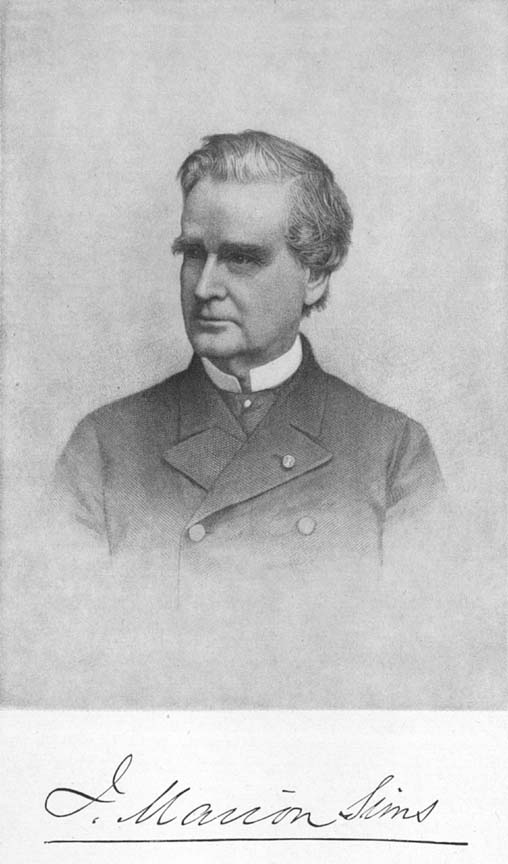
Something more than France's doldrums was responsible for Sims's decision in the fall of '71 to transfer his principal base of activities from Europe to America. Even with Paris temporarily out of the question he might easily have settled again in London, where he had many friends and where a goodly practice awaited him any time he wanted it. That he chose New York over London was due in part to his realization that now at last the opportunity was ripe for him to renew his active association with the Woman's Hospital.
Through his advisory connection with the hospital he could not help knowing that Thomas Addis Emmet was having some difficulty in maintaining his ascendancy as surgeon-in-chief. It was not that anybody questioned Emmet's capabilities; the thousands of patients who had been cured or relieved at the hospital by his dextrous operations and treatment were living testimonials to his professional eminence. Not only had he made marked improvements on Sims's original vesicovaginal-fistula technique, but he had been responsible for numerous other notable developments in the field of gynecology, including the hot-water treatment of pelvic congestions, the application of the medicated vaginal tampon, and the repair of lacerations of the cervix uteri. No, Emmet's trouble was a matter of personality clashes rather than of abilities. A wordy, touchy, and rather humorless man of decided opinions, with no small estimate of his own high claims to distinction, he had suffered all through his nearly ten years as chief surgeon from an incapacity to get along satisfactorily with the Board of Lady Managers and, to a lesser extent, with the Board of Governors and his professional colleagues. All manner of people, it seemed to him, were interfering with him maliciously, spying on him, intriguing against him, and subjecting him to petty persecutions.
The last straw came about the time of Sims's return to New York from his ambulance service in France. Emmet nominated his nephew, Bache Emmet, to be one of his assistant surgeons, but since his power of appointment was only provisional the Board of Lady Managers embarrassed him (as it had done earlier in the cases of Dr. Josiah Nott and others) by refusing to sustain his choice, citing the nephew's youth and inexperience as reasons for its disapproval. Being quite aware that his nephew was older, better educated, and more experienced than the other young surgeon whom the Lady Managers supported in his stead, Emmet was deeply hurt at this snub and expressed his sense of injury in no uncertain terms. As this was merely the culmination of a whole series of somewhat similar incidents, the Board of Governors decided that perhaps the time had come to reorganize the hospital's medical direction.
It is more than a little likely that Marion Sims, as a member of the governing board, had much to do with this decision. James Beckman, E. C. Benedict, Dr. Edward Delafleld, and others of his old friends on the Board had been urging him to return to active connection with the hospital by taking Emmet's place or at least by sharing his responsibilities; but Sims, being well aware of how much hard feeling either of these arrangements might engender, countered with the proposal that in place of the existing one-man rule, a four-man medical board be set up.
In advancing this plan he was motivated in part by his great admiration for the abilities of two gynecologists now serving on the hospital's consulting medical and surgical boards who could be prevailed upon, he was sure, to add to the brilliance of the working staff by accepting appointment with Emmet and himself to the projected new four-man group. The two gynecologists in question were T. Gaillard Thomas and Edmond Randolph Peaslee. The South Carolinian, Thomas, had come a long way in the dozen years since Sims first had placed him in charge of the hospital's outpatient clinic. Though only forty, he was professor of obstetrics and the diseases of women and children at the College of Physicians and Surgeons and had written a comprehensive textbook on women's diseases which was widely used in France, Spain, Italy, and England, as well as in the United States. Sims esteemed him highly as a fine practitioner, a learned and eloquent teacher, and the author of one of the best books in his field. He admired Peaslee, too, although there was inevitably some constraint in the relationship between the impulsive, emotional Southerner and the stern, impassive New Englander. Peaslee was professor of gynecology at Bellevue Hospital Medical College, and his book on ovarian tumors was, in Sims's opinion, the finest monograph on any subject that medical literature had produced. Sims's feeling---in which the other members of the Board of Governors joined him---was that the combination of Peaslee, Thomas, Emmet, and Sims all working together would give the Woman's Hospital a medical and surgical staff equal or superior to that of any other hospital in the world.
Emmet, not surprisingly, held a different opinion on the matter. When the Governors asked him for his viewpoint on the proposal that he be replaced by a four-man medical board, his reaction was one of sorely injured pride. The suggested change, he believed, was the result of "misrepresentation to the Board of Governors by medical men outside who wished to destroy my reputation and get a position in the hospital." The hospital was far better off, he declared, under a single responsible head than it could possibly be under the divided authority of four men. Not only this, but he strongly suspected that the quadrumvirate arrangement was only a blind for a plot to put Sims himself back in supreme command, and he frankly admitted that he hardly could be expected to support cheerfully a change in policy "calculated but to transfer the position now held by me to Dr. Sims." The whole trouble was, he said, that both he and Sims had been unpopular in their one-man rule; therefore if the Board of Governors insisted on creating a medical board the ideal solution was for neither of them to be named, except in a consulting capacity, and for the board to be composed of four other men, whose names he suggested.
It was a rather pitiful plea, with its contradictory contentions that, first, a four-man board was highly undesirable, and, second, that such a board might not be so bad if only Sims (and, by necessary courtesy, himself) were excluded. Not the least pitiful part of it was that apparently it carried no weight; and early in 1872, after his years of devoted service as chief surgeon, Emmet found himself forced to accept a position of equality with Sims, Peaslee, and Thomas on the newly created Medical Board. His fellow members tried to salve his wounded ego by promptly selecting him for chairmanship of their body, but Emmet's sense of injury was so acute that for some time he could not view his distinguished colleagues in any light but as intruders, nor was he able to make any effort to disguise his feelings toward them.
The new arrangement stipulated that the beds of the hospital were to be divided equally among the four surgeons, which heightened the awkwardness of the situation, inasmuch as many of the patients in the beds thus to be divided had been under Emmet's care for a long time. Peaslee, Sims, and Thomas solved this problem by refusing to interfere in the treatment of any of Emmet's patients and by waiving for the time being their right to equal shares of the facilities. In numerous other ways, too, they made such conscientious efforts to treat the deposed monarch with tact and consideration that before long he was effectively disarmed of his hostility.
It was then, with the four great surgeons working smoothly together and acting as a unit on matters of policy, that the Woman's Hospital began to attain the outstanding position of influence of which its founder so long had dreamed. The flow of eager visitors who had streamed into the old Madison Avenue hospital in the '50's to watch Sims's pioneer operations had multiplied many fold now, not only because of the drawing power of Sims's personality and international reputation and of Emmet's great achievements and skill as an operator, but also because Peaslee and Thomas, in their capacity as professors in the city's leading medical colleges, had great numbers of students who considered the opportunity to see their masters at work as one of the major requirements and privileges of their courses. Just as had happened in the prewar days when Sims and his operations were a novelty to New York, many of the men who came to watch and learn went out to practice what they had learned; some of them, indeed, went so far as to found in other states and countries and communities new hospitals for women modeled after the mother institution in New York. This multiplication of women's hospitals patterned on his own was a development which Sims always had hoped to see, and it made him profoundly happy.
He was happy too in the renewed thrill of being again on the hospital's staff and in his stimulating association with his fellow surgeons. Everything seemed to be running most amicably between them, and after the initial tenseness with Emmet their relationships apparently had settled down into a pleasant routine of mutual approbation. Each admired and used the instruments which his colleagues had devised---for Thomas and Emmet were nearly as inventive as Sims and were responsible for almost as many valuable additions to the surgical armamentarium. All of them were unstinting in their praise of each other's works. Thus Thomas, for instance, in one of his public addresses about this time and in a book published soon after, spoke glowingly of Sims as "the master hand" and as the founder of a new era in medicine; and Sims, in turn, wrote with the utmost enthusiasm about Peaslee's development of intraperitoneal medication to prevent septicemia in ovariotomy, and viewed Emmet's paper on laceration of the cervix uteri as such a valuable contribution to surgery that he persuaded the New York County Medical Society to adopt a formal resolution of thanks to its author.
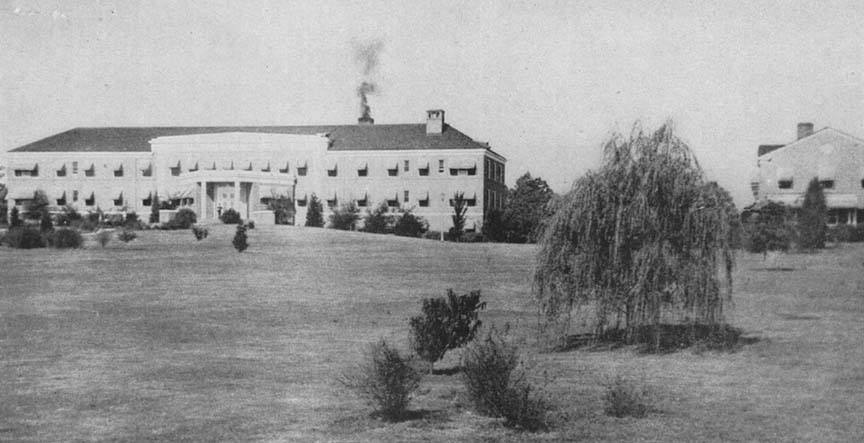
In their dislike as well as their likes the four surgeons saw eye to eye at this period, and it soon became apparent that one of their mutual dislikes was for the fine, roomy hospital site on Fourth Avenue which Sims had worked so hard to obtain fifteen years before. The trouble was that during those fifteen years Commodore Vanderbilt's colossal Grand Central Terminal, with its network of busy tracks and its medley of noisy switching engines, had come into being and so affected the neighborhood that the members of the Woman's Hospital Medical Board, near the close of their first year of joint service, felt impelled to make a radical suggestion on the subject to their Board of Governors (from which Sims had resigned upon his resumption of active duty). "There is indeed but one disadvantage," the doctors told the governors in a written communication, "which mars the perfect working of the hospital for the best interests of its inmates. This is the intolerable nuisance connected with the propinquity of the railroad depot which appropriates Fourth Avenue almost entirely from Forty-second to Fifty-second Streets. At all hours of the day patients rendered nervous, sleepless, and excitable by prolonged disease and often by grave operative procedures are startled and alarmed by the roar of passing trains, while the ceaseless and discordant screeches of engines stationed on the tracks just opposite the walls of the hospital literally render night hideous. The Medical Board sincerely hopes that before the erection of a new wing the propriety of exchanging the present site of the institution for one more quiet and at the same time less expensive may be recognized."
The flaw in this complaint that a railroad terminal was not an ideal neighbor for a hospital lay in the matter of timing. The hardheaded business men who made up the majority of the Board of Governors hardly could have been expected to look kindly upon a recommendation that they abandon so summarily the splendid new hospital building which they had opened with such pride only four years before, and despite the Medical Board's advice the hospital remained firmly planted in the noisy Grand Central area for many years to come. (Not until long after the offending railroad tracks had been submerged beneath the street, in fact, did removal to a new location farther uptown become possible.)
The nearness of the raucous and soot-belching steam engines was particularly obnoxious during the hot summer months; and this, combined with "the malarious effect produced by the digging of the foundation for the new pavilion" (for already the institution was feeling a renewed necessity for expanding) caused the Lady Managers to advocate continuance of the old custom of closing the hospital during July and August. As far as Marion Sims was concerned this was not a bad idea, for he had rented a house at Newport as a summer home and had found that to transport his private patients to Newport also, instead of confining both them and his family to the hot city, was an excellent arrangement.
The acquisition of a Newport house was in keeping with his earnest attempt during these years to do a thorough job of re-Americanizing himself and his household. Upon his return from service in the Franco-Prussian War he had taken the first step along this line by buying a town house at 267 Madison Avenue, near Thirty-ninth Street. Next had come his renewed connection with the hospital, eagerly undertaken despite the financial sacrifice which the unpaid service there involved. At the same time he was making a definite effort to take a more active part in the affairs of the various medical societies---city, state, and national---and was letting himself be named as delegate to various professional-group conventions of the type which, in the past, he had been in the habit of disregarding. Like many another wanderer, apparently, he had come to a sudden realization that it is a good thing for a man to have some roots, and was doing everything he could to establish the solid, homely ties which he needed to make amends for the loss of the cosmopolitan existence he had decided to forego.
Summers spent at the charming old seaport in Rhode Island which had become such a pre-eminent capital of fashion seemed like an excellent substitute to offer to daughters who were inclined to miss the gilded social life to which they had become accustomed in France. The number of these daughters at home had begun to diminish by now, to be sure, for not only had Lisa stayed in France but, in September of '73, Fannie, the fourth of "the beautiful Sims girls," was married to Charles Edward Gregory of New York in a wedding ceremony which the Newport Daily News described ecstatically as "the great social event of the season" and "one of the most elegant that has ever occurred in the City." Marion Sims delighted in giving vast and elaborate receptions, it is true, but even so it is probable that in reporting Fannie Sims's wedding the local paper erred on the side of exaggeration, for Newport by that time already had come to be known as "the millionaires' beach," characterized by unbridled rivalry in extravagant entertaining on a colossal scale which no medical man, however successful, could hope to emulate.
Much as Sims enjoyed social pursuits, however, his summer stays at the Rhode Island resort were far from being pure vacation. He maintained an office there, and a very active office it was, too, for not only were the women who foregathered at Newport no less subject than their sisters elsewhere to the various ailments peculiar to their sex, but most of them were above the average in their ability to pay the kind of fees that were a concomitant of Dr. Sims's renown.
At Newport, far away from the excessive heat and noise and dirt of the Woman's Hospital surroundings, Sims was able to operate in peace and comfort on the women from New York or other parts of the country who did not want to take any chances in the great epidemics of puerperal fever which were so often a feature of summer in the city. One of the things that pleased him most about his Newport practice was that there for the first time he was able (beginning in June of 1873) to have by his side as his aide the young doctor of whose eventual coming he had been dreaming for over thirty years: his own son. When first that dream had begun the son in question had not been Harry, to be sure, but Granville; Granville's death had postponed its fruition by a decade, but now at last Harry had been graduated from the College of Physicians and Surgeons and was ready to begin the apprenticeship which had as its goal his eventual inheritance of his father's shining mantle. If there were any doubts in Marion Sims's mind as to Harry's fitness for this exalted role he strove resolutely to push them aside; true, the boy might be a little frivolous in his tastes now, but surely he would be able to settle down in his father's mold as soon as he was given enough responsibility!
Certainly no young physician ever had a more precipitate or wholesale induction into exacting service. In company with experienced surgeons many years his senior, Harry Sims acted as his father's assistant in a whole series of major operations within a few months after the receipt of his medical degree; the following winter, moreover, he was awarded the very plum which had been denied a few years before to Dr. Thomas Addis Emmet's older and more experienced nephew: an appointment as an assistant surgeon on the staff of the Woman's Hospital. That this appointment may have placed some strain on Emmet's precarious tranquility may be guessed; to Harry's father, however, it seemed merely a logical first step up the ladder for a young man whose inheritance and ability obviously destined him for great things.
Almost as gratifying to Sims as Harry's inclusion on the staff was the fact that another one of his children, his daughter Carrie, was taking enough interest in the hospital to give it her active assistance in its habitual need for more funds. Carrie Sims, possessing an excellent voice and a good share of her father's restless energy, took it upon herself to arrange a series of concerts (or, as the advertising handbills called them, "dramatic and musical entertainments for the benefit of the Woman's Hospital") in which she herself sang one of the leading roles. These benefits brought very substantial financial returns to the hospital, thanks to the lively organizing ability of their sponsor, who, if she had been born in a later period when the activities of "ladies" were not so circumscribed, might very well have been capable, with one or more of her sisters, of carrying on the work of a father who was perennially eager for his fame to be perpetuated by his sons.
Altogether it seemed that Marion Sims had every reason to be glad that he had returned to the United States to live: his family was happily readjusted to New York, his son at last was being groomed to succeed him, and everything was going harmoniously at the hospital which was so close to his heart. Harmony is a tenuous condition, however, subject to summary disruption, and at the Woman's Hospital there soon began to appear ominous signs that the days of its pleasant reign were numbered.
Twenty-five hundred years ago in Greece, it may be recalled, Aristides the just was stripped of power and banished from Athens for no particular reason except that the voters were sick and tired of hearing him continually called "Aristides the Just." In this respect, Marion Sims's banishment from the hospital he had founded had much in common with Aristides's fall from favor. In a pre-eminent degree Sims possessed the faculty of drawing to himself the attention of the world. Since his return from his European triumphs he had been praised and glorified to such an extent that some of his contemporaries, humanly enough, were heartily weary of seeing him cast forever in the role of conquering hero. He was too cocksure, they felt, too reckless, too much inclined to hold the spotlight in a one-man starring part.
Just how much justified these criticisms of Sims may have been is, from this distance, strictly problematical. Certainly he could not be accused, with justice, of having lost the common touch despite his experience of walking with kings. Yet there can be little doubt that he had grown so accustomed to praise and success and to dominance in his field that he had become somewhat impatient of rules and restrictions. On the Woman's Hospital's Medical Board he was supposed to function not as an independent spirit, but as one of a group, and apparently it was as hard for him to adjust himself to this curbing of individualism as it would be for a high-strung race horse to grow accustomed to being harnessed as one of a four-horse team. He himself honestly thought that he was trying hard to be docile in harness and to abide by group decisions, but not a few among those with whom he came into contact at the hospital were convinced that he was too incontrovertibly a prima donna ever to fit in smoothly as a member of the chorus.
Among those who viewed his renewed participation in the hospital's affairs with a jaundiced eye none were more critical than the majority of the members of the Board of Lady Managers. In the nineteen years since the hospital's founding the personnel of this board had undergone many changes, and although a few of the devoted old guard (including the irreplaceable Mrs. Doremus) who had been his staunch supporters in the '50's were still on hand they were far outnumbered by newer members who frankly resented what they considered his attempts to resume control of the institution. Somehow or other they kept receiving prejudiced and distorted reports of the dangerous "experiments" which Sims was said to be conducting upon some of the hospital's patients. (It is possible that the origin of these reports was not unconnected with the fact that the veteran head nurse, Margaret Brennan, had every reason to be dissatisfied with the new regime which lessened the prominence of her revered Dr. Emmet, whose faithful lieutenant she had been for so long.) Time and again these dubious bulletins had to do with Sims's treatment of cancer cases, until the Lady Managers began to be convinced that the lives of all the patients in the institution were being threatened by these mysterious experiments.
Their opposition took the form of a long series of notes and resolutions of protest, addressed first to the Medical Board and later to the male Board of Governors. The reason why the latter course was necessary was that the other members of the Medical Board---particularly Peaslee and Thomas---shared Sims's ambition to find a cure for uterine cancer, and they too were in the habit of admitting occasional patients for operations of this nature. The four physicians united in sending the women's board a resolution urging "that curable cases of cancer of the uterus or those susceptible of decided amelioration be hereafter admitted to the House when such a course can be pursued without detriment or discomfort to the other patients"; and when the ladies, refusing to look kindly upon this suggestion, protested to the Board of Governors against the Medical Board's insubordinate attitude, the embattled surgeons submitted to the Governors a counterproposal urging the provision of a small building suitable for the isolating of "certain cases."
In this affair the four members of the Medical Board stood on common ground, but unfortunately for Sims this was not always the case. Around New York, among those who if they had lived in ancient Athens would have rebelled at that perpetual tag, "the just," for Aristides, there began to be persistent rumors that the wonderful Dr. Sims was not so wonderful after all---that actually he was reckless and overbold and that many of the operations he performed were fraught with danger.
For Sims's own future peace of mind it might have been better if he had learned with the years to bow more frequently to accepted majority dictums---but if he had learned this he would not have been the bold, impulsive Sims whom people loved and hated with such fervor. The trouble was that now, after his two years of service on the Woman's Hospital's reconstructed medical board, the list of black marks entered against his name by those who did not trust him was beginning to assume fairly serious proportions. It was bad enough, according to his critics, for him to insist on performing controversial operations which sometimes resulted in fatalities (such as the new "Battey's operation" ---ovariotomy designed for the purpose of relieving certain nervous disturbances); but it was even worse for him to perform them, as usually he did, in a blaze of publicity. The publicity, to be sure, was not exactly of Sims's own seeking, but so widespread was his reputation as a scintillatingly dextrous performer that every Friday found crowds of physicians and medical students begging for admission to the operating room, which always was filled to capacity while he worked. (Friday was his regular time for operations at the hospital, chosen deliberately because, with a trace of superstition, he regarded it as his lucky day.)
These intent audiences had no adverse effect upon Sims himself, who tended to thrive under the stimulus of their presence, but they were a source of considerable worry for the watchful Lady Managers. "The noise of the tramp up stairs and the loud talking of such a crowd confuses and unnecessarily alarms the patients," they protested in a memorandum to the Board of Governors. "Is the Woman's Hospital to be made a public school or is it to be a Private Hospital where our afflicted Sisters can come without fear?" Things had come to such a sorry pass, they related, that newcomers entering the hospital were being greeted upon their arrival by the older patients' warning: "Do not come here to be operated upon unless you are willing to be made a subject for a great crowd of doctors and students." The members of the Medical Board, according to the Lady Managers, persistently had disregarded their repeated complaints about this situation, which by now had become so intolerable, in their opinion, that the only solution was for the Board of Governors to enact a ruling setting a strict limit to the number of spectators to be allowed admission to any operation.
The hospital's charter from the state, as a matter of fact, had laid down as one of the specific conditions to the granting of public funds that the institution should serve as an informal school where members of the medical profession and their students should feel free to come at all times to receive practical demonstrations in the science of gynecology. But in the face of the Lady Managers' obvious distress at the way this provision was working out, and in response to their veiled threats to cease supporting the hospital if their wishes continued to be disregarded, the Board of Governors (several of whom had no great liking for Sims) obediently enacted the requested ban, stipulating that not more than fifteen spectators, in addition to staff members, should be present at any operation. More than this, they took cognizance of another of the Lady Managers' frequent complaints by ruling also, in January of 1874, that no cases of uterine cancer should be admitted to the hospital.(13)
Up to the time of the Board of Governors' ukase the four surgeons usually had presented a united front in insisting on their right to admit occasional cancer cases and to invite as many spectators as they wished to their operations. They had shared a sense of craft solidarity---a common despairing recognition that although the Lady Managers and the members of the Board of Governors (most of whom were successful business men) were, as Emmet put it, "almost without exception ignorant of all knowledge pertaining to the management of a hospital, yet they were burdened with a full sense of their own importance." Now, however, it began to be not the Medical Board against the Governors and the Lady Managers, but Sims alone against the whole field. Peaslee, Emmet, and Thomas abided docilely by the terms of the Governors' new rules; Sims, however unwillingly, was obedient in the matter of cancer cases, but he made no pretense of heeding the injunction concerning limitation of the number of spectators.
Resistance to this rule, which he considered an infringement upon the dignity and independence of his profession, became as much an obsession with him as resistance to the tax on tea had been with the doughty patriots of Boston a century before; and the activities of the hospital's engineer in serving as official spy upon his comings and goings seemed to him the crowning touch of indignity. On the surface his relationship with his fellow surgeons remained cordial, although from various friends outside he began to hear rumors that one or another of his three colleagues was working against him. Such rumors he could not take too seriously, however, for after all, he thought, the reputation of the Woman's Hospital was almost synonymous with the reputation of Marion Sims, and it was inconceivable that these men for whose appointment as the hospital's surgeons he had been primarily responsible should have any serious disagreement with him over such trivial matters as these.
This condition of apparent, if somewhat uneasy, amity continued throughout the major part of the year 1874, until with the approach of the hospital's traditional annual meeting in November the members of the Medical Board found themselves faced with the preparation of their customary annual report. The actual writing of the report fell to the lot of Dr. Thomas, the Board's secretary, and when he had completed his labors he presented his draft of the document to each of his three colleagues for examination and possible alteration. The report as drawn up by Thomas alluded specifically to the regulation restricting the number of spectators at operations, stating that "The Medical Board desires, and has ever desired, in the interest of the patients and of themselves, that the number of the spectators should be limited," and that the board "announces its determination to do its utmost to obey the law."
Sims apparently joined Emmet and Peaslee in endorsing Thomas' report, although in the debate that raged several years later there was some difference of opinion on this score. Whether or not he gave his approval would be of minor importance if on the following day he had not committed an indiscretion which gave the whole affair lasting prominence. Often before in the course of his career he had allowed his impetuous nature to lead him into the commission of indiscretions, but usually, thanks to his ensuing contrition and to his ingenuous ability to captivate those whom he had offended, he had been able to emerge relatively unscathed from such imbroglios. This time, however, the bomb which he cast in one of his unguarded moments exploded so resoundingly as to destroy all possibility that the wreckage it caused might later be gathered up and fitted neatly together. What his ill-timed bomb destroyed was the very thing which he regarded as the cornerstone and major achievement of his career: his identification with the Woman's Hospital.
 |
 |
The occasion was that annual feast of sweetness and light, the hospital's anniversary meeting. It was the nineteenth of these happy affairs, held, appropriately enough, on the nineteenth of November, and it gave every indication of being even more salubrious than any of its predecessors, for the institution had just completed a banner year; the handsome new pavilion was almost completed, and a goodly assemblage of notables was on hand to celebrate the occasion. There were reports from the various boards, there were invocations and moving appeals by an assortment of eminent divines, there was a fluent address by the celebrity who was the principal speaker of the day. All through these pleasant, if unexciting, ceremonies, so soothing and reassuring in their harmony, the founder of the hospital sat brooding darkly. Just as the time to adjourn was at hand he arose to speak; and by the time he sat down again, a few minutes later, he had torn into tiny tatters the illusory figment of harmony.
If Marion Sims had been a drinking man the intransigent remarks which he made to disrupt that placid, stereotyped anniversary meeting might very well have been attributed to the influence of alcohol. But Sims was an abstainer from liquor; the only intoxicant which oiled his tongue on that ill-fated nineteenth of November was his sense of indignity and righteous anger. "Everything seems to be rose-colored," he began, "and on the surface all is tranquil." But actually, he continued, this calm exterior was deceptive, for in recent months the members of the Medical Board had been feeling distinctly upset by several instances of the Board of Governors' dictatorial policy. These instances, he said, were not limited to the glaring outrages involved in the barring of cancer cases and the restriction on the number of visitors at operations; they included also several other examples of the exercise of arbitrary power in which the Governors had acted "contrary to the expressed wishes of the Medical Board." In the matter of excluding cancer, he asserted, "I have no hesitation in saying that you have transcended the bounds of your authority. But your Medical Board, feeling themselves powerless to resist, have submitted to your dictation." Similarly, concerning the barring of spectators beyond the number of fifteen: "I have always thought that this is a matter in which your Board had no right whatever to interfere, and I think so still .... When you see fit to invade the sanctity of our operating room and to dictate to us who shall be present ... you evidently overstep the limits of your authority."
In justification of this accusatory statement he pointed out that "The Woman's Hospital is today one of the great lights of gynecological science. The profession throughout the country look to it for instruction .... Medical men come up to New York every winter to study the clinical advantages to be found in the metropolis .... They go home with enlarged views and improved methods of treatment. They thereby become friends and patrons of the hospital; they send ... cases to the hospital .... But by our illiberality in excluding our country friends.. . I find we are making enemies of them."
Warming to his subject with rising ire, he seemed quite oblivious of the numerous outsiders at the anniversary celebration who were being placed in the embarrassing position of having to listen to a family quarrel. Worst of all, he declared, was the action of the Board of Governors in placing an attendant "as a spy over your Medical Board to report to you any violation of your rule .... Such an act is unworthy of the Board of Governors .... For myself, I have never heeded your edict and never will; and if you are aggrieved at this you can have my resignation at your next meeting if you wish it."
With this dramatic offer he took his seat. The assemblage, stunned by this sudden onslaught which had converted a love feast into a council of war, sat for a moment in shocked silence which eventually was broken by another angry voice---the voice of one of the wealthy members of the Board of Governors, Colonel George T. M. Davis. For some time Davis had been a leader of that faction of the Board which lost no love on Sims, and now the surgeon's ill-timed diatribe convinced him that his dislike had been well founded. In biting phrases he denied the justice of the accusations Sims had made and censured him sharply for selecting so inopportune an occasion to air his personal grievances.
Before this public battle could be extended any further the president (Sims's long-time friend James W. Beckman) called for the benediction and, immediately thereafter, for adjournment, and the Woman's Hospital's nineteenth anniversary meeting ostensibly was over. The excitement, however, was not over; it had only begun. No sooner was the meeting formally adjourned than Drs. Peaslee, Emmet, and Thomas rushed up to the president's chair to assure him and the assembled members of the two governing boards that they were in no way responsible for their colleague's violent speech. They were completely out of sympathy with his action, they said, and deplored it as an unwarranted misrepresentation of their feelings. Sims, watching them, already was beginning to taste the bitter brew of remorse; the intoxicant of righteous anger had begun to lose its potent effect, and he was commencing to see things in the cold hard light of the morning after. He had not needed Colonel Davis' scathing rebuke to bring him to his senses; the minute he sat down he had found himself filled with regret at what he had done, knocking down in an instant a precious structure which had been twenty years in the building.
Resigning from the Woman's Hospital's Medical Board was the last thing in the world (short of leaving his beloved wife and family) that Marion Sims wanted to do, but he had threatened to submit his resignation, and so he felt obligated to do so. At the time he made his threat he had not expected anyone to take him seriously, but within a week or so after his disastrous explosion he learned that the majority of members of the Boards of Governors and Lady Managers still were outraged at his tactless display of temper; obviously they had every hope that his offer to resign would be consummated without delay.
It was an incredible and humiliating situation for a man who had become accustomed to being courted, praised, and honored, but certainly not to being stripped of power and turned out into the cold. Perhaps he could meet it with grace, he decided, if he accompanied his promised resignation with a frank confession of remorse and a humble apology for his misbehavior. Accordingly, feeling far more like the poor young boy down in South Carolina who had been so perennially convinced of his own unimportance than like the great Sims who had won his shining spurs among the world's elect, he set himself to eating humble pie. To the Board of Lady Managers he addressed a missive which he hoped was sufficiently penitent and conciliatory; but his friend Gaillard Thomas, who attended the ladies' meeting to carry the contrite message and ostensibly to plead Sims's cause, came back with the report that they were still unappeased and still so deeply incensed at his "unwarrantable attack" that their chief concern was to urge the Board of Governors to take the sternest possible measures to discipline the offender. To his own colleagues on the Medical Board he apologized also, admitting that he did not want to resign. And, finally, to the august Board of Governors---of which he himself once had been an honored member---he submitted a letter which, for all the fluency he had acquired with the years, he found quite as hard to write as had been those required compositions of which he had deemed himself incapable so many years ago in school and college. He wrote:
"Gentlemen:
Having said at the annual meeting that I would send in my resignation as Surgeon to the Woman's Hospital, I feel in honor bound to do so.
In taking leave of your honorable body, allow me to say that I feel great regret at having said aught to mar the harmony of the anniversary meeting, and I further regret that I seized that time and occasion to lay my views before you.
J. Marion Sims.
This was one time in his life, however, when he could not be rescued by the magnetic personal charm which usually had served to extricate him from the consequences of his proverbial openness of speech, for of course he himself could not be present at the Board of Governors' meeting to serve as his own advocate. When his letter was presented for consideration Colonel Davis promptly responded by preferring against Sims charges of gross insubordination and demanding that, instead of being permitted to resign, he should be expelled. A few others among the Governors supported Davis in his extreme view of Sims's offenses, but the majority refused to consider the motion for expulsion. There was no attempt, however, to ask the now penitent hothead to withdraw his resignation; the general temper of the meeting did not allow even Sims's most devoted adherents to propose any action but its acceptance.
So that was that. The unbelievable had happened. The founder of the Woman's Hospital was now on the outside looking in, with no voice at all in the management or policies of the unique institution which he loved so devoutly and which, through the years, he had come to consider as a projection of his own personality.
It was a fate precisely the same as that which many years before had overtaken the man he had so admired in his youth and upon whom, to some extent, he had modeled himself---Dr. George McClellan, founder of Jefferson Medical College, whose fiery, restless genius, like that of his pupil Sims, had involved him in difficulties leading to his banishment from the institution which owed to him its birth. McClellan, after being dropped from the Jefferson faculty, promptly had retaliated by establishing a new medical school, and some of Sims's friends now urged him to adopt a similar course---to start a new hospital for women. This, however, was something he could not bear to do. It was the Woman's Hospital---his Woman's Hospital---that he wanted; no substitute could possibly be the same.
There were some who considered Marion Sims a proud, conceited man, but now he proved that he could be a truly humble one: he swallowed his pride, converted himself---his lordly, insouciant self---into a suppliant, and in all humility begged to be reinstated. He simply could not believe that the majority of the Board of Governors, who only a few years before had been so eager to have him back on the staff, honestly could wish to have his connection with the institution severed. He was sure, too, that Emmet and Thomas, his Medical Board colleagues, were deeply upset by his forced resignation, for both of them, unlike Peaslee, had made a point of coming to him to express their regret. It was, he decided, all a matter of prejudice against him on the part of Colonel Davis and his small clique; perhaps if he could make his peace with Davis the whole unpleasant business soon would blow over.
A few weeks after the acceptance of his resignation, therefore, he wrote to Davis, as the leader of the opposition, apologizing again for his "state of momentary excitement" and asking that the Governors reconsider his case and reinstate him. In his letter he mentioned the surprise and distress felt by Emmet and Thomas at the acceptance of his resignation. A few days later, however, in talking with one of the Governors who still was his close friend, he was amazed to be told that not only Peaslee, but Emmet and Thomas too, were eager to have his connection with the hospital terminated, and that indeed they had furnished Colonel Davis (at that gentlemen's request) with a set of statistics purporting to prove that Sims was such a reckless surgeon that his operations at the hospital had resulted in a far greater proportion of fatalities than those which they themselves had performed.
As a matter of fact the friendly Governor who gave Sims this information was somewhat mistaken. Davis had obtained a set of weighted statistics, it is true, but they had been furnished to him not by Sims's ex-colleagues on the Medical Board but by one of the house surgeons. In essence, however, the impression Sims received from this garbled intelligence---the impression that his fellow surgeons were heartily anxious to be rid of him---was not far from the truth. Peaslee quite frankly disliked him; Emmet and Thomas were torn between their old affection for him and their perpetual uneasiness over what they considered his "headstrong arrogance." They admired him as a rarely gifted surgeon and an exceptionally warm and winning personality, but they had given up all hope that he ever would be able to work together with them on equal terms; the brilliant soaring comet could not be harnessed with the steady predictable stars. In Emmet's case, too, this feeling of irritation at Sims's persistent individualism was complicated by a wholly natural touch of jealousy springing from his resentment at the showering upon Sims of a constant stream of adulation which, he believed, he himself was rightfully entitled to share.
To the fallen hero, however, in his present state of mind, all such delicate distinctions as these concerning his confreres' motives or their justification were entirely beside the point; the one thing that mattered was that these men whom he had trusted and taught and admired had turned against him. Already, he learned, they had nominated his old friend Dr. Fordyce Barker---the same Dr. Barker who had been his invaluable supporter twenty years before upon his arrival in New York---to be his successor on the Medical Board, and there was no doubt that the Board of Governors had every intention of confirming Barker's appointment and had no intention at all of considering favorably his own appeal for reinstatement. There was nothing more for him to do but face the fact that he was out, irretrievably out---ignominiously ousted just when he had seemed to be at the peak of his life's achievements. He was still the great and sought-after Marion Sims, to be sure, but he was no longer Dr. Sims of the Woman's Hospital. In that little distinction lay all the difference, from his viewpoint, between successful living and the blackness of defeat.
When Marion Sims lost his temper and fired his disastrous volley at the hospital's governing boards he did precisely what many similarly situated physicians throughout the United States apparently had been longing to do for years, if their reaction to his explosion may be accepted as a criterion. His blast at laymen who presumed to lay down the law to doctors in matters of surgical practice may have been both tactless and ill-advised, but it caught the fancy of numerous medical men as a courageous expression of their own suppressed desires, and promptly they rallied to his support. Hitherto Sims had been a pioneering gynecologist whose reputation, though widespread and distinguished, was limited primarily to the field of his own specialty; now, almost overnight, he was transformed into a popular hero with advocates in every branch of the profession. What he had said, most doctors were convinced, badly needed saying, and their sympathy was with him in his debacle.
This was not true of all physicians, of course. In New York there were many who deplored his conduct; and in New England, where an incipient dislike of the Alabamian had existed ever since his conquest of vesicovaginal fistula had brought him the glory which loyal New Englanders felt should have gone to their own Dr. Hayward, predominant sympathies tended to be with the Massachusetts-born Peaslee and his colleagues. In the South, Midwest, and West, however, the dethroned Woman's Hospital surgeon became a lionized idol. Invitations poured in upon him to speak, to perform operations, to hold offices of honor, to establish new hospitals, and to amplify the remarks he had made at the anniversary meeting. The last two suggestions he would not accept; it was unthinkable that he supplant the Woman's Hospital with a new love, and it was equally unthinkable, in his now repentant mood, that he add any new fuel to the devastating fire which he had kindled. It was a different story, however, with requests that he deliver addresses, demonstrate his methods, or play a part in organizational activities. To these he acceded with an eagerness born of his need to find a fresh interest to supplant the one which had filled so large a part of his life for twenty years.
If the assignment involved a longish journey, so much the better; the nomadic instinct which he had tried so conscientiously to curb during his active association with the hospital was given full play again now that there was no anchor to hold him in New York. In recent years he had limited his peregrinations principally to European trips; now he began to explore the United States as well. Seldom before had he taken time to attend the American Medical Association's meetings, but now he became an active participant in these, no matter where they were held; he cheerfully contributed his presence as a drawing card at gatherings of various state and local medical organizations; and he wandered across the continent for visits in Texas and for a month-long stay in California, where he interlarded his vacation with informal lectures at medical schools and with operations to demonstrate his technique. At these numerous public appearances he was received as a venerated elder statesman, and, with a conscientious curbing of his sometimes contentious spirit, he fitted into his new role with appropriate mellowness.
In 1875, only a few months after the Woman's Hospital fracas, he was elected to the presidency of the American Medical Association. The delegates who voted unanimously to give him this honor made no secret of the fact that the great gynecologist's stand in the hospital controversy was the major factor influencing their choice.
With this vote of confidence to buttress his self-assurance Sims apparently felt justified in tempering his newly acquired mellowness with a decidedly caustic note in giving his presidential address at the A.M.A.'s annual meeting held in the gala atmosphere of the great Centennial Exposition at Philadelphia in 1876. This was no ordinary doctors' session; the eyes of the whole country were focused on Philadelphia that summer, and everything said there reached an audience of abnormally wide proportions. Sims seized on this opportunity to expound his views not only upon such conventional topics as the raising of medical educational standards and the establishing of state boards of health, but also upon certain other subjects which usually were taboo. One of these was the need for legislation to restrain the spread of syphilis; in an era when that disease was rarely mentioned in polite circles, even by medical men, he was far enough ahead of his time to urge greater frankness about it, together with the institution of measures to control its ravages by the isolation of known cases. Even bolder than this, however, by existing standards, was his slashing attack upon that holy of holies, the A.M.A.'s Code of Ethics. He had been feeling particularly bitter about certain aspects of the sacrosanct Code ever since his unhappy experience half a dozen years before with the New York Academy of Medicine's Committee on Ethics, and this seemed to be the ideal opportunity for drawing public attention to its defects. In doing this he knew perfectly well that he was likely to be accused again of tactlessness and all manner of other sins, but he felt strongly enough about it to be willing to take the chance. Accordingly, he proceeded to castigate the Code's stand on patent medicines, the patenting of surgical instruments by physicians, the secrecy of professional consultations, the publishing of announcements by doctors, and other features of the physicians' Decalogue which he considered unjust.
His final target in this unconventional presidential address was an aspect of the Code which probably seemed to him particularly applicable to his late fracas with the New York Academy of Medicine. "Did it ever occur to any of you," he demanded, "that it is capable of being used as an engine of torture and oppression ?--- that men jealously, maliciously intent upon persecuting a fellow member may distort the meaning of the Code to suit their malign purposes, thus entering into a regular conspiracy to blacken character, and that under the sanctity of the Code's provisions? . . This is the first time that the validity, the constitutionality of the Code has been openly called in question. But every honest-thinking man here has at times felt an inward protest against its unequal operation . . . . Honorable men do not need its protection. Dishonest men are not influenced by its edicts."
However much Sims may have enjoyed the honors that were being showered upon him, his exile from the hospital continued to weigh heavily upon his spirit, despite the new popularity it brought him and despite his immersion in other affairs; and with no hospital duties to hold him he soon slipped back into the habit of boarding a ship for Europe whenever the fancy seized him. The summer of the Centennial was no exception; within a few weeks after his Philadelphia attack on the A.M.A. Code, he was back in his familiar haunts abroad: posing for a bust by a French sculptor, speaking before the British Medical Association's annual meeting, treating patients in several countries, and enjoying the opportunity to see again his expatriated daughters. (In the preceding year Carrie, the third of his girls, had been married to William Graham Sandford, secretary of the British Embassy in Paris, thus becoming, like her sister Lisa, almost more European than American.)
The matter of shuttling back and forth across the ocean and picking up a waiting practice at either end had become increasingly easy in the last few years, for not only was Tom Pratt able to handle affairs in Paris in his father-in-law's absence but also it was possible now to leave the New York end in capable hands. Harry Sims was sharing his father's office and beginning to show some promise as a surgical gynecologist, but Sims's major plenipotentiary in New York was Gill Wylie, a young South Carolinian who had been serving as senior assistant at the Woman's Hospital at the time of the 1874 eruption there. Sims was drawn to Wylie both by ties of a common background and by the loyal support he had received from the younger man during his period of crisis, and as the years went by (with Harry proving not too strong a rod to lean upon) he came to depend more and more on the expert help that Wylie could give him in keeping the details of his New York practice running smoothly during his increasingly long absences. He himself no longer felt the financial need to remain in harness day in and day out; so lavish were the fees he received for his services, particularly in Europe, that he found it possible to spend a fair proportion of his time in travel and recreation.
Another aspect of Sims's holiday was a trip into Germany to observe the work of two great professors of surgery and gynecology whose achievements ranked high in his esteem: Koeberlé at Strassburg and Gustav Simon at Heidelberg. Simon's claim upon Sims's interest was not limited to their mutual genius for gynecology; he had the additional distinction of being, next to Sims, Nathan Bozeman's favorite target for vilification, and like Sims he occasionally had made the mistake of enhancing the choleric Bozeman's notoriety by responding in kind to name-calling and abuse. (Bozeman, in fact, was even now in the process of traveling around Europe, demonstrating his methods and doing his best to dispel the benighted Europeans' wrong-headed notion that America's leading light of gynecology was not Bozeman, but Sims.)
Upon his return from this 1876 vacation, Sims plunged into a new preoccupation brought about by the re-emergence into his life of his erstwhile promoter, Henri L. Stuart. In the years since he had used his magic keys to open doors to the newcomer from Alabama, Stuart had been devoting his crusading genius to an array of causes of varying complexions, including active participation in the founding of a new "Eclectic Medical College" whose whole program and platform were anathema to the older-established schools of medicine. Now he was busying himself with the preparation of an array of authoritative articles for a forthcoming reference work (originally projected by his good friend Horace Greeley) to be known as Johnson's New Universal Cyclopaedia. For this compendium he not only was writing articles himself; he also was instrumental in the selection of subjects to be included and of the authors to handle them. In this situation nothing was more natural than that he should strive to give as much favorable publicity as possible to his old protégé Marion Sims, who, after being for years so successful as to seem beyond all need of a promoter's helpful hand, had been transformed by the Woman's Hospital revolution into a potentially suitable subject for the renewed exercise of Stuart's talents. As a first and obvious move he saw to it, of course, that Sims received a long and glowing biographical sketch in the new cyclopedia; and as a secondary form of favorable publicity he persuaded the dethroned Woman's Hospital surgeon to undertake the authorship of several of the cyclopedia's definitive articles. Some of these articles had to do with subjects strictly in Sims's line, such as sterility. One of them, however, was a very different type of thing; it was a biographical sketch of Dr. Horace Wells, the Hartford dentist who was credited with having been the first man to use anesthesia to prevent consciousness of pain.
Sims, still feeling somewhat at loose ends without his hospital responsibilities, agreed willingly enough to furnish the articles Stuart suggested. Biography was something he never had undertaken, to be sure, and he knew little about Horace Wells, but he was and always had been profoundly interested in the subject of anesthesia. His distrust of chloroform for major operations, which had been so dramatically justified in the case of the thrice-moribund "little countess" in France in 1862, had found further evidence to support it in some of his more recent experiences; and although he was on the whole favorable to ether he never ceased his quest for the "perfect anesthetic," experimenting in the course of his search with bichloride of methylin, chloride of ethyl, and various other gases. Now he was glad to have an opportunity to investigate the rival claims of Wells, Morton, and Jackson---all New Englanders---to priority in the use of ether. His decision was in favor of Wells, but just before his article went to press he had an encounter which altered his whole viewpoint.
The encounter was with Dr. P. A. Wilhite, a physician from Anderson, South Carolina, who had brought his daughter to New York to undergo an operation by Sims. With the operation over and the etherized patient still blissfully unconscious, conversation between the surgeon and the patient's father naturally turned to the wonders of anesthesia, and Wilhite amazed Sims by remarking that he himself had been a student under the doctor who first had performed surgical operations under ether's influence. "But how could that be?" Sims protested, knowing that Wilhite had lived in the South all his life, and that the first surgery with ether's aid, as everyone conceded, had been at the Massachusetts General Hospital in Boston in 1846.
Dr. Wilhite then told his story: How, during his boyhood in rural Georgia, the young people of his neighborhood had been in the habit of holding "ether frolics" quite as casually and frequently as their contemporaries elsewhere held dances. The practice was to get a friendly doctor or chemist to mix up a batch of the gas; then the boys and girls would sniff it in varying quantities, depending upon their degree of bravado, and would proceed to have a hilarious time observing each other's antics under its influence. Some would laugh hysterically; others would sing, weep, dance, fight, or stagger around the room and fall down clumsily. At one of these frolics, held early in 1842, according to Wilhite, the doctor who obligingly provided the gas was a young practitioner named Crawford W. Long. Long himself participated in the somewhat morbid entertainment, and at the party's conclusion his friends inquired whether he had been injured by his several hard tumbles over benches while under the ether's spell. Why no, he replied, he had not been hurt at all! Examination of his legs and arms, however, revealed a number of cuts and bumps, and he realized that he must have sustained these injuries without being conscious of them at the time. When he found that several of the other frolickers had had similar experiences it occurred to him that perhaps ether might be used not only for inciting bizarre hilarity but also for preventing awareness of pain.
A week or so later Dr. Long was faced with the task of removing a small tumor from the neck of one of his patients, and, pressing one of his students into service to administer the gas while he himself plied the knife, he put his theory to practice. The results were all that he had hoped for; the patient---and various other patients who submitted to operations at his hands within the next year or so---experienced instead of the dreaded pain only a sensation of pleased surprise that surgery could be such a comfortable process. This was an achievement remarkable enough to have brought the world beating a path to Long's door, but the town he lived in was a small and obscure one, so the only people who knew about his magically painless knife were his neighbors. He realized that he ought to let one of the medical journals have an account of his discovery, but thus far the operations which he had performed under the influence of ether were such trifling ones that they hardly seemed worth reporting; he would wait, he decided, until he had had an opportunity to test the pain-obscuring gas in some surgical procedure of major importance. He still was biding his time several years later when the incredulous world received the awe-inspiring announcement that several men up in New England, by a pooling of efforts, had achieved the miracle of painless surgery. Apparently Long's chance for priority and fame had passed, and though in the years that followed he had become a highly successful practitioner and the proprietor of the largest drugstore in his section of the country, he had remained unknown on any but a local scale.
Marion Sims, learning for the first time through Wilhite's reminiscences that the benefactor who had led all others in bringing to the world the boon of anesthesia still remained unhonored and unsung, and that he was, moreover, a fellow Southerner, promptly bestirred himself to see if he could not aid Long in winning, however belatedly, the recognition which was his due. After ascertaining that the essential points of Wilhite's story were substantially true he plunged with all his accustomed energy into a vigorous campaign in Long's behalf. As one of his first steps he appended to his laudatory biography of Horace Wells for Johnson's Cyclopaedia a postscript (a rather surprising postscript, indeed, in view of the claims he just had advanced for Wells) saying that the real discoverer of anesthesia was not Wells, but Crawford W. Long, whose biography would appear in the Cyclopaedia's appendix, to be published later. Then he entered into a lively correspondence with Long himself, telling him that he had promised to write not only the Cyclopaedia biography but also a comprehensive article on the discovery of anesthesia for the Virginia Medical Monthly.
As an author Sims must have been somewhat trying to his editors and publishers, no matter how much they valued his contributions. The editor of the Virginia Medical Monthly, for instance, was a young Richmond gynecologist named Landon B. Edwards, who was a devout admirer of gynecology's high priest. A few years earlier, when Edwards, after his medical studies and hospital experience in New York, had returned to his native state filled with the ambition to inaugurate a professional journal there, he had been aided substantially in achieving his goal by Sims's advice, encouragement, and financial assistance. Now, as the greatest boon of all, Sims had promised to give to Edwards' still-new and modest magazine one of those rare articles from his pen which presumably one of the older, larger, and more influential journals would have been only too proud to publish. It was a great feather in Edwards' cap, and several months before the article was to appear he began printing happy little notices on his editorial page telling his readers of the delights in store for them.
Sims's article on anesthesia was scheduled prominently for publication in the Virginia Medical Monthly for April, 1877, but when that issue appeared it contained instead a makeshift leading article and the following announcement from the editor: "It is with deep regret that, at the latest possible moment that we can wait for the article on the Discovery of Anesthesia by Dr. J. Marion Sims, we are compelled to go to press without it." Partly this disappointment was due, according to Edwards, to an illness of Sims which had delayed the article's completion, but even so it might have been published according to plan had it not been for the fact that "After the manuscript was received and set up in type, revised and corrected, and ready for the press, we received a telegram from the author asking us not to go to press with it until he could again revise the proofs, as he had just obtained more facts which he desired to insert. This article, which is of the intensest interest throughout, will appear as the leader in our May number." Appear in May it did, but only by dint of postponing issuance of the Monthly two weeks beyond its usual date; and even then there came a letter from Sims immediately after the journal had been irrevocably printed, asking that the publication date be deferred a little longer, if possible, as he just had obtained some additional facts!
Whatever headaches it may have caused the Monthly's proud editor, Sims's article on "The Discovery of Anesthesia" is one of the best products of his too seldom active pen. Perhaps because it was purely a labor of love, quite without occasion for mention of his own experiences or grudges, it is entirely lacking in the zealous subjectivity and naive conceit which characterize such productions as his Academy of Medicine discourse on silver sutures and his fragmentary autobiography. Instead it is a graphic, interesting, and remarkably objective account of a subject which has caused and continues to cause much controversy. In the matter of priority in anesthesia's use, to be sure, Sims left no doubt that in his opinion all credit must go first to Crawford Long and next to Horace Wells, but he presented in some detail and with a fair degree of sympathy the rival claims of Morton and Jackson, and concluded by asking that the medical profession unite in asking Congress to grant some fitting emolument to all four of these men or their surviving families, even as European countries were in the habit of doing for their medical and scientific benefactors.
Though it was unsuccessful in goading Congress into the desired enactment, Sims's campaigning in Long's behalf (which he prosecuted not only in his articles but also through printed pamphlets and a New York lecture) did have a pronounced effect in bringing to the Georgian a widespread degree of belated recognition which he hardly would have received had his cause not enlisted the support of so prominent and energetic a champion. There was some controversy, of course, over the sudden advancement of these new claims to credit for anesthesia's discovery, but by the time this had developed Marion Sims himself was in no mood to participate. He had become involved in another controversy, far bitterer and more personal in nature.