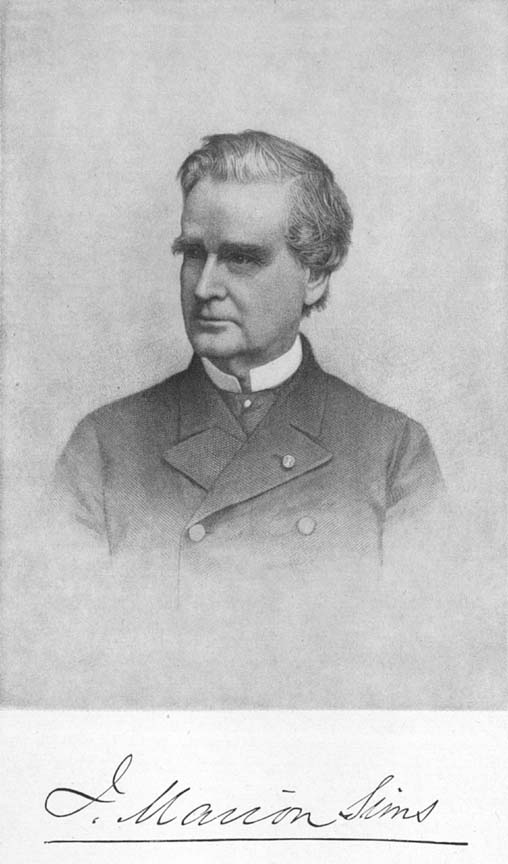
Something more than the stage-fright incident to his medical debut was troubling Sims as he made the slow journey back to Lancasterville that May of 1835. He also was worried about his relationship with Theresa. He had hoped against hope that somehow by the time he returned he would have attained such a degree of worldly success as to justify him in boldly storming Mrs. Jones's fortress and playing at last the part of the eligible and triumphant suitor. Instead of that he found himself doomed to a re-entrance as humble and unimpressive as ever, doomed too, presumably, to an indefinite prolongation of the secret agreement by which he must not visit Theresa or publicly reveal his love for her. For a youth of twenty, still sheltered by his role as student, this tender private understanding had been stimulating and not too unsatisfactory; but for a young man of twenty-two, conscious that he was still unable to support himself, let alone a wife, it was a dismal prospect.
In these gloomy forebodings Sims was unaware of a new factor that was about to work in his favor---the establishing in Lancasterville of a Presbyterian Church. Up to this time, strangely enough, the town (which had grown up around its court house and its taverns) had been practically without churches, but during Marion's sojourn in Philadelphia both the Methodists and the Presbyterians had bestirred themselves to do something about this lack. The Methodists' decision was of only minor interest to Sims, but that of the Presbyterians turned out to be his lucky omen, for it was responsible for providing him with a powerful advocate at court.
The advocate was his old hero, James Thornwell, for whose brilliant gifts of intellect and oratory he had cherished such great admiration at South Carolina College three or four years before. Thornwell always had intended to be a lawyer, but soon after he had started studying for the bar he had experienced a profound emotional upheaval and religious conversion which had caused him to change his plans. Abandoning his legal ambitions and the prospects of a distinguished political career which all who knew him had predicted he had become a Presbyterian minister---a very fervent, highly orthodox, intensely serious Presbyterian minister. Only recently returned from theological seminary in Massachusetts, he had been assigned to preach at Old Waxhaw Church in Lancaster District, and thus he became the logical choice for the ministry of the new church just opening in Lancasterville.
To find his former college friend installed as one of his home community's leaders was not only a pleasant surprise for Sims, but a boon as well, for Thornwell, with his forensic gifts and his pastoral authority, had powers of persuasion which Sims himself still lacked. The most active and interested members of Thornwell's new congregation were Theresa Jones's close relatives: her mother and grandmother and uncle and her brother-in-law James Witherspoon, not to mention Colonel Witherspoon himself and his oldest daughter Nancy, in whom the new minister already seemed to be taking a rather more than pastoral interest. Theresa herself also was included in the Presbyterian flock, of course, and it did not take long for her and the new minister to discover that they had a close friend in common. For two years, under considerable pressure from her mother to make up her mind as to which of her suitors she would marry, Theresa had persevered in concealing from everyone but Betsy Witherspoon and Wash Sims the secret of her agreement with Marion, but the fact that Thornwell had been Marion's friend broke down her reserve, and she told him about her secret engagement.
Hence when Marion came home he found himself welcomed by an old friend who was also a new ally in his siege of the Jones barricade. Thornwell urged Sims to abandon his public pretense of not being interested in Theresa and to embark instead upon an open courtship. This advice, naturally, was more than welcome to its recipient, who adopted it enthusiastically, dropping in to call on Theresa every day or so, accompanying her to parties and to church, and going horseback riding with her. This revival of a ghost which she thought had been banished was a cause for considerable uneasiness for Mrs. Jones, who could not forget that Colonel Sims still owed a sizable sum of money to her husband's estate and who certainly had no grounds as yet to believe that Marion was any better than his father as a financial risk. True, Marion was now a doctor, but she could not see any prospect that he would be able to make a living by his profession, for Lancaster District already was oversupplied with doctors---several of them, in fact, being in Mrs. Jones's own family.
It was Thornwell, the newcomer, who finally brought the undercover struggle out into the open. One day Theresa's mulatto maid and confidante, Annie, came to him in high excitement with the news that she had overheard Mrs. Jones telling her brother that she was going to bring an end, once and for all, to this business between her daughter and young Dr. Sims, who was a nice enough fellow but not the right one for Theresa to marry. Thornwell hastened at once to relay to his friend this news of an impending explosion, and Sims decided there was nothing for him to do but write a letter of explanation to Mrs. Jones.
For a youth who always had eschewed the writing of compositions he acquitted himself with remarkable speed and facility, dashing off within a few minutes, while the waiting Thornwell read a newspaper, a properly repentant yet buoyantly confident note revealing "the relationship existing between your daughter Theresa and myself," apologizing for not having disclosed it sooner, expressing his respect for Mrs. Jones's parental authority and his desire to obtain her approbation, and voicing his hope that she would soon relieve him of the suspense which was oppressing his mind, although he admitted that circumstances rendered it inexpedient for him to propose marriage immediately.
Thornwell read the note, approved of it, and volunteered to act as messenger. When he delivered the letter Mrs. Jones read it in his presence, then burst into tears, exclaiming that she could not possibly give her consent to such a marriage either now or later.
"Pray, what is your objection to him?" asked Thornwell.
Mrs. Jones, as a true Southern lady, naturally could not stoop to mention crass financial matters, so she said that the only specific objection she could think of was that young Sims did not belong to the church.
"Two years ago," replied Thornwell, "I was not a member of the church myself. I know that in college Marion Sims was a boy of good morals. He swears a little bit occasionally, but he can be cured of that; he has no really bad habits. Now, as I view it, when two young people's hearts have clung to each other from childhood up, the interference of parents and friends is a very serious matter unless there is the best of reasons for it, and here there is absolutely none."
That was only the beginning of his lecture to the lady who to Sims was the awe-inspiring mother of his beloved, but to the minister was simply an erring member of his congregation. It was not for nothing that Thornwell had been the oratorical pride of South Carolina College and had seemed destined for a career as a great lawyer. When he concluded his brief for the plaintiff with the stern admonition that "It is impossible for you to separate these two young people and I advise you, as your pastor, to dismiss the whole of this nonsense and let them come together" Mrs. Jones did not immediately withdraw her opposition, but something of the wonted assurance and authority seemed to have vanished from her manner.
It took her ten days to bow to the inevitable---ten days during which Theresa remained a prisoner in her room and Marion stayed strictly out of sight. At the end of this anxious probationary period Thornwell won his battle, and Mrs. Jones, heroically swallowing all recriminations, belatedly gave her blessing to the engagement. In doing so she had to contend with no small quantity of articulate disapproval voiced by divers Witherspoon, Crawford, and Dunlap relatives who felt that in the contemplated alliance Theresa would be marrying beneath her station; but Mrs. Jones, mindful of her minister's ringing exhortations, stuck bravely to her guns and ruled that the couple might be married as soon as Marion was able to provide for her daughter.
In that all-important matter of earning a living, however, Sims was not merely faring so badly as he had feared; he was faring worse. Just as his matrimonial prospects began to brighten his professional prospects grew cloudier and cloudier. It had not been so bad for the first month, when he simply sat apprehensively in the Main Street office his father had rented for him, dreading the possibility of actually being called upon to treat a patient. The fact that no patients turned up did not worry him unduly; that was in the accepted tradition for fledgling physicians, and it was always possible to cheer himself up by admiring his beautiful framed diploma on the wall or by stepping outside the door to glance with pride at the huge gold-lettered tin sign announcing to all who passed along the street that "J. Marion Sims, Physician and Surgeon," was to be found within. In the second month, however, just as he was feeling his happiest at the official sanction of his engagement, he had his first patient. Into his peaceful office, hitherto visited only by relatives or friends intent on stepping in out of the sun and passing a sociable half-hour or so, there came one morning the man who years before had fitted him with his first suit of bought clothes---Andy Mayer, Lancaster's former mayor and long its only tailor.
Mr. Mayer was obviously worried. "Marion," he said, "I wish you'd go up to my house to see my baby. I'm afraid he is dangerously ill."
Sims's heart began to pound, and he longed ardently for the good old days when no patients had darkened his door. He knew very well, of course, that the only reason Andy Mayer had come to him was that he was the only physician in the district at the moment, the others being away on summer vacation trips. Whatever the reason, however, he actually had come, and it was up to the proprietor of the office to act as if he really was entitled to the beautiful diploma and the big tin sign. "What's the matter with the baby, Andy?" he asked.
"I am sure I don't know," replied Mr. Mayer. "That is for you to determine. I wish you would go see him at once."
Sims tried to stall for time; tried to tell Mayer he would be along in just a few moments. He wanted a chance to consult his precious Eberle treatise on Diseases of Children in order to find out what might possibly be wrong with an eighteen-month-old baby. But Mayer would not be put off. A few moments' delay might be fatal, he said, so the reluctant doctor hastened to the bedside of the sick child.
He found it with a burning fever, pitifully emaciated from what its mother called "the summer complaint" (diarrhea). Sims examined his small patient minutely from head to foot, with mounting bafflement as to the nature of the disease and of the measures which he himself was supposed to take. He noted with some relief that the infant's gums seemed to be swollen. Here at least was one symptom which was not Greek to a young doctor with surgical propensities! Gratefully he took out his lancet and, with sure strokes, cut the gums. Such an authoritative action, he felt, ought to impress the worried parents with the fact that he was a physician who knew what he was about. Beyond that he was completely at a loss as to what to do, but he told the Mayers that their baby was threatened with congestion.
"Congestion of what, Marion?" they asked him.
"At this stage of his illness," came the reply, "I am not prepared to say. I rather think-that is, it is my judgment---he will have congestion of the bowels, brain, or lungs---perhaps congestion of them all."
"All at once, Marion?"
"Yes, Andy, and when the three do combine, chances of recovery are exceedingly doubtful. However, I will do the best I can."
After giving this impressive prognosis he announced that he was returning to his office to compound a prescription, asking the Mayers to send Jennie, their Negro girl, within an hour to get the medicine and instructions for its use. Back at the office, he hastily took down Eberle's Diseases of Children and turned the pages with trembling fingers, hoping that by some miracle he might find out what ailed the Mayer baby. Almost at once he came upon Eberle's description of cholera infantum. Well, it might be that quite as well as anything else. Sims compounded the recommended medicine and gave it to Jennie when she came, saying he would call to see the baby in the afternoon.
When he went, the infant was no better, so he gave instructions for Jennie to be sent to him again, after a suitable interval, for a different kind of medicine, which he compounded after hurriedly reading a second chapter of Eberle dealing with an entirely different complaint. This procedure went on for several days, with the prescriptions being changed once or twice a day and the baby growing steadily weaker, while the old nurse to whom the Mayers had assigned the care of the child gazed upon the ineffectual young doctor with growing disdain. Finally there came a day when she told him that the child was going to die, and he assured her that this was unlikely. A few minutes later the infant stopped breathing, and Sims, remembering his medical school training, jerked it from its bed, held its head down, shook it, blew into its mouth, and shook it again. He was certain that he would be able to restore its respiration, for it was quite inconceivable that his very first patient should die. Absorbed in his frantic efforts, he felt a hand laid gently on his shoulder, and from what seemed far away he heard the old nurse's voice saying: "No use shaking that baby any more, doctor. That baby's dead."
Numbly, automatically, Sims walked back to his office, locked the door, dropped into his chair, looked at his mocking diploma, and wept, wishing for death. At the child's funeral he was the most disconsolate of all the mourners, moved by a grief which, he believed, exceeded even that of the parents. He thought humbly of Dr. Churchill Jones, still far away on a visit to Tennessee, and hoped ardently that he would return before any more of Lancasterville's babies fell ill.
Fortune refused to favor him, however. With Dr. Church still out of town, Elias Kennedy's baby came down a few weeks later with symptoms exactly like those which had brought the other infant to its grave, and there was none but Marion to care for him. Kennedy, who was Andy Mayer's employee and close friend, was none too happy at the prospect, and even as he importuned the demurring young doctor to examine his child he added: "I hope you will have better luck than you did with Andy's baby."
"If I don't, Elias," said Sims solemnly, "I'll leave town."
This time he reversed the treatment, starting at the back of Eberle and working forward, but Kennedy's baby fared no better than Mayer's. While it was still just barely alive Dr. Churchill Jones returned from Tennessee, and Sims, hastening to tell him all that happened, begged him to examine and prescribe for the child. Dr. Church went promptly to the Kennedy home, but after one look at the poor little patient he took his former pupil outside the house and told him bluntly: "That baby is going to die tonight."
"Then I shall never be your successor in this town, doctor," declared Sims, "for I shall leave."
After the funeral (for of course old Dr. Church was right, and the baby died that night) Sims sat for hours in his office in complete communion with misery and despair. At one o'clock in the morning, when all the village was asleep, he crept stealthily out, procured a ladder, leaned it against the front of the house, climbed up, and removed his ponderous professional sign from its moorings. Staggering under its weight, he dragged it out in the back yard and tried to hide it in the weeds. On second thought, however, he decided that no weeds grew tall enough or thick enough to hide his shame. At this point his memory suddenly reminded him that not far away, and far better for his purposes, there was an old dry well, reputed to be forty feet deep. So again he shouldered his despised burden until at last he was able to dispose of it, bidding mocking farewell to J. Marion Sims, Physician and Surgeon, and feeling tempted to toss himself down too, in company with the sign which symbolized his failure. His courage deserted him, though, at thought of such a summary departure, and so instead he crept stealthily home and to bed.
The next morning there were many early knocks at his door, as hosts of excited friends called to tell him that apparently his sign had been stolen during the night. He expressed shocked disbelief, dressed hurriedly, and went out to stand in the midst of the crowd, surveying the blank space where only yesterday his name and calling had reigned. Everybody was horrified that such an act of vandalism could occur in peaceful Lancasterville, and search was made promptly for the culprit and the missing sign, but no trace of either could be found.
When the first excitement was over and the now anonymous doctor was sitting forlornly in the wreckage of his office, having hidden from sight all vestige of his instruments, his medicines, and his books, not to mention his diploma, he had another visitor. It was his father.
"What does all this mean, Marion?" asked Colonel Sims. "What's the trouble?"
"It means that I am going to leave town. 1 am going to leave town tomorrow morning."
"Where are you going? You have no money."
"That makes no difference. My mind is made up. I shall leave for Alabama in the morning, before I am driven out as a humbug. Think of it: two months; two patients; both dead!"
There was something about going to the far western land of Alabama that seemed to fill his need to escape from disappointment and failure; two years before, when his suit for Theresa appeared hopeless, he had dreamed of migrating there to start life over again; and now in his new disgrace the old dream returned. But today, as in the former instance, his father's counsel and his own lack of money served, at least temporarily, as deterrents. He longed to set out at once, with or without funds, burning all his bridges behind him; but Colonel Sims told him that if he would wait a month or so he himself would join the expedition and would provide as well a horse and wagon for the trip. Such an offer of parental co-operation was not to be taken lightly, even by a desperate man whose name and reputation had vanished down a well; hence Marion reluctantly consented to bide his time. Those two months while he was waiting for escape were at least as bad as the months he had spent in 1832 when love was lost and with it all the world. This time, to be sure, he at least had love, for Theresa was steadfast in her devotion and her faith in his future; but her very devotion served to deepen his depression and his feeling of unworthiness. He was, he knew, only a handicap to her, and she stuck to him only out of misplaced loyalty. It was not fair to a girl to expect her to wait so long for a man who apparently was destined to be nothing but a failure. He watched in gloomy fascination as his friend James Thornwell---a notably homely man, for all his mental power---made rapid strides in his suit for the hand of Colonel Witherspoon's daughter Nancy, Theresa's cousin. In only a few short months the minister's wooing had progressed further than Marion's campaign for Theresa had done in a decade; already plans were afoot for the Thornwell-Witherspoon wedding. This pointed contrast between the fate of the man who was a success in his profession and the one who was found wanting accentuated Sims's eagerness to seek a new start elsewhere.
Before he could leave, however, he was summoned to treat another patient, thereby earning his first money in the practice of his profession. (He had not dared send bills for his attendance on the babies who had died.) The patient was Lancaster's richest man, Captain William McKenna, a peppery Irish politician who owned a hundred slaves and a successful store and nearly half the real estate in the village. None of these distinctions were so important in Sims's eyes as the fact that McKenna was the father-in-law of his own beloved old friend and teacher, J. F. G. Mittag, although two men more dissimilar would have been difficult to imagine. Undeterred by Sims's retirement into professional anonymity, McKenna elected to send for him to handle one of the bouts of delirium tremens which followed his periodic sprees. Sims knew no more about delirium tremens that he did about infant diarrhea, and he cared far less for McKenna that he did for Mayer's and Kennedy's babies, but his luck was better this time, and the patient recovered in such good order that he hastened to press upon his unhappy doctor a ten dollar bill---a fairly fabulous sum, as fees went in that era and locality.
Perhaps this was a good omen, felt Sims, although he could not help reflecting sardonically that the patients who should have lived had died and the one who (in his opinion) might just as well have died had been guided all too easily back to life. It was not enough of an omen, however, to tempt him to change his mind about leaving Lancaster, and when the second week of October rolled around he excitedly stowed his clothes, medicines, instruments, and Eberle's medical books in the back of his father's little Yankee carryall and with high hopes set out for that fabulous new world, Alabama. The one flaw in the picture was that once again he was having to part from Theresa; but Alabama, he was sure, was the land of promise where his luck was to change, and soon he should be able to return to take her with him to his new kingdom.
 |
 |
Ever since Marion Sims could remember he had been hearing people talk about moving to Alabama, which had won its statehood at about the time he was learning his ABC's. For nearly a score of years restless spirits from the South Atlantic states, including many from Lancaster District, had been flocking there to settle on the rich land from which Generals Andrew Jackson and John Coffee and their conglomerate cohorts so recently had expelled the Indians to whom it had belonged for centuries. Among the ex-Carolinians in Alabama were a number whom Sims knew well, and many of these made a habit of sending back to their old friends at home glowing accounts of the wonderful opportunities for pioneers and of the thousands of acres of fertile land still available. Settlers were pouring in so fast, they wrote, that the new state's population already had shot up far beyond the 300,000 mark.
To the disgruntled young doctor in Lancasterville it sounded like an unparalleled chance to start life anew under more favorable circumstances, and his always restless father was quick to share his enthusiasm. Of all the promised lands in Alabama the most alluring, according to reports, seemed to be Marengo County. When the Simses left home, therefore, they told everyone that that was to be their destination. To Marengo County from Lancasterville was a journey of nearly 500 miles, and the going was extremely slow---mostly over woodland trails so rough that either riding or driving was out of the question. Most of the time, accordingly, they made their southwestward trek by foot, with the loaded carryall jolting along behind them; but since both father and son were hardy woodsmen and enthusiastic marksmen the difficult trip had all the aspects of a wonderful adventure.
Adventure or no, however, they were glad after three weeks on the trail to break their journey for a while to visit with some Carolina friends at the little settlement of Mount Meigs, fifteen or twenty miles east of Montgomery and nearly a hundred miles short of their destination in Marengo County. Several men whom the Simses had known in Lancasterville had settled there, including Ward Crockett, the erstwhile model boy of Franklin Academy who had blasted Marion's plans some years before by failing to sit on the pin so carefully planted in the teacher's chair. All of these old acquaintances united in telling the younger Sims that he was foolish to think of traveling farther. The section around Mount Meigs, they said, was badly in need of a new physician. There was Dr. Lucas, to be sure, but he was so wealthy and so busy with his plantations and his politics that he had comparatively little time to give to medicine. There was old Dr. Childers, too, but he was such a restless soul that he could not stay put in one place more than a year or so, and already he had been in Mount Meigs for eighteen months. Obviously he soon would be moving on, and Sims could count on falling heir to his practice and to much of Dr. Lucas' as well.
Sims appreciated his friends' desire to keep him in their midst, but his heart was set on Marengo County. Besides, he did not like Mount Meigs. It struck him as the most dissipated little place he ever had seen. Women were scarce, and the chief occupations of most of the men seemed to be drinking and fighting. Certainly he could not visualize this as an environment to which he would wish to transplant the gently reared Theresa, so he wrote to her that he planned to leave his belongings in Mount Meigs and to set out on a tour through Perry, Greene, Marengo, Wilcox, and Lowndes counties, hoping that in one of them he might find a place more to his liking.
Before he could put this program into effect, however, he had changed his mind. His father---to whom, naturally, he felt deeply indebted---had joined the intrenched Mount Meigs boosters in urging him to remain in a locality where opportunity seemed assured rather than to strike off for himself into unknown territory. His friends united in assuring him that the vulgarity and crudity which characterized Mount Meigs were equally characteristic of practically all the other little new towns of this pioneer region. Moreover, they told him, Mount Meigs was improving by leaps and bounds; its population was increasing rapidly, and within a year or so, they were sure, its social life would be quite up to the standards expected by such a girl as Theresa Jones.
It remained for old Dr. Childers, however, to advance the clinching argument; itching to be on the move again, he lost no time in offering to turn over his practice to the newcomer and to sell him, on credit, all his medicines and books. Since Childers' reputation as a learned doctor was widespread all through Georgia and Alabama this was a chance not to be missed; and Sims, bidding farewell to his dreams of the alluring but unknown Marengo County, agreed to make Mount Meigs his home. Within a few more days his father had turned back toward Lancaster, and he was left at last to make his way alone.
At first his new routine consisted principally of accompanying Dr. Childers on his professional visits, and after a brief taste of this Sims began to wonder why the old man had such an impressive reputation as a medical authority. He was zealous and kind and meticulous, to be sure, but, like many of his contemporaries, he placed his chief reliance on the lancet and other heroic measures which to the invalids under treatment often must have seemed worse than the disease itself.
The more he saw of the tactics of Dr. Childers and others of his contemporaries the more worried he became about the standards of the profession of which he was now a member. He was already well aware that he himself knew practically nothing about medicine, but now he began to realize that a great many older physicians knew very little more than he did. Some of their practices were not merely heroic---they were murderous; often, he felt, patients would be better off if they trusted entirely to nature rather than to the haphazard empiricism of the doctors, with their blistering, bleeding, and monumental dosing.
Such reflections might well have been disastrous to the self-confidence of a young physician just embarking on his career, but fortunately for Sims he soon was too busy to have much time left for meditation or misgivings. His friends had been right in telling him that if he stayed in Mount Meigs he would have plenty of patients, for, as he cheerfully wrote Theresa, "the vicinity is a rich, densely populated country, and withal sickly." That he himself might in time be affected by the region's prevailing sickliness did not occur to him, for he always had been a healthy youth. For the moment it was miracle enough to find himself falling heir not only to Dr. Childers' practice but also to part of Dr. Lucas', since that prosperous gentleman was so tied up in state politics that he had to spend a sizable portion of his time at Tuscaloosa (then Alabama's capital) and perforce was often away from Mount Meigs for a month or more at a time.
It was because of one of Dr. Lucas' prolonged absences, in fact, that Sims had his first experience as a consulting physician. One day only a few weeks after his arrival in Mount Meigs a stranger came riding into the village seeking Dr. Lucas; but since Dr. Lucas was away and Dr. Childers already had moved on to the next chapter of his restless odyssey the only physician available was Sims, the neophyte, and to him the stranger told his mission. His name, he said, was Evans, and he came as a messenger from Benjamin Baldwin, a wealthy planter of the Union Springs neighborhood, a new community more than twenty-five miles away. Baldwin's daughter, Mrs. FitzGreene, who had given birth to a baby several days before, was seriously ill with puerperal fever, and Evans begged Sims to come with him and try to save her life. Sims, feeling even more ignorant about the diseases of women in childbirth than about most other medical matters, was so horrified at the suggestion that he begged the travel-stained emissary from Union Springs to keep on riding as far as Montgomery, where he might find a doctor possessing the necessary knowledge and right experience.
Evans was insistent, however, for going on to Montgomery meant almost doubling his journey, and time was precious Sims had no choice but to comply with his urgent request, so with copious misgivings he tossed a few things into his saddlebags and joined Evans on his long ride back through swamps and almost indistinguishable wilderness trails. Night fell as they rode, and all around them they could see the Indians' campfires flickering and hear the dismal howling of the wolves, providing a fitting accompaniment for Sims's qualms about his mission. His spirits rose, however, when, late at night, they came at last to Mr. Baldwin's clearing, with its score or more of Negro cabins, and entered the planter's own large and cheerful living room, which in Sims's eyes was particularly distinguished by its possession of a piano---a piano in the depths of the wilderness!
Better even than the piano were the two beautiful young ladies who immediately took him in charge---Mr. Baldwin's niece and younger daughter, products of a Georgia finishing school who, bored with their life in the wilds, were pleasantly excited at the sudden arrival in their midst of a good-looking youth with a lively sense of fun. While they fed him supper and made much of him, Sims, holding firmly to his memories of Theresa, began to realize that a doctor's life was not without its secondary advantages.
The main business which had brought him to the Baldwins', however, was not so pleasant as the sidelines. Not only was Mrs. FitzGreene dangerously ill, with Sims completely innocent of any notion as to what should be done for her, but also there was the complication provided by the presence of another and older doctor ---a heavy drinker whose nearly perpetual state of intoxication had depreciated the value of his services to such an extent that Mr. Baldwin had felt it essential to call for reinforcements. Sims, though almost completely ignorant of puerperal fever, at least knew enough to recognize that Mrs. FitzGreene was critically ill and that the bibulous doctor was indignant at an ignorant young puppy's intrusion upon his preserves. The ignorant young puppy soothed the tense situation, however, by assuring the offended practitioner that he had no alterations to suggest in the method of treatment. "My dear doctor," he said, "I find that you have managed this case strictly in accordance with the principles laid down by our very best medical authorities."
Actually, of course, Sims had not the faintest idea as to what principles were laid down by the best medical authorities, and even if he had been conversant with them he would have been little better off, for puerperal fever was still a complete mystery to the medical profession. Physicians knew that a ghastly proportion of women died of this relentless disease which so often followed childbirth, but they never guessed that the cause of the disease was the infection carried by their own contaminated instruments and hands and clothes. From sickbed to sickbed they went, wiping their hands on their handkerchiefs or coattails, stuffing their instruments into their pockets or bags, and wondering why the blooming young women who seemed so healthy at the time of parturition should often sicken and die a few days later. The answer seemed to be that females were notoriously a perverse and mysterious sex, and probably Providence had no intention of letting mere man understand them.
For a tyro like Sims, who enjoyed women as companions but disliked them as subjects for medical investigation, such meditations were distinctly distasteful. It was pleasanter and safer to leave the care of the stricken Mrs. FitzGreene entirely in the hands of the more experienced physician, however deplorable his drinking habits. Fully conscious of his own inability to be of any service whatever, Sims prepared to return home the morning after his arrival, but the Baldwins insisted that he must remain until the crisis was over. For the next several days, therefore, his position was a peculiar one; two or three times daily he met his older colleague in the sickroom and gravely went through the motions of professional consultation, while the rest of the time---his youthful conscience quite untroubled by the anomaly of his situation ---he enjoyed the musical accomplishments of the dying woman's charming sister and cousin or joined them in racing through the wilderness on their fleet horses.
One of these wilderness excursions with the two girls served as a prologue to the first great thrill of his professional career: his initial experience in saving a human life through his own surgical skill. He had seen such miracles performed many times by his old preceptors, Dr. McClellan and Dr. Churchill Jones, but so far he himself had had no chance to emulate them, although nearly nine months had passed since he had received his medical degree. Now at last, however, the opportunity came. Mr. Evans, the same neighbor of the Baldwins who had ridden all the way to Mount Meigs to summon Sims several days before, again was the one to enlist his services. This time Evans' concern was for Mr. Adams, the overseer of a near-by plantation, who had been desperately ill for many weeks. During his invalidism he had been examined by half a dozen different doctors summoned from communities twenty or thirty or forty miles away, but though all of them had prescribed for him not one of their prescriptions had done him the least bit of good. Because of the length of the journey none of these physicians had returned to see their patient a second time. Inasmuch as Sims happened to be in the neighborhood Evans felt that it was incumbent upon him to add his examination of Adams to those which had gone before; perhaps he might be able to succeed where others had failed. Sims greeted Evans' new petition by protesting that in view of his insignificance and inexperience (not to mention his marked lack of success with Mrs. FitzGreene's case) he did not care to join the medical profession in attendance upon Mr. Adams, but as in his previous encounter with the perennially optimistic Evans his protests were a waste of breath, and ultimately he had no choice but to accede.
To the high-spirited Baldwin girls the proposed professional visit seemed like an excellent opportunity to entertain their guest by another cross-country romp on horseback, so with the novice doctor in tow (and with Mr. Evans trailing far in the rear) they tore at breakneck speed three miles through woods and fields to the plantation where the stricken overseer lay facing death. Once there, Sims the schoolboy promptly evolved into Sims the physician by the simple process of smoothing down the rumpled skirts of his frock coat, that dignified badge of his profession without which he would not have dreamed of appearing in public. Even the frock coat, however, apparently did not serve to give him the desired aspect of wisdom and authority, for when Evans introduced him to Adams as the new doctor who just had arrived to handle his case, the unhappy overseer, after a single glance at the newcomer, emitted an outraged groan and protested indignantly: "My God, Evans, do you call that thing a doctor? Take him away; take him away! I am too sick a man to be fooled with."
It was not the first time that Sims, with his slight stature and beardless face, had been mistaken for a teen-age youth, so he was able to take his adverse reception in good humor and to relieve Evans' embarrassment by saying: "Mr. Adams, I haven't come here to see you as a doctor, but simply to gratify Mr. Evans. I haven't the least desire to prescribe for you; I have great sympathy for you, but I haven't the knowledge or experience necessary to treat any man who is as sick as you seem to be." Adams, quite disarmed by the juvenile physician's ingenuousness, begged to be forgiven for his fretfulness, and in penance recited a detailed history of his illness. Sims, however, still contended that he was not equipped to handle the case and rode away.
With Mrs. FitzGreene's death soon afterward his visit to the Baldwins' ended, but his activities in the Union Springs district were not yet concluded, for several weeks later the indefatigable Evans rode all the way to Mount Meigs to summon him again, insisting that this time he must do something for Adams. (In the interim a further assortment of physicians called from every point of the compass had been sampled without success.) Sims, whose always precarious store of self-confidence had not been augmented by his inability to aid Mrs. FitzGreene, was even more reluctant than before to go, but again Evans had his way. When the diffident young doctor re-entered Adams' cabin he was shocked to observe how changed in appearance was this wretched patient whose ailment a dozen physicians had failed to diagnose. Formerly he had been a heavy man, but now so skeletonlike was he in his emaciation that Sims noted immediately, upon examining him, that the right side of his abdomen seemed higher than the left.
At once he gained in confidence. Here at last was something he could understand. He might not be much of a doctor yet, but he had the sensitive fingers of an instinctive surgeon, and beneath that abdominal mass he could feel the wavelike motion of what he knew must be a great concentration of fluid. "Why, there is matter here!" he exclaimed. "It must come out. The abdomen will have to be opened."
Mr. Adams, near death though he was, had not lost his contentious spirit. "But how can that be," he demanded, "when so many doctors have examined me and none of them have found it out?"
Sims stood by his guns, but he suggested that another physician be called to confirm or dispute his diagnosis. This involved a twenty-four-hour delay during which the patient grew steadily weaker; and when at last the consulting physician arrived he proceeded to disagree emphatically with Sims and to express strong opposition to any surgical operations. The overseer was dying of a tumor, he said, and an operation would do no good.
That left the decision up to a council of Adams' friends, who by now had gathered round. They ruled that since the overseer ,was doomed to die soon anyway there was nothing to be lost by letting the young doctor from Mount Meigs attempt the operation he proposed. Thus agreed, they all trooped back to the sickroom and looked on anxiously while Sims went to work.
It was all over within a few minutes. In those days there were no preparations to be made---no anesthesia, no antiseptic precautions, no sterilizing of instruments or hands or operative field. Sims simply pulled out his long narrow surgical knife and plunged it unhesitatingly into the fluctuating mass. The result was instantaneous and infinitely gratifying to the surgical novice. More than two quarts of pus came pouring out. With a few days Mr. Adams was well on the road to complete recovery from his long and nearly fatal illness, and Sims's local reputation was made.(2)
New patients, hearing of his rapid and dramatic cure of a man who had been at death's door, soon began to flock to him from all over the countryside. When they needed surgical attention he felt sure of his ground and usually was able to give them real help.
When they needed medical care he was forced to rely largely on guesswork, but at least his confidence increased as gradually he came to realize that most of his professional brethren were quite as much at sea as he was himself. Besides, he was studying now, using his spare minutes to pore over the medical books he had acquired from Dr. Childers and also the precious set of Eberle he had brought from Philadelphia; and now that the textbooks were supplemented by a little actual practice and experience they seemed to have far more meaning than they had had in college.
Soon, he realized, he might become quite as good a doctor as the next fellow!
Altogether he was busy, he was prospering, he had more good friends every day and plenty of opportunities for an active social life. But he was not happy. His reason for unhappiness was a simple one, but all-pervasive: he had been away from Lancansterville for nearly three months, and in all that time he had heard not one word from Theresa.
It was enough to drive a man frantic. Every week or so Sims wrote a long letter to Theresa, telling her all about his progress and his prospects---telling her, too, how desperately he needed her and wanted her. Sometimes he entrusted his letters to friends who were undertaking the return trip to South Carolina; sometimes he sent them by mail---a month-long journey by way of Montgomery, Mobile, and Pensacola. Every time a traveler arrived from the East, every time a new batch of mail reached Mount Meigs, he looked hopefully for a note to assure him that he had not been forgotten by the girl he had left in Lancaster. But nothing came---nothing but a brief letter or so from his brother, telling him all about Thornwell's wedding to Nancy Witherspoon.
This seemed like the last straw---for Thornwell already to be married to Theresa's cousin. Grimly he set himself to be a martyr, sternly refusing an invitation to the Christmas ball at Montgomery, resolutely trying to forget the pleasant companionship of the lovely young girls at Mr. Baldwin's plantation, taking savage delight in spending all his Christmas day caring for the sick.
Then at last the long-awaited missive arrived, and when he learned from it that all was well at Lancaster and that his letters too had been delayed he became again the gay young man, full of impatience and full of plans. The impatience and plans got all mixed up, in fact, for not long after receipt of Theresa's letter he dispatched brief, excited notes to her and to her mother, telling them both that he was leaving Mount Meigs within the next few days to return to Lancaster and claim his bride. He did not ask their opinion or approval; he simply told them---told them, too, that his practice was so prosperous that he could not possibly afford to be away long from Mount Meigs and that therefore the wedding must take place without delay upon his arrival in Lancasterville.
There was no time, of course, to wait for any reactions from the Joneses before he started; once he had made up his mind that his wonderful plan was feasible nothing seemed essential except to mount his horse and be on his way. Traveling with little baggage, he made remarkably good time, and within two weeks he was presenting himself at the Jones's door in his new role of conquering hero. Then the bubble burst. Yes, Mrs. Jones had made her promise, and she still was willing for him to marry her daughter, but she most decidedly was not willing for him to do it on such short notice, without giving time for all the planning and preparation which she considered necessary for a proper wedding. They were still young; it would not hurt them to wait ten months longer; by then he should have his practice even more firmly established and might also have a home made ready for his bride.
Always before Sims had been the bashful suppliant, filled with doubts about his abilities and prospects; now at last he had arrived, bursting with self-confidence and assurance, determined to impress Mrs. Jones with the fact that Theresa was not throwing herself away upon a weakling but was getting a really promising fellow who was bound to succeed. The metamorphosis was too sudden to be entirely convincing; Mrs. Jones continued, as before, to hold the upper hand; and Sims found himself relegated once more to the distasteful role of docile, hopeful suitor, endlessly waiting.
He tried to accept the postponement with good grace, but it left him at loose ends, restless and undecided as to his next move. True, he had written Mrs. Jones that he could not afford to be away from his practice for more than a short time; but now he could not bring himself to go back to Mount Meigs immediately, for he had told everyone there that when he returned he would be bringing his wife with him, and it was going to be extremely humiliating to have to return alone. If only he could have some good excuse for staying away a while it might be easier.
Fortuitously indeed there was a good excuse right at hand. Down in Florida some of the Seminole Indians were objecting to being forced to move west of the Mississippi, surrendering all their well-loved lands to white settlers. Their objections were not unreasonable, perhaps, but to white Americans inflamed by the belief that ever wider conquest and expansion were their destiny the Indians' objections were merely the signal for armed conflict. The bellicose orations of avid superpatriots met a ready response in a citizenry long conditioned to distrust the Indians, and in no time at all the Seminole War was launched. Immediately all the restless young men of Lancaster District, including among their number Wash Sims, began organizing a company of volunteers to go to Florida and put the Seminoles in their place. Marion, devoted as ever to his brother and seeing in this the ideal way to fill the vacuum left by the postponement of his wedding, determined to join them in their martial venture; but his father, by dint of a little quick thinking and acting, managed to deflect him from a course which seemed likely to destroy the promising foothold he had obtained in Alabama.
What his father did was to ask him a favor. Colonel Sims said that he was extremely anxious to send his two young daughters, Virginia and Miriam, to Miss Edmunds' school in Philadelphia, of which he had heard his son speak so enthusiastically. At present, however, he was unable to get away to take them there. Couldn't Marion act in his stead?
Marion suspected that this was a ruse; he was pretty sure, in fact, that his father had not planned to send the girls away until the following year. But the prospect of seeing Philadelphia again was tempting, the prospect of not having to return immediately and alone to Mount Meigs was even more tempting, and his ardor to fight the Seminoles was not overpowering, so he acceded gracefully to the suggestion and, with his little sisters in tow, set out for Philadelphia. There followed a couple of months during which he managed amazingly well to forget how imperative it had been for him to return promptly to his busy practice in Alabama. He stopped in Washington to see the sights; he spent a week or so in Philadelphia, happily renewing old acquaintances; and then (having deposited his sisters safely at Miss Edmunds') he moved on for his first view of New York, where Theresa's brother Rush now was studying. There, picking his way through the hogs which wallowed in the mudholes and fed on the garbage in the streets, he took long walks from his boardinghouse in Bleecker Street out into the open fields north of what years later he was to know so well as Washington Square. Next, by steamer, he moved on to Charleston, where he found himself stranded for a week until his funds (not surprisingly depleted by his long and carefree vacation) could be replenished by a loan.
Thus, broke and in debt, he returned to Mount Meigs in April of 1836, only to discover that for his friends and neighbors his failure to bring a wife with him was quite overshadowed in interest by the renewed outbreak, in the country all around, of the old feud with the Creek Indians. The Creeks, like the Seminoles in Florida, were putting up a last-ditch fight against enforced removal from the remnant of their lands, and the white settlers were determined to quash their rebellion. This time Sims, lonely and restless, promptly joined the volunteer warriors from the Mount Meigs neighborhood who marched off for five or six weeks of bloodless warfare in the Creek Nation. By the time that difficulties finally were patched up he and his fellow soldiers had had just enough martial life (of a very easygoing kind) to satisfy their love of adventure, and from among his comrades in arms he had gained a hundred or more new friends and potential patients. As to just what they all had accomplished in their brief military careers, however, he was not so sure. He had joined the colors with high faith in the righteousness of the white man's cause, but he ended up with little relish for the whole affair and with increased respect for some of the Indian chiefs.
He would not have been too surprised, upon returning to Mount Meigs, to find that most of his medical practice had disappeared during his long absence; but, on the contrary, his professional services soon were more in demand than ever before, for his arrival home was just in time for the opening of the annual malaria epidemic. Now for the first time he could appreciate fully just what people had meant when they had told him malaria was Alabama's chief scourge and that the district around Mount Meigs was rather sickly. The whole countryside was down with the disease. Deaths were so frequent that practically every family was stricken; in some there were hardly any survivors left to mourn the passing of the others. The few available doctors ran themselves ragged rushing from household to household, bleeding and physicking their patients in an attempt to reduce the fever, but their efforts seemed almost completely futile. Handicapped in their fight against the epidemic's ravages by ignorance of its cause and of effective methods for its treatment and control, the physicians were hindered further by the fact that in many cases they had no one in whose care they might leave their patients, for there were not enough well people to wait upon the sick ones.
For a youngster like Sims, just getting started in his profession, it was a searing ordeal. New calls came to him continually, particularly calls to the big plantations, where Negroes by the score were ill and dying. Dog-tired, he went from cabin to cabin, prescribing and advising. Actually his knowledge of what ought to be done was not much better than that of his patients, most of whom were more familiar with the disease than he, having lived through previous epidemics. On one point, however, the young doctor took a strong stand: he felt quite sure that the older practitioners were wrong in bleeding their malarial patients, and he himself never bled them at all, though like most of the others he placed reliance on purgatives and fever mixtures. Beyond that it was hard to know what to do. In the medical journals there had been some talk of using quinine for malaria, but Sims and his back-country colleagues had no access to supplies of this drug.
Marked though it was by illness and death and grueling overwork, that first tragic summer in Alabama was not without its pleasant moments. For one thing, there was the excitement of hearing the news that out in Texas the settlers from the United States (including several Simses from South Carolina) had united under the leadership of Theresa's redoubtable cousin, Sam Houston, to take their decisive revenge upon the Mexicans for the recent Alamo massacre, thus assuring Texas' position as an independent republic. Better than that, there was the delight of planning with Theresa by slow but precious letters the details of their wedding, which they had scheduled for December. And best of all, there was the solid enjoyment of a week-long visit from Theresa's brother Rush, who, having finished his medical studies in New York, was looking over the field in Alabama with the thought that he too might settle there to practice after a brief return to his family's home in Lancaster.
The visit from Rush Jones was the last thing that Sims was able to enjoy for a long time, for immediately thereafter, weakened and exhausted by his summer-long campaign against malaria, he himself fell victim to the disease. Then at last he was able to understand far more clearly than he had before the agonies his patients had been undergoing: the devastating chills, the raging fevers, the escape into delirium, the gradual wasting away, the ever-present intimations of imminent mortality.
Yet, weak as he was, he retained enough of his burgeoning medical wisdom to save himself from the well-meant ministrations of his friendly rival, the prosperous Dr. Lucas, who came to see him on the second day of his illness. Doctor Lucas, after making a routine examination, lost no time in asking the servant who was acting as nurse to bring him a string and some cotton and a bowl.
On hearing these instructions the patient came to life. "My dear doctor," he protested, "you are not going to bleed me, are you?"
"Yes, old fellow," Dr. Lucas assured him. "I am going to draw a little blood."
"But, Doctor," the patient persisted, "do you think I will die tonight or tomorrow if you don't bleed me?"
"Wily no! You won't die tomorrow if I don't bleed you."
"Then, Doctor," Sims went on, firmly, "you will excuse me if I am not bled tonight."
"Well," rejoined Dr. Lucas, with understandable irritation, "that is just as you please, but you ought to be bled. I had an idea before that you were a contrary fellow, and now I know it." Still, he continued to call to see his young colleague whenever he had a free moment; but the demands on his strength were overwhelming, and by the end of two weeks, when the crisis of Sims's illness arrived, no doctors at all were available. His landlady, very sick herself, and with her son dying, naturally could not care for him, and all the servants were down with the fever except for one little girl who was too rushed to do anything but bring him and each of his fellow sufferers an occasional drink of water.
If Sims had allowed himself to be bled he probably would have died (or so he himself was convinced) within that fortnight. As it was, he nearly died anyway; doubtless he would have done so if he had not been saved by what was almost pure luck---the first of the many narrow escapes from premature death he was to have within the next dozen and a half years. His savior was a young Montgomery druggist named Thomas Coster who had been one of his comrades-at-arms during the recent set-to with the Creek Indians. Coster, in the course of a September expedition into the wilderness in search of medicinal herbs, found himself at dusk in the vicinity of Mount Meigs and hence spent the night at the village's little hotel. There, upon inquiring about the young doctor from Mount Meigs whom he had met not long before, he was told that the doctor in question was that very evening presumably on the point of death. Shocked, he hastened to see the doomed man. In place of the lively, good-looking young fellow he had known in June he found an emaciated skeleton, apparently in his last agonies, and with little or no pulse, but with his mind at the moment perfectly clear-gruesomely clear, in fact, for Sims was thinking of how much he hated to die so far away from everyone he loved.
When Coster learned that Sims had neither a doctor nor a nurse in attendance he promptly appointed himself to both posts. He served far better, however, than Dr. Lucas or any of his fellows of the countryside could have done, for in his traveling pharmaceutical kit he possessed what they lacked: quinine. Regularly throughout the night he administered this, alternating it with doses of brandy. By morning, thanks to Coster's quinine, the crisis was past, and Sims was started on the long slow road to recovery---or rather to partial recovery, for not for many years was his health to be really robust again. It was nearly a month before he could sit up straight in bed without assistance or walk across his room, another couple of weeks before he could venture out of doors, and another month before he could dare undertake the long-anticipated trip back to Lancasterville for his wedding.
The fortnight's ride and the reunion with his family and fiancée ---a reunion which for a while he had thought would never take place---served as potent tonics, and by December 21, when he and Theresa at last were married, he had only one conspicuous mark of his illness left to plague him: because of the fever his hair had fallen out. He knew that in time it would grow back, of course, but meanwhile it worried him that his Theresa, who in his eyes embodied everything beautiful, should have to have a bridegroom who was not only thin and haggard, but nearly bald as well!
Theresa showed no sign of regretting her bargain, however. In fact, as she and her husband set out for their Alabama home in January of 1837, several weeks after their wedding, she was as excited as he about their adventure. With them they carried a wagon load of precious cargo, for Theresa's mother, after her long opposition to the match, had made handsome amends by providing her daughter with all the equipment she seemed likely to need for setting up housekeeping in the wilderness. Important members of the caravan were Theresa's Negro maid and her husband. These two, as slaves, were among Theresa's wedding gifts from her mother; In the wagon driven by the colored man were Theresa's trousseau and other treasured supplies, ranging from silver and linens and candlesticks to a generous allotment of salted meats and bags of flour from the Jones plantations. Mrs. Jones was determined that her daughter---improvident though she might be in marrying the penniless Sims---was not going to go unfed or unclothed or unserved.
For Theresa, who was an enthusiastic equestrienne and had spent a good part of her life in the saddle, the 400-mile ride from Lancaster to Mount Meigs, with its often rough trails, its fording of creeks and ferrying of rivers, and its overnight camping out or sleeping at queer little country taverns, was as glamorous a honeymoon trip as she could have asked. Not quite so glamorous, however, was the arrival at last in Mount Meigs and the realization that this highly unprepossessing little collection of "ginhouses, stables, blacksmith shops, grogshops, taverns, and stores, all thrown together into one promiscuous huddle," was supposed to be her home from now on. True, Marion---anxious to prepare her for the worst---had described the place to her in one of his letters in just those words, but always it had seemed possible that, with his gift of vigorous expression, he might be exaggerating. Now she found, however, that he had not been exaggerating at all. Not only did Mount Meigs lack all the charm and social life of her native town of Lancaster, but Sims's illness had spoiled his plans for building a home of his own, and the little rented shack in which they set up housekeeping was a far cry from the roomy Jones mansion at home, with its solid walls of brick, its richly furnished rooms, and its well-loved avenue of trees.
She was glad that her mother could not see her new home. For herself, she could stand it if Marion could. At least in this outlandish place he seemed somehow to have acquired the essential self-assurance he had lacked so conspicuously in Lancaster. More than that, here at last they had each other; and after all these years of waiting that was something.