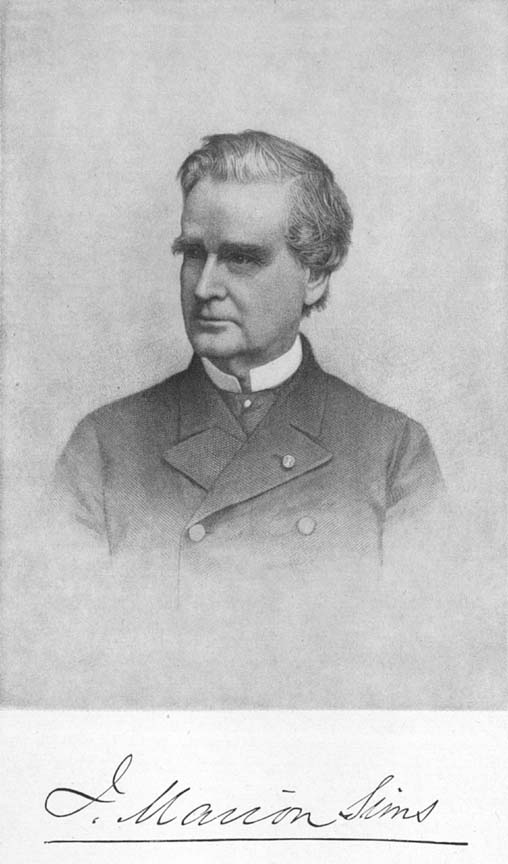
These years of extraordinarily hard work and incessant activity might have been expected to take toll upon Sims's precarious store of health, but instead he seemed to thrive under his exacting regimen. A month or so after the Woman's Hospital's opening his long-standing malady finally had disappeared for good, and now he was feeling more robust and vigorous than he had in all the twenty-odd years since malaria first had laid him low. With his new fund of good health he was able not only to labor untiringly for the hospital and to lay the groundwork for a successful private practice, but also to savor some of the aspects of genial and gracious living in which his gregarious nature took such great delight.
The center of his social life continued to be his family, for never, even in that Victorian age, was a man's whole being more firmly rooted in domestic felicity than was that of Marion Sims. In an era when many parents lost half of their offspring in infancy, he and his Theresa felt particularly blessed in the fact that, of the nine children Theresa had borne, eight were, as Sims once described them, "in a magnificent state of preservation." The birth of the ninth and last child had coincided not only with the year of the Woman's Hospital's founding but also with the Crimean War, when Americans were just beginning to hear of Florence Nightingale's wonderful work at Balaklava and Scutari in revolutionizing the nursing of war casualties. Sims, in common with other physicians of his era, had abundant reason to deplore the prevailing low standards of nursing service, so he promptly exalted Florence Nightingale as a major heroine, and as a token of his admiration he bestowed her name upon his newborn baby daughter, who was the fifth girl of the family.
Young Florence Nightingale Sims ("the musical little Nightingale," her father called her) was separated in age by nearly a generation's width from her eldest sisters Mary and Eliza, who by now were beginning to take an active part in New York's expansive social life of the late '50's. At the time of the Simses' New York debut the Madison Square section had been considered on the extreme edge of propriety, but in only a few years the city's rapid expansion northward had transformed this dubious outpost into the town's new social center. This meant that instead of being an odd and isolated address 79 Madison Avenue was now an excellent one. Holding court there, "the beautiful Sims girls" (as they generally were described) were a magnet which kept their family's home always filled with gay young people discussing the new plays at Niblo's and Wallack's, the budding Adelina Patti's wonderful voice, the handsome young Prince of Wales's exciting visit at the near-by Fifth Avenue Hotel, and the relative merits of the schottische and the lancers or of the new hoop skirts as opposed to the conventional Grecian bend.
Somewhat overshadowed, perhaps, by his bevy of charming sisters was the oldest Sims son, Granville, who now had reached an age where arrangements were being made for his medical education. One of his father's fondest ambitions was to have sons who were equipped to carry on his work and his name. Harry and Willie were too little as yet to be the subject of serious planning, but within a few more years Granville might be a second Dr. Sims---a Dr. Sims who, thanks to his father's prestige and guidance, should not have to fumble and grope for a start as Marion Sims himself had done. It was a heart-warming prospect.
Yet however animated Sims might be by fatherly concerns, the one great central fact of his life, now as always, was his dependence on his wife. Now that he was well again she no longer had to feed him like a baby and keep concerned watch over his every activity, but he seldom dreamed of making a move or a decision without consulting her, for he had learned by experience that her judgment was likely to be better than his. "For his impulsive nature," as Emmet put it, "her placid disposition was as essential as the flywheel in an engine." There can be little doubt that Theresa Sims's personality, poise, and background had much to do with the way the tenant-farmer tavern-keeper's son fitted so easily into the upper-crust social milieu in which he now found himself moving.
Perhaps it would be more accurate to say that he found himself in such a milieu part of the time, for actually the world of Sims was a highly diversified one, extending from the poverty-stricken and underprivileged women he encountered in the free wards of the Woman's Hospital to the favorites of fortune whom he met through his private practice and his contacts with the hospital's Boards of Governors and Lady Managers. In between were the great hordes of friends and admirers and professional associates who constantly were being made to feel at home in the big and life-crammed house on Madison Avenue, whether their stay was merely for a dinner of for a month-long visit. The fact was that Sims's pioneering operations and his successful hospital experiment already were beginning to make him a minor celebrity, and old acquaintances from South Carolina, Alabama, Philadelphia, and elsewhere whom he had not seen for many years were forming the habit of seeking him out whenever they came to New York.
Among those visitors from the past were two of his teachers from his boyhood days at Franklin Academy in Lancaster: Henry Connelly and J. F. G. Mittag. Connelly, now a preacher in the near-by town of Newburgh, New York, became a frequent overnight guest at his former pupil's home until the unfortunate evening when one of the younger Sims children, laughing heartily at a funny story he had just recalled, exclaimed: "Oh Papa, isn't that the man whose chair you put the pin in when you went to school to him?" Mr. Connelly, a sober, earnest man, could find nothing even slightly amusing in this revelation. Though the schoolboy prank in question had been perpetrated more than a quarter century before it still rankled in his memory, and he was deeply humiliated and shocked to learn that such an apparently good little boy as Marion Sims could have done such a thing as to stick a pin in the teacher's chair and then tell a lie to escape punishment. From that time on, despite Sims's protestations that the transgression had been weighing on his conscience all those years, the outraged minister never would come again to the home of the man who in childhood had committed such a crime.
With Mittag, Sims had a more enduring friendship. The scholarly Lancaster lawyer, whose marriage to a wealthy woman had emancipated him long ago from the ranks of ill-paid teachers, had been seeking for years to escape the materialism of modern civilization by gathering material for a profound (but never completed) philosophical work. In the course of his researches he traveled often to Europe, stopping en route to visit in New York the old pupil in whom he had been able to discern signs of promise even through the dull disguise of an undistinguished boyhood.
Another Lancaster contact was James Witherspoon, who, to escape his loneliness after the death of his wife (Theresa's sister Mary), spent a summer in the North refreshing his relationship with his sister-in-law's family and making the rounds of society's hot-weather watering places. Sims and his two oldest daughters accompanied Witherspoon on this expedition---partly, perhaps, for the purpose of appraising the various resorts with an eye to their own future, now that financial prosperity was beginning to make a summer home of their own a distinct possibility. After inspecting Saratoga Springs, Niagara Falls, and divers other popular spots, they decided that the place they liked best was Newport. At the pleasant old Rhode Island seaport town they felt immediately at home, for its summer residents came quite as much from the South as from the North, and in many ways it was practically a Southern colony. Another year, they decided, it might be advisable for them to rent a Newport house themselves for the season.
Even more common than South Carolinians among the travelers who passed in and out of the hospitable Sims home were visitors from Alabama. For a resident of Montgomery no trip to New York was complete without a stop at 79 Madison Avenue. There was Congressman Henry W. Hilliard, who insisted that his main purpose in coming to New York was to persuade his old fellow townsman to write his autobiography---a suggestion which Sims, though not overburdened with modesty about his own achievements, considered rather ridiculous for a man still in his forties. There was the Reverend William H. Milburn, the famous "blind preacher," lecturer, author, and former Chaplain of Congress, who, like Sims, had left Montgomery shattered in health and who now on more than one occasion repaid his former physician's favors by employing his magic oratory to help the cause of the Woman's Hospital. And there were dozens of others less well known, not the least of whom was Sims's restless and vigorous father, who---erect and handsome as ever in his late sixties---traveled all the way from his home in Texas to behold with some amazement the success his oldest son had achieved in a profession for which he himself had had nothing but scorn.
Amid all this stream of Southern guests, however, one old acquaintance was conspicuously missing. This was Nathan Bozeman, the young surgeon who had bought Sims's Montgomery practice after serving for a time as his assistant. His failure to be included among the swarming Alabama visitors was no mere matter of chance; there was a very definite reason for his absence.
By 1857, only four years after his transplantation to the metropolis, Sims's reputation had increased to such an extent that he was selected to deliver the Anniversary Discourse before the New York Academy of Medicine. This was by all odds the highest honor that he had yet received, for the Academy, then ten years old, habitually named as its annual orators only physicians of unquestioned eminence.
The choice of Sims to this august succession was more than a recognition of his personal worthiness to be numbered among the leaders of his profession; it was an acknowledgment that surgical gynecology, of which he was the foremost exponent, had outgrown its novitiate and was about to be accepted as a recognized specialty. As its spokesman he delivered an informative address on silver sutures, pointing out that they were not only the sine qua non in the success of his vesicovaginal-fistula operation, but also an effective means of lessening the dangers of infection in a wide range of surgical procedures.
Silver sutures, he said, had revolutionized surgery by ensuring prompt, beautiful cures free from the inflammation and suppuration which so often attended the use of silk ligatures. In amplification of this thesis he gave a detailed account of his trials and troubles in his early vesicovaginal-fistula experiments in Montgomery, culminating in his salvation by silver sutures which, he said, had been uniformly successful in his hands after three or four mishaps with early cases while he was still experimenting.
Sims explained that he had chosen this topic on this important occasion because he wished to place permanently on record a history of the origin and progress of the use of the silver wire suture in surgery.
Sims in his New York address was careful to give credit to LeVert of Mobile for having experimented with silver, gold, and platinum sutures in the ligation of arteries in animals, and said: "Mettauer and Dieffenbach actually had used leaden sutures in operations for vesicovaginal fistula." He stated also that he had tried leaden sutures unsuccessfully several times. His objection to the use of leaden sutures was that they were too friable. He asserted that it was not until he used silver sutures that he was able to cure vesicovaginal fistula. Sims also credited Rodgers with having used silver wire sutures between fragments of bone prior to their use in the treatment of vesicovaginal fistula.
The blood of the Crusaders, inherited from his English and Scotch ancestors, coursed in the veins of Marion Sims. He knew that the silver wire suture would hold the edges of a wound together and that healing would take place without suppuration, whereas when silk sutures were employed suppuration and often death from septicemia followed. He felt it his duty to impart that information to other members of his profession whenever and wherever the opportunity offered. It was not self-conceit that was responsible for Sims's belief that most of his patients recovered from operations in which he used silver wire sutures, whereas the surgical results of his confreres who used silk sutures were not comparable to his own. Sims had the self-confidence of a man who has both knowledge and wisdom. Therefore Marion Sims became a crusader for the use of silver wire sutures. He felt that the Anniversary Oration of the New York Academy of Medicine was the propitious occasion to advocate a technique for closing wounds that would prevent inflammation and save lives.
At the time Sims was delivering this address (1857) there was a young surgeon in Edinburgh who was destined to make the greatest discovery---next to Louis Pasteur's---in the history of medicine. Joseph Lister, appalled by the frightful mortality from all surgical operations, was working frantically to devise methods for lessening the dangers from what was then deadly surgery. When the article on silver sutures was published in 1858 Lister read it and was so impressed by Sims's presentation of his thesis that he was moved to give the method a trial in the Royal Infirmary in Edinburgh.
That Sims was not overly enthusiastic in stating the advantages of the silver wire suture over silk stitches in surgery is shown by Joseph Lister's statement regarding his own results before and after he adopted the use of silver wire sutures in his surgery. Lord Lister, then surgeon to Queen Victoria, in his Third Huxley Lecture before the Medical School of Charing Cross Hospital, London, October 2, 1900, said: "When Marion Sims had published his remarkable success with the silver suture in gynecology I resolved to give it a trial in general surgery. The operation was for the removal of a tumor of the scalp. The wound, sutured with silver wire, healed without suppuration. As the suture created no disturbance I left it in situ for ten days. When I showed the patient to Mr. Syme [the great Scotch surgeon and Lister's father-in-law] the skin about the suture was perfectly pale and natural in appearance, without a trace of discharge, whereas a silk stitch, within four days, would have infallibly caused suppuration with surrounding redness. Mr. Syme at once recognized the importance of the facts and from that day forward the silver suture was used in all wounds in the clinical wards [of the Royal Infirmary of Edinburgh] until, some years later, antiseptic measures caused it to give place to more convenient and no longer hurtful [sterilized] silk."
Neither Sims nor Lister knew at the time (1858) why wounds closed with silver wire sutures healed without suppuration, but the discoverer of Listerism later explained it when he said: "In thinking over the differences between the effects of the two kinds of suture it seemed to me clear that it depended upon the silk which, imbibing blood and serum, underwent decomposition, whereas metal gave no hold to organic liquids. From these and other analogous considerations I taught my class, at the time, that decomposition of the organic liquids was the essential cause of suppuration."
Lister, himself, made a not unimportant improvement in the technique of applying silver sutures. He devised a needle, with the eye near the middle, with grooves into which silver wire fitted, thus facilitating the twisting of the sutures. Lister's needle for silver wire sutures was widely used in England and Scotland until he proved that silk "stitches" could be sterilized by soaking them in a 5 per cent solution of carbolic acid, when he and his confreres discontinued the use of silver wire sutures.
In what English physicians call the greatest biography of all time, Sir Rickman John Godlee, nephew of Lister, in commenting on Lister's appraisal of silver sutures, said: "In those pre-antiseptic days there was great virtue in the silver suture introduced by Marion Sims. Lister became a very strong advocate of wire sutures, pointing out that if there were no tension suppuration did not occur in their track, though it was seldom absent when silk stitches were used."
No doubt Marion Sims was gratified when he learned that in far away Scotland the use of silver sutures was making surgery safer and that those who dared to operate for the relief of disease in the United States---with the exception of a few who refused to learn anything that was originated by an "upstart" from a country town in Alabama---adopted the use of silver wire sutures. But Sims, in his New York Academy of Medicine address, in an effort to establish his claim to priority in methods of applying silver sutures in vesicovaginal fistulas, overstepped the bounds of propriety; and he received prompt and deserved punishment for his indiscretion of injecting personalities into what should have been a strictly scientific address.
Persecution of progressives has been practiced ever since the first events in the history of man were recorded. It certainly is true that practically every pioneer in the great advances in medicine, particularly in the nineteenth century, was harassed by envious and jealous confreres. Fielding Garrison, in his monumental "History of Medicine," in referring to the long-drawn-out and virulent attacks on the discoverer of germs by one of his own countrymen, Pouchet, and by Liebig, a German, said: "Louis Pasteur suffered from the cavilings of lesser men." Pasteur expressed regret that in refuting the onslaughts of his critics he had to give up time needed for his experiments. The names of Pouchet and Liebig will live in history only as reactionaries who vainly tried to obstruct the wheels of progress, while Pasteur will be revered until the end of time as the world's greatest benefactor of mankind.
Joseph Lister, whose discovery of antisepsis in surgery has saved millions of lives, was attacked mercilessly by English and Scotch surgeons, including Sir James Y. Simpson, the discoverer of chloroform anesthesia, who himself was pilloried by his fellow physicians. Simpson spoke with derision of "mythical fungi" (Pasteur's microorganisms) as being the cause of fermentation and putrefaction on which Lister based his "antiseptic principle" in surgery. Lister, who ignored most of his critics, Lawson Tait in particular, lived to see his views accepted in every civilized country in the world. Oliver Wendell Holmes had to reply to Meigs and other outraged obstetricians when, in 1842, he announced his belief that childbed fever is a contagious disease transmitted by physicians from one patient to another. Semmelweis, who came to the same conclusion as Holmes in 1845, was persecuted by his confreres in the University of Vienna until, broken in health, he returned to live in his native city of Budapest. It therefore was to be expected that Marion Sims, who had achieved success as the pioneer in the surgery of women, should become the victim of vicious attacks by a few envious and jealous confreres. An old prophet said: "Oh that mine enemy would write a book!" Sims, in his zeal to impress upon his large audience in the New York Academy of Medicine the fact of his priority in the use of silver wire sutures, provided his enemies with ammunition for a satirical broadside which was very effective in silencing the offender.
There is no doubt that Sims was guilty of self-praise when he denominated the use of silver wire sutures as "the greatest surgical achievement of the 19th Century," though it was a great advance in surgical technique before the advent of aseptic methods. There also is no question of the impropriety of Sims replying to the attacks of his enemy on such an occasion. But Sims was very human and made mistakes which he afterward repented.
Goaded by his sense of persecution and by the fear that his brain child would be taken from him and given to his unworthy antagonist, Sims went on to describe how, when bad health had forced him to leave Montgomery, he had taken Dr. Bozeman into partnership and indoctrinated him in his methods of using silver wire as a suture; how Bozeman, "not understanding its principle of action, and therefore failing in its practical application, was quite disheartened with his ill success, when by mere accident he fell upon a plan of fastening the wire, and so modifying my method that in awkward or inexperienced hands it became easier of application"; and how "notwithstanding the fact that the doctor lived in Montgomery for years, without any professional position till I gave it to him, that he is indebted to me for what he could never have obtained without my aid, he appropriates to himself every step of the operation that resulted from my own individual and unaided efforts . . . and publishes it as his operation by a 'new mode of suture.'
Certainly the dignitaries of the Academy of Medicine who had chosen Sims as their spokesman for the year must have squirmed uncomfortably in their chairs as he continued on and on in this vein, pillorying Bozeman, parading his grievances, emphasizing his own achievements and his sense of divine mission. Near the end of his extraordinary recital, to be sure, apparently realizing that some of his remarks might be considered out of place, he suggested "that an apology is due this Academy for a personal narrative, although necessary for the vindication of right and the establishment of truth."
All in all Sims's attack on Bozeman was incredibly ill-suited to the occasion, and that it did no permanent damage to his reputation was a convincing testimony to the genuine esteem in which he was held by the members of the distinguished assemblage which heard him. Through firsthand acquaintance with the speaker and observation of his remarkable work these men had come to understand that Marion Sims was neither so conceited nor so bombastic as he sometimes made himself sound, and that his inept performance was due to an intense fundamental honesty and ingenuousness which made it quite impossible for him to dissemble his outraged feelings. He had no gift for pretense, nor was he able to deal in glittering generalities when his mind was preoccupied with a personal grievance.
Having taught Bozeman all he knew about the operation for vesicovaginal fistula he was outraged when the younger man, writing in 1856 in the Louisville Review, dared to suggest that the type of sutures originally recommended by Sims might be improved upon. Having found Sims's clamp sutures not satisfactory for his purposes he had devised what he called a "button suture," and this he recommended as safer and surer than the form of ligature with which his former preceptor's name and fame were so closely associated. In making his criticism and recommendation he apparently went out of his way to avoid hurting Sims's feelings, apologizing for his own temerity in finding any fault with the methods of the acknowledged master in the field, whom he praised with every evidence of sincerity. "I do not wish to be misunderstood," he wrote, "as attempting to detract from the great credit due to Dr. Sims for his untiring perseverance in bringing his method to its present high state of perfection. I consider that this gentleman is fully entitled to more than all the praise that has been bestowed upon him." And despite his criticism of the clamp suture he insisted that in the other aspects of the operation "Dr. Sims had left little or nothing to be desired."
Why Sims should have taken such violent offense as he did at Bozeman's moderately phrased article is hard, at this distance, to understand, particularly in view of the fact that he himself was on the verge of abandoning his clamp suture in favor of a more dependable type. The records of the Woman's Hospital for this same year, in fact, show that he even experimented on a number of occasions with "the button suture introduced by Dr. Bozeman," and soon afterward he reverted to a simple twisted metallic suture similar to the one which had long been used by Mettauer of Virginia in his fistula operations. Chances are that his bitterness had its roots further back in temperamental and financial differences between the two men and in the gradual souring of the partnership agreement into which they had entered three years before. Possibly, too, he was irked because the circumstances of the article's publication seemed to indicate a certain amount of logrolling on the part of the editors of the Louisville Review for the purpose of boosting a favorite son. The journal in question was a brand-new one just established by that indefatigable surgeon, teacher, and writer, Samuel D. Gross, who, now in the full flower of his nationwide reputation, was on the verge of transferring the scene of his manifold activities from Louisville to Philadelphia, where he had been appointed professor of surgery at Jefferson Medical College. Assisting Gross with the Review in the role of junior editor was Dr. Tobias Gibson Richardson who, like Nathan Bozeman (his close friend), had been one of Dr. Gross's star pupils and demonstrators of anatomy at the University of Louisville in 1847-49. Gross and Richardson not only featured Bozeman's paper in the maiden issue of their journal, but called special attention to it by an editorial note in which they patted their mutual friend conspicuously on the back, calling him the world's most successful operator for vesicovaginal fistula---a characterization which was not based on facts and which could hardly have been expected to find favor with Sims.
Whatever its cause, Sims's reaction to the Louisville Review article was fairly violent. He chose to view Bozeman's paper as a deliberate insult and proceeded to call its author an ingrate and his claims false. He did not, to be sure, rush into print immediately with these charges, but some of his friends and admirers did, and their indignant refutations of Bozeman's statements, plus Sims's undisguised display of petulance, had the effect of giving to Bozeman (whose reputation until then had been strictly local) an unwonted degree of national prominence, and of inciting him to an implacable enmity for Sims which he may previously have felt but had attempted to conceal. When Bozeman hated he hated, and now that his former partner had given him what he considered just cause he proceeded to display his remarkable talents in that direction, embarking on a vituperative campaign which was to continue for nearly thirty years---even after the death of Marion Sims. In his later articles (and he was a prolific writer) the comparatively friendly, moderate tone of his original Louisville Review paper was completely lacking. Typical of his line of attack was his reiterated statement that more than half of Sims's vesicovaginal-fistula operations in Montgomery had been failures which later had been transformed into successes only when Bozeman himself came to the rescue.
This was only the beginning. Feeling himself unjustly persecuted by a man who had attained the fame which, he convinced himself, was rightfully his own, he made a practice not only of arranging widespread distribution of reprints of his articles attacking Sims but also of making minor modifications in the various instruments Sims had invented and then rechristening them as his own. Thus the medical world soon was presented with the opportunity to use not only Bozeman's button sutures, but also Bozeman's speculum, Bozeman's tenaculum, and a whole array of other devices bearing a marked resemblance to those developed earlier by Sims. As a crowning touch he invaded Europe, where Sims's name was still but little known and where vesicovaginal fistula was still considered incurable. There he met the world-famous physicians and surgeons whose names were held in awe by American medical men, introduced his line of gynecologic instruments, and operated on fistulas---although with not striking success---in London, Edinburgh, Glasgow, and Paris.
These cumulative developments goaded Sims into a frenzied counterattack. His own position of leadership in his field was so secure by now that he would have been far better advised, of course, to have disregarded Bozeman's pinpricks entirely or to have shrugged them off with a tolerant Olympian smile. But that was not Sims's way. Even his best friends admitted that he was unduly excitable and jealous of encroachments upon what he considered his own exclusive rights, and that when he was crossed he was likely (as his almost worshipful contemporary, Dr. Baldwin of Montgomery, put it) to be "outspoken to a degree beyond the reserve usually found in men of less mercurial dispositions"; and this was one of the occasions when he certainly went beyond that reserve in a most conspicuous way. What made his rebuttal so conspicuous and its implications so unfortunate was the fact that he chose to deliver it from one of the most exalted forums in American medicine.
Most of his auditors, under the sway of his winning personality, presumably made the necessary allowances and promptly forgot the portions of Sims's address which had been better left unsaid. Not so, however, the man at whom its sharpest passages were directed. Bozeman was in Europe when the printed version of Silver Sutures in Surgery was published under the impressive aegis of the New York Academy of Medicine, but his distance from the scene did not prevent him from seeing the offending disquisition or from responding with heat and dispatch. He was wise enough to realize that his response would bear more weight if it was not signed by himself but came instead from an ostensibly neutral third party. Hence there appeared, in the North American Medico-Chirurgical Review for July, 1858, a long and burning "Review of Sims on Silver Sutures." Here again, to be sure, as in the case of Bozeman's original article two years before, there was ground for some question as to the complete disinterestedness of the retort's sponsors, for the Medico-Chirurgical Review was, in fact, a continuation of the Louisville Review and was edited by those loyal supporters of Bozeman, Drs. Gross and Richardson, who had transferred their teaching and editorial activities from Louisville to Philadelphia the preceding year. The new journal's searing "Review of Sims on Silver Sutures"---presumably the handiwork of Richardson with liberal assistance from his good friend Bozeman overseas---called Sims's address before the Academy an "extravagant and absurdly egotistical discourse," ridiculed both his "mission of divine origin" and his claims to primacy in the origination of metallic sutures, and pointed out pungently that Sims's worst enemy was not Bozeman, but himself, suggesting that by now he "must deeply lament the occasion which has thus brought him so unpleasantly before his brethren and the public."
It seems likely that Sims himself, being at this period far too busy and happy to give his undivided attention to nursing a grudge, was inclined to agree by now with this opinion, for in his future public utterances or writings he never again mentioned Bozeman by name. In giving vent to his temper and his conviction that he was being persecuted, however, he had set himself a dangerous precedent. This time, thanks to his engaging personality and the truly fine work he was doing, he escaped from his indiscretion comparatively unscathed; two decades later he was not to be so fortunate.
The Sims-Bozeman vendetta was symptomatic of the times, Throughout the nation brotherly love was giving way to brotherly hate at such an accelerating pace that everyone knew an explosion of some sort must be near. Even at the Woman's Hospital's sixth anniversary meeting, held in the last week of January, 1861, the traditional love-feast atmosphere was harder than usual to maintain. Partly this was due to the unprecedented absence from the president's chair of the panegyrical Dr. John W. Francis, whose prestige value in his role as "godfather to the Woman's Hospital" (as Sims called him) had done so much toward putting the young institution on its feet and keeping its dissonant elements working smoothly together. Doctor Francis was lying now on his deathbed, and his kindly presence and soothing, if verbose, eloquence were sorely missed.
Doctor Francis' imminent demise was not the only reason, however, for the meeting's altered atmosphere. More important was the fact that the American Union, too, seemed to be in grave danger of mortal dissolution. A strong consciousness of this danger pervaded the meeting. It could not be forgotten that both of the hospital's attending physicians were from the South and thus subject to suspicion in the current state of affairs, no matter how unquestioned their services to gynecology. This consciousness, generally ignored in a gentlemanly pretense of unaltered camaraderie, came abruptly to the surface in the address at the anniversary session by the Honorable George Folsom, a former diplomat and state senator who was one of the leading lights of the New York Historical Society. Folsom concluded his remarks by turning toward Marion Sims and observing pointedly: "I am happy to see that our friend, the inventor and discoverer, comes to us from another state which may almost be considered foreign to this Government. Although a son of South Carolina, he is now a citizen of New York, and does not, I hope, mean to secede from us, but to devote himself to this great work . . . . What do you say, sir?"
Sims responded instantly: "I have not the least idea of seceding, sir"; but behind those apparently decisive words was concealed a whole array of inner conflicts which still were very far from being resolved. For the last few years he and his family had been in an increasingly anomalous position. Circumstances compelled them to reside in the North, but their hearts and sympathies had stayed unavoidably in the South (or, as Sims always phrased it, "at the South"), where all their roots were and where so many of their friends and relatives remained. Each year they had watched uneasily as the cleavage between the world of their birthright and the world of their adoption became progressively greater and greater. Within recent months this grim cleavage had grown so wide that there seemed to be no chance of healing the fissure. The last Christmas had been a black one for them, coming as it did just after South Carolina, native state of the family's heads, seceded from the Union; and when with the new year their second homeland, Alabama, followed South Carolina's lead their predicament took on ominous proportions.
Sims himself, completely wrapped up in his work and realizing all too well that a return to the South probably would mean for him a relapse into useless invalidism or worse, clung to the hope that somehow or other he would be able to stay in New York and weather the storm. He could not help being sharply aware, however, that his oldest son, Granville, was growing more and more restive in his contacts with his anti-Southern college mates, and that most of his own old friends now were sharply and apparently irreconcilably arrayed against his new ones. Only a week or so after the hospital meeting where he was publicly reminded of his divided loyalties there came news of the convention held in Montgomery, his old home, to organize the Confederate States of America; and before long he began to hear that first one and then another of his friends---including those who, like Hilliard, formerly had opposed secession and sought to preserve the Union---were taking an active part in the new government. Even his beloved church was no longer united, for Southern Presbyterians had broken away from the Presbyterians of the North to form the Southern Presbyterian Church, which numbered prominently among its leaders Sims's college idol, James Thornwell, who had gone far, through the years, as college president, preacher, editor, and teacher.
After the fall of Fort Sumter and the actual opening of hostilities Sims's position became more and more difficult, his proper course of action harder and harder to decide. One after another of his family and Theresa's---brothers, brothers-in-law, nephews, and even his elderly father---joined the Confederate forces. With the sudden withdrawal of all his Southern patients his private practice showed ominous signs of falling off; and the pleasant social life which meant so much to him and his family was even more seriously affected, for Northerners, not unnaturally, were reluctant to exchange amenities, either professional or social, with persons suspected of Southern sympathies.
There remained his work for the Woman's Hospital, but that too was seriously affected by the war. The need, to be sure, was as great as ever, if not greater, but the funds necessary to carry on essential services were blocked by all kinds of wartime barriers. It was apparent not only that the whole ambitious plan for erecting a roomy new building and expanding the hospital's program would have to be postponed, but also that probably there would have to be retrenchment even in the present modest scale of work: longer summer closings and a reduction in the number of patients admitted. So hard pressed was the institution for money and the barest necessities that the majority of applicants in search of relief had to be refused or else forced to wait a year or so until an opening was available; on several occasions appeals for contributions to fill the empty treasury had to be made to the public through the newspapers.
With such a discouraging curtailment of the work which only recently had seemed so surely headed for notable expansion there ceased to be any pressing need for the regular services of two attending surgeons. Emmet, Sims's assistant, had set out for the South immediately after the declaration of war, heading directly for Montgomery to offer to Jefferson Davis his services as an army surgeon. In his absence Sims was aided in the hospital's busy outpatient department by another young Southerner, Dr. T. Gaillard Thomas. Thomas was a brilliant South Carolinian who, despite his youth, already was professor of obstetrics at the University Medical College; as a gynecologic surgeon and inventor he revealed a boldness and dramatic flair not unlike those of Sims himself, with whom a dozen years later he was to find himself in public conflict. Soon Emmet reappeared upon the scene, having been told by President Davis that the Confederate Army already was provided with more physicians than it needed (Bozeman, incidentally, was one of them) and that his proper place was in New York with his family.
With Emmet back and Thomas caring for the outpatients Sims felt that he no longer was really needed at the hospital, shrunken as its sphere now was. His restlessness and unhappiness increased; what to do next became a difficult problem. He might offer his services to the North, which had been good to him, and thus desecrate his every instinct and align himself against his own people; or---disregarding the rejection of Emmet---he might take his family back to the South and dedicate his skills to the Confederate cause. If he followed the latter course he not only would be sacrificing all his property and courting almost certain relapse into crippling illness, but also, he felt, he would be betraying all the many Northern men and women who had befriended him when he was so badly in need of help. Between these two unpalatable choices there was a possible third alternative. Instead of serving either of the warring factions, he might essay the difficult role of neutral: remaining in New York, keeping his attention strictly on his surgical practice, and trying to close his eyes and ears to all the rending passions round about him. Not a few other Southerners (including Emmet and Thomas) were doing just that, but presumably they were men more given to circumspection than Marion Sims, whose impulsive, outspoken temperament was ill-adapted to neutrality.
Caught thus between the horns of a deadly dilemma Sims solved the issue by dodging it---or at least that is what his critics accused him of doing. Loving the South, respecting the Union, and viewed with suspicion by the ardent adherents of both causes, he found a way out of his perplexity by escaping from the whole scene of turmoil. He went abroad.
When Marion Sims set out for Europe in the summer of 1861 he ostensibly had no intention of making his stay a long one. His purpose, he proclaimed, was simply to take a little rest and vacation, to learn something at first hand of the Old-World medical centers which had nurtured so many of his professional confreres, and to investigate trends in hospital construction in Great Britain and France. There can be little doubt, however, that his private intentions were decidedly more far-reaching than those which he announced in public.
The trip was really Mrs. Sims's idea. Observing with loving concern her husband's growing chagrin at the war's disruption of all his plans, she suggested that somewhere on the other side of the Atlantic he probably could find a way to practice his profession and support his family without being thwarted at every turn by wartime hates and barriers. He himself was dubious about the outcome of such a venture, but Theresa was so confident in the powers of his personality, skill, and reputation that he yielded, in some trepidation, to her urging. It was fairly presumptuous, he believed, to hope that he might receive any substantial recognition in Europe, for American doctors customarily went abroad not as practitioners but as worshipful students, sitting at the feet of the European masters who, according to long tradition, were so markedly their superiors. A generation ago, to be sure, New York's famous Dr. Valentine Mott, pioneer in surgery of the veins and ligation of the arteries, had built up a highly successful surgical practice during a six-year residence abroad; but Mott had had the advantage of an extensive European education in his youth, whereas Sims's own background was distinctly homespun.
From the reports of his more traveled friends and from his perusal of medical journals he had reason to believe that his name was not entirely unknown in the British Isles and even on the Continent, but in order to be on the safe side he carried with him a packet of letters of introduction from Mott and others. With him, too, there went as traveling companion a young man who for the past two years had been serving as house surgeon at the Woman's Hospital. He was a Virginian named Thomas Pratt ---one of the many Southern physicians who had been studying or practicing in New York at the outbreak of the war. With Tom Pratt, Sims had in common not only their mutual war-born predicament and their mutual interest in the Woman's Hospital, but also a more intimate tie, for the younger man had been showing a lively interest in Sims's second daughter, Eliza, who---with her thoughts turned toward matrimony by the recent marriage of her older sister Mary to Charles Carr---had been giving indications of looking upon his suit with favor.
That other young Virginian, Thomas Addis Emmet, who with his wife and children now occupied a house close to Sims's own on Madison Avenue, fell heir during his chief's absence to the latter's private practice as well as to the directing generalship of the Woman's Hospital. Because of the wartime isolation of Southerners in New York Emmet was drawn closer than ever to the Sims household, on which he kept a watchful eye while the father of the family was overseas.
If Sims had harbored any misgivings as to his ability to make his way in a strange land they were dispelled in short order. In Dublin, his first port of call, he found himself welcomed with open arms by the leading surgeons and obstetricians, who, being curious about his operative methods, provided him with a case of vesicovaginal fistula and crowded around to watch him as he repaired it. They went out of their way to entertain him socially as well, regaling him with lavish dinner parties night after night and marveling at his peculiarity in abstaining from the wines and liquors which flowed so freely at all their festivities. In their eyes such abstemiousness usually was suspect, but in Sims they soon forgave it because they found that he needed no stimulants to keep a jump ahead of them in animated play of wit and even in the gentle Irish art of flirtation.
At this latter pursuit the American visitor, incurably uxorious as he was, had had little practice, but he rose quite adequately to the occasion when Sir William Wilde---later to be remembered principally as Oscar Wilde's father, but then at the peak of his career as aurist, oculist, archaeologist, and lady-chaser---paired him off for the evening at a Royal Irish Academy reception with a wealthy young widow who had a wide reputation as an accomplished coquette. With her ample supply of beauty and money, plus her practiced technique of lamenting her loneliness and swooning in her victim's arms, this flirtatious lady seldom had any difficulty in eliciting a declaration of affection or a proposal of marriage from any man who caught her fancy. These proffers she always promptly rejected, but not without making sure to let everyone know that she had added yet another conquest to her long string. When she tried her usual artifices on Sims, however, she failed to achieve her customary results, for though he led her on expertly he also made covert fun of her and failed completely to succumb to her well-tried wiles. Luckily for her peace of mind she did not know that when her handsome young American (he assured her that his age was only thirty) returned to his hotel he proceeded to pour out every detail of his evening's experiences in his habitual long letter to his beloved Theresa.
Much more to his taste as a feminine object for his admiration was Queen Victoria, who came to review the troops at the Curragh, an hour's ride away, while he was in Dublin. Like many Americans of his time, Sims was enamored of the Queen and all she stood for, and "feeling that it would be very unloyal not to sacrifice one day to testify my admiration for this purest of women and best of queens" he prolonged his stay in Dublin by three extra days, made a long and uncomfortable trip out to the review grounds at the Curragh, stood three hours in the rain waiting for the royal party to put in an appearance, and then felt fully rewarded for all his trouble by the privilege of seeing Victoria pass by in her open carriage only twenty or thirty yards away.
This was not his first view of a titled personage, for during his preceding fortnight of festivities in Dublin he had had ample opportunity to meet members of the nobility at close range and to begin to develop that frank pleasure in such glamorous contacts which was to characterize his European years. At Dublin Castle, as a guest at the Earl of Carlisle's viceregal reception, the former South Carolina small-town boy had made his first shocked discovery that "lords and ladies at home look much the same as any of us" and that, indeed, members of the nobility could not be distinguished from anyone else unless they were pointed out by someone who knew. At this gathering, too, the sight of men in civilian clothes wearing elaborate bejeweled decorations had made a deep impression on him, bringing as it did the realization that according to Old-World customs even physicians, if sufficiently distinguished, might be granted the right to adorn themselves with such badges of honor.
Dublin, however, was strictly a trial flight; no one there made any serious pretense to eminence in gynecology; the fortresses which Sims needed to storm, if he was to win his European spurs, were Edinburgh, London, and Paris. Of these Edinburgh came first on his agenda. For well over a century the Scottish capital city had been regarded as one of the world's leading centers of medical knowledge, and in recent years new luster had been added to its name by its university's present brilliant medical faculty, with that formidable pair of rivals, Syme and Simpson, as its bright particular stars.
Edinburgh's professor of midwifery, James Young Simpson, was the one man above all others in Europe whom Sims most had wanted to see. Widely acclaimed as the most eminent obstetrician of his day, he was now at the height of his fame, honored everywhere for his introduction of chloroform anesthesia, his new method of controlling bleeding by acupressure, and his voluminous contributions to the techniques and literature of the young science of gynecology. (In this last-named field his then current series of clinical lectures on diseases of women was considered a milestone.) Marion Sims had followed all of these contributions, at a distance, with the greatest possible interest, and in the Woman's Hospital he had attempted a number of Simpson's novel operations. Now he was extremely eager to observe Simpson's technique at first hand, hoping thereby to learn something of value for his own work. His observations, however, left him disappointed and unimpressed, and he decided that Simpson had been vastly overrated.
In this estimate he was doubtless far from right, for Simpson's great reputation was founded on solid achievements of unquestioned validity; yet it is not surprising that Sims should have been disappointed in his high expectations, for between these two giants of gynecology there was an instinctive undercurrent of antipathy, stemming in part, perhaps, from an understandable mutual jealousy. The two men had many traits in common: both had risen from humble beginnings; both were resourceful, inventive, zealously hard-working, ardently enthusiastic, and inclined occasionally to rashness and to an excess of self-esteem; both of them not only possessed the qualities of genius but looked and acted like geniuses; "neither of them [as one of their contemporaries observed] were reluctant to have their good work appreciated." Sims and Simpson usually spoke respectfully of each other's work, and between them there was never any overt controversy, but neither was there any blossoming of warm friendship such as Sims felt for so many of his other confreres in Great Britain.
It is probable that two influences, quite independent of any personality factors, served to keep the relationship between the two great gynecologists on a relatively cool basis. The first of these had to do with the one man whom, above all others, Sims detested: Nathan Bozeman. During his European pilgrimage three years before Bozeman had been received most cordially by Professor Simpson, who had watched with keen interest while the American visitor performed an operation for the relief of vesicovaginal fistula. Simpson had been so impressed by this procedure (which, he was given to understand, was of Bozeman's own origin) that he had maintained ever since, through correspondence, a cordial relationship with Sims's erstwhile disciple; and, as an offshoot of this relationship, his widely attended and extensively printed lectures on the diseases of women contained a number of specific references to the way he himself was now employing Bozeman's technique, Bozeman's instruments, et cetera, for the repair of vaginal fistulas. Under these circumstances something of the deep bitterness which Sims felt for Bozeman was bound to permeate his attitude toward the famous man who, innocently enough, had strengthened the hand of his enemy.
The other influence which presumably kept Simpson and Sims apart was another feud; in this instance, however, the feud was not the American's, but the Scotsman's. Edinburgh's veteran professor of clinical surgery, the distinguished James Syme, widely known as "the Napoleon of surgery," possessed an intense dislike for Simpson, whom he chose to call derisively "the male midwife." In sharp contrast to his attitude toward Simpson was the strong attachment which he immediately developed for Sims, whose endearing candor and impulsiveness were in such sharp contrast to his own cantankerous taciturnity. Since a large part of Sims's time in Edinburgh was spent either in watching Syme operate or in visiting Syme's home, where he was entertained repeatedly, it would have been surprising if some part of the professor of surgery's hostile attitude toward his renowned faculty colleague should not have been transmitted to his American guest.
Syme's warm admiration for Sims had its primary roots in his enthusiasm over silver sutures, of which he and his son-in-law, Joseph Lister, had become as ardent advocates as Sims himself. Their successful experience with the suture's use predisposed them favorably toward the man who had devised it. Lister, however, had moved the preceding year to Glasgow, scene of the initial experiments in antisepsis which were to make him world-famous, so the usually dour Syme took it upon himself to repay with unwonted geniality the debt which both he and his son-in-law owed to the visiting American.
Sims, watching in enchantment while Syme performed his rapid, brilliant operations, began to feel a little better about the benefits he was receiving from his travels, for up till then he had been somewhat worried by the realization that Europe had taught him hardly anything which he did not know already. At Aberdeen, the next stop on his itinerary, he found himself even more rewarded. For one thing, he learned through a tour of the Royal Infirmary there just which faults to avoid and which patterns to follow in the construction of the new Woman's Hospital building. For another, he had the thrill of witnessing the incredibly skillful operations executed by young Professor Thomas Keith, who in later years became one of his most venerated surgical heroes. In Aberdeen, incidentally, he put in what he called a truly "Sabbathical Sunday." On his way to catch a morning train he dropped in a Union Street church and became so enthralled by the young preacher's vigorous sermon that he lingered on far beyond his train's time of departure. Then, uplifted and refreshed, and quite unconcerned at the disruption of his schedule, he returned to the afternoon service to enjoy a second installment from the same gifted pastor.
In such a mood of appreciation for virtuosity, whether in the operating room or in the pulpit, he descended at last upon London, where he had the pleasing experience of being welcomed as a virtuoso himself. Most of the leading physicians there were familiar by now with his American reputation, which had been augmented considerably of late by the enthusiastic reports on this visitor from overseas which had been drifting into the capital from such pillars of British medicine as Sir William Wilde in Dublin and James Syme in Edinburgh. As a matter of fact, both Wilde and Syme, as well as various other physicians Sims had met in his tour of the Isles, had been urging him to settle in London, assuring him that his talents were badly needed there and that he could make far more money in the British metropolis than he ever could hope to do in New York. Sims himself had been considerably impressed by the apparent prosperity of the medical men he had been encountering in his travels. "All the doctors I have met as yet," he wrote Theresa, "are well to do, live in the very best style, and many of them are very rich; but if I write more in this vein you may fear that there is danger of my setting my face toward the service of Mammon. Not wishing to distress you in the least, I shall change the subject."
He might have been tempted to yield, if not to the service of Mammon, at least to the flattering importunities of his new friends, if at this juncture he had not had an unfortunate accident. At the invitation of the noted British surgeons, Spencer Wells and Henry Savage, he performed a vesicovaginal-fistula operation on one of their patients at the Samaritan Hospital. He had no reason to anticipate any result but the triumphant success which had attended practically all of his hundreds of operations for this disability in the last dozen years, but by a malign twist of fate his guardian angel chose to desert him for his London debut. Never before had one of his fistula operations resulted in death, but this time the patient died.
This tragic mishap may or may not have been responsible for his decision to move on to Paris rather than to linger in London. His London sojourn, however, was not too short to permit the laying of the groundwork for a number of firm friendships which were to last for the rest of his life. The British, inclined though they often were to be harsh in their judgment of Americans, were won over completely by Sims's personal charm. They liked his simple directness, his engaging frankness, his penchant for banishing all mystery from his surgical procedures and making them clear to everybody. The fatal outcome of his first London operation apparently did not lessen their opinion of him, however much it may have disturbed Sims himself, for while he was in France he kept receiving urgent invitations to return across the Channel to perform operations or to deliver papers at the meetings of the London Obstetrical Society---an organization in whose deliberations, during the years to come, he took an active part.
Yet however cordial his welcome in London may have been, it was in Paris that his spirit felt immediately at home. As one reporter of his conquest of the French capital observed: "He could not speak a word of French, but a man who could smile like Sims spoke an international language." Paris at the moment was in a mood to feel very favorably disposed toward all Southerners, for the prevailing French attitude toward the war in America was one of strong sympathy for the South. Certain influential Frenchmen, actuated by their distaste for the Yankees' growing commercial prestige and also by their country's dependence on Southern cotton and Southern markets, even went so far as to urge that France and England ought to ensure the Confederacy's permanent separation from the North by joining openly in its fight instead of merely building ships to help it break the Northern maritime blockade. One of the most ardent supporters of the Southern cause was Emperor Louis Napoleon, who---with his prestige still at the high point achieved through his recent success in the brief Italian war---made no attempt to conceal his friendly feeling for the official representatives whom the Confederacy had sent abroad to seek aid from Britain and France.
With such a hospitable atmosphere it was not surprising to find Paris harboring a sizable colony of Southern refugees. One of the accredited Confederate agents was the fiery William L. Yancey, a former Alabama friend of Marion Sims, and he and the other émigrés from below the Mason and Dixon's line were eager to accept Sims as one of them; but the visiting gynecologist, with his catholicity of taste, was constitutionally unable to limit his acquaintances solely to Southerners, however much he might love them. His two most significant friendships, in fact, were with an Anglo-Irishman and an expatriated American who hailed from the North. The Anglo-Irishman, Sir Joseph Olliffe, physician to the British Embassy, had conducted a successful medical practice in Paris for over twenty years and possessed wide and valuable social contacts which he willingly employed for Sims's benefit. The American, Dr. W. E. Johnston, was an Ohioan who had come to France as a young man and had become so attached to Paris that he had settled there for life, devoting himself more to journalism (he was a correspondent of the New York Times) than to medicine.
Johnston and Olliffe between them knew everyone of importance in French medical circles, and they espoused Sims's cause so enthusiastically that before long, despite his ignorance of the French language, he was nearly as much at home in Paris as they were themselves. At the outset Dr. Johnston warned his distinguished protégé that most European physicians did not believe the numerous reports of remarkable cures which had been emanating from the Woman's Hospital within the last few years; they considered all such claims merely typical examples of American humbug and bravado, for they were convinced that all Americans were cut off the same piece of cloth as the grandiloquent P. T. Barnum, with whose flamboyant standards of showmanship they had become well acquainted during his recent extended European visits. Particularly in the matter of Sims's reputed success in curing vesicovaginal fistula, Johnston said, French surgeons were more than a little dubious, for they all knew that no one in the world was as great an authority on this grievous affliction as their own revered Professor Jobert de Lamballe of the Hôtel Dieu; and even Jobert, with all his years of experience and experimentation, hardly ever had been able to effect a permanent or complete cure of such fistulas.
Despite this warning Sims apparently had little trouble in convincing the French physicians that he was no Barnum. One after another the leading surgeons of Paris welcomed him to their midst and gave him a chance to prove that his reputation was not a mere product of American ballyhoo. To Sims it was like living in a dream come true to find himself mingling on terms of familiarity with great men whose almost legendary names he had revered for years from afar. There was Chassaignac, for instance, inventor of the rubber drainage tube for abdominal surgery and also the écraseur, an ingenious looped-wire instrument which Sims frequently used instead of a knife. When Sims went to the Hôpital Lariboisière to join a group of other visitors in watching Chassaignac make his rounds of the wards he had no expectation of playing any role but that of a humble and admiring observer. Midway of the tour, however, the redoubtable Chassaignac, learning from one of his assistants the identity of the newcomer among his entourage, interrupted his work to seize the American by the hand and to address to him a voluble discourse which was completely incomprehensible to its surprised recipient, who as yet was completely unversed in the French language. After this incident the surgical genius of the Hôpital Lariboisière insisted on keeping the American close by his side; and with all the students and doctors looking on and presumably understanding the verbal volley which was so totally lost on him, Sims felt as embarrassingly conspicuous "as if I had been nicely dissected or was undergoing a brilliant écrasement." Not content with this demonstration of admiration, Chassaignac promptly arranged to take Sims with him as his guest to the next two meetings of the Société de Chirurgie and to present there translations of papers written by the American. (One of these papers, incidentally, had to do with amputations ---a field in which, Sims was amazed to find, American surgeons were far in advance of their French contemporaries, whose amputation patients nearly always died.)
An even more legendary figure than Chassaignac was the venerable Civiale, originator of the technique of lithotripsy for the crushing of stones in the bladder. Sims, intent on witnessing all the French masters of surgery in action, made a pilgrimage to the Hôpital Necker to observe an operation by Civiale, and there he had a virtual repetition of his experience at the Lariboisière with Chassaignac. Civiale too, catching sight of Sims standing unobtrusively among a group of medical students, interrupted his whole performance to extend a lengthy, fervid, and flattering welcome to his American visitor.
Chassaignac's and Civiale's enconiums came as a result of their having witnessed Sims himself at work, for by the time he had been in Paris a month he already had performed several successful vesicovaginal-fistula operations. The opportunity for the first of these came as the result of introductions in the proper quarters by his worshipful and helpful friend, Dr. Johnston. Thereafter it no longer was necessary to seek invitations to operate, for they came unsought. One after another the famous French surgeons of the day---Huguier of the Hôpital Beaujon, Vernier of the Hôpital St. Louis, Loquier of the Hôtel Dieu (stronghold of the great Jobert de Lamballe himself), Mungenier, and, above all, the world-renowned Velpeau---brought to Sims their miserable, fistulous patients, doomed to lives of exile by the revolting nature of their hitherto incurable infirmity; and in every case he effected a cure. The atmosphere at these operations and at their follow-up sessions, where the sutures were removed, was charged with drama; the demand for admission became increasingly acute, the audiences increasingly distinguished, the reports they carried away increasingly glowing and increasingly designed to make the personable American surgeon the lion of the hour. For the volatile mass of Parisian medical students Marion Sims was soon a popular hero without flaw; even for their elders---the professors and practitioners in a field where professional jealousy was common---he was a man to be honored without stint and, if possible, to be emulated. In short, a great Sims cult was in the making.
At all of these surgical dramas Sims described in detail the various stages of the operation for the benefit and instruction of his audience. Being without knowledge of French, he spoke in English, depending upon a translator to make his words intelligible to his hearers. Usually the versatile Dr. Johnston (who also doubled as anesthetist, operative assistant, and reporter for the press) served as his interpreter; but on at least one occasion this role was filled by a young American who, some thirty-odd years later, performed a useful service to posterity by recording an eyewitness' account of the manner in which his fellow countryman achieved the subjugation of Paris. The young American was Edmond Souchon of New Orleans, later to become a distinguished professor of anatomy at Tulane University in his native city, but then a twenty-year-old medical student in the service of the most famous of all the surgeons of Paris, the great Alfred Velpeau. Sims felt that Velpeau, professor of clinical surgery in the University of Paris and author of his era's most important and comprehensive textbooks on surgery, was the one man above all others whose favor he needed to win. Soon after his arrival in the French capital, therefore, he made his way, well armed with letters of introduction, to the Hôpital Charité, where for nearly thirty years Velpeau had ruled as chief surgeon. There, for the first time, he met Souchon, whose report on the progress of Sims's quest manages to capture some of the flavor of high excitement which characterized the study and teaching of medicine and surgery in Paris at that period.
"Early one morning in the latter part of 1861," wrote Souchon, ". . . I was going to the hospital, and, as I was about to enter the gate, my attention was attracted at once by the face and appearance of a man who was coming toward the gate also . . . . That the face and appearance struck me at once will readily be believed by all those who have had the happiness of knowing our great American surgeon. Its characteristic soft and sweet expression, together with his deep-set, bright eyes and prominent, bushy eyebrows, the half-smiling expression of his mouth, left uncovered by the absence of mustache or beard, made a much deeper impression on me than a glance ordinarily produces. I also at once recognized that he was a foreigner, and no Englishman at that, but surely and unmistakably an American----perhaps, hastily thought my young rebel heart, a Southerner. . .
"When I reached the door of my ward I went through and closed it; it was soon opened again; . . . turning around I noticed my 'American.' . . . The stranger came up to me, and after a most suave bow, said in a very slow and deliberate manner, that the Frenchman he thought he was addressing might have some chance of understanding: 'WiIl-Professor-Velpeau-be-here-today?'
"I burst out laughing and answered him in fluent English: 'No sir, Professor Velpeau is on his vacation and will not return before two weeks.'
"The beautiful face brightened up at the sound of the English language where and when he so little expected it. 'Where are you from,' said he, 'that you speak English?'
"'I am from the South, from New Orleans,' said I, thinking that that would cool his enthusiasm if he was a Yankee.
"But far from it; he grasped my hand and pressed it so as to crush it. 'Why,' said he, 'I also am a Southerner; I lived a long time in Montgomery, Alabama.' That made us friends at once."
This was before Sims's operations for Huguier and Vernier and others had made him the talk of Paris, so when he told Souchon his name and his desire to demonstrate his method of vesicovaginal-fistula repair for Velpeau the young student from New Orleans was sorely distressed, for he knew Velpeau's distrust of Americans and was trained to consider no one but Jobert de Lamballe capable of dealing with vesicovaginal fistula. Having formed an instinctive liking for the stranger, he found himself pitying him and dreading the debacle which was bound to come. Sure enough, when Velpeau ---a brusque, self-made man with little taste for the social amenities---returned a fortnight later from his vacation he received with marked lack of enthusiasm Sims's request for an opportunity to operate at La Charité, although he promised to let the visitor handle the next case of the desired nature to turn up within his domain. After that, for days on end, Sims would arrive at the hospital early every morning, hoping that the case he sought might have arrived and explaining to everyone who inquired his purpose: "I want a case," while Souchon, who in the time since their first meeting had become the older American's devoted admirer, would trail him anxiously, introducing him to the assembled surgeons and proclaiming in his turn to each one, "He wants a case."
When at last the case came "the whole of the old Quartier Latin," according to Souchon, "had heard the news . . . . On the day of the operation the famous little operating theatre in the old Charity Hospital was overcrowded with students, and the arena below was crowded also with the most distinguished professors of surgery of the French capital: Velpeau, Nélaton, Ricord, Malgaigne, et cetera---all but Jobert de Lamballe, who would not come." Jobert's reluctance to attend was understandable, inasmuch as the patient was a young woman upon whom he himself had operated unsuccessfully seventeen times. As Sims demonstrated his method---first on a piece of cotton batting and then on the patient herself---he explained each step carefully, asking young Souchon to translate his explanations for him. When the operation was speedily and gracefully completed, Souchon recalled, "A salvo of applause broke out from the benches; the professors rendered justice to the manner in which the operation had been performed, while reserving themselves mentally until the day when the sutures should be removed . . . . On the ninth day the same amphitheatre was again packed to witness the removal of the sutures; the case was pronounced cured, and this was confirmed by the French surgeons . . . . The enthusiasm of the French students far exceeded their former outburst, and since they could not very well carry Dr. Sims on their shoulders they took hold of me in his place, and the resident students carried me o their messroom to breakfast with them---a great and unprecedented honor in those days, for I was but a simple, insignificant first-year student!"
Scenes of this sort were repeated time and again. The young medical students---an emotional group given to lively enthusiasms ---became so ecstatic about the visiting American that (according to a letter from the object of their admiration to his cherished Theresa in New York) they "are absolutely running down women to find out if they are fistulous." Whether or not patients were obtained in this unorthodox manner, the fact remains that there was an astonishing abundance of them. It seemed as if all over France---and, indeed, all over Europe---victims of fistula had been in hiding for years, awaiting the day when the wonder-worker from America would come and make them whole. The majority of them were handled as charity cases in the hospital wards, but not a few were private patients willing and eager to pay fees far greater in size than any Sims had known in the United States. One of these---the beautiful young Countess de F.---served to introduce him into a hitherto unknown world of privilege and luxury with which in the years to come he was to become increasingly familiar.
"The little countess," as Sims always described her, was a patient of the eminent Dr. Auguste Nélaton, surgeon to Garibaldi and to Louis Napoleon. Young, lovely, rich, and accomplished, the countess was praying incessantly for death, for ever since the birth of her child two years before she had been in purgatory, with all the physical, mental, and psychological sufferings which were the inevitable lot of a woman who was doomed to go through life with the base of her bladder completely destroyed. Nélaton had told her that she was incurable; Sims himself thought so at first, but on further consideration he decided that if he performed not just one operation, but two, he might be able to restore her to health.
Restore her he did, but not until after he had passed through one of the most searing experiences of his life. It all had to do with the use of chloroform, a form of anesthetic for which he had a profound dislike and distrust because of its tendency to cause cerebral anemia. Left to his own devices he never would have employed it, but when the time came for the second operation (the first one having been concluded satisfactorily) the little countess' family, eager to do everything possible for her comfort, insisted that chloroform be administered by Dr. Charles James Campbell, the Scotch-born obstetrician who was the most popular and fashionable accoucheur in Paris. In addition to Campbell, Nélaton, and Sims's invaluable interpreter-friend Johnston, two other physicians were in attendance as assistants. It was fortunate that so many were present, for when the operation was only a few moments short of completion the patient ceased to breathe. Doctor Nélaton, recognizing the signs of chloroform narcosis, promptly gave orders that her body be inverted, with feet raised in the air and head hanging down. For fifteen or twenty minutes several of the assembled physicians held her in this position, while others took turns prying open her jaws, pulling out her tongue, and making efforts at artificial respiration.
Meanwhile (Sims wrote to Theresa two days later) "imagine poor me, standing like a very statue of sadness and sorrow, calling out mechanically now and then, 'My dear Dr. Campbell, is there any hope of saving her?' She was to all intents and purposes dead . . . . It appeared to me to be useless. At last she breathed, and breathed again. It was very poor breathing, but better than none at all . . . . After a while they laid her on the table in the recumbent posture. But . . . almost immediately the breathing ceased again, and the pulse stopped too, as it had done before. Again they quickly inverted the body, and again long, painful, protracted, and anxious efforts for resuscitation were repeated as before---but now she seemed more dead than before, and I thought spontaneous respiration would never again return." After another quarter hour of effort there were renewed, if feeble, signs of returning life. Once again, however, respiration ceased when the countess was laid on the table, and the whole nerve-shattering process had to be gone through for a third time, while Sims was absolutely certain this time that all was lost. On the patient's third resurrection from apparent death the taut little group of anxious men did not lay her on the table at the first sign of returning breath, but continued to hold her inverted until she began to kick---weakly at first and then with real vigor. At long last, then, after nearly an hour of suspense between life and death, it seemed safe to place her again on the table and to conclude the operation---without, needless to say, any further administration of chloroform.
Attendance upon a woman of the countess' station in life, Sims discovered, was no ordinary matter of visiting her at a hospital every day. It involved spending nearly a month as a guest at her mother's country chateau and becoming practically a member of the family. When the harrowing operation was over and his charming patient's complete recovery was assured this arrangement pleased him immensely. "Altogether," he wrote Theresa, ". . . it is the pleasantest time I have had since I left my happy home. I am quite domesticated and hate to leave. Whenever a countess or other dignitary calls, Madame la Comtesse says, 'Come, doctor, you must put on the dignity now.' Of course, I get immediately as stiff as possible, and look as grave as a Presbyterian preacher just about to say, 'Let us pray.' All of which tickles my little patient very much, but she soon calls out, 'Now, doctor, that's too tiresome, please be yourself again.'" On the day of his departure from the chateau he found on a table in his room a box bearing the written inscription "From the most grateful of mothers to the kindest of doctors," and containing, in addition to a dressing case so handsome that he considered it far too fine for use, a roll of currency representing a voluntary fee much higher than any he would have dared to charge.
Such heartwarming experiences as this, combined with his triumphs in the Paris hospitals, his expanding social life, and the growing demand for his services, convinced him that Theresa, as usual, had been correct: the place for him---at least as long as the war in his own country continued---was not in New York, but in Europe. Between the making of such a decision and its execution, however, there were certain complications to be overcome.