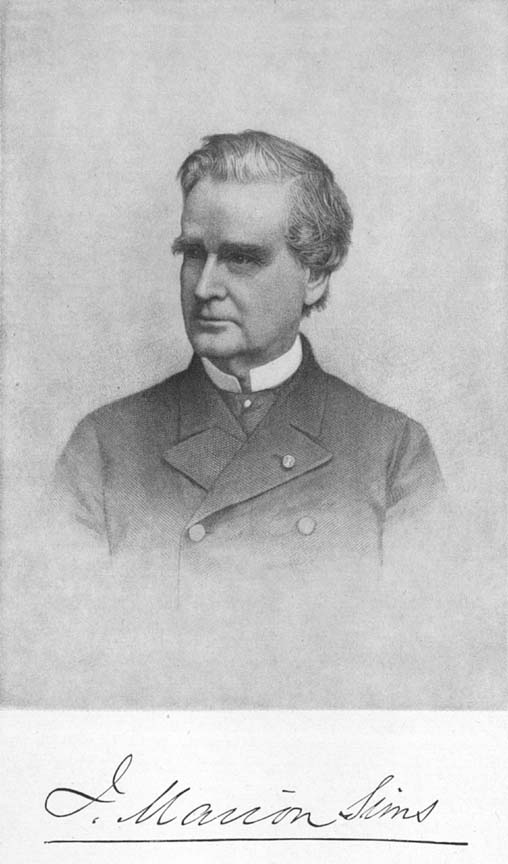
Marion Sims now had passed his fortieth birthday, a time at which most men tend to take stock of achievements, prospects, and current liabilities and assets. Despite the fact that his achievements in the past dozen years had been outstanding, there could be no denying that his prospects appeared poor and that his liabilities seemed to outweigh his assets by a considerable margin.
The first of his liabilities, of course, was his illness. For nearly four years, with only occasional brief intermissions, he had been the victim of a severe malady which not only had undermined his constitution and transformed him into a living skeleton but also, inevitably, had had a pronounced effect upon his disposition and mental outlook. The lively, boyish, winning young man of a few years before, with his perennial gaiety and enthusiasm and his irresistible personal magnetism, had been replaced by a peevish, resentful, suspicious invalid, hard to get along with and quick to take offense. For a man whose chances of succeeding in his new world were dependent primarily on his ability to win new friends these unhappy characteristics could not but prove a severe handicap.
An even greater handicap, perhaps, was his lack of local connections and of a European medical education. New York's physicians in the '50's were divided sharply into cliques; there was perennial feuding between those who were allied with one medical college or hospital and those who owed their allegiance to another institution, while newcomers affiliated with neither group were likely to be subjected to the opposition of both. Moreover, most of the profession's leaders had studied abroad, and an outsider with no firsthand knowledge of the methods and teachings of Paris' and Edinburgh's medical giants soon became aware that his provincialism was a deterrent to metropolitan distinction. For a young man just making his start in medicine these barriers were not insurmountable, but for a man turned forty they were a formidable obstacle.
Third in the list of Sims's liabilities was his stringent financial situation. In Montgomery his earning power had been great, but his long siege of illness not only had eaten up most of his savings but also had made severe inroads on the modest estate which his wife had inherited from her father. His sole financial resources were the $7,500 obtained from sale of the drugstore partnership and the income he hoped to receive from hiring out his slaves' services and from Dr. Bozeman's payments toward purchase of his Montgomery property. Until he could regain his health and get established in New York this money would have to suffice for all the needs of a family of eight.
In this situation a prudent man probably would not have used most of his nest egg to buy a large and expensive house, but Sims was characterized more by impulsiveness than by prudence, and after several months of living in boardinghouses and visiting with friends in Connecticut he decided that if he was to present the solid, settled, and prosperous appearance so essential to his local acceptance as a successful physician he absolutely must have a home of his own. A house, he reasoned, not only would provide a dwelling place for his wife and six children but would serve as a nucleus for the recouping of his fortunes, for he had been receiving letters from former patients in the South asking him if he could treat them if they came to New York, and since he had no hospital affiliations the only way to answer their questions affirmatively seemed to be to establish a private infirmary where patients could receive board and lodging as well as surgical treatment.
Selection of the location of his home was a matter of prime importance. For the sake of his professional standing it was essential that his address be in a good neighborhood, but financially it was quite out of the question for him to purchase a place in a really fashionable district. After some searching he found an available house in a newly developed section which, though certainly not fashionable, at least had the virtue of being in the line of society's general march northward, so that in time it might become an address of some distinction. It was on Madison Avenue between Twenty-eighth and Twenty-ninth Streets, not far from the New York and Harlem Railway Union Depot and several blocks above Madison Square, which only recently had become a public park, after having served its turn as the site for a paupers' burying ground, an arsenal, a house of refuge, and a hippodrome. The address was 79 Madison Avenue, though it might just as well have been almost any other number, for it was so conspicuously on the straggly uptown fringe of things that there was no other first-class dwelling house nearer than Twenty-third Street. So bare of other substantial buildings was the vicinity that the new house commanded an unobstructed view of the boats on the Hudson and East Rivers, as well as of the wagons and carriages passing along busy Bloomingdale Road (later rechristened Broadway to match its downtown continuation).
For this isolated structure, standing in solitary state amid immigrants' shacks, weed-grown vacant lots, and grazing goats, Sims agreed to pay $15,000. This was considerably more capital than he possessed, but the seller was willing to accept only $5,000 as an immediate cash payment. This meant that after furnishings were bought and installed the Sims family's remaining capital amounted to not more than a thousand dollars, with the means of making future payments on the house still problematical.
Not the least difficult aspect of the situation was the fact that the older Sims children had reached an age at which, in the normal course of events, their parents would have gone to considerable expense to give them a good education with appropriate social trimmings. Mary was fifteen---a handsome girl with a quiet dignity befitting her place as the oldest in the family. Eliza was nearly fourteen, Granville twelve, and Carrie ten. Only Fannie, going on six, and Harry, aged two, were too young to be much affected by being transplanted from the deep South to the North at a time when Northern and Southern politicians and newspapers were absorbed in vilifying each other. The older children in their school contacts were unhappily aware that they were now in a new and different world, and the adjustment was not easy. Granville, in particular, found it hard to feel at home among all the Yankee boys who ridiculed his Southern ways and Southern viewpoint.
What worried Dr. and Mrs. Sims particularly was that they had to send their children to public school because they could not afford the extra expense of private schools. New York acquaintances assured them that the public schools were really quite all right, but this was hard for them to believe, for in Alabama and throughout most of the South free public schools were as yet practically nonexistent.
In this prevailingly gloomy picture there were, to be sure, a few rays of light. New York's "pure soft Croton water and bracing air" (as Sims himself characterized them) already were beginning to get in their good work, and within a few months the wasting disease which had brought about the flight from Montgomery showed encouraging signs of coming under control, although complete good health was not restored for nearly two years. Added to this was the fact that, in surgical circles, Sims, though definitely on the outside looking in, actually was not completely unknown to New Yorkers. A few physicians remembered him because, on his Northern visit the preceding summer, he had represented the Alabama State Medical Association at the annual meeting of the American Medical Association. His principal card of introduction, however, was his authorship of the article on vesicovaginal fistula which had appeared in The American Journal of the Medical Sciences in 1852. The claims made in that article were sufficiently astounding and unorthodox to have aroused in the profession considerable discussion, not infrequently mingled with disbelief; and the article's author soon found that when he was introduced to New York physicians they were likely to recognize his name as that of the Alabama doctor who claimed, incredibly enough, to have found a sure-fire way of curing that ancient scourge of womankind, vesicovaginal fistula. They obviously were curious about him, and Sims was hopeful that this curiosity might bear fruit in the form of invitations to demonstrate his technique.
For several months, however, his wares were politely ignored, despite the fact that he tried to call attention to them by having reprints of his fistula article distributed among the medical profession's leaders in the metropolis. Then in October, while the Sims family was mourning Theresa's mother's death the week before in distant Alabama, there came a day when the out-of-the-way house at 79 Madison Avenue was honored by a call from the man who was widely recognized as the dean of all New York's great surgeons, the illustrious Dr. Valentine Mott.
Doctor Mott could well afford to be hospitable to an outsider, for his own pre-eminence was unquestioned. For four decades (with a six-year intermission during his triumphal period of residence and practice in Europe) he had been New York's best-known professor of surgery, and during those forty years he had achieved an international reputation for his daring and original operations -particularly for his brilliant pioneer work in surgery of the veins and ligation of the arteries. Recently an upstate physician had sent to him a patient who was severely incapacitated by a large vesicovaginal fistula, and to Mott this presented a good opportunity to test the validity of the sweeping claims to success in this field made by that pathetically emaciated newcomer from Alabama whom he had met once or twice. Sims jumped at the chance, of course, and his operation on Mott's patient was a complete success. It was, he was told, the first cure of a vesicovaginal fistula ever effected in New York.
Doctor Mott's request was followed in short order by one from Dr. Gurdon Buck, a much younger man than Mott and, after him, probably New York's most famous and resourceful surgeon. To have been invited to operate at the New York Hospital, where Buck was visiting surgeon, would have been a precious feather in Sims's cap, but that was not Buck's proposition. What he asked was that Sims show him the technique of the operation so that he himself could perform it on one of his patients. Naturally Sims, humbly seeking every possible opportunity to make his methods known, even at the sacrifice of personal preferment, could not but oblige. He loaned Buck his instruments, coached him in their use, and acted as assistant at the operation, which turned out gratifyingly well. At its conclusion Buck, addressing his audience of intently watching students, spoke glowingly of Sims's genius, patience, and skill in bringing this hitherto baffling operation to such a state of perfection.
Now at last, thought Sims, with the recognition of such men as Mott and Buck, he ought to be well on his way toward the remunerative practice he so desperately needed. He soon found, however, that kind words and compliments would not purchase groceries. Doctor Buck, being a surgeon of exceptional ability, needed no more than the one lesson. He thought highly of Sims's methods, but now that he himself was able to employ them it seemed hardly necessary to employ their inventor. Soon there began to be reports of brilliant cures of vesicovaginal fistula effected not only by Dr. Gurdon Buck but also by several other surgeons possessing established followings and hospital connections, while Sims himself, still quite without patronage except for his few patients from the South, sulked unhappily in his tent, finding in the new turn of events ever greater fuel for the misanthropic bitterness born of his long illness.
The trouble, he realized, was that the very thing which made his fistula operation so invaluable was also, from the point of view of his own prosperity, its greatest liability: it was so sure and simple that other surgeons could master it with ease. Therein it differed sharply from the techniques worked out by his predecessors---men like Mettauer of Virginia, Hayward of Boston, and Pancoast of Philadelphia-who, though they had had some success in curing fistulas, had done so by methods too esoteric and uncertain to inspire many of their fellows to follow in their footsteps. Even so supreme a surgical authority as the great Velpeau of France, writing of the hazards to be encountered by anyone who sought to mend a vesicovaginal fistula, had said that "The suture is of such difficult application that but few practitioners have ventured to make trial of it . . . . To abrade the borders of an opening when we do not know where to grasp them, to shut it up by means of needles or thread when we have no point apparently to secure them, to act upon a movable partition placed between two cavities hidden from our sight, and upon which we can scarcely find any purchase, has appeared to be calculated to have no other result than to cause unnecessary suffering to the patient." But Sims, with his silver sutures, his perforated shot, and, above all, with his speculum which made perfectly clear the whole formerly invisible field of operation, had overcome, one by one, all of these difficulties, with the result that now other men were able to learn in an hour or so the painstaking technique which had taken him the better part of four years to perfect.
It was not that he minded sharing the fruit of his efforts with the medical profession as a whole. That was all part of the Hippocratic tradition and he was thoroughly in accord with it; he was aware that he had profited abundantly from the work of other men before him, and he was eager for others to profit in turn from his---all the more eager because he knew how many women there must be, scattered far beyond his field of action, who needed the kind of help his methods made possible. What he did mind, however, was that his current situation seemed to be more than a matter of sharing; what he had done, apparently, was to give away outright the whole product of his labors, without retaining anything for himself. To see his Theresa---the gently reared Theresa, accustomed to a houseful of servants---doing all the cooking for a large household and cutting up her best gowns to make school dresses for her daughters, all because he had no patients and no money, while at the same time other surgeons were earning large fees for performing the operations he had taught them---to see all this was enough to drive him into a very frenzy of self-pity and despair. He was discouraged, he was homesick, he was broke; he fancied himself the target of a deliberate campaign of persecution when actually he was merely the victim of indifference. With money at a dangerously low ebb and with no hope of better days in sight he was ready to call the whole thing off and go back to Alabama. Fortunately for his future (for in his still perilous state of health renewed exposure to endemic diseases probably would have been fatal) one very potent obstacle stood in the way of ignominious retreat. That potent obstacle was Theresa.
Theresa Sims usually was quite content to stay in the background while her talented husband was sailing along on the crest of the waves of success. But when---as happened many times---his craft seemed to be in grave danger of capsizing, she always was ready to take over the command---unostentatiously, to be sure, but with a firm and compelling assurance. His temperament had about it more than a touch of the prima donna---at one moment touching the clouds and at the next sunk to the depths. He very much needed a steady hand to restrain his impulsiveness on occasion and to buoy him up when he was down; and he was fortunate in having such a stabilizing agent always present in the person of his wife. Now when he declared himself beaten by all the obstacles arrayed against him she emphatically refused to share his viewpoint. In the seventeen years of their marriage she had been willing to follow him in all his peregrinations quite as faithfully as Ruth had followed Naomi; but this time, she felt sure, a new move would not solve his problems; it would only aggravate them.
It was not merely that she dreaded his almost certain relapse into acute illness if they should return to the South. Beyond that was the feeling that, having burned all his bridges behind him in Montgomery, he would encounter even there severe shocks and disappointments. It was one thing to come home from a simple tour of convalescence, sure of finding a welcoming house and an established practice; it was quite another to return defeated from what had been widely heralded as a permanent move to the North. Even some of his most treasured personal relationships, she knew, would be on a treacherous footing, for in the petulance of illness and financial stress he had managed to quarrel with one or two of his closest friends, including Dr. W. O. Baldwin, who had been his devoted companion during all his years in Montgomery. No, it was unthinkable for him to leave New York until he had found success there; if ever he was to return to Alabama it must be as a conquering hero, not as a failure. True, their financial plight appeared to be desperate, but still she was not ready to admit defeat, for she felt that they had not yet exhausted quite all their resources.
Among these remaining resources was the Madison Avenue house. Obviously they could not afford to support it, but why should it not support them? New York, with its population growing by leaps and bounds, was in the throes of a housing shortage; and as a result of that shortage a woman named Mrs. Seymour, with whom the Simses had boarded before they bought their own home, had lost possession of her rented boardinghouse on Fourth Avenue and was looking desperately for another one to take its place. She offered to take over the operation of 79 Madison Avenue and to board the entire Sims family in lieu of rent. At the moment this seemed like the best available solution for at least part of the problem of making ends meet, so the offer was accepted.
Under this new arrangement the major portion of the house was occupied by paying guests, while the Sims children had to be served at the second table in the dining room and crowded into whatever attic bedroom space the landlady could spare. Sims retained the use of his office, however, and his professional name plate continued to be displayed on the front door. It was because of this name plate that he had his first meeting with Thomas Addis Emmet, a young man who was destined to play an important part in his New York career.
Emmet was a twenty-five-year-old Virginian, recently graduated in medicine and now serving as visiting physician at the Emigrants' Refuge Hospital on Ward's Island. He came of illustrious stock, being a great-nephew of the famous Irish patriot, Robert Emmet, and a grandson of the exiled Thomas Addis Emmet who had won distinction as a lawyer, physician, politician, and railroad promoter in the New York of a generation before. One afternoon late in 1853, as young Emmet and a friend were taking a walk on the outskirts of the city, they observed with considerable surprise and amusement how one lone house of generous proportions was standing in solitary grandeur among the weed-grown lots and nondescript shanties of Madison Avenue above Twenty-eighth Street. Their surprise became even greater when they noticed that the house bore a physician's sign. "J. Marion Sims, M.D." Emmet read aloud. "What a strange location for a physician!"
"Sims!" exclaimed his companion. "Why, that is the Dr. Sims who used to live in Montgomery! I don't know him very well, but I have heard he has been ill, and I would like to call."
The two men stopped, accordingly, to pay their respects to a fellow Southerner who, in coming North, had managed to move rather too far north in New York City for his current professional well-being; and Emmet, seeing Sims for the first time, was moved to pity to behold a man of such youthful appearance so anemic and so extremely emaciated as to give the impression of being at death's door. In the course of the conversation Emmet happened to mention that he was soon to be married to a girl from Montgomery; and Sims, knowing both the young lady and her parents, and homesick for the sight of anyone who reminded him of Montgomery, showed heightened interest in his visitor and assured him that they must meet again.
For the time being, however, purely social contacts with Emmet or anyone else were entirely out of the question. Whatever slim resources of health and energy Sims possessed must go into the attempt to get himself established professionally. However little he might feel like it, he must steel himself to push his way through any slight rents in the great curtain of indifference which shut him off from active participation in New York's world of medicine.
One such rent came in the form of two little notices which appeared in the New York Medical Times for December, 1853. One of these items, under the heading "Infirmary for Treatment of Accidents of Parturition," reported that "Dr. J. M. Sims, late of Montgomery, Alabama, having selected New York as his future place of residence, has opened an infirmary for the treatment of the accidents of parturition, such as injuries of the bladder, rectum, perineum, &x. He has made ample arrangements for the accommodation of patients from a distance, where they may enjoy all the comforts of a home, and looks to the profession to second his efforts. His residence is No. 79 Madison Avenue." The second item was a bibliographical notice of Sims's pamphlet on vesicovaginal fistula, embellished by the Medical Times editor's expression of good wishes for the success of the New York infirmary just established by the pamphlet's author.
With overt advertising strictly contrary to the A.M.A. Code of Ethics, such notices as this constituted as good publicity as a doctor could hope to get. Sims followed it up by searching through his Alabama case histories, writing brief reports of several of the many successful operations recorded there, and getting them published in the medical journals, always adding to his published signature the nostalgic phrase: "late of Montgomery, Alabama." None of these excursions into print, however, had the desired effect of influencing physicians to refer their specialized surgical cases to him. His "infirmary for treatment of accidents of parturition," with its "comforts of a home" now somewhat altered by the presence of Mrs. Seymour as head of the household, continued to have no patrons except those who came from the South. There was one brief period of hope when the famous Dr. Valentine Mott again enlisted Sims's aid, this time in the case of Mrs. H., "the amiable and accomplished lady of an intelligent professional gentleman of South Carolina." For more than seven years Mrs. H. had been traveling from one distinguished surgeon to another, being subjected to the repeated torture of the "actual cautery," or hot iron, in her vain attempt to find a cure for a vesicovaginal fistula incurred in childbirth. So smoothly had Sims perfected his technique by now that he required only twenty minutes for his operation on this long-suffering lady: and less than two weeks later she was able to return to her home in South Carolina completely cured after her seven years of invalidism.
Yet even this new proof of his abilities brought no further invitations to operate, and after another interval of waiting Sims came to the unhappy conclusion that there was absolutely no likelihood of his ever receiving an appointment on the surgical staff of any of New York's established hospitals, whereas without such an appointment, he knew, there was little chance of his finding any but occasional scattered patients. It was a frustrating realization---frustrating not only because it meant that his inability to earn a living seemed likely to be prolonged indefinitely but also because he felt sure that there was in New York a crying need for his services which was not being filled.
Living, as he did, in a section where there were many newly arrived immigrants, he was acutely conscious of their problems. Several hundred thousand foreign-born newcomers were pouring into the United States every year, and the majority of these came first to New York. Usually their financial resources were quickly exhausted, and the only way they could keep themselves from starving was for all the members of their families, including the mothers of young babies, to go to work for incredibly low wages. (An experienced cook, for example, received nine dollars a month.) These working mothers, taking scant time out to have their babies, fell victim to many female ills; and nowhere in the city were there any facilities to provide them with the specialized medical or surgical attention which their ailments required. As a matter of common humanity, Sims meditated, these women ought to have access to a hospital of their own.
A hospital of their own! Why not? After all, there was nothing stranger in this idea than there had been in that of setting up separate hospitals for cholera victims, such as he had found when he had arrived in New York during the great cholera epidemic. And if a special hospital for women was needed, why shouldn't he himself be the one to found it? Perhaps it was fatuous of him to dream that he might secure enough popular support to establish a new institution when he could not even secure enough patients to support his own family; probably he would be considered a presumptuous upstart. Well, he would have to take a chance on such unfavorable reactions, not only because this seemed to be the only way he could possibly acquire a foothold in New York, but also because the idea of a hospital exclusively for women fired his imagination. The more he thought about it the more the conviction grew upon him that here was a crying need which must be filled.
Establishing a hospital, he realized, was definitely something which could not be done by an unknown without influence. Ideally a woman's hospital should be founded by women. But New York had only one woman doctor, Elizabeth Blackwell, the first feminine physician in the country, who had opened her office in the metropolis only a year or two before Sims and who was having an even harder time than he to obtain recognition. And as for laywomen, it was quite out of the question to expect them to take the initiative in inaugurating such a movement; the very idea would have horrified the dominant male world, which chivalrously referred to women as superior beings but in all essential questions of equality treated them as a subordinate race. No, the initiative would have to come from men, and, more than that, from medical men, who, unless their approval was secured in advance, could easily destroy such a hospital, even assuming that it could be started without their co-operation.
What Sims must do, then, if he wanted his dream to become an actuality, was to turn himself into a salesman---a role for which, in health, with his natural geniality and charm, he might have been ideally fitted, but which in his nervously unstrung state of partial invalidism he found little to his liking. He began making the rounds of New York's leading physicians, telling them of his idea and asking their advice as to ways and means of creating a special hospital for the treatment of diseases and injuries peculiar to women. The three outstanding "elder statesmen" of the city's medical circles---Dr. Mott, Dr. John W. Francis, and Dr. Alexander Stevens, who had been the principal founders of the New York Academy of Medicine---all were kind to him and gave him encouragement. Doctor Stevens, in fact, went so far as to offer to use his influence with the Episcopal backers of the projected new St. Luke's Hospital so that it would be designed to include a separate ward devoted exclusively to the diseases of women. He even volunteered to call a meeting of the whole medical profession at the College of Physicians and Surgeons (of which he was president) in order to introduce Sims, who might then explain his plan and seek general support.
Confronted with this proposal, Sims grew just as panicky as he had years before, back in medical school, when asked to speak in public. In the intervening years he had acquired a fair degree of self-confidence, but during his illness and despondency most of this had vanished, leaving him so suspicious even of those who were trying to help him that he feared that in asking him to speak they merely were seeking a chance to make him the butt of their derision. To Stevens' invitation, therefore, he replied in instinctive horror: "But Doctor, that is impossible! I cannot make a speech. It would frighten me to death to stand up before an audience." Even in the face of this rebuff Dr. Stevens cordially renewed his urging, but Sims begged to be let off for a time to think it over.
After two months of futile attempts to achieve his goal through other channels he returned to say that now he was ready to make the suggested appeal to New York's doctors. Not too surprisingly, Stevens in the meanwhile had lost his enthusiasm. Since the earlier interview he had been talking with other members of the profession about Sims's proposal and had found them so cool to the idea that he no longer felt justified, he said, in offering to act as the Alabamian's sponsor.
With a nerve-torn invalid's tendency to consider himself persecuted, Sims felt that this verdict was a stab in the back. Its real cause, of course, was his own failure two months before to strike while the iron was hot, but that did not alter his conviction that every man's hand was against him, that New York's physicians were deliberately leaguing themselves in opposition to him, and that he had not a friend in the world. It was while he was in this low stage of extreme depression---financially, mentally, and psychologically on the bitter edge of disaster---that he met the mysterious, strangely improbable man who was to steer him out of trouble and then---two decades later-to steer him into it again.
No conscientious novelist would dare to invent Henri Luther Stuart, or the part he played in Marion Sims's life, for the fabrication would seem too farfetched to warrant credence. Certainly Stuart's first appearance on the scene and his ensuing whirlwind campaign had all the aspects of something which Aladdin might have produced by rubbing his lamp.
It happened in April of 1854, nearly a year after Sims's arrival in New York. His morale was at its lowest ebb when he encountered one day on the street a Mr. Beattie---an old neighbor and patient from Montgomery. In answer to Beattie's polite inquiries concerning his health and prosperity he did not have the heart to make the conventionally cheerful or noncommittal replies; instead he poured out all his woes, saying bitterly that he and his family were in danger of starving because the medical profession was opposing all his plans and practically boycotting him.
Beattie, concerned and a little embarrassed to see the frantic state of despairing self-pity to which his once gay and confident physician had been reduced, mumbled something about being sorry that he himself was in no position to help Sims out of his difficulties. "However," he added, "I happen to know the very man who, if he takes a fancy to you, can help you. I will bring him to see you tomorrow evening."
It seemed to Sims more than a little unlikely that Beattie, a layman and a comparative stranger in the city, could casually produce a miracle worker whom he himself had not encountered in all his eleven months of effort. Hence he was not in a particularly receptive mood the next evening when his old friend came to call, accompanied by a tall, thin, odd-looking man who was introduced to him as Henri L. Stuart. His diffidence soon gave way to amazement, however, as he discovered that the newcomer was prepared to take entire charge of the situation without further ado.
"Doctor Sims," said Stuart, "Mr. Beattie has told me something about your antecedents and your experience in New York; and I have come to have a talk with you and to know what it is all about."
Sims felt a little as if an undertaker had come into the room to take his measure and lay him out, but he was in that stage of depression where he welcomed any opportunity to talk about his troubles, so he proceeded to unburden himself freely to this man who, though a perfect stranger, offered the sympathy and interest which he craved. As soon as he had finished Stuart was ready with a plan. "I will tell you what is to be done," he said. "We will rent Stuyvesant Hall; we will advertise in the newspapers for the whole medical profession to attend a meeting to be addressed by you on the necessity of a hospital for the treatment of the diseases of women. We will invite all the leading doctors in town by special cards, and they will come to hear you and will be wise enough to endorse what you have to say. If you tell your story to that crowd of doctors as you have told it to me we will carry the day, and a month from now, instead of being a beggar, you will be a dictator."
Sims was puzzled at the calm and confident way in which this man assumed generalship over his campaign, but he was immeasurably relieved, too, for he had just about given up hope of being able to continue waging battle all by himself. Now, therefore, he stood by in passive delight as this mysterious good fairy calmly proceeded to dispel with a few strokes of a magic wand the various obstacles which had blocked his path for months. After deciding that the evening of May 18 would be a good time for the meeting, Stuart sat down at Sims's desk and dashed off a form for the several hundred cards of invitation which he proposed to have printed. Next he announced that he would go down to Broadway and Bond Street the following day and arrange to rent from Stuyvesant institute the auditorium of the Medical College of the University of New York.
At this point Sims began to be a little worried, and he reminded his new friend that he had no money or resources and did not dare to run into debt. This demurrer bore no weight with Stuart, who dismissed it with a breezy "Damn the expense; never mind the money!" Off he went then, cautioning his host to start getting his proposed lecture in order, and leaving him, not unsurprisingly, in a state of complete bewilderment.
Morning came, and another and another, and still the incredible experience did not turn out to have been merely a dream. There actually was a Henri Stuart, apparently, and he actually was going ahead most energetically with his plans to put the surgeon from Alabama on the map and to help him create the first hospital exclusively for women in the Western Hemisphere. Why? That was something which Sims never quite found out, although he was able, as time went on, to collect fragmentary bits of information about his puzzling benefactor.
Stuart, he discovered, was a man of some wealth, but decidedly not in the conventional mold for men of means. A Vermonter of about Sims's own age, he had studied law, medicine, and civil engineering, had been the engineer in charge of building the Michigan Southern Railway, and had founded a newspaper in Michigan---all before he had decided, nine years before, to move to New York, where his brother was one of the editors of the New York Sun. For some years Stuart had followed in his brother's footsteps, becoming one of Horace Greeley's right-hand men on the staff of the Tribune. He was too restless, however, to remain permanently content with a newspaper man's routine, and in time he became strictly and frankly a dilettante: writing when he felt like it for this publication or that, working vigorously and usually anonymously for such causes as captured his enthusiasm and fancy, and proposing and promoting all sorts of ideas, ranging from the laying of an Atlantic cable to the placing of pianos in schoolhouses. There was no end to the subjects which interested him and engaged his support: the abolition movement; the Native American or "Know-Nothing" Party, with its anti-Catholic, anti-immigrant platform; the development of torpedoes; the consolidation of the city's ward and public schools. Not long before he met Sims he had been active in helping the ladies of the Home Missionary Society to establish the Five Points Mission in a notorious Lower East Side slum section; now he was looking around for new outlets for his extraordinary energies. By a beneficent trick of fate Sims and his plan for a woman's hospital happened to fall under his eye at a propitious moment.
During those first few weeks of their acquaintance Sims was still largely in the dark as to Stuart's background and motivation, and as the days went by and the tall stranger casually shouldered his burdens and rearranged his life he began to have an uneasy sense of bewildered obligation. Obviously he could not let this man do so much for him without doing something in return. With some embarrassment he broached the subject, suggesting that when he got back on his feet again financially he would want to pay a generous sum in recognition of Stuart's efforts; but Stuart brushed aside all such proposals, saying that the only payment he wanted was the privilege of sending occasional deserving cases to the hospital for free treatment once the proposed institution was well under way. Meanwhile he continued to act as a puppet master, pulling the strings and causing his somewhat bewildered protégé to go through his paces.
One bit of puppetry which very easily might have caused Sims to lose caste in the medical world was the high-powered publicity campaign preceding the Stuyvesant Hall meeting. A day or so before the scheduled date Stuart turned up bright and early in the morning to ask Sims to go down town with him, refusing to reveal the purpose of the trip. Their first stop was at the Tribune, where Stuart walked into Horace Greeley's office, introduced Sims as the originator of an enterprise of great potential benefit to humanity, described his project briefly, and said he would like to have a notice of the meeting put in the paper. "Write your own notice, Mr. Stuart," said Greeley. Stuart did, then moved on, with Sims in tow, to the Times office, where he went through exactly the same ceremony with the Times's famous editor (and Greeley's sworn enemy), Henry J. Raymond. Raymond was quite as willing as Greeley had been to do precisely what Stuart wished.
By this time Sims was beginning to feel uneasy about the expedition. For weeks he had been moving more or less in a dream, doing as he was told without question; but now he saw rising before him a frightening vision of the medical profession's stern disapproval of a member who stooped to engaging in advertising practices. After Stuart's many kindnesses, however, he could not bring himself to phrase his objections quite so baldly, so all he said was: "I am tired of this. Can't you go in and make your speeches just as well without me?"
"Why no!" replied Stuart. "You are my card and I am playing you off."
This candid admission was not calculated to make Sims feel any better, but obviously he had gone too far now to retreat. All morning, therefore, he continued to follow his energetic promoter like a faithful dog, trudging up and down innumerable steps and allowing himself to be placed on display before the editors of the Herald, the Sun, and the other New York newspapers of the time---a total of fifteen. In all this array of offices Henri Stuart was treated with great consideration; there was not a single editor who did not immediately agree to run the suggested notice.
The next day all the metropolitan newspapers published announcements of the impending meeting. Certainly this was advertising in every respect except that it was not paid for, and Sims was acutely aware that he might be widely criticized for it. Yet he had no sense of personal guilt, for he felt that the advertising, if such it was, was not for himself but for the proposed hospital, and this he was beginning to look upon as a divine mission, a holy crusade. All over the world women were suffering from a wide range of ailments associated with their childbearing function; everywhere the dominant male sex seemed content to let them continue to suffer without making any concerted effort to improve their lot; in all America there was no hospital dedicated solely to study, care, and correction of these manifold ills of womankind. Now was the time, he believed, to remedy this long-standing neglect; now was the time for New York to take the lead. So great had become his crusading fervor that it was fast submerging his personal worries; his prime motive, he convinced himself, was not the establishment of Marion Sims's New York reputation but the establishment of a great center where ill, unhappy women might find new life and health and hope.
It was in this spirit that he composed the crucial address he was scheduled to deliver at Stuyvesant Hall. Somehow his sense of dedication to a great cause served to overcome his perennial fear of public speaking, and when on the evening of May 18 he arrived at the auditorium and found it filled with an expectant crowd his reaction was one not of stage fright but of pleased surprise and elation that so many people had ventured out in the face of a relentless, drenching rain. Mr. Stuart's campaign had had its intended effect. The medical profession of New York was here at his feet, over two hundred strong. There were even a half-dozen women in the audience---a surprising phenomenon, according to contemporary journalistic reports of the occasion; women were the principal persons concerned, to be sure, but even so it was customary for everything to be handled by men.
 |
 |
This, Sims knew, was a decisive moment in his career; it could make or break him. He was no public speaker, but in private conversation he was a pleasing and impressive talker, and on this occasion he managed to speak to his sizable audience just as he would have talked to a roomful of friends. His ability to do this was aided by the fact that---probably as a result of Stuart's shrewd estimate of his protégé's character---the meeting was completely informal. No one introduced the speaker; he simply strolled up to the front of the room and started to talk. For more than half an hour he held his audience's rapt attention by his graphic account of his experiences in his little hospital in Montgomery while seeking a solution for the tragedy of vesicovaginal fistula and kindred disabilities of women. When he finished the meeting was still without any definite plan of action. Sims, having presented his case and shown New York's need for a hospital for women, felt that it would be presumptuous for him to assume any further initiative until the assembled doctors had given some indication that they approved his project. Therefore he simply sat down and waited, hoping devoutedly that someone in his audience might be moved to take the next step.
There was a long and nervous interval of suspense, with everybody waiting for something to happen. When at last the sustained silence had begun to be generally embarrassing, Dr. John H. Griscom, New York's pioneer public health worker, came to the rescue. Since there seemed to be no preconceived plan of action, he said, it might be a good idea to organize the meeting along conventional lines. On his recommendation Dr. Edward Delafield, the great surgeon who had founded the New York Eye Infirmary, was asked to take the chair. Before relinquishing the floor to Dr. Delafleld, however, Dr. Griscom heartily endorsed Sims's plea, saying that the creating of a hospital for women was not only a matter of common humanity but also one of common sense, for in his years of public health work he had observed that a large percentage of the cases of mental illness in the insane asylums were the result of neglect of female diseases.
 |
 |
Dr. Griscom's standing in the eyes of his fellow physicians was high, and now that he had started the ball rolling the meeting moved along smoothly and purposefully. The chairman was empowered to appoint a committee of ten---five physicians and five laymen---to carry out Sims's plan for the establishment of a women's hospital. There were a few die-hards, to be sure, who scoffed at the suggestion that a separate hospital for women was necessary, saying not only that it would be impossible to find enough patients to fill it but also that the idea of specialization in the care of women's diseases was all poppycock-that any general practitioner was perfectly capable of treating any of women's peculiar ailments. Such dissenters were decidedly in the minority, however, for there seemed to be very general approval of the hospital project, and there were several speeches praising Sims, as well as a vote of thanks to him for his presentation of the subject.
The whole affair---certainly as striking a testimonial of faith as any newcomer to a big city ever could hope to receive---left its central figure walking on air. His black despair of a few weeks before had given way to a mood of happy amazement. So these were the standoffish New York doctors whom he had been accusing of coldness and malice! Why, they were as friendly and neighborly as if they all had been members of the Sydenham Medical Society down in Montgomery! How the miracle had come to pass he could not be sure; but there was no doubt that it had happened; his lonely dream actually seemed to be on its way toward becoming a reality.
First, however, there was much work to be done. As a starter there was the matter of choosing the working committee. Over the objections of Dr. Delafield, the chairman, who favored a homogeneous "old-school-tie" organization, Sims insisted that the committee should be made up of representatives of all the divergent medical groups in the city, including Dr. Horace Green, founder and president of the four-year-old New York Medical College, an institution which was sharply derided by adherents of the older colleges. Dr. Delafield was positive that if the maverick Green were included the more generally accepted leaders of the medical profession would refuse to serve with him; but Sims's self-confidence---re-established by a taste of success---was optimistic about his ability to persuade them. And persuade them he did, so that the committee included not only himself and Green (who was the country's first specialist in diseases of the throat) but also that veteran trio of giants, Dr. Alexander Stevens of the College of Physicians and Surgeons, Dr. Valentine Mott of the Medical College of the University of New York, and Dr. John W. Francis, who, in addition to being widely considered New York's most representative, cosmopolitan, and eloquent physician, was the leader of that branch of the profession---obstetrics---which naturally would be most concerned with the distinctive work of a special hospital for women.
Serving with these towering medical men on the committee were five prominent laymen, including Peter Cooper, the great manufacturer and philanthropist, and Erastus C. Benedict, a highly successful lawyer who was president of the Board of Education and one of the principal` founders of the city's first free college. With such outstanding sponsors as these it looked as if the new hospital might be able to get off to a flying start within a very short time; but that, Sims found, was not to be the case, for by this juncture warm weather was at hand and in New York it was an accepted custom for everybody who was anybody to go away for the entire summer. Obviously no real progress could be made until fall, for if the hospital was to be organized on a firm basis as many supporters as possible must be enlisted from the ranks of precisely those wealthy and influential gentry who were now widely scattered in Europe or in America's own favored summer resorts. Just when things were beginning to look promising, therefore, it was necessary for the whole project to go into a state of suspended animation until such time as society should see fit to return to town for the winter.
The encouraging events of the last month or so had had a buoyant effect upon Sims's spirits but none at all thus far upon his income. Despite this condition of approximate insolvency, however, he and his family followed the example of the socially elect and spent the summer in the country, choosing as their refuge the pleasant town of Portland, Connecticut, where they had visited before. Partly they left the hot city because the reign of Mrs. Seymour at 79 Madison Avenue was making their household situation not too happy, partly because Sims needed to build up his health as much as possible before entering on the arduous activities confronting him in the fall, but chiefly because Theresa was expecting a new baby, whose arrival and first few months could be more comfortably arranged in rural Connecticut than amid the crowded complications of a Madison Avenue boardinghouse.
This new baby, a boy born in July, was named William Clay Sims---the "Clay" being primarily in honor of the friendly and generous New York wholesale druggist who handled Sims's financial affairs and, when things looked darkest, loaned him money. It may also have been incidentally a token, however, of Sims's admiration for Henry Clay, whose death a year or so before had left Congress without the powerful and pacifying compromiser it so sorely needed to keep its legislation steering an even course between the demands of the North and those of the South. Only two months before Willie Sims's birth the Clay-less Congress had passed the Kansas-Nebraska Bill repealing the Missouri Compromise and giving slavery a chance to expand in new territories north of Mason and Dixon's line. This had aroused the North to wide and angry protest and to the spontaneous organization of an antislavery political group which called itself the Republican Party. Such increasing development of anti-Southern sentiment in the North naturally made things no easier for Marion Sims, who, like Henry Clay, continually found it necessary to try to steer a middle course---a difficult line of action dictated by the conflict between his natural loyalties and the circumstances which forced him to spend the rest of his life in the North.
Fortunately by the time he returned to the city in the fall he had regained his good spirits and his normal infectious charm to such an extent that he was able, Southerner or no, to win the favor of the people he needed to help him with his plans for the Woman's Hospital, as now he was beginning to call it. This task of securing essential support was an arduous one, requiring the entire winter. It required also the co-operation of many willing co-workers, and it was at this point that Sims discovered that his principal assistants in achieving his ends were to be not physicians or men of affairs, but women. His first inkling that this was to be the case came, soon after his return to town, from the worldly-wise Henri Stuart. "Now you have done with the doctors all that you can hope to do," said Stuart. "You have had their public endorsement and they cannot take that back, but you have nothing more to hope for from them. What you must do now it to start out and tell your story to some of the leading women in the city and ask them to do the work."
Sims followed Stuart's advice, although he soon found out that it was not literally true that the doctors could do nothing more for him, for one of them, at least, was an invaluable ally in the campaign to organize the hospital. This was Dr. Fordyce Barker, a young surgeon from Maine who had come to New York---by way of an extensive medical education in Europe---only a few years before Sims to assist Dr. Horace Green in the founding of the New York Medical College, where he became professor of obstetrics and the diseases of women and children. Despite his identification with this oft-disparaged new institution, Dr. Barker, by grace of his exceptional ability, his genial personality, and his great social aptitude, already had won for himself a high place not only in New York's medical circles but also in its social life. He had been one of Sims's first acquaintances in the metropolis, and, being one of the few doctors of his time who, like Sims, was specializing in the diseases of women, he felt a very genuine interest in the Southerner's plan to establish a hospital where gynecology might at last have a chance to come into its own. During the summer he had gone out of his way to help Sims's cause by publishing in the American Medical Monthly, of which lie was one of the editors, a long editorial praising the Alabamian's accomplishments and taking certain British surgeons sharply to task for their attempts (unsuccessful, as it happened) to appropriate Sims's method of repairing vesicovaginal fistula without giving a trace of credit to its American inventor. Barker, like Henri Stuart, was convinced that the principal workers for a women's hospital must be women; and through his wide social and professional contacts he was able to introduce Sims to the leaders of the city's feminine world who were most likely to be assets to his cause.
For the next several months, therefore, Marion Sims, attired in a threadbare old frock coat carefully brushed and scrubbed by his wife, devoted himself primarily to the business of making a long series of diplomatic calls at the big brownstone houses on Fifth Avenue and Bleecker Street and Washington Square. Visiting at these homes of wealth was, on the whole, a task he enjoyed, for he had a naive admiration, characteristic of his era, for the possessors of great fortune and social position. He was convinced ---probably correctly---that the way to win success for his cause was to make its espousal fashionable among what he chose to call "the higher stratums in society." In this belief he happily, if anxiously, made the rounds of the list of glittering names which had been given him by Stuart and Barker, being careful, however, not to let his pleasure in meeting the mistresses of luxurious establishments blind him to these ladies' qualifications for serving on his proposed "board of lady managers." What he wanted was not merely women whose husbands' illustrious names would make them imposing figureheads, but women who were willing to give liberally of their time and their energy to help the hospital. (He liked to speak of these ideal board members, incidentally, as "working women," giving these words an entirely different connotation from that which they bear today, for in the 1850's what are now called "working women" formed a class apart---a pitied, exploited class which never was asked to serve on boards.)
Mingling as he was every day with people of great financial resources, he found it disturbing to realize that his own resources had sunk to such a dangerously low level that even with the aid of the kindly Mr. Clay he could not hope to keep his head above water very much longer. Obviously he must have reinforcements and have them soon, and there was only one source from which those reinforcements could come---the sale of the slaves who had been left in Montgomery. For Sims himself to make the long trip to Alabama now, just when he was in the midst of such an important campaign, seemed suicidal; yet the family's relationship to its slaves had been such a close and loving one that it would have been unthinkable to negotiate such a sale without personal contact. The mission to Montgomery, therefore, fell to the lot of Theresa, who, accompanied by the nearly four-year-old Harry, set out in December of 1854 to visit her old home in the South.
There she was faced with the unhappy task of trying to explain to the Negroes that in her family's present financial crisis she had no alternative but to sell them. They were deeply distressed at the prospect, but when they begged to be allowed to return North with her to work for their old masters she could only weep and refuse their pleas, for both lack of money and the present uncomfortable household arrangement with Mrs. Seymour made taking them to New York quite out of the question. Good slaves were scarce and in demand, so in the main it was possible for her to let the Negroes themselves select their own future homes before she discussed terms of sale with prospective owners. As the result of these gloomy proceedings, lacerating to the sensibilities of all concerned, she was able to raise enough money to tide her family over until such time as her husband should be on his feet again.
That elusive time seemed at last to be approaching with gratifying assurance, for during his wife's absence Sims finally began to see daylight after his protracted period in darkness. Not only did New York's cold winter weather apparently have a good effect on his state of health (he gloried in each new snowstorm), not only was the task of organizing the hospital now approaching completion, but his private practice---for so long nearly nonexistent---was starting to show definite signs of being reborn on an even more satisfying financial level than it had known in Montgomery. So far, of course, it was nothing phenomenal---merely an occasional trickle or so; but it was enough to keep the wolf from the door and to give some indication of what he might hope for in the future. More and more he began to be called in consultation by general practitioners confronted with specialized gynecologic problems; and---even more gratifying---he found himself being asked to visit in his professional capacity the well-to-do friends of some of the prominent women whom he had come to know through his crusade for the hospital. This last development gave him comforting reassurance on a matter which had been causing him some worry, for he knew that he never could receive any income from the hospital itself, to which he planned to give his services without charge.
His calls in behalf of the hospital were not all upon potential lady managers, for by now, thanks to the indefatigable Henri Stuart, he was on good terms with the city's mayor and councilmen and aldermen and divers members of the state legislature, with all of whom it was necessary to co-operate if the proposed institution was to obtain the necessary charter, permits, and financial help from the public treasuries. For a man who had been an invalid for more than five years, all this busy campaigning was a heavy assignment, but Sims was thriving on it. He welcomed particularly the sensation it gave him of "belonging" again after his long period of feeling like what the modern world would call a displaced person. His reassuring conviction that at last he was at home in New York was reinforced at New Year's, when, following an old New York custom which was new to him, he devoted all the holiday to making social calls, finding that he now had so many friends that he visited thirty-three different homes. (He had forty-eight on his list, but he could not manage to cover them all.) On New Year's Eve he had written to Theresa that he expected to go to only about half a dozen places, for "You know how I hate mere idle compliments, bowing in and bobbing out. I would not go at all, but I may have a chance to drop a word somewhere for the advancement of the cause of poor suffering woman." When he got into the swing of the thing, however, he did not hate it at all, but enjoyed every minute of it, even when the conversation drifted far from the cause of poor suffering woman.
So far had his spirits rebounded, in fact, from his long siege of despondency and petulance, that he was finding fresh enjoyment in everything, including his children and his religion. His new delight in the children was due largely to the fact that in Theresa's absence he was seeing more of them than he usually did and was getting to know them better. A supremely devoted husband, his affection had been centered so completely on his wife that his sons and daughters had had to play second fiddle. Now, with Theresa away, he began to notice them more and to depend upon them for a new fellowship; and he was charmed to find what satisfactory companions the older children were and how much good sense they seemed to have. His most extravagant manifestations of doting parenthood, however, were reserved for Willie, the baby, whom he chose to call "Knick" in honor of his being the first to be born since the family's move to Father Knickerbocker's town. In his letters to Theresa he never tired of boasting of little Knick, repeatedly assuring her that her youngest "improves daily and is said to be not only good-looking but the best boy in the city." He was particularly enchanted by the infant's hair. "It is really ridiculous," he wrote Theresa, "to see Mrs. McCarren curling his hair-hair that is so rudimentary that it requires a microscope to see it." A few days later, however, he was able to report enthusiastically: "His hair grows finely. I should suppose it to be at least a quarter of an inch long. You can see it without holding him sidewise in the sun."
Side by side with his growing zeal for fatherhood went his growing zeal for religion. A great religious revival was in the process of sweeping the country, and Marion Sims was in precisely the right frame of mind and emotion to be caught up by it. Like his father before him, he never had had actual membership in any church group, although he always had accepted without question the church's teachings and had been in the habit of attending services desultorily. His sorely trying experiences of the last few years, however, followed by his current rebirth of hope, had developed in him a firm conviction that his life, like job's, was directly subject to divine control, that his recent hardships had been ordained to test his fitness for the great work he was called to do, and that in not being an active church member he was guilty of gross moral negligence.
In this exalted mood he did two things: he wrote long letters to his wife and his father urging them to join him in a public profession of their faith; and he devoted his Sundays to the business of shopping around from one church to another, trying to find the one in which he could feel most at home. On these sampling tours he was likely to spend his morning in one church, his afternoon in a second, and his evening in a third; and so eager was he to be familiar with all the possibilities before he made his decision that one Sunday he even deserted Manhattan and traveled over to Brooklyn in order to hear the renowned Henry Ward Beecher. He was not tempted to repeat this experiment, however, for he was unfavorably impressed by Beecher, who seemed to him not a preacher, but an actor---"purely a pulpit demagogue" devoid of "the first ray of spiritual religion."
In sharp contrast to his reaction to Beecher was his feeling about the Reverend Dr. William Adams, pastor of the new Madison Square Presbyterian Church, who, with his congregation---reflecting the trend of the times---had just moved northward from the old Central Presbyterian Church in Broome Street. Adams, a minister of broad catholicity with a sharp distaste for sectarianism and dogma, appealed strongly to Sims, who after a month or so of experimentation was quite ready to abandon his religious sightseeing and settle down for life as one of the Madison Square Presbyterian Church's devoted pewholders.
All of these concerns---private practice, social life, family matters, and churchgoing---were strictly secondary, however, to the one great preoccupation which now dominated his every thought: the founding of the hospital. Thanks to Sims's own tireless enthusiasm and to the invaluable assistance provided by Henri Stuart, Dr. Fordyce Barker, E. C. Benedict, and others, most of the initial obstacles had been hurdled by now, and the concept which a year before had been only a dream was apparently well on its way toward fruition. There was just one thing that worried Sims: among all the women of social prominence to whom he had talked there seemed to be not one who was able and willing to take full responsibility for organizing and directing the work of the Board of Lady Managers. Then it was that he had a stroke of notably good fortune: he succeeded in enlisting the support of one of the most remarkable women of her time---Mrs. Thomas C. Doremus.
Sarah Platt Haines Doremus---at that time in her early fifties---was one of the first women of her class willing to assume leadership in public movements. Although she had married at nineteen and was the mother of nine children, she always managed to find time to give active assistance to a wide range of religious and humane causes. Even more valuable, perhaps, than the great work she did herself was her unique ability to persuade other women of privileged social background to join her in organized philanthropic effort to help persons less fortunate than themselves. When Sims first went to see her, early in February of 1855, she already was deeply involved in work for various other organizations, but she immediately became so convinced of the merits of his cause that without hesitation she agreed to put her shoulder to the wheel.
Her first move was to examine carefully the list of names which he and his friends had drawn up and to tell him which of the women included thereon could be counted on to be of real service and which could not. Next she outlined the proper organization of the board. "Mrs. David Codwise must be first directress," she said, "Mrs. William B. Astor second directress, Mrs. Ogden Hoffman third, Mrs. Horace Webster secretary, and Mrs. Jacob LeRoy treasurer."
"But," Sims protested, "pray tell me what must Mrs. Doremus be? You seem to be a regular Warwick, appointing kings and leaders and keeping in the background yourself."
"I will be your chief marshal or chief counselor," Mrs. Doremus replied; and for more than twenty years that is what she remained, never accepting any office higher than that of assistant treasurer and yet always functioning as the board's main tower of strength ---not merely as marshal or counselor behind the scenes, but as the chief of the hospital's "working women."
The organization of the board proceeded precisely as Mrs. Doremus had planned it. Mrs. Codwise, for four decades one of the city's social leaders---a charming, generous woman of lively intelligence---promptly agreed to accept the role which Mrs. Doremus had assigned to her and to complete the task of enrolling the women who were to serve. Sims went away from her home walking on air. Things really were looking up now! A few days earlier he had had another bit of recognition which, combined with these other heartening developments, had gone far toward restoring the confidence in himself which had been so badly shaken during that bitter first year in New York. Dr. Chandler Robbins Gilman, professor of obstetrics and the diseases of women and children at the august College of Physicians and Surgeons, had called to invite him to deliver a lecture on his vesicovaginal-fistula operations before Gilman's class of students. This, Sims felt, was decidedly a feather in his cap; it seemed to be a fairly obvious sign that representatives of the opposing medical schools were beginning to tumble over each other in their eagerness to get on his band wagon ("the fighting of the chickens," Henri Stuart gloatingly called it). To be sure, Dr. Gurdon Buck and Dr. John Watson of the New York Hospital still were strongly opposed to the idea of a women's hospital; they even went so far as to make special calls on Mrs. Doremus and Mrs. Codwise in order to explain that such an institution would be an unnecessary and extravagant luxury, since it could not accomplish anything which was not now being done just as well in the already established hospitals. Sims was convinced, however, that their opposition represented a fast-waning minority; certainly it did him little harm, for their arguments had no effect at all upon women who had been won over by his own eloquence in behalf of his dream.
The official founding of the Woman's Hospital Association, dedicated to "The treatment and cure of diseases peculiar to females," took place on February 10, 1855, in the quiet parlor of Mrs. David Codwise's pleasant house at 27 St. Mark's Place. There Sims told the newly assembled Board of Lady Managers that although relief of the terrible condition known as vesicovaginal fistula was his primary aim, he believed that many other apparently hopeless diseases of women could be brought under control as a result of the opportunity for concentrated study at this new hospital, which, he dared to predict, might soon become known as a center of instruction in gynecology for medical men from all over the world.
Before that hoped-for day could arrive, however, there was a vast amount of groundwork to be accomplished: raising funds, renting and furnishing a building, planning an organization, choosing a staff. On this last score there was, for the present, little to do, for inasmuch as the whole project was built up around the specific genius and personality of Marion Sims it was obvious that he must be the attending surgeon, and until such time as the hospital's patronage should warrant expansion of the staff he was to be its sole medical officer. To prevent his little kingdom from becoming an absolute monarchy, however, his activities were placed under the supervision of a Consulting Medical Board made up of the same group of leaders in the profession (Francis, Mott, Stevens, Delafield, and Green) who had agreed the preceding spring to serve on the organizing committee.
Of these men the one who took the greatest interest and became most closely associated with the hospital's fortunes was the picturesque Dr. John W. Francis, a versatile and eloquent old gentleman who prided himself on his resemblance to Benjamin Franklin and who always could manage to spare time from his lucrative obstetrical practice to patronize the fine arts, preside over meetings devoted to a diversity of worthy causes, and encourage younger men in the development of their projects. In this last capacity he was an indispensable guardian angel to Marion Sims, who in these final busy months of activity before the hospital's opening was constantly alternating between moods of elation and moods of irritation and deep worry. These relapses from buoyancy to despair had ample cause, for now, just as his great dream seemed about to be realized, his old twin demons---ill health and financial insecurity---had arisen again to plague him.
For some months, by virtue of the New York water and climate and an extremely rigorous diet, he had managed to keep his debilitating disease under a fair degree of control; but of late his condition had been complicated by the development of dropsy in his legs, caused, he believed, by the arresting of the diarrhea. The effect of the dropsy was not only to render walking difficult but also to make it impossible for him to rise without assistance if ever he fell down. More than once, in the very midst of his crowded schedule of important conferences concerning the hospital, this handicap caused him severe embarrassment. One such occasion was the morning when, walking up Maiden Lane, he tripped over the curb and fell literally into the gutter, where he lay sprawled with his face to the curbstone, his swollen legs powerless to upraise him, although he floundered away desperately in the attempt to get up. From this predicament he was rescued by a policeman, who, gazing in shocked surprise at the prostrate man's clerically somber black frock coat and stovepipe hat, lifted him gently to his feet and said reprovingly: "I am surprised to see a gentleman of your cloth in the gutter so early in the day." It is not clear whether the meaning of this remark was that, while it was reprehensible for a clergyman to be found lying drunk in the gutter in the morning, it would have been perfectly proper in the evening; but in any event Sims was able to convince his rescuer that he was entirely sober, whereupon he proceeded on his way badly shaken up, but not permanently damaged.
Sometimes, however, he was not so fortunate, and as the result of the shock caused by another of his severe falls on the street his diarrhea returned in an acute form, threatening to lay him low at the very time when it was particularly essential that his energies be at their peak. Things looked very gloomy for a while, and he dragged himself around to his numerous appointments with lady managers and city officials and others in a nightmare of fear that the opening of the hospital might be a case of Hamlet being played minus Hamlet himself. Fortunately he recovered from his relapse after a few weeks (never, incidentally, to be seriously stricken again by the same ailment), but no sooner had he sailed safely past Scylla than he found himself running smack into Charybdis.
Charybdis took the form of Mrs. Seymour, the boardinghouse mistress who had taken the operation of the Simses' house off their hands the year before when they were in such dire financial straits. Now, with the agreed-upon year of her lease concluded and their prospects beginning to look brighter, they were anxious to have their home to themselves again, but Mrs. Seymour failed to see eye to eye with them on this. The place pleased her well, her business was doing nicely, and she had possession and every intention of keeping it. There followed an unsettling and nervewracking period, with Sims getting a court order for the landlady's forceable ejection and her countering with a suit for breach of contract, claiming that she had rented the house for a longer period and had suffered damages to the extent of $2,500. The referee who heard the various claims and counterclaims agreed with E. C. Benedict, who served as Sims's lawyer, that the case was one of blackmail, but pointed out that it would be far better to silence the woman by paying her one tenth of her claim than it would be to accept a clear verdict against her, for as Sims was still a comparative newcomer to New York the enterprise on which he was embarking might be seriously damaged if anyone cared to spread malicious rumors about him.
For a time while the Seymour-Sims battle raged it looked as if the Woman's Hospital soon might have a home while Sims himself had none, for the Board of Lady Managers had succeeded in leasing for $1,500 a year (with the husband of the ever-resourceful Mrs. Doremus going security for the rent) a newly erected house at 83 Madison Avenue. This location had been chosen because of its close proximity to Sims's own residence---an important consideration in view of the recent relapse into feeble health which made it advisable for him to avoid any extra effort. The business of equipping the building with beds and other essential furnishings was proceeding at a promising pace, aided by an appropriation of $2,500 just received from the city's Common Council.
Not until these preparations for the new institution's opening at the beginning of May were almost completed was the unhappy Seymour affair finally settled on the basis proposed by the referee, leaving the Simses free at last to spread out and enjoy themselves under their own roof, and giving the father of the family the peace of mind he needed for his challenging new role as surgeon and presiding genius of America's first hospital dedicated solely to the needs of women.