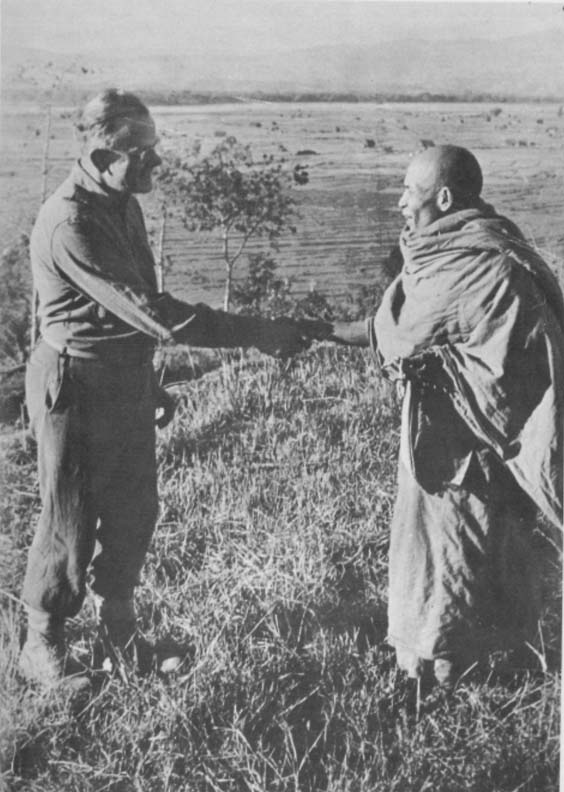
 Hpongyi Sari Ya, Senior Buddhist Abbot of the Namkham Valley, Welcomes Dr. Seagrave Home to his Old Hospital |
|
Hpongyi Sari Ya, Senior Buddhist Abbot of the Namkham Valley, Welcomes Dr. Seagrave Home to his Old Hospital |
|
OF THE SEAGRAVE HOSPITAL UNIT 1942-1946 BOTH BURMESE AND AMERICAN CIVILIAN AND MILITARY and unselfish devotion to duty were a constant source of inspiration to their commanding officer |
|
|
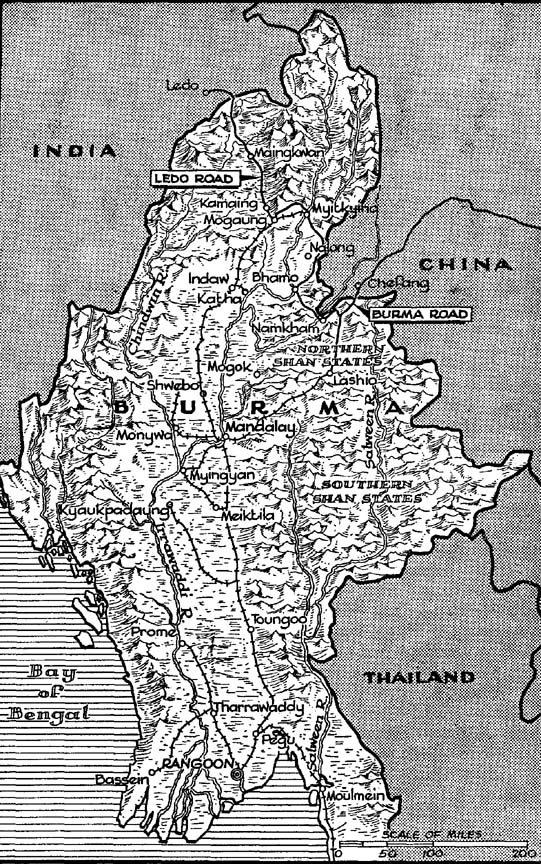
IN THE remote wilds of Northeast Burma, long before world war threatened, Dr. Gordon Seagrave was carrying on his own war against misery, disease, and death. Born in Rangoon, he was the fourth generation of his family to serve as an American missionary ---and the first to be a doctor. To the little village of Namkham he brought his young wife, Tiny, and started his medical mission. His hospital was a little frame building, his equipment a wastebasketful of broken-down surgical instruments salvaged from his training at Johns Hopkins. There were plenty of sick people to treat. Malaria, dysentery, plague, blackwater fever, and all manner of bodily disorders challenged the doctor's knowledge and skill. Patients thronged to the little hospital, and a larger hospital was needed. The Seagraves, assisted by some Chinese coolies and their friends and nurses, built it out of cobblestones with their own hands. Simple native girls were trained to be nurses whose abilities astonished all who came to know them. "Seagrave's Burmese nurses," they were called; they were not Burmese but Karen, Shan, Kachin, and a half dozen other races. Different in their nature, they were alike in their devotion to the doctor they called "Daddy" and to the exacting standards of their work. Their charm and gaiety were in striking contrast to their efficiency in every direction---from giving intravenous injections to driving trucks.
The world and the war came nearer. The Burma Road was built, and Dr. Seagrave set up a chain of field hospital stations to give medical aid to the Chinese during its construction. The Japs were fighting in China, and an airplane factory servicing Chennault's A.V.G. was bombed just across the border from Namkham. When the storm broke over Burma, Dr. Seagrave was commissioned a major in our medical corps, formed a mobile medical unit, organized an emergency ambulance service, and put field hospitals where they were needed. Through days and nights of Japanese bombing, he and his nurses cared for the wounded amid the flames of burning towns, moving back as the Japanese onslaught grew fiercer. Finally the order came---and the Seagrave Unit joined the retreat with Stilwell of American, British, and Chinese Army men and a polyglot mixture of refugees, out of Burma into India---one of the epic stories of the war. On this grueling march, through jungle and over mountains, the little nurses won the admiration of all for their endurance, their unflagging spirits, and their consideration for the welfare of others.
When the refugees reached India, Dr. Seagrave learned that the Japanese high command was quartered in his hospital at Namkham, and later, that the U.S. Air Force had bombed the buildings that had been his home. It was the end of his dreams and hard work, but he had only one thought. "I told General Stilwell," he writes at the end of Burma Surgeon, "that we all hoped when new action developed against the Japs he would save out the meanest, nastiest task of all for us. The general turned on me like a flash with a real sparkle in his eye. 'I can certainly promise you that,' he said."
The story that follows tells how that promise was kept.
Part One: Ramgarh to the Naga Hills

