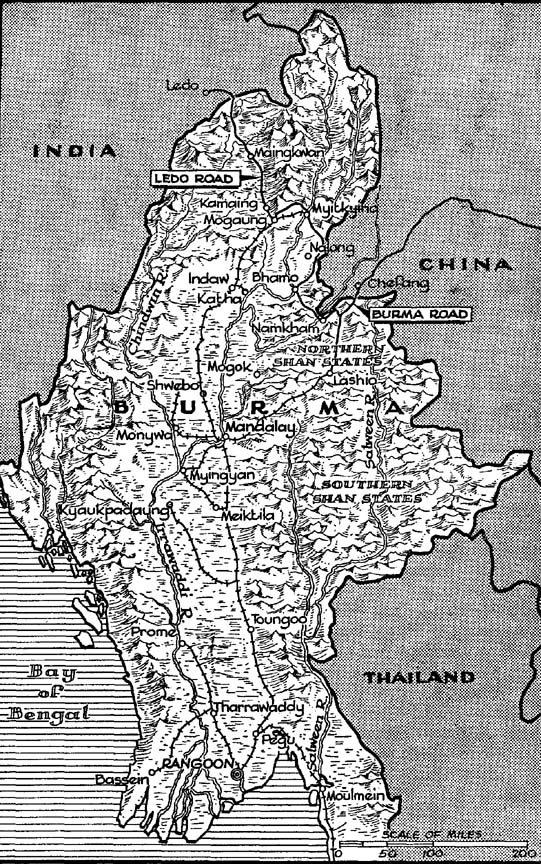
AFTER the loss of Myitkyina, Japanese resistance in northern Burma crumbled. New Chinese, British, and American units were coming into the battle. Changes were made in the over-all command, but the original Stilwell plan remained unaltered. On October 28, 1944, Lieutenant General Daniel I. Sultan assumed command of the American forces in the Burma-India theater. China became a separate American command under Lieutenant General Albert C. Wedemeyer.
From Myitkyina on, the allied advance was rapid. Bhamo fell to Chinese troops on December 14, 1944. The Ledo Road was now pushed forward to a point where it joined the old Burma Road. Chinese forces entered Namkham on January 15, 1945, and a few days later cleared the last Japanese roadblocks on the Burma Road at Wanting and Mongyu. On February 4, 1945, a convoy of American trucks, led by Brigadier General Lewis A. Pick who built the Ledo Road, rolled into Kunming, China.
IT TOOK US two days to finish off the last of Myitkyina's casualties. General Wessels offered me a trip over town in a liaison plane and first priority in choice of a site for the field hospital we were to run for the rest of the rains.
We flew back and forth over where Myitkyina had been. Nowhere was a house intact. The shelling and bombing had been extraordinarily well done. Everywhere were pockmarks, especially around the railway station and other military targets. Near the riverbank on the northeast corner of town were two buildings that looked as though they could be repaired. The Baptist Mission area appeared hopeless. I flew back and pointed out my choice on the map. Two days later General Wiley and I rode around there in a jeep. One of the buildings had an almost intact shingle roof, but the plastered mat walls had been blown out and the floors were ordinary wood. The tile roof of the other was completely off, but the upstairs floors were teak and downstairs teak tile over cement.
S.O.S. and combat commands all needed sites, and General Stilwell had ordered a house on the bank of the Irrawaddi saved for himself, so Willey could give us only the tile house, the floors of which would be better for an operating room. For the hospital we were given a hundred yards of the riverbank south to a tall steel tower whence the telegraph wires to Tengchung, China, jumped across the river. During the fight for the city one of our fighter pilots in his dive had struck the top of this steel tower. The engine of his P-40 lay in front of our house on the edge of the riverbank. The propeller and one wing were at the base of a huge mango tree near the crater of a thousand-pound bomb that had just missed the house. Bits of the engine, fuselage, and the other wing were scattered over the hospital area. We hoped the Japs had given the pilot a decent burial.
The task ahead of us was formidable, for we had to move the hospital as a going concern. We had stopped air evacuation with the close of the battle and had some two hundred patients in the wards at the airfield. For making the move we had only one broken-down jeep and trailer that we could call our own. Our enlisted men, having worked continuously all those months at the field, had not yet recovered from their forced march over the mountains. We had ten Burmese and ten Kachin coolies working for us under an Indo-Burmese boss and four Indian sweepers. With these men, our Burmese and Chinese boys and Dr. Hsang Yee to help me, we drove over to our new location to start cleaning up, while Captains Gurney and Antonellis and Dr. Ba Saw finished up the medical and surgical work and saw that our jeep was loaded with priority goods for each shuttle trip.
Upstairs in one bathroom I had noticed a flushing toilet completely modern and in perfect condition. The amoebae I had been incubating since the first days at the strip began to die at the sight of it! The other bathroom was a wreck except for one porcelain bathtub that had survived a 75-mm. shell as it passed through the bathroom wall. While the rest of us worked on the largest downstairs room, which I had set aside for surgery, the Burmese boys climbed to the roof to throw down the broken tile and gather the intact pieces together. I assigned one of our new men to tour the town and look for loot.
The future operating room was a horror. The Japanese had used it for food storage. Near the brick fireplace---the first one I'd seen in three years---were huge heaps of potatoes, rice, dried peas, and dal. After our shellfire had blown the roof off, rain water had seeped through the upstairs floor and soaked and rotted the foodstuffs, and then flies had come. Now maggots in incredible millions were streaming out of the food all over the floor and up the chimney. As a matter of fact there was a distinct Japanese odor about the room and we fully expected to find one sleeping his last sleep under the potatoes and rice as we carted them out. I say "we." Personally, in such matters I'm a confirmed goldbrick. I searched hastily around for some job requiring "brains" that I could perform just out of range of my olfactory nerves.
The proper men to get the stink out of the room were the Indian sweepers. The lowest caste of "untouchables," they had been the scavengers of India and Burma for untold generations, so theoretically their olfactory nerves were atrophied. The sweepers went to work with a will. But so did our Americans and Chinese. I still claim I had some of the best Americans and Chinese in the American and Chinese armies.
Out in the yard were two Japanese dugouts, fifteen or twenty feet deep. The one near the operating room had the mysterious scent of a ten-day-old hara-kiri arising from it. We didn't go down to explore lest we trip on the cunningly concealed wire of a booby trap but dumped in bushels of similarly scented rice and potatoes on top of the Jap so he would have plenty of rations for his journey to Shinto heaven. Then we gave all a proper burial. The Chinese had "buried" two more Japs near the water's edge by throwing clods of earth over them as they lay on the ground. Here also the scent was somewhat strong so our coolies erected mounds in their memory.
Leaving a few boys to scrub out the operating room with soap and disinfectant, the Americans climbed up on the roof to re-lay the good tile. I had seen marvels before but nothing like the speed with which that roof began to look like a roof. I set the Chinese to hauling water from the well and took the sweepers upstairs to sweep and scrub the teak floor. Then I took a peek into the good bathroom, just to gain strength from another look at that beautiful flushing toilet, and such a wave of anger swept over me that I couldn't even swear. 'What I did was go to the veranda and gaze at the beauty of the Irrawaddi, with the majestic mountains of the Triangle, and of China rising beyond it---until the trembling passed off. My Burmese boys had carelessly filled the toilet bowl full of broken clay tile and smashed it to a pulp.
There was no help for it: I would have to take those emetine injections after all!
It took three days to make a start at cleaning out a house that a Japanese general had used as his quarters. But on the second day a quarter of the roof had been retiled and one could see in spots the lovely teakwood of the upstairs floor, so I sent for a dozen nurses to come over and help. The men were by now hauling in tile from other houses that had been irreparably ruined. To bring over our hospital equipment, G-4 lent us a captured and very decrepit Japanese truck, while in their spare time the 1,888th colored engineers drove over their six by six truck, which had been flown in from Ledo after having been sawed discreetly apart and later welded together. By the third morning so much of the roof had been covered with tile that one forty by forty tarpaulin could cover over the untiled area, and all but four of the nurses came over.
By this time some twelve scrubbings with disinfectant had removed all but a faint, mysterious aroma from the surgery and downstairs rooms. While the girls with dabs and sickles mowed down the yard-high grass from what had been beautiful lawns in the days of the English, our men and coolies filled in the numerous shellholes on our land, began erecting pyramidal tents for our male personnel, and put up the first ward tent.
The enlisted men whom I had detailed to bring in loot had located many broken and bullet-pierced tables, sets of shelves, almirahs and bureaus, four operating tables, and the framework of a settee just like those we had furnished the nurses in Namkham. Regretting the absence of the woven rattan seat and back, I made new ones out of some thin teak boards, only to find later that the Chinese orderlies had the seat and the Burmese boys had beaten me to the back. I settled for a nice big downstairs room with a bathless bathroom on the end opposite the operating room. Gurney and Antonellis shared a smaller room in the middle. Gilbertson and Bullock appropriated the former dining room and pantry for supply and office. We fitted up the central entryway as a recreation room and library, and the girls took over the entire upstairs floor. In order to give them enough room we disconnected the porcelain bathtub and put it on the back veranda of the operating room to store water.
One of our sweepers was a tall, white-bearded Punjabi Sikh. He took one look at my cubbyhole of a "bathroom" and disappeared. Hours later he reappeared covered with smiles. In one hand was a framework of a commode and in the other a gorgeous chamber pot which he had looted from somewhere in town. After that I didn't dare use the officers' latrine for fear of breaking his heart.
All my life long I have utterly despised and detested the type of sweeper-served toilets that seem so fully to satisfy the inner desires of the colonial English. They always stink. Furthermore the sweepers are inevitably dirty and lazy goldbricks. They're always underfoot when you don't want them and never to be found when you do. But these sweepers were different. Only once before had I seen a sweeper I had any respect for---the Christian sweeper who worked for my mother in Rangoon for years. These men were incredible. Anything they knew, from years of experience, that white men wanted sweepers to do---they did very efficiently without being told. We had to teach them to do only those things Americans insist on in addition. The bearded Sikh swept and mopped my floor at least three times a day and cleaned the bathroom oftener than that. Not realizing the difference between Americans and colonial English his servile respect was a constant embarrassment to me. He would no more think of passing between me and another person than he would of desecrating me by touching my messkit or canteen cup. Even when he passed behind me he doubled himself over almost to the floor.
For days our sweepers could hardly eat, amazed at being served in the chow line by American enlisted men, who made their dark skins blush still more hotly by calling them sahib. Then they caught onto the leg-pulling and made up for lost time. After everyone else was served they came along, each with a plate and cup. Into the cup went coffee and amazing quantities of milk and sugar. Onto the plates went enough rice for four ordinary people; then quantities of Spam, tinned vegetables, nurses' curries, soup, bread, butter, and jam, everything finally drenched with canned fruit. How they could stomach the mixture I don't know, but they never left a morsel.
Our fourth day was bedlam. Patients came over by the truckload and occupied the one ward tent, while the one they'd just vacated at the field was hurriedly put up in readiness for the next truckload. New nurses and coolies alternated mowing down grass for new ward sites. Older nurses received patients, sorted them and their charts, and gave the day's treatments. In the center of the area between our driveway and the river was a broken, crumbly cement floor, an ordinary type of construction in Burma where cement and sand have been padded with a lot of river mud to line the contractors' pockets with more money. Apparently no house had ever been built over it---certainly not more than a bamboo house. We put a ward tent over it and had a very effective receiving office and sick-call room. We were clearing the tall grass away for our tenth and last ward tent when one of the coolies touched something and yelled for me. It was an unexploded five-hundred-pound bomb. Unfamiliar with the mechanics of those things, I ordered the crowd out until the engineers could come and cart it away.
When the natives began to stream out of the Myitkyina area to seek haven with the Allies, the British Civil Affairs officer had to put them where they'd be out of the way and yet near enough to help the allied war effort and so pay for the free rice and salt they demanded. All were herded into a tiny village called Pamati, a couple of miles from the airstrip, where they lived in most unsanitary fashion, on the ground under parachutes or poorly thatched roofs. Medical care was administered in the civilian hospital at Pamati.
My interest in civilian medical care in Burma is a matter of long standing. When I express an opinion on the way certain medical matters were handled there, I stand on my record in Burma.
I doubt if any other foreign family has given Burma as many centuries of service as mine has. That service can in no sense be connected with exploitation---unless you can call education, medical and surgical care, and a bit of Christian preaching "exploitation." My family has not taken a cent of money out of Burma. On the contrary we brought into Burma many hundreds of thousands (lacs) of rupees of American money in the form of our salaries and appropriations for mission work, money that has improved the financial condition of a good many thousands of the people of Burma.
In Burma it was the practice to rotate doctors from one area to another every three years. But in any country a doctor has to root himself into the soil and struggle until the people nearby know him, especially if he is a surgeon. People the world over will go to quacks for medicine but not for surgery---not if they can help it. They want someone whose skill is known to themselves and their friends. And if that is true of the Occident how much truer it is of the Orient where the people still have to have the excellence of western medicine and surgery shown to them.
True government of a less fortunate people consists not in giving them what they demand but in teaching them to want better things and preparing those things for them in advance. This is what the missions, at their best, did for Burma as a policy. Was it or will it be the government's policy as well?
When an outstanding surgeon makes a name for himself in a district he should be left there or promoted in the same division. This will decrease rather than increase graft. His fame will bring in so many honest shekels that he won't need to resort to extortion. To avoid the smearing of his own reputation he will be much more rigid in supervising the professional work and morals of his subordinates.
You can't help loving the people of Burma if you honestly work for their good. The real surgeon would love his district and use his utmost ingenuity in laying out programs for its medical welfare. He wouldn't be satisfied to keep up the placebo (make-believe) hospitals he might have inherited. For the sake of his own reputation he would make his district shine in medical matters instead of using the sins of his predecessors as an excuse for inefficiency. And surgeons who fail at their initial assignment should be given one in an entirely different area; for one part of Burma can psychologically and medically be so different from another as to seem part of another country.
While we were at the strip and the battle was still going on an Indian lad with a shell fragment in his chest wall was sent to me. He had been operated on a number of days earlier at the civilian hospital but he had continued to drain blood and had a very high temperature. That was all we could find out about him. When I examined him he had a small incision where the fragment had struck in the anterior axillary line level with the nipple. The entire right breast area was enormously puffed out and fluctuating all the way up to the clavicle. With the temperature and history this should have been an abscess---always assuming, of course, that the surgeon knew what he was doing when he performed the first operation. When everything was ready I pulled at the "drain" when, to my horrified amazement, it turned out to be a gauze cork plugged tight into the skin wound. A pint of old blood burst out, covering me from head to foot, and then fresh venous blood poured from the wound. The shell fragment had struck upward, tearing the subclavian vein, and as treatment the surgeon had debrided slightly at the side of the chest and corked the opening. There was no attempt at wide incision and packing down to the bleeding vessel. The patient was dead in less than fifteen seconds.
I had had a similar case of my own shortly before. The shrapnel had entered the back of the chest and torn the subscapular vein high up. I fumed as I made three enormous incisions trying to dissect out the bleeding vessel. Bleeding would stop with pressure and then blood pour all over me when I tried to clamp a hemostat on the right place. I packed him and sent him back to the rear to better men than I, with a prayer and a complete description of what I had done and failed to do. Major Freeman at the 20th General Hospital laughed when he saw my operative note and was still laughing two weeks later when he wrote me to say the patient had done well with no further operation, my pack having been removed slowly from day to day. But I know what Freeman would have said if I had just corked the wound and had not told him a major vessel was injured.
The excuse for the civilian hospital was that they had only half a dozen surgical instruments. Granted. But that is the very essence of my criticism. Half a dozen surgical instruments, two dozen bottles of medicines (half of them placebos), three or four L.M.P. degrees (licensed medical practitioner), or even an M.B., B.S. (bachelor of medicine, bachelor of surgery) do not make a hospital capable of caring for civilians wounded and sick in a war zone, even if they do constitute a fairly good dose of eyewash in the piping times of peace. If there hadn't been an instrument or a placebo or an L.M.P. degree around, the patients would have been brought to the Americans at once. What does the government intend to give Burma in the peace?
So we kept a few civilians in our wards, only those who would certainly die or need an amputation if we sent them out. I arbitrarily set the maximum number at fifteen so as not to interfere with the work for a total of five hundred beds for Chinese soldiers, which I knew would soon be filled and for whom I was requisitioning tarpaulins, cots, and blankets. But someone told General Willey that in order to care for those fifteen civilians, Seagrave was refusing to admit sick Chinese soldiers. That, if true, would have been a court-martial offense. General Willey very properly ordered me to get rid of all civilians at once.
We were deluged with natives needing treatment, many of whom had been treated without improvement at the civilian hospital. Portable surgical hospitals in the Mogaung, Kamaing, and Hopin areas continued to evacuate badly wounded civilians to us by train and plane for definitive treatment. How the civilians griped when we sent them away to the civilian hospital! Especially resentful were the Kachins. Most of their able men were in our army units helping us as Rangers and guerrillas as well as regular soldiers. Did that not entitle the sick and wounded of their race to our medical attention? It was especially embarrassing to me to have American soldiers pick up sick or hurt civilians in the street, many of them working as coolies for American units and bring them to us, confident we would care for them, and then have to send them to the civilian hospital.
Furthermore, I couldn't rid myself of the idea that Stilwell had had some special reason for tolerating the existence of our "unorthodox, nameless, bastard" unit all those years---the desire to have someone to do unorthodox jobs in an unorthodox way to satisfy his sense of the fitness of things. His first assignment to us after our activation as the Seagrave Hospital Unit had been to care for civilian refugees in Assam in 1942. Then at Ramgarh we had wards for civilians. Then in the Naga Hills we had been ordered by General Boatner, as our third duty, to obtain the friendship of the natives through medicine.
When General Wiley returned from his furlough I pointed out these things to him and General Cannon, and assured them we had never refused admittance to Chinese, even to Chinese goldbricks, on account of civilians. Permission was immediately granted for us to continue helping needy civilians on this basis.
With this permission we even did a couple of gynecological operations, one a large tumor of the uterus. And then Nurse Hkawn Tawng, one of our Burmese dancing girls, now eight and a half months pregnant, came to visit us and went to the movies with the crowd. On her way back she slipped and fell, went into labor, and we delivered another cute toy of a baby girl, while our enlisted men crowded around the doors of the operating room to catch the first glimpse of a baby being born.
The coolies who worked for us at the strip came over to work with us in town and we fixed them up in the old servants' quarters. At the strip the coolies soon learned that I spoke Burmese well. But I was too busy to waste time supervising them, so they sponged on us as they did on other American units and had sponged on the English for a century. On one of our busiest days setting up the Chinese hospital in town, I discovered that at eleven-thirty they were just eating breakfast and hadn't yet done a stroke of work. I stood them up with their Indo-Burmese boss in the center and gave them a ten-minute demonstration of bazaar Burmese which no white man is supposed ever to have heard, let alone have understood in its implications. I used the entire bazaar dictionary, except for one female term which I reserved as a token of my respect for women! The coolies stood there wide eyed and speechless until I was done, then forgot their breakfast and fell furiously to work. From then on we had no further trouble. We never had to urge the Burmese on. Outline the work to be done and they did it even though it meant working on for an hour or two after quitting time. On four occasions, when our work became lighter, I had to order them to stop working at five o'clock. They laughed, sang, joked. And when we were alerted for our next combat assignment and I hoped possibly the Kachin coolies might be persuaded to follow us, the Burmese came in a body and demanded to be taken along.
"Why do they want to stay with us?" I asked their spokesman, Dr. San Yee.
"They say this is the first time in their lives they have been treated white," he replied.
As our work began to fall into regular routines the amenities of the rear areas began to come into evidence. Ann Sheridan and other Hollywood personnel were coming to give us two shows, one at the Marauders in the afternoon and again at the strip in the evening. Special Service called me up soon after Ann's arrival and said she was coming to our hospital at eleven o'clock to be photographed with "Seagrave's Burmese Nurses." Would I please have the girls dressed in their best Burmese manner.
I knew the girls would be bored to tears---and they were. But after a lot of persuasion they fixed themselves up in their perfectly blended silk longyis and sheer jackets. Burmese girls love to dress up but not on command, and certainly not for other women. So while the ward work went to ruin, they sat for two hours with folded hands, waiting; but la Sheridan never came. I had planned to take half the girls to the afternoon show but was so full of adrenalin that I let them go alone.
They had no sooner set forth with all the transportation we had when the Special Service officer called up again. So sorry, Ann had been too busy to come but she would be brokenhearted if she had to leave C.-B.-I. without a picture of herself and the "Burma Surgeon." I would therefore go to the strip and meet the great lady when she visited the 44th Field Hospital there at four-thirty. I didn't dare say anything---out loud!
I located a jeep and drove back to the strip. Less than a month had passed since fighting had ceased but combat units and S.O.S. had changed the entire landscape. Bombed buildings had been torn down and rebuilt into huge tarpaulin-covered warehouses and barracks. Bomb and shell craters had been filled in, first with debris, then with earth, by bulldozers or by spade and shovel crews. Fire-blackened skeletons of native huts had been burned clean away. The railway was operating to Mogaung, with a jeep at each end of the string of handcars. Not even a fragrance of the Japs remained. Nature, too, had co-operated, for the shattered trees and bushes had grown new leaves to cover the scars of war. It was like spring. The airport was unrecognizable. Already it was one of the busiest fields in the world. I was proud of being an American and that Americans had thus rapidly repaired the damage they had unavoidably caused to this bit of Burma. Another two months and Myitkyina would be restored to a great deal of her original beauty.
Then a battery of cameras arrived, the signal for male temperatures in all the wards to rise to 106°. And finally Ann herself!
My thoughts are always incongruous. All I could do was stare amazed at America's latest hair-do. Then introductions began and I could think of nothing but what the feelings of the others in the Sheridan troupe must be. They were actually traveling incognitos---"also rans." There was as much ravishing beauty among them as Ann brought, but not a G.I. even glanced their way.
Instead of insisting on meeting the Burma Surgeon, Ann had never even heard of him. Why should she have? Film stars don't care about missionaries. But our theater photographers were determined.
"Miss Sheridan, shake hands with Colonel Seagrave again," they commanded.
Now who in blazes is Colonel Seagrave? thought Ann as she turned around to shake whatever paw might be extended.
"It's a shame you're forced to go through all this, Miss Sheridan," I commiserated.
"Oh, it is all part of the day's job," she shrugged.
"I'll be seeing you at the show tonight," I said as I turned away. But the jeep had other ideas. Just as we got back home it heaved a sigh of relief at having done its Boy Scout job for the day and went out of action.
I was pardonably skeptical when Special Service called me up a month later to say that an all-girl troupe of five American beauties would have dinner with our unit on Sunday at noon, after which one of the girls in American dancing costume wanted to be photographed with a Burmese nurse in Burmese court dress. The nurses were also skeptical. Hkawn Tawng was sick with a high fever but she was the only dancer we had and the only girl with a court costume. I told the girls about what was desired and left them to do as they saw fit. Being Sunday they would be dressed up anyway, in honor of the day. Hkawn Tawng began to overhaul her wardrobe.
But the five-girl troupe turned up one minute ahead of schedule. They took messkits and stood in the long chow line just like G.I.'s. They even helped themselves to Burmese food and, to my utter astonishment, ate it as if they enjoyed it. The previously disillusioned nurses stood on the sidelines diagnosing the American girls. Something was needed to break the ice. I went in to check with Hkawn Tawng as to which nurse was to wear her court costume for the picture.
"I'll wear it myself," she said. "It won't fit anyone else."
"But you still have a high fever."
"That doesn't matter. It will take only a minute and it's the least I can do for the army."
As I turned away my eye fell on Hkawn Tawng's baby and I had an inspiration. "Bring the baby out and walk around a bit," I said to the grandmother.
Soon the grandmother came out, a spotless four weeks' baby in her arms, dressed in a threadbare but clean little blanket. One of the American girls saw her and, letting out a whoop of delight, grabbed the tiny morsel and for an hour there was a snatching contest as to who should hold the baby. Then the disillusioned nurses melted and I heard them---for a wonder---saying nice things about the American girls in Burmese.
"They say you have adorable hair," I translated, sotto voce, to the fluffy blonde. "And you, according to them, have very perfect features and are, as the Burmese would say, very smooth." I turned to a third girl. "Being a mere male," I said, "I don't dare translate the very complimentary things they're saying about your figure!"
The leader of the group had by now found our little organ and sat down to it. But instead of producing the latest jive she picked up a hymnbook and in a beautifully cultivated voice began to sing and play the grand old hymns. Soon the nurses swarmed around her and joined in the singing, completely captivated.
Then Hkawn Tawng, supported by two nurses, and the American girl appeared in their respective dancing costumes and walked out to the bank of the Irrawaddi to have their pictures taken together.
The Burmese court dress consists of a bodice covered by a sheer gauze jacket that reaches just to the waist, ending in two little peaks that project slightly backward from the side. The skirt is not a longyi, which is a perfect cylinder folded neatly about the body, but a thamin, a single sheet of gorgeous cloth that tucks in at the side and that in the days of the Burmese kings was split from hip to ankle, showing the entire thigh and leg as the lady walked or danced. To avoid too much exposure the Burmese court ladies and dancers developed the beautiful mincing step characteristic of Burmese dancing. The missionaries would probably throw a Christian girl out of church if she wore a true thamin, so Hkawn Tawng had pinned the open edges together to the knee, hiding her beautiful legs but at the same time making it impossible to move without the characteristic mincing step. She had used her make-up box well and you couldn't tell she was ill except for her heavy lids, and these also are a characteristic suggestive note of the Burmese dance. Aside from the fact that she nearly fainted when the cameraman delayed snapping the picture after ordering her to take a pose with one foot in the air, everything went well and we tucked the poor kid back into bed and said goodbye to our very considerate and tactful guests.
Incidentally I paid the ladies the compliment of calling off our Sunday-evening sing so all the nurses could go and see their show, which was delightful. Yet when we came home we passed thirty or forty vehicles leaving our messhall. The men from all over Myitkyina had come for our Sunday song service and though we were all away they had had the sing anyway.
If I had asked the U.S. Army for authorization for our Sunday-evening song service someone might conceivably have told me to be a Medical Corps officer and leave the chaplains to do the chaplains' work. I kept my mouth shut, had the services for the nurses but opened them to everyone. Sometimes we had only the nurses, sometimes a few enlisted men. At Myitkyina, on the riverbank, no one was present the first week but our own crowd. But we gathered in the operating room and sang in a real brick-walled room for the first time since Namkham. We had army hymnbooks with notes. The acoustics were perfect and we really enjoyed ourselves. The next week two chaplains came; the week after, a squad of ground crew of the 10th Air Force. In a month the operating room was packed and men were standing around the doors. Then we burst out into the huge messhall, which we filled, and then, though the unit played hooky and went to the all-girl show, the men came anyway and filled the hail again. My friend Mr. Gustaf Sword, missionary to the Kachins in the Namkham area, told me that he had heard of our song services from enlisted men back in the States.
We were really getting little tastes of peace as we worked away at our five-hundred-bed hospital. After supper it was everyone's delight to go to the riverbank and sit, watching first the majestic, swiftly moving stream and then gazing off at the mountains that marked the border of China. Not many miles above Myitkyina the real Irrawaddi is formed by the junction of two great rivers which the Kachins have named the Mali Hka and the N'mai Hka. The great mountain mass between these two rivers is known as the Triangle and is inhabited by primitive Kachins who practiced slavery and human sacrifice until very recently. Three huge peaks at the lower corner of the Triangle give Myitkyina its greatest beauty.
As the sun goes down at Myitkyina incredible thousands of lovely green parrots fly south over the river from their feeding grounds to their night's bivouac in the teak forest just below town. They come in flights of several thousand each, so close in their formation that they form a greenish black cloud, sometimes stretching half a mile across the river and beyond each bank. You can count perhaps a hundred flights of an evening. Occasionally something will upset the flight, which will then eddy and swirl like a cloud struck by a gust of wind. And always you hear the harsh notes of the beautiful birds calling to each other as they fly.
When the sun sets in Myitkyina you do not face west: that's too common. You face east and watch the suggestive, reflected tints on the China mountains and the broad river. Right across from us were native houses, untouched by war, pasture ground, and beautiful trees. From the highest point of that sunset-hued ridge you can see Tengchung to the east and, to the south, the tip of the ridge on which stands Sinlumkaba, summer resort for Bhamo District and for peace lovers from all over Burma. And, from Sinlumkaba, the hills around Namkham! Just two hops and a skip yet to go.
Even in the Hukawng we heard G.I.'s sing about the moon over Burma. Poor fellows, they didn't know it was just an imitation there. In Myitkyina we not only had the moon over real Burma, we had the Thadingyut moon over Burma. In the rainy season the Buddhists have a Lent just as Christians do in the spring. During Lent they strive to be especially good Buddhists and that means going to monastery schools on their Sabbaths and listening to the reading of the Pitakas, the Buddhist scriptures. On Sabbath nights the merit-seeking Shans sleep at the monastery. Their Lent, too, has an Easter---at the full of the Thadingyut moon which usually comes in October. To the Burmese and Shans, Thadingyut is the greatest feast of the year. At night hundreds of paper fire balloons are released, carrying light high up into the sky. Every good family lights all the candles they can afford around their own houses, carrying others to the pagodas and monasteries, for is not this the Feast of the Lights?
How I berated myself for not remembering that this moon was Thadingyut! I could have begged, borrowed, or stolen---or even bought, if necessary---tissue paper to make balloons (as I had made them for John and Sterling in Namkham) and made the first Thadingyut back in Burma memorable for our poor, hungry-hearted Buddhist nurses. But our three blue-blooded princesses, Louise, Pearl, and Chit Sein, did not forget. Louise came to me at sunset.
"Daddy, tonight is Thadingyut." She had to stop for five minutes while I cursed my memory. "Will you please let us go to the pagoda to place our candles? Captain Antonellis says he will drive us there in the jeep."
"Of course you can go," I said. Darn Antonellis anyway, I thought. He's always doing the right thing while I just go blundering along.
Much later that evening I turned out my light in my loneliness and went out to the veranda. There was the moon, high above the China hills, making a broad golden path across the Irrawaddi, and there, sitting on the bank of the river, their bodies sharply silhouetted against the perfect Burma landscape, were little groups of our personnel. Here an American boy and four nurses, there three girls and a couple of officers. Not a sound anywhere but you could feel them drinking in the beauty. Peace, peace again in Burma! The youngsters were out there enjoying it together. And I was all alone as usual. I went in, turned on all the lights, and set furiously to work.
Myitkyina was no longer a combat zone. It was a supply base. S.O.S. had taken it over-lock, stock, and barrel. And we were eating nothing but canned rations. Our food was worse even than it had been at the strip. The traditional fight between combat units and service units went on in the C.-B.-I. theater as it did all over the world. Already, with the coming of S.O.S., our happy-go-lucky red-tape-slashing days were over. You couldn't walk far without tiring your right arm answering salutes. Paper work haunted my sleep. But in Myitkyina I learned that S.O.S. always ate that way! They tied themselves tighter in their own red tape than they did the combat units and if there was any choice of foods, the delicacies went to the combat zone.
Although we knew that the battle had occurred at Myitkyina during the rice-planting season and therefore no rice had been planted, we certainly expected to be able to buy fresh meat and vegetables, chickens, eggs, and milk. As for vegetables, the natives weren't having any. The government was rationing the people like a paternal government should. To most, only rice and salt were given. To my way of thinking this should have been given to those who worked for it. Some were women and children who couldn't work for the army (but who could have made a great many truck gardens and planted a lot of late rice). Some were wealthy traders of Myitkyina who refused to demean themselves by working. These last I would have thrown into jail for refusing even the lowest coolie work, rather than feed them; or I would have put them to work at the point of the bayonet. For the others, the government could secure no seed---and Brayton Case was dead!
Brayton Case had almost single-handed fed the Chinese Fifth Army in the first campaign. He had walked out with us after General Stilwell. A typical missionary and unable to grasp in the slightest degree the psychology of Americans and English at war, Brayton had often made a nuisance of himself to British and Americans by worrying about people's morals and actions. American brass had even begged Stilwell to get rid of him. The British griped and gulped. But Stilwell's answer always was, "I need him when we get back to Burma." In Assam and in the Hukawng, Case made much ado about getting seed and having it planted by Chinese, Nagas, and Kachins in spite of the British Civil Affairs officers, whose nerves he frayed. Yet he made a wonderful success of the Hukawng, amazing to the Americans who saw signs of flourishing agricultural peace there only a few months after the war had passed on.
Yet Case was not in his element there. He was still working among foreigners, for the Kachins of the Hukawng do not speak Burmese. From Myitkyina and Mogaung south he would have been in his element. Nobody, not even the Burmese themselves, understood the psychology of the Burmese people half as well as Case. Born in Burma like myself, among the Burmese, he grew up with them and worked for them and therefore spoke Burmese even better than the Burmese, whereas I was born among the Karens, spoke Karen as a boy, spoke Shan as a man, and learned Burmese from necessity. If the Burmese Government had shrugged and said, "There is no seed," Brayton would have found it by the carload even if he had had to sweep it up personally from the gutters of the bazaars and antagonize the government of India into the bargain. He would have got priority of transport for his seed to Myitkyina even if it had meant half a dozen American officers being sent back to the States in a mad frenzy. But just as Mogaung and Myitkyina were falling to the Allies, a ferryboat in which he was transporting some seed tipped suddenly and precipitated him into the water, where his body, weighted down with a heavy pack, sank like a stone and was never recovered.
Case not only greatly excelled me in speaking the Burmese language in idiom but could beat me at my own game of getting others to do my work for me. In fact, twice he tried to get me to do his work for him. That was a mistake, for if anything I was more interested in my work than he was in his. But he made a good try and left me feeling that hot asbestos hands were reaching out to draw me into the pit for refusing him. When agricultural Burma lost Case, it lost the best friend it ever had and automatically set back the restoration of Burma's full crops by about two years.
S.O.S. wages were high---double prewar. I wonder the government didn't complain. Probably it did. There had been a great deal in the press of India those years about the disruption of economy caused by American G.I.'s and the prices they paid. I personally regretted the enormous sums they paid for trash to wily shysters who were already too rich. But high wages to men who work hard should, for the sake of democracy and improvement in the standard of living for everyone that we talk so much about, be allowed to disrupt a prewar economy a trifle. The nurses of our unit had been drawing much higher salaries than before the war and their standard of living had gone way up, but aside from the inevitable couple of asinine fools, they banked their money, in order, when peace came, to maintain the real improvement in their standard of living that they had obtained. Of course they'd had a good bit of sensible advice!
I have always been irritated at the idea that the slightest mechanization of Burma will deprive the great coolie class of work. I know a great many coolies with first-class minds who could soon run the machines and improve the economic condition of the country immensely. And with this improvement would come increased buying power, improved standards of living, increased demand, increased happiness everywhere. Let the coolie class die out except for the half-wits for whom there will always be coolie labor and let the rest of the country prosper in the way the inhabitants of one of the wealthiest countries in the world---in natural resources---have a right to prosper. Don't forget that Burma has the only real rubies in the world, the best teak and rice, the second-best silver, oil, tungsten, tin, lead, jade, amber, rubber---and was fast developing rich tung-oil estates before the Japs broke loose.
For myself now there were deep drafts of peace. By the time the hospital on the riverbank was a going concern, we had taken on some twenty-five new girls and boys as probationers. If they were to be worth much to us in Myitkyina, or beyond, they had to know what it was all about---more than Naomi could teach them in the operating room or Wasay and the head nurses could teach them in the wards. So I began to give them classroom work from ten to twelve every morning. The boys weeded themselves out in a week, but that didn't matter since they were a small minority, and in combat there is much an educated Burmese boy can do that coolies cannot---or nurses, either. At the end of another week I threw half a dozen girls out of the class, girls too stupid to learn, letting them act as orderlies on the ward, where they could ease the work of the graduate refugee nurses. The remainder were good or excellent.
If I had begun a regular course of training it would have been a year and a half before they would be worth much. I gave them instead a two months' bird's-eye view. First, three weeks of bandaging, bacteriology, and the parasitology so essential to surgery and to medical work among the Chinese, who are tanks for parasites. Then the twelve most common diseases of C.-B.-I., teaching only a bit of anatomy and physiology here and there so they could grasp the inklings of pathology. A day or two on the benefits of fever---a thought that never occurs to an oriental. Another day or two on the importance of charting. It was fun.
Probably the most fun in teaching consists in the teacher's study of his pupils, especially when they are Burmese girls, for the difference in race and sex adds spice to a difficult job. Nang Pri, who was a natural in practical surgery, never could answer the right question at the right time. Hkawn Raw, who had a false front in practical work, tried but a still falser front in the classroom and wondered why she couldn't kid the old man. Daisy and her younger sister Bessie both tripped over shadows when at work but never tripped over the trickiest questions in class. Julie was as sweet in class as out but took a few months to find out what it was all about.
As usual I taught in both English and Burmese. The star for several weeks was a very beautiful but very dark Kachin girl named Hkawn Rin who knew English almost better than Burmese. Her father had been an officer in the army and they hadn't heard of him since the first campaign. Then as I released the class one morning, she walked out of class and bumped squarely into her father who had just come down with General Haswell's troops from Sumprabum. That was the end of Hkawn Rin, whose father had a higher education in mind for her.
One of the girls was an Anglo-Burmese-Karen girl who appeared in the sort of short dress that the Anglo-Burmese think so very English. She was extremely awkward in these dresses and appeared misshapen and devoid of beauty. She also seemed either naked or about to be so at a second's notice. As an Anglo-Burmese---with the accent on the Anglo---she was very dark and not English at all. With her lack of clothing as an excuse I asked Naomi to get her into Burmese clothes. Naomi gave her a couple of longyis, which she consented to wear, but she couldn't get her into Burmese clothes above the waist. Perhaps it was a good thing for the peace of mankind that Naomi didn't succeed completely, for the longyi alone changed the ugly duckling into a swan. As an Anglo-Burmese---with the accent on the Burmese---the girl was an incredible beauty. You were struck at once by her fairness and exquisite features. If she had worn the longyi properly, and with the Burmese bodice and sheer voile jacket, she would have been completely irresistible.
Nobody in Burma can escape thinking of the problem of the intermarriage of races. I have thought about it for years and my ideas are somewhat as follows. The intermarriage of oriental races immediately strikes you as being a very good thing, while that of occidentals and orientals almost always seems to turn out badly in the children, so much so that it is commonly said that they inherit the worst characteristics of both races. Why should this be so? I have seen misfit children of oriental combinations. If a Chinese marries one of the races of Burma, in Burma, and raises his children as Burmese, the combination is always a success. If, in Burma, he tries to raise his children as Chinese, the combination is a failure. Indians who marry Burmese always try to raise their children as Indians and so their children are always failures. Kachins and Shans occupy the same country; the combination is successful whether the child is raised as a Kachin or a Shan. In fact, these combinations, when the child is raised according to the ideas of the prevalent race, tend to produce super children. That is perhaps why combinations of Americans with European races are so successful in America. They are raised as Americans in American communities and are accepted---providing the combination is a combination of whites. Americans will not accept color, so the combination of American with Negro does not work in America. But I would bet a hundred to one that it would work in Africa if the parents raised the child there as a Negro.
To me that is why the Anglo-Burmese does not succeed. The English will not accept color, yet the parents are determined to raise the child "English." I know an Anglo-Burmese woman who was charming as an Englishwoman, for she had had all her schooling in England. Yet she never lost her Anglo-Burmese accent which is too, too English to be true---as it always is. In determinedly trying to raise their child as English the parents show the community that they regard the English as the superior race. So the Burmese will have no more to do with the Anglo-Burmese than will the English whom they try to ape. The Anglo-Burmese is the original man without a country. It is all exemplified by our little Anglo-Burmese girl in Myitkyina. When she came in her "English" clothes, the nurses would have nothing to do with her and her airs. She put on a longyi and they began to accept her, even though the top half of her still tried valiantly to be English. If she had been willing to dress Burmese entirely they would have accepted her with open arms---as would every single American G.I. in the town. So perhaps it was just as well she determined to remain a hybrid and make extremely awkward her undeniable beauty.
Big Bawk had spent a postgraduate year with Captain Chesley in the laboratory at Ramgarh and, except with cultures, had become an extremely able laboratory technician. While my own knowledge of laboratory work was broader than hers, in the phases she had studied her knowledge was so much deeper that I never argued with her. In fact, I soon regarded her as infallible. We had the only microscope at the airfield during the entire battle for Myitkyina, and the decision as to whether an American soldier should be evacuated to base for malaria depended on the little Kachin girl's diagnosis as to whether the malaria was malignant or benign.
At the riverbank the laboratory work for a five-hundred-bed hospital was extremely heavy so I set Little Bawk, who hadn't been well for months, to work in the laboratory with Big Bawk, where she could sit at her work. I put new girls on in rotation to help as bottle, tube, and slide washers and specimen collectors. One day Naomi appointed Hkawn Tawng's pint-sized twelve-year-old sister Roi Ji as bottle washer in her lab. Roi Ji ate it up. In five days she was using the microscope herself. In seven she was identifying malaria parasites in the blood, amoebae and ova in the stools, and then passing the microscope over to Big Bawk for final diagnosis.
Two weeks later Little Bawk called me to the lab.
"What's that red splotch in the center of the field?" she asked.
I looked. "They're not tubercle bacilli, if that's what you mean," I said, recognizing the Ziehl-Neelsen stain for sputum.
I went on with my work. Two hours later, while I was at rounds in my Chinese officers' wards, the laboratory bottle washer came to me.
"Daddy," she said, "Little Bawk wants you in the laboratory at once."
"Confound it, these girls order me around and I haven't any more sense than to obey," I grumbled, walking back to the lab.
"Take a look at that specimen," commanded Little Bawk.
I obeyed. "Beautiful! Beautiful! That's a lovely stain! Those are real tubercle bacilli. Loads and loads of them, aren't there? You're getting good, Little Monkey!"
Silence.
"That's her own sputum," said Big Bawk in an undertone that meant, "You unspeakable idiot!"
"Good Lord!" I looked around. Little Bawk had disappeared. I went around the corner to my room and found her crying. I put an arm around her.
"Little girl, forgive me. I never suspected it was your own sputum. I can't understand it. I've examined you very carefully three times since you coughed up that blood at the field and have never heard a râle. Please don't quit on me. I'll take you to the 44th Field Hospital and we'll get an X-ray picture of your chest."
I stayed awake hours that night cursing the spirit that made me drive people until they broke down and caught tuberculosis. Yet I could never control my disgust at people who wanted to win a war from an armchair. I always insisted on my officers, enlisted men, and Burmese personnel going to bed with malaria and dysentery but hadn't put myself in bed for two years with either one. But my body could take that kind of thing and these poor little bodies couldn't. And what chance had Little Bawk? Unlike Julia, from whom she had caught the disease, sleeping in the same bed at Ningam because there weren't enough blankets to go around, Bawk couldn't stay still. Intense by nature, she had an overwhelming dose of thyroid secretion. With a much quicker brain than mine---although she hadn't learned a fraction of what I'd been taught---she would never be able to stay still.
And the X-ray didn't help. There was a large band of active tuberculosis in her left lung, with much acute inflammation.
I went to Big Bawk.
"Little Bawk has got to stay in bed. I'm sorry. Choose the nurse who will be most useful to you in the laboratory and I'll give her to you; I don't care who she is," I said, expecting her to ask for Kyang Tswi or one of the other graduates who had worked with Captain Chesley.
"Give me Roi Ji," Big Bawk said without hesitation.
"You're kidding, aren't you?" I asked, stunned.
"No, indeed. I want Roi Ji."
So pint-sized twelve-year-old Roi Ji was installed as assistant technician in the laboratory, and, as bottle washer under her, I appointed half-pint Emmie.
Roi Ji felt her own importance now. Sitting in on a gossip fest of the graduate nurses she suddenly began to reminisce: "Once when I was young," she began, then stared when the older girls burst into gales of laughter.
Our stay at the riverside was not all peace. To start our troubles Major Dushkin was given a well-deserved lieutenant colonelcy and that, in our unit, is tantamount to transfer elsewhere. Then the American officers and men and the Burmese doctors and men were long overdue for furlough. While we were in the midst of increasing our ward space to the final high of five hundred and forty beds filled, a third of our male staff went off to Calcutta for two weeks. I had asked for a month in the States, not having been home for seven years, during which time my daughter Leslie had grown from a sixteen-year-old to a woman married to a naval ensign on duty on one of our big flattops. My son Weston had grown from a boy whose head reached my shoulder to a man whose shoulder my head would not reach and who was in the navy trying to qualify as a fighter pilot.
Don't let anyone talk to you about huge sacrifices made by foreign missionaries. They have the time of their lives. The only real sacrifice is that they can't watch their children grow up. I hadn't seen Tiny and the two little boys for two and a half years. I wasn't fed up with Burma. Far from it. But I could have enjoyed a few hours with the family, trying to remind them that I existed other than on paper, and censored paper at that. But I had reminded General Boatner that if the leave were granted at the wrong time I would be unable to leave.
"It's up to you whether you take your leave or not," he said.
For the six weeks after Myitkyina fell I could have been away and no one would have missed me. Then the first third of our male personnel returned and the second third was leaving when catastrophe hit us. We lost nine men and Captain Johnson on the rotation plan. Gurney, the only officer other than myself from whom the nurses would take orders, needed a vacation much more than I did. He had not only gone more months without one but had been on several flank moves through the mountains and had been ill several times. Besides, he had a date with a colonel of artillery at Imphal. Just before he was due to leave, my orders came through.
Gurney would gladly have given up his furlough in my favor but I would have none of it. He needed that vacation; and besides, not knowing Burmese, he couldn't teach the new girls. With only the rank of captain he couldn't manage the unruly Chinese officers' wards that he had had to turn over to me. Having lost half our American personnel, the staff running the five-hundred-bed hospital was almost completely Burmese.
I radioed back turning down my leave. You can't work for a man like Stilwell without realizing the job comes before the man.
When this became known the army from Ledo to Delhi to Karachi expressed itself roundly about that stupid Seagrave. I shrugged. I wasn't half so scared of the army as I was of what Tiny and the children would say. Tiny, expecting me back, had bought a used car and had a couple of spare five-gallon gas coupons. And they were having special musical concerts at nearby Los Angeles.
One day as I strolled around butting into the wards of other officers, I saw a Chinese soldier with characteristic pimples on his face. I called the boys and had them put up a small tarp near the telegraph tower away from everyone else and transferred the smallpox patient there. None of the other officers had seen a case of smallpox. Then we had the whole area vaccinated. Only two other cases occurred.
Toi Roi asked me to look at a patient in her ward who was crying with a headache in spite of aspirin and codeine. I bent his head forward---or tried to---then sent him over to the operating room for a spinal puncture, which produced a milky fluid full of Gram-negative diplococci. In Burma, epidemic cerebrospinal meningitis is never really epidemic. The next two or three cases were picked up immediately.
But the high point came when Big Bawk walked into my room with a bottle full of dirty water containing white flecks. She laughed. "They say this is a specimen of stool from a new patient," she said contemptuously.
This time I was excited "Put a specimen under the microscope for me to look at," I said, "then put cresol in that bottle and soak your hands in bichloride. Order the patient to be carried out to the smallpox ward at once."
I could find no cholera vibrios under the microscope but I phoned Colonel Dushkin to order cholera vaccinations immediately and went out to look at the patient. He was in a state of collapse. His eyes were deeply sunken. His forehead was moist but his body dry and cold and the skin of his palms wrinkled. His pulse was rapid and very small but not weak. He was incontinent. When he talked at all he complained of severe cramps around the umbilicus and of vomiting which had begun suddenly six hours earlier. I ordered a quart of glucose intravenously and massive doses of sulfaguanidine and sulfadiazine. We put a can of very weak permanganate solution beside him to drink. Two hours later, with collapse still more marked, I gave him a quart of plasma.
He was holding his own the next morning, though still in shock, incontinent, and unwilling to talk. We gave him the same glucose and plasma as the day before, and by the third day his body was reacting and warm and his eyes were beginning to come back out of the walls of his brain. The day we discharged him cured we received a radio message from the big laboratory in Chabua to which we had sent stool for culture: "Organism identified as malleomyces pseudomallei. Request further specimens of blood and stools and complete report of post-mortem examination."
I regretted, in my reply, that we could not give them the report on the autopsy as the patient had refused to die and had gone home! None of us had ever heard of malleomyces pseudomallei, but after much search Colonel Petersen discovered an article that stated that it caused a fatal disease with symptoms of cholera and that only two patients had ever been known to recover from it. This made three. There were no other cases.
We were having a game now with the divisional hospital of the Chinese 38th Division which had moved up the railway from Mogaung to join the new Chinese First Army under Lieutenant General Sun, while the 50th and 14th Chinese divisions moved to join the 22nd at Kamaing-Mogaung and form the new Sixth Army under General Liao. My old Tagap friend Colonel Lee was now a major general commanding the 38th Division. He had gained a reputation under Stilwell as one of China's great tacticians. The divisional hospital had equipment for a hundred and twenty beds but the officers had decided they needed a rest more than we, so they kept a maximum of sixty patients and sent the rest to us. A good many officers and men also decided they wanted a rest and some of these wanted the rest in Ledo. So they worked up what they felt were a lot of really good symptom-complexes and came to our hospital. In malaria country you can't prove a man a goldbrick in less than three days so we had to admit them. Then the officers demanded evacuation to the 'real" hospitals in Ledo. I was in complete command of all air evacuation of Chinese and I wouldn't bite. I had worked with Chinese too long and I could take their gripes because I knew they liked me. When we had proved that the patients were goldbricking, we shipped them back to the divisional hospital, only to have the officers there send them back by return post with a brand new symptom-complex and we had to go through the same game again.
Whenever we got completely fed up we went out and had a baseball game, twenty-five on a side and with special rules:
1. Any man who knocks the ball into the nurses' home is out.
2. Any man who knocks the ball into the river---his whole side is out permanently and forever.
3. Women may run on the third strike if the ball is not caught. Men are out anyway.
4. Women may steal base. Men cannot run until the ball is hit. (That raises interesting complications.)
5. The first baseman must be a woman.
6. Shortstop must be a woman but she may be supported by half a dozen male shortstops.
7. Nobody is allowed to cheat more than once per game.
Colonel R. P. Williams, theater surgeon, whose special property we had always regarded ourselves, dropped in one day to chat. Our delight in his visit was dimmed by his information that Washington had ordered that we be anonymous no longer. We were to be activated as the 896th Clearing Company. It was too much trouble for Washington to remember, if we had no number, that equipment for an extra clearing company was always being needed in C.-B.-I.
"They will now have to promote me to the rank of major or captain!" I said.
"Oh, no! You will remain a lieutenant colonel and continue as before, with your civilian personnel. You will be assigned your full Table of Organization strength of thirteen officers and one hundred enlisted men but you won't actually get any more officers or men than you have now. Your additional officers and men will be put on detached service with other units who are short of personnel."
Strange are the ways of the army. Apparently, in spite of everything, we were to be the same "unorthodox, bastard" unit---but now with an illegitimate name as well. We would not only be assigned the old unorthodox jobs as whatever brand of hospital the tactical situation might demand, but now would have a new unorthodox job as a replacement pool for all the other units in the theater! The more I thought about it the more intriguing the thought became. Not by the widest stretch of the imagination could the "original" Seagrave Hospital Unit, as I always regarded the Burmese nurses and men, Captain Gurney and myself, be considered part of the 896th Clearing Company except for Gurney and myself. The Table of Organization of a clearing company calls for no nurses (certainly not for Burmese nurses) and for no civilians. No, we would be two units, the 896th Clearing Company with its dispersed American officers and men and the old Seagrave Unit. I would be the C.O. and Gurney the executive officer of both units, belonging to both.
I was sorry for the new 896th Clearing Company's Americans, for when a man is on detached service he can't be promoted. Promotions come only when on duty with the parent organization. For their sakes I would have to pray for the co-operation of Colonel Petersen in allowing me a free hand in shifting the men and officers around from duty with the parent organization to detached service elsewhere so that deserving personnel could be with me long enough to earn merited promotion.
I wondered about the old Seagrave Unit. Was this Washington's first hint that it was tired of Stilwell's old unorthodox, bastard unit and that soon there would be an order to disband it?
But I was sorriest for Gurney. If anyone in the U.S. Army deserved a majority Ted Gurney did. Now he would never be a major unless he left me or unless I conveniently stopped a Japanese bullet.
There was nothing to do but wait and watch developments.
There were evidences that the war might begin again. A liaison strip had been built between our house and the movie show. The little planes roared over us hundreds of times a day on various missions, missing our roof by inches. I was anxious to get started on the new campaign before the pilots decided to fly in the nurses' windows. For the third consecutive time, and this time seriously, I invited all my American and Chinese friends to Christmas dinner in our bungalow in Namkham.