OUR SECOND group of vacationing personnel was just returning to duty when Colonel Petersen flew in from base.
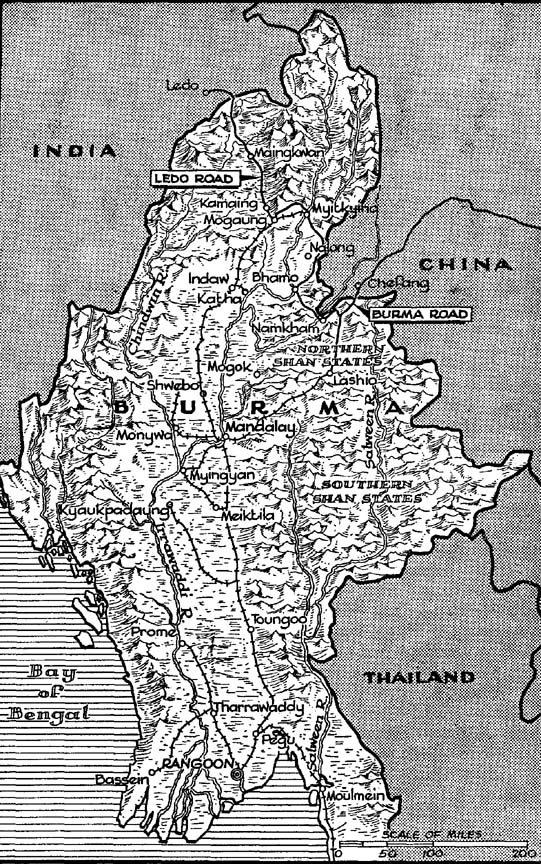
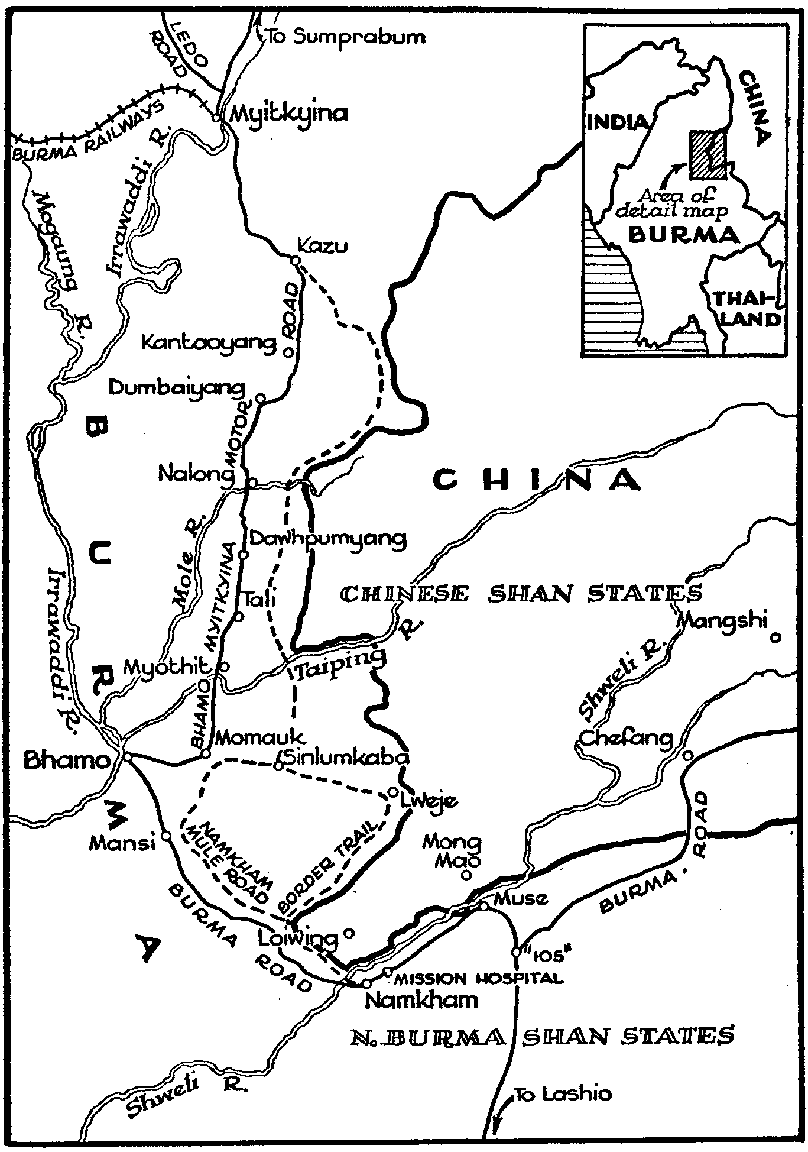
"The 38th Chinese Division will begin to drive south on October 16," he said. "You will furnish a surgical team with the first regiment. The 43rd Portable Surgical Hospital will follow the second regiment, and you will move as a clearing company with divisional headquarters. There is no heavy Japanese concentration reported north of the Taiping River at Myothit, although an occasional patrol has been reported as far north as Nalong. Your first semi-permanent setup will probably be at Dumbaiyang, a day's journey north of Nalong. You will march, and Major Davison, chief medical liaison officer with the 38th Division, will furnish you with animal transport."
"What are we to do with this hospital?" I asked. "We have way over five hundred beds filled. Is the 48th Evacuation Hospital ready for Chinese patients? I have heard they are taking only Americans from S.O.S."
"They're not ready but I'm trying to rush them a bit with the idea of taking patients by Monday. Evacuate all patients that will take more than three weeks to get well to the 73rd Evacuation Hospital, those that will take two weeks to the 25th Field Hospital at Tingkawk, and try to get rid of the rest to the 38th Divisional Hospital, leaving a maximum of a hundred beds filled here. The 42nd Portable Surgical Hospital will move in and take over the hundred beds with your equipment."
Major Davison called up to say he would furnish twenty horses for the advance detachment, and since Gurney would not be back in time, Antonellis took command with Captain Fair and Lieutenant Breger, our dentist. They had a mixture of technicians with them, American, Burmese, and Chinese. Everyone carried a pack.
The men got off on schedule. Three nights later we received a distress telephone call from the town of Kazu. It was Sergeant Probst. The horse carrying the surgical instruments, sterile goods, and plaster of Paris had stepped on a land mine and blown itself up. The gauze and plaster flew into the trees and the surgical instruments vanished over the horizon. None of our men was hurt but the Chinese muleteer had lost an arm. Would we please drop them substitutes for all but the arm at Kantaoyang the following day.
I telephoned Lieutenant Cook, Colonel Petersen's supply officer, who promised to take the instruments in a cub plane and parachute them to Antonellis.
"What color parachute would your nurses like?" he asked.
"Red," I said, absent-mindedly. No one could promise to replace those instruments in C.-B.-I. Instruments were too scarce. Some of those that had been blown away were my own and Gurney's, from Namkham and Langhku.
Incidentally the nurses never saw the red parachute. The Chinese apparently like red, too!
Try as we would, we couldn't force the number of patients below four hundred. We could congratulate each other in the morning as we put fifty or a hundred patients aboard planes for Tingkawk and Shingbwiyang, but in the evening the railhead would send us in an equivalent number. The hospitals in Mogaung and Kamaing were also alerted for action and were unloading their patients onto us. Getting a little more stern, we forced the number down to three hundred, just as Colonel Petersen drove in with real trouble.
"The 48th Evacuation Hospital isn't ready yet," he said, "and the 38th Division has decided to send the divisional hospital south ahead of you. They have a hundred and twenty patients to evacuate tomorrow."
"Send them over," I said, as Major Stowe, the new commanding officer of the 42nd Portable Surgical Hospital, walked up. "We'll put up the ward tents that we pulled down today and admit them. Then we'll try to get the number of beds down to the two hundred Major Stowe says he can handle."
We took in the patients from the 38th Divisional Hospital but---in spite of all effort during the remaining three days of work we still had three hundred beds to turn over to Stowe.
Many people dropped in to say goodbye those last few days. A surgeon from the 48th Evacuation Hospital spoke to me.
"Do you remember a Chinese casualty at the airfield that seemed to cause you some distress?" he asked. "Your operative note on that slip of toilet paper said you opened his abdomen and resected two feet of intestine, then, after anastomosis, found another three-foot stretch some distance away that you had to resect, too. Then you were going to close the abdomen, when you found a rent in the sigmoid and so you pulled the sigmoid out of a gridiron incision and stitched it outside the abdomen."
"Indeed I remember," I replied. "What did he do? Die?"
"Never turned a hair," he said. "We closed the artificial anus and he was running around the hospital when I left."
I sighed. I hoped all the Chinese casualties I'd have to operate on for the remainder of the war would have iron guts like that.
"Those toilet-paper operative notes of yours," the surgeon continued, "gave us a lot of trouble. The paper was so flimsy they were hard to read, but worst of all, our nurses stole the darn things to get your autograph!"
Colonel Hirschfield called up to say our vehicles must be ready at the main ferry at seven o'clock sharp the next morning. This meant getting up at four-thirty, even though Captain Whedbee and Lieutenant Carver, our old friends of the 13th Medical Battalion, offered to lend us three ambulances, three jeeps, and a truck. Afraid I wouldn't wake up in time, I asked the 42nd's enlisted man on night duty to call me at four-thirty without fail. Then we all went to a last movie show---the movies were getting good just when we were about to leave.
Three of the girls with spots of tuberculosis, Saw Yin, Julia, and Little Bawk, were left behind. They pouted when we left, although I promised to have them flown to our first semi-permanent installation.
"Let it not be longer than five days," ordered Bawk.
The ferry was an amazing thing. Four large pontoon boats, each with its own outboard motor, were bridged together. All of our personnel except the enlisted men and the coolies were packed on board with a jeep and trailer and a lot of baggage. Then the outboard motors started with a roar and we were off to the east bank of the Irrawaddi for the first time in two and a half years. We had to go downstream to round Plum Island first and then beat our way up against the current on the other side. At the far landing was a Shan village. I sent the jeep on to Kazu full of officers and Burmese boys, the trailer piled with baggage, while we walked to the headman's house. This was the first normal-life village we'd seen in Burma.
The headman welcomed the "Burmese" nurses and even became friendly with me when he heard me talking to the girls in Burmese. I sat on a stool listening carefully for a word of Shan, for the people were talking to each other in Burmese, and many Shans in Burmese areas forget their own tongue. Then I heard a woman scold a child in Shan and I started chatting with the woman in their own language. How the jaws dropped! Many white people can speak Burmese quite well but the number in all Burma who can speak Shan intelligibly could probably be numbered on two hands. My wife was one of three white women whom I have heard speak Shan intelligibly. And yet Shan is so much more pleasant a language to speak than the more exact Burmese.
The nurses scattered through the village, meeting old friends and making new ones. Two of the girls stumbled on a native restaurant and brought me back a large dish of hkow swai (Shan noodles) and another of wan toe poon (pea jelly). Starved for good-tasting food, I gobbled them down with a prayer of thankfulness, enjoying even the hiccups that the hot chillies caused. Then Kyang Tswi whispered that I was invited to dinner at a nearby house. Real Burmese rice! I filled up again on their very good curry and hot salad. The first large meal I had eaten in months made me sleepy, and I was just dozing off on a wooden bench when I heard someone asking for the colonel. This was no time for visitors. I shut my eyes tight and they went away. When the arrival of the last of our equipment awoke me fifteen minutes later, one of the nurses informed me that I had missed a chicken curry dinner in another home because they hadn't wanted to wake me.
That afternoon we shuttled down to Kazu, the "end of the road," in the two jeeps and the weapons carrier. Captain Gurney had been assigned an old Japanese-Chinese camp on the bank of a deep swift river. There were a lot of flies and it was hot in the sun but it was interesting to sit and watch the Chinese being ferried across the river on single pontoons with outboard motors. The nurses spread banana leaves on the ground under their little bedrolls, the girls sleeping in twos again as they always did when we were short of transport. They insisted on making me a very narrow bed on "ten-in-one" ration boxes with a ground-sheet roof. Since I had "promised" the army there would be no rain until November 15, 1944, it would have been unwise to have a real roof!
The liaison officer of the 30th Chinese Division, which was in bivouac at Kazu, dropped in for a call, saying that he would arrange to put our jeeps across the river, since we could still use them another ten miles down the road to where fifty-five horses would meet us. That was good news. We were getting the breaks again.
Early the next morning, while a battalion of artillery was forcing its horses to swim the river, the local engineers began bridging two pontoons together for our jeeps. The Chinese mule skinners were having their troubles. Stark naked, they led the horses into the river until out of their depth, then prayed profanely that the beasts would continue over to the other side. At least a quarter of the animals decided that this bank was greener than the other and swam back again. Completely exhausted, two Chinese were saved from drowning only by the alertness of the American boys on the pontoons. By two in the afternoon our equipment and the artillery had completed the crossing. Then the pontoon boys took the nurses on a motorboat excursion up the river.
I should have gone on with the first jeeps to explore the "impassable" landslides that blocked the road where the British airborne Chindits had blown up a precipice to prevent Japanese reinforcements from reaching Myitkyina. If I had done so, I would have discovered that with fifteen borrowed pickaxes and as many shovels we could have made it passable for the jeeps within forty-eight hours, a trifling delay as compared to the time lost later. The jeeps could have been floated across the next big stream, bundled up in tarpaulins. But as we crossed to the south bank at Kazu, the captain of the animal transport assigned to us met me and arranged to pick up our supplies at the first landslide at seven the next morning. We had heard so many conflicting reports about the road that I sent Gurney ahead again to find a camp site, while I remained to see that all the nurses were herded onto the shuttling jeeps.
Since our fifty-five horses could move less than half our stuff, we left the rest with Sergeant Brough in camp in a glade and marched on to Kantaoyang, only to find that Antonellis and his detachment had pushed on to Dumbaiyang that very morning. Antonellis now had only three horses instead of sixteen so his equipment was left at Kantaoyang in the care of Lieutenant Breger and a Burmese boy. For bivouac we had been assigned the bald brow of a hill beside two new Chinese graves, and the merciless sun beat down on us. Cross at the heat and rather stiff from the first day's march, I found a tiny stream some distance away and sat in the shade of some bushes, determined to do nothing until the cool of the evening. When I walked back to camp Breger and the nurses had put up a lot of parachute tepees and were busily engaged sorting out mountain rations. Hkam Gaw rescued us from a supper of "health biscuits" by discovering a sack of Burmese rice abandoned in some nearby underbrush.
Major Davison was still in camp and pulled out a map to show me what was cooking. Advance Chinese units were halfway from Nalong to Myothit on the great Taiping River which empties into the Irrawaddi at Bhamo. They hadn't seen a Jap. The 113th Chinese Regiment was pushing on to Myothit. The 114th was following the "border trail" along the mountain ridge to prevent Japanese reinforcements from the Salween front coming over. The 112th Regiment was guarding the rear and right flank. We were to join the division's headquarters at Dumbaiyang next day but not set up a hospital, since the headquarters might move on immediately.
The new girls had made the march difficult the day before by their lack of discipline. Our unit was full of rugged individualists. Leaving Breger behind to lead on the Burmese coolies when they arrived with our power unit and heavy sterilizer, I formed the girls into line of march with myself in the middle of the line, where my alert eye could spot breach of discipline both front and rear. Chief Nurse Naomi set the pace, with E Kyaing and her clubfoot immediately behind her. The hottest hour of the day caught us crossing the shadeless Dumbaiyang plain. By the time we reached the river we collapsed in the shade of a tiny Chinese camp. Salt tablets and water treated with halazone tablets soon revived us, though I made a mental note to take a course of carbarsone, without waiting for the amoebae to develop, which halazone won't kill.
As we started on again we found Major Davison resting under a tree by the side of the road.
"So you decided to come on today, anyway," I said.
"Yes. We left at half-past ten," he replied, in a tone that reminded me we had started three hours earlier than he.
A few hundred yards farther on, Davison's party passed us at a trot, riding beautiful army-bred horses. No wonder they had caught up with us.
Davison was seated on a log at the entrance to our camp site.
"This is the man whom the entire Chinese Army calls Lao E Guan, the old doc," he said, introducing me to Lieutenant Colonel Pien, divisional surgeon.
"Heard about you in China months and months ago," Colonel Pien said warmly.
"You will move on with the division to its new headquarters on the south bank of the river at Nalong tomorrow," Davison said. He had been executive officer of a two-thousand-bed army general hospital in the States and loved moving medical pawns around the chessboard. "An airstrip for liaison planes is being built there," he continued, "but don't set up a real hospital. The 113th Regiment is almost at Myothit and hasn't yet found a Jap. There are a thousand Japs reported in Myothit area and another two thousand in Bhamo. Five thousand are said to be in Namkham."
"Yes, dug in on the mission hill and occupying my hospital," I interrupted, quoting grapevine information that had come to me.
"No one can understand why the Japanese have let us have all this gigantic area without a fight," Davison went on. "Kachins say the Japanese grand strategy is to suck us all into the Bhamo area and then wipe us out from the rear, but General Lee is guarding against this very thing by deploying the 112th Regiment on the right flank."
After we had all had a gorgeous bath in the cold stream, Colonel Burns, chief liaison officer, and Major Davison returned for a visit in the delightful parachute tent Antonellis and his boys had built for me.
"General Lee is unhappy that you are marching while he rides," they said. "He wants you to accept a riding horse for the trip to Nalong tomorrow."
"Thank the general," I said, "but ask him to excuse me from riding while my unit walks."
The next day's march was a mess. We had no sooner started when the battalion of artillery insisted on passing us. As soon as they got in front of us they stopped for a rest. It was positively nasty. I called the noon halt hours before noon and let the artillery get out of the way.
The Nalong plain was not nearly so hot and being a Shan plain (the name means "Great Rice Paddies") there were vegetable gardens and fruit trees growing everywhere.
"Why don't they let us choose our own site and then we could camp here and get a full stomach for once," grumbled one of the girls.
The site picked for us was an old monastery with a shrineful of Buddhas. Japanese had camped there and it was filthy and lousy with sandflies. There weren't enough shade trees for the men to hang up their jungle hammocks. Although we were next to the field where the liaison planes would be landing the next day, we were two miles from the dropping field and farther than that from divisional headquarters. Colonel Burns and Dr. Taubenfliegl rode off on horses to find us a better bivouac area.
From then on Taubenfliegl became a charter member of the 896th Clearing Company Reconnaissance Patrol. The site he chose was perfection---another monastery in a temporarily deserted Shan village with unlimited shade and surrounded by weedy vegetable gardens and fruit trees. The girls fitted into the monastery and one room of the nunnery, which we covered with a tarp, and I took another room in the same building. It wasn't the first time I'd spent a night in an abandoned nunnery. Gilbertson had a shack roofed with jungle-made clay tile where he could sort out our supplies. While the girls collected fruit and vegetables and chatted with the natives, who came out from the hiding places in the jungle when they saw Burmese nurses, the boys went to the dropping field and came back with---delightful surprise---sacks of Louisiana rice.
It was mostly the fault of our own unit that India furnished the Chinese Army such awful rice. Though Indian rice is no good in any case, we had been getting the best grade of milled, though not actually polished, rice until Major Grindlay began to see beriberi cases at Tagap and had one man die during an appendix operation from what Ba Saw diagnosed as "beriberi" heart. Losing a simple appendix case hit Grindlay in his tenderest spot. He demanded unpolished rice so loudly and repeatedly that India let us have it---with both barrels.
From then on we got nothing but the worst grade of Indian rice, rough brown stuff with the coarse hard shell scattered through it, dirty and full of little stones. Quartermaster at the base ration depots, not understanding that rice spoils easily after milling, dropped us sacks of rice from the top of the stacks until stocks were slightly deplenished, then followed with the lower sacks which by then were moldy, sour, and full of insects. Often the rice stank so while cooking that we could approach the chow line only by holding our noses. Now after a year, India's stock must have been low for they were dropping to Americans, at least, an occasional sack of Louisiana rice. How we gobbled it up! American rice is the cleanest in the world, though in taste it doesn't compare with Namkham Valley rice, which has by far the most delicious flavor of any in the world.
In peacetime I would have turned up my nose at boiled giant cucumbers, pumpkin, and squash. After two years of army rations they were delicious, especially when reinforced with tamarind, pomelo, fresh garlic and ginger, lots of chili peppers and a dash of Kachin "rotten beans" for seasoning. An hour's rest was required after such a meal.
The 38th Division pulled out and left us at Nalong. If we had to linger somewhere, that was the spot for me. Our horses went back for another load near Kazu. Our coolies caught up, staggering along under the weight of our power unit. Then orders came in by phone for us to push forward to Dawhpumyang with horses from the artillery battalion. The artillery promised us seventy horses and turned up with fifty. There was a flurry as we abandoned cases of rations right and left---much to the delight of the natives---and scattered bottles of medicine and pyrethrum (mosquito) bombs around for the nurses and myself to add to our own packs.
We crossed a little ridge, rounded a corner, and there were the Dawhpumyang rice paddies spread out below us. I stopped, rubbed the cobwebs and sweat out of my eyes, and looked again. It couldn't be. But there it was. The Dawhpumyang fields were the beginning of the forest-floored Bhamo plain, and there, in the distance, was the same blue ridge of mountains west of the Irrawaddi at Bhamo upon which I had gazed so many hundreds of times in the past twenty-two years. I pointed out the Bhamo area to the nurses and they quickened their pace as if they intended to sleep that night in Bhamo. The refugees were getting home to their own mountains.
Major Davison was beside the road near some dilapidated Kachin houses he had selected for our bivouac. "The 113th Chinese Regiment has occupied Myothit and rubber boats are being dropped to them tomorrow," he said. "The 114th has taken the suspension bridge over the Taiping River on the border trail and is pushing on to Sinlumkaba. Their last battalion leaves the road ten miles south of here at Tali tomorrow morning to join them there. Have a detachment with three officers ready to do a double march tomorrow to catch up with them. They will have twenty horses. You will go tomorrow to a tiny village called Numfang half a mile this side of Tali. You will have thirty-five horses. No one can understand why the Japs don't try to stop us. General Lee says he will be in Bhamo in a week."
I selected Captain Gurney, Dr. Taubenfliegl, and Dr. San Yee. Since we had only five enlisted men available I included all my good Burmese technicians and enough new Burmese boys to do the dirty work. Boganaw went along as interpreter, for this was Kachin country. Wong Jack went as cook.
"I hate to send you off on this flank, Doctor," I said to San Yee who always begged to stay with me, "but you may strike directly across the hills to Namkham and get there before us. Give your wife and child my love, if you do."
San Yee chuckled.
At Numfang there were three Kachin houses still standing. The nurses took over the biggest one, which, with extension of the floor space next day, gave them all room to sleep on the floor; the coolies took another and the Chinese detachment the third. For myself we put up a three-layer parachute tepee with a bamboo bed, while another was prepared for the three sick nurses who were flown in three days later.
With the 113th Chinese Regiment in control of the entire north bank of the Taiping River, it was decided to have the 112th join the 114th at Sinlumkaba and drive down on Bhamo from the east and south. The 43rd Portable Hospital's Kantaoyang detachment appeared with our horses just in time to take off in support of the 113th, but they had to borrow Captain Fair from us since they were short an officer.
The rest of us sat back to await developments. Interesting things occurred sufficiently frequently to keep us from too complete boredom. The 30th Chinese Division marched in and began to supply us with patients. There was a swarm of scrub typhus cases---the Shitsugamushi fever of Japan. This was unknown in Burma before the war but is one of the legacies to remain with Burma long after the Japanese themselves were driven out. Scrub typhus had caused more havoc among the Marauders before Myitkyina than had malaria.
One of the scrub-typhus patients died in our wards and the Chinese appeared with a Burmese wooden coffin, the first one we'd seen in years. As custom dictated, some Shan or Burmese grandee had purchased his own coffin years before his death in order to be certain there would be one on hand for his funeral. Now the Chinese had looted it for their dead comrade.
"S'taing ga," said the nurses. "If they're going to bury him in real style we will have to get busy!" and, lacking flowers, they gathered a lot of twigs and grass and made the hero a wreath. A group of Kachins with baskets hanging from their foreheads walked by, and I called to the Kachin nurses to grab them and buy whatever vegetables they might have. As they were dickering, one of the men looked repeatedly at Nang Pri.
"Isn't your name Nang Pri?" he asked.
"Yes," she replied, smiling.
"You've certainly changed a great deal in three years. Do you know your father is living in our village on the mountain?"
Nang Pri started to cry. "May I go back with these people and visit my father for a couple of days?" she begged.
"Of course you can. How does your father happen to be in their village instead of at Sinlum?"
"He heard the Japanese were intending to arrest him as a spy so he ran away to China and didn't return until told the Chinese Army was pushing the Japs out."
Nang Pri returned three days later, wreathed in smiles and loaded down with ginger, mustard, fresh onions, garlic, and "rotten beans."
There was the sound of a gasoline engine one afternoon and a jeep drove in. Two Americans had floated it across the rivers at Dumbaiyang and Nalong, wrapped up in a tarpaulin. It was an omen that before long our own jeeps and other vehicles might catch up with us. Then Captain Whedbee and his clearing company marched in and we knew it was time for us to leave and catch up with the 38th Division. Orders arrived the next morning.
South of the Taiping the road was at first heavily graveled and then asphalted. We had been warned about mines and so weren't surprised when we saw near the road what looked like a Christmas tree. On one of the lower branches was a shirt, on another a pair of blood-stained trousers, on still others were a pair of socks, underwear, and one wrap-legging. They were the property of a former Chinese cavalryman whose horse had first proved that the road was mined. Beside the crater of the exploded mine Chinese engineers had dug up three others which they had piled beside the road. From there on we came to one mined area after another, the mines closer together the farther south we went, until in the most heavily mined area of them all we smelled the remnants of a water buffalo that had exploded half a dozen mines at once.
On a good many of the world's worst trails the nurses had frequently beat me into camp. But this asphalt road was too much for them to take. Unused to walking on hard roads, their arches gave way and I had rapidly to increase the rest periods to twenty minutes, then thirty minutes per hour. Finally some of them toddled away for ten minutes at a time, and some removed their G.I. shoes and went barefoot. At camp at the fifteenth-mile post they flopped on the floor of the house Major Davison had selected for their quarters. For the first time in three years of army marching they couldn't be enticed out for a bath.
Gurney and his men had completed their flank move to this same camp and were operating as we came in; but Momauk, the first large town near Bhamo, had just been captured and they moved on the next morning while we set up a clearing station and liaison planes flew into our back yard to evacuate patients.
Esther was preparing to give an anesthetic the next afternoon when she looked up and there was her brother standing in the gateway. It was perhaps just as well for me that I didn't see the actual meeting. By the time I came along Esther had calmed down a bit and told me, starry-eyed, that her father and mother, her elder doctor-brother Albert, and her adorable younger sister Pansy were alive and well and living only four miles away from us in a jungle village. The family had been planting their own rice and vegetables and, as confirmed vegetarians, had done rather well. Esther, who had missed her family desperately, went back to them that next day to help them through the period of reconstruction with the thousands of rupees she had saved for them from her salary.
As one girl after another found her people, the other girls from farther south began to smile and laugh from sheer good spirits, accepting the omens as portending happy days in store for them also.
The Kachin owner of the house in which we were living, an old friend, dropped in one day properly to welcome us back to Burma. Like everyone who had lived through the Japanese occupation he complained, first, that not one bit of cotton---woven, unwoven, or raw---had been on the market since the English left, second, that one person to each household was always away on compulsory unpaid labor, and, third, that the Japanese had driven off or shot all their buffaloes, cows, and chickens. Pigs, he said, had been so contrary that the Japs had been unable to drive them off. Since the owners were unable to feed them, the pigs had become so wild that even the owners couldn't catch them or---since the Japs had taken up all their guns---shoot them. If we would shoot one of his own pigs for him we might shoot as many as we wanted for ourselves.
We were more than agreeable to his proposal and, with the householder as guide, got all the pork we could stow away at a sitting.
The Chinese had now debouched on the entire Bhamo plain, had wiped out company after company of Japanese, had cut the Namkham and Sikaw motor roads, and had backed a thousand Japanese into Bhamo town where they were completely encircled. Gurney's detachment was five miles outside Bhamo town. We in the main unit made one last march down the asphalt road to Momauk town, arriving to the music of rifle fire as a company of Japanese was slowly being wiped out a quarter of a mile away.
For our new location Major Davison had picked out the best part of Momauk. A huge, well-built Buddhist monastery and its outlying nunnery and resthouses gave us a perfect hospital setup, while across the asphalt main road, two two-story wooden houses gave us quarters for nurses. Our Chinese detachment and coolies and sweepers appropriated two thatch houses. About ten days later Colonel Burns, chief liaison officer, suddenly woke up and complained to Major Davison that Seagrave had taken over the best part of the town.
"Doesn't he always?" chuckled Davison, who had at last obtained his dream: the perfect medical setup for a Chinese division. The 43rd Portable Surgical Hospital in two detachments, one with each of the two regiments on the Namkham Road, and Gurney's surgical detachment with the third regiment on the Momauk Road were less than two miles from the fighting front. Most of their casualties reached them by litter in less than an hour after being wounded. From the portables the casualties were being jeeped back on an asphalt road to our hospital. Just beyond our hospital the Chinese field hospital was taking all the medical work and much of the minor surgery. A quarter of a mile away hospital planes were taking on our evacuation patients for the short run to big institutions at Myitkyina. More than 50 per cent of the casualties never needed to be evacuated, and long before the fall of Bhamo two hundred casualties had been returned by us to the front---a whole company of troops. Davison had a right to be a bit smug.
One day, just after Captain Staples joined us, a Japanese sniper "burned" his neck with a rifle bullet. Staples and his men dropped in a ditch as a second bullet hit the earth at the edge of the ditch, spattering them with dust. I moved them back a mile. A few nights later the Japanese, fed up with the barrages of 155-, 105-, and 75-mm. howitzers that had been pounding them for two days from positions on three sides of Gurney, pulled up their remaining big guns to the very Chinese lines and threw fifty shells at point-blank range into Gurney's hospital area, hoping to destroy the ammunition dump beside them. When Gurney and his men emerged above ground in the morning, their operating-room roof and their jungle hammocks and blankets were full of shellholes. I brought them back to our monastery, since patients could reach us within ten minutes of the time they had been reaching Gurney.
Our monastery was now really three hospitals. The upstairs floor was a field hospital, caring for patients who would take three weeks or more to get well. The larger area downstairs was a clearing station for patients who would be well in less than two weeks and for those who needed to be evacuated to the rear. The remainder of the downstairs was a portable surgical hospital operating on casualties direct from the front. The nunnery was a civilian hospital, filled with badly shattered natives, and the resthouse was an American hospital. Life was interesting.
And life was immeasurably interesting to the refugees. The day after we arrived, a well-dressed Shan woman hurried up and prostrated herself on the floor, much to my embarrassment. "My, but we're glad to have you back," she said. "We heard you were coming and I felt I must conic right away to wai [a word that means something between to bow and to worship]. You may not remember me but you operated on me for uterine tumor four years ago."
Two bunches of bananas---the standard gift to important people---were laid on my table and the lady went off satisfied.
Then a group of Shans came in cautiously and fearfully, carrying a woman with a badly shattered thigh. What would these American doctors be like? When they saw Burmese nurses, they showed a bit more confidence. When Princess Louise started talking to them in Shan, they ceased trembling. When I opened up a barrage of Shan, they were at first speechless and then muttered to each other, wondering where I'd picked up their language. Hkam Gaw heard them and said, "Don't you recognize him? He's the Namkham doctor." They could hardly believe their ears, for though they had heard many tales of our hospital and though many of their people had been patients of ours, none of these men and women had actually seen me. From then on they were all smiles, confidently left the injured woman in our care and, next day, brought in three more civilian casualties and three baskets of fresh vegetables.
What with gifts of vegetables from former Namkham nurses and patients and their families and purchases from others who needed money, we never had a meal without at least one fresh vegetable, and for a period of two weeks I ate not one meal of rations except for the cereal and coffee at breakfast. As soon as Bulu, who had graduated from our training school in 1940, found we were in town she began bringing over four-course dinners every three days, cooking us special dishes that she knew, from her training years, I especially relished.
Bulu was the fourth of our old friends who was married, and all of them were eight months' pregnant. The story came out from different sources and tallied in the important details: The Japanese, a year before, had begun rounding up unmarried girls and carting them off to Bhamo where they were put on "duty" for a few months before being sent home. They didn't interfere with married girls. Promptly a large number of Christian Kachin girls, not wanting to be "employed," grabbed the nearest available male---though in at least two instances the man was thoroughly detested---and married him.
"Bulu," I said, "if you want me to deliver your first baby you'd better start taking quinine and castor oil and hire a jeep. We have no idea when Bhamo will fall and when it does we will move like a shot."
Bulu couldn't comprehend how little warning our group was often given or how fast we could move when orders came. Perhaps, too, she was a bit complacent about it. Suddenly late one night I was ordered to take a team and move early in the morning for the thirty-second mile on the Namkham Road. Whereupon Bulu immediately went into labor without the use of quinine, castor oil, or jeeps. Luckily I had left Ted Gurney behind to transfer our patients to the 13th Medical Battalion and Bulu was well cared for and a perfect delivery performed.
On Thanksgiving Day we did not have turkey. Bulu invited the older nurses and myself over to dinner at her house instead. She insisted our jeep could ford the stream and drive right to her house. My driver Taperek, however, thought he was driving an amphibious vehicle and didn't stop to look for a ford. Choosing the deepest part of the stream, he plunged right in to the top of the hood. Wet to the waist, we trudged the rest of the way. Bulu's brother-in-law Zow Lawm was the former headmaster of the mission high school in Bhamo and had built a very nice house, with many old photographs of his schooldays tacked on the wall. Because of his great perspicacity and his determination not to give offense, the Japs had not destroyed his house, though a few months before, learning he had been giving information to the Allies, they had come to arrest him. Zow Lawm had run for the wild jungles and had only now dared to return home. We had a good view of his perspicacity and long suffering:
A 30th Division G-2 Chinese was in the house as we entered. He knew well who I was for he had been a patient of ours in Myitkyina and had created disturbances in our hospital at Tali. He was disgusted at our intrusion but went about his business. With a notebook and pencil he studied the old school pictures.
"Here, you, who is this?" he demanded, pointing to a girl in a picture dated at Mandalay in 1924.
The headmaster politely walked over and took a look and said, "Her name is Ma Hla Din."
"Where does she live?"
"She used to live in Monywa, west of Mandalay, twenty years ago."
"Where is she now?"
"I don't know."
"Why don't you know?"
"I haven't seen her since we were in school together."
"Is she alive?"
"I don't know."
The intelligence expert scribbled in his notebook and Zow Lawm returned to resume our interrupted conversation. In half a minute the expert jerked him over to another face in the picture, and the grilling went on. Zow Lawm remained patient as other group photos of 1924 and 1925 were scrutinized. Not once did he show exasperation. After forty-five minutes of continuous interruption the expert, in a gruff whisper, demanded, "I want whisky."
"We Christian Kachins do not drink and I have no alcohol in the house," Zow Lawm replied.
"Who is that man in that picture?" the expert demanded, repeating the performance for another five minutes---and then, "Give me whisky."
And so on endlessly until my patience was completely exhausted.
"See here," I said. "You're exceeding your authority in trying to scare this man into giving you whisky. You're not inquiring into anything that can possibly be of value. Those pictures were taken hundreds of miles away from here eighteen years before the war. You can read the dates on the pictures yourself and the names of the towns where the pictures were taken. You're not trying to get information. You're after whisky and I happen to know that these old friends of mine never drink. This is the headmaster of the Bhamo High School and he was Number Two on the Japanese list for execution for helping the Allies. Stop bothering him and us!"
"Who are you?" he growled in Chinese with a lot of filthy oaths, pretending he understood no Burmese though he had been talking continuously in Burmese for an hour.
"You know very well who I am," I said in my best Chinese. "I am Colonel Seagrave of the Seagrave Hospital Unit serving the 38th Division, the old doc of the Chinese armies. I can have you arrested for what you're doing now."
He burst into a terrific rage. What he didn't call me doesn't exist in the Chinese language.
I sat and stared at him.
He rushed to the door and screamed to someone outside. A Chinese tommy-gunner came rushing in. "Arrest that man and tie him up!" yelled the G-2 agent, pointing at me. The gunner, thinking of course he meant the native and not the American, seized Zow Lawm's arm roughly and ordered him forward. Zow Lawm went without resistance or protest.
"Not him! That American in the corner!" screamed the agent.
The soldier stopped nonplussed and eyed me to see if I were a safe American for him to deal with. Apparently I looked too old to be dangerous. To fortify himself he reached for the packet of American cigarettes on the table, took one, slapped the pack down, and started for me with his tommy gun poised.
"Get up!" he shouted at me in his most orthodox Chinese G.I. sergeant's voice. I sat and stared.
"Listen, big boy," I drawled. "I can have you shot for this. Let's us boys all go and have a talk with Generals Sun, Lee, and Tang and then we'll stand and watch you executed!"
"Get up!" he screamed, raising his tommy gun.
Now Little Bawk was getting worried. She spoke swiftly. "Do you know who he is? That American is the yenjank [commanding officer] of a great American hospital with the 38th Division. You're going to be in real trouble in a minute!"
At the dread word yen jank and the mention of the famous 38th Division, the sergeant faltered, looked at me in dismay, turned and ran for cover. The G-2 agent, now without protection himself, was at his wits' end how to depart gracefully and without loss of face. Zow Lawm and Bawk, anxious to get rid of his stench, quickly apologized for the "misunderstanding" caused by language difficulties and begged his indulgence.
"I did not know who Colonel Seagrave was," said the man I cured of malaria in Myitkyina two months before and who had been reminded of my identity in good Chinese minutes earlier. Then without his whisky, he backed bravely to the door and by morning was twenty miles away at Mansi.
I turned in a report through channels and three days later was informed that the G-2 agent had been apprehended at Mansi and shot. He must have been very gently shot, for a month later, with General Tang beside me, I saw him draw swiftly behind a tree where he had been abusing some Kachins, hoping the nurses and I hadn't spotted him. Later I learned that he was going from one Shan village to another in the Namkham Valley, branding with hot irons any Shan who didn't have on his person as much money as the agent thought he ought to have. One of these Shans was a friend of mine, headman of Kong Wing village, who came to welcome me home. I saw his wounds. Three other Shans in the same village had also been branded.
After Thanksgiving the American infantry began to march past. As the boys caught glimpses of the nurses, choruses of whistles and catcalls rent the air. One group was given a breakfast halt right in front of us and dropped to the ground and started making coffee in their canteen cups over their canned heat. Pin-up girl Big Bawk stepped daintily across the road toward the hospital.
"Ann Atomy! Hao-bu-hao!" called an infantryman.
"That must be the Seagrave Unit," said another.
"Sure it is," said a third.
"What are they doing down here so close to the front?"
"They're always at the front. They operated on me in Myitkyina."
They thought I was out of hearing, as I sat wishing that our unit could be allowed to serve the American infantry. Just then Colonel Esterbrook stepped into the room.
"Colonel," he said, "I have a problem on my hands. We're ordered to march double stages around Bhamo and south and west toward Shwegu. We have no time to build liaison strips and no way to evacuate our road casualties. Is there any way you can help us?"
"The five-mile bridge and the eight-mile bridge on the Namkham Road have both been bombed by our air force," I replied. "I think I can ford the first stream and float a jeep across the second wrapped up in a tarp. If so, I can shuttle your casualties back here and fly them back to Myitkyina after a night's rest."
I set off with our coolies, intending to bridge the narrow deep channel across the first stream and look into the possibilities of the second. To my amazement Chinese engineers had already bridged the first with a part pontoon, part pier bridge constructed of captured Japanese pontoon boats and salvaged timbers from the outskirts of Bhamo, and were already halfway across the second. My only real opportunity to serve the Americans turned out to be too easy. Still it was fun and I made one ambulance trip myself, hoping the boys would get a kick out of having a lieutenant colonel for an ambulance driver.
After the infantry was out of the way the heavy guns began to roll by. It was the first time we'd seen our own 105's and 155's
Colonel Levell stopped in to pay his respects.
"Are you going to shell Bhamo?" I asked.
"Can we come down and watch you?"
"Sure. Come tomorrow at ten o'clock."
"Colonel," I went on, "I understand that in Namkham the air force has ruined only my operating room, but all native reports agree that the mission hill there is the center of the Japanese activities, not the town. In Namkham the Japs can't build their usual deep dugouts for they will strike water about six feet down. All their real defenses will be around the hospital."
"That is indicated by our intelligence reports," the colonel agreed.
"Sir," I said, "I feel the same way about that hospital of mine that a father feels about a dying son. He stands the son's death better if he can be present and helping. I am sure you will have to shell that hospital, but I wish you would promise me that when you do you will let me pull the first lanyard!"
"It's a promise."
The nurses and enlisted men who went with me to watch the barrage on Bhamo were properly impressed. The 114th Chinese Regiment under Colonels Chen and Peng had learned at last how to move in behind an advancing barrage and it was exciting to watch the officers in contact with headquarters and air observers giving orders and having the orders expertly obeyed. By afternoon the 114th Regiment had obtained their objective and captured their north end of the town. Now it was up to the 113th Regiment to take the rest of the town.
And then the tanks rolled by, lights and mediums. Colonel Brown, freshly discharged from the hospital, flew down and spent one night with me. Brown planned to attack Bhamo and show everyone how to fight.
Everyone felt Bhamo was in the bag, so Captains Antonellis and Fair and Dr. Ba Saw started off in the morning to begin a flanking move with the 112th Chinese Regiment on Namkham. Their vehicles had no sooner left when word came that the Japs had evacuated Bhamo. They must have heard Brown shouting the night before about what his tanks were going to do and just couldn't take it!
It was reported that two hundred Japs had escaped south along the riverbank, and Antonellis and his companions expected to run into an ambush at any moment during their first day. Colonel Brown was disgusted that his tanks hadn't had a chance to fight and sent several of the light tanks south in a futile effort to catch the enemy. The last effort on the part of the Japs before leaving had been to throw all their remaining 70-mm. shells at the 43rd Portable Surgical Hospital area.
The following day Major Davison informed me that he was going to visit the 43rd and congratulate them on their narrow escape, so I drove him down, hoping we could sneak into Bhamo by the back door and take a look at the wreckage of the large stone church I had built there. Two of the officers of the 43rd joined us. Stepping warily to avoid mines, we had only reached the south edge of the town when we saw my friend Colonel Peng also viewing the remains. Peng stopped his tour and insisted on escorting us all over, by paths that had been cleared of mines. There was nothing but destruction. The only building I saw in town that could be used for living purposes was the old Burmese Anglo-Vernacular School. I didn't see the north end. Shops where I had bought stores for years and the entire bazaar area, including the famous clock tower, the "Circuit House," Deputy Commissioner's and Civil Surgeon's houses, the Government Hospital---especially the hospital----were a complete loss.
Diagonally opposite from the hospital was my church. From the front no damage could be seen, save that the corrugated asbestos roof had been blown off. We entered and there was a huge oval hole in the rear wall where a 75-mm, gun had scored a direct hit. But my belief in cobblestone architecture was well justified: over the shellhole, the overhanging stone structure had not fallen and only part of one corner of the building nearby had been cracked. The pews had all been stolen but the complicated electric wiring remained, still usable after a bit of untangling. The mission could repair the building and make it as good as new with an expenditure of about a thousand dollars. Under my heavily reinforced concrete porte-cochere was written the reason for the shelling of the church: an arc cut an inch deep in the cement floor, on which the base of a Japanese 70 had rested. I went back to Momauk happy---and crazy to start for Namkham.