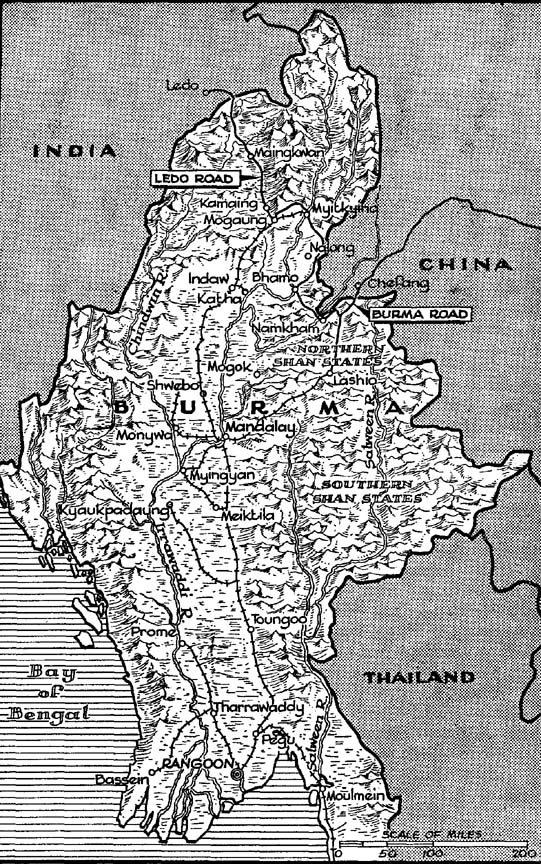
ON THE evening of the day we inspected the remains of Bhamo the Civil Affairs officer gave a dinner to celebrate. As we were eating dessert Dr. Gurney came hurriedly in and informed me I was to telephone Colonel Van Natta, chief liaison officer of the Chinese First Army, at once. As I was reaching for the telephone Van Natta himself rushed in.
"The 30th Division is in trouble on the Namkham Road," he said. "They failed to patrol jungle paths in their rear and one battery of our 75's has been captured. There are so many casualties that their medical units are swamped. I want to borrow a clearing platoon of your unit until the situation clears up. You will leave as early as possible in the morning."
That sounded good. We would be forty miles closer home next day.
Taking Dr. San Yee and Dr. Mildred and the girls who had been through all the experiences in India and the Naga Hills, we set off in trucks and reported to 30th Division Headquarters at the thirty-second-mile post. The area allotted to us was the side of a hill, for the Namkham Road rises from Bhamo plain through steep mountains of very solid limestone. From the narrow ribbon of road the mountains drop away precipitously to the stream hundreds of feet below. There was room for one ward tent, an operating room with four tables, a shock tent, and then, for living quarters, parachute tepees scattered all over the hill.
Just below us was the 58th Portable Surgical Hospital and beyond them the 13th Medical Battalion's Clearing Platoon. I was distressed to have one of the medical officers of the latter come in almost immediately and complain about our choosing a site closer to the front than theirs. They had hoped, on the departure of the 58th next day on a flank move, to be doing all the surgical work.
"My dear boy," I said. "I didn't choose this site. I was ordered to set up here by your liaison officers. I have no intention of stealing your surgery. I don't care if I never see another casualty. I was ordered up here to help in any way possible because your medical system was screwed up and you were yelling for help. If any casualties are brought in here we will send them on to you. If you have more than you can handle, pick out the ones you want and send the nuisance cases back to us. We'll do your postoperative work."
Of course as soon as we arrived the emergency ceased to exist. The 112th Regiment of the 38th Division, which Antonellis was serving, threw in a roadblock behind the Japanese at the fifty-second mile and the Japanese pulled out from in front of the 30th Division. Our task in the Bhamo area had also been completed and the main body of the unit was ordered forward. But where were they to locate? There wasn't enough level ground around us at the thirty-second mile even for our personnel, let alone a field hospital. I gave in and ordered them to set up at Madanyang, a lovely position at the twentieth mile just before the road leaves the plain to start up the mountain.
For three long years I had been inviting everyone to Christmas dinner in Namkham, first in 1942, then in 1943, and now again in 1944. We were now only forty miles from our objective but still couldn't fulfill our Christmas obligations. It was irritating that not only were we not in Namkham for Christmas but had to be separated from each other. Our personnel liked to be together.
We could remedy the first defect somewhat. On the day before Christmas I called the nurses whose homes were in the Namkham area and we drove up to a point beyond Kaitik from which we could see, fifteen air miles away, the central portion of the Namkham Valley spread out before us. Namkham and the hospital area were hidden by the mountain from which Chinese mortars were still driving the last of the Japanese. While we were exploring for a better view a lone Japanese sniper, hidden in a brush a hundred yards away, tried ineffectively to pick us off.
At the thirty-second mile we found that the Kachins of the villages nearby had braved stray Japanese and the Chinese outposts to come down, welcome us back, and share Christmas with us. They had brought pigs, chickens, and eggs, and were already cooking the feast. Our stomachs full of fresh food, we had a short Christmas service together and then they went off home, their old-fashioned rifles and muzzle-loading shotguns ready for the Japanese.
We couldn't remedy the second defect completely, for Captain Antonellis' detachment was miles away over jungle paths. But it wasn't difficult to reach an agreement with the 13th Medical Battalion. They were anxious to let their men have Christmas Eve off duty so they could get tight, if they wanted to, and try to forget that they weren't having Christmas at home in the States. We wanted dinner with our main unit at Madanyang on Christmas Day. We therefore took all the medical responsibility for Christmas Eve, while the 13th assumed responsibility for Christmas Day.
While the 13th had their Christmas Eve party we built a huge bonfire and sat around it till midnight, singing carols and chatting. Many of the 13th's guests slipped out to join in our carol singing for half an hour or so. We were unhappy because we were still forty miles from Namkham at Christmas but there was a feeling of peace as we sang.
All was not peace, however; for we learned in the morning that three of the Japanese who had escaped from Bhamo, ragged, starving, and half frozen, had spent Christmas Eve in the Chinese camp and, oversleeping themselves on Christmas morning, were discovered and shot by the Chinese as they tried to escape.
We couldn't drive through Madanyang Christmas morning, for engineers of the tank battalion were blasting the granite-hard limestone cliffs at the sharp curves to make them passable for the tanks. But, by shuttling, we arrived in time for dinner. There was no fresh turkey but our boys had done their best with a bit of canned turkey and fresh venison, and a very good best it was.
We had few guests so the occasion was not as dignified as Christmas at Ningam in 1943. A tank sergeant produced wonderful guitar music and the rest of the program. was placid and enjoyable. We hurried back at the conclusion of the program to another dinner with General Tang of the 30th Division.
There had been few casualties and we weren't busy. We had learned patience in our years of army service and we spent our time watching the engineers bulldoze and blast the road to twice the width of the original English road. Meanwhile officers of the Air Force, Tanks, Corps Artillery, First Army, kept dropping in continually with their maps to ask about the geography of the Namkham Valley, locations of fords and marshes, gravel banks and sand, and level plateau areas. Everyone was restlessly stamping around waiting for the 30th Division to take Namkham so they could get on with the war. The first through convoy for Kunming, China, was forming at Myitkyina.
But the 30th Division was bogged down. Impatiently the 112th Regiment of the 38th Division took matters into its own hands and walked into Loiwing, capturing the airplane factory site and landing field. Then it plunged on to the Mansawn ferry and back up the motor road toward the 30th. Still more impatiently, Colonel Levell of the heavy artillery begged Colonel Brown of the tanks to set his bulldozers to cutting a direct road down to Panghkam, near the Loiwing airplane factory, in order that the artillery and tanks could reach the plain ahead of the 30th Division and smooth things out so they could capture Namkham. Colonel Brown snapped at the suggestion and came to me with Colonel Sliney for help on a reconnaissance to locate the best short cut to the old mule road to Panghkam.
The nurses yelled S'taing ga after me as I set off with great dignity in a train of jeeps with a brigadier general in front and countless full colonels behind. We drove through to the fifty-second mile, where the Chinese told us we could go no farther as Japs were entrenched two hundred yards beyond. But that was far enough. We were at the entrance to the short cut and in sight of the hospital buildings at Namkham. Something had certainly happened. Even with binoculars, the outline of the buildings was indistinct, whereas the last time I had looked back from this spot, the naked eye could clearly see the red-roofed, pearly gray stone buildings, set like a jewel in the green of the foothills above Namkham, with the great twin seventy-five-hundred-foot mountains behind. Now the blur was so indistinct you could hardly be sure you were looking at the right spot.
While I gazed at the physical evidence of what was left of my lifelong dream, the tank officers explored and found a steep but steady descent by which they could reach the old mule trail, after a mile of bulldozing through the jungle. Colonel Brown decided this would be the route for his tanks and the artillery.
I was moody and silent on the return trip. My dreams for the Northern Shan States seemed pretty well shattered.
New Year's Day passed rather quietly. I sent the nurses down the hill to celebrate with the bigger group while I remained on duty. All returned after midnight except Big Bawk, who had come down with a severe chill and fever and had to be left behind. The next morning, as I was at my desk, I looked up and there was Big Bawk's father. I had never had much love for the gentleman. He was arrogant, loud-voiced, and much too full of phrases. He had been in hot water so frequently during the past years that I couldn't remember an occasion when he wasn't getting out of one mess or falling into another. Big Bawk inherited her sweetness and grace and in fact everything but her face from her dead mother. She and her father had been estranged for some time.
His second question nauseated me. "How much salary have you been paying Bawk these three years?"
His eyes glistened and his mouth drooled as I answered him.
With a small part of Bawk's four thousand rupees as a dowry and the rest in his hands, he could marry her off at a very handsome profit to himself and live most excitingly and unethically for years to come.
My sympathy for Bawk increased. No wonder she'd been frantic through the years away from Burma. As anxious as everyone else to get back to her own country, she had no one left but this black sheep of a father. And on his first visit he was showing that what he was waiting for was not so much his daughter as her money.
I sent him down to Madanyang to see Bawk and, they returned together.
"Daddy, I want to take a vacation at home. My father wants me to stop nursing, but I'm not ready to stop yet if you will let me continue working."
"Of course you can have your vacation. I promised you back at Ramgarh that as soon as you found your family you could take as long a vacation as you desired. How much money do you want to draw from the bank?"
"All!" interrupted the father.
"That wouldn't be wise, would it? The country is still unsettled and the Japanese are roaming these hills. You can't possibly need four thousand rupees, or even spend a thousand rupees, for months to come. I'll give you a thousand rupees only and then if anything happens to that you won't be destitute. The rest will be safe in the bank."
I could see Bawk's eyes shine with relief. Her father muttered something but he knew of old that I was a tougher man than he and that it was no use grumbling.
I sent for Bawk quietly when he was out of the way. "I knew more about your family affairs than I ever admitted to you, Bawk. You have a definite responsibility to your father but that is settled with this gift of a thousand rupees. He can't possibly need more than that except for wrong purposes. He is able bodied and strong and far too clever at getting along for his own good. You're more than twenty-one years old and your own mistress. If you let your father force you to stop nursing before you yourself desire to stop---or force you to marry some fellow whom you have no use for---I will never forgive you. Take two weeks' vacation at home and if you aren't back on the motor road on the fifteenth day I'll send two Marauders to your village to escort you. If your father tries to lock you up, you can escape out of the back window and these men will bring you safely to us."
The 30th Division Headquarters finally moved on from Kaitik and the 38th Division settled there immediately. Major Davison asked me how long it would take our entire unit, patients and all, to move from our two locations to Kaitik. Predicating my reply on the use of the level ground at the pass, I replied that we could complete the move in twenty-four hours.
To my vexation the level area at Kaitik was still pre-empted by 30th Division Artillery who had no intention of moving. There was nothing left but a Chinese cavalry camp on a hillside and some rice paddies. It was a steep climb for the nurses to carry their barracks bags, and men were scarce for they were driving vehicles, loading and unloading, erecting ward tents and a kitchen. The nurses, children, and I did our best to drag bedding to the top of the hill but broke down and had to beg our coolies to help us. Girls put up their own parachute tents. The ward tents were placed in the rice paddies and patients were left on their litters on the ground.
And then it rained. Water beat through the thin parachutes and flowed in streams through the wards. Officers and men, nurses and patients, all were sopping wet---in January, at an altitude of four thousand feet, twenty air miles north of the Tropic of Cancer. I had promised the army two to five days of rain each month during the dry season. In November and December we had had two days of overcast weather and a few drops of rain but now in January we were having the real thing. Our move took thirty-six hours instead of twenty-four.
But our troubles were still not over. Though it was raining the 38th Division Chinese Field Hospital, deciding they needed a nice long rest, unloaded swarms of patients on us while we were frantically trying to get our own patients out of the mud. If it hadn't been for the extraordinary efficiency of our enlisted men, acquired through long experience with difficult moves, our professional work would have broken down. Our three staff sergeants, Probst, Stolec, and Mortimeyer, especially distinguished themselves.
On the ninth of January, Lieutenant Rathje, our finance officer, had but one day to complete payment of the enlisted men with Antonellis, so we obtained permission to contact them. With Little Bawk, whose home was in the valley, and two of our former Marauders, we hopped into a jeep and set out to see how far Colonel Brown's dozers had succeeded in pushing their new short cut. They were already well down the mule trail and there were tracks of a jeep beyond the dozers. So we pushed on and, after almost running over a decayed Jap in a small stream, burst out onto the plain at Panghkam. We drove into the battalion command post and discovered one of the finest, most courteous young Chinese officers I'd ever had the good fortune to meet, a Major Shu. He furnished two guides to lead Lieutenant Rathje and the two Marauders up the jungle trail to Antonellis' hospital, while he led Bawk and me around the area, showing us the wrecks of the airplane factory and letting us use his binoculars.
This time it was possible to see quite clearly that the operating-room end of my stone hospital was in ruins. But the house Tiny and I had built seemed untouched. If only one of the buildings I had built remained unscathed it could become the nucleus for rebuilding the whole plant. But I crushed my hopes as they sprang again to life. The latest Chinese G-2 information reported six thousand Japanese still in Namkham. The 10th Air Force was not done with me yet---dive-bombing was going on at that very moment---and the heavy artillery had not yet begun to shell.
Major Shu was extremely kind. He served us tea, more tea, K-ration, and yet again tea. We had been chatting in what Chinese I knew, and in what English he knew. He wasn't aware of the fact that Bawk was most proficient in Mandarin, and she was greatly amused to hear him gripe in a charming voice to his lieutenant, "What am I going to do if these people don't leave soon? I haven't anything fit to give them for dinner. There is nothing but Spam and rice!"
Major Davison was excited when he learned on our return that we had actually driven to Loiwing and asked me to reconnoiter the location with him the next day.
"Major," I said, as we drove around the Panghkam area, "this is the place for a field hospital. There are no Japs between here and the river. The 30th Division has at last captured Manwing, where the motor road debouches on the plain south of us, and the 112th Chinese Regiment holds the flank on our north. You can see that there's no danger from the nonchalance of the Chinese soldiers, wandering without guns all over the plain in search of food. The only imaginable danger would be from shelling by 150-mm. guns."
"Yes, and they would be trained primarily on the Loiwing airfield to the north and the English fort to the south," the major replied. "Furthermore, you could hide a huge hospital in the area where Major Shu has his command post, if he moved out, and you could take shelter behind the high embankment of the irrigation ditch if the Japs started to shell you."
"The map doesn't show them all as motorable," I added, "but there are five motorable roads that come together at Panghkam over which casualties could be jeeped to us. There's the motor road through Loiwing to Wanting, a road from Panghkam to the Nawngtun ferry a mile north of Namkham, a road from Panghkam to the big ferry at Mansawn, and a road through Manwing to the big Shweli suspension bridge and a road through Manwing to the south flank at Mawswi. If Namkham turns into a big battle like Myitkyina this would be the ideal spot."
We were invited to have dinner with Major Shu and found his command post full of distinguished guests, Generals Sun, Lee, Tang and their staffs and a couple of photographers. General Sun had a huge map spread out on the table and asked me a question about geography. The candid cameramen and newsreel photographer set upon us, hammer and tongs, and it was amusing to see General Sun, docile for once, allowing himself to be pushed around here and there, posing with a former missionary. The general, on the insistence of the cameramen, welcomed me back to the Namkham Valley at least fifteen times that afternoon.
During dinner we had learned that the motor road was clear at last so we completed the round trip through Manwing and back by the Burma Road to Kaitik. Knowing Colonel Bob Thompson would approve anything he recommended, Davison gave me the "all clear" to begin moving to Panghkam the next day.
"It's almost twice as far as our last move and we have many more patients," I warned. "We may need three days to complete the move."
"Take as much time as you need," Davison said.
We made it in two days. Not only our old-timers but all our new personnel were crazy to see the valley the old man had thought worth spending his life in, and they worked with a will. They even failed to complain at having to tear up the Kaitik hospital before the finishing touches had been put on it and build a new one. And because we thought the conquest of Namkham would take at least a month, we made this the best tent hospital ever. Knowing it was around somewhere, I searched and found the cement floor of the shack where Al Anderson had set up his motor department when the airplane factory had been bombed out almost five years before. On this the Burmese boys put up an excellent operating room, while the coolies put up seven ward tents.
Ever since the day the chaplain of the 20th General had told me at the Pangsau Pass how glad he was to get out of Burma, I had heard Americans complain about Burma, its climate, its customs---everything but its people, whom Americans seemed to like instinctively. They had complained in the Hukawng, at Myitkyina, and at Bhamo. They didn't like the mountains between Bhamo and Namkham. Why good Americans should be forced to fight for a country like this was beyond their comprehension. But now all was changed. Everyone who took one look at the Namkham Valley gasped and took a deep breath of fresh air.
"Gee, Doc, this valley---it's beautiful! Beautiful! No wonder you want to get back!"
"And it's rich," I would reply. "Look at those thousands of stacks of rice waiting to be threshed. Yet the people haven't planted all their fields. The best rice in the world grows in this valley."
We heard there was a bazaar still operating in Panghkam, the first bazaar we'd seen in all stricken Burma. There were only a few stray Shan women and they were completely surrounded by Chinese eagerly bargaining for their food. It looked as if there would be none left for us.
"Hello, folks," I said in Shan. "It's good to see you again. I haven't seen you for three years."
They looked at me in bewilderment.
"Don't tell me I've changed as much as all that. I know my face is wrinkled and my hair is getting gray, but I'm the 'Doctor of Nawngsang Hill' all the same!"
"Our doctor, our doctor," said one old lady, grasping my hand. "Even your mustache has gone gray!"
When they calmed down a bit we began bargaining and then the Chinese were left out in the cold.
"How much is this bunch of mustard?" asked a nurse and a Chinese officer simultaneously.
"Five rupees," she said to the officer. And then, in an undertone to the nurse, "Take it for half a rupee but pay me after the Chinese leave." And so it was with other vegetables, fruits, and rice, real Namkham Valley rice! The Chinese went off in disgust.
Thereafter the bazaar sellers saved out stuff for us and brought it right to the hospital and we gorged three times a day and in between as well. One woman had a basket of vegetables for which she wanted fifteen rupees. While Bawk was getting the money it occurred to her the woman might like a handful of salt that was left over from the mess.
"Never mind the money," gurgled the woman happily as she reached eagerly for the salt. "Take them." She held out the basket of vegetables. Bawk took two bunches, a fair exchange for the salt.
"No, take them all, take them all! It has been years since we have had enough salt to eat."
Dr. San Yee walked by, spotted one of the women, and began talking eagerly. I heard the woman saying someone or other was dead but thought nothing of it. Many must have died while we were away. An hour later I saw San Yee on duty. His face was deeply lined and he looked years older.
"Who did the woman say was dead?" I asked, shuddering a little with apprehension.
"My wife, sir. She died five months ago of malaria because no one had any medicine for her. My son is still alive."
And five months ago we had been impatiently but comfortably settled in Myitkyina curing Chinese of malaria by the hundreds, while San Yee's wife sickened and died of neglect.
On January 14 I called Boganaw, the man whose family had been blown up into the telephone wires at Myitkyina.
"I have a feeling it won't be long now until we move into Namkham," I said. "For three long years I've been inviting everyone to a big feast when we get home and I don't want to be caught without food. How about taking a foraging party to N'Bapa and buying us some chickens, pigs, and eggs?"
Boganaw was delighted. He had many friends in N'Bapa.
On the afternoon of the fifteenth Colonel Van Natta walked in.
"How would you like to move?" he asked.
"Any time, any place," I replied, trying to look pleased but expecting him to give us another flank move. "Where are we going and when do we start?"
"How about moving to Namkham?" the colonel said, a twinkle in his eye. "The 30th Division walked in this morning!"
I was positively delirious and screamed out the news to the nurses.
That night General Sliney and Colonel Brown drove in to congratulate me.
"General Sun and Colonel Van Natta are going to escort you personally into Namkham tomorrow," Sliney said. "You are to be at Manwing headquarters at ten o'clock."
I couldn't sleep that night. We were at headquarters soon after nine-thirty but General Sun had already left. Colonel Van Natta told us that the time had been changed to nine-thirty and we would have to hurry to the suspension bridge area. In front of the Manwing bazaar Colonel Van Natta found some engineers who reported that there was no bridge across the Mawswihka and that there were huge bomb craters in the center of the road. Furthermore, their own dozers hadn't arrived. Van Natta told me to walk on beyond the Mawswihka to meet General Sun and he turned back to beg the use of Colonel Brown's dozers.
I found General Sun near what was left of the great suspension bridge. He had the two cameramen with him and they photographed our meeting.
"Where are the pontoon boats operating, sir?" I asked.
"There are no boats."
"We could cross by the Mansawn ferry."
"There might be snipers beyond."
So there had been no-intention of walking into Namkham at all. Just picture taking The conqueror of Namkham welcoming the Burma Surgeon home! I detest having my picture taken but it had long since been impressed on me that if the army thought they wanted pictures of you, you submitted. I would have gone anywhere to oblige General Sun and the photographers, without having a pretended trip to Namkham thrown at me.
On our way back we met General Sliney who hadn't been informed of the change in time and had sincerely desired to escort me into Namkham, since he was the only old-timer left besides myself who had walked out with Stilwell. He was out of humor at not being informed of the change, and when he discovered no actual crossing had been planned he became purple in the face and went on to the suspension bridge to cool off.
Staff Sergeants Probst and Stolec and Dr. San Yee were also in need of calming, so I suggested we explore the jeep road just to see if we could reach the ferry at Mansawn. As it turned out, on the way we passed within a hundred yards of a wandering Jap but we proved that jeeps could reach the river. Then we worked off the rest of our impatience with a game of baseball.
On the morning of January 17, 1945, I spent some time with air force engineers exploring the possibilities of a C-47 airstrip nearby. Just as I was returning to camp a jeep hurried up and an officer informed me that this time they were really intending to escort me to Nankham but that since they had to ride horses, they couldn't allow my personnel to follow me. I must be at the location of our 155-mm. guns in fifteen minutes. I decided to take Stolec, Probst, San Yee, and Ba Saw with me anyway and let them trail along on foot after the horses.
At the trysting place I found General Sun and his staff poring over maps and I noticed his finger tracing a path from the spot where we then were to the Mansawn ferry.
"You can drive a jeep to that ferry, sir," I said. "I drove there myself yesterday."
For a full fifteen minutes Sun lectured his staff because they hadn't known the road was jeepable. Then he ordered me to lead the train of jeeps.
We drove straight to the site of the big ferry and then noticed no one was following us. Probst went back to make inquiries and learned that some Chinese soldiers had led the general and his party off to a different, smaller ferry crossing. We hurried along but they were out of sight and it took us half an hour to find where they had crossed to a large island in the middle of the stream. We reached the other branch, however, before they finished crossing and the Chinese gave me priority. Newsreels cranked and the cameras clicked, as General Sun welcomed me to the valley all over again. Then, without waiting for the rest of my party, we walked out of the village and started across some paddies.
"This is the road to Namkham over here," I pointed.
"The general is going to Nawngkong first, to see General Tang," an aide explained.
"I'll wait by that big banian tree," I said.
"Don't move till I come back," the general said.
"Okay, sir."
We waited for an hour, then started toward Nawngkong to find out what had happened. On the edge of the village a cavalryman met us and pointed to where the general's party had taken to horses and was heading across the paddies direct for Namkham. That released me from my promise to sit, and we marched down the road on the double-quick in an effort to catch up. San Yee and the rest of my party had taken an even more direct route to Namkham. Since his wife was dead San Yee was even more determined to see his son and he was letting no generals or lieutenant colonels force him to go slowly. All we saw of him was a small patch of dust. I was just as anxious as he to see what was left of my baby, the hospital I had built up in Namkham, but with all the brass hats, photographers, and correspondents around I had to bite my nails and do it in style and like it.
Namkham! There was nothing left of the poorer Chinese quarter of the town, although the wealthier Chinese traders' houses were still intact. Occasional houses had been destroyed by bombs but for the most part the dilapidated condition of the Namkham houses, as of those in all the villages of the valley, was due to the Shans themselves. Without being taught, they had learned dispersion. They knew that if they remained in the towns they would be bombed, so they pulled down the essential parts of their houses and moved out bag and baggage to the rice fields, where each built himself a tiny grass shack as far from his neighbor as he could get.
After we crossed the Namkhamhpong River the destruction caused by bombs began to appear. And then I noticed a peculiar thing. When the British first took over the Shan States sixty years before, Shans had ambushed and killed an English captain. As a reminder to the Shans that they must not do these things, the government buried the captain in the exact center of town beneath a huge banian tree and built a stone tomb over him, surrounding the grave with a wire fence fastened to concrete posts. A thousand-pound bomb had fallen right into the captain's tomb. Only the two concrete posts at the foot of the grave remained. Had the air force also destroyed Gordon junior's grave? I was more anxious than ever to push on and see.
On the other side of the open area had been the great monastery of Namkham, the center of the town's Buddhism, a monastery so sacred that I had entered it only once in twenty years, and then with my shoes off out of respect for the religion of other people. It was in complete ruins, but out of the ruins still stood the great image of Gautama, the Buddha, almost untouched, the mosaic on the back of his throne still gorgeous in its beauty. Christians will read many meanings into the freak destructions of their churches in this war. Perhaps we will concede the Shans also the privilege of making something out of their great Buddha, sitting serene and unmoved amid the havoc of war.
Generals Sun, Tang, and Lee were inspecting the wreckage of the monastery. General Sliney and the staff were resting outside the abandoned shop where the nurses used to buy their silks and satins with money saved up from the pitiful stipends of sixty cents a month which was all I could afford to give them while they were in training. Probst, Stolec, and I, perforce, sat too. An hour passed and the generals reappeared. I had been sitting within a mile of the hospital for an hour, unable to go farther.
Now, surely, the wait was over. I stood up expectantly. But then General Sun sat down. Orderlies ran hither and yon, bringing tea, biscuits, and candy. I managed to choke one biscuit down. General Sliney watched me sympathetically. He was as eager as I to see what was left of my hospital.
At the end of the second hour General Sun decided he would push on. We passed by the all but ruined bazaar buildings; the Namkham bazaar had been the biggest and most colorful in the Federated Shan States. I had hoped the air force had had sense enough to destroy the awful post-office building but it was untouched, an ugly living monument to the unimaginative architectural ability of the Public Works Department. A battalion of Chinese were passing us now and they had impressed some natives into portering for them. I stopped. "Well, well, folks," I said in Shan, "how are you making it?"
They glanced at me, looked again, threw down their loads and grasped my hands. "Our doctor, our doctor, our doctor!" The newsreel camera began to grind.
General Sun turned to look, covered with smiles. "They recognize you, do they?"
"Shucks, they'd better! I've taken care of them since they were pups!"
As soon as I could tear myself away we marched on, waylaid frequently by other small groups. And then we were climbing the mission hill at last. At the foot of the hill was a sign in Japanese: "HEADQUARTERS, NAMKHAM GARRISON, IMPERIAL JAPANESE ARMY." In three years the Japs had not cut a weed. Branches of trees shattered by bombs were strewn across the road. We had to climb warily lest the Japs had laid booby traps. The center of the hospital gateway was occupied by the crater of a thousand-pound bomb. Other craters were everywhere. But the southwest corner of the hospital was intact. Again I was officially welcomed back to Namkham for the sake of the newsreel man, who posed me several times in the way to demonstrate best the feelings he thought I had at the time. All I wanted was for them all to go away and leave me alone. At last the photographers were tired and the generals, exhausted, went away to rest. General Sliney, God bless him, deliberately chose a different route for his exploration and left me alone with Stolec.

A small feeling of satisfaction came strangely over me as I walked around. A thousand-pound bomb had struck within five feet of the wall of the men's wing, but all it had accomplished was the destruction of a three-foot pillar between two windows on the ground floor; the second story wasn't hurt. But the most extraordinary thing was that either God or the air force seemed to have decided that I was to practice no more gynecology or obstetrics, for the men's wards were all up except for the bathrooms and the women's wards were all down---except for the bathrooms. The maternity wards were completely destroyed but the children's ward and the ward for newborn infants were still there. My office and one private room were untouched except for bullet holes. The operating-room section and the women's wing were destroyed completely, but it had taken three direct hits and ten near misses to do it.
The iron roof had been torn almost completely off and what sheets of iron remained were full of countless holes from machinegun strafing. Even the undamaged wards were deep in litter. Unwilling to sleep on teakwood floors, the Japs had built bamboo platforms a foot off the floor. In three years the place hadn't once been swept.
Out in the patio one of Tiny's red roses was bravely blooming as if to show the war was over at last.
I went over to the nurses' home. One of the front-door pillars had been smashed, the ballroom floor had collapsed, the roof was full of holes, and everywhere was Japanese filth; but otherwise the building was unharmed.
Then I started my search for Gordon junior's grave. I feared the worst when I saw that the enemy had completely disposed of the banian tree beside him. It was incredible that the weeds could grow so high even in three years. Finally I found the grave, completely untouched. Roses were blooming in spite of the neglect, and beside the grave our poinsettias were in full flower. I felt much better.
Only one of the cottages which we used for private patients had been wrecked. The other cottages and the old dirty hospital building to which I had first come twenty-two years before and which I had often threatened to burn down were still there and immediately usable. The machine-gunners hadn't missed these roofs either; there wasn't a single roof on the entire mission hill that hadn't been riddled.
My other buildings were also usable. The damage to the stone church was slight, but the wallboards and the partitions of the house where Tiny and I had lived for eighteen years, and those of every other house in both compounds, had been torn off by the Japanese to build sheds and lean-to's.
On the Kachin compound was complete devastation. Only one small cottage and the schoolgirls' dormitory could ever be repaired. What our air force had not destroyed the enemy had.
Now that I'd inspected all the buildings of our working plant, I was free to visit the little cottage of stone Tiny and I had built for ourselves and used for two short years. The Japs had torn off all my copper screening from the doors, windows, front and back porches. They had torn off the paneled doors of our built-in closets. There was a hole in the dining-room floor. Not a stick of furniture anywhere. Then I opened the bathroom door. The Japanese had broken the toilet bowl loose from its moorings. The bathtub was gone. The washbowl had been torn out and was set into Tiny's neat closet on the back porch.
General Sliney obtained permission for me and my party to separate from the rest and go back to Panghkam alone. At the foot of the hill, in the ruins of the recently burned Christian Kachin homes, were the twisted ruins of five of our iron beds and our bathtub, the enamel completely destroyed. I was told later that the Japanese had used them for the comfort of the Korean and Japanese prostitutes, whom in true Japanese style they had installed in Christian homes. The first Chinese shell thrown into the area, a phosphorus shell, had lit squarely in the area and burned both houses to the ground.
San Yee had been lost all this time. Ba Saw undertook to go find him in the rice fields to the southwest of Namkham where he had located his brother, cousins, and the son he had never seen. It took half an hour to pry San Yee loose from his son but when he came his eyes were shining and his face wreathed in smiles. "Such a nice big boy with bright red cheeks and so fat!" he chuckled. Ba Saw and the American boys were just as enthusiastic. San Yee had something to live for again.
The bamboo raft was just landing as we reached the river. A young Shan woman and a fair red-checked girl were aboard. The woman stared, threw down her baskets, jerked off her turban, and prostrated herself in front of me in the complete wai.
"Goang Hpra, Goang Tra! The grace of God and of the Law! It's our doctor! Goang Hpra, Goang Tra! Goang Hpra, Goang Tra!" and to my red-faced embarrassment she kept on waiing me in spite of all I could do.
"Surely you know Dr. San Yee?" I asked, when I had calmed her down somewhat. She looked and then prostrated herself in front of him and went through the whole process again. Then suddenly she stopped and her face sobered.
"Your wife is dead!" she whispered.
"Yes, I know. But my son is alive!"
We crossed the ferry and it was darkening as we entered Mansawn. We took a different path from the one we had come over in the morning. A hundred yards ahead of us a Shan was climbing over a fence into his garden.
"Will this road lead us to the great monastery?" I called. He glanced at us as we approached but couldn't believe a man in uniform could be talking Shan so did not answer. I repeated my question twice before he realized I was talking to him, and then he answered yes. We were now only twenty yards away. Suddenly his eyes focused intently on me.
"Why, it's the doctor of Nawngsang Hill! It's been three years since you went away. Three years, bee, hee, hee! Three years, ho, ho, ho! Three years, ha, ha, ha!" he laughed hysterically and then his voice broke. He was still muttering "three years!" to himself, again and again, as we turned the corner and passed out of sight and hearing.
On our return the girls crowded around to hear the news.
"When are we going to move to Namkham?" they demanded, excitedly.
"Not until Major Davison says okay," I replied. "He knows how anxious you all are to go. It won't be long. But Dr. San Yee and ten coolies can certainly go over tomorrow and stay and clean up the nurses' home for you."
Dr. San Yee had just set out by the ferry route when Major Davison appeared.
"Let's go over and reconnoiter," he said.
"By the ferry?"
"No, the engineers have already thrown a pontoon bridge across. We can drive over."
We hurried. Davison hunted for booby traps and made inquiries about the disposition of troops. "I don't see why you can't come over right away," he said. "Your only danger will be from the Japanese 150-mm. rifle and you've been shelled before. Your whole hill is dotted with dugouts and trenches for you to jump into."
It was after twelve when we got back to camp.
"All the original unit nurses and Burmese boys will leave immediately for Namkham," I shouted. "Trucks back up to nurses' quarters immediately for baggage. Probst and Stolec and all Burmese coolies on board! Everyone else will follow tomorrow with the patients."
I was too excited to eat. The girls, convinced that Major Davison wouldn't hold them back, were already packed up and ready. Within half an hour we were away on the last lap. Then, for the first time in many weary months, the girls began to sing at the tops of their voices as we rode along.
I had thought I was excited but I was calmness itself compared to the nurses as they jumped out of the jeeps and ran into their home, tripping over the heaps and piles of junk the coolies had been clearing away. Each of them ran to the particular corner where her bed had been three years before and dumped her musette bag there, as one who would stake out a claim to a gold mine. Then they began to explore. They were delighted that the destruction wasn't more extensive. One girl found, in a bathroom, the first sheet of typewritten notes on anatomy I had been teaching her when we left Namkham for the Shan States front. Suddenly there was a burst of laughter from several of the nurses and they began to tease a companion who, running to a corner of the attic, had found there just what she hoped to find: a bundle of love letters from her sweetheart of three years before.
Then they ran out to the jeeps and brought the worn-out brooms we had looted months before in Momauk and set to work with a will. Soon they raised. such clouds of dust that it was impossible to breathe. They tied handkerchiefs over their noses and continued to sweep but I ran out, to find that the coolies had stopped work to enjoy the delight of the nurses at their homecoming.
"Come on, let's go!" I shouted. "I promised we'd be ready for new admissions at noon tomorrow and we have three hundred old patients to bed down before then. Burmese boys, clean out the cottages! Half the coolies to the old wooden hospital! The rest, clean out what's left of the stone hospital wards! The nurses will cook our supper!"
Everyone became infected with my mad frenzy, and tons of Japanese dirt and trash began to fly out from the windows and doors. It wasn't safe to walk anywhere for fear of having a load land on one's head and shoulders. My old white-bearded Punjabi sweeper, who had adopted me in Myitkyina, had stowed away in one of the trucks and was standing by with a forlorn doglike expression on his face, fearful that I would make him work with the others rather than fix my own quarters for me.
"All right, Santa Claus!" I said. "Come along and I'll show you where I'm going to sleep."
Santa began to grin and trotted after me good-naturedly as I led him over to the stone cottage.
"I'm going to sleep here in the little front bedroom where my two sons used to sleep," I told him. "The other bedroom is to be for my guests."
His beard indicated that he was smiling from ear to ear. With a profound salaam he set to work and soon it wasn't safe to breathe in my house either.
Early Friday morning we set to work again keeping half a step ahead of the patients as they came over by the truckload. Heroically, the nurses bedded down patients on the wooden floors, saving the cots for wards with cement floors. Then they tagged the patients' foreheads with adhesive tape to correspond with their new positions, renumbered their temperature charts, and began dosing them with medicine and putting on fresh dressings. I must have walked ten miles that day without leaving our compounds, for the Shans had heard we were back and had turned out three hundred strong with dahs, shovels, and bamboo baskets.
"These people are from Manhong, Nawngsang, and Manhkam villages," said their respective headmen.
"Good! We need you!" I replied. "I will pay grownups one rupee per day and children proportionately."
"You won't pay us anything. You've been away three years and we had given up hope of your ever coming back. The Japs forced us to labor every day for nothing. Now for once we are going to do something just because we want to do it and not for money. Every village around Namkham is going to give you three days of free labor. There will be another group of villagers in tomorrow."
I felt like a candidate for president of the United States. All the Christians grasped my hands, while the Buddhists insisted on the complete wai. Then a group of girls ran up and I saw Hseng Hun, the Shan girl Tiny and I had put through the English high school. Excitedly I threw my arms around her and gave her a big squeeze while bystanders applauded and her mother stood by smiling delightedly.
"Are you married yet?" I asked.
"No," Hseng Hun replied demurely.
"What the Sam Hill do you think I put you through school for?" I demanded.
Paw Hpying Awn, the coolie I had trained to be a master mason and who had been the chief of those who built the hospitals, nurses' home, our cottage, and the church in Bhamo, pushed his way through the crowd, his eyes streaming with tears, his mouth set in a broad grin. I almost kissed him.
"I want you to work for me again. We must rebuild this hospital. Will you help me?"
"Aw hka. Yes, sir," was all the reply he could produce that day.
"I wish someone would tell Sein Hla Tha, the old headmaster, and Chief Nurse E Hla and the rest of my old staff that I'm home again," I said to everyone at large.
Koi's old father and mother came up and I drew them aside and asked Big Bill to give them two hundred rupees on account. Even a group of Shans who hadn't cared tuppence for me in the old days came to shake hands as if I were their long lost brother. I walked on, watching the villagers at work.
"That's he! That's our old doctor!" said a twelve-year-old to her younger sister.
"How he has aged!" exclaimed one after another of the old friends.
In the middle of the morning the new patients began to arrive to add to the melee, although I had set noon as the earliest permissible time. Dr. San Yee's brother Hsang Hsam, who had been prime minister of Hsenwi State, his cousin Hkun Hsam Myat, the lord mayor's son, and their cousin Hkun Myat Hsa, a barrister-at-law, also called to pay their respects. They looked starved and haggard. The Japanese had been offended at their non-cooperation and had deposed them, forcing them to relinquish the title of hkun or prince and compelling them to start truck gardening. With them were San Yee's sister-in-law and son. No wonder everyone was delighted with the boy. The nurses began to strive for his affections. Looking at the beautiful girl who was his aunt, I began at last to place San Yee's charming wife whose name I had not previously recognized. He had really suffered a great loss.
I tried to organize the work of clearing away the rubble, saving up piles of stone and gravel for future use so that when bulldozers came to fill in the bomb craters they wouldn't bury stone that we could use again. It was a nerve-racking ordeal. In the middle of giving instructions in Shan to the coolies, American officers would stroll up to congratulate me on my return. As I chatted hurriedly with them a nurse would break into the middle of a sentence with a demand in Burmese for instructions. Before long I couldn't be certain what language would pour out when I opened my mouth. I began to talk in Shan to nurses and in Burmese to Americans. Then the presents began to arrive. By Shan custom a present must be made in your home, the fruit, vegetable, or rice being laid on a table. But I had no table. Hour after hour I had to drop my work and walk to the kitchen, formally accept the gifts, and try to find some container to hold them.
Saturday morning the engineers drove in a dozer which I might use straight through the twenty-four hours. I didn't dare trust the bossing of the bulldozer crew to anyone else. Every minute of the day before, I had been planning just how the dozer could fill craters without pushing the remnants of the hospital down or burying precious materials that could be used in rebuilding. The dozer boys and I spent the day together. By the time they left, all the important craters around the big buildings had been filled and our roads cleared, widened, and in use again. The dozer was still filling craters farther away when I fell asleep.
Sunday morning Sein Hla Tha walked up.
"How did you learn I was back?" I asked.
"That mason, Paw Hpying Awn, ran all the way up the hill to tell me," he said. "We have been living in the woods behind Oilaw ever since the Japs came."
"How are Rosie and the children?"
"Rosie is well. She had a little son nine months ago but during the rainy season he suddenly died without anything seeming to be wrong with him."
There went another dream. After all my operations she had finally had a son, only to have him die before I could come back and take care of him.
"I heard about the boy's birth in Myitkyina. You left there the day before we captured the airfield."
"Yes, I was there. The Japanese forced me to act as interpreter and took me all the way to the Mogaung Valley. At one time I was only ten miles away from the American lines. They paid me eight annas Japanese money a day and my ration was rice and salt. The villagers received only rice. I was tired and sick but I couldn't get away from them to the Americans. Finally a Kachin showed me a jungle path the Japs didn't know about and I ran away and walked all the way back to Namkham. The Japanese threatened to burn down my house, as they threatened to burn down all the rice stacks in the fields, because the Shans heard the Americans were coming and refused to turn over any more rice. But they pulled out so suddenly, when they knew they were surrounded, that they 'didn't have time to carry out their threats."
"Have any of our people been shot by the Japs or raped?" I asked.
"I don't know of any shootings myself," he replied, "but an officer raped the beautiful Kachin lady teacher in Mr. Sword's school and she poisoned herself with opium the next morning."
"Is Little Bawk's father all right?"
"He was, the last I knew."
"Can you send a messenger to tell him she's back and wants to see him?"
"I'll send one in the morning."
"When are you coming back to stay?"
"Will they let us come back?"
"Certainly. You don't live on the main road. The villagers who live on the Burma Road can't come back yet, for some of their villages are being used by the army. But all of the Christians can come back and if anything is said I will tell them that I need you to work for me, and I do! I can't rebuild without all the workers who worked for me before and I need you teachers, Kachin as well as Shan, to act as foremen for me. I can't do all this myself; there's a war on!"
"What about the preachers and the schools?"
"As soon as the army gives me permission to bring back Dr. Ba Saw's wife and family from India, we're going to start a little school on our own. It will be done without government assistance. The nurses and I will pay the teachers' salaries out of our own pockets. Perhaps some of my officers and those of other American units will help. As for preachers, that will have to wait. That doesn't mean we're not going to have church services. Already officers of four different American units have come to me begging me to repair the church before I repair the hospital so they can have a nice place to worship. The army has repaired the church I built in Bhamo and is using it as a church for all denominations. That's what I'm going to do here. When the church is repaired chaplains of every denomination, including Catholics and Hebrews, will be invited to conduct services here. I couldn't do that in peacetime because the Baptists would have yelled. But this is war and I'm the boss of this hill!"
That night we had our sing in the stone cottage. Though the piano had been stolen, the nurses sat cross-legged on the floor as in the days of old and it was nice to have Sein Hla Tha's baritone voice with us.
The next day Ai Pan, the Shan pastor, his new daughter-in-law, Nurse Htawnt, and Hkam Gaw, who had taken care of John and Sterling, suddenly appeared. I threw an arm about each girl and squeezed, and I mean hard. Htawnt laughed and laughed and Hkam Gaw cried and cried. It was fifteen minutes before I could get loose and even then I couldn't stop Hkam Gaw's crying.
"We thought you were dead," she sobbed. "Three times the Japanese announced they had captured you. Once they said they had captured you and thirty Burmese nurses in the Hukawng Valley. Then they said they had captured you and five nurses and were taking you to Rangoon. The last time they just mentioned they had caught you and put you at forced coolie labor at Sagaing and I knew you couldn't stand that. It was only a few weeks ago that the airplanes dropped leaflets prepared by the O.W.I. saying that you and the nurses were all safe and already in the Bhamo area with the Chinese and American armies and we knew the Japanese had been lying."
"Come over to the house and I'll show you the family pictures," I said hurriedly, hoping to stop the sobs.
I drew out the pictures of Tiny, of Leslie and Weston, of John and Sterling. Hkam Gaw sat on the floor and spread the pictures out on my cot. When she came to Sterling's picture she pressed her face down on it and began sobbing again as if her heart would break. This was no good. I turned to Htawnt, a lovely Shan girl who, to my regret, had not gone out with us.
"Who told you you could go and get married?" I scolded fiercely.
Htawnt and her husband smiled. Nobody was scared of me any more.
"And how many offspring have you produced?" I demanded.
"One already and I am producing another at the moment."
"I'll say you are! I left you a young girl and here you are an old woman already!"
We continued to rail at each other until Hkam Gaw began to return to normal.
Things were happening every day and all day long. Ma Hkun, the first girl trained by me to become head nurse at Namkham, came down from the mountains, children and all, and with her was Ma Nu. Seven months' pregnant she had walked twenty-five miles on mountain paths in one day just to welcome me home. Ma Nu, of Htawnt's class, was distinctly unhappy.
"You didn't come, and you didn't come," she complained. "My folks insisted on marrying me to a man I didn't want but I held off until I gave up hope of your ever returning. And now that you're back I'm pregnant and I can't start nursing with you again!" and Ma Nu also dissolved in tears.
My return was causing more tears than laughter.
"Listen, woman. We're going forward soon. Go on home and stay till the baby is born and then, when you hear we're back in Namkham, get a servant girl and come down and start nursing again."
"Will you take me?" she asked, astonished, her tears stopping and her eyes beginning to shine.
"Of course I will, you little fool! You're one of the best nurses we ever had."
Colonel Petersen flew down all the way from Myitkyina to congratulate me on my return. We were sitting on the front steps of the cottage chatting when around the corner appeared Ai Lun, my medical student, and---yes, there was E Hla! I ran past Ai Lun and threw my arms around her.
Colonel Petersen delicately withdrew and we all went in and jabbered for an hour.
"How many children do you have?" I demanded.
"Two of my own and the little orphan girl we adopted," E Hla replied.
"Are you coming back to work?"
"We came down to inquire if you wanted me."
"Silly girl, why didn't you bring the children and all your possessions down at once? You knew I'd want you."
"It will take a truck to bring us all down."
"You can have it. Where are my two Irish terriers with the pedigree from Ireland two pages long?"
"They took sick and died," she replied, looking away.
The next day at dinner Little Bawk was seething, as if she had something on her chest, so I took my messkit over to a corner to eat with her.
"E Hla says she lied to you yesterday about the two dogs because she thought you couldn't stand the truth. What actually happened was this. The Japanese were extremely provoked when they failed to capture you here. When they learned that Buddy and Podgy were your dogs they hung them up by the neck to a tree and split their bodies open while they were still alive."
I stopped eating.
In the evening E Hla brought her whole family to sit by the fire and talk. With her was Hkam Yee, one of the former teachers in our middle school who had served with our unit at the Shan States front and was in Selan when the Japanese came in.
"They caught Pastor Paw Hkam and his son and executed them in front of us all," he said. "The executioner's bullet broke Paw Hkam's hip and he fell to the ground. Then the executioner stepped up and slowly hacked off his head with a dull sword. When Paw Hkam was dead I heard the Japanese commander say they were going to execute all the people who had worked in your unit. They didn't know I was one of them. So I took off into the woods and warned all the others and we hid for months until there was a new commander."
People of all races had come to welcome me back. But it wouldn't be official without a British welcome. I was therefore delighted to see a jeep drive to the door and a British major general climb down---Major General Cavell, chief of all the antimalarial work of India. He had come to Namkham once just before the fall of Burma, but I was at the front and we didn't meet. Now, hearing that I was at home again, he flew all the way down from Ledo just to extend a formal welcome. Cavell did me the honor to stay with me overnight and we had a long conversation, during which we talked about the future of Burma. I was surprised and delighted to find that he concurred in a good many of my ideas. This was all the more important to me because Cavell had once been invited to become inspector general of civil hospitals for Burma.
On Tuesday, the twenty-third, General Cannon came in to congratulate me.
"Well, Doc," he said, "what do you want to do now? Remain here in Namkham permanently?"
"Sir," I said, "we're in the army now. I have no choice as to what I will or will not do. But if I do have a choice I want to stay with combat until combat's mission in Burma has been completed. I was in combat with the Chinese troops in Burma before General Stilwell himself. The unit has been under combat ever since, although under loan to S.O.S. at Ramgarh. I would feel badly if we were transferred to S.O.S. before combat's mission is completed. After that, to be frank, I would like a station hospital assignment on the Burma Road with installations, say, at Namkham, Kutkai, Wanting, and even at Chefang and Mangshih which are Shan States in China. The engineers, S.O.S., and convoy drivers will need them. I'm conceited enough to feel we would do better at that assignment than any other American unit, for we know the languages and diseases of the country and would be happy as well. If our unit could combine such an assignment with a bit of U.N.R.R.A. medical reconstructive work for the people, we would be happiest of all."
"But if you remain with combat you will have to move forward," the general warned.
"I realize that, sir. But none of us expected to remain in Namkham permanently after our first arrival. We all expected to push on."
"Of course some of your personnel will have to remain here to guard the place and supervise the rebuilding. You must start rebuilding at once!"
"Sir, I accept that as an order. We have already begun to rebuild." I couldn't keep my delight from showing. I had thought I might have to beg for permission to rebuild. "But in order to rebuild in wartime we will need a lot of engineer supplies," I added.
"What engineer supplies will you need?" the general inquired, cagily.
"Cement and iron and stuff like that," I replied boldly.
"Certainly you will need cement. The engineers won't be able to give you much, of course, but they undoubtedly will give you some."
Was I getting the breaks again? An hour later I was sure I was. Lieutenant General Wheeler, formerly commanding S.O.S. in India and now on S.E.A.C. staff, also flew in to congratulate me. With him was Colonel Hirschfield of S.O.S.
"You're going to rebuild, aren't you?" the general asked.
I explained about General Cannon's remarks and my statement about cement.
"I told Colonel Hirschfield on the flight down that he must supply you with everything you need."
"That's an order, Colonel!" I said, turning to Hirschfield.
Colonel Greene of the engineers looked over the buildings. "Doc," he said, "why did you study medicine?"
A note came from Boganaw saying he had secured twenty-six pigs, a cow, and a hundred and fifty chickens and would be on the road on Wednesday. I promptly sent out invitations to everybody from General Sultan down to come to a feast and entertainment on Thursday afternoon to celebrate our homecoming. Then I scouted around for Chinese, Shan, and Burmese cooks so everyone would find some dish to his taste. The American boys cooked steaks and creamed potatoes and made delicious pies.
And then, just as everyone was frantically preparing for the great evening, an avalanche of newsreel cameras, with sound and radio-recording apparatus, and sixty correspondents fell upon us. We had planned Burmese and Chinese dances in which the nurses were to take part and all our Karen personnel were singing ancient Karen songs. The newsreel men wouldn't be able to photograph these at night so we had to stop everything at two o'clock and put on an extra show for them. Repeat after repeat was necessary until everyone was satisfied. People were beginning to eat before we were done.
I had expected some three hundred Shan guests, a hundred and fifty Kachins and, if lucky, about three hundred Americans. As it turned out we fed sixteen hundred people---or tried to. Many went away empty or half-filled. The Shans had for days been welcoming us with open arms, and according to Shan custom this was my special dinner to them. The Kachins, once a year, put on a great dance called a manau which combines sex, religion, and war. The Japanese were so afraid of them, however, that they forbade the Kachins to hold a manau and it had been three years since the last one. The Kachins were uncertain what the Chinese and Americans would do to them if they had the big dance and were intending to postpone it further when they heard I had come home. That gave them an idea. If they had the manau under my auspices, they were sure nobody would interfere. I regarded it as a great compliment to their knowledge of my tolerance that they were so certain I would permit this heathen ceremony on Christian ground; but I was appalled when I saw some three hundred and sixty Kachins come in from the mountains to the west and another hundred and fifty from the mountains to the east where the Japanese patrols were still operating.
The greatest compliment of the day, however, was the arrival of whole villages of Palongs, timid Buddhist mountaineers. To have the Palongs pass through the Chinese lines in order to welcome us home was a compliment indeed. I posed for a photograph with the Senior Buddhist Abbot of the Namkham Valley.
But the guests of honor---the American officers, Chinese officers of field rank, and the sixty correspondents who were following the first convoy through to China---were late. General Sun at the last moment had invited them all to a party celebrating the arrival of the convoy. To make matters worse, there were, as the news broadcasters admitted, still two Japanese snipers with rifles on the road. What the broadcasters neglected to state was that the snipers' rifles were 150-mm. rifles! So the generals were fighting a war and Sun's party also was late. I gave up hopes of their coming at all, and since I already had two brigadier generals, Sliney of the artillery and Pick who built the Ledo Road, I decided to start dinner with the twenty guests who had arrived. We had no sooner sat down when the others poured in, General Cannon with them. Still we were minus the three chief Chinese generals, Sun, Lee, and Tang.
I suggested the usual toasts: to the Chinese First Army, conquerors of Namkham; to the artillery, the best part of the Chinese Army; to the liaison officers; to the tanks; to the engineers who built the Road; to the pipeline; to S.O.S.; to the convoy; to Generals Sultan and Stilwell. But I brought the house down with my last toast: "To the 10th Air Force and their precision bombing of the Namkham hospital!" Everyone shouted "Kambei! Bottoms up!"
The only place big enough for the entertainment was the upstairs floor of the nurses' home. When Colonel Greene saw the number of people crowding upstairs he began to feel for a moment that perhaps I was right for having studied medicine instead of engineering, but after careful examination of the gigantic timbers on which the upper floor rested he walked right up with the rest of the crowd.
Having welcomed the U.S. Army to that first Christmas in Burma at Ningam, I now welcomed the army to Namkham and told the guests I hoped that I was the only American soldier to return home and find everything he owned destroyed by his own air force! We had prepared some authentic items. The Karen singing---all the girls in adorable Karen costumes---was the real thing and very beautiful with its close harmony. Nurses put on a parody of a Chinese dance, dressed in modern Chinese clothes which they had made from torn silk parachutes. Princess Louise and M.T. Lu did solo Burmese dances and M.T. Lu a duo dance with a Burmese boy. This dancing, too, was authentic. Two pretty Kachin nurses sang a duet. They were suffering from stage fright but their gorgeous Kachin clothes, heavy with silver plaques, and their beautiful faces made them an immense success. The prime minister had secured expert Shan male dancers who put on a series of skillful sword dances with two swords, which made the front-line spectators wish they'd taken standing room in the back after all. The rest of the program was just for fun. But the crowd had to go outside for the last number, the most authentic of all: the great Kachin manau dance with two hundred dancers.
The Kachins had fenced off a large area of the football ground. In the center were two nat poles, reminiscent of the totem poles of the American Indians. All the men were armed with drawn swords and with rifles or muzzle-loading shotguns on their backs. All, men and women, were a bit tight. Two chiefs, who outranked all others, had on high feathered headdresses and led the dance. Between the nat poles were the musicians playing on native pipes, gongs, cymbals, and drums. The music was weirdly exciting, with a powerful rhythm. In long rows they danced back and forth, sometimes like a snake dance. To an unsophisticated observer the steps were all the same, but I had seen manaus done for fun before and had heard stories of the unfettered manaus in the animist areas. Whether these Kachins would go to the usual extremes or tone the dance down because they were on Christian land I could not know.
Flashlight bulbs were exploding and radio-recording men were at work in the midst of the dancers, who tolerated them unconcernedly, grateful for the protection the U.S. Army gave them. But five or six correspondents, who had been tight and noisy all evening, decided they would show the Kachins how their manau looked to a foreigner and, jumping into the enclosure, began to interfere with the dance. I lost no time in gruffly ordering them out of the ring and insisting that the sober correspondents keep them out! It would seem that correspondents aren't accustomed to reading any but their own writings, for these men should have known that a Kachin in a trance is nothing to be played with; these two hundred Kachins were in a religious, sexual, alcoholic war trance, the first they had indulged in after three years of abstinence.
But I had to leave early. A Chungking Radio broadcaster, who was too much of a rugged individualist to record while others were recording, had insisted on a midnight séance and I had to order the tired girls and boys out again. By the time he was done with me I was stammering like a Sunday-school child reciting his first poem.
That afternoon word came that Little Bawk's father, hearing she was safe, had started down the mountain from his home in I Sang village to greet her, only to be refused passage by Chinese outposts. It was unreasonable of me to be irritated, for there was a war on and the Chinese, never omniscient, couldn't know that this man had been a constant thorn in the flesh of the Japanese. But after all the girls had gone through for the Chinese Army, I felt they ought to have recognized the father of a girl who had nursed so many of them. Major Lee ran at my call and wrote out a beautiful Chinese pass for my signature. The Kachin chief of Oilaw produced two guides. My two Marauders jumped to their guns and set off with Bawk to fetch her father down the hill in style.
Just as we sat down to the great dinner an excited voice screamed for me. "Daddy, Daddy, Father is here!"
Maru Gam is the only Kachin I've ever known with the spunk to stand up to an American missionary and tell him just what he thinks of him. Older than I and the father of twelve, he looked about thirty-five. He walked up to me with friendly dignity.
There was no gushing about how glad he was to see me back. For the moment, at least, he didn't give a hoot about my return. The person he was rejoiced to see was his daughter Maru Bawk, Little Bawk, and he didn't care who knew it.
The difference between the fathers of the two Bawks was very apparent. Not once did Maru Cam ask either Bawk or me how much salary I had been paying her or how much money she had in the bank. On the contrary.
"Daughter," he said, "you've been away from home a long time. You must be badly in need of spending money. Here's twenty rupees for a start."
Embarrassedly Bawk told him she didn't need it. She'd been saving up money for him!
Not once did he ask her to give up nursing. Not once did he complain about his treatment at the hands of the Japs, though for several months they had been so eager to catch him that he had had to sneak out of the village at night and march a hundred miles across the mountains to hide, east of the Salween River, until the hue and cry died down.
I told him about Bawk's tuberculosis but he had no recriminations to offer for the woeful way I had overworked the girls. He asked what Bawk wanted to do and when she said that after two weeks at home she was going to push forward with the unit, he was well satisfied. I warned him that Bawk couldn't walk to their village on the mountaintop and he agreed to return home the next morning and send a horse for her on Saturday.
The next day Colonel Brown's tanks cleared the road junction at the 105th-mile post of the two large-barreled "snipers." When I drove Bawk down the road the next morning the great convoy was forming, ready to start for Kunming. Bawk's horse was waiting for her at Nawnglawng, a mile beyond the lead truck. I decided to do the thing in style. Ever since the fall of Burma in 1942 we had been serving the troops who were fighting to get convoys into China and now the first one was going through. General Sliney, the only other officer besides myself still left of those who had walked out with Stilwell, was just starting back for the States. Stilwell himself was gone. I had welcomed the army into Burma. Who was better entitled to bid them Godspeed on their way to China? I turned the jeep off the road, backed it to right angles, stood up on the hood, and took the salute. Generals, colonels, majors, sergeants, and even buck privates entered into the spirit of the occasion and gave me "Eyes Right!" and stiff, precise salutes, though they had broad grins on their faces at the presumption of that queer bird, the Burma Surgeon.
Tonight, as I write, the convoy is safely in Kunming. It is lonely without Uncle Joe here to celebrate with us. All the hospital wreckage has been cleared and everything looks as if a new building was in process of construction. Ah Kway, my old Chinese carpenter, is making new furniture out of the wrecked lumber. Soon he will start on new doors and windows. My American boys have fixed up the collapsed floors and are now jacking up roof trusses. The engineers are working with us and giving us salvaged equipment. The Shan men and women are down in the bed of the Namsari collecting new stone and gravel. A party is at work collecting limestone and firewood near the limekilns. Our hospital is running over five hundred beds. We are alerted to send a hundred-and-fifty-bed field hospital unit to Manpong down the Burma Road toward Lashio. Some officer once said that Seagrave's war would end at Namkham and that no one would be able to force him to leave, so I'm going to command that advance echelon myself with Drs. Ba Saw and Mildred Pan Hla. Just for spite I'm going to be the first member of our unit to leave.
For my personal war with the Japanese is not over. Kyang Tswi and Esther are at home with their parents. Big Bawk and Little Bawk, Kaw Naw, Ma Grawng, and "Chubby" Malang Kaw have had vacations with theirs. Tugboat Annie almost reached home but was turned back by Japanese patrols. But Julia, Naomi, Wasay, Saw Yin, Ruby, Emily, Chit Sein, Nang Aung, Pearl, Louise, and "Jackie" E Kyaing live far to the south. It will be months before these last of the refugees can return to their homes. They are happy here at Namkham in their adopted home, as I am. But not until they can see their people and then decide whether or not to continue nursing will my personal fight with the Japanese be over.
And after the war? With the clearing of the Japs from our territory the Kachin Christians held a great convention to which I was invited as guest speaker. I informed them of Britain's recently announced plan to give Burma complete self-government as soon as the havoc of war was cleared away and the country restored to a semblance of a peacetime basis. I reminded them that the real Burmese people greatly outnumbered the sum total of all the other peoples of Burma---the "tribes" as we call them: Kachins, Karens, Nagas, Lahus, Chins, and Taungthus; outnumbered them even if we included the Shans with the tribes. I reminded them that almost all the Christians of Burma were in this minority of the tribes; that not only had the Christians not yet discovered a common ground for co-operation with the Buddhist majority but that the native Baptists had never even come to regard the Methodists, Episcopalians, and Presbyterians as Christians like themselves.
"What will happen to you," I asked, "if, when Burma is given her independence, you have not resolved these differences between races and between faiths as these nurses of ours have resolved them? Oh, I realize it's the tribes of Burma that produce the real fighters and not the Burmese themselves. So what? Civil war? And do you think you will win without weapons? If other countries make weapons available it will be to the Burmese, the majority rulers of the country. No, it will be massacre, and already the census shows that you Kachins are dying out at the rate of 1 per cent per year from disease. There is only one hope for you if you wish your race, your Christianity, and your democratic spirit to live in Burma after the British withdraw. You must realize that your differences of race and faith are of little importance and that only one thing matters: that you are all citizens of Burma whether Kachin or Shan, Karen or Burmese, Christian or Buddhist. The nurses in our unit have proved it can be done. And in every way you must co-operate in our medical program for Burma."
I sat down feeling that I had surpassed myself and given a rather good speech. How would these people react to my advice? It was only a few minutes till I found out, for as we waited for dinner the Christian Kachin leader Ebbyn led me aside.
"Is it true," he asked me, much worried, "that there is a Catholic priest at work in the Myitkyina and Bhamo areas?"
"You mean Father Stewart? Yes, indeed. He stayed in Burma throughout the Japanese occupation and put us Baptists to shame. He has been a source of endless comfort to the people in all their troubles. He is a great man."
"Well, then," said Ebbyn, "we Christians must get a hustle on or he will be converting some of the Kachins to Catholicism."
"Aren't the Catholics Christians?" I asked.
"Well," he hesitated, "Catholics don't practice everything the Bible says."
"Do we Baptists? Listen, Ebbyn, when you get home you take your Bible and a pencil. If you're busy, never mind the Old Testament. And leave out all the Epistles if you must. But just read the four Gospels through carefully once more and underline everything Jesus taught that Baptists don't always practice. Be honest about it and if when you're done your Bible isn't rather badly marked up, I'll be greatly mistaken."
Ebbyn wouldn't eat dinner with me after that caustic remark.
And as soon as I had gone the executive committee of the Kachin Christians met to discuss the measures to be adopted to prevent the dying out of their race. I couldn't believe my ears when told that they had voted unanimously as follows: That if any Christian Kachin man desired to marry a girl of any other race whether Christian or not he should be permitted to do so, for the girl would become a Kachin. But if any Christian Kachin girl were to many a man of any other race, even if that man were a Christian, she should be excommunicated from the church!
In spite of all the good the missionaries had done for the country they had failed to teach the people that they were all Burmese and that people of other denominations were Christians like themselves. The job I had had before the war was too small. I had trained nurses only, and though the girls had astonished not only me but a good part of the world by surmounting their racial and creedal differences for the good of their country and had shown a spirit of selfless, untiring, and loving service to the sick and wounded of all races, what good would that do if the men and the doctors had not grown in the same way at the same time?
Last night I lay awake hours remembering my old ruined dreams. Perhaps they were gone forever. But I could still dream of rebuilding so that my successor would start his work with a beautiful, modern hospital and not with a mass of rubble. And perhaps something still more wonderful might prove possible---a hospital of a thousand beds instead of three hundred; a hospital where young medical students could come for internship and surgical training, where the men of Burma would catch the spirit that seemed so beautiful to me in the girls of our unit; not a Baptist hospital alone but a Christian hospital; a hospital that would appeal to Americans whether church members or not; a hospital above denomination where Buddhists and animists could come and receive loving care when sick and learn that peace comes only to men of good will.
It was a beautiful dream---and outside the stars were shining.