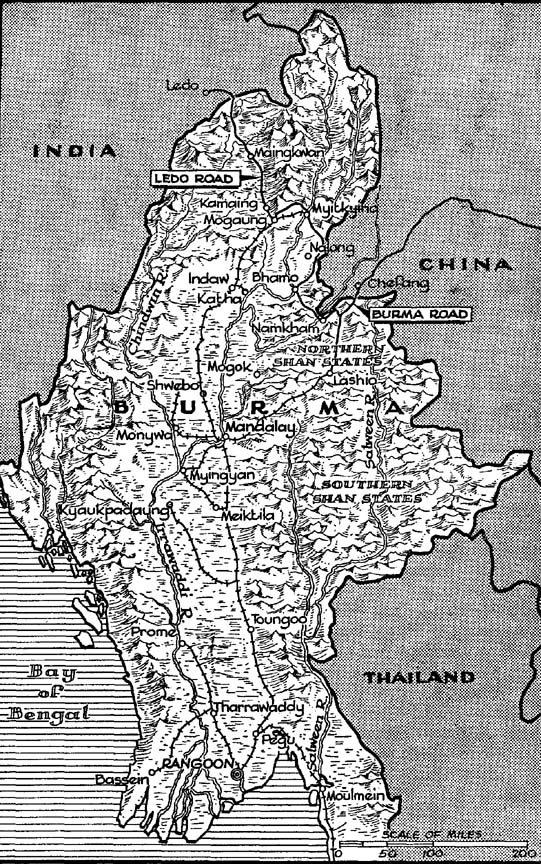
To go back a bit, in July, 1942, we left our work for the sick refugees, military and civilian, at Gauhati, Assam, and went to Ramgarh to open a post hospital. This was the training center Stilwell was organizing to teach the remnants of the Chinese expeditionary force how to use modern weapons to fight an offensive war. Everyone said it couldn't be done, but the general was determined to succeed. The Burmese girls were at their best then, for they were thrilled at the idea of being allowed to help "Granddaddy" with his job.
Colonel Fuller was S.O.S. chief of Ramgarh and he spat in disgust when informed that Burmese nurses were coming in. Why did Stilwell have to send him a bunch of useless civilian nurses? He would probably have to lug the baggage of the helpless fools himself! He was therefore completely astounded when the train pulled to a stop and a group of girls in uniform blue longyis jumped out with their own kits and at once fell into columns of threes waiting for further orders. Colonel Fuller drove us to the quarters of the hospital staff, almost getting lost in the maze of prisoner-of-war camps. Ramgarh was one of a system of camps the British had scattered all over India for their German and Italian P.O.W.'s. The British had refused the places Stilwell had first selected for his proposed training center but had finally consented to shift the P.O.W.'s from Ramgarh and let Stilwell set up there.
The P.O.W. hospital at Ramgarh consisted of twenty-two wards, each in a separate building of brick with tile roof and cement floor, surrounded by double barbwire barricades. The five wards, operating room, dental clinic, and orderly room that were nearest to our quarters were again separated from the rest of the hospital by double barricades. This was the Italian hospital. The larger group of buildings was for Germans. Outside the barbwire were three wards for Indian troops, two for "Europeans," and the administration buildings. The central roadway that passed by the office building divided the total area in half. The patients in the P.O.W. hospital had been cared for entirely by medical prisoners of war who had lived in what was now our barracks area; so we, too, were entirely surrounded by barbwire. The hospital had a total of some seven hundred and fifty beds. It was the intention of the theater surgeon, Colonel R. P. Williams, that we take care of all patients till half the hospital was full; then an American station hospital would be sent in to take over the other half. The necessity for using the entire hospital was considered somewhat remote.
The U.S. Army was, no doubt justifiably, skeptical of my ability to run a G.I. institution. An unorthodox arrangement was decided upon. I was to be in complete charge of the professional work of the hospital, while Major Bevil was to be post surgeon and administer the hospital with a Medical Administrative Corps officer and a group of Medical Department enlisted personnel from a casual detachment. The health of the post and the veterinary department would be under Major Bevil. Any extra men from the casuals would be turned over to me for professional work. Major John H. Grindlay and Major Donald M. O'Hara as well as Lieutenant Ray F. Chesley of the Sanitary Corps---the men who had made possible the success of our work in the first Burma campaign---were to return to us as chief of the surgical service, chief of the dental service, and chief of laboratories, respectively. Captains William Webb and H. Myles Johnson of the Medical Corps also joined our staff.
With most casual detachments the units who furnished the cadre took the opportunity to get rid of men for whom they had no further use, and this one was no exception. It contained some of the best and some of the worst. Three of the men, Technical Sergeant Emmet T. (Stinky) Davis, Technical Sergeant Mitchell (Puss) Opas, and Staff Sergeant Chester Deaton, were so good we held onto them against all odds and they remained with us till September, 1944, when the two-year rotation scheme sent them back to the States. Only Opas was lost to us for a time. I had been ordered to fill a cadre of casuals to work in Chungking, so I took the opportunity to get rid of one who was a thorn in the flesh. He, of course, let me down at once and by the end of a week Chungking had shipped him back to a padded cell in Karachi. Only a few weeks later I was called on to fill another cadre, this time for Stilwell's second training center in China. Determined that all key men should be "tops," I had to send Opas as chief surgical technician. It took me ten months of hard work to get him back.
Providential help was needed by any American unit that took over a hospital from the British. The ways of the two races in conducting a hospital are diametrically opposed. During our first two weeks in Ramgarh the British colonel in charge refused to turn over the hospital to us until a lot of red tape could be cut in New Delhi. He turned over only the empty wards from which furniture and apparatus had been removed to storage. We had to locate the furniture and transportation and get it all back to the wards and at the same time receive trainloads of patients as the 38th Chinese Division arrived. The greatest difficulty was with the pharmacy. British hospital pharmacies wouldn't issue any drug that had not been diluted with water to make a uniform one-ounce dose for all medicines. Our American doctors, however, wanted drugs that could be prescribed by the drop, as, for example, Fowler's solution-liq. arsenic, to the British---to be furnished pure, while mixtures were supplied for a one-dram dose. We had incredible difficulty getting the idea across, and calamity soon overtook us. Forced by British usage to prescribe Fowler's solution by the diluted ounce, the order was so written for fifteen patients on one ward just as the pharmacy caught the American idea and issued pure Fowler's to that ward without changing the label. There was no difference in color of the solution, so Thelma, one of our nurses, gave each patient three ounces of pure arsenic. Luckily she noticed that the Chinese didn't react properly and reported at once. We had a field day washing out Chinese stomachs. Thelma was in a coma by the time the Chinese were out of danger.
Finally Delhi red tape was cut and the British colonel announced he would begin the turnover and have it completed by the end of three months. Bevil said the turnover must be completed in three days. Fortunately for us, he was supported by the boards of officers of both the American and British armies, and the three days sufficed.
The 38th Chinese Division had come out of Burma on the same road to Imphal that Stilwell had used. Yet they were in an awful condition when they reached Ramgarh. In addition to all the diseases the refugees had brought to Gauhati they had picked up ferocious "Naga sores," ulcers that eat down to and through bone. Luckily the 22nd Chinese Division was only then beginning to reach Ledo over the West Axis or we would have been swamped. We had to open two or three new wards every day. It had been thought we might run slightly over four hundred beds when both divisions were in, but we were already beyond that figure with only the 38th Division.
Colonel Fuller was wild. None of the trains ran on schedule. Frequently he was notified that the train was in, and he would hurry down to the station only to find it a false alarm. Again and again trains appeared without warning. Fuller had to find transportation where none existed. He had to see that one of our medical officers met each train, yet he was determined that our overworked doctors made no useless visits to the station. And everywhere he came up against the blank wall of foreign language. The telephone rang and I answered.
"Hello, hello, hello," said Fuller's voice. "Do you speak English?"
"A little," I replied. "But I speak American better. I try to improve my English a little every day!"
"Say, who are you?"
"Seagrave."
Thereafter Fuller never met me without asking how my English was getting along.
I had heard of General Sun Li-Jen of the 38th Division in Burma, for it was he who rescued the British from encirclement at Yenangyaung. He had been decorated by both the British and American governments. He came over to us every evening now to check on the physical condition of his men. Sun was a graduate of Virginia Military Institute and spoke superb English. Quite tall and very handsome, he looked much younger than his years.
When General Sun went on rounds in the hospital, he chatted with each patient as if he were one of them, treating the enlisted men much more courteously than their sergeants or lieutenants would have done. As for the soldiers, though they gazed at him with intense respect, they would call to him across the ward to present some gripe or other, more often than not directed against me. Sun always listened patiently, yet usually he did me the honor to recognize the difficulties under which we were trying to give his men adequate attention.
Not all Chinese generals were like General Sun. There was the really big shot who came over with General Stilwell one day, apparently determined to criticize Uncle Joe and all his works. Stilwell brought him over to inspect the hospital and Grindlay and I produced our entire bag of tricks trying to get him interested in the welfare of the soldiers. Finally Stilwell nudged me to one side and growled in an undertone, "Don't waste time on that four-blank. He doesn't give a blankety blank about anything worthwhile. Get him through the hospital and out again as fast as you can." Stilwell seldom broke out in profanity. When he did, it was well deserved. I noticed that Chinese generals who didn't care for their men didn't remain very long in command of the armies under Stilwell.
Soon the 22nd Chinese Division began to arrive. They had had a much more ghastly time getting out of Burma than the 38th. At least three truckloads of men, packed like sardines, were brought to the hospital from each train. During the train ride of one group from Ledo to Ramgarh, fifteen men had died and been buried en route. It was common to have three or four men die within a few hours of arrival. One patient, deathly ill with malaria, refused to wait for our enlisted men to carry him to his bed and stumbled from the truck to the ward by himself. He was dead in three hours. I saw that happen many times among the Chinese. We saw it almost two years later at Maingkwan when the 50th Division was flown in direct from China. In this case the man was sitting up in the truck as it came in beside me. I called to our enlisted men to get him first, that he was dying in his seat. He was dead in a half hour. In Myitkyina I saw it again as the Chinese litter bearers carried in a soldier sitting on the stretcher holding several yards of intestine that had escaped from his shell-torn abdomen. No doctor will ever understand the Chinese. They die when a post-mortem discovers no cause of death, but they live for days, still trying to do their stuff, long after the people of any other race would have died.
Major Grindlay and his surgical technicians, Koi and her surgical nurses, were frantically busy receiving and dressing the new admissions. Every morning hundreds had to be redressed. Grindlay evolved a routine by which these dressings could be done with a minimum loss of time. He commandeered all the towel racks from the bathrooms and fenced off the veranda of the operating theater, so that patients had to come in at one end, get processed by the enlisted technicians, and go out the other end back to their wards. A long production line of two hundred patients with huge Naga sores would be lined up in the yard all morning waiting to be processed.
Naga sores are horribly painful and no matter how gentle the technicians were many of the patients screamed with pain. Yet they all took it in such a brave and cheerful spirit that visitors were astonished. One photographer with a newsreel camera took many shots of these patients being dressed, to show the anguished expression on each face relax into a grin of pure delight as the dressing was finished. At every howl of pain other patients, waiting their turn, let out corresponding howls of laughter.
Many a Naga sore extended from knee to foot. Penetrating to bone the periosteum would be eaten away and nothing but a huge dead sequestrum left. At least three patients had to have the tibia removed completely and there were many more who had to have the entire fibula removed. At that time the service since developed for procuring artificial limbs for Chinese soldiers did not exist. I knew from bitter experience that while a Chinese coolie can eke out a living with a shriveled, crooked leg, he cannot manage without the leg at all. So we never performed amputations except for gangrene. I remember a hopeless-looking foot that I dissuaded Grindlay from amputating and Grindlay's genuine delight when he succeeded in making a very passable foot out of it.
At first we tried wet dressings for the Naga sores of saturated magnesium sulphate solution but there were so many cases that the nurses couldn't keep the dressings wet. Grindlay then discovered a 10 per cent solution of magnesium sulphate in glycerin not only much more effective for the smaller sores but much easier for all hands to take care of. For the enormous sores, nothing was satisfactory except a complete excision, after which the limb was encased in plaster of Paris and "forgotten" for a month or six weeks or until it could no longer be forgotten. Such patients were kept on the verandas of the wards, where they wouldn't remind their comrades of the bodies rotting along the trail out of Burma. After the second change of cast there invariably was a fine bed of granulation tissue which Grindlay and his staff could very successfully graft.
Some of the sores were incredibly full of maggots. Two or three hundred was not an infrequent count. One of these patients was on my ward. After all the maggots had apparently been removed, Grindlay operated on him and put him in a cast, later skin-grafting him successfully. But every time I planned to discharge him, some portion of the area would break down and a long-dead maggot would be extruded from the depths of the wound.
Our wards were crowded long before the bulk of the 22nd Division arrived. We put beds down the aisles of the wards and began to fill the verandas. A British Red Cross unit, on its way to China, was held up by lack of transportation and came in to help us. We gave them five wards, a fair proportion for the number of their personnel. They had English nurses, supposedly much more efficient than our Burmese girls, and most of their personnel spoke Chinese fluently, having previously been missionaries in China. Our receiving office did its best to assign cases evenly, going so far as to send the worst cases to us. But the Red Cross group griped at the number of their admissions, at their quarters, at their food---at everything else. We were relieved when they finally left for China.
The U.S. 98th Station Hospital under Major Warrenburg was ordered to come to help us, but by the time they arrived we were up to 1,200 beds and a few days later topped 1,350. And this in a 750-bed hospital! It was lucky that every ward had verandas on each side running down its length. Aisles and verandas were now packed and there were patients crowding even the decrepit buildings of the P.O.W. isolation camp.
During all this time the nurses were extremely happy, though they put in many a sixteen-hour working day and occasionally even an eighteen-hour day. My malaria gripped me once more just as Colonel Williams was visiting us and he shipped me off to Darjeeling for a month's rest, together with three nurses who were also breaking down. From that day on I never lost half a day's work from illness. But while we were away, Saw Yin, our chief medical nurse, was taken ill and began to develop tuberculosis in the glands of her neck.
Even though their bodies were beginning to give out, the nurses' morale was very high. Our officers treated them with great courtesy and their work was absorbing enough to keep them from being more than normally homesick.
On his first visit to the hospital General Stilwell called our officers together, explained what he was trying to do, and asked us to support him by getting the sick Chinese well as fast as possible by any means, no matter how unorthodox, so that the soldiers could get into the training school and learn how to fight. Grindlay and I were determined to see the general's orders obeyed and with the help of the entire staff set about finding ways to cut short the number of days lost in the hospital. We were handicapped by lack of medicines and supplies and had to adapt ourselves to the drugs in hand. Thus, with malaria, we had at first nothing but Indian quinine which is far from potent, then nothing but the British imitation of atabrine. We were all willing to try anything once.
We classified our wards as far as possible. Webb, Ba Saw, and Johnson had medical wards. Grindlay and Gurney had two wards each for major surgery and I took what the others would not have, an eye-disease ward and a venereal-disease ward among them. So many typhoid cases came in that Webb opened a special typhoid ward. Tuberculosis was rife and Gurney, who was interested to see what he could do with them, segregated seventy particularly severe cases in another building. There was one German P.O.W. still with us, his lungs so full of tuberculous cavities that the British didn't dare move him, assuring me I need not bother about him since he would be dead in a week. I remember my first visits to him. His temperature was extremely erratic, spiking high on the chart several times a day. He was completely helpless and able to eat almost nothing.
Gurney begged me to let him treat these cases with a new remedy which had been tested out by a few doctors in England before war stopped their researches: an African drug called umckaloabo---a "quack" remedy, if you will. Gurney claimed to have observed some very good results in his own practice in England before setting out for Burma several years before. We could certainly do the German no harm nor, for that matter, the Chinese, since by ordinary methods they would never make soldiers for Stilwell. Furthermore, there was no home for tuberculous Chinese in India and no transportation back to China. I told Gurney to go ahead, and from its own funds our unit purchased two shipments of the drug from Calcutta.
Umckaloabo comes in three forms: a concentrated extract, a dilute extract, and a powder. Gurney gave three doses a day, before meals, diluted in a cup of hot water. Specialists in tuberculosis do not think well of umckaloabo and refuse to give it a trial. It may have been unethical to use a drug not yet passed on favorably by the American or British medical associations, but Gurney obtained such extraordinary results that I was willing to stand court-martial any day for approving of its use. The British had given the German P.O.W. a week to live. With umckaloabo he not only did not die at the end of a week but after six weeks was having no fever or pain. His appetite was greatly improved. At the end of two months I paid him an evening visit. The nurse had propped him up in bed with his guitar, and he was happily strumming away at it, crooning his favorite German love songs. Beside him were two letters that had just reached him from his folks in Germany. The nurse, standing behind him, told me in an amazed whisper that the patient had eaten an entire chicken with trimmings for supper. And so he continued for months, as happy as a sick prisoner could be, until one day, without pain or distress, he suddenly died.
In the Chinese ward Gurney was having just as amazing results. He was working with proved cases, patients with swarms of tubercle bacilli in their sputum. We had all been skeptical but we were so no longer. Gurney proved, first, that the drug had no effect whatever on lung diseases other than tuberculosis, and, second, that in tuberculosis the effect was to improve appetite at once, then reduce the temperature gradually to normal, cause a rapid and very steady increase in weight, and, finally, actually clear the tubercle bacilli from the sputum and cause the disappearance of all physical signs, except in patients with huge cavities. Gurney discharged a great many cured during the months we were there. He had half a dozen deaths---patients who died of malaria, dysentery, or typhoid superimposed on their tuberculosis. Not one died of tuberculosis alone except the German. Gurney set up scales in his ward and each patient was weighed once a week. At first the gains were slight but then there would be an average sustained rise of one pound a week. Twice we ran out of the drug and patients organized committees to complain: they were losing their appetites and putting on less weight. Gurney's results were so undeniable that Colonel Williams authorized the medical supply officer to purchase the drug from government funds.
Typhoid was another worry. The Chinese would not cooperate by staying still in bed or eating the diet we permitted. Friends brought in all sort of indigestible Chinese delicacies which the patients devoured, to their great detriment. Since sulfaguanidine and sulfadiazine were coming in from the States, Webb prescribed sulfaguanidine empirically without much success until he used sulfadiazine simultaneously and then his patients, too, began to stop dying. I will admit, for the sake of argument, that American typhoid patients are not benefited by these drugs; but Chinese certainly are. Webb fortified his cases by giving them two large eggnogs a day, each with an ounce of Scotch. We had no trouble making the Chinese drink those eggnogs. Webb lost no more cases except those complicated with intestinal worms. He asked me whether it was better to leave the worms alone or administer a vermifuge, and I had to reply that I didn't know. Either course seemed fatal. On my advice Webb used vermifuges on alternate cases and found the percentage of death the same. Intestinal parasites were equally obnoxious in cases of dysentery.
American medical officers continually diagnosed primary syphilis as chancroid. They had never seen chancres so enormous,, dirty, or painful as those the Chinese had. After wasting weeks in mistaken diagnosis they threw the venereal ward at me. Among the cases they turned over were many that had shown no improvement because the patients needed circumcision. In America it is not considered good practice to operate on the phimosis until the chancre, chancroid, or gonorrhea is cured. With the Chinese it is not good practice not to; and with General Stilwell's order it was imperative that the phimosis be operated at once so that the underlying disease could be brought rapidly to a noninfective stage and the soldier be returned to training. We never had complications from so doing; in fact, the circumcision sometimes removed the lesion, and simultaneous therapy for the disease itself prevented recurrence in the wound.
We used neoarsphenamine or mapharsen with more frequent injections than is customary, until the patient was almost saturated with arsenic, and we usually used bismuth simultaneously. As soon as the primary lesion was healed we sent the patient out to his military training, leaving it up to him whether he would come back weekly for the entire course.
Each staff officer sent a report to the Surgeon, S.O.S., Delhi,, on the special phase of our program for which he was responsible. Much to our distress Colonel Tamraz published the reports and distributed copies to all Medical Corps officers in the theater, sharply criticizing my methods with syphilis and instructing a first lieutenant, who happened to be theater venereal disease officer, to inform us how syphilis really should be treated. The lieutenant warned us we were making it almost certain that the syphilis patients would develop locomotor ataxia and general paresis as a result of our therapy.
I shrugged. My reasons were hard boiled: Stilwell needed those boys to be trained for a campaign that might begin at any moment; probably half of them would be killed in that campaign long before they had a chance to develop neurosyphilis; those that were not killed would certainly have repeated attacks of malaria before this campaign, through the worst malaria belt in the world, was completed, and would thereby cure their own syphilis. I happened to know that neurosyphilis never develops in that malaria belt.
Grindlay loved abdominal surgery above all else, but with the Chinese he soon became a rectal specialist. It was amazing how many Chinese soldiers suffered from hemorrhoids and fistula-in-ano. Years previously I had seen specialists in Baltimore and New York have troubles with fistulas, operating repeatedly and having patients return for weeks to the outpatient department. Grindlay developed a type of operation so simple and effective that we could count on discharging the patient within two weeks. With umckaloabo we could even discharge tuberculous fistulas in three or four weeks. There seemed to be no special trick to Grindlay's operation except meticulous care and an effective postoperative routine.
One day, to his utter and complete disgust, Grindlay came down with amoebic dysentery. None of us could understand it, for our water was pure and our diet so good that no one else had developed the disease. I dropped into the operating room soon after he recovered. He was smoking a cigarette between operations with his rubber gloves still on.
"Doc," he said, disgustedly, "I've just discovered how I caught the dysentery."
"How was it?"
"Smoking between fistula operations!"
After all his poisonous remarks about Chinese and their intestinal habits it took Grindlay months to live down our laughter at his direct method of acquiring amoebic dysentery.
That we were able to avoid some serious epidemics during our stay at Ramgarh was entirely due to the brilliance of our laboratory chief, Lieutenant Chesley. When typhoid started he made a complete survey of all the Chinese in town and discovered several carriers in the Chinese restaurants. Their removal stopped the epidemic. One day, within twenty-four hours of admission, Chesley diagnosed a patient with atypical symptoms as cholera, much to the disgust of the Public Health officer who said such a diagnosis could not be made in less than three days. We had no more cholera. A patient was admitted with epidemic meningitis, in a coma and incontinent. After a fifteen-minute diagnosis by Chesley, the 98th Station Hospital ward officer gave an intravenous injection of sodium sulfathiazole to start his treatment: the following morning incontinence had ceased, by afternoon the patient was conscious, and the next day a nurse had to be on hand continuously to drag him back to isolation when he started to run away. There was no further meningitis.
Napoleon's observation that he would rather fight his allies than other nations was frequently recalled at our officers' mess. Our unit was composed entirely of allies, and we enjoyed ragging each other. Ted Gurney and the Friends Ambulance boys had to take caustic remarks about the frailties of the English. But it wasn't long before one of the Englishmen at the table would take a crack at the frailties of Americans, and then we Americans hadn't a chance, for our frailties were being displayed right under our collective noses. There was an especially heavy silence the day a new medical lieutenant joined the unit: he hadn't taken his bag from the jeep before he demanded that a bearer be secured for him at once. The lieutenant didn't feel happy about joining the unit when I announced that our officers were not allowed to have bearers. Without the excuse of being colonials, the Americans, enlisted men as well as officers, were hiring bearers everywhere. The farther away from the front they were the more bearers they had. The hallways of the Imperial Hotel in New Delhi were crowded with bearers waiting all day just to be on hand to draw "master's" bath, hold his pants for him, or fetch him cigarettes.
Of course, being typical G.I.'s, we griped about our work, and since our work was with the Chinese, we griped about them. Most interracial strife seems to be caused by differences in habits of thinking and acting. In America, men steal. But it is a relatively small per cent who steal and they steal in a big way, wholesale. The Chinese don't steal but they pilfer. It is not stealing to them ---if they are not caught. They feel they are salvaging things for their own use. Pilfering is an almost universal Chinese habit, and several good truckloads of stuff could be carried away piecemeal. The Ramgarh hospital was completely surrounded by barbwire, but blankets walked out of the gates even in the daytime.
At our request guards were put on all the gates, but our blankets, mattresses, medicines, and even bedsteads "escaped" in a steady stream. Lieutenant Martin, our M.A.C. officer, discovered that almost four thousand rupees' worth of supplies had "escaped" during the first months. Later Lieutenant Baker, at my command, started several inventories of our stocks and each time had to give up in despair since the inventory became obsolete before he could finish one round of all the wards.
And there was nothing we could do about it. During his first speech to American officers at the post, General Stilwell had made plain the sensitiveness about loss of face which is a national characteristic of the Chinese race, and he warned us it would be an unforgivable offense for any American to lay hands on a Chinese while under his command. No order Stilwell gave caused more griping among the Americans than this one, chiefly because no similar order appeared to have been given to the Chinese, who frequently laid hands and drew guns on us. But Uncle Joe knew what he was doing. If he hadn't given that order there would have been no fighting against Japs in China-Burma-India. There would have been riots with far more casualties than the Japs caused---riots resulting from paltry, trumped-up misunderstanding of each other's customs and language.
General Boatner, then chief of staff of the Chinese Army in India, pretended to be a very ferocious infidel but he knew enough about Christianity to insist on my "giving till it hurt." First he asked me for Bill Cummings, who was then a second lieutenant in the Medical Administrative Corps. He had known Bill in Burma and his liking for him, as well as his respect for his command of the Burmese language, made him determined to acquire Bill for his own staff. Bill felt that more excitement could be found in this work than in a hospital unit, so we reluctantly let him go. A month later Bill and the general drove to the hospital in a jeep and asked to see me. Bill fidgeted around and couldn't look me in the eye. The general just hemmed and hawed.
"All right, all right. I know what you want, sir," I said. "You want Tun Shein."
"Yes, I do," the general admitted. He had all the arguments on his side and I could do nothing but let Tun Shein go too, though he had been invaluable to us as a supply officer. Later the general wheedled me into letting him have Saw Judson, my other Burmese supply officer, and finally even took away my Lahu boy Aishuri to work with Brayton Case in supervising the truck gardens he was persuading the Chinese Army to develop---Brayton Case who practically single-handed had fed the Chinese Fifth Army during the first campaign.
When the last of the 38th and 22nd divisions' battle casualties had been discharged to duty, our hospital census dropped rapidly to about seven hundred. Then my real troubles with the nurses began. During our first busy months they hadn't had time to be more than normally homesick. Furthermore, everyone prophesied that General Stilwell's return would begin in November, 1942. But Stilwell hadn't been given the wherewithal in 1942 and the sudden disappointment, coming at the same time as the decrease in pressure of work, was more than the girls could bear. At first they found a great deal of pleasure in the recreation hall we opened, where they could gather together in the evenings with the enlisted men and play games. Then the Special Service officer brought over officers twice a week to teach the girls to dance. But the girls weren't accustomed to mixed dancing and didn't enjoy it. Paul Geren proposed that we learn Gilbert and Sullivan's Mikado and put on a G.I. show of our own, but just as things were becoming interesting, the male soloists in the Friends Ambulance Unit were transferred to China and with them went our pianist. So that plan also failed.
Then I made a bad mistake. I bought the girls two guitars, a mandolin, and a ukulele. Thereupon they gathered four or five to a room of an evening, strumming and humming the songs they used to sing in Burma. Someone would make a nostalgic remark; someone else would add another; a third would voice her sense of frustration at the postponement of the return to Burma, and the whole party would forthwith dissolve in tears.
One night after the 98th Station Hospital had been transferred to Assam and our group had been augmented by personnel on detached service from the 181st General Hospital, a sack of belated mail arrived for the new officers. Lieutenant Chesley soon came for me in distress. Hla Sein had been chatting with him on his veranda quite cheerfully until the new officers began shouting to each other excitedly about letters they had just received from mother or wife. Hla Sein, to the best of her knowledge and belief, had lost every member of her family except one brother who had run out into China and had never been heard of since. She stood it as long as she could and then burst into violent hysterics, screaming and crying as if her heart would break. Chesley had been unable to quiet her.
I walked over, picked up Hla Sein, carried her back to her room and tucked her into bed, sitting beside her till her wild sobbing ceased.
"I'm all right now, Daddy," she said. "I'm going to sleep."
"Good girl," I said. "Good night."
The nurses' psychology was much like that of other exiled persons. They had voluntarily left their country in order to share in the task of liberation. Now the return seemed indefinitely postponed. It was impossible to reach their people by mail; and though their families were probably unharmed they had heard so many true accounts of Japanese atrocities that they knew that some, at least, had suffered. Poverty was rife in Burma, foodstuffs being commandeered by the Japs and clothing material completely unavailable. The fact that the nurses were rapidly banking funds to help their families only made matters more difficult since they had no way of sending the money to them. Many of the families in Burma didn't know that their daughters were safe with me in India, and the girls were sick at the thought that their families might be despairing of ever seeing them again. As a climax to their other worries, they realized with dread that with our return, cities and towns would have to be razed to the ground and thousands of civilians unintentionally killed. What was to prevent their own people being of this number?
American troops found it hard to endure separation from their families while on garrison duty in a foreign country even though they knew their families were safe from enemy attack and could exchange frequent letters with them. My own position was halfway between the American soldiers and the girl refugees. I could hear weekly from Tiny, get frequent letters from the two older children and an occasional one from the two little boys. I knew they were out of harm's way. I was homesick but I had resources to combat my feelings which the nurses did not have. They had no Burmese books to read, no magazines, no newspapers. And the language in English books and periodicals was so difficult for all but a few that they could get no enjoyment from them.
Lacking my forms of self-anesthesia the girls tried to develop some of their own. A movie theater had been opened with three-fifths of the seats assigned to the Chinese and the rest to Americans. Both Chinese and American units rotated on assigned days. The nurses greatly delighted in these movies and to my utter astonishment began to imitate various actresses, as their tastes dictated. Big Bawk fell for an actress in one of the musicals who talked with a resonant, singing tone even when she wasn't supposed to be singing. For months Bawk concentrated on her own voice, developing its naturally lovely, sweet tones until every word she said rang like a chime through the entire area. By the time we reached Myitkyina she was more expert than the screen star. We were then operating on some of the ghastliest casualties I had ever seen and under tremendous strain. To have Bawk, at the instrument table, sing out in her wonderful, resonant voice, "Okay, retractors coming up! Abdominal gauze? Right away!" would jerk me out of my operating trance and irritate me more than the shells that whistled over us.
One of the girls, who was never well, capitalized on her infirmity by posing as one of the extremely bored, disillusioned, indifferent ladies of the screen. The girls, who were by nature clowns, became even more skilled in the art as a result of the movies. And they began to change their hair-dos, which would have delighted Tiny since the new styles were designed to remain neat for hours at a time instead of collapsing every few minutes in the way that used to irritate her.
But of most absorbing interest to them were the love scenes and especially American love words. They were learning English very rapidly of necessity and there is no better place for a foreigner to learn English than at the movies. Practicing love words on each other didn't have quite enough spice in it for them. Besides, the feminine nature is extraordinarily possessive. They had to "own" someone, and God help the person who said more than three words or looked more than twice at their "property." Each girl had at least one other girl who was her personal property already. Now she set about looking for some male to call her own. That was not so very difficult. There were plenty of volunteers among the Americans, both officers and enlisted men, and it was seldom that the girls made a mistake in the men selected.
One of the prettier nurses had a special problem. She already "owned" two of the other girls who were not nearly so attractive as herself. She dictated every act of their private lives. 'While the pretty girl had a trail of boy friends, the other two had none. That would never do. A Burmese girl would be conspicuous if she didn't do something about her less fortunate friends. So she "assigned" one man to each of the others and saw to it that all four "played the game."
In the contest of wits that continued throughout the campaign, the boys definitely came out second best. I knew this, for I censored the girls' letters. The boys never caught on to the fact that they were being used as foils to satisfy female possessiveness or as a help in the practice of English. The girls wrote incredible letters, full of an extraordinary variety of love words and phrases picked up hit or miss at the movies and thrown hit or miss into the "sugar reports." One phrase would be used over and over until the little Burmese girl felt she had mastered it---then she would start on another. Fortunately sugar reports didn't have to be grammatical. The boys used slightly better grammar, but as for spelling, the girls won hands down. Being Americans, the boys never thought to use a dictionary. Being Burmese, the girls always did---either the dictionary or the old man. One of the girls went so far as to make me write her sugar reports for her. She would bring paper and pencil, ask me how one said this or that endearing phrase in English, get the spelling, right, and then copy it. I often wondered how much her various boy friends would have enjoyed those love letters if they had known that they had been written by the old man.
I was particularly amused by the three girls who had long waiting lists of boy friends and at the way they handled them. To the pretty one, it was an entirely callous affair. The men were graded in her estimation according to rank. When the lieutenant was around she gave the sergeant the cold shoulder. When the captain arrived she cut the lieutenant dead. Undoubtedly she picked up this trait, too, at the movies.
The other two girls, like expert bridge players, succeeded in finessing the old love out of the way before the arrival of the new. I have no doubt that each boy friend fondly imagined himself the only one upon whom his beloved ever permitted her thoughts to rest. These two girls differed in their line of attack. The first was quite careless in her dress when none of her pets was around, but as soon as one appeared she would apologize hastily for her dress, since she had "just come off duty" or had "just come back from a stroll." Then she would excuse herself for a few moments and come back positively ravishing in a symphony of color. The other took no chances on being caught off balance and managed to make herself perfectly stunning in a pair of oversize G.I. pants and shoes big enough for me. One day I discovered that she had acquired half a dozen boy friends that even I hadn't known about.
"Listen, girl," I remonstrated, appalled, "don't you have about fifteen sweethearts too many?"
"Why, Daddy! How can you say that? It was you yourself taught us in Namkham that there was safety in numbers!"
A great deal of publicity had come to us because we had been with Stilwell on his trip out of Burma. The largest group on the retreat had been our hospital unit. Correspondents, anxious to put the C.-B.-I. theater on the map, pounced upon the Burmese nurses as being unique in the United States armed forces. Most of these correspondents had never been to Burma but their job was to bring Burma to public interest. The nurses were all the Burma they could find to describe, so they described them---plenty and often. All this would have done little harm had it not been for the fact that American journalists liked to exploit individual names, nicknames, and personalities. The girls with cute names or nicknames and those who were brim-full of personality were featured in one article after another. Visiting photographers would call for them by name and photograph them, to the exclusion of nurses more important to the work of the unit. A hard job well done gained no publicity whatever. So the efforts of the correspondents, though perhaps good for the theater, almost broke up the unit. Girls who had worked themselves sick wondered why they had tried so hard. Girls who made headlines by their attractive individualism decided that that was all that mattered and became more and more temperamental. I came to fear the advent of photographers and correspondents more than I feared the outbreak of an epidemic of bubonic plague, but I had to be courteous and helpful to the press as one of my war duties. I smiled externally but internally I boiled.
Whether Sergeant Opas was trying to help me in maintaining nurses' morale or adopting a ruse to get work promptly and efficiently done, I still don't know. But he succeeded admirably in either case. He pretended that he couldn't tell the Burmese girls apart and that even when he could, he couldn't pronounce their strange Burmese names. So he nicknamed them all Susy. There was Susy No. 1, Susy No. 2, Susy No. 3, and so on. He himself became just plain Susy to all of them. The result was that when something had to be done in a hurry, Opas had only to shout "Susy" and everyone on the operating-room staff jumped to attention. There was so much laughter and delight over this in the operating room that the 98th Station Hospital surgeons couldn't think and we had to ask the girls to laugh in whispers.
From then on nicknames were given all around, some of them most appropriate. Ma Kai delighted in the name of Tugboat Annie, which, considering her shape and her winning ways, was most apt. Hla Sein became Chow-hound No. 1 and Lulu, Chowhound No. 2. Captain Yen, a Chinese Special Service officer, became Father Monkey and Little Bawk became Baby Monkey. Nang Aung could speak Chinese so fluently and with such a perfect accent that even the Chinese were mistaken in her ancestry and called her Miss Wang.
But everyone didn't help us maintain morale. When a Chinese is really sick he is the best patient in the world. So is he a fine soldier when actually in combat. But when he is in garrison or only a little sick, he can be at least as troublesome as most other soldiers. The nurses, being Burmese "foreigners," were considered legitimate prey, especially by the goldbricks.
Before General Stilwell had given us his order to keep hands off the Chinese, a major in Chit Sem's ward had pulled a revolver on her, "Miss Burma, 1942." I promptly beat him up most thoroughly and General Sun put him in jail. Later, when our hands were thoroughly tied by the order, all I could do was call the Chinese guards and have them throw the offender out of the hospital. There came an epidemic of trouble which did not help morale a bit. One Chinese soldier struck a nurse so forcibly on her breast that she was incapacitated for days.
Burmese longyis are circular skirts folded neatly about the waist and tucked in. They have to be retucked every few minutes, since they loosen with movement. Soldiers often snatched at these longyis to make them drop off. The girls reacted by buying G.I. belts. Occasionally some hero would make a pass at a nurse and then brag to his mates about his "conquest." One of these braggarts was a major on my own ward. When I heard of his efforts I got his clothes, gave them to him and stood by while a Chinese M.P. dressed him and kicked him out of the hospital.
The following Saturday night, as we left the cinema and climbed into our truck, we noticed the major standing in a milling group of soldiers. Just as our truck pulled out, two stones, each as big as a fist, were thrown at us. One of the stones struck Little Bawk's forehead with a sharp crack, laying her out for the rest of the evening, and the other hit big, broad Captain Kochenderfer so violently on the chest that his breath left him in a loud grunt. The officers and men rushed to jump from the truck to repay the Chinese in kind, but I remembered General Stilwell's order in time and insisted on their remaining where they were. The next day I took the stones to General Boatner.
"Just how far do we have to obey General Stilwell's order to keep our hands off the Chinese, sir?" I asked.
"Right up to the hilt!"
"What about self-defense, sir?"
"What do you mean?"
I told him about two incidents of attempted rape and about the blows and about the longyi snatching and showed him the stones. Boatner reached for the telephone, called General McCabe and reported the incident. The generals agreed there had been enough abuse of cinema privileges and ordered the cinema closed to both Americans and Chinese. Then Boatner called his secretary and dictated a written order empowering me to use any immediate disciplinary measures that seemed necessary in such emergencies, reporting the incidents and my handling of them as soon as possible thereafter. I never had to use that order. Our worst troubles ceased immediately. Very rarely after that did a Chinese soldier attempt insult to these girls---except for an occasional bit of profanity, and the nurses had learned so much Chinese that they could cuss the soldier down in his own language every time, much to the delight of the other patients. But the damage had been done. The cinema was closed and with it went the best self-anesthetizing device the nurses had yet found.
At Ramgarh there were rumors that Stilwell's campaign, already postponed till February, would not begin even then. I began to wish I hadn't kept my promise to Tiny---to come out of Burma if it fell---but had done what I had longed to do: remain behind and organize guerrilla bands of my own. I rather fancied myself as a guerrilla. With my local reputation in the Shan States I might well have succeeded. I tried to wheedle General Boatner into setting the nurses and me down by plane on some meadow in the Shan States to let us see what damage we could do to the Japs. All I got for my pains was a big laugh.
As time dragged on I grew desperate. If I didn't soon get these girls at least part of the way home, they would go mad. Or if they didn't---I would. The outcome of my desperation was our expedition to Tagap. But the Naga Hills were no more Burma than they were the valleys of the moon, and the girls were so disappointed that they were soon pouting for the boy friends they had used so cleverly for distraction at Ramgarh. In trying to help the girls over their unbearable nostalgia, I had ended by hurting them in their sensitive---and possessive---hearts.
WHILE the 38th Chinese Division was moving to Hkalak to replace the colonials, a battalion was ordered to guard the flank of the West Axis at Hpachet Hi. Captain Webb's hospital group was ordered forward from Punyang with this battalion. There was a lateral road connecting the two axes running from Tagap to Pebu to Hpachet. Since it was necessary for Webb's group to pass through Pebu, I arranged to meet them there and see personally to the establishment of the new hospital. I had a secondary thought in this plan. Perhaps if I were away from Tagap for two weeks it would be good for the girls there and, again, I might be good medicine for Webb's nurses who had already driven that long-suffering hero almost out of his wits.
From Tagap one drops back to the Namyung River on the Refugee Trail and then goes up the river, crossing from one side to the other some fifteen times in the first twelve miles. There had been leeches on the wide Refugee Trail---lots, we had thought, compared to anything we had ever seen in Burma. But at that time I hadn't seen the Pebu Trail. This must have been the birthplace and ancestral home of the leech. There were three species, all of them of the "ground leech" type, an inch or so long when hungry, as opposed to the "water leech" or "buffalo leech," some three inches long before it gets to work. The brown ones were on the ground or in the damp grass waiting, so close together that your eyes had to be focused on the ground at your feet to find a place where you could step without landing on several of them. The red variety kept out of the mud on the stems of the elephant grass or small plants, and the green ones on branches about shoulder height from the ground. All three kinds fastened themselves on you as you went by. They seemed to direct themselves by a sense of smell. Poised on the small sucker at the base, the big sucker at the head end waved in the air leaning directly toward you. If you suddenly moved a yard to another position, the leech would immediately sway like a compass needle and still keep pointed right at you.
Every ten or twelve steps my Naga porters stopped and cut leeches off their feet with their long dabs. I had a pocket knife and tried cutting my leeches in two after I scraped them off. Then I was astonished to see both halves come for me. I tried flicking them off with thumb and middle finger. I soon found you couldn't budge them if you snapped at them while the head sucker was attached. But they would fly off into the bushes at once if you flicked just as the head sucker was about to take over from the tail sucker: This was a pretty lesson in timing. The flick had to be correct to the split second or you could flick in vain all day.
At our first and second ten-minute rest periods I took off my leggings, socks, and shoes and burned off about thirty leeches that had squirmed through my defenses. Remembering experiences in Namkham with patients who had leeches in the nose, throat, and urethra, I finally compromised with the leeches of the Pebu Trail, letting them get their fill elsewhere so long as they kept away from my face and the fly of my trousers. All in all I tried all the routines: brushing the pests off with sacks of wet salt and tobacco, burning them off with matches. I found that nothing compared with Skat. If you soak the fly of your trousers and your socks with Skat, tuck your trousers into your socks and smear Skat all over the exposed parts of your body, the leeches take one suck and quit. But on this trip I had no Skat. When I reached Pebu I made a fire and cremated some seventy beautifully gorged specimens and then bled so much all night that my sheets were covered with blood.
I also had nightmares all night long, for two miles short of Pebu I had suddenly ceased looking for leeches at my feet and
glanced upward to see a long green snake hanging by his tail from a branch, his head on a level with mine and his beady eyes staring inquiringly at me. People had been telling me that there were no snakes in the Naga Hills. On their trip from Tagap to Hkalak months later Grindlay and Chesley killed three: a cobra, a krait, and a Russell's viper, the big three of poisonous snakedom.
The next day was Saturday. I didn't expect Webb's detachment until Sunday, so I loafed and enjoyed the yarns of the radio boys who had been evacuated from Hkalak when the colonials abdicated in favor of the Japs. General (then Colonel) Cannon walked into camp the same afternoon, having taken the mountain trail from Tagap. Cannon was doing what I was: getting familiar with the terrain and helping his Chinese battalions choose garrison sites and get themselves dug in.
The air supply dropping ground at Pebu was on the top of the mountain behind the camp. On Sunday afternoon I climbed up, both to meet the colored Quartermaster boys and their lieutenant and to meet Webb's detachment if it came in. Nobody turned up. So I loafed in camp until Thursday, when I again walked to the top of the mountain; just as I reached the brow, down tumbled the nurses of Webb's unit on top of me, clattering along in the huge G.I: shoes Webb had secured for them.
Next morning we struck up the mountain to the west and the nurses taught me how to climb at such a slow pace that I could continue steadily for fifty minutes instead of stopping to gasp" for oxygen every few steps. We made faster time going slowly than we did when we struggled forward too rapidly for our hearts to stand. We had quite a happy day's trip. The girls chattered continually about their journey from Ledo, laughing as they recalled the way roly-poly Roi Tsai had negotiated the long steep path down the east side of the first range in the middle of a downpour. Webb had had to order one of the men on ahead to each corner to grab Roi Tsai as she slid, scrambled, tumbled, and dived down each slope, brake her and turn her head on for the next slope, while he ran ahead to repeat the maneuver at the next corner.
That night was the worst I ever spent anywhere for insects.
There is no place in the Naga Hills that is not infested with one or another insect plague. In Hkalak it was a small black fly, which cuts a clean hole in your skin and then injects a drop of a horrible itch-producing poison. They bite only in the daytime, but you don't know they're biting or even that they're on you until the poison has been injected, and then it's too late to do more than squeeze out the poisoned blood and hope for the best. At this camp, too, there were literally clouds of buffalo flies, insects so tiny that they can hardly be seen. They bite only at night and swarm through the meshes of the mosquito net. A single bite doesn't itch nearly so much as that of the black fly, but when myriads of them bite at once it is more than the nervous system can endure. I may have slept a total of two hours that night. Our huts were horrible old coolie shacks with roofs of dried withered leaves, and it poured rain all night. We fastened our ground sheets over our mosquito nets. I didn't seem to be very expert at that. During the first half of the night the head end of the ground sheet gave way repeatedly and then the foot end fell down and buckets of water poured in on me.
The next day's trip into Hpachet, a large village full of pigs, chickens, cattle, buffaloes, and dogs, was almost entirely uphill but the country was so pretty and the villages so interesting---Hpachet is on the edge of real Naga country---that we didn't mind too much the steepness of the road; and the natives hadn't run away from the West Axis.
The air-drop field was located at the top of the mountain above Hpachet, with the American barracks beside it. Beyond it the Americans and Chinese were encamped. Lieutenant Mitchell, liaison officer, and Quartermaster Lieutenant Robinson and his colored boys were not expecting us and must have thought they were seeing things when we arrived; but they were equal to the occasion and made us royally welcome. We were soon sitting down to a good hot meal.
Building materials were very scanty about Hpachet and it was several days before we could get our quarters and a small hospital built between the Americans and the Chinese. The camp was so high that there were few insects and the scenery was beautiful. But because of the height, there was almost no water---just a trickle from a spring. Bathing was next to impossible and I could feel the forthcoming gloom. You can deprive nurses of almost anything and they will smile, but not if you deprive them of their baths.
General Boatner was now in command at Ledo. While I was in Hpachet a radio came in from him: "Your mission is first to furnish hospitalization for all Chinese troops south of the line Tagap-Pebu-Hpachet; second, to give medical attention to all porters in the employ of the U.S. Army; third, to furnish medical attention to the natives as far as practicable in order to obtain their friendship for the U.S. Army."
It was the end of May. During the week at Hpachet the weather had been delightful, but it couldn't last. If I didn't hurry back to Tagap before the rains finally broke in earnest I wouldn't be able to use the "leech trail" but would have to strike for the mountains. I would rather have the leeches than the mountains any day. The rains actually broke before I reached Pebu but we made it anyway, cutting new trails here and there to avoid crossing the Namyung.
I arrived back at Tagap in time for another "battle." The shooting began at Nathkaw, several miles south, where a patrol of Japs had been reported trying to outflank our outpost. The outpost at Kumkidu heard the shooting and opened fire and then Tagap itself threw in everything it had. We kept ducking as all sorts of missiles whistled over us. Bill Cummings was a bit skeptical of there being any Japs near us so he set off with another officer to investigate while the nurses and I cut several American-made bullets out of Chinese bodies. On his return Bill told us that there hadn't been a single footprint in the valley through which "the Japs" passed. Bill had asked the Chinese captain which direction he had been firing.
"Sir," the captain had replied with much dignity, "we fired in every direction!"
They had most certainly been firing in every direction. The first Chinese soldier to be killed was the sentry on the north edge of camp hit by a bullet fired across the camp by a sentry at the south edge. Machine-gun bullets had riddled the mosquito nets of the American radio boys, who luckily had dropped into their trenches at the first shot.
I couldn't understand how the troops under my friend Major Peng had gone so haywire at this late date, for on the occasion when they had opened fire on the herd of monkeys in April, Peng had almost immediately controlled the mass hysteria of his troops and they had subsequently been well disciplined. I soon found these were not Major Peng's troops. All but one company of his command had already left for a "rest" at Ledo---funny place for a rest, malarious Ledo---and the job had been taken over by another regiment. Peng was still at Tagap, however, and the moment Japs had been reported at Nathkaw he had radioed General Sun for permission to remain in Tagap with his one company so he could help give the Japanese another licking. That seemed quite typical of the man. He went off to Ledo in great disgust when he learned there had been no Japs at Nathkaw.
Grindlay's detachment was now due to arrive and we all decided to go meet them. Knowing that the rains would make the Namyung River unfordable, American engineers had had cables dropped by air, dragged them to the site by elephant, and built a suspension bridge across the Namyung gorge. There was a new road to this bridge and Bill Cummings claimed he knew where it was. Thinking we might have a long wait, we took our swimming suits and some hand grenades and a picnic lunch so we could enjoy ourselves while waiting. Our stomachs already rebelled at canned corned beef.
But Bill had been too enthusiastic about his knowledge of the right turnoff. He led us on the wrong path and we finally arrived at a river that was not the Namyung at all. We agreed we'd have plenty of time for a good swim, fishing, a picnic lunch and still be able to return to the Refugee Trail to meet Grindlay. So we cast all care aside, put on our swimming suits, and had a really good time. It was the first time the girls had worn occidental swimming suits instead of longyis and they were quite shy at first, though the suits were extremely becoming.
Bill went upstream to a deep hole under an overhanging cliff and threw in a grenade. Fish of all sizes up to eighteen inches floated down, and men and women went wild grabbing at them. Bill and my Chinese orderly Pang Tze (Fatty) got the biggest fish, but Chit Sein and Little Bawk won on total number, though Bawk was just learning to swim. Chit Sein, born on the banks of Inle Lake, the largest lake in Burma, could swim like a fish. Grabbing fish right and left and diving into the deep water for them, she thrust them into the bosom of her swimming suit and piled them into the tiny apron, came out of the water after each dive bulging in all the wrong places, rid herself of her fish on shore, and dived back in again.
I managed to catch one small fish.
When our three grenades were used up and we had caught enough fish to furnish the whole unit with a big meal, we started a fire, made coffee, ate our picnic lunch, then hurried back up the hill. As usual Grindlay was ahead of schedule and we found the crowd had just passed by. They were still getting out of wet clothes when we arrived back at the hospital.
It was a very happy meeting. Everyone jabbered about the experiences on the trail: how the leeches had been quite nasty to Grindlay's dog; how E Kyaing, in spite of her clubfoot, had refused the privilege of making the trip slowly with an escort, had thrown away her painful shoes at the first stop, and had kept up with the rest of the party barefooted; how Grindlay, who couldn't carry a tune, had taught them on the trail to sing "Alouette" and how the girls were singing in French as well as English and Burmese. Big Bill Duncumb had come back to us from the Friends Ambulance China Convoy and he had taught the nurses to sing what they called the English pub song, "Green Grow the Rushes-O."
But shrieks of laughter burst forth as Koi described how she and Emily had bathed in the nude at Namlip Salcan. Arriving hot and tired, they were desperately in need of a bath but had no change of clothing along so couldn't let their clothes get wet. So they walked up around a bend in the stream out of sight of the camp and everyone else, and then, promising each other by the memory of their ancestors not to glance around, placed their backs firmly together-apparently they didn't trust each other's ancestors-and bathed, continually admonishing each other not to look.
For days, while we waited for permission to push on to Hkalak, everyone was busy and happy. Our bamboo walks between the wards had fallen apart, so the men dug up and crushed soft rock; nurses lugged it to the wards and we soon had paved paths everywhere. Squads of nurses hoed and planted a large garden with the types of vegetables that could be eaten as they grew. There is hardly a green thing Burmese girls don't love to eat; they eat pea vines, for instance, long before the peas flower and pod.
To prepare Hkalak for us, Dr. San Yee, two nurses, and a Chinese boy had gone on ahead. Now they radioed that quarters were built and medical work was increasing rapidly, so I set out with seven nurses and Pang Tze. Of the three Chinese garrisons, Tagap was the largest and Hpachet the smallest. Hkalak, of medium size, was farthest forward, and about twenty-five miles from Hkalak was Shingbwiyang, still in the hands of the Japs. Since Captain Webb and Captain Johnson were friends, I detailed Johnson to join Webb at Hpachet. Grindlay always got mad if he didn't have enough medicine and surgery, so I left him in charge at Tagap with Gurney, who now had his commission as captain, and Ba Saw. At Hkalak I would be farthest forward and in an intermediate position between our two other stations.
The road from Tagap was west along the Salt Springs Trail, down, down, down, crossing two large streams like millraces to a broken-down coolie camp at the Salt Springs. If we had only known it, we could have gone four miles farther to a lovely little camp that had just been built. Anyway, we spread our ground sheets over the broken-down roof and slept on the broken bamboo floor. From there, the next morning, we walked many miles continually uphill over an unconscionably miserable excuse for a trail. In many places we had to guess where the trail was supposed to be. There were innumerable fallen trees over which we had to scramble, some of them four feet in diameter. We evolved a special technique with these: one, look for leeches; two, turn your back to the tree; three, push yourself up to a sitting position on the top; four, swing your legs over in an arc; five, pray silently that your knees can take it; six, drop down on the other side.
Halfway up the huge mountain, the strong wind had blown down bamboos, forming arches about four feet high across the trail. It began to rain and we had to stoop under the bamboo arches and claw ourselves to a stop with our fingernails when we started to slip back. About three in the afternoon we came to a shoulder of the mountain that we thought must be the top and, therefore, near our next proposed camp. The nurses were hungry and cast eager eyes at bamboo shoots, the first we had seen in two years, so we stopped every few rods and cut the shoots to carry with us. The wind was very strong now and made us shiver in our wet clothes as we climbed. The top was still a long way off.
When we finally reached the camp there was nothing left of it but a few scattered bamboos. We were tired out but the girls managed to put up a framework to support our ground sheets and a lot of leafy branches. We stuffed ourselves on rice and fried bamboo and got what sleep we could between the attacks of buffalo flies.
By this time I discovered I had become the private property of my Chinese soldier friend Pang Tze, who had been a sergeant major in the Chinese Army before becoming an orderly in the Ramgarh hospital. He had popeyes and a domineering manner, and I wouldn't have chosen him to come along with us. He chose me instead and insisted on staying with me. Now he was the real boss. He wouldn't allow me to carry even my musette bag or canteen. He strapped on my revolver and carried that as well. When I had trouble climbing over a tree trunk or huge boulder, his big paw would reach out, grab me by the seat of the pants, and heave me over. I used to have to argue with him to let me bathe myself. He brought me my food and almost insisted on feeding me; and if I tried to wash my own messkit he would become extremely hurt. The status of every man and woman in the unit could be judged by whether or not Pang Tze would take orders from them. Those who were at the moment out of favor with me had their orders ignored.
Our third day out of Tagap was much easier. The road was as much down as up. The only interesting feature was our crossing of a small lake on what appeared to be a floating island of sod. I hesitate to think what would have happened to us if we had stepped off the well-defined path. Then after one last horribly cold damp night beside a stream with still more buffalo flies, we were over the range and moving down into the camp we had left at Hkalak. Hla Sein and Lulu, Chow-hounds Nos. 1 and 2, came running out to meet us Several little bamboo huts had been built for us, though mine was not yet completed. The site was wonderful, on a camel's back to the north of the Chinese camp. It faced directly east across the gorgeous mountain country we were later to cross on our way home to Burma. Two small rivers sprang full grown from the land---the one on the north to supply the hospital, and the other on the south to be entirely private for our personnel. There seemed to be only one fly in the ointment, a very real fly---our old friend the black or dumdum fly; but with Skat even this pest didn't bother us---much.
Instead of waiting for me to check in with him, the liaison officer, Lieutenant Stewart, came over to check in with me. Not far behind him was the Chinese battalion commander. I knew at once that there was to be one more fly in the Hkalak ointment. In my time I have come to know many officers, good and bad, in many different armies. I cannot permit myself to state my feelings with regard to Major X, except to say that he would disgrace an army in Hades, where he undoubtedly is now roaming restlessly around. The major's first act was to try to force me to "pull my rank" on Lieutenant Wallace, the Quartermaster, and compel him to issue American rations to his troops instead of the Chinese rations to which they were entitled by order of Chungking. When I refused, he tried to force me, "for safety's sake," to move the hospital into a hollow in the center of the Chinese camp. After my experience with trigger-happy troops at Tagap, I knew we would be safer outside the Chinese lines.
The night of our arrival, Wallace and his colored boys came over to give us a welcome concert. Wallace pretended he couldn't sing, but no sooner did his boys get off the first note when be jerked to his feet, put an arm around each of his sergeants' shoulders, and joined his tenor to theirs. They began with "Praise the Lord and Pass the Ammunition" and ended with "When I Take My Vacation in Heaven." Their voices were very good and their harmony superlative. Amo's eyes rolled, Grier's bass growled, Casey's tenor soared upward, and the Burmese girls sat by with throbbing hearts, completely fascinated. When Jimmy Ackerson opened up on "Shout, Brother, Shout," the girls' feet began to itch and they joined in the shouting in true revivalist fashion.
The boys always came to our Sunday-evening sings and gave us another concert after each service. When any new dignitary came to town they threw him a concert and party.
I was always greatly impressed by all the dealings between our enlisted men, both white and colored, and the natives throughout Burma. I wonder why psychological studies are not made on different races based on the dozen or so words each race will pick as the most essential to teach to foreigners or to learn from foreigners. With the English, the words of Hindustani deemed most essential are those for "Get out!" "Go!" "Stop!" "Left!" "Right!" For the Indian the most essential words are "No papa, no mama, no brother, no sister---backsheesh!" In Chinese the words necessary for Americans are "Hao bu hao? Ding hao, bu hao!"---Good or bad? Very good, no good! The many Burmese languages are too much for the Americans, but what they teach the natives is "Okay. Come on, let's go!" whereat everyone digs in with a laugh and the job is promptly done.
It's the "Let's go" that spells the difference between the American and the colonial Englishman because it indicates the truth: that the American intends to work along with the natives and sweat the job out with them. It is therefore not surprising to hear natives everywhere say of the four races: "We fear and detest the Japs. We are afraid of the Chinese. We respect the British. But we love the Americans, especially when they leave our women alone."
General Boatner had given us the task of doing medical missionary work among the natives to win their friendship for the U.S. Army. But these American Quartermaster men were already doing a swell missionary job. It was high time I got busy. Ted Gurney and several nurses and Big Bill Duncumb had made one tour among the natives out of Tagap, circling first east, then north, and so back to the Refugee Trail. Gurney reported considerable success in treating natives in the villages, and many of the patients who needed hospitalization followed him back to the hospital or were carried to Tagap. Now Grindlay, too, was circling more directly east and south and, using the excuse that an American pilot had been forced down in a very wild section, he made a forced march alone except for a Naga companion to a high valley never before visited by a white man.
Grindlay is a funny cuss. To listen to his claims he is a growling, atheistic, profane hater of all mankind. In practice he is gentle, kind, inordinately interested in humanity, especially in its stranger forms. He sits for hours making the natives talk about themselves, their customs, their strange ideas. By the time he has done he has won them into feeling themselves his equals and they are eager to give him everything they have. Completely antagonistic to the very idea of missionaries, he is the best medical missionary I've ever seen.
I radioed Johnson at Hpachet to make a missionary trip south on the West Axis to the top of Mu Bum, halfway to Hkalak, where I would meet him with another party, exchange nurses, and let the two groups have a change from the monotony of Hpachet and Hkalak. I wanted to see the road that had killed so many men of the 22nd Chinese Division.
We dropped down rapidly to the foot of the Hkalak mountain, three nurses, my pal Pang Tze, and I, and found twenty miles of the smoothest trail we'd seen in all that country. The grades were easy, the weather clear, there were no leeches, the scenery was exquisite, and there were interesting native villages---a pleasant change, since the villagers around Hkalak were too sophisticated for us. They were well fed and well paid, since they worked for the Quartermaster. They had a market at ten times normal price for all the fresh foodstuffs the Chinese wanted, so they paid no attention to us and refused to sell us a thing. The only interest they showed in us was the height to which girls of their own race group had attained. The women of all the villages were completely fascinated by the nurses.
Our second camp was in a four-house village. Here we were lucky enough to find the headman's family all sick in bed---lucky in that we were able to be of so much assistance to him that he was later to prove a very great help to the garrison at Hkalak.
Early the next morning we began the difficult ascent of Mu Bum. The road was good again, the grade was entirely legitimate. But whereas we had previously passed not more than fifty or sixty Chinese skeletons, we were now passing groups of from ten to thirty skeletons every few hundred yards. Unlike the refugee skeletons, however, these soldiers had not died completely unattended where they dropped, on the trail and at the water holes. They were in small broken-down camps. Apparently their comrades had helped them into camp and tended them till they died, and then pushed on themselves, too weak to give proper burial to their dead comrades.
About five miles before we reached the top of Mu Bum, we ran into Captain Johnson's party cooking dinner for us by the side of the road. Their coolies had already started building two thatch huts. Johnson and his nurses had made such good time that they'd passed the top of Mu Bum before realizing it and then had picked what Johnson felt was rather a good site for a camp. We were so delighted to see one another that no one realized till the next morning what a very extraordinary camp site it was. What we had thought were a lot of thick bushes just beyond the campfire and the huts were the tops of giant trees. The camp was within a yard of an enormous precipice.
Wondering for what tasks the good Lord was saving us, we exchanged nurses and started back. We had planned to go all the way back to the village at the foot of Hkalak hill in one day and sleep there, but we heard that there was a "safe hand" letter from General Boatner for me at Hkalak and so we pushed on up the hill that night.
During our first two months at Hkalak, Major X forced his battalion to perform a prodigious amount of labor in building a most elaborate system of defenses. He was obviously planning to remain at Hkalak for the duration. Now his defenses were complete and he planned an inspection of three days to be performed by me, of all people, and Lieutenant Wallace who was now liaison officer as well as Quartermaster. Since I wasn't busy medically, and couldn't think of a valid excuse, I spent three of the unhappiest days of my life inspecting every trench, every foxhole, every dugout and pillbox, not only in the main camp but in the outposts as well. Wallace was a canny southerner and stood around looking at the scenery and, taking notes, pretending to be mapping the defenses, while I jumped in and out of trenches and foxholes, exclaiming about their individual "merits"---each was really worse than the last---gasping in astonishment at the marvelous intricacies of each dugout and pillbox. The climax came when Major X took me into the top story of his own pillbox. "This pillbox," he said proudly, "being my own command post for the day the Japs attack us, is, of course, the best of them all!" He leaned against the center post which promptly fell with a clatter to the floor.
Never have I seen anything so childish as those defenses. Though fortifying against an enemy that notoriously attacked from the rear, the major had outposts on all the roads into Hkalak except the one in the rear. The "outpost" on the road from the south was two hundred yards from the center of camp. Every pillbox or dugout had at least one line of fire directed exclusively against American barracks and installations. The line of fire of several machine guns was such that nothing could be hit but some enormous trees. The major was especially proud of the camouflage of his pillboxes, which could be seen from ten miles away in any direction. If I'd been a Jap platoon leader I'd have considered no assignment easier than to wipe out this battalion.
The third afternoon the major threw a huge dinner party for the entire camp. There were speeches. Then there were two volleyball games. At my request the Signal Corps team, in their contest with Major X's team, took a terrific beating, after which Wallace and his Quartermaster boys could safely and most thoroughly drub the Chinese. Then came dinner. It was really excellent, for it was composed of American rations, Chinese rations, and quantities of bamboos and mushrooms from the jungle. Major X had gotten gallons of what the Americans called bamboo juice, potent stuff, and everyone promptly toasted everyone else with the usual kambei!---bottoms up! After the banquet the Chinese platoons sang Chinese patriotic songs, and it was over.
Informers began to bring in reports that the Japanese were opening a series of supply bases on a line from Taro, outflanking us, and on to a point within twenty air miles of Ledo. General Boatner radioed that General Sun was ordering Major X to send a platoon to cut this supply line and ambush the Japanese. I was ordered to furnish two first-aid men to accompany the expedition. I had only two men, Sergeant Deaton and Chiou Seing, a former officer of the Chinese Army who was working with me. Neither of these men had seen action---and when anyone in my unit was to see action for the first time, I wanted to lead him into it---not drive him. I promptly radioed Boatner for permission to go. In the morning, back came Boatner's message addressed to all American liaison officers in the Naga Hills: "Any American who catches Seagrave more than five miles in any direction from Hkalak is hereby ordered to shoot him. Seagrave is not, repeat not, allowed to go on this expedition." Boatner told me later that General Stilwell came into his office just after the message had been sent and that he showed the general a copy.
"Change it," Stilwell growled, "change it to one hundred yards!" So I sat and cussed and cussed.
Then a message came from Boatner saying that the Chinese had been ordered to leave Wednesday morning and that all American officers were to get a hump on and arrange for porters and rations and help in every way to see that the platoon left on time. That meant me, for Lieutenant Wallace was off on a patrol to Shingbwiyang and I was the only officer around.
I walked over to see the major and to find out how many men there were in a platoon of Chinese so I could secure the correct rations and porters. He said a Chinese platoon consisted of forty-five officers and men. I therefore arranged for rations for forty-five men in a platoon. I promised that the rations would be forthcoming and that more would be dropped after a three days' march. That evening he returned and declared there were seventy-five men in a platoon. By Wednesday morning the number was eighty-five. He was clearly trying to use American "inability" to furnish rations for his "platoon" as an excuse for not sending the platoon on the mission. After three hours of argument I convinced him that General Sun would have his hide if he disobeyed his orders, and at noon he finally permitted his captain and lieutenant to start. Both the captain and the lieutenant were as fine men as the Chinese Army could produce and had been eager to be off. The captain was later killed at Taro and the lieutenant was brought to me with his femur shattered by a machine-gun bullet.
The major deployed the first two squads with fixed bayonets---the Japanese were only five days' journey away---and with them his Chinese "intelligence" section. These men, who between them were able to speak some fifteen or twenty Burmese words and in a frightful accent at that, he had dressed in what he thought were Burmese clothes, skirts of white parachute cloth---Burmese men never wear white longyis---and nondescript torn shirts. Since this was Naga and not Burmese country, he might better have disguised them as Nagas, in other words sent them off naked. As the rations were portered out the major himself counted the number of loads, and his only complaint was that I was sending Chinese rations instead of American.
The next morning, before I had had my second cup of coffee, he sent his personal interpreter, the worst scab in any army, barring the major himself, to tell me that he was furiously angry with me for having lied to him about the number of rations I'd sent. I coldly told the interpreter to go back and tell his chief that he had seen the ration loads go out himself and had counted them. Furthermore he might remind the major that in no man's army does a major call a lieutenant colonel a liar or get "furiously angry" with him. The major stormed for hours after my message reached him.
When Wallace returned the next day the major ran to him and asked if he did not wish to hear what a rascal I was. Wallace said he did not, probably because he already knew. That took the wind completely out of the major's sails. He sent me a message of apology and invited the whole American camp to a banquet of apology the following night to restore his "face."
A diversion occurred the following day when Lieutenant Topp walked in with a staff photographer and an order to do a story on the Seagrave Unit. I was glad to see Topp but not the camera. Since Ramgarh, cameras were a terror to me. The nurses had read some of the "stories" and had picked out places in them where correspondents had deliberately changed my answers to make the kind of story they thought the people back home would like. I never could persuade the girls that I hadn't told the falsehoods or selected the same photogenic group each time for the pictures. But Topp had been ordered to write the story, which later appeared in Life, so I explained to the girls the value the army placed upon keeping the theater in the eye of the public, and they cooperated very well. Topp not only got some wonderful pictures but gave us a very decent and subdued write-up.
The next evening at dusk Nang Aung, Emily, Tugboat Annie, and Pang Tze arrived, having made the thirty-mile trip from the top of Mu Bum to Hkalak in one day, a feat an infantryman would be proud of. Then the silly girls stayed up till after midnight, shouting, singing, and laughing as they recounted their adventures at Hpachet.
Letters reached me from Tagap saying that Pearl, E Kyaing, and Louise wanted to take a vacation at Calcutta, and I was in trouble again. These girls hadn't had a vacation for two years. Perhaps I was all wrong. Looking at the matter now I know I was wrong, for I had put the success of our job first in importance, the integrity of the unit second, and personalities third. When we first went to Ramgarh there hadn't been time for vacations, so only the sick were permitted them. About the time the work began to decrease we were unofficially alerted for a campaign to begin in November or December, 1942, so we only arranged for a rest camp in the mountains near Ramgarh. The girls had wanted to tour India. Then the campaign was postponed till mid-February and I sent off one party of nurses on a vacation to Agra and Delhi. If line officers would only give medical officers definite information, which they never do, I would have had no difficulty, for our work was easy and I could have sent off large groups of nurses at any time.
Now in the middle of the Naga Hills in the latter part of the rainy season, with our unit newly alerted for action supposed to begin the first week of October, three of the girls---one of whom had a clubfoot---wanted a vacation. I wrote back advising against it because, first, a total of twelve days' marching through deep mud would not make fourteen days in Calcutta a very successful vacation and because, second, we were alerted for a day earlier than they could possibly return; but I left the decision up to them. They decided to let the vacation go. But then girls who had not asked for leave began to gripe verbally and in letters, until I dreaded to see the mail runner arrive.
Then General Boatner ordered me to Ledo to discuss plans for the medical setup for the coming campaign. He had suggested by radio that he place three new portable surgical hospitals, fresh from the States, under my command and the 25th Field Hospital in close liaison so I could integrate the medical work of the entire front and, as he put it, get the new units away from the Park Avenue methods of running hospitals and get them used to the woods. Grindlay came to Hkalak to hold the fort during my absence.
During the whole rainy season Lieutenant Harris had been the unit's liaison officer between our different detachments. He had covered some twelve hundred miles over the ghastly trails, wearing out one pair of G.I. shoes every sixty miles. He was now in Hkalak and wanted to join us, so he, Pang Tze, and I set off together for Tagap. May the good Lord spare me from traveling the Naga Hills with Harris again. On the trail he would hold his arms away from his sides, like a cormorant drying its wings, and sail along. I would reach the top of each hill a half mile or so behind him and have to run down the other side hell bent for election to catch up with him. I wouldn't even have enough time to pull off leeches. By the time we reached Tagap our porters were completely disgusted and ran away.
From Tagap we followed the new trail across the suspension bridge over the Namyung. When American engineers built this bridge they shrugged off the approaches and let the Nagas build them unassisted. The Nagas cut steps from two to four feet high, right straight up the mountain. One step was so high that a half-inch rope had been fastened to a tree above, so the climber could pull himself up to the higher level.
The last day before we reached the roadhead at Nawngyang, Harris took sick and I actually beat him into camp. At Nawngyang we hopped a jeep for the rest of the trip into Ledo.
At Ledo I discovered that Colonel Vernon W. Petersen, M.C., had arrived the day before, assigned to combat headquarters. Boatner's plans were therefore automatically canceled and I had made that horrible trip for nothing. Petersen not only outranked me but was a splendid officer of many years' experience in the army. They didn't need me any longer. The whole theater was lousy with medical units, and with many more on the way.
But my troubles weren't over. General Boatner ordered me off on a month's vacation.
"But, Sir," I protested. "I've been doing nothing but sit on my fanny for months."
"I am the one who gives orders in this headquarters," he said.
So there I was, off for a month's vacation I didn't want, after having requested the Tagap nurses not to insist on theirs. On top of everything else, that was too much for them, and I wasn't surprised when I returned to Tagap to find that the girls had no further use for me.
Part Two: The Long Road to Myitkyina
Table of Contents