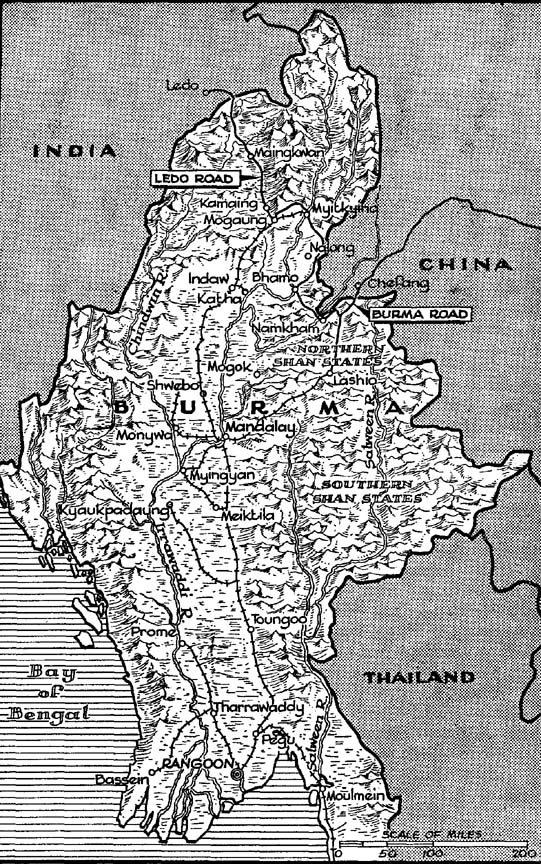
IN 1943, forces of the United Nations climbed up the ladder of the Solomons. Early in 1944 they invaded the Gilberts and Marshalls and leapfrogged up the coast of New Guinea. Simultaneously a campaign for the control of the Hukawng and Mogaung valleys in Burma was fought by Chinese, British, and a small force of American troops. Fighting and cutting their way through the hills and jungles, the Chinese and Americans advanced toward the strategically important town of Myitkyina which the Japanese defended until August 3, 1944.
While the campaign for the Hukawng and Mogaung valleys was being fought, the Japanese launched two offensives on the Arakan and Manipur fronts in an effort to cut the Bengal-Assam railway to Ledo. Had they succeeded, the communication lines of the Chinese and American forces in northern Burma would have been severed. The repulse of the Japanese by the British Fourteenth Army at Kohima and Imphal---and the capture of Myitkyina---assured the eventual realization of General Stilwell's plan for the conquest and construction of a relief route to China.
AFTER my unfortunate vacation I returned to Ledo four days late for the job at hand. The Chinese had been ordered forward in three columns. The first, from Hkalak, was to secure the right flank at Taro, then held by the Japanese. A detachment of our unit, minus nurses, was to proceed with them and serve that flank until replaced by a surgical team of the U.S. 151st Medical Battalion. The second column of Chinese would advance from Tagap to secure the left flank at Sharaw down the Tarung Valley. Another detachment of our unit, also minus nurses, was ordered to proceed with them. The third and main column would then advance directly south to Shingbwiyang and continue up the Hukawng Valley until stopped by the enemy. The main group of our unit, with our nurses, would follow this center thrust in three echelons. I assigned Captain Johnson and three Burmese technicians to the Sharaw flank---Major Grindlay, Major O'Hara, Lieutenant Chesley, and Dr. Ba Saw to the center. If I made a forced march of double stages, I could reach Hkalak in time to head that detachment with Dr. San Yee and three men. Captain Gurney and the nurses would remain at Hkalak until relieved there. Captain Webb's transfer from our unit to another assignment was a terrible blow, but he was being replaced by Lieutenant (now Captain) Antonellis already on his way to join Grindlay at Tagap.
Harris and Pang Tze were willing to undertake the double-stage forced march, so we set off with as small a kit as possible. When we reached Nanilip Sakan we came upon Antonellis whose knees had soured on him. He had planned to rest there a day but decided to go on with us if we would let him take his time. I could well sympathize with him, for my own knees had squeaked for three days after we first reached Tagap, for a week after I made the Hpachet trip, and for a month after we went to Hkalak.
At Tagap we left Antonellis for a few days of rest and started on for Hkalak. Reinforcements for Major X were on the road, sick and weary from their long march. One poor soldier with a high temperature was helping himself down from rock to rock in a part sitting, part crawling posture. We knew he could make that last mile to our hospital so hurried on by. It was wonderful to have the Hkalak girls come running to meet us with the old-style enthusiasms we had grown so to depend on. The Quartermaster boys came over immediately to give us a welcome concert.
One day late already, we hurried on the next morning and by nightfall caught up half a day on Major X's troops. Two of my men were with him so there was no further necessity for me to hurry. It was known that there were no Japanese north of Ngajatzup. If I arrived at the village two miles north of Ngajatzup the day the Chinese contacted the Japs, I would still be in plenty of time.
The second day out of Hkalak, Harris broke down. I didn't wish Harris any bad luck but I was quite proud of the fact that the old man had outlasted the young infantryman from the mountains of Tennessee. Stinky Davis was waiting at this camp with a fever casualty whom he turned over to Harris and then he went on with me.
After two more days we reached a little deserted village behind the lines and were eating our third meal of baked beans for the day when our first casualties arrived. One of them was a lieutenant who had a shattered thigh with a three-inch overriding of the bone ends. No forward unit had even an imitation fracture table, so it was up to me to arrange some sort of traction apparatus. It might be weeks before the lieutenant could be evacuated, so we had to give definitive treatment in the jungle. We set up on the dirt floor of the veranda of an abandoned Naga house in the midst of buffaloes and their dung. Naga houses have enormous posts and girders. Our parachute air-drop canvas bags were reinforced with two-inch-wide straps. We ripped off these straps and, fastening them to the girders above, suspended our lieutenant by the hips and shoulders a foot above the bamboo operating table. With cuffs of strapping around ankles and armpits and a lot of rope, we secured traction and countertraction on our patient by pulling against the posts of the house. The knee and thigh were held in the correct amount of flexion and abduction by additional straps fastened to the roof. It was then easy to put the patient in a plaster cast which incorporated the straps. The "fracture table" was such a success that I decided to patent it, though a Naga house might prove difficult to transport all over the jungle.
We didn't have a good night's sleep in that old house, for it was already far too well "occupied." In the morning we picked out two newer shacks, much smaller but cleaner, at the other end of the village. The village was built in a semicircle around the crown of a little hill, and the Air Corps transport planes were using this thirty-by-eighty-yard area as a dropping field. It was the first time our transports had dropped so close to the Japanese lines and the pilots were probably a bit nervous. They were also new to air-dropping so they were very erratic. Already we had lost one Chinese whose skull had been cracked like an eggshell when a sack of rice hit him. Now, all day long, we had to dodge as they threw rice, corned beef, baked beans, mortar shells, and small-arms ammunition at us. On the afternoon of our second day, there were only four houses left untouched by air-drop. A Kachin Ranger persisted in taking refuge under one of these while planes were dropping, refusing to learn the lesson of the ruined houses. As I stood watching, a case of ammunition burst loose from its parachute shrouds and struck him squarely on the head and shoulders. He was dead before I could reach him.
The third morning a plane came over whose pilot had gone completely haywire. Without the usual warning he buzzed down the length of the field and dropped about fifteen sacks of rice within a very few yards of where I was standing beside our hospital. Very well, I thought. If he's going to drop lengthwise I'll step over behind that house twenty-five yards to the side. Back circled the pilot. This time he shifted his axis thirty degrees and again the sacks came straight for me. I moved over another twenty-five yards but he came straight for me again. He was shooting pretty close. He must be trying to get me, I thought. Okay, I'll move once more. There was a tree behind which I had stood during previous droppings. It had a trunk nine inches thick. If the pilot threw them at me there, it would mean he was dropping on an axis exactly ninety degrees from his first throw. I stood a foot from the tree and peered out to watch. He was heading straight for me. Just as the sacks tumbled out I drew my body erect and turned sideways behind the tree. Sacks fanned my back and one struck squarely in the fork of the tree beside my head. The tree bent with the shock, hitting me on the point of my shoulder and fracturing the coracoid process of my scapula.
The pilot must have seen me tumbling down the hill, for he didn't change his axis again. Chinese soldiers grabbed me and put me in their trench while they stood guard over me. This would have been little protection if the transport had "bombed" us again, but the soldiers seemed to think it more important for their Lao E Guan (old doc) to be safe than for themselves to keep out of harm's way.
A half hour after the bombing the medical detachment of the 151st Medical Battalion arrived. I had been worried about how to keep people from finding out about my shoulder. If I had to operate in the next few days some American might see something peculiar about the movements of my left shoulder and report me. Then brass hats would order me back to Ledo just as the campaign was getting under way. The arrival of the 151st boys meant I could use the ten days of marching back to Hkalak and Shingbwiyang in teaching myself how to handle that shoulder. I took the captain into my confidence and he strapped it into position with adhesive tape so I wouldn't be tempted to swing my arm as we marched. The next day went well. I had dreaded the climb up the precipice to Lulum but even here I had no trouble, for Pang Tze pushed me all the way to the top.
Traveling by double stages again, we reached Hkalak and found that Gurney and the girls there thought I had been wounded. They were more gently exuberant over my return than ever before. If I'd thought it would have the same effect on the nurses at Tagap, I'd have stayed out in the open and let the "bomber" pilot have one more chance at me!
It was hard leaving Hkalak and the Quartermaster boys. We had had happy times there. The boys came down to give us a farewell concert and of course they ended with their "masterpiece."
|
High above the Chindwin River, Hail to the Seagrave Unit! Hail to the American Rangers! Hail to the Q.M. boys! Faithful, loyal, brave, and true |
And now the refugees were leaving the Naga Hills and going down into the famous Hukawng Valley for the real test as to whether or not Stilwell had been able to teach the Chinese to fight an offensive war to win. We couldn't help wondering, as we left the Naga Hills, whether we would find a bit of real Burma in the Hukawng Valley or just some more no man's land. I was disturbed that the fight for the Hukawng was being entrusted to the 38th Chinese Division alone. If it was to be a hard fight for one division, then surely the 22nd Chinese Division would be the one to take on the job, since this was the territory out of which the Japanese had driven them, to the death of many of their comrades on the West Axis. But the colonials had reported few Japanese in the valley. It was thought a few battalions of the 38th would have no difficulty in pushing the Japs over the Tarung to the Tanai in a matter of three weeks. And certainly from what we heard at Shingbwiyang things seemed to be going according to plan, for the Chinese already had driven the Japs beyond Ningam to Yupbang. Grindlay had moved on to Ningam Sakan, and with my knees and shoulder it looked as if I would never catch up with him. Our morale was wonderful! Perhaps our return to Burma would take no longer and be no more difficult than our trek out with Stilwell!
But Grindlay was still at Ningam when we got there on November 11, 1943. Things had been moving so fast that we medics, at least, were certain we'd be marching on any day for Yupbang, Taihpa Ga, Maingkwan, and points southeast. Myitkyina by February, 1944, did not seem impossible at all. Since we were not going to be in Ningam long there was no use building new quarters. We used sheds with tarpaulin roofs and bamboo floors.
Grindlay had put up parachute tepees for an operating room and there were already three wards full of patients, for the unit had been quite busy during the first week in Ningam. The front line was in Yupbang about eight miles away. The road was not bad for foot travel. Evacuation of casualties from the front to Ningam was by regimental litter bearers. At Ningam we were to act both as a surgical hospital and as a clearing station, evacuating the most serious cases to the 151st Medical Battalion at Shingbwiyang by litter bearers of the Chinese Transport Company under Major Thrailkill. The litter bearers from the front did their work most efficiently; our patients reached us from three to five hours after being wounded. In front of us were no American medical personnel. The Chinese battalion medical officers gave first aid and sent the patients back to us at once.
It became apparent immediately that these Chinese first-aid men had learned a great deal since the first Battle of Burma. In those days their first-aid work had been uniformly terrible. Now it was unbelievably good. I knew, back at Ramgarh, that Major Sigafoos, the first American liaison medical officer to the Chinese Army, had felt complete frustration when given his assignment to train Chinese regimental medical men. It had seemed to him what it really was: the toughest assignment in the theater. Liaison medical men had a thankless task. Their job demanded immense tact and self-immolation upon the altar of Chinese "face." Stories about them never reached the newspapers. No photographer wanted to take their pictures. They had no chance to practice medicine or surgery themselves. They were often shelled or machine gunned, but no one ever stopped to think about it. But Major Sigafoos, his associates, and his successors undoubtedly saved the lives of more Chinese soldiers than any single combat surgeon. Many of the soldiers whom the combat surgeon saved would never have reached him alive if regimental first-aid men, trained by Americans like Sigafoos, hadn't done a really good job. At Myitkyina there was actually little difference between the first-aid standards of the American and the Chinese units.
One of my first duties at Ningam was to build a fracture table and, since I had been unable to bring my Naga house along, to modify it so it could be made entirely out of bamboo. This proved quite successful, since it was possible to move the bamboos around to suit the patient rather than move the patient around to fit the posts and girders of the Naga house.
We had no electricity. Our Storm King gasoline lamps were of India make and cracked on their first lighting. We had six kerosene wick lanterns and some flashlights, but we could spare no personnel to hold the flashlights. However, in actual combat the U.S. Army was a huge family. Stationed in Ningam were a company of antiaircraft men and a company of airborne engineers, as well as a few Quartermaster and Signal Corps men. We didn't have to wait for a nurse to notify us that a casualty had arrived. The American boys would spot a casualty a hundred yards away and come thundering in to hold flashlights, act as litter bearers, orderlies, or what not.
The smooth working of the unit at Ningam owed a good deal to the assignment to us on detached service of two Chinese political officers of the 38th Division---Captains Yen Hsiao-Chang and King Pe-Du. When Major Grindlay told me about the assignment of these political officers, who correspond to the Russian political commissars, I feared the worst. I had heard too many caustic comments on Chinese politicos. The entire unit, however, fell in love with both of them at once. Captain Yen spoke good English and was soon adopted by the nurses and given the honorary title "Monkey Father," which didn't seem to offend him at all. Both Christians, they came regularly to our Sunday-evening song services. Yen had a fine tenor voice and soon teamed up with Paul Geren, Big Bill Duncumb, Little Bill Brough, and Major Chao Kuo of the 38th Division in a glee club that performed in and out of season.
It now became known that the Japanese had many more troops in the area than the Chinese. Both sides were sparring for time. The fighting was not continuous and some days there were only six or seven casualties. We had plenty of time for relaxation and good fellowship. We swam in a little stream that ran by the hospital and sometimes grenaded for fish when it became impossible to stomach corned beef and Spam. American rations lacked nothing but flavor! Japanese corned beef tasted much better than American, simply because it was spiced a little more. I'd seen American soldiers vomit when given a package of K-ration. To avoid uncontrollable nausea I had to look far away and stop breathing when I saw Spam. But I am spoiled. All my life I've eaten the best of American, British, Indian, Burmese, and Chinese cooking, as taste demanded. In Ningam, with fish and many jungle vegetables available, even, occasionally, some venison, our food was good and a help to our morale. All this, together with the success of the campaign to date, made us feel so cheerful that our previous misunderstandings were being ironed out and in another month we would all have been ourselves again.
And then the blow fell.
In his firm determination to be nowhere near the Chinese camp, Grindlay had chosen a site for the hospital downstream and completely outside the Chinese perimeter of defense. While the hospital was in this defenseless position a small Japanese patrol broke through between Yupbang and Kantow. The Japanese patrol was less than a mile from the hospital when intercepted by a Chinese patrol. Major Boag, the American liaison officer, promptly radioed General Boatner begging him to order the Burmese women to the rear, which General Boatner immediately did. The nurses realized that without their help we wouldn't be able to carry out our assignment and ten of the Hkalak girls begged the general to permit them to remain. Their request was granted, but the remainder marched back to Shingbwiyang.
Thus within a month of the actual beginning of the second Battle of Burma the nurses were as much as told that they weren't needed, that they couldn't be counted on to work under danger, and that in all probability the second campaign would be full of retreats like the first. Again they were separated from me, so I couldn't take up their troubles one by one as they appeared. Instead, small gripes and misunderstandings piled up and were magnified into overwhelming proportions, added to which, at Shingbwiyang they had many "friends" who patted them on the back and assured them that all their complaints were justified. So I was not surprised when at the end of December fourteen of the girls resigned from the unit and went back to India as refugees. The only mitigating circumstance was that among the fourteen who left were five whose unsettled nervous systems had caused trouble many times since leaving Burma. Even for them, however, I could feel only the deepest sympathy, for all the thirty-three nurses who had retreated with us to India in 1942 had gone through hell.
After the resignations, Ruby and five other nurses came back to Ningam with official permission. Ruby came to talk to me the first evening.
"Ruby," I said, "why do you Tagap girls all seem to dislike me so much?"
"Well, for myself, Daddy, all I know is that you hate me."
"Hate you?" I exclaimed. "What gives you that silly idea?"
"So-and-so told me you hated me," she replied. "That's how I know. She said she heard you say so."
"Yes, and she has lied about me before. Just the other day she lied about me to one of the girls with whom she happened to be angry. You know very well, Ruby, that when you girls get upset with each other you misquote people just so you can hurt each other the more. People of all races do that. You yourself have been misquoted, haven't you?"
"Yes, indeed."
"Do you still believe I hate you?"
"No, I know you don't; I knew it all the time but never had a chance to talk to you by yourself. If you had talked to the other girls by themselves, Daddy, they would never have wanted to leave."
But that was the one thing I hadn't had a chance to do ever since Ramgarh. First there was the separation at Tagap, Hkalak, and Hpachet, and then the enforced evacuation to Shingbwiyang just when things were beginning to smooth out.
Losses never come singly. O'Hara had been refused a deserved promotion to a lieutenant colonelcy simply because our unit wasn't big enough to merit two lieutenant colonels. I had protested the fact that a superior officer like O'Hara should be penalized for being a member of a small unit. The army was O'Hara's career and he ought to have gotten his promotion even if it meant our losing him. Now his promotion came through. At the same time Major Grindlay and Lieutenant Chesley were transferred to Ledo, and later, because of long service in the theater, sent back to the States. To replace them we were given Major Milton A. Dushkin and Captain Bachmann; but the unit wasn't the same any more.
Officers of all sorts of units were continually trying to persuade me to treat our unit personnel in the "orthodox" G.I. manner. If our civilians got upset about something or other, their advice was simply to bat them down, lock them up, bust them, dishonorably discharge them, do anything but reason with them or let your heart bleed for them. But to me this treatment was not only foreign to the things we were fighting for but too often demonstrated lack of personality and leadership on the part of the commanding officer. Mediocre officers could use the power entrusted to them to bluster their way out of personal failures and shout down those whose only fault was being human. Stilwell didn't do things that way. Major Grindlay was so unlike other officers that he complained about my being military at all. Somewhere there was a middle road and it was up to me to find it.
The possibility of danger threatening the unit was forestalled within twenty-four hours of the evacuation of the nurses by the antiaircraft unit and the airborne engineers who voluntarily threw a system of foxholes and trenches in two perimeters around us.
A peculiar thing was now holding up the Chinese attack: lack of cough medicine. The floor of the Hukawng Valley is less than a thousand feet above sea level, but it is a hundred air miles or more north of the Tropic of Cancer and there is a heavy damp fog blanket over the valley until late in the morning. The Chinese, never heavily clothed, in muddy cold trenches all night and day, suffered from bronchitis almost to the last man. By their incessant coughing they gave themselves and the Chinese positions away to the Japanese. Gallons and gallons of cough mixture---goodness only knows what the mixture contained---were finally issued and the situation improved rapidly.
And then General Stilwell himself came to town, and wherever Stilwell went something happened. In a very few days the Chinese began again to attack.
With Stilwell's arrival the triangle between Sharaw, Yupbang, and Ningam was cleared permanently of the enemy. Almost simultaneously the 22nd Division pulled a surprise encirclement on the Japs at Taro and wiped out the garrison. Annoyed that the 22nd had beat him to it, General Sun threw his men of the 38th Division into a final assault at Yupbang and captured that town. Many Americans wondered why the Battle of Yupbang was considered so important. It was not that the Chinese had demonstrated their ability to fight a prolonged offensive campaign at Yupbang. They had not. It took Taihpa Ga, Maingkwan, Mogaung, and Kamaing to do that. But to us Yupbang was important because here the Chinese passed their final examinations and graduated from the course of instruction Stilwell had begun for them at Ramgarh.
From Taihpa to Shaduzup, the Chinese would be having their postgraduate "internship," with the assistance of General Merrill and his famous Marauders. Then at Mogaung and with other engagements north of Mogaung, Colonel Lee and several other distinguished Chinese regimental commanders demonstrated conclusively that they had become expert tacticians. They proved, as Stilwell always claimed, that with proper food, training, and sufficient weapons the Chinese could really lick their weight in Japs.
I don't pose as a military genius. Whenever I'd say a word about military matters in General Boatner's hearing he'd burst into loud laughter and proclaim Doc Seagrave the world's worst strategist. Wherever in this book I make references to maneuvers of any sort, they must be understood for what they are: a doctor's ideas about a campaign he happened to take part in. And more, they are the ideas of a doctor to whom, aside from General Ted Wessels at Myitkyina, not one line officer ever told a single fact about what the blazes was going on.
On Thanksgiving Day, 1943, the promise of Congress that every United States soldier in the world would have turkey for dinner was not fulfilled at Ningam. American personnel at Nigam felt badly about this oversight and, fearing that our Christmas turkey might also fail to appear, I radioed General Boatner that if he would furnish ten pigs and the trimmings, our unit would put on a barbecue and entertainment for all American personnel and Chinese officers.
The pigs arrived on the dot by parachute. We recovered nine. The tenth pig started squealing as his parachute opened and some hungry soldiers had the poor brute killed, cooked, and eaten almost before he hit the ground. Everyone took an extraordinary interest in that barbecue. The butchers were sufficiently representative and impressive: Colonel Laughlin, the liaison officer, Sergeant Jacobs of the Signal Corps, and our own Englishman, Little Bill Brough The Veterinary Corps was represented in the person of Major Haley. Not realizing what a good pastry cook we had in the person of Sergeant Brown, I started to bake the pies myself and then quit when I saw that Brown was almost as good as my wife. All our new enlisted men sweated at the barbecue pits. Paul Geren, the nurses, and, most especially, our three Englishmen---Captain Gurney, Big Bill Duncumb, and Little Bill Brough---worked up a half-hour program that was a hit.
And General Stilwell and General Sun were there.
The festivities began, very properly, with the Chinese and American national anthems. I started to make a welcoming speech, as the only American who had ever before spent a Christmas in Burma, when the Chinese Army carried off the honors by presenting General Stilwell with the first prisoner of the campaign. As I left to take a look at the wounded Jap, General Stilwell called out, a twinkle in his eyes: "Don't give him any ether!"
I know where I would have landed if I'd obeyed that order!
After the barbecue almost the whole army repaired to our operating room to watch the operation, and each man wrote on the Jap's cast his personal remarks---most of them unprintable.
In the fall of 1943 a swarm of unattached medical officers appeared in the theater unannounced, assigned by combat headquarters. Not knowing what to do with some of them at that time, General Boatner asked me how many I could use.
"Sir," I explained, "our nursing personnel is only sufficient to handle the work for the medical officers we now have. We can use as many more officers as you care to assign---providing you can give us ten enlisted men for each new officer."
General Boatner and Colonel Petersen undertook to find out whether we might be given the Table of Organization of a clearing company. In the meantime he sent us some fifteen men, many of whom had been with us in Ramgarh.
As these men came in, hitchhiking over the Refugee Trail, their barracks bags were free-dropped by airplane at Ningam. Air-dropping could be very funny. The parachutes on cases of corned beef and Spam never failed to open. But those on cases of peaches or coffee or milk frequently remained closed or their shroud lines ripped off and the supplies would come hurtling and crashing down. This had already happened to much of our own stuff. Parachutes didn't open when they dropped the nurses' suitcases at Tagap. The shroud lines gave way on my own suitcase at Tagap, so on my vacation I invested in a new high-priced one and filled it with my most valuable stuff. When it was dropped at Hkalak the unopened parachute came down with it as a little packet, and the Quartermaster boys picked up my stuff from all over the field. A pressure sterilizer dropped at Tagap came down the same way, and it took Colonel O'Hara a month to fix it so it would hold steam. To see three shipments of canned beer free-dropped to the enlisted men at Tagap and Hkalak had been an experience, for the cans exploded and foamy beer fountained into the air and flowed off in tiny streams. Now our men's barracks bags were being dropped quite expertly---into the river.
Almost at the moment of losing the fourteen nurses, we discovered two of our other old girls, one in India and one in China. Naomi had come for training to Namkham in 1932. She was a Taungthu girl with a fine sense of humor, a born mimic; she was also the best educated girl I had trained. She remained in Namkham as head nurse for two years after graduation. But she had several younger brothers and sisters, one of whom was Nang Aung (Miss Wang), who needed education, and she left our Namkham hospital to work in the civil hospital at Taunggyi where the government paid her more than twice what I could afford.
When the British evacuated Taunggyi they gave Naomi twenty-four hours to bid her folks goodbye. She hurried to her home village only to find that her father and mother were away on a visit so, without seeing them, she was flown from Shwebo to Calcutta, and later was evacuated to the Punjab where she lived a completely humdrum existence on a small pittance from the Burmese Government. One day, languidly turning the pages of a London illustrated weekly, she was startled to see pictures of myself and the nurses at work "somewhere in India." For months she searched for an American officer who could tell her where we were. Finally, long after we had left Ramgarh she was given the Ramgarh address.
And now in January, 1944, we had her back as chief nurse. Like a good chief nurse, Naomi watched quietly for several weeks, relearning our American ways and studying the psychology of the younger nurses. She was intensely annoyed at the trifling complaints of the nurses who had left, because she knew what real trouble was. She was some six or eight years older than the other nurses, and when she had them diagnosed she began to win their friendship by displaying her old sense of humor, mimicking everyone in sight. The girls began to call her Grandma.
One day when a younger girl was nearing the ragged edge of control and in a few more minutes would have had a tempest well organized in her teapot, Grandma Naomi suddenly exploded with a gruff "S'taing ga!"
"What do you mean?" the girl asked, startled.
"S'taing ga! You're posing!"
The girl thought it over, recognized the correctness of the diagnosis, laughed, and it was all over.
S'taing is the Burmese transliteration of our word "style." To the occidental, style is important. It changes every year or every month and one must change with it. In other words, one must pose as everyone else is posing at the moment. To the oriental mind, style, which is a temporary custom, is perfectly ridiculous and something to be embarrassed about. Custom, the custom of your ancestors for generations, which the Burmese and every other race in Burma call htonzan, is everything. To give up the htonzans of centuries for the s'taing of the moment is disgusting or at the very least laughable. S'taing ga! from now on became a byword of the unit. The enlisted men used it as well as the nurses and officers. Everyone's delinquency, from that of the old man down, was recognized as a pose and laughed off. Many of the personnel would catch themselves posing and admit it with a shouted S'taing ga! before anyone else could catch them at it. Insincerity can be pretty well overcome when brought out into the open and laughed off.
The other girl to come back was Wasay, who entered training four years later than Grandma Naomi. A Karen girl of strong physique, almost never ill, priding herself on being able to stand as much as a man any day, Wasay had been in charge of my Kokang hospital on the east of the Salween River, the largest of my branch hospitals. When the Japanese attacked Rangoon in 1942 and Mr. H. N. C. Stevenson, political officer in Kutkai, began to organize Kachin guerrilla bands, Wasay volunteered to go with one company if these original guerrillas ever went into action. They did not. She stayed with her job till she heard that the Japs had broken through the Chinese Sixth Army and were on their way to Lashio. Then she set off on foot hoping to join me at Namkham ahead of the Japs.
When she reached the Salween crossing at Kunlong she found, to her dismay, that the Japanese were already on the other side of the river---so she hurried back to Kokang, hastily collected the most important drugs still in her possession, and, with her assistant nurse and the Karen pastor and his family, hurried out to the Lisu Mountains just as the enemy pulled in. She said two women were left behind by the townspeople to watch their property, women whom they assumed the Japanese would leave alone: a crazy woman and one who was six months' pregnant. The Japanese raped them both and the pregnant woman aborted.
From then, May, 1942, till December 23, 1943, the two nurses and the pastor's family lived between the Japanese armies and the Chinese armies on the Salween front. They settled in a friendly Lisu village about fifty miles over jungle paths from Namkham. The people gave them a small plot of ground on which to grow potatoes and corn. With their few medicines, they cared for sick villagers and even for some Chinese casualties from the Salween front, receiving an occasional peck of rice as a fee. When their medicines gave out they filled the bottles with water and kept on caring for the sick.
Finally in December, 1943, an American liaison officer discovered Wasay and, through Colonel Condon and General Dom, radioed me asking if I wanted her. I replied that I certainly did. Wasay found a horse, rode many days until she reached the Burma Road east of Paoshan and was given a jeep ride to Kunming to catch a plane for Shingbwiyang. She was rather ragged when she arrived and it took about three months to get her over her experiences, but as assistant chief nurse she became most useful.
Up to this time in the campaign there had been no liaison between front-line units and the big base hospitals. Surgeons at the front didn't know the outcome of casualties they'd operated on, and base institutions had no conception of the circumstances under which front-line surgery was performed. To remedy this the 20th General Hospital sent us first their Major Norman A. Freeman for a month's detached service with our group and later Major Henry P. Royster for six weeks. Both were marvelous surgeons and helped immensely to improve our technique. I believe they enjoyed their stay with us also. In any event, during the months that followed they wrote us frequently, telling us about the outcome of some of our most interesting cases and also quite frankly pointing out our grosser errors of therapy, knowing we would appreciate rather than resent their so doing.
During January the U.S. 13th Mountain Medical Battalion arrived in the theater minus equipment. The campaign had not yet developed sufficiently to warrant giving them an assignment, and their commanding officer, Lieutenant Colonel Faller, came to Ningam to find out if I would accept a company or two from their battalion on detached service and let them learn some jungle medicine while waiting for their first assignment. Realizing that this would help us over the period of reorganization of our unit's teamwork following the resignation of the fourteen nurses, I gladly accepted the offer. Captains Whedbee, Bomse, and Andrews, and Lieutenants Gladstone and Beebe soon appeared with a hundred men.
During the cold season the Hukawng Valley is very cold and very wet at night. A fairly large number of casualties occurred during the battle that resulted in the final capture of Yupbang. Shock had reached alarming proportions by the time casualties reached us. We now had a new operating shed, covered by a forty-foot-square tarpaulin, in which were six operating tables. We built four more shock tables with very low head ends in front of the operating room. On these tables the casualties were given plasma and other treatments for shock before being taken to the operating tables. One of our boys put up a smaller tarpaulin in the form of an almost airtight tent heated by a gasoline stove, where our blankets were hung and brought out warm to cover the chilled bodies of the casualties. A small-power light unit reached us, and the boys made blackout shades out of empty No. 10 cans. My third "Hukawng Model" fracture table was more of a success than the earlier models, but the American boys immediately introduced some improvements of their own. Tired of continually running after the hkai shwei (hot water) which the Chinese demanded all day and all night, the nurses filled empty plasma bottles or enema cans with water and hung them to the roof beside each patient, with the rubber tube within easy reach of his mouth so that he could suck to his heart's content.
Since Stilwell had proved to everyone that the Chinese could fight, Ningam became a Cook's Tour for officers in the rear. Many a curious medical officer arrived, and Major Dushkin, who acted as our triage or disposition officer, collared them and made them perform a minimum of one surgical operation each, whether they were surgeons or not. It was amusing to see pediatricians, obstetricians, and psychiatrists learning to operate in the jungle.
Motion-picture cameras also began to arrive and the army honored us by having a newsreel made of our hospital and surgical work which was used for educational purposes in the training of medical officers in the States. Newspapermen, too, began to pour in. One correspondent called on me the day I was finishing our report for the entire Battle of Yupbang. He asked me a lot of questions, one of them regarding our mortality figures. I pulled out the report and showed him that whereas on January 7 we had been running 4.8 per cent, we were now running slightly over 2.6 per cent. Six weeks later, as I was driving a jeep south of Taihpa Ga, an officer waved to me to stop and came over to talk. He was censorship officer for war correspondents at Delhi and a correspondent had sent in an article about our unit that contained statements he didn't believe could be true. Of course he realized, he said, that the correspondents had stretched things a bit to make good reading for the folks back home but he couldn't pass things that weren't facts. Would I read the article?
"That contains practically nothing of the usual exaggerated nonsense," I said, as I folded up the article and handed it back.
"Do you know what the mortality rates were in the last war?" he asked.
"I can't quote them exactly but I believe they were well over 10 per cent," I replied.
"That's right. Yet you claim you are getting only 2.6 per cent."
"That report is on file at headquarters. You can look it up any time," I said, getting a bit irritated. "If the report has any errors it will be in understating the total number of patients treated, because our registration clerk failed to register some of the minor cases. Deaths have to be reported too many times to too many people to permit of errors." I didn't go on to point out that his rates for World War I were final figures. Ours were those of a front-line surgical unit and a clearing company. Probably he hadn't heard of plasma or the sulfa drugs or the closed plaster treatment of large wounds.
"The article quotes you," he continued, "as saying that Chinese by custom do not readily give blood for transfusions, yet the 20th General Hospital says they obtain lots of Chinese blood."
"The 20th General," I replied, "has been working with the Chinese for less than a year and under military circumstances, when Chinese will give blood on command. I have been working with Chinese for twenty-one years. Take your choice."
I was always apprehensive when correspondents came around. You could never tell what would come of it. Even if the correspondent didn't misquote or misrepresent you, someone would resent the disparity in publicity given you over other equally deserving units. Because we were an unorthodox unit, with some very photogenic Burmese nurses, we were given a hundred times more publicity than we cared for or merited.
WITH the Japanese wiped out at Sharaw, Yupbang, and Taro, the next objective was the triangular area of ground between the Tarung and the Tanai, which form the Chindwin River, and the village of Taihpa Ga, which guards the motor-road crossing of the Tanai. So far the Japanese hadn't worried much about Stilwell's Chinese accomplishing more than a pinprick. Now they threw in a good part of the Japanese 18th Division, which had helped capture Singapore, and pulled up some 150-mm. guns. This gave the Chinese something to think about, for the 150's could stay in safety far beyond the reach of the Chinese 75's and raise havoc. Most soldiers, I have heard, prefer being bombed to being shelled by big guns: the guns are far too persistently regular and, if properly used, seem to be able to hit a ten-penny nail on the head. They are extremely hard on the nervous system. There has been much loose talk about the Chinese as soldiers, but when it came to nonchalance in the face of shelling, I believe the Chinese could win hands down. On many occasions I saw our own Chinese, as well as Chinese on detached service with us, get up on high ground just to watch the shells hit. You could swear at them in five different languages for doing it but their heads would pop up again the minute you looked away. The Chinese way of fighting may be exasperating but the rank and file of Chinese troops did not lack courage.
The entire Chinese 38th Division was now in the main Hukawng thrust and officers were busy training new replacements from China. One regiment was in garrison at Ningam, one began the sweep down the triangle from the Sharaw-Yupbang line toward Taihpa Ga, and the third was ordered to cross the Chindwin at Kantow to outflank the Japanese in the Taihpa area. A detachment of our unit was ordered to accompany these troops in the Kantow flank. Captain Gurney and Captain Antonellis, Dr. Ba Saw and Dr. Taubenfliegl went on this mission with our enlisted men. On the arrival of Major Royster from the 20th General Hospital, the command of the group was turned over to him. Not only was Royster a great surgeon; he was a born teacher as well. In their six weeks of surgery with Royster, Antonellis and Ba Saw learned more surgery than they'd thought it possible to know. Royster made himself the "assistant" and the young men the "great surgeons" and their self-confidence increased immeasurably.
Dr. Taubenfliegl was a Polish contract surgeon. At the beginning of the war in Spain he joined a medical unit with the Republican Army and served till the end of the war, after which,, with other foreign doctors, German, Czechoslovakian, and Polish, he was evacuated to China. There the group spent troublous years serving the Chinese armies, with little or nothing in the way of equipment and medical supplies. All spoke Chinese well and had learned how to live with the Chinese and like it. Under Stilwell they had been transferred to Ramgarh to work with Major Sigafoos as liaison officers with the Chinese regiments. Taubenfliegl was a grand person to have around. Although he had taken punishment the like of which few American officers have ever experienced, he was never known to complain and had a sense of humor that was leaven to the whole group. At Myitkyina when Colonel Petersen offered me my choice of any liaison medical officer as a permanent addition to our unit, I chose Taubenfliegl.
The remainder of our unit continued to run the clearing station at Ningam until the first echelon of the 25th Field Hospital could set up a semi-permanent hospital there. A surgical unit of the 25th was hurried forward to newly captured Yupbang. Major Thrailkill, post commandant at Ningam, thought that this team, setting up for the first time in the jungle, might be saved a great deal of trouble if one of my officers were to go along with them in an advisory capacity. I selected my executive officer, Major Dushkin, a fire-eater who seemed determined to take vengeance on the Japanese for all the sins of the Axis against the Hebrew race.
Dushkin and Bill Brough reported to Thrailkill the next morning and started off with the detachment. It became immediately apparent to Dushkin that the captain in charge was determined to have nothing to do with him. But you couldn't do such things to Dushkin. You couldn't keep him quiet if you put him in a padded cell. At Ningam, in order to keep everyone from going mad, we had to issue an order forbidding him to pull any wisecracks before 3 P.M. Dushkin blithely changed P.M. to A.M. and kept on going. Now he chatted and joked and finally asked the captain what the grouse was about.
"Everyone knows that as long as Seagrave is around no one else will have a chance to do any combat surgery," the captain said.
Dushkin lost his breath for nearly five minutes. This statement, plus the rigors of marching, almost got him down. Then he began a half-hour's dissertation on how we had made the visiting medics operate, even against their will; how he had had difficulty, as triage officer at Ningam, making me operate whenever there was a chance to teach a younger man to do the operation. Finally the captain yelled for quarter and asked Dushkin to apologize to me for his unwillingness to look over our hospital at Ningam or even to shake hands.
Soon after our surgical detachment had set up beyond Kantow, General Stilwell sent me orders at eight one morning to have the group move forward several miles to the regimental headquarters so that the evacuation of casualties would be more rapid. I sent Gurney and four nurses to handle the evacuations and the new operations and to transmit Stilwell's orders to Royster. They reached Royster at noon and by eight in the evening he and his group were set up and operating at the new site.
As the battle increased in intensity, I had Royster reinforced with nurses and more enlisted men and later with still another detachment of the 13th Medical Battalion. A week later I walked over to see how everyone was getting along. The installation was crowded into the smallest area of any ever occupied by a surgical hospital anywhere. It was completely hemmed in by Chinese troops. One hardly dared take a deep breath for fear someone else would be forced out of the enclosure. There was only one cook, Wong Jack, one of my Chinese sailors, who was cooking two diets simultaneously, Burmese and American, and making both delicious. Our personnel would grin even at a flank assignment if they knew Wong Jack was to go with them.
The girls were excited over the battery of Chinese 7'S that was firing only a hundred yards away, so we walked over after supper. We had heard many a shot fired in anger but this was the first time we had actually seen artillery in action. The Chinese put on a good show for the ladies; too good, for it provoked the Japanese and they threw a lot of 150's back at us.
A few days later Royster wrote that the Japanese shells had come so close while they were operating on casualties that he had ordered the nurses into the dugout, to their great disgust. One officer, thinking the girls must be frightened, went down to comfort them and found them nonchalantly playing contract bridge. After that the girls were not ordered underground while surgery was going on.
The 22nd Division had now mopped up the entire Taro valley and a regiment suddenly appeared at Kantow with orders to march around the 38th Division's right flank to get in the rear of the Japs who were holding them up. General Liao of the 22nd didn't believe in using existing trails because the Japs were too well acquainted with them and could shell the trail or ambush troops on it, so he ordered his troops to cut a new trail over the foothills. He had his trail cut and his troops in action in the Japanese rear before anyone discovered that he had no medical unit with him. When Stilwell heard of it he sent a small detachment of our unit under Captain Antonellis to support Liao with a surgical team, until the surgical team of the 25th Field Hospital could be transferred there from Yupbang. Antonellis and his men made a forced march, dug in, and were operating on casualties by nightfall.
In the meanwhile the 38th Division had pushed the Japs across the Tanai at Taihpa Ga, and our unit was ordered to leapfrog Yupbang and set up on the Brambrang River three miles north of Taihpa. Since there were still many snipers wandering around in the jungle the nurses were forbidden forward until Dushkin and his men had dugouts ready for them. It is interesting to note that in spite of all that Stilwell and his Chinese had thus far done (it was still only late February, his American officers had so little faith in his getting much beyond Taihpa that they ordered us to start our hospital as the first section of a permanent installation where the 25th Field Hospital would spend the monsoon from May to October. Dushkin had a large group of men with him but the Japanese seemed determined to keep him from building anything permanent. Howitzer shells came over at regular intervals. Dushkin and his men got underground in short order and had enough dugouts to accommodate us all by the time we arrived. For the first and only time in the war we lived underground with sand in our hair for days, while we built wards and bamboo shacks. Since it was most painful and most un-American to the entire army for me to have no fancy domicile in which to live, Pang Tze and the Burmese boys built me another charming twelve-foot-square bungalow. The Japs, of course, now began to run, and not till the Battle of Myitkyina did any semi-permanent medical installation catch up with Stilwell's front line. So much for the lack of faith which, added to his lack of supplies and troops, made Stilwell's burden in Burma complete!
Even Dushkin wasn't convinced that the 150's were gone for good. He found a stray bulldozer wandering down the road one day and borrowed it to scoop out a huge underground ward. The bulldozer did its work in a day and Dushkin threw his hundred Chinese labor corpsmen into the job of roofing it. They had it half finished when we were ordered on. The men couldn't decide what the major had built, a garage, a ward, a swimming pool, or a garbage pit. Whatever it was, it was gorgeous. We named it Dushkin's Folly.
The name Brambrang stands out in my memory as the place where our unit's basic equipment finally caught up with us. Colonel Williams, the theater surgeon, had ordered a clearing company minus personnel in August, 1942. We were told the equipment had left the States in October. In February, 1943, we learned the ship had been sunk and that Williams had ordered us another complete outfit. In September, General Boatner, sending me off on the unwanted vacation, ordered me to locate the equipment no matter where it was in India. I traced it across the breadth of India and found it stored and forgotten in the dark corner of a warehouse in Karachi. It had been there since May. All but one of the trucks had been commandeered by other units. Delhi approved the immediate transportation of this basic equipment by air to Ledo. Planes were actually assigned when again something went wrong, and the equipment left Karachi by coastwise vessel for Calcutta. There the fates were still against us, for instead of coming on to Ledo by rail, it was put on barges and towed slowly up the Bramapootra River. At long last, our lost vehicles having been replaced by ordnance at Ledo, our equipment rolled into Brambrang, but almost immediately the men of the unit were ordered on flank moves and had no chance to use the equipment or ride in the vehicles---and the main unit went into an eclipse that lasted for two months.
For the Battle of Taihpa Ga was over. The Japanese had been thrown back on Maingkwan, capital of the Hukawng. From now on the 22nd Division would be responsible for the main drive down the valley, reinforced by Colonel Rothwell Brown's tanks, while the 38th Division, spearheaded by General Merrill's Marauders, took responsibility for the wide left flank and its encircling moves. Ever since the first days in Ramgarh I had done my medical best to please General Sun of the 38th, a much easier man to know, since he spoke English, than General Liao, the French-speaking commander of the 22nd. And now I was apparently being punished for succeeding too well. Although our motorized equipment had arrived, General Sun insisted on our unit moving through the jungles with his division. But American officers refused to let the nurses move through the jungles and ordered the real Seagrave Unit to bivouac along the motor road and wait and wait and wait---while our enlisted men and officers performed one difficult flank move after another.
One regiment of the 38th was to start south from Makaw and another on an inner flank from Ritu to the south and east. They were to back up the Marauders when they set up their roadblock at Walawbum. I sent Major Dushkin and Captains Johnson and Bomse on the outside flank and Captains Gurney, Bachmann, and Gladstone on the inner flank. With the battalion that was ordered to guard Pabum, where the Tanai breaks out of the mountains, I sent Dr. Ba Saw with Captain Andrews and a few men. Then we turned over our hospital to the 25th Field Hospital and moved to the south bank of the Tanai to vegetate.
All through the months since the 13th Medical Battalion had joined us at Ningam, Captain Whedbee, the senior officer, had stuck to me like a brother, sharing the awful boredom of inaction, hoping, as he put it, that when he started learning front-line surgery it would be with me. But always the group with me was a clearing station and not an active surgical unit. Now without a single chance at surgical training, Whedbee and Beebe were rushed off to Taro to join a battalion of the 22nd Division on a flank move of four months' duration through the jade-mine area.
So our unit sat on the Tanai with the war going by all around us and with not a thing to do. I sent off six girls at a time for a two weeks' rest in Calcutta. With San Yee, Antonellis, and Dr. Kish, another contract surgeon, to help me, I would still have a powerhouse to go into action if and when I could persuade someone somewhere to want us.
It must take a special type of psychology to enjoy army life in peacetime. When you're actually fighting and helping wipe something nasty out of the world, the army is the only place to be. The excitement of danger and the feeling of usefulness make up for the loss of democratic privileges. But when there's no danger and nothing to be useful about, the army is horrible. All my adult life I've been my own boss, often to the consternation of the American Baptist Burma Mission. I've planned my own grand strategy and determined the tactics by which I would accomplish each phase of my campaign to develop medicine in the Northern Shan States. I've moved my pawns if and when it suited me. As I saw one "battle" about to be won, I would complete preparations for another and swing into it before boredom overwhelmed me. Life was always interesting and worth living. I've had to use my brains at least ten hours a day and have been able to sleep at night with a more or less clear conscience.
In the army, of necessity, you have none of these privileges. Grand strategy is determined with no help from you. Medical tactics are sometimes left to you, but not if anyone can help it. You can't move until every other unit involved in the particular phase of the conflict is ready to move also. Supply is so complicated that experts have to do everything. As a result, most of the time you may not use your own brains more than two or three times a day. In fact, you're better off without brains for then you don't have to think.
At the Tanai we had chosen to bivouac in what seemed at first a rather nice old Japanese camp. There were foxholes under huge banian trees. The jungle had been cleared away. But when we began to brush away the leaves the site turned out to have been used by the Japanese cavalry. Manure and dirt were everywhere, and untold millions of flies. At least we had found some work to do even if it wasn't medical. The few men we had with us didn't like the thought of the work because back in the States, policing up camp had been a form of punishment. But the nurses got at the job and between us we managed to get tired enough to get some sleep at night and forget our troubles for awhile. The boys worked at repacking supplies and repairing vehicles.
While we were working the first morning, Grandma Naomi asked me what Colonel Williams and I had been talking about on his visit.
"I asked him what his plans were for our unit after Stilwell conquered northern Burma," I said.
"What did he say?"
"He said he might have us open up some station hospitals on the Burma Road such as we had before the war."
"Aren't you going with the army until they capture Tokyo?" she asked.
"That's what I intended to do."
"Then why the station hospitals?"
"Colonel Williams said he was sure you girls wouldn't be willing to go on with the army after we leave Burma."
"Why not?" Grandma asked. "Now that we're in the war we'll stay with it till it's over."
"That's what I told Colonel Williams most of you would say. The trouble with you girls these past two years is that you've not been in contact with your families. You haven't been able to send money to them or know that they're safe and well. When we get beyond Burma there'll be a mail service back and you can keep in touch, and your army salaries will be a wonderful help to your families in rebuilding their lives and their ruined homes. But," I added, "some of you girls will be getting married. You're already much beyond the age most girls in Burma start housekeeping."
"Maybe some of the girls are foolish enough to want to get married," Naomi replied, "but they will get married one at a time, not all at once!"
"And whom are we going to marry?" asked one of the younger girls.
"One of the handsome men of your own race, of course," I replied.
"All our handsome men are married or gone to war," she said. 'Besides, I'm never going to marry a man of my own race. If I marry I'm going to marry a Chinese officer!"
"What on earth for?" I exclaimed.
"Our men always beat their wives with sticks. Do you suppose I'm going to let any man think he can beat me?"
"No, I certainly don't," I said, thinking of the numerous times I would rather have taken a beating from this five-foot nurse than have her lash out at me with her tongue, as she could when things got her down.
"And that's not all," the young lady continued. "There isn't a school in Burma that teaches boys all the practical things you've taught us. And now for two years we've been associating with hundreds of really big people who have been treating us as their equals. We've lived in foreign countries, traveled in airplanes. We've helped save thousands of lives. We've been through hell just because we thought that was what we'd come into this world for. Now do you think I'm going back and marry a man who never in his life was more than a few days' journey from home---and let him beat me?"
"All right, all right," I capitulated. "You're not. But why the Chinese officer? Have you got a new sweetheart I don't know anything about? I thought you already had that American boy in Ramgarh and the colored sergeant in Hkalak. Have you already forgotten about them?"
"Oh, I have more boy friends than that!" the little vixen replied. "But I never keep more than one on the books at the same time. When I admit a new boy friend I discharge the old ones. Sometimes I readmit them, too. Right now I have one white boy friend, one black, one yellow, and one brown. I enjoy variety!"
The conversation was definitely getting beyond me. Yet I could sympathize. Years ago my mother had grieved because the Karen boys and girls she had put through high school and college never married each other but went back to their villages to marry someone with no education at all. For a college girl to many a man who could barely write his name seemed a pitiful waste, but only by so doing could she hope to become boss in her own home and avoid a life of semi-serfdom. I could understand the frustration these nurses of ours must be feeling.
I turned again to Naomi. "Wouldn't you girls like the Burma Road station hospital assignment?"
"Sure we would," she replied. "We'd be in our own country and perhaps they'd let us help our own people, too. But it wouldn't be nearly so exciting."
"Perhaps," I said, "they won't need us after Burma is conquered. There are lots of new American medical units coming in all the time, you know."
"Well, if there's nothing special they need us for we wouldn't enjoy just going along."
Already we seemed to be at that stage. There were three portable surgical hospitals leapfrogging each other down the road, busily active while we stagnated on the south bank of the Tanai.
Our supreme commander, Admiral Lord Louis Mountbatten, put on a little show for us, personally coming to inspect what Stilwell was doing. All American units were ordered to be present in columns of sevens for Lord Louis' speech. Our unit appeared with the men in full regalia, tin hats and all, and the nurses in their best silks and satins. After all that had been said about our unit's not seeming to be a real part of the army, it was very heartening to have Colonel Willey tell three different officers that we had the most military behavior of any unit present. In his speech, Lord Louis hinted that before long the British would be giving Stilwell the support he deserved.
Next morning I was standing bored and despondent at the entrance to our area when Stilwell's aide, Captain Young, drove a jeep in; and there was a patient for me, Lord Louis himself! He had been driving when a bamboo had sprung loose and struck him across the left eye. Examination showed a hemorrhage in the anterior chamber of the eye. Here was real trouble. Stilwell had long waited for the admiral to come and watch the Chinese in action, travel over the Ledo Road, and see how well the Americans had accomplished the "impossible." And now, before the admiral could see either the Chinese or the road, it was my certain duty either to send him back to Ledo by air to Captain Schele, the ophthalmologist at the 20th General Hospital, or else be responsible for the loss of the eye. There was no question at all that Lord Louis was as unhappy to be sent back as I was to send him. But the nurses were thrilled at having a chance, however slight, to serve a cousin of their king.
Major Dushkin was a wonderful letter writer---to his wife. He used to write her such wonderful letters that he lost his censorship privileges for three months! He wrote to no one else, not even reports to his C.O. I soon learned that once Dushkin got away from me on a flank move, he and his detachment would be completely lost, then suddenly appear again half a hundred miles away. It was no use worrying about him. He would undoubtedly take good care of himself, or his boys would see to it that he didn't get hurt.
Gurney, however, was something else again. No sooner would a courier leave his regiment when Gurney would send a note by him reporting on his men and his work. He had plenty to report this time, as it happened, for before they reached Ritu, their jumping-off point, the Japanese began to shell their path. A Chinese soldier was blown apart next to some of our boys and a small shell fragment struck one of our 13th Medical Battalion sergeants, piercing the right frontal lobe of the brain. Gurney performed the minimum operation and sent the boy back to the experts at Ledo. He was back on duty in six weeks.
One noon a radio message arrived: Merrill's Marauders had captured Walawbum on the motor road fifteen miles beyond Maingkwan, only thirty minutes behind schedule. About a mile east of Walawbum the Americans had come to the edge of a rice field across which the Japanese were entrenched. The Marauders were not green troops. They set up machine guns, screamed tauntingly, "Tojo eat -----! Tojo eat -----!" and mowed down the Japs as they sprang to the defense of Tojo's lost reputation.
With the establishment of Merrill's roadblock, the Chinese 22nd Division rushed into action spearheaded by Rothwell Brown's tanks, and for the first time in Burma the Japanese were massacred. Headquarters moved immediately to Maingkwan and I obtained permission to move forward to a new bivouac on the Nambyu River near Walawbum. My first act was to put up a sign, "SEAGRAVE UNIT," hoping that the powers that be might see it and give us a job.
Passing through Maingkwan we saw the first P-40 plane shot down by the Japanese. The pilot, they said, had been rescued, while his pals, circling the field, had kept the Japs at bay. The plane was a complete loss. So was Maingkwan town. But already American engineers were putting in a transport landing field. Beyond Maingkwan the fields were ripe with harvested Japs.
Our new bivouac area was as nice as a bivouac area can be. The Nambyu is a medium-sized stream, clear, fresh, and deep enough to provide good swimming. We were on an old village site. No houses remained but there was a parade ground, almost like a lawn, where we played baseball. Orchids were in bloom and the girls brought in lovely clusters of gold and purple ones that would have been worth a fortune in the United States. The country was beginning to look a bit like Burma at last. There were actually a few fruit trees, mangoes, lemons, and pomelos, even raspberries and a few poor-quality plantains. These, together with fresh fish, when we could beg a grenade from someone, gave us a welcome change from corned beef and Spam.
Just beyond our bivouac area we discovered the deserted camp of a Japanese regiment. It was half a mile from the main road and was built in dense forest with no destruction of the local trees and bamboos. All building material had been brought from a distance. Even the road to the camp had been cut through underbrush, its entry a mile farther south than convenient. No wonder the air force hadn't been able to find the Japs. Camouflage was perfection itself. Beside the bamboo houses were underground shelters, many of them yards deep under the trunks of huge banian trees. A direct hit by a five-hundred-pound bomb would have hurt nothing but the trees. Everywhere was evidence that the Japs had lived very well indeed. Anticlimax was evident only at the exit onto the highway of one of the many small roads.
There thirty Japanese had gone to see what was causing the great clatter on the highway and had met point-blank fire from Brown's tanks. They had met such sudden death that they hadn't had sufficient time to plant the mines we found beside them. Until then I had never been close enough to see men lie as they fell, hit by bombs, shells, machine-gun or rifle fire. The sprawling, awkward postures of the dead are amazing. But nothing so amazing as the countless millions of maggots that flowed in stream from the bloated, purple corpses, while myriads of bluebottle flies hovered about, buzzing and laying eggs themselves, to hatch and swell the ranks of the all-conquering maggot.
Even at our new site we were away from the sound of firing, for the Chinese were pushing forward so rapidly that the front was already at Tingkawk Sakan, the last village in the Hukawng Valley. The only shots we heard were those of the 38th Division soldiers who, having finished their share of the Walawbum battle, were resting across the river and practicing with tommy guns and bazookas. Many tommy-gun bullets whizzed over us, but the bazookas were providentially pointed in another direction. As the Marauders pushed on across the mountains to establish their second roadblock in the Mogaung Valley, only one regiment of the 38th supported them. Dushkin, Johnson, and Bomse accompanied them, but Gurney's detachment returned to us and helped us keep sane.
Whenever half the 38th Division went into bivouac, it put on Chinese operas to which General Sun gave us a standing invitation. The master of ceremonies held up the performance for half an hour on the first day to give us time to jack up and out of the mudholes on the route; and then he made us a flowery speech of welcome.
An American should, of course, show a bit of tolerance for his first Chinese opera. There is no scenery. Props are of the simplest. But the Chinese have a right to be proud of their opera. There really is a plot and, usually, a fairly good one. The costumes are gorgeous and the acting in most cases superb. The music, which most Americans would not call music, is music. For three hours they sing and play without a note in front of them yet every note is correct and, with no maestro to direct or baton in evidence, each attack is perfect.
All the Chinese actors were men, but the make-up of those taking female parts was so superb and the acting so very good that in the love scenes, even my sclerotic arteries skipped a few beats. One soldier was incredibly perfect in his imitation of a shy, coy, coquettish Chinese girl with her first lover. And these were soldiers, not a professional troupe imported for the occasion. I argued with two Chinese colonels for an hour about the amateur status of the players but they assured me it was all 38th Division local talent.
There was always plenty for me to think about in the Nambyu bivouac, even though a feeling of helpless uselessness is not conducive to constructive thinking. Pamphlets kept coming to me continually from the government of Burma at Simla containing charming pictures of prewar Burma and the government's idea of the kind of propaganda against the Japs worthy of being distributed to the Burmese refugees. The pictures, presenting as they did scenes that will never be the same again, brought an unbearable nostalgia. The publishers undoubtedly realized the scenes would never be the same, for the theme of the pictures was, "Look what the Japs are desecrating!" And how did they happen to be desecrating Burma? It takes two parties for an invasion to be successful: a strong invader and a weak, unprepared defender. The invader is wicked in sins of commission but the weak defender is wicked in sins of omission.
My unhappy thoughts at the Nambyu bivouac were not entirely caused by the apparent determination of the Burmese Government to learn nothing from the "hell of a licking" given them by the Japs. The American Baptist Mission seemed determined to learn nothing also. They, too, sent pamphlets.
The Burma missionaries were refugees like ourselves, eager to go back to the country and people they loved, to help them throw off the disastrous effects of Japanese conquest and rule. But the government wouldn't permit the missionaries to return for a period of years unless they donned uniform and went in as part of a military unit. The missionaries divided into two groups: those who were willing to put on any kind of uniform or join any sort of unit just to get back to Burma, and those who, just as eager to return, still lived strictly by their principles. They felt it was sinful to wear a uniform or to be identified in any way with war. If the people of Burma saw them return with a military unit, what would they think? Would not the natives be disgusted with missionaries who took any part in war, even patching up its wounds, and lose faith in their quondam preceptors?
Always the same old stupid story! It was common in Christian circles, in the last two decades, to be pacifist in word and deed, but especially in word. Pacifist phrases were the style everywhere. It was stylish to condemn such grand old hymns as "Onward, Christian Soldiers" and "Stand Up, Ye Soldiers of the Cross." I remember well a heart-rending diatribe published in Missions by a Burma missionary in which he bewailed the presence of these two hymns in the Burmese hymnbook. He described how he had had either to tear them out or to order them left unsung in order not to compromise Christianity with the peaceful Burmese. Of all the crass hypocrisy I ever met, that's the worst. Neither of those hymns extols fighting that is destructive of people's bodies or souls, but rather exhorts "soldiers" to fight against invisible forces of evil. The Burmese, every race of them, dearly love those songs and never misunderstand them.
A much better example of a pacifist was our Bill Brough, the Friends Ambulance Unit leader who served with us in the first campaign. Conscientious objector that he was, Bill put on the uniform of the Friends Ambulance, rather than be drafted into a fighting unit, and served in London during the great blitz. Later he was assigned to the unit's China convoy and reached Burma just in time for the Burma War. Learning that things were going a bit quietly in China, he requested transfer to the Burma front under Stilwell and so joined us. After evacuation in India he was again ordered to China and worked feverishly through all sorts of dangers and difficulties south and east of Kweilin. During 1943, he was actually within sight of Hong Kong. But still he wasn't satisfied with his contribution to the war. Learning that Stilwell was about to begin his return trip to Burma, Brough, who had been a detachment commander, came to Ledo and enlisted as a buck private in the U.S. Army, asking to be assigned to me. With me, during the Hukawng and Myitkyina battles, he was under fire, ambushed and shelled more than anyone else in our unit except Captain Johnson. He complained if he wasn't first on the list for every difficult assignment.
While serving on Dushkin's flank move, the Marauders were ambushed and shelled one evening and there were several American casualties. Japs were still shelling and no one had time to get wounded men under cover. Everyone was scooping out earth and getting himself into safety. Surgical operations were impossible because of the proximity of the enemy which even prevented the use of flashlights. So old pacifist Brough with Mitchell Opas, my chief technician, heedless of their own safety, took out their entrenching tools and, still under fire, dug each American casualty a shallow trench to protect him from additional wounds.
But Bill still had a deep unrest in his soul. What Japan did to Burma and China was beyond the endurance even of a sincere pacifist. Giving anesthetics, helping at operations, and even performing minor operations himself-all this was splendid training for a man who expected to enter medical school on V-J Day. Perhaps that was where the discontent lay. He was too safe with us. He was learning things that would help him after the war. He might be saving lives, as he did when he won the Bronze Star and the Oakleaf Cluster with the Marauders---but that was only an attempt to alleviate the evils of war. He was doing nothing to destroy the cause of all these things. The battle for Myitkyina was only half over when Bill came to me with regret in his voice.
"Sir," he said, too good a soldier to continue calling me "doc" after he enlisted, "I've got to get into a fighting unit. I'm sorry. I'm not doing my share here."
So I lost Bill to a fighting unit. That is real pacifism. I, too, am a conscientious objector. I detest war. My idea of my mission on this earth is to stop misery and pain, prolong life and happiness. Yet I couldn't get released from medical work in World War I, and by World War II, I knew how little I would be worth in any but a medical unit. So I can't preach about one's real duty being in a fighting unit rather than a rehabilitation unit. But surely in the face of what Germany and Japan have done to the world, the pacifism that will choke over the idea of wearing a uniform in a reconstruction group is something the world can do without.
Letters began to come from good Baptists back home in America who were very shocked that a few cusswords had been reported in my book, Burma Surgeon.
It seems to me that swearing is sometimes a very excellent safety valve and keeps one sane and on the job. At other times it amounts to a prayer and I am convinced God recognizes many oaths as such. If one couldn't see God in that story of mine he wouldn't believe me if I'd protested on every page. Somehow it never seemed to me that a man proved his real Christianity just by proclaiming it to the world in a loud voice. Even the Pharisees did that about their religion.
Old "Dad" Harris of the Karen Mission, the last of the great missionaries in Burma, stood up for me, backing me up with the Bible. "If anyone gets after Gordon for those swear words in the book," he said, "he should refer him to Galatians. Saint Paul did plenty of swearing in Galations!"
My family are practically charter members of the American Baptist Mission. It was about one hundred and fifteen years ago that my two great-grandfathers came out to Burma as missionaries, and some twenty-eight members of our family have since been missionaries in Burma. Each generation found the work of a missionary so satisfying that they urged the profession on their descendants. We love the country and its people. It is a great thing to help a people grow. There is no more satisfying job in the world. But never have I urged my children to return to Burma as missionaries, for unless missionary work is broadened to include more practical help to the people of the east, I believe it has little future in the postwar period.
In Namkham we had Bible study out of school hours and many Buddhist children came early just to be present. If no one wanted to be converted I didn't care, for we were thinking in terms of generations. I don't love people who become "Christian" too easily. We are, or we should be, out to change a race; help the race to grow hundreds of years in a generation. I never required any of my Buddhist nurses to go to our religious services. As a result they went to all of them.
In Myitkyina our Princess Louise came to me with a solid gold crucifix on a chain.
"Daddy, I want to buy this."
"How much do they want for it?"
"Two hundred and fifty rupees."
"It isn't worth half that and you know it."
"I know they want too much for it but I must have it. I have got to have it."
I didn't object to the girls buying jewelry for what it was worth. That's the way the people of Burma bank their money. But ordinarily I urged the nurses to save their money to rehabilitate their relatives when they returned to them rather than buy trash. But when this mature Buddhist girl asked me for permission to buy a crucifix at double cost, I didn't feel like demanding her motives.
"Okay, Louise. It will take me a couple of weeks to get the money from Ledo. You will have time to think it over."
Two weeks later Louise came to me again. "Daddy, they say the money is here. I want that crucifix!"
She wore it everywhere.
While all these things were going through my mind, the Chinese Army gave Stilwell a birthday present of the Jambu Bum Pass into the Mogaung Valley, and headquarters moved to Tingkawk Sakan. The battle of the Hukawng was over; the armies were at last in real Burma, but we, the refugees, were left stranded in the horrible, dark, foul, stinking no man's land they call the Hukawng.
"Girls," I said, "we are nothing but a bastard unit now: no papa, no mama, no brother, no sister, no friends---backsheesh!"