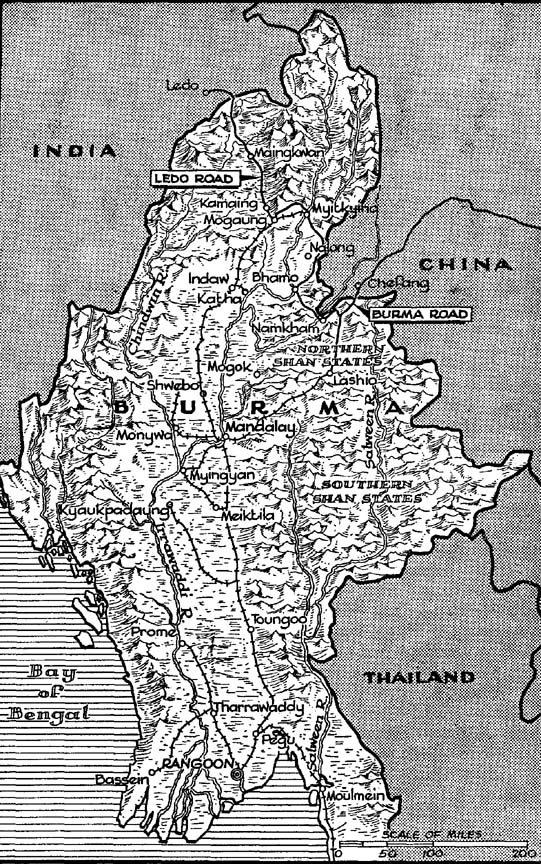
I HAD another birthday at the Nambyu River. Our Special Service radio was working for once and gave me a most wonderful birthday present: news of the airborne landings of General Wingate's Chindits behind the Japanese lines in Burma. Lord Louis had kept his promise. The radio gave some conflicting reports about where the airborne commandos had landed, but to an old-timer it was easy to locate at least one of the landings as having been near Katha. Stilwell was receiving a bit of support at last. At Katha it would be possible for the British to cut both the river and the railway. The Japanese were crossing the Chindwin westward, reported the radio, but nobody seemed to realize what a blow the Japanese were attempting against India and Stilwell's lines of communication. The Japanese must certainly be afraid of Stilwell and his two Chinese divisions. Rather than try to wipe him out by frontal assault, they threw several divisions against the British at Imphal and Kohima in an effort to get behind Stilwell. The British held on with their teeth and fingernails and saved India and, incidentally, Stilwell's forces. But that's not a part of my story.
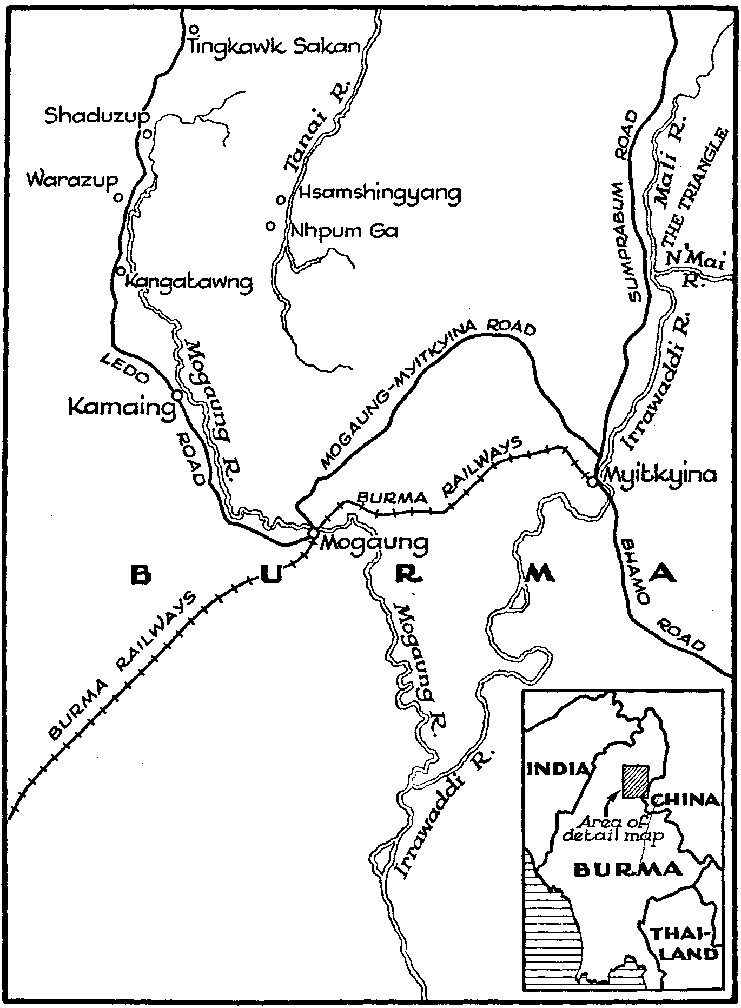
I made one last try for a place in Stilwell's campaign by driving south to Tingkawk to see Colonel Petersen. There Petersen informed me that Major Dushkin's detachment had finished its flank assignment and would be on the road in twenty-four hours. I was worried about rumors that Stilwell was flying in some new Chinese divisions. It would have been entirely in keeping with army thought at that time to push me back to process those divisions rather than give the Burmese girls a combat assignment. So I pretended that our unit would remain assigned to the 38th Division and went forward to contact Dushkin and select a site. It was delightful driving down into the Mogaung plain. As soon as you pass Jambu Bum you smell real Burma. Even rainstorms stop at Jambu Bum. On the Hukawng side it may be pouring. On the Mogaung side it's typical Burma weather---in April bright and clear. None of that Naga Hills stuff. I inspected some of the Japanese defenses in the pass. How the Chinese ever drove the enemy out of them is beyond the powers of a simple imagination to comprehend. Walking up a tributary of the Mogaung River I bumped into Dushkin.
"I thought you'd be coming after us!" he said. Never have I been paid a better compliment.
I took Dushkin back with me, arranging to send back transportation for our men the following day. At Tingkawk I reported to Colonel Petersen, realizing that I was in for it.
"The 50th Chinese Division is being flown into Maingkwan this week," he said. "The Seagrave Unit will proceed to Maingkwan at once and open up a hospital for them."
That meant we were to retreat twenty miles. How I wished I had never joined the confounded American Army! If I'd stayed on in Burma and organized guerrilla bands I would have been my own boss. We were Stilwell's first surgical unit. We had joined him when he hadn't a single medic but us. Now, instead of letting us help at the front, we were being sent back again. Had we really become a nuisance instead of a help in Stilwell's war? But where had we failed? 'What had we done wrong? The last time some of us had been ordered to retreat we had lost fourteen girls. How many would we lose this time? My objection to the assignment was, of course, due to being afraid of women. What man isn't? But in the U.S. Army you obey orders.
So we went back.
"It's your own fault," Dushkin said. "You said in your book that you asked Stilwell to give you the nastiest jobs he had."
"Okay," I said. "I'll shut up."
God bless those girls! They could see that the old man was heartbroken about it and this time not one of them griped. Their co-operation at Maingkwan was immense. From that point on our unit perhaps proved itself worthy of General Stilwell's tolerance of us. We had lost fourteen of our girls, but from Mamgkwan on we turned out a bigger job than we ever did with the original unit except during the first two months at Ramgarh.
The 50th Chinese Division was to camp five miles north of Maingkwan along a fair-sized stream. We were given a tiny stream two miles closer to Maingkwan. There was an open field available but one could never tell when the Japanese would start bombing again so we had to camouflage and disperse our wards. If the colored engineers hadn't lent us a bulldozer we could never have put up our wards and quarters in time to be of help to the 50th Division, for the jungle was the thickest, most matted, thorny, and impenetrable it was ever my ill luck to see. The engineers pushed the jungle away, our men put up the ward tents and built bamboo beds with the help of a few Chinese, and the nurses and Pang Tze and I built a hut for me and erected a ward tent for nurses' quarters. Then the nurses took over the ward work and sick call as the Chinese streamed in.
It was plain that Stilwell wanted us to do as we had at Ramgarh: get the sick into wards as rapidly as possible, cure them, and rush them out again for combat. We couldn't do this effectively unless we held sick call ourselves. American liaison officers, working through Chinese dispensaries, could never do it rapidly enough. Holding sick call would be a horrible job for our few officers and nurses in addition to ward work, but if we had been chosen because the job was important to Uncle Joe, extra work was nothing to complain about. Only one officer did complain. I added insult to injury by sending our trucks to the Chinese camp to pick up outpatients. That was a bit of shrewd psychology because these were Chinese who had seldom seen or ridden in a truck and lots of patients came with minor complaints just for the ride. The doctors sorted them out rapidly until we had three hundred beds filled, the number I had calculated a new Chinese division would need. There were an additional three hundred in sick call every day.
More than a hundred of our worst cases had very severe relapsing fever. Since the Chinese had been deloused in Chabua as they changed planes, we had the perfect chance to wipe out relapsing fever immediately, before the Chinese again acquired lice and spread the disease among Stilwell's fighting troops. The relapsing fever was the worst I'd seen, and there was a small epidemic of pneumonia also acquired by troops in a weakened condition flying over the Hump. We cured the two diseases when they occurred separately but lost a dozen cases that had both diseases simultaneously. Malaria wasn't too bad. There were some venereal cases and many chronic ulcers and, of course, the inevitable Chinese fistulas-in-ano. Beriberi was present even in April, two months before the beriberi season, for these troops were half starved. Many of the beriberi cases were partly paralyzed. Luckily for them we had secured a large shipment of thiamine which resulted in visible improvement daily, while thousands of multiple vitamin tablets soon wiped out the rest of the beriberi. During the real season for the disease at Myitkyina we had only a few of the minor cases and no severe beriberi.
The new Chinese needed Indian-type typhoid and cholera vaccines as well as smallpox. Liaison officers lined the men up by the regiment and we went to town in the old Namkham way. As we gave the shots we found no plump Chinese but many emaciated ones. After one week of good and oversufficient food the Chinese came back for their second injections without that starved look. In the wards it was the same as at Ramgarh. Patients fattened so rapidly that their intestines didn't have sufficient room to circulate freely in their abdomens and they were continually whining about abdominal pain. Apparently none of Stilwell's new Chinese had had full bellies on consecutive days since birth. Now their abdominal weight increased more rapidly than that of a woman during pregnancy.
Just after we passed our peak Colonel Petersen came to visit us. Merrill's Marauders were crossing the range to attack Myitkyina from the north. They were to be supported by a regiment of the 30th Division of Ramgarh-trained Chinese, with whom he was sending the U.S. 42 Portable Surgical Hospital, as well as by a regiment of the 50th Division, with whom I was ordered to send a medical detachment from our unit, composed of men only. As we polished off the 50th Division, I was to evacuate the chronics and bivouac until Colonel Petersen found something for us to do. Dreading another bivouac I begged for permission to hold onto our chronics so we might have something to do. Petersen agreed, but warned me that he might have to order us to move suddenly. Sudden moves didn't frighten me; what did were sudden and prolonged sits.
Lieutenant Colonel Combes was liaison officer to the regiment that Dushkin, Gurney, and Antonellis and their men were to support. In co-ordinating our moves with his, I discovered that the Chinese were to march twenty miles the first day down the blistering motor road to Wesu Ga in the jungle beyond Walawbum. Then there would be three days of forced marching until they caught up with Merrill, though at that point there would be considerable shade through the jungle. With most of the soldiers just getting on their feet physically and many just discharged from our wards, I was convinced that the men would collapse in the heat of the sunny motor road and the value of our work at Maingkwan destroyed. Combes permitted us to contribute our sixteen motor vehicles to see if they would be of material help. Early in the morning our men started off with our own equipment and with as many of the weaker soldiers as they could crowd into the trucks, drove them to Walawbum, then came back to the rear of the column to pick up stragglers and carry them through to Wesu Ga. Shuttling thus all day long gave every Chinese soldier a ride of from three to twenty miles, longer in proportion to his weakness. The only group that received no help was the group with the heaviest loads: trench mortars and kitchen equipment. Always the toughest men in the Chinese Army, these men staggered along with impossibly heavy loads and invariably got there. In my strongest days I couldn't have carried a load like that for a single mile even in winter. Yet these men carried them over twenty miles on a blistering hot highway.
It had been punishing work for our enlisted men, driving all day in the heat and then having only a few hours of rest before beginning a very difficult trip over the mountains, but there were no complaints. We didn't have many enlisted men in our unit but those we had were superb and deserved the bronze stars they earned on this trip. They stood up to punishment magnificently.
It was lonesome in Maingkwan after the boys left, but one day Brigadier General Sliney, who had trained the Chinese artillery in Ramgarh---the artillery was the best part of Stilwell's Chinese Army---came in to chat and we had a long bull session. And one day I looked up and there was General Boatner. It was the first chance I'd had to talk to him since the first of January.
"Doc," he said, "Delhi has decided that your unit is to have no Table of Organization. You are to remain a nameless, unorthodox, bastard unit."
"Okay," I said. "I've been calling our unit that anyway. No papa, no mama . . . backsheesh!"
"I hope you don't object," the general said.
"Sir," I replied, "if I interpret the reasons for that decision correctly I consider it a compliment."
"That's exactly what it is."
"As I see it, Stilwell wants us to remain plastic so that if he's short a station hospital or a field hospital or a clearing company or a portable surgical hospital, he can throw us into the vacancy without a by your leave. This thing we're running now is a field hospital."
I then took the opportunity to beg the brass hats to abandon the idea that Burmese nurses must not be allowed into danger zones and to give us a combat assignment.
"Sir," I said, "I wouldn't want one of these girls hurt for anything in the world. I've known some of them since they were babies. But they entered this war with their eyes open. They've been in plenty of danger and proved they can take it. Their morale has never been hurt by danger or hardship. Nothing hurts their morale but retreats."
"What do you think you want? Kamaing and Mogaung? You can't have them."
"No, sir. Let the portable surgicals and the 13th Medical Battalion have them. But I want first priority on Myitkyina, Bhamo, and Namkham."
"You don't want much, do you? I promise you that you'll go into Bhamo with the first troops. I can't promise that with regard to Myitkyina. How big a field hospital can you run in Myitkyina during the monsoons, if we take it?"
"With our present staff, five hundred beds, sir."
"How would you like Sumprabum if we don't capture Myitkyina?"
"A poor second best, sir, but one of our girls lives there."
The day after Boatner was with us Harris returned from a trip to Ledo much worried. So was everyone else in Ledo, he reported. Tokyo Radio had just reported that Colonel Seagrave and thirty Burmese nurses had been captured in the Hukawng. I laughed. Tokyo was paying us a real compliment by thinking it worthwhile to "capture" us. I could wish all other Japanese prisoners of war were as happy as we were, as well fed, and as free to move around.
A report came in that an English-speaking Kachin refugee had been seen marching up toward Yupbang answering to the description of Lebang Lu's father. Lebang Lu was one of the girls who had left us, but for all that, several of us climbed into a jeep and drove back to Yupbang to verify the report and to help the gentleman financially if he were in need. We drove by our old bivouac on the south bank of the Tanai, by the Taihpa Ga airfield and the site of the hospital at Brambrang where the 25th Field Hospital had planned to spend the rainy season. Everything was abandoned. Not a sign of war anywhere. Natives were returning to their areas and making first preparations for a new rice crop. I hoped the American officers who thought Stilwell couldn't accomplish what he said he could were properly ashamed.
There were hundreds of Kachins in the refugee camp at Yupbang, and though Lebang Lu's father wasn't among them, Kyang Tswi bumped into an old friend and learned that her own family as well as that of Kaw Naw were well, that they knew their daughters were with me and safe. The trip was well worthwhile. As we stood waiting for the tea the English Civil Affairs officer was preparing for us, an American soldier---I was not wearing my insignia---approached me.
"Do you suppose those girls are some of 'Seagrave's Burma Nurses'?" he asked.
"Yes, they are."
"Gee, they look good! Do they speak English?"
"Not quite as well as you do," I replied.
"This is Colonel Seagrave," introduced Brayton Case, who was standing beside me.
Thereupon the soldier bolted and ran.
Back at Maingkwan we found Ba Saw, just flown back from his flank assignment in Pabum, and Captain Johnson, back from a much-deserved vacation.
Early on the morning of May 17, 1944, as I was tossing sleeplessly on my bed wishing it were time to get up and that there were something special to do when I did get up, one of those incredible hunches hit me. Something was cooking. I hustled the boys out of bed and ordered them to evacuate all our remaining patients to the Chinese regimental hospital. While they emptied the wards, the nurses, our few Chinese, our Burmese boys, and I pulled the tents down and rolled them up. When the trucks returned we loaded them with equipment for a surgical hospital. Everyone thought the old man had gone mad.
After breakfast the following morning I sat waiting for the telephone to ring. It rang at eight-fifteen. On the other end of the wire was Colonel Petersen.
"How long will it take you to evacuate your patients?"
"I evacuated them all yesterday, sir."
"How soon can you start for the airfield at Maingkwan?"
"In an hour!"
"Hurry down there. Three C-47's have been assigned to pick you up."
"Yes, sir. Goodbye!"
The men and women of our unit needed no detailed orders. They had worked too long as a team for that.
"One suitcase and one bedroll each," I shouted. "We leave at once."
I was the last to be ready and even then a couple of the girls had to help me. Fifty-five minutes after the telephone rang we were at the field. Hour after hour passed. Planes were darkening the sky and a few landed on our field but they were on other missions. They had never heard of Seagrave. At noon the boys we were leaving behind with our equipment and vehicles brought us down a hot meal.
A liaison plane flew in and circled to land. "That's Colonel Petersen," I said to one of the boys. "Meet him and show him where we are." Those were my psychic days.
"What made you think it was I?" the colonel asked.
"I know you fairly well, sir. I knew you would come if you could steal a plane."
"That's just what I had to do. Yesterday Merrill's men took the Myitkyina airfield. You will report to Colonel Hunter."
"Yes, sir. Will I have to radio you for instructions as to evacuations and so forth?"
"Whatever medical measures need to be taken in the Myitkyina area will be determined by you," the colonel replied. "You are to arrange the entire medical setup with Colonel Hunter."
"Yes, sir."
"The planes seem to be held up. Medical needs are third priority today. I will have to return this stolen plane at once."
"Lieutenant Harris will telephone you when we leave, sir."
The boys played horseshoes. The girls fluttered around here and there looking for fruit. I sat. I had sat so many months I felt I could tolerate a bit more without going mad, for Myitkyina---Myitkyina!---was at the end of this wait.
Out of a jeep climbed a Chinese in an American uniform, covered with dust that had caked with his sweat.
"Are you Colonel Seagrave, sir?" he asked.
"Yes."
"I'm Corporal Wing, sir. Medical Department. Colonel Breidster assigned me to your unit and I have just come in from Ledo."
"Are you an American-Chinese?"
"Yes, sir."
"You're Cantonese, aren't you?"
"Yes, sir."
"Then you don't speak Mandarin?"
"Yes, I do, sir."
"You don't write Chinese, do you?"
"Yes, I do, sir."
"Somebody catch me while I faint! Where's your barracks bag?"
"Here, sir."
"Stick around. We're leaving for Myitkyina any moment. What do you know about medicine?"
"I'm a dental technician, sir."
"You aren't any longer. You're registration clerk to the Seagrave Unit. God help you. I'm going to work you to death. A Chinese-American who speaks Mandarin and Cantonese and writes Chinese as well! God is good! God is good!"
Little Bawk had too much thyroid secretion for her own good. About four o'clock she came to me for the umpteenth time.
"Darn it, Daddy, why don't the planes come?"
"I don't know, I tell you. Listen, woman. Everything that's happened during the last two days shows that the good Lord is at last taking an interest in us again. I don't like to wait any more than you do, but I'm willing to bet you real money that when we get to Myitkyina we'll find that it was a good thing we didn't get there any sooner."
A C-47 circled in to land. After it had taken off again one of the Signal Corps boys from Hkalak sauntered over.
"Sir," he said, "the radio reporter on that plane says the Japanese bombed and strafed the Myitkyina field a little while ago. An American casualty that was being put on the hospital plane was killed and an American nurse shot in the leg."
"Bawk," I yelled, "just listen to this!"
We didn't have much longer to wait. A plane landed and the pilot admitted that he had heard of Seagrave. A third of the nurses, a third of the Burmese boys, a third of the supplies, and I got on board. Johnson, Ba Saw, and San Yee would come in the other two planes.
I looked down on those awful hills as we crossed the Chindwin-Irrawaddi divide: the hills that our men had negotiated on foot. Then I felt my still-creaking knee joints. And I thought the Lord didn't care about me any more, I thought, shamefacedly.
A railroad. The Burma Railways. The Irrawaddi again. Myitkyina. Myitkyina airfield from which half the unit had taken off for India two years before. May le bon Dieu forgive all my sins. The refugees are back again in real Burma. God is good!
We circled the field. What if a Jap sniper did hit us now? We were in Burma. I had always wanted to die in Burma.
A smashed C-47: was anyone hurt? Several crushed gliders: I hoped the passengers weren't killed. A dead Jap, sprawling, grotesque in the fading light. A Zero half buried in the ground: our boys got to work in a hurry.
We landed. Burma at last. Burma. Burma!
"Where will I find Colonel Hunter?" I asked a nonchalant American soldier.
"Across the field, sir," he said, pointing.
Hunter was minus a front tooth and wasn't ashamed of it. He was a real American officer who cared about nothing but the job in hand.
"Lieutenant Colonel Seagrave reporting, sir. Seagrave Hospital Unit. Four medical officers and eighteen Burmese nurses. Where do you want us to set up, sir?"
"My God! Women!"
How often I had heard that phrase shouted in joy! But Colonel Hunter's tone was one of complete disgust: hadn't he had enough trouble?
"We ask for no special security, sir," I said.
"Go over to the revetment next to the first-aid station across the field. I suppose you want rations. I haven't had enough food for seven days."
"We have three days' rations with us, sir," I said. "We shall be glad to share them with you."
"No, thanks. We'll get along."
"Yes, sir," I saluted and took my leave.
It was about four hundred yards from our plane to the revetment that Colonel Hunter had assigned us. Major Shudmack, at the first-aid station, regretted that his men were too tired to help us properly; they would do what they could to move our baggage into the revetment.
"Please, Major," I said, "our unit is here to help, not to cause trouble. For months I've begged the brass hats to give us a real assignment. Let us do this alone."
The major insisted on helping me with a couple of loads and then his tired feet gave out. Ba Saw's and Johnson's planes parked near our revetment. The airstrip was lit up by flares, for planes were coming in all night. Snipers' bullets whizzed over us as we carried our equipment down the field piece by piece but the refugees didn't care. They were back in real Burma at last. We laid a tarpaulin over some upright litters and crawled in. Only two casualties came in during the night and they were dead on arrival.
Our first task was to boil our instruments and set up operating tables for casualties. Anything approximating an operating room was out of the question. There wasn't a bamboo or a stick anywhere to support a tarpaulin. We set packing cases up with litters across them for operating tables and were soon ready to go. Before long the Chinese found us, and Ba Saw, San Yee, Johnson, and I were busy. At noon Dushkin and Gurney arrived with their detachment, the thinnest, dirtiest, weariest bunch of men I'd seen for a long time. The sun was blistering hot and our skins began to burn, for we were naked to the waist. Then a squall of rain blew up and a nurse held an umbrella over the operative field while I removed a man's shattered spleen. Apparently there were photos being taken and weeks later I heard that Howard Baer had done a sketch of us; but we were completely unconscious of it all. Correspondents never interfered with medical units when they were really busy with surgery.
Dushkin immediately began acting as triage officer, and Gurney and Antonellis, tired as they were, set up two more litters and joined in. Our men stretched electric wire over upright litters, cut holes in empty No. 10 cans to act as black-out shades and as night fell we had electricity. The men put up several parachute tepees for patients, while they covered others with ground sheets. We operated on one hundred and twenty patients that day and crawled under our tarps with patients all around us.
It's hard to praise adequately the job that was done by the C-47 pilots during the battle for Myitkyina. For many days the big transports flew around the block. They came in on mornings when ceiling was zero and seemed to smell their way to the field. The hospital planes didn't fly in very bad weather but nothing held back the transports. For some time we were forbidden to put up more than three ward tents because of the danger of Japanese planes. But when we had patients to evacuate, the transports took them. It was for patients and patients only that the transport pilots would consent to delay their take-off. For them they would wait an extra half hour.
On our second full day the men put up three operating rooms of triple-layer parachutes and several more tepees for patients. Then Bill Brough located a lot of bullet-riddled gasoline barrels and some moth-eaten bamboos and three by six timbers. Using the wall of the revetment to hold one end of the bamboos and gas barrels piled three high to rest the other, the men stretched out tarps and we had a place to keep dry at night. On Sunday evening the Japs began throwing 70-mm.-howitzer shells at us. Colonel Hunter thought us too close to the field so on the fifth day we moved two hundred yards nearer town. Here there was a much larger and higher revetment, the best near the field.
We were lucky to have three light days in succession---only twenty or thirty patients per day---to make the move. We had acquired a few local coolies to help, plus the detachment of litter bearers that had accompanied Major Dushkin. By the end of three more days we had put up a ward tent for the nurses against the east wall of the revetment toward the town, and our colonial-style, gasoline drum-pillared tarpaulins against the south and west walls for officers, enlisted men, and operating room. Later the men erected several pyramidal tents for themselves in the center of the revetment and at its mouth. The litter bearers built shacks for themselves west of the revetment. As the rules were relaxed we put up three ward tents for Chinese casualties and one forty by forty tarpaulin for Americans and British. A month later we were allowed a total of seven ward tents. In the operating room I had thirteen litters set up as operating tables, two for each surgeon, and one "Myitkyina Model" fracture table. This decreased the time lag between operations and offered opportunities to guest surgeons who dropped in from time to time.
The only fault with the revetment lay in the fact that it was on lower ground than the rest of the area. The only drainage was into the huge pits outside, from which earth had been taken to form the revetments. The drainage ditch by the operating tables was continuously running red with blood, and the pits soon became unspeakably foul---so also was the mud we churned up as we operated. On wet days the mud was ankle deep but didn't stink quite so much, while on hot days the mud dried and stank. One night during a heavy downpour a huge ditch in front of us collapsed and all the water from the airfield, instead of being carried away, flowed into our area, filling the pits and our revetment a foot deep. By morning our suitcases and shoes had floated some distance away. But the accident flushed out our stench very properly.
Our large number of casualties was increased through the hysteria of poorly trained troops in their first battle. As at Yupbang, the Japanese would fire a few rounds of rifle, machine-gun, and mortar fire and then climb down into their dugouts and laugh as both Chinese and Americans let loose with all they had for an hour at a time. For there were green Americans in the fight now, combat engineers and infantry fresh from the States who were replacing the worn-out sick Marauders, few of whom were still able to fight. We soon learned to distinguish the sound of hysteria in the rattle of machine-gun and rifle fire and to gird our loins for the inevitable casualties caused by American-made weapons. During the first three weeks they were more numerous than those that were caused by Jap fire.
About a week after we reached Myitkyina, Sein Myaing, one of our nurses who lived in that town, heard from her uncle that our unit was back in Burma again. One dawn she made him lead her out from Myitkyina through the Japanese and Chinese lines. I could understand the Japanese letting them through, for at that time they were anxious to get civilians out of the way. But I couldn't understand why the Chinese didn't shoot them down. Sein Myaing's nonchalance was amazing.
When we came out of Burma, Sein Myaing had been a bit fed up with me because I had chosen her as one of those to stay behind and help run the Namkham hospital for a few months rather than go to the front, little realizing that the battle would be over almost as soon as it started. There were other things, too. So when, on my instructions, Bill Cummings told the nurses at Namkham to decide whether they wanted to fly to India or stay in Burma, Sein Myaing decided to stay, and set off for her home in Myitkyina. The first Japanese commander there was a Christian and had enforced order among his troops, treated the people with kindness, and even organized Christian services on Sunday. Sein Myaing had been ordered to serve in a hospital for civilians in town and had been well treated.
After the refugee nurses had almost hugged her to death, Sein Myaing gave us the surprising news that Sein Hla Tha, headmaster of my Anglo-Vernacular Middle School at Namkham, had been in Myitkyina the night before the airfield was taken. Impressed by the Japs to act as interpreter he had come straight up there from Namkham, starting for the south just as the Americans came in. So Sein Myaing was crammed with news of Namkham, and very fresh news, too.
"Your own bungalow is untouched and the Japanese general lives there," she said to me. "One wing of the nurses' home has been hit by a bomb but no bomb has yet touched the hospital. On the other hand, the Japs have torn up floors and wooden walls and doors and windows and have used them for firewood and to build sheds." This after we had obligingly left the Japs more than a hundred cords of firewood conveniently cut and stacked!
"E Hla [head nurse at Namkham] and her husband Ai Lun are running a hospital for civilians at Muse. Dr. San Yee's wife and baby are well. [Cheers and tears from San Yee.] Sein Hla Tha and Rosie have a fat baby boy. [Cheers from me. I had operated on that woman three tunes to cure her sterility and then had had her abort her first pregnancy during an attack of malaria.] Than Shwe's father Po Nec and the Karen headmaster at Kutkai are pro-Jap and are lording it over Lashio and Kutkai. [Groans.] Dr. Ba Saw's father and mother and doctor-sister are safe in Shwebo, working in a civilian hospital there.
"Hkawn Tawng and her little sister are in Myitkyina now," she continued. "Do you remember she got angry with you for not taking her to the front and ran off with a Shan-Chinese trader? Well, he took a commission as a captain in the Japanese Army and is somewhere south near Katha. Hkawn Tawng has one baby girl and is six months' pregnant now."
"Where is Nang Seng?" I asked.
"She's here in town."
"Has she any children?"
"Where is Toi Roi?"
"She ran off to the mountains and is safe. Her mother divorced her father and married again and is living on the big island in the river just below town. Her father was killed by an American bomb."
"How have the people fared under Japanese rule?"
"The Japanese continually went off with everyone's rice which now costs eighty rupees a basket. [About thirty dollars a bushel.]
We haven't been able to buy any cloth and not even cotton to weave our own clothes. That's why I'm so ragged. The Japanese would have been better liked if they hadn't constantly slapped and kicked everyone with or without provocation."
Not long after that episode, a Kachin scout serving the Americans across the river was flown to us in a liaison plane with a minor injury. As I was treating him I discovered to my astonishment that he was Toi Roi's older brother.
"Doesn't Toi Roi want to come back and work with us?" I asked.
"She will when she learns you're here," he replied.
"Can you get her down to your American officers? If you can they will fly her to us."
"I'll try."
Three days later, in walked Toi Roi. She was pale and thin and told a long story of semi-starvation and malaria, with no drugs available for treatment. It was good to see her again. Then one day Nang Seng No. 2 and Nang Seng No. 3 herself appeared together. No. 3, whose husband was in Rangoon studying medicine, was nursing in the government's new hospital for civilians. No. 2 had several children, acquired since she had been forced some years before to stop training and marry a man who didn't want her.
Something should be done to change the marriage customs of the people of Burma, especially pernicious among the Kachins and most pernicious of all among so-called Christian Kachins. All marriages are marriages of convenience---convenience of the parents. The likes and dislikes of the children, especially the daughters, are never taken into consideration. For a financial inducement, for a bit of imitation rank, or simply to marry someone in the right clan, a priceless daughter will be given to a determined rake whom she utterly despises, or a son will be forced to marry a girl for whom he feels not the slightest respect or affection. The lives of each son and daughter of the two most famous Kachin "Christians" of Bhamo District were ruined by the headstrong cupidity and stupidity of their parents and grandparents. It is no wonder the girls and boys will take their happiness when and where they can find it.
I was especially glad to see Nang Seng No. 2. I had a problem to talk over with her.
"The nurses are wasting too much time on jobs that require no skill," I said. "Don't you think you can find some boys and girls who would like to work for us? I'll pay them five rupees more per month than the army pays coolies. They will have good food and a civilized place to sleep and Christian people to work with. If they prove to have the knack of nursing they may go on with us when we leave Myitkyina or stay behind if they choose. Even if they stay with us only while we're in Myitkyina, they'll pick up enough nursing to be a help with their families all their lives."
Not many days later Nang Seng appeared trailing three Karen girls, three Kachin girls, and a couple of Karen boys after her. One of the girls was her own sister, Nang Pri. Soon girls began to trickle in by ones and twos and a few more boys appeared. One day Ohn Hkin's entire family walked in from a village north of town and left Ohn Hkin's younger sister Ohn Yin to work with us. Even Hkawn Tawng turned up, with a sheepish grin on her face for having married the wrong man, and left her twelve-year-old-sister Roi Ji with us. I hardly recognized Roi Ji with her short hair and boy's clothes. Like Hkawn Tawng she had a fascinating smile and a mincing way of walking as if she were wearing high heels. This, in a twelve-year-old, presaged years of heartbreak for the males of her world.
And then a Karen doctor, Mildred Pan Hla, walked in and asked for a job. Working in the government civil hospital at Lashio she had started on the run a few jumps ahead of the Japanese, who caught up with her at Myitkyina. The Japanese refused to recognize her medical degree and ordered her to work as a nurse.
I've never regarded graduates of the Rangoon medical schools as knowing much about medicine. What Dr. Ba Saw and Dr. San Yee knew---and they were skillful surgeons---they learned after coming to us. But I was curious to see what it would be like to have a woman doctor in a combat surgical team, so we took her on. Mildred was hurt when I insisted she learn her first lessons from nurses, but before long she came to realize that she was learning things about medicine of which she had never dreamed. She worked placidly under fire, marched over difficult trails with the best, and when the unit moved to a new location she did coolie work with the rest and with indefatigable good humor.
All of our new additions were useful. Having lived through American bombings and shellings they paid no attention whatever to Japanese 70's. But unlike her sister, Nang Pri seemed to have been born at an operating table. She was a "natural," just like Little Bawk. In a week she had learned the names of surgical instruments and supplies and in two was assistant to the graduate nurse at the instrument table. Naomi took a fancy to her and at the end of three weeks gave her a chance, after midnight when most of the other girls were in bed, to act as second assistant to me at an abdominal operation, acquitting herself with great credit---much to the disgust of the girls who had gone to bed early.
On the day the airfield was captured it seemed that Myitkyina would be ours within a week. We were told on good authority that the Japanese had actually evacuated Myitkyina except for snipers, not knowing just how big a force Stilwell had thrown against them. But Colonel Hunter had only his depleted, weakened Marauders and two regiments of Chinese, who also were not only tired out from their forced march over the mountains but were fighting their first battle. There had not been nearly enough troops to guarantee both airfield and town against unknown odds. Of the two, the airstrip was by far the more important. So while we hurriedly flew in reinforcements, the Japs moved back into Myitkyina and dug in. We had to fight for it, blast and burn the enemy out of their dugouts under road and river embankments and deep under huge banian trees and bamboos.
WITH a long battle ahead of us we organized our work to the peak of efficiency possible in the jungle. Two operating tables for each officer cut down the time lag for surgeons, until they had time for only half a cigarette between operations, during which they had to write up the previous case on the inevitable toilet paper to send back to base with the patient the next day. To make our surgical instruments go further and save time of nursing personnel, we set up one large instrument table at the angle of the V-shaped operating room, like the serving counter of a huge restaurant, from which 'short orders" were served out at a moment's notice to the first assistants of the surgeons at all tables. Two nurses were on full-time duty with plasma and glucose, getting shocked patients into condition for operation and keeping them alive as we operated on them. One Chinese sailor ran the autoclave all day, sterilizing linen washed free of blood by two of our soldier-orderlies. Two other Chinese orderlies were continually hauling water to keep our GI cans filled. Two nurses injected each new arrival with morphine, atropine, and tetanus antitoxin, reporting the nature of wounds and the patient's general condition to Major Dushkin, who acted as triage officer and assigned cases to the individual surgeon's tables. Nurses who were not assigned elsewhere cut and folded gauze into sponges. At least we didn't have to wash out and use again the blood-soaked gauze, as we did in the first campaign. Sergeants Probst and Stolec organized the men into the "Myitkyina Plasterers' Union," and soon they were putting on plaster casts most efficiently, with only an occasional glance from the surgeon. This proved its value one day when there were fifteen hip spicas to be put on men with badly shattered thighs. Two men with hand brushes and basins of soap and water rushed from table to table as patients were anesthetized, scrubbing out the wounds and cleaning skins of the mud and grime of war. Then nurses applied alcohol and iodine, draped towels, and the surgeons began to cut.
And up and down the operating room were cries for "Grandma. Grandma!" "Pang Tze. Pang Tze. Pang Tze!" "Wing. Wing. Corporal Wing. G.I. Wing!" as the three most essential people in the unit were called to straighten out difficulties everywhere at once. Grandma Naomi, unruffled, calm, efficient, pulling wisecracks in two or three languages, stood in the angle of the V, supervising the cleaning and resterilization of instruments, assigning nurses and American, English, Burmese, and Chinese technicians to scrub up as operative assistants or to anesthetize patients, smoothing ruffled feelings, and always casting a critical eye around to spot some gross break in technique on the part of the younger personnel.
"Pang Tze, get this patient off the table for me and bring me another, will you?" "Pang Tze, scrub!" "Pang Tze, hold this leg for me!" "Pang Tze, tang cha ping [litter bearers], tang cha ping!" "Pang Tze, I want a box to sit on. My back is breaking!" And again and again, "Pang Tze, what the Sam Hill was the number of that last patient I operated on?" And Pang Tze, running for a look at the strip of adhesive glued to the patient's forehead, would shout back, "Sickasa fif a tree!" or, "Nina sickasati pour!" Poor Pang Tze's hard-earned fat began to melt out of his pores and he hitched his belt a quarter of an inch tighter every day.
Once, during a short lull, Pang Tze lay down on the revetment beside me with a sheepish grin on his round face. "Wo kun jao bu kou!" he said. "I haven't had enough sleep!" One of my sergeants caught him at it and tickled his nose with a straw. Like a chow dog, Pang Tze turned with a snarl and snapped at him with his teeth. Yet I could rouse him from a deep sleep at any time and he would jump to his job with an apologetic laugh.
Wing was the only person we'd ever had in the unit who could write Chinese. Until he came we'd never tried to get the patient's name for our records. We'd tried it at Ramgarh, spelling out the name as best we could in English, but no two people spelled the names the same way, and no matter who had written the name, the patient wouldn't recognize it when read back to him. But Wing took over our admission clerk's work and wrote the names in Chinese, and his records were a pleasure to work with. If he'd been a lesser man he'd have gone insane those weeks at the field. While admitting one patient or preparing him for evacuation, other casualties would come in behind his back. Because the surgeons could allow no time lag before beginning the operation, Wing was in continual demand. At first the Americans were very polite to this "foreigner" in the U.S. Army and called him Corporal Wing. He wasn't ruffled. When they dropped the title and called him just Wing, one felt that the enlisted men were beginning to like him. Finally they began calling him G.I. Wing or just G.I. To them Wing was now not just another American soldier but the best kind of American soldier.
In the supply but we had a new American boy named Gilbertson who had never been on a combat mission with us before. Though he had no teacher he somehow learned in no time at all just how much of each article we would need during each phase of the battle. With Stinky Davis collaborating---chumming with C-47 pilots and hospital-plane surgeons, grinning his twisted smile at the right moment in his censorable yarns---the supplies would flow in from base. One morning, when we were almost out of ether and plasma, Stinky and Gilbertson so worked on the tender feelings of the pilot of the hospital plane that quantities of both necessities were delivered to us only six hours later.
Two nights after we moved to the larger revetment, we had just crawled into bed when an incredible storm of wind and rain bit us and nearly blew away our tents. Every bit of starlight was blotted out of the sky. Suddenly, as the storm swept past, there was a tremendous burst of machine-gun fire all around us, the lighter, snappier noise of the Japanese small-calibered weapons. Then the clatter of the heavier American-made weapons replied, as the Americans and Chinese opened fire. Even the machine guns of the English antiaircraft battery just across the way from the open, unprotected side of our revetment began to blaze away, and we knew it was the real thing and not hysteria. These English were old-timers who had seen action all over the world. Tracers streaked over us from all directions. One Japanese machine-gun squad had sneaked up under cover of the storm and was located between us and the landing strip.
But there was no panic. Dushkin quickly assigned men to sentry positions and to barricades of packing cases at the entrance to the revetment, while the nurses crowded around me for whispered instructions. "Get down flat on your beds at this end of your tent," I ordered. "No lights, no talking. Two girls on each cot."
Hours later, when the shooting had died away, I told the girls to climb back into their own beds. As Ruby and Louise brushed past me I noticed they were sopping wet and muddy and shaking with cold.
"What on earth happened to you?" I asked.
"You told us to get down flat, so we did---under the other girls' cots!"
At the open end of the nurses' tent I found our Burmese boys and a couple of enlisted men on guard with carbines, tommy guns, and rifles. As I added my automatic to the arsenal, I warned, "Don't shoot on any provocation until you've proved conclusively that what you're shooting at is a Jap, and even if it is a Jap, don't shoot on a line between us and the British antiaircraft!"
It was well we were warned, for soon a body crowded under the northeast corner of the tent wall and I could hear weapons being thrust to shoulders.
"Who's there?" I stage-whispered, dramatically.
"Don't shoot! It's me, Wentz. Sergeant Brown and I were sleeping out in the kitchen with the Chinese cooks when the shooting started."
"Where's Brown?"
"Right behind me. The Chinese dropped into the revetment pit."
Soon there was another shuffling and a muttered curse that sounded like Chinese, then a fierce challenge in Chinese from Bill Brough. If Brough was taking care of them it was all right, for he was a crack shot. We breathed easily again. Minutes later Bill crawled under the tent wall. "Chinese litter bearers with a casualty," he said. "I thought they might be masquerading Japanese so I asked them where their home towns in China were. They knew their geography and their Chinese accent was all right so I let them in. The casualty has only a flesh wound and will keep till morning. I gave him plasma. We can't have lights anyway."
Those Chinese litter bearers deserve a lot of credit. They worked under fire just like American medical corpsmen. With our four thousand Chinese casualties at Myitkyina we averaged only 3.8 per cent mortality in the cases that reached us alive, though some were gasping their last breath. Very few died in the plane on their way to base and two large base hospitals assured me, months later, that only 1/2 per cent died after reaching them. This was a record to be proud of in view of the ghastly wounds the casualties at Myitkyina had sustained. The wounds were no more horrible than those of other battles, but in other battles they didn't reach us alive. That they did so in Myitkyina was due not only to the fact that we were never more than two miles from the fighting but also to the efficient service of the Chinese litter bearers.
A great deal has been said---and I have said a great deal myself---about the callousness of one Chinese to the sufferings of another, a callousness epitomized in the story of the American pilot who saw a group of Chinese soldiers push one of their number out of the open door of a C-47 as they were flying over the Hump and then stand back and laugh immoderately at the joke. But at Myitkyina we saw hundreds of casualties carried in and laid tenderly on the ground by their regimental litter bearers---who then burst into profanity as our own litter bearers less tenderly jerked the patients over to the American litters. Every American casualty knows that it was more comforting to be carried on Chinese litters by Chinese than on American litters by Americans.
If our own tang cha pings were perhaps a bit more rough, they also astonished us daily. They were from the 50th Chinese Division, yet, contrary to Chinese custom, they served us equally well, whether casualties were from the 50th, 14th, or 3oth Chinese divisions, from the Marauders or from British units. For some reason most of our patients persisted in arriving in the evening and we were frequently operating until two and three in the morning. No matter how late we were, there were always tang cha pings on duty, and no matter how early we started in the morning, we found them standing by.
Inevitably I wondered how our unit would act if bullets and shells came near. I was and still am curious to know how I myself would react if we were really in danger. People talk about our medical unit's having been under shellfire more than any other, yet we knew nothing of danger as the men in the lines knew it. I never actually saw a man struck by a bullet or a shell. No one was killed within a hundred yards of me. Still the shells came rather close at Myitkyina. Several of the men and three of the officers dug themselves trenches beside their cots, into which they flopped when the shells began to scream over. The rest of us dug nothing. If the Japs shelled when we were not operating we all crouched by the east wall of our revetment. If they shelled while we were operating, we went on operating.
I recall one evening when they brought in an American boy with a bullet wound from temple to temple which had left only a few shattered remnants of his eyes. Paul Ceren was giving him pentothal and Chit Sein was assisting me. I had only a few more stitches to take when the 70's began shelling. "Go over to the revetment wall," I said. "I don't need either of you any more. If he begins to wake up I can shoot in a bit more pentothal myself."
Both of them ducked under the table as they heard another shell scream and then came back to duty positions as it exploded beyond us, only to duck again at the next scream of a shell. I should have rebuked them for disobeying orders, but I was fascinated by my last few stitches into the American boy's torn face, and in any case their demonstration of courage helped my own nervous system along and, I hoped, made the involuntary ducking of my own head less apparent.
One evening Japanese reinforcements pulled a 150-mm-gun to the north of us and started shelling. A few shorts exploded just to the north, while most of the shellbursts were just south of our installation, shrapnel flying back over us into the revetment. Then the Japs in town opened up with 70's which fell to the west of us and with large mortars which hit to the east. There was a ring of exploding metal all around us and we didn't know which way to duck.
I still don't know the answers, but to me fear is the result of a too vivid imagination. If you spent your time thinking that the next whine of a shell would see your body bursting apart, like the bodies of the Chinese and Americans on whom we operated every day, you could soon work yourself up into a frenzy of fear and imagine shells bursting all night long, much to the impairment of your usefulness to the army. Some of the self-styled fire eaters got it the worst. There was that enlisted man at Ningam who breathed fire at the thought of all the unlucky Japs he was going to send to their eternal punishment. One week of shelling at Brambrang and he wouldn't come out of his dugout unless ordered, and only then with three grenades, a dagger, a bayonet, and an automatic strapped to his belt and a carbine over his shoulder. Rigged up with this terrific assortment of American firepower, he would scrub up to assist at surgical operations.
There was also a medical officer who wasn't satisfied until he made a tour of the Chinese front-line trenches just as the Japanese opened up with machine guns. Then he was altogether too well satisfied. After that the sound of a Japanese gun would start an uncontrollable attack of dysentery, miraculously cured by putting a few miles of space between him and the Japs.
So far my only "wound" from Japanese shellfire was received one evening as I stood watching Ted Gurney operating on an abdominal casualty. There were two Air Corps men right behind me. At the whistle of the first shell they plunged for cover, thrusting me aside so forcibly that I fell over an operating table and was completely winded.
Most incomprehensible was the man who, to escape a theoretical wound, would inflict one on himself, in the hope that a certain wound would let him escape from a possible one. There were epidemics of this practice when new troops went into action. We had it in the Fifth Army troops during the first Burma campaign in 1942 and again in the new Chinese and American troops in the battle for Myitkyina. The Americans did it a bit better than the Chinese, putting a bullet through the base of the smaller toes of the left foot---we had half a dozen of these at Myitkyina when the new troops went into action. A platoon slept in our revetment one night. In the morning a soldier "accidentally" shot himself in the left foot just twenty yards from me while I was looking at him.
An American can get along in life with a limp or an artificial leg. A Chinese can get along without an arm or hand but he must have two good legs to make a living. So the Chinese self-inflicted wounds were always in the left hand or forearm. The best Chinese anatomists shot themselves very cleverly between the two bones of the left forearm, missing both bones, both large arteries, and the important nerves. Personally I would rather be hit suddenly and unexpectedly. It hurts less.
But no medic has a right to preach at hysteria in combat troops even if he serves in a combat medical unit. Someone was always fussing over the medics, urging them to take care of themselves and throwing out defense systems around the medical installations, whereas it was just the opposite with fighting troops.
The U.S. 42nd Portable Surgical Hospital under Major Harris had come over the mountains with the 30th Division and was set up in regimental headquarters north of town, so close to the enemy that they couldn't use lights to operate at night; already one of their technicians had a fractured spine from shellfire. At the time I was still medical boss in Myitkyina, so I invited Harris to come over and work beside us. It would be easier for us to keep them supplied with sterile goods and make all our work more efficient. Harris agreed and we had ten delightful days working together. Their Captain Bone performed a magnificent nerve-block anesthesia. He blocked the shell-torn faces I was trying to put together so well that the operations were easy and our enlisted men began to call me a plastic surgeon! By taking turns at the surgery, officers and men of both units were able to get some much needed rest.
Then one morning one of our fighter pilots zoomed over us and, testing his controls, accidentally released two bombs that missed us by what seemed like inches. We were operating at the time and wondered what made those guns sound so loud. Had the Japs brought up another 150-mm. gun? General Boatner and Colonel Willey rushed to the door of their command post. The general was convinced that that was the end of both medical units and sent Colonel Willey over on the double-quick to see.
Next morning the 42nd Portable Surgical Hospital was ordered to move to a new site on the other side of the field, thereby ending a most delightful companionship. The 58th Portable Surgical Hospital had just arrived from the States and was ordered to serve the American lines north of town on the Myitkyina-Mogaung Road, while we served the Chinese who were attacking the town from the west and south. The officers and men of the 42nd, almost overcome by fatigue and illness, were to begin taking furloughs, helping in the care of American patients until the 44th Field Hospital took over.
During the first two months of the Battle of Myitkyina we had confined our air support to the use of fighter bombers to pinpoint targets, then strafe, hoping we might save part of the town for our own use later. Soon fighters were based on our field. On days when work was light the nurses would climb to the top of the east revetment wall and watch them take off to bomb, screaming with delight as one plane after another peeled off into a power dive, dropped its load, and shot up into the sky again, then circled and strafed with his machine guns blazing. Any decent missionary would have reprimanded the girls for their actions or reminded them that perhaps the bombs and bullets were hitting their own relatives and friends in the city. But all I could remember was the unspeakable misery these girls had suffered as refugees in India waiting for the chance to help drive the hated invaders from their country. And as to the bombs and the bullets hurting their relatives and friends---I wanted them to forget it.
But still the Japanese defense didn't collapse-so B-25's 's were sent for. They came in squadrons, dropping so many sticks of bombs that their explosions sounded like the rattle of a super machine gun.
One day a prematurely aged man and an eight-year-old boy walked in. It was Esther's Uncle Boganaw and his youngest son. Boganaw had been headmaster of the mission school in Myitkyina and had elected to live out the Japanese occupation. At the time of Sein Myaing's and Dr. Mildred's escape from town he also might easily have escaped to the safety of the American and Chinese lines. Why he didn't do so I still don't know. Possibly he was skeptical of our ability to tear the Japs---and the town---apart. Perhaps it was only the apathy and fatalism of the Orient. Perhaps it was the oriental's determination to stick by his home. And, of course, it is very possible that, being the senior mission official of the district, he felt it his duty to stick it out and prevent as much as one man could the looting of mission property by the Japanese or the Allies. One day, when he and his youngest son were away from home, our B-2's came over and one bomb dropped squarely in the trench occupied by his wife and five other children. When Boganaw returned home there was no sign of his children or wife except a small piece of flesh hanging on a nearby telephone wire. That was the end. He slipped out of town---a much more difficult feat as the battle drew to a close than at the beginning. The Civil Affairs officer set him to work recruiting Kachins. He finished this assignment in October, sick with malaria and half crazed by the loss of his family, and begged to join us as coolie, orderly, or errand boy, just to get away from the hateful memories of the last days of Myitkyina.
Many other civilians had experiences like Boganaw's. Ma Yi, one of our new girls, was the wife of a Burmese actor touring somewhere in the south. She and her oldest sister hid from our bombers in foxholes some distance apart on the Irrawaddi bank. A bomb missed Ma Yi and blew her sister apart, right in front of her eyes.
I've talked to a great many people who suffered the loss of family, friends, home, and property at the hands of our air force or big guns. As far as I know there was only one instance where any blame was laid on us. A Burmese woman, crazed by the loss of everything she had in the world, ran to the first American sergeant she saw after her escape, pounded his chest with her little fists, screaming, 'You killed all my family. I hate you!"
The contrary, however, was the rule. Everyone, as did Boganaw and Ma Yi, admitted the right of the British and Americans to drive the Japs out of Burma and the necessity of using bombs, shells, and machine guns to do so. They blamed themselves for not having the common sense to clear out of the battle area when the war drew close. Long experience had convinced them that the allied planes and guns were aimed at legitimate Japanese targets, even if they didn't always hit the target on the nose. Civilians were hurt only when they helped the Japanese or when they remained too close to them.
There was one heartbreaking experience toward the end of the battle. Some gaunt, haggard, and starved prisoners of war had effected an escape from the Myitkyina concentration camp. They were Anglo-Indians and Anglo-Burmese whom Chinese and Americans had picked up as they reached the allied lines and hauled to the areaway in front of our operating rooms. One was an old man of seventy with tuberculous lungs and an enormous inguinal hernia that reached to his knees. I came out at the completion of my operation. On a litter on the ground was the most beautiful woman I'd seen in many months, an eighteen-year-old Anglo-Burmese girl whose figure would have taken Hollywood by storm.
"Great Scott," I said. "I know you. I've met you somewhere. Where was it?"
"At Bhamo, three years ago, Dr. Seagrave," said a gaunt woman by her side. "I am her mother. My husband was in the service there and on one of your trips to Bhamo, when you were building the great stone church there, we asked you to come and prescribe for several of us who were ill."
"How did the Japanese happen to catch you?"
"We tried to get out of Myitkyina by plane during the evacuation but there was never room for us."
"How have the Japanese treated their prisoners of war?"
"Most of the time they didn't treat us badly," broke in the old man with the hernia. "I hate the Japs but you must give the bastards their due. Our food was never good but we were given. enough until the Americans captured the field. After that we received practically nothing and they were very harsh to us."
"My husband was taken somewhere by the Japs a few weeks ago and I haven't seen him since nor have I any idea where he is," the mother continued. "My younger daughter is rather scatterbrained and cares nothing about us. She always manages for herself well enough with the Japanese and Burmese and English. She is off somewhere now with the Americans."
"What happened to this girl?" I asked.
"She was wounded by your bombs seven days ago. The Japanese refused to do anything for our wounded so we decided to escape. We were almost safely away when they machine-gunned us. That was three days ago."
"How did you manage to get out today?"
"They seem to want to get rid of us now," she replied.
"Didn't the Chinese fire at you?"
"No, they stopped firing the minute they saw us and let us into their lines, then sent us back by jeep."
I turned back the ragged blanket. The lovely body was clothed in very scanty and foul Burmese rags. There were three huge bomb-fragment wounds which had fractured the left arm and both thighs. There were several less significant machine-gun-bullet wounds of soft parts. Wounds were covered with clean fresh Chinese first-aid dressings but under them the shrapnel wounds were so foul that I could hardly breathe. The girl herself didn't resent the ghastly bomb wounds but, all through my examination, her weak plaintive voice cursed the unnecessary machine-gun wounds.
There were some serious Chinese casualties to whom I gave priority at the operating table. Finally they brought the girl to me. It was too late to operate radically. To do too much would be more dangerous than to do nothing at all. With a nurse holding an ammonia sponge to my nose to keep me from fainting from the incredible stench of the wounds, I gently cut away the rotten flesh, removed rotten fragments of bone, arranged for drainage, and put the three limbs in plaster. After our surgery was over for the day I went back for a last look and found the girl out of the anesthetic and sleeping peacefully. I was climbing into bed when I heard her stir and call. I sat on the edge of my cot for a second to make sure the enlisted man on night duty was on his toes. He answered the call immediately so I rolled over into bed, thanking the good Lord for giving me fine men and women to work with.
The next morning one of the nurses brought me my breakfast. "Get up," she said. "Your Anglo-Burmese girl is dead."
"She can't be." I struggled to my feet. "She was perfectly all right when I went to bed."
"She's dead, all right!"
I couldn't eat. "Send for the night man."
"She called me just as you went to bed, sir," he said, "and asked for some water. I got the water and she died suddenly just as she started to drink."
Pulmonary embolism! How often I had seen those large clots filling the veins of shattered Chinese limbs as we amputated, sighing with relief that I had not caused embolism. Perhaps the girl would have lived if I'd amputated both legs at the hips and the left arm at the shoulder. Perhaps I might have done so, as the easy way out, if it had been a man or an old woman. But perhaps this young and beautiful woman would have heaped me with gratitude for not condemning her to live so mutilated.
Since there were no Chinese casualties at the moment, I tried to erase the matter from my mind by looking after the needs of the other escapees. The old man with the hernia was only suffering from starvation and the Civil Affairs officer agreed to fly him out to his people in India. One whole family of Anglo-Indians was very weak with amoebic dysentery and the mother had advanced beriberi. We could save everyone but the mother. The right thigh of an Indian had been almost torn off by shrapnel. I sent him in to Gurney for an amputation. American Kachin Rangers brought in a Kachin scout with a shrapnel wound of the right face of ten days' duration. The various parts of his face that had not sloughed off were growing back to the wrong parts of his skull. I sent him to my own table. Someone ran after me to say a Karen nurse---not one of our graduates---who had escaped with her husband after the bombing of the day before had entered the second stage of labor and that the baby's head was in sight. I detailed Wasay to supervise the delivery by one of the pupil nurses who had not delivered her quota---and started pushing around the pieces of the Kachin's face. Soon there was a squawk from the delivery table and the nurses had a new mascot to cuddle.
General Merrill was in the hospital. General Boatner flew in to take command with Colonel (now Brigadier General) Willey as chief of staff. Lieutenant Colonel Hiehle of the Medical Corps was flown in to act as task force surgeon with a Medical Administrative Corps officer to open up a task force medical supply depot and take supply worries out of our hands. Since I detested administrative work and loved surgery and since my executive officer, Major Dushkin, disliked surgery and loved administrative work, all routine matters were handled by Dushkin with Hiehle direct. Now Dushkin and Hiehle got along well enough face to face but not at all well over the phone. Every time one called the other up there was a dogfight; the wires would burn for fifteen minutes, and then I would have to spend a lot of time calming down the two warriors.
"He may outrank me," fumed Dushkin, "but he doesn't outrank you. When I'm talking for you I have your rank."
Hiehle, I thought, probably figures he draws his rank from General Boatner whose surgeon he is.
I had to see either General Boatner or Colonel Willey one afternoon so I walked over to the command post, cataloguing in my mind what I would say and what I would leave unsaid. I found them both together in front of the command post and was about ready to take my leave when Colonel Hiehle stormed up, his face a purplish red.
"What the unprintable is the matter with that unprintable executive officer of yours?" he thundered. "I call him up about some simple matter and he starts shouting at me over the phone as if I were a buck private. I don't have to take that kind of stuff from a major!" And Hiehle gave me a five-minute dissertation on Dushkin's errors.
Colonel Willey and General Boatner, I could see from the corner of my eye, were watching me quizzically with grins of anticipation at what reply a missionary, well-versed in Biblical and bazaar profanity, would produce to this tirade from a junior officer in front of the top brass of the task force; so I smiled until Hiehle's less complete stock of forceful words was exhausted.
"There's nothing wrong with Dushkin," I said slowly, "except that his nerves are a bit ragged after that awful march over the mountains." Hiehle had flown in, as I had.
"Doc," said Boatner, disappointed, "why the four blanks don't you ever lose your temper?"
"I do, sir," I replied. "I lose it for half an hour before I ever dare come over here!"
About a month before the town fell, Boatner got malaria and Brigadier General Wessels took his place. Wessels was rare in that he was one general officer who kept his medical units informed of the tactical plans. It was a relief to know what was actually going on and not have to lay one's medical plans on underground rumors. Either Wessels or Willey dropped in once a day to make sure everything was going well. It was during the beginning of the end that our unit reached its all-time high on total number of operations in one day--one hundred and ninety---and still we had six hours of sleep. Forty of the cases were skin-deep minor wounds. Our high-ranking technicians had had so much experience helping with major operations that removing the tiny shell fragments from these numerous "nuisance" cases was a treat for them. Bill Brough had a man whose flank had been struck by a .4-caliber bullet which, proceeding just under the skin, had come out near the navel. Under my direction Bill connected the two wounds with a long incision so as to be able to debride the muscles underneath and sew them together cleanly to prevent hernia. When he was done he called all his pals to show them the "abdominal" operation he had performed. "I took out his liver and both kidneys," he declared.
It was during this greatest inflow of casualties that a plane came in bringing with it the largest collection of American brass Burma ever saw. I was just finishing an operation when two major generals appeared so I went out to chat for awhile just as I was, in nothing but a pair of G.I. slacks and shoes and my rubber gloves. The generals refused to let me find a shirt.
They were astonished at the pigsty character of our operating room and the informality of our operating without gowns except for abdominal cases. I explained that in jungle fighting, medical officers have to sort out rapidly those things in surgery that are a sine qua non of success and those that are nonessential refinements. Many a capable American surgeon knows that 80 per cent of modern techniques are refinements not absolutely essential to success. The first thing American medical units had to do in the jungle was to shelve these nonessential "Park Avenue" methods, as the army calls them, and learn to do good surgery without them. Our unit could make this change more easily than those fresh from the States, for Gurney and I had been learning through years of poverty in mission hospitals that many things are nonessential. We never masked the nose, for instance, even for abdominal operations---only the mouth. In surgery on casualties other than abdominals we didn't bother to mask the mouth. Sterile gowns are hard to get in the jungle so we used them only for abdominal cases. For others the body naked above the waist, or with only an undershirt, was sufficient. In the effort to keep his own body clean the surgeon keeps the patient's clean as well. A litter makes a good operating table. One fly hovering over a surgeon even when he's operating in a pigsty will cause a burst of horrible profanity, while nurses, technicians, and orderlies run for the Flit can or pyrethrum bomb. But the myriads of insects at night arouse the surgeon's ire only when they bite him in a place he can't accurately locate for the back-scratching nurse who's always on duty. If these night insects become so fascinated watching the operation that they drop onto the intestine during an anastomosis, the surgeon wipes them away with gauze and doesn't turn a hair; for the patient will get well--also without turning a hair. Even the maggot, which should justly become the golden symbol of war, rarely causes irreparable damage and sometimes helps the patient get well.
A combat surgeon had to learn to shrug off maggots if he wanted to keep from going mad. From May to August the real owners of Myitkyina were not Japanese, Chinese, British, or Americans---but the maggots. Chinese and American G.I.'s were in the lines for days at a time, their clothes constantly wet with sweat from the awful heat of the sun and from the frequent rains. Omnipresent flies laid myriads of eggs, and the uniforms of the casualties that came in, American boys as well as Chinese, were such a mass of maggots, tiny, medium, and full grown, that if you took the shirt off it would crawl away under its own power. Very definitely, if he wanted to remain sane, the surgeon in the jungle had to learn what are the essentials and what the nonessentials of surgery.
The generals saw another load of casualties arriving by litter and took their leave while I went back to work. Not much later, while I was painfully sweating out most difficult case, our dentist, Lieutenant Breger, came up and in an awed undertone informed me that a lieutenant general, three or four major generals, and five or six brigadier generals were visiting us---a veritable galaxy.
"Darn it," I said, not realizing that General Sultan was within earshot, "I haven't time for any more generals. I'm busy." I went on operating, not caring at that moment whether they court-martialed me or not. The generals looked us over from a respectful distance and then walked away. There were times when I'd have almost given my soul for a few words from Stilwell, but that man could tell at a glance how difficult an operation you were engaged in. If it were a minor operation he'd stand by and chat and ask you tricky questions that would force your whole attention lest you tell him a lie. If the operation were moderately severe but not critical, he'd stand a few moments and chat and you'd feel strength flowing back into you. But if it were a major operation, he wouldn't even reveal that he was around.
General Wessels was like that, too. If we were just clearing the slate of a few leftovers, he would sit and chat for fifteen minutes at a time and let you in on the secrets of what the war was all about. But your life in the army wouldn't have been safe if you'd tried to talk to him while involved in a major operation. It was young medical officers making Cook's Tours of the front who'd tear you apart while you were working on something big.
A few days later an important major on the general's staff came to "shoot the bull" one afternoon. He was a devoted friend of the unit, though he had definitely not started out that way. It had taken months at Ramgarh and a severe bout of illness to make him like us at all.
"Colonel, why don't you recommend two or three of your outstanding Burmese personnel for civilian decorations?" the major said. "Your recommendations would most certainly be approved. You're not being fair to them."
"They told me that at the end of the first campaign---both the Burmese Government and the U.S. Army," I replied. "I took my life in my hands and classified the group according to special effort in the face of danger or unusual technical skill. Not a word was heard from the Americans on the subject and the British gave each civilian a pat on the back in the form of a certificate saying they'd done something or other constructive. To the best of my knowledge the girls threw the things away. The fact is that except for Naomi, who makes a superb chief nurse---and that isn't a purely military trait---our work hasn't succeeded because of the work of any single Burmese girl or boy who stands out above the others. It has succeeded because we're a group of teams that form a larger team that's a powerhouse. It's not the Burmese girls or the Burmese boys or the American enlisted men or Gurney, Antondus, Johnson, Dushkin, Ba Saw, or Hsang Yee, and it certainly isn't me that gets us by. It's the teamwork of them all. What they and I would appreciate most of all would be to have Stilwell line them up and give them each a handshake and a couple of words. But Uncle Joe is so shy around these girls that I know he'll never do it."
"There are such things as presidential unit citations and unit citations from the theater commander," the major said.
"Those would be too good to be true," I replied. "There are many medical units that deserve such citations more than we, for to them the jungle is a real hardship, whereas to us it's home. If Stilwell is too shy to give us a formal nod and a couple of kind words, maybe General Wessels would do it."
Shortly thereafter a letter came in from rear-echelon headquarters saying that bronze stars were to be given to Dushkin, Gurney, and Antonellis, the officers who had led the detachment over the hills in the attack on Myitkyina airfield; that I was to make out a story at once of their labors on that trip. I complied. Then I wrote the following letter:
1. It has come to the attention of the undersigned that decorations are to be awarded to three officers of this unit for their meritorious services on the move which resulted in the capture of Myitkyina airfield.
2. The undersigned wishes to call attention to the fact that the following enlisted men accompanied these officers, sharing their dangers and difficulties.
3. On the occasion when the regiment served by this detachment resumed the march without notification and the detachment was abandoned in enemy-infested territory, these men, although not trained for that type of work, made litters and carried American and Chinese patients, who had also been abandoned, over mountain trails many miles to the nearest liaison strip whence they could be safely evacuated to base.
4. This action on the part of the enlisted men reflects great credit on the Army of the United States.
Months later Lieutenant General Sultan paid a visit to our hospital on the Irrawaddi bank.
"It seems almost every member of your unit is about to receive a decoration. I can't understand it," the general said with a twinkle in his eye.
"I can't understand it either," I said soberly.
That week orders came out awarding the Bronze Star Medal to all the officers and men of that detachment and the Oak Leaf Cluster, in lieu of second bronze stars, to Sergeants "Susie" Opas and "Bill" Brough. And on top of that came the notification that by presidential order, bronze stars were being granted to all our nurses who served in the first battle of Burma.
General Wessels' first two attempts to take Myitkyina were foiled by the general of the 30th Chinese Division refusing to obey orders. He either attacked a day early or a day late, refusing to support other divisions and consequently not being supported on his own un-co-ordinated moves. His men were accordingly massacred, though by this time the Japs were out of 70-mm-shells.
Stilwell ordered the recuperating Boatner to fly back, get the general and ship him to Chungking for investigation. The day after the Chinese general left, Myitkyina was ours. Mogaung had fallen to the 38th Division and Kamaing to the 22nd. Stilwell had proved not only that the Chinese, when well trained and equipped, can fight, but that a war can be fought in Burma during the rainy season. The English, not to be outdone, had sent in their 36th Division, experienced English and West African troops who had fought in Ethiopia and elsewhere, and were carrying the fight down the railway south of Mogaung, while Chinese and Americans took a much needed rest.
Part Three: Return to Namkham
Table of Contents