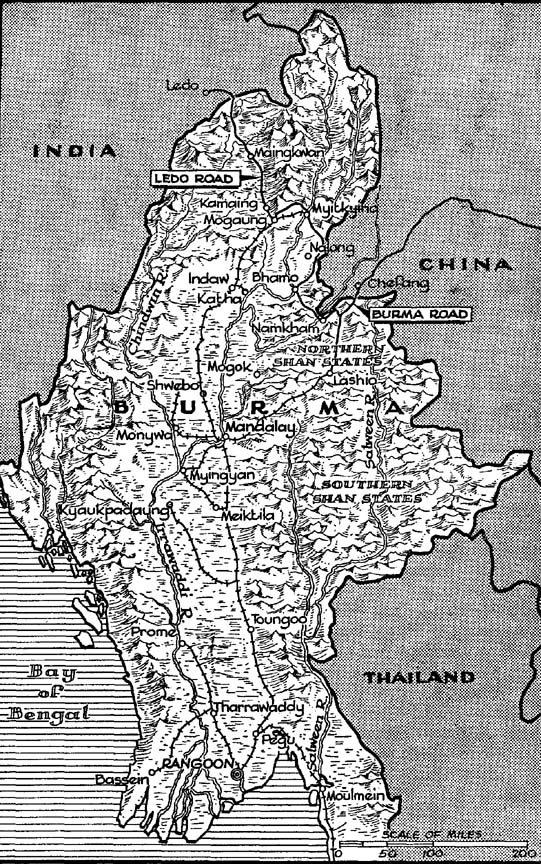
IN SEVEN terrible months from December 7, 1941, to June, 1942, Japan conquered an empire in the Pacific. Her armies overran Malaya, Burma, the Netherlands East Indies, and the Philippines. China was isolated and Australia menaced. Then, in the summer and late fall of 1942, the Japanese advance was halted at Midway, Guadalcanal, Port Moresby, and at the gates of India.
With the main military strength of the United Nations then dedicated to the defeat of Nazi Germany, the American commander in the China-Burma-India theater, General Joseph W. Stilwell, saw only one possibility of effective action against the Japanese. With Chinese troops trained and conditioned in India, he would reconquer a route into northern Burma. American engineers and service troops would build a road through some of the worst terrain in the world from Ledo in Assam to the old Burma Road and Kunming. This would relieve China's isolation and make it possible to supply her with weapons and equipment for the war against Japan.
It took a long time to nurse back into health the disease-ridden remnants of the Chinese armies which had retreated from Burma into India. It took even longer to train the Chinese soldiers who were flown into India over the Hump. Early in 1943 General Stilwell was ready to begin an operation which many observers regarded as impossible.
IT WAS March, 1943, and Burmese refugees were at last on their way back into Burma. At any rate a small group of us were on our way: twelve of the Burmese nurses, Lieutenant Harris of Washington, D.C., and myself. Lieutenant "Bill" Cummings, former charter member of our hospital unit and now on special duty in the wilds of Burma, was our escort.
It had not been easy for us to obtain permission to start back so soon. All of "Uncle Joe" Stilwell's plans for an early return had been given up for lack of support from home. Uncle Joe---"Granddaddy" to our nurses---was XYZ on the priorities list in those days. All the supplies and troops America had were pre-empted for what the world---but not the G.I.'s of China-Burma-India or the Burmese refugees---considered the really important theaters. And that meant every other theater except C.-B.-I. We could get along on a face-saving shoestring to make the Chinese remain in the war until we conquered all enemies but hers. Then we would begin to rescue China in earnest.
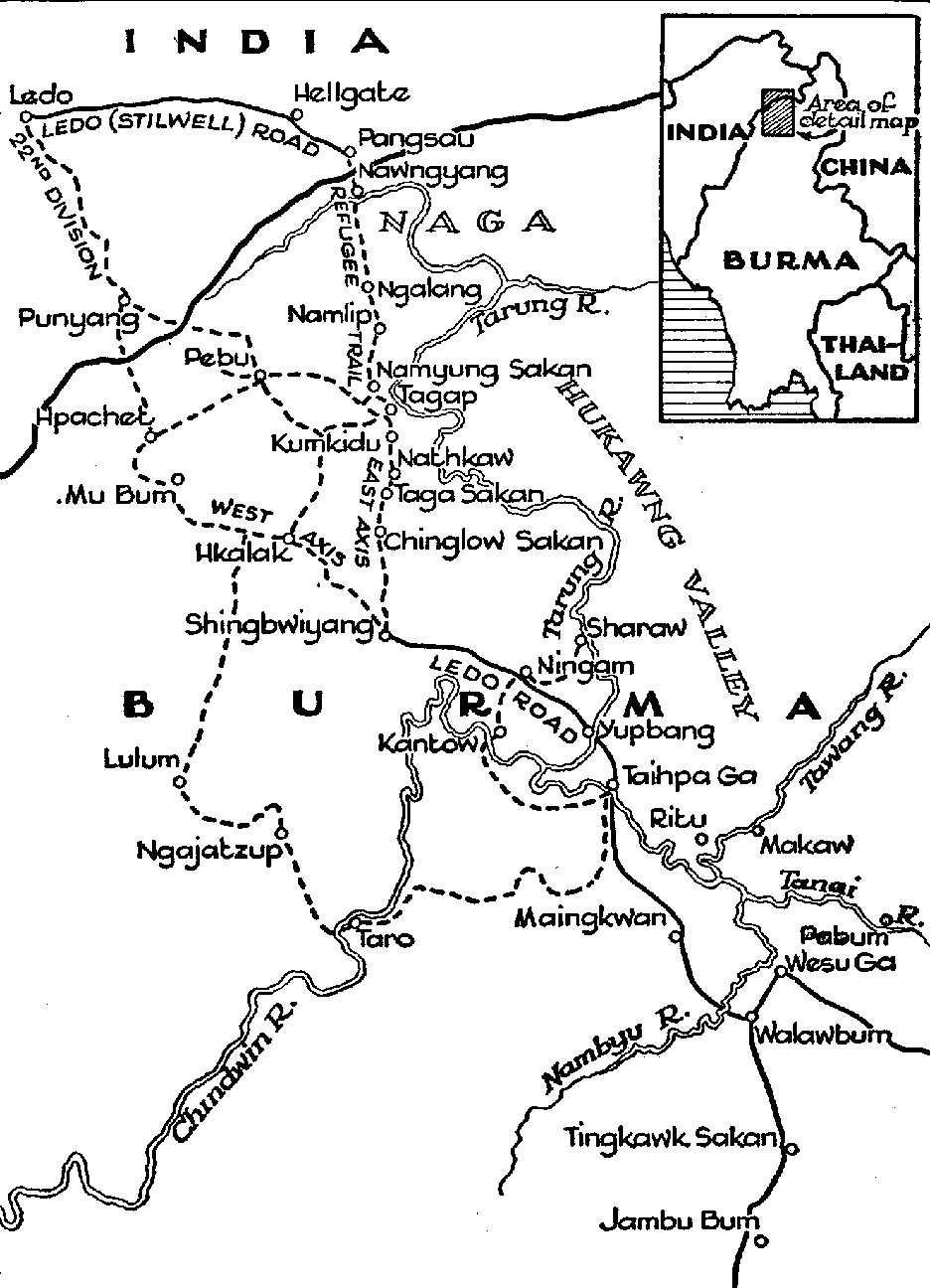
General Stilwell couldn't have been very pleased by the meagerness of the resources allotted to him, but distress was never visible in his face or actions. Give him little or give him nothing, he had promised to return the "hell of a licking" the Japs had given him, and he went about his "impossible" task with determination and no complaints. Already his few colored engineers had bulldozed a road from Ledo in Northeast Assam to the Burma border in the Pangsau Pass. Now the road was going down into Burma itself---if you can call the Naga Hills and the Hukawng Valley "Burma." But though the colored boys were working at all hours, with rifles and tommy guns strapped to their backs, Granddaddy knew they would accomplish more if the Chinese troops he had trained for eight months at Ramgarh were to do their share in opening the Ledo Road to China by throwing a screen in front of the road builders. So the Chinese were on their way and we after them.
It was good luck that had secured the assignment for us. Uncle Joe had been on an inspection trip to Ramgarh where I was post surgeon and asked me, as usual, to tell him what we needed.
"Sir," I said, "since we came to Ramgarh last July we have had no complete set of surgical instruments. The British left in their prisoner of war hospital only a few decrepit instruments, and if Dr. Gurney and I had not brought a lot of our own instruments along with us from Burma we couldn't have done half the surgery the Chinese Army needed. All the new American hospital units that have come to India have had complete sets of surgical instruments allowed in their Table of Basic Allotments in the States. Service of Supply has no bulk stores from which to fill our own requisitions. Now I understand that at Ledo there are large stocks of surgical instruments in China Defense Supplies destined for China. Since our hospital is working for Chinese troops, may I have your permission to go to Ledo and select instruments both for the Ramgarh hospital and for our unit to use when we finally return to Burma?"
"You're not planning a one-man expedition into Burma, are you?" the general asked with a twinkle in his eyes.
"No, sir," I replied with a grin. "I promise not to go beyond the border." Granddaddy was acquainted with my slippery ways.
"My plane starts for Delhi in the morning and then we'll go on to Ledo," the general said. "Be at my headquarters an hour ahead of time."
I was not late for that appointment.
We drove to the airport in Ranchi and took off in "Uncle Joe's Chariot."
One "Cook's Tour" of Delhi is all anyone with a grain of sense ever wants, and I'd had that experience eight years before. So after I got my order from the Theater Medical Supply officer for whatever useful instruments I might find in Ledo, I sat in complete boredom in the hotel.
We had an incredibly beautiful trip straight to Chabua the next day. The atmosphere was delightfully clear and we flew close to the Himalayas all the way. Since it was "winter," the snow on the range was gorgeous. Two brass hats and I had an argument about which of the peaks was Everest. I pointed out Everest's "cocked hat" and beautiful Kinchinjunga as well, but the colonel said, "That isn't Everest. The pilot says we won't see Everest for another hour."
I bit my tongue. Of all lessons I'd learned in the army, the chief was that one does not deny the truth of anything an officer says, no matter how wrong it may be, if that officer happens to be your senior even by a day. I continued to enjoy looking at Everest and Kinchinjunga by myself, recalling the happy days, ten years before, when our whole family had made a four-day march from Darjeeling, opposite the base of Kinchinjunga, to Sandakphu, almost on Kinchinjunga's shoulder, just to have a good look at Everest. One doesn't forget things like that.
The colonel, poor chap, never did see Everest.
We landed at Chabua early in the evening. No transportation was available to Ledo till morning so we spent the night there and I hopped a ride in General Wheeler's car next morning. The portents were good. I knew my travels had really begun when I noticed that I had left my pillow behind in Chabua. I always leave something behind at each stop when I am on a long journey.
At Ledo I found my friend Lieutenant Colonel Victor Haas who once told me in Lashio that no matter how good a teacher I was I would never make a decent nurse out of a Kachin.
Later Haas came to Ramgarh to visit me. "When I was flown out to India," he said on that occasion, "they asked me what famous historical sights I intended to visit and I told them there were only two famous things I wanted to see in India: the Taj Mahal and Seagrave's Burmese nurses. Now let's see them!" At the end of the inspection Haas had to admit that Kachins could be made into wonderful nurses.
Haas was now surgeon of S.O.S. in Ledo. He not only secured my instruments for me but drove me to "Hellgate" in sight of the Pangsau Pass and then back to my assigned quarters at Chih-Hui-Pu. To my delight one of our unit's best friends, Lieutenant Colonel McNally, was in command. Mac was in perfect condition, griping in his best manner at what was going to happen to his Chinese troop's when they established their advance screen in the Naga Hills.
"It's ghastly country, littered with the bones of the refugees," he said. "There is malaria everywhere and the streams must be still swarming with the cholera, typhoid, and dysentery that killed the refugees by the thousands. In two weeks I have to send Chinese troops down to Tagap and Punyang and there isn't a medic around to go with them."
"There's me," I said, ungrammatically.
"If I had a chance to see General Stilwell I'd jolly well ask for you. But what would happen to Ramgarh?"
"My executive officer, Major Crew, is a better army officer than I'll ever be," I said. "Besides, there are only about seven hundred patients left in Ramgarh instead of twelve hundred. They could spare a couple of surgical teams from our unit and never miss us, and" I added out of the corner of my mouth, "General Stilwell is in Chabua. I rode up in his plane."
Colonel McNally jumped up and reached for his hat. A few seconds later his jeep vanished around the corner.
Chabua had only one plane out the next day and it was bound for Delhi after one stop in eastern Bengal. I had either to get out at the Bengal field and chance catching a plane for a thirty-six-hour ride to Ramgarh through Calcutta or fly on to Delhi, catch another plane back to Gaya, and thence the short way by train to Ramgarh. I chose the latter as the quickest route.
Back at Ramgarh Lieutenant Harris and Stinky Davis wanted to go along if my Ledo coup produced results. It did. General Stilwell radioed orders for two surgical teams of the Seagrave Unit to report to Ledo for orders.
Major Grindlay and I had a quarrel as to whether he or I should lead the party. At last he agreed that I should go---if I would promise to use all my influence to move him and the rest of the unit out into Burma as soon as possible. I was in a humor to promise him the moon.
Captain Webb headed the smaller group---Stinky, four nurses, and my Lahu boy Aishuri---while Lieutenant Harris and I led the larger group of twelve nurses and Judson, my Burmese supply officer. I discussed the question of Chinese orderlies with General Boatner, and he ordered me to select thirty Chinese sailors and soldiers from our wards and take them along. These sailors had had a hard life. Removed months before from interned ships at Calcutta, they had been a constant headache to the British who gladly dumped them in the lap of the Chinese Army when it reached Ramgarh. The Chinese could think of nothing to do with them except put them in a concentration camp, where they became an American headache. General Boatner cured the headache by turning them over to me to use as orderlies and cooks in the hospital. Having spent their lives on occidental ships, they were the perfect servants.
"But, General," I said, "what if they desert as we pass through Calcutta?"
"You won't be held responsible," he replied.
The thirty men---there were six soldiers among them---were suspiciously eager to go with us.
The railways were, as usual, overloaded. We might have two compartments but no more, so General Boatner ordered me to leave at once with my larger group, while Captain Webb and his group were to follow with the Chinese on the next available train.
On the seventeenth of March, we were at the great jumping-off place for Stilwell's return to Burma-Ledo. We parked the girls at the 20 General Hospital and took up our quarters in a tent at Chih-Hui-Pu. That afternoon some of the girls turned up, their eyes popping.
"You know those American nurses?" they said. "They aren't a bit ashamed of each other. Why, when they bathe they strip to the skin right in the middle of their barracks and even bathe in front of each other!"
In the excitement of moving I was sure the nurses had forgotten my birthday, but at five next morning the entire Chih-Hui-Pu staff, Chinese and American, was astounded to hear "Happy Birthday to You" pour from female throats right in the middle of a male camp. The girls had carried presents for me all the way from Ramgarh. Later I learned that the girls in Ramgarh had also thrown a party in honor of my birthday.
That afternoon, as we were repacking our equipment into forty-pound porter loads, Colonel McNally asked me to take a look at Colonel Rothwell Brown of the tanks who had just returned from a trip to Shingbwiyang in the Hukawng Valley with my former Burmese supply, officer Tun Shein. They had been lost for seven days trying to find a road which the maps insisted ran from Taga Sakan to Hkalak. Rothwell Brown is an extremely efficient artist at profanity and he was at his best as he described how their rations had run out and Tun Shein had kept them both alive on roots, leaves, and ferns. "Ferns," he profanely insisted, "are the best three-blank things to eat I ever tasted."
The climax of their trip had come when, at the foot of the incredible climb up to Ngalang, Brown had come down with a terrific chill and a temperature of 106° But he marched on into Ngalang, 106° and all. Now a shadow of his former self, he was worrying Mac to death insisting that I treat his malaria "on the hoof."
McNally asked Colonel Tate of the colored engineers to get me a hundred porters for our trip. The colonel claimed it couldn't be done, and then promptly went ahead and did it. Stilwell and his men only enjoyed life when they were doing the impossible. So Mac put us all into two Chinese six by six trucks and started us off for Hellgate where the porters would be waiting for us.
How the girls enjoyed the trip! They gurgled with laughter at the signs the colored engineers had stuck up along their "Ledo-Tokyo Road": "DON'T TEAR ME UP, ROLL ME DOWN!" "I'M YOUR BEST FRIEND; DON'T RUIN ME!" "HEADQUARTERS FIRST BATTALION, HAIRY EARS." "TATE DAM. HOT DAMN, WHAT A DAM!" And later, "WELCOME TO BURMA. THIS WAY TO TOKYO!"
Soon we began to pass groups of colored boys at work. One stepped back wearily with his spade, took one look at us, threw his hat in the air, and screamed, "My God! WOMEN!" The girls became a bit scared as they recalled some of the things they had heard about the way American Negroes treat women. They recovered soon enough as they became acquainted at close hand with our colored soldiers. Let me say here, for the record, that though an occasional American white enlisted man or officer and an occasional Chinese soldier or officer had been known to offer insult to our Burmese nurses, not one single colored soldier ever treated them with anything but respect. The girls often recalled with misty eyes the colored soldiers they came to know so well.
When we reached Hellgate---Chinese drivers were not permitted to go farther---we expected to sleep in some of the coolie huts. But Colonel Tate had sent word to the captain of engineers that we were coming, and the captain met us and escorted us to his own camp, where he turned over the newly completed messhall to the nurses and gave me General Wheeler's bed---the only time I ever had the honor to sleep in a major general's bed. I begged the captain to let the girls cook their own Burmese food since they were so fed up with American meals, and much against his sense of hospitality he permitted them to do so. It was the first time the girls had cooked for themselves for many months and the dinner was delicious.
We were a day ahead of schedule so the next day the girls asked to go for a swim. There were Americans, Chinese, and Garos bathing under the Hellgate bridge and the girls refused to bathe there. I led them two miles down the Refugee Trail, where we found a deep hole near a village of aborigines garbed in loincloths. We had a delightful swim, in spite of the fact that we had had to step over a few whitened refugee skulls to get there, and then rushed back to camp to beat the rainstorm that invariably arrived when our unit was about to travel somewhere.
The next morning some colored boys drove us up the mountain until they bogged down in the mud just before reaching the Pangsau Pass. We had been surprised at how good our Chinese drivers had been after their Ramgarh training---we remembered well how they had driven on the Burma Road! But these colored boys could really drive. Even when the fresh earth of the road shoulders slid away they performed miracles getting their trucks back onto solid ground again. We stepped out into the deep mud, when the trucks finally bogged down, and began to march. Almost immediately Sein Bwint's flimsy shoe was sucked off in the mud. We hadn't been able to buy one pair of stout shoes in all India that would fit the girls, and G.I. shoes, three sizes too large, were so ungainly that I never dreamed the girls could use them. Captain Webb, however, thought differently, and the girls clattered around delightedly all day long in their huge oversize G.I. shoes.
 As
we passed the "WELCOME TO BURMA" sign at the top of
the pass the girls began to laugh and sing and trot downhill,
though the rain was drenching and cold. They were on their way
now, back to Burma and home and parents. That night we slept,
still drenched, in three little huts in Nawngyang---the returning
refugees' first night in Burma! To our astonishment we were serenaded.
"Silent Night," "The Spacious Firmament,"
"All Hail the Power," and other favorite hymns swelled
forth in exquisite harmony from the hundred throats of our Garo
porters.
As
we passed the "WELCOME TO BURMA" sign at the top of
the pass the girls began to laugh and sing and trot downhill,
though the rain was drenching and cold. They were on their way
now, back to Burma and home and parents. That night we slept,
still drenched, in three little huts in Nawngyang---the returning
refugees' first night in Burma! To our astonishment we were serenaded.
"Silent Night," "The Spacious Firmament,"
"All Hail the Power," and other favorite hymns swelled
forth in exquisite harmony from the hundred throats of our Garo
porters.
I was proud of the noble work of our Assam colleagues of the American Baptist Mission among these wild Garo tribesmen of southwestern Assam. All our porters were Christian. Garos take their time when portering but they stole none of our goods and they are the only race I have yet found in India that knows how to give out with a belly laugh. On contract to the British Government and under command of American missionaries, they did almost all the portering for the U.S. Army as far south as Tagap. Later they worked southward as far as Shingbwiyang, the first "town" in the Hukawng Valley. They know their jungle. One group of G.I.'s was astonished to see the Garos suddenly get excited and begin splitting a hollow tree trunk. They were still more astonished to see them start pulling from the tree trunk, foot by foot, an enormous twenty-foot python. Their astonishment knew no bounds when the Garos immediately cooked and ate the huge snake.
Garos will not set out on a journey before seven in the morning. I was worried about how six-foot-two, spindle-legged Lieutenant Harris would stand the trip up the terrible ranges ahead; but we wanted an early start so we pushed on at our best speed, leaving Harris to see the porters off with all our goods. To my amazement Harris caught up with us within an hour. How a man from the most notorious chair-warming city in the world, Washington, D.C., could negotiate these hills on high was a mystery, until he acknowledged that his Washington address was a temporary one and that during most of his life he had been a Tennessee mountaineer.
I was curious about this Refugee Trail which ran from Mogaung on the railway near Myitkyina through the Hukawng Valley and Naga Hills to Ledo. My father had trekked it forty years before when visiting Assam with Dr. Geis of Myitkyina. Geis never saw me without telling me what a fine man he had found my father to be on that journey. No sooner would Geis state his own desires as to where to rest, what to eat, when to start, where to bivouac, when my father would concur with his "extraordinarily intelligent" decisions. It is not difficult for a domineering personality to love someone who lets him have his own way. I suppose Geis's unstinted praise of my father was repeated to me in the hope that I might change my persistent habit of resisting the A.B.M. powers. But I was a hopeless failure at emulating my father.
These Naga Hills were famous for their head-hunting tribes. My father had met many parties of head-hunters on his trip but they showed no interest in his head. The British, however, never entered the Naga Hills along this route unless backed by a small army. I was curious to see these frightful Nagas and compare them with those we met on our retreat with General Stilwell a year before on the Indaw-Imphal trail, much farther south. Would we meet the famous tribe whose women wore nothing before marriage but a tiny apron on their behinds and swung it around to the front after?
Last but not least of the reasons for my interest in the trail was that it was by this trail that "Tiny," my wife, planned to march out of Burma with the two little boys if I had let her remain till the country fell to the Japs.
As we marched along the trail, place names recalled another disastrous expedition of seventy years before when the King of Burma sent his famous General Bandoola with an army to invade and conquer India! From Tingkawk Sakan at the southern entrance of the Hukawng Valley to Namyung Sakan and Namlip Sakan along the Refugee Trail you can trace the line of march of Bandoola's army all the way to the neighborhood of Ledo. Sakan is the Burmese word for "bivouac." Other names showed us that all this belt of country was a no man's land rather than a real part of the Naga Hills. Place names like Nawngyang and Namyung were Shan. Names like Tagap Ga and Tanai Hka were Kachin. Hpachet Hi and Shamdak Ku were Naga.
We soon found that the people were no man's people. When we marched around a corner two natives were resting at the entrance to a side road. I could see Kachin blood in the shape of their faces and stopped to pass the time of day with them in Kachin. Thank God we were back in a country where we could converse with people without using several relays of interpreters! I asked them whether they were Kachins or Nagas. "Neither," they said. "We are Chins." People the whites called Nagas called themselves Chins but spoke Kachin. Along the East Axis, as the army called the Refugee Trail, all the Nagas called themselves Chins---which they decidedly were not. They were hybrids. All sorts of conquests and migrations had occurred along the axis through the years. We saw natives with unmistakable Shan, Hkamti, Burmese, Kachin, or Naga physiognomies calling themselves Chin, but there was no pure blood of any of these races. In a few more years people still calling themselves Chin will have American, English, Indian, Negro, Garo, Nepali, Chinese, and Japanese features as well!
We soon found that it was also a no man's land with regard to climate. Assam has the world's heaviest rainfall but at least the rain has sense enough to fall in season. Burma weather is beautifully regular. But that of Hukawng follows no rules whatsoever. It makes all its own climate and every bit of it wrong. July was supposed to be the rainy season, so we had weeks of beautiful weather. We shivered in Tagap in the hot season. As we marched along it was the middle of the dry season, so it poured steadily for a month. This was the country through which Stilwell's engineers had to build their road from Ledo to China, and build it without hard rock with which to surface it---nothing but clay and soft river rock.
Through these torrents of rain the Chinese had marched down the Refugee Trail two days ahead of us and with animal transport. As a result we were continually to our knees in mud even when going up the steepest of hills. At every step you had to yank your leg out of the mud with an angry suck and sink it in to the knee again as you put it down. Stilwell's pace, with a ten-minute rest every hour, had to be abandoned at once. We were lucky when we didn't stop for oxygen every ten minutes. And when the deep mud no longer hampered us we growled inwardly at the lack of mud, for then the path, sloping in every direction at once, was so slippery that we were continually negotiating the road on our behinds. Ground leeches were everywhere. I had always thought people were exaggerating when they claimed that leeches could suck a man to death, but I'm sure that many of the refugees must finally have succumbed to leeches.
Certainly they had succumbed! From the first day on we passed skeletons in ever increasing numbers, yet we could see evidences of camps where, by setting fire to the shacks, hundreds of skeletons had been destroyed en masse. There were skeletons around every water hole, lying sprawled out where the refugees had collapsed. At the foot of every ascent were the bones of those who had died rather than attempt one more climb, and all up the hill were the bones of those who had died trying. Still standing along the road were some extremely crude shacks, each with its ten to twenty skeletons of those who couldn't get up when a new day came. In one shallow stream we were horrified to find that the Chinese had placed a long row of skulls to be used as steppingstones. Sex and age and even race could be noted, not by such elusive clues as surgeons use but by the rotting clothes. When I saw a skeleton clothed in a delicate English dress I was thankful for Tiny's departure a year before. Looking at the skeletons of little boys in khaki shorts, I realized they might have been John or Sterling. There were men, women, and children of every race and age, their hair white, gray, brown, and black, still lying beside the whitened skulls; there were English, Anglo-Burmese, and Indians---civilian and military.
There were no skeletons of Chinese soldiers. The British had not permitted the Chinese Army to use this trail, the "easier" trail of the East Axis, but had sent the Chinese 22nd Division out on the trail of the West Axis which had much steeper and higher ranges to cross. But the government miscalculated. The rivers that the East Axis crossed were much bigger than those of the West Axis, and while the Chinese were held up at only two or three streams, the Burmese refugees were held up all along the line, dying by the hundreds as they waited for the rivers to go down.
And yet in spite of the hundreds and hundreds of skeletons we saw, we didn't see half of those who had died on the Refugee Trail, for English and Indian and Chinese burial and cremating squads had been at work. A few months later only a few scattered skulls were left to mark the trail of the refugees. Now we were the first of the refugees to return.
As we reached our second night's camp we began to get a foretaste of what was to hound us for the entire year to come. There were officers in the area who knew not "Joseph and his daughters" and supposed these girls "couldn't take it." We were told that officers up ahead were horrified at the speed of our advance and were rushing to get proper camps built for the nurses. We were not to proceed until all camps were completed. We halted for Sunday since the coolies were tired and, as Christians, entitled by contract to one day off per week. Then, too, the girls had worn out their first pairs of shoes and were beginning to develop sores on their feet. But by Sunday evening everyone was so restless to get on that we resumed our march the following morning.
On that day we had the worst climb of all---uphill hour after hour, pulling ourselves up out of mud by the roots of trees. On the slippery stretches I stamped my G.I. heels as deeply as possible at each step, hoping the nurses might catch toe holds. Each of us carried a long strong cane to push ourselves along and help us keep erect. But at almost every step one or the other would go down, to the uproarious delight of the rest of the party. Cheers always burst forth when the old man himself went down. And so on, up and up to unbelievable heights, till at last we came onto the air-drop field at Ngalang. There the enlisted men at the radio station made us completely at home in a spare shack, while they prepared for us the kind of meal only our air force units could produce. Unfortunately there was no visibility that afternoon and we missed the magnificent views from Ngalang where to the north on a clear day one can see the snowy range of the Himalayas.
Travel the next day was much easier and brought us to a camp delightfully situated near a rushing stream. The shack was only just building but by night there was a thatched roof over our heads, and what more could returning refugees want?
At no time did we cover more than eight miles in one day, although without a heavy pack sixteen miles a day is quite possible in those hills if it has to be done. We got a big laugh when we read long after an article in a States-side magazine about the Signal Corps man who "taught himself to walk five miles a day" in the head-hunting Naga Hills. We purposely took it easy on this trip because we had no idea how soon the Chinese would begin to have casualties, and the girls had to be ready for them.
On the noon of our sixth day we came to the wide Namyung River at the foot of the enormous mountain on which perched Tagap Ga, the intended base for Chinese operations. We were so anxious to get there that after tanking up on tea we started the last climb at once. The nurses now began to search the jungle for edible plants which they might secure on future forage trips. At last there were wild flowers and a few edible fruits which bravely tried to cover the traces of the refugees.
Nowhere along the road was there a single native village. Even "fierce Naga head-hunters" could not understand the tragedy of the refugees except as the act of one of their mysterious gods, and they had moved away, as far as they could from the haunted and accursed trail. Even at Tagap there was nothing left of the village that formerly housed the tribal chief.
Airplanes were dropping food and ammunition as we reached a knoll in front of Tagap. We watched them free-drop sacks of rice and then parachute down sacks of canned goods and ammunition. It was impossible to cross the field as long as the planes continued to circle and drop. Finally, as colored American Quartermaster boys began to gather in the day's haul, we pushed on to the coolie camp beyond the Chinese troops. We were at Tagap Ga---the base for our work.
The British major in charge was extremely cross because we had come on in spite of his instructions, for he had nothing but a roof and a floor to offer us. I asked him if he had ever heard a nurse complain at having nothing more than a roof and a floor.
Quite often they had been happy with a roof and no floor. If there were no roof they could jolly well make one in a hurry.
Major General Wheeler of S.O.S., a day behind us on the trail, reached Tagap in the early morning. His first action was to ask Major Peng, the Chinese commandant, whether he had yet sent forward the company of troops that had been ordered on patrol. Peng had not. Wheeler ordered them off at once. Finally a patrol of one platoon set off and had proceeded only a mile beyond Kumkidu, with a Kachin scout a hundred yards ahead of them, when they bumped smack into a Japanese patrol. Machinegun bullets tore up the earth around the Kachin scout. The Kachin slipped into the dense jungle and circled back to the Chinese who were frantically deploying to return the Japanese fire. The first engagement of the new Burma campaign was joined within twenty-four hours of our arrival.
The first casualty was, of course, an abdominal case. We had not set up yet. The few available transport planes were bringing in higher priority stuff than tarpaulins. We would have to build thatched bamboo shacks and that would take time. So we borrowed the Signal Corps messhall and did the operation on their dinner table. The intestine had been badly torn and, as in the case of so many Chinese, roundworms were escaping from the various rents and exploring the abdomen on their own. One was actually lying in the abdominal wound, its body cut in two by the bullet. By the light of one gasoline lamp and several flashlights we resected the torn intestine and made an end-to-end anastomosis. A respectable number of my abdominal cases had been known to live, but not one where roundworms filled the abdominal cavity. This patient lasted twenty-four hours.
While our own Chinese battalion was successfully holding the Japanese, Bill Cummings was ordered to proceed with a Kachin patrol down the Salt Springs Trail that connected the East and West Axes and find out what had happened to the British troops then garrisoning Hkalak at the entrance to the West Axis. The garrison consisted of Indian and Kachin troops officered by former British tea planters of Assam. There was also a radio team of American enlisted men at Hkalak. Bill made a forced march of twenty miles and when he reached the middle trail toward Pebu bumped into the force retreating to Pebu on the double quick. Having been attacked by an "overwhelming force of two hundred Japs," they had barely had time to fire their supplies and run. The American boys, ordered to retreat, had scattered their radio equipment in the jungle. Bill about-faced and marched back over that ghastly trail without rest to report to General Wheeler.
The retreat of the Hkalak garrison, before the arrival of Chinese troops down the center trail, laid Tagap wide open to Japanese encirclement and General Wheeler ordered us to pack up and be ready for immediate evacuation---if the Chinese had to fight their way out of the encirclement. The same old story of the first campaign in Burma: the Japs attack with a party of ten or two hundred, it doesn't matter which; the colonial troops retreat at the drop of a hat, convinced that they will not be able to resist successfully; the Chinese have to retreat or be surrounded; and commanding generals have to start worrying about the safety of American medical units. Was the new campaign to be tainted with the same defeatism? Had no one the guts to make a real stand? What would Stilwell say if we all started running again?
General Wheeler was busy sending out 4-Z radio messages, but twice that day I snared him and pled with him.
"Sir," I said, "the Chinese have so far not discovered much reason to trust the United States fully. They have no proof that we also are not going to run away and leave them holding the bag the minute they come up against danger. During the first campaign General Stilwell kept our unit well out of harm's way and always warned us in time of an imminent Chinese retreat. The general was certainly justified because at that time we were the only surgical unit he had for the entire Chinese Army. That situation has changed. There are all sorts of American medical units now in the theater. If anything happened to us we wouldn't be missed. These nurses are Burmese girls of the country for which we are fighting. They aren't going to gripe if they die for their country."
"Naturally not," interpolated the general.
"Furthermore," I resumed, after the laughter that this outburst provoked had subsided, "nothing would please the Chinese more than to have a high-ranking American officer stick it out with them. If, in addition, that officer is an American officer with a detachment of women nurses who have the guts to stay, their morale will also be enormously improved. As for myself, I had a hard trip here, marching forward over those hills. I know I can't go up them backward!"
The general was noncommittal, so I saluted and left.
Next morning, scouts reported that the Chinese advance patrol at Pebu had thrust south below the entrance of the Salt Springs Trail and had dug in there while the colonials continued to retreat. Colonel Rothwell Brown was with them. Captain Webb and his nurses had arrived at Ledo, minus twenty sailors who had slipped away as they came through Calcutta, and were marching in to Punyang on the West Axis. Judson, whom I had left behind to escort Webb into the jungles, was with them. Our own Chinese were holding at Kumkidu and "had inflicted many casualties on the enemy." General Wheeler, greatly relieved at the stabilizing of the line, permitted us to go ahead with our plans and build the hospital.
Our Garo porters cleared the bamboo jungle and erected wards, a supply shack, an operating room, and, finally, several little bamboo houses with bamboo floors and bamboo beds thatched with bamboo leaves. There was a cottage for every four nurses, one for Harris and any guest who might appear, and one for me. Some Nagas built us a pipeline of bamboos which carried water from a stream nearby right through the hospital grounds to the operating room. As soon as the supply building had been built we moved into it and put up a combined messhall and kitchen. That day there was another casualty whom we placed in the messhall since the wards were not quite ready.
About ten that night there was a tremendous burst of machinegun and tommy-gun fire and bullets whizzed over us. It was lucky we were in a hollow out of the line of fire. Everyone supposed the Japanese were making a fierce attack and I expected casualties before morning so ordered all the nurses to bed while I went on sentry duty beside our patient.
At midnight the firing reached a new peak of intensity and mortars opened up all around. Suddenly there was a flash of a dozen torches and what in the dark seemed like the entire Japanese Army plunging down the path toward me. I stepped under cover and waited with my automatic. As they drew near, the light from the torches showed me that the Japanese Army was only our Naga coolies.
"Where do you-all think you're going?" I asked in my best Kachin.
"The Japanese have broken through and are coming this way. We're beating it for home."
"If the Japanese were coming they would already be here," I said. I had to talk alternately in Kachin and Burmese now, for my Kachin was fast running out, but the Naga headman knew Burmese. "You guys can run home if you want to but you are not going to run home through this hospital area. I always understood Kachins and Nagas were brave men and made good warriors and yet here you are running away like mad, while girls of your own race are in that shack over there sleeping quite peacefully in spite of all this shooting. Only chickenhearted blankblanks would start running ahead of women. Back up and run away on some other trail."
The Nagas were armed with rifles and shotguns, but they didn't know what an awful shot I was. My automatic looked very efficient even if I did not, so they milled around for awhile, arguing, and then followed my advice and went back to bed.
In the morning we discovered that the great battle was caused by the appearance not of Japs but of a herd of large monkeys which swarm all over the Naga Hills. I couldn't blame the trigger-happy Chinese for mistaking yellow monkeys for Japs. A few days later a Chinese patrol found that the Japanese had retreated. It was discovered a month later that not more than ten or twenty Japanese troops had caused the rout of the colonials at Hkalak.
The troops in the forward area those first months were the 114th Chinese Regiment under Colonel (now Major General) Lee Hung, and the battalion at Tagap was under the command of Major Peng Ke-Lee, now a full colonel, having taken over command of the 114th when Colonel Lee assumed command of the 38th Chinese Division. I had not known Major Peng before, but Colonel Lee and I had seen quite a bit of each other in Ramgarh. Our relationships with both men were very pleasant. We had to work hard to give them as much co-operation as they gave us. One or the other came every day to the hospital to report information received and enable us to be ready for emergencies. Neither knew English, but they saw to it that interpreters did not last long who tried making speeches for them, instead of actually translating their words. Colonel Lee was young but had the tired eyes of a man who does occasional deep thinking. Major Peng had close-set eyes and a broad mind, a rather unusual combination in my experience. He had an enormous admiration for Nurse Nang Aung whom he called "Miss Wang" and often used her as an interpreter. The relationship between them was interesting to me. There was never any flirtation. Major Peng never came around when off duty. But he never failed to pay his respects to Nang Aung when military affairs brought us together. If he had fresh fish at his table, he would invite us all to enjoy the meal with him or else would send fish over to us. He and Major Hu, who came to Hkalak in October, were our favorite Chinese majors. The most extraordinary characteristic of Colonel Lee, Major Peng, and Major Hu, in my mind, was the fact that not one of them ever came to me with an illegal ax to grind. They never asked me, for example, to use force on American Quartermasters to compel them to issue American rations to Chinese troops. They knew that Chungking had decreed what the Chinese should have and they abode by that decision. If any soldier under their command needed discipline he got it, and quickly. It seemed too good to be true. Another delightful thing about all three was that they wasted no time. They got down to the matter in hand at once without the usual half hour of polite prelude.
We were back in routine work again and now actually in Burma, though none of us was willing to think of the Naga Hills or the Hukawng Valley as Burma. But as the days passed it was forced increasingly on my consciousness that there was something wrong with the nurses. They didn't seem happy, even though they were so very much nearer their own homes. Pouts appeared for no reason at all. There was no cheery singing as they worked and even our Sunday-evening song services went flat. I worked off my own energy studying Japanese surgery, the kind one performs with an ax: I cut loads of firewood. I even took my turn in the kitchen making pies and cakes and delicious curries, hoping to wheedle the nurses out of it-whatever "it" was. Not one would tell me until I was rather mean to Little Bawk one day and then she explained it was because the girls had had to leave their boy friends behind at Ramgarh in order to return to Burma---and what they had returned to was not Burma at all.
Ramgarh certainly had done something to those girls.