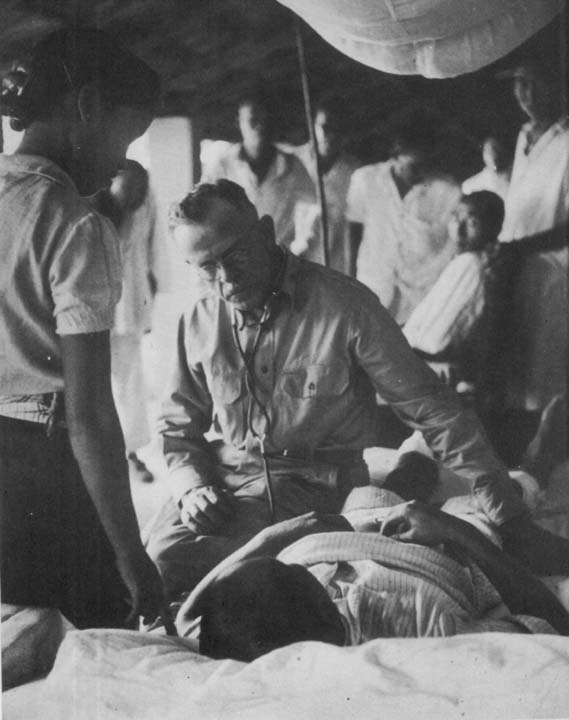
|
"TINY" TO BILL, PAUL, and TUN SHEIN TED and BASAW "UNCLE" GRINDLAY and MAJOR "BEAR" and even with my wholehearted admiration TO "GRANDDADDY JOE" |
|
|
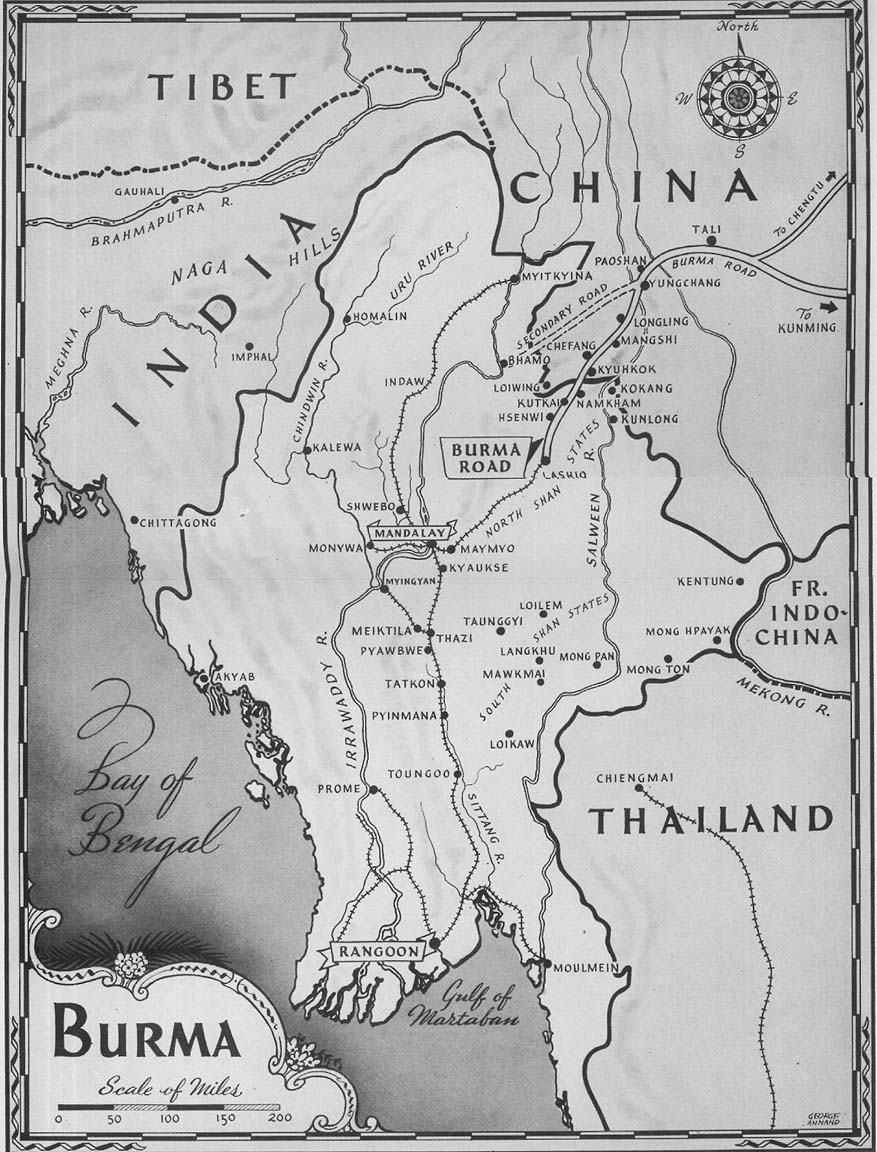
Rangoon; 1902---I was about five years old. A great hulking Irishman stamped up the steps to the huge verandah of the house my great-grandfather had built to live in when, after the second Burmese War, the British took over all of Lower Burma as far north as Toungoo. It was a huge house but it shook under the Irishman's footsteps. I came out to explore. The Irishman apparently loved children. He sat me on his lap and told me stories of wild jungles and great deeds: about service in the Royal Irish Constabulary as a young man; about his later adventures in Canada in the Royal Northwest Mounted Police; about stray rifle bullets that whizzed past him as he sat in his bungalow in the Shan States and that bored through the side of his bookcase; about the day his horse ran around the corner of a jungle path and almost plunged into a wild elephant, bucked and threw him to the ground; about walking sixty miles with both bones of his arm broken to find the nearest doctor. Then he grasped the top of a heavy dining-room chair in his teeth and swung it up over his head. I was fascinated! I tried it out on my tiny nursery chair, but it didn't work; my teeth couldn't have been much better then than they are now. Then he asked me for a glass of water to quench his thirst, and drank it down---standing on his head. I was completely overwhelmed!
After he had gone I asked my mother who the big chap was. "He is Doctor Robert Harper, a medical missionary at Namkham on the border between the Northern Shan States and China."
That made it still more romantic.
"When I grow up I'm going to be a medical missionary in the Shan States," I declared.
Mother didn't say anything. The vaporizings of a five-year-old didn't worry her. After a few years her only son would undoubtedly become an evangelistic missionary to the Karens of Lower Burma like his father, grandfather and great-grandfather, and a smattering of uncles and aunts, great-aunts, and what not had been before him. Blood would tell.
Perhaps blood would have told if the Karens hadn't taken their new national religion so seriously. To them religion meant going to church on Sunday in a big way. Their chapel next door boasted the largest bell purchasable in America and they rang it twice for each service. Half-past five every Sunday morning it woke them up. Fifteen minutes later it told them to hurry along for the morning prayer service. At six o'clock it warned stragglers that the service was beginning. At seven the women had a special meeting to pray for the souls of their errant males. Then breakfast, then Sunday school, then the main service, followed by assorted Christian Endeavor meetings till nine o'clock at night.
My parents were very lenient. The only service I had to go to was at ten o'clock. Now a good Karen preacher almost always begins his sermons with the lapse from grace of Adam ---it being Eve's fault, of course. An outline of the more dramatic sins of the poor Israelites follows, and then, after people have subsided into coma, he ends up with a little intricate exegesis of some of St. Paul's more difficult remarks.
I used to sit by my mother's side in the choir. All the Vintons who were missionaries to the Karens were musical, and so were the Karens. My father didn't have the Vinton voice, but he could wield a mean bass when he sat beside my uncle Vinton who was a basso profundo. My uncle Vinton's voice would come from his toes, some six feet two below his pith helmet, and fairly shock the natives. Those anthems were grand. Karen singing has even been known to convert a hard-boiled captain in the Medical Corps of the modern United States Army!
My father preached some of the most convincing, simply worded sermons I ever heard in English or Karen, and his prayers were poetry. But one day after a long-winded Karen sermon he stood up and prayed. I had been hoping for the best when the preacher sat down. This was too much, even if it was my father who was praying. I rolled the paper boat, which I had been making, into a wad and threw it at him in disgust. I hadn't meant to, but I hit him squarely on the cheek. The means I took to bring the meeting to a close were effective---very! So effective it still hurts me to sit down when I think of it.
My father never spanked me enough. If I'd been spanked as often as I deserved, I probably would never have grown to manhood.
I had three sisters, all older than I. Now that isn't right. If parents are going to divide their children eccentrically with regard to sex, the oddly-sexed one should be the eldest so that he will have some chance to lick the others when they gang up on him. That's what I did. I had three sons and one daughter, so I fathered the daughter first, and she can still hold her own though the eldest boy is about a foot taller than she is. But I had good training, taking on those three older sisters. I eventually stood up to my mother and dad and told them I was going to be a medical missionary---and made them like it.
Some time that same year a little girl was learning to toddle around in the not-very-famous city of Carlinville, Illinois, where her civil-engineer father was taking on more jobs than he could handle. She must have been "Tiny" then, and I bet she was cute. When I first saw her, some seventeen years later, she was, at least in my eyes, the glamor girl to end all glamor girls.
1909---The Atlantic was in a turmoil. I ate a ham sandwich as we pulled out of Southampton and my next meal---to stay down---was a banana as we passed the Statue of Liberty.
We settled down in the great and glorious university town of Granville, Ohio. Unfortunately, our house was surrounded by a yard sufficiently large for us to have a big garden. The fact that the garden was one mass of rocks didn't seem to matter to my father. Any future missionary, said he, should know how to lay his hand to anything. The more difficult and nasty jobs you could learn to handle, the better missionary you would be. So that was when I first learned to gather rocks. It was then, too, that I first learned how to handle women. My three sisters each had household jobs they had to do in rotation. One had to cook, one had to sweep, one had to do the washing. I had the garden. I bargained with Grace to do our jobs together, she to help me in the garden, and I to help her in the house. So I hitched her to the cultivator and made her drag that plough while I pushed---if and when we hit a rock!
On my part I learned to cook, wash the dishes, sweep, do the laundry, and, all in all, become the ideal bridegroom.
I liked to rotate crops. One year I raised so many potatoes that we didn't have enough room in the cellar to store our winter coal. Another year I raised so many beans that the grocery stores were filled with them, and the price of beans on the Granville Stock Exchange crashed. That was the year appendicitis and tympanites became so fashionable in central Ohio.
Mother thought I was getting off too easily, so we began raising chickens for the market. Everyone helped me raise them, but I was the Lord High Executioner. I don't like chicken yet unless it is a strange chicken that has been butchered far, far away. The ducks and geese were worse. Without a sound they could stretch out their necks on the chopping block. I am still unable to do an amputation without a sob.
But it wasn't all easy. Granville knew about missionary children, and since we had come there for an education, education was what we should have. I still bear on my bruised carcass the marks of that education. As soon as I got into long pants I began to work for my board in the college girls' commons, waiting on tables, since my father, being a missionary, never had any spare cash. I got quite adept at the art. I could carry five full coffee cups in my bare hands without very much of the coffee slopping into the saucers. I could carry out all the dishes for eighteen girls on one tray without having a crash more often than once in two weeks. That was good training for my shoulders, so I decided to go out for pole vaulting. I became an expert. Once in Johns Hopkins, at the end of the first World War, I actually got a gold medal for pole vaulting.
That night the Baltimore Sun gave me a good write-up: POLE VAULT---SEAGRAVE, JOHNS HOPKINS, FIRST. NO OTHERS RAN.
I earned my room rent by working in the college library, and my tuition by correcting papers for the English and/or Mathematics departments. That's how I became such a good teacher of nurses. I nursed a huge chap along who had failed his first semester's Virgil examination. By the end of the second semester he was so good he got an A and didn't have to take the examination!
1918---I was sick of the smells of the dissecting room at Johns Hopkins, smells that would empty the balcony around you if you went to a movie without a bath. I wanted some fresh air. I applied for and got a job at a summer camp in Lake Geneva, Wisconsin. I am glad I didn't know, in advance, what the job was going to be. At dawn we got up, fetched the tank car, went into all the cottage rooms and emptied the slop pails into the tank. But I used to come across a damsel there who was making up beds. Since 1902 she had been creating havoc on the farm her father bought for a hobby. When she wasn't hoeing the corn and the potatoes, she and her ten brothers and sisters had been generally raising Cain riding the horses bareback, falling out of trees, stealing apples and otherwise producing a crop of scars for identification purposes.
I had kept my fingers crossed whenever I cast my eye on these neurotic little creatures. I had seen many a first-flight missionary who had had to give up a grand job and come back to the States because his wife couldn't take it. But Tiny looked as if she could take it, with a little education! The only fault I could find with her was that she didn't like rice, and a missionary must like rice and curry. Something had to be done, for Tiny was too good to miss. She undertook to educate me in the art of enjoying long walks, and I used the opportunity to cook her some picnic dinners of rice and curry and teach her to like it. I was the better teacher of the two. Tiny loves rice and curry and can cook a mean curry herself. I abominate my legs and continually hope and pray I never have to use them. If a Japanese bomb gets me, I hope it's in my legs!
It took me two summers of slop emptying to convince Tiny she couldn't do better than marry me and go to Burma, but it was worth it. Furthermore I became completely converted to modern plumbing, as you shall see.
1921---Tiny was going to have a baby. I decided to find out something about babies with a summer internship in the Pediatrics Hospital at Mt. Airy, Maryland. We had a grand time there till Tiny's father was killed by a Chicago and Alton train.
Then came my real internship at the Union Memorial Hospital in Baltimore. I didn't begin well. During our first emergency appendix a telephone call came telling me Tiny's pains had set in. Why do residents always get such a laugh out of an interne who is having his first baby?
Then I got into trouble showing off Leslie Mae to the hospital staff. The Chief Resident, like Queen Victoria, was not amused. He accused me of upsetting the hospital routine. Well, the future Prom Queen, May Queen, and College Annual Queen of her university ought to be allowed to upset the hospital routine! The other day my colonel looked long and closely at Leslie's picture. "Well," he said at last, "there is something about her eyes! Yes, I guess you are her father after all." I was glad of that. I had wondered about it myself!
But it was in the hospital that I learned the efficacy of prayer in the practice of medicine. In our first year at Hopkins we had an eccentric classmate whose name was---shall we say---Smith. He hadn't been able to make the grade and had taken a job about town. An ambulance brought him in one night with a physician's diagnosis of acute appendicitis. John M. T. Finney had been called to operate. Smith fell into the hands of Paul "Eggy" Sutton, my fellow interne. Eggy found Smith hadn't had a bowel movement for eight days so he decided to give the preoperative enema himself. He called Smith to the toilet and proceeded to mix the enema. A quart of soapsuds, half a bottle of glycerin, several ounces of turpentine, and, finally, a pint of peroxide went into the enema can.
"Now," said Eggy, "before I give you this powerful enema, old man, I think we'd better kneel and have a word of prayer together."
But Smith, popeyed, didn't even get a chance to kneel. He no longer needed the enema, nor the operation!
One day in the operating room there was comparative quiet, and the operating-room superintendent decided to clear out all the useless broken-down surgical instruments that could no longer be repaired. I happened in as she was having the orderly take away a wastebasketful of these instruments. Since I knew my Burman mission and the extent of surgical instruments I would find there, I asked for, and was given, that wastebasketful. With them all my surgical work was done for five years, in spite of the fact that they were broken and not mates. Many of the hemostats would not remain clamped but would spring apart and permit large hemorrhages in the most embarrassing parts of the operations.
So in August, 1922, Tiny, Leslie Mae and I set sail for Burma, well equipped with shaving soap and toothpaste (which some fool told us couldn't be bought in Burma), with our wastebasket of surgical instruments, but, most of all, with dreams of the marvelous surgery we were going to do for the aborigines of the Shan States of Burma.
Part One: Burma Mission

