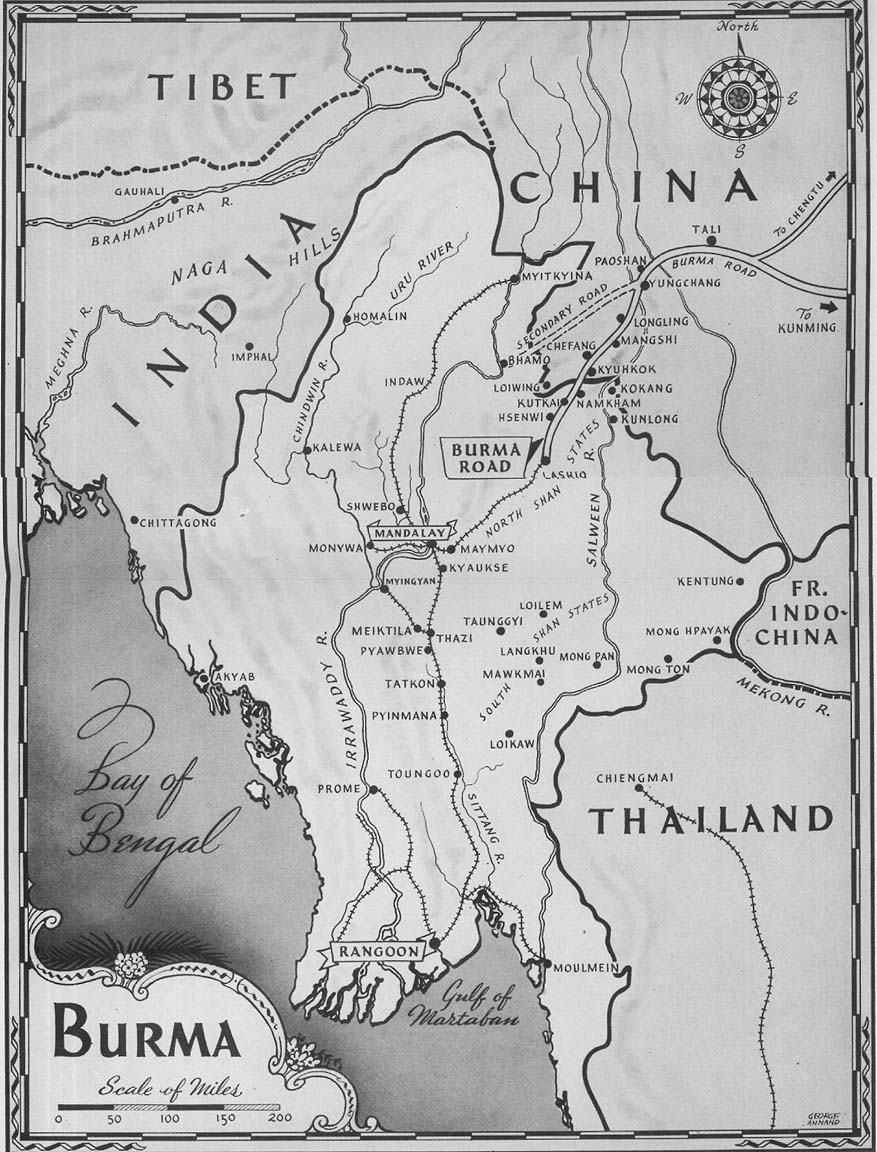
April 9th---Paul and Kyang Tswi started off about four this morning. At four-thirty Bill Brough and Brian Jones, who had left last night with two trucks to bring in casualties, came back with one truck. There were twenty patients crowded in on the straw. Bill had quite a tale to tell. At the usual first-aid post they had few patients. The Chinese officer said that there were a large number of serious cases farther on, so Bill left Brian and started off with Yen Ling, his Chinese interpreter, to find them. Enquiring along the road, he was continually directed to proceed still farther forward. Suddenly a bullet whipped through the windshield just where he would have been sitting if he had been driving a Lend-Lease truck instead of a Canadian-manufactured right-hand drive. Bill decided he must already be between the Chinese and Japanese lines, and shouting to Yen Ling to jump, he stopped the car and bent over to open the door. As he bent, a bullet whizzed over his head. He and Yen Ling dropped down the embankment into the ditch as shells began to find their range, one of them demolishing the truck. On all fours the two men hurried up toward the Chinese lines, the Japanese dropping a series of shells into the ditch behind them. Contacting the Chinese casualties and their stretcher bearers at the upper end of the ditch, the men led them to Brian's remaining truck, and so back to us. Bill drank some coffee and went over to wake Tom and have him accompany him back to the front for the remainder of the casualties.
"Tom, Tom, wake up," said Bill, shaking Tom's shoulder. "I need you for an ambulance trip. I have lost another truck. The Japanese have been shelling me."
"What, did you lose my extra pair of socks?"
"Yes, Tom, I'm afraid I did. I didn't dare go back to the truck for them." That was a major catastrophe to the Friends, who had so few clothes that I had to lend them all of mine while the nurses washed theirs out at Shwemyo Cliff.
"Did you say you lost another truck?" said Martin, waking up sleepily. "You salvaged the tires, didn't you?"
"No, Martin, I couldn't." The air became blue with profanity.
April 10th---Time after time the ambulances went back to the front yesterday, until by three this morning we had had to operate on a hundred and twenty patients more. Grindlay and the nurses and I were falling asleep in spite of ourselves about one in the morning, so Eric volunteered to make us some tea. Coffee, he felt, would be too much of an undertaking. When he came back with the tea it was burned! The first and last burned tea I ever drank---and made by an Englishman!
We used up all our sterile supplies yesterday, so the nurses turned out at dawn to wash out the bloody towels and gauze. They were just as tired as I, so I got up and joined them in washing out the stuff in the near-by stream where we could take cover and still enjoy the sight of the bombers. Those crazy sores I got on my feet at Pyinmana just won't get well. The nurses dress them several times a day, but the foul discharges from the wounds of the several-day-old casualties keep my shoes wet and the sores dirty.
On our return for lunch I found that Grindlay and O'Hara had been scrubbing out the operating room themselves with cresol. Grindlay had found pieces of amputated fingers and toes in the plaster of Paris and wound refuse on the floor! No sooner had we finished lunch than the Friends brought in another thirty-five patients. One of them had his enlarged spleen shattered by a shell fragment. Insects were so numerous that they kept dropping into the wounds of the abdominal cases. Planes were over us all afternoon, but we had no time to stop and take a look.
April 11th---Twenty-five more cases arrived at eight-thirty this morning. No more can be brought till after dark as the shelling is so incessant that the stretcher bearers can't evacuate them from the front lines till then. We all decided to have a good sleep during the day, but it didn't work very well. It's too hot! Today is Bill Brough's twenty-third birthday. Wherever we set up, regiments of Chinese soon move in beside us. They are moving in next door. They won't get out of sight when observation planes come over; but the pollution of our precious wells is distressing. These wells were never supposed to supply water to so many hundreds. Now we have to send Tun Shein for water to a monastery a mile away. He brings it back in a jeep. Captain Eldridge and Fabian Chow dropped in for a chat. Personnel of the Air Force is reported to have reached Karachi, but they have no planes.
April 12th---Friends couldn't locate the new casualties, so we had a baseball game. It wasn't too much of a success. Emily scalded her arm badly with steam from the sterilizer. The sterilizer truck does not permit free movement. It is too full.
Colonel Williams brought Major General "Bobby" Lim and Colonel Chen down to visit us. They brought some flashlights and a couple of revolvers to chase away the Burmese who are continually putting barriers across the roads at night and then popping at whoever gets out to remove the barriers. Bobby Lim had some Red Cross money along to help us pay our bills. Colonel Williams is certainly going to town securing medicines and supplies for us, flying in a lot of stuff from India. He has a very sympathetic understanding of our problems here.
Seven Japanese bombers passed over us this afternoon. On their way back seven A.V.G. planes suddenly appeared hot on their trail. We heard later that they caught up with the Japs just before they reached Toungoo and shot down three. Everyone in the unit shouted and screamed with joy that the A.V.G. scorpion still had a sting left in its tail! Report says A.V.G. got eighteen out of twenty-one planes over the Namkham valley today.
Had only thirty-five cases today. We have been burning up the bloody remnants of clothes we have had to cut off our patients and cleaning up the grounds and the little but next door where we place postoperative cases until the ambulances can cart them off. My, what a stink!
Things were so quiet I got a sudden inspiration to find out whether or not I had guts to drive one of the ambulances to the front. All the men objected; but I would have gone if the silly nurses hadn't fastened on to my shirt and stowed away in the ambulances to go along too! Even at that I could have made it, for Bill Brough promised to wait for me out on the road. I had an idea I could sneak out in a jeep when no one was looking, but those confounded nurses beat me to it and hid the keys!
April 13th---We were just dropping asleep at night when Paul drove in with three more nurses from Loilem. Jap raiders were strafing the Taunggyi-Kalaw road as he came along. He made a record trip to Namkham and back-up in a jeep and back in a "pregnant" truck. We had quite a time delivering that jeep from the body of the truck. Wished I had had my obstetrical instruments! Paul had brought along Tiny's cache of Waldorf toilet paper. I was almost as glad to see it as I was to see the nurses! E Hla had written me a nice long letter with all the news of the crowd. Hkawn Tawng, angry at not yet having been brought to the front, had run off with a Chinese shopkeeper. All the wards were comfortably full. Dr. Grey had flown back from India and she and Dr. Ahma were busily at work, leaving E Hla in charge of the hospital finances. Japanese planes had brought the front to Namkham, as they tried to wipe the A.V.G. out of Loiwing. So far the A.V.G. had had the best of it, shooting down Jap planes in dogfights over the valley. The nurses had had a ringside seat for the whole show. Some of them had been at Nawng Tao delivering a baby during one of the attacks and on their way home had passed two Japanese planes that had crashed.
Tun Shein made us a lot of bel-fruit juice. Most refreshing.
April 14th---Just got to bed last night when twenty more casualties were brought in. We worked on them till two in the morning. Terribly hot and dry today! They brought in three Indians who had been shot by the Burmese. Tun Shein has located several nice thin Shan pants for Grindlay and me. They are so comfortable to work in. The F.A.U. brought in a lot of loot they had salvaged from Pyinmana. A lot of Burmese are burning their homes so as not to have them commandeered by the Chinese.
April 15th---Between the heat and the bombers we can't get much sleep in the daytime, and the nights are full of work. Last night at ten-thirty, thirty-five cases arrived, two of them belly cases which Grindlay greatly enjoyed. One had a hole in his liver, but is doing very well indeed. While the captain was enjoying himself to his heart's content I had a most extraordinary case---a shell fragment had torn right across a soldier's buttocks without touching bone, laying the buttocks wide open. The wound was like two isosceles triangles with the apices turned in. The rectum had been dissected completely away from the other structures and was hanging down, without perforation or injury to the sphincter, like the udder of a cow. There was very little actual loss of tissue, so that after debriding and filling up with sulfanilamide powder I could get the structures loosely together. I wish I could keep him here, but our staff isn't sufficient. Two more truckloads arrived while we were working, and we did not finish till nine-thirty this morning, when we had one hour of sleep before we had to start washing out last night's gauze and linen. They brought in a Chinese officer who had been shot in the arm by a Burmese who thought he was too overbearing when he asked for food. It is 136° in the sun. Villages are burning all around us. I was finishing a bath at sunset when a plane circled over us and then made a forced landing west of town. We started off in jeeps to catch the pilot if he were a Jap or help him if he were an A.V.G. man. We must have made a complete circle around the plane without locating it, while the pilot had made the edge of the town under his own steam when we got back.
"Are you an A.V.G. pilot?" we asked.
"Yes, I had to make a forced landing in a dry river bed, and the plane cracked up. My name is Patech."
"Come on over to our 'Little America,'" I said, and he jumped in.
We gave him a lot of coffee and a little snake poison. He almost sobbed at finding friends so soon. He had lost sight of his buddy and had circled around looking for him until his gas gave out. We sent him on into Pyawbwe with a truckload of patients.
Eric was out burying Chinese all afternoon. It was "high" time!
April 16th---Soon after Patech left, the trucks came in with seventy cases which kept us busy till 8:00 A. M. Grindlay had a Chinese who had been attacked by Burmese. He had had a lot of parallel chops with a dab on the top of his head. The wounds went down into the bone but not through. It was too hot to sleep, so we had a discussion as to what to do. The Japanese had been advancing rapidly along the Irrawaddy and their soldiers were said to have been on the main road north of Meiktila. Other Japanese patrols were reported trying to cut the Shan States road at Kalaw, while two drives were being made toward the Sixth Army headquarters at Loikaw, one from Toungoo on the Thandaung-Mawchi road and one westward from Chiengmai in Siam. If these drives succeeded we would be encircled. That would not matter for our personnel, as we could sneak out on the same mountain paths; but we would certainly lose all our precious equipment. Grindlay and I went to Pyawbwe to see General Stilwell and contact Dr. Mei for information about our ex-patients.
A British liaison officer, Captain Crouch, came to us to get some rest. He had been isolated in a Chinese trench for seven days with practically no food and only muddy water to drink. Almost continuous shelling had kept him from getting any sleep. We got off his filthy clothes, gave him a bath and some good food, and after a few hours of sleep he was a new man.
April 18th---General Sibert dropped in at dawn and ordered us to retreat to the first decent place beyond the junction of the two roads to Mandalay from Myingyan and Meiktila. We began to pack at six-thirty, had breakfast, and after a little fun smashing up all the furniture and windows to let off steam, were off at nine just in time to avoid the retreating Chinese. Burmese fifth columnists had been attacking the Chinese. So far all the Burmese villagers have been very good and kind to our group, recognizing us as the Americans and "Burmese" that we are.
It was ghastly hot! We nearly perished of thirst before we got to Kyaukse, the first place beyond the junction General Sibert mentioned. In Kyaukse we found a couple of tiny shops still open, so we tanked up on all the tea and coffee---if you can call it that---that they had. Kyaukse had already been bombed, and inevitably would be bombed again. A few miles south of the road junction, and perhaps three miles away from the nearest railway station, I had noticed a couple of bungalows by the side of the road. Leaving the nurses bathing in a lovely deep river near Kyaukse, we officers explored near-by roads; but finding nothing we decided to set up at the bungalows---Kume Town. Ko Nyunt had a lot of nice tea ready, but when we unloaded at Kume bungalow he went on his first and last strike and refused to get dinner. Poor chap! He was as tired out from the heat and lack of water as we were. The nurses, as usual, turned in, so that we finally got a meal late at night.
Kume Town, April 19th---Grindlay, O'Hara, and I kept thinking we were too far back, and the F.A.U. had no idea where to go to pick up casualties; so Grindlay and O'Hara went off to Maymyo in a jeep to contact Colonel Williams. Things had been moving so rapidly during the last twenty-four hours that no information had yet reached the colonel. But their trip was not in vain. O'Hara, who was nauseated every time he took a mouthful of rice and was thin and ill, had had a very hard time eating anything at all those last days at Tatkon. Once in a while some thoughtful soul had left him a can of beans or a tin of soup and that had been all he could eat. In Maymyo he bad a grand American dinner, bought sixty pints of fresh strawberries, and arrived in Kume at midnight so happy that he woke the whole crowd and fed them the strawberries. Dr. Mei went through today on his way with his unit to set up at Sakhantha and Hsipaw. That means the Friends will have a sixty-mile trip to the front and another ninety miles or so back to the base hospital from here.
April 20th---Grindlay was quite friendly this morning. In Maymyo yesterday he discovered his old pal of Chungking, Sergeant Chesley, whom he describes as the only really good laboratory man in the world! He spent a lot of time telling Chesley what a fine bunch of girls our nurses were and how expert they were at their nursing. Chesley, who had seen the smoke screen of profanity that Grindlay had laid over the historic city of Chungking when he received orders to work under an ex-missionary, and who himself was a most confirmed misogynist, laughed in scorn. O'Hara also joked about the way he had received his orders to join our unit!
"Boys," he said to his fellow officers, "I'm going to get terribly sick with something right away and be back here in four days." He was sick now, all right, from our horrible food! But, though tempted by the taste of a real American dinner and strawberries, he could not persuade himself to remain away from our unit.
Rumors of a break through the Sixth Army at Loikaw came to us this morning, so I impregnated a truck with a jeep, and with a nurse-driver and Bill Brough in his ambulance, we went back to Pyawbwe to get orders direct from General Stilwell as to where the casualties could be found. The general had been working steadily for several days without rest and had just started to take a much needed nap when we arrived. Hearing I was there, he came down, told us where to find the patients, confirmed the news of the Japanese break-through, and had me sworn in as a major in the Medical Corps. I told him that the break-through would negative the value of our Sixth Army unit to a great extent and asked for permission to rush to Loilem at once and bring back five nurses to Kume.
"How do you plan to get to Loilem? By the Maymyo road?"
"No, sir, I prefer to take the direct road through Thazi and Kalaw."
The general's tired face became grim. "If you go by Kalaw you will have to start at once and drive like hell or the Japs will reach Hopong before you!"
"I am starting at once, sir."
"Good-by, Major." Gosh! was I really a United States major?
That pregnant truck certainly covered the ground! Thazi had been bombed twice since we had that delightful Chinese lunch in the restaurant there on our way down. Less than four weeks ago! And now not a building remains! Desolation, absolute and complete!
While we were driving along tonight I kept thinking of the way General Stilwell came down to see me today. It was the same way the first time I met him. Someone introduced me to Colonel Dom, explaining about our work with the Sixth Army. Colonel Dom went into the general's room, and almost immediately he came out and shook hands, asked a lot of friendly questions and then was very apologetic because some Chinese generals had come in for a big banquet and he couldn't continue his conversation with me. Some bootlickers that I knew tried to act as though they had known the general all their lives and didn't even get a "good morning." They say that he turns down invitations at important places right and left because "there is a war on," and yet he always has time for anyone who is trying to do a good job. Bill Cummings also got to see him, and the general spent a long time talking with him. He is most fun of all when you are talking business with him for he gets the point before you are half through with your sentence and his decision is as quick as lightning. You certainly get the idea right away that it wouldn't pay to start any bootlicking. He had a big laugh today when I told him our unit had three gears forward and only one in reverse! Even the nurses see through him. This morning before I left several of them told me to give their love to "Granddaddy Joe."
"Why, who on earth is 'Granddaddy Joe?"' I asked.
"Why, General Stilwell, of course."
"I suppose you have a name for Colonel Williams, too?"
"Yes, he is our 'dooteah daddy'---'second daddy.'"
Thinking of Stilwell made me think of Fogarty. That grand fellow is dead. The plane that was taking him to Chungking crashed and he got a compound fracture of the thigh, dying some time later.
April 21st---Lunch beside the road at sunset yesterday was our only stop. We couldn't see whether Kalaw had been bombed or not. About midnight as we were approaching Heho, a group of Punjabi soldiers stopped us with leveled guns---which surprised me since we were coming from the west, about the only direction the Japs would not be coming from! I stopped, obligingly removed the canvas, and offered the soldiers a ride. They climbed in, sat around and in and on the baby jeep, and rode with us as far as Shwenyaung. We didn't discover, until we got to Loilem, that they made off with all our personal possessions when they descended! Taunggyi was in ruins around us as we drove through. Hurrying down the Taunggyi hill into Hopong we were racing the Japanese. Would we find them already at Hopong? If so, I was not going to stop so obligingly for them as I had for the Punjabis! I forced the nurse to lie down, held my revolver out of the window with one hand while I rushed down the road. I didn't expect to hit anything with my automatic, but if I met Japs, the noise of the gun plus the terrific speed with which I intended to plunge through them might startle them into letting the old fool by! But they had not arrived, and did not arrive for an hour or so. The total population of Hopong visible that night was one lone Chinese soldier, stumbling around with a rather dazed expression on his face!
We got to Loilem at dawn. Bill was as glad to see me as he would have been to see Hazel. Gladder, perhaps! He would not have been glad at Hazel's presence in Loilem that morning.
WHEN OUR surgical unit left for Pyinmana and the Toungoo front, Bill had gone back to a double job. The government had ordered him to organize extensive truck farms throughout the Shan States so that a sufficient supply of vegetables might be raised for the Sixth Army. He secured upward of sixty pounds of vegetable seeds in Lashio, Hsipaw, and Taunggyi, and, receiving wholehearted support from the sawbwas, had the seed planted in all suitable localities. Ted Gurney and Stanley Short had taken their families to Lashio as ordered by the government. Learning that the earliest plane available would leave in four days, they went to Kutkai, on the invitation of friends there, and just got out of Lashio before the town was bombed. Ted and Stanley saw their families off to India on a comfortable passenger plane (instead of the usual troop carrier, which was delayed on account of engine trouble), and then hurried back to Langkhu. During the days that followed they were incessantly on the move, going from their own hospital (now full of Chinese soldiers) back and forth to Mong Pan, Wan Hat, and Loilem, at each of which towns many Chinese troops were stationed. At Mong Pan, casualties from raids across the Siam border were constantly coming in. Mawkmai was bombed, and military and civilian casualties were brought for hospitalization. On top of the surgical work, there were always the usual cases of malaria, dysentery, pneumonia, and so forth, which kept them fully occupied. Though Gurney and Short had only two nurses to help, and a minimum of equipment with which to work, they felt well supplied, as previously they had been doing the whole work of the hospital alone.
On the night of April 10 an urgent message came from Loilem asking for help with a patient who had a bayonet wound of the chest. There was no doctor there at the time as Bill had taken Dr. Tu down to Loikaw where action had already begun. As they left, the nurses pleaded with Bill to bring back some patients---which he promised to do. Just as they got out of Loikaw they came upon an upturned truck in which there were a number of casualties. These they sent straight back to the hospital. That was the first installment for those nurses who were clamoring for work! When they arrived at Loikaw, they found the first lot of patients already waiting, having just arrived from the front. Bill thought that some of these were too difficult for Dr. Tu, so he took them back to Loilem, where there were more facilities, and sent for Dr. Gurney to come up immediately. Gurney and Short went to Loilem at once, arriving about midnight. The next morning, having done what was necessary, they were about to leave when a convoy of trucks brought in a hundred and twenty Chinese casualties from the recent bombing of Thazi---the railway junction a hundred and sixty miles west. The next twenty-four hours were busy ones for all concerned. Short gave the anesthetics while Gurney and the nurses operated on the worst cases. There was no time to pay much attention to the planes that came and went-some, no doubt, on their way to Taunggyi, and others reconnoitering Loilem itself. The next morning
Ba Saw arrived from Namkham and helped finish up the surgery. The relief of working in the base hospital with a relative sufficiency of nurses was unspeakable!
Gurney and Short returned to their own work in Langkhu, leaving Ba Saw in charge of Loilem. On the seventeenth, Graham suddenly appeared in Langkhu saying that the British liaison officer had ordered the evacuation of the nurses at Mong Pan, and that General Stilwell had requested that Gurney go to Loikaw. So Graham and Gurney went on to Mong Pan at once to collect the nurses and all hospital equipment. On their return they left those nurses at Langkhu and took the two younger ones from there on to Loilem the next morning. Then Bill, Gurney, and four nurses went on to Loikaw with a view to handling the casualties from the action that was expected very soon. They set up on arrival that night, and were snatching a short sleep when they were awakened by an officer who ordered them to retreat early in the morning. Bill remained behind for more definite information and to salvage anything useful he could find in town, while Gurney and the nurses pushed back a few miles and set up once more, by the side of the road. Soon Bill appeared.
"It's no use," said Bill. "The Japs are only eight miles away and we have been ordered to evacuate all our hospitals back to Lashio. We will have to hurry if we are to rescue the Langkhu nurses."
This packing up and retreating was getting to be a nuisance. When they reached Loilem, Graham and Whittington were loading the trucks. While Gurney went straight on to Langkhu to rescue the personnel, hospital equipment, and three hundred gallons of petrol from the local dump, Bill, who had received reports of abandoned missionaries on the Taunggyi road and of sawbwas whose transportation had broken down, went back to rescue them and send them on to Lashio in trucks he had commandeered. It was an overloaded truck that reached Loilem from Langkhu late that night! A little more sorting out of equipment and equalizing of loads, and the remaining trucks left Loilem for Lashio at three o'clock in the morning. Owing to a shortage of vehicles, Bill, Ba Saw, Theodore, and four nurses were left behind, together with a jeep and four tons of hospital stuff. It was hoped that Graham and Whittington might be able to dump their loads in Lashio and return for them before the Japs reached Loilem. Colonel McCabe and Colonel Aldrich drove in at four, while I arrived at five with the pregnant truck they needed. No wonder Bill was glad to see me. If I had not brought the truck they would have been in the hands of the Japs in less than twenty-four hours. The safety of all the other nurses except those at Kengtung, whom Bill had ordered by radio to retreat by the short cut to Lashio, greatly relieved me. The base-hospital patients had all been evacuated by the Sixth Army, so we did not need to worry about them.
They let us have three hours' sleep, and then as a squadron of bombers flew over we started packing. I had just delivered my truck of her jeep when a car drove up and an A.V.G. groundman, an old friend of mine at Loiwing, stepped out.
"Lord! If it isn't Doc Seagrave! I never thought I would have as good luck as this! Listen, Doc, those bombers machine-gunned one of our pilots back at Namsang. He is in a bad way. Will you go and see him?"
"Nobody in the world I would rather help than one of you A.V.G. boys," I said. "I'll start at once with a couple of nurses in a jeep and operate on him there. Will you ride with me?"
"No, I have to take this truck back, and as it runs on only half its cylinders you can get there much faster than I can."
Sterile equipment was available, so we started at once. Halfway to Namsang a car passed us. The driver saw our red crosses and stopped. I walked back.
"I have a machine-gun casualty here," said the driver. "Will you take care of him?"
"I was coming out to get him. I can do the surgery, all right, but I am worried about his after-treatment. I have been ordered to evacuate my Loilem hospital. What shall we do with the patient after the operation?"
"Don't worry about that. I'll fly him back to Loiwing where he will be in the hands of a real surgeon."
I felt that that was an unkind thing for an A.V.G. man to say to me after all I had been trying to do, but my loss of face didn't matter if I could only give this injured pilot the help he needed! We turned back to Namsang. In the pilot's room the nurses boiled instruments and laid out sterile goods.
"That is a wonderful doctor you A.V.G. men have in Loiwing," I ventured.
"You bet he is. Dr. Richards is a grand man!" The pilot's buddy was grim.
"How long have you boys been stationed at Loiwing?" I asked, as I started to scrub.
"Two months."
"Then you must have seen that little 'show' of mine across the valley from you," I said.
"What do you mean?"
"Haven't you ever seen the Namkham hospital buildings?"
"Say, who in hell are you?"
"I'm Seagrave."
"Doc Seagrave? Hell! All right, Doc, go ahead and do what you can for my pal. I have another job on. I've got to blow up a bomb dump the R.A.F. left here," and the self-appointed chaperon went out, covered with smiles.
The patient on the rude bed also was smiling with contentment as Than Shwe adjusted the chloroform mask. One bullet had gone right through the thumb. Two others were in his legs, and I recovered several bits of airplane metal from various parts of his body.
As soon as the patient recovered from the anesthetic we hurried back to Loilem. Bill was stamping around in great disgust.
"You'd better get going right away," he shouted. "The Japs are reported at the divide over there eight miles away and may be here any minute. I have sent the nurses along with Dr. Ba Saw and Theodore to wait on the Laikha road."
April 22nd---That was a trip! I was driving the jeep in which Htulum was killed, and it had no windshield. In the late afternoon it began to rain, and I nearly froze to death. We got to Pangkitu at dusk and had dinner in a little Indian restaurant there---or what was left of it. Everyone was on the road that day, whizzing north. Chinese Sixth Army trucks were the only decent vehicles. British civil officers and their clerks were packed tightly in undersized English cars. Trucks that should have been burned before the war began had been made to run somehow and were heavily overloaded with fleeing Karens and Shans. Nowhere was there any sign of effort to plan resistance to the Japanese advance. Theodore took pity on me as we started again, loading the stuff from my jeep into his and driving the one without the windshield, since he had a thick overcoat of English Army issue. The trip on from there was one mad struggle to keep awake. If we could have found a hut to sleep in after ten o'clock, we would have stopped; but we went past the last hut of which we knew and had to keep driving until about two in the morning. I went off sound asleep for as long as three or four seconds at a time, waking up startled to find I was driving a jeep, and still more astonished to discover the jeep was still on the road! Bawk, in the jeep behind, later said that she had done the same thing. Bill, ahead in his truck, was also having trouble. At last, about thirty miles from Hsipaw, Bill saw a broken down zayat, or monastery resthouse, and we went in to sleep. The joists had given way at one side, and the floor was thirty degrees off horizontal and covered with refuse and various excreta; but it seemed like paradise. We fell asleep immediately.
Sometime before dawn one of our own trucks drew up, recognized our caravan and stopped. It was Graham and Whittington on their way to pick up Bill and the nurses. We had a joyful reunion, made a huge pot of American coffee which was disposed of in most efficient style, and went on, much refreshed. At the junction with the Lashio-Hsipaw road we parted company, Bill and the other boys going on to Lashio to contact Gurney and bring him back with a team of nurses to set up in Hsipaw, while Bawk in her jeep and I in mine took the four Sixth Army girls with us west.
In Hsipaw we had breakfast, and finding a few stores still open, bought a lot of cotton longyis and other things for our unit girls. In Maymyo all the stores were closed. We were horribly hungry, and hunted up and down every street to find a restaurant of some sort. There was nothing. But, also hunting, were Brian and George of our own F.A.U. They were returning from Hsipaw, where they had taken a lot of our casualties, and were just as hungry as we were. We gave up, finally, and set out for Mandalay, discovering, about five miles out of Maymyo, that the shopkeepers had set up stalls by the side of the road out of the reach of bombers. We had a wonderful meal: three different kinds of hot Burmese curry and the most delicious rice I had had since my last trip to Namkham. The ration rice we had been eating wasn't fit for the pig!
Mandalay was a ghastly mess. There wasn't a thing left within sight of the road but the two leper asylums. Fire had wiped out every bombed building. As we turned south, Bawk's petrol feed pipe kept getting clogged up with dirt. We were in the middle of a tremendous convoy of Chinese troops rushing south to reinforce the Fifth Army. Every time we stopped to blow out the petrol pipe another convoy went past. We were filthy with dust in a way possible only when you ride a jeep in convoy. At that swimming hole south of Kyaukse we stopped and had a gorgeous time getting clean again, scrubbing each other's backs with real joy. Smelling less like an eight-day casualty, we pulled in at the Kume bungalow and were at once smothered in a screaming, sobbing, laughing blanket of hysterical nurses. The crazy girls had been convinced, on our failure to return that morning, that we had fallen into the hands of the Japs!
Grindlay had had himself a time! The day I left, Tun Shein had built us an operating room of mat and thatch which had gone into action at once when, at 4:30 P. M., Bill Brough and Brian had come back with the first load of casualties from the south. Up again before daylight yesterday, Grindlay had begun work on a Gurkha, who eight days before had been chopped through the jaw, face, and neck, his fingers cut off and his arms dangling as the result of wounds that had severed the bones at the elbows. With those awful wounds, which he had received at the hands of the Burmese, the Gurkha had walked eight days, until he accidentally stumbled upon our little setup. Load after load of Chinese casualties were brought in all day and all night. O'Hara was busy, too, as there were several jaw injuries. Grindlay's thin Shan pants stuck to him by sweat and began to rip. Unconscious of calamity, he operated on, occasionally wondering what the hell the nurses were giggling at! Then Koi took pity on her beloved uncle and got two long strips of adhesive plaster to repair temporarily the damaged pants.
"So that's what you girls were laughing at, is it? Well, never mind now---you've seen all I have got already!" Grindlay turned back to the plaster cast he was applying and continued to mix profanity with "that damned plaster," in hopes it might set a little better!
With one hour's rest he continued operating till two o'clock this morning---a hundred and twenty cases in thirty hours. The only good news during the day came when Colonel Williams ordered us to take our cases, not to Hsipaw, but to the river steamer Assam at Mandalay. With only eight ounces of chloroform left there was nothing further to be done.
The baskets of strawberries we had brought down with us from Maymyo were just disappearing when Captain Jones appeared with two hundred pounds of chloroform that Colonel Williams had had flown in from Calcutta.
April 23rd---At midnight Bill Cummings turned up with Kaw Naw whom he had picked up in Lashio. This morning we had a powwow with the nurses.
"The 'son-in-law' says that today is the last day cars can get back to Isipaw and Lashio," I said. "We are not going to be able to get out of Burma through Namkham as we planned. When we go, we will undoubtedly follow the general up the west bank of the Irrawaddy, and we may have to walk out into Assam. If any of you girls want to quit and go back to your people to hide out with them until the war is over, you will have to go now. If you go along with us into India, you will have to count on a lot of hard and perhaps disagreeable work in a strange country for nobody knows how long! Nobody will say or think anything unkind about you if you stop now, and I will furnish you transportation back to Namkham. Stick up your hands if you want to leave."
Not a nurse moved. Only my Lahu orderly wanted to return to rescue his wife and child.
"Well, Bill," I said, "I guess they really mean it! I will have to leave the Namkham-Hsipaw groups entirely in your hands. Let any of the girls leave that want to join their families. Dispose, as you see fit, of all our Namkham equipment and medicines, and the trucks and jeeps of the Sixth Army crowd. If you can get out to Myitkyina, perhaps we may meet you there."
Koi wanted to borrow a hundred rupees on her salary to send back to her father and mother by Bill. I offered to give her twice the amount, but she wouldn't take it. She didn't want her folks killed for the sake of their money. Amid a shower of tears the "son-in-law" disappeared around the bend in the road.
Bombers bombed the Kume Road station today, and the Friends picked up a few casualties. Right behind them came General Sibert. The Jap machine-gun bullets had just missed him. There is another one of those rumors running around to the effect that there is a regiment of Japs, on the other side of the river, which has been lost sight of. If anyone who knows his map of Burma wants to figure out what the Japs are up to, all he has to do is make up his mind what the meanest move in a certain area would be, and a few days later news arrives that the Japs have done just that thing. In this case they are undoubtedly heading for the Chindwin to cut off retreat into Assam by the southern route. It is known that the Japs are not too proud to hire ordinary Burmese coolies to show them paths unknown even to the British.
April 24th---While we were eating dinner last night, patients began to arrive from Yamethin. In all there were eighty-five of them. We finished operating at seven-thirty this morning, and after two hours of sleep I began again. Grindlay has a ureteral stone which began to torture him during the night. He has spent most of the day in the bathtub, soaking. We had a nice swim in the irrigation canal that flows by our compound, and while I was enjoying it a real cyclone came on. Bits of gravel and sand stung my skin unless I submerged. Could hardly breathe for dust before the rain finally arrived. The wind blew our stuff all around the house, and we had only begun to straighten things up when a truckload of British troops were brought in. The sergeant said they had been traveling in convoy up the Myingyan road when the storm broke and a tree crashed down on their truck. He had heard of our unit being at Kume and would appreciate our taking them in. Several of the cases were horribly injured. It was odd to have the men lie quiet on our six operating tables, each waiting his turn. One of the men had his scalp torn off. Another's skull had cracked like an eggshell. There were three long lines of fracture and two areas where the fracture was comminuted, some fragments piercing the brain. Of the sixteen British, only three had relatively minor injuries.
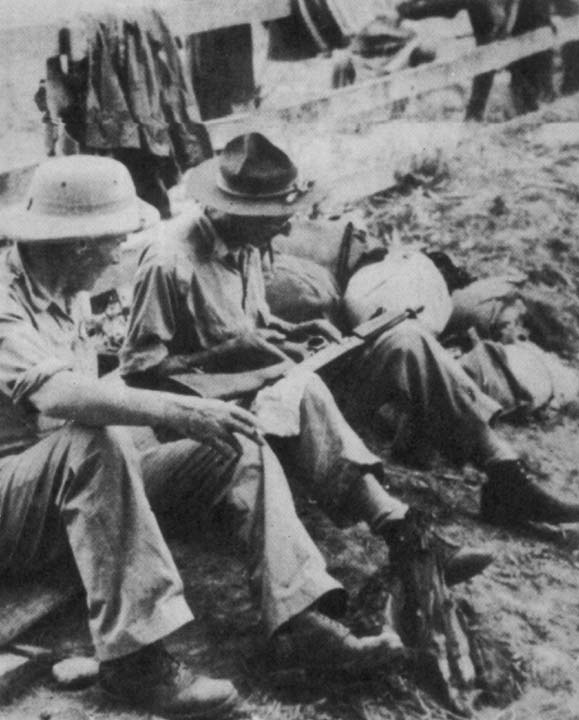
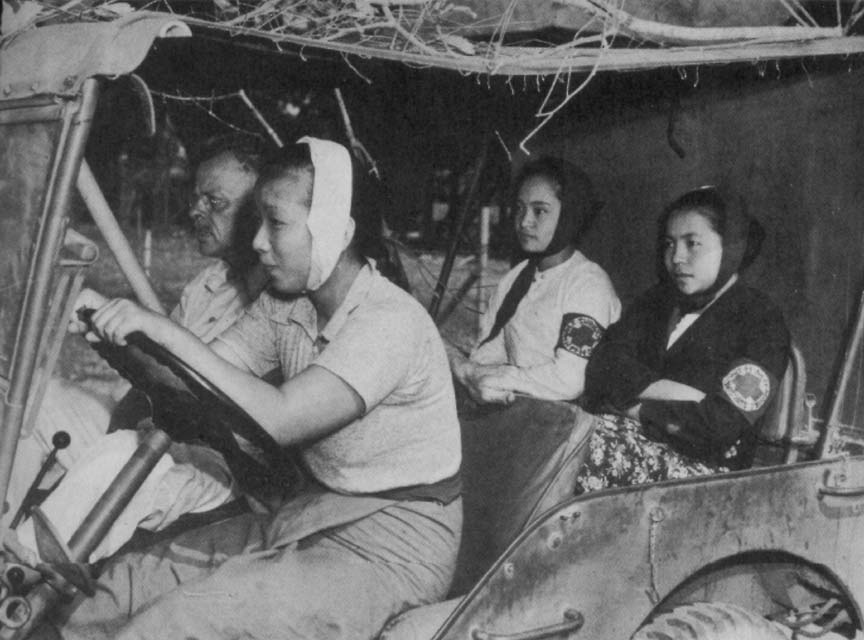 Doctor and Nurses [U. S. Army Signal Corps] |
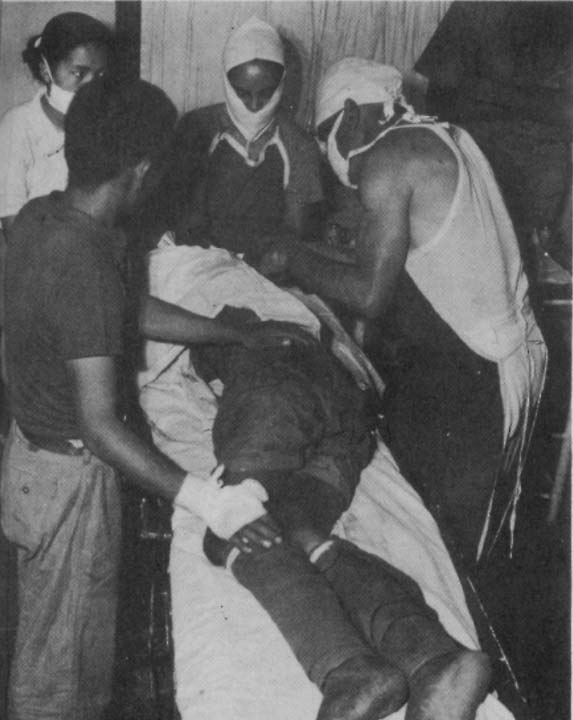 Dr. Seagrave Operating during the Battle of Burma [U. S. Army Signal Corps] |
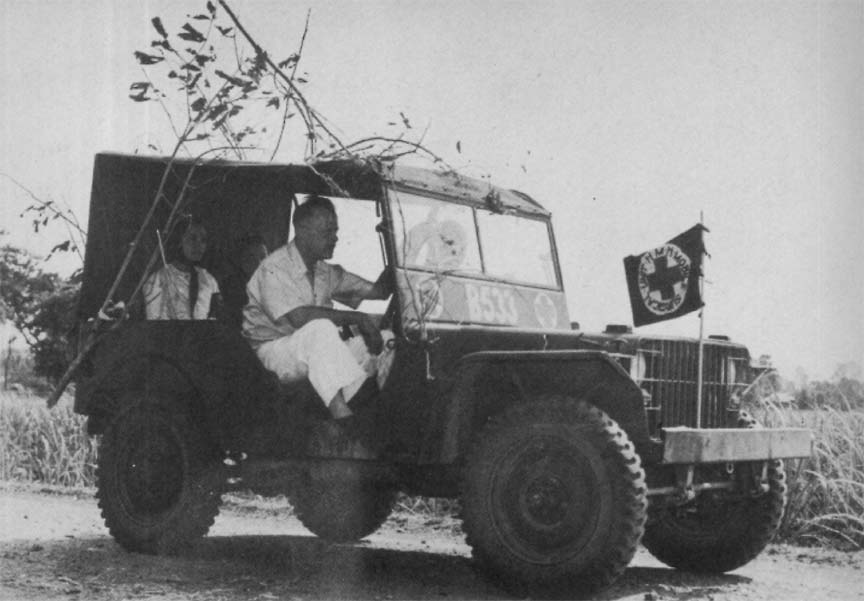 The Doctor's Jeep [U. S. Army Signal Corps] |
 General Stilwell (right) and General Sibert [U. S. Army Signal Corps] |
April 25th---They woke me at night for sixty more Chinese. Grindlay insisted on helping with a few, though he could hardly stand. Worked all night, using two shifts of nurses as we did the night before. The girls are so tired that two of them dropped asleep on their feet, and then cried when I ordered them off to bed. So far we have had no patients today. An ambulance came for the English. I wish I could follow up that skull case. I let Emily go along with Paul when he took the Chinese to the hospital ship at Mandalay. When there, she heard somehow that her brother Gilbert was in trouble at Aungbinle, a few miles away; so Paul drove her there. Gilbert, being part Indian, was terrified at what the Burmese might do to him, and thought he might avoid being chopped to pieces if he toadied up to the local hpongyi. He had no sooner chummed up with these Buddhist priests than the Chinese Army began to round them up for their fifth-column activities. Gilbert, like a foolish boy, began to run when the Chinese came to interrogate him, and received three bayonet wounds. Because of his effort to escape, the Chinese were convinced he was guilty, too, and put him in jail to await trial.
When Paul told me the story I sent him to General Stilwell at Kyaukse, offering to go bond for Gilbert and guaranteeing to take him with us as a member of our unit until he was safely out of Burma. With the general's influence Gilbert was soon released, and Grindlay took care of his wounds.
Sagaing, April 26th---About five o'clock yesterday afternoon Lieutenant Young came in with orders for us to move to Sagaing at once. We were packed up and off by nine, weaving in and out of columns of British trucks and tanks that had been using the road all day. Case has joined our party. We nearly missed the turn to the Ava bridge in the traffic jam. It was long after midnight when we located the A.B.M. compound at Sagaing. The only empty building was the church, and most of the girls slept on the pews. I slept on the front seat of my truck. Soon after dawn a lot of Japanese bombers flew over and bombed Mandalay and the bridge, and for the first time I heard the sound of antiaircraft guns. Nobody hit anything. Beyond Sagaing the road was jammed with British and Indian troops. I kept my eyes peeled for some decent place for us to set up, and just happened to see a lovely bungalow, half a mile away from the road, almost completely hidden by pride of India trees and palms. It would certainly be invisible from the air. We settled down for some rest. All of us are pleased. There is a large irrigation canal beside us with a high dike that jeeps can travel on very nicely. There is only one fault to find with the place---the well water is full of alkali and has a ghastly taste! Spoils the coffee! This is the hot, dry belt and the water wouldn't be better anywhere else near by. It is so hot that the nurses and the villagers are bathing continually. We decided not to unload as we have things so arranged now that we can get out the necessary supplies and be operating in fifteen minutes if casualties come in.
April 27th---Grindlay, Bill Brough, and O'Hara went off to the general's new headquarters at Shwebo, twelve miles away. They saw General Stilwell sitting on the verandah looking terribly tired. No one knew what the next move would be, nor will they until orders come in from Washington and Chungking. No further resistance is being given to the Japanese, except for a few Chinese troops that are in danger of being cut off. Everyone is talking about the action in which the company of General Sun's troops cut through the Japanese lines north of Yenangyaung and rescued a regiment of British. General Stilwell sent for Grindlay to have a friendly talk, and outlined plans for dumping our comparatively useless stuff. The next move will be toward India. Grindlay heard that Major Wilson was killed yesterday in the Mandalay bombing. First American casualty! Bombers bombed Shwebo as Grindlay and O'Hara started back, then circled around and began machinegunning. O'Hara jumped under a culvert, and to his unspeakable disgust found that someone with diarrhea had been there before him!
While the boys were at headquarters I took the girls for a shopping expedition. In none of the cities through which we had passed since Pyinmana had there been a single shop where the girls could spend their pitiful Namkham allowance of one or two dollars a month for the little bits of finery so dear to their hearts. The Red Cross now allowed them about ten rupees each, and there was no place to spend it! Some of them were pretty ragged, for these Burmese voile jackets are flimsy and the shoes are still more so. Tun Shein had heard of a few shops open eight miles west of Shwebo, so we went there. Every door was barricaded, but a few people were on the street.
"Fellows," I said to the F.A.U. boys who went along with us, "don't get out of the truck or the people will all run away. Let the nurses browse around by themselves for fifteen minutes, and those barred doors will open."
The nurses chattered in Burmese, laughed, and acted just as any bevy of normal Burmese girls would when they have a shopping spree ahead of them. After ten minutes I began to call out to them in Burmese, letting the people know they weren't dealing with a stranger. My Burmese is sometimes quite good and it was particularly good today! In the fifteen-minute time limit some of the stolid villagers admitted there were a few things for sale at a certain shop. I walked along with the nurses. There was a bolt of voile on the counter. The nurses asked the price, and then, true orientals as they were, began to bargain with the shopkeeper.
"Girls," I said, "don't try to beat that man down. Pay him whatever he asks and if you can't afford it, I will buy the stuff for you. You are lucky to find anything suitable, and these poor people are going to have a hard enough time as it is these next few months."
I spoke purposely in Burmese. A few minutes after we left that shop a rumor spread among the villagers that here was a group of people that had a slight touch of humanity in them! Bars were removed from doors, shops opened, and the nurses became quite happy as they exchanged their pitiful stipends for feminine finery.
When we got back to our charming bungalow we found that the surgical team of the Friends Ambulance Unit, China Convoy, had arrived. I will never be able to understand why these men came down. By the time they reached Lashio the Battle of Burma was over. We were doing no surgery now. They had come through, knowing that bridges were to be blown up behind them. Peter Tennant, their boss, was with them, and he had brought with him Lu Shang, one of their Chinese interpreters, the only F.A.U. man we did not like. However, the surgeon, Handley Laycock, is the sort of man one ought to have a chance to meet: conscientious objector? Yes. But any sensible man objects to the things he objected to. He certainly never objected to war because of fear, nor yet through dread of hardship.
Colonel Williams came down that afternoon to look over our stock, and advised us to get rid of the bulky things that would certainly not be needed on a swift retreat. We dumped several boxes of Kotex that some misguided soul had sent us, not realizing that the Chinese Army was composed of men! Colonel Williams says that the present plan is for us to go by river or train to Myitkyina and then by plane to India, walking out if planes are not available.
I asked Colonel Williams if we might not send Paul and a couple of nurses by that evening's train to Myitkyina with one of our trucks, so that they could hurry to Namkham by the motor road and warn Bill Cummings to leave at once and join us. He gave us permission, and we prepared everything, choosing nurses who could kiss their folks good-by en route. It was an awful disappointment when Paul returned to say that there had been a collision and the train was not going. The news is that Lashio and Hsipaw are already in the hands of the Japs.
Tonight the Friends had a big powwow. Tennant doesn't want them to remain with us. The Friends who have been with us don't want to be taken away. Bill Brough finally got permission for them to remain. Williams has suggested that Laycock and his surgical team join the British on their trek out, while we go along with the Americans. I think that is the best solution. There are so few doctors that it seems useless to keep so many in the same place.
April 29th---I went into Shwebo with Grindlay today to see if Colonel Williams had any orders for us. We are not getting any casualties, except for an occasional man that jumps out of his truck when he sees our flag by the side of the road and comes in for treatment. I met Grindlay's friend, Sergeant Chesley! While we were talking to him the bombers came over again. They sure went to town on Shwebo. Why didn't they realize that the most important part of Shwebo that day was General Stilwell's headquarters, a mile out of town? If the Japs had any sense they would know that the American general they hoped to kill was as astute as they were and had not located his headquarters in the town itself. We started back as soon as the bombers disappeared, finding the whole town burning, trees across the road, electric mains torn and impeding our way. We wove in and out through the streets looking for casualties, but there were none. None of the natives had remained in the town; they had too much sense! The only casualties from the Jap bombing that day were some pigeons. They looked so pitiful that we did not pick them up to take home for dinner!
We have had so little work to do that the nurses are going wild. Two of them got into a big fight today. Just before supper I found Roi Tsai out on the verandah sewing and crooning songs to herself, the way she does when she is homesick. I stopped it right away because whenever she does that for very long at a time she works herself up into hysterics. None of this crowd likes peace and quiet.
April 30th---Terribly hot again. We had a few minor casualties. Brian and Kenneth drove in toward Mandalay for some stuff, but couldn't get there. There was some rain, and Brian was driving like mad, as usual. He skidded, turned over, and now has a broken collarbone. Bill Brough is down with severe dysentery. Tennant has ordered them off to Myitkyina by train, as soon as the railway line is cleared, and they are to be flown to Calcutta. Darn it, those are the two that really led our Friends Ambulance. How on earth will we get along without them? This talk of our tramping out of Burma has me worried. It has been a long, long time since I have had to do much foot work in the jungles, and I feel much older than forty-five with this confounded malaria that keeps returning. And no treatment of any sort helps these four sores on my feet. The only thing that gives me hope that I may be able to make it over the mountains is that the Friends brought me a pair of English Army Issue boots today. They are as heavy as lead, but they permit me to wear two pairs of thick woolen socks, and that ought to pad my sores! Plans for evacuation change daily. We understand the idea at the moment is for us to go to Myitkyina by truck. Unless the government has been rushing construction of new roads that I don't know about, we will have ourselves a real trip.
May 1st---Colonel Williams was downstairs in his jeep just as we woke up. Somewhere north of Mandalay is a regiment of Chinese who couldn't get across the Ava bridge. Colonel Williams wanted Grindlay, a couple of Friends, Lieng Sing, and Low Wang to go east to Kyaukmyaung, where one takes the ferry for the Mogok Ruby Mines, and set up a surgical station there to take care of casualties when this regiment arrives. The rest of us were to go north to Zigon. We hurriedly selected a lot of equipment for Grindlay and loaded it on a separate truck, and they set off with the truck and a jeep. Grindlay is afraid this means he is going to be permanently separated from our unit, which makes him swear as badly as he did when he was first ordered to join us! The rest of us started north. We have enough men to drive all our trucks and jeeps except for one jeep, and Big Bawk is driving that one. Koi is too tired for me to make her drive it, while Big Bawk is as strong as a horse. The road north of Shwebo is nothing but a graveled dike along the canal and so narrow that you can hardly pass anyone else, so it takes hours to cover a few miles. About forty miles north the road stopped suddenly. Our two generals were there, and they ordered us to strike west a couple of miles and find a place to sleep in that was not too near a railway station. The next station south of us got plastered this morning. It was rather pitiful. A company of English "Lancs" had been badly shot up at Prome and sent to Calcutta to recover. The other day, far too late for them to be of any use, they were flown into Myitkyina, with orders to come down as reinforcements. Their train reached this station just in time for them to be bombed, and lots were killed. Laycock and his Friends took care of their casualties.
General Stilwell has set up three miles beyond us on the "Mu" River. Since there is nothing further to do until tomorrow, I am going back to Kyaukmyaung to see how Grindlay is getting along. Maybe we can contact Colonel Williams again. He has remained in Shwebo.
May 2nd---What a day, what a day! We got to Kyaukmyaung about nine last night. Eric was beside the road looking for me, by George! Those boys seem to know my psychology! Told me Grindlay was down at the river since there was a lot of trouble about steamers. Only available ones had no crew. Kyaukmyaung had been bombed the day before, and everything was in a turmoil. Eric had a lot of cold rice and sardines and---of all things---S and W coffee. Grindlay had found any number of cases of the stuff, abandoned on the dock, and had salvaged a couple of cases for us. I did not trust Eric to burn the coffee as he did the tea, so I made it myself, and it was unspeakably delicious. Real American coffee! Grindlay came in stomping angrily. He had to go right in to Shwebo and contact my old friend General Martin and have the English cough up some steamer crews, or the Chinese Army would not be able to get across the river. The Japanese are already at Kalewa, and that means that all these English troops that are trying to get out of Burma by the "comfortable" southern route will have to cut their way through. As I thought, that is where that "lost battalion" of the Japs was heading for all this time.
We went back together in our jeeps. General Martin is nothing but a walking skeleton. Still calls me Colonel! There is no way he can find crews, so we went on and found Colonel Williams still up. He had been burning everything at headquarters. When he heard Grindlay's story he decided it was a useless gesture to send him back on the original mission, to wait with his arms folded until the Japs surrounded and killed him; so the captain left at once to pick up the truck and his personnel and rejoin us at dawn. When the colonel heard that I knew where the new general headquarters were, he decided to come along with me. Not all of the general's papers had been destroyed yet, so he got rid of them all---plus the house---by means of a tin of gas and a judicious match. He certainly never could have found the right road in the dark. There was slightly less traffic on the road. I got him to headquarters at four-thirty, and, after contacting the general, got orders for our unit to fall in line at dawn when the general's echelon passed us. I got fifteen minutes' sleep while our boys and the girls loaded up. Grindlay, the old truck driver, got to camp just as we were pulling out. Three Anglo-Indian refugees hitched themselves onto us at the last moment. I am sure I. will get into trouble about their being along. Never should have been given a commission in this man's Army. I am not tough enough; but there is hope. I am getting tougher and tougher every day!
Who told Big Bawk to lead our echelon, I don't know, and I don't want to find out, for I wouldn't have time to repair his shattered jaw. Just beyond the road's end we had to drive across the bed of a stream and then up a sharply sloping bank onto the dike again. Bawk is a wonderful driver, but she had not had enough experience to know there would be less chance of tipping over if she attacked the bank at right angles; so her jeep rolled over. None of the girls was hurt. The officers wanted me to take the jeep away from her, but I refused, and told Bawk to get back in and drive. She has guts, all right! The road from that point on was ghastly; nothing but cart track here and there, and occasionally nothing but a blazed trail through the jungle where the general's advance guard had chopped down small trees to open up a path. We are having a contest to see who can keep the roof supports of his truck the longest. Grindlay, who told me this morning that he was "exhausted," is finding out that he has reserves he never knew about, driving his jeep through this kind of jungle! O'Hara is driving a jeep too. Martin insists on dragging that useless jeep that Lieutenant Haymaker was riding in when it turned over and skinned him in such a way that he had to lie on his tummy for weeks! Martin and Tom take turns driving the tug jeep and the tugged jeep. I think they have a bet on to see who can eat the most dirt and not holler!
At bombing time the Japs came over and bombed the echelon of Chinese immediately behind us. We heard them in time and hugged the filthy ground in our most approved manner. Stopped at dusk at Pintha, a town with the expressive name of "beautiful fanny." There was a well across the railway line, and we had a gorgeous time washing off dirt. Grindlay began to bathe after the nurses had left and, thinking himself alone, did it in the nude. He could not reach the caked dust and sweat on his back so he yelled, "Hey, somebody, come and scrub my back." Little Bawk heard him and, quite unconsciously, went over and began to scrub. As soon as Grindlay could get the soap out of his eyes he looked around to see who was obliging him, and there was General Stilwell standing near, chuckling! We had some most delicious bananas to eat at dinner. Just as we were getting into "bed," the last train to run north from Shwebo pulled in beside us and kept us awake, chugging around for hours. Two of the nurses were hugging themselves to sleep in the cab of my truck, so I am going to sleep on top of the sterile goods in the back. Rather lumpy!
May 3rd---We followed the general out at dawn. Traveled all day, but only managed to cover about forty miles. What imitation bamboo bridges there were had been crushed by the Chinese six-wheelers ahead of us. Tennant, who is supposed to be an English racing-car driver, distinguished himself by getting embedded in the sand of a river bank and holding up the procession for hours in the awful heat. My years of misery on these Burma roads are coming in handy now. This is old stuff to me, and if it were not for the terrible heat and lack of sleep I would be perfectly happy.
One of General Stilwell's cars caught fire. Of course, it was the one with a lot of small-arms ammunition on board. We had to cut a new road around it to avoid the popping shells. Sometime during the day we must have circled that town of Zigon which we were supposed to reach the day before yesterday. In the afternoon there was a twelve-mile stretch of fairly good road leading into Wuntho. Actually sped up to thirty-five miles an hour. Before, we had had miles of rice fields and their dikes to negotiate. I kept awake by clowning around with the truck, and talking Shan at the top of my voice. The natives thought I was drunk! Lilly, the A.T.G. expert on cars, is with us---the chap who diagnosed the trouble with my jeep that day in Maymyo after one second's examination. That chap has an extraordinary way with a bottle. He never draws the cork from a bottle but pushes it in with his thumb---and then, to keep the stuff from spilling, he just has to drink it up! But I haven't seen him tight yet.
Martin got fed up with the broken jeep at last, so we had a grand time burning it up. We dragged it off into the woods a hundred yards from the road and built a little fire a yard away from it and then I blew a hole in the gas tank with my revolver. Only time I can remember hitting what I was aiming at! The Japanese will never be able to use that jeep. Martin loaded all the spare tires onto my truck. I still have a couple of roof trusses left. That is more than the other truck drivers can say.
The general is parked on the edge of Wuntho near some monasteries. Our crowd slept on the ground before the bridge. This is the best swimming hole in Burma, barring none. There is a little dam below us, and the water is clear and deep. Our crowd has become the best bunch of back-scrubbers in Christendom. If only those girls wouldn't use their fingernails on me!
I went over to headquarters to chum around with our fellow officers for the first time. Colonel St. John was at his best. That chap can certainly tell a story. Jack Belden, Life reporter, was there. He seemed to think it was his unfortunate duty to try to get a story out of me.
May 4th---We lost the whole morning waiting around for orders. Japs are reported to have taken Wanting. That means they are in Namkham right now looting the house and hospital and nurses' home. Why have I worked so hard all these years to build up that plant? I shall never be able to do it again, old and tired as I am. Well, I have had me a darned happy time out of it! I still keep on thinking there must have been some PLAN behind it all. If all that background of mine has molded this unit into the sort of machine that can do the special sort of nasty tasks that General Stilwell needs to have done, I won't shed any tears!
Now they have a new plan for Grindlay. He is to go along as medical officer for a convoy of jeeps that will cross into Assam by the northern route from Mogaung, Roi Tsai's home. We shifted our loads around again, getting out the stuff he would need and discarding all our excess supplies. The heat was worse than ever, and we were parched with thirst and hungry. Didn't dare cook for fear we would be late when orders came to start. You can't relax in this awful heat. No food all day.
They say Brigadier General Martin has started west from Wuntho with the idea of connecting with the southern route into Assam above the Japs. General Stilwell feels certain he will be cut off. We are to try to get through to Myitkyina. Colonel Williams drove up to order us to be ready to leave at four. Koi and Paul Geren have had a fight. Koi felt he was working too hard and wouldn't let him lift heavy boxes from truck to truck. Tried to make him let her take his place. Paul felt insulted to have an eighty-pound nurse try to do his work!
May 5th---We started off at four in three echelons. General Stilwell commanded the first, Colonel St. John the second, and Captain Grindlay the third. I brought up the rear, determined to see that none of our crowd was left behind. I was a minute late getting started and took the wrong turn in town and then had a hell of a time catching up with the others. We had a graveled road for a while but went past the north turn and would have been at the Irrawaddy again in no time if Case had not interrogated some Burmans. The road north was one of those things. Some government official had existed in this district with the vision to know that if the Japs attacked Burma, it would be advisable, even this far north, to have means of communication available to replace the railroad when it was cut. The road began all of a sudden at the boundary line of his district. We got lost trying to find it, but the general's luck held, for he discovered, near the turn, the man who had built the road. We backed up in the dark and got onto the road. Even then it was not easy, for there were bits of elephant roads and paved roads here and there leading off into the jungle. With the P.W.D. man to guide us we managed fairly well. At every crossing the general left some officer behind to direct the traffic, and we carried him along with us in our truck. There was one place where the general did not feel it necessary to leave a traffic cop; but Tennant, who had gotten to the van of our group, somehow, decided to leave Ruby there so the rest of us wouldn't get lost. Famed tiger country! But Ruby got down meekly and stood there in the dark, directing traffic, until Grindlay came along. "Oh, uncle," said Ruby, "I am so glad to see you! I have been expecting a tiger on my back any minute." Grindlay cursed and swore and picked her up. The rest of us might get lost if we didn't have any damned sense, but that girl was not to be left on traffic-cop duty in the middle of a jungle!
The general found a forest bungalow about midnight. We have three hours here to get some food and sleep. All the food we have time for is rice and sardines. All the other pews are occupied so I am going to relax on the roof of my cab.
Off again on the dot of three. Same kind of roads as yesterday! Grindlay was so sleepy he decided to wake himself up by scaring the sleep out of O'Hara. On a little strip of good road he sped up to sixty miles an hour, sweeping past O'Hara and bumping him over toward the other side of the road. The ruse was very effective. O'Hara will never get sleepy again when Grindlay's jeep is behind him! At dawn we got to the Maza River near Naba. The big railway bridge was right beside us, and we had to wait there for hours because a Chinese six-wheeler had broken through the flimsy bamboo bridge. We went swimming while Chinese repaired the bridge under Colonel Holcombe's direction. General Stilwell promised the men he would give them a hundred rupees if they had the bridge ready under three hours. We expected the Japs to bomb us and the railway bridge any minute, so we did not get. any real sleep.
Between that bridge and Indaw some Burmese dacoits fired on Colonel St. John. Many of the villages are deserted. We had a long wait in one of them while the general went into Indaw for information. Rumor says the Japs will be in Myitkyina tomorrow, so we are cut off. We were ordered to start west from Indaw to take the middle route into Assam. A group of British joined us.
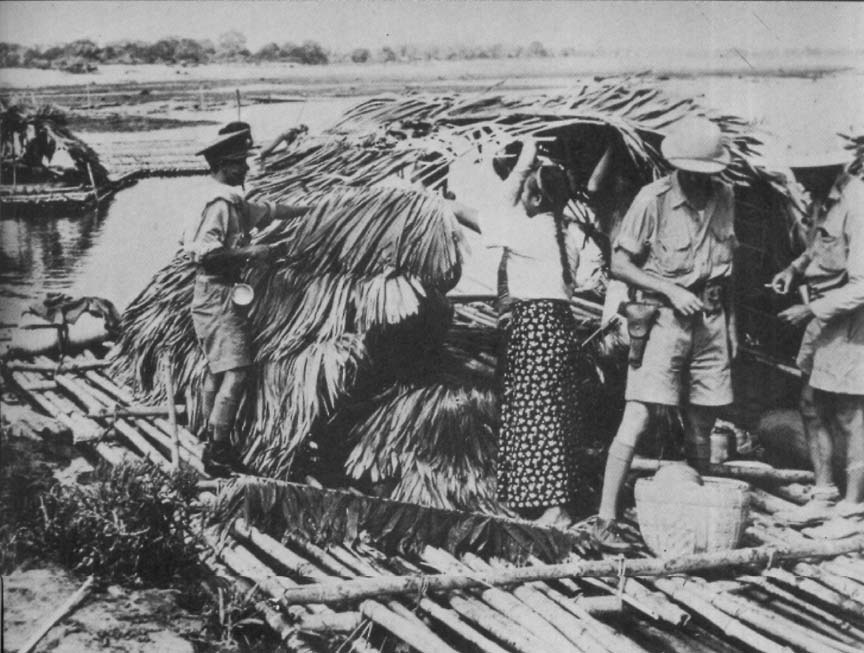 |
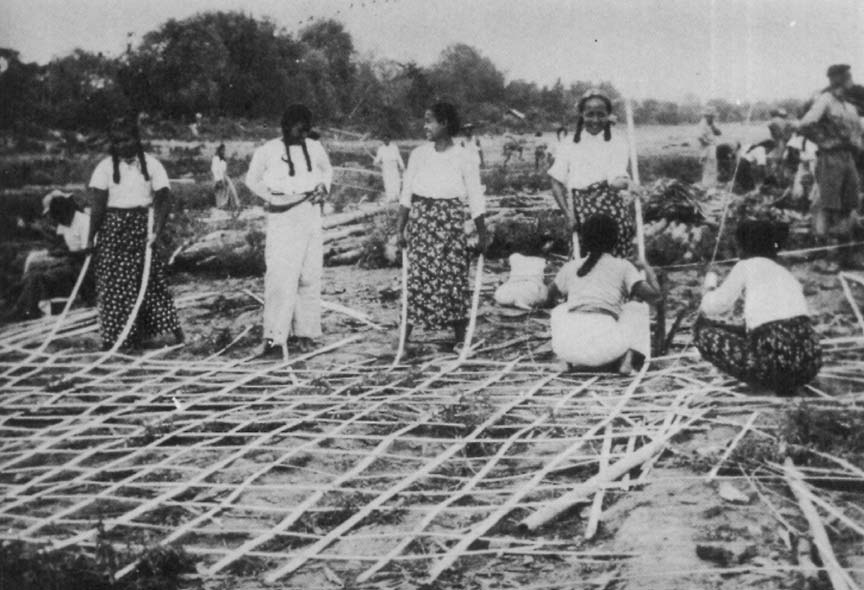 |
|
|
|
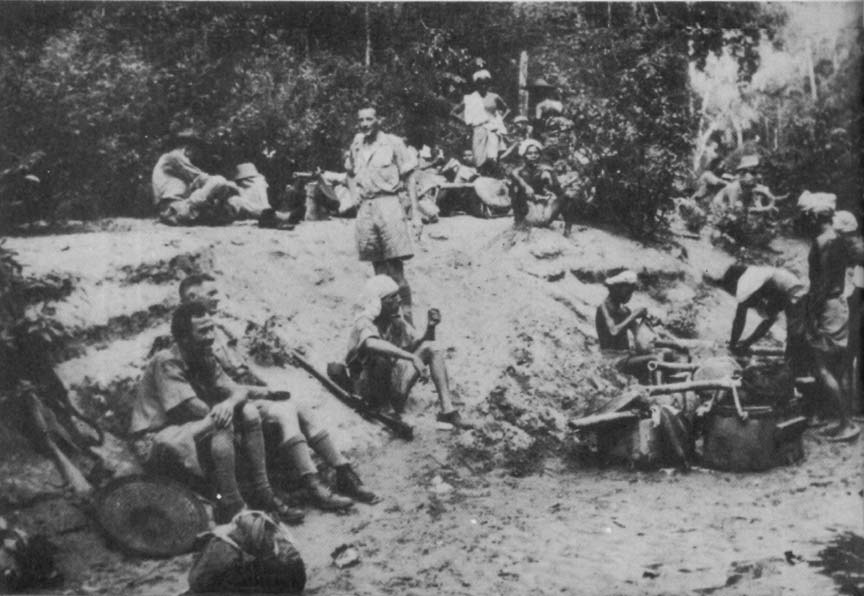
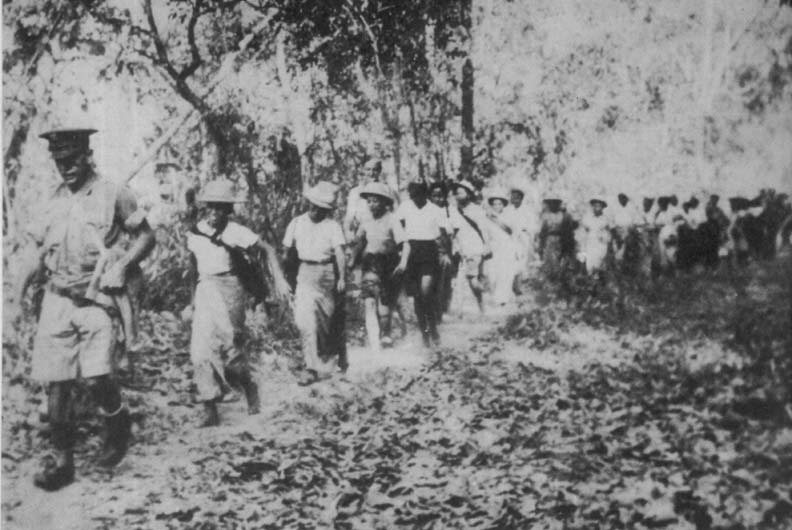 Dr. Seagrave Leading the Unit through the jungle |
 |
Indaw was jammed with refugees, and the road, ankle deep in dust, was so crowded that we had to do a great deal of it in low to keep from hitting someone. Those poor people! Mothers trudging along, pregnant, but carrying children on their backs. Blind people. Lame and wounded soldiers---saw and recognized a few of the Chinese casualties we had operated on. Children and ancients walking along hand in hand. Punjabi cavalrymen on lovely horses. British officers on foot with their men. Chin soldiers of the Burma Rifles walking home with their families, looking as though they had been discharged from their regiments. Easy to see that the road into Assam is going to be lined with graves---or, more probably, skeletons---soon! We got a big laugh out of one group of refugee Indians dressed in the yellow robes of hpongyis. They must have taken a monastery by storm, to pay back a small part of the mistreatment they have received from fifth-column hpongyis. I hope the group of hpongyis they beat up were not the perfectly innocent variety.
Fifteen miles of this, and then we had to ford streams. Paul's truck sank in up to the hubs in the first ford and something went wrong with General StilweIl's own car. The general must have heard some bad news in Indaw, because he has ordered us to move forward continually at all costs, abandoning vehicles at once if anything goes wrong. He abandoned his own car there, and we hurriedly salvaged our surgical instruments out of Paul's truck and went on. At the next ford they ordered Lilly, the American Technical Group man with the powerful thumbs and leather stomach, to drive the trucks across so there would be no more mired down. Tun Shein forgot to tell him that his truck had trick brakes, so when Lilly got across the other side and jammed down on the brakes the truck plunged into the body of the one in front and crushed the radiator. We had to abandon it also. Mine was the only one of the original trucks of our unit that got through. The Friends have lost one of theirs. Even Lilly could not have driven the trucks up the steep bank on the west shore if Grindlay and other American officers had not stood beside the truck and thrown sand under the wheels as they started spinning. Several times a jeep had to come to the rescue and pull.
Some time after dark we passed a lot of Chinese troops quartered in a refugee camp. We kept on over one more ridge along a very narrow road where it was all we could do to get by a lot of oxcarts that were being used by refugees. At 2:00 A. M. we stopped to camp for an hour by a stream. Heard there was some talk about the advisability of paying the nurses off and leaving them there so they wouldn't be a drag on the party as we marched over the mountains! But General Stilwell heard about it too and squelched it at once.