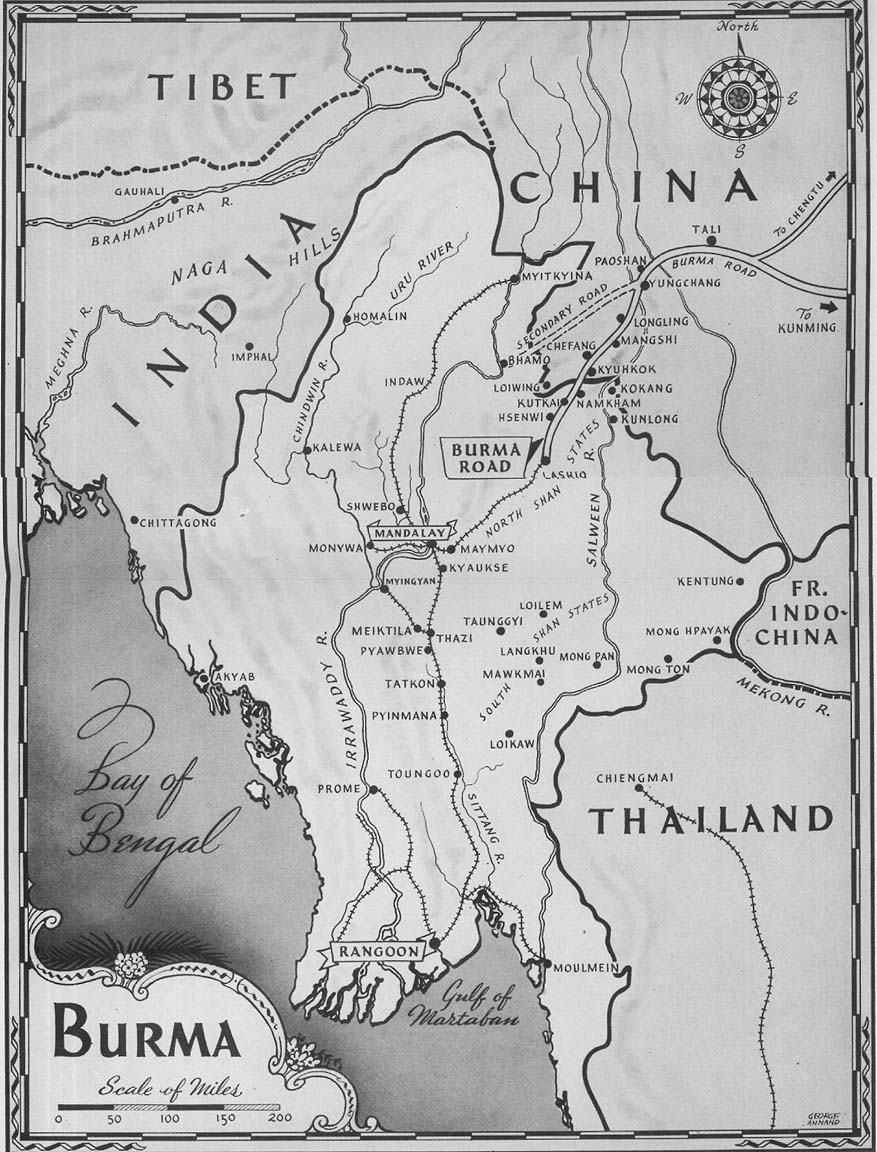
May 6th---I fell asleep at the last minute and darn near didn't get into my place in our echelon when the general started at three. That would have finished me once and for all! We passed through a big Hkamti Shan village called Mansi, and, five miles farther along, the road ended at a flimsy bridge which nothing but a jeep could negotiate. The general got us all together around him and made us a speech. All the different groups were to turn in their food supplies into a pool, then abandon everything they had except what they felt they would be able to carry themselves. I got the nurses together, after that, and told them the Chin Hills and Naga Hills which our trail would cross were famous for their steepness and therefore they certainly could not carry so much stuff as to make them lag on the march. We must vindicate ourselves by covering the ground as fast and as far as the long-legged Americans. Furthermore, we would certainly be called on to care for the sick en route; so each girl must take a little first-aid kit, with the drugs for malaria, dysentery, headaches, etc. My speech was very effective; for tonight I find the silly girls threw away their blankets and have only enough for one to every group of three. They even threw away their silk longyis and kept one extra cotton outfit each.
While the Americans were shuttling back and forth to the end of the jeep road eight miles away, transporting the food supplies, we set out on foot. I find my feet don't hurt much if the ground is fairly smooth and I can set my feet down squarely. It is this ghastly heat! I noticed the girls were carrying water in sulfathiazole bottles. About fifteen thousand tablets of the only sulfathiazole in India must be all over the ground back there! After four miles I was exhausted and lay down for a half hour under a mango tree and soothed my parched tongue with green mangoes. There is no shade, but at least we did not have to climb mountains. That guy Grindlay has got guts. He carried Ruby's pack as well as his own. Colonel Williams did this trip on foot with us, though he could have hopped one of the food-carrying jeeps. He seemed to have made up his mind to take things the hard way with his medical unit. He is ten years older than I am, but he can walk circles all around me. The Americans have a tiny bungalow, and Mr. Case had persuaded the hpongyis to let our unit have their monastery. There is a world of difference between these Hkamti Shan hpongyis and the variety between Mandalay and Rangoon. The people were very kind to us and cooked us a wonderful dinner. We heard a mule train was passing the bungalow, and the general persuaded the muleteers to go with us to Assam. That will make it possible to take all the food along, and we won't starve. Major Barton, an English commando officer whom we used to see in Namkham and Lashio fifteen years ago and who speaks most of the languages of the orient, has joined us to act as a guide. He has lived most of his life in the jungles and is built like a bull. He has an Edward VII beard. The nurses have been bathing my feet and putting dressings on the sores.
May 7th---Up at dawn, but the Chinese muleteers, as usual, took an extra hour or more to get the loads tied on the saddles; so the sun was fairly high when we started. We followed a path that passed through jungle crossing a stream they call the Chaunggyi several times until we came to a sort of gorge; and then there was no road at all. The general and his Hkamti Shan guide led us splashing right down the stream bed. The general sets the pace and is followed by the American officers; then comes a small group of heterogeneous officers; then the English; then our group; and finally the general's Chinese bodyguard. The general has been carrying one of the tommyguns. From ten minutes to until the hour we have a rest, and then fifty minutes of marching. When we started down the river, the Americans at first stopped and snatched off their shoes and rolled up their trouser-legs. Later they gave up in disgust, and all plodded right through. One or two have cut off their trouserlegs and made shorts of them.
We are all worried about Than Shwe and how she can stand the trip. It is less than a year since I opened her abdomen for appendicitis symptoms and discovered the peritoneal cavity full of tuberculosis and the appendix tight to the horn of the uterus. She looks well and is carrying absolutely no pack at all. About ten o'clock one of the Friends saw a rubber air mattress that had been discarded by an officer, inflated it, put Than Shwe on board, and dragged her along. As soon as the girls got tired they began to sing. I was scared that the general might think this a breach of discipline, but no bullets hit me from his tommygun and their singing put new life into me, as it always does, so I let them go to it. About noon Colonel Holcombe, who has been ill for weeks, had a heat stroke, and they brought him down slowly behind us. About a mile farther on Major Merrill fainted from the heat right in front of Bawk and me, and we fell out of line of march with Colonel Dom and gave him first aid. He should not have had such a heavy pack! Than Shwe and her air mattress gave me a sudden inspiration. When Merrill's condition improved, Bawk and I hurried on to send Paul and Tom back with it. They dragged Merrill into our noon camp where the general was having two small bamboo rafts built while we were cooking. Colonel Dormi has given us permission to cook our own mess separately from the officers, as the girls like chillies and things in their food that the Americans can't eat. I had an hour's sleep until the ants biting me had had a good meal, and then we all had a bath. I asked the general for permission for four of our Friends Ambulance men to drag the hospital rafts down the river. Colonel Williams has assigned Than Shwe to ride on Colonel Holcombe's raft, and a Chinese lieutenant, who also collapsed with the heat, to Major Merrill's. It was dark before we stopped for the night. The general would have kept on if there were not so much chance of his men getting badly hurt stumbling around in the dark. The Friends didn't get in with the rafts till midnight. They were sopping wet, since, without light, they had been unable to avoid deep places and had sunk in up to their necks. One of them stepped on me as he was trying to find us in the dark. They are dead tired.
May 8th---Grindlay has been detailed to bring up the rear with the sick who are to travel at their own rate of speed. The river is running in a sort of gorge. On some of the sandbanks there is tiger spoor. Some group of refugees had driven jeeps down the river but gave up and abandoned them. I have never seen jungles so full of monkeys! The minute they spot us they start whooping and hollering. Nurses claim they are yelling, "daddy, daddy, daddy!" They can get a laugh out of anything! Jack Belden dropped back to walk with us and find out something about these nurses who laugh and sing when we white people are cussing our sore feet and the sand in our shoes. He was surprised to hear them strike up one of the modern Chinese national songs and wondered where they picked it up. Hadn't heard of our Sixth Army work, I guess. We crossed short bits of jungle here and there, and the girls insisted that some of the plants beside the road were edible. I have forbidden them to eat anything, though, until Tun Shein passes on it. I don't want any of them poisoned. We stopped for our noon meal on a high bank above the river, where there were some big trees and shade. Bawk spread out a rubber sheet she is lugging along so I could lie down and get some rest; but the shade moved away from me so fast that I had to get up and move every few minutes. Thorns were everywhere, and the girls kept picking them out of their bare feet. But the ants were positively vicious! Grindlay didn't turn up until we had finished our food, really delicious with some wild gooseberrylike fruit and some boiled wild greens that Tun Shein recognized. We are all vegetable hungry. Grindlay had been lost. He had had to go very slowly until a Chinese mule was sent back for Major Nowakowski to ride, and then the mule had a much faster gait than Grindlay, so Grindlay gave up and wandered along behind, finally noticing a village on the bank of the stream. Just about then he must have passed out from heat exhaustion, for when he came to, he was lying under a house with a Hkamti woman peeking down at him through the floor slats. He couldn't decide whether to go up or down stream and must have dropped asleep again. When he awoke he saw a uniform in the distance, and found us. The nurses made him lie down and took off his shoes and stockings, bathed his feet, and put dressings on his broken, bloody blisters while Tun Shein fed him his lunch. We are camped for the night by a big Hkamti village on the river bank. It took Tun Shein about fifteen minutes to make the villagers fall in love with him and cook us a dinner.
May 9th---The coolies the general secured to carry stuff at the first village refused to go any farther, so Case had to round up a new group. Took us that much longer to get started. Some of our packs are being carried and we distribute the rest around so that each person's load is fairly light. The Friends' packs are still rather heavy, but they are the type we all really need---they hang from the shoulders without constricting the chest. The rest of us have the ordinary Kachin and Shan bags and their straps make it hard to breathe.
Our trip today was across the neck of land between the Chaunggyi and the Uru, into which it flows. Just before the noon halt there was a huge elephant standing just off the road looking at us. The general and several other officers stopped with tommyguns to shoot if he charged---until our whole line of march went by into safety---and then rejoined us. The hill climbing, however, had been too much for Than Shwe, and she, with Kenneth and Eric, had had to drop behind unofficially. They passed the elephant after the guard had gone on. Our camp was covered with elephant spoor. It was hard to find room to lie down, and the ants and thorns were worse than yesterday. There was a little creek beside us with a sandy bottom, and the nurses scooped out hollows and lay down in them to cool off after they had gathered a lot more wild vegetables. We had three vegetables today. Some are rather coarse and some have a bitter tang, but the nurses like them all the better for that. As far as I am concerned, as long as the chillies and salt last I can eat any vegetable and enjoy it! An airplane flew over us a couple of times but we hid. A mile before we reached Maing Kaing there was a graveled road, too narrow for cars. The gravel was so sharp it cut the feet of the nurses, whose shoes had worn out and been thrown away, until the blood ran and finished off the flimsy shoes of the girls who still had them. We stopped for a long rest in Maing Kaing eating dozens of bananas and drinking gallons of coconut milk, then came on to the Uru River bank where we are bedding down on the sands. Tun Shein persuaded the local people to cook us another meal, and, of all things, they produced some boiled potatoes. O'Hara is ordered to camp with the Americans, so Grindlay went over to invite him to dine with us. How that rice hater did attack the potatoes!
May 10th---They say it is Sunday again, but you can't prove it by me! The general had secured three large rafts and one small one, and, we are to float down the Uru to the Chindwin. Each of the rafts consists of three sections fastened together with rattan. The Burmese had several hours' more work to do on one of the rafts, so we had a long wait ahead of us. The sight of those bare bamboo rafts worried me, for I hate the hot sun, and there were occasional dark clouds that looked like rain in the offing. Tun Shein scouted around and found a lot of thatch piled up under a native house, so I went over and stood near the general until he noticed me.
"Sir," I said, "if we may have your permission, our nurses will build shelters of thatch on each of those rafts to protect the whole group from sun and rain. We can complete them by the time the last raft is ready."
"O.K., get going!"
The Friends and orderlies split bamboos, some of the nurses cut rattan into twine and others wove framework under Tun Shein's direction. As the shelter went up some of the American officers got interested, watching the way the girls twisted, the rattan knots, and then began to help. We did our raft last, putting on the thatch after we had begun floating down the river. The raft assigned to us was the largest and had been tied nearest the bank. As the other groups loaded supplies onto their rafts, they had to carry heavy loads across ours and many of the rotten bamboos had broken before we started our historic trip. The small raft with Colonels McCabe, St. John, Wyman and Major Merrill went first, with orders to explore Homalin for Japanese. The Americans went next, then the English, and finally our group. Grindlay is with us as my second in command. And Jack Belden elected to come with us too! He doesn't dislike us as much as he thought he did. He spent the time chatting with first one and then another of the girls, who speak English freely, and is getting their life stories.
Eric is going to be the ruin of us all. He is so big and clumsy! He can't sit still, and keeps plunging around here and there, and you can tell where he has been by the broken bamboos he leaves behind. This afternoon I had to cuss him and order him to stay put. We men live in our underpants and the girls in nothing but a single longyi strapped up under their armpits. Every time we get hot we drop over the side and have a swim. It is nice to be able to sleep again. If we aren't swimming we are sleeping. Tun Shein has built us a little native fireplace of mud amidships, and we have weak tea and a bit of black sticky rice, which he begged off a native, every so often when our tummies rumble. We are better off than the others who don't know the customs of the country. We are all growing beards. Koi has adopted Grindlay as her own very special uncle and won't let him do a thing for himself.
The first hours were easy. We had a Hkamti captain at the bow and a helmsman at the stern. We men only had to jump to action when we got into shallow water. The Hkamti have taught us to be patient and not try to pole faster than the current, for when we pole too rapidly, the several sections of the raft tend to pull apart. We had to pull them together once during the morning and attach them with reinforcements of full-thickness rattan. An hour before sunset we caught up with the general who had stopped at a sandy bank to cook dinner. The minute the girls set foot on land they scattered into the jungle. This time they were unusually successful and came back with five different wild vegetables. The variety of which they had secured the most was a tender leaf with a slightly sour taste. I took some of it to Colonel Dom.
"Have a taste, Colonel," I invited. "Tun Shein guarantees that it is edible and the nurses have brought in far too much for us to eat. How about boiling some up like spinach for the general's mess?"
Colonel Dom took a taste, decided the leaves had possibilities, and gave instructions to the cooks. He told me later that they had really enjoyed it. It was something like spinach with the vinegar already added.
Since we always make a point of it, we were done with dinner and ready to move before the others were, so we sat around and sang while the others ate. It was dark when we started off again. We arranged shifts of two men each, since we were to travel all night and our Hkamti friends were tired. Grindlay and I took the first shift, I on the bow and he on the stern. The batteries in my flashlight were almost gone, and we kept grazing snags that appeared out of nowhere. Grindlay was cussing, me from the stern.
"Damn it, Doc, why don't you push us off those snags?"
"Damn it yourself! If I had a flashlight that would work I would keep us off them." I had the advantage of him, for I could cuss him roundly in Burmese and Shan, and make a good effort of it in Chinese, without his even knowing I was cussing! I could have done a better job of it also if there had been anything for me to stand on. There were only one or two sound bamboos left at the bow. I couldn't keep my shoes on for fear of slipping into the water, and as I moved from port to starboard and back again with my long bamboo pole, those confounded broken bamboos kept piercing my feet and often they ran right into those blasted sores of mine.
After three hours of cussing I turned my pole over to Paul with a sigh of relief. I found my bed was partly under water, so I moved over to a six-inch-wide stretch between a couple of nurses on the other side. But I hadn't had more than a beauty nap when I was wakened.
"God damn. God damn. God damn!" Breathless, fervent, a real prayer! Was that Paul? It certainly was none other! Something must really have happened if that most discreet, self-contained, he-man saint, Paul Geren, was cussing! Aching in every joint I got up and looked out.
"What's the matter, Paul?"
"This damned river is so deep I can't reach the bottom with my pole and there is a little creek falling into the river over there that makes a kind of whirlpool, and the raft just keeps running round and round in the same place. I can't paddle with this bamboo fast enough to get us past."
"Just let me find another bamboo pole and maybe both of us, working together, can get us by."
It was another hour-two hours and a half in all-before we managed to inch the raft beyond the interference of that little creek. Then we both went to bed and turned the job over to the Anglo-Indian refugee.
May 11th---Tun Shein cooked us some red sticky rice for breakfast. We caught up with the other rafts at ten. Even with the extra food that Tun Shein wangles out of the natives we are still half starved. I don't know how the others stand it! Soon after we caught up with them a bomber flew over us and swerved back and down toward us again. We expected to be machine-gunned any minute, till someone spotted the English insignia. When only a hundred feet off the ground the plane began to drop bags on the sandbank and we all plunged overboard, General Stilwell included, and raced for the sacks. Natives of the near-by village also were racing, but aside from a sack or two we got the whole shipment. Inside the sacks were bully beef, many of the tins cracked, ration biscuits, and cigarettes. The general carried back his own sack. The beef in the cracked tins had to be eaten immediately, so for once we had our fill.
We found a lot of bamboos at one of the villages and have, spent a lot of time today splitting them and repairing our raft which is fast going to pieces. There are not many places where you can stand with safety, and the floor level is not much above water. In the afternoon we got to another stretch of deep water just as a strong head wind came up. The rafts just kept turning round and round until some officers swam to shore with a rope and drew us in. We stopped there for a meal. It was dark when we started again with orders to keep in sight of each other. Our flashlights are all worn out and the snags are worse than ever. To make matters still more difficult, the current is now much stronger. Time after time it was almost impossible to keep the raft from breaking up. All hands had to plunge overboard and pull the entire length of the eighty-foot raft with every ounce of strength, the sand washing away from under our feet as we struggled. Once the water was too deep for the men at the stern, and the raft got away and did the next few miles stern first. For several hours we saw nothing of the other rafts and then suddenly discovered their lights right in front as we swung around a corner. Captain Eldridge shouted back that the Burmese steersman had let the general's raft get into the wrong channel and we were all to remain where we were. "Where we were" was good! There were the usual crosscurrents of the river's bend and if we held the stern in the front, the raft would break loose and float off by itself with no men on board. We had to get all the stronger nurses out to help us. Finally Martin explored in the dark and found a place a hundred yards farther on where the currents were less confused, and we poled in there and "anchored" ourselves with bamboo poles driven into the bottom. The next shift is on duty now to keep us from breaking loose, and I am going to try to get some sleep. It is long after midnight.
May 12th---The night shift went to sleep, too, and the raft broke away again. The front and center sections held together by only one bamboo. It began to pour rain, but I was sopping wet as it was, the place where I lay being six inches under water. From then till dawn all we could do was let the raft take its own course while we tried to keep the various sections somewhere near one another. As soon as there was light enough Tun Shein got some more rattan and tied us together again. Then it was a question whether the raft would stay afloat long enough for us to catch up with the general, who had vanished during the night. It rained again this morning and we had a time trying to get our clothes dry. The funniest thing that happened the whole trip was when we came around a bend and found Lieutenant Belknap sitting on a snag right in the middle of the stream hoping someone would find him! He had started off across country with the mule caravan, but his feet were so covered with sores he couldn't make it in to Homalin. Tun Shein found some potatoes and cooked them for breakfast---one tiny potato each!
Just before three this afternoon we found the other rafts tied up to the bank behind a huge boat with high carved teak stern. The officers on the scout raft and those with the mule train had explored Homalin and had found no Japanese there. While we were eating some bully beef and the biscuits, I heard there were some shops still open in Homalin, so, with the general's permission, sent Tun Shein, Grindlay, Martin, and Eric on ahead to try to buy shoes for the nurses. When they got to Homalin everything was closed; but Tun Shein started kidding the Burmese until he got them laughing, and then one of them admitted he had some shoes for sale. They bought ten pairs of tennis shoes and two pairs of oxfords, a lot of cigarettes, and some flashlight batteries. By this time the Burmese had fallen so much in love with Tun Shein that they invited the party into the headman's house and gave them tea. They were drinking the tea as we marched through. The rest of the party is sleeping the night in a Buddhist monastery and our unit is in the "nunnery." The floor is full of holes. Grindlay distributed the shoes, and all were fits except Ruby's. Her feet are as big as a man's and we had to cut holes for her big toes.
May 13th---Off at daybreak, marching north two and a half miles to the Chindwin. Over to the west were the terrible mountains to be marched over. The top of the range was wreathed in clouds. We had to cross a half-mile of deep sand before we got to the river itself. There were only two or three small dugouts available for the crossing when we arrived. The nurses crossed over in one of these, crouching on the bottom and balancing carefully to keep the thing from rolling over. Later, larger dugouts came along and one Burmese cabin boat with a hold and everything. Someone had found a little pony for the sick men to ride, and the general ordered me to swim him over. I held on the stern as the boat started off, leading the pony by the bridle. At first the animal went willingly, being used to fording small streams; but when he got tired and saw no farther bank in sight he got wild and tried to swim back. For ten minutes the boatmen could make no progress at all and then, catching a glimpse of the bank, the pony became docile again.
We waited on the far bank, where there was no room to stretch out and no real shade, until two this afternoon, wondering where the pack train had disappeared. It finally turned up beyond us, having crossed the river some distance below. There was a good trail through teak forest. As we climbed the ridge we saw our first Chins, villagers with heavy loads of thatch grass they had been ordered to produce for construction of shacks for refugees. They are quite like the Kachins and some of their words have a resemblance. After only a short march we passed a burned village and descended to a small stream whose banks were very rocky. We found enough patches of sand for us all to have just enough room for a small bed. The water is very cold and very refreshing after the awful heat we have been through. My sores are much worse. While we were bathing, a tremendous storm blew up and we could see rain pouring down all around us. It missed us completely, much to everyone's delight, for there was no possible shelter for us and we would have been set for a cold wet night. The nurses burst forth into song again. They say we made only ten miles today.
May 14th---Case had to get a lot of Chin carriers to replace the Hkamti, and so, since Chins carry their loads suspended from their foreheads and not on yokes like Hkamti, there was a lot of repacking to do. The road today was steep from the start, and the swarms of monkeys everywhere kept laughing at us as we panted and sweated. Our noon camp was by a clear mountain stream rushing madly over gigantic boulders. I had a malarial chill while the boys were cooking and the nurses fixed me a place where I could stretch out in a sort of arbor and rolled me up in a blanket. Of course, the general had to catch me at it just as the chill passed off.
"What's the matter, Seagrave, got fever?"
"No, sir, I got wet and felt a little cold so was warming up." "How are your feet?"
"Better, sir."
"You are lying."
"Yes, sir."
The general laughed and walked off to give orders to start. Grindlay saw a lot of otters playing in the stream, but I wasn't interested. Today was the first without elephant spoor. They say the road was built by the government of India in 1918 to suppress a rebellion among the Chins who did not understand why they should form a labor corps to work in France. It is being repaired for the first time since then. The reason why there are not the motorable roads needed now so badly to connect Burma and Assam is that the Burma-India Steam Navigation Company wanted the monopoly of Indo-Burma trade for their Calcutta-Rangoon steamers. Only six people have used this road ahead of us.
We have outdistanced everyone else. Jack Belden is still with us on the march and sleeps with our unit at night too. There is supposed to be only one more day's march before we reach the top. The afternoon climb was worse than the morning one. I got so angry with the girls for singing and talking at the tops of their voices as we climbed. Couldn't stand the idea of anyone wasting breath while I was dying on my feet, as it seemed to me. I asked them to confine their singing to the few slopes down. Maran Lu wouldn't listen to me and I had to give her a direct order. The last hour the road was horribly steep and a drenching rain came on. My morale was at very low ebb. We finally reached some half-finished grass shacks at an elevation of thirty-nine hundred feet. That means that we have climbed three thousand feet today, for Homalin is only four hundred and fifty feet and we went down almost as much yesterday as we climbed up. A Mr. Sharpe, secretary to the maharajah of Manipur, was waiting in camp. He was sent out by the government of India to meet General Stilwell. He has a few ponies here and about a hundred Naga coolies. There are more ponies and anything up to four hundred more coolies a few miles farther on. Now, at least, we won't have to carry our packs any farther. The sick are to ride the ponies. The party brought large quantities of food with them and we have to be on half rations no longer. There are only five to eight more days of travel ahead of us, depending on how fast we travel. The general knows the rains are due to break suddenly and effectively soon, and he has rightly determined to push us along to the limit of our endurance. It would be terrible to have to climb these mountains if we had rain all day long, and the Assam rainfall is so heavy they measure it in feet and not in inches. Case found a couple of pigs and gave our mess the smaller one. It couldn't have been very large, for we ate up every scrap in one meal. The girls have been drying my clothes as well as theirs. I have done nothing but roll up in my blanket and pray for a sudden easy death! Thirty-nine of us have to sleep in two small huts on muddy ground. The rest of our party have been cutting grass to spread out. Grindlay has picked up a severe conjunctivitis. The smoke of the fires---the rain compelled the boys to cook inside the hut---makes his eyes burn terribly.
May 15th---We were up at dawn but couldn't get off till seven-thirty as the loads all had to be arranged again to suit the Naga carrying customs. Colonel Williams ordered me to take command of the sick cavalcade. Lord, what a break! I honestly don't think I could have taken another step. There were only eight ponies at the start but I managed to wangle two of them for Than Shwe and Esther. Grindlay now commands our unit. He will not ride a pony and yet I have seen his feet and they are a terrible sight. He insists he is younger than I, and that, of course, is a self-evident fact.
The trail was very steep and hard on the ponies, but until my noon chill started, I enjoyed gazing in awe at the Nagas. When we first saw them, last night, they were wrapped in blankets. This morning they were stripped for action, and never in my life have I seen such beautiful men in such large numbers. They were perfectly shaped with well-developed muscles. Lovely proportions! There wasn't much of them that you couldn't see, for almost all were naked except for a tiny apron and a little bag, about six inches long and two wide, for the most important part of their anatomy. There was no trying to avoid the heavier loads. Their chief anxiety seemed to be to beat the other man to the load and get going first. They had their heads shaved except for a ridge of hair down the middle. Their ear lobes were stretched to great lengths by heavy ornaments.
There was no shade from the hot sun and the heat was damp. We covered only six miles before the noon halt, where our meal consisted of tin willie and biscuits. We had tea, though, and that washes anything down! Had to climb another two thousand feet in the afternoon to the border ridge at an elevation of six thousand feet. During all this latter part we could look back and see across the entire country that we had taken seven days to cross spread out in panorama below us. On the horizon were the low hills of the jungle where we had abandoned our trucks and supplies. We passed a border pillar and the girls burst into song again as they crossed into India. Everyone began talking about the huge quantities of ice cream she was going to consume and the numbers of movies she was going to see when she reached Calcutta. To hear them carry on you would think we were going to sleep in Calcutta tonight with no further miseries before us! We are now in taungya country again, the first we have seen since we left the Shan States. The Nagas are more like Kachins in some ways than the Chins are. They burn down the hillsides to plant their rice for three or four years until the soil is no longer fertile and then move on to another spot and burn down some more. Between these patches of taungyas are stretches of thick forest. There were three hundred and fifty more Nagas waiting for us as we rode on for a time along the ridge. Clouds came up from the west, and then as the rain broke, we had a last glimpse of the Chindwin before we plunged down into the valley. There were now twenty-eight ponies, but only eighteen were usable. Many had no saddles. Most of the saddles were in pretty poor condition, without decent girths or stirrup leathers, and my stirrups today were so narrow I could just get the tips of my Army boots into them and no more. I am glad Than Shwe and Esther had a chance to ride up the steep section. Going down in the rain we had to lead our ponies and walk a good bit of the way. Our refugee friend begged for one of the new ponies and I let him have it. Then the big scab rushed along with it, not waiting for the people who were really sick! The two women refugees are not so bad, but all three of them manage to slip in a squeeze when there are any favors to be had, while the nurses don't like to accept any favors for fear the Americans will get the idea they haven't got guts! The Naga village where we are spending the night is back in Burma again! When the nurses heard that, they didn't continue to brag quite as much about what they were going to do in Calcutta! There is only one but for us and we had to dry out our clothes. Maran Lu is completely all in and in a rotten humor and acts like a cat. Grindlay says she insisted on talking and singing all by herself while they were climbing the worst stretch. Now she and all the rest of us have to pay for it. Several of the girls are distinctly pooped. The ones who usually take care of me could do nothing but change into drier clothes and drop down on the floor, so I have been trying to dry their wet things, holding them in my hands over the fire. Everyone is talking about how Bill Duncombe can laugh. He has always been very reserved around me, since he took his place in our Friends Ambulance at Kume, but he and Paul have become fast friends, and today, when the morale was low, Paul told him something funny and his laugh roared out so loud that all the Americans turned and laughed in sympathy. Grindlay was greatly impressed with a herd of miffin that he would have missed entirely if the girls hadn't seen them and called his attention. They are wild cows that look something like buffaloes but have a white tufted tail. They were grazing along the border ridge. I, of course, missed them entirely.
May 16th---Up at 4:00 A. M. and off at 5:30 to the sound of a wild elephant trumpeting in the distance. I made Koi and Bawk ride with me today and they kept me busy answering all sorts of fool questions. I wish I had a phonograph record with me to say, "Nga m'thi, nga m'thi. I don't know, I don't know." Maran Lu had to ride, too, but she is still provoked with me and didn't say a thing. We went over a mountain shoulder with gorgeous scenery---just like the woods in Ohio---and then down a deep chasm, losing most of the height we struggled so hard to gain yesterday. Why did I put my movie camera onto the mules? The road up the other side of the chasm wound back and forth on the face of the precipices and the whole line of march was spread out in front of us, certainly a full mile in length. This was the first very steep climb since the last group of Nagas joined us, so I heard something new and very impressive. The Nagas travel in groups from the same village, keeping step as they walk in single file. At every step one or another lets out a grunt, each grunt in a different key, up and down the line until each has had his grunt, and the leader begins again. It makes a weird tune something like this:
| Leader | Unnhh |
| No. 7 | Hump |
| No. 3 | Ugh |
| No. 8 | Heep |
| No. 2 | Hic |
| No. 5 | Hah |
| No. 6 | Ho |
| Nos. 4&9 | Hay |
Not a chance of our riding the ponies up that stretch! We had to get off and lead them. At the top of the precipice I found several of the girls and a couple of men waiting. Grindlay had ordered them to wait for me and have a ride because they had been on the verge of collapse. We hitchhiked from there on. The grades were not quite so steep but they were enough. Thank goodness it was not much farther till we came to the little village where the general had set up the noon camp! Red-blanketed chiefs carrying rifles met us there with their formal present of rice wine. The blankets and rifles are a gift from the government and are the royal marks of the chief. Nobody has any trouble persuading the Nagas to carry his rifle or tommygun. The Naga lucky enough to carry one is the envy of the whole tribe for the day! We left at two this afternoon and walked downhill for a couple of hours. I had had more than my share of riding, so I put one of the girls on my pony. Giant Eric caught a tiny pony without a saddle and rode him bareback. Eric's legs are covered with sores from the thighs down. Of the eighteen ponies only four or five are ridden by our unit, though our unit is 40 per cent of the whole party. Ruby's feet have been so badly torn by those tight shoes that she is walking barefoot again, and the path now is covered with broken shale. The girls think they lose face when ordered to ride.
We stopped for the night by another rushing mountain stream. Our whole crowd had to get into one narrow hut. I made the nurses spread out a single layer of blanket on the top of the rough saplings that the floor of the hut is made of, and we are all going to sleep in the one huge bed. I was selfish and picked my spot at the farther end where various portions of my anatomy can bulge out of the side wall of thatch if I don't have enough room---and provided it doesn't continue to rain! All the menfolks dropped down to rest, but those silly girls rushed off to the river, bathed, washed their own and our clothes, came back and have been powdering their noses and even putting on a touch of rouge! Now they are singing as they serve up our food! All sorts of fellow sufferers have been coming to us for dressings for their feet, and the adhesive is running short; but I overheard two girls laughingly tell each other that they each had a roll hidden out, which I wasn't to be told about until I had gotten properly frantic!
May 17th---What a night! What a night! By actual count we were each entitled to five saplings to lie on; but as the crowd in the middle twisted and turned in sleep, made restless by branches and knots pushing into them, they gradually pushed me out until I had only two saplings left. I tried so hard to stay on those two that I got horrible cramps in my legs and kicked out the side wall beside me---and then it rained! Tun Shein and Ko Nyunt got up long before dawn and cooked us some breakfast. The coolies had slept on the path, and the ponies were a mile beyond us. The sick party had to walk to the ponies and then the pony syces had got mad because they were not given a chance to cook food on the trip at their usual times, and refused to co-operate. They hid stirrups and girths and pretended they were lost. General Sibert rode with us today. One of my stirrup leathers was very short and the other long and there was nothing to be done about it. I dangled my feet most of the time. The road was so narrow we could hardly pass the carriers. We climbed steadily for hours. Veins of coal had been exposed everywhere cutting the road. First we went through a forest of firs and then, near the top, came to pines. This, they said, was the real top. I don't believe them. I got permission from General Sibert to remain behind at "the top" with the two nurses who were riding until the lost ponies turned up. Our ponies had a chance to graze and we found a hut where we could stretch out on a couple of banana leaves. Colonel St. John and Major Barton caught up with us there with the whole mule team and they straightened out the syces so we could have decent saddles at least.
The rest of the party was an hour ahead of us on the trail, but the road now was smooth and comfortably wide and so well graded that we made wonderful speed, even running and trotting in spots! We got to the afternoon camp just five minutes after the others. General Sibert is fed up with his pony and would rather walk no matter how sick he is. The nurses were laughing about how on the way down they took the wrong turn onto a path that turned out to be a short cut, and the first thing they knew, they were ahead of the general! There was an occasional drizzle. One thing that impressed me today, as we passed through the Naga villages, was the absence of women anywhere near the road. We made eighteen miles today, pushing on after lunch to a Naga village of fourteen houses built of heavy planks carved with all sorts of figures. There were totem poles here and there with the mounded graves of the dead in front of the houses. The houses are decorated with miffin skulls instead of the human skulls of not so long ago. There are pigs and dogs everywhere. All this in an alpine setting. We were given one of the Naga houses to sleep in. The front room had a nicely packed floor covered with straw, and it looked so inviting that our three refugee parasites were, of course, already parked there when we looked for a place to sleep. Five of us have found a sloping platform of planks in a corner just about big enough for us if we don't try to turn over. It is clear and cold. While the boys were cooking dinner we had our usual foot clinic, treating each other's sores and then the sore feet of others of the party. On the whole we have done rather well in not letting the sores get worse. Most of them started that first day's march down the Chaunggyi.
May 18th---Got up in the dark and were off by 5:15. It wasn't hard to get up. Everyone but myself had been chewed all night by innumerable dog fleas! While the darn things never bit me I was having my own troubles, for I was on the highest edge of the sloping platform and had to cling to the edge with my fingers and toes to keep from rolling the others off onto the ground.
Today the hills were drier and there were fewer streams. The valleys were a bit wider and there were terraced paddy fields here and there. I knew they were lying to us yesterday when they said we had reached the real top, for we climbed up again until we went over a pass seventy-five hundred feet high, where there was a very strong breeze and we had to get off and walk, sick and sore-footed though we were, to keep warm. The rainfall here when the season starts must be very heavy, for the trees are shaggy with orchids, lichens, and moss and parasites of all sorts. Ghostly appearance! Two railway men from India, who were sent to Burma to help out during the war and were about the only two men who stayed and helped Captain Jones with his impossible job to the very end, are sick with malaria. Today they couldn't balance themselves on their horses; so Colonel Williams is having them carried by the Nagas on stretchers. We had tea and biscuits for lunch at a camp in the next valley. That was the most wonderful valley of all, for around the camp were six brand new latrines---the only ones on this whole trip. The nurses were so pleased that they practically lived in them! From that camp on we had glimpses of Ukhrul, the town on the top of the distant ridge to which all the mile posts of the past four days had been pointing. When we started to climb again we came to a village with a church in it. Gosh, are there still things like churches in this Godforsaken world? A Naga chief who was walking beside me and knew a few words of English pointed to it and said, "American Baptist Mission." Well, we certainly were reaching civilization again!
As we climbed up to Ukhrul I chatted quite a bit with the British officers who had been assigned to my sick cavalcade for the day. They had held various civil and military positions in Burma and had actually heard about me and about Namkham! I didn't feel quite so lonely---no, I think I felt more lonely as my mind went back to Namkham again: Namkham in the hands of the Japs! Where was Bill Cummings? Where were the nurses?
They assigned us the government bungalow at Ukhrul. It actually had a flower garden around it. The nurses had been trying to teach me for months how to "say it with flowers" in Burmese. One flower meant "I hate you," and three meant "I love you." I could not find enough flowers available for me to give three to each, so I let them pick the darn things themselves and take the consequences! These girls like nothing better than to deck themselves out with flowers in their hair. With black hair, such as they all have, any flower looks wonderful!
Although Ukhrul is sixty-five hundred feet high and the water cold, those crazy girls were bathing till dark. I can't understand it! I am going to stay dirty.
The government officer escorting us, Mr. Sharpe, had arranged for a miffin barbecue and a Naga song-and-dance festival in the general's honor, but they had to call it off. Imphal has been bombed and all the local people have run away. They run faster in India than they did in Burma! And farther, too! They found a butcher who didn't run away and he butchered two steers for our crowd, and we have all the meat we can eat! There is a fireplace in the bungalow, so we cut our meat into steaks and grilled them in the fire on sticks. Didn't eat anything but meat tonight. My steaks were partly burned and partly raw, but I don't think I ever tasted anything so heavenly!
Two A.B.M. preachers came to talk to me when they heard I was a missionary. I was so awfully tired that I turned them over to Case. He is a much better missionary than I am!
May 19th---We spread out our single blanket on the floor, but the cement was horribly cold and I was on the edge as usual and couldn't keep the upper blanket on me when the other four rolled, so I got mad, built up the fire, and slept on a chair beside it. They say we made twenty-one miles yesterday. I certainly felt like it, and yet I had that pony! How do the others stand it?
We got off at 5:30 and for miles were passing swarms of Nagas of a different tribe from our carriers. Their hair is cut in a different pattern and they wear different clothes---if you can call those aprons and bags clothes! There has been a cold drizzle all day. The nurses are so tired now that they have lost all sense of shame and don't even bother to leave the road to answer the call of nature. And nobody cares about it either! At noon we had a "dry" halt. Yeah! It was "dry" as far as having any fluid to make tea was concerned; but there was plenty of water falling from the skies on us! I never saw anything so funny as the efforts of the various members of our group to keep dry. I had a sweater which made me imagine I was keeping warm. Roi Tsai had on Kenneth's trench coat. The girls who brought rubber sheets with them instead of blankets had them fastened over their shoulders; but funniest of all were Lilly and Little Bawk. Lilly cut two holes in his blanket, put his head through one and Bawk's head through the other and they walked along together looking like a couple of ghosts. Everyone got a good laugh out of them, so they were an invaluable asset to our morale! Grindlay looks just what he says he is: absolutely exhausted. Yet he won't ride my pony. He is so afraid that he will lose one of the nurses that he walks backward at every corner counting them! In the state of half coma we are all in, it isn't possible to tell, except by counting, that ,anyone is missing. That darned jackass, Maran Lu, was demon-possessed again today and went off into the jungle saying she was going to hide out there till the end of the war!
My saddle kept slipping off as I went down that last awful descent. Finally the pony put his foot in a deep hole and fell just as the saddle slipped up on his neck and made me turn a full somersault on the rocks. Then I got mad and finished the trip on foot! We got into camp late. Colonel Williams met us at a narrow suspension bridge beyond which was the motor road into Imphal, and informed me that the general had ordered our unit to set up in Imphal and help the government with the refugee problem until he had another job ready for us. Near the general's camp was a shack occupied by refugees. They were a healthy lot--probably the last healthy lot to come through---so they moved out quite willingly when they heard there were a bunch of nurses who needed shelter for the night. Maybe you can call it shelter! Grindlay had his hands full, for he had been ordered to leave our unit and remain with the other American officers. His friends, Sergeant Chesley and Colonel St. John, had arrived in camp with high fever, and Grindlay hadn't the slightest idea how to treat malaria.
Sometime after dark Colonel Eckert and Lieutenant Arnold arrived in a jeep to meet the general. We were all ordered into the bungalow to listen to the news. Tokio, Colonel Eckert said, had been bombed by the United States Air Force. Well, we can stand anything now!
May 20th---We slept late this morning. Didn't get off until 7:30! We were quite ready to leave, for it had poured all night, the roof of our shack had not been repaired for years, and we were all sopping wet. To make matters worse, when the rain began to pour, refugees had all pushed back into the hut and lay in the aisle and on top of our feet. The government sent out a number of trucks and ambulances to fetch us. In my ambulance we had Colonel St. John and Sergeant Chesley, both looking more dead than alive, though their high fever had temporarily subsided. As soon as we left the mountains and started across the huge Imphal plain we began to have difficulty with mud. There was no gravel on the road and the trucks had ploughed deep ruts. Our ambulance had huge desert tires and they would not fit into the ruts of the trucks ahead, causing us to skid more than ever. Every time we slipped off the road it was a case of all hands getting out in the mud to push. The driver had a peculiar habit of doing everything in low, even when the ambulance could have gone on quite well in high with an occasional shift into second gear. I suppose he was afraid for his safety in high, not realizing that high gear doesn't cause skidding on a muddy road nearly as much as low. Martin finally got peeved, pushed him out and began to drive for us. The cars all had to be hauled across a detour, necessitated by a broken bridge, and General Stilwell pulled just like the other officers. There were sixteen miles of this and then ten miles of graveled road into Imphal. Our ambulance pulled in last after the nurses had disappeared, so leaving Grindlay at the old fort, built in memory of British officers and men massacred during the early years of British rule, we began to explore the town. There were bomb holes everywhere, the tiny ones caused by antipersonnel bombs. Not a shop was open. Aside from troops there were no inhabitants to be seen.
I finally located the nurses and Friends in the English Casualty Clearing Station. The English captain in charge of the station is one of the finest men I ever met. His father, it seems, was a medical missionary at Quetta, in Baluchistan, and a very famous man. The buildings of a separate hospital unit in the compound had just been vacated and he told us to set up in them. There were beds there, and mattresses! How many weeks is it since I last slept on a bed?
With a sigh of relief I pulled off my boots for the last time and started soaking my feet in the puddles of rain water, when suddenly one of the nurses let out an awful scream.
"Mr. Cummings! Mr. Cummings!"
There was Bill coming on the run, tears streaming down his cheeks! What a bedlam broke loose, sobs and cheers, tears and laughter. The girls threw themselves on him and fairly mauled him, firing questions at him so rapidly he had no chance to answer. They would have torn him apart if the food ordered for us had not that minute arrived. The nurses were so starved they finally consented to pack their mouths with rice and dal and give Bill a chance to answer my questions. Gurney had brought out fourteen nurses with him, traveling by plane from Loiwing to Dinjan. Several of our orderlies had also come by plane, among them Theodore and Judson. Bill, Graham, Whittington, Ba Saw, and Bella had driven to Kunming in trucks and jeeps and had then flown to Dinjan. They located Dr. Gurney's crowd at Jorhat in the A.B.M. hospital where the crazy girls were already attending classes in the nurses' training school and trying to help on the wards. While they were worrying about what had happened to us, Bill bumped into my old friend Colonel Ottaway, who used to be a tin-mine manager near Tavoy. Ottaway told him he had been supplying foodstuffs to R.A.F. planes to be dropped to General Stilwell and that the general would probably reach Imphal in another three days.
Bill and Ted Gurney talked over the new information with Colonel Ottaway, and they decided that if our unit had come out with General Stilwell, Gauhati would be the logical place to wait for us. Ted would take the nurses there by train while Bill rode in Ottaway's jeep to Imphal. Kyang Tswi was afraid Bill would slip away in the jeep without her, so she hid all his clothes and Bill had to leave in the things he stood up in! They drove all day and all night and got to Imphal yesterday. Just a few minutes ago Bill, wandering hopelessly around, had bumped into Colonel McCabe and learned we had arrived!
THAT EVENING Bill and I had a chance to talk. He told me quite a tale:
After leaving us in Kume, Bill traveled back to Hsipaw, seeing no sign of a stand being made against the Jap advance which could cut them off on either of the two roads from the south. There was nothing to do but evacuate Gurney and the nurses, who had been operating steadily, to Namkham. After they were safely off, Bill commandeered a Chinese Red Cross truck and followed with the rest of our equipment. A few miles along, he met a puzzled Colonel Boatner who wanted to know where the hell that damned bridge was that General Stilwell had ordered him to blow up! Bill stopped a minute to enlighten him, made it into Lashio at midnight, and then, with breakfast at Kutkai, managed to reach Namkham at noon. Next morning Ted insisted on going back to Kutkai with four nurses to set up, but they found Major Lindsay already there doing what little there was to do, so they rushed back to salvage Namkham. At Kutkai they heard that our base hospital at Loilem had received a present of twenty-eight bombs the morning after we left, and Hsipaw also had been plastered.
At Namkham the woman's surgical ward was full of R.A.F. men. Dr. Grey and Dr. Ahma, who had been doing my Namkham hospital work, had flown out that day from Loiwing with two women missionaries. Bill's house was full of government officials, and Gurney and the Grahams and Whittingtons and Dr. Barr-Johnston were in my bungalow; so Bill slept on the big table in the nurses' home. Dr. Barr-Johnston had brought out two of the Kengtung nurses. The others elected to remain with their families.
The next morning Mrs. Graham, Mrs. Whittington, and other missionaries flew out from Loiwing. Bill made a rush trip to Kutkai with two nurses who wanted to rejoin their people, and returned with five huge sacks of salt to distribute to Kachin and Shan teachers to help them through the months of Japanese occupation. Loiwing had been bombed again the day before and the stabilizer of one of the big United States Army transport planes had been injured. The plane was now repaired and had no passengers. Bill was hopeless of ever reaching Myitkyina ahead of the Japs, so he arranged for the nurses to take passage. At the last minute Bill and Ted had a fight, for Ted was determined to be the last to leave; but Bill finally persuaded him that the nurses would be lost in India without him, and pushed him on board just in time. Two patients went along with them.
After the plane left, Bill asked an A.V.G. officer if he knew when Hsipaw had fallen.
"Yes, the Japs took it two days ago."
"In that case," said Bill, "they will be here day after tomorrow morning."
"How can they? The Namkai bridge has been blown."
Bill got a map and showed the officer the short cut from Hsipaw through Namtu Silver Mines to Namkham.
"God! We'd better get out of here."
Dr. Richards of the A V.G. went back to Namkham with Bill and was presented with one of our trucks, two of my sterilizers, my Oldsmobile sedan, and all the medicines he could carry. He took some of our surgical instruments, too. Then Bill went over to the nurses' home and discovered that the Shans had stolen most of the suitcases that the nurses had left ready packed for Bill to put on his truck. Bill doesn't get profane very often!
That historic afternoon Dr. Tu and Nang Leng found a few minutes to get married. Bill pleaded with E Hla to go along with him, but her mother refused to budge and E Hla had to stay behind. What do you suppose the Japs have done to that charming girl and her baby?
Bill called in all the mission staff and paid them three months' salary in advance. To E Hla he gave six months' salary -God bless him!---and huge quantities of salt, kerosene, rice, and sesamine oil. Koi's poor old father and mother got the same. Then he had an argument with Ba Saw.
"What is the advantage of my going with you?" asked Ba Saw.
"If you stick out this thing with Dr. Seagrave, then, at the end of the war, you can build up the Namkham hospital again while he goes home to America for money."
"O.K. I'm going."
Ba Saw arranged to meet Bill at Kyuhkok on the border that night and hurried off in a jeep to get Bella and the baby and return by the road on the other side of the river. Graham, Whittington, and Bill left Namkham in relays as they got their trucks loaded. Bill thought the others had salvaged my clothes and more precious possessions, so he brought along only my family photographs. Somehow or other he didn't find the Kaisar-i-Hind medal the viceroy gave me. When he left, the Shans were waiting to loot our entire setup. Myers of the American Red Cross came through Namkham the next night and went to our bungalow for a couple of hours of sleep and found everything looted and no bed to lie on. At the hospital, also, everything had been stolen. The Japs appeared a few hours later at the precise time that Bill had predicted, one party on each side of the Shweli suspension bridge, surprising and shooting the British captain and men detailed to destroy the bridge.
Bill's memory of the once great Burma Road was of one long, continuous traffic jam. It took him six hours to get from one side of Chefang Town to the other. He refused to sleep in Paoshan because it looked ripe for a bombing; and, sure enough, it was plastered the next morning. A spring on the ambulance that Nang Leng was driving broke, and Bill repaired it with a rear jeep spring, filing extra threads on the shackle bolts, and making a lot of washers out of a biscuit tin. At the side of the road they passed my Oldsmobile, abandoned because of a broken axle shaft; and there was the end of another of my dreams.
During the night at Shiaokuan, two of Bill's companions got tight, and one threw a lighted cigarette which dropped on top of a sweater containing a lot of .22-caliber shells. Bill, dreaming happily of a Japanese attack, found his dream had a sound accompaniment. The two drunks "put out" the fire by throwing the sweater onto a straw mattress which then blazed up merrily.
White rhododendrons were blooming along the road as if there were no war on; but war traffic jams lengthened the time for the trip to ten days. Casualties on the road asked for treatment when they saw the ambulance, and Dr. Ba Saw and Dr. Tu cared for them. The chief nuisance of the trip, however, was Nang Leng's adopted son, one of our hospital orphans, so spoiled that he remained constipated the whole trip because Nang Leng had forgotten to bring along his pet chamberpot!
At Kunming, Nang Leng and Tu went off to his relatives, keeping the ambulance to help them set up in a new practice. One of our trucks Bill gave to the Friends Ambulance, and then turned the rest of them and the jeeps over to the United States Army. A.V.G. influence got them passage by plane to Dinjan the next morning. At Dinjan, half starved, they made a wonderful meal of sauerkraut and sausages which they ate with hemostats, having no other cutlery. Ba Saw's baby boy thought the whole trip was grand fun!
May 21st---This place is lousy with mosquitoes. Worst we have seen. The Casualty Clearing Station captain has produced some mosquito nets for us today and a few extra blankets, but last night was pretty bad. This morning I went up to see Grindlay and O'Hara at the fort, and the general was there looking quite fresh. I believe he stood the trip better, tired as he was, than any of us. He could have made much better time if others had been as capable of marching as he. He appointed a board of three colonels to meet with me at two o'clock and decide rate of salaries for each of the groups of nurses and orderlies.
The three officers who appeared were our old friends Colonel Holcombe, Colonel McCabe, and Colonel Williams, who had more firsthand information with regard to the build-up of our unit than the other officers. The policy approved by the board was not to attempt to pay the girls on the same basis as American Army nurses, because of the difference in living standards, but to pay them sufficiently large salaries to cover the cost of messing and refit, and leave enough over to permit them to save against the very rainy days that would come to Burma in the postwar period. While discussions were going on, Colonel Holcombe began to have a malarial chill, and we put him to bed in one of our new wards. Colonel St. John and Sergeant Chesley were already in the wards with three Chinese, for, aside from myself, none of the American medical officers was prepared to take care of malaria patients. Two nurses went on day duty at once, and two more are on night duty now. Sergeant Chesley was so nauseated that we had to give him his medicine by hypo; and Colonel St. John, besides the nausea he is suffering from, is sensitive to both quinine and atabrine. I have decided to treat him with only one dose of five grains of quinine given very accurately at the time he feels the chill begin to come on. He is so fed up with being ill that he co-operates wonderfully.
Colonel Ottaway came in to chat. I told him Imphal, on closer acquaintance, seemed the last place where we would be of real service to the government in handling evacuees. There were government medical units coming out continually with troops and remaining in Imphal for a week or two, and even they were unable to get supplies to do effective work for the sick. Furthermore, it was a policy not to keep refugees at Imphal one minute more than absolutely necessary, for it was too close to the border, and food was almost unobtainable. Colonel Ottaway agreed and added the fact that the hundred-and-thirty-mile motor road connecting Imphal with the railway at Manipur Road Station was very narrow and the mountain sections were particularly subject to landslides during the heavy rains. He suggested that we get permission to set up in Gauhati, a day's journey by train below Manipur Road. Gauhati was on the banks of the Brahmaputra River and the meeting place for the three routes that refugees would follow out of Burma. Manipur Road, he said, was worse even than Imphal, because it was a very malarious spot, so full of swamps that space was limited and refugees were permitted to remain there only overnight. He told me he could furnish our unit two trucks in the morning if I could get permission from Colonel Williams and General Stilwell to move on from Imphal.
I reminded General Stilwell of the wide latitude he had given me in Burma in the selection of locations for our unit and asked for permission now to choose the spot in Assam where we could really accomplish the purpose of his orders. He agreed immediately.
After twenty-four hours' separation from us, Grindlay walked down this afternoon to say good-by, for he follows the general to Delhi tomorrow and won't see us again unless our roads lead to the same place after our Assam assignment has been carried out. The nurses spotted him as he entered our compound and, yelling "Uncle Grindlay, Uncle Grindlay," rushed on him and flung their arms around whatever part of him they could reach. Grindlay had tears streaming down his cheeks and the nurses were sobbing quite openly. That fellow has made himself so essential a part of our unit that it is going to be pretty hard to get along without him; but with Gurney and Ba Saw to help me I had no argument wherewith to ask Colonel Williams to continue to detail him to service with us in Assam. I have learned a lot during these twenty years. If you want the confidence of your superiors so that they will give you what you need, you always ask for the very least that you can possibly get along with. If you find out later that you asked for too little, you go to town and turn out the best job you can anyway.
My fever came back on me again this evening and the nice Casualty Clearing Station captain came over and gave me an intravenous injection of quinine. We have just enough ampoules left to get Colonel St. John safely to Delhi.
May 22nd---Off early this morning. Our Chinese patients went down in an ambulance. We borrowed three air mattresses and spread them on the floor of the two trucks, which Ottaway assigned to us, and put our three Americans on them. There were twenty in each truck. The three refugees have at last been persuaded to leave us and go down in the regular refugee caravans. I wonder if those three feel the slightest appreciation of the fact that, coming with General Stilwell and our crowd, they are about the luckiest refugees out of Burma. I was horribly ill the whole way down, but there was no place to lie. It was a most monotonous trip. With the side curtains down we couldn't see a thing except that our driver didn't know where his back wheels were and seemed determined to drop them over the edge. There were car wrecks everywhere and a lot of trucks had been bombed by the Japs. The nurses tried to sing, but the rough road jolted the songs out of them and they quit. Grindlay told me yesterday afternoon that General Stilwell said that the singing and laughter of the nurses on the trek out was the most marvelous morale-boosting device he had ever come across. We turned our patients over to Colonel Williams in Manipur Road. Chesley has got over his misogyny. He asked permission to send back presents to the nurses from Delhi.
May 23rd---It was midnight before we found a camp to stay in at Manipur Road. Everything was crowded. We got two tents finally, with string beds to sleep on. Had less food to eat yesterday than for some time. This morning we all had breakfast in the British officers' mess and ate several times what we should have been allowed. Since we are a United States Army unit the British are more polite and anxious to please than they would be if we were English. I told them we had our own cooks, so they have supplied us with rations, and we cooked our own lunch and dinner. This camp is on the site of some ancient Hindu temple. There are many phallic symbols set up in groups, huge rock carvings showing signs of great antiquity. The nurses couldn't figure out what they were, and that is perhaps just as well! I had fever till two this afternoon and then contacted the British colonels in charge of the local C.C.S.'s. They insist that Gauhati is the place for us, for here even they are able to do nothing constructive. Every available foot of ground is covered with patients for whom they cannot furnish tents. The refugee patients are so ill they can't make use of the toilet facilities and the sanitary condition is awful. Nine died on the way down from Imphal yesterday in our truck convoy. They die every night here before they can be put onto the trains. The only thing to do is get them out of this bottleneck and down to Gauhati for real treatment, before sending them on by boat and train to their homes. The officers were convinced that the Army as well as the government would welcome us at Gauhati with open arms. To facilitate our rapid arrival in Gauhati they have given us a third-class coach and one first-class compartment on the hospital train this evening. They were very apologetic about the third class, but I assured them that our only anxiety was to get going on our new assignment and we would go in a freight truck with pleasure! Now I have settled down in the first class myself with Bill and three nurses. That is no way for me to act, but I feel so sick I don't believe my morale would be equal to the third-class coach. It is a two-berth compartment, so I am going to ease my conscience by sleeping on the floor.
May 24th---We slept in the station all night. They say that after the Imphal bombing all the train crews ran away and they are running the train with volunteer crews. Guess that must be right, for we had not covered more than seven miles this morning when, going around a siding, our driver failed to apply brakes, plunged into the train on the main line and derailed our engine and tender. We have been near the tiny station all day. I have slept almost continually, but the nurses have been running around picking flowers. Tun Shein got on the job again, so we have had enough to eat including delicious bananas. Paul, whose favorite brand of poison they are, disposed of a whole bunch all by himself. I made a couple of trips to see sick British soldiers on board and the nurses have been taking care of them. We have almost no medicine left. This evening they began to push the cars of our train around to make way for the wrecker train. The English soldiers turned out and so did the nurses and Friends. Maran Lu got off a statement today that will go down into history. "I hope we never have to travel by airplane like the Sixth Army girls," she said. "We traveled by jeep and had to get out and push the jeep. We traveled by truck and pushed the truck, by raft and had to push the raft, by train and had to push the train. I shouldn't like to have to get out and push an airplane!"
May 25th---They finally got the wrecked engine out of the way and we started off after a delay of twenty-four hours. Assam is very much like Burma, though not nearly so rich a country nor so picturesque. Perhaps I am a bit prejudiced. Got to Gauhati just before dusk. I expected a city, but it is nothing but a town. There was just one gharry and one cart available at the station, so we used them for our baggage and marched over in our best manner to the A.B.M. compound. Several Sixth Army girls were walking around in the cool of the evening and stood paralyzed with astonishment for a full minute when they saw us marching in. Then there was a most joyful reunion.
The A.B.M. has a fifty-bed women's hospital here, with one American woman doctor, Dr. Randall, and three American nurses. They say there are two Indian women doctors, too, a lot of staff and pupil nurses. There are three other women missionaries in charge of a high school and orphanage and they have a large dormitory for college girls studying in the local university. They all made us very welcome. The Educational Mission House has taken over the six Friends Ambulance boys and the girls are parked in some of the smaller buildings. Bill and Gurney are in the downstairs part of the medical bungalow. Paul is across town at the evangelistic mission. The ladies have given me a private room in the hospital which has a bath and a lovely bed with inner-spring mattress.
May 26th---This morning I wandered around the compound, making plans. I asked the mission ladies to let us use their college dormitory for cleaner patients and the high-school building for the others. Both these buildings are unused because the school and college have closed down since the Imphal bombing. The ladies were glad to co-operate, for their own civilian work has almost ceased and they have been wanting to get into the very sort of work we are planning. With their permission I drove around to the Casualty Clearing Station to contact Colonel Meneces, informing him of General Stilwell's orders and asking him if he could use us in his refugee program. He was delighted at our arrival, but needed us more in the care of military evacuees at the moment as the other refugees had not yet swamped the hospitals arranged for them by the government. Colonel Meneces wondered how long it would be before we could accept patients, and I said we would be ready at once if he could find us any medicines. With the mission hospital beside us we could borrow equipment until the supplies Colonel Williams had promised to send us arrived. Meneces took us right over to his stores and told his officer to give us anything up to half his supply of each article we desired. The good Lord has certainly given me some decent men to work with!
Later---That evening the C.C.S. ambulance brought us twelve Indian troops and I put them in the high-school building with nurses from the Sixth Army group on duty, since they had had quite a rest after their easy trip out. The next day some British soldiers arrived and by the third day we had a hundred patients, and the Fifth Army girls were back to work again. By the end of a week we were up to two hundred patients, which was the capacity of the two buildings. It was a relief to have two such hounds for work as Gurney and Ba Saw again with me, for I could not stand on my feet more than half an hour at a time. My room was on the ground floor of the building we were using for British troops, and I spent my days in a large comfortable chair with my feet propped up, at last getting the treatment and rest I needed for a cure. Nurses and doctors came to me for orders and I made rounds of the most seriously ill patients once a day.
About ten days after we arrived one of the Lahu orderlies whom Case had turned over to us came down with a virulent attack of cerebral malaria and died in twenty-four hours. Several nurses also broke down with the disease, one of them having an atabrine psychosis as a result of our needing to use that drug. She had a mania for climbing trees and stayed up in one all one night, singing, praying, and saying naughty things about everyone who came in sight. We have been lucky not to lose any nurses. The troops we have had have been horribly ill with malaria, dysentery, and skin disease acquired on the way out. Many had had to cut their way through the Japs.
My old friend, Brigadier General Thompson, director of the Medical Services for the British Army in Burma, was brought to us one night with a temperature of 105° which promptly went up to 106°. It was touch and go with him, but he is well now and off to Shillong for a long rest.
The nurses are playing baseball again every Friday night. At first I could do nothing but referee. In the first game one of the nurses made a hit yet ran to first so slowly that the ball was fielded and she was put out.
"Why don't you run faster?"
"I can't. I left my strength behind in the Naga Hills!"
June 21st --The evacuation of troops is over and we will have no more admissions. But the government hospitals are now swamped with Indian refugees and they want us to help with them.
June 30th---I have never seen anything so pitiful as these poor refugees! They are starved and emaciated and suffering so much from lack of vitamins that they can't swallow. With this starvation background they have picked up the most virulent forms of malaria, amebic and bacillary dysentery. Those who picked up cholera and smallpox died before they got to Manipur Road, so we have had no cases of cholera and only two of smallpox. There have been women dying of puerperal fever as a result of having had abortions on the trip out. It is the most hopeless situation from the medical point of view. We can't get medicines for them for the railway has been washed out in several places and steamers are busy with the transport of reinforcement troops. The supplies Colonel Williams is sending us are still held up. We are trying to treat malaria without atabrine and with very little quinine and our stock of neosalvarsan is almost gone. There is no emetine and almost no stovarsol for amebic dysentery and absolutely no sulfaguanidine for bacillary dysentery. The typhoid cases have done fairly well. But those poor people keep on dying three or four a day.
The dormitory building is screened and we are trying to keep the worst dysenteries there. The other building is not screened and screening is not to be bought; the flies there are impossible to describe. The patients sleep on mats on the floor, which is what they prefer, and in spite of our nurses being on almost full-time duty with flyswatters, in spite of flypaper everywhere, in spite of gallons of Flit, the patients and the floors are black with nasty flies. The flies are all over the patients' faces and even get into their mouths. The dysentery cases are so weak they are incontinent, and that doesn't help matters much! Some of the patients have "Naga sores" which eat down through skin, fascia, and muscle and even into bone, destroying the periosteum. The other day I had to remove the entire femur of a patient with one of these sores. I put him into a cast then, and his temperature immediately dropped to normal and remained normal. The best treatment for the sores seems to be 10 per cent Mag. Sulph. in glycerin after the sloughs have been debrided in the same way we did our war wounds.
July 1st---I can't help but feel that the Japanese were very clever when they decided to let the Indian refugees leave the country. They took pains to see that the refugees would starve by robbing them of their money and food supplies as they went through their lines. One pregnant Indian woman dropped on her knees before the Japanese and begged for the return of just enough money to help her through into India, and she was kicked in the abdomen for her pains. She aborted on the way out and is one of those who died here from puerperal infection. Making starvation en route certain, the Japs thereby also made inevitable the acquisition of the worst forms of contagious disease, and the arrival, in a poorly prepared province of India, of thousands of sick who would each one be a source of contagion to the whole country. It seems like a new variety of bacterial warfare!
Somewhere in India. Later---newspapers are full of accounts of R.A.F. and United States Air Force activities in Burma, and the nurses, who have seen the destruction the Japanese wreaked on their home towns, are rather depressed at the certain knowledge that the havoc now caused on those same towns by the allied air forces must mean their final disappearance. I have been comforting them by assuring them that their folks are undoubtedly so sensible that they must have taken to the woods, away from Japanese-occupied sections. Today the matter came closer to home in the announcement that the United States Air Force had bombed Japanese barracks at Namkham. There is nothing at Namkham fit to be used as barracks except the bazaar buildings, the hospital, and nurses' home and the dormitories and school buildings of the Kachin and Shan missions. Well, that is the end of all my dreams and hard work. As I feel now, I wouldn't want to drive broken-down trucks all night to haul stone and go through those other miseries in order to build up those buildings again in the same poverty-controlled way we built up before. The hardest building of the lot to hit would be our bungalow---Tiny's dream house and mine; but if, as they certainly would be, the Japanese High Command were quartered in that house, I hope the Americans busted the daylights out of it!
The number of refugees diminished rapidly at Gauhati, and the government hospitals were able to cope with the situation. Besides, Dr. Martha Gifford, who used to be in Moulmein, came to help Dr. Randall; and the two of them are going to continue the work we began and which they had been helping us to do. The inspector general of civil hospitals and the secretary to the government of Assam have written their formal thanks for the assistance given by this American Army unit. We are at work for the Chinese Army again. We don't know where we are going next, but all of us hope it is going to be to a big job! The last time I saw General Stilwell, I told him we all hoped that when new action developed against the Japs he would save out the meanest, nastiest task of all for us. The general turned on me like a flash with a real sparkle in his eye. "I can certainly promise you that," he said.