1937---We came back from America with an X-ray and a lot of brand new surgical instruments. I hoped I was done with my specialization in wastebasket surgery.
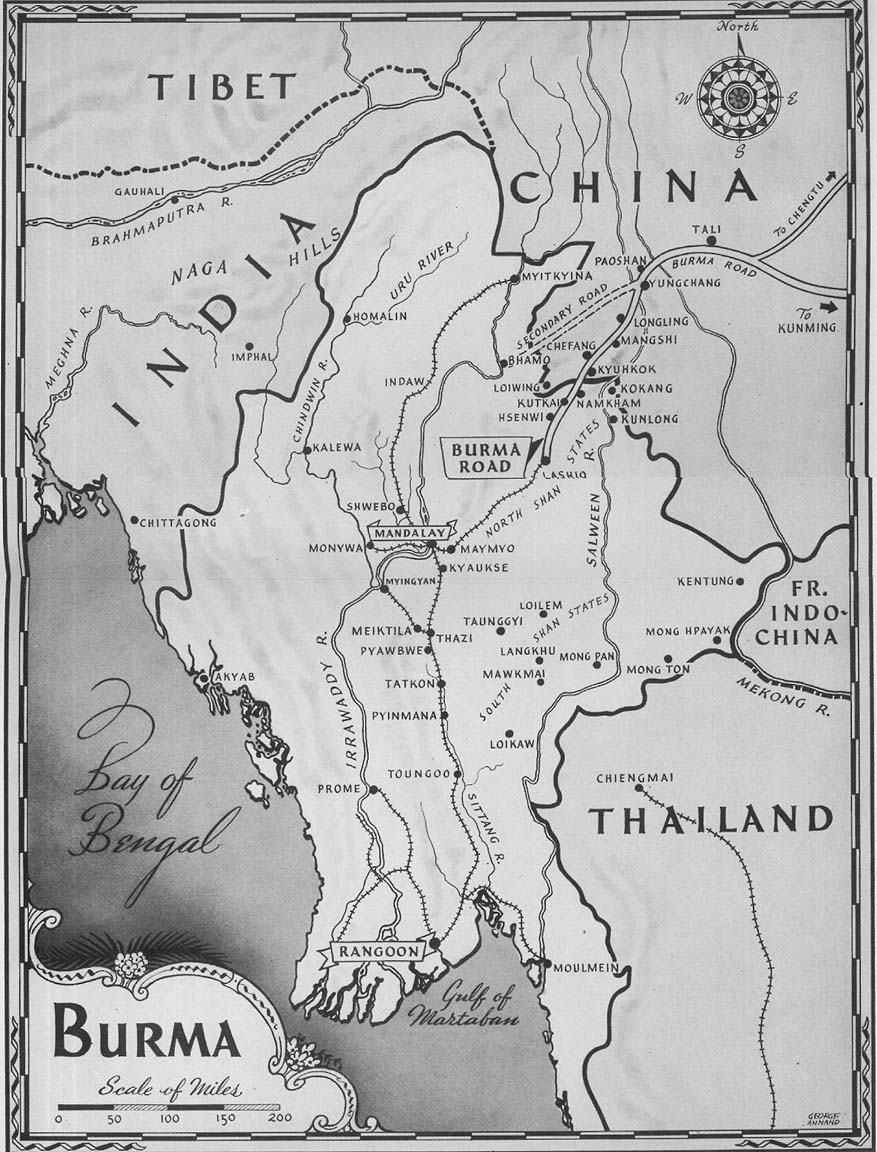
Namkham was growing by leaps and bounds. Japan and China were having an "incident." China was pushing a road through from Kunming to our border, working feverishly at both ends and in the middle as well. Already our road had reached Mangshi. I hoped an "incident" would occur that would give me an excuse to travel up by car as far as the road was completed. It occurred. A telegram came in from Tengyueh saying that a China Inland Mission lady at Longling, twenty miles north of Mangshi, was ill with pneumonia and wanted me to come and take care of her. She had previously been a patient of mine in Namkham, and Tiny and I had both been very fond of her; but I didn't need that inducement. Two nurses and I started off in our second-hand Buick.
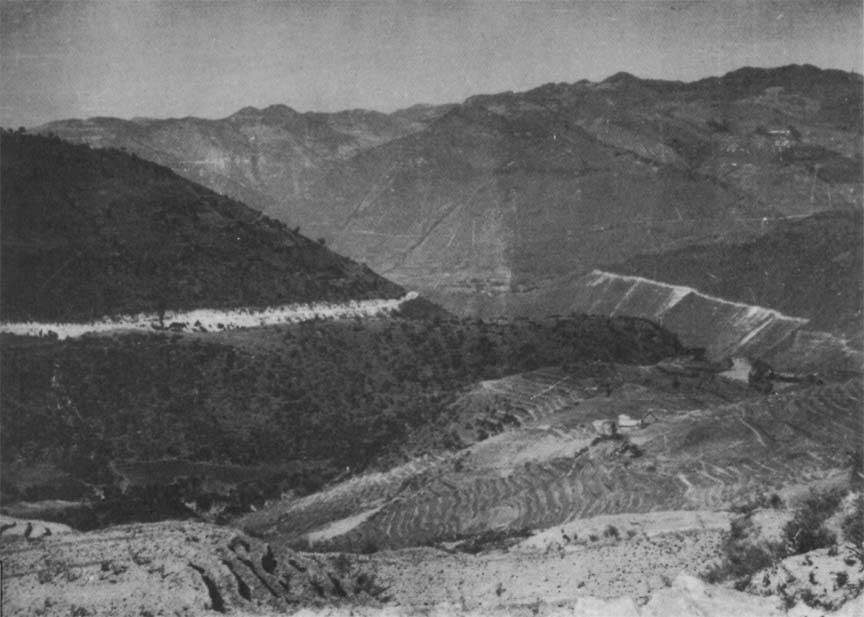
In many places the road was only six inches wider than the car, with tremendous precipices dropping away from the side of the road. Occasionally there were huge overhanging boulders, and we had to put down the roof and fold over the windshield. Beyond Mangshi no bridges had been built. So we had to leave the car. We drove into the grounds around the Mangshi palace, and my friend, the sawbwa, was luckily at home. It was late so he put us up for the night and, the next morning, started us off on three of the smallest native ponies it has ever been my ill luck to ride.
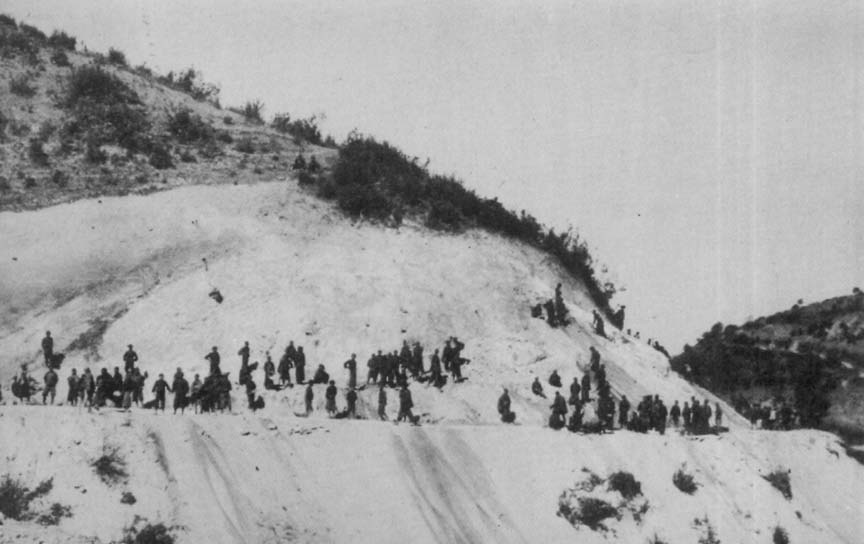
We took an occasional short cut, but our mule path was along the route followed by the new motor road. Even on that short stretch of road there must have been ten thousand coolies at work. The hillsides were black with them: Chinese, Shans, Kachins. Huge goiters hampered their work. Dozens were lying by the road shaking with fever. Hundreds had sore eyes. A few, totally blind, were nevertheless dragging bamboo sleds on which others had dumped earth. In the rockiest parts coolies were tediously drilling holes in the hard limestone cliffs in which crude gunpowder could be packed for blasting. There was no dynamite. Every few minutes there was an outbreak of yelling and screaming and the coolies rushed aside as a muffled explosion shook the valley. Boulders bounded down the hillsides, often narrowly missing us. If a cooly failed to run at the warning, it was just too bad; but the work went on. Where the limestone was softer, hundreds of coolies picked at it with pickaxes, chipping off an inch or two at a time. Ants on a hillside! But ants work together, and what they can't accomplish!
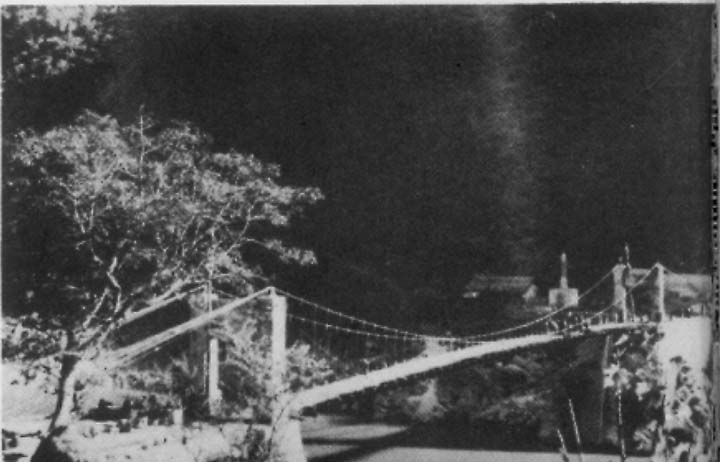
The banian is a sacred tree to the Buddhist Shans. In the deep jungles, miles away, were huge trees of stronger wood that would have made much better bridges, but there was no time to spare. Banian wood is good for nothing. But these trees had been planted right along the roads, near the streams, to give shade and comfort to travelers; the branches are gigantic. Shans resented destruction of the sacred trees, but the road had to go through. Hundreds of these banian trees were being chopped down; bridges were being made.
 |
 |
|
|
|
 |
 |
As we climbed up out of Mangshi we left behind the Shan States of China. Now we are entering Chinese China. Graves, graves everywhere! Sacred ancestors! Nothing had ever been permitted to disturb those cemeteries during the centuries; but the road must go through! The Japs were pressing in. There was still the railroad from Indo-China to Kunming, but the generalissimo was looking ahead. This road must go through! Cemeteries got in the way. They cut right through them, disinterring the bones of the sacred ancestors. China was looking backward over her shoulder no longer. She was actually looking ahead in a big way that Americans could have been proud of; but Americans were imitating the ancient Chinese in those years. They were not only selling scrap iron; but they were shipping droves of the best American mechanics to Japan to help her start airplane factories.
The road went through Kachin country, with its sacred groves of trees dedicated to the nats---groves so sacred to those spirits that Kachins never dared enter them. If the British had been building the road, they would have avoided trespassing at all hazards. I mean hazards! They would have had sharp turns to right and to left, blind corners, deep cuts. But China was awake at last. Japan was pushing in and the road must go through. Nat altars and shrines were chopped down. There was something bigger than nats in the offing!
But to me, the most extraordinary thing about "the Road," as I saw it that day, was not the number of coolies toiling with pick and shovel and crowbar. I had seen that before. It was not the lack of reverence for banian trees, cemeteries, and nat altars. I had felt impatience at these sacred things, too. The extraordinary thing to me was the marvelous surveying job that had been done---the wonderful grading of that road. They were steep grades, as steep as a road should ever have, but they were steady! There was a reason for the steepness of each. The work had been done, not by some amateur who had been given the job because he couldn't be used by the government elsewhere, but by a man who understood surveying. I couldn't believe my eyes. Surely, the Chinese had just accidentally made the grading perfect!
Amazed, and very deeply impressed with the new road, we pulled into Longling Town and, after much effort, discovered the home of the sick missionary. She had right lobar pneumonia and was very ill. But, as usual, I had the breaks. One of the nurses, tired as she was, went on duty while the other got a few hours of sleep. For no reason at all, as far as I was concerned, the patient within four hours had a favorable crisis. In twenty-four hours she was so far along the road to recovery that there was no point in our staying further. When her companion missionary thanked me for my marvelous cure, however, I remained silent. If she thought my arrival had helped the patient, so much the better. There is no point in opening your mouth when you have nothing to say!
We returned to Namkham the second morning. Two months later the Burma Road was completed into Longling, and Tiny and I and three missionary guests drove all the way there to visit our pneumonia patient. Driving there in the morning and returning that same night, we reached Namkham about two the next morning. The head nurse heard the car and came to meet us under the big banian. Some Palongs had come to call me for a transverse presentation over on the far side of our seven-thousand-foot ridge. I could get within ten miles of the village by using the car for the first fifty miles. Three nurses and a couple of men went along. We sang at the top of our voices, hoping thereby to keep me from falling asleep as I drove. Just before dawn we parked the car in a small village and began the ten-mile climb. I had fallen asleep riding ponies. I had fallen asleep driving cars, much to the car's detriment. But I had never fallen asleep while I was walking. This was my first experience. But the whole trip was useless. The woman had delivered her own baby. It was one of those very rare cases of spontaneous birth of a transverse presentation. We slept an hour and then went home.
Then came graduation time---the most hectic of the year: nurses being nursed through their preparation for the government examinations, then being distributed to their several stations for work. The government examinations in Lashio and the breaking of the monsoon occur simultaneously every year during the first two weeks of May.
On our way to Lashio we found government coolies throwing earth on the graveled road, to a depth of nine and ten inches to raise the road level. Sixty miles of this would be pretty ghastly for travel purposes if it should rain before our return, and this was likely, as two of our nurses had to be taken to our hospital east of the Salween and installed in their work there before I could start back.
The examinations went off well. On the afternoon of the last day we returned as far as Hsenwi Town, left the two nurses who were to join our Namkham staff and, with a broken center bolt in one spring, pushed on to the Salween. Arriving on the great river's bank at midnight, we tried to get a little much-needed sleep under adverse circumstances. The back seat being full of luggage, the two nurses curled up semi-erect in the front seat, and I took up a precarious position on the running board. The mosquitoes were ghastly. Not far away there was a tiger who seemed most provoked about something. Every few minutes he let forth a monstrous roar, and the nurses would jump as if they had been shot. Personally, the nurses worried me more than the tiger; but my real nightmare was snakes. All in all I was glad to see daylight. We boiled coffee and then crossed the Salween in dugout canoes.
From the far bank we traveled on ponies furnished by the sawbwa of Kokang. One more night on the way and we reached our hospital. When we first began the work in Kokang the hospital was a grass shack, but, the work developing rapidly in importance, the sawbwa had, during my absence in America, built us a new hospital of sun-baked brick with a tile roof. That night I slept in a tiny tent furnished by the sawbwa, and I had barely climbed into bed before the rain came down in sheets, through the canvas, soaking me to the skin. Now I was in for it. I had to start back and start at once, or I would never be able to drive the Buick into Namkham for the rains. The myosa furnished me two fresh ponies, and, riding them alternately at a rapid pace, I reached the Kunlong ferry at about four. My speed was increased by the fact that when we came to steep descents, the ponies just set their four feet and slid. Occasionally, if the slope was so uneven that there was danger of their falling with me, I dismounted and did the sliding under my own steam, erect, prostrate, or prone, as luck would demand.
On the west bank of the Salween I met a British captain who was as anxious as I to get back to civilization. He had an Indian soldier and a cook. I offered him a ride and he accepted. We started right off, luckily passing several places where more than half the road had already been washed away after only twenty-four hours' rain. The Buick just managed to squeeze by. As soon as we began to climb I put on four chains, every two or three miles having to stop and repair them with wire. First one and then another of the chains disappeared in the mud, and I replaced them with spares. On the steeper grades the three men pushed. The cook was worth nothing, but the British officer and his orderly were worth four normal men. The last five miles to the top of the Salween-Irrawaddy divide are so steep that you have to use low gear to ascend even in dry weather, and the rain was still pouring! Only the two rear wheels had chains now. The officer and his two men rode not at all on this five-mile stretch. They would push me to a start and then trudge along after me while the Buick struggled along, skidding this way and that until suddenly it slipped to the edge of the precipice and I was forced to stop and wait for them to catch up and give me another start. At last we reached the bungalow a half mile from the top. The road from there was reputed to be graveled. Sure that he could hop a truck there next day, the officer elected to stop and get some sleep. It was then two in the morning. I decided to go on alone. A few yards short of the top my right rear tire blew out. It was still pouring rain. The batteries of my flashlight were so worn out that I could not release the much battered chains. Praying this time in only two languages---I forgot to sing---I climbed into the back seat and slept until dawn.
Putting on my spare wheel I decided to go through Hsenwi to Lashio and buy a new set of chains before picking up the nurses and returning to Namkham. It was a good thing I did for from Kutkai on we were ploughing through deep mud---the embryonic Burma portion of the Burma Road. The hundred and ten miles from Lashio to Muse required eighteen hours. Again at two o'clock in the morning, "zero hour" for me, we started across the Muse plain, when suddenly the two front wheels plunged over the bank of a three-foot deep and eight-foot wide river that had appeared from nowhere. This time I quit; but the nurses walked back, awoke some villagers who dug away the bank under the car, sloped down both banks of the new stream enabling us to get-across. At Selan we slept the two hours that remained before dawn and then began the last twelve miles home.
THAT YEAR the hospital was filled to overflowing. We placed mats on the floors between the old wooden beds and iron beds that I had had made in Rangoon. The nursing school had grown till there was not sufficient room for all the nurses in the old hospital building. With great days in the offing it would be the worst thing for the government if we had to shut down part of our hospital and decrease the number of nurses on account of lack of funds. Days were coming when very hospital bed and every trained nurse would be needed. I wrote to the commissioner of the Federated Shan States, Mr. P. C. Fogarty, whom I had never met, and put the case as clearly as I could. I requested a grant of five thousand dollars for a clinic for women and children, and asked that our annual grant of one thousand dollars for hospital expenses be doubled.
Ten days later Mr. Fogarty appeared unexpectedly at Namkham. When I met him I asked if he would like to look over the hospital; but no, he must talk to me in my office first. There, his face grim, he drew out my letter. I had made some astonishing demands, he told me. Surely I didn't think that, without taking the matter up with the Defense Department at Rangoon, so large a grant as this could possibly be made. The Department would insist on very convincing facts being presented to support my case. I told him I realized all those details and was prepared to furnish any facts he required. After securing various statistics from our books, he finally consented to go on a tour of the hospital. He was astounded at the amount of surgery, the extent of pediatric work, the large number of cases of venereal disease of all sorts being treated in the same wards as the other patients. But nothing can describe his amazement as he went through the women's ward and saw women, with all manner of diseases, being treated on the floor as well as on the beds.
"Why don't you have more iron beds?" he asked.
"No money, sir," I replied.
"How much do they cost?"
"About twelve rupees for the welded iron in Rangoon. We rivet the pieces together ourselves in Namkham."
"Would three hundred rupees help you out?"
"Yes, sir."
He walked on to the row of smaller rooms intended for one patient. There were four to six women patients on the floor of each.
"I'll send you five hundred rupees."
A week later we got a check for seven hundred and fifty! Mr. Fogarty took up the question of building grants with the Defense Department. Things like that take time. We kept getting more and more crowded. Then, one day stopping in Kutkai on our way back from an urgent trip to Lashio in the Buick, we learned that that very morning the two chiefs of the Defense Department had gone through to Namkham, with the idea of looking over our hospital for a couple of hours before returning for a short trip up the Burma Road. They had an hour's start on us. Tiny and I jumped into the car. There were too many things at stake. If we could catch up with them and give them a personally escorted tour of the hospital they might become convinced of the importance of the work and help us. Otherwise we were certain we would fail to get any grant at all. An hour after leaving Kutkai, the rubber-hose connection on the water system sprung a leak. We had to keep our eyes open for water and fill up, at first, every ten miles, then every five, and finally every single mile, waiting each time for the overheated engine to cool down before adding water. It was one of the slowest trips we ever made from Kutkai to Namkham.
Ten miles out from Namkham, as we were filling the radiator, a car approached us; two gentlemen descended and introduced themselves as the Defense Department secretaries. They expressed their polite regrets that we had not been in Namkham and stood chatting about the hospital, the Burma Road, and the possibilities of the road ever being completed. They went on. Tiny and I looked hopelessly at each other. Our luck hadn't held this time.
But two months later, approval was given for a grant toward the nurses' home, payable at once, and one for the women's clinic building the following year. Close on the arrival of this notification came a personal letter from Mr. Arthur K. Potter, one of the two secretaries. A ten thousand rupee personal check dropped out. The money, said Mr. Potter, was a much-too-small effort on his part to help us in the development of our program of medical work in the Northern Shan States. There were no "strings" tied to the gift. It was to be used in any way calculated to be of most permanent value. We deposited the money in the bank as a buffer fund to save the hospital from any debt liable to occur if we pursued our policies of medical development forcefully. Tremendously encouraged and emboldened by the availability of this fund we went ahead, drawing on it when in trouble, and repaying funds into it as we received occasional windfalls from grateful patients. But word leaked out among the Kachins that Mr. Potter's gift had amounted to a hundred thousand rupees, and thereafter they paid even less price in hospital fees than before.
So in the rainy season of 1938, Tiny and I sat down and drew up plans for a two-story nurses' home. She made suggestions from a woman's, and I from a structural, point of view. As we were drawing the plans, we had in the hospital a patient from the royal family of Mangshi State. Representatives of both Mangshi and Chefang were continually visiting this patient, so Tiny and I used every opportunity, in and out of season, to describe our program to them, emphasizing our difficulties in putting up the nurses' building. We even gave them practical demonstrations. With a great deal of effort I repaired our old ton-and-a-half truck until it could run---sometimes---and converted our Chev touring car into an ugly half-ton truck. Day by day they saw nurses jump on board after the day's work and help haul stone. They were so astonished that they even volunteered to help load and unload. Luckily for us the two cars broke down several times when these people were helping us and, members of royal families though they were, they had to walk home. Soon after they left the hospital, a rumor filtered down that the sawbwa of Mangshi would like to lend us two new three-ton trucks to haul stone as his contribution to the hospital work. Rumor though it was, I promptly hired the Shan who had helped drive my truck when we were building the main hospital, and we started north over the Burma Road that night. The rainy season was just over, and there was plenty of mud to plough through.
The sawbwa was very gracious. Dinner was just being served and he wanted us to join him. As we were disposing of a fifteen-course Chinese meal I told him of the rumor and of our very great need for the assistance he was ready to give.
"But you have no drivers," he objected.
"Yes, I have, and they are both here, ready to start in the morning."
That was so typically American that it floored him completely.
"All right," he said. "The two trucks will be ready in the morning." He seemed to like Americans, for in the morning it was three trucks instead of two, and the sawbwa furnished his own driver for the third truck. He went the Americans one better!
Nine tons at a time instead of a ton and a half! We had to haul rapidly, for when the country really dried out after the rains, the sawbwa would need the trucks to fulfill his responsibilities in the construction of the Burma Road. When the Shan driver finished a day's work, Tiny took his truck and we continued to haul.
Knowing that with the completion of the nurses' home we would begin the construction of the women's building, we took time by the forelock and began leveling the site of the latter. Tons of earth had to be removed. Trained in wastebasket surgery, we felt that that waste earth should be put where it would do some good. Where could we put it? Our only remaining dream was a decent little stone bungalow for us to live in, where we could be properly screened from the mosquitoes that constantly made havoc of our work. We had the site already picked out on the little hill beyond the hospital. We could use the waste earth as a fill for a future road connecting the hospital with the doctor's residence. Wouldn't it make things quicker all around if I hauled the earth there in the truck whenever there was no stone ready? I tried it out, loaded on three tons of earth and backed down the incline that we had begun years ago, with the same purpose, when we were leveling the site of the main hospital. Just as I reached the predetermined point, I braked suddenly. The right rear wheel broke through into a two-foot deep termites' nest, and the loaded truck turned over one complete roll and landed "on its feet" in a bunch of bamboos. I love bamboos! If it had not been for them I would have rolled over fifteen more times.
I was rather dazed. That was one experience I had never had before! While I was sitting there, feeling more or less battered, a bunch of nurses who had heard the terrible crash rushed out of the hospital with the cadaver stretcher to pick up the old man's dead body. When they saw him sitting there in the driver's seat, still alive, they flung down the stretcher and went back to their respective jobs. Tiny heard a rumor that her husband had been up to mischief again and came running down to see whether he was still alive. He was. Tiny ran back home again, and I sat on, feeling more or less neglected, and ached, and ached.
Finally my Lahu mechanic turned up. He was most solicitous, and his sympathy stirred me to action.
"Get all the schoolboys and all our coolies and a big rope," I directed, "and pull me out of this."
When they were quite ready I started the engine, and with the men and the nurses, who had by this time begun to realize that the old man was in a bad way, pulling simultaneously, I drove back up onto the road. I was happy again, for the truck had not been hurt at all, except for one small dent in the fender, which we straightened forthwith.
I hauled no more earth for the fill. I let the coolies do it in their little bamboo baskets.
Finally we were ready to build.
On the site we had chosen for the nurses' home were two mat-walled houses on stilts, the bottoms of the posts resting on cut-stone blocks. We had to get them out of the way and still have them available for use for private patients who were always complaining that we had not enough private rooms. Some of us jacked up the house and put long wooden runners under the posts, connecting them to each other. Others cut down trees of appropriate girth and sawed them in four-foot-long rollers. Every rope in both the Shan and Kachin compounds was commandeered and fastened to the cottage at strategic points. The Shan and Kachin schoolboys turned out for a field day. One pull, and a rope broke! The house did not budge! We had no windlass, and the pulls were, of necessity, jerky. I rigged up a block and tackle and we tried again. This time the house went so far as to shudder. The yelling of the schoolchildren had caused half the town of Namkham to turn out for the show. Someone told me there was a Public Works Department rope in the government bungalow, and someone else said my friend, the Chinese contractor in town, had another. We got them both and tried again. Now the house was convulsed, but still wouldn't move forward. As usual, I had to give in and send for the nurses. They crowded up to the far side of the house, and as the males pulled, the females pushed, and the house plunged forward to the ends of the runners. Then we inserted new rollers and, plunging this way and that, we slid the houses around until they finally and very accidentally happened to fall into their right places, with an error of not more than two inches. That was close enough for me. The discrepancy couldn't be seen unless one were looking for trouble, and if anybody had as mean a mind as that, there were plenty of other errors elsewhere that I could add to his collection! That day we were grateful for the numerous times the nurses had had to push cars and trucks through mud, in training for the day they would have to push houses.
The first wall of the nurses' home was about four feet above the ground in November, 1938. I was setting a window in place with a plumb bob, when from nowhere appeared the handsomest man I ever met. He offered me a Chesterfield. His name was Dan Gourley and he was, he said, advance agent for an American airplane manufacturing company that had been bombed out of Hangchow and Hankow and had decided to set up their factory in Kunming. While settling in Kunming, Japan had begun to bomb that city also, so they had determined to find that spot in China, farthest from Japan, which still had possibilities for easy transportation. On the map, the Namkham valley seemed the most promising. He had been referred to me as the man best acquainted with the valley. Would I be willing to help him locate some spot where nature facilitated the building of runways above the level of the paddy fields?
Great Scott! an airplane factory in the Namkham valley!
He did not look like the confounded liar he seemed to be from the context of his speech.
"The company sent me from Haiphong to Rangoon by plane," he said. "The manager of the factory, Mr. Hunter, is trying to come through from Kunming by car over the Burma Road. I want, if possible, to have a satisfactory site picked out for the factory before he arrives. I would appreciate your help."
By this time my eyes began to focus again.
"Yes, I can help you," I said. "There is a perfect low plateau the other side of the river, on Chinese soil. I delivered a baby in the village there just last week. It is a natural landing field." I threw down the unromantic plumb bob. "Come over to the office. I have an inch-to-the-mile map there, and I can show you just where it is."
I spread out the map and showed him my choice, as well as two other plateaus, much smaller, but closer to the Burma border. Then I took him to the hospital verandah and pointed out the actual spots in the distance.
The next morning, armed with the map and an English-speaking Shan guide whom I furnished, Mr. Gourley set out to explore. He returned delighted.
"Your first suggestion is a perfect spot," said he, "but it is too far from that little spur of the Burma Road. I have selected the two other sites. They are within a quarter mile of the border and we will have no trouble transporting our supplies."
Mr. Gourley returned to Rangoon. We went on building the nurses' home, not quite sure why Gourley had tried to excite us.
Then, one day, a station wagon, the first I had ever seen, drew up under the banian tree. A thick-set, muscular man stepped out. It was Mr. "Chuck" Hunter, manager of the Central Aircraft Manufacturing Company. He had come down the Burma Road from Kunming as far as the Salween River and then, one day's journey by car from his goal, had had to turn back to Kunming and come to Burma by air. There were Chinese engineers with him. After paying his compliments, he went across the river to Pang Kham, the English bungalow nearest the chosen site at Loiwing, and set up headquarters in a grass shack.
Though their headquarters were so close to us, they were busy and we were busy and we did not see much of each other.
Ever since the first year in Namkham, Tiny had had a vegetable garden near our house where she had experimented with seed procured from all over India and Burma, finding varieties of American and English vegetables that would grow in our climate and determining the seasons when each variety did best. As she succeeded in her work she extended the area under cultivation until we were well supplied with the most delicious corn, tomatoes, head lettuce, celery, carrots, and sweet potatoes that it had ever been our good fortune to eat. They were at least as good as similar vegetables purchasable in America. Now, her period of experimentation over, she ploughed up several acres of farm land owned by the mission and began to grow vegetables for the nurses and even for the hospital. Some of the new vegetables, like carrots, the nurses had to acquire a taste for; others they recognized at once as having a much fuller and more delicious flavor than their own home-grown foods. Tiny had even started a pineapple garden in which she produced fruit from imported Hawaiian plants several times as juicy, sweet, and tender as the local natives could produce. Seldom a day went by when the chief gardener did not carry several bushels of assorted vegetables and fruits down to the hospital kitchens. Now with homesick Americans in the valley Tiny began to pick baskets of "first-fruits" and take them over to Loiwing. The airplane company reciprocated by lending us an occasional truck overnight to haul the tons of manure that grateful patients presented to us in the near-by villages. The word awza in Burmese means either "manure" or "prestige." Ai Lun, who married E Hla, didn't know the latter English word and so, when called on to make a speech at the wedding dinner Tiny gave them, really succeeded beyond all expectation.
"It takes a lot of manure to change the son of poor people into a medical-college student," he said, "and Doctor Seagrave furnished the manure."
I will never hear the last of that one!
A TELEGRAM came from Rangoon. Several important Baptist Mission secretaries had been attending a "World's Alliance" meeting in South India. They wanted to get into West China for some more meetings, and had heard there was a new road from Burma to Kunming. They wished to go over that new road. Would I drive them to Kunming? I certainly would! I had wanted an excuse to go over that road to Kunming myself. Besides we had a brand new Dodge as the result of the Potter Fund, since the Buick was ruined.
The two secretaries arrived one evening, and we started the next morning. Tiny and John and I rode in the front, the secretaries and their baggage behind. The Bhamo branch of the Burma Road to the border was the worst section of the whole road. Before we got to the border we had bashed in the bottom of the petrol tank, but luckily it didn't leak. We had to carry enough petrol to get us to Kunming. After we had reached the border, the road began to get better. The British had not been able to believe that the Chinese would really keep their promise, and so had delayed carrying out theirs. Later the British section was the better.
The first night we slept with my friend, the sawbwa of Mangshi. He introduced us to the central government's officials, who visaed our passports and gave us a card with Chinese writing on it which was worth more than our passports.
The next morning we pushed on to Longling and waited hours on customs. We had to make a deposit of the price value of the car to guarantee that we would not sell it in Kunming. Thanks to the Chinese writing on the card, the Dodge was "valued" at about a third of its real worth, since that was all the money I had!
We pushed on, hoping to make Paoshan before nightfall. That gorgeous Salween divide! Up, up, up out of Longling, and then you can see, way over the other side of the Salween, a snaky road curving, in most dramatic fashion, up a gigantic mountain. It takes hours to get to the road, over there, where it reaches the top of that mountain. We started down a series of ghastly precipices, the road getting narrower and narrower. Then we passed the fifty-mile mark on our speedometer, and it was Tiny's turn to drive. Tiny is the only driver who can drive me without my getting sick; but this time I had to close my eyes and swallow and swallow! One of the secretaries offered to drive. I refused with thanks. It was bad enough with Tiny, and I knew what a wonderful driver Tiny was, from long experience. I was taking no chance on strange drivers.
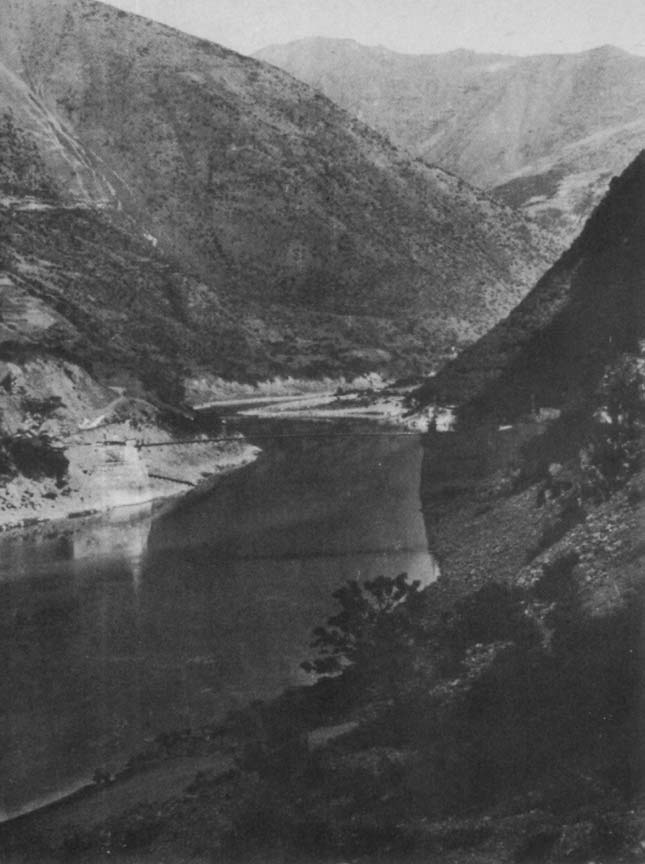
The beauty of that gorge: fearful, terrifying beauty! All along its course, the Salween is fierce and cold. In no part that I have seen is it as beautiful as along the Burma Road. We saw it at its best. There was no other traffic. We owned the Burma Road that day---we and the ragged Chinese coolies who threw their baskets of gravel on the road and patted it into a smooth surface with their hands. Along the road were rollers, cut from huge blocks of stone, and hauled either by coolies or by a single water buffalo. I shall never forget those coolies of the Burma Road, men and women. Men with nothing on but a pair of ragged pants full of holes so large that the trousers did not hide their nakedness. And they smoothed the road with their hands! Little loving pats! We were glad we had taken John along that day. The first little white boy these Chinese coolies had ever seen! The women coolies oh-ed and ah-ed over John. Undoubtedly their long, hard day's work was made easier for them that day. They had something new to talk about.
And so to the suspension bridge across the Salween. I had seen the huge iron sections of that bridge carried up over the Burma Road---before it was a car road at all. All the passengers dismounted while I drove over. Could that flimsy structure that sagged under the weight of a single man hold our Dodge? It not only could hold the Dodge, but it held many a four-ton truck loaded illegally heavily in the days that were to come. Country of romance! The Burma Road has become romantic to the American of the street during the last two years. I was traveling through country that had been romantic to me for fifteen years! Many of our patients had come from this country.
Tiny had had enough of that drive down to the river. I drove up the other side, a much easier task than hers had been. Paoshan was endless, miles away, yet we had to stop every few minutes while the two secretaries took pictures. At least, one of them took pictures with a camera; the other took pictures with his eyes, disappearing suddenly so that we could never tell where he was. Closer to Paoshan we came upon a couple of old-time Chinese, high-arched bridges which the low-slung Dodge could not negotiate without special care, blocking of wheels with stones, etc. About dark, we reached Paoshan. What a relief! With much difficulty we located the house of the China Inland Mission where we hoped to spend the night. They had heard of me from my old pneumonia patient and made us welcome, cooking us some eggs and Chinese ham for dinner, though we were almost too tired to eat. I slept in the Dodge that night.
From Paoshan the road has to descend again to cross a river almost as low as the Salween---the Mekong. Not so fierce in its beauty, the Mekong River is probably the more beautiful. At least you can see more beauty at one time. Descending, we passed our first groups of surveyors and engineers at work, many of whom had been trained in America. The road and its steady grades was not just an accident after all! The trail reaches the Mekong and then follows along the bank for miles before crossing on another apparently frail suspension bridge. Now comes drama! The car climbs out of the Mekong along one tributary after another, each turn opening up new vistas of entirely different scenery. The grade becomes steeper and steeper, until, the radiator of the car boiling madly, the top is reached---a pass two thousand feet higher than those on the great transcontinental roads that cross the Rockies.
We knew of no mission station along this day's route and had a definite repugnance for the idea of sleeping in the old Chinese inn of that day. A corner of the road seemed much more romantic for a place to sleep. Both of the secretaries were so long-legged that they chose to spread their bedrolls out on the ground. Marion curled up on the front seat, I on the back, and John just fitted in between us on the floor. Everything was simply grand, until Tiny let her knee fall on the horn button, bringing everyone to attention. Surely the Japs were upon us! There is no end to amazement as the car keeps rolling to the east. The Salween and the Mekong gorges have not exhausted the scenic possibilities. No wonder we froze that night! Climbing still higher from our night camp, thick frost and new-formed ice crunched under our wheels. Here and there a little flurry of snow, and then, against a clear blue sky, the snowcapped peaks behind Talifu. Wild mountain torrents pouring into the Red River. Our first vision of Chinese Army recruits marching east to join the forces in action against the Japanese. The heavenly blue of the great lake at Tali. An hour strolling through a huge Chinese bazaar. Tibetans on the streets. Then night in a warehouse of the Southwest Transportation Company.
On from Tau the road is an older one, built before the Japanese "incident." There are other cars traveling here. Care must be taken to avoid collision around sharp corners. Much more open spaces. Densely cultivated valleys. More frequent towns. Salt factories. Coolies with heavy blocks of salt on shoulder harness trudging up and down the road. A coffin with some distinguished dead being carried home by coolies to be buried with his fathers. A last night in a brand new inn of the variety being built by the Southwest Transportation Company for travelers on the Road, and then, after a last climb, the lake of Kunming spreads out, with fabled Kunming itself beyond.
We found a French hotel, left our things there, and made a hurried trip around town. I paid a pilgrimage to the C.M.S. (Church Missionary Society) hospital, the nearest mission hospital to us in Namkham; to the bazaar for food for the return trip and for gasoline. Tiny, John, and I must start back before dawn.
Not having to stop every few minutes for pictures to be taken, we made the return trip in three days.
A letter appeared in the post one morning---an application from a young Karen doctor named Ba Saw. After graduating from the medical school of Rangoon University he had developed tuberculosis and had been refused a government position. Months at Taunggyi, in the Southern Shan States, had improved his condition very greatly. If I could arrange to take him on as an interne he would, he said, be glad to work without pay. He was the son of Karen missionaries to the Chins of the wild mountains of West Burma. I was fed up with all my previous assistant doctors, whether Kachin, Indian, or Karen. Since they had each passed the Rangoon University examinations, sometimes on the third or fourth try, they knew it all and were not willing to learn more. Give them a chance to operate and they were too proud to study up on the operation the night before, no matter what happened to the patient! Not knowing much myself, after passing my examinations the first time at Johns Hopkins and zealously studying every book I could find for sixteen years, I was apt to be a bit impatient at their "complete" knowledge. But I couldn't do all the routine work myself.
Ba Saw came. His right lung was collapsed with a pleural effusion. I ordered him to work no longer than a maximum of four hours a day. It was the only order I gave him that he ever disobeyed. With only one lung he was forever on the job. No matter what nurses you put on his side in a baseball game he would lead them to victory over my side three games out of every four. Whether he was to do the operation himself or not, he would get out his and my books on operative surgery and study up the next day's operation. A man of completely charming personality. A man whom both men and women love. A perfect Christian, he didn't have a trace of hypocrisy anywhere in his make-up. No fancy phrases and slogans. No prudery. Incapable of exhibiting anger, though capable of deep indignation at the mean things of this world.
I have taught Ba Saw a lot. He has taught me a lot also and continues to teach me.
I gave him ten dollars a month spending money from the start. Six months later I had to argue with him for a long time before he would let me raise him to twenty dollars. A few days before Christmas he came to the office and shame-facedly asked for a loan of a hundred rupees. Every cent went into Christmas presents for nurses and schoolteachers. A year with us, and inevitably romance sprang up between Ba Saw, the most charming Karen male I had ever met, and head nurse Bella, about the sweetest Karen girl you could hope to find! Tiny and I were delighted. In 1941 they had a lovely wedding. As long as I live, may they both remain on our staff!
Construction had begun at the airplane factory seven miles across the plain. Their trucks began to haul supplies up from Bhamo. One night nurses came running for me. One of the Americans at the factory had just been brought in in an Indian truck. His truck and trailer had crashed down a mountainside. The cab had been crushed completely, and he had remained in the valley for hours until the Indian happened along and picked him up. He had recovered from a mild concussion when I saw him and his delight at falling into the hands of an American doctor was pitiful! Tiny came and helped me tuck him into bed. An American woman tucking him in! Unbelievable! He broke down and sobbed. Later I saw the curve where his truck had dropped. He was lucky to get off with only a concussion and a deep gash in his thigh.
FOOD TRUCKS passing from Bhamo to Namkham in five hours when heretofore such articles had taken five days on mules. . . A tremendous fire breaks out in the Bhamo bazaar and destroys half the native town . . . Rats leave the burning houses and have a difficult time finding sufficient food . . . Trucks loaded with food are standing ready to start for Namkham in the morning and the rats leap aboard . . . A month later rats are dying in Namkham by the hundreds . . . Householders pick them up by the tails where they drop on the floor and throw them out into the garden, and the bubonic plague comes to Namkham for the first time in eighty years. Virgin country! I telegraphed for enough plague vaccines for our entire staff and wondered when the first case would appear.
Almost immediately I was called. The patient had been ill since the night before. By the time I reached the house he was dead. He had died so rapidly after the onset that there was no sign of disease on his face. Two rather large ecchymoses on his body were all the signs of plague I could find. The next day another patient was dead in the adjacent house, and in two days three in this second house had died. All of them were cases of septicemic plague. I telegraphed the civil surgeon in Lashio and the assistant superintendent in Kutkai. I sent our staff through the town urging people to be vaccinated and personally urged vaccination on the lord mayor. Aside from the Chinese community, led by a very intelligent Chinese friend of mine, everyone refused vaccine. We telegraphed for vaccine for the Chinese. Plague cases appeared all over. Rats began to drop dead from the ceiling. Down the street rats would run and fall over dead in front of you. Rats dropped on a group of nurses delivering a labor case in the town. Lashio had done nothing. I telegraphed the superintendent in Lashio himself, asking for a free supply of vaccine from the government, as I could not afford giving free injections by the thousands when each one cost me ten cents. The civil surgeon complained to the superintendent that Seagrave was just having hysterics. Plague was endemic everywhere and not epidemic, and there was nothing to get excited about. Under compulsion from the superintendent, permission was granted for me to order all the vaccine I wanted, bills to be sent to the government. Shans refused to be injected, though by now cases were taking forty-eight hours to die, and they died with terminal plague pneumonia. I wired Lashio again and under pressure from the superintendent, the sawbwa issued an order ordering everyone in the plains to be vaccinated. Then true bubonic plague appeared.
We set a time favorable to the lord mayor and, with a corps of nurses to assist, we started inoculations in a big way. The lord mayor submitted first, but the germs were already in him and in two days he developed bubonic plague and died. We injected more than half of the people in town. Many of those ordered for vaccination refused to appear. The plague began to search out their homes and many of those who had refused vaccination died. Where all but one in a house had been vaccinated, the one unvaccinated person acquired the disease and died.
But occasionally a person who had been vaccinated acquired the disease, and a small per cent even of those died. The nurses and I were constantly exposed to the disease, using every treatment in the books---and out of them, for that matter---to try to save lives. I decided to use a second injection of c.c. of the vaccine on our staff. My luck never holds, when it comes to trying to avoid work. After each injection, an obstetrics call would come in and I would have to foot it all over the valley, febrile reaction and all.
Plague began to appear in near-by villages. With the local police to help, we went out to give injections in those villages. The first day was completely wasted. Villagers had heard that we were coming and had evacuated. Not one person was at home. The second time this happened, I telegraphed the assistant superintendent for Kachin troops to help us. The Shans are scared to death of the Kachins. The acting mayor sent for me and begged me not to put this indignity upon him. He would guarantee that his own police would enforce our orders. We tried again with little success. Then the assistant superintendent himself arrived. He was disgusted that I had been put to so much inconvenience. The villagers must come to me. He sent out Kachin troops and arrested the headman and elders of each village where I had had trouble and threw them into jail. Our troubles were over.
Village by village they presented themselves in the bazaar at appointed times. By now the total number of deaths had reached such a number that the civil surgeon had to admit we were starting a major epidemic. The League of Nations' public health chief for China came in and demanded immediate action against a disease which, if allowed to cross the border, would by itself compel China to cease her resistance against Japan. Telegrams flew to Geneva and London.
The civil surgeon visited us to see if we knew how to do the inoculations. He sat, grim, on a seat in the bazaar and saw nurses---nurses!---giving the inoculations. At a distance, try as he might, he could see nothing wrong with their technique. But nurses could not possibly be free from mistake. A dear old Shan lady of sixty presented her arm and a nurse slipped in the needle.
"How much vaccine did you inject?" he asked the nurse, gruffly.
"Two c.c., sir," she replied. Correct! Disgusted, he stamped out to see if he could locate something else to complain about.
That afternoon he walked into my office. He had heard that I buried my Potter's Field cases so close to the surface of the ground that the dogs unearthed and devoured the bodies. I told him I would investigate and make a report that evening.
The head nurse and I walked over to our Potter's Field. Four or five graves had been broken into and the bones scattered about, but each of these burials was in a Chinese coffin. Bodies buried by me are never in a coffin. These cases had been buried by relatives. Furthermore, the coffins had not been broken into until termites had eaten through the lid of the coffin, which meant that by the time the local pariahs scattered the bones about, there was not more than an odor of meat left on the bones.
I turned in my report. The only thing he could think of was smallpox vaccinations.
"I shall have to report to the government in Rangoon," he said, "that you have charged fees for smallpox vaccinations. This is illegal."
"The government did not furnish me free vaccine," I said. "I charged just sufficient to recover the costs of the vaccine paid for by myself."
"Well, I shall have to prosecute your nurses for performing vaccinations without having taken a special three months' government course in the subject."
"No, they have had only a three years' course in subjects bearing on vaccination, and are only skilled enough in such subjects as to make government officers glad to have them assist at major operations performed on their own bodies. Furthermore," I said, "I also have performed many vaccinations without the special three months' course; so, when you prosecute the nurses, you will also please prosecute me."
Threats of prosecution were still being made more than three years later after Japanese troops had entered Burma.
That year we gave some ten thousand inoculations of plague vaccine, and as soon as the number of people injected reached 60 per cent of the population, the epidemic stopped.
But we were having real trouble ourselves now. Nurse Nang Leng and I had been trying out various injections on a pregnant plague patient. Our legs were being bitten as we injected. Three days later Nang Leng had a bubo in her groin. I made a smear from the gland which proved positive. The airplane factory had a small stock of plague antitoxin and on our urgent plea for help, sent us over a few c.c. I gave Nang Leng 10 c.c. and then started off on an obstetrics case twenty miles away. On my way there I had a peculiar pain in my right armpit. On the return trip I kept feeling that aching spot, and discovered that I had a bubo myself! I told Tiny about it and she insisted on giving me an injection of the serum. Then I came down with a huge chill and the most gorgeous headache I ever enjoyed in my life. Rats had been dying in our house, and one had died in the bookshelf behind the chair in my office. Every single child under ten that had contracted plague in the town had died, even though the child had previously been vaccinated. Tiny and I fought over the matter tooth and nail. She didn't want to leave me and I didn't want our two boys to get the disease and die. I won the argument finally; Tiny turned me over to the head nurse and took the boys out to our school in Muse for the period of quarantine, preparatory to taking them down to Maymyo and safety.
Thanks to the 6 c.c. of vaccine I had received, I was an entirely uncomplicated case. I had far more trouble with the serum reaction that followed a week later. I even went so far as to faint for the first and only time in my life.
Altogether ten of our hospital staff got the disease, but, thanks to double dosage of vaccine, all of us recovered.
The American engineers had now come and settled in Loiwing in grass shacks. Many had brought their wives. Thousands of workmen and coolies were at work under American supervision putting up one building after another and installing machine tools. A very attractive Chinese surgeon, Dr. Horace Yu, graduate of Northwestern Medical School, had come. With the help of engineers he had drawn up plans for a factory hospital, and the building was going up rapidly. Dr. Yu's very charming and beautiful wife, an American-born Chinese girl trained as a nurse in Peiping Union Medical College, joined him. Mrs. Yu and her little daughter lived in our home for several weeks. Until their hospital was completed, the factory sent all patients needing hospitalization over to us. Our financial situation, for the first time, eased off a little. Honest Americans in the valley, people who speak your own tongue! On our first visit to the grass shack, which they dignified by the title "Club," there was a chap named Al Anderson, an airplane engineer, who viewed with distress the intrusion of missionaries into the sacred precincts of the club. So, perhaps, did many of the others; but being Americans they all made us welcome. Later, when they discovered what scandalous missionaries we were, they changed their ideas of missions in general. Al himself adopted our car and every bit of machinery our hospital possessed, kept them in perfect repair, and, when any mechanism gave out completely, replaced it with a new machine ordered out from America. He soon became the Big Brother of all the nurses, for whom he was quite willing to take on all comers, ten rounds each.
After I had recovered from the plague I received a formal invitation from Messrs Hunter and Walsh, factory manager and general manager, to dinner. I knew something was up, and made up my mind to refuse. But that dinner was far too delicious. Tiny was still away with the boys and it had been a long time since I had had anything fit to eat. By the time the meal was over I had practically no resistance left! Their idea was for me to stop being a missionary and come over to run their hospital on a generous salary. I had helped order their hospital and surgical equipment and knew there were no "wastebaskets" in the list. I would be practicing medicine and surgery in the way every doctor dreams of doing. But---I liked my stupid idea of missionary work, and I had become badly spoiled by the fun of always having more work on hand than I could ever possibly do. Namkham was my brain child. Even if the American Baptist Mission sent out another missionary, or two, or three, to take my place at Namkham, it would be like divorcing an only son.
I had my alternative suggestion ready: Their job---director of the hospital---was nothing like a full-time job, and if I had no work to employ me other than holding down a chair in the grand new club building, I would soon go mad. I would spend three days a week at Loiwing and assume full responsibility for the work of the hospital, make emergency trips at any time if an American needed special work done. In the other two-thirds of my time I would continue my work at Namkham. They should pay me only a part of the salary suggested and, by mission rule, this money would be used for the Namkham hospital work. I would be able to build the little stone doctor's house Tiny and I had always wanted, and other dreams for Namkham could be realized. Both men objected, but it was a case of accept my offer or have no American doctor for their Americans, so they finally agreed.
When Tiny found out about my contract, she was furious! She wanted me to live to hoary old age, and I wanted to live fast and most furiously, no matter how soon I went on to my reward---or punishment! The only occasions when Tiny's resentment decreased were when the Americans threw a party. Tiny had had itching feet from the first time she heard a foxtrot, but her husband, the only eligible male in Namkham, was too clumsy to learn how to dance. But Leckell and Stoker had taken prizes for dancing in the States, and several of the others should have had them too.
And so thrice-weekly trips to Loiwing began, fourteen miles each way by motor road. I soon discovered that aside from my American patients, most of my work was to keep the hospital staff from resigning singly or en masse. All the Chinese engineers and workmen were from East China. Refugees driven out by Japan, all had lost their homes, and many their families. There was a very tender and delicate mental balance. The slightest suspicion of insult and the balance was lost and feuds developed. Doctors, authorized to grant leave with or without pay from factory duties, were the chief scapegoats. Dr. Yu, who refused to be intimidated into granting leave with pay to well persons, soon became their pet abomination. Doctors who preferred to distribute leaves lavishly to a smattering of gangsters, and thereby live in peace and comfort, soon became abominations to their director and had to leave. Not one week went by that I did not have to spend many hours of argument with some member of our staff. Even the medical chief demanded that a nurse be discharged, and when I refused to dismiss her for a first offense he lost so much face that the president of the company had to give him an expenses-paid trip to study in the Calcutta School of Tropical Medicine to restore his dignity. Finally, to keep some semblance of order, we had to have Chinese Army sentries patrol the halls of the hospital.
The factory was now turning out training planes.
On the first anniversary of the breaking of ground for the factory buildings, the company threw a great party. Mr. W. D. Pawley, the president, made a speech in which he called to their attention the extraordinary growth of the factory from grass shacks to a thriving modern plant in the incredibly short period of twelve months.
"You have seen wonderful changes in this past year," said Mr. Pawley. "I can promise you that during the year now starting you will see just as vast changes at Loiwing."
Mr. Pawley was a much better prophet than he thought. There was a vast change those next twelve months, but not quite of the variety he had planned; and the year after, the change was still more astonishing!
Soon after our nurses' home was completed in 1938, Tiny went out on an obstetrics call. It was a normal case in which a long, long wait was inevitable before the baby could be born. Tiny went into session with her pencil and a piece of paper, and came home with a gorgeous floor plan for the women's and children's clinic. It was such a divine inspiration that all we had to do was work out the dimensions and blueprint it. We built it that first eight months of 1939 before the plague put us temporarily out of commission. When the latter was over and my Loiwing work was running smoothly---all but the weekly resignations---Tiny and I both went into a huddle to put our dream house on paper. Putting dreams on paper is not too easy a job, but in a few weeks we succeeded beyond our wildest expectations and produced such a good plan that the factory engineer could only add one artistic touch to give it perfection---complete drawings for a fireplace, a small-scale model of the grand fireplace in the Loiwing Club's drawing room. Stone hauling was again the insurmountable obstacle. The factory had plenty of trucks but they were in use all the day long. Finally, the Americans found a solution. After work on Saturday, they would drive over three trucks and haul stone for us till dawn Sunday morning, if the nurses, our few coolies, and I would load the stone. Meanwhile, Bill Cummings and his family had moved to Namkham on a mission plus government agricultural project for the Kachins. Bill is just as crazy a missionary as I am and just as continually up to mischief of some sort. You can tell how crazy he is very easily---he named his youngest son Gordon Seagrave Cummings! This scheme of hauling stone all Saturday night was so insane that it appealed to him as much as it did to me. Tiny and Hazel sobbed in each other's arms, and then took turns producing us some marvelous midnight suppers!
Mr. Fogarty, the commissioner, was not idle. He had more "ants in his pants" than I had in mine. During the dry season of 1940 he had widened and paved the entire Lashio to Kyuhkok (at the border) section of the Burma Road. But he still connived with me to develop the medical services of the Northern Shan States; and that year we opened three more jungle dispensaries: one on the Burma Road, halfway from the border to Kutkai, one thirty miles east of Kutkai, and one forty miles southwest of Namkham in the state of Momeik. The nurses in charge traveled two weeks of each month through an area thirty to forty miles in diameter visiting their patients. During that first year they took no in-patients. Then, as their work proved most satisfactory, we put two nurses at each point and they began to receive in-patients as well. Our first jungle hospital at Mongpaw became a very thriving institution, and the local chiefs joined me in putting up a lovely cobblestone building there for twenty patients. Kokang was now a three-nurse institution.
The Burma Road and the Loiwing airplane factory shared first honors for importance in Chungking. Nothing rivaled malaria as the possible cause of failure of these two projects. The United States sent out malaria experts to study our peculiar variety and to institute effective methods of prevention. They made their headquarters at Chefang and spent much time at Loiwing. Even our hospital was not beneath the dignity of their help. Our laboratory had become quite worth while, but we were not satisfied. They offered to give a special six weeks' course in malaria to our two best laboratory nurses which would not cost us a thing. E Hla and Hara came back from Chefang most efficient in their work, and they have given a two months' course to each pupil-nurse since.
Then the rains of 1940 broke. From that time on I have not had a moment's peace, and I hope I never will.
Plague broke out this time in Muse, at the upper end of the valley. One of the Loiwing workmen spent a night in Muse, picked up the disease, and, after a very short illness, died in Loiwing.
Then began the Loiwing rat hunts. Extraordinary things! Chinese workmen surrounded each house that had a floor near the ground with a barricade of galvanized roofing. Coolies pried up the floor boards one by one, and then the fifteen or twenty men in each enclosure, Americans and Chinese, went mad. Clubs in their hands they struck wildly at each rat as it ran out into the open. As they were killed they were thrown into a five-gallon can. Five gallons of dead rats---a hundred and fifty to two hundred of the rodents---was a normal catch from each house.
The Loiwing hospital staff, doctors and nurses, were quite busy enough with malaria, dysentery, and typhoid, so I brought over Namkham nurses, and we injected 40 per cent of the personnel with 3 c.c. of vaccine and the remaining 60 per cent with a total of 5 c.c. When the factory personnel had completed their injections we vaccinated in the surrounding villages. We continued to kill rats, getting positive smears from their spleens and bone marrow till the end of the rains, but not another case of plague appeared at the factory.
WHEN THE nurses moved from the old hospital building into the new nurses' home we shifted all venereal and dirty patients to the old hospital, giving us much more space for cleaner cases. The women's clinic had lovely wards, and single rooms for private patients, while many of our other wealthier patients preferred rooms in the little cottages, for there they could keep their friends with them. Now our new house was being completed rapidly, when, with the beginning of our second plague epidemic, rats began to die in our old home. This was too much. I didn't want to ship Tiny and the children out of Namkham again, to be away for months! Though the new house still needed a great deal more work, we decided to move in and keep away from the plague. From then on our workmen wasted no time. Tiny was in the house and kept them on the move. After the epidemic Ba Saw moved up to our old house and had decent quarters at last.
Lashio had a new civil surgeon, Captain (now Lieutenant Colonel) Lindsay. I began the same compulsory vaccination of the entire Burma side of the valley that had proved so effective in limiting the disease the year before, and sent nurses out in teams. Captain Lindsay wrote me a long letter from Lashio saying that since I was performing compulsory vaccinations he would be unable to assume any responsibility in the matter of the plague epidemic as he did not believe in compulsory vaccination, which was a variety of fascism. Furthermore, he was convinced that the best way to cure these stupid villagers of their horror of vaccination was to vaccinate those who were willing, and let the people die off who refused protection. This was, to me, an entirely new concept. I could never persuade myself that it was correct, and in any case I could not forget the Burma Road and the fight of China against Japan. But Captain Lindsay was the best civil surgeon Lashio ever had; far too big a man for Lashio, and as fine a man as you could hope to see in the Indian Medical Service. If as big a man as that had an idea, there must be something to it. God knows I wanted nothing to continue the feud that somehow had developed between me and the Burma Public Health Service. But it was too late. I had crossed the Rubicon, and I had to finish the job. We gave fifteen thousand injections that rainy season. There were few deaths. No plague went up into China along the Burma Road, and by 1941 plague ceased to be epidemic in our valley. In 1941 I refused to have anything to do with plague vaccinations except in our mission.
That rainy season of 1940 would have ruined my disposition entirely, had it not been for an occasional happy incident. The road from Namkham to Loiwing was terrible, and the trip horribly monotonous. Once in a while things happened to make life interesting. I left Loiwing one afternoon just as the sun was going down. Passing along by the American golf course, at just that time of day when a driver is not quite sure whether to turn on his headlamps or not, I saw a leopard step to the side of the road and stand still to watch me pass. I was in a sedan with a splinterproof glass window which I could close rapidly, so I drew up abreast of the leopard and stopped. He could not have been more than fifteen feet away from me. I had no gun or I could have shot him easily. I don't know why I stopped except that I had been so very, very bored. For several minutes the leopard and I looked each other over with mutual interest, then he slipped forward into a bush where I could see so little of him that I was not quite sure of his plans. I decided that the place had become the sort it would be good to get away from, so I started off. But my lights wouldn't come on. I drove about seventy-five yards, stopped the car, and replaced the fuse. Now the starter refused to work. Expecting teeth to crunch into my shoulder any time, I got out and pushed the car forward till it reached a descent in the road; and then I jumped in and went on. My psychology is all wrong. The thought of a harmless snake fills me with horror; but a tiger or leopard is so beautiful a sight that it fills me with artistic delight!
Two hundred Chinese troops had been sent to do guard duty at the factory. They were quartered in small bamboo barracks. Coming from nonmalarious parts of China they were not protected by a single trace of natural immunity. The wards of the hospital were so crowded with the factory workers that there was seldom room for sick soldiers. The chief physician and one of the internes paid regular visits to the various barracks, distributing medicines; but the cases of malaria that developed could not be cured without actual hospitalization. Blackwater fever in soldiers came to be common, and by the time the patient reached an occasional free bed in the ward his urine was really black. Algid cases were carried in, their bodies icy, with up to 10 per cent of their red blood cells occupied by malignant tertian parasites. The mortality for malaria was higher among the soldiers than was that for plague in the valley this second year of the plague epidemic. Personally, as I visited the barracks, I was appalled. I appealed to Mr. Hunter for permission to use the bamboo isolation hospital which the factory had built to house plague patients that never appeared, and urged him to rush construction of more buildings. As the Loiwing staff was too busy to deal with the new wards, I brought over a team of nurses from Namkham.
Then I borrowed a truck to gather in the sick soldiers. Mr. Hunter, thinking I had made much ado about nothing, came along in his station wagon to see for himself. At the first barracks I asked the captain to "fall in" the men so that I could select those for hospital care. They most literally fell in, stumbling, heaving about like drunken men, dragging out companion soldiers slightly sicker than themselves. Mr. Hunter picked up in his arms one erratic patient whose legs could not quite get him into line and deposited him in the truck. Then he leaned himself against the side of the truck a minute, wiped his eyes and blew his nose loudly.
"Doc," he said, "I never saw anything so pitiful in my life. How can a man be as sick as that and live?"
Loaded with malaria cases, we drove to the foot of the hill leading up to the "plague" hospital. Some interested Americans turned in and each carried a sick soldier up the hill. It was late, so we treated them wholesale, while the truck went on to the other barracks for more malaria casualties. The nurses were given a little twelve by ten grass shack to live in. It had been built for use as a morgue for plague cases! Al Anderson brought in three camp cots, all he could find, and two nurses slept on each when they were off duty. One of the girls was that goofy Burmese child, Mercy. About four feet eight in height and seventy-five pounds in weight, her sense of humor was positively gigantic. The soldiers' isolation ward promptly became known as the "Mercy Hospital," and Americans in need of laughs continually went to Mercy for treatment. The management was so worried lest the girls wouldn't have enough to eat while doing this special work for them that the main hospital kitchen sent up Chinese food, the club sent down American food, Al kept bringing in special desserts, and the girls had smuggled in their own special dishes of "rotten" fish and "rotten" beans. At the end of each two weeks we had to bring the nurses back to Namkham for treatment and send out a new group!
I have never seen blood so full of malaria parasites. For several days we lost patients daily; then the value of the treatment began to become apparent. The high proportion of blackwater fever, cerebral malaria, and the algid type decreased and the uncomplicated variety became the rule. To celebrate the improvement in health of the Chinese soldiers, the club threw a party, and three of the nurses put on a series of Burmese dances that brought down the house. It is not surprising that Namkham nurses have developed an extraordinary idea of what constitutes an American. All the Americans they met were hard workers, whether their immediate task was the sort usually done by coolies or an office job requiring brain work of a high type. Every American treated them with great gentleness and amazing respect. So when, a few months ago, a couple of men were detailed to work with Esther in the operating room, and stood or sat around all day watching her as she rushed about her preparations for the morrow's long list of operations, occasionally making sneering remarks which she was not supposed to understand, she was naturally much perplexed.
"Daddy," she said that evening, "didn't you tell me those men are Americans? Are you sure they are, really?"
With Loiwing and war news continually filling my mind, it was only natural that I should dream of planes bombing the factory. The dream was very realistic. Again in October, 1940, I dreamed the same dream. It was my day to go to Loiwing, but I had had some very major operations to do that morning in our own hospital and as I was so tired I lay down for a short nap before going over. This time the dream was so realistic that I could even hear the drone of the engines. Suddenly I heard Tiny screaming for me from the bathroom where she was in the midst of her bath.
"Gordon, Gordon, wake up! Those are Japanese bombers!" I took one look at the flock of "swans," discovered it was no dream, and yelled to the two boys to run to the valley where we had arranged for them to hide. Leaving Tiny to dress frantically, I ran over to the hospital. Nurses were already evacuating the patients according to our prearranged plan, and I passed several who were carrying male patients on their shoulders out into the woods. E Hla and the operating-room nurses were loading the Dodge with all our surgical instruments and baskets of sterile goods. On the far side of the hospital a Burmese was staggering along with his wife in his arms. I had just finished a major abdominal operation on her that morning. The husband was shaking with fright and his wife was fast sliding out of his arms, so I snatched her from him and carried her into a nullah. Running back I found a little five-foot nurse with a huge insane Kachin woman on her back. She was determined that if the Japanese were saving a bomb for us, as we expected, they should at least not hurt a crazy woman! We were just depositing our patient in safety when the bombers circled back over us. They had saved a bomb, but it missed us by a mile, and nearly massacred a Palong picnic party.
The bombers had passed over neutral Burma, both on their way to Loiwing and on their return.
The Dodge now loaded and volunteer cars coming to help, I started on with a team of nurses, Tiny coming along a few minutes later with another team. Four carloads, in all, went. I touched an occasional high spot in the road on my way, reaching Loiwing about half an hour after the bombing; but somehow or other Tiny, in spite of her late start, arrived at the hospital simultaneously. Dr. Yu and the first-aid men he had trained had already carried most of the casualties in. The operating staff was distracted; but with one Chinese nurse and Low Wang, the Chinese orderly who is still with me, to help, our nurses lit primus stoves and boiled instruments. The power mains had been destroyed and we had no electricity. We were just ready to begin operating when some fool turned in a false alarm. All the factory nurses ran, so I told our nurses to hide out, too. When nothing appeared and we came back, we began operating. Dr. Yu took the amputation and other orthopedic cases on one table, with Tiny to give his anesthesias, and I took the abdominal cases on the other while E Hla put them to sleep. We both worked fast. The internes selected cases and had them waiting in the doorway of the operating room. As I finished one major abdominal case and the nurses lifted him onto the stretcher, I moved over to the patient nearest the entrance. He moaned to me in Chinese, "Take me next, please take me next." He was covered with a blanket so I could not see just how badly he was hurt. I wheeled him toward my table, but the head factory nurse jerked him back and insisted I take another patient who, she said, needed operation more urgently. Thinking she knew her job, I took her patient, finding it to be a simple flesh wound. Then I went again to the other man, drew back the blanket and found one leg almost completely severed at the thigh with no tourniquet in evidence. Disgusted that favoritism should come into play during a time like this, I hurried to control hemorrhage; but the patient died. If I had operated on him first, as I intended, I could very probably have saved his life.
It is extraordinary what a ghastly wound can be caused by an insignificant bit of shell.
Not nearly so many casualties would have occurred if the Chinese had thrown themselves flat on the ground. Instead of lying down, however, everyone had started to run. The total number of killed was never accurately known. An entire family was buried alive in a hole they had dug to cache their personal possessions. Some children never found their parents again. One woman lost her husband and three children and went mad for several months.
A patient reached my table who had an apparently simple wound of the right hip below the crest of the ilium. There was no sign of abdominal involvement that I could describe verbally, but I opened the abdomen just for the fun of it, and there was a two-inch rip in the small intestine. This was one of the pitifully few abdominal cases that lived.
A woman, eight months pregnant, had a tiny puncture in the left flank, from which oozed a little blood. Sure the shell fragment must have passed into the uterus, I opened the abdomen which contained a lot of blood and amniotic fluid. Tying off the ovarian artery that had been injured, I delivered the baby by Caesarian section. Across the dorsum of the baby's right foot the shell had made a wound, the scar of which that child will carry till the day he dies. Both mother and child did well.
And so on, case after case: splenectomies, removal of several feet of lacerated intestine, amputations of the leg and arm. A shell fragment had penetrated the skull of a little lad just John's size and build. Dissatisfied with some of the first-aid work, I became very impatient that all my calls for one of the physicians were unavailing. Where had that man disappeared to? Dr. Yu and Tiny were working heroically at the other table, saving lives by the dozens, yet losing patients just as I was, because the inexperienced internes could not decide correctly which cases were most urgent. Had the head of the Department of Internal Medicine been killed by a bomb?
Night was coming on and we were not half done. No electricity. Americans were trying to buy Storm King gasoline lamps across the valley and to borrow those the mission owned; but they had not returned. What light could we use? I remembered two packages of candles in the drawer of the desk in my office and sent a nurse for them. Entry to my office was possible either through the door of my secretary's room or through that of the office shared by Dr. Yu and another physician. Both doors were locked. The nurse looked for the orderly who kept the keys. He was nowhere to be seen. She tried the door again.
Surely there was someone in that room? She knocked and knocked and nothing happened, yet that soft noise, like a child crying, persisted. Then the orderly appeared with the keys and opened the door. In the office, his head bowed on his arms, sobbing, was the physician we had been looking for.
Some people just cannot take it. Others, like these crazy nurses of ours from Namkham, just haven't sense enough to be scared when the bombs drop. The doctor, with his long legs, had disappeared rapidly over the Burma border soon after he sighted the planes. He went so fast and so far it had taken him hours to get back again, and even then he could do nothing but sob while Chinese died all around him.
Candles kept us going, with the aid of an occasional flashlight, till the Storm King lamps appeared. Americans had driven thirty-eight miles to Muse to buy them. At eleven o'clock the physician, who had come on the job reluctantly after being caught sobbing, insisted there were no other cases that needed operation before morning. The Americans dragged us up to the club for coffee and sandwiches. They treated our Namkham nurses as if they, too, were pure-blooded Americans. After an hour of relaxation---divine relaxation---we went back to check on our patients. Two of those who "did not need operation" had died while we were resting. All the factory nurses had gone home. All the casualties, whether operated on or not, needed an injection of morphine, so three of our nurses volunteered to go on night duty, tired as they were. It was high time I changed my blood-drenched clothes. Dr. Yu could offer me a shirt, but nothing else. When I reappeared from my office, dressed in that shirt---and nothing else---those crazy nurses burst into raucous laughter! Al Anderson took pity on me and lent me some pants.
In the hall, one of the staff men grabbed my arm and begged me to look at his son who "didn't need an operation." A shell fragment had struck him in the leg causing a compound fracture of both tibia and fibula. We splinted his leg carefully, put him on his daddy's lap in the back of the Dodge, and when we reached Namkham debrided the wound, placed the bones in position, healthy fragments and all, and applied plaster. From then on the father did his best to make me take off the foul-smelling cast. Sensibly, he did not remove it himself. When I took it off, a couple of months later, the wound was well and the bones had grown together in perfect position.
At eight on the morning following the bombing, I started again for Loiwing to help operate on the "less seriously injured." While tanking up in town, several trucks came by. They were full of casualties. Dr. Yu, who was aboard one of the trucks, explained that they had decided to move all their hospital patients over to us in Namkham so that they would have no responsibility for carrying them to safety if bombers returned. That suited me; it would make my work much easier! What did not suit me was the horrible groaning of a man on the floor of one of the trucks. He was one of those cases that had not needed operation! All that was wrong was a compound fracture of the thigh. He had on no splint. One of the three nurses that had volunteered to go on night duty was on his truck. "At each bump," she explained, "the poor fellow screamed with pain." Twenty-four hours later, in spite of everything we could do, he died of gas gangrene.
And so, for days, we were operating on bomb casualties, removing arms and legs and using the "Spanish treatment" where we could. Tiny was fascinated by a woman who had lost her arm near the shoulder, but whose baby was untouched. Impervious to pain, she lay with the baby in the crook of her remaining arm, smiling and smiling! Times without number I caught Tiny standing in the doorway gazing in awe at that woman and her child!
Then came the days of paralysis. Chinese staffmen, workmen, and coolies disappeared from Loiwing and took up residence in little villages on both sides of the border---where they should always have been living from the first days of the factory, instead of all bunched up in a small, prominently visible area waiting to be bombed! The Americans who had begun the factory in grass-shack homes, took up residence in grass shacks, "somewhere in Burma." "From Grass Shack to Grass Shack"---what a book, if one of those Americans would only write it! President Pawley's prophecy was certainly fulfilled after that single bombing. Instead of working by day, the factory---such personnel as could be found---worked at night hauling off machine tools to the Burma side and hiding the generalissimo's private amphibian plane which had been flown in for repairs, and other machinery, over miles and miles of the Chinese side of the border. For our part we were paralyzed for fear we would not be in Namkham, near enough to help them, if another raid occurred. We did not dare push our outside work.
Our hospital had never been full, judging by present standards! Now there wasn't one spare inch available. The shock of the bomb raid made many of the pregnant Chinese women go into labor early. Our maternity building was jammed with women outdoing each other. Now I learned the true use of a husband when the wife is in labor. No matter how hard a certain woman tried, her baby postponed its arrival. It was getting to be a nuisance. Finally the husband insisted on being admitted to the delivery room. Every time his wife had a pain he let out a terrific grunt! She duplicated it. At the next pain, the husband's grunt was more extraordinary---so was his wife's. The third pain came on; the husband's grunt was one long wail of anguish. The wife took a deep breath, made an awful face, and---out came Mr. Baby!
For months the factory hospital remained closed and patients were sent to us. Our plant had again to be adapted to take care of them. With funds furnished by them, the old hospital and the small cottages were fitted with running-water toilets. Septic tanks were built. Fearful that their precious hospital equipment would be destroyed if the bombers returned, they sent most of it over to us either for our temporary use or to be stored. Our attic was floored, and supplies not susceptible to heat were stored there. On their hospital staff I selected two who could work with me in perfect harmony and who could not lose face if I smiled at them: Dr. Tu and Low Wang. George N. Tu had been born in San Francisco, received his medical education at the Imperial University in Tokio, and was working up a nice practice in East China when the "incident" began. Since then he had come diagonally across China, a couple of hops ahead of the Japs whom he detested. He was by no means a surgeon by nature like Ba Saw, nor could I ever instill the spirit of SURGERY into him. But as an internist he was very fair. He worked with the medical branch of the unit behind the Chinese Sixth Army, and when that army broke before the Japanese he hurriedly married head Nurse Nang Leng and rushed off with her to Kunming.
Low Wang was the Loiwing operating-room orderly. He fell in love with me long before the bombing, insisted on staying at Namkham after the factory hospital closed up, was with the surgical unit behind the Fifth Army from the battle of Toungoo on, walked out happily into Assam, and is with us still. He is the author of the famous remark made as we reached the top of a range in the Naga Hills, "No, I am not tired. My knees have just gone soft." About as large as one of our nurses, he works as long as they and does his best to see that they never have to do any of the dirty work in the operating room. Unable to read a word in any language, he comes to every service and "reads" every hymn and every scripture passage. He plays baseball with terrific energy but can never be in the right place when the ball arrives there. When he came over to Namkham he could not speak a word of Burmese, but now he is very voluble in that language and often acts as my interpreter. He has only one "fault." He treats every Chinese cooly or private as if he were a major general!
Our effort to fit the Loiwing nursing staff into our work was disastrous; and that experience still colors our attitude toward mixing in with other units. It never turns out right. All the dirty work comes down on the Namkham girls who never refuse a job, no matter how nasty, and all the little plums go to the other group.
After months had passed, the factory personnel decided that the Japanese were never coming again and consented to go back to work. The hospital reopened. Tiny and I took a deep breath and decided that since we were no longer tied down to the Loiwing job, we would go ahead with some more dreams for Namkham. Taking John to school in Taunggyi and leaving Sterling for a few weeks with his grandmother, Tiny went with me on our first protracted jungle trip together, visiting our most distant hospitals at Kokang and Momeik. It was grand. We were surprised ourselves at how good the work done by these hospitals had turned out to be.
MR. FOGARTY came to us in perplexity. He was not satisfied with the medical facilities on the Burma Road. Venereal disease was being brought in by the drivers of the Lend-Lease trucks which were moving by the thousands along the road. Diseases not known before in Burma were being brought in from China, and there was always the chance that plague would be carried up into China. So many of the truck drivers were unskilled that trucks were being smashed up daily. The morbidity caused by malaria among the road coolies was so great that the Lashio branch could not be kept in condition, nor could the surfacing of the Bhamo branch proceed rapidly. Would I please make a suggestion?
It was a foregone conclusion that he could win any argument with me. He and I were alike in more ways than one. Both of us were experts in getting other people to do things for us---only one plan did he ever have for me that I refused to consider. I didn't need to consider it. Tiny turned thumbs down on his idea---to ask me to give up Namkham and be chief medical officer of the Federated Shan States! To me he only expressed his regrets. But now he was asking my help in a matter about which I cared more than he did, and Tiny and I had plenty of suggestions ready.
"We want to have two more hospitals on the Burma Road besides that one at Nampaka; one at Muse and one at Mong Yu. We want them to have mat walls, thatch roofs, and dirt floors, till we prove them valuable; ten beds in each; salary for the necessary nurse in charge to be paid by the government; and a grant made to cover costs of medicine if you desire us to give free treatment."
"But you can't supervise them satisfactorily," he said, "and they are so far apart they will be of no assistance in preventing malaria among the road coolies."
"That brings us to our next suggestion," I replied. "If the government will buy us a half-ton ambulance and make a grant to cover the cost of necessary petrol, we will make trips twice weekly to Mong Yu and back, dispense to the sick of the villages en route, give preventive doses of cinchona to the coolies, supervise the work of the nurses in each of the hospitals, and bring back to Namkham all those patients whom the nurses are unable to treat satisfactorily."
"It all sounds good, but I do not believe you will ever have much success in roadside dispensing! However, the ambulance will pay for itself even if it only makes possible your supervision of those Burma Road hospitals. You may buy the ambulance, provided you will do one more thing: build a twenty-bed stone hospital where the road crosses the border at Kyuhkok."
"But," I objected, "there is a government hospital at Kyuhkok now, and I don't want to get into trouble again with Captain Lindsay."
"You won't. That hospital is for the soldiers at the frontier post which is being moved back this side of Kyuhkok, and the hospital there will cease to exist in a few months."
"All right, I'll build the hospital and staff it with three nurses." He had gone me one better, as usual, but I had to have that ambulance.
I made the first trip with the ambulance. Two nurses went along each time to make my work easier, give them a change from their monotonous routine, and act as interpreters. We had to travel the first thirty miles on the unpaved Bhamo branch, through Muse, till we reached the main paved road a few miles from the border. Between Namkham and Muse the coolies were almost all Shan. From Muse to the paved road at the "105th mile" were two hundred Indian coolies whom the Burma Oil Company had lent to the government, desiring to haul their oil to China from Bhamo. Beyond 105 the work was done by gangs of Chinese and Kachins. We never had much success in giving preventive doses of quinine to the first group of Shan coolies, probably because I didn't want to waste time arguing with them. They had natural immunity, anyway. At Muse we stopped at our new hospital, examined and prescribed for the patients, and ate the delicious breakfasts cooked by head nurse Saw Yin, who is now top nurse of our medical unit. From Muse to 105 we never had trouble. The nurses and I walked up to each Indian, opened our jaws wide---at which their mouths opened wide also, in sympathy---and popped in two tablets of cinchona before the cooly could recover from his surprise. These men were continually constipated. I shall never forget their exhibition of good breeding when we gave them their Mag. Sulph. They tipped their heads back and filled their mouths with the solution without letting the bottle touch their lips, and then passed it on to the next man.
Beyond 105 the Chinese and Kachins were already acquainted with me, and instead of having difficulty in persuading them to take their medicine, we had difficulty in preventing them from running off with our entire supply! At "91" there was a bazaar village---one of the favorite night stops of the Lend-Lease truck drivers. There were always lots of drivers there, and many villagers came down from surrounding hills with groceries to sell. This was always our longest stop. The uncle of one of our Shan nurses had a tea shop. He spoke Shan, Kachin, Chinese, Burmese, and some Hindustani, and was a power in the community, so his shop became the waiting room for patients from distant villages.
Stopping again and again, as we came to gangs of coolies at work, we pushed on to Nampaka, instilled pep into the Kachin nurse there who needed that article more than any other we ever had, treated her patients and finished the trip in the evening at the Mong Yu hospital, sixty miles from Namkham. The Kachin nurse here always had dinner ready, determined that we should like her food better than that furnished by the Karen nurse at Muse in the morning.
After dinner we returned to Namkham, picking up stretcher cases at the different hospitals or at the villages along the road. If the day's work had gone well we could reach Namkham at 10:30 P.M. If there had been unusual numbers of patients---well, we had the night before us!
Tiny made the second trip each week. We used to vie with each other to see who would have the most interesting tales to tell after we got back. On my trips I had to see many special cases which she had picked out to refer to me, and that always made my trip longer. It was Tiny who worked up the village dispensing service. By the time she had finished arguing and smiling, smiling and arguing, the most reluctant villager was willing to take any medicine, or undergo any operation. The rest of us were satisfied with whatever patients happened to appear for treatment. Tiny made a great many more want to come for treatment.
Certain that the day would come when one or the other of us would be too ill or too busy to make the ambulance trips on the appointed days, we decided to train nurse drivers. Two of our head nurses, Htulum and Nang Leng, had driver's licenses. Htulum had learned in Maymyo, where she had spent years as a nurse after completing her training with us. Nang Leng had driven around our valley. Neither had driven on the "Burma Road," and driving on that road is one of the most dangerous things one can hope to do. There were blind corners and steep precipices everywhere; unskilled drivers, and, above all, drivers who were driving trucks which they did not own and which cost their transportation companies nothing: Lend-Lease trucks. They were drivers who could earn a pretty penny by putting the gears in neutral, turning off the electricity, coasting down every hill, and then selling in China, at a fat profit, any gasoline thus saved, seldom getting hurt even when their trucks fell over precipices. I actually saw the crushed ruin of a truck that had rolled over many times as it fell down a three-hundred-foot cliff. The driver had a half dozen bruises and a cut lip! They were men who cared nothing about what happened to the other fellow into whom they crashed. Htulum was careful but couldn't see well at night. Nang Leng was scatter-brained. It used to take me forty-five minutes to go from Namkham to Loiwing. Nang Leng made it once in twenty-five, and as a result her future husband, Dr. Tu, bragged about what a wonderful nurse she was!
Those were the girls Tiny and I had to train. How much easier it is to do things yourself than to teach other people to do them! Tiny and I could drive the ambulance trip ourselves and come home healthily tired. We could let the nurses drive it---and reach Namkham again in a coma! But always throughout my foolish life, there has been that inner something or other that compelled me to teach people how to do things, no matter how eccentric or unorthodox---a sense of some great event ahead that would need every talent I could develop in all who came under my influence. That strange urge was behind every decision of policy in our medical work, in our nurses' training; behind acceptance of duties for which I was myself poorly trained: an urge to learn first, how to do the thing myself, and then to find someone whom I could teach to do it for me. I never knew what it was all about! Now I have a feeling that the last nine months showed me why I have been so obsessed all these years.
We taught them. First we let them drive only in the valley. Then we let them drive the straight stretches of the Burma Road. When they finally made up their minds to try to drive, as we drove we let them experiment with the worst sections in the daytime. When they graduated with honors they were permitted to drive at night also. Then the time did arrive when neither Tiny nor I could make the ambulance trip.
Htulum did it alone. We couldn't sleep, that night, until we heard the ambulance return safely. Until the unit started off to work with the Chinese armies, neither of the girls had had a crash. The only accident occurred to the old man himself, when he was treating a group of coolies by the side of the road and a truck crashed into the parked ambulance.
The rainy season of 1941 arrived soon after the ambulance service started. Burma Oil Company trucks soon had ploughed deep ruts in the road to Muse; the ruts filled with rain, and a part of the road was little better than a morass. The B.O.C. drivers were always kind to us and frequently hauled us out of our troubles. As tough as the drivers of the other transportation companies, they had been in the habit of thumbing their noses at us until the day that one of them, starting out from Bhamo, ruptured a gastric ulcer. How that man drove his truck fifty miles with an acute abdomen, I can never think; but he was determined to come to us for treatment rather than turn back to the Bhamo hospital. While he was recovering from his operation, the other drivers stopped in to see him and soon became acquainted with us. From then on, the sight of our ambulance flag caused them to extend every courtesy to us or the nurse-drivers.
Tiny came home one night with a tall story. Just as she left Namkham she passed a man on a bicycle. He passed her a few miles out again as she was trying to get out of a mudhole. Zigzagging back and forth, she finally reached Muse, twenty miles away, a half mile ahead of the bicyclist. Could I beat that one?
The very next week I started out and passed a man on foot who was leading a mule. Five hours later the man reached Muse just ahead of me. Tiny was sure I was lying!
Tiny was so provoked at the number of times I got back way after midnight! But I couldn't help it. I had a perfect genius for getting stuck in the mud. There were always cases saved up for the doctor because of difficult diagnosis. Besides, I always carried my gun, and there were so many things to shoot after midnight. Tiny has never carried her shotgun since the day she shot a partridge through the windshield and knocked her teeth loose with the recoil of the gun! But during the rainy season, almost no trip after midnight ended without our seeing one of the small yellow panthers that raise havoc around the villages. During the cold weather we saw many foxes, but during the rains there are these huge wildcats. I never shot foxes, little cute things! But I shot five panthers, much to the delight of the Karen nurses who ate them for dinner.
Nang Leng was with me one night when I had forgotten the gun. Suddenly she grabbed my arm.
"Kya, kya! Tiger, tiger!"
I stopped the ambulance.
"Behma le."
"Don't you see him sitting there under those bamboos beside us? He walked out from behind the pile of gravel!"
Sure enough, there he was, sitting like a huge pussycat with his front legs drawn up close to his body.
"Thake hla de, naw," I said. "He is perfectly beautiful, isn't he?"
Nang Leng agreed. We were both having the time of our lives. Just then one of the patients spotted the tiger through the ambulance window and started screaming; so reluctantly I drove on.
Nang Leng returned from her first trip alone in the ambulance. She had taken my Lahu boy with her, and they, with the help of some patients, killed a huge python that they had found trying to climb a very steep bank. They had killed him with small, short clubs. Nang Leng had put a guard on duty on arrival at Namkham to make sure no one would steal the python's gall bladder before I saw the snake in the morning. She was wise, for a Karen patient was doing his best to get by the guard as I came on duty. Nang Leng eventually stole the gall bladder herself, and sold it for a hundred rupees to native quacks for use in their medicine. The Karen nurses ate the rest of the python, and we got the skin, or rather the Japs did.
During the first month of the rains of 1941 coolies gathered tons of gravel for the hospital at Kyuhkok. It was to be a stucco building. I tried to haul the gravel in the ambulance, but only small amounts could be carried for fear of breaking the springs. Loiwing again permitted us to borrow a truck each Saturday evening, after work, and keep it till dawn the following Monday. At first the trucks were old ones, some without brakes, some with no headlamps, some with very faulty engines. It was. not much fun driving. But after midnight we had the Burma Road to ourselves, and this offset the other dangers. Our masons were by this time very skilled. There was little supervising to do, and Tiny did this on her ambulance trips. Later, as part of their program to help the A.V.G. (Flying Tigers) which was training in Burma, they bought a lot of new trucks, and my work became much easier. The hospital was completed the first week of December, 1941.
Not one trip but the ambulance brought home patients, filled to capacity---the ambulance, not the patients! The patients were completely emptied before they got to Namkham! More than half the cases were surgical. A fourth were complicated malarias, while the rest were a smattering of pneumonias and other medical complaints. Mr. Fogarty was greatly impressed. The Chinese were building a Burma-Yünnan railroad, and the United States had sent out a malaria commission to help them avoid that havoc-causing disease. But they were working on the Chinese side of the line. Trucks were hauling building materials for the railway from Lashio, east from Hsenwi, across the Salween at Kunlong---where we turned north to our hospital at Kokang---and fifteen miles beyond Kunlong to the border. The road coolies on this route were Chinese, and malaria had completely incapacitated them for their job. Mr. Fogarty said that if we would build two new hospitals on this road, at Namsarawp and Kunlong, and extend our ambulance work to Kunlong and the border, the government would buy us a new ton-and-a-half ambulance to make it possible. All he had to do was tell us about the way those Chinese coolies were dying and we bit!
While the new ambulance was being built we started the longer weekly trip---a hundred and fifty miles each way---with the first ambulance. This trip took two days instead of one. The Kunlong road was much more difficult than the Burma Road. I did not dare let either of the two nurses drive it alone, expert as they had become. Only Tiny and I could manage it. Most of the Kunlong road was so narrow that cars could not pass each other except at rare intervals. If one met a car or truck in a narrow spot there was nothing to do but back up hundreds of yards and let it by. Although graveled since my historic trip five years before in the Buick, the graveling was as yet poorly done. The road was horribly bumpy, and the drivers did not know Joseph. They would not make way for me at all. But no matter how provoked I would get at those drivers, I could laugh it off as I read the names they had given to some of the trucks. One was labeled, Ky'ma lin lah be ("my husband has come"). Another gloried in the name, Apyo lin Gyi ("husband of all virgins"). On the top of still another was written "Mae West."
Knowing the coolies were Chinese, I took Ohn Khin along on the first trip; she was a granddaughter of the sawbwa of Mong Mow. Her Shan father had married a Kachin, and she had known how to speak Chinese since childhood. Without stopping to dispense on the way, we passed along the road at night, reaching Kunlong shortly before twelve o'clock. On the way back the next evening we stopped at each cooly camp. The Chinese did not know us yet and we had to argue with them to persuade them that we were trying to be of help. One camp said they had no sick. From the way they talked, Ohn Khin was sure they were lying; so she persisted. They at last admitted that one of their number was sick, so she took her flashlight and hunted around the jungle. She located him, finally, lying naked in the jungle, barely conscious, his body wet with black urine, which, owing to his incontinence, he had voided on himself. She turned back and demanded that the other coolies produce the clothes they had stolen from him when they threw him out to die. They brought out a pair of ragged trousers. "Now carry him to the ambulance," she ordered. They refused. "All right, then, I'll carry him there myself," said she. Shamed, they put the man on a stretcher and carried him to us. We stowed him away, covered him with blankets, and gave him a dose of atabrine and an ounce of glucose. Arriving at the hospital in Namkham at dawn, we administered a pint of glucose solution intravenously and gave repeated intravenous injections of atabrine. Three weeks later we took him back to his camp well. I gave him ten rupees to spend, saying he must tell others what had happened to him.
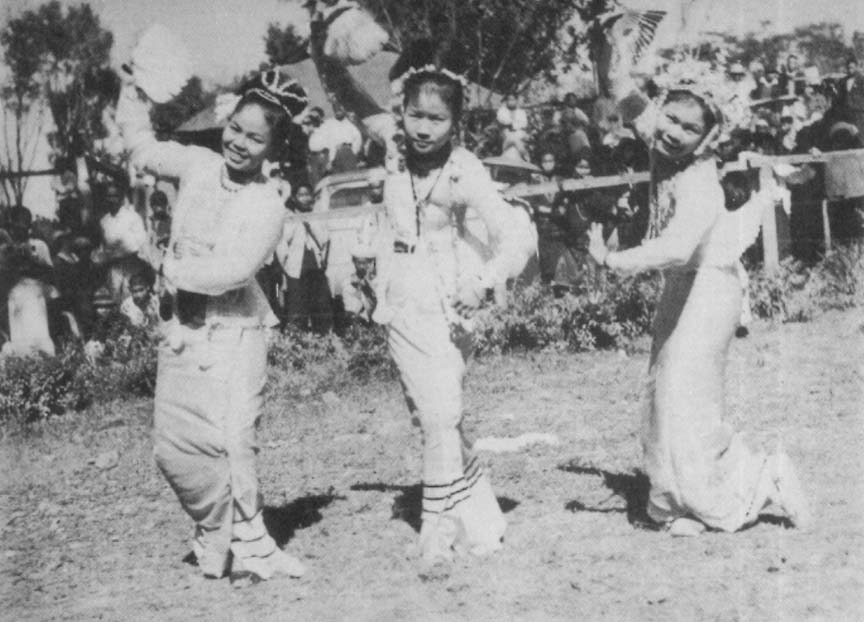 Dancing Nurses in Burmese Court Dress [Frank Crane] |
 Shan Nurses in Men's Clothing for the "Sword Dance" [Frank Crane] |
 Chit Sein "Miss Burma, 1942" [Bill Cummings] |
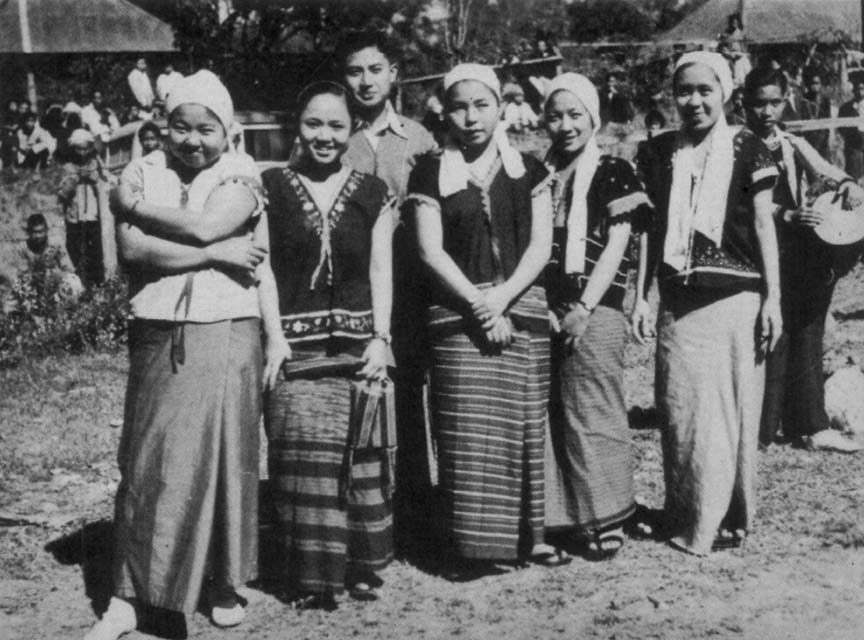 Karen Nurses and Dr. Ba Saw [Frank Crane] |
The Chinese on the Kunlong road finally became acquainted with us. We had loads of fun with them. The new ambulance, when it came, had medicine shelves above the windshield from which we could reach the drugs without having to go outside. The coolies crowded up to the windows and got their cinchona tablets, and whatever other special medicines they asked for, if we were convinced they really needed them. Nurses dispensed out of one window and I out of the other. Soon we discovered patients were getting too, too clever. Having received all they were entitled to from me, they slipped around and, pretending to be someone else, tried to draw rations from the nurses as well. We always glanced back at the men as we pulled out. Invariably they were gathered in little groups comparing notes to see who had managed to get the largest number of pills of various sorts.
Then the assistant superintendent of Kutkai wired me to join him at Namsarawp, where we could choose a satisfactory site for the new hospital we were to build of mat and thatch. It was the eve of the seventh of December, 1941. I expected that, as usual, we would push on and spend the night up in the mountains sleeping in the ambulance, so I was carrying no mosquito net. Mr. Barton insisted, however, that I stay the night with him in the Namsarawp plain, as he had other business to attend to and wished to travel on to Kunlong in the ambulance next day. Never in my whole life have I been so miserably chewed by mosquitoes! It was hot, but I covered my body and head with my blanket, leaving only a small air hole. The mosquitoes chewed my nose. Sweating from the blanket, it was only natural to kick it off the minute I fell asleep, and swarm after swarm of mosquitoes had their blood meal. A glorious feeling greeted the appearance of dawn, with its resultant freedom from my tormentors. After choosing a delightful site above the bazaar, beside the homes of some friendly Shans, we drove on to Kunlong, dispensing to everyone as, we went. Mr. Barton enjoyed it as much as we did. Heretofore rather skeptical about missionaries, he began to unbend slowly and even went into a contest with me to see who could produce the most interesting songs. He won on variety of music, producing a couple of sonatas à la tra-la-la. I on my part could rattle the leaves and startle the coolies at least a furlong farther than his voice could carry. When our voices gave out and we started telling our favorite stories, it was a draw. The nurses in the rear of the ambulance sat in astonishment through the whole concert, gazing in awe at the Englishman and the American who had suddenly gone mad.
Sleeping again near Kunlong, we were met, as we reached the new motorboat ferry installed for the Yünnan-Burma Railway, by a Chinese official who told us about the attack on Pearl Harbor---a garbled version, because he located the attack at Singapore! So at this time we did not realize that America had been attacked.
"Let's hurry the selection of the site for the Kunlong hospital as much as we can, Mr. Barton," I urged. "I want to get back to our own radio and listen in on this thing; if Japan has cut loose, Burma is in for it."
Hurrying back much faster than the road warranted, I met the Namkham-Lashio bus. The driver waved me to stop, and Dr. Tu, who had hospital business to do for us in Lashio, stepped out.
"Mrs. Seagrave is critically ill with malaria," he said. "She has been delirious and Dr. Ba Saw is very worried."
We stopped for no more patients! At Namkham, Tiny was conscious again, but very weak. Dr. Ba Saw had done a wonderful job giving her various intravenous and intramuscular injections, using the right drugs, as her condition demanded from time to time, and pulling her out of the cerebral malaria attack with the utmost skill. Tiny's favorite nurses had been on with her continually without thought of rest for themselves. She remained critically ill for many days, but the cerebral symptoms, at least, did not return. About the time she was able to be up again, the malaria parasites injected into me by the mosquitoes at Namsarawp that night had multiplied to sufficient numbers to put me in bed for a day. Since then Tiny and I have had relapse after relapse of malaria, neither one being able to afford time to cure it completely by staying in bed.
Part Three: Battle of Burma
Table of Contents