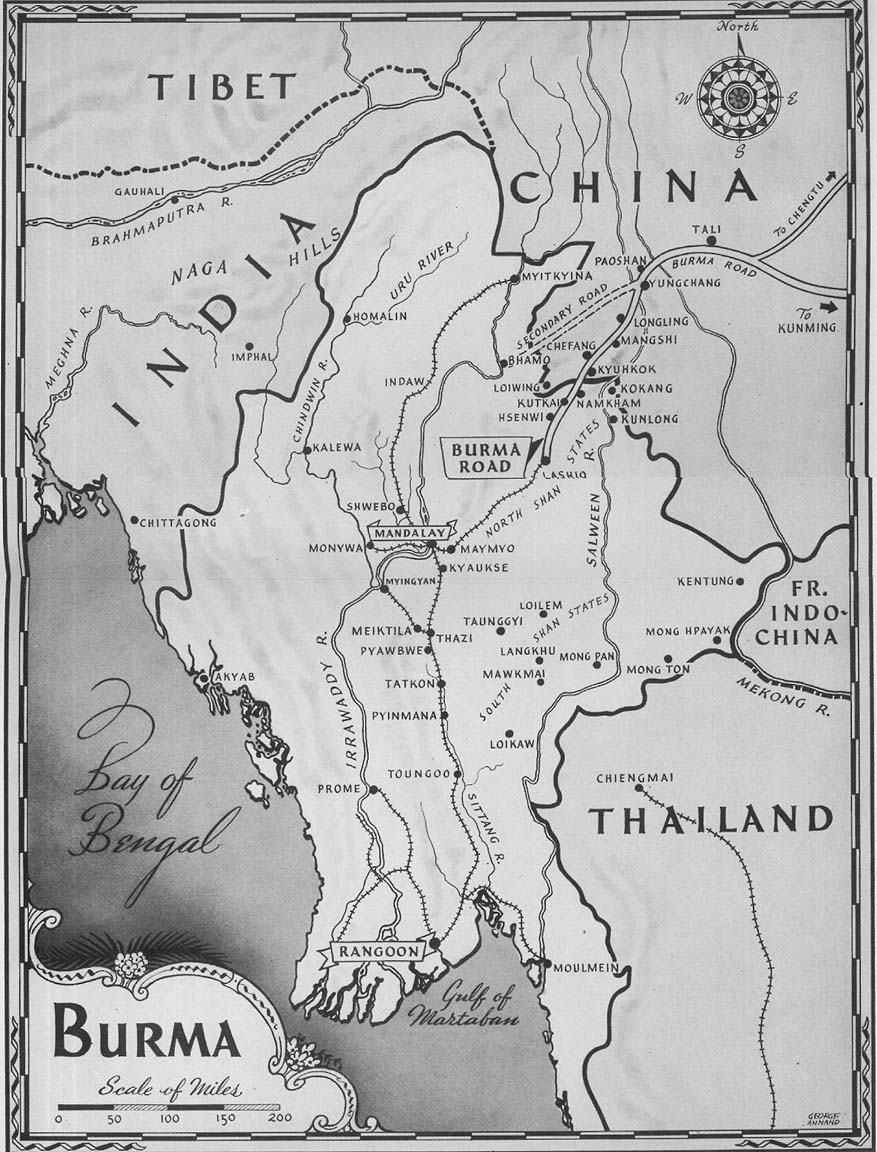
THE NEWS on the radio was not so good. Sooner or later they would be in Burma, and then where would our hospital be? We felt around to find out what the government officers had planned to do to us. Mr. Fogarty's idea was to have me send our entire third-year class of pupil nurses to Taunggyi to work in the British Army's base hospital there. That did not suit me, for the girls would be little better than ayahs there, allowed to do none of the things they had been trained to do. Mr. Porter, in Lashio, did not want us to do anything. He was convinced the Japs would never succeed in entering Burma in force. Mr. Stevenson, in Kutkai, sure the Japs would enter Burma by the Burma Road, was going to use us as a base hospital for British troops, pushing us back from valley to valley if things didn't go well. Yes, and how were we going to move around when we had only two ambulances, and how would we be good for anything if we were dispersed over the entire map? Yet we must do something, because every year for the last ten years I had promised the government that they could count on us in any military emergency. Our problem was not whether or not we wanted to serve, but how we could serve efficiently and really help the country. I hated "eyewash."
Then Bill and I took our ladies over to a dance at Loiwing. I asked "Chuck" Hunter if he could figure out some way in which our hospital could become mobile so that we could move swiftly to the scene of action when hostilities started.
"Listen, Doc, why don't you go down to Rangoon and persuade them to give you some Lend-Lease trucks. The authorities would rather have them given to Americans who they know will not misuse them. They have given us some to help in our work with the A.V.G."
On our way home, Tiny, Hazel, and Bill Cummings and I talked it over. The idea seemed pretty good to us, but there was the difficulty of getting enough drivers. It was Christmas, and I had to go to Rangoon in any case to take delivery of the new ambulance, and Bill consented to go along with me in the Oldsmobile which the factory had presented to us. Tiny was still too weak to drive long distances.
Cooped up in the car for three days on end were two of the craziest missionaries the A.B.M. ever produced in Burma. We saw no scenery the whole trip, for our tongues were moving so rapidly that we persistently interrupted each other. Starting out from Namkham with only a hazy idea, continuous argument caused the pieces of the puzzle to fall into place and the picture gradually to come into focus. Realizing the difficulties we would encounter, we thought out solutions for each one, so that by the time we reached Rangoon, with the blessing of the new Shan States commissioner upon us, we had detailed plans ready to present. While we were traveling down, Rangoon was bombed twice, the first attack being a massacre. Nothing could persuade the natives, when the bombers appeared, that they were not looking at another Hollywood film; so they gathered in the streets to see the free show, making perfect targets for bombs and machine guns. The hospitals were full to overflowing, and the nursing staffs of the Dufferin and Ram Krishna hospitals had disappeared. I was astonished at the smallness of the bomb craters. The Japs were not using the huge demolition bombs they had used in Loiwing. In both raids bombs had dropped within a very short distance of my dying mother, so my friend Mr. Smith, of Judson College, and his wife, had taken her off to temporary peace in Prome.
Mr. Fogarty was in Rangoon, now chief liaison officer between the government and the Army. Bill and I went to his house at once to lay the project before him; but before we could say a word, he started laying his plans before us!
"Seagrave! I was just hoping I could get hold of you. I want you to start for Prome tomorrow night and open a four-hundred-bed hospital at once for bomb casualties. I will give you three days to set up, and then your first hospital train of patients will arrive. Can you do it?"
"Yes, if you can get a telegram through to Namkham asking for eight of our key nurses to be brought down to help me with the volunteer assistants I will have to secure locally; and I will be glad to do it if you will help us with this other project of ours," I told him, as I outlined the plans Bill and I had made.
"I'll take you around to Army headquarters first thing in the morning," he said. "Now I will have to hurry over to the governor's council meeting and put the Prome matter before him. Come back in the morning."
The next morning Mr. Fogarty's face was wreathed in smiles.
"It worked," he said. "The governor approved of my plan for sending you to Prome most wholeheartedly; so the Burma Medical Department immediately discovered that they had underestimated their own ability to handle the situation and are no longer talking of evacuating all casualties to Calcutta by sea. They decided that if you could start a four-hundred-bed hospital on three days' notice, so could they; so they are getting busy at once. Now we can go around to the Army." Fogarty moves in mysterious ways. I felt a little dismay at having been used as a red rag, and yet Fogarty would have been quite capable of tying me up in Prome for a month or six weeks if his red rag had not produced results.
I am afraid the next two days made us get just a little embarrassed. Every officer we met, from the deputy assistant director of Medical Services to the brigadier general, had heard all about us. We could only hope they hadn't heard altogether too much! I would have liked permission to censor the stories before they heard them. The director of Medical Services was the only man to criticize our plans. We should, he said, have asked for thirty three-ton trucks instead of six. Then they could call us a mobile hospital unit. With only six trucks they could dignify us with no higher title than a mobile surgical unit. We told him that the title was entirely immaterial provided they gave us a real opportunity to work---and work together as a unit composed of doctors and nurses who were used to each other's ways. Scarcity of drivers made thirty trucks impossible for us, but we could locate six missionaries, who were at a loose end because of the war, to drive the six trucks. It was specified that no member of our unit should receive pay. The government medical stores would issue anything needed that was available, but we would have to secure the trucks and necessary blankets and sheeting material from Lend-Lease. Approval of General Hutton having been obtained, it took only a few minutes over the telephone to secure the trucks and Lend-Lease supplies from the American officers in charge.
Early the next morning we took delivery of the trucks and other supplies and loaded up with all the gasoline we would need during the first month. The medical stores filled our requisitions in record time. Mr. Baxter, financial secretary to the government in Burma, gave us a thousand rupees of his own personal funds to cover incidental expenses liable to occur during the period essential for organizing our unit. Several missionaries were out of constructive jobs because Judson College, of the University of Rangoon, had closed down. Driving our hospital trucks seemed to them to offer possibility of real service to Burma. It certainly would prove more interesting than sitting on chairs for the duration. Paul Geren and Whittington joined us then, and for one of the trucks we secured Mr. Tun Shein, a Karen who had had years of service with Macgregor's, one of the companies handling the teak of Burma. A college graduate, elephant catcher, a little bit of everything that we needed so badly, he took the job first as a lark, then later became just as vitally a part of our work as Bill and myself. Tun Shein could hear the squawk of a hen laying an egg five miles away, and come back with both the hen and the egg! Speaking Burmese, Hindustani, and English as well as his own Karen, and understanding the psychology of each race, he was a perfect liaison as well as supply officer! He is more important now to this unit than I am. There are plenty of other doctors, but only one Tun Shein. As long as he is with us we won't starve, nor will we get into conflict with Burmese or Indians.
That day in Rangoon great pressure was put on us by the mission and by the American consul general to get all American women and children out of the country. Now what were we to do? Rangoon Port was almost out of commission as the result of only two bomb raids. How much longer could it remain open? Indians, maltreated by the Burmese for years, were streaming out of town by the tens of thousands on their long trek for India. Most of them were on foot, their possessions strapped on their backs. Many were driving their cattle and goats along with them, hoping to have something, when they arrived in India, with which to begin their lives anew. Some had large pushcarts and wheelbarrows, trishaws---bicycles with sidecars---and anything that would roll. A few had "salvaged" some brand new truck chassis on which huge packing cases were bolted. Yes, the Indians were definitely leaving, and Indians are essential for Rangoon docks. Bill and I had a major problem on our hands. What sort of advice should we give Tiny and Hazel? Each of us had two small sons in Namkham. Hazel was not very well, and Tiny had been very ill for a long while. If Tiny were well she would be of immense service with our unit either, at the front or keeping the Namkham hospital open while we were away. If she regained her strength, she might stand the trip to Myitkyina if we had a chance to fly out from there, but from Myitkyina to India on foot would be beyond her in any case. If the Japs gave our friends in Loiwing time enough, they might fly her and the boys out from Loiwing at the last minute. There were too many ifs. If Tiny remained ill (and I had tried so long to restore her to health without success) I would never be free for continued action at the front.
The day after our return, January 2, we put the matter up to them. May I never have to go through another day like that!
Finally the two mothers decided they had better go over to India and take no chance with the children. Twenty-four mad hours were spent packing the most essential things, and then Tiny started off in the Oldsmobile, one of the trucks accompanying her to pick up supplies for the unit that we had been unable to bring on the first trip. She reached Rangoon just in time for a week of continuous night bombing. The A.V.G. had shot so many Jap bombers out of the sky that the Japs did not dare come in the daytime. Night after night Tiny had to grab up the children and run for the slit trenches and stay there till dawn while bombs dropped all around. All the missionaries were keyed up and their tempers very brittle. After what seemed like seven years instead of seven days, the three obtained passage on a steamer for Calcutta. The letter Tiny wrote from there on her arrival was the last to reach me till July. Someone told me later that he thought she had sailed from Bombay, but it was not till I reached India that I knew she had safely reached our home in Ohio.
January was a busy month for Bill and me. We had to arrange our trucks for immediate departure when the Army authorities ordered it, while I still had all my regular hospital work to do and ambulance trips to make, and Bill had to wind up some important phases of his agricultural work. We had a driver for each truck, but we should have had a dozen spare drivers trained, and ready, to take over when occasion demanded. That meant nurses again. Several of the nurses had shown great interest and natural ability in car driving. I took them in rotation on each ambulance trip, and they learned very rapidly. Tiny had already taught Dr. Ba Saw the rudiments, so he learned his remaining lessons quickly. Bill outlined a miniature "Burma Road" on our football ground and made the more promising nurses drive those huge trucks back and forth on that road. Soon they reached the point where we could let them practice on our valley road, with one of us ready to pull on the hand brake or snatch the wheel out of their hands in an emergency. Coming back from the long ambulance trip to Kunlong, always at night, there was no danger of smashing into other cars, so I took my life---and theirs---into my hands, and let them drive the ambulance. Theodore, my secretary, took lessons and did very well indeed.
Now we had our equipment all ready and planned a practice mobilization. Every nurse had her place in the trucks assigned to her, and the position of each truck in convoy was announced. Key nurses had lists of last-minute things which they were to load on the trucks after the signal was given. Each boy who had volunteered to go with us was told what he must do. I allowed them fifteen minutes after the gong had sounded to be ready to start. On this practice the trucks were to go down the main hospital road, around the hospital hill, and come back up the private road leading to our house. I slipped up on only one thing. I forgot to assign a driver for Bill's truck; and Bill was out of town. The gong rang out; everything was chaos for a few moments; then I led off the convoy with my truck. As I went around the corner of the hill I looked back over my shoulder. All the other trucks were taking their assigned place in convoy. Who on earth was driving Bill's truck? It was swerving from the ditch on the right to the precipice on the left in very accurate imitation of the way a snake travels. Lord! What if the girls in that truck were to be killed on a practice trip! The mountain hid them from view, and I drove around and up the narrow road to my house---a road just a few inches wider than these huge trucks and so steep that I had to go into compound low. Back at the hospital again I watched the other trucks and the big ambulance pull up. Htulum and her ambulance rolled into position in great style. Ba Saw and the Americans were like old-timers. Finally Bill's truck arrived ---driver Theodore, of all people! I was speechless! Theodore had heard me telling the nurses a hundred times that they must be ready in any emergency. He felt that this applied to him! It was a dress rehearsal; Bill, one of the principals, was absent and a driver was necessary. Even if he got killed in the process he was determined he would not be found wanting!
While we were still gasping with relief that Theodore and the nurses had not been killed, a friend came running up from Namkham to say that all the bazaar people and shopkeepers, hearing we were starting for the front, had evacuated the town! It was days before they discovered it was a false alarm and returned.
I do not think we could have gotten through those weeks, after Tiny and Hazel left, if it had not been for our Sunday evening song services. We had had them for years, teaching the nurses to sing accurately and in harmony. Some of their voices were very, very sweet, and all of them could carry a tune. They enjoyed the services as much as we did, calling for hymn after hymn until our throats were all worn out. These last four weeks one sang with a lump in one's throat. Tiny was not at the piano, and the boys were not turning somersaults on the floor. But still we were all one big family, loving each other and going through the same period of hope that soon we would be doing something of vital importance to this country of ours. The effect on our morale was so extraordinary that we kept up these weekly sings all through the Battle of Burma and after.
A division of the Chinese Sixth Army was reported to have arrived in Kengtung State. Two other divisions were due to come through into Burma by way of the Burma Road. Somehow we knew the Army in Burma intended to assign us to the Chinese Army. We were the only hospital in Burma that had Chinese-speaking nurses, and we were the only non-British hospital available for military use. It was known that the Sixth Army had no medical-school graduates to do their surgery. But I had begged headquarters not to tie me up with medical work for an idle army. Namkham, the work we had developed in the Northern Shan States, the Burma Road hospitals---all seemed well worth maintaining until there were actual battle casualties that needed treatment. Then a peculiar order was telegraphed in. We were to start immediately for Wanting and report to the liaison officer there for duty. What Wanting did they mean? Surely not the Wanting at the border, forty miles away from Namkham and a hundred yards from our Kyuhkok hospital? It must be the Kengtung State Wanting. I sent Bill to Lashio to find out. Yes, it was our Wanting. We stayed put. We were already in Wanting. Army Headquarters in Rangoon had not looked closely enough at the map. A few days later, the British liaison officer assigned to the Chinese Sixth Army came in to see us. It would be two weeks before the Army would cross the border on the way to the Southern Shan States. He would let us know the actual date on which the first convoy was traveling and we could follow it down to Takaw, where the Kengtung road crosses the Salween. We kept the trucks loaded, continued training the nurses who were learning to drive, and for the third time gave them their course in first aid. Our ambulances made their scheduled trips. When we could stand this "mark time" business no longer, Bill and I would climb into the Oldsmobile and go over to Loiwing and meet some of the A.V.G., and listen to their stories. One young A.V.G. had had such a struggle getting into his shirt one morning that he was a minute late getting off the ground, and his pals had taken off without him. As he gained altitude he discovered a formation of Japanese bombers above him. He was so afraid of being killed that he pointed his nose straight up and ploughed through the Jap formation, bringing down three planes as he went. I became intensely curious as to what my reaction would be if I got into danger. Would I cut and run, or would I plough right through the danger like this A.V.G. boy?
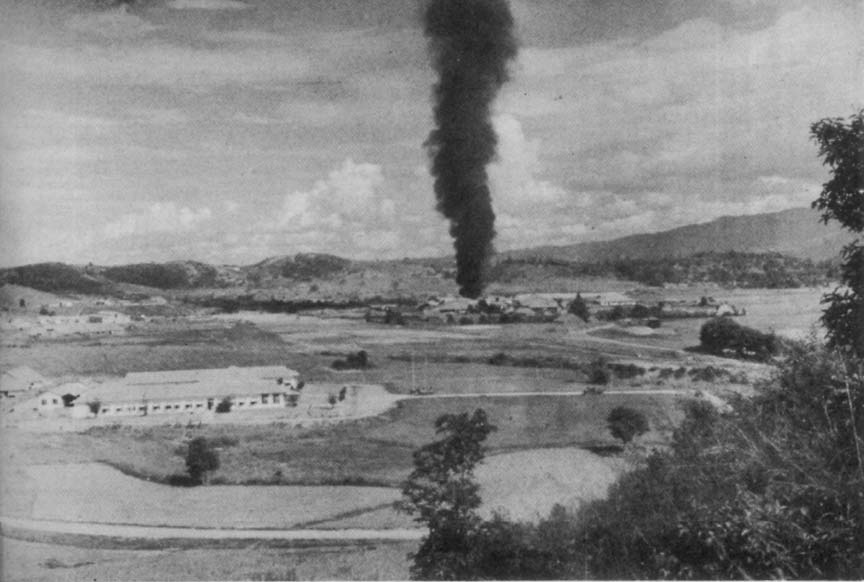 After the Bombing---Loiwing [H. Hoteko] |
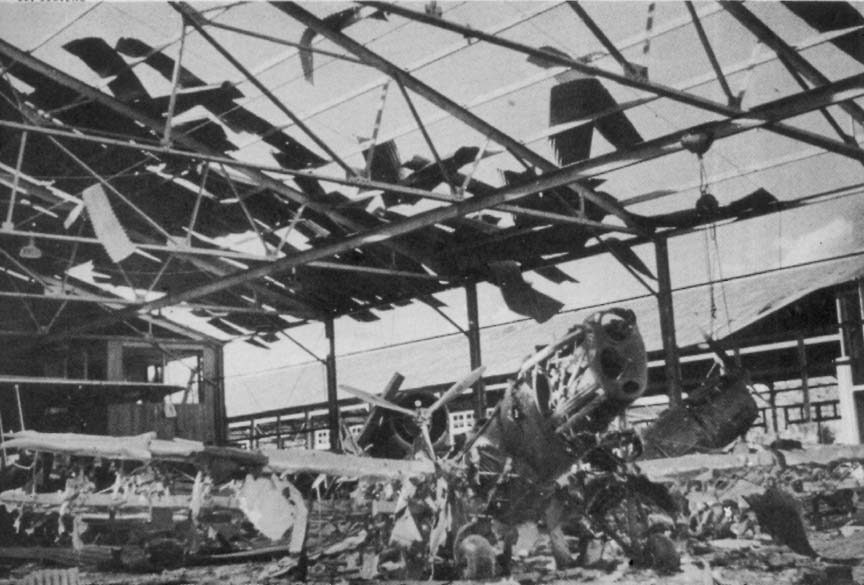 Airplane Factory after the Bombing-Loiwing (Mme. Chiang's Private Plane in Rear [H. Hoteko] |
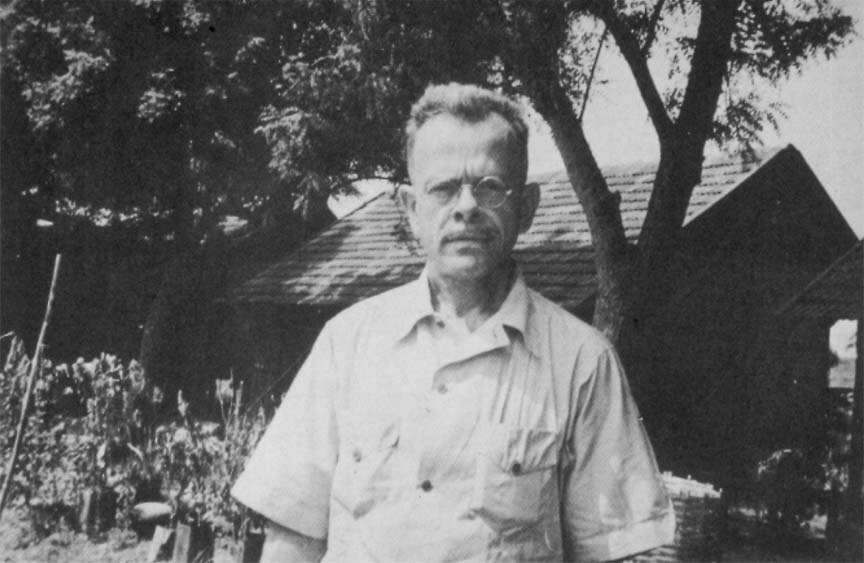 Dr. Seagrave at Emergency Hospital on the Toungoo Front [U. S. Army Signal Corps] |
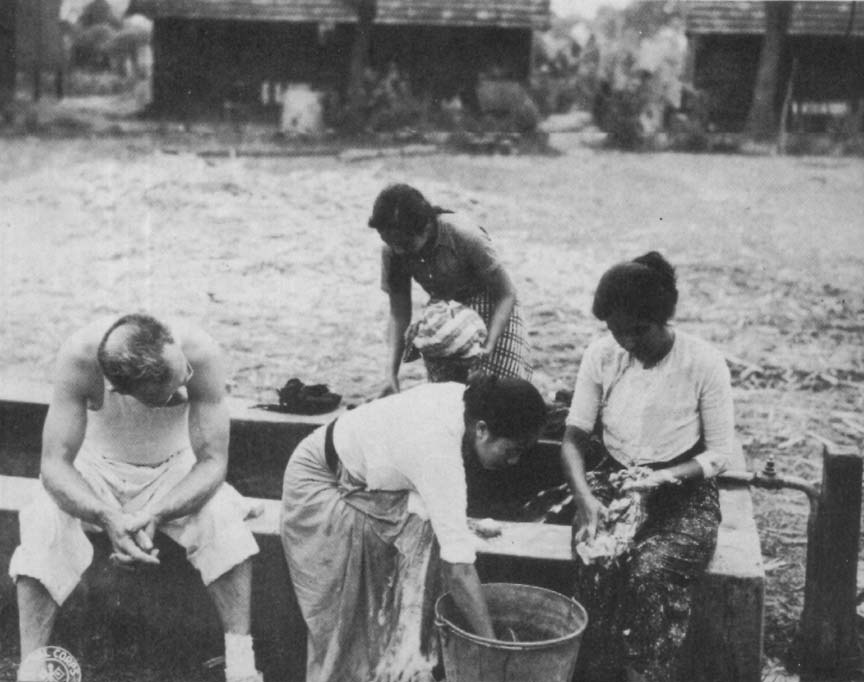 Nurses Doing Hospital Laundry [U. S. Army Signal Corps] |
The liaison officer reappeared. The first regiment of Chinese, he said, would start on Wednesday. It would be better for us to start on Thursday so that there would be no difficulty getting mixed up with the Chinese convoy on the road. So, on Thursday, we started off under a barrage of pouts and tears from the nurses, whom we had decided to leave behind to keep up the Namkham hospital work. Promises of rotation between Namkham and the front had no effect. Sein Bwint lost no time writing me a letter accusing me of persecution because I had not let her come with us. Five other nurses started a Gandhiesque non-co-operation strike because they had been left behind.
WE SPENT the first night in Kutkai getting used to Army life. Arriving in Lashio the next morning we drew out our first stock of rations and cooked breakfast in the jungle, ending our second day's journey in the bazaar sheds at Pangkitu. While we were eating our breakfast next day at Laikha, another liaison officer appeared, who told us we were to report at Mongnai instead of at Tikaw, on an entirely different road. We got to Mongnai at sunset, and there Brigadier General Martin, chief of the British Liaison Mission to the Chinese Army, met us. He informed us that our orders were more extensive than we had originally been given to understand. Our unit was to serve not just one division but the entire Chinese Sixth Army in the Southern Shan States and Karenni, over a front extending from Kengtung State, three hundred miles east of Loilem, through Mong Pan State a hundred and fifty miles south, and into Loikaw, capital of Karenni, a hundred and fifty miles southwest. Since the main roads to these three stations met in Loilem, a delightfully situated town, General Martin advised us to set up our base hospital there. We pushed back to Loilem that night. What kind of men did these British think we were anyway, giving us a job of that size? After refusing us the dignity of the title of Mobile Hospital Unit they were ordering us to be a whole confounded medical corps! It was well known that the Chinese Medical Corps consisted only of a few men trained in first aid, and of companies of stretcher bearers. We would somehow or other have to do all the hospitalization for the entire Army. General Martin promised me a free hand in adding to our personnel any volunteer doctors I could secure, providing they worked without pay, but said I was to ask for no British medical officer to be assigned to us. My job was so large that a commission as lieutenant colonel was offered me.
I declined with thanks. They could make me an honorary lieutenant colonel---Kentucky variety---but I was taking no chances of losing my American citizenship!
We selected a lovely pine-covered hill east of Loilem, and the government secured contractors to put up a lot of bamboo and thatch wards under the pines. With as big a job as this before us we knew there would be endless miles of travel to and from the small advance hospitals that we would have to develop; so Bill set off at once for Rangoon with five drivers, two of them nurses, to attempt to secure a half-dozen jeeps. I, for my part, went off to Mong Pan to get in touch with the regiment of troops that had just arrived there and decide as to the necessity of having an advance hospital in that place to care for their needs.
The road to Mong Pan branches off from the Kengtung road at the Namsang airfield, passes southward through Mongnai, then down steep grades to Langkhu, a hot, coconut palm-covered plain. From Langkhu the road is of much more recent construction, graveled but very narrow, rising sharply up to the Mong Pan plateau. At Mong Pan one sees the first signs of Siamese influence in the pagodas and monasteries. Beyond Mong Pan Town the British were hurriedly pushing construction of a motor road down to the Salween. The first regiment of Chinese was marching along this road as I drove up. They were just the sort of Chinese I was used to, many of them stumbling along in the grip of fever. They would certainly need one small hospital in Mong Pan Town if I could persuade the political officer or the sawbwa to construct it. No solution suggested itself to my imagination other than the development of a system of small, nurse-controlled hospitals like those we had built along the Burma Road, supervised by means of weekly trips.
Returning to Loilem, I tanked up and started early the next morning for Kengtung, where a division of the Sixth Army had been stationed for more than a month. I took along the nurses who had come from Kengtung for training, since they had not been home for four years. We crossed the Salween Ferry at Takaw in the early afternoon, only to find that the road from there on permitted only one-way traffic, and the gates would not be opened for the east-bound traffic till seven in the evening. A visit to the local British officer secured for me a pass permitting us to travel all night. The nurses cooked dinner and we set off. The road to Kengtung is steep, full of curves, and very, very narrow. To avoid going over precipices the car had frequently to push against the bank on the other side. About three in the morning I was so sleepy I stopped the car, leaned over the wheel and dropped off for an hour. The four nurses had been sound asleep in each other's arms for some time. I had promised the officer, however, that I would be off the road and out of the way of west-bound traffic by seven, so I forced myself awake, drank a pint of hot coffee from my thermos and drove on, reaching the A.B.M. compound with a leeway of half an hour. We were welcomed with open arms, given a nice bed to spread out on, and I fell asleep after extracting a promise that no one would tell Mr. Buker I was there till nine o'clock. The promise was not kept. In fifteen minutes Buker came striding in in great excitement. I pretended to be in a coma, so at last he went away and let me have my two hours' sleep.
Buker thought I was an answer to his prayers and letters, none of which---not even the prayers---had reached me. I was delighted to find that in Kengtung things were already arranged. The mission hospital had been turned over to the Chinese Army under the direction of a Chinese physician from Rangoon who wished to join our unit. The English civil surgeon was very cordial and anxious to help us in every way. Buker took me around to headquarters, introducing me to two generals who seemed very fine types and most intelligent. With the aid of an interpreter I explained the orders that had been given me and agreed, on their advice, to open a front-line hospital at Mong Hpayak near the Siam border, from which serious cases could be transferred to the base hospital by ambulance. I arranged to leave our nurses in Kengtung and promised to send back others to open the Mong Hpayak hospital the following week. Then, at noon, I started back. I was lucky enough to get about five hours' sleep that night.
I had done all I could for the few days during which hospital construction was going on, and I knew that my first week away from Namkham would be very difficult for Ba Saw and E Hla; but I had forgotten to warn General Martin that, until there was actual battle, I would be making frequent trips back to Namkham. Taunggyi was only sixty miles west. I decided to see the general, outline the plans I had formulated, and get his approval. Running around the streets in Taunggyi were Bill, Htulum, Koi, Paul Geren, Whittington, and Tun Shein with their new jeeps. We had a celebration. Our work would be just possible now, whereas without the jeeps we would have been making much ado about nothing as far as medical service for the Chinese Army was concerned. Htulum and Koi had acted like old-timers, driving those jeeps up from Rangoon. They viewed with scorn their old man who was, at that time, afraid even to ride in one of the darn toys!
At Namkham it was just as I had feared. The nurses we had had to leave behind, albeit temporarily, had been just as mean as dirt because we had not taken them to the front. I pointed out to them the fact that they were very lucky in being assigned their share of the Namkham work at the beginning, before hostilities commenced, as they would not need to return to humdrum work in the middle of the excitement that would come later. They were only half convinced. Bella was now at term. Her pelvis was very narrow and she and Ba Saw were terrified at the thought of her having the baby while I was away. As Bella was not very strong and ought not to have another pregnancy soon, it would be more than they could bear if trial labor resulted in the death of the child. That evening I performed a Caesarian section, stayed with Bella for twelve hours, and then went off on the regular ambulance run for Kunlong. From Kunlong I returned to Loilem. Two more regiments of the Sixth Army had gone through to Mong Pan, and the general, whose headquarters was in that town, wished me to open our hospital there at once.
Htulum was the top nurse of our unit. It seemed only logical to put her in charge at Mong Pan with two younger girls and Lieng Sing, our Chinese college boy, to help her, Koi remaining in charge at Loilem. Htulum, being such a good driver, could keep a jeep at Mong Pan for use as an ambulance; while, if he was willing, Dr. Gurney of the English mission at Langkhu would answer emergency calls from Mong Pan when Htulum got into trouble. Loading a sufficient amount of supplies for the new hospital into a truck, we started off, Htulum trailing us in her jeep. As we passed through Langkhu we stopped and had tea with Mr. Short and Dr. Gurney. Another kindred spirit that was always looking for trouble, he already had his hospital full of Indian troops, with an occasional Chinese soldier or two who had been taken ill on the way to Mong Pan. Afraid he might be drafted some day for an office job in some out-of-the-way place far from scenes of action, he was delighted with the idea of joining our unit, and volunteered to make trips up to Mong Pan every other day to supervise Htulum's work. I am a most unfortunate chap. Short and ugly, every other male in our unit is tall and handsome, making me look and feel most awfully insignificant. Gurney was the prize of them all: a fair-haired Englishman with a lovely scar on his upper lip that looked as if it had been received in an honorable duel at Heidelberg! Sulkily I drove on to Mong Pan knowing it would be but a very short time before all our nurses fell in love with him. As a matter of fact, in two weeks they had dubbed him achit galay---"little pet"---or, as some of the nurses translated it, "first love." They have the name written above the door of his room at the present moment!
The sawbwa of Mong Pan built Htulum a fifty-bed hospital of bamboo and teak-leaf thatch, above a cement floor of some unknown origin. There was a nice little nurses' home beside it. I was quite pleased with the arrangements, feeling no qualms at leaving the nurses there. I was sure they would be able to take care of themselves. One of the younger nurses was the Princess Louise, granddaughter of the sawbwa of Lawksawk--who was a very old friend of mine. Louise is unfortunate. Everyone falls in love with her, from my son John to a certain Chinese major at Mong Pan. Htulum and Lieng Sing were worried, at first, at the persistent attentions of the Chinese major, but Louise told them not to fret---she could handle him! So she took the poor man and made him teach her Mandarin until she was an expert. I lent her to my American Army colleague "somewhere in India," the other day, to act as interpreter.
"Louise is grand," said the major. "She must be one of your top nurses, isn't she?"
"No," I replied, "she is one of the youngest. We have a lot that know more than she does, good as she is." The major shook his head. He didn't believe me. But Louise is really grand. Educated in a convent in Burma, she speaks very nearly perfect English, and she has centuries of breeding behind her. A Shan princess, she is not too proud to do the most menial tasks for patients of any race; and she can keep her admirers, no matter of what race, just exactly where she wants them.
On my next trip to Mong Pan I discovered that the feeling the nurses had for Dr. Gurney was fully reciprocated. The girls had had a big laugh out of him. On his first visit he had poured sweat preparing and giving hypodermics of quinine to patient after patient.
"Why not let us give those hypodermics for you," said Htulum, "while you examine the patients and write out the orders for medicines which you think they ought to have?"
"My goodness! Do you girls know how to give hypodermics?"
"Well, we don't know all about it, but we have given a few thousand and we can give intravenous injections, too, if you prefer the quinine given that way. Dr. Seagrave has supplied us with distilled water."
So Dr. Gurney confined his attentions to physical examinations, diagnosis and writing of his orders upon the sheets of toilet paper with which the nurses provided him. Wonderful thing, toilet paper! The nurses used it for almost everything except the use for which it was intended! It made wonderful emergency temperature charts and order sheets and served very well to wrap up medicines for ambulatory patients. They indented for such large supplies that the British ration stores must have felt that there was a cholera epidemic on!
When surgical cases, and a few casualties from raids into Siam, needed more than Htulum was able to give them, Dr. Gurney transferred the patients to his own hospital at Langkhu, asking if I could spare him a couple of nurses. I sent him first Pauline, and later Ohn Khin, also a princess, granddaughter of Mong Mow. Pauline and Ohn Khin still trail Dr. Gurney around everywhere and are never so happy as when near him.
Eight miles north of Loilem a missionary colleague of Dr. Gurney's, Dr. Barr-Johnston, had a small hospital. His civilian work practically at a standstill because of war rumors, he consented to take his ambulance and surgical equipment with him and assume responsibility for all our work east of the Salween in Kengtung State. That was an immense relief to us. Still we would be in a very tight spot indeed if hostilities were to break out along our whole three-hundred-mile front; so after settling our unit in the newly completed buildings near Loilem and taking a half day off to get control of a relapse of my malaria, I made another flying trip to Namkham. The morning following my arrival was spent in doing a lot of major operations Dr. Ba Saw had saved up for me. Late in the afternoon, I paid a visit to Loiwing to report on the job that had been given us, and to ask the co-operation of the company in contacting Chungking, Chengtu, and Kunming, with a view to obtaining medical officers for our unit.
For the following two weeks the work consisted of flying trips to first one and then another of our small hospitals, of which we now had six. What wards the contractors had completed in Loilem were full of Chinese soldiers-accident cases resulting from poor truck driving as the Army moved south, pneumonia caused by exposure, and the everlasting malaria. Troops were concentrated in Loilem itself. Rangoon had been evacuated, and Hla Sein, the first girl to lose her home and all her people, had a few days when her laughter and cheerful singing were silenced. Then hard work came to her rescue, and the songs and laughs burst forth once more, never to subside. The last division of the Sixth Army was moving into the Karenni States east of Toungoo, with headquarters at Loikaw. The Fifth Army, much better troops, was hurrying down, convoy after convoy traveling night and day through Mandalay to Toungoo where they were digging themselves in.
At Mong Ton, beyond the Salween and only a few miles from the Siam border, advance units of the division that had its headquarters at Mong Pan had made contact with Siamese troops. I picked three nurses, of whom the chief was Chit Sein, "Miss Burma, 1942," to open a small hospital there. Having no doctor to spare, I asked Paul Geren to go with the nurses and add to their prestige as well as protect their morale. A forty-mile walk was necessary from the end of the dirt road beyond Mong Pan. I felt positively ill as I escorted the little party to the road's end. The other two girls were Kachin and had been toughened by many years of life in the mountains, but this little Shan beauty, brought up in comfort, was in for a very, very hard trip which I was sure she could never stand. I was convinced that I was bidding them a permanent good-by. Later a nice long letter came back by messenger from Paul. Chit Sein had smiled and laughed the whole way there, standing the trip much better than he had. One day's journey from Mong Ton the Chinese had sent out a group of dignitaries to welcome them and bring them to the post in style. A tremendous Chinese banquet had been prepared in their honor. Paul, a doctor of science, was assumed to be a doctor of medicine, and all the sick officers sent for him. Being a canny man, Paul took Chit Sein with him on each visit.
"Chit Sein," said Paul in an undertone, as he made a theatrical examination of the patient, "what the dickens is the matter with this fellow?"
"He has malaria," Chit Sein replied without moving her lips.
"What do you think ought to be done for him?"
"Chinese like injections; I think we had better give him a hypodermic of quinine."
"Chit Sein," said Paul in an authoritative tone, as he put away the spare stethoscope, "this officer has a bad attack of malaria. Please give him an injection of quinine."
Under the treatment of such a handsome doctor and lovely nurse, it was impossible for the patients not to get well!
Mong Pan hospital now had a hundred beds. Htulum had become very popular not only with the Chinese Army but with the medical officers of the Indian troops that still remained there, and the latter continually sent particularly difficult cases to her for treatment.
When we were about to leave Namkham for service, Htulum had come to me.
"I have been engaged for ten years to a Kachin schoolmate of mine who was planning to study veterinary medicine," she said. "My folks did not approve of him and tried to compel me to marry other men whom they preferred; but I loved this man. We postponed our wedding until he got himself a good job and I had had enough fun nursing. He has his job now, and I am getting older. I want to marry him on the first of April but I don't want to miss out on our unit's war service. Can you give me a month's vacation beginning from the middle of March? As soon as our honeymoon is over I will return to duty and remain with the unit till the end of the war."
"O.K.," I said. "That's fair enough. I will take you back to Namkham myself on any date you set."
It was now the second week of March, so I asked Htulum if she was ready to start home.
"No," she replied, "I am having too much fun here, and I still want to make one trip to Kengtung with you the next time you go there. If you will take me back to Namkham four days before the wedding that will be quite enough."
On the eighteenth day of March, I was due to have a birthday. I hoped that, without Tiny there to remind them, the nurses would forget about it; so on the seventeenth I went to Loikaw to make preparations for opening our last branch hospital there, and purposely did not get back to Loilem till nearly midnight on the eighteenth. As the car pulled in by my shack, the strains of "Happy Birthday to You" swelled out from the throats of the entire unit---boys and girls---all of whom would have stayed up until morning if necessary. My shack was decorated inside and out with flowers "salvaged" from the town. On my table was a tremendous assortment of presents surrounding a three-tier birthday cake. My eyes were a bit damp as I opened the presents and read the little birthday messages in ungrammatical English, in Burmese, and Shan. When I had thanked them, Htulum, who had come in her jeep for the occasion, told me that there was still another present, but it was so big they could not carry it through the door of my hut and had had to park it outside. I went out to look. There it was, a palatial latrine! Over the door was written, "Happy Birthday to the Doctor from the Boys with Love." Then we all had a big laugh, went back in, and finished off that cake with extraordinary efficiency!
NEXT MORNING we started for Kengtung with the large ambulance loaded with supplies for Dr. Barr-Johnston. Htulum, Esther, Hla Sein, and Roi Tsai went along to study geography. Htulum and I took turns with the driving. We got a few hours of uneasy sleep, scattered as we were on top of bundles of medicines and gauze. Barr-Johnston was at Mong Hpayak near the Siam border. Stowing away a meal of Chinese hkow swe, grandfather of all chop sueys, we pushed on. I really believe that trip from Kengtung to the Siam border is the most beautiful in Burma. My experience with narrow roads was rich, but this road was the narrow road to end all narrow roads! It was literally nothing but a shelf, sometimes cut out of solid rock, sometimes built up with stones from the river's bed. You had to scrape the cliff to stay on the road at times. We were in Kaw country, and the nurses soon dubbed the women "bare navels." Every Kaw woman had a pipe in her mouth and a bare, protuberant abdomen. Extraordinary! The ambulance engine was running on only half her cylinders, so we did not reach Mong Hpayak till after dark. Barr-Johnston had so many patients that he had taken over a lot of bazaar buildings and had a flourishing two-hundred-bed hospital. Before the Japs burst through, our unit was handling seven hundred and fifty beds over a three-hundred-mile front for the Chinese Sixth Army alone. The little Shan nurses were so glad to see us! I wonder where they are now? They did not connect with us on the evacuation. I hope the Japs did not get them, for they were too lovely to turn over to Japanese soldiers.
With two drivers, we made the return trip in record time. Esther and Hla Sein, singing almost continuously, kept getting back to that old Karen song of mythical origin.
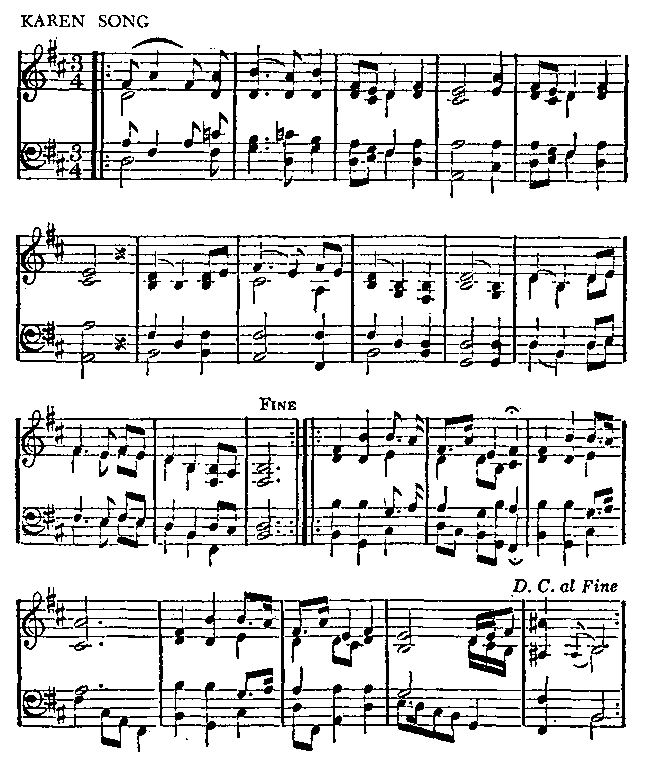
With its delightful minor harmonies we sang it over and over until it became the theme song of our unit. Americans who are assigned to interview us, or work with us, often come with deep-seated prejudices against missionaries and Christian natives; but let us sing that song for them just once, without warning, and they decide our folks are pretty good after all! There is a distinct majesty about that tune.
Next morning we separated at Loilem. I had just heard that Lieutenant General Stilwell had arrived from America to take over command of the Chinese armies in Burma. Was I going to have a chance to work under an American general after all? Had there been some plan behind all my years of misery practicing wastebasket surgery, building up all that work in the Shan States, forcing myself to keep on pushing, God knows why, when all the odds were against us? Was I, perhaps, to be permitted to do some little bit that would help the America that I loved and called my own even though most of my life had been spent in a foreign country? If so, all the misery I had gone through would have been worth while, for as a result of it, I was the only American doctor in the world who had under his command a group of nurses that could speak Chinese and all the languages of Burma; nurses who had been so trained that they enjoyed nothing so much as hard work and emergencies of all sorts; nurses who fought and went on strike if they were not chosen for the hardest and most dangerous tasks; nurses who looked upon anything calling himself an American as a sort of tin god! God! Was there a real place for us in this damnable war after all?
I had not the least idea that General Stilwell would see me. What little reputation I had obtained in Burma would be completely unknown to him. If I had tried to brag about what we had accomplished in the Shan States, General Stilwell would be perfectly justified in dismissing me with a shrug. To believe that the general was a judge of men, without prejudice against missionaries in general and "Burmese" nurses in particular, was surely wishful thinking. At least so I thought as I traveled north to Maymyo, the general's headquarters, leaving Htulum to go south to her post at Mong Pan for the last week's work before her return to Namkham and her long-delayed wedding.
I was mistaken; General Stilwell would see me! His medical chief, Colonel R. P. Williams, would also like to have my ideas with regard to supplies necessary for the Chinese armies. Very, very diffidently, I asked that my surgical unit be permitted to serve the Fifth Army, which was in action at Toungoo, while the medical unit maintained the hospitals already at work with the Sixth Army. Still more diffidently I begged that our units be transferred from the control of the British Liaison Mission to the American Army. Nobody was more surprised than I when the general approved of my suggestions and promised to issue the necessary orders as soon as things could be arranged with the British. I completed the trip to Namkham, relieved that I had not been thrown out on my neck!
At Namkham everything was serene. The nurses had started to co-operate again, beginning to believe that I loved them after all! E Hla, especially, was glad to see me. Ba Saw, relieved from his Namkham duties by the arrival of a Burmese woman doctor who had worked with me previously in Namkham, was fretting for permission to return to the front. Bella was well after her operation. The baby was putting on weight. As the jeep climbed out of the valley with two more nurses, whose turn it was to go to the front, I looked back. Suddenly a feeling of homesickness came over me. I was positively nauseated. "I'll bet that is the last time I see those buildings in Namkham," I said to the nurses. They kept their mouths shut. Thank God for people who know when it is best not to say anything!
At Lashio a telegram reached me: "Htulum killed. Wire instructions." Lord! What had happened to that poor girl? Just about to be married to the man she loved for ten years, could she really have been killed? Why had I not insisted on her returning to Namkham at the time originally agreed upon between us? If she had returned then she would be alive and sewing on her trousseau! I rushed on to Loilem to find out. Htulum, returning to her post in the jeep, was traveling on a perfectly straight, loosely graveled road, when her left front tire burst, and the car turned over. Htulum's skull was crushed by the windshield and she died instantly. The nurse with her had sustained three fractured ribs but was doing well, while Moses, the orderly, had escaped with a few bruises. They buried Htulum among the beautiful pines by our hospital.
It was a sad group of girls that met us that day. Our first casualty the most competent girl of the unit! Something drastic was needed to set the girls back on their feet again. That "something" was lying on my table: orders from General Stilwell to report to General Sibert at Pyawbwe before setting up for active duty at Pyinmana. I called all the girls together.
"I don't want any heroics this time," I said. "I know there is not one of you girls that would not follow me into hell! We will need twelve nurses at Pyinmana, but our Sixth Army work has to go on. The girls who remain are going to have just as hard a task as those who go, and are going to be in just as much danger without having the thrills of Pyinmana to help them in their daily work. Paul Geren and Tun Shein are going with me, but Mr. Cummings is staying on with the Sixth Army group. Take a slip of paper and write on it where you personally feel your real place in this picture is and hand the slips in to me."
The slips returned; we counted them out. Thirteen girls asked for Pyinmana, one of them the girl with three broken ribs. The others had indicated one or the other of the Sixth Army hospitals as the spot where they felt their work would prove most valuable.
"Well, girls," I said, as we bade them good-by, "you can count on Bill and me. We won't leave you in any of your hospitals unprotected if the Japs ever break through and a retreat becomes necessary. Some of you already know and love Dr. Ted Gurney, who is top doctor now for the Sixth Army, and Ba Saw is coming back to help. Give them the satisfaction in your work that you have given me and scramble for the trenches when the Japs come over!"
Bill accompanied us as far as Kalaw where he had a summer cottage. Spending our first night draped all over his floor and the few beds, we raided his stores for everything the Japs might like to have and then, amid a burst of sobs at the thought of leaving behind the beloved "son-in-law," as the nurses called him, we hurried on down the mountain, our trucks and jeeps camouflaged with branches of trees in the most approved Chinese Army pattern. At Meiktila the British garrison gazed in unbelieving awe at a group of "Burmese" girls heading for the front instead of running away at top speed! On reporting to General Sibert we were informed that a group of British Friends Ambulance men had volunteered to serve with our unit and would follow us down immediately to Pyinmana. General Sibert recommended that we pass the night in Pyawbwe, but I requested permission to push on at once as we all wanted to get on with our job.
It was midnight when we reached Mr. Case's agricultural school on the outskirts of Pyinmana, the F.A.U. trucks on our heels. Mr. Case was away looking for food for the Chinese Fifth Army that he was feeding, but we assumed he would approve of our using his buildings; so we set up our operating equipment while the F.A.U. boys went on to the front for their first load of patients. When the operating room was ready for action we snatched a couple of hours' sleep, waking up again at 4:00 A. M. to the sound of the returning ambulances.
We started operating at once. Those operations before dawn that morning are hazy memories. All that stands out in my mind is the trouble we had keeping plaster casts on our patients. There was a high percentage of bone injuries requiring "Spanish treatment" and we were using plaster steadily; but it was very inferior and took so long to set that the patient was awake and tearing at it while it was still soft. Nurses tied arms and legs together, but the patients tried so hard to get free that the casts were cracked and broken. While I was removing a foot of intestine from one badly injured patient, Mr. Case walked in. He was delighted that we were doing something for the Chinese, but he could not permit us to remain in the agricultural-school buildings. He had had a great deal of trouble keeping a sufficient number of boys with him to help secure food for the Army. If we remained the boys would be in terror of our drawing a Japanese attack on the buildings and they would run away. I did not tell Mr. Case that if his boys ran away from the group of girls working with me they would be the only males in the world capable of doing so! The best way Case could ensure having his staff of males remain on duty in the agricultural school, bombs and all, would be to keep our girls located there. But I was too sleepy and busy to argue. During a short lull we piled our packing cases back onto the trucks and moved over to the "Child Welfare Center" where there was one small, very inferior building. On the bottom floor were two small open porches. We chose one of the porches for the operating room and set up four operating tables. The upstairs floor was soon covered with bedrolls, while the main floor was reserved for patients. The ambulances now returned from their second trip to the front, and with a good deal of trouble, the Friends located us in our new setup. We started operating again and were soon in our stride. This was getting to be old stuff. Four of the nurses were upstairs getting a little sleep preparatory to taking over when the first group downstairs dropped from exhaustion. Two of them, with the help of Low Wang and Lieng Sing, were giving first aid to the casualties as they were brought in and deciding the order in which the patients would be sent for operation. Esther and Big Bawk each had two tables assigned to them and were pouring chloroform in a way that would have delighted Tiny, who taught them. Koi, Kyang Tswi, Ruth and Little Bawk were assisting, one at each table. The sun began to scorch us. Off came my surgeon's gown, then my rubber apron. I would rather catch a Japanese bomb than perish from heat stroke as I moved from table to table debriding devitalized tissues, putting bone fragments together, throwing powdered sulfanilamide tablets into the wounds and applying plaster casts. Sweat was still pouring, and my shirt, undershirt, and stockings came off and were thrown into a corner, leaving me in nothing but a pair of bloody shorts. It was grand to be a man! I could work in a pair of shorts without anyone's getting excited! The poor nurses were not so fortunate. Their thin little Burmese jackets plastered tight to their bodies, they had to sweat and gasp and like it! A squadron of Japanese bombers passed over us on its way to Mandalay, and I forced the girls to jump into the slit trenches in the back yard. An hour or so later the formation returned. Since the girls were convinced that all bombs had been disposed of and that the planes were returning empty, I could not persuade them to leave off operating. Just as the planes were straight above us the bombs began to scream downward.
"Lie down, you darn little fools," I yelled as the bombs burst a scant two hundred yards down the street.
Paul had dragged the spare nurses into one of the trenches and heard them praying as the explosions shook the house, "Oh, God, don't let the doctor get hurt; don't let him get hurt!"
As fire began to sweep the town we returned to our operating tables. Civilian bomb casualties were now being brought in. I simply could not locate the bullet in the thigh of one of our Chinese patients.
"Here, let me have a try," said Koi. She inserted one tiny finger in the wound, using it as a guide for a long forceps, and out came the bullet!
'Listen, woman, what are you helping me for? You take over this table and do your own darned operations! I'm busy. Debride each case, get the bullet or shell fragment out if you can, pack the wound, and if the destruction is extensive, put on a plaster cast."
Kyang Tswi and Ruth were getting along pretty well also. All I needed to do was select uncomplicated cases for them, explore, and leave them to trim, while I kept them in view out of the corner of my eye. Little Bawk and I handled the worst cases: abdominal, chest, and head wounds. Just as we were really going to town I looked up and saw General Stilwell standing in the doorway! The room behind him was littered with the patients we had been operating on, lying on our little cotton mattresses. On the ground outside nurses were receiving patients from the trucks and giving first aid. Three Chinese casualties were standing by the wall of the operating room waiting for nurses and Friends to carry away the one who had been operated on so they could climb up on the vacant operating table and sigh thankfully as Bawk or Esther began to chloroform them. My body was covered with blood. Well, I was in for it! The general certainly wouldn't have any use for me now!
Soon after the general left, some liaison officers appeared with a few Chinese soldiers whom they had impressed to help bury the dead.
"Can't you help us get some food for these patients?" I shouted over the verandah railing. "Some of them haven't had a bite to eat for three days."
Soon a liaison officer returned with several Chinese soldiers and a lot of rice.
"Look at that white foreigner there on the verandah," he said to the soldiers. "He has taken off everything but his shorts and he is covered with blood and pus from your Chinese buddies. How about you boys taking off a few surplus clothes and feeding and otherwise helping all these casualties?"
He stood watching us. The sweat was pouring down my face, and one of the spare nurses came to wipe it off with a gauze sponge, inexpertly knocking my glasses off. Her hand swooped down and caught the glasses in the air before they crashed on the cement floor.
"Gosh, that was close," I said. "If they had broken I would have had to operate by sense of touch until we could get some more lenses from Calcutta."
The nurse stood trembling all over for some time because she had come so close to wrecking our work!
We had not had many bites to eat ourselves and had forgotten all about food, as a matter of fact, when Tun Shein asked us to knock off for a while and eat the dinner that had been ready for some hours so that the cooks could get some sleep. When we went upstairs we found the rice and curry served up on enamel plates on the floor. The town was blazing merrily. Paul assured me the flames were not coming our way, and would not do so unless the wind veered around to the west.
"O.K.," I said, "give us plenty of warning if the fire spreads this way so that we can get the patients out to safety."
The food disposed of, we went back to our operations. Two Storm King lamps and the burning town furnished us light. Tomorrow, I thought, we must locate some other place where we will not have to worry about fire. We ourselves and our precious supplies are not important. With the trucks always handy we can get away easily, but the patients are a different matter. Already we are filling the surrounding house; with them. During the first thirty-six hours we have operated on a hundred and fifty. We must find some hospital fifty or a hundred miles back that will receive our patients.
About midnight we turned in. At two there was a stamping, and the girls on night duty aroused me to receive some distinguished visitors. Colonel Chen had brought a Dr. Mei to see me. Mei, a graduate of Johns Hopkins and a surgeon of no mean repute throughout China, had been told of my telegrams to Chungking, Chengtu, and Kunming for help. He had brought a corps of his nurses with him and was planning to set up just the base hospital we needed at Pyawbwe, General Sibert's headquarters. That was grand news! I promised Dr. Mei several truckloads of patients as soon as the trucks could move in the morning. It was pretty nice, being able to send our patients back to a first-class man like Mei. All through the Burma War our chief grouse was that we could not keep our patients with us so we could follow up our own cases and check on the correctness of our surgical procedures. At least we did not have the right type of follow-up treatment. Later he did us the honor to say that after checking fracture cases with X-ray he found that he need never worry about the primary work done on the casualties cared for by our unit. And Colonel Wong informed us that 45 per cent of the cases we sent back were able to return to military duty.
The next day, as we were treating the truckloads of new casualties, Paul explored the town. There was nothing big enough for us but the lousy jail, and he advised our moving three miles closer to the front where there were some abandoned Government Agricultural Institute buildings. I drove out to have a look and was so pleased that on my return the nurses packed up, nurses and Friends loaded the trucks during the first lull, and we moved---the second time in forty-eight hours.
Pyinmana, March 30th---This is a grand place. The school building has a nice cement floor and plenty of windows. There is a laboratory with all sorts of glassware which we must carry with us if we have to move again. There are two teachers' houses. The Friends have moved into one and our group is in the other. There are a lot of huts scattered around the grounds and we can put patients into them. Today bombers passed over us twice, one formation bombing Pyinmana again. It is nice to have clean well water. Our patients had thrown bloody bandages into the other well at Pyinmana. We all got a nice bath by the well, the nurses bathing in their longyis (skirts) and us menfolks in our shorts. We can have water carried to our bathrooms tomorrow.
March 31st---Another big day. The F.A.U. brought in several more truckloads from Yedashe where the Chinese are making a big stand. They lost the Toungoo airfield. Magwe field has been bombed, they say, and about thirty A.V.G. planes were destroyed on the ground. I guess that leaves us without any air support. The only decent landing ground this side of Namkham seems to be Pyawbwe and the Japs are over Pyawbwe every day. While we were getting ready to operate, an American officer drove up and said he was Captain O'Hara of the Dental Corps. General Stilwell had ordered him to come down to help us. Another one of those tall, handsome guys! What the dickens was I going to do with a dentist, especially this one! After he had watched us for a while he offered to do some of the smaller operations. Gosh, he didn't even know how to scrub up! He washed his hands just like any dentist does before he sticks his thumb in your mouth! He made a mess of a couple of simple cases and then the F.A.U. brought in another of those shattered jaws like the one that took me so long to put together in Pyinmana. While I was exploring the possibilities of the case, O'Hara took a look.
"Listen," he said, "I don't know anything about surgery, but I can put that jaw together for you."
I let him go to it with a sigh of relief. By George, that fellow certainly knew his job! By the time he had finished I had something I could really drape that face over.
Friends are the funniest Englishmen I ever met. They pick those blood-covered patients up in their arms as if they were sweet and lovely. Every Chinese seems to them to have been named "George." The Friends themselves don't seem to have any last names; they are teaching the nurses to call them "Bill" and "Eric" and "Martin." The girls get a great kick out of calling white men by their first names! Well, if the girls can get a laugh out of them it is all right by me. Today the Friends were out cooking for the patients. I wouldn't feed the slop they produced to a pig!
April 1st---An observation plane circled over us several times this morning. The Chinese have a gasoline dump fifty yards away from us, camouflaged by banian trees. I suppose the Japs were looking for it. I had to give the nurses a tongue-thrashing because they insisted on staying out to watch the planes. One squadron passed over but didn't drop any bombs on us or on Pyinmana. Captain O'Hara is still here. Today Captain Eldridge, who seems to be an Army publicity man, paid us a visit and took a lot of pictures. These nurses of ours seemed to strike him as quite picturesque. He was so astounded at the idea of nurses driving trucks and jeeps that we posed a couple of pictures for him. When we quit work, late tonight, we were so tired we had a short sing. That Karen song certainly has real harmony. I like to sing out on those low bass notes; the nurses think I am funny!
April 2nd---Captain Eldridge seemed to like that Karen tune. Must have been listening to it over at the other house when I thought he was in bed. During our rush hours today several newspapermen came in, but I was too busy to talk to them. Heard later that they had been surprised to see Esther give three anesthetics at one time, jumping from table to table. We have five tables now. The F.A.U. stole one from an abandoned hospital in town. They are going to steal me a sterilizer tomorrow---"salvage" it, I mean. Captain O'Hara doesn't seem to object quite so much to having to work with me as he did. But he doesn't like our food!
April 3rd---Another captain turned up today while I was matching the nurses for blood transfusion: Captain Grindlay trained in the Mayo Clinic after finishing Harvard. Looks just like a Mayo Clinic man, too! I will have to keep a stiff upper lip and do the best surgery I can. At least he hasn't operated on as many different parts of the body as I have! One of my cases today was a man with a bullet through his skull. I asked Grindlay if he didn't want to handle that patient, but he preferred an abdominal case. There was nothing for it but to go ahead as if O'Hara and Grindlay were not there. I used my old wastebasket trephine to remove about three square inches of shattered skull. The brains were beginning to ooze out even before I cut the dura mater. I simply could not locate the bullet, so I put in a vaseline wick and sewed a few stitches in his scalp. Bet he dies tonight! Grindlay had a patient with a piece of shrapnel in his hip just like one of those cases at Loiwing. He finally listened to me and opened the abdomen and found the intestines were ripped up just as I said.
Grindlay had a tale to tell about his trip down. Those planes that passed over us this morning were apparently headed for Mandalay, because Mandalay had been bombed and was burning madly as he came through. He had stopped at the medical stores there to ask for medicines that Colonel Williams requisitioned for me. The officer in charge said the drugs would be ready in three or four days. Grindlay said no, they would be ready right now!---and in half an hour he had them! Pyawbwe was also bombed and the whole town east of the railway was burning. Good thing General Sibert's headquarters are west of the railway! Pyinmana had its fourth bombing this afternoon. The F.A.U. went in right away and found a lot of casualties at the station. One woman had had both legs blown off and died just as Grindlay was getting her to sleep.
We stopped for a while and had dinner again on the floor. All the available furniture is being used in the operating room. Grindlay and O'Hara look disgusted when they see us eating the rice and curry with our hands. We have very little silverware, but I am eating with my hands myself as a morale measure. No oriental likes to be bombed, but if I can make these girls realize that their old man is in this thing on an equal footing with them and takes no privileges, they will keep on the way they have done, ignoring the bombings as if they liked them. Later I can start using silverware again. This responsibility for the mess of these officers weighs heavily on me. Ko Nyunt cannot possibly cook two messes. Tun Shein is helping in the kitchen as it is, like any menial. We make a special effort to give O'Hara and Grindlay silverware and a suitcase or box to sit on, but I know they are still horribly shocked. While we were eating, Little Bawk was stung by a scorpion as she put one of the operative cases to bed. Sometimes those scorpion stings are so severe that they incapacitate; but we sucked the poison out and there is as yet little swelling.
This morning, when the bombers went over, Chinese soldiers saw some hpongyis near the road signaling with their long robes, and hanged three of them out of hand. Just as we were sitting down to dinner they marched two more past us and a minute later we heard a crackle of rifle shots. The Burmese are so stupid. They think that if Japan conquers the country they will immediately be given independence. Their reading of the proverb is, "A bird in the bush is worth two in the hand." I doubt whether, of the Burmese themselves, more than 10 per cent are fifth columnists, and certainly 10 per cent are completely loyal. The great majority are kind and gentle and want only to be left in peace to make enough money from their rice fields to live in what to them is comfort. Certainly the Burmese we have met have been very co-operative. The Shans and Kachins and other people of the mountains are at least 90 per cent loyal to the English whose justice they recognize fully.
There has been tremendous traffic on the road past us all day. The trucks are going down empty and coming back full. Liaison men say the Chinese are retreating from Yedashe. What worries me is that bridge across the Sittang at Pyinmana. The bombs today dropped very near it. If they should destroy it we would cease to be of any use to the Chinese Army. We had a consultation of all hands, and decided to move on tonight.
Shwemyo Cliff, April 4th---We packed up late last night. I am afraid I was not of much use. One of the darned boxes lit on my foot and took off some skin, and I was so tired from the operations that I could make only a pretense of bossing the packing. It was a pretense, all right, because Koi and Esther can do a much better job than I can. Those Friends were Herculean in their efforts. Eric can throw a hundred-and-fifty-pound case into a truck without any help. Big Bawk is almost as good as he is when she gets excited. Paul is such a handsome chap it doesn't seem possible that he could do half what he did tonight, and Tun Shein continually astonished me. I am afraid I am getting old. Had some fever yesterday.
The Shwemyo Cliff bungalow is where we are now: first. place we could find north of the Sittang bridge. Got here at four o'clock this morning, so tired we just dropped down on our bedrolls and slept till nine. My brain case is still alive and, furthermore, conscious and up to mischief, although he seems a bit crazy. We unpacked and set up for work, but had to run for the nullahs every two hours as squadron after squadron passed over us. We are much too much in the public (Jap) eye here. The bungalow is right on the brow of the hill where they can't miss us, and today the planes swooped down and machine-gunned the village at the foot of the hill. Every time the planes had passed by and we returned from the nullahs, someone had to go after that brain case. Once he had run half a mile away. Why does he live? Hasn't even got a fever!
As soon as their trucks were unloaded this morning, the Friends went off with several loads of patients to bestow them on Dr. Mei at Pyawbwe. They came back minus one truck which the Japs had strafed. All four tires had been ripped to pieces. The drivers plopped into the ditches on each side of the road just in time.
Had to swear at those nurses today. A blistering hot wind came on and they got fed up with running for cover every time the bombers came over. Maran Lu climbed up a tamarind tree and wouldn't come down, so I dragged her down and over to cover, and darn near dislocated the poor girl's shoulder.
We all went down to the river to bathe. Grindlay is so shy he won't bathe anywhere near the girls, even in his shorts. He went off fifty yards and bathed by himself. While we were bathing, a Chinese colonel discovered us and said there were a lot of machine-gun casualties ten miles down the road. The Friends went after them, on their way passing a truck that had caught fire when the bullets struck. The driver's companion and three soldiers were sitting in their seats, burned to a crisp.
The driver himself and any other soldiers that had been aboard, not being hit by bullets, had got away. We operated on the casualties under the house. The bugs were awful!
April 5th, Sunday---Tennant, head of the F.A.U., came in from China today and had a long talk with the Friends. Chinese soldiers are shooting Burmese fifth columnists. Didn't have any casualties because the Friends can't locate the front! Bill Brough, top man of our special group of Friends, and I took the opportunity to run around in a jeep and find a more suitable place. Tatkon, a few miles nearer Pyawbwe, was our choice. It was raining as we loaded the trucks again at night, but the girls kept singing! I suppose they were happy because Tun Shein butchered a pig that Case bestowed on us. We all liked that pork curry, but Grindlay says it is "wretched slop." O'Hara is eating almost nothing. Nurses are commenting on the fact that Sunday is always our busiest day. Every Sunday is moving day!
Tatkon, April 6th---An observation plane circled over us as we got up. There was no place to hide except in a sugar-cane field, and I am scared to death of snakes. Prefer bombs any day! About a quarter of a mile away there was a government "Rural Uplift Center," the compound of which is full of beautiful banian trees under which we could hide the trucks as well as ourselves. All of us felt this was a much nicer place, so we moved again. The American officers and the Friends have taken over a little bungalow, and our unit is in the upstairs floor of the school building, which is quite nice, now that we have torn out the wooden partitions between the rooms to let the air through. Blistering hot! Ko Nyunt burned the oatmeal again this morning, much to the disgust of Grindlay and O'Hara. But what can I do! No use getting angry with Ko Nyunt who has his troubles trying to cook food without any cooking facilities whatever. I keep getting fever, so I don't care what they feed us. That night with Barton at Namsarawp in December is going to be the finish of me yet! The nurses give me so many injections that I manage to keep on working, which is the most important thing. First the English and now General Stilwell have so much faith in us that we must keep going!
In spite of our horrible food Grindlay and O'Hara seem to be getting over their antipathy for our unit. Grindlay can't understand the nurses insisting on making up his bed for him every day although they are as tired as he is. Tonight, not having been worked to death, our morale was at a low ebb, so we had a sing. Both officers stayed for it. Neither of them can sing, but they sit and listen in amazement at the wonderful harmony the girls raise. Geren has a really fine voice, but insists on singing soprano. Several of the Friends are Welshmen and are certainly an addition! They are teaching us new tunes for "Love Divine" and "Guide Me O Thou Great Jehovah." The latter is the tune the Welsh miners sing in "How Green Was My Valley." The bass in it is passionate! I hate the old tune of "Love Divine" so much that this new effort suits me down to the ground. O'Hara asked the girls to sing "There's a Church in the Valley," and from his expression, you might think he was having a glimpse of Heaven. Every time we sing the nurses call for "Diadem" and "The Spacious Firmament," that poem of Addison's sung to a tune from "The Creation."
I think the thing that astonishes our honored guests the most is the wide variety of songs the nurses sing: anything from the grand old hymns to the jazz "gospel songs."
April 7th---Tun Shein has found some Burmese coolies to dig slit trenches for us. They work in the early morning and late afternoon, disappearing during Jap bombing time. Planes have been over again and again today. The nurses pulled a new gag on me so that I wouldn't make them jump into the trenches---the sand keeps getting into their hair! Silly fools stand on the edge of the trenches in full sight waiting for me to jump in first! Unless I jump in there is no possible way to make them take cover. Darn it! Those Jap planes are interfering with my sleep. Every time they come over, a squad of nurses comes running for me. Wish they would leave me alone! Still, it was fun watching them today; they kept swooping low over the road, machine-gunning the Chinese trucks.
For some time I have noticed that O'Hara never takes shelter in the same trench that I do, no matter where it is. I figured, as a result of my inferiority complex, that it must be due to some personal objection to me, but it turned out today that he was afraid both he and I might be hit by the same bomb! He was willing to be hit by a bomb in the pursuit of his duty, but wanted me, in such a case, to be still alive and able to operate on him!
Both Grindlay and O'Hara feel no special desire to be killed in action defending Burma or India or China, though they would have no qualms at all if they were to be required to die for the United States. Somehow my mind can't see any difference, the way the world situation has developed. Maybe I am deluding myself with wishful thinking, but somehow or other I keep feeling that everything we are trying to do here is being done for America and, perhaps, the whole world. Nobody feels the insignificance of our work more than I do, but it keeps us cheerful to imagine that our work may be worth something, after all.
The Friends brought in thirty-four patients, of whom all but two were serious casualties. There were three brain cases, and I did them all. Since my first brain case is doing so well, walking all over the place, everyone thinks I am a brain surgeon! Two of these died on the table, but I still feel cocky, for the third was the worst, and he is still alive! The girls put him on the table soon after the ambulances arrived, but in addition to having a shell fragment in his brain, he had shell wounds all over him and looked so ghastly that I told the nurses to carry him out and let him die in peace while I went on operating on the other seriously injured cases that I might possibly save. When all the operations were done I was about to take off my gloves; but Ruth asked me if I wasn't going to operate on the patient they had thrown out behind the kitchen.
"Golly," I said, "is he still alive? Gosh darn it, bring him in." It took me another hour to finish him off. I don't believe he is going to die after all. Grindlay is helping the nurses give him a huge intravenous injection of glucose.
The bugs are awful. The only way I can stand it is to operate naked except for the pair of thin Shan pants that Tun Shein located for me today. The nurses obligingly scratch my back at frequent intervals. Grindlay is apparently getting over his shyness, a bit. He can stand the bugs anywhere but on his bald head. O'Hara will not go to bed as long as there is any work to do. Even if he can't find a patient to operate on he sticks around helping the nurses with their jobs. Grindlay had trouble with a neck wound today, tearing into the jugular vein as he was debriding. He packed the wound and the patient is O.K. I was away at Yamethin at the time trying to "salvage" some hospital equipment.
I have been jealous for some time of the way the girls have a nickname for everyone, or call them by their first names. They have already adopted Grindlay and call him "Uncle" quite shamelessly. O'Hara, as soon as they caught sight of his hairy chest, became "Mr. Bear." Tun Shein is "Little Uncle," Geren "Big Brother," Gurney "First Love." Bill Cummings, being the favorite of all the nurses, is known as my "son-in-law"; but they won't call me anything but "Doctor" to my face, "The Old Man" behind my back, and "Our Father and Mother" when they write me letters. This afternoon at lunch, before the casualties began to arrive, the Friends were having a lot of fun kidding the nurses, and they were certainly up to mischief! One of the Friends decided that Roi Tsai needed to be spanked and chased after her. She naturally ran to me for protection.
"That's right, run to daddy," said the Friend. Koi, ringleader in everything, began to call me "daddy," and now none of the nurses calls me anything else unless I am administering a rebuke. It makes me homesick for John and Sterling.
Moving so often we have broken all the mantles for our gasoline lamps, and only one Storm King lamp was available for the operations when the sun set. Candles help some.
Kyang Tswi is working too hard. She gets thinner every day. I suppose it is the heat. She has never done well in a hot climate since that spot of tuberculosis she had the year she came into training.
April 8th---The Friends arrived with twenty-five casualties at dawn. There were two belly cases two days old that I turned over to Grindlay. He had to remove two feet of bowel from one case, doing a beautiful anastomosis. I took time out to watch him. He sure knows his stuff! Both those cases are doing right well. So is my brain case of yesterday! He is still unconscious, but his condition is good. I shall have to send away the first brain case I did south of Pyinmana, since we have no room for him. Most of the cases today had serious shattering wounds of bone. Grindlay had one case with four compound fractures. That guy is a hound for work! The nastier the case the better he likes it. The Friends brought in another eighty cases. The older girls were all in, so I put Little Bawk on as first assistant to Grindlay when he was operating on his abdominal cases. Mean way to make a young kid like her the one and only assistant at the sort of abdominal cases he was operating on; but he seemed to like her. At dinner tonight he said she was a "natural," and the best assistant he had ever had. And he comes from the Mayo Clinic!
I have decided to send Paul back to Namkham with Kyang Tswi. She has a few tuberculosis rales in both apices. Lord, don't let that girl die! Paul can start back before dawn so as to be off the main Mandalay road before the bombers appear. It really is kind of the Japs to choose such regular bombing times. Kyang Tswi wept when I ordered her off, but promised me she would co-operate. I, for my part, assured her we would bring her back as soon as she got control of her disease.