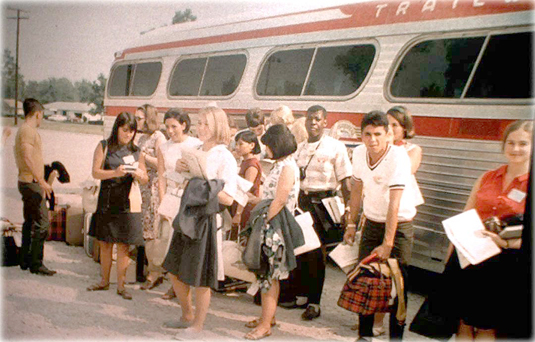
Active involvement in the French Fellowships, international scholarships for university students, hospitality to visiting foreign students : this time, AFS intended to “stay in business “ after the war. But it was the offer to give full scholarships to teenagers at boarding schools that was to provide the opening it was looking for. The bus trip --- another AFS "find" --- showed heartland America to the kids and vice versa, leading to the extension of the private school program to public high schools. Finally, it was government funding of a program for German students that primed the pump financially, enabling the AFS international scholarships to take off. By 1952, it was obvious that high schools, not universities were where AFS’s future lay.
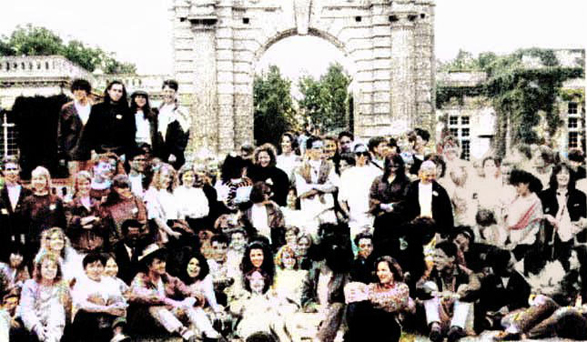
This spring issue of 1950 contained two other items of vital importance to show the new directions the International Scholarship program was taking. The beginnings of both the Summer Program for American teen-agers and the Summer Camp. François de Mey suggested that all AFSers in the neighboring countries meet for a few days that summer at Le Touquet-Paris Plage. The French AFS Committee announced that, through the hospitality of the French families, it had invited some American students from schools that had participated in the AFSIS program for at least two years to come to France that summer "to study the language and to learn the customs and life of the country." (George Rock. History of the American Field Service, 1956.)
* * * * * *
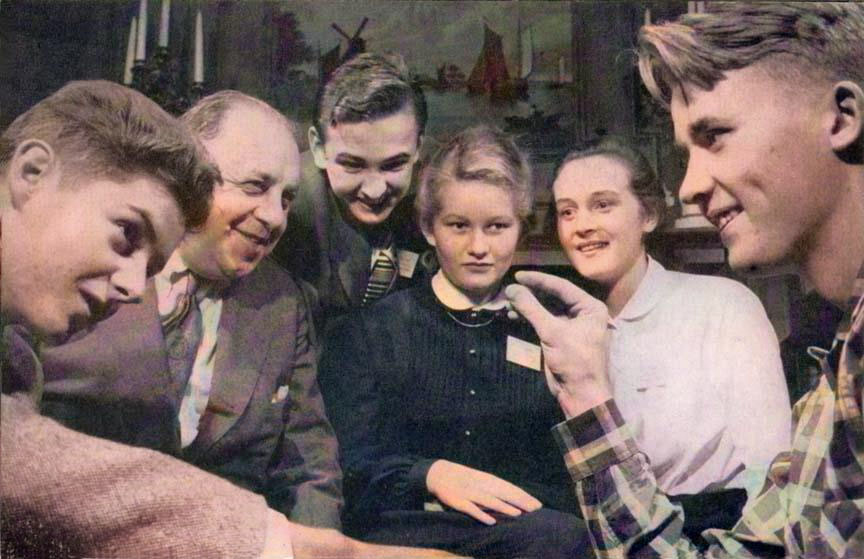
The Americans Abroad summer exchange, Mr. Galatti went on, which was conceived and carried out by the foreign returnees as a thank-you gesture, had spread to twenty-four nations by 1959. The returnees find families for the Americans to live with for their seven to eight weeks' sojourn (eleven or twelve weeks in Asian countries), watch over them during their visit, and raise money for an official end-of-season stay together in one spot, often the nation's capital, where the students evaluate their experiences, discuss their future role in A.F.S. and are elaborately entertained. "It's quite a feat for the returnees," Mr. Galatti said. "In their countries a youngster doesn't just clap his father on the back and tell him he'd like a foreign kid in his home for the summer. And school officials and community leaders are not in the habit of sitting down with teen-agers and seriously discussing anything."(Katherine T. Kinkead. Walk Together, Talk Together, 1962.)
* * * * * *
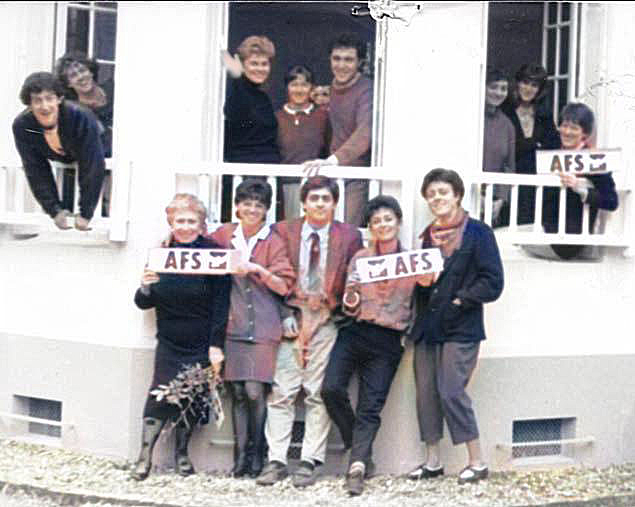
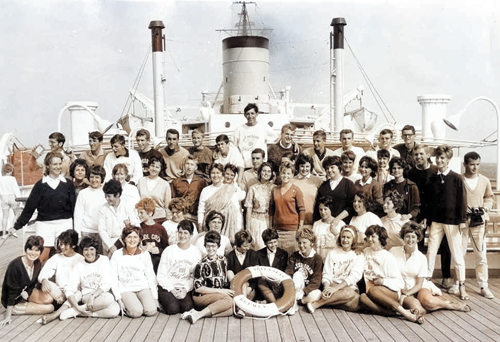
I was interrupted in my reading by the French returnee, a dark and intent young man in his middle twenties, who was to sail with a group of AFSers later in the day. Despite the chaperon duties facing him, he amiably said he could spare a few minutes to tell me about the briefings he planned for his twenty charges, eight of them girls, during the boat trip. He was a university student in Paris, he told me, and for the past few years had been working in the A.F.S. office there. On his arrival in the States a few weeks ago he had flown to Minnesota for a "superb" visit with his American family before settling down at headquarters to study the folders of his students and the families with whom they were to live. On the boat he said he planned to spend at least a half hour with each student, giving him more detailed information about the home he was going to than had hitherto been provided. (Katherine T. Kinkead. Walk Together, Talk Together, 1962.)
* * * * * *
Every meal is good to gain world peace, and isn't it a wonderful ambition? We can do it by keeping friendly relations among AFS students---French, German, Ecuadorian, Italian, or Greek---and by telling around us in our own countries that we don't feel differently about Germans or Italians because we're all alike, God's creatures, on earth to love each other. We will not have a World Government today or even tomorrow, but we can bring in Europe, if not in the world, in our lifetime this sense of good understanding and co-operation. This is what a year spent the States and the AFS made me feel. Good luck to all of you. Let us go to work, right now, each of us in our own sphere, and we will see good results sooner than we think. (Claude Ballande in George Rock. History of the American Field Service, 1956.)
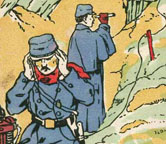
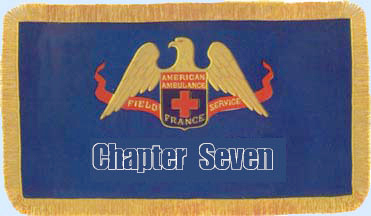
In the few days before I was due to visit A.F.S. headquarters, I did a little research of my own into the history and accomplishments of the organization. It was started in 1914 by some American expatriates in Paris, whose first mission was to help convey the French wounded back from the First Battle of the Marne. In the following years of the First World War, its ambulances, bought with American donations, were manned by such notables as Waldo Peirce, Malcolm Cowley, Edward Weeks and Sidney Howard. Comparatively dormant between the wars, the organization sprang back into action in 1939, and before the end of the Second World War its drivers had carried more than a million casualties. Its exchange program, begun in a small way in 1948, now functions through twenty-three foreign offices, which are supported in part by the State Department, and through nearly twenty-one hundred local committees here and overseas, which do the actual spadework of finding outstanding students to send abroad and finding families that will take visiting youngsters into their homes. (Katherine T. Kinkead. Walk Together, Talk Together, 1962.)
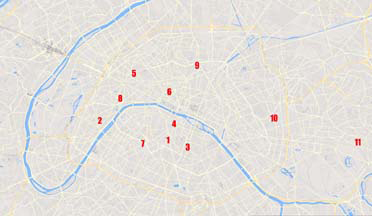
French offices of AFS International:
1. Office des Universités, 96 bd. Raspail, Paris VI (1950-58)
2. 8, rue des Maronniers Paris XVI (1950-53)
3. rue Saint Jacques, Paris XIII
4. rue du Dragon, Paris VI
5. 14, rue Daru, Paris VIII (1960-63)
6. 39, rue Cambon, Paris I (1963-72)
7. 6 rue Blomet, Paris XV
8. 20, rue de Longchamp, Paris XVI
9. 69, rue de Rochechouart, Paris IX (1980-86)
10. 93, rue des Vignolles, Paris XX (1986-88)
11. 46, rue du Commandant Jean Duhail, Fontenay-sous-Bois (1988- )
Short version
François Boucher and Frances Wilson Huard. American Footprints in Paris. George H. Doran: New York, 1921.
Joseph Cochran. Friendly Adventurers. A Chronicle of the American Church of Paris, 1857-1931. Paris: Brentano's 1931.
Alan Albright. "Thomas W. Evans: A Philadelphian "Yankee" at the Court of Napoleon III." Blérancourt Exhibition Catalog, 1993.
---------. "American Volunteerism in France", Blérancourt Exhibition Catalog, 1993.
---------. "The Legion of American Friends and Allies in the Great War," Blérancourt Exhibition Catalog, 1993.
Thomas W. Evans. History of the American Ambulance Established in Paris during the Siege of 1870-71, London: Low, Low and Searle, 1873.
The Citizen's Association. A Typical American. Incidents in the Life of Dr. John Swinburne. Albany: The Citizen's Office, 1885.
Louis Judson Swinburne. Paris Sketches. Albany: Joel Munsell, 1875.
Arthur H. Gleason. Our Part in the Great War. New York: Stokes, 1917.
André Tardieu. Devant l'obstacle. Paris: Éditions Émile-Paul Frères, 1927.
--------- France and America. Some Experiences in Coöperation. Boston: Houghton Mifflin 1935.
Col. T. Bentley Mott. Myron Herrick. Friend of France. An Autobiographical Biography. Garden City, New York. Doubleday, Doran & Company, Inc., 1929.
Warrington Dawson (ed). William Graves Sharp, American Ambassador to France 1914-1919. Edinborough: Constable, 1931.
Robert Lacey. "Chapter Six: Model T" in Ford, The Men and the Machine. Ballentine: New York, 1986 .
Charles I. Barnard. Paris War Days. Diary of an American. London: T. Werner Laurie, 1914.
Eric Fisher Wood. The Notebook of an Attaché Seven Months in the War Zone. New York: Century. 1915.
Elizabeth Dryden. Paris in Herrick Days., Paris: Dorbon, 1915.
Jeannette Grace Watson. Our Sentry Go. Chicago. Seymour, 1924.
Samuel N. Watson. Those Paris Years. With an Introduction by William Archer. New York. Revell, 1936.
Edith Wharton. Fighting France. 1915.
James Brown Scott. Robert Bacon, Life and Letters. Garden City, NY: Doubleday, 1923.
George W. Crile.Autobiography. New York, Philadelphia: Lippincott, 1947.
Harvey Cushing. From a Surgeon's Journal, 1915-1918. Boston: Little-Brown, 1936.
Edwin W. Morse. The Vanguard of American Volunteers in the Fighting Lines and in Humanitarian Service, August, 1914 --April, 1917. New York, Scribner's, 1919.
Paul-Louis Hervier. Les Volontaires américains dans les rangs alliés. Paris: La Nouvelle Revue, 1917.
Percy Mitchell. The American Relief Clearing House. Its Work in the Great War. Paris: Herbert Clarke, 1922.
Henry P. Davison. The American Red Cross in the Great War. New York: Macmillan 1920.
Charles F. Thwing. The American Colleges and Universities in the Great War. 1914-1919. New York: Macmillan. 1920.
M.A. deWolfe, ed. The Harvard Volunteers in Europe. Cambridge: Harvard University Press, 1916.
Abbé Félix Klein. The Diary of a French Chaplain. Chicago: McClurg, 1915.
James R. Judd. With the American Ambulance in France. Honolulu, 1919.
Edmund L. Gros. The Transportation of the Wounded. Boston, 1915.
Lansing Warren. Ambulancier. Unpublished manuscript, 1978.
"War Work. Harvard Men in Hospital Work." Harvard Graduates' Magazine, September 1915.
Eric Fisher Wood. Notebook of an Attaché, Seven Months in the War Zone. New York: Century, 1915.
Valentine L. Oldshue. The American Ambulance Paris Section. Reprint of an article in the Pittsburg Gazette-Times, cerca 1916, New York.
American Committee. Report of Ambulance Committee of 1915. New York, 1915.
Archival Documents Concerning the American Ambulance of Paris, August 1914-April 1915.
J. Paulding Brown in George Rock History of the American Field Service, 1920-1955. New York, 1956.
Friends of France. The Field Service of the American Ambulance described by its members. Boston and New York: Houghton Mifflin. 1916.
A. Piatt Andrew. "For Love of France" in Outlook Magazine. Dec. 27, 1916.
History of the American Field Service in France. "Friends of France". 1914-1917.. Boston and New York: Houghton Mifflin, 1920.
Clarence V. Mitchell. With a Military Ambulance in France, 1914-1915. Privately printed, 1915.
Notes on the Harjes Family of Paris.
Pierre-Alexis Muenier. L'Angoisse de Verdun. Notes d'un Conducteur d'Auto Sanitaire Paris: Hachette, 1918.
Barbara Hudnut Boston. "AFS Carries On." Town and Country Magazine. July1940.
Peter Muir. War Without Music. New York: Scribner's, 1940.
Herman Harjes, "With the Morgan Bank in England and France, 1939-1940" (unpublished).
Jacques Phillipet. S.O.S. Service de Santé. Neuchâtel: Baconnière, 1941.
Mary Borden. Journey Down a Blind Alley. New York: Harper & Bros, 1946.
George Rock. "The First Years of the Teenage Programs (1946-1955)." History of the American Field Service, 1920-1955. New York, 1956.
William P. Orrick. The First Thirty Years of the AFS International Scholarships. New York: AFS Archives, 1991.
Rosters
Drivers, 1914-1917.
Members, American Field Service Association, 1931.
Drivers, 1939-1945.
French Fellowships, 1919-1942
French Fellowships, 1947-1954
International High School Exchanges, 1946-1952
Table of Contents
Feedback