The American Committee submits herewith the report to the Board of Governors of the American Hospital in Paris of the Ambulance Committee for the first year of the war, giving in detail an account of the work made possible by the generous support of the American Public.
| MRS. ROBERT BACON, Chairman MRS. C. B. ALEXANDER, New York MRS. AUGUST BELMONT, New York. MRS. EDWARD BRANDEGEE, Boston MRS. LLOYD BRYCE, New York MRS. S. R. BERTRON, New York MRS. GEO. A. CASTLEMAN, St. Louis MRS. F. L. CHAPIN, Erie, Pa. MRS. HENRY P. DAVISON, New York MRS. E. H. HARRIMAN, New York MRS. A. BARTON HEPBURN, New York MRS. MYRON T. HERRICK, Cleveland MRS. BRYAN LATHROP, Chicago Albany, N. Y. MRS. JUNIUS S. MORGAN, Princeton, N.J. MRS. HENRY W. MUNROE, Tuxedo Park, N. Y. MRS. H. FAIRFIELD OSBORN, New York MRS. GEORGE W. PEPPER, Philadelphia MRS. WHITELAW REID, New York |
MRS. WILLIAM GREENOUGH, Secretary MRS. WM. HAMILTON RUSSELL, New York MRS. HERBERT L. SATTERLEE, New York MRS. CHARLES H. SHERRILL, New York MRS. F. A. SAYLES, Providence, R. I. MRS. J. MONTGOMERY SEARS, Boston MRS. STANLEY STONER, St. Louis MRS. WILLARD D. STRAIGHT, New York MRS. BAYARD THAYER, Boston MRS. RICHARD TOWNSEND, Washington, D. C. MRS. RUSSELL TYSON, Chicago MRS. W. K. VANDERBILT, New York MRS. PARMELY W. HERRICK, Cleveland MRS. BAYARD VAN RENSSELAER, Albany, N.Y. MRS. WHITNEY WARREN, New York MRS. BARRETT WENDELL, Boston MISS MAUDE WETMORE, Newport, R. I. MRS. HARRY PAYNE WHITNEY, New York MRS. J. WILLIAM WHITE, Philadelphia |
| MR. LAURENCE V. BENET DR. JOSEPH A. BLAKE MR. S. F. B. BIDDLE DR. CHARLES W. DU BOUCHET DR. EDMUND GROS MR. J. J. HOFF MR. LEOPOLD HUFFER |
DR. A. J. MAGNIN MR. CORNELIUS TIERS MR. L. V. TWYEFFORT MRS. WILLIAM K. VANDERBILT MRS. HARRY PAYNE WHITNEY DR. CROSBY WHITMAN DR. ROBERT TURNER (ex-officio) |
 |
 and Main Hospital Buildings |
The Board of Governors,
American
Hospital of Paris.
GENTLEMEN:
The Ambulance(1) Committee has the honor of presenting herewith its report for the year ending August 31st, 1915.
By resolution of your Board the Ambulance Committee was constituted August 14th, 1914, with the mission of organizing and administering the affairs of a hospital for the wounded, and to the Committee were delegated the broadest powers and authority to this end. Your Committee entered upon its duties without delay, and, as a first step, the activities of a number of preliminary committees, previously constituted, were co-ordinated under its direction, a general plan of organization was adopted, chiefs of the various departments were selected, and volunteers were rapidly enrolled and assigned to their duties.
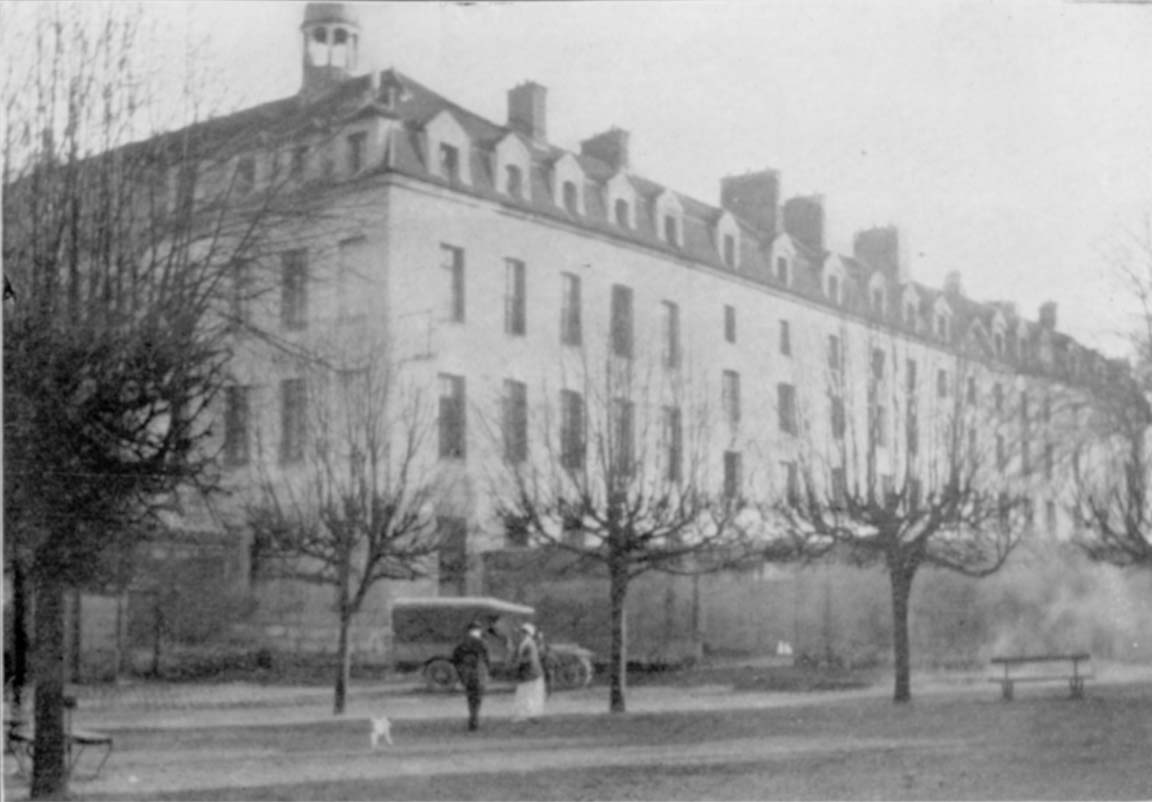
On August 12th the partially completed buildings of the Lycée Pasteur were requisitioned by the Military Authorities and turned over to your Committee and on that day the work of installation and equipment was begun. When taken over the building was in the condition in which the contractors had left it on the day of mobilization; it was filled with the materials and refuse of construction, it was partially completed everywhere, but fully completed in no particular. Many modifications in the interior arrangement were required to adapt it for hospital use, and all articles of furnishing and equipment had to be provided. Nevertheless, on September 1st the hospital, fully equipped, organized and ready to receive and care for 175 patients, was inspected and formally accepted by the Sanitary Authorities of the French Army.
The work of installation, completed in the short space of eighteen days, was carried out in the face of great, and at times almost insurmountable difficulties. France was in the midst of the general mobilization of her forces; shops, stores and factories were closed or closing, few workmen were available, transportation was demoralized or non-existent, credit was suspended, and the German armies were swiftly closing in on Paris. Nevertheless, through the resourcefulness and energy of the entire volunteer staff, men and women, the seemingly impossible was accomplished.
On September 6th the first patients were received, and on September 9th a train of motor-ambulances, despatched by the Hospital, with surgeons, nurses and supplies, proceeded to Meaux and beyond, the first volunteer relief to reach the field of battle. Thus, within three weeks of the appointment of your Committee, every department was in full activity and the American Ambulance was ready to meet any calls that could be made upon it.
Since the day of opening, the history of the Ambulance has been one of development and extension. New wards have been opened as funds have become available, new departments have been organized and equipped, until, at the close of its first year, the extensive buildings of the Lycée Pasteur have been fully occupied.
The Ambulance now comprises fifty wards, with 575 beds, but with provision for 625 patients in case of emergency. Two general, one special and two dental, operating rooms have been equipped with the most modern appliances; two X-ray plants have been provided, and pathological, research and dental laboratories have been installed. Sterilizing, disinfecting plants have been constructed, and ultra-violet ray apparatuses for sterilizing the water supply have been installed on every floor. Six isolation wards have been prepared in a remote part of the building, and fifty rooms provide quarters and dormitories for the surgeons, graduate nurses, orderlies and ambulance men. In the housekeeping department, the kitchen has been fitted with most modern appliances, and has a capacity for supplying meals for more than 1,000 persons. Two mess-halls have been arranged and furnished for the working staff. The offices of the various departments occupy fifteen rooms, and fifteen store-rooms have been provided for provisions, and surgical and medical supplies. Workshops have been installed for carpenters, plumbers, electricians, painters and locksmiths, as well as for cleaning and repairing the clothing of patients, and for repairing house and ambulance cars. The linen department has been provided with every facility for storing and handling clean and soiled linen, and arrangements with the American Hospital have placed its steam laundry at the disposal of the Ambulance. A complete system of house telephones has been installed, and extensive work has been carried out in steamfitting, electric lighting, plumbing, gas fitting, installation of bath tubs, glazing, doorhanging, drainage, in fact in everything required to transform a partially completed building into a modern surgical hospital. Finally, through the generosity of friends, and the collaboration of the municipal authorities of Paris, the unsightly grounds surrounding the hospital have been converted into lawns and flower beds, and made available for convalescent patients and their friends.
The Administrative organization has kept pace with the material development of the Hospital, and comprises correspondence, purchasing, accounting, statistical and storekeeping departments, in addition to which a special office compiles the elaborate records, and carries on the extensive correspondence required by the military authorities.
In planning and organizing the work thus summarily described, your Committee has exercised the most rigid economy; providing only what was essential to the care and comfort of the patients, but with a full sense of their responsibility to create an establishment worthy of the American people and of the generous contributors to the Ambulance fund.
In the administration of the Hospital your Committee has used every effort to keep the operating expenses at a minimum, and has closely scrutinized every item of expense. What success has crowned their efforts may be judged by the daily cost of a patient, which, for the year ending August 31st, has amounted to $1.68. This covers all running expenses, including not only ward expenses, but all wages, salaries, subsistence of the patients and of the staff, supplies of every description, lighting, heating, office expenses, service-cars and a portion of the expenses of the Paris section of ambulances. Since January 1st the greater part, and since July 1st the entire cost of new equipment has been charged to running expenses.(2) The cost per diem of a patient was at its maximum during the months of September and October 1914, and at a minimum in January 1915; since when it has been slowly increasing due to the increasing cost of food and supplies of every description.
In comparing the daily cost of a patient with the corresponding cost in permanent hospitals in the United States, it must be remembered that the American Ambulance has received from generous donors large contributions in the form of surgical dressings and materials, anesthetics, hospital, dental and photographic supplies, linen, blankets, wines, fruit, etc. These donations, the cost of which is unknown, could not be carried into the accounts, but they have not only had a material influence upon the per diem cost of a patient but have also enabled your Committee to provide comforts for the patients which they could not otherwise have contemplated.
The average daily cost of a patient, during the past year, was adversely affected by the fact that, during the months of September, October and November, 1914, the number of patients under treatment was very considerably below the capacity of the Ambulance. A large proportion of the operating expenses is naturally continuous, and independent of the number of patients under treatment. In this respect, attention is invited to the accompanying graphical chart, showing the number of patients under treatment on each day, and the total capacity of the Hospital.
Detailed and voluminous reports covering the operations of the various departments of the Ambulance for the year ending August 31st, 1915, have been filed with your Committee and these will be briefly summarized in what follows. Your Committee proposes to publish at the close of the war a complete and final report, and for this a vast amount of material has already been accumulated. The surgical, pathological, statistical and administrative data which will then become available, will undoubtedly be of great value to the medical profession and to those who may be called upon to organize a military hospital under war conditions.
SURGEON IN CHIEF. In accordance with the military regulations governing all hospitals, ambulances and sanitary organizations, the Surgeon in Chief is the administrative, as well as the medical head, of the organization, and has full authority and responsibility over every department. By delegation of well-defined authority to the Medical Board and to the various chiefs of departments, a proper division of labor has been assured.
The patients treated in the institution have been exclusively surgical cases, and the number under treatment has varied from 1 to 570.(3) In general, the cases have all been of extreme severity, as the American Ambulance has been reserved by the authorities for the treatment of "grands blessés", and patients suffering from slight injuries have been evacuated to other hospitals with as little delay as possible. Many races and nationalities have been represented by the patients under treatment, including French, English, Scotch, Irish, Welsh, Canadian, Belgian, Dutch, Russian, Servian, American, German, Algerian, Moroccan, Tunisian, Senegalian, Soudanese, etc., and every military rank from the common soldier to the Major General, and every class in life from the titled aristocrat to the day laborer. It is needless to say that every patient without distinction has received the same consideration and devoted care.
The cases treated may be divided into two general classes: 1, Gunshot injuries, a large majority of which have involved compound and multiple fractures, and 2, Gunshot wounds of the face involving the maxillæ, and requiring the intervention of dental surgery. This latter class has greatly increased in number, owing to the unique facilities of the American Ambulance for their treatment.
The number of patients received during the year ending August 31st has been 2622,(3) of whom 1968 have been discharged cured or improved, 117 have died, and 537 remained under treatment. The death rate has been 4.46%.
It would be erroneous to draw any conclusions from the above figures, but it may be stated that the chief factor of gravity for the patients has been the infection of their wounds, and that the intensity of this infection has been almost absolutely proportioned to the interval of time between the injury and admission to the hospital. During the first half of September 1914, patients were brought by our own ambulances directly from the battlefield to the hospital; almost all of these recovered with slight infection or no infection at all. The comparison with cases reaching us later on, six days or more after their injury, is most eloquent in this respect. One infection in particular, gas gangrene, seems to be chiefly governed by this factor of delay.
In general, the patients received at the Ambulance have only received first aid, or have undergone operations of an imperative nature before admission; at times, however, when it has been necessary to evacuate hospitals nearer the front, patients have arrived who have been under treatment during extended periods. In jaw cases this delay has sometimes been as long as six months, resulting in most difficult conditions in the way of treatment.
It may be stated, generally, that the results have been satisfactory, both by absolute standard and by comparison with other hospitals.
During the year there have been performed approximately 3100 operations(3) in the two main operating rooms, besides many of minor importance which were done in the general wards and in the receiving ward. Many patients are received whose only treatment previous to admission had been a first dressing at the Poste de Secours, while many others are sent from other hospitals for special or revisional surgery. Despite the destruction of tissue, and severity of the infections, there have been few amputations, 81 in all. Of these about 50 per cent. were for gas gangrene, 30 per cent, for other severe infections, and 20 per cent, for secondary hemorrhage.
Another interesting feature of the work has been the extreme recuperative power with which the patients are richly endowed. In many cases of compound fractures associated with severe trauma, recovery was as prompt as in the case of simple fractures in civil hospitals, due probably to the youth and health of the patients and the almost complete immunity from hereditary diseases. Tetanus has been, perhaps, less frequently seen than in the civilian hospital, and is due no doubt to the routine promptness in administering anti-tetanic serum, and to dressings by the surgeons in the field.
The bulk of the surgical work has consisted in the incision and drainage of the infected wounds and the removal of foreign bodies. There also has been much revisional and reparative work done in the form of plastics and bone grafts, for the restoration of lost tissue, and the correction of marked disfiguration and deformities.
In the Dental department there have been compound fractures of the jaw associated in nearly every case with loss of the soft parts of the mouth and chin, and in some cases almost complete loss of the face, and the excellent results obtained in the restoration of function and cosmetic appearance in these cases exceeded all expectations. Plastic masques and photographs (ordinary and in color) are made of these patients before, during and on completion of treatment; these form a valuable part of the record that is kept of each patient.
The small number of amputations is a great credit to the surgical staff and to the efficiency of the department of surgical dressings, in devising appliances that made it possible to get efficient drainage with extension and fixation, whilst giving to the patient the greatest degree of comfort.
Perforating wounds of the chest have been one of the most common types of injuries, also one of the greatest sources of distress to both patient and surgeon. Despite the serious nature of these injuries and the frequent complication of pneumonia, the high percentage of complete recovery has been a source of gratification. Injuries of the brain and special nerve trunks with resulting paralysis have been numerous and have afforded an especially interesting field to the surgeons and neurologists. The results obtained have been remarkably good.
Every effort has been made to be as conservative as the conditions permitted in each particular case. This has involved great prolongation of treatment in many instances, but it has been considered a duty not only to save life, but, wherever possible, to discharge patients in a condition to provide for themselves in the future, and not as helpless cripples. The efforts made in this direction have been richly repaid, not only by the gratitude of the patients themselves, but by the constantly expressed desire of the wounded to be brought to the American Ambulance.
The hygienic conditions of the hospital have been most excellent, thanks to the painstaking efforts of every department. The clothing and effects of all patients are promptly disinfected or destroyed upon arrival, infected dressings and refuse are incinerated or sterilized, wards and corridors are constantly ventilated and cleaned, and the supply of drinking water is rendered sterile by ultra-violet rays. The success of these precautions may be measured by the fact that no epidemic of any kind has occurred in the hospital, and the further fact that the few sporadic cases of contagious disease have never spread to other patients.
Recently the Ambulance has increased its efficiency by the addition of a small Convalescent Home of 80 beds at Saint-Cloud to which are sent cases requiring mechano-therapy, massage, and electricity. Two members of the Surgical Staff visit this Hospital twice a week and follow the patients to complete convalescence. This has proved of the greatest value to the patients.(3)
Efforts are being made to increase this service to a 500 or 600 bed capacity. Through this outside service the Surgical Staff is able to keep under their control any patients who may need further operations and have them returned to the Ambulance at an elective time.
THE MEDICAL BOARD. The Medical Board has met regularly throughout the year, and has been in close collaboration with the Surgeon-in-Chief in the solution of the many technical problems which have been brought before it. It has been particularly charged with the selection of members of the Medical Staff, subject to confirmation by the Ambulance Committee, and in the organization and distribution of the various medical services.
The medical and surgical staff was originally composed of American physicians and surgeons resident or present in Paris, and who promptly volunteered their services at the outbreak of hostilities. To these were added a small number (five) of French surgeons and physicians who also volunteered, and their services have been particularly valuable not only professionally, but through their knowledge of government routine and conditions obtaining in France. Their connection with the American Ambulance has gone far in cementing the bonds of sympathy between the people of the two republics and in bringing the character of the institution and its work to the knowledge of the French authorities.
With the growth of the institution it soon became necessary to increase the medical staff, and volunteer surgeons and physicians for various terms of service were obtained in the United States. As originally organized, the Ambulance comprised three medical divisions, but in January 1915 a fourth division was established and placed at the disposal of American universities, which were thus enabled to send complete units composed of surgeons, specialists, pathologists, operating nurses, etc., for a definite term of service with the institution. The Northwestern Reserve University (Lakeside Hospital of Cleveland) was the first to avail itself of this opportunity, and it was followed successively by units from the Harvard University and from the University of Pennsylvania. In addition to the privilege of rendering incalculable services to suffering humanity, these units have had unique opportunity for experience and study of traumatic and pathologic conditions incident to war. The results of their experience should be of the greatest value to our own country in case of need.
During the year a series of lectures and conferences on war surgery and allied subjects has been organized, and these have been of great value and interest, not only to the surgeons and physicians, but to the nursing and orderly staff as well.
DENTAL DEPARTMENT. The Dental Department dates from the inception of the American Ambulance, and it was organized, equipped, and ready for work on the day of opening of the institution. Up to this time no other military hospital had made provision for dental surgery, but the English and French soon after began the organization of similar departments, which brought the general surgeons and dental surgeons into a mutual co-operation and interdependence which had never existed before. The novelty and unprecedented nature of the work soon became apparent, for, whilst fractures of the maxillæ had been classified, and their treatment indicated, no reference books could be found recording the treatment of the terrible devastation caused by the projectiles of modern warfare.
 |
 |
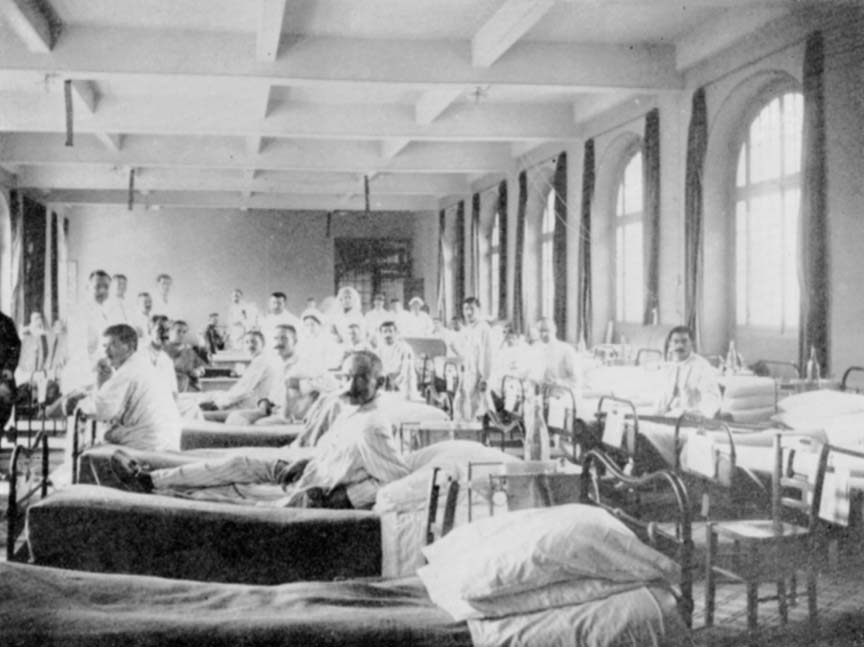
 The Way Wounded Were Carried Over the Mountain Passes in Alsace Before the American Ambulance Arrived |
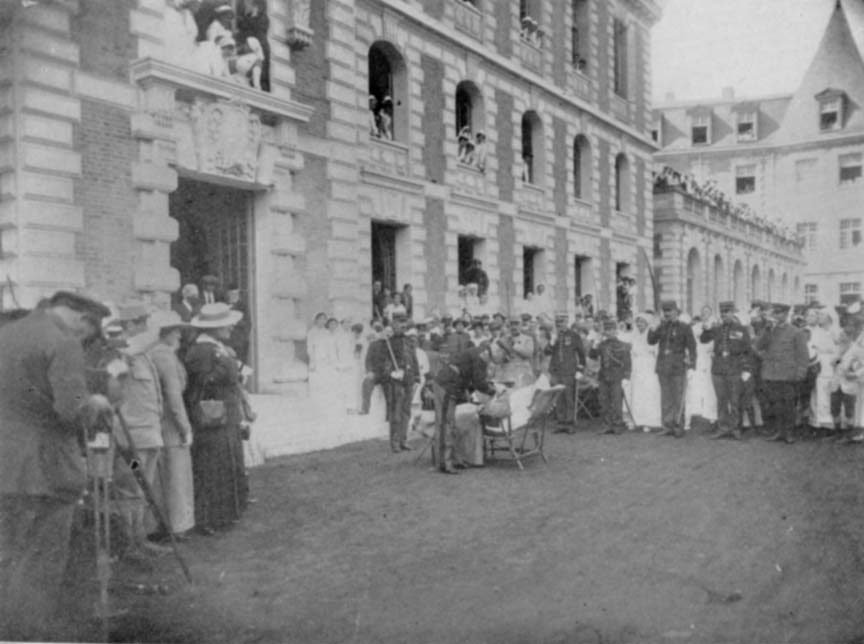 A Wounded Officer Receiving the Decoration of the Legion of Honor |
Almost every case has presented fractures with loss of substance varying from small pieces to half or nearly the whole of the mandible, or half the face. Each case has required a study of what fragments could be removed and what saved, means to maintain the fragments in their normal position during the healing process, and devices for restoring lost parts and building up a skeleton or frame for the final grafts and plastic work of the surgeon. The gravity of such injuries has involved daily and prolonged treatment, and approximately one-half of the cases have been tardy arrivals, healed of infection, but, from lack of dental intervention, with vicious consolidation and deformation of the remaining parts, necessitating reduction either by section or by application of complicated apparatus. The value of the work of the dental surgeons and dental mechanics on these novel and difficult cases has been widely recognized, and they have made it possible for a final plastic operation to return these mutilated wrecks to the world, not as objects of horror and commiseration, but as presentable men, happy, and fit to resume their places in society.
During the year ending August 31st, 244 cases of fractured maxillae were admitted, of which 104 have been discharged cured, 94 remain in the hospital, and 46 were transferred to convalescent homes and are still under treatment. In more usual dental work may be mentioned 2658 extractions, 2810 fillings, 519 plates and appliances fabricated and fitted, and 1279 cleansing and prophylactic treatments.(3)
RADIOGRAPHIC DEPARTMENT. The Radiographic Department has, from the first, been one of the most important and essential elements in the work of the hospital, as the vast majority of cases have required radiographic or fluoroscopic diagnosis or location of foreign bodies. As this was, of course, anticipated, the Ambulance was provided with a complete X-ray plant, and a complete developing and printing equipment. The services of expert operators and photographers were secured, and during the first year 2169 patients were examined by means of the original plant. Later on a second equipment was installed, for the service of the upper floors, and began operations on August 4th. Three hundred and seventy-one patients were examined by means of this second plant up to August 31st, making a total of 2440 examinations during the year.(3) The radiographic examinations were supplemented in many cases by the location of steel and iron fragments by the electro-vibrator.
PATHOLOGICAL DEPARTMENT. The following summary of the work of the Pathological Laboratory covers the principal activities of the year from October 1st, 1914, to September 1915.
During the year, 1523 specimens and cultures of all kinds were examined, and 110 autopsies were performed.(3) In addition to the routine examination of specimens referred to the laboratory from the hospital wards, considerable work in the nature of water-analyses, cultures of wounds, serum reactions and examinations of pathological specimens, etc., has been conducted for the American Ambulance, Hospital B. at Juilly, and other hospitals.
An attempt has been made to carry out researches culminating in the papers cited below, which have been published, or accepted for publication, by various Medical Journals. An analysis of the autopsies performed was made with a view to determining the chest complications among the wounded dying from different lesions and was published in the November number of "THE ANNALS OF SURGERY" (New York), under the title of "Chest Complications Among the Wounded." A fairly extensive study of the bacteriology, pathology and treatment of gaseous gangrene was carried out, and the following papers were compiled by the Pathologist in Charge:
"The Use of Quinine in the Treatment of Experimental Gaseous Gangrene." --- The Lancet, September 4th, 1915.
"Factors Responsible for Gaseous Gangrene." The Lancet.
"Observations on the Pathology and Bacteriology of Gaseous Gangrene: Clinical Cases and Experimental Infections." --- The Lancet.
"A Case of Self-Inoculation with the Bacillus Aerogenes Capsulatus." --- The Lancet.
"The Use of Quinine Hydrochloride Solution as a Dressing for Infected Wounds." --- The British Medical Journal.
At the request of the British War Office, reprints of the first of the above articles, viz.: "The Use of Quinine in the Treatment of Experimental Gaseous Gangrene," have been sent to the Directors of the Medical Services of the London District, and likewise of the Eastern and Southern Departments, for distribution among the military hospitals under their administration and were also sent to individual surgeons and hospitals in the War Zone as well as in the United States.
Routine autopsies have been performed on all cases dying at the Ambulance, and microscopical examination of the tissues made in nearly every instance. Records have been kept of all autopsy and biopsy reports, and are on file in the laboratory.
Besides the routine and research laboratory work, a large number of pathological specimens have been collected, preserved and forwarded, with histories of the cases, to the Warren Anatomical Museum, Boston, Mass., and notice has been received from the Curator that they are on exhibition.
NURSING DEPARTMENT. At the outbreak of the war nurses on duty at the American Hospital of Paris and others in private practice, promptly volunteered their services to the Ambulance, and during the month of August were already busily engaged in preparing surgical dressings, and in giving elementary instructions to volunteer auxiliary helpers. On September 1st, 15 volunteer graduate nurses reported for duty, and the following day moved to quarters assigned to them in the Ambulance. Of these original volunteers ten were still on duty on the 31st of August 1915. By September 17th the staff of graduate nurses had increased to 32, and it continued to increase with the development of the Ambulance until June 1915, when for a few days 110 nurses were on the rolls, including those on the sick report or on leave of absence. A general reorganization of the nursing staff was soon after effected and a greater use made of volunteer auxiliaries who had then become very proficient in their duties. As a result the staff of graduate nurses was reduced to 78, of whom 8 on leave of absence or in reserve.(3) The nurses are assigned as follows:
| Floor Nurses |
3 |
| Charge Nurses |
2 |
| Operating-room Nurses |
8 |
| Massage Department |
3 |
| Dental Department |
1 |
| Diet Kitchen |
1 |
| On Special Cases |
3 |
| Ward Nurses (day) |
31 |
| Ward Nurses (night) |
17 |
| Night Supervisor |
1 |
|
70 |
Although the Ambulance comprises fifty separate wards, and although the nature of the cases requires the most constant and devoted attention, this small staff of highly trained nurses, aided by the auxiliary helpers, have been able most efficiently to perform all of their important duties.
Nearly all of the present staff are graduates of the more important hospitals and training schools of the United States, who have been carefully selected by the representative of the Ambulance in New York. In times of emergency, however, the Ambulance has gladly availed itself of European graduates. On October 10th, 1914, ten British Army nurses reported for duty for a period of ten days, and were then replaced by a like number from St. John's Ambulance, London, who served for several months. A number of Swiss graduate nurses also came as volunteers, and rendered excellent service. During the first months of the war, the nurses, without exception, served without any remuneration whatever, but it soon became evident to the Ambulance Committee that this volunteer service could not be indefinitely continued. An allowance of 100 francs a month, after three months' service, was at first established, and later on changed to 100 francs a month from date of reporting for duty. It is greatly to the credit of the nursing staff that this allowance was accepted with great reluctance, as all were anxious to continue their volunteer service. A number of the graduate nurses, 30 on August 31, 1915, receive no allowance from the Ambulance, being supported by generous benefactors in the United States. Since the opening of the hospital, nearly 250 graduate nurses have served for periods varying from one month to one year.(3) With rare exceptions they have been faithful, skillful and indefatigable in their duties, and have won the admiration and undying gratitude of the patients under their care.
AUXILIARY NURSES. On August 4th, 1914, the Woman's Auxiliary Committee was formed, and a number of its members immediately offered their services for work in the Ambulance then about to be organized. A number of these volunteers had already had hospital experience, and others immediately began a course of instruction at the American Hospital of Paris. On the 1st of September they reported for duty, and were at once assigned as assistants to the trained nurses in the wards, to the work of preparing surgical dressings, or to miscellaneous duties in connection with the various departments. After a few months a special department for preparing surgical dressings and appliances was established, since which time the Auxiliary Nurses have served only in the wards and related services. On August 31st, 1915, 75 Auxiliaries were available for day and 17 for night duty, with 33 on leave of absence, and of these 23 were among the original volunteers at the beginning of the war.(3) While the majority of the Auxiliaries are Americans, many of French, British, Belgian and Swiss nationality are found among their number. All, however, are imbued with the same sense and responsibility of duty, and they have rendered inestimable service to the Ambulance.
ORDERLIES. Of the many volunteers offering their services to the Ambulance in the early days of August, a large proportion were immediately assigned to duty as hospital orderlies.
These men, drawn from every walk of life, have performed their onerous and exacting duties, day and night, with a cheerful efficiency worthy of the highest praise. When it is remembered that their duties involve carrying patients to and from wards, operating rooms and X-ray plants, up and down many flights of stairs, and the carrying of patients in their beds to and from the terraces, the burden of their task can be appreciated.(3)
Of the original volunteers, a small number are still on duty, but the greater number have been recalled to their former avocations or to the United States; many have volunteered in the French and British armies, others in due course have been called to the colors. It has been found necessary, as the months went by, to assist certain of the orderlies with a small daily allowance or through the issue of uniforms, or both, but, even when receiving an allowance, their service is no less voluntary, in the sense of being disproportionately great in comparison with their merely nominal remuneration.
Forty-four Orderlies were on day and ten on night duty and ten on sick leave on August 31st, 1915, and seven boy scouts were employed on general messenger service.
DEPARTMENT OF SURGICAL DRESSINGS. Even before the opening of the ambulance for the reception of patients, a number of trained nurses, volunteer auxiliaries and others were engaged in the preparation of surgical dressings in anticipation of future needs. Spacious rooms in the Ambulance Building were set aside for continuing this work, and, at first, volunteers were assigned to this Department as a preliminary to work in the wards. It soon became evident, however, that this service would become of far greater importance than anticipated, and it was, therefore, organized as an independent department. Thanks to the capacity and untiring zeal of its chief, and to the unflagging industry of the volunteer workers, it has not only promptly met the great and varied demands of the different services in the way of dressings, but has also supplied practically everything needed by the entire institution in the way of splints and special apparatus for the treatment of the most difficult cases of fractures. During the first year of operation this Department has prepared and supplied 1,598,932 different articles of hospital use, from the simplest form of applicators to the most complicated bandage. In addition, 1,019 splints, extensions and other special apparatus have been devised, manufactured and issued.
LINEN DEPARTMENT. From small beginnings this important department has grown with the development of the Ambulance, until 55 men and women are constantly occupied under the direction of its efficient chief. This department is responsible for the maintenance, accounting, washing, ironing, repair and issue of all bed and table linen of the entire establishment, of the uniforms of doctors, nurses and orderlies, and of the hospital clothing of the patients. In addition it is responsible for the disinfection of all septic dressings and their washing for subsequent use, and for the cleaning and repair of patients' uniforms and clothing. The magnitude of its work may be gauged from the fact that no less than 28,000 pieces have been washed, ironed and issued in a single week, and 966,074 pieces during the entire year. This department has met all calls upon it promptly and efficiently and is worthy of high praise and commendation.
SUBSISTENCE DEPARTMENT. The Subsistence Department, from an administrative point of view, is the most important department of the Ambulance, as upon its economical management depends in great measure the ultimate daily cost of a patient. Your Committee was particularly fortunate in securing as manager of this department a man of wide experience and tireless industry, whose services have been not only voluntary, but prompted by a desire to do his share in the aid of the suffering.
The plant at the disposal of this Department has been developed with the growth of the hospital, and now comprises a most complete equipment of modern and labor-saving appliances. In September, 1914, a total of 25,544 meals were served to patients, staff and employees, a total which reached a maximum of 89,022 in the following July. During the year, and exclusive of those supplied by the diet kitchen, 822,010 meals were served, and 8374 tons of food products were consumed, of a total cost of $122,559. The average cost of each of the principal meals, luncheon and dinner, was $0.198 per person, including wages and coal, but exclusive of washing of table linen, and breakage. During the year food to the value of $6,109 was issued to the diet kitchen, and of $945, to the other services.
THE GENERAL OFFICE. The General Office, under the direction of the disbursing Secretary, comprises the Accounting and Bookkeeping Department, the Statistical Department and the Donation Service, has charge of the general correspondence, identity and reference card systems, and acts as a Bureau of Information. In addition to these duties, it keeps the books and accounts of the Juilly Hospital, and purchased all of the original equipment of that institution.
The accounts, vouchers and cash of the American Ambulance are verified and audited three or four times a month by the Chartered Accountants, Messrs. Marwick, Mitchell, Peat & Co. They have always been found in perfect order, and the auditors have expressed their satisfaction in the efficiency of the Bookkeeping Department.
THE PURCHASING DEPARTMENT. This department purchases and delivers all supplies, other than subsistence, required for the equipment, maintenance, and use of the various departments of the Ambulance. No purchase is made except upon requisition signed by a chief of service and countersigned by the Officer of the Day, and all purchases are paid on delivery by check or in cash against properly receipted bills, thus profiting by all discounts and rebates. Three thousand six hundred and eighty requisitions have been filled during the past year, and it is believed that the Ambulance has purchased at the lowest possible prices, quality and prompt delivery considered.
THE STATISTICAL DEPARTMENT. The Statistical Department, which operated under the direction of the Disbursing Secretary until nearly the end of August 1915, compiles the military identity cards, and medical record of all patients, acts as military paymaster for French non-commissioned officers and men under treatment, prepares, and forwards to the military authorities, all returns relating to admissions, discharges and deaths, carries on all correspondence with the Sanitary Authorities, and answers all inquiries regarding the condition of patients under treatment. This Department is also the custodian of and is responsible for all valuables found in the effects of patients.
THE DONATION SERVICE is charged with the recording, distribution and acknowledgment of all donations in kind, and of clearing donations from abroad through the Custom House. During the past year more than 600 separate cases have thus been handled and accounted for.
CHAPLAIN. With the opening of the Ambulance, a chaplain designated by the Archbishop of Paris was provided with quarters in the hospital and a chapel was installed for the use of the patients and the staff. A chaplain of the Church of England was appointed a little later who held regular services in the chapel as long as British patients were under treatment. The ministrations of these two good men, working in perfect harmony, were of great comfort and solace to the suffering and the dying, and their influence for good has been felt throughout the entire institution.
LIBRARY. Soon after the opening of the Ambulance donations began to arrive of books, magazines, illustrated papers, games, etc., for the amusement of the patients. A room was soon set aside, which rapidly developed into a well-stocked reading room and library, and throughout the year, books, periodicals and newspapers have been regularly distributed to all of the wards.
PRODUCTIVE WORK OF PATIENTS. Through the initiative of one of the auxiliary nurses, patients so desiring have been instructed in many varieties of light, interesting work, which has greatly relieved the tedium of hospital life, and permitted them to earn a little money for their future needs. Tools and materials are supplied free of charge, and the amount realized by the sale of the articles produced, less cost of materials, is turned over to the patients. The most popular work is the dressing of soldier dolls, macramé, worsted and bead work, embroidery and wood carving. The articles produced command ready sale, and many are commercially exported to the United States.
WOMEN'S AUXILIARY COMMITTEE. The Women's Auxiliary Committee was organized on August 6th, 1914, and immediately began soliciting subscriptions for the American Ambulance, the organization of which had only just been decided upon. A considerable sum was soon secured, and this formed the nucleus of the Ambulance fund. To the Women's Committee belongs therefore a large part in the creation of the Ambulance. In addition to securing funds, the Committee soon organized the work of preparing dressings, bed linen, hospital garments, and aided materially in preparing the first wards for the reception of patients. Many of the members followed a course of training in nursing during the month of August, and are still performing efficient service in the wards of the Ambulance.
Throughout the year the Committee has met regularly, and has been of great assistance in obtaining money and supplies, and its members have provided, through their own efforts, much of the hospital clothing, and cigarettes, tobacco and other luxuries which are regularly distributed to the patients. This Committee also organized and provided everything for the memorable Christmas celebration and one of its members organized a series of weekly concerts and entertainments throughout the winter, which were highly appreciated by all who were able to attend. The activities of the Women's Committee have been varied and tireless, and the Ambulance Committee desires to record its grateful appreciation.
THE JUILLY HOSPITAL. In November 1914, the generous offer of Mrs. Harry Payne Whitney, of New York, to finance a hospital under the direction of the Ambulance Committee, to be established at a point nearer the theatre of military operations, was accepted by your Committee. Ample funds for its installation and maintenance were provided by Mrs. Whitney, and after a careful study by the Military Authorities, the Seminary at Juilly, about thirty miles to the north-east of Paris, was requisitioned for this purpose. Under your Committee's supervision and direction, this ancient building was thoroughly renovated, plumbing, central heating and electric lighting were installed, and by February 1st, 1915, it was fully equipped, organized and ready to receive 225 patients. A section of ambulances has been constantly stationed at Juilly for the transportation and evacuation of patients between the hospital and the neighboring towns and railways stations. In equipment and general facilities for the care and comfort of the wounded, the Juilly Hospital is in the same class as the American Ambulance, and in efficiency it ranks high among the Military Hospitals of France.(4)
FIELD HOSPITAL. In anticipation of the possibility of an advance of the armies during the summer campaign, it was believed that a mobile field hospital which could be installed close to the field of battle would be of great value in the immediate relief of the wounded. Through the generosity of three gentlemen, the necessary funds were obtained, and a field hospital of the United States Army pattern, complete in every detail, and of a capacity of 108 beds, was purchased from the United States War Department. The entire equipment could be transported on four 5-ton trucks, and could be erected and installed in a very few hours. To this hospital was attached a section of ten automobile ambulances, and early in April it left Paris, and four days later was erected and ready for service on the banks of the Meuse, near Pagny. The sedentary character of the military operations had not, up to August 31st, offered any opportunity for utilizing the mobility of this unit, but, nevertheless, a considerable number of wounded had been received for treatment, and were efficiently cared for by this organization.
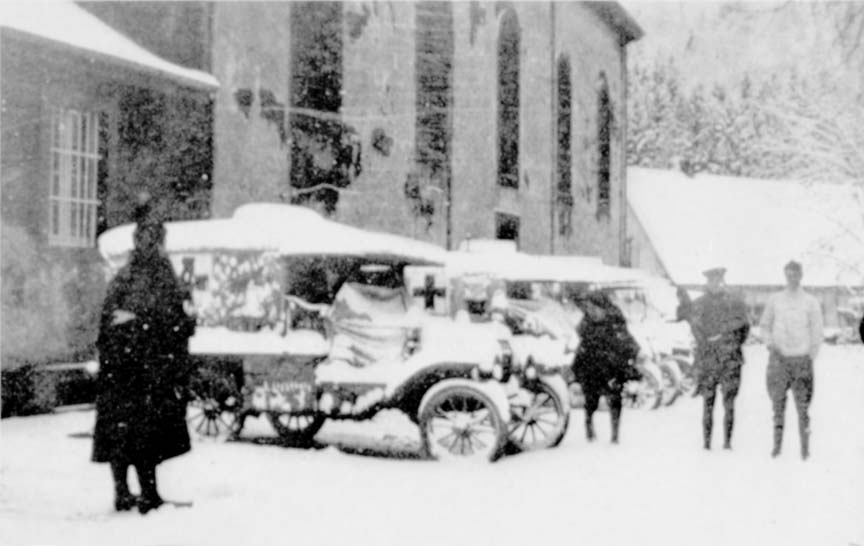
THE TRANSPORTATION DEPARTMENT. The Transportation Department originated with a small committee during the first week of August 1914, and was organized with a view of providing ambulances for the transportation of patients to and from the proposed Ambulance Hospital. By August 15th eight town and touring cars were available and in constant use, and were rendering most valuable service in connection with the work of installation and equipment. On this date the Manager of the Ford Automobile Company donated ten chassis for the duration of the war, and these were at once fitted with ambulance bodies, designed and, to a large extent constructed, by the volunteer members of the Department. These little cars were at once utilized for the transportation of equipment and supplies, and the personnel worked unremittingly in installing the wards and other departments of the hospital. It was in large measure due to the Transportation Department that the hospital was ready for patients eighteen days after the buildings of the Lycée Pasteur were requisitioned.
On September 7th a detachment of ambulances was despatched beyond the entrenched camp of Paris, and on the night of September 9th the entire organization comprising ten ambulances and six touring cars, proceeded to Meaux, bringing the first relief to the wounded at that point. Thirty-five patients were transported to the hospital at Neuilly, and a part of the ambulances aided in removing the wounded from the battle field, and in transporting those in Meaux to the nearest rail-head.
Since that day the duties of the department have been constant and arduous; patients have been transported from the railway stations of Paris and neighboring towns to the Ambulance and to other hospitals, the transportation of food and other supplies has been effected regularly and efficiently, and the transportation of volunteer nurses and others between the gates of Paris and the Ambulance during the long months when the passage of vehicles was forbidden, was a great factor in the efficient working of the hospital.
On October 1st, at the request of the British Expeditionary Force, a small detachment of five ambulances was detached for service in the field, and on October 8th left Paris for its new duties. This was the first opportunity of realizing the long cherished plan of a Field Service, which as money and ambulances have become available has been increased and extended until on August 31st, 1915, four complete sections, aggregating 91 ambulances and cars were operating in the zone of the armies in addition to 15 ambulances, and 28 other cars attached to the Ambulance Hospital. One hundred and fifty-two officers and men were on duty with the transportation department on the same date.
To August 31st, 1915, inclusive, 65,076 patients had been transported, at an average cost of Frs. 3,29 ($0.55) for each patient.(3)
Your Committee cannot speak too highly of the courage, devotion and efficiency of the personnel of the Transportation Department, and of their care and tenderness in handling the suffering wounded. They have undergone hardship and privation cheerfully and uncomplainingly, they have been calm and steadfast in danger, and they have never faltered however exhausting might be the task to be accomplished.
In closing this report your Committee desires especially to thank individually and collectively every member of the American Ambulance and of its various departments. The service, whether voluntary, assisted or paid, has been self-sacrificing and efficient, an esprit-de-corps has developed wonderful in its sympathy for the wounded and in its devotion to the institution, and it is to this spirit and to the collaboration of all that the great achievement of the American Ambulance is due.
And your Committee finally wishes to express their gratitude, and the gratitude of thousands of sufferers, to the generous friends and contributors to the American Ambulance. However small or however munificent their donations, they alone have made our work possible, and to them alone is due that friendship and gratitude so constantly demonstrated by the French people toward America and Americans.
While the Annual Report was in process of being printed, a cablegram was received from Paris, giving additional statistics up to January 31, 1916. The substance of the cablegram follows:
| Maximum number of patients in one day at the main hospital in Neuilly |
615 |
| Approximate total number of cases received at the main hospital |
3,760 |
| Number of operations at the main hospital |
5,150 |
| X-ray examinations 3,760 Autopsies |
142 |
| Pathological cultures and examinations |
2,250 |
| Jaw cases |
384 |
| Dental cases |
2,315 |
| Wounded transported in ambulances |
105,000 |
| Trained nurses |
81 |
| Auxiliary nurses |
70 |
| Outside beds available for semi-convalescent patients |
765 |
Through the generosity of a subscriber elevators are now being placed in the Hospital.
| Mr. Robert Bacon. | Mr. F. W. Monahan. |
| Mr. Laurence V. Benet. | Mr. L. V. Twyeffort. |
| Dr. C. Winchester Du Bouchet. | Mrs. W. K. Vanderbilt. |
| A. J. MAGNIN, M.D., Vice-Chairman. | C. J. KOENIG, M.D., Secretary. |
| N. Allison, M.D. | J. P. Hutchinson, M.D. |
| L. Chauveau, M.D. | D. J. McCarthy, M.D. |
| C. B. Craig, M.D. | R. Mignot, M.D. |
| E. L. Gros, M.D. | F. Soulier, M.D. |
| G. B. Hayes, D.D.S. | Kenneth Taylor, M.D. |
| J. A. Blake, M.D. | J. P. Hutchinson, M.D. |
| C. W. Du Bouchet, M.D. | R. Mignot, M.D. |
| T. G. Aller, M.D. | P. Lund, M.D. |
| A. E. Billings, M.D. | D. J. McCarthy, M.D. |
| L. Chauveau, M.D. | A. J. Magnin, M.D. |
| Mary Crawford, M.D. | F. Martigny, M.D. |
| A. Desjardins, M.D. | W. P. Nicholson, M.D. |
| H. O. Feiss, M.D. | E. B. Piper, M.D. |
| J. B. Flick, M.D. | F. Soulier, M.D. |
| P. M. Keating, M.D. | H. W. Stone, M.D. |
| W. E. Lee, M.D. | R. H. Turner, M.D. |
|
N. Allison, M.D |
H. W. Scarlett, M.D. |
|
C. J. Koenig, M.D. |
C. B. Craig, M.D. |
|
Kenneth Taylor, M.D. |
A. Harlay, M.D. |
|
S. Goldsmith, M.D. D. S. Davison, M.D. |
E. L. Gros, M.D. E. H. Lines, M.D. |
|
M. Dutrieux, M.D. |
G. B. Hayes, D.D.S. |
| R. A. Cooper, D.D.S. | Prof. S. H. Guilford, D.D.S. |
| Prof. Jules Choquet, Ch.-Dent. | E. P. Lane, D.D.S. |
| E. Darcissac, D.D.S. | W. C. Speakman, D.D.S. |
| W. S. Davenport, D.D.S. | F. Stuhl, D.D.S. |
| D. Guilford, D.D.S. | D. M. Wass, D.D.S. |
|
George W. Crile, M.D. |
William E. Lower, M.D. |
| Samuel L. Ledbetter, M.D. | Leroy B. Sherry, M.D. |
| Edward F. Kieger, M.D. | Lyman F. Huffman, M.D. |
|
Miss Agatha Hodgins. Miss Mabel Littleton. |
Miss Iva B. Davidson. Miss Ruth J. Roberts. |
|
|
|
|
|
|
|
R. B. Osgood, M.D. |
W. M. Boothby, M.D. |
|
George Benet, M.D. |
Orville F. Rogers, Jr., M.D. |
|
|
|
|
J. P. Hutchinson, M.D. |
W. E. Lee, M.D. |
|
D. J. McCarthy, M.D. |
A. E. Billings, M.D. |
|
|
|
|
|
|
|
|
|
|
|
|
|
Miss E. M. Hall. |
Miss Marion S. Doane. |
|
|
|
|
|
|
|
|
|
|
Mrs. G. A. Audenried. |
Mrs. A. W. Kipling, Sr. |
|
|
|
|
A. H. Stewart. |
Arthur O. King. |
 |
 |
 |
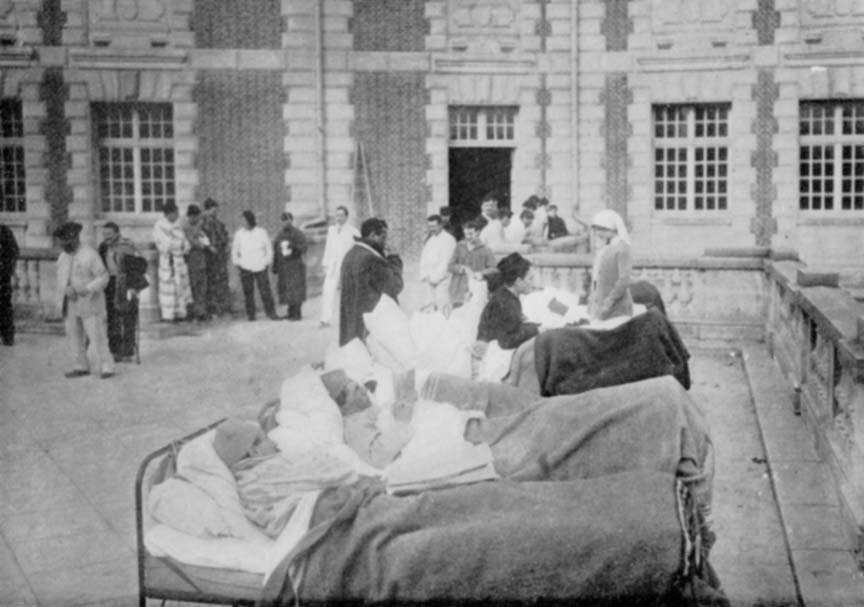
Ambulances of the American Ambulance hospital in Paris Awaiting the Call |
|
|
|
|
P. G. Du Carpe. |
Barton Morrison. |
|
|
|
|
|
|
| A. Piatt Andrew. Dr. Edmund Gros. |
A. W. Kipling. G. W. Lopp. |
|
Laurence V. Benet. |
A. Piatt Andrew. |
|
A. W. Kipling. |
Dr. Edmund Gros. |
| Frederick B. Bate |
Mechanical Officer. |
| J. F. McFadden, Jr |
Equipment Officer. |
| A. H. Muhr |
Controller. |
| J. E. Rochfort |
Adjutant. |
| H. Skerret-Rogers |
Paymaster. |
| R. M. L. Balbiani. Lovering Hill. |
Robert Maclay. Edward Van D. Salisbury. |
| A. G. Carey R. J. Cunninghame. A. T. Ewell J. Eddy |
J. H. Glover. H. D. Hale. J. C. Hurlburt.. H. L. Kingsland. |
| Mrs. J. W. Barker. Mrs. Robert W. Bliss. Mrs. Carl Boyd. Mrs. Spencer Cosby Mrs. J. G. Coolidge. Mrs. Percival Dodge. Mrs. S. Barton French. Mrs. George Getting. Mrs. Cooper Hewitt. |
Mrs. Ralph Hickok. Mrs. A. W. Kipling. Mrs. A. W. Kipling, Jr.. Mrs. Frank H. Mason. Mrs. F. W. Monahan. Mrs. Arthur Orr. Mrs. W. R. Sayles. Mrs. B. J. Shoninger. Mrs. S. B. Watson. |
| Alt, Miss N.
J. Alt, Miss M. Argles, Miss R. Ballantyne, Miss E. G. Barter, Miss M. T. Buckley, Miss F. Balsillie, Miss K. Barriel, Miss J. Bigelow, Miss G. L. Boddell, Miss M. C. Bossis, Miss J. Bown, Miss B. E. Carson, Miss I. Cass, Miss B. Clark, Miss G. Conlin, Miss M. A. Contryman, Miss B. Cowles, Miss Cremerieux, Miss L. M. Davies, Miss L. H. Davis, Miss Ethel Dessigny, Miss M. Dickerson, Miss R. B. Donnelly, Miss Edgers, Miss A. Fleckenstein, Miss A. Flint, Miss A. Freund, Miss C. Gibbs, Miss E. A. Giles, Miss M. D. Goldstone, Mrs. M. Gould, Miss B. Grace, Miss M. A. Greyloz, Miss M. Griffiths, Mrs. A. M. Haack, Miss V. Hall, Miss M. A. W Handford, Miss I. Hammond, Miss E. Hanrahan, Miss A. E. Hickman, Miss N. Hinckley, Miss H. T. Hodgins, Miss E. C. Johnstone, Miss R. Jones, Miss M. G. |
Jackson, Miss
E. B. Kerr, Miss M. Kiener, Miss A. E. Laming, Miss S. Lattimer, Miss H. Lawrence, Miss Lefebvre, Miss J. Legeret, Miss C. Lockwood, Mrs. M. Lough, Miss A. MacCallum, Miss J. Macdonald, Miss M. C. Macdonald, Mrs. S. Mackay, Miss J. Makagon, Miss K. Manning, Miss A. R. Marshall, Miss K. Mewhort, Miss H. F. Nolan, Miss M. Oelker, Miss M. O'Toole, Miss M. Page, Miss B. Paris, Miss M. E. Patterson, Miss E. J. Royds, Miss W. M. Ryan, Miss L. B. Sawyer, Miss G. Schipper, Miss A. Selby, Miss J. Sharp, Miss N. Sliney, Miss M. A. Smith, Miss E. P. Summerhayes, Mrs. G. E. Swinney, Miss M. S. Thompson, E. R. Trestrail, Miss C. Turbeville, Miss G. de Watson, Miss E. Weller, Miss M. G. Whitaker, Miss G. M. Winning, Miss M. Y. Wood, Mrs. Rapley Wright, Mrs. G. Young, Miss F. Young, Miss M. |
The above list of names includes persons who were on duty in various capacities, at the American Ambulance Hospital on August 31st, 1916. At the close of the War a complete roster will be issued with the final Report, giving the names of all persons who have been in the service of the Ambulance from its creation until the close of its activities.
| Alfonce, Miss J. d' Arkwright, Miss V. *Bagues, Mrs. R. Benet, Mrs. L. V. Benneteau-Desgrois, Mrs. H. Bennett, Miss N. Berg, Mrs. Birkhead, Mrs. Blanc, Miss J. Bordenave, Miss M. L. Boucly, Miss E. A. Bouyeron, Miss J. Bridges, Mrs. Bullock, Miss A. C. Charansonney, Miss S. Chenut, Miss S. Clark, Miss E. A. Coiemena, Miss H. Collinet, Miss R. Cooke, Miss K. T. *Cordey, Mrs. J. Craik, Miss C. Crosbie, Miss K. Cyon, Mrs. E. de Dana, Miss M. Dehlinger, Mrs. G. *Desbrières de Lavelaye, Mrs. R. Desjardins, Mrs. A. Dornes, Baroness R. Doty, Miss M. Dougherty, Mrs. *Du Bouchet, Miss H. Dunlap, Miss La Belle Elliot, Lady E. J. Elliot, Miss E. Erzer, Miss R. Facchini, Miss N. Fleurot, Mrs. George G. Foster, Mrs. *Fourier, Miss M. Fretté, Mrs. Frey, Miss H. Gaurat, Mrs. Getting, Mrs. G. Girard, Mrs. Gleiser, Miss O. Goddard, Mrs. C. F. Gordon, Mrs. Guérin, Miss M. Guilford, Mrs. D. Hall, Miss M. L. Harvey, Miss V. G. Heath, Mrs. Holland, Miss D. Holland, Mrs. S. G. Holmes, Miss A. M. Hoogstoel, Miss M. V. Irwin, Mrs. H. L. *Ivatts, Mrs. C. P. Jackson, Miss M. Janssens, Miss F. Janssens, Miss M. Jeannel, Miss M. Johnston, Miss M. Jorrisen, Miss H. Jung, Miss L. |
Kent, Miss L. M. Kipling, Mrs. A. W. Klein, Miss E. Lachenmeyer, Mrs. Lacroix, Miss M. Lawton, Miss E. Lawton, Miss L. Lawton, Miss M. Lefebvre, Miss E. Leplat, Mrs. L. Lester, Mrs. Lestringuez, Miss L. M. Lévy, Miss M. Lines, Miss M. Lines, Mrs. E. H. Lockwood, Mrs. R. M. Lopp, Mrs. Washington Lynch, Miss E. Maitland, Mrs. *Mayer, Miss G. McWean, Miss J. Mège, Miss G. Merritt, Miss A. S. Montpays, Mrs. Muhr, Mrs. A. Munroe, Miss Y. Nicollet, Miss S. *Oothoorn, Baroness Guy. Oppenheim, Miss G. Parent, Miss A. Pareux, Miss M. Pas, Miss J. de Paumier, Miss A. Petit-Dent, Miss L. Phalempin, Miss E. E. Phillips, Miss R. P. Plan, Miss L. *Rheims, Mrs. J. Roberts, Mrs. E. V Rosa, Miss L. de Scarlett, Mrs. H. Schofield, Mrs. Sewall, Mrs. W. G. Seyler, Miss J. Silva, Mrs. V. de *Simon, Miss C. Slade, Miss G. Slimmon, Miss I. B. Smyth, Mrs. E. Strauss, Miss Y. Stummer, Miss G. Taylor, Miss E. Thalmann, Miss S. *Thomas, Mrs. J. Yeo Trambetsky, Miss L. Treadwell, Miss C. *Tysen, Mrs. R. Vallier, Miss G. Verany, Mrs. Wagen, Miss L. Webster, Mrs. C. Wheeler, Mrs. D. E. Whibley, Miss K. White, Miss A. M. White-Smith, Miss F. Whitton, Mrs. F. B. |
| Miss E. Amsden Countess Guillaume de Balincourt Miss G. Beauclair Mrs. R. G. Berner Mrs. J. J. Bonnell Miss F. F. Billings Miss M. Brandt Miss E. Brewster Miss L. C. Brooking Mrs. Laurence Brown Mrs. G. Dazard Mrs. A. Delvaux Mrs. E. S. Douglas Mrs. Harry Ellis Mrs. V. R. Engelmann Mrs. N. T. Gassette Dr. A. Gleason Mrs. L. Grabowska Mrs. L. M. Gros Miss M. Gros Mrs. E. C. Heilig Miss M. Herr Mrs. Galbraith Horn Mrs. M. Jonas |
Mrs. Pierre Lafitte Miss B. Lanusse Miss F. Lozout Miss C. MacIntosh Miss Sarah Mackinder Mrs. M. Michelet Mrs. Auguste Van Minden Mrs. A. Morrison Miss A. C. Morton Miss C. Philippe Mrs. Paul Rie Mrs. L. L. Van Rinkhausen Miss G. Robin Miss H. Robin Miss E. Rogier Mrs. Morse Rummel Countess Jacques de la Salle Miss M. Simon Mrs. E. G. Strouse Mrs. William Tiffany Miss Marie William Mrs. W. J. Younger Miss M. Zellhardt |
| Bersier, Jean Bigaré, Gérard Blenman, Valentin Brightwell, William Cadot, Charles Carruzzo, Maurice Carruzzo, Paul Crossland, Wedon Dahlgren, John D'Aste, Alexandre Decloedt, Oscar Dickenson, Edw. Dittmer, Edgar Divonne, Antoine Dunn, David Durham, Terry Fay, Herbert Fitzgerald, Clement Foltzer, Jos. Frank, Victor Glanville, Ranulph Gosselin, René Gray, Edwin Grimwood, Frank Guillaume, Charles Häfelin, Robert Howland, Thomas Jackson, James Jansen, Jean Jones, Robert Jousse, Léon |
Kouindjy, Isaac Lequin, Carlos Liodau, Jean Lomas, Henry Lund, George Meguerian, Georges Neveu, E. Niles, Emory Otis, Francis De Rommevaux, André De Roudanez, Benjamin De Rougemont, P. L. Royer, Louis De Saldanha, A. Sandoz, E. Sandoz, Paul Scherer, Edmond Scherer, Paul Spender, Arthur Stanton, Th. Terry, John Valet, Charles Vandenbulcke, Fernand Vandendriessche, Maurice Verschaeve, Edmond Villanueva, Marcel Wallet, Philippe Whitham, Lawrence Wilkinson, James Wilks, Sidney Yorke, Henry |
| Allen, Julian Askam, E. L. Askam, F. O. Aubier, P. L. Austin, K. L. Avard, Percy L. Barclay, Leif Brenner, M. Brewer, L. Budd, O. W. Buswell, L. Campbell, J. G. B. Carey, A. G. Cartier, P. L. Chalus, A. Cunningham, J. E. Curley, E. J. Cushing, E. G. Darr, René Dawson, B. F. De Roode, C. H. Delabarre, L. V. Delplanque, C. Dobes, Otoka Doty, R. Z. Douglass, D. B. Du Bouchet, V. Duiguid, B. G. Emerson, W. R. B. Eno, J. W. Fenton, Powel Fischof, Pierre Francklyn, Giles B. Freeborn, Ch. Freeborn, G. F. Furlong, M. A. Gence, C. Gence, Leo Gile, H. Girdwood, K. Glover, J. H. Granger, J. M. Grimbert, L. Hall, R. N. Hamilton, T. L. Hansen, S. Hatton, J. Hayden, E. B. Hellier, W. H. Hostater Hourcade, L. Hubbard, W. Humbert, R. Jennings, A. R. Judson, F. S. Kent, P. L. Kirwan, J. S. Kurtz, Paul B. Lewis, D. W. Lockwood, P. |
Loiseau, G. Lovell, Walter Lyon, John Machiels (de) R. Martin, W. T. Mayet, M. McConnell, J. R. McGibeny, D. H. McMenemy, L. Mellen, J. M. Meyer, L. Montgomery, R. B. Moore, H. R. Morin, F. H. Morss, P. R. Moss, R. T. W. Myers, C. Northover, G. H. O'Connor, Winnie Ogilvie, F. D. Oller, Ch. Pierce, Waldo Putnam, T. J. Reese, G. F. Rice, Durant Richardson, W. E. Riggs, C. G. Rockwell, G. Roeder, G. Ryan, Dolph F. Schoonmaker, J. N. Schroeder, B. Schwartz, G. Sheahan, H. B. Siegel, Jean Slater, W. A. Smith, B. E. Smith, Phil. Smith, T. Sommer, Lucien Stierli, Jean Sulzbach, M. Sykes, R. W. Taylor, J. C. Taylor, J. M. Tefft, L. V. Tetreault, A. Townsend, E. D. Townsend, H. P. Van der Borght, P. Van Driesche, E. Vincent, P. Waddell, A. T. Wainwright, C. Walden, D. Weller, R. H. White, Victor Willis, H. B. Winsor, C. P. Woodworth, B. N. |
The following volunteer ambulance drivers have sailed from New York to enter the service since the above list was compiled:
| Adamson, Harry Barclay, Leif N. (returning) Brown, Charles H. Brown, John F. Carson, James LeRoy Cate, Philip T. Clark, John W. Clayton, Dr. Wiltshire Day, Harwood B. Downes, Jerome I. H. Doyle, Luke C. End, George K. Fay, William P. Graham, John Ralston Griswold, Roger Hall, Louis P., Jr. Hammond, Leonard C. Hitt, Laurence W. Howe, George L. Hoye, James Paul Illich, Harry T. Imbrie, Robert Whitney Kent, Peter Lorillard Kenyon, Hugo A. Latimer, Empie MacMonagle, Douglas |
Mather, Robert McCall, George A. Monteith, Donald Wright Muckley, Robert Latour Nevin, Ogden (returning) Nolan, Harry W. (returning) O'Neill, James H. Page, Donald O. Perkins, J. R. Osgood Phillips, George W. Potter, Thomas W. Rainsford, Walter Kerr Ripley, Louis A. Russell, Henry Potter Sanders, Roswell S. Shattuck, Maxwell C. Sponagle, James M. Stanton, Ernest M. Taber, Arthur R. Tucker, Allen Tyler, Charles H. Van Dorn, William E. Walker, John Marquand Walker, William H. C. White, Kenneth T. |
The following universities are represented among the men who have volunteered as ambulance drivers, and whose applications were made to the Headquarters in New York:
| Harvard |
|
New York University |
2 |
| Yale |
|
Maryland Agricultural |
1 |
| Princeton |
|
Bowdoin |
1 |
| Dartmouth |
|
Stevens |
1 |
| Massachusetts Institute of | Wabash College |
1 |
|
|
Technology |
|
Temple University |
1 |
| University of Pennsylvania |
|
Brown |
1 |
| University of Virginia |
|
University of Michigan |
2 |
| Columbia University |
|
Amherst |
1 |
| Fordham |
|
Cornell |
2 |
| U. S. Naval Academy |
|
Hillsdale College |
1 |
| St. Lawrence |
|
University of California |
2 |
 |
 |
 |
 |
| CABLE ADDRESS: | "MAWIKMIT" FOR ALL AMERICAN AND CANADIAN
OFFICES "VERITATEM" FOR ALL EUROPEAN OFFICES |
|
|
|
TELEPHONE LOUVRE 09-90
To the Directors of
The Ambulance of the
American Hospital of Paris.
GENTLEMEN:
We have audited the books and accounts of the Ambulance of the American Hospital of Paris for the period ended 31st August, 1915, and have pleasure in submitting you herewith the following Exhibits and Schedules which we have prepared therefrom:----
| Exhibit "A" | Balance Sheet as at 31st August, 1915. |
| " "B" | Statement of Receipts and Disbursements of the General Fund for the period from 19th August, 1914, to 31st August, 1915. |
| Schedule "1" | Statement of Current Working Expenses for the period from 19th August, 1914, to 31st August, 1915. |
| " "2" | Statement of position of General Fund at 31st August, 1915. |
| " "3" | Statement of position of Special Funds at 31st August, 1915. |
| " "4" | List of Advances and Deposits refundable to General Fund at 31st August, 1915. |
| " "5" | List of Amounts outstanding at 31st August, 1915. |
| " "6" | Resources of the Ambulance at 31st August, 1915. |
Since our appointment as Auditors to the Ambulance, we have conducted a continuous Cash Audit of your Disbursing Department. This audit consists of an examination, on an average of once a week, of vouchers for all payments made since the preceding examination. A requisition for the total amount of such vouchers is then made by us and the cash for it placed to the credit of the Ambulance Committee. At irregular intervals, averaging once a month, the cash in hand has been counted and the balance of the Ambulance Committee's account at the Bank verified.
We have the following remarks to make in regard to the under-mentioned accounts appearing in the Balance Sheet.
Office Cash at 31st August, 1915, Dr. Frs. 26.523,65. We counted the Cash in hand at your Office on 10th September, 1915, and found it to be in accordance with the balance of the Cash Book as shown at that date.
Cash in Hands of Heads of Departments, Dr. Frs. 25.369,25. We counted the cash in the hands of the heads of Departments at 31st August, 1915, and found it to be in accordance with the accounts.
General Fund, Dr. Frs. 737.338,95. The Cash in Bank at 31st August, 1915, on the General Fund, amounting to Frs. 737.338,95, consisted of the two following accounts:
| General Fund Account |
Frs. 762.725,30 |
| Ambulance Committee Account |
24.613,65 |
|
Frs. 787.338,95 |
We have reconciled the above balances with the Bank Statements as at 31st August, 1915, and found them in order.
Transportation Fund, Dr. Frs. 74.446,75. Staff Sick Relief Fund, Dr. Frs. 9.450,35. Special Reserve Fund, Dr. Frs. 500,00. New York Nurses' Fund, Dr. Frs. 14.379,00. We have compared the balances of the above accounts with the Bank Statements issued as at 31st August, 1915, and found them to be correct.
Advances and Deposits refundable: General Fund, Dr. Frs. 10.191,65. Transportation Fund, Dr. Frs. 1.794,00. We give in Schedule "4" details of the above amount of Frs. 10.191,65 refundable to the General Fund.
Medical and Surgical Stores, Dr. Frs. 18.325,85. An inventory of Medical and Surgical Stores was taken at 31st July, 1915, by the Staff of the Ambulance and produced a total of Frs. 14,595,00. On examination of the purchases of this Department for the month of August and of the storekeeper's book of stores distributed during that month, we found that the value of stores in stock had increased by Frs. 3.730,85, bringing the total value of Medical and Surgical Stores in hand at 31st August, 1915, up to Frs. 18.325,85.
Household Stores, Dr. Frs. 44.766,10. The monthly inventory of the Household Stores at 31st August, 1915, handed to us by the Head of the Household Department, amounted to the above figure.
General Stores, Dr. Frs. 21.173,15. Fuel, Dr. Frs. 2.732,00. House Cars, Dr. Frs. 4.454,45. Stock of the above stores was taken by the Staff of the Ambulance as at 31st July, 1915. The amount of goods added to these stores during the month of August being approximately equivalent to the stores issued during that period, we have accepted the above figures as representing the stocks at 31st August.
Initial Building, Dr. Frs. 132.643,10. Permanent Equipment, Dr. Frs. 200.932,30. An amount of Frs. 132.643,10 has been expended on the necessary structural alterations and installations required to transform the unfinished building handed over to you by the civil authorities into an efficient ambulance. The necessary Permanent Equipment installed in the Ambulance has cost a further sum of Frs. 200.982,30.
A reserve amounting to Frs. 250.000, which appears on the Liabilities side of the Balance Sheet, has been formed to meet the cost of restoring the building to the state in which it was taken over by the Ambulance. No amount has, however, been charged in respect of depreciation of the Initial Building and Permanent Equipment accounts.
Balance of General Fund at 31st August, 1915, Cr. Frs. 1.026.495,35. Balance of Special Funds at 31st August, 1915, Cr. Frs. 78.414,75. In the annexed Schedules "2" and "3", we give detailed statements of the positions of the General and Special Funds at 31st August, 1915.
Amounts Due but not Paid at 31st August, 1915, Cr. Frs. 35.692,95. At 31st August, 1915, there were various sums amounting in all to Frs. 35.692,95 outstanding. Particulars of the classification of these items under the different departments will be found in Schedule "5".
We have received from your Statistical Department the Figure of 142.016 as representing the total number of patients per day treated during the complete period under review.
As the total Current Working Expenses of the Ambulance during the same period amounts to Frs. 1.437.464,40, the daily cost per patient, therefore, works out at Frs. 10,12, which at the current rate of exchange at 31st August, 1915, is equivalent to $1.68. We would, however, call your attention to the fact that a large quantity of material, etc., has been donated to the Ambulance, no estimate of the value of which has been made. Had it been necessary to purchase these goods, the daily cost per patient would have shown a higher figure.
We have examined the counterfoils of the receipts given by the Treasurer for Donations received, where such receipts have been given, and found them to be in order. Certain Donations, however, having been received anonymously or through a third person, the Treasurer has been unable to deliver receipts. This also applies to the amounts collected for the Ambulance by the American Relief Clearing House of Paris, which has periodically transferred to your Treasurer the total amounts of the Donations received by them.
Subject to the above remarks, we certify that the Balance Sheet presented herewith gives a true and correct view of the financial position of the Ambulance as at 31st August, 1915, and that all payments have been properly vouched and instructed.
In conclusion, we have pleasure in stating that we have received all the information we required from your Staff, whose unfailing courtesy we appreciate.
We shall be pleased to furnish you with any further information you may require.

