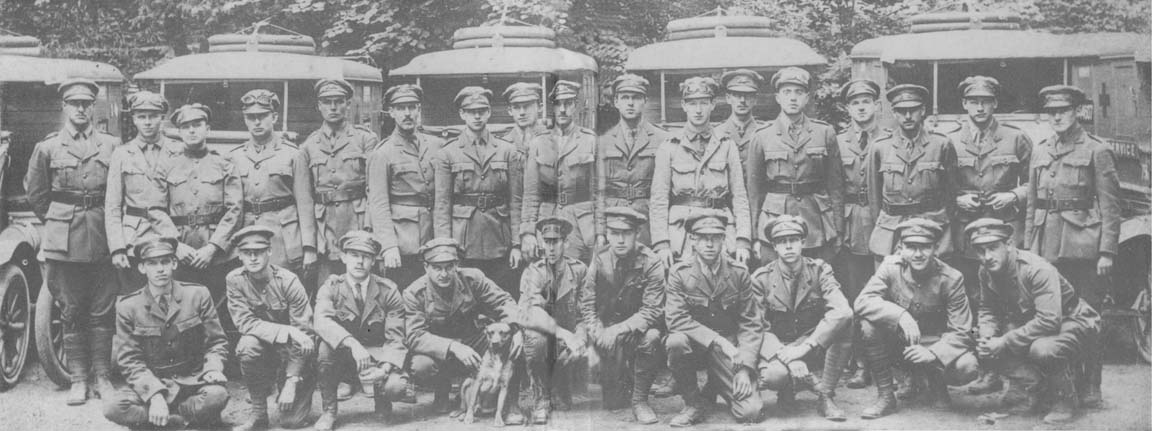

|
Removed, contained, scarce touched by all the strife Far removed from the thunders of a foreign war, Who might in peace have followed all our life? Our debt to France? --- Incurred in times of old? Graced by the workings of a despot king? Rochambeau, Lafayette, we oft are told; Our bell of freedom which they helped to ring- No, none of these; forget the ancient score; A greater thing: --- for France today we fight; Our living debt to France is even more; Her struggling battle is our cause of right. For fine-souled France, a star too bright to go, We come to battle back the tyrant foe! Lansing Warren, S.S.U. 70 |
|
Samuel Geller, M.D. |
|
From the AFS Photographic Archives The American Field Service, 1914-1917: An Essay on the Sources Series Descriptions Record Group #1 |

A word must be said concerning the inclusive dates of this descriptive inventory of the American Field Service in World War I. The dates used are 1914-1917. These dates do not represent the time of the existence of the American Field Service in France, but rather the inclusive dates of the documents in the World War I archives. The actual dates of the operation of the American Field Service are from April 1915, when the first section of ambulances of the American Hospital were attached to French line divisions, until the AFS was finally militarized by the United States Army in September 1917. At this point, the AFS ceased to exist as an independent body for the duration of the war.
The archives of the American Field Service of World War I, as described in the following pages, do not include the descriptions of the large and valuable photographic archive which is now only partially processed. This description does not include the prints, posters, paintings and artifacts of the Field Service that properly belong to the museum collections. Of course, it would be difficult to comprehend fully the whole story of the American Field Service without consulting all of the sources in the collections, nor is it possible to begin to obtain a full knowledge of the AFS by a study of the archives at AFS headquarters alone. As the essay that introduces this work indicates, one must consult the archives of the American Hospital in Paris for a complete view of the early days of the ambulance service when it was a part of the American Hospital's Transportation Department. There is also a large and most significant collection of material in the hands of the family of A. Piatt Andrew, the head of the World War I Field Service, which is kept at Andrew's home, "Red Roof," on Eastern Point in Gloucester, Massachusetts. The house, "Red Roof," has been preserved by A. P. Andrew's family in much the same way as when Andrew lived there. Its library and art collections are replete with Andrew's memorabilia of his Field Service days in France. There are many important volumes and papers that deal with the World War I Field Service that are unique and that complement the materials found in the AFS Archives in New York. As yet, no listing of the sources at "Red Roof," either archival or artistic, has been undertaken. Given the news of the grant to the AFS Archives that has been announced very recently by the Florence J. Gould Foundation, it will be possible to undertake the survey of the Gloucester materials, and those of the American Hospital of Paris, Blerancourt, and other institutions that hold AFS materials in France.
In France, in addition to the American Hospital Archives, the Museum of Franco-American Cooperation at Blerancourt must also be consulted for its American Field Service collection. In 1938, at the time of the dedication of the American Field Service wing of the museum, many archival and museum objects were sent by the AFS to the museum for purposes of exhibition. For example, today, the only original AFS Ford ambulance of World War I that is known to exist in its original condition is found there. Therefore, a study of the collections at Blerancourt is essential to any scholar of the history of the American Field Service in France. The close connections between Blerancourt and the American Field Service were further reinforced with the dedication of the American Field Service Memorial Garden honoring the men of the AFS who lost their lives in two World Wars while serving with the French. The Memorial Garden was dedicated in 1968.
It is a pleasure to mention certain individuals who have been closely connected with the World War I archival project. Mr. William Orrick, Director of the AFS Archives, has been with this project well before it was born. It was he who obtained the grant that funded the project from the National Historical Publications and Records Commission, and who served as reader of this work. Much of the work of arrangement could not have been done so easily without the preliminary sorting work of Rosemary Pryse of the AFS Archives staff. Her interest in this project and her hands-on help until illness forced a temporary withdrawal from service to the archives is very much appreciated. While the work of arrangement and description was going on, Bill Foley made sure that more and more donations kept pouring in to upset the shelving order of the archives. His wide contacts and friendships with men of the World War I Field Service and/or their families have insured that this is a constantly growing collection of unique materials. Cynthia Gyimah has done all of the word processing and computer collation of the manuscript. Without her work, this publication would not have been completed. Andrew Grey of Washington, D.C., and Gloucester, Massachusetts, an author and scholar of American Field Service history, among other subjects, has opened his own collection to the Archives staff for purposes of cross-referencing and checking. His enthusiasm for this story is contagious, and his knowledge ever useful. Nancy Cricco, an M.A. candidate in New York University's Archival Management and Historical Editing Program served as a graduate intern processing a part of the World War I Photographic Archives. She quickly obtained a knowledge of the World War I AFS that has helped to make a good start in cross referencing the photographic to the paper archives. Her work will serve as a good beginning for future processing work on the Photo Archives that must be done. Lastly, I am grateful to all of the former American Field Service drivers who made this story. One can only hope that their service to their country and to France will be increasingly appreciated as the years go by.
This work has been published by AFS Intercultural Programs under a grant from the National Historical Publications and Records Commission. The AFS International Scholarship and Exchange Program was begun immediately after World War I by the veterans of the AFS as the American Field Service Scholarships for French Universities. Its programs have since grown to become world wide in scope and influence. Materials concerning these programs can be obtained by writing to AFS at its international headquarters in New York City.
L. D. Geller
American Field Service Archives and Museum
June 30, 1988
