It was August of 1914. France's theoretical war plan for dealing with her feared German neighbor, "L'Attaque a Outrance," had failed with great losses of officers and men at the Battle of the Frontiers. The French Army, nurtured on "Le Cran," found that courage and bravery in the attack could not stand up to the power of the machine gun. The best divisions of the French Republic fell backward before the Germans to the Marne. Within a few weeks after the opening guns of the Great War, Germany was once more at the gates of Paris. It looked to the world as if it were 1870 all over again.
On August 14, 1914, the Board of the Ambulance Committee of the American Hospital of Paris was constituted with the mission of organizing and administrating a hospital for the wounded. Since before the war, the American community resident in Paris had run a small but well-respected hospital in the Paris suburb of Neuilly. As soon as the intention of these Americans to expand the operations of the hospital to treat war wounded was known, the French government, through its Minister of War, expressed its appreciation and placed at the disposal of the American Hospital a large and nearly finished school building, the Lycée Pasteur. The building became an "Ambulance," which is the French word for a military hospital or field hospital. In two weeks time of energetic activity, this partially renovated building, filled with the refuse of construction, was fully equipped and ready to take its first patients. It was an impressive achievement, even for these extraordinary times, for the work of installation of equipment was severely handicapped by the lack of a work force owing to factory shutdowns and the general army mobilization orders. Yet, a closer look at the American Board of the Ambulance Hospital of Paris shows some of the wealthiest and most socially and politically prominent people in the United States. They were used to getting things done. Among them were: Mrs. Robert Bacon, Mrs. August Belmont, Mrs. Henry P. Davison, Mrs. E. H. Harriman, Mrs. Myron Herrick, Mrs. Junius Morgan, Mrs. Whitelaw Reid, Mrs. Montgomery Sears, Mrs. W. K. Vanderbilt, Mrs. Bayard Van Rensselaer, and Mrs. Henry Payne Whitney, among others. Many of these women, with their husbands, were part-time residents in France. The President of the Board of Governors of the American Hospital was Robert Bacon, United States Ambassador to France, with Mrs. W. K. Vanderbilt as a member of his board. These last two individuals became important figures in the history of the American Field Service.
The early history of the American Hospital was one of rapid growth and extension of its medical services, which quickly became highly regarded in France. New wards were organized, and new departments opened as soon as funds became available. By the end of 1915, the Ambulance Hospital had fifty wards with 575 beds, but a provision was made for 625 beds in case of emergency, which was almost always the situation, especially in the early days of the war. In its two general surgical theaters, and two dental operating rooms, where cases of extensive wounds were referred from the base hospitals in the Zone of the Armies, most complicated cases of reconstructive surgery were undertaken, in many cases using the combined skills of general and dental surgeons. [There, large portions of the face of a wounded man might be reconstructed and other highly technical operating procedures were performed.]
From August 1914, to August 1915, 2,622 cases were treated at the American Hospital with a high rate of cure or improvement, as well as a correspondingly low death rate. Also, by the end of 1915, there were 10 medical specialty departments, numerous offices and other services available at Neuilly.
In addition to the main Ambulance Hospital at Neuilly, through the generosity of Mrs. Henry Payne Whitney of New York, the American Hospital at Juilly was established in November 1914, about 40 miles from Paris. The purpose of this hospital, known as Hospital "B," was to be closer to the war zone, which at the time of its founding was in the vicinity of the Battle of the Marne. By February 1915, this hospital was fully equipped and taking patients. In addition, the American Hospital had available a complete mobile field hospital, but because of the static nature of the war after the first engagements it was seldom used.
In the entire listing of the hospital departments in the Annual Report of the American Hospital for 1915, it is significant that the last department to be listed was the Transportation Department. It was in this department that the future American Field Service was born. Considering the fact that the American Hospital was run on a daily basis by physicians and nurses, and with one single department constituted by rotating units from prestigious medical schools in the United States, the Transportation Department was of secondary importance to the hospital's leadership. In March 1915, Regis Post, a volunteer driver in the department who was also a millionaire, wrote home to his mother, "The Ambulance is an outgrowth of the efforts of the American Colony in Paris using the American Hospital as a sort of starting point. But we are in quite a distinct building and operated entirely independently of the real American Hospital which runs on, as usual, six blocks away." Thus from the first, the operation of the Transportation Department of the American Hospital was tangential to the hospital's purpose, which was really to handle cases that other military hospitals could not deal with. Post's account is found in World War I Drivers' Journals, Diaries, and Personal Collections Series of the AFS World War I Archives.
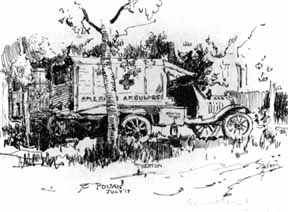
Nevertheless, the Transportation Department was begun with a gift of ten Ford chassis donated by the manager of the Ford Motor Company in Paris. These chassis were fitted with lightweight ambulance bodies designed by the resident carriage maker in the garage of the American Hospital. The ambulance, as constructed, was capable of carrying three lying cases, or five or six sitting cases. In fact, many more could be carried, and were, in emergency conditions. The Photographic Archives of the American Field Service contains many pictures of the construction of ambulances at the American Hospital, in Folder #8 of that Record Group under the category of Ambulance Maintenance.' The materials concerning the lightweight Ford ambulance pioneered by the American Field Service, first at the American Hospital and later in its own automobile repair and construction parks, are found throughout the AFS Archives of World War I. The AFS Headquarters Correspondence Series has material on the construction of the Ford ambulance. Many section commanders of ambulance sections in the field wrote extensively to the Inspector of Ambulances, A. P. Andrew, at headquarters in Paris, on the subject of ambulance construction and improvements. These field suggestions were often acted upon at headquarters to make the ambulances more efficient. These materials can be found in the Ambulance Section Field Correspondence Series, which is divided into subseries by ambulance section numbers. For example, Lovering Hill, commanding Section 3 in the Vosges, and later in the Balkans, had many things to say about the Ford ambulance and its performance. These ambulances were unlike any other used by the Allied forces in the war in that their lightweight, mobility, and their turning radius made them the ideal car for use in mountainous terrain such as in the Vosges or the Balkans where they served with distinction. They were also useful on the Western Front where a few hands could push them out of a shell hole and get them going again.
The first ambulance sections of the American Hospital in 1914 were composed of men of many nationalities. Of course, Americans were predominant in numbers, and under the Field Service, Americans would be the only drivers recruited. Their earliest duties were to transport the wounded from the railroad stations in Paris where they had been evacuated from the front, to the American Hospital. As the battle pushed further away from Paris, however, after Marshall Joffre's and General Gallieni's successful counter-attack of the German troops on the Marne, ambulance sections began to operate more and more in the field. By January 1915, a small detachment of five ambulances was sent, at the request of the British Expeditionary Force on the Belgian Front, to the Dunkirk area. Twenty men and twelve ambulances left the American Hospital on January 18, 1915, and proceeded through Beauvais and Amiens to the British lines. The earliest account of field sections operating outside Paris is that found in A. Piatt Andrew's Letters Written Home From France In The First Half Of 1915, in the World War I Drivers' Journals, Diaries, and Personal Collections Series.
The mention of A. Piatt Andrew at this point requires a digression from the narrative, for it was Andrew who was responsible for the growth and efficiency of the American Hospital's ambulance sections, and then, the creation of an American Field Service independent of the hospital. It was also Andrew who was the force behind the creation of a transport corps to serve the French army, which earned the continued praise and gratitude of the French high command and the French government. Once the war was over, Andrew was the single most important individual promoting the American Field Service Fellowships for French universities, the beginning of the modern scholarship program run by AFS Intercultural Programs today.
A. Piatt Andrew was born in La Porte, Indiana on February 12, 1873. He was educated in the East, however, at the Lawrenceville School in New Jersey where he prepared for Princeton University. After graduating A.B., in 1893, he went on to Harvard University to study economics, and earned his M.A. in 1895, and his Ph.D. in 1900, with time out for international study in Germany and France. Although Andrew went to Germany in order to study the German language for his doctoral examinations, it was France that inspired in him a lifelong love of that country.
As an Instructor, and then an Assistant Professor at Harvard College from 1900 to 1909, Andrew served there as Assistant Editor of the Quarterly Journal of Economics. In these years, he wrote widely on economic issues, and in 1907, in the Journal of Commerce, he predicted the financial panic of that year, which gave him a reputation as something of a seer and eventuated in his appointment as Research Assistant to the National Monetary Commission organized by an act of Congress in 1908. While on leave from Harvard, and with the Commission, he again traveled to Europe, this time on the business of the Monetary Commission, gathering information on the European banking system. After his return, he edited the twelve volumes of the Commission's publications, and had a large share in the framing of the bill and report of the National Monetary Commission which became the basis of the Federal Réserve Act of 1914.
In 1909, President Taft appointed Andrew Director of the Mint. It was at this point that he finally relinquished his teaching post at Harvard, although his contacts with that university and its students proved invaluable to him later in the American Field Service. In June of 1910, Andrew became Assistant Secretary of the Treasury, a position that he held until his resignation in 1912 to return to his home in Essex County, Massachusetts, with the ambition of running for Congress.
The outbreak of the First World War in 1914 found Andrew at the end of an unsuccessful bid for Congress in the 6th Congressional District of Massachusetts, and with a desire to serve France in virtually any capacity. Calling on a fellow Harvard graduate, Robert Bacon, then Ambassador to France, and President of the American Hospital of Paris, Andrew approached him for a position on the Hospital's executive staff. Bacon was unable at the time to repay a debt to Andrew of a few years back when Andrew had employed Bacon's son, Robert Low Bacon, as his personal secretary in the Treasury Department. Andrew sailed for France in December 1914 as a driver in the American Hospital's Transportation Department. After serving a three-month apprenticeship under continuous shell fire at the front in the Dunkirk Sector, Andrew was recalled by Bacon to Paris to take up the newly created position of Inspector of Ambulances in the Transportation Department of the American Hospital in March of 1915.
Much of the material relating to the rapid growth of the Ambulance Service of the American Hospital can be found in the correspondence of A. P. Andrew with various ambulance donors in the United States, in the Headquarters Correspondence Series, Subseries I. There can be found A. P. Andrew correspondence with Mrs. Andrew Carnegie, Mrs. William K. Vanderbilt, Edward de Coppet, Alice Longfellow, daughter of the poet, made famous in Longfellow's, "The Children's Hour," and many other donors. There is also important Andrew correspondence in this series concerning driver recruitment in various American colleges. Shortly before Andrew entered into a formal contract with the French Army on behalf of the Transportation Department of the American Hospital to become a part of the French Army structure in the summer of 1915, there were approximately 170 drivers representing such universities as Harvard, Yale, Princeton, University of Virginia, Dartmouth, Columbia, St. Lawrence University, New York University, the University of Pennsylvania, Bowdoin College, University of Michigan, Cornell University, Amherst College, Brown University, and the University of California, among others. Of the 170 drivers serving the American Hospital in the summer of 1915, 55 of them came from Harvard where Andrew had been a student and later, a professor. In fact, many of them had been his students.
As yet, rather surprisingly considering his prominence, there
has been no biography of A. P. Andrew. Other than the American
Field Service Memorial Bulletin for him at the time of his death
in 1936, and an article on the American Field Service by Andrew
Grey, published in the American Heritage Magazine in December
1974, Andrew's life story is still to be found in a wide variety
of sources. Andrew Grey, A. Piatt Andrew's grand-nephew, along
with E. Parker Hayden, have been the editors of the Intimate
Letters of Henry Davis Sleeper to Abram Piatt Andrew, Jr., 1906-1915.
These letters, copiously annotated, are most useful for an understanding
of the lives of these two prominent American Field Service figures
in the years before the war. The letters explain why the Field
Service functioned so well from an administrative point of view,
after its independence in the summer of 1916. It is clear from
the reading of these letters that the American Field Service was
built upon mutual trust and affection between these two Eastern
Point, Gloucester, Massachusetts neighbors, whose friendship extended
back a number of years before the war. Since Henry D. Sleeper
has not yet been mentioned in regard to the American Field Service,
it should be noted that he became the chief AFS fundraiser, recruiter,
and general administrator in the United States during the war,
closing down the Field Service offices in Paris in 1919.
A. P. Andrew material is found throughout the entire AFS Archives of World War I. There are also Andrew postwar papers in the archives of AFS that document his work in the Congress of the United States from 1922-1936. There are papers on his work as a pioneer of the American Legion, and as the originator of the American Field Service Association, and the American Field Service Fellowships for French Universities program, already mentioned. His postwar correspondence from such men as André Tardieu, Georges Clemenceau, Marshall Joseph Joffre, Raymond Poincaré, William Roscoe Thayer, General Leonard Wood, and his great friend, and incidentally Theodore Roosevelt's as well, Jules Jusserand, Ambassador of France to the United States, is of great interest and value.
By far the most significant aspect of the American Ambulance Field Service before its independence from the American Hospital in 1916, was its formal affiliation with the French Army's Automobile Service. Previous to this, the ambulance sections of the American Hospital served as auxiliaries to the British Ambulance Service in Flanders, and performed railhead evacuations well behind the lines, or in Paris, where the service carried wounded from the train stations of the city to the hospital. Andrew, with his great love of France and his officer's appreciation of the quality and the mettle of his American college men in the ambulance service, was ambitious for the service that he commanded. Through the intercession of two French friends, Gabriel Puaux, whom he had known from his postgraduate studies in Germany, and André Tardieu, who had been a visiting lecturer at Harvard when Andrew taught there, Andrew had access to the higher levels of the French military. Both Paux and Tardieu were officers on Joffre's staff at the Grand Quartier General. Through them, Andrew was introduced to Commandant Doumenc, Head of the French Army Automobile Service under whose jurisdiction fell the ambulance service. Doumenc heard Andrew's plan of attaching American ambulance sections directly to French divisions at the front, and sent him to speak with Captain de Montravel, Head of the French Automobile Service of the East, stationed, at that time, in the Vosges. De Montravel suggested a trial section of Americans to work with the French Army in the Vosges Mountains where the French were holding the Germans in parts of reconquered Alsace. Previously, French Army authorities would not allow foreign nationals to serve at the front with the French armies. Dallas McGrew, who was a member of this first Vosges section, Ambulance Automobile American Section Z, under the command of Richard Lawrence of Harvard University, with McGrew and Lovering Hill, both Harvard men, in charge of the two squads of the section, kept the account of the section's work. It can be found in the AFS Administrative Series, Box I, in the Reports of the American Field Ambulance Service to the American Hospital Board. In this report, McGrew describes the cordial reception of the Americans in the Vosges, and their militarisation by Captain Arboux, Commander of the Automobile Service of the Vosges Army. The previous service of what became known as Section Sanitaire U.S. 3, or S.S.U. 3, in Belgium in its evacuation work around Elverdinghe, and Poperinghe, can be found in the Headquarters Correspondence Series I. Complete and detailed accounts of S.S.U. 3's work in the Vosges, and the death of driver Richard N. Hall in action there, are found in the Ambulance Section Field Correspondence Series, in the S.S.U. 3 Subseries. The accounts of the section's removal to Verdun, and its subsequent service on the Macedonian Front, can also be found in this above mentioned series. The legal contracts between the French Army represented by Commandant Girard, and A. P. Andrew, representing the American Hospital, which detail the complete relationship of the American Ambulance Field Service to the French Army in terms of administration, chain of command, discipline, communications, leaves, etc. are found in AFS Headquarters Correspondence Series II, Folder 60A, Legal Contracts between AFS and the French Army, June 15, 1915 - March 3, 1917. These include the original and all subsequent contracts.
It is possible to trace the movements of the various ambulance sections, their battle front evacuation actions, their administrative and personnel changes, unit citations and individual citations, and the opinions of the men concerning their militarisation into the U.S. Army in the spring of 1917, in the above mentioned series. Most of the above can also be found in much abbreviated form in the Appendices to Volume 3 of the "History of the American Field Service in France" (Boston, 1920).
Up to this point, this essay has concentrated upon the American Ambulance Field Service's operations under the administrative aegis of the American Hospital of Paris to which it was attached as the Transportation Department. Any research concerning the Field Service as a branch of the American Hospital must make use of the Archives of the American Hospital in Paris itself. At this point, the Archivist of the American Field Service has not had the opportunity to examine the Hospital's archives to see how they relate to what is found in the AFS Archives in New York.
The series already mentioned, the AFS Administrative Series, the Ambulance Section Field Correspondence, the World War I Drivers' Journals, Diaries, and Personal Collections, all provide the scholar with a picture of the AFS wartime conditions in France, descriptions of evacuation of wounded from the Front, and the administrative relationship with the French Army.
The American Ambulance Field Service, being a private organization
whose initial funding under the American Hospital was meager in
view of Andrew's ambition to serve the French more efficiently
and more directly, had need of a much broader base of financial
support and recruitment than the hospital was willing to provide.
Andrew therefore set out to accomplish these ends on his own.
Indeed, by early 1916, given his wide connections in the American
academic, political and social worlds, the web of AFS connections
was far along with regard to fund-raising and recruitment. Former
ambulance drivers whose six- month terms of enlistment were up,
often returned to the United States to recruit on their own campuses
or on others. In addition, the very favorable press that the AFS
was having in the United States in such notable publications as
the Outlook, and in national and local newspapers, meant
that enlistments continued to grow along with donations. For example,
in September 1915, an article appeared in the Outlook by
driver and former writer, J. R. McConnell, entitled, "With
the American Ambulance in France." The article was published
with an introduction by former President Theodore Roosevelt. It
was a characteristically pro-French, anti-American neutrality
statement, typical of T. R., and of course, exceptionally complimentary
to the work of the American Ambulance Field Service. It was naturally
very influential. In November, 1916, in Munsey's Magazine,
appeared an article, "In Memory of Lafayette; How Americans
are Paying their Debt to France,' and in the Outlook, for
December 1916, A. P. Andrew's own, "For the Love of France."
All of these articles, by their titles alone, are descriptive
of the sentiments held by their authors, and indeed, by an ever
increasing population in the United States that was against neutrality,
and for American participation in the war. These publications,
and more like them, are found in the AFS Publications Series,
Box 55. By the spring of 1916, therefore, conditions in France
and in the United States appeared to be moving in the direction
of an American Ambulance Field Service increasingly independent
of its parent body, the American Hospital. In fact, donations
for ambulances were up nationwide. The Field Service, now six
sections with a total of about 126 ambulances and other supporting
vehicles, was then attached directly to French divisions of infantry.
It no longer evacuated wounded from railheads to the American
Hospital. The Service now worked divisional postes de secours
directly at the front line trenches, evacuating wounded, usually
under heavy bombardment, to postes de triage still within
limits of enemy fire, and then to base hospitals, or evacuation
hospitals near railroads. The sections were now operating far
from Paris with each section being almost completely independent
on a day-to-day basis. Henceforth, sections depended upon Paris
only for men, spare parts, and ambulance replacements. The most
significant example is at the Battle of Verdun. There, American
Field Service sections, by then greatly increased in numbers,
served over 60 French divisions during the entire course of that
prolonged and tragic battle.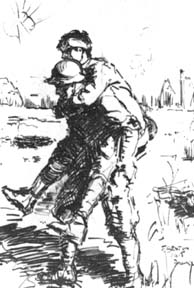
All of the above mentioned factors were important in contributing to the AFS becoming independent in 1916. However, the main reason for the AFS independence was political, a matter of personality clash between A. P. Andrew, Inspector of Ambulances, and members of the Transportation Committee of the American Hospital. Many of these members Andrew could not abide, particularly George Washington Lopp and Arthur W. Kipling whom Andrew saw as, at best, social imposters and administrative incompetents. Lopp's wife's extramarital affairs were such common knowledge as to make the newspapers. This Andrew saw, quite correctly, as an embarrassment to the American Ambulance Corps. Arthur W. Kipling, whose self adoption of the title, "Captain of Ambulances" was pompous in the extreme, was heartily disliked by both Andrew and the men of the American Field Service, as Waldo Peirce's poem, "Captain Kipling and Doctor Gros," will attest. The poem can be found in Rare Document Binder #4, AFS Archives of World War I. The documentary evidence of the indiscretions of Mrs. Lopp is found in the A. Piatt Andrew scrapbook in the possession of Andrew Grey of Washington, D.C., and Gloucester, Massachusetts. A. P. Andrew in correspondence with Henry D. Sleeper of Gloucester, Massachusetts, described at length the conditions leading to the independence of the American Field Service. New material relating to Robert Bacon's role as an obstructionist in the move toward independence, and Andrew's often angry responses to Bacon's temporizing, can be found in the A. P. Andrew-Henry D. Sleeper Correspondence Series, Box 7. Anne Vanderbilt's sympathy towards an independent Field Service, and her very pro-Andrew position, is found in correspondence in this series, as is the most important, but brief statement of Andrew to Sleeper, concerning Mr. William K. Vanderbilt's promise to stand by the Field Service financially until it could get on its feet, which of course gave Andrew the courage to push ahead with his plan.
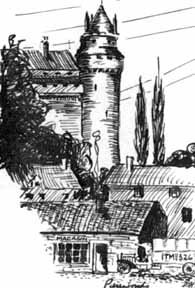
At the end of July 1916, another major boon to the existence of an independent Field Service came to A. P. Andrew. This was the gift of the use of the ancient chateau and its extensive grounds composed of lawns, gardens, and a forest at 21 Rue Raynouard in the Passy Section of Paris. On July 21, 1916, Andrew wrote to his friend, Le Comte Maurice des Monstiers Merinville, "We have our hearts set on getting a house next to the Allens---Number 21 Rue Raynouard---partly because of its location about halfway between our automobile repair park at Billancourt, and the army office with which we have constant relations, at 21 Rue Pinel, (near the Place d'Italie), and partly because of the house itself, which with its spacious rooms and its terrace, seems perfectly adapted to furnish dormitory, refectory and home for our boys coming from, and going to the front." Donated for the use of the Field Service by the hereditary owners, La Comtesse de la Villestreux and members of the Hottinguer family, this princely estate provided easy access for the Field Service ambulances, with plenty of space for approximately 150 cars to be parked under the protection of the estate's enormous trees. From the terrace of the chateau across the trees, one could see the Seine, and the Eiffel Tower. Beyond its natural beauty, the historical associations of the house and its grounds were not lost on Andrew or on many of the over 2,000 members of the American Field Service who passed through its doors from 1916 to 1919.
21 Rue Raynouard was known, as early as the 17th century, for its medicinal springs, called "Les Eaux de Passy," and many of the French nobility of the 17th and 18th centuries came to the estate to take the waters. In one of the chateau's rooms, called the "Orangery," Jean Jacques Rousseau wrote part of his "Devin du Village." As Stephen Galatti, second in command of the Field Service during the war and A. P. Andrew's adjutant wrote, in the University of California section book found in the AFS Publication Series, "His beloved Madelon, to whom he wrote his Lettres sur la Botanique, was none other than Mme. Gautier, the mistress of the chateau. The family still possesses these letters." From 1777 to 1785, the estate's first American connection was provided by Benjamin Franklin who could often be seen walking in the park at 21 Rue Raynouard, as he lived close by, during his mission to France at the time of the American Revolution. At the end of the 19th century, the sculptor Frederic Auguste Bartholdi, the creator of the Statue of Liberty, given by the people of France to the United States in 1885, lived at 21 Rue Raynouard. One of the high points of an AFS driver's stay in Paris was a visit to Bartholdi's half scale model of the Statue of Liberty, a picture of which is reproduced within the pages of this work. "Doc" Andrew made this history lesson a part of the orientation session that he gave to each incoming American college unit that was recruited for the Field Service, on its first day of arrival in France. Few of the men ever forgot it, or the beauty and hospitality of 21 Rue Raynouard. Many pictures of the estate are fortunately found in the American Field Service Photographic Archives, for in 1922 the gracious old building, perhaps one of the greatest historical landmarks of Franco-American amity in France, was taken down and replaced with an apartment building. Such is progress. There is material in the Sleeper-Andrew Correspondence Series on the donation of the house for the use of the AFS, and its historical associations, as there is in the Headquarters Correspondence Series. Rare Pamphlet Binder #1 contains floor plans, drawn by a Boston architectural firm, to alter the building for the Field Service's use. Lastly, and most importantly, the World War I Drivers' Journals, Diaries, and Personal Collections Series gives impressions of "21" as it was known to the men. As Stephen Galatti wrote concerning "21," in Volume 2, of the History of the American Field Service in France, "There is not a member of the American Field Service who has not been affected in some way by 21 Rue Raynouard. Throughout all the memories of varied experiences at the front remains the ever present background of the contact with this home, for it was necessarily there that the first impressions of France and of the Service were stamped indelibly in the mind of every newly arrived volunteer. There centered the realization of each one's hopes in at last reaching Paris; the first steps which enabled him to start in the service; the final period of preparation, and the start for the camp or the section; the return after three months to civilization for those all too short seven days of leave; and finally, the return from this great adventure at the completion of the enlistment period while waiting for a boat to America, or an opportunity to enlist in some other branch of the Service. Rue Raynouard is indeed a part of the history of the Field Service, for each volunteer has woven there some part of his story."
Why did men volunteer for the American Field Service, and for France, and what was life really like at the front for an ambulance driver? More than any other series in the AFS Archives of World War I, the Drivers' Journals, Diaries, and Personal Collections answer this best. In this series, the motivation of the men can be discerned. Besides being the largest single series in the World War I Archives, 8 1/2 linear feet, and constantly growing with donations as a result of an active collections policy, it is also the most descriptive series. There are presently 33 separate accounts, published, or in manuscript, indicating the influence that the Field Service, and the war in France and in the Balkans had on the lives of the men. The AFS was completely voluntary to the point that the men paid their own way over to France, and back to the United States, as well as bought their own uniforms and kit. The pay was French Army wages, and no one ever got rich on that. The American Field Service motto was, "Tous et Tout Pour La France," everything and all for France. Certainly, adventurism provided some motive for going overseas to join a foreign army years before the United States entered the War. Humanitarianism also was a motive. But, by and large, the historical idealism of repaying a debt to France for its role in the American War of Independence and the defense of French culture and civilization against the perceived barbarism of the invading force, were uppermost. It is difficult in this day of greater cynicism and perceived self-interest to conceive that men actually acted in accordance with their ideals. Perhaps Dunbar M. Hinrichs, T.M.U. 526, summed up the motivation of these men best in his account, We Met By The Way, found in the World War I Drivers' Journals, Diaries, and Personal Collections Series. "In 1915, ambulance work was tinged with a touch of when knighthood was in flower. As I have noted, all of these late Victorians had a touch of romanticism about them. I certainly caught the disease as I was part and parcel of the times."
Leslie Buswell's account, Ambulance Number 10, and F. Prescott Fay's diary both have much in common with Phillip Rice's An American Crusader at Verdun (Princeton, 1918).
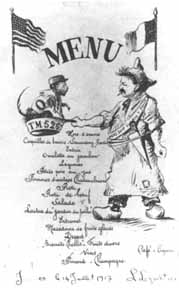 Rice stated, 'Many young Americans
in sympathy with the Allied cause, and anxious to uphold the honor
of their own country when others were holding back the flag, went
over as "Crusaders' in advance of the American Army."
On the other hand, William Yorke Stevenson, commanding S.S.U.
1, gave his opinion that most men did not go to France for really
altruistic reasons, although once there, France was able "to
get a grip on you that is hard to explain." Could not Powel
Fenton's (S.S.U. 3) life be an example about which Stevenson wrote?
Fenton went to France in 1915 with the American Hospital's ambulance
service and stayed with the AFS until 1917, when he became an
officer in the U.S. Aviation Corps. After the war, Fenton remained
in France, married a French woman, and opened a business in Paris.
The outbreak of the Second World War found Fenton again in the
AFS, until the fall of France in 1940. Picked up by the Nazis
as "an undesirable," Fenton was put in a Nazi prison
camp until he was liberated by the Allied forcés in 1944,
when he was repatriated, against his will, to the United States.
He had been in France continuously since 1915.
Rice stated, 'Many young Americans
in sympathy with the Allied cause, and anxious to uphold the honor
of their own country when others were holding back the flag, went
over as "Crusaders' in advance of the American Army."
On the other hand, William Yorke Stevenson, commanding S.S.U.
1, gave his opinion that most men did not go to France for really
altruistic reasons, although once there, France was able "to
get a grip on you that is hard to explain." Could not Powel
Fenton's (S.S.U. 3) life be an example about which Stevenson wrote?
Fenton went to France in 1915 with the American Hospital's ambulance
service and stayed with the AFS until 1917, when he became an
officer in the U.S. Aviation Corps. After the war, Fenton remained
in France, married a French woman, and opened a business in Paris.
The outbreak of the Second World War found Fenton again in the
AFS, until the fall of France in 1940. Picked up by the Nazis
as "an undesirable," Fenton was put in a Nazi prison
camp until he was liberated by the Allied forcés in 1944,
when he was repatriated, against his will, to the United States.
He had been in France continuously since 1915.
John I. Kautz of the Field Service, Réserve Mallet, wrote in Trucking to the Trenches (Boston, 1918), "It was a wonderful thing, this gathering in the Spring of 1917, from colleges all over our country, for volunteer service under a foreign flag. Most of the boys were moved very little by the spirit of adventure. They were impelled by high desire to do something, what they could, in a world crisis .... France needs us .... I wish that I could do more for these people. Even this little while has taught me that they have given the best they have, that no sacrifice is too great, that the best men of France are being killed for the sake of great ideals. Only now does one begin to realize what the war is really like."
The reading of the journals, the diaries, and the letters written home by AFS drivers shows clearly how they came to these opinions concerning France. Working often under the heaviest shell fire, being wounded or killed themselves, and always taking wounded from the French stretcher bearers at postes de secours, to field hospitals, sharing an "Abri" (field shelter) with French soldiers and doctors under thundering bombardments, dealing daily with French officers and non-coms serving their sections, and being attached to French divisions, they came to feel that they were part of France. For many, this sense of sharing of those times in France became, if not the high point of their lives, certainly one of the high points. When on March 15, 1917, the Stanford University Section prepared to leave Paris for the front, A. P. Andrew spoke the following words to the men and assembled dignitaries at the dinner for the section at 21 Rue Raynouard. "You who are here will realize, as the days go by, that you are here not merely to serve France, but that in a much more real sense, you are here to serve your own country. You are here to help keep alive in France that ancestral friendship which dates from the beginning of our own history. You are here to make the people of France feel and realize what the American people feel about them. There are men here tonight from twenty-two different States of the Union, the representatives of eighteen American colleges and universities, and while for the next months you are going to be the ambassadors of America in France, you are going back to your homes after six months, or nine months, or a year, or at the end of the war, whenever it may come, to tell the people in America what you have seen and felt in France. You are not only going to tell them of the beautiful heritage of the past which you have seen, or are going to see, but of the wonderful ideals of the French people, what they stand for, and you are going to make them believe that these ideals are the ideals for which we stand, for which America stands; the ideals which Jefferson brought back from France, the ideals which were incorporated in the Declaration of Independence and which form the fundamental compacts of our Constitution."
It would be accurate to say that if the American Field Service had an overall goal, at least in-so-far as its commander A. Piatt Andrew was concerned, it was to bring the United States into the war on the side of France. In Andrew's public addresses and his writings for the press, as well as in his private correspondence, the service of American volunteers with the French augured the day when many thousands of Americans would, at last, bring the flag to France. Therefore, in a way, the United States Declaration of War in April 1917, was the high water mark of the American Field Service. The U.S. Declaration had two important interrelated results. It greatly enlarged the ranks of the Field Service as enlistments increased rapidly after the Declaration, and it was the occasion for the creation of the Réserve Mallet.
Immediately after the United States Declaration of War, Andrew received a call at 21 Rue Raynouard from Commandant Doumenc, Head of the Automobile Service of the French Army, asking whether American volunteers might be secured to help in transporting munitions and other war materials for the French Army. It would be a radical shift in policy for the American Field Service, and Doumenc knew it. Many of the men who had signed a contract with the Field Service in the United States fully expected, and were led to believe, that they would be driving ambulances. Yet Doumenc pressed his point with Andrew, stating that at the moment the ranks of the French Transport Service were seriously depleted, that a large portion of their men then driving were over-aged and were needed on their neglected farms, or in French war industry. He further indicated that the Transport Service was lacking some 7,000 men to fulfill the current needs of the armies. Andrew did not hesitate, just as he had not hesitated when asked by the French to supply ambulance sections to the Balkans in 1916 to serve the French Army in Albania and northern Greece. The plan was not to place men arbitrarily in camion (truck) sections; rather Andrew allowed the men the choice of the ambulance service or the transport. Events however were moving in the direction of the choice of the latter. First, the supply of ambulances was not keeping up with the greater influx of men enlisting in the AFS. Ambulances were either fouled in the bureaucratic tangles on the docks of Bordeaux, or were back-ordered in the United States. At the same time, Doumenc promised Andrew that the camion sections, to be staffed with Americans, would assist the armies in regions of great offensive and defensive operations, giving ample opportunity for the young Americans to see action at the front. In addition, it was promised that they would be under the command of an outstanding French officer who understood Americans well and had an excellent command of English. He was Captain Richard Mallet, for whom the Réserve Mallet was named.
The first American unit to be offered the choice of the camion service or the ambulance was the Cornell University Unit under the leadership of Edward Tinkham. The date was May 2, 1917. As Dunbar Hinrichs, a member of that unit has written, one hundred per cent of the Cornell men volunteered to drive the 5-ton Pierce-Arrow trucks of camion reserve. Shortly afterwards, the Andover Academy Unit followed their example, as did the Dartmouth College Unit, the University of California Unit, and those units of Marietta College, Yale and Princeton Universities, and Tufts College. Of course, there were some men among these groups who felt deceived and left the Field Service for other branches, such as the Norton-Harjes Ambulance Corps, a much smaller outfit than the American Field Service.
The Headquarters Correspondence Series, and the Sleeper-Andrew Correspondence Series indicates that this new turn of events involving the transport service caused an unprecedented crisis for the American Field Service in the United States. There is Andrew correspondence with angry parents of volunteers and some school headmasters, such as Alfred Stearns of Phillips Andover Academy, trying to explain the situation. Many parents who thought of their sons doing a humanitarian service were appalled at the thought of their sons being involved in carrying war materials to the front. Henry Sleeper, the Field Service's head administrator in the United States, was bombarded with embarrassing questions, and some parental ultimatums, as his correspondence with Andrew indicates. In fact, Andrew's decision to take on the Réserve Mallet caught Sleeper by surprise, to the latter's consternation, for Sleeper was responsible for sorting problems out at home. In fact, it was not the first time that Sleeper had to write angrily to his friend A. P. Andrew in Paris on issues of which he felt he was not being kept properly informed. A reading of his correspondence will indicate that he was deeply mortified on more than a few occasions, when Field Service men were wounded or even killed in action and he was not informed quickly enough. It was Sleeper who had to answer to the next of kin with limited or missing information. One can appreciate his situation even though problems of communications were eventually rectified.
Nevertheless, during the spring and summer of 1917 more than 800 men joined the Mallet Reserve. The Cornell Unit was the first to fly the American flag at the Front, at Dommiers, near Soissons. Training bases were established for the Réserve at Longpont and Chavigny Farm, at Pont-Sainte Maxence and at Jouaignes, remembered for its caves and valued mess hall, which the artist-camion driver, C. LeRoy Baldridge, T.M.U. 184, has preserved so well in print form in the Art Collections of the American Field Service Archives and Museum.
The French Army Automobile Service established an officers training school for both the transportation service and the sections sanitaires, at Meaux, near Paris. Both J. W. Craig, T.M.U. 536, and Theodore Lunt Preble, T.M.U. 397, were candidates for the officer corps there. Both have left excellent notebooks of the course at Meaux that are found in the Drivers' Journals, Diaries, and Personal Collections Series. These notebooks are essential for a knowledge of how officers were trained for the Automobile Service, and the content of their studies. They are also valuable for a knowledge of the organization of the transport service, and a description of a T.M.U. section in terms of officers, men, equipment, and the repair and upkeep of the camions. For those scholars interested in the physics of the automobile engine of the Ford ambulance and the Pierce-Arrow truck of that era, or how such vehicles were put together, probably few better sources can be found.
The most complete account of the Réserve Mallet is Alden Rodgers' The Hard White Road; A Chronicle of the Réserve Mallet. Of particular value is Rodgers' account of the structure of the Reserve, how it worked, and what it did. It is, no doubt, the best single source on the subject. It too can be found in the above mentioned series. Another useful source is the manuscript extract from the History of the Motor Transport Corps in the A.E.F. during 1917, 1918, 1919, which if found in Folder #152, Réserve Mallet-T.M.U. Series.
Originally while under the American Field Service, there were sixteen American T.M.U. sections in the Réserve Mallet, grouped under T.M.U. 133, T.M.U. 184, T.M.U. 526, and T.M.U. 397. Although federalization is another topic altogether, it must be mentioned in connection with the Réserve Mallet since it came not long after the Réserve was established. On October 1, 1917, the Transport Service was taken over by the American Army, which meant that henceforth command was shared between Major Mallet, who was the head of the Reserve, and Colonel Gordon Robinson, who was the first officer in charge of the American Mission to the Réserve Mallet. The latter's duty was to feed, clothe and pay the men. Colonel Robinson was, in the course of time, replaced by Major Phillip Potter. Even after militarisation, the Réserve continued its French organization. Over all was the Réserve Headquarters, entirely French in personnel. In this office were Headquarters of the two Groupements of the Reserve, Groupement 8 and 9. In each Groupement were four Groupes, each named for its commander. A Groupe consisted of four companies, 18 trucks to a company, with a theoretical strength of 60 men and officers. The major change from the old American Field Service structure of the Réserve was that the men were now officially under the A.E.F. (American Expeditionary Force).
As Alden Rodgers has said in his The Hard White Road (Buffalo, 1923), "The work of the Réserve was to supply the needs of the Army, Army Corps, or Division to which it was temporarily attached. During the war, the Réserve hauled principally, ammunition and trench material. It also hauled troops, 75mm canon and caissons, 37mm canon, trench mortars, machine guns, baby tanks, baggage, food, refugees, in fact, anything that lacked the means of transportation." It participated in the French offensive on the Chemin des Dames throughout the summer of 1917, culminating in the Battle of Malmaison, October 23, 1917. It participated in the British Cambrai Offensive of November 2, to December 2, 1917, in the Somme Defensive, March and April 1918, in the Aisne Defensive of late May and early June 1918, in the Montdidier-Noyon Defensive, June 9 to June 13, 1918, in the Champagne-Marne Defensive of July 1918, and many other engagements, culminating in the Meuse-Argonne Offensive of October to November 11, 1918, that ended the war. Details of the Reserve's work in hauling tanks, shells, troops, ammunition, and other war material, as well as its strenuous efforts and rugged endurance, are all well documented in the Réserve Mallet-T.M.U. Series, the World War I Drivers' Journals, Diaries, and Special Collections Series, and in the AFS Publications Series, especially, in the case of the latter, in The American Field Service Bulletin Special Mallet Réserve Number, of March 8, 1919, found in Folder #277. An excellent short sketch of all of the above actions of the Mallet Réserve under the U.S. Army can be found in The History of the American Field Service in France, Vol. II, pps. 115-126. Throughout these series, there are original letters and some speeches from Captain Mallet and Commandant Doumenc of the French Army to the men of the Field Service and to A. P. Andrew. Mallet was especially held in great affection by his men, and he, in turn, was highly solicitous of their well-being.
It has been stated that in a sense, the high water mark of the American Field Service was the U.S. Declaration of War in April 1917. From A. P. Andrew's point of view, France would then receive the aid that she so desperately needed to win the war, and the United States' honor would finally be upheld in repaying its long standing debt to France.
The next question was, therefore, after these years of service to France, which Andrew saw as service to the United States as well, what would become of the AFS? The whole question of militarisation, or federalization of the American Field Service, was a perilous one. There were many ramifications, both in the United States, and in France. Andrew Grey in his 1974 article already mentioned, deals most cogently with militarisation when he says, "Andrew at once played for the highest stakes, proposing to use the Field Service as one of the foundation stones of the A.E.F., and thereafter to maintain it as a separate unit in the U.S. Army's table of organization." What Andrew wanted was for the AFS to become the nucleus of an expanded U.S. Army Ambulance Corps. Politically, as Grey has pointed out, it was not to be. Wilson was President, not T. R. Andrew, whose service in the Republican Party of Taft was well remembered by the Democrats, and whose views on the "Spineless Neutrality" of the Democrats in the years before April 1917, which he openly shared with Roosevelt, would not be forgotten. He, therefore, was not offered a high post in the United States Army Ambulance Service (U.S.A.A.S.). This did not prevent Andrew from trying to carve a prominent position for the AFS in the American Expeditionary Force, then forming in the United States. The Sleeper-Andrew Correspondence Series contains telegrams and correspondence offering the AFS to the War Department intact, with all of its equipment and those trained men who wished to remain in the service. There is correspondence on the subject of Secretary of War, Newton Baker's initial, seemingly welcome reception of this suggestion. There is also Andrew correspondence with Sleeper on what Andrew hoped would be the critical role of the French Government in helping him to achieve his aims. Andrew well knew that he had more leverage with the French Government than he did with his own. There is an important letter from Andrew to Sleeper on the part that he hoped his friend André Tardieu would play as Joffre's Chief Negotiator in Washington on Franco-American cooperation in the war effort. The whole thing came down in the end to how much political clout a war-torn France would have with its new and powerful American ally. How much could France really demand of the United States and realistically hope to achieve? When the negotiations were over, it was not the central role for the AFS that Andrew had hoped for. By November 1917, the American Field Service would disappear as an independent entity. Yet the Réserve Mallet would continue to exist, and those men who chose to remain in the Réserve would continue, largely as before, serving the French Army. In fact, so would the ambulance sections, which after militarisation, would be a part of the U.S. Army Ambulance Service but would themselves continue to serve largely with the French as they had before. This was something that both Andrew and the men of the Field Service had wanted. Of course, the U.S. Army Motor Transport Corps, of which the Réserve Mallet was now a part, and the U.S. Army Ambulance Service would greatly increase their sections over those of the old Field Service days. There would be new recruits from the United States going into these services and there would be a need for officers. Andrew was able to get many of his Field Service men field commissions in both services. Therefore, the officer cadre of both the U.S.A.M.T.C. and the U.S.A.A.S., at the junior officer level at least, was to a considerable extent made up of former AFS men who had studied at Meaux. Of course, many AFS men chose to leave the service for other branches of the U.S. armed services at this point. Some were rejected for physical reasons by the U.S. Army and returned home. Andrew himself accepted a commission in the U.S.A.A.S. as a Major. He ended the war as a Lieutenant Colonel. His assistant, Stephen Galatti became a Captain in the U.S.A.A.S. and later was promoted to Major.
There is a considerable correspondence with AFS Headquarters in the Ambulance Section Field Correspondence Series, during the period of militarisation. The correspondence shows the men to be restive in that they did not know what their position would be as AFS men in the U.S. Army. Of course, Andrew, playing for time and for a large role for the AFS in the new A.E.F., could deliver no solid assurances. Section heads had a most difficult time with the men during this period. Many of them felt that they could have commissions in other branches of the U.S. Army. Even the stalwart Lovering Hill, who had been with the American Hospital Transportation Department in 1914, and later the distinguished head of Section 3 in the Vosges and the Balkans, wrote at this cloudy time to Andrew of his desire to leave the Field Service for another branch. Eventually, Section 3 in the Balkans was disbanded and its equipment turned over to the French Army of the Orient, in that the men could wait no longer to hear of the fate of the Field Service from Washington.
Andrew Grey has kindly provided the AFS Archives with a folder on militarisation which is in his possession. The folder is valuable in that it demonstrates the incompetence in the leadership of the new U.S.A.A.S., and the fact that neither Major Andrew nor Captain Galatti was consulted by their superior Colonel Kean on matters with which they could have easily helped the new service. Their valuable experience in France was almost completely overlooked until things became so bad as to almost force a collapse of the new ambulance service. The main consolation of Andrew and Galatti, as Andrew Grey has indicated, was the knowledge that they served France well. They were aware, of course, of the impressive statistics of the American Field Service. The facts that the AFS had carried approximately 600,000 wounded French soldiers in its ambulances and had organized a camion service of extraordinary value to the French war effort were well known in France by many persons in high places in the French government, as well as in the United States.
In the last issue of the American Field Service Bulletin, the Rue Raynouard Number for April 1919, A. Piatt Andrew wrote the "Ave et Vale" for the World War I Field Service.
"The main object which the old Field Service tried to achieve was to interpret France to America and America to France, to spread abroad throughout the States a knowledge of what France is and has done, and means to help other Americans to feel and appreciate what we have felt and appreciated during these past four years. This effort must not end with the war. The four or five thousand of us who volunteered for France during the war can rededicate ourselves to the same ideal in the years to come .... To the old Field Service of 1915, 1916, and 1917, hail and farewell! Life can offer no higher privilege and no greater satisfaction than to have been associated with you during these matchless years in France."