 1.
Overview. The Italy Second Front Alternative, German Thermopylae
- 2.
Tripoli to Taranto to Termoli - Short "Indian Summer"
Interlude in Italy 3.
Battle of the Trigno and the Sangro. October to November 11,
1943 4.
Jaundice, Evacuation on and Treatment: Cobb (Oct 16-Nov 28) Edwards
(Nov 11-Dec 31) 5.
The Sangro and Beyond by Word and Camera, Nov.28-Dec. 15, 1943 6.
Pollutri Rest and Refitting/Episodes in Intercultural Relations.
December 15, 1943- January 24, 1944. 1.
Overview. The Italy Second Front Alternative, German Thermopylae
- 2.
Tripoli to Taranto to Termoli - Short "Indian Summer"
Interlude in Italy 3.
Battle of the Trigno and the Sangro. October to November 11,
1943 4.
Jaundice, Evacuation on and Treatment: Cobb (Oct 16-Nov 28) Edwards
(Nov 11-Dec 31) 5.
The Sangro and Beyond by Word and Camera, Nov.28-Dec. 15, 1943 6.
Pollutri Rest and Refitting/Episodes in Intercultural Relations.
December 15, 1943- January 24, 1944. |
We of the "Lucky 13" and C Platoon, 567 Ambulance Car Company, had been pulled back, following the Battle for Tunisia, to Tripoli, Libya, there to rest, reorganize, and refit. It proved to be our long "Summer of 1943." Meantime events of great moment during that summer of 1943 dictated the future course of the continuing Anglo-American offensive in the West by land, sea and air against the Rome-Berlin Axis.
To the east, the Soviet armies continued to engage the bulk of German forces --- some 160 German divisions --- all along the vast Russian steppes, having reached the Dnieper east of Kiev in August 1943 following their breakout from Stalingrad in February. All in all the Soviet Union bore the greatest losses of the war with eight million dead, of which seven million civilians.
It was Franklin Roosevelt who assigned first priority to win the war in Europe, and to open a second front through the Normandy Landings. The American "arsenal of democracy"--articulated in an address to Congress by Roosevelt in December 1940 --- was now in high gear, keeping both Britain and Russia in the war through "lend-lease," and supplying as well two massive American armed forces in Europe and the Pacific. Two-thirds of all Soviet military transport was American for example, as well as one-half of their war planes. Stalin was demanding even more, a second front in France.
This was not to be, at least in 1943. Meeting with President Roosevelt at Casablanca in January 1943, Winston Churchill and his senior aides called for the invasion of Italy, and Roosevelt, with General Marshall, accepted postponement of the Normandy invasion, code named "Overlord," for another year.
For a full year, Italy and the war in Italy, became the alternative to "Second Front" in France. It proved to become one of the most bloody and difficult campaigns of the entire war. Although those of us in Italy were categorized as "D-Day Dodgers" --- words of Lady Astor speaking in Parliament --- we took this sobriquet literally as a red badge of courage. One of us, with a gift for ribald verse and hard-hitting satire, composed a song, The D-Day Dodgers, which we lustily bellowed when we had the chance (see Annex). Lady Astor would not have been pleased.
Churchill had initially opposed the strategy of a second front in France. The Italian invasion actually coincided with his strategy for a penetration into southern Europe, including the Balkans. This was Europe's not so soft "underbelly" --- to misquote him --- and he also argued that it would help counter Soviet-dominated communist expansion in this region. Nevertheless, at the meeting of the "Big Three," Roosevelt, Churchill, Stalin, at Teheran at the end of 1943, Churchill reluctantly went along with "Overlord" for May of 1944, for which General Dwight Eisenhower was named Supreme Allied Commander.
Although the Italian campaign was an alternative to the Second Front, this Anglo-American first breach of Hitler's "Fortress Europe" through Italy made some political and strategic sense. Politically, the liberation of Rome would damage the prestige of the Rome-Berlin Axis, and rally the basically anti-Fascist Italian population to the cause of freedom.
Strategically, the cream of battle-tested American and British armies and their supporting air and naval arms lay just a "stone's throw" across the Mediterranean from the long and beckoning Italian boot. General Eisenhower continued as Supreme Allied Commander for the Italian campaign, until his eventual transfer to London. The American Fifth Army under General Clark, with some Commonwealth units, moved up the west coast. General Montgomery continued with his Eighth Army taking the east side of the Italian boot. And the Germans were forced to bring as many as 24 crack divisions, relieving thereby some pressure upon the Soviets and also weakening their defenses in France.
One of the most sustained, difficult, and costly offensives of the Anglo-American armies in Europe unfolded from September 1943 to June 1944 in the least likely of regions: the steep mountains, deep valleys, narrow coastal littoral of Italy's Apennines south of Rome, made virtually impassable by the rains and snows of winter.
Montgomery, to be knighted as the victor of Alamein, was then, in the fall of 1943, the most celebrated of the Allied field commanders. His equally famed Afrika Korps rival, Field Marshal Rommel, had been transferred to the defense of the "West Wall" in France, to be replaced by Marshal Kesselring, former Luftwaffe Chief of Staff with field command on the Russian front. He was appointed German Commanding Officer, South, in the summer of 1943. A master of detail, he proved to be a skilled tactician exploiting to the fullest the Italian terrain. Montgomery himself would leave for Second Front preparations in the next year.
Eighth Army in Italy was built around famed 10th Corps and its "desert rat" armored divisions. With two additional Corps, 13th and 5th, and troops from the Commonwealth and other nations, it was a representative United Nations force. The Canadian 1st division became heavily and heroically engaged. Punjabis, Sikhs, Gurkhas of the newly arrived 8th Indian division supplemented those of the storied Indian 4th. From the UK came a new division, the 78th; also the colorful Irish and Scotch brigades. In addition to the New Zealand division, already famed for its service in Africa, there were fighting men from Poland, Morocco, Senegal; and all of these made the difference in the eventual breakthrough for Rome at Cassino, May 18, 1944.
We AFS drivers with Eighth Army in Italy, posted to these various nationalities, found in Italy "old friends" from the African campaigns, and continued our impromptu "studies" in inter-cultural relations.
The first step in the Italy "alternative" was the Anglo-American liberation of Sicily, commencing July 10 and completed victoriously on August 17, 1943.
Even before the final liberation of Sicily, the Italian dictator Mussolini was overthrown by action of Italy's King and armed forces, and taken to house arrest at the highest mountain of the Apennines. This took place on July 25, 1943 the day after Palermo the capital city of Sicily was occupied. Field Marshal Badoglio became Head of Government in Italy, and initiated secret negotiations with the Allies looking to an armistice for Italy and association with the Allies as a co-belligerent.
The once proud Il Duce, Mussolini, was rescued in a daring raid by German paratroopers, September 12, 1943 to command the remnant of Italy as a Nazi puppet. He has been consigned by the verdict of history and the Italian people to the most ignominious of fates: the pathetic example of Lord Acton's aphorism on the total corruption of absolute power. Captured by partisans in the last days of the war in Europe while trying to escape to Switzerland with his mistress Clara Petacci, he and she were executed and left hanging heads down in the central Piazza of Milan.
Nevertheless, the young Mussolini, an ambitious journalist, had restored order and pride to Italy in the dark days following World War I and the collapse of the world economy after the American "crash" of 1929. And he alone of the world leaders had faced up to Hitler and blocked the Nazis' first attempt in 1934 to annex Austria ---while England, France and America practiced and continued to practice appeasement or isolationism to their eternal shame. And Fascism, even at its worst, never committed the extent of atrocities of the Nazis.
The Italian people had never accepted the Fascist ideology, and had turned against Mussolini's corruption of power. A glimpse of the heady days inside Italy as Mussolini and his Fascists were overthrown, and it was hoped the Allies would soon arrive, is given by Eric Newby in his Love and War in the Apennines. This amazing story was published in 1971; it is dedicated "To all those Italians who helped me, and thousands like me, at the risk of their lives..."
Newby, a POW together with other captured officers held in a converted orphanage north of the Po, was immediately released after Mussolini was overthrown (July 25, 1943). He was spirited to safe haven from the Germans, under protection of the mountain people of the Apennines south of the Po. He would eventually return to Italy after the war, to find and marry the young woman who had protected him.
Newby, and others, are critical of Badoglio and also of the Allies for excessive caution and lack of leadership and bold initiatives to take advantage of the golden opportunity presented by the fall of Mussolini, when Italian ports and airfields were open and Italian troops could have been mobilized against the Germans.
Negotiations with the Allies dragged on for 45 days until an Italian "armistice" was granted by Eisenhower on September 8, having previously announced Italy's "surrender" September 3. Italy's declaration of war against Germany to establish Italy's status as "co-belligerent" was not completed until October 13, when the Italian government had withdrawn from Rome to Brindisi in southern Italy.
By then it was too late. The Germans, by contrast, had acted with dispatch and imagination. Fresh Panzer divisions rolled into Italy through the Brenner pass, to a total of two Army Groups --- one North, one South --- 20 divisions by October, according to Giovanni Artese, La Guerra in Abruzzo e Molise. 1943-1944 (1993).
Little had been done by Badoglio and the Allies to mobilize the Italian troops against the Germans. Instead, most troops had been forced to escape into the mountains, to form into fighting units at a later time. They would fight to expunge the stain of Fascism and join in the cause of freedom. Plans for an American airdrop in strength at the Rome airfields had to be canceled; by early September the Italian airfields were in German hands. Other Allied airborne drops and the occupation of airfields and ports had to be abandoned because of the rapidity of the German march into Italy. The prize of Rome had been lost.
The Allies had planned landings in early September at Salerno south of Naples (west coast), and Taranto (southeast). When the 5th Army landings at Salerno got underway on September 9 the Germans were dug in. The 8th and 16th German Panzer Divisions had already disarmed the Italian forces and taken over their gun emplacements. There was heavy fighting, and German counterattacks on the beachhead September 13-14.
Fortunately, the Italian fleet had abandoned its base at Taranto, to surrender at Malta, easing thereby the British landings at Taranto, also on September 9.
This Allied invasion of southern Italy, September 1943, took place just before the autumn rains followed by winter snows would turn any battlefield into a sea of mud. This was made even more difficult by the nature of the Italian topography. The Italian "boot" is an endless spine of high mountains, deep valleys, and successive streams flowing east and west from the mountains to both coasts, and becoming torrential rivers when swollen by the rains.
This is ideal for defense, impossible for attack, especially from the south. Even the great Hannibal in his marauding march through Italy in the second Punic war, invaded Italy on his elephants from the north.
In Kesselring, the Germans had found another Hannibal. Having countered the fall of Mussolini, and brought his Panzers deep into southern Italy, Kesselring was determined to prevent the liberation of Rome at all costs.
Facing two Allied armies on each side of the central mountain chains, his strategy was to exploit every stream, valley and mountain to delay the Allied advances until he and his forces could complete a fortified line of defenses across the Italian peninsula from coast to coast, hinged upon the mountains at Cassino that dominated the Liri valley approaches to Rome. This was to be the formidable Gustav Line --- unless the Allied advance could break through at Cassino, or outflank it from the east beyond the Sangro before its completion.
The Allies by the same token mounted a formidable, aggressive and courageous attack by both armies, the American Fifth and the British Eighth, in an attempt to smash through Kesselring's defenses and overcome his fortifications. The Fifth moved straight up on the west against Cassino; the Eighth mounted a series of major battles in an effort to outflank Rome and the nascent Gustav Line from the east.
Advance was slow. Eighth Army faced huge logistical problems, a complex command of different Commonwealth divisions, plus Montgomery's celebrated concern for maximum preparations in the interest of his troops before each thrust; and there was perhaps excessive reliance on motorized units rather than Alpine-type infantry.
The failure to take Rome in that autumn and winter of 1943-44 was determined as much by the mountains, rivers, and mud as by the skill of the Germans. Illness also took its toll --- an epidemic of jaundice, the "yellow infection." Despite horrendous obstacles, there was no wanting in the courage of the Allied troops. Bill Mauldin's celebrated drawings of the bone-weary, unshaven and mud-soaked "GI's" Willie and Joe that soon appeared in Yank magazine, speak volumes. The cards were stacked against "GI-Joe" and "Tommy-Atkins" --- the foot soldiers, tankers, "sappers," and mobile artillery men, all supported from the air, who bore the brunt of the relentless attack until the Allied advance inevitably bogged down at Ortona (late December) and after the second attempt to break through Cassino in February 1944. It was not until May 1944 that Cassino was taken, and the road to Rome open. In retrospect, the political and military commanders at the highest level had set impossible goals.
We "Drivers" of AFS counted ourselves as one with those weary foot soldiers of the forward lines. Our two Car Companies, 485 and 567, were generally in the thick of things all the way through the Italian campaign. Our nimble four-wheel drive Dodge ambulances, except for the smaller jeeps, were the only medical vehicles able to navigate the mud-filled diversions across rivers, the winding and muddy tracks crisscrossing the mountains and valleys.
Both AFS Companies shuttled between the two armies on the west and east, but generally as in Africa were assigned to British Eighth Army units.
'The simultaneous Anglo-American landings at Salerno and Taranto September 9, were hotly contested at Salerno by advance German units hastily brought down; then forced to pull back to the augmented German divisions deployed for holding action along the first of a number of riverian lines backed by the mountainous terrain. This first line was the "Volturno-Biferno" line --- the Volturno River was just north of Naples on the west, the Biferno River just south of the port city of Termoli on the east. Naples had been liberated October first, but was subject to continuing bombing from the air. On the east side, the airfields at Foggia were taken by September 27.
It was imperative for the security of these airfields to drive the Germans from Termoli and on to the north. From these airfields the planes of two U.S. Army Airforce squadrons could range far over Germany and the Balkans, as well as provide air support for the campaign on the ground. The 12th Air Force, with B-25 Mitchell attack bombers and P-47 fighters flew tactical missions. The four-engine "Liberators" and "Flying Forts" of the 15th Air Force with P-57 Mustang and P-38 Lightning fighter escort flew the strategic missions into the German and Balkan heartland. And as our troops advanced, other air bases were established at Castel Benito and San Savero, central Italy, then Elba and Corsica to the north as well as other locations south and north.
Command of the air from these bases was a major factor for the Allies in the war in Italy. As the advance continued, there were bombings from the air against the German positions at Lanciano, Atessa, Fossacesia in the Sangro region: also farther north at Avezzano, Sulmona, Pescara --- the principal passage from Rome on the west to the Adriatic --- to interdict German reinforcements and the preparations along the German winter or Gustav line. They also supported the Allied ground troops.
Eighth army units led by Commandos of the 78th division crossed the Biferno and invested Termoli in a surprise night attack October 2-3 assisted by amphibious landings on the coast behind the Germans to the north of the city. German paratroopers mounted a fierce counterattack with fighting in the city itself for two days, and were beaten back October 5. D Platoon of 567 Company, which had disembarked at Taranto October 1, was rushed to Termoli to perform heroic services during this battle. Autumn rains were already beginning to turn the roads into rivers of mud; the AFS ambulances would come through the mud with flying colors.
Despite the autumn rains, the winter snows, and the terrain, both armies --- American Fifth, British Eighth --- mounted and maintained major offensives during the remaining three months of 1943 and on into 1944, and actually turned the Gustav Line at its eastern terminus as a result of Eighth Army's battle of the Trigno-Sangro. But the Germans held at Cassino, and Eighth Army was forced to draw back into winter positions south of Orsogna inland and Ortona on the Adriatic coast.
Crossing the Volturno October 12, Fifth Army pushed north through the impossible terrain in a series of bloody engagements through January 1944, reaching the Rapido, Garigliano and its tributary the Uri --- all become raging torrents in the winter rains. The Uri valley was the only direct route from the southwest through the mountains to Rome, guarded by Monte Cassino where the storied Benedictine Abbey shining white on the mountain top was located. Cassino --- mountain, city and rivers below --- had become the lynch-pin of the Gustav Line, and held firm against repeated ever bloodier efforts to break through until May 1944. Never have I seen such total devastation --- as reported in my poem "Cassino" (Table of Contents ---Part X).
The Germans had flooded the Uri valley and much of what was left of the shattered city. The American 36th --- the "Texas Division" --- leading the advance, decimated and exhausted, was finally relieved in late January by the New Zealand Division transferred over the mountain spine from Eighth Army. C Platoon of 567 AFS ACC and our "Lucky 13" Section, was attached to the New Zealanders. Platoons of 485 AFS ACC had participated in the Fifth Army advance all the way from the Volturno.
Following its break-out from Termoli on the east, "Monty's" Eighth Army pushed relentlessly ahead over equally mountainous terrain, turned into quagmires of mud by the rains. Refitted and reorganized into an even more formidable fighting machine than had defeated Afrika Korps, the tried and true divisions and brigades of the Western Desert and Tunisia were now joined by others: 78th UK, 8th Indian, 1st Canadian.
"Monty" planned for action along a front from the coast to the mountain spine with his usual capacity for detail and for surprise. The Trigno-Sangro battle that unfolded was in some respects reminiscent of those great battles of Eighth Army all the way from Alamein to Tunis. Prophetically, the build up and initial assault along the lines to force the Trigno, kicked off October 28-Nov 4, first anniversary of El Alamein.
Eighth Army faced the Trigno and the Sangro, two riverian barriers in Italy's Abruzzo Province, now swollen by the autumn rains. Here Kesselring concentrated his holding action. Bridges, roads, rail lines, ports and whole villages in the path of the Army advance had been demolished by German "scorched earth" tactics. The valleys, river banks, hillsides sprouted German mines backed by wire, gun emplacements, tanks and infantry.
C Platoon, 567 ACC, and our "Lucky 13" Section, was in the thick of this from Termoli in early October until finally withdrawn on December 15 for needed rest and refitting. At the start we worked with units of the 78th UK Division, which bore the brunt of the central sector and suffered thousands of casualties; subsequently, the Platoon also worked with the Canadians as the Gustav line was turned at its Adriatic terminus.
The "record" of the Platoon can speak for itself. All ambulances were assigned to forward posts; hundreds of casualties were evacuated over impossible tracks; one driver was killed, others wounded; several ambulances were knocked out and most scarred by shrapnel. Platoon commander Lt. Jack Hobbs came down with jaundice as did others. Considering conditions at the front and the heavy work load, it could have been much worse.
We drove around the clock night and day. According to my notes scratched down in pen-and-ink on a slip of thin paper during two weeks of the battle up to the Sangro: "No sleep 10 days --- 36 patients one day --- 60 patients 4 days." Shortly after the first crossings of the Sangro itself, I succumbed to jaundice (Nov. 11). Evacuated, I missed action experienced by the Platoon up to December 15 when it was relieved.
Commencing with the attack and build-up at Termoli (October 2-3) until the New Zealanders, Indians, and Canadians were forced to pull back from Orsogna and Ortona north of the Sangro in early January 1944, the battle of the Trigno-Sangro was one of the longest continuous engagements of the war in Italy. The Gustav Line had been turned but not broken.
On the west, three offensives at Cassino had been mounted by both Fifth and Eighth Army units in some of the bloodiest fighting of World War II or any war. Holding actions and diversionary counter-offensives continued on the eastern or Adriatic front at the Gustav line until the third and final break-through on the west at Cassino by Eighth Army units in May 18, the breakout from Anzio which followed May 26, and the Allied occupation of Rome June 4, 1944.
Mute evidence to the ferocity of all of these battles is the terrible cost of young lives. From September 3, 1943 (crossing the Straits of Messina) to June 4, 1944 (the liberation of Rome) there were 20,250 British Commonwealth dead. They have been laid to rest in nine of the eleven Commonwealth Military Cemeteries in Italy. The American military dead for the comparable period have been gathered together at the Sicily-Rome Cemetery, Nettuno near Anzio south of Rome. Here are headstones for 7,862 and the names engraved on marble of 3,094 missing.
These cemeteries, so beautifully designed and landscaped and reverently tended, tear at your heart strings and bring tears to your eyes.
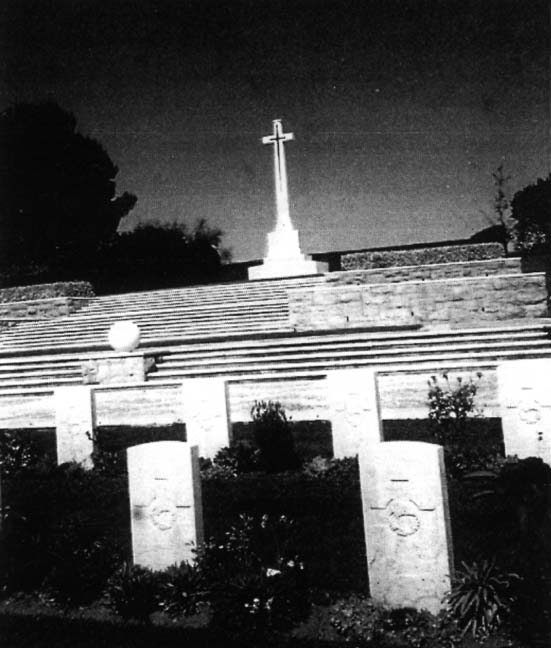
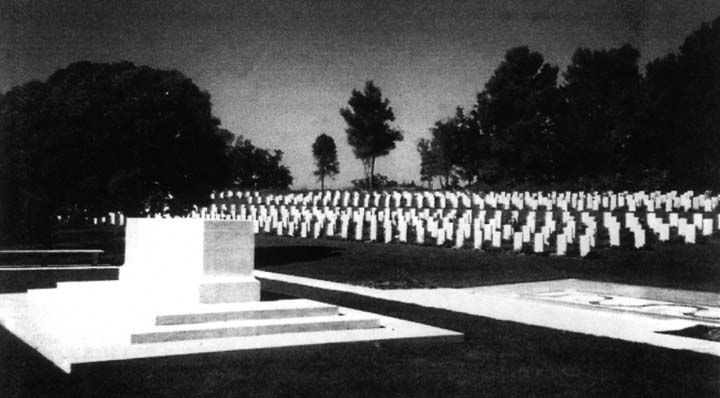
One such Commonwealth cemetery stands on a hillside at Torino di Sangro overlooking the Valley of the Sangro from the south. Here are row on row of inscribed marble headstones, and a marble cenotaph containing the cremated remains of Hindu believers. In all, there were 2,600 killed in the Trigno-Sangro crossings of which 1,790 UK, 385 Indian, 357 New Zealand, 74 South African, others (Australia, Canada). There were more than 5,000 wounded. A beautifully bound Journal within the entrance pavilion records these and other macabre statistics of war.
These do not include a comparable number of Canadian troops killed in the final push beyond the Sangro. This offensive concentrated on the port city of Ortona which was almost totally demolished. There were thousands of Canadian and German casualties, and equal numbers of civilians. Known to the Italians as "Little Stalingrad," door-to-door fighting raged on Christmas day 1943, tragic witness to the extremes of folly and futility of war. The hauntingly compelling, reverently designed and maintained Canadian Cemetery on the coast road south of Ortona, makes one weep.
Shortly after Ortona was "taken," a winter blizzard --- commencing December 31, 1943 --- put an end to any flanking action against Rome until the following spring. General Alexander called off the offensive. On that day, General Oliver Leese replaced Field Marshal Montgomery as Eighth Army Commanding Officer, and Montgomery flew to England to take command of the 21st Army Group in preparation for Normandy.
The "Grand Strategy" behind the Trigno-Sangro battle had been to turn the east terminus of the Gustav Line before it could be well established, opening thereby a route to Rome from the East while concurrently creating a diversion to support Fifth Army's assault at Cassino. The effort was heroic. It might have "worked" in spring or summer despite the terrain. Against Kesselring --- his crack German divisions, the mountains, the rivers, and the mud --- there wasn't much of chance.
Instead, what might have been a march on Rome turned into a succession of bloody battles: the Trigno-Sangro crossings, the suicidal horror of Ortona, the even more devastating succession of three offensives at Cassino and the Anzio bridgehead beyond, each battle leaving in its wake rubble and death for soldiers and civilians. The names of these battles are recorded in the litany of the carnage of war, as was Verdun of World War I.
In retrospect, military blunders were committed in Italy by our top generals and politicians. Initially, for example, there was the failure to fully exploit the fall of Mussolini. The strategic bombing and destruction of the Abbey at Cassino is now recognized as a blunder. There are many documented accounts of the Cassino campaigns; see especially David Hapgood and David Richardson, Monte Cassino (NY, Congdon and Weed, 1984).
Given the benefit of hindsight, one could argue that mounting a major military advance across the mountains, torrents, snows and mud of the Italian autumn and winter ( the compromise of the Italy Second Front alternative) was an irresponsible mistake. Nevertheless, those 20 to 24 German divisions tied up in Italy had been taken from the Russian front and from the German build-up against the cross-channel invasion of France of June 1944, indirectly supporting the Allied landings at Normandy.
In the words of Field Marshal Kesselring to American reporters after the war: "I can say this... if you had never pitted your divisions in the Mediterranean, as at Anzio-Nettuno, you would not have won the victory in the West." These words are quoted in the final paragraph of the following article: "Stranded at Anzio Beach," pp.44-49, The Retired Officer Magazine (Washington, Retired Officers Association, April, 1994).
Furthermore, the German and Balkan heartland lay exposed to attack from the Italian airfields, and the political prize of the liberation of Rome was gained June 4, 1944, two days before the first landings at Normandy. In that year of 1943-44, the Italian campaign had been as bloody and difficult as any in the entire war. It had been a superb Anglo-American effort. The lives of those gallant "GI's" and "Tommys," as well as the lives of innocent civilians, were not altogether squandered in vain in Italy.
But in this "overview" I have gotten ahead of my own story, a story based on the memories of an AFS "Driver" --- one of those many "foot soldiers." It is, therefore, the story of just one "foot soldier," one of millions of such caught up in the maelstrom of a world at war. Such memories have little to do with the grand designs and deliberations of the "top brass."
We "foot soldiers" of the war in Italy were not privy to the particular strategies and tactics of the Italian campaigns; at least I wasn't. It would have helped to know that there was a strategy, beyond simply engaging the enemy and pushing him from one interminable mud-filled valley to another. Ours "not to reason why" --- and we assumed that those on top knew what they were doing --- an assumption not entirely valid.
Fifty years after these events of the war in Italy, 1943-1944, the Italian scholar-historian Giovanni Artese completed his massive, thoroughly documented account of them in two volumes, with maps showing lines of action of each attack and counterattack as well as numerous photographs. This major work is: La Guerra in Abruzzo e Molise, 1943-1944, Vol. I (Casa Editrice Rocco Carabba, 1993) and Vol. II (Edizioni Grafiche Italiane, 1994). The specifics are given within the context of the entire war effort against the Germans by the Allies. A much shorter, but equally compelling and dramatic account is given by Giovanni Nativio, La Guerra in Abruzzo (Lanciano, Editrice Itinerari, 1971).
 |
 |
 |
 |
We of Platoon C, 567 AFS Ambulance Car Company, and our "Lucky 13" fraternity, were more than ready for orders for the next phase of the war as our idyllic "Summer of '43" drew to a close at Tripoli, Libya. Unknown to us the "die had been cast" for Italy, but preparations for invasion took time, and our orders did not filter down until September. We were well rested by then, and our ambulances refitted or replaced. I had been assigned a new ambulance, which I named Fox III, to replace my sturdy but battered "Fox II."
New arrivals had joined the Company and our Platoon at Tripoli, and Jack Hobbs had been appointed our C Platoon commanding officer. Chan Keller, Jock Cobb, Jay Nierenberg, John Leinbach and I, all of the "Lucky 13," had been assigned to Section 3, together with Bernie Wood. Others of "Lucky 13," Art Ecclestone, George Collins, joined fellow Sections. The standard table of AFS organization in the field was four Platoons to a Company, designated A, B, C, and D Platoons; and four or five Sections of five ambulances each to a Platoon. Our Company, 567, had been assigned to Eighth Army units and the Adriatic side of the Italian peninsula.
Eighth Army units commenced landings in force at Taranto September 9 and moved rapidly up the coast, reaching the port city of Bari and the airfields at Foggia to the west by the end of the month. But the Germans held just beyond Naples on the West, and invested the port of Termoli on the east coast beyond Bari. Taranto, in the extreme south of Italy, had been a major base of the Italian navy, its spacious harbor located at the head of the Gulf of Taranto.
D Platoon was the first to disembark at Taranto on October first, and was rushed north for immediate forward action with 217 LFA and the 78th UK and 1st Canadian divisions in the battle for Termoli. After fierce fighting, Termoli was taken by October 7, with the Eighth Army offensive continuing to push the Germans north. D Platoon did great work under fire.
It was C Platoon's turn to embark from Tripoli on October 4, for the four day crossing of the Mediterranean to Taranto by Landing Ship Tank (LST), courtesy of the US Navy.
Tripoli harbor had been a principal base for Afrika Korps, and then Eighth Army in the sea-saw battles back and forth across the Western Desert. Ships had been sunk in the harbor during numerous bombardments. Some on their rolled-over sides with their bows along the harbor front had been converted into additional wharves with ramps constructed on top of them. Our ambulances had used these ramps for servicing hospital ships. Now the entire Platoon lined up to load -single file into the opened maw of our designated LST.
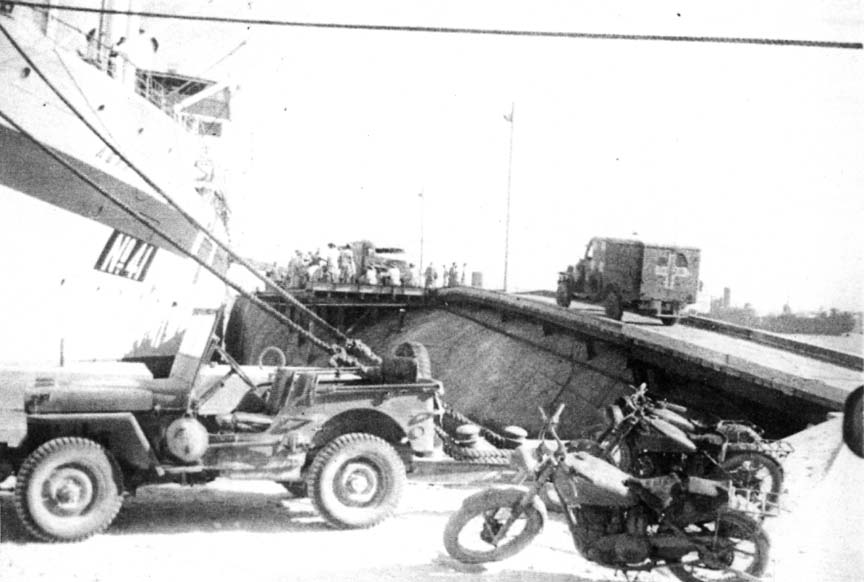
An LST is in reality a bulky small-seized freighter with high freeboard, and a rounded shallow-draft bottom able of nose up to wharf or shore to drop its huge bows and form a ramp capable of loading and landing tanks and trucks as well as our small ambulances. Although adapted for their mission, and true work-horses, they wallowed and rolled with abandon in any swell or "sea." I was an accomplished sailor, or so I thought; however I reported in a letter dated October 20 that "during our sea voyage of four days several weeks ago, I lost two meals over the side." And it was good American rations!
Secure from the rolling and wallowing, Fox III was chained top side; most of the others vehicles were secured by chains below.
I soon found my sea-legs in time to meet several members of the crew and to share with them delicious (!) American meals; I wrote (in a letter dated October 20):
One fellow, Tom Wyman, lives near us at home. His address 890 Adams Street, Milton. He took me through the whole ship, of which he is bo'sn, from stem to stem, top to bottom. I spent an afternoon on the bridge studying the theory and practice of navigation Navy style.
Our Mediterranean "cruise" terminated October 9 at Taranto, as our C Platoon with the rest of our 567 Company drove down the opened bow ramp of our LST with only one mishap ---a driver who missed the ramp part way down. Company HQ was temporarily established just north of the city, where we received orders to proceed north to Termoli about 150 miles up the coast. We would be posted with Field Ambulances of 78th UK and 1st Canadian divisions, 5th Corps of Eighth Army.
The Germans were being driven back further up the coast as Eighth Army continued its build-up of 10th, 13th and 5th Corps for the battles to cross the Trigno and the Sangro rivers another 15 to 30 miles north of Termoli. The American 5th Army had also taken Naples on the west coast, October 1.
Our two-day drive to Termoli and first week in Italy was a welcome but short-lived Italian "Indian Summer" idyll --- the very opposite of the conditions that would soon prevail. Lush days were warmed by a harvest sun. It was the season of the "vendemia"--- the harvest of the grapes and the autumnal largess of lands that had been lovingly cultivated since Roman times.
Mindful of my maternal Italian ancestry, I revelled in my first taste of the "patria", in the Apulia province of the deep south through which we traveled, little touched by the war. In letters home, I "let myself go" in a virtual travelogue account of those first days, as reported in several long letters. written Oct 15 and 20 by "candlelight"; I wrote:
The road led across a hilly country. Every square inch of ground was under cultivation. A thick forest-like growth of trees along a hill was in effect made up of the endless olive trees and fruit trees interspersed with fields of grapes. A white town, perched often on the very summit of a hill and with the old church tower of decorated stone reaching up out of the clustered buildings, seemed to belong to each section of surrounding land and to claim it for its own. We passed through several larger towns, and always there was a central piazza with a church on one side and a bit of statuary in the center. There were lots of children to shout at us as we drove past; but often the roads would be blocked by the high-wheeled carts of the peasants drawn by horse or donkey, and loaded with great baskets of grapes.
And I wrote:
As we continued north, the hills leveled off onto a great plain. (Note: this would have been the locale of Foggia and its airfields). Neat stone farm houses, each with a pile of hay and a little patch of garden near the house, lined the way, or stood out boldly scattered across the almost treeless plain with the black earth harrowed after the autumnal harvest. The plain soon narrowed down between two ranges of high hills, equally treeless and with white towns poised along the slopes or on the very tops. Again we reached hilly country, with the road built in hair-pin turns. There were fewer olive trees, more frequent grape arbors along the hill-sides, and often a valley with fields of wheat or corn or rye in neat squares. There were few houses along the countryside --- rather they seemed to be reserved for the frequent towns of stone walls and tiled roofs and cobbled streets.
We are stationed at present in one of these towns, and all of our section (Section 3) are here together.
We had reached Termoli, scarred by the fierce fighting that had taken place there only a week before. The British had taken Termoli, and the Germans forced back, with units of 78th division and 4th armored brigade in hot pursuit, and the entire Eighth Army build up under way from the coast to the mountain spine inland. We would all be engaged too soon full tilt in the pending battles; but for a precious few days our "Indian Summer" idyll continued.
I reported my initial impression of Termoli (a letter dated Oct 10):
Jay and I have just had a swim in the Adriatic. It was really cool, with a nice beach running against the steep green hills upon which this old town is built. Old, I say, because one of the churches dates from the 6th century; and the stone houses, built every which way along the pebbly cobblestone zig-zag roads, give the appearance of age itself. Occasionally a street ends abruptly in a series of steep stone steps all leading down to the little harbor where quaint fishing boats dry their many-colored sails. And some boats are hauled up in a line on the beach itself, looking like ducks out of water.
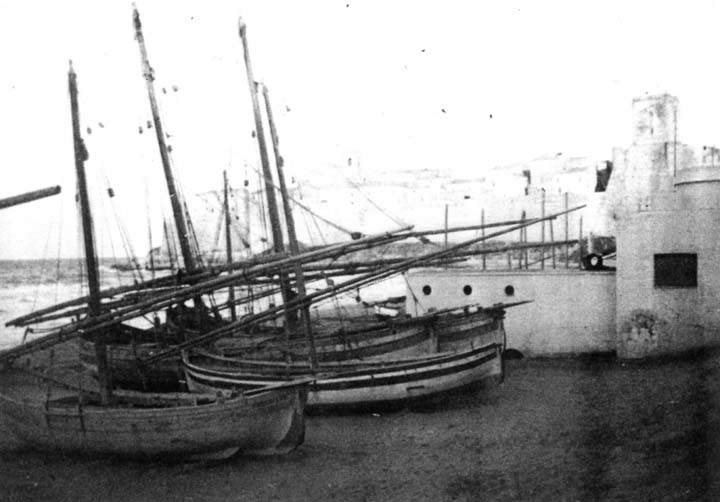
Our idyll at Termoli could not last long, but we enjoyed it while we could. I had written hastily via one of those "V-Mail" photograms, that "all of our Section 3 (Chan, Jock, Jay, John, Bernie Wood, and I) are comfortably installed in a suite of rooms. I haven't been in such luxury since I left the States!" Jock corroborated on his V-Mail of the same date: "We are billeted in the luxurious house of an ardent local fascist who is now behind bars. We eat at a restaurant across the street where our cook has set up with the help of the owner and family." I gave a more detailed account in my letter dated October 15:
You would be amused at the style of living we are enjoying at present, especially after the simplicity of life on the desert. We have taken over a suite of rooms, and all of us are spending peaceful nights sleeping in real beds. Lavish bits of furniture --- divans, chairs, etc. --- are on hand for purposes of reading or just plain reclining.
I continued:
It has been fun to move in and "keep house" as it were, for when we arrived everything was in a terrific mess. The occupants had fled on the spur of the moment, leaving sheets, blankets, plates, cocktail glasses, pillows, fine silks --- all the accouterments of a comfortably furnished home --- to the fortunes of the looters and "scroungers."
And the war still seemed remote; I wrote in the same letter:
You would not know there has been a war in most places we have passed through. Only areas strategically placed because of rail-roads, air-fields or defense fortifications have felt the brunt of war from land and air: and in those areas it fell with a heavy hand. And only those "diehards" (e.g. fascists) hopelessly tied up with the fortunes of the other side, were forced to leave their homes --- homes exposed to looting.
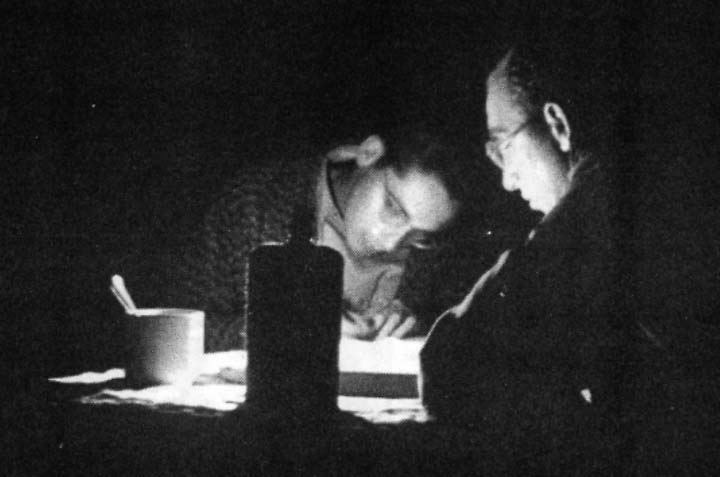
My letter (Oct 15) continued to describe our luxurious accommodations at Termoli:
We have also inherited a little café across the street for our mess, and are dining with silk table-cloths and China plates. The American rations obtained when we were back in Tripoli are still holding out. The other morning breakfast was tomato-juice, sausage, scrambled eggs, pancakes and syrup, coffee. This sort of thing can't go on for very long. Meanwhile we propose to enjoy it to the fullest! We had roast-beef last night, purchased at the market.
While in Termoli I managed to make friends with several of the local residents, thereby also improving my use of the Italian language and serving as interpreter at the hospital (CCS) where we were attached, and also in contact with officers of AMGOT (Allied Military Government Occupied Territories). Little did I know then, that I would be attached to AMG for a few months in the following spring.
The Italian people had never accepted Mussolini's corruption of power, and especially his unholy alliance with Hitler. After the overthrow of Mussolini, the people themselves turned against the German occupation, organizing an underground resistance and welcoming us as liberators. The ignominious hanging of Mussolini (May 1945) was an excessive but understandable paroxysm of their pent-up anger.
I wrote ( my letters of Oct 15 and 20):
I have already met several people in this town. The schoolmaster of the elementary school (in which our medical unit is placed at present) is giving me lessons in the language, and we are reading Collodi's Pinocchio together. He is a very "cute" little man with twinkling eyes and freely gesticulating hands.
I also made friends with a gentleman who has a most attractive daughter! --- and have helped them in their relationship with the military authorities (Allied Military Government of Occupied Italy --- AMGOT). They are refugees, and need permits to travel. The daughter's name is Anna, and I have been to the house where they are staying for several meals, and gone for several walks through the town. The company of this girl, who is quite vivacious and who has a lovely smile, is most refreshing. And then, too, she is a good teacher and corrects all my mistakes in conversation.
My knowledge of Italian came in handy for service as interpreter; I wrote:
I am coming along quite well with Italian, in fact have been hauled in many times by the hospital (to which we are attached) as an interpreter... Now that we are in a populated country, the most destructive aspects of war with regard to civilians and especially children, present themselves. In serving as interpreter, I have run across some sad cases. But then, there is a pleasant side to things, and one can not help being either amused by these excitable people, or touched by their kindness. It is one of the tragedies of present day history that this country and people, which have seen such glorious days, should have lost the respect of all nations. But most of these traditional "little" people have no conception of the world outside.
Tonight I am having one of the AMGOT officers to dinner with me. We will be eating by candle-light for it is darkish by 5:30.
It was already mid-October. Eighth Army preparations for the massive Trigno-Sangro offensive all along the line were advancing, as German resistance stiffened. Casualties were coming in from the not too distant front, and I reported several trips in the hill country north of Termoli with casualties both military and civilian. On one such evacuation near Termoli, we passed a recently blown-out Sherman tank.
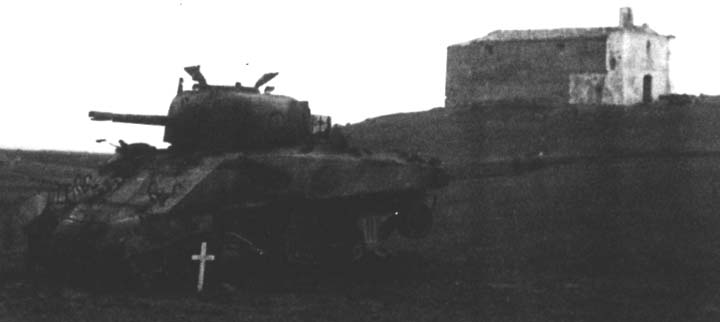
Soon all C Platoon ambulances would disperse to forward posts with 78 UK division, and 4th armored brigade., and the luxury of sleeping in beds would be over for those of us billeted at Termoli. In all, seven of us of the "Lucky 13" had found ourselves together again, and in more comfort than our initial billeting down in E deck, HMS Aquitania, September 1942. In a letter written October 16, Jock Cobb wrote about an evening "song fest" at Termoli. noting that Jay, Fox (my nickname), Chan, John as well as Art Ecclestone and George Collins all joined in singing at the top of their lungs the chorus from a ballad about the Titanic, "it was sad when that great ship went down..."
But there were problems at "our" villa. In a letter Jock reported that the drain from the bathtub had become plugged, and that it had become impossible to flush the toilet. Furthermore, our comfortable furnishings were the target of raiding parties pulling rank. Jock wrote of an incident when one of us was taking a nap on a sofa by the fireplace; he wrote: "A major stuck his head in, cocked it, and with glee said 'Just the thing'. " He, the Major, then proceeded to have the couch carried away --- much to the surprise of the occupant; but he did leave a wooden bench in its place. On another occasion two naval officers came by seeking beds; fortunately we were able to direct them to additional beds in the attic and kept our own.
Jock also had interesting contacts with some of the Italians, and was able to converse with them in French. One of them had been studying chemistry at the University of Bologna and told of student opposition to Mussolini. Thirty students had been sent to prison for writing "Down with Mussolini" on the walls,
Jock also met a former lieutenant in the Italian Airforce, who had managed to return to his father's farm near Termoli after the September armistice. Jock's letter about this meeting, written afterwards on October 28, provides interesting insights on conditions inside Italy during the war, as well as the fortitude, culture and kindness of the people. I quote the following passages from this letter:
A well groomed Italian came into my sight from behind a fig tree and read in broken English, "American Field Service" on the ambulance door... Finding he spoke French better, I tried to help him out and we finally wound up drinking wine and talking about the state of the nation in his up-stairs drawing room ... I learned that his family would be all right for food this winter, being well to do, farmers; that they could even afford to help some of the poor folk who would be short. His only complaint at present was the lack of cigarettes and soap. In the cities there would be more severe food shortages. His father owned many strips of farmland in the colorful valley lying below the village; a valley of vineyards, cane, tomatoes, figs, olives, cabbage, spinach, carrots all ripening in the warm sun.
Jock's letter continues:
All this I had seen the day before... There were casual farmers hoeing and a group talking wildly at each other so that their voices came up clearly from the floor of the valley to where I stood. I watched an old woman come down to the spring with a donkey who waited patiently from long habit while she filled the casks he carried ... It was truly a paradise of peace for this wandering soldier ... but I hadn't dared to leave the path because I knew there were mines there. A man had been blown up only yesterday while plowing a field .... I asked my new friend about the mines ... he knew of several. We agreed that the civilians get the worst of it.
He invited me to dinner, spinach --- great heaping plates of it more like an herb soup --- tried chicken and potatoes, nuts, figs, and wine ... After dinner, he pointed out his paintings ... very good oil portraits of his family ... and he showed me his family album ... himself in uniform, his wife and child in Venice ... and he showed me his library.
He was well educated, University of course in economics including eight years of study in English and twelve of French, math, chemistry... He was interested in post-war plans, economics and politics ... The way I see it, he is the type of fellow who must be in the new government of Italy. He already knew about the coming of Sforza to lead an army of liberation for Italy, but was quite interested in other developments ... He wanted to know about world economics, so I lent him some of my Foreign Policy Bulletins to read ... He is waiting now to be called up to fight on our side ... meanwhile his wife and child are in Venice.
Jock also, as did I, made notes in outline form for future reference after the war. As I assembled and reviewed my own notes and letters, after more than 50 years, in order to prepare this manuscript, Jock also forwarded to me copies of his own letters and notes. There follows in outline form as written down by Jock at the time (on or about mid-October 1943), and transcribed by him a halt century later, his notes about Termoli city; about an evacuation to a civilian hospital in the rear; and about an action by night at the front in which he was engaged several miles north of the city. Jock's account is a sparse, dramatic and intimate story which brings the reader right inside the very guts of a military action by night involving infantry, tanks, artillery, and the setting up an AFS aid post in support of the action.
My quotations from Jock's notes which follow, are also a fit conclusion to our brief Italian "Indian Summer" sojourn at Termoli, early October 1943. They are furthermore an eloquent metaphor about the extremes of war: the abrupt shifts between violence and calm, and from relatively secure quarters to the most dangerous and arduous of situations. One is tempted to join with the poet who wrote: "Oh what fools these mortals be..."
The following outline is from Jock's rough notes, transcribed by him years later:
Termoli: Old church rebuilt several times since 600 A.D. to fit the changing styles of religion, as if facing East or West at prayer made any difference. Little man showed us all around---relics, mosaics, tombs ... Then he wound up by saying there was a German sniper in the belfry until yesterday.
Priest came in with loud voice... then slyly to Charlie to one side and whispered "cigarette?"
People seem well off; few houses bombed; some stores open. Men all standing in groups ... telling their stories of the battle--- like New England after the hurricane of '38.
Harbor: a number of fishing boats behind a breakwater ... a few invasion barges pulled up at dock.
Our Work: up and down hills along coast (of Adriatic) to San Severo (about ten miles south), taking patients, mostly sick, many Italians, some who were hurt when town was bombed.
Civilian Hospital at San Severo: takes all Italians, soldiers and civilians. Italian sergeant in civvies told me he was working in the military hospital when the armistice was signed. The Germans took him prisoner; took his uniform. He escaped, is now loafing around the hospital.
When the English came, they took over the military hospital, sent all Italian soldiers to the civilian hospital. The Italians got crapped on from all sides.
Now that Italy is in the war with us, the Italian soldiers still go there...
I pulled up to front of the hospital. No sign of life, so I asked a man in a horse cart.
Inside I found a man in a white coat. He directed me around to the back of the hospital... girls thought the whole thing a great joke; me, an American, speaking Italian, bringing Italian soldiers to their hospital. They turned out to be nurses.
Then began the chase. The little man with the white coat disappeared. I chased him down corridors ... rooms. He was looking for an officer to find out what to do with the soldiers.
Officer finally got things squared away, I got my stretchers back with a few wet blankets; and made off amidst the giggles of the nurses.
Jock's notes continue:
Action: Arriving at the ADS (Advance Dressing Station) ... was sent out again to spend the night at an ambulance station near the front, where an attack was going in. At dusk with three ambulances ... and M.O. (Medical Officer) and half dozen stretcher bearers, we were to go without lights up to the post
The M.O. showed us the ridge which was the objective of the attack going in at 1:30 AM. Bernie (Wood) and I sent around to the Q.M. to get a ration of rum to fortify ourselves and sat on the hood of my car...
When we finally got to the post, it was quiet and dark. I blew up my air mattress and rolled up in a blanket on the ground.
About 9:00 PM when the moon rose, I was awakened ... The M.O. had come up on a motorcycle with some tea ... he didn't see why we were up there ... The corporal seemed to know the story ... (evacuations) by ambulance if the road was good, by stretcher bearer if not, and/or by sea ... using little landing barges.
The M.O. peered through his glasses at the darkness. We smoked a while. He asked if he could take a nap in my ambulance, and we all rolled in again.
About ten, the infantry walked down the road past my ambulance., Lying on my side ... I watched their helmeted silhouettes against the faint cloudy sky. They were walking fast ... An Officer ... was saying "Close up!"... "Close up G. company!"
They went by casually ... now and then they would speed up to a run. Sometimes two would be talking..."Those are Yank ambulances!" Or, looking at me rolled in a blanket, "What's that, a pile of stretchers?" I wondered what they thought seeing the ambulance to take them out...
Then they halted. The chap by the ambulance rested his arm on the door handle. Then, realizing what he was leaning against, drew back slowly ... Then, at the command, he stiffened and went on.
I woke up chilly at one o'clock, pulled over another blanket, and lay admiring the peacefulness of the moonlight. At 1:30 the barrage started ... the Jerry's 88's were speaking, and we heard the occasional woomph!" of mortar bombs...
Each gun flashed in turn, then sounded, then came the sharp echo ... and the quick whistle turning into a low rushing whisper as the shell sped over our heads towards the ridge. An occasional shell rushed through the leaves of a nearby tree.
I thought, "What a magnificent spectacle!" Then thought of the infantry crawling in, and of the Jerries ... in slit trenches sending up flares in a vain attempt to see what was going on... I saw a shell set fire to some ammo. Flares lit up the sky, then died down, and flared up again.
Jock's account continues as the tanks moved in:
After an hour or so, the shelling died down ... A few last shells rushed past, and we could hear them landing a minute later.
About three o'clock the Sherman tanks clanked and squeaked up the road, and we rolled out to watch them go past, huge, ugly masses. We talked about how they were made and how they were driven. One after another they shifted gears at the corner and rolled on into the valley...
At first light we ate a few biscuits. A motorcyclist came back down the road and said the tanks had been stopped by mines. It seemed the attack would be put off ... the sun was rising ... I washed my face...
A half hour later, an armored car came up the road and asked if the road was clear. The officer said that he came from the Brigadier and that the patrols were already in the town.
As the armored car disappeared down the winding road, I thought, "Never have I seen such a peaceful scene!" and I felt foolish for having been up all night for nothing.
The other ambulances that went into the town that morning brought back four British wounded and about fifty civilians. A few Germans were captured; the rest left when the infantry came up.
That morning I got a little relaxation around our billet in Termoli, and while burning an old Fascist newspaper, saw a couple of pages of photographs of the wonderful new bridges the Fascist regime had made.
As I drove a car full of wounded down to the CCS (Casualty Clearing Station) that afternoon, I crossed eight makeshift bridges made to replace those beautiful bridges built and then destroyed by Fascist hands. [Note by CPE: Jock refers here to the incredible Bailey bridges put up by the R.E.'s --- Royal Engineers]
I thought, "What a lot of trouble it would have saved if Italy had only stayed out of the war altogether!"