The offensive by Eighth Army to advance across the Trigno and the Sangro rivers concurrently with the advance of the American Fifth across the Volturno to Cassino on the west, were the longest continuous sustained actions of the war in Italy and as bloody as any actions in war. As noted above, the objective for Eighth Army was to turn the Gustav line and outflank Rome together with a hoped for break-through by the American Fifth Army at Cassino. The Eighth Army offensive coincided with rains commencing in mid-October, and eventually ground to a halt in a blizzard the last, day of December 1943. Although initially turned at its eastern terminus by this campaign, the Gustav line held at Cassino blocking the way to Rome.
In some respects, this battle was a continuation of the Eighth Army-Afrika Korps battles of Africa. Field Marshal Montgomery still commanded Eighth Army until he was relieved by General Oliver Leese, December 31, 1943. Although Rommel had been replaced by Kesselring, Kesselring was the equal of the "Desert Fox." He was ordered by Hitler to hold ground at all costs to deny the Allies the occupation of Rome and its airfields. Having lost Termoli, Kesselring tried to base his winter line at the Trigno, then the Sangro --- and finally at Ortona.
Eighth Army in Italy was built around 10th Corps of the African campaigns, joined by two more army Corps, 13th and 5th, plus armored brigades, light and medium artillery regiments, engineers, air support from Foggia, and amphibious units for landings along the Adriatic coast. Some Italian units joined for the first time. It was a formidable fighting force all along a relatively short line between mountains and sea.
The distance between the eastern slopes of the Apennines to the sea is about 25 to 30 miles but involved terrain as difficult as any for an advancing army. The peaks of the huge Maiella massif, from which the Trigno and the Sangro flow, reach almost 10,000 feet, the highest of the Apennines. These two rivers, and smaller streams crease the relatively narrow and hilly coast of Italy's Abruzzo Region. The Trigno forms the southern boundary of the Abruzzo where it joins the Molise Region.
The lands and peoples of the Abruzzo date from pre-Roman times. Wedged between the highest Apennines and the Adriatic, its streams and rivers plunge through a jumble of steep valleys and innumerable foothills. There are scores of villages and towns, many poised on hilltops with remnants of their Medieval walls; they seem to grow from the very stones upon which they are built. The larger towns and cities include Pescara and Ortona on the coast, Chieti and Lanciano further inland. It was across this populated and intensely cultivated land that this unlikely battle unfolded.
The Trigno is about fifteen miles north of Termoli, and the Sangro another fifteen miles beyond that. The map on the next page shows the locations of the two rivers, and of AFS 567 Company Platoons.
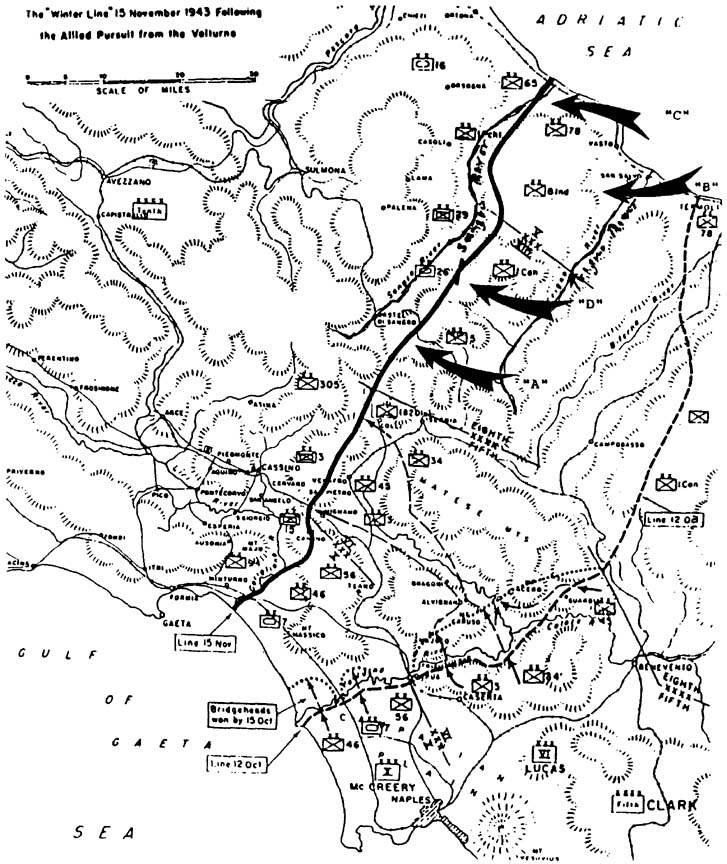
| Map, Trigno and Sangro Rivers, and AFS 567 ACC Platoon Locations From Thomas Hale, The Cauldron---1943-45 (1990) following p. 23. (Note: the Trigno in its lower reaches forms the boundary between the Abruzzo and the Molise Region to the south, as does the Sangro in its upper reaches.) |
The rains and snows of fall and winter turned the rivers and streams into raging torrents spreading across the flood plains between the hills. The terrain was a nightmare for attack, a godsend for a resourceful enemy whose one objective was to delay and hold.
Adding to our difficulties was an epidemic of jaundice --- infective hepatitis; also cases of malaria and dysentery. By November 2, there were 30 cases of jaundice in our 567 Ambulance Company. Our C Platoon commander, Jack Hobbs, and also Jock Cobb and Art Ecclestone were among the first. Tom Hale was down with malaria.
I succumbed to jaundice November 11, and was evacuated to a field hospital in Naples. Jay Nierenberg followed later on. Of our "Lucky 13" fraternity, only Chan, George, John made it through to December 15, when the Platoon was relieved.
In addition to illness, Platoon suffered battle casualties --- one killed, two wounded. A number of ambulances were knocked out. Considering the conditions at the front, and the heavy work load, it could have been much worse.
By October 14 all C Platoon ambulances had been assigned to forward posts moving north from Termoli. C Platoon was in the thick of things until finally withdrawn from the line on December 15 for essential rest and refitting. We served at the outset with units of 78th UK division, which bore the brunt of the attack between the center and coast; subsequently in the push beyond the Sangro Platoon Sections served the Canadian 1st as well as the 78th.
As the rains came, autumn turned brisk following our Italian "Indian Summer." Providentially, our winter "battledress" issue reached us at Termoli, to replace the light khaki "KD" issue which had served well in the summer heat of Africa. And, at Termoli, Jay was assigned as my fellow or "relief" driver with Fox III.
With regard to my eye-witness accounts of my postings from Termoli through November 11, I have found three of my letters written at the start of the campaign during the last two weeks of October, and another dated November 26 after I had been evacuated with jaundice. These had been subject to censorship. I had also attempted short notes about each day, but of these I have found only the record of my last days down to November 11. By then, it had become virtually impossible for me to write down much of anything. In one such note I had scrawled: "no sleep ten days, 60 casualties four days, 36 in one day..."
On November 9 advance patrols had made an initial crossing of the Sangro. My memory of the days and nights between mid-October to mid-November are a blur. I can recall only a few moments or incidents vividly, the rest something of a nightmare leading to a crescendo of day and night evacuations around the clock in November perhaps best forgotten.
For specifics about the action, I rely on George Rock's The History of the American Field Service, as well as the Artese and Nativio volumes cited in: XII "Sources," of the "Table of Contents"; Artese and Nativio are also cited in the first section of this Part VI, "Italy---Sangro and Beyond..."
According to George Rock, all Corps assignments of 567 Company had been made by October 14, with B and C Platoons assigned to 5th Corps. C Platoon was posted with units of 78th Division UK and 4th Armored Brigade. These units bore the brunt of the advance; the 78th alone suffered 7,000 casualties in action from Sicily through the Sangro crossings. We served variously with infantry, tanks, and the artillery.
Montgomery had concentrated forces all along the front with feints in strength in the interior, at the center and along the coast to keep the Germans off balance. At the outset the 8th Indian Division and the 5th UK advanced in the west, the New Zealanders at the center, and the 78th UK from the center to the coast with the 4th Armored Brigade. These locations changed as dictated by operational needs, with the 1st Canadian Division moving up the coast in the final action against Ortona.
After Termoli, the Germans --- contesting every inch of the way --- were pushed back to the natural and man-made defenses of the Trigno River barrier, assisted by the worsening weather. The principal obstacle was the fortified heights at San Salvo at the coast on the north bank of the river. The 78th established a bridgehead at the flood plain across the river October 23, but the initial attack on the heights failed. Action by night November 4 was successful, and the key port and staging area at Vasto, on the coast road just beyond, was secured.. Units of 5 and 13 Corps also crossed the river upstream. The winter line at the Trigno had been broken.
During the advance from Termoli, the Italian people had welcomed the Allied troops as liberators. Their towns, villages, farms, homes --- their very lives --- were hostage to the ravages of the war as it passed over their lands. They endured with stoicism, buried their dead, and lived off the land as best they could. Their young men, escaping from the Germans when they could, became partisans or were trained and formed into armed units to serve with the Allies. One such unit, the "Maiella Brigade" of partisans, operated in the Maiella mountain range of the Abruzzo.
The scorched earth tactics of the Germans, and Nazi atrocities, were too much to bear. Not only were bridges, roads, ports, rail lines, houses and whole villages demolished, but foods and animals were taken, stores looted, men and boys taken into forced labor. On October 5 and 6 there was a spontaneous revolt in the small city of Lanciano, the first such armed action by Italians against the German occupation.
Eighth Army, just beginning its advance north and engaged many miles south at Termoli, could provide no support.
Lanciano, located between the coast and the mountains of the Abruzzo in the hills a few miles north of the Sangro, is the principal city of the Sangro region. The revolt was an act of heroism and desperation. Lightly armed men and boys didn't have a chance against German Panzers brought in to crush the revolt. Twelve youths were killed in combat, another 12 or so captured, tortured, executed. The Germans soon controlled the city, put out the fires and the road-blocks, completed their systematic looting, and gave all residents of the city just three days to take what they could carry, evacuate, and move north.
It was not until December 2-3, 1943 that Eighth Army reached Lanciano across the Sangro and its port city of San Vito. In 1952 Lanciano and its citizens were awarded Italy's highest honor, the Gold Medal for Military Valor, by the President of a free and democratic Italy, Luigi Einaudi.
After the Trigno line had been broken, regrouping, Eighth Army pushed on to the Sangro where the Germans were again trying to anchor their winter line. The advance was over increasingly difficult terrain scoured by German "scorched earth" demolitions, planted in mines, and with heavy rains washing out temporary bridges. German artillery, infantry and tanks were deployed. AFS ambulances were the only ambulances that could get through the diversion at the swollen Sinello stream midway between the Trigno and the Sangro to evacuate casualties from the RAP's, Car Posts and ADS's along the front.
The Sangro was a broader and deeper barrier with higher bluffs on each side than the Trigno. After heavy fighting all along the front, the south bank at the center was reached November 8, and an exploratory patrol sent across the next day. Although units of the 78th established a bridgehead on the north bank, all the newly constructed bridges over the river were washed away in torrents November 23 and the planned attack had to be postponed. Meantime, the Germans had been able fortify the bluffs overlooking the north bank from the mountains to the coast.
The personal vignettes which follow are based upon the slender account of my postings in a few letters and the few memories I have of this major engagement.
I had written on or about October 15 (letter dated October 24):
Jay and I and the Fox III have moved on rather quick notice from the little town of the church bell. We are at a small post with several English fellows now, and our camp is beside a little stone house set in the heart of rolling, ploughed, mist-bathed fields. Last night I bargained with Antonio and Maria (every one over here seems to be called these names) for one of their not too plump chickens for dinner ... Maria cooked the chicken on the open hearth ... corn and peppers were strung up on the rafters in brightly colored strings ... Antonio assured me that he owns his own land (about 5 acres) and so he is a "proprietor."
The "little town of the church bell" refers to Termoli in a way to avoid the cutting of the censor. Some of my earlier letters ended up in ribbons. There was also no way in a letter to identity the British unit involved here, and the nature of the "small post." One device used in our evacuations in Italy was the "Car Post' --- a small post in the run between the RAPs to the next medical station where in between a few ambulances were held in reserve, and one of these would go forward to cover the RAP. The "small post" described in my letter was indeed a Car Post, directed by a British Medical Orderly with Sergeant rank.
The "English fellows" could have been members of a medical dressing station of a Light Field Ambulance (LFA) unit. However, their bulky British Humber and Austin ambulances, without four-wheel drive, little served the difficult tracks of the forward areas and were generally assigned to medical stations to the rear of the lines.
The others of our "Lucky 13" Section 3 and companion Sections of the Platoon also moved up to forward posts.
On October 22-23 one battalion of the 78th crossed the Trigno near the coast and established a bridgehead under the ridge at the town of San Salvo on the north bank of the river.
The bucolic idyll of that chicken dinner of our first night at that "small post" October 15 --- thanks to Antonio and Maria --- was short-lived.
My next letter, a week or so later, tells a different story of my own "fortunes" and those of our Section 3 during the Trigno crossings; I wrote:
As a matter of fact, I have been as busy as hell the past two weeks. I've had a great deal of night work, which is not much fun (no lights of course), and have been up to my ears in mud to boot! .... ill fortune has also plagued our Section the last few weeks. Chan Keller took his rightside door off one night; Johnny Leinbach almost mowed down an unwary pedestrian. Another of us ran into a donkey cart. Saddest of all for me was the old Fox III bang on her side in a deep ditch with all four wheels waving in the night air. We were going up a steep track at the time, pitch black, and Jay was driving (my alibi!). I was taking a cat-nap in the back after having made a run with two stretcher cases. Needless to say, I was rather surprised, and crawled out from the side of the car on my hands and knees. A wrecker hauled us out (at first light) and Fox III drove off as if nothing had happened. I had to drive back, 'tho, to repair a rear spring, and so Art Ecclestone took my place. He came back next day with the gasoline-tank refill tube sheared off, and having flattened a jeep! Never a dull moment in Section 3!
According to this letter, we had continued to work out of the initial Car Post while the front advanced. Fortunately, on that night in the ditch, Jay and I had already evacuated our patients. Aside from the travails of blacked-out night runs on difficult tracks, often under fire, I reported that George Collins had gone off with my Italian Grammar, impairing my role as unofficial Section interpreter. It didn't seem to matter. I wrote that "I have been so busy of late, that the present is quite enough to handle." My days of bargaining for not so plump chickens for our "brew-up" pot, were long gone.
We Drivers were required to carry out a detailed maintenance schedule on a continuing basis, when we could; see "Table of Contents, XI, "Annex." In a third letter at about the same date I boasted of my skills as auto-mechanic; I wrote:
Right now I am being relieved, and am back at the Medical Dressing Station (MDS) for some sleep! I put in a hard day at Work Shops after several nights of work. Incidentally, I know these Dodge 1/2 ton ambulances pretty well, and can manage such jobs as fitting new springs, gasket cleaning, and adjusting the carburetor.
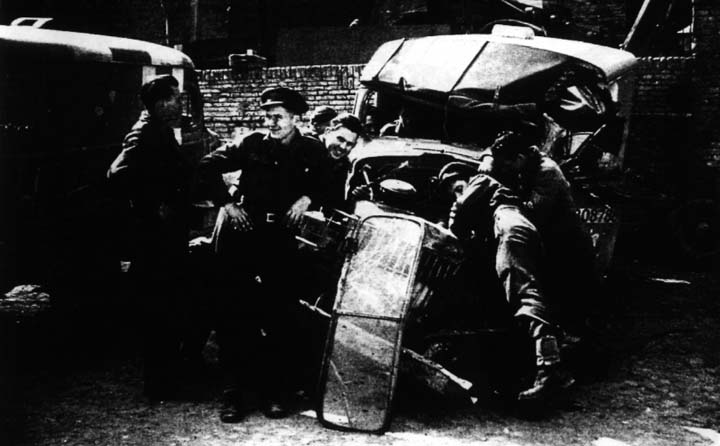
Dealing with an ambulance partially run over by a tank was another matter. This actually happened to Howard Brooke. Fortunately, his ambulance, having rolled over on a hillside, had a canvas roof, and Howard was able to crawl out unhurt..
In the same letter about vehicle maintenance, I reported honing my skills in first-aid:
Even more interesting are new bits of first-aid which one picks up. The sergeant in charge of the Car Post where I have been, gave me some damn good first-aid instruction. A demonstration of the use of Spencer-Wells arterial forceps to tie off an artery was new to me; also the way to inject morphia (which we Drivers are not supposed to do, but which is useful to know --- and done in emergencies). I am going to tell (in my next letter) about the additional first-aid equipment I now carry.
It was early November. Illness, especially an outbreak of jaundice throughout our Company, combined with fatigue, was taking its toll, and our ranks were thinning. I wrote, October 29:
A qualified medical orderly (British) has taken Jay's place, and Jay has a car of his own now. All of us have taken on medical orderlies. We are working on a different set-up than on the desert. Also the Division to which I am attached (78th UK) is a new one to me.
I concluded this letter with a bit of nostalgia, the sense of having become an "old hand," and a dose of ennui:
Your letters make me a bit home-sick. 13 months from home is a record for me. I ought to be getting used to it by now. As a matter of fact, I am rather amused by my attitude towards a fellow who has only just been over here a couple of months! --- "New Boys" we call 'em ... The peoples of this Old World think that America can do the impossible. But of late I have given over giving a damn about what is going to happen ... the present is quite enough to handle.
In my third and final letter written somehow during the campaign, I elaborated upon the first-aid equipment carried in my ambulance, as well as my assigned British medical orderly. This letter was dated October 30 (letter to Mother):
You will be interested in the new bits of equipment I have taken on my ambulance, especially since you are an expert in First Aid. I now carry a Thomas splint and suspension bar, four hot water bottles, drinking cup, bed pan, Gootch's and Cramer's splinting. I have also rigged out a first aid kit with plenty of shell dressings, three triangular bandages, roller bandaging, gauze and cotton, gauze pads, scissors. Some of this stuff I've scrounged from abandoned equipment...
I continued with an account of my British orderly:
I also carry a British orderly who is qualified as a medical orderly. He is a very nice chap whose name is Bill Crabbe and who comes from the Channel Wands. I have been practicing such as putting on a Thomas splint, stopping arterial bleeding, bandaging, splinting etc. The Sergeant at the Car Post where I have been, taught me how to tie off an artery. These medical personal have all seen service as stretcher bearers, which is one of the hardest and most dangerous jobs in wartime. Our Section is working forward out of an infantry M.D.S. at present, and so my work is a little different at times than with the artillery Light Field Regiment back in Tunisia last spring.
Our principal task was of course to drive our ambulances through thick and thin; however, all of us performed first-aid at times, usually with a qualified medical orderly in the ambulance with us, or to assist at a dressing station or aid post.
I wrote further (October 30) --- about missing a bed and home-cooking:
Now that I have several weeks of hard work under my belt, I am no longer concerned with the doubts, and academic issues, that bothered me when waiting. My present mood is that the war finish as soon as possible so I can get home as quick as possible to a real bed and some of your cooking! Right this minute, I hope I can get some sleep and keep clear of this jaundice which so many of the lads have gotten.
Finally I indulged in reflection on "global" and "philosophical" matters, from the perspectives of mud and battle in a remote comer of Italy:
Although I haven't the energy at present to bother one jot about what is going to happen with regard to a future type of internationalism, I am in a position to more truly benefit from your words about the League of Nations and your expression of the last attempted peace settlement .... I have lost touch with organized forms of worship for the reason that I am unable to understand the meaning of church in time of war, and because some of the human expressions of it don't impress me. But my one prayer, aside from for those I love ... your thought ... to live in relationship to a belief that is more than a code of ethics and is built on faith in the goodness of things, to live that in time that belief becomes you ... but not quite yet, for it makes me want to wash my hands of the jumbled mess mankind has made of things and retire to some quiet farm near the sea, or to a campus like Bowdoin,
During war, thoughts of parents and others especially dear, are always closely held. In this same letter to Mother dated October 30, 1 concluded that "if I achieve true peace and patience and humility, I will give it no name like "Congregational" or "Episcopalian" for I shall have learned it from you, and from Dad, and from "Larlie" (a much loved and very special Uncle), and shall have worked on it myself."
These bare words --- even after more than a half century --- of thoughts of those held most dear bring to life the sense of the imminence of death each of us experienced during a fiercely contested battle when death was all around and our own lives were on the line. In particular, my words repeated in these letters to the effect that "I have given over giving a damn about what is going to happen ... the present is quite enough to handle..." equally reflect the impact of the very present risk of death we experienced.
In his review of my manuscript --- a half century after these events --- Jock Cobb wrote to me about these lines:
This thought, "that the present is quite enough to handle," is repeated. I think it is a very important observation about how AFS Drivers, like the soldiers they worked with, were forced by the horrible dangers and need for continuous activity, to block out their hopes for the future. I can remember thanking, "there won't be any future, so why even worry about it?"
With the first crossing of the Trigno (October 22-23) and the tortured advance to the Sangro 15 to 20 miles beyond, the battle was in full tide; three British Army Corps were engaged all along the line from mountains to sea, and the Germans were putting up a fierce resistance abetted by weather and terrain. On November 4 there was a major attack by night, which reached the port town of Vasto about five miles beyond the Trigno, with evacuations back to San Salvo.
The Allied advance reached the Sangro on the night of November 8 after continuous fighting night and day. According to Giovanni Artese's account, the right bank of the Sangro was now controlled by units of 78th Division from Paglieta to the coast (about eight miles). Patrols had crossed, with an initial crossing in strength near the coast prepared for November 10. At the same time, units of 13th Corps, including 8th Indian, Canadian 1st, and New Zealand Division, were also advancing on the upper Sangro. However, heavy rains, floods, and. washouts, as well as the need for fresh troops and supplies, caused a temporary delay in this plan to cross the Sangro in strength and advance north.
Our assigned aid stations moved up with the advance. By November 7, George Rock reported that C Platoon postings were established near the south bank of the Sangro with 11 ADS. at Scerni and 217 ADS at Torino di Sangro, and 14 LFA farther back near Vasto. Evacuations back to CCS at San Salvo were long and difficult. All the bridges had been blown; temporary Bailey bridges were often washed away in flood. The engineers constructed earthen "diversions" across streams such as the Sinello north of Vasto, but only AFS ambulances of the medical vehicles could manage the horrendous mud of these.
Fox III took part in this advance. In my letter dated October 30 I wrote:
Five mornings ago (i.e. October 25) 1 drove out from the little farm house near the RAP where I had been on Car Post duty. It was a crisp October morning...
Bill Crabbe, my British orderly, came "on board" shortly thereafter. There would be little or no rest for me during the next 16 days, until I was taken by jaundice November 11. I wrote no more letters as the battle increased in intensity, and I have found only the final page of brief pen-and-ink notes made on a scrap of paper during the battle.
I will quote these notes verbatim at the conclusion of this section. However, I managed to write two letters on November 26, from my hospital bed, while my memory of events was fresh; both letters were written to sisters back home.
One of these letters gives a rather light-hearted account of spectacular "wounds" suffered by Fox III (my ambulance), which nevertheless continued to perform yeoman service regardless. This account is a tribute to the amazing durability and resilience of our Dodge ambulances in World War II. The other letter is a sober and dramatic account of preparations affecting one infantry unit during the night attack on the Sangro itself, November 7. I quote from both these letters:
First, then, there follow passages from my letter about my faithful and sturdy ambulance, "Fox III":
Since your sense of humor is as profound as any one's, I shall tell you of woes that befell me during the first two weeks of this month (November) when the Fox III started to disintegrate (almost) at a most difficult time. First came the crumpling of Fox III's back step. Fox III and I had returned to our post after the night Jay put her in the ditch (Fox III sporting two new springs and two new oil-seals); and, on an especially dark night, were being led down a trail by a sergeant walking ahead. We took a wrong turn, which I recognized as such, so asked the sergeant where he thought he was going? He said he didn't know! (Are all sergeant's you know that dumb? don't answer). At any rate I had to back up --- and that proved tragic to the back step, for said sergeant guided me into a mud bank. Fox III had a perfectly proper back step, which hangs down on hinges quite proper for going forward, but doesn't function when one goes backwards. And thus the back step bit into the mud bank à la steam-shovel, and bent itself gracefully under the car. Every time I tried to climb in the back way henceforth, I barked my shins (with appropriate words directed towards the species "sergeant." You'd be surprised how one can cuss when one is just beginning to feel jaundiced!).
My letter continues:
Next obstacle was a shell hole in the road some days, or rather nights, later. Visibility, of course, nil. One wheel crashed in it (with appropriate chorus of groans from the patients). The effect on Fox III was rather amazing. The blow bent the various rods and levers from the accelerator peddle to the carburetor (of all things), and so, whenever I pushed down on the peddle, it stayed down. and the old engine roared its protest. It was most difficult to change gears, as it was impossible to "double clutch." I drove the rest of the trip down, and back to my Section, with one hand yanking back the accelerator every time the engine went into a dive. It was quite simple, next morning, to bend the various levers back into shape. But I had memories of a hectic drive.
Next parts to disintegrate were the various levers and arms running from the starter peddle to the starter motor. Step on the starter --- no response. A cursory inspection under the hood revealed that several bolts connecting the levers had disappeared. I had no spare bolts with me. It was quite "simple" to start the car, however: set the various things inside, leap out, throw up the hood and press the starter arm down with one's hand. Fancy this, on a cold morning, or in the event of stalling in traffic. One would have to be a "whirling-dervish." Fortunately, Fox III didn't stall very much.
Another minor thing to add to my woes, was the heater-gauge, which refused to work, along with the starter peddle. At the same time, I noted that the fan-belt was cracked. In the event that it broke altogether, I had no heater-gauge to inform me that my engine was boiling. I lived in apprehension that a fate similar to yours (when the oil mysteriously ran out from your car last summer, and the drain-plug "undid itself") lay in store for Fox III. Fortunately the recalcitrant fan belt held together, although I used to switch the heater on and off quite often to try and determine engine temperature that way.
As the campaign progressed, the oil-change became over-do; but by that time I had enough trouble dragging my weary, jaundiced frame about, without wrestling under a mud bespotted ambulance. Besides, where would I find sufficient oil, stranded as I was on the barren and muddy hills of "sunny" Italy? Anyway, visions of grit, and scarred cylinder-walls, kept haunting me. As you can imagine, it was a relief to deposit weary Fox III back at H.Q. and workshops, and give myself up to the mixed pleasures of British hospitals.
My second letter, also from my hospital bed and dated November 26, records setting up a Car Post, together with Chan (Keller) near the south bank of the Sangro November 7; and a meeting with the Commanding Officer of several infantry companies preparing for an attack at first light the next morning. It provides a dramatic contrast between the stark inhumanity of the circumstances of war on the one hand, and moments of warm human feeling on the other hand despite of such circumstance.
I find myself becoming "acclimatized" to sheets, bed, hot baths, etc ... Sometimes I lie in bed of a morning and shudder at the thought of the past two weeks of this month, during which I had about one solid night's sleep; of the cold and the mud, and getting up after an hour's catnap to go on a run. I shudder most of all when I think of November 7, although that night was also a pleasant memory. Major Pepper helped make it so. I shall tell you about him.
That night Chan Keller and I drove up several miles, across one diversion (probably at the Sinello beyond Vasto) to set up a Car Post in preparation for the RAP/ADS, as an attack had been planned for the early morning. We reached the location, a large stone farm-house near a cross-roads --- and after we had dispersed our cars behind hay mows and various farm buildings (tanks were also thusly dispersed as Jerry happened to be shelling that cross-roads from our flank) we walked over to the farm house itself. Our aim was to find the thickest, highest wall the place would offer, and bed down "in the lee" of it.
We located a solid wall, and Chan, with his customary playfulness, was wrestling with a tiny Fiat automobile, pushing it out of the way of the wall. He made a hell of a clatter, and then a fellow came out of a wooden door in the wall behind us and asked us (rather politely under the circumstances) what we wanted! We told him of our hopes about bedding down against the wall. This particular farm house had been chosen for the night by several companies of a famous infantry Battalion, which was to take part in the attack the next morning. The men were sleeping about, wrapped in their great-coats and single blankets, in the spacious cellar rooms of the farm house.. The fellow who had so mysteriously appeared out of what had seemed part of the wall, explained the circumstances to us, and introduced himself as Major Pepper. He was CO of that group of men. "Come in for a drink" he said. It was cold, and we needed no second invitation.
He took us into his "command post" --- a sort of wine cellar built under the front porch of the house. It was underground, tunnel shaped, built of cement. We couldn't have been in a safer place. One candle, on a table, delivered a cozy light, rich with shadows on all the corners.
My letter continues:
The light revealed our host's face to be most kindly, tanned, and with bushy black mustache above even teeth ... his smile was friendly and his laugh warming. He soon poured out a good snifter of army rum for Chan and me. British army rum is excellent stuff, and the most thoroughly potent stuff I have ever had. I was soon warm. The rum is issued to men before they go into battle. [Note: Giovanni Artese reports that on November 8-9 78th Division in a major attack reached and controlled the right bank of the lower Sangro down to the coast].
We must have talked for a good hour --- until the candle burned out --- about many things. Home, places visited, our war experiences, the present campaign and its objectives, how soon the war would be over. Of the officers who had shipped out from England with the Battalion (1,000 men) Major Pepper was one of ___ remaining (the number of survivors was cut out by the censor). [Note: casualties among the infantry officers and company commanders were very high].
He was proud and confident of his men. "They're good lads," he said in his quiet manner, "it only takes them ten minutes to get up and on the move. All I do is blow the whistle." Sure enough, just before first light next morning, the chaps had eaten and filed off, Indian style, quietly, Tommy guns, rifles, and bayonets in readiness. They carry a pack for mess tin, canteen, emergency rations, blanket and ground sheet. Standard fighting equipment is rifle and bayonet, although about every fifth man carries a Tommy gun. In winter it is army boots, battledress and greatcoat (tough, warm, wool); and tin-hat of course. I suppose you would call this traveling light in any man's army!
Major Pepper's company as well as his rum, was warming and friendly. An occasional shell would pass overhead as we sat talking together, or sipping our drinks, but in our underground tunnel we paid it not the slightest attention. For us, a shell singing overhead was like a whistling wind when one is inside a sturdy log hut with a great fireplace blazing with forest wood. It performed the same function, and simply increased our relative warmth and comfort. This hour was simply an interlude sliced away from the war.
My letter concludes as follows:
As I stepped outside the little warm room into the cold night, a fellow ran up in a jeep calling for an ambulance. The last shell to pass over our farm-house so harmlessly had wounded two soldiers at another farm behind us. As I left to pick them up, Major Pepper called "I'll see you again --- but not in your ambulance!"
The attack starting at first light that November 7th reached its objectives in the next three days: control of the south bank of the lower Sangro. It was led by such gallant British Army officers as Major Pepper. There was an initial crossing of the river near its mouth November 9, and there would be another major continuation of this campaign in December. I often wondered if our generous friend had survived this, and gone on through the war, to return to his beloved England. I never saw him again.
It had become impossible for me to carry on after November 11, because of jaundice, although I had tried my best to keep going.
I conclude these memories of my own action during the Termoli to Trigno-Sangro campaign, with the verbatim text of pen-and-ink notes set down on a scrap of yellowing paper I found years later in my attic. Of six pages, only the final two remain:
Nov. 8: Nap in wine cellar of farm, arrival at A.D.S. Jay with Chan, John, Bernie --- view of snow on mountain, "brew up" of cocoa and near-miss as shell zoomed over car, loss of cocoa cup, more tanks at crossroads and more shelling, patients at ADS.., hesitant trip across field to cook-house, 210 shell lands in back yard. glass broken (chicken killed!), move to Scerni at night in rain. (Note: #11 A.D.S.. moved up to Scerni on Nov. 7, a few miles south of the Sangro). Trip to San Salvo (30 miles round trip) at night in rain across diversion --- arrived 1 A.M. News of John Leinbach accident at night --- ambulance dropped off 15 feet.
Nov. 9: Advance party at Casalbordino (east of Scerni ), rain, bad diversion across river, quarters in print-shop, definite signs of jaundice, night shelling of town
Nov. 10: Bridge still out, rain, Italian. family at print shop, help given by Bill Crabbe.
Nov. 11: Jaundice, self evacuation across diversion despite of mud back to 18 CCS Termoli. Hardly any sleep ten days, 36 patients one day, 60 patients 4 days, attack reached Sangro on the 9th, advance patrols cross Sangro, lull in battle for next assault and new troops --- objective Ortona, Pescara and road to Rome.
After my own demise with Jaundice November 11 a major phase of the battle would continue on down through December. The successful Sangro crossing in strength was delayed until November 27-29 because torrential rains and floods had once again washed out the Bailey bridges. It was fiercely contested by the Germans from the high ground of the bluffs along the river, one of the most difficult engagements of the war. Vern Preble, first of our Drivers across the river Nov. 28, was killed when his ambulance was demolished by a mine.
The offensive continued through December, reaching another ten to fifteen miles beyond the Sangro at Ortona on the coast and Orsogna in the interior. The Platoon continued in the advances across and north of the Sangro despite manpower shortages, until it was relieved for much needed rest and refitting December 15. The Platoon was withdrawn for this "R and R" to the hill-top village of Pollutri south of the Sangro. As we all gathered there during the Christmas season not far from the snow-covered mountains, it provided one of our most pleasant Platoon interludes.
Weather and exhaustion forced Eighth Army into winter positions by early January 1944 and the offensive on the east was halted. The Gustav Line, although turned at its terminus at the Trigno, then at the Sangro and at Ortona, had held.
As for me, after as arduous and danger-filled month as any I had known, on November 11 I gave up my body --- in its yellowed, derelict and depressed state --- to jaundice. Jock Cobb advised me later on that "melancholia" is the Greek-derived word meaning "black bile," which is what makes you yellow in hepatitis.
Although not necessarily life-threatening, the type of jaundice (infective hepatitis A) that reached epidemic proportions with our own AFS 567 Company and, indeed, all army troops, was debilitating and required a rest and a "fat-free" diet before recovery. I was evacuated to a British, then an American Army Hospital in Naples, and could not rejoin my Section and Platoon until the end of December.
In the following Sections of this Part VI. "Italy, Sangro and Beyond...," I narrate my treatment for jaundice, Platoon action beyond the Sangro illustrated by Jock Cobb's photographs, my return to the Platoon at Pollutri, and our interlude there.
Jock Cobb had returned to the Platoon in late November from his own bout with jaundice, and participated in the final weeks of the Sangro campaign up to December 15. Ortona, about 15 miles beyond the river, had been reached.
Jock recovered in time to take over an ambulance for the final two weeks of Platoon action beyond the Sangro up to December 15, as attested by his dramatic photographs which follow. Art Ecclestone was eventually evacuated to the United States. Alas, Jock was not able to take photographs of his experience as a jaundiced patient in British Army hospital care, with the exception of a self-portrait of himself and Art. However, he gave me copies of his letters as a patient, including an account of a truly bizarre bombing of his hospital ship! I quote from these, and from my own letters and experience, below.
From the point of view of the soldier, jaundice came as a mixed blessing. The disease is not usually life-threatening nor overly painful. It is debilitating, with nausea and fatigue accompanied by yellow skin and yellow urine. But for its victims it was also an escape from war: from the mud; the fifth; the constant danger; the crushing action without rest or safe haven or nourishing food. I remember how thrilled I was to sleep in a bed; to have clean sheets, and a hot bath. Aside from a daily dose of "salts." the cure was rest and good "fat-free" food. After two weeks in the British 92nd General Hospital in Naples, I learned that in most cases the cure was rest, the "good food' being left to the imagination. My imagination became very lively after a diet of canned salmon and tasteless porridge. Fortunately later on the doctor ordered a two-week's convalescent leave for me, to recover from the lingering effects of the sickness or, perhaps, from the three weeks in the hospital.
These three weeks in the hospital were the most I spent as a patient during the war. As an ambulance driver, I had been close to the medical side of the army. I had carried many men to the reception tent or building of a score of Army Medical Units. But I had never been "on the inside" in the literal sense: been a patient or casualty, been laid out on a stretcher or bed while an efficient nurse hurried past or stopped to take my temperature or worse. The idea of it had been appalling. But there was no alternative. I had jaundice.
So it was that, in order not to tie up another ambulance, I managed to drive myself back Company HQ at Termoli, and was carried on from there to the 4th CCS at Foggia for evacuation from the airbase by plane to Naples.
Ruefully, I gave up my battered ambulance "Fox III"; then gave up my body, with an infinite sense of relief, to the good graces of the 18th Casualty Clearing Station, Termoli. I had seen the battle of the Trigno to its conclusion and then on to the Sangro itself and the occupation at the south bank. Chan Keller and Jay Nierenberg were still in the mud where I had left them near Scerni on the south side of the Sangro valley. I did not have a guilty conscience about my enforced "desertion," not even when I was carried gently to a real bed (i.e. army cot) and had snuggled between sheets for the first time in fourteen months. For me, the war had temporarily become a closed chapter and I tried to force thoughts of it from my mind.
I had hoped to escape infection from jaundice (infective Hepatitis A), and continue with my Section and Platoon throughout our participation in the battle of the Trigno. and the Sangro. Never had we of the "Lucky 13" and C Platoon been in such demand or faced a greater challenge than in this battle. When our exhausted Platoon was pulled out on December 15, we had broken British Army records during the months of October-December for most patients carried the greatest distance with the fewest ambulances --- and doubtless under the worst conditions!
I kept going until November 11, when my bout with jaundice, complicated by fatigue, became too severe for me to continue. I was evacuated by hospital plane (November 18) to Naples (92nd British Army Hospital) for what became treatment and convalescence through December.
As reported above, the Sangro had been reached on November 9 by units of the 78th UK Division and supporting armored brigades, and its southeastern bank near and along the coast was occupied. For the next two weeks there was a delay in the advance on account of heavy rains washing opt bridges and diversions; also the need to bring up supplies and combat units all along the Sangro line from the mountains to the sea.
In December the battle continued across and beyond the entire Sangro valley with as great, or greater fury, than before, and in conditions of rain and snow. Ortona on the coast at the eastern terminus of the Gustav Line was taken, about 15 miles north of the Sangro, but at tremendous cost. On December 15, C Platoon was pulled back to the hill town of Pollutri, south of the Sangro.
I had written in a letter from. Naples that I had been forced out of this action by my jaundice infection. I was not the first, or the only one to succumb. George Rock in his History... reports an "epidemic" starting with more than ten percent of the Drivers of the four Platoons of our 567 AFS Ambulance Car Company out of action at a given time. By October 12, there were 30 cases in a makeshift "sick ward" at Company HQ, Foggia: the number increased to 40 by November 7, plus other cases of malaria and dysentery.
Of our "Lucky 13" Sections, Jock Cobb and Art Ecclestone among the first with jaundice were evacuated by hospital ship down the coast to Brindisi, leaving Termoli October 16. Our Platoon Lieutenant, Jack Hobbs, followed in early November. Tom Hale was down with malaria. Somehow, assignments to medical posts were maintained.
The speedy evacuation system helped me to do this. All cases whose medical cards read "not urgent" were promptly cleared out of the battle zone by ambulance, ship, or plane to be deposited at one of the Base Hospitals some distance from the front lines. There is a story about one such case, a fellow with a slight wound in the arm. Hurried and harried doctors kept sending him back down the evacuation line. By the time he had reached North Africa the wound had healed.
I was not sent this far. Instead, a kindly Major shipped me off to Naples on an ambulance plane. Next to the first hot tub baths since leaving home, this was the most exciting experience of my sickness, and it was my very first flight on a plane. Those army ambulance planes were stripped down DC-3's with metal bucket seats along each side plus stretchers at the center. To add to the thrills, the pilot banked the plane through a river gorge between the mountains of the Italian spine, and then soared above a sea of clouds pierced by snow-streaked mountain peaks. As I peered through one of the port-hole windows, the plane's wing was gently flapping up and down. The clouds thinned as we neared Naples, and endless mountains stretched north and south, with towns and cities tucked away in pyramid valleys deep in shadow.
I elaborated more fully upon my spectacular evacuation by plane between rather than over the mountains, in a letter (to "Dad") written on November 26 from my hospital bed in Naples, writing in such a way to avoid the censor's scissors:
In one of my evacuations back to General Hospital I was carried by ambulance plane, the same type of plane you used to hop from NY to Washington when Mother wasn't peeking! After a smooth take-off from a field where many types of planes were parked, we flew low over farms, with fields in different colored squares, and white farm houses with red tiled roofs. Instead of going over the cloud-girt mountains, we went right between them, following a winding river valley --- almost a gorge in places, with water tumbling down between steep tree-lined banks. Beyond this first row of mountains another wide plateau of farm country opened up. This time we looked at the land from a greater height and could see a whole town at a single glance. The sun, shining through the clouds, formed a path of running silver on the many bends and curves, twists and turns, of a river.
For the most part we sailed above a sea of clouds. All was clean in this world, and this ethereal cleanliness somehow invested the earth itself --- for mankind's cities, roads, towns, houses and fields seemed to be a neat perfection. As the clouds thinned, we passed between two peaks and could catch sight of the sea beyond. One mountain was black against the rising sun, with a great bank of clouds piled up against it. On the other peak, one could almost make out the individual stones and a small tower on top of it. It was bastion to an endless chain of mountains, dropping off abruptly along the coast.
I continued, in the amazement and wonder of my first flight:
Day had not come to some of these valleys as we could see the lines of shadow that ran out to the west... A wide sweeping plain curved beneath us and to our left a solitary mountain backed by its plume of constant cloud rose as if from the sea itself, and several spurs of mountain went out into the sea. (Note: I intended to depict in this way the bay of Naples, its islands, and Mt. Vesuvius). We circled the airfield four times... We made a perfect landing, and the lorry that bounced and jounced us across the muddy field told us eloquently that we had doffed our wings and come down to earth's crude method of transportation .... Would that that airfield had been Boston, and the end of long journey home for me, home for Christmas!
Jock Cobb had a different, and even more exciting story to tell in his own matter-of-tact way about his illness with jaundice. He and Art Ecclestone saw a hospital ship in the harbor and thought evacuation to a distant safe haven would be preferable to the Company sick ward at Foggia. They persuaded the Medical Officer, a "good sport," to let them on board at Termoli October 16. The supreme irony of it was that the ship was bombed from the air that evening, and their destination was a run-down maternity hospital at Brindisi many miles down the coast. This whole episode of the hospital ship. he wrote, "was more comedy than tragedy, a story of the irony of war."
His account in a letter written a week or so after the events, is more opera bouffe than operation of war:
Jaundice --- tried to stick it out but turned bright yellow and felt lousy and got sent down the line. Hospital ship lying off Termoli. Art Ecclestone and I going together said let's give it a try ... and a new adventure began to loom in our minds. At the CCS we tried to play officers but it didn't work... we let it go that we were civilians without rank and a fat jovial doctor thought it was a joke... and said we might go on the hospital ship.
On the windy dock we were each given a red cross package with wash rag, handkerchiefs ... cigarettes. I felt funny to be on the receiving end of medical comforts, and to be riding in an ambulance instead of driving one. They got us and our kit with eight lying patients in a small boat ... On the way out Gen. Montgomery and some Brig. coming in after visiting the hospital ship. He waved in a friendly way and we waved back --- the way you might wave to someone in another yacht on the Maine coast.
They hoisted us right up on davits and got the lying patients off right on deck. Very neat but I'd hate to be a patient with a broken back in a heavy sea.
Jock's letter continued:
The ship was the St. Andrew, a small channel craft run by the RAMC ... the Colonel a pleasant, elderly man... We got down to our quarters, a corporal with the list ... we had trouble making them believe what we were. "American Secret Service?" he said studying our cards. "No, Field Service ... Well, it sounds like Secret Service to me with no rank and no number."
I got a wonderful wash in hot and cold running water in a basin ... One of the MO's came in to wash his hands and talked casually to me about operations he had just finished on three German prisoners of war ... He knew about the Field Service and told me they brought some of the lads back from France in 1940.
I was lying in my bunk and wondering why it was only 6:00 PM but my eyes were heavy, long day ... Crash Bang! I thought maybe they dropped one of the landing boats on deck. Then again Crack Snap and people began climbing out of their bunks. The orderly said "all right, everybody get a life jacket on," and I thought what the hell it's just a false scare. There wasn't any alarm signal ... I didn't have to ask, but I got down and put on my coat and life jacket ... Art was putting on his life jacket. I began to think what I could take out if the ship did go down, decided to take my camera and enlarger.
I moved over to Art ... He looked ready to jump ... I thought the noise was something on deck, what did he think? ... he forced himself to say "thought a bomb." ...But sure enough the corporal told us all to get our kit and go up the companion-way. It ... broke up the nervous tension ... The ship could hold 400 patients, was carrying only 70. The idea was to get up nearer the boat deck.
The doctor and nurse came around wearing their life jackets and tin hats. I couldn't see what good a tin hat could do. So I went to sleep. A great rustling stir woke me up. Rushing water! I thought, and saw people running, the orderly diving under a bed .... Somebody said "it's steam, shut it off!"...and I went back to sleep. During the night I vaguely heard the anchor being lowered and hoisted and in the morning we were out in the open sea ... Talking with one of the ship's crew I learned that we had come into Barletta the same night there had been an air raid going on at Bari. They suspected Jerry was dropping mines in the harbor, so we steamed on to Brindisi, sailing all around to use up time until dawn.
After reaching Brindisi and before going ashore, this same member of the crew told Jock about the bombing; Jock's letter continued:
I asked him about the bombs. He said two planes had been circling over us for half an hour in the dusk. Then shortly after the lights had been turned on illuminating the Red Crosses they dove, dropping four small bombs. He said the ship had been bombed six times, but this was the closest they had come. One bomb, landing within 50 yards, had blown out the starboard lights. I couldn't believe it was that close... I had never seen nor heard a bomb land in the ocean before ... He might have been stringing me a line. We walked off the ship into an ambulance,
Jock's and Art's treatment for jaundice continued for a month at the hospital in Brindisi. Only field rations had been available at the hospital --- bully beef, biscuits, jam and tea; they couldn't have the beef because of the fat and were given glucose to counteract weight loss. They were released for a week's sick leave on March 21, and hitched a ride on army transport to Bari --- one of southern Italy's principal ports on the .Adriatic. There follow some accounts of his experiences in the hospital and at Bari:
Writing on November 11 from the hospital:
As you know, I am in the hospital with a mild case of jaundice. The treatment is nothing but rest and fat free diet. It seems to be contagious, but as far as I can make out, nobody knows much about it. Art Ecclestone came down with it while we were at the same post. He is in the bed beside me now and we have a pretty good time playing chess together ... and laughing at the strange ways of the hospital.
Continuing in the same letter:
Today is armistice day which used to mean quite a bit to me when I was a kid and used to think of everybody all over the world standing for two minutes silence, and we all used to stand around the flag at haft mast at school and shiver with the tragedy of it all. It's a great thing here in the hospital to have a real mattress and springs and sheets and electric lights and hot and cold running water, hot bath, meals served in bed ... I had my teeth cleaned the other day by a genial dentist. He put in a filling and X-rayed my wisdom teeth which he said will be alright until March anyway... It's a funny thing being in a hospital. I figure I haven't been in a bed like this for seven years ... I've done pretty well to keep going for a year without any trouble on the food we've been eating and the rather unhealthy life we've been leading ... I think I'll be back on the job in a couple of weeks anyway ... I think I may get some convalescent leave ... depending upon how hard up they are for men at the time.
Sure enough, on November 21, Jock wrote:
Here I am out of the hospital with clear eyes, a spring in my steps, but pretty weak still after twelve days in bed. So I'm taking a sick leave which I think I will spend in Bari; probably with Art Ecclestone who got out of the hospital at the same time as I did. We plan to get a little room with some family where we can learn Italian and get the feel of their way of life. Then there are movies to see, a symphony concert, and perhaps an opera or two. The weather is getting colder now, so I doubt if we will do much swimming.
Jock had a few observations on the Italians under conditions of war:
It's been exciting enough in Italy, places I have never seen before, but I do remember the crowds of children ... The places where there has been heavy fighting are hard hit. But even there, I am continually amazed at their buoyancy. Nothing really puts them down. I was impressed to see the Italian women coming every day to put flowers on the British graves in the square of the little town I was in.
The major problem during the weeks of evacuation and hospitalization was food, Jock wrote on November 21:
Food was our greatest difficulty. We became known all over the hospital as the two fat-free yanks who would eat anything they could find.
One of the Italian girls who helped around the hospital made great friends with Art because he spoke Italian to her and he's such a handsome fellow anyway. She used to smuggle cakes and things for us, to fill up the chinks in the long hours after they woke us up to take our temperature...
Jock also supplemented the hospital fare with some cocoa, coffee and powdered lemonade "we got from the Americans." And then after discharge from the hospital. he and Art celebrated the Thanksgiving season of their sick leave by "eating like kings..."; he wrote November 27 after Thanksgiving:
We had a real stuff-down drag-out Thanksgiving dinner with a huge turkey we bought thanksgiving morning, wine, spaghetti of course, green vegetables ... chestnuts, walnuts, almonds, apples, olives, macaroons, and plenty left over to have turkey again on Friday --- and so full we couldn't think of having supper. Art and I are boarding with a genial Italian woman who really can cook --- plenty of garlic, pepper, and spice! Spaghetti every day. I haven't eaten so well since we landed in Egypt. Opera this PM and back to duty tomorrow. Feeling great!
My own treatment for jaundice continued in Naples on through Thanksgiving 1943 as well as the Christmas season of that year.
Although in Naples and by no means recovered from my own bout with the yellow jaundice, I too was able to celebrate that Thanksgiving of 1943. At Foggia CCS, while awaiting evacuation by plane to Naples on November 18, I had been assigned to the officer's ward. In Naples, in the much larger 92nd General Hospital, I found myself with the NCO's and in an American ward. Our British comrades-in-arms never knew quite what to make of us of AFS, at least in the rear areas. Hospital routine commenced with wake-up call at 6:00 AM, followed by wash and shave, and making the bed. Then breakfast, although I had little appetite for this and especially its British Army version.
In hospital on the morning of Thanksgiving, November 26, 1943, 1 wrote that "I started the day off with a hot bath, which continues to be experiences in luxury for me. I have now had three tub baths since leaving home --- all in the last two weeks." Despite my jaundiced condition, I explained in this letter that "I hope to get out of the confines today for the purpose of scrounging a Thanksgiving dinner at the other AFS Company (485) whose location happens to be next door. Several of their lads are in this jaundice ward with me, and they have assured me that all rivalry will be cast aside on this festive day..."
My efforts paid off, I wrote on the next day:
My efforts at scrounging a turkey dinner were completely successful, for I was a guest of our fellow AFS Ambulance Car Company (my own Company is some distance away), and got permission from the Doc to go outside the hospital and walk the few yards to where the dinner was being held. Unfortunately, at the precise moment dinner was served, "sunny Southern Italy" proved true to form and rained down in sheets of the most miserable rain I have ever encountered. I now know too well what it means to "see Italy, and die." Despite of its dampness, dinner was excellent. Hot soup, real tender turkey in vast quantity, dressing, corn, potato, cranberry sauce, and several other nondescript foods which somehow ended up on my dixie, plus fruit, cake, apple pie. As usual, I ate too much, and was all too willing to return to my warm bed. To cap the climax, the hospital produced several slices of cold turkey for lunch today! They must have been shamed into doing it by those "spoiled yanks."
As in Jock's case, hospital food --- or perhaps the lack of it --- was foremost; I wrote:
Unfortunately in my present condition of "fat free" diet, about which I kid the hospital staff by calling it "food free," mine is a hunger fearful to behold. Jaundice also has the effect of making one melancholy, and even more home-sick than is customary.
I continued my musings:
In one of these lingering Hamlet-like moods, my home-sick thoughts turned to food. All sorts of dishes, meats, feasts, salads, sea-foods paraded in my imagination past my hospital bed in savory numbers...
Food, too, ran high in the intra-ward debates we jaundiced ones carried on with each other. About all our English fellow-sufferers could muster to their side would be a "good" brew of tea, roast pork, mutton, or beef, potatoes, "fish and chips," and "duffs." We soon outflanked their insular array of "good things to eat" with oysters-in-the-half -shell, lobster, chicken fried Southern style, corn flakes with cream and bananas, pie a la mode, corn on the cob, cape scallops, and assorted fruit juices.
Nevertheless, after two weeks or so in the hospital, I was recovering and on December 3 wrote that "I am to be discharged from hospital next Monday morning, and will be commencing two week's convalescent leave at that time. AFS has set aside an Italian villa for a club, and for purposes of convalescence, since a goodly proportion of our personnel have jaundice." AFS would also soon move its General HQ from Cairo to Naples. The villa or club, located appropriately on the Via Tasso in the elite Vomero section of Naples overlooking the magnificent harbor, featured an excellent Italian chef. Here I relished his "gniocchi di patate" garnished with genuine Parmesan cheese. Not far from the club, one of the celebrated Funiculare carriages led steeply down to the principal Corso, the Via Roma, with its shops, restaurants, theaters. Here I undertook Christmas shopping, and discovered the lovely San Carlo Opera House, where I sat spellbound as Beniamino Gilgli sang Rudolfo in Puccini's Boheme. This remains my favorite of all the treasury of Italian opera.
Via Roma, running east-west, terminated in a piazza at the majestic Via Caracciolo which circled the entire harbor. The piazza was dominated by the Romanesque Cathedral of Naples. Inside, an ornate reliquary contained dried blood of San Gennaro, Patron Saint of the city. Once a year this blood turned liquid and alive. according to the Faithful who never doubted this, one of many miracles of Italy.
Naples had been severely bombed. Vesuvius was erupting. But none of this seemed to allay the ebullient spirits, bonhomie and joie-de-vivre of the remarkable Neapolitan people whose authentic boast is "see Naples and die." A host of images come to mind of my first stroll through the streets and along the harbor: happy throngs in the streets, baths, movies, concerts, opera, dark-haired Italian beauties, tempting side-walk cafes, strolling minstrels, soldiers on leave. I could not help but reflect on the paradox imposed by war, that a mere 50 miles or so to the north the fury of battle was raging all along the Gustav line; that young men were dying and in terrible conditions of cold and mud. Despite the festive facade, the ominous undercurrent of war could not be forgotten.
The highlight of my own convalescent leave was a few days spent on the island of Ischia with three other fellow AFS drivers on convalescent leave from jaundice. Ischia on the north side of the Bay of Naples, and Capri on the south, are the two jewels which crown this glorious Bay and its city marching up the surrounding hills, all under the brooding watch of Vesuvius.
We went over by one of the frequent ferries that ply to Ischia and Capri from the ferry depot, staying at one of the small hotels requisitioned for British Army leave. The mineral baths at Ischia featured the island's thick sulfurous black mud in which one became totally encased, lying luxuriously in a stone tub. We explored the ruins of an old Norman castle on a point jutting out into the sea, reaching it by horse-drawn carriage. The rest, quiet, and good food was just "what the doctor ordered." On our return to Naples, we passed small fishing boats and tiny harbors, as a glorious sunrise from behind the dark mountains sparkled the great bay. At the same time, December 15, my fellows of "Lucky 13" and C Platoon, had been pulled out for rest and refining in the hill town of Pollutri to the south of the Sangro where I would eventually rejoin them.
My return to the Platoon was delayed, however, by another round of hospital care, this time in an American hospital, the 300th General in Naples. On December 18 I was admitted with a severe case of "ferunculosis" --- a fancy medical name for boils. Large and painful, they erupted like small volcanoes in my neck, back, and one ear. I wrote, on January 1, 1944:
During my convalescence I got worse instead of better, due mostly to boils which interfered with my sleep quite a bit. I managed admission into an American Army hospital this time, if only at the prospect of American rations which are better than the British. The hospital was a beautiful place, well run, and it was truly swell to be in a ward with some "yanks" for a change. The fellows were from all parts of the States, and we had lot of fun together. Frank Sinatra came by. The Red Cross put on shows for us, and there was carol singing and a party for Christmas, and a real turkey dinner to boot. Needless to say, where things of the stomach are concerned, CPE got in good favor with ward-boys and nurses and managed to wangle "seconds" and even "thirds." I put on about ten pounds in the ten days I was there... I also got issued a pair of GI OD pants, which are quite snappy looking. While in the hospital all kinds of tests were made of my blood etc., and it has been definitely determined that I am now the picture of health, and await anxiously transport back to Platoon C and Section 3, and expect to be with the fellows again in a few days. I am most eager to do a good job these next two months, and I guess there is plenty to do.
In my notes about my experience with my fellow Americans, I was impressed with their generosity, native openness, good humor and simplicity, as they shared with me their stories of action on the front --- especially the terrible conditions of the fighting at Cassino. Some thought the "unconditional surrender terms were a mistake. Their admiration and support for President Roosevelt was boundless. There was, nevertheless, criticism of the Italian campaign, as well as of the alleged discontent and materialism at the home front, and of the strikes by labor unions, as well as pressure groups --- farm, labor, cattle --- trying to raise prices.
We avidly sought news of the home front when we could get it during the war, and my mail from home included copies of Newsweek from to time. Good news from home was a morale booster; bad news the opposite. In my letters home I commented on Roosevelt's leadership to organize and administer the war effort, and to enlist "hard-headed" liberal business-men such as Donald Nelson, Stetinius, Harriman in this effort; also his experience in working with Churchill and Stalin. Coming from a rock-ribbed Republican family background, I wrote that "in the event I get a vote this time, I may vote for FDR (such heresy in the Edwards family!" ).
I was discharged from hospital a second time on December 30, to "await transport back to Chan Keller and the others," as I wrote. Jay Nierenberg was on hand at the AFS villa. Jay had been my shipmate going overseas and "charter member" of our Lucky 13 fraternity, and also my fellow Driver at times. We called him "Jay-bird" in tribute to his rich tenor voice and warm disposition, and it was wonderful to see him again with news of our Lucky 13 Sections, and the advance beyond the Sangro. Several ambulances had been destroyed. Two Drivers were wounded. But there was the terrible news that we had lost Vern Preble, one of our dearest friends and fellow Drivers of our Lucky 13 fraternity, killed when his ambulance was destroyed by a mine.
While together in Naples, Jay and I had haircuts, lunch, and as I wrote, "attended a really well done presentation of Lucia de Lamamoor at the San Carlo." Of my experiences at the San Carlo while in Naples I had written:
You'd be surprised how civilized it feels to wander about in the corridors during the intermission and sip hot chocolate at the bar... you can just bet that I am in a mood to sop up good music like a sponge ... The contrasts of this life I am leading are almost too complete. From slit trench to Grand Opera in one easy jump!
Jay also helped me track down an address in Naples of the offices of a certain Signor Bianchi, a representative of the Pastene family business. We found it all right. All that was left of it was a pile of twisted steel, tired looking cement, and dust. It had been blown up, along with many other office buildings, by the Germans before leaving Naples. I learned from a neighbor that Signor Bianchi had escaped to his country home near Salerno, but came by occasionally to look for records, furnishings, etc.
Before obtaining transport back to C Platoon at Pollutri, Jay and I celebrated New Year's, 1944, at the AFS rest-home villa. It was an unusual variety of fire-works tacking place among the ships and gun-crews that we watched from our vantage point above the harbor.
I wrote in a letter home January 1, 1944:
Jay and I celebrated New Year's together here at the AFS villa. Ours was a quiet celebration, warmed by some champaign produced by one of the fellows, Henry Jones. We stood at the window and listened to the deep-toned sound of ship's horns from the harbor, and watched as the gun crews put up a scattering of red tracers into the sky from the Bofors guns. There were also flares. No, soldiers do not forget New Year's Eve by any means, and there was probably more light right here than in Boston ... Jay is engaged to marry Inge, a young German Jewish woman who left Germany and came to live in Palestine as part of the movement there of Zionism. After she left, her parents and sisters (of a wealthy and ancient German family) were placed in camps where they have died I believe. Inge has been driving trucks for the British Army for the past few years in Egypt. I think her marriage to Jay, a young American, is a unique and hopeful thing of this war.
My sick leave terminated January 1 as the new year began. Jay and I obtained transportation overland back to our Company HQ (at Casalbordino) and to our C Platoon HQ (at Pollutri). Both were historic hill towns, separated only by a deep valley, and midway between the mountains and the sea south of the Sangro River. We drove across the mountains then up the coast via Foggia, Termoli, across the Trigno, and San Salvo and on, remembering passages under fire in the previous months.
At Pollutri, where our exhausted Platoon had been pulled back on December 15, we all came together once more, billeted under the tile roof of a spacious traditional Italian villa. Our "veteran" Lucky 13 and Unit 26 Sections of the Western Desert and the Battle for Tunisia, together with those joining us at Tripoli, had become truly a "band of brothers" as a result of the Trigno-Sangro experience. All in all, the Platoon rested at Pollutri until January 24 and it was a happy time for us, as we cemented our own friendships for all time, and were deeply touched by the warmth and generosity of the people of this quaint town centuries old perched on its hill top.
But first, before recounting our Pollutri experience, I will have to backtrack to pick up the final action of the battle that raged as Eighth Army crossed the Sangro and advanced beyond.