My return from Naples to Section 3 and C Platoon, had been a sentimental journey (of sorts). The winding road led across the spine of Italy, then up the Adriatic coast and back into the foothills of the high Apennines to the hill-top town of Pollutri. We traversed in a day terrain from Termoli to the Sangro that had been contested by two great armies inch by inch in the previous months.
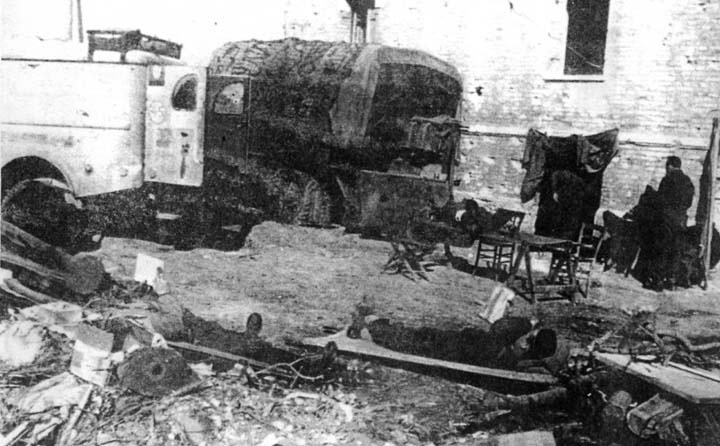
The Platoon had been pulled back to Pollutri on December 15. Here I received a royal welcome, and a briefing of the heroics of my fellow drivers during the fury of the battle of the valley of the Sangro and beyond. There follows a summary of these accounts; also remarkable photographs of the battle taken by Jock Cobb, who had returned to active duty on November 29 after his bout with jaundice.
First, it is necessary to review the course of this final phase of the Battle of the Trigno and the Sangro, as Eighth Army attempted to complete the strategic battle plan to outflank the German Gustav Line. In the final two weeks of November the advance stalled after the Sangro had been reached, because of torrential rains which again washed out the bridges; also the need to bring up supplies and to reinforce the troops at the front. Then, in the first two weeks of December, the battle to cross and advance was joined.
The New Zealand Division was brought into action at the center, and the 78th Division and its armored brigades, reinforced by the 8th Indian and then the Canadian Divisions, continued to bear the brunt of the attack all along the front from the center to the sea. All Sections of C Platoon were assigned forward posts with British and Canadian forces.
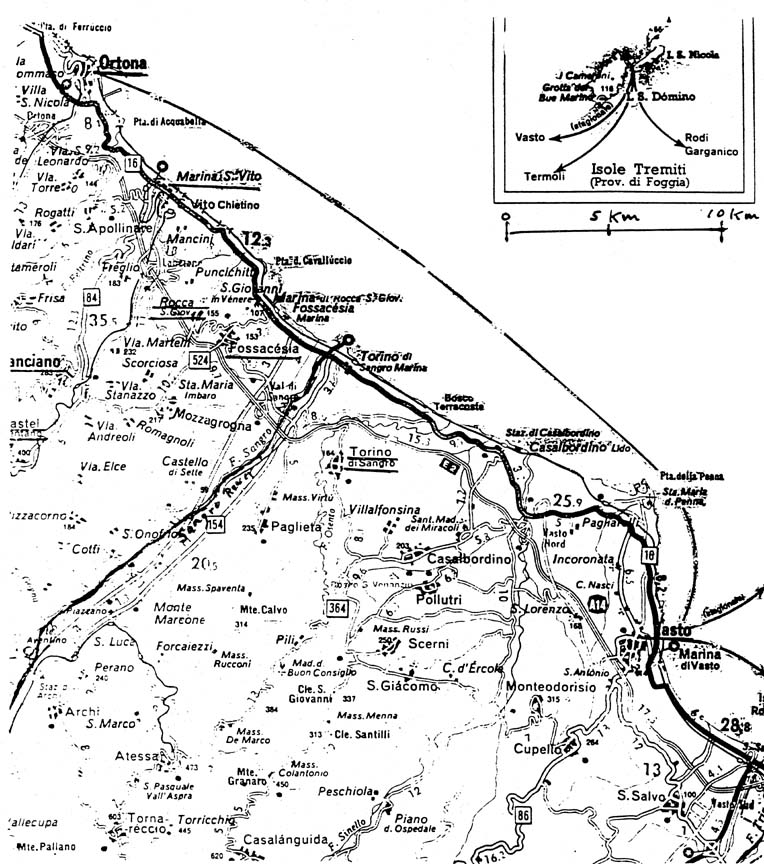
Although the flood plain itself If was lightly defended, the Germans were bringing in reinforcements from the Russian front, and had dug in on heavily fortified positions in the steep bluffs and hills that lined the river beyond, The action involved San Vito, Fossacesia, Lanciano, Mozzagrogna, Castel Frentano, and other hill towns from the coast to the mountains. Fossacesia, on one of the main roads through, was flattened.
The accompanying map, next page, shows the course of the river and these strategic locations, as well as Ortona up the coast and Orsogna fifteen miles west of Ortona.
Preceded by a withering artillery barrage, and with attacks from the air against German formations beyond the valley, it took three days of intense fighting to breach the German lines along the bluffs and hills between the coast and the center of the region at Mozzagrogna. Flanking action by the New Zealand and Indian troops in the interior secured the entire valley from the mountains to the sea. Large amounts of German ordnance were captured. The winter line was again. broken at its terminus, and the Germans forced to retreat. All in all, there had been more than 6,000 Commonwealth casualties in the Trigno-Sangro campaign.
On December 3, troops of the 8th Indian Division entered Lanciano, the principal city of the Sangro valley region. Led by the Mayor, who unfurled the Italian flag, a welcome was staged. There were toasts in wine, using real glasses. It was a bitter-sweet time for the Lancianese, who had attacked the German occupation on their own in October and suffered reprisals.
The Canadian Division along the coast now took up the offensive from the exhausted and decimated 78th UK Division. Their immediate objective was the port city of Ortona, fifteen miles up the coast from the Sangro delta, and it was hoped to reach Pescara beyond and the main road to Rome by Christmas. At the same time the New Zealand Division moved against Orsogna. They could not break the fortifications there despite of repeated attempts. Orsogna would became a no-man's land until the eventual break-through by Eighth Army the following June.
In late December the Canadians finally occupied Ortona and a few miles north of the city. but at frightful cost and unable to continue the advance. The Germans had dug in at the city, and here they stood, blocking the advance on Pescara.
The ferocious Ortona battle was comparable to Cassino and Stalingrad, but on a smaller scale. Demolitions, bombings from the air, artillery barrages, tank battles in the streets, house-to-house and door-to-door combat reduced much of the city to rubble. There were 2,000 civilians killed, caught in the houses or unable to escape to the caves or mountains, and an equal number of soldiers killed --- Canadian, German. It was unprecedented for General Montgomery to take such casualties in any action, so well did he plan and prepare, so strong was his concern for his troops.
The most intense fighting shockingly took place on December 24, 25, 26, 27 --- the Christmas Season, 1943. On December 28 there was a stunned silence. Ortona had become "the city of the dead."
On December 31, General Alexander, the Allied Commander Central Mediterranean, called off the offensive, and General Montgomery left for England to command the 21st Army Group preparatory to the Normandy invasion. In Italy General Sir Oliver Leese, a Corps Commander in the Battle for Tunisia, replaced Montgomery in Eighth Army Command.
Ortona marked the furthest advance of the Battle of the Trigno and the Sangro. A blizzard and high winds on December 31 worsened the already intolerable conditions. Transport, tanks, and men were immobilized and "everything came to a halt" --- a fitting close to the long and bitter Trigno-Sangro campaign along the Adriatic
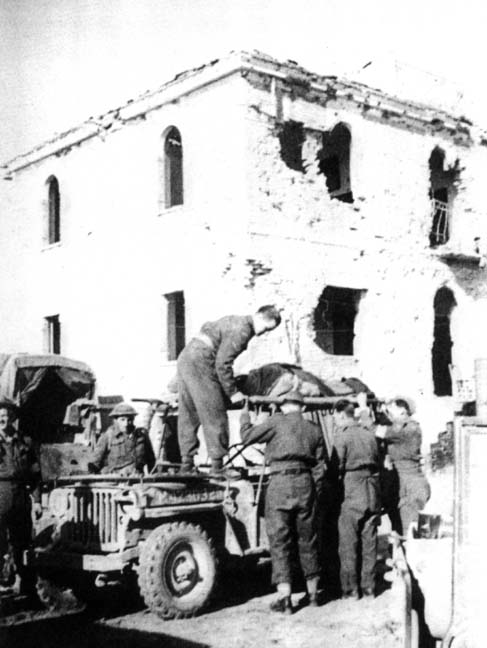
When I rejoined my fellow Drivers of C Platoon at Pollutri at the beginning of the New Year 1944, they had recovered sufficiently from their trial by fire to render anecdotal accounts with a light-hearted twist to conceal the fear and the shock. Considering what they had been through, and the freak accidents or close encounters through which most had survived, it could have been much worse. And as before, most of the evacuations were by night with no lights, under fire and atrocious driving conditions in mud and rain.
Indeed, at Naples in December I had received from Jay Nierenberg a foretaste of the action by our Platoon across and beyond the Sangro November 28-December 15. Jay told me for example how he had managed to haul several casualties from a burning ammunition truck. And for the first time I learned the details of the agonizing death of Vern Preble as explained below.
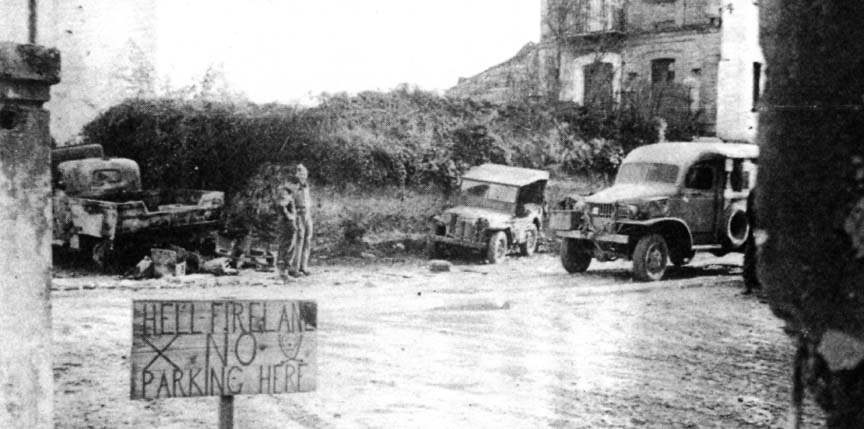
John Meeker, one of our "elder" war-horses, and his ambulance with tour casualties, dropped over a 30-foot embankment, rolling over six times. Miraculously, none of them was hurt. "This trip ain't deluxe" he told me. Chan Keller told about driving through "Hellfire Ally" out of San Vito where six ambulances were hit. George Collins told of the devastation at Fossacesia, mined and blasted by the Germans where seven ambulances were hit by shrapnel. We weren't "just washing our dixies" he quipped.
A mortar bomb had landed smack in the middle of the red cross on the roof of Bob Orton's ambulance. He was outside carrying stretchers, and escaped injury. Shrapnel punctured Tom Hale's ambulance, including making a jagged hole in his driver side window and grazing his wrist. Denny Hunt, another of our elder "warhorses," told of diving into a ditch during a barrage outside Fossacesia. Denny started collecting stones, apparently for additional cover. When George Collins shouted to ask why: Denny replied "just picking some peppers." Bernie Wood found himself ahead of the infantry one night, and quipped "just waiting 'till they catch up with me."
In all, 17 out of 31 cars were hit; and all ambulances risked breakdown in the mud. or tipping over, in the "world's worst" diversions across the swollen rivers.
Tom Barbour was wounded by shrapnel from an antipersonnel bomb; and on November 29 Ralph Beck was more seriously wounded by mortar shrapnel; both were able to return to action fairly soon.
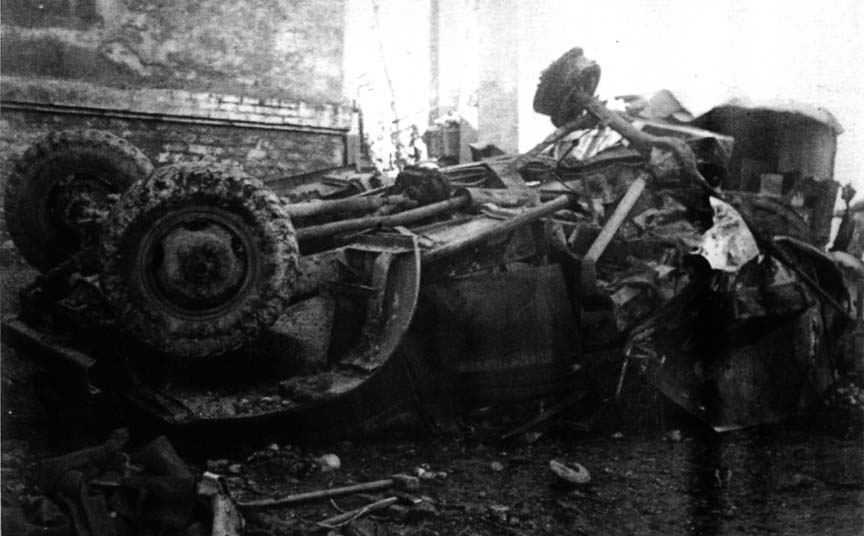
There could be no return to action for Vern Preble. First to cross the Sangro November 28, his ambulance struck a German box mine near a farm house on the north side of the river. An anti-tank mine made of wood, it had escaped detection by the sappers. His ambulance was demolished. He was mortally burned in the explosion, and died four days later. It was a terrible shock for the Platoon.
We called him "Preb." He was loved by all of us of the Platoon, and especially we of the "Lucky 13" and Mideast Unit 26. 1 felt especially close to Vern as both of us had twin sisters at home. After the war, I visited Vern's sister and mother.
Vern shipped out as one of our "Lucky 13' fraternity with Jock and me and the others of E Deck, HMS Aquitania. We trained together in Lebanon and Syria; made the long trek out to Marble Arch on the Western Desert; then to Tunisia and through the Battle for Tunisia. We had been together in those halcyon days of our "Summer of '43" at Tripoli, and on to Taranto, Termoli, the Trigno, the advance to the Sangro.
My own elegy for Vern is expressed in my poem "Preb," and in the initiative I took with the Platoon after the war to design and create a plaque to his memory at AFS Headquarters, New York City. These are included in the "Annex" of this
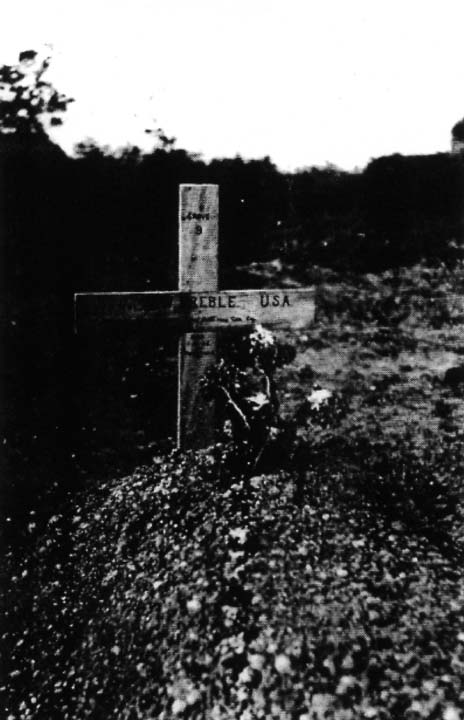
For Jock Cobb, Vern's death had been a wrenching first-hand experience. Jock had returned to action just then, and took the photographs which follow of the demolished ambulance, and of Vern's temporary grave near Lanciano. Jock also managed to visit Vern at the hospital.
Writing to me July 10, 1996, more than a half-century after it had happened, Jock remembered the details so great was the impact of Vern's death:
He backed over a German wooden tank mine that had been missed by the Sappers because of containing no metal. His ambulance was flipped over, and caught fire. He was fatally burned, lived a few days. This was a tough time for all of us. I can remember my feelings of hoping he would live and somehow knowing he was dying, and not wanting to visit him in the hospital with this attitude. That was my denial. I think we all experienced it, and it was not possible to write home about it, both because of our denial and because of military censorship; and we didn't want to worry our folks. It worried me plenty, and I was darned careful ... and darned lucky.
During war under conditions of combat, the prospect of wounding or death was a constant presence in the mind of each one of us. But when it had happened, and to one so close and under conditions all of us had faced one time or another, the impact was personal and profound.
Jock, and his camera, were indeed back in action, and he wrote with measured understatement on December 6, 1943: "I'm back where there is work to be done and have had a few exciting times since I last wrote! He added that "I didn't get my old car back, but took over from a chap who was slightly wounded; and so I'm not in the same old bunch any more, but that makes no difference since we are all moving around so much now."
The fighting invested heavily populated areas involving homes, farms, villages, cities, as well as the very lives of the people. Jock wrote with sensitivity of the plight of civilians caught up between the two contesting armies, and he was amazed by the resilience of the Italians; he wrote in this same letter of Dec
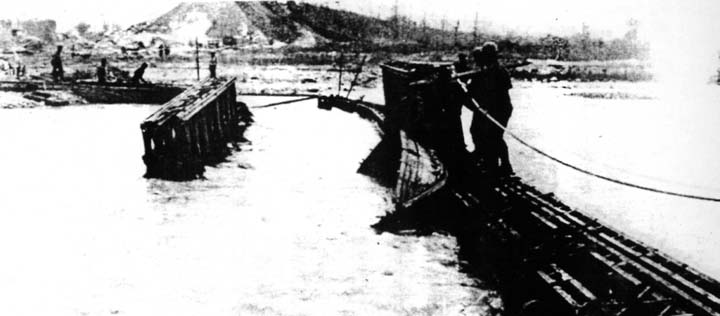
Things are pretty grim here for the civilians, but I am constantly amazed at the Italians' ability to take it with a smile. I helped a bunch of refugees across the river a while back. As usual there was one old man in the crowd who had been to New York and thought America was OK When I began to take pictures of the poor destitute barefoot bedraggled and broken band of refugees, they all posed with their broadest grins and laughing eyes. I had to make them all look back across the river to make the picture convincing and not look like Tony's family down for a picnic on the bank.
As the four Platoons of our 567 Ambulance Car Company advanced in the forward areas, 567 HQ brought up the rear --- moving by December 8 to the hill-top town of Casalbordino south of the Sangro. Our Company CO Major Arthur Howe, a true AFS Veteran of ME Unit 2 and Alamein, had led us through the battle for Tunisia and on up across the Sangro; he had to be relieved of command by Major Snead for reasons of health, and was replaced by Major Charlie Snead. Art returned to the United States to recover, and he continued to lead in AFS activities during and after the war.
But so much for words. It is a cliché, trite, but true, that "a picture is worth a thousand words." Jock's photographs which follow speak for themselves. They are some of the most dramatic and poignant of the war as to the portrayal not only of the of the soldier, but also the civilian, the terrain, and the desecration wrought by war.
The photographs follow the approximate chronological order of the offensive. Jock is not altogether certain as to the correctness of some of the captions, having --- as he wrote to me in July 1996 --- "blocked out almost all of my memories from the push across the Sangro to Ortona, which was so horribly torched by shell fire and bombing, both ours and theirs..."
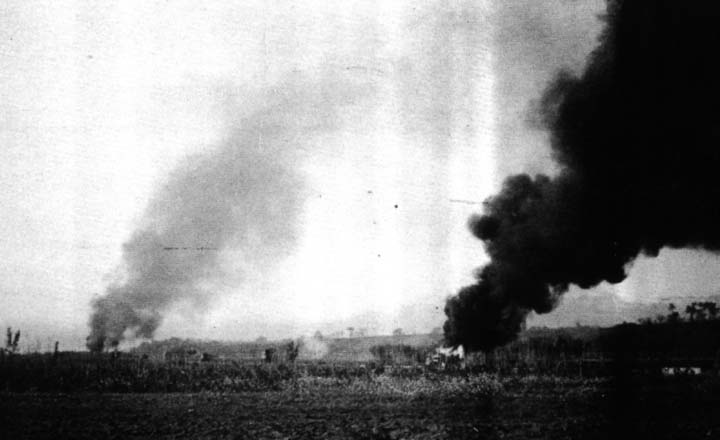
Jock had written to me that he "had blocked out" almost all of his memories, except "those memories that peek out from the pictures..." About this photograph he explained: "That was when the road I was on came under enemy fire. I stopped, ran out into field, and lay in a ditch with my helmet ... looking up at the sky. I actually saw a mortar bomb coming towards me (and you know you don't see them unless they are headed pretty much right for you). Luckily it landed just beyond me. Others were failing all around. I think that is when I took this photo ... after the enemy fire had stopped. The ditch in the foreground is where I had been lying. My ambulance was OK."
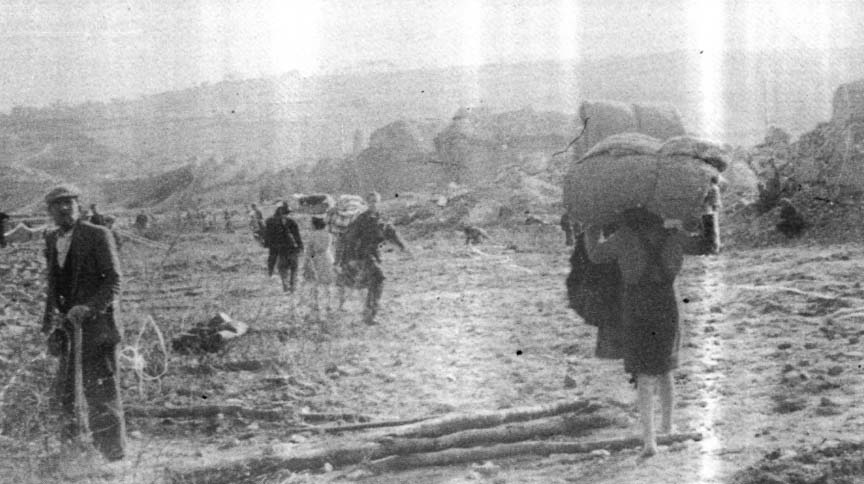
This photograph reminded Jock of "the long lines of civilian refugees fleeing across the Sangro to safety (?), carrying whatever things they could on their heads."
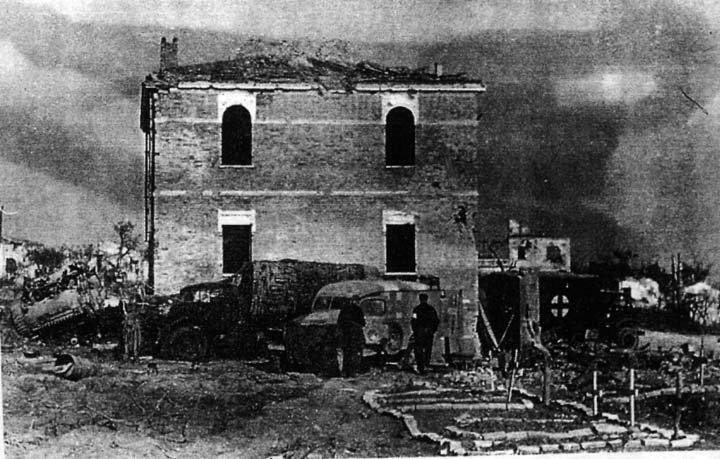
First of us across the Sangro, Vern Preble's ambulance was blown up by an anti-tank mine, November 28, 1943. Vern, mortally wounded and burned, died four days later. The ambulance was totally destroyed.
Vern's body was laid to rest in a temporary grave near Lanciano, north of the river; and has been removed to a permanent grave with thousands of his fellow Americans at the lovingly tended American Sicily-Rome Military Cemetery, Anzio-Nettuno, Italy.
 |  |  |
 | 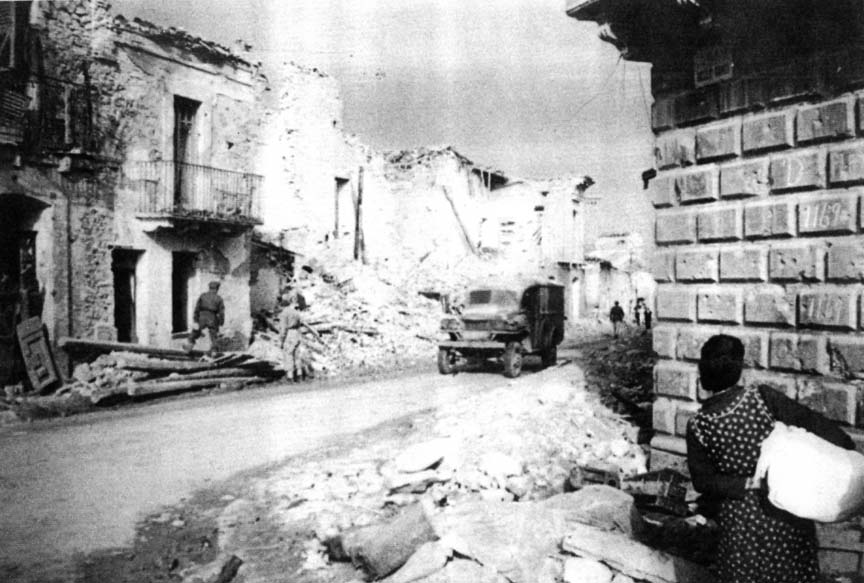 |
Jock noted that the house on the right was about the only habitable place in a town which used to hold 5,000 persons. It was used as an AFS billet after the town was occupied.
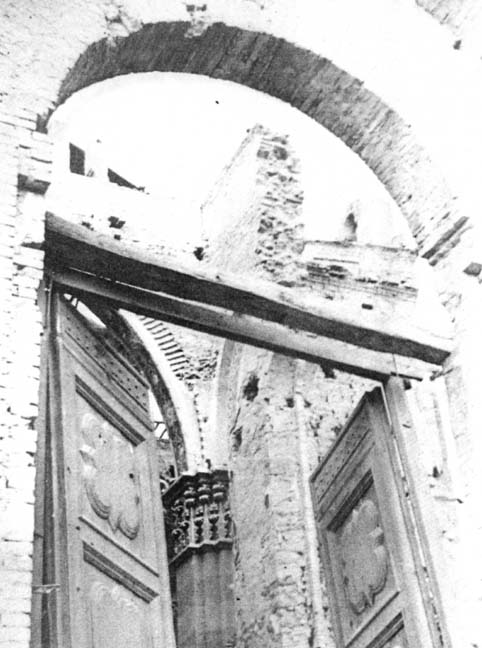 | 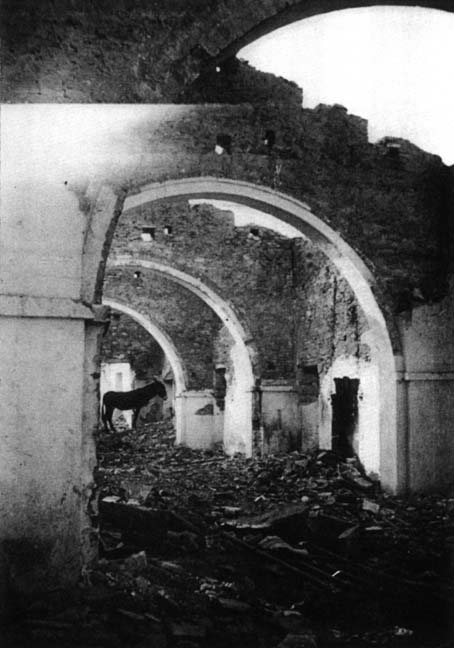 | 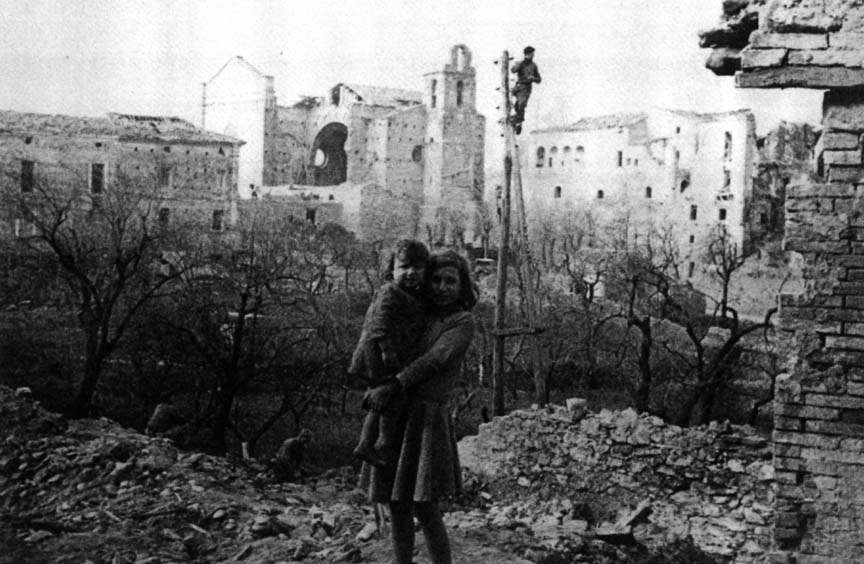 |
Note the "remains of a stable" according to Jock, but probably a "fancy residence reduced to rubble. It might have been an office building. The donkey had just wandered in, giving a note of absurdity to the place."
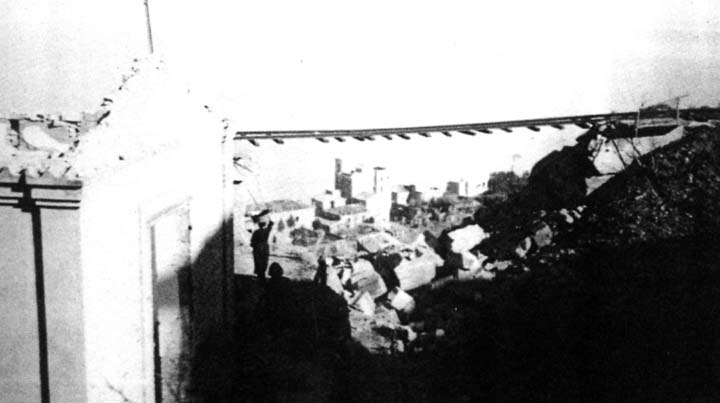
German scorched earth demolition destroyed the entire 160 kilometers of the regional rail system serving the villages and cities of the Sangro Valley. This system tied in with the national rail network of Italy.
 |  | 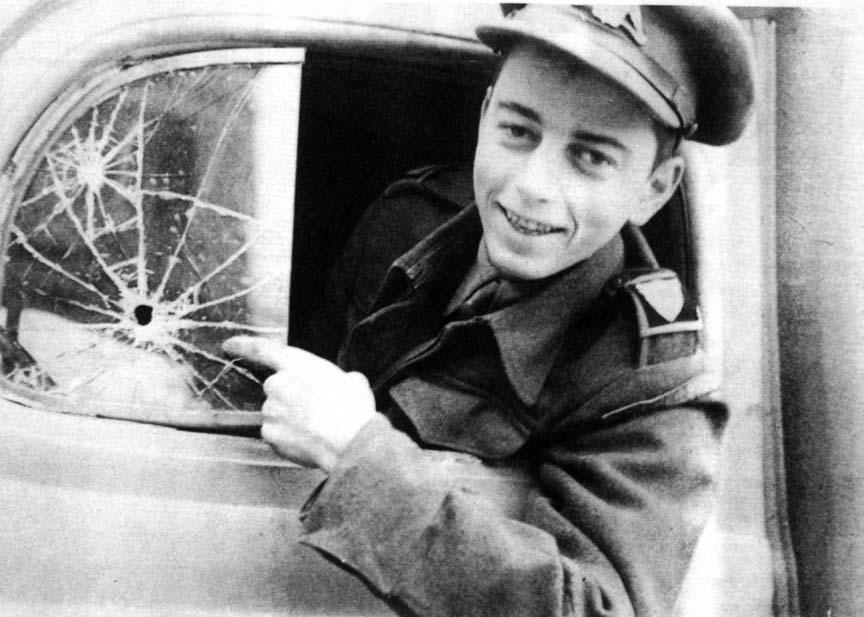 |
Tom Hale had a close shave one night on a difficult evacuation under fire from San Vito north of the Sangro. The bit of shrapnel tore his sleeve and shattered the instrument panel leaving a neat hole in his side window panel. This action is covered in his own Memoir of his AFS experience, The Cauldron --- 1943-1945. Tom had been one of the first across the river.
 |  |  |
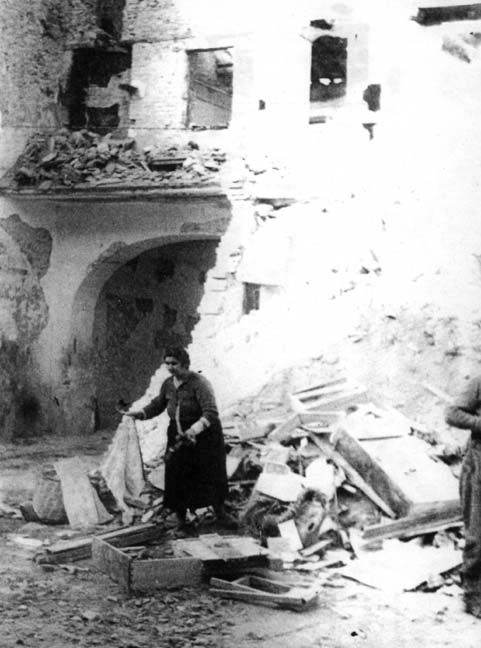 | 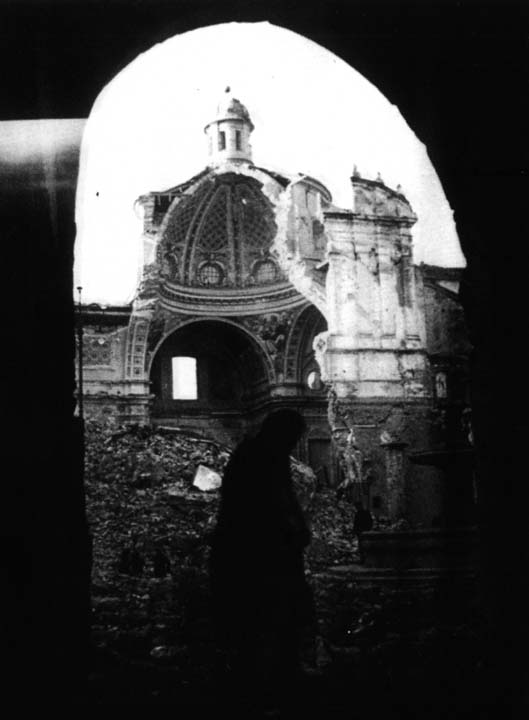 | 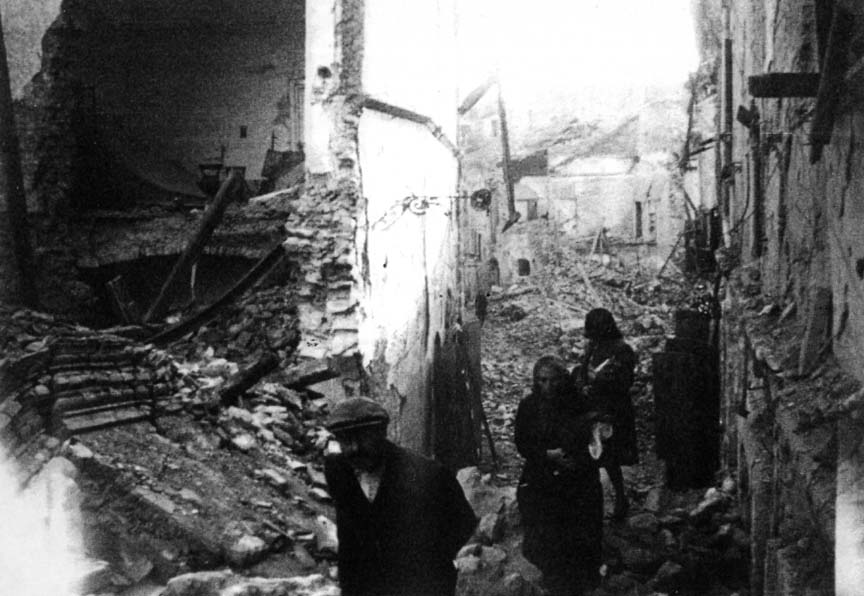 |
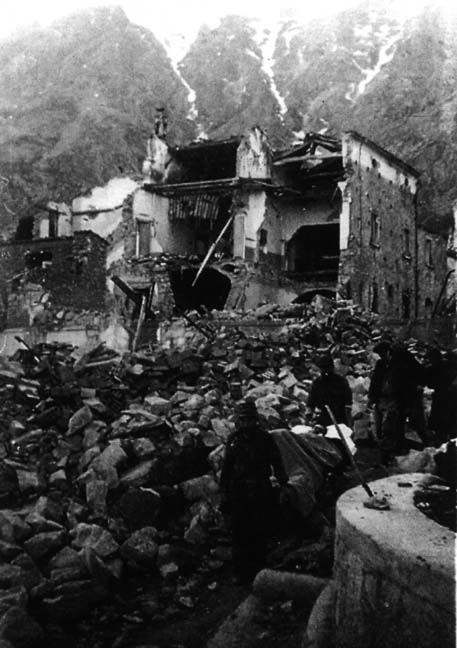
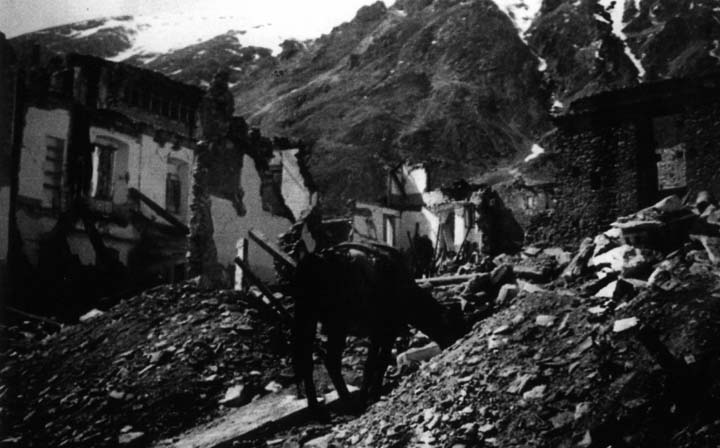
German scorched earth demolished all structures of the villages along the one roadway that skirted the Maiella massif in the interior, effectively closing off this western passage from the upper Sangro to the Pescara-Rome highway. In March 1944 Jock Cobb was posted to these villages in the final month of his AFS duty before returning to the United States to enter Medical School.
The "Maiella Brigade" of the Italian partisans operated against the Germans in these mountains. The Brigade was commanded by Ettore Trillo, who would become Prefet in Milan after the war in a free and democratic Italy.
My own Pollutri "R & R" commenced at the start of the New Year, 1944, when I rejoined the Platoon from Naples. On December 15, 1943 C Platoon had been pulled back to Pollutri, one of the many small hill-top villages of the Abruzzo interior south of the Sangro. At Pollutri our Platoon "found itself," became one "band of brothers." This spirit continued throughout the war and on after the war, as attested by our many postwar reunions; these are listed in the "Annex" of this Memoir.
At Tripoli, our "Summer of '43" there had been a bonding, but the Platoon had only recently been organized as a unit of 567 Ambulance Car Company, and there had been many comings and goings, departures and arrivals. Harry Hopper and Jack Chaffee of our "Lucky 13" left AFS. And such Platoon stalwarts to be as Bob Blair, Sterling Grumman, Tom Hale, Clarence Reynolds, Whit Bell, Dunc Murphy, Skip McKinley, Luke Kinsolving, Tom Barbour, Denny Hunt, John Meeker, Bernie Wood, Fran Everett, Fred Wackernagel were newly arrived from the States or transferred to us from other Platoons. To be sure, we of the "Lucky 13" had survived the wrenching experience of the Battle for Tunisia, but the newly formed Platoon as a unit had not.
What made Pollutri the defining experience for us was that we had participated in one of the most difficult battles of World War II in Europe, the Trigno-Sangro offensive. In retrospect, for us there would never again be a battle experience as extensive and wrenching as this, with as many casualties. We had experienced as a Platoon the same bonding we of our "Lucky 13" Sections experienced in Tunisia. In one sense, C Platoon had "swallowed up" those of us of "Lucky 13; yet, in another sense, the Platoon itself had become an extension of our smaller fraternity --- the "veterans" of HMS Aquitania, Egypt, Syria/Lebanon, the Western Desert, Tunisia. And the events of our stay in Pollutri, as reported below, provided cement for these bonds.
My return overland to Pollutri was for me a sentimental journey of sorts. We retraced in just three days on winding roads from Naples through Foggia and Termoli those weeks in October and November of arduous battle. I had covered this ground and more, only to succumb to jaundice as the south bank of the Sangro was occupied. Before reaching Pollutri, we stopped at Termoli, then across the Trigno and on to Pollutri about five miles south of the Sangro.
Here I received a royal welcome, especially from my "Lucky 13" fellows, and from the entire Platoon "old" and "new."
The feeling at Pollutri was one of earned rest after a job well done.. It was for me a bitter-sweet reunion upon learning of the ordeals that had followed my own illness: ambulances destroyed, wounds suffered, and especially Vern Preble's death.
Pollutri was one of many time-worn, centuries-old hill towns, paese, of the Region of Abruzzo. It was located midway between the Apennines and the Adriatic about five miles south of the Sangro River and now out of range of German artillery. Directly across a steep valley to the east, was the larger hill-top town of Casalbordino where 567 ACC had established its HQ. Looming to the west, as far as the eye could see north and south, I beheld an amazing sight: the majestic snow white wall of the highest of the Apennines whose massive rounded and jagged peaks of the Maiella and the Gran Sasso ranges reached beyond the clouds of a winter's day. Bathed in gold in the setting of the sun, they belied the horrors of battles at their feet.
Pollutri was a jumble of stone buildings that seemed extensions of the very ground on which they were built. They faced narrow, winding streets, some just flights of stairs, with glimpses of the patch-work fields, orchards, and grape-arbors along steep slopes below on each side of the town. Here, as in countless valleys and hillsides of the Abruzzo, the sturdy farmers and herders, the contadini, had cultivated olives, grapes, vegetables, cattle since Roman times and before. Most farmed lands were held by the aristocracy. The people would obtain rights to the land by land reform after the war; some had already taken over absentee holdings in the anarchy of war.

At Pollutri, we came to know and love these brave, hard-working, hospitable "little people," the popolino of the hills, valleys, and mountains of Italy, some of whom --- as in the north, risked death to succor escaped prisoners of war. The people of Pollutri opened their homes, goods, and hearts to us almost as it we were their own sons returning from war. Some had relatives in New York, Philadelphia, Providence, Boston. All idealized America, the "promised land." Their innate dignity and goodness was personified by a simple retired mason and his wife, Maestro Mauro "Il Vecchio" (the old one) and "Mama" who virtually adopted many of us.
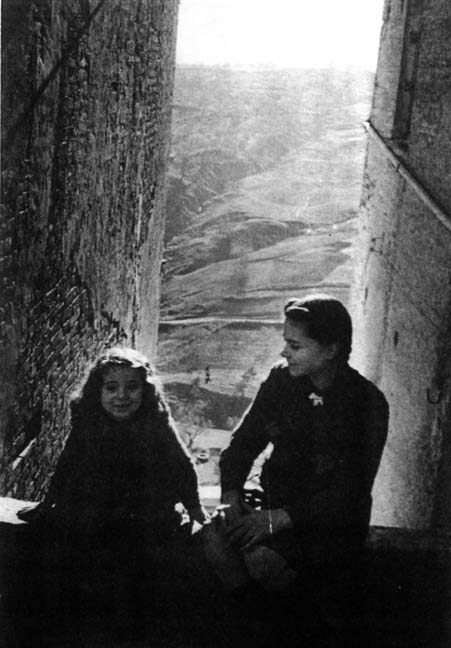
We were also made welcome by the family of the Marchese Gerbasio, of the Neapolitan Bourbon aristocracy, especially by his son Achille, and daughters Teresa, Wanda, Inez. The family had fled to their ancestral mansion, palazzo, in Pollutri to escape the combat and the bombings at Naples, ironically to find themselves caught up as refugees in the war in Abruzzo, Our billet, a large stone villa, was almost directly across from their residence. Some of our ambulances found parking spaces in a small square, piazza, which bordered on the front steps of the regal entrance of their home.
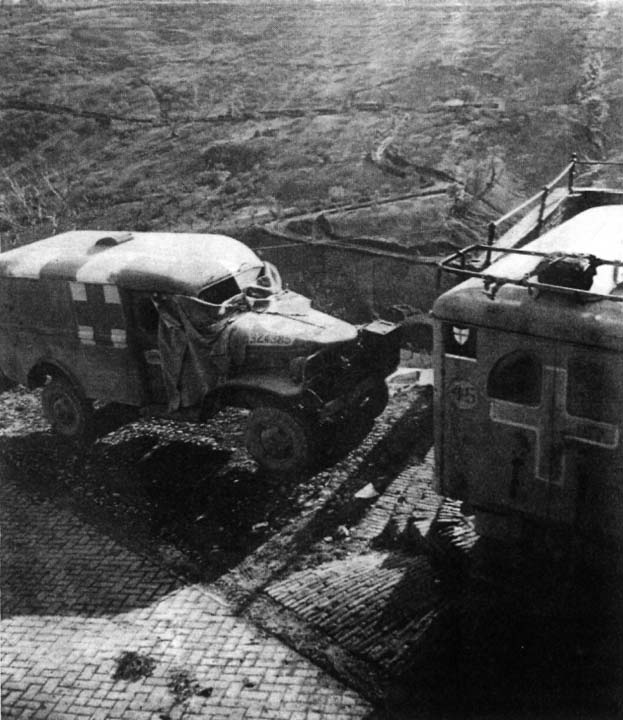
Miraculously, Pollutri had been spared the scorched earth and plunder of the Germans, the bombings of the Allies, the cross-fire of the artillery; and had been bypassed on its remote hill in the tank and infantry combat of the steady advance to the Sangro. We found our rest haven virtually unscathed.
I was regaled initially by accounts of an AFS Christmas celebration which was held at the 567 Ambulance Car Company HO at Casalbordino, and which I had just missed. At the outset, there had been a church service, then dinner at the Company HQ office converted into a decorated banquet hall complete with Christmas tree, white table cloths, and a dinner from soup to nuts.-,,,
In a letter dated December 31, Jock Cobb listed the array of food and drink to which our Platoon was treated; Jock wrote:
There was soup, wine, turkey, pork, chicken, cauliflower, peas, mashed and roasted potato, as much and as many times as we all could eat which was plenty! And then to top it all off a fine Christmas pudding with rum-chocolate sauce, and wow what a meal.
Jay Nierenberg told me that five pigs and 15 turkeys had been used. "Proof of the pudding" was that even Chan Keller when offered seconds declared: "Sorry, I can't eat any more." Chan served as toast master, with toasts all around to our Allied war leaders, then to special guests. Brigadier Phillips (DDMS Eighth Army) was guest of honor, and praised AFS in response to his toast. Col. Ralph Richmond, Overseas Commander AFS, and second in command of AFS under our Director-General Stephen Galatti, had moved his AFS GHQ overseas offices and staff from Cairo to Naples, and came up from Naples for the banquet. Other AFS "brass" were Majors Fred Hoeing and Bill Perry. Fred, loved by all of us, was scheduled to return to AFS GHQ New York City to continue his stellar services for AFS there. Our C Platoon CO, Lt. Jack Hobbs, was also recognized and toasted.
In this same letter Jock wrote that "while various jovial members of the company sang songs and told after dinner stories, quite unexpectedly Santa Claus (played by Robin Craven) paid us a visit and showered presents of a somewhat whimsical sort on the assembled gay multitude." Examples of such presents were mustache soap for Jack Hobbs and Bernie Wood, ammo boxes for Skip McKinley (for his tools), a ring for newly engaged Jay.
The snow outside enhanced the Christmas spirit as well as the sense of comradeship felt by the fellows of the Platoon, having only recently been "in the shit" as we were want to refer to battle action.

Our C Platoon had been relieved on December 15 by our fellow Drivers of Platoon B, with their headquarters at Fossacesia. Notwithstanding continuing action in the forward areas, the Christmas spirit was represented by a tree painted on one of the walls at Platoon HQ - about the only building left standing at Fossacesia.
 Talking with Capt. Charlie Pierce: Lt. Field is left, Facing Camera |
 |
One of the supreme ironies of the war was that on that same Christmas Day of 1943, while our AFS ACC HQ and C Platoon were celebrating a joyful Christmas event, a scant 20 miles to the north the massacre (I know no other term for it) of and at the small coastal city of Ortona was taking place. It was comparable in its ferocity and total devastation if not its size, to the horrors of Cassino or Stalingrad. Indeed, it is known to this day in the Abbruzo as the "little Stalingrad." But unlike the eventual break-through at Cassino, and the turning of the German tide at Stalingrad, there was little justification for the slaughter at Ortona, as explained in my account of the Ortona battle above.
Our billet was a three-story villa with tall windows, high ceilings, ceramic floors, balconies constructed in stone blocks and bricks faced with a coating of cement. Such villas were requisitioned for troops. Some had been abandoned by Fascist owners; in others resident family found space in ground floor storage rooms or with relatives. Needless to say most were in stages of disrepair. We used our own stretchers and blankets for beds. The few kerosene stoves available did little to cut the chill. Denny Hunt, George Collins, Chan Keller, and Jay Nierenberg had taken rooms upstairs which soon became the "nerve center" for bull sessions and gossip.
It was not, however, a luxury hotel. The lights, a few naked bulbs strung on wires, worked indifferently, as did the toilets. The rooms were dusty; furnishings and beds were scarce. Most of us slept on our own stretchers, I wrote (January 7) that this was "pretty hard lines after those soft hospital beds." Jock wrote (January 1) that he preferred "the warmth of my car heater to the cold chill" of the stone walls and floors.
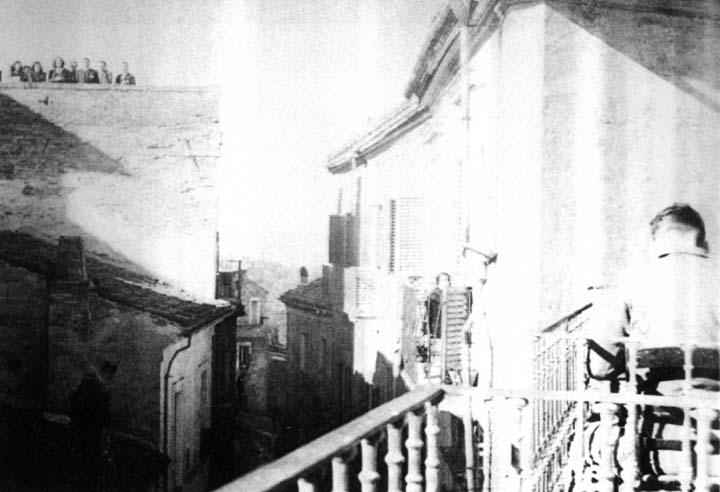
The ground or entrance floor whose thick stone arches resembled an underground grotto, was ideal for storage. Wide stone stairs led from there to the living quarters on the second floor (Italian first floor).
A large central room with adjoining kitchen doubled as mess hall and social hall, complete with a piano in one corner. There were chairs and tables for cards and games with at least several tables of bridge going each evening. Jock and I kept our chess games going. The tables and chairs also served for reading, and for writing letters home.
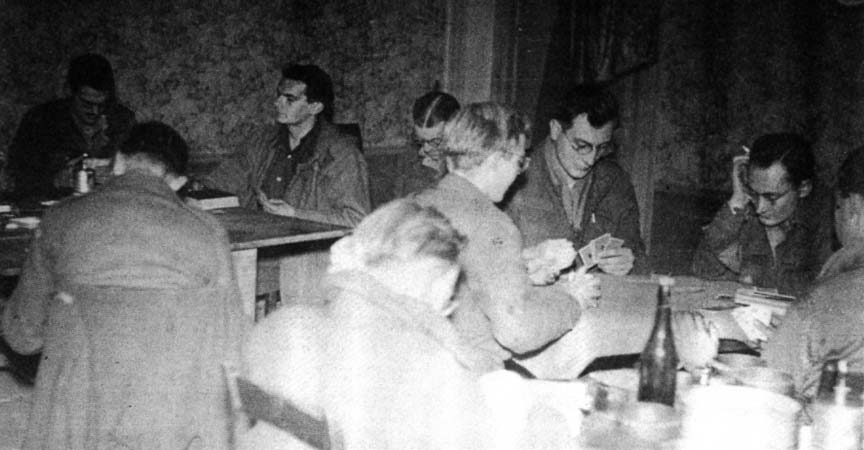
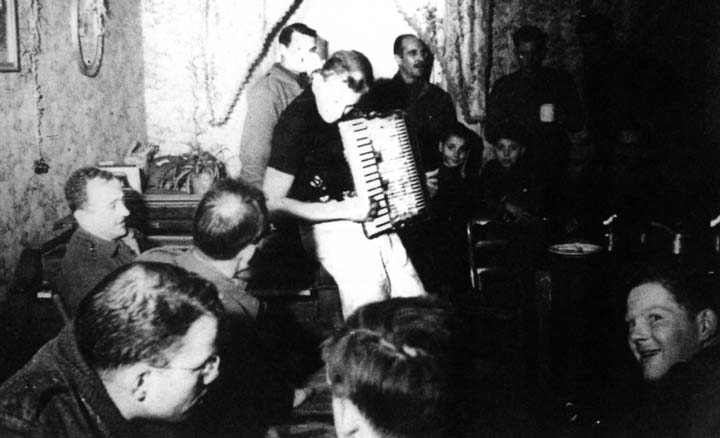
We could all be counted on to join in impromptu song and drinking tests with either John Leinbach or John Meeker at the piano, or "Lofty" at the accordion, perfecting our knowledge of ribald British Army songs. "Lofty" was one of our British Army Catering Corps chefs.
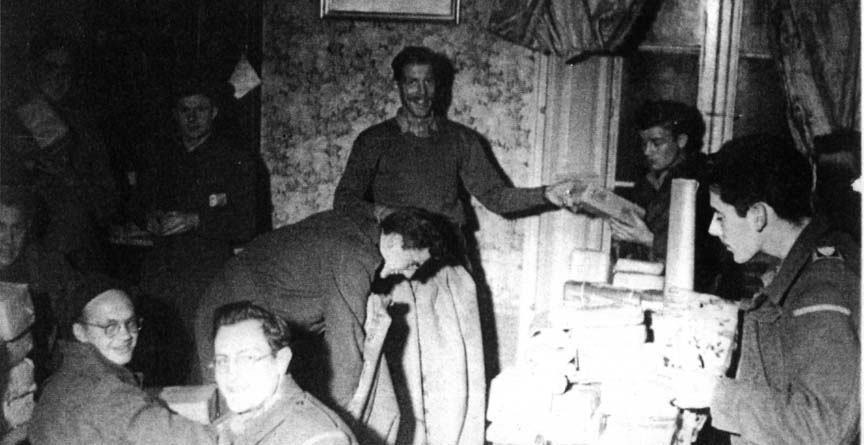
Our central "social hall" was the occasion of yet another Christmas event, with Lt. Jack Hobbs playing Santa this time. The occasion was the arrival of a shipment of Christmas packages from home. I wrote about it, in a letter home dated January 22: "Our happy evening was complete, for on arriving back at our billet, we found ten bulging mail bags waiting for us. My total of Christmas packages received was swollen to 27 ( plus some odd ones containing glasses, vitamin pills .... )"
Although these "ten bulging mail bags" did not reach us until mid-January, the fact that they reached us at all was a miracle, considering the logistics to supply two Allied armies across dangerous sea lanes for the task of waging war up the Italian peninsula in winter. More, it spoke volumes for the concern of our Allied armies and leaders for the morale and well-being of the troops in World War II. Throughout the months and years of our service in war overseas, the most important single factor in the lives of each one of us was mail and packages from home.
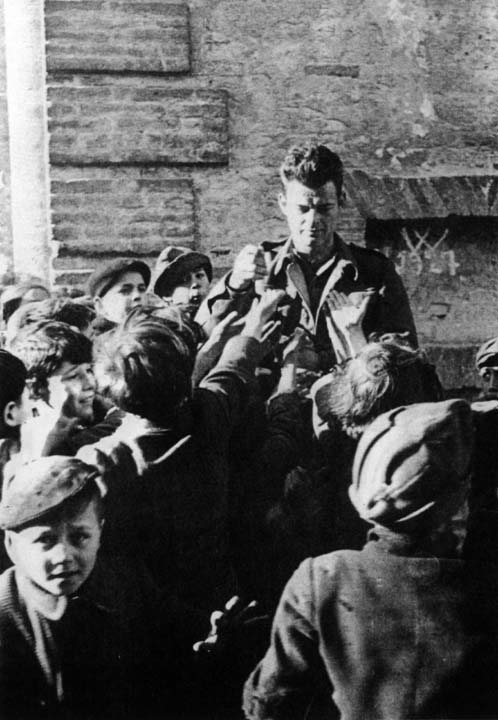
We exchanged gifts not only with each other, but shared our cookies, candies, and other treats with the children at Pollutri (and elsewhere) --- the marvelous, resilient, joyful children of war who played games on our door-step, followed in our footsteps, warmed us with their smiling it smudged faces, called out bits of slang in broken English --- "hello, chocolate," "hello, cigarette." Dunc Murphy, all heart, became their "American Uncle." Jock's camera caught him with a clutch of kids in the photo below.
Not all our activities were frivolous fun. Inevitably, our American work and community service ethics took hold, as well as the urge to keep busy. Outstanding was the achievement of George Collins to restore the town's broken water mains and water supply system which were gravity feeds from a cistern at the top of the hill. Potable water was lost, or contaminated. George directed the necessary technical assistance with the help of our workshops, and mustered able young men regardless of class or caste to provide labor. Platoon members pitched in.
George Rock, in his richly documented The History of the American Field Service ... noted (p. 269): "G.R. Collins discovered that the town's water mains were broken ... Under Collins' guidance, some members of the Platoon fell to with pick and shovel, working with unemployed day laborers whom the Allied Military Government (AMG) put under his direction ... he passed their labor bill on to the Town Major ... he did get the job done."
In my letter home dated January 7, I rendered a slightly different and more jocular version:
You would be interested in the scientific pursuits of George Collins. He has assumed the role of "sewer and water commissioner" of the little town where Platoon C is resting. Whenever an able-bodied male chances past the "scientific" project which George has under way, George thrusts a shovel in his hands and leads him to ditch or water pipe. With the help of his good if pedantic Italian (and some American cigarettes), George will have a gang of the local good-people hard at work in a matter of minutes. Most of them have nothing else to do anyway.
The women do a good share of the work in these parts, and the young men are too busy studying to be doctors etc. (or so they say) to soil their hands. George is changing all this. That's one of his selling points in his campaign for Mayor: he expects to cop the women's vote hands down. At any rate, his efforts at pipe-repairing have served to build up enough pressure to flush our toilet --- on occasions. Incidentally, George hasn't stooped as yet to kissing babies and passing out cigars. His methods with the fairer sex are more subtle, as is the case with most of us. The old "racket" around here is to take Italian lessons from a fair lady. Even big Chan has gone in for this sort of thing, and no less than three young things to teach him the language.
There were other pursuits. As in the Western Desert and Tripoli some of us exercised our minds by volunteering for discussion groups organized by the regional British Army Padre. I wrote in a letter home (January 17) concerning one such event:
Jay, Chan, Jock and I have just returned from conducting a discussion at a near-by convalescent camp along English-American lines: differences and points of cooperation. The "Little Padre" (who was my guest for dinner last week ... ) suggested the discussion just after church services yesterday, and we were all eager to help out ... if only for the purpose of giving ourselves some much needed mental exercise. It all took place in a smallish ward of bed patients, and so we all got to know each other pretty well, which I suppose is the main thing after all. We got a bit side-tracked on the differences, but at least we weren't kidding ourselves. I came to this discussion with Dad's pipe glowing brightly, and with a feeling of well-being in my "inner man." That can be traced directly to a terrific spaghetti dinner of this noon...
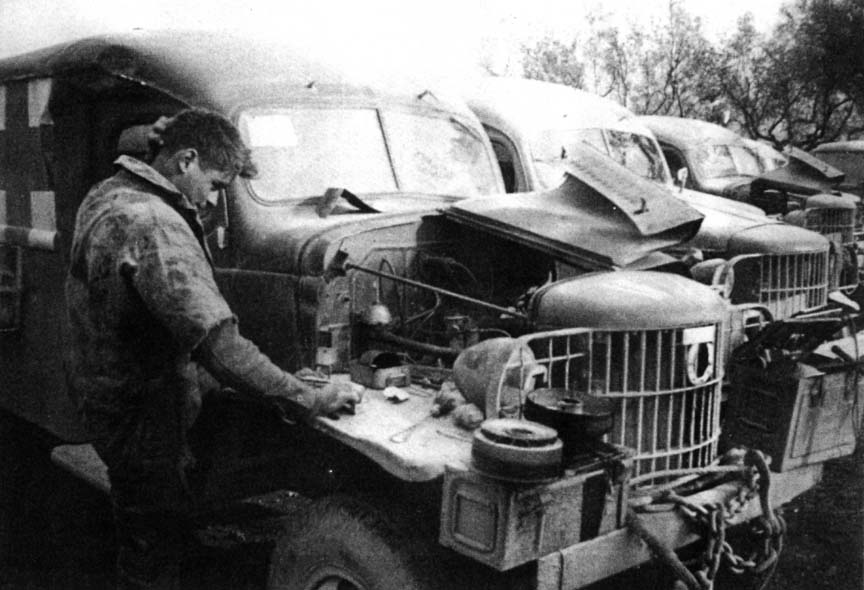
We were responsible for the care and routine maintenance of our ambulances in accord with our assigned detailed Vehicle Maintenance check list; our Platoon was also accompanied by a contingent of RASC workshops. By now, all of us "veterans" had become adept at servicing our sturdy and faithful charges, and to call upon workshops for the major repairs.
"Skip" McKinley especially loved to don his soiled coveralls, and get under the hood or frame. The six-week rest at Pollutri provided time for servicing and repairs, also for replacements for ambulances destroyed in recent battle action.
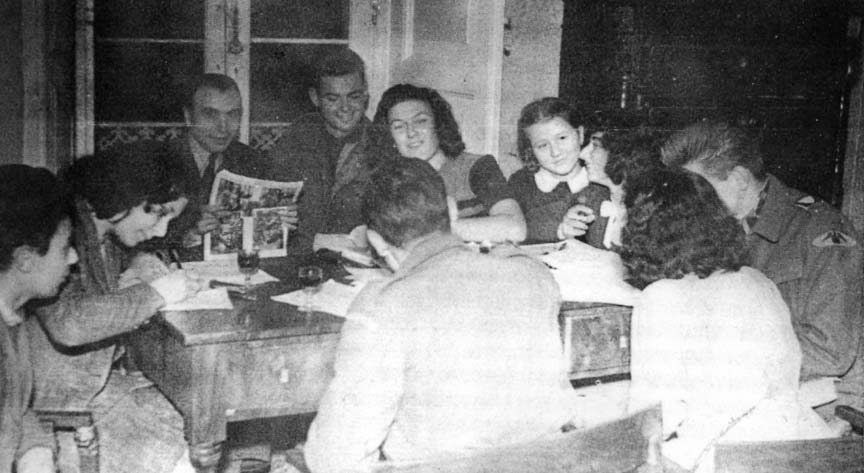
One of our happiest social and "intercultural" pursuits were Italian lessons offered by the three attractive nieces of the Marchese Gerbasio family at their imposing family palazzo. The lessons, perhaps a subterfuge for meeting with the girls but nevertheless expertly conducted, were already in full swing by the time I had reached Pollutri. The vivacious and well educated young ladies --- Teresa, Wanda, Inez --- were often joined by brother Achille and others, along with us "students," around a polished wood table and matching chairs in a beautifully appointed room of the mansion.
The Marchese would sometimes ask for a game of chess with Jock Cobb in his ambulance, although no match for Jock. Jock wrote, in a letter home dated January 1 about the chess and the Italian lessons; this letter also provides a vignette about the life of an AFS ambulance driver on rest leave in winter in Pollutri during World War II:
... Oh dear, an interruption, someone is knocking on my ambulance door ... It was the Marchese, a youngish man wanting to know if I would like to play chess as we did last night at this time ... I think he likes to play because I get the car nice and warm with the heater and he is ... never warm enough. In fact, I don't see how anybody who lives in these old Italian palaces all made out of cold stone ever does get warm ... I prefer living in my ambulance with a heater and good light to read by.
It's dark out now, so I have the windows blacked out. I am parked on the street right outside the Marchese's mansion. We are out of the line for rest now, so we find ourselves in this little out-of-the-way town, which has hardly been touched by the war. We are getting to know the people of the town pretty well,
Four of us go up to the Marchese's house every afternoon for a lesson in Italian. Our teachers are the three lovely nieces of the Marchese. They also supply the necessary incentive through the spirit of competition they inspire us with. For the unlucky fellow who falls behind is sadly left out when it comes to pairing off for social occasions. I am happy to say that my Spanish and French give me a head start. Right now we are learning the Italian equivalents of the 850 basic English words, and they are learning the English.
Participants in the lessons included Dunc Murphy, Skip McKinley, Chan Keller, John Leinbach, George Collins and Jock. I joined in, with an advantage of already speaking Italian. These lessons were a learning experience of a beautiful language; more they were a social highlight of our Pollutri sojourn, providing an entree for singing and parlor games; more, to discover the bonds of our common humanity.
I wrote in a letter dated January 22 before we left Pollutri to return to action:
John and I joined George, Jock, and some others for a final visit at the home of the Marchese, whose nieces have been teaching us Italian. The evening with them soon resolved itself into singing, and the playing of parlor games everyone seated in a ring of chairs around the living room. I was "the goat" more than once, and had to pay the consequences by standing on my head, or something else equally ridiculous. My "excellent" basso profundo (which was once again absent at the Edwards carol singing this Christmas) rang out on more than one occasion, and supplied some amusement to the party...
Our moments with these high-spirited lovely girls were among the happiest we knew overseas. For John Leinbach there would always be a special place in his heart for Wanda, and rightly so; we were all deeply touched. The gift of Teresa, Wanda, Inez was sanity, civil discourse, peace --- as if the insanity, the madness, the horror of war did not exist. We learned from them of our shared humanity, overriding often inconsequential cultural differences --- overriding more importantly the corruption of dictatorial power that had misled so many of the world's people in the 1930's bringing on the cataclysm of World War II, and continues to threaten the world's peace.
In late September 1991 Chan, John and I, with our wives, returned to Pollutri. We managed to locate a young pharmacist who was custodian of the Gerbasio palazzo, and let us in. Alas, the courtly rooms we had known almost 50 years before were dusty and unkempt, the furnishings covered with sheets. Spiders and cobwebs commanded the darkened rooms. The family no longer visited Pollutri, and the custodian had little news of them for us. We three could only try to imagine the special moments we had known in that place despite the circumstance of the war, and hope that life had been good to those lovely young ladies who had been so good to us.
We treasured equally our moments in Pollutri with the traditional "little people" of Italy, il popolino, with whom we also discovered a common humanity even more remarkable because of vast differences in culture and the intrusion. of class and caste. What little they had was ours, but most of all their great gift to us was to alleviate the terrible longing in our hearts for home --- home that we might never see again. Their kindliness and love was totally unaffected, totally spontaneous and generous, proffered with wise and caring simplicity. In this, they represented not only themselves --- artisans, farmers, herders, workmen of one little remote town on its hill --- but the best qualities of the Italian people. Their acts of kindness for us were repeated and expressed in hundreds of ways towards the Allied soldiers in Italy from Sicily to the Po Valley and beyond --- even at risk to their own lives.
I may have had an edge because of my knowledge of Italian, but relationships were well established by the time of my return to Pollutri. I was informed at the outset for example of a wonderful elderly man and his wife known to us simply as "Il Vecchio" and "Mama." They virtually "adopted" a dozen of us within their hearts and home, including me. But my initial experience of the kindness and compassion of traditional Italian character, was provided by Alfredo, a "little man" who swept up the dust and dirt left by our muddy boots in our billet.
I wrote in a letter dated January 17 about his generosity and that of his wife:
I am invited out to dinner (or rather lunch) for a steaming plate of fresh-made spaghetti. The little man who sweeps around the place has discovered my weakness along that line, and so whenever his plump and rosy-cheeked wife makes a batch of the "old standby" of Italy, I am invited to come along to help put a dent in it. This kindliness is, as you say, one of the things you notice first in the Italian character, which is obviously more complex than the childlike simplicity it exhibits on the surface. The life in this town is terribly primitive, especially as judged by our American standards; and the patch-work slopes give evidence of land subdivisions after each new generation. Few of the lower classes seem to get much beyond where their parents left off; many are without unencumbered land ownership.
I continued in my letter of January 17:
But it is among these poor people that you find this quality of "kindliness.' It is manifested in spontaneous invitations to share a meal (such as my invitation today), a free job done for you at the cobblers, helping get your car pushed out of a mud hole in the road. Jay joined me in the invitation to the little man's house. The central room where most of the living is done, with the customary fire-place in one corner, dining room table along the wall, peppers hung up on the ceiling, cats and children in odd corners, and general atmosphere of cleanliness despite of the poverty and dingy antiquity of the walls and arched ceiling, took on a most cheerful aspect. Upon the crude table a clean table-cloth appeared as if from no where. Clean napkins were beside each place, where their was a clean china plate and spotless silver-wear. Apparently the family's choice pieces had been dragged out for the occasion, and each home, no matter how humble, can produce beautiful things... one of the things in the knowledge of poor Italians in the art of living. A great bowl of steaming spaghetti placed on the table by the smiling Senora, announced that dinner was served ... I finally drew the line when they threatened me with a third helping, and then had to unhitch my belt even more when an unexpected second course of veal patties was served up. The fellow had walked all the way to a neighboring town to buy the meat ... you can guess how difficult for the towns-people to get flour, meat etc. because of the war. When I exclaimed about the hospitality, the wife raised up her chubby hands and said: "I worried about my boy when he was away from home, and I know you have a Mother who is worrying about you. And so perhaps she will be a little happy to know that I am helping take care of her boy while he is away." Jay and I were both touched, and very full as we "staggered" away, holding on to our respective tummies.
By contrast, my impressions of the wealthy upper class Italians were critical, although these views were based at that time on limited experience and contacts with Italy. I wrote in this same letter (January 17):
The wealthy people, when it is possible to break down some of their antique customs, can be very hospitable as well; but you get the "idea" that it costs them nothing to be so ... members of the intelligentsia as well as the so-called rulers, have had about as much spine as the proverbial jelly-fish ... They don't seem to care that their country is in disrespect all the way around, nor is there evidence of any feeling of sincere repentance because of the cowardly role their government played... at its entrance into the war.
Fascism, alien to the Italian spirit, had nevertheless established a dictatorship which denied all classes responsible participation in their own government, numbed and perverted standards of information, truth and justice, and blundered into the war on the wrong side. The upper class had been forced or bribed into an accommodation with the Fascists until it was too late. As regards the majority, the poor, the "little people," I wrote further in this letter home, January 17:
You get the idea that there is some "spine" among the lower classes, the farmers and laborers. But these have quite obviously been given so little share in the government, that a whole war can pass by their front doorstep and they will have no concept of what it is all about. You get the impression that there is more intelligence and "spine" as well among the northern sections: both from reports of revolts in Milan and Turin, and from talking with escaped farmers. and ex-soldiers who have drifted down from the German labor gangs ... Fortunately for Italy, in one way, most of her people are poor! As a people they are wise in the arts of living, and feel rather than know when something is evil. The upper classes seem to have split themselves from the depth of this feeling ... In her time of need, it will be the millions of farmers, laborers, village-dwellers which will pull Italy through.
Especially touching for many of us while in Pollutri was the kindliness of one of these "salt-of-the-earth" village-dwellers, an elderly, retired master mason, "Maestro" Mauro, and his wife. For us, he was simply the "Old-One", "Il Vecchio," and she "Mama." They lived in a small, stone, indistinct house along one of the narrow, winding cobble-stone streets that was little more than a passage-way. This became for many of us "home away from home," and we were welcome at any time individually, in small or in larger groups. Seeming insurmountable differences of age, culture, language were no barrier to the affection and goodwill that shone through. And there was plenty of laughter.
Near the end of our rest leave at Pollutri, the "Vecchio" and Mama invited as many of us as could fit to a feast none of us present could ever forget. I wrote about it in a letter home (January 22):
The event of the month was a feast at the Vecchio's little house. It was a special feast, and beforehand our little old friend sent out a list of those invited written in our Italian names. A dozen hungry young men trooped down the steep alley and up the equally steep steps that lead to the retired mason's home. Mama had set the table with a spotless clean table-cloth, and she must have borrowed sufficient plates, knives and forks from all the neighbors. Two large steaming bowls of spaghetti were waiting on the table. Mama can produce wonderful dishes with simply an open fireplace, and a little stone oven on one side of ft.
My letter continued:
I told her how it reminded me of spaghetti my Mother makes... Hardly had we stuffed ourselves with the first course, than a half cooked pigeon and potato cakes appeared on each plate. Having seen the pigeons wandering around the evening before, and fancying them to be house pets, I was alarmed about their changed state --- on my plate. But the meat was tasty ... I for one reached the saturation point. There was no room between the dining table and the big four poster bed to permit a person (even as small as Mama) to pass, and so the old lady nimbly crawled over the bed itself and disappeared up the attic stairs. She returned coyly with a large sort of blueberry cake held out before her. It was a fitting climax to a splendid meal and good fellowship.
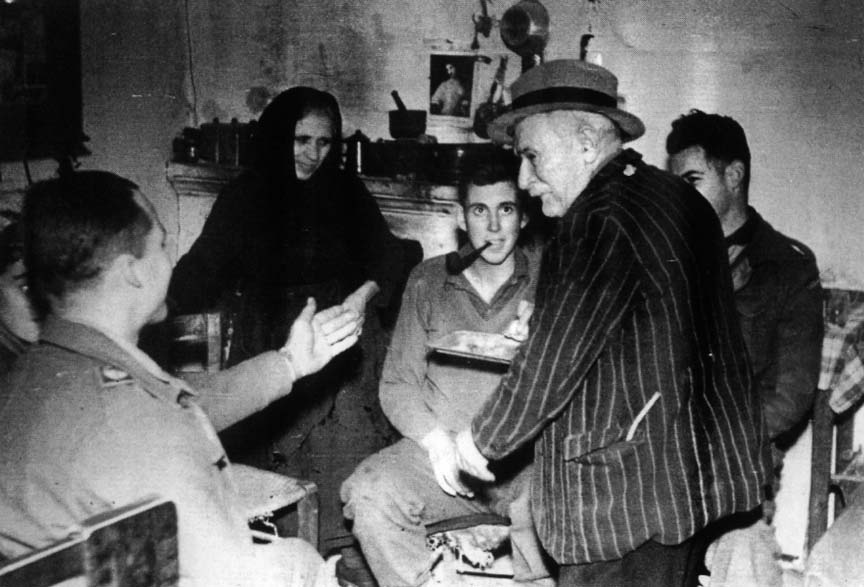
| Maestro Mauro and his wife entertaining Members of C Platoon. Pollutri. They could not do enough for us. On the left Chan Keller. Center Clarence Reynolds. Right Duncan Murphy |
Before our Pollutri interlude was over, we had acquired Italian names, so close was our fellowship with the people. These were our names as known to our beloved "Il Vecchio" and "Mama." Translations of Charles to *Carlo," John to "Giovanni," George to "Giorgio," and Robert to "Roberto" were comparable; Jay into "Giacomo" was close; however, there was no ready linguistic transference for Chan, which henceforth (for us) became "Giuseppe," and for Sterling which was converted. to "Stalino ."
We would keep our Italian names throughout the remainder of our World War II saga, and for the rest of our lives --- addressing each other this way in correspondence, telephone calls, reunions. And we would safeguard thereby our memories of those days of sanity and peace at Pollutri, carved out of the tribulations of war, when, in our common humanity, we had transcended barriers of race, language, religion, culture, and class in fellowship with the people of that little town on its hill, Pollutri.
Could this be the harbinger of a world which would not know war? We could only hope so. Also harbinger, perhaps, of the AFS intercultural exchange program --- now beyond its 50th year --- which AFS initiated in 1946 after the war.
The time had come for us to say our goodbyes. It would be one year and more before the guns of World War II would cease. In late January, 1944 the Platoon in convoy inched down the hair-pin turns of the single road which had brought us to Pollutri, and then we turned north, led by the staff car of our Commanding Officer Jack Hobbs. We would never again see those special friends and people of Pollutri who had carved out for us a "home away from home" on their hilltop haven in Italy.
The interlude at Pollutri, and glimpses of civilized family living, had helped to soften the trauma that all of us had experienced in various ways since the breakout from Termoli in early October; but that trauma would never be entirely gone.
The Germans had committed nine divisions on the Abruzzo front plus logistics support and a "ferocious obstinance" to hold at every line: the Trigno, Sangro, Ortona. The people had endured with dignity and with sympathy for the Allied cause which had become their own. The soldiers served with "splendid valor" in some of the most intense fighting and atrocious conditions of the entire war --- as at the heights at San Salvo, the Sangro bluffs at Mozzagrogna and Fossacesia, the door-to-door carnage at Ortona. The soldiers, and we of AFS had done what we had been asked to do.
In retrospect, and in the reporting of war there may be tendencies to glorify the action --- Generals are praised, medals are given, "heroes" are recognized. Survivors may romanticize things, or smooth over the horror, but how can anyone who has not been through it ever really know the feeling, know the experience?
Yes indeed, there are "heroics" in war --- a word used in the reporting to extol the valor, the sacrifice, the courage, the intensity of duty performed where men and women, especially the young, are asked to put their lives on the line. The bitter war in the Abruzzo was no exception. But war itself is not heroic. It is a nasty business, even when the cause is just. Jock Cobb's photographs of the action speak volumes. In comments to me many years after, Jock put down on paper what all of us experienced:
There were of course times when I got involved in the excitement of the advance and romanticized it ... but mostly for me it was a messy, muddy, scary business, and I wanted to get out alive and go home...
In concluding his history, La Guerra in Abruzzo, Giovanni Nativio had noticed a flower growing out of the rubble at Ortona. For him, this was a symbol of the spiritual dimension of our common humanity upon which to build a more humane and tolerant world out of the horror of World War II.
Another potent symbol, a horse foraging in the rubble of German demolition in the high Apennines of the Abruzzo --- shown in Jock Cobb's photograph below.
We must hope that such as this may be the last word on the Trigno-Sangro campaign in Italy's Abruzzo, October through December, 1943.