 1. Overview, Cassino Offensives, Gustav Line
Broken. Liberation of Rome 2. Return to Action. San Vito. Cassino --- January 24-March 1,
1944 3. Lanciano, The Vital Center. C
Platoon HQ and Postings, March 1944 4. Lanciano. My Transfer to AMG, PHWO. April-June 1944 5. Courtship and Marriage, My AFS
Wedding, August 3, 1944. An Episode in Intercultural Relations 1. Overview, Cassino Offensives, Gustav Line
Broken. Liberation of Rome 2. Return to Action. San Vito. Cassino --- January 24-March 1,
1944 3. Lanciano, The Vital Center. C
Platoon HQ and Postings, March 1944 4. Lanciano. My Transfer to AMG, PHWO. April-June 1944 5. Courtship and Marriage, My AFS
Wedding, August 3, 1944. An Episode in Intercultural Relations |
On January 24, 1944 we of C Platoon (567 ACC) received orders to return to action. Our orders were to relieve B Platoon posts in the Canadian sector along the coast from San Vito to Ortona just south of the German lines. Another 16 months of war faced us in Italy until the German surrender, May 3, 1945, although in retrospect our Platoon, and my own "Lucky 13" Sections would never experience as extended first-line service as we had known in Tunisia, and in the Termoli to Ortona advance.
As for me, my life would enter an unexpected sea-change in June 1944, my engagement to Licia Sargiacomo in Lanciano followed by our wedding August 3, 1944 attended by six of my fellows of "Lucky 13." Platoon CO Bob Blair was "witness."
It was mid-winter of 1944 in central Italy and the Germans were entrenched in their "winter" or Gustav Line. It was not a Maginot Line of concrete structures but rather a network of mine-fields and barbed-wire; also dug-in mortar, machine-gun, light and heavy artillery placements backed by crack mobile infantry and armored divisions. The line stretched through the highest mountains of the Apennines and its deep valleys --- for 130 miles from the Adriatic north of the Sangro river, to the delta of the Garigliano on the Tyrrenhian coast 70 miles south of Rome (map, page 2). The Germans took advantage of the torrential rains, blizzards, and the rugged terrain in winter, notably their virtually impregnable position at Monte Cassino which blocked the road to Rome.
After the overthrow of Mussolini (July 25, 1943) the Germans had rushed into Italy an entire Army Group of as many as 24 divisions brilliantly led at the beginning by Field Marshal Rommel, then Field Marshal Kesselring. Their advance had reached Salerno south of Naples on the west and Termoli on the east in time to confront the Anglo-American landings at Messina, Taranto and Salerno (September 3-9, 1943). There would be a series of "winter lines" across Italy resisting the Anglo-American advance towards Rome, up to the final one called the Gustav Line which held.
There were two Anglo-American armies advancing against the Germans: the British 8th on the east side of the Apennine spine, and the American 5th on the west with some Commonwealth troops there as well. The Gustav Line was pushed back in December at Ortona on the east coast by the first Canadian Division; and American troops crossed it at the Garigliano delta on the west coast in conjunction with an attack at Cassino in mid-January 1944. Both these attempts to turn the line were contained, and the Germans continued to hold, notably at Cassino.
The fighting at Ortona during the Christmas season 1943 was one of the bloodiest of the entire war, and to little avail because winter snows blocked any further flanking advance on Rome from the Adriatic. Ortona had been reduced to rubble.
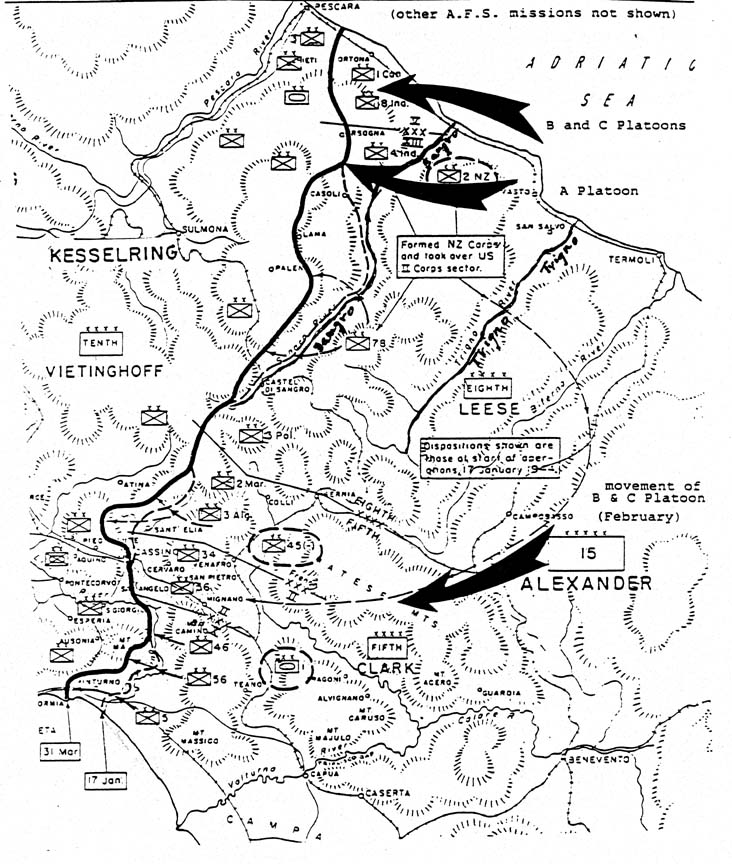
The Allies never gave up the march on Rome. Throughout the winter and spring of 1944 there was continuous fighting all along the Gustav Line at the center and both sides of Italy east and west south of Rome. There was also a surprise Anglo-American landing from the sea at Anzio between the Gustav Line and Rome January 22, 1944, but this was contained by brutal German counterattack. It became evident that the only possible road to Rome was the valley of the Uri River at Monte Cassino and the highway system along it, route 6, running parallel to the coast about 30 miles inland. The Allies were determined to push through, even in winter. It was not to be, until the eventual Anglo-American breakout at Cassino May 20.
The Germans held the high ground at Cassino. Monte Cassino, rising sheer 1,500 feet at the entrance to the Liri valley; was topped by the famed shining white Benedictine Abbey at its peak. The town of Cassino itself, with another river --- the Rapido --- at its southern edge, hugged the base of an adjacent mountain just to the east; indeed row on row of countless mountains stood to the north and east, and along the river valleys. From this high ground bastion, German guns commanded every entrance to the Liri valley; German eyes observed every movement below. The rivers had become icy torrents. Also much of the ground which the Allied foot soldiers had to cross, and through which the Allied armored advance would have to pass, was flooded by the Germans, who demolished a dam on the Rapido.
The Allied action at Cassino in winter was one of the most controversial of any engagement of the war. Monte Cassino by David Hapgood and David Richardson (Congdon and Weed, 1984), documents all sides and brings focus upon actions at the Abbey itself. Cassino. The Hollow Victory, The Battle for Rome. Jan.-June 1 by John Ellis (McGraw-Hill, 1984) is more comprehensive, and lists some 80 titles in its bibliography. Both accounts are critical, and for a number of reasons.
The Battle for Cassino was also one of the bitterest, bloodiest, most protracted engagements of the entire war in Europe, of any war anywhere. Tom Hale, one of our fellow Drivers of C Platoon posted with New Zealand aid stations at the front for the most harrowing two weeks of his life, rendered the definitive epitaph: "Nowhere on earth could the destruction wrought by man be greater than at Cassino, and nowhere was the price in human lives and misery greater than the paid in the Valley of The Shadow." (Tom Hale, The Cauldron, p. 62, citation in Table of Contents. Part XII).
To be sure, the Russians were driving on Germany from the east with five Army Groups along a front of more than 1,000 miles, breaking out from Stalingrad in February 1943 and losing more than 6 million soldiers in warfare of unprecedented brutality. In the West, starting at Normandy (June 6, 1944) with history's largest combined amphibious invasion (155,000 troops), two American Armies, two British Armies, and one Canadian Army lost thousands of brave men, but swept back the German Army Groups West.
While more limited in scope than these, the six months Battle for Cassino by land, sea and air involving combined operations by two armies and heroic troops from a score of different nationalities, equaled any other action of the war in its intensity, brutality, totality of destruction, and the atrocious terrain and weather encountered.
An eyewitness account by one of the "yank" foot soldiers during the third major attack at Cassino, which "kicked off" February 24, 1944, is extremely graphic. This is a story by one of the machine-gunners of H Company, 351st Infantry, 88th Division. It was printed in August 1993 Volume 44 Number 3, of the 88th's quarterly The Blue Devil, and is dedicated to the memory of his Captain, John Church.
The action reported required reinforcements at Mt. Castellone in order to reach and come in behind the then shattered Abbey from the mountains to the northeast, and immobilize Monte Cassino; it was part of combined operations by New Zealand Corps which included Indian and French troops as well as the "Kiwis." It was the second push by NZ Corps. There were torrential rains. A row of burnt-out tanks smelling of death lined the way. To reach the base of the mountain, the troops had to ford at first-light the flooded and icy Rapido on crossing stones in water up to their waists- while under observation and fire from the Germans. The demolished Abbey was visible above; they had to skirt the shattered town still held by Germans.
Only men on foot loaded with guns and packs, and pack mules could navigate the narrow steep trails filled with rocks, mud, ice skirting deep ravines. Some fell, and broke bones, unable to climb further. The climbing column at times gave way to mule trains coming down, each mule carrying a stiffening body in grotesque shapes. Various units along the way were digging-in or reinforcing guns or mortars; some were Algerians of the French forces, others were Indians including Gurkhas. Enemy shells were dropping everywhere. After several days at the peak, the squad was relieved by French forces, but had to navigate down the mountain and across the icy Rapido. As the survivors reached base camp, they overheard comment: "Hey, did you see those guys from the front ... they were covered from head to foot in mud ... just stared ahead and walked slumped over like zombies. My God! what are we in for?"
There were, in all, four major Allied attempts to break through at Cassino. Units of the US 5th Army (2nd and 10th Corps) led the advance from Naples to Cassino under foul conditions in December. On January 15-18, 1944 they launched the first concentrated assault on Cassino, while on January 22 the American 6th Corps and British 1st Army landed at Anzio on the coast 50 miles north. There was some advance at Cassino, but the Rapido and the town itself could not be forced nor the high ground taken despite heroic efforts in unimaginable conditions. Two AFS Platoons of 485 Company were in the thick of this. The Germans also continued to contain the Anzio landings.
Had Anzio "worked" it would have forced the German evacuation of Cassino, but the Germans rushed in four more Divisions in a brutal counterattack January 26 which pushed the bridgehead to a narrow strip along the coast less than 6 miles deep until the eventual breakout May 23. The bridgehead nevertheless held out as a constant threat despite continuous German infantry forays, air raids, and enemy fire of all kinds by day and night.
The Allied forces at Anzio survived in dugouts, caves, the sturdy stone remnants of buildings. Evacuation of casualties from the port was by night --- under fire. Two Sections of 485 Company AFS served bravely at Anzio, fortunately none killed despite wounds inflicted on the Drivers and the ambulances.
The remaining three major attacks on Cassino were principally by units of British 8th Army, with 5th Army participation along the coast. Two of these were by the New Zealand Corps during February 1944 under command of their esteemed General "Bernie" Freyberg who had won the Victoria Cross in World War I. The Corps included the New Zealand Division, the 4th Indian Division, some French (North African) troops and units of 78th UK Division, plus massive artillery; it was brought over from the Adriatic to relieve the Americans and continue the American advance. Two Platoons of AFS 567 Company, B and C, were also brought over from the Adriatic with the New Zealand Corps, to be replaced in late February by three Platoons of 485 Company.
New Zealand Corps took over the line February 12, and launched a major attack February 18. One thousand 5th Army tanks prepared for the hoped for breakthrough. The Indians and North Africans in the mountains pushed from Mt. Castellone to within 300 yards of the Abbey at Monte Cassino, while the "Kiwi" troops below crossed the Rapido and reached Cassino station. This attack could not be maintained because of rains, the swollen river, and German counterattacks. The New Zealand troops pulled back. The Allied position on Mt. Castellone held, and a second attack by the entire NZ Corps was launched on February 24, but after some advance it also had to be abandoned in the unrelenting rains and despite a second bombing of the town from the air. The men lived in mud and slush under constant observation and fire. Casualties were heavy.
One of the most controversial acts of the Cassino Battle took place on February 15 during the first New Zealand build up when the Abbey at Monte Cassino, and the town itself, were subject to strategic bombing by the heavy bombers, "Flying Forts" of the 8th American Air Force. The Abbey was reduced to mounds of rubble.
The destruction of the Abbey from the air had been approved by Allied high-level command in order to eliminate what was then thought to be the principal German observation post and defensive position, accounting for the frustration of the Allied advances and taking the lives of our troops.
This was, however, a misconception, as documented by the Hapgood and Richardson book cited above. First of all, with Allied advance patrols within a few hundred yards of the Abbey, Corps Commander General Freyberg had requested tactical air support only against German positions and away from the Abbey, but was overruled. The heavy bombing made the situation worse. The Germans simply moved into the rubble on the mountain, as in the town, to improve their defensive positions.
Mote significantly, the Germans had not in fact occupied the Abbey, where there were only a few of the Benedictine Brothers plus terrified civilians under the protection of the Abbot. The German Commanding Officer at Cassino was anti-Nazi although serving in the army as a professional soldier. He, General Von Senger, had been a Rhodes Scholar and a patron of the arts, whose actions to crate and evacuate the art treasures and archives of the historic Abbey saved them. He had pledged the absolute neutrality of the Abbey, but was not believed.
The build-up for the fourth and final assault on Cassino got under way in late March when the New Zealand Corps was replaced. Polish Corps and French forces (mountain troops from Morocco and Senegal) took over the mountain positions. Along the rivers facing the town were the 8th Indian Division, 78 UK Division, some "Kiwi" units, supported by massed artillery and sorties from the air. The American 6th Armored Division stood by with 1,000 tanks for the anticipated breakthrough. Units of US 5th Army also held the line between the Liri River and the coast.
Helped by spring weather a combined attack started on May 11 encountering as always fierce resistance. The Polish and French/North African forces came over the mountains to invest the Abbey; the forces on the ground secured a bridgehead, constructed bridges over the Rapido, and invested the town. A German Tiger tank, dug-in at the rubble of the Continental Hotel, kept firing until silenced. The Liri valley and the road to Rome was open May 20, with the breakout from Anzio three days later. Units of AFS 485 and 567 Companies performed heroically in all of this.
When it was done after the fourth assault and breakout May 20, the shining Abbey on its hill was a rubble of marble shards; there was nothing left of the town of Cassino but gaping craters and croaking frogs in green scum. So complete was the annihilation of the town, that it had to be rebuilt at a new location some miles east. My poem "Cassino" (Table of Contents, Part X) paints a grim word picture.
To take advantage of the breakouts at Cassino and Anzio General Alexander, Commander-in-Chief of Anglo-American Army Group, Mediterranean, called for 5th Army to link up with the Anzio forces to trap opposing German forces. Instead, General Mark Clark headed straight for Rome to claim the prize of liberation of the Eternal City. Rome was liberated June 4, 1944 just two days before the Normandy landings, but many German units escaped north. Italian partisans had taken an active role in the city during the German occupation.
Eighth Army forces, which had broken through at Cassino, continued without delay to maintain the advance beyond Rome, and force the German retreat into north Italy where they would hold until the following spring at their Gothic Line.
Today, the white marble Benedictine Monastery has risen phoenix-like from its ashes, rebuilt stone-by-stone in a perfect re-creation inside and out. Visitors come from the ends of the earth and enter in awe and reverence under an archway marked "PAX" as described by my poem, "Monte Cassino Revisited" Table of Contents Part X ).
But war left a neighbor of the Abbey on a rise nearby: the Polish Military Cemetery with a thousand and more crosses row and row, and a memorial to others missing in action. And, at the American Sicily-Rome Cemetery, Nettuno/Anzio; headstones mark 8,000 dead; another 3,000 are unknown; another 6,000 Americans are at rest near Florence.
There are eleven military cemeteries of member nations of the British Commonwealth throughout Italy. For the nine months, from landings at Messina on September 3, 1943 to the occupation of Rome the next June 4, 1944, 20,250 soldiers of the British Commonwealth were killed. Many more than these were wounded in action. These Military Cemeteries are as temples to God, lovingly constructed, reverentially maintained, but mute witnesses to the terrible cost of war.
After the liberation of Rome and the Normandy invasion two days later on June 6, 1944, the Italian campaign was no longer the alternative Allied second front it had been, but became nevertheless an important if secondary front. It took almost another year of difficult advance up the Italian "boot" to push the Germans beyond their Gothic Line in north Italy and defeat them.
The Italian campaign had been launched as an alternative second front before the build up for the Normandy invasion could be effected. Having destroyed the German armies in Africa, at great cost to Germany, it made tactical sense for the tested English and American armies to advance directly to Sicily in July 1943, and' then to the Italian mainland in September. A major consideration was to relieve German pressure on the Russians; also, advancing into Italy opened important airfields closer to Germany, and brought Italy into the Allied side as a co-belligerent. The liberation of Rome, although not achieved until June 4, 1944 almost one year after the landings at Sicily, was a major political objective.
In retrospect, it has been argued that it was a mistake to try to advance through the impossible terrain of Italy especially during torrential rains and blizzards of winter, and that the gains in the first year of war in Italy did not justify the terrible cost of life and resources. This argument is also presented above in Part VI of my story "Italy --- Sangro and Beyond..." pages 10-11.
At this point in time, it is perhaps best to put this argument to rest, and to leave the "last word" to Field Marshal Kesselring who commanded the German troops in Italy. In his view, the diversion by Germany of key men and resources into Italy, such as at Anzio, tipped the balance in favor of the Allies at Normandy and assured thereby the success of that enormously complicated and dangerous operation. Kesselring's words are quoted in the article "Stranded at Anzio Beach," The Retired Officer Magazine, Washington, The Retired Officers Association, Alexandria, Virginia, April 1994; also in my Part VI above, p. 11.
This is compensation for the terrible costs, especially in the first year of the war in Italy, and contributes as well to justification for the Allied action in Italy. It had not been in vain.
On January 24 our C Platoon 567 ACC and my "Lucky 13" Section 3, returned to action on the Adriatic where 8th Army faced the German Gustav "winter" line. We left our safe haven at Pollutri with some misgiving. Although both sides were heavily engaged at Cassino and the costly advance up the Adriatic seemed stalled, action continued all along the Adriatic front until the liberation of Rome June 4, 1944.
Indeed, General Leese who had replaced Montgomery as 8th Army Commander, prepared an offensive for mid-February on the Adriatic sector which was called off because of diversion of his forces to Cassino. Nevertheless, there were continuous artillery barrages, air strikes, and patrol activities --- some of them in force --- to feign attack and test the Germans. Action was especially heavy at Orsogna midway between the mountains and the sea; Ortona on the coast was another hot spot.
At Pollutri we had learned to admire the unfailing good humor, generosity, and resilience of the "little people" of the farms and villages of Italy despite the ravages upon them and their lands by the two opposing armies. It had been these villagers who had opened their hearts and homes to us at Pollutri, and whose sons had pitched in with picks and shovels on work projects to benefit the town. Their diligence and courage gave meaning to Allied recognition of Italy's status as co-belligerent.
On the other hand, our feelings towards the upper class had been critical. At Pollutri, for example, some upper class youths had not helped out on the George Collins project to restore community water. Members of this class, caste-like with medieval roots, seemed to us to lack community spirit and to have made a bargain with the brutish Fascist overlords in return for keeping their privileged control of land and wealth. This caused doubts of possibility for a democratic Italy after the war.
In fact, however, class privileges together with the dead hand of Fascist dictatorship, were rapidly swept away by the Italians of all classes even before the war was over and Germany defeated. In the months ahead all of us gained understanding of the anti-Fascist and pro-democratic qualities of all classes.
My appreciation of this was reinforced by my own duties, which would bring me in close association with dedicated, respected and responsible Italian professionals with upper class roots. This class would indeed help lead Italy into viable democracy after the war. As we returned to action, reconstruction of Italy, now a co-belligerent, was already taking place as our troops advanced and responsible Italians replaced the despised Fascists, but almost 16 months of war remained before Italy would be free and united and able to restore its shattered "house" and honor.
Our orders were to relieve B Platoon and its posts with the Canadian Division along the coast from San Vito to Ortona just south of the German lines. San Vito was some 15 miles north of Pollutri, and Ortona another five miles beyond. The road to San Vito wound through hills north to the Sangro River, then across the river and on up the steep hills and slopes which skirted the coast beyond.
Before our Platoon could move up in force, we would have to secure a base from which to operate, with accommodations for headquarters, workshops and supporting transport for some 24 ambulances. Our "Lucky 13" Section 3 was sent on ahead on January 24 as an advance party to locate and secure a location near San Vito requisitioned by the Military Government authorities. The location proved to be ideal; it was a farm on a flat ridge a mile or so west of San Vito itself. The substantial stone house and barns were in good repair with sufficient open spaces for ambulances and workshops. As at Pollutri, the farm family welcomed us with open arms.
The rest of the Platoon arrived on January 27 three days later. One Section was assigned to RAP's just north of Ortona; another with advance posts of an air-borne brigade near Lanciano in the hills a few miles west of San Vito. We of our "Lucky 13" Section 3, together with Section 4 continued on at San Vito with the Canadian CCS.
On our Section 3 advance-party assignment, I was joined by Jay Nierenberg, Chan Keller, John Leinbach, Jock Cobb and Bernie Wood. I wrote, letter of February 1:
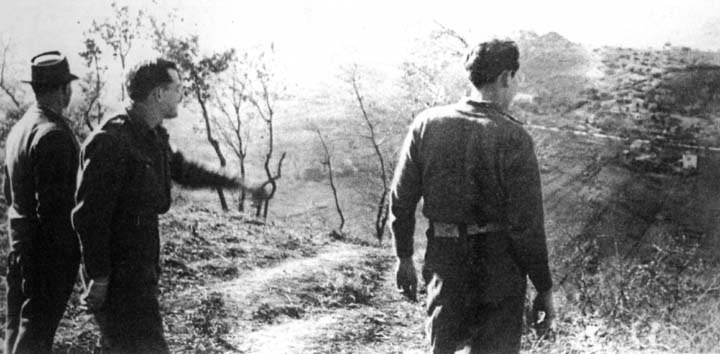
Our Section was chosen to go ahead and hold a farm-house for several days while the rest of the Platoon got ready to move. The farm was a nice big one, on a ridge with olive orchards all around and a steep valley in front. You can stand on the bluff overlooking the valley and, with the sea on one side, look inland with a view of the front and the mountains to the west all covered with snow. It seems as if you could reach out and touch one mountain ... and that one is no mean little hill. It's about as tall as Mt. Hood, and I think the base is bigger. We took advantage of our advance occupation of the farm house by taking over the choice rooms and arranging our stretchers on bricks as beds.
My letter of February 1 continues as follows:
For the three days we were alone at the farm house, I was cook and my first move was to get on the good side of the Italian couple who own and run the place, and soon I had the elderly lady (we called her "Mama") bringing in dried twigs for the fire. We traded as much of our British rations as possible for some good Italian food --- eggs, pasta, and even managed to get a chicken for a special dinner one night...
I noted in my letter that "Christmas packages played a prominent role in making the menu what it was. We also dined on fresh eggs cooked in every way possible: poached, scrambled, fried, boiled. I even made cream-toast one morning...".
San Vito was within range of the German heavy artillery, with sporadic shelling day and night. One afternoon we stood on the bluff overlooking the valley below and the winding road to Lanciano while the road was being shelled; a truck was hit:
The Platoon came up on January 27, and we took up our posts with the Canadians. Activity along the front was sporadic and casualties light, I wrote of a "sudden aliveness at the front, and then stillness." I had time to thoroughly grease my newly assigned ambulance, "Fox IV"; and I enjoyed the comfort of a scrounged German air mattress which Bernie Wood left me. During one of the lulls, I remember a friendly tussle with big Chan, during which I got properly sat upon; also a walk on a quiet night in the rain for hot showers and a movie, courtesy of our Canadian friends.

Our Platoon HQ base at the farm outside San Vito to the rear of the front lines themselves, was out of range of most German artillery. Our Allied planes controlled the skies. There was no need to disperse, and we could park our entire Section in a row at the farm while waiting for evacuations to and from the CCS. There had been a break in the winter weather; too soon, however, the rains returned, and the farmland and olive grove became a sea of mud.

There was, however, considerable risk for our fellows at the RAP's at the front in the Ortona sector. Four were wounded in a single day, January 29. Our Commanding Officer, Lt. Jack Hobbs, sustained serious wounds when a mortar shell exploded six feet from his jeep. Bill Warden, riding with Jack, received a slight head wound; this same shell also riddled Jack Chaffee's ambulance. That evening, Dennis ("Denny") Hunt and Bill Taylor drove up to replace the wrecked ambulance. In the dark they missed a turn and drove into a German mine field on the road two miles north of Ortona. Their ambulance was blown up on a tank mine. Both sustained serious wounds. Denny's left leg was amputated just above the knee, and he had to be evacuated back to the States.
Denny Hunt was one of the Section leaders of our Platoon, respected and loved by all of us. He had won the Croix de Guerre in World War I. Too old for the armed services, he had volunteered with AFS. I wrote, in a letter dated February 11: "Denny is one of the finest men I have ever met ... 50 years old, he is tall and straight as a young pine from riding many hours a day on horse-back at his ranch in Arizona... He is going to pull through OK, because he is one of those guys who just doesn't give up..."
In this letter dated February 11, I enclosed a poem I had written entitled "No Place for Kids." It is my tribute to Denny Hunt, and is quoted below (Annex).
Pending return to duty by Jack Hobbs, NCO Bob Blair took over command, and we maintained our posts with the Canadians with no further casualties. Jack had to be evacuated to the United States in early March when Bob was appointed Lieutenant, Platoon CO, and Chan Keller as NCO. With such losses early on, our 567 Company Commanders had been concerned if the Platoon "will be able to go on."
Since moving up to San Vito from Pollutri, we had enjoyed bright days and crisp nights in those final days of January, 1944. This was too good to be true, and torrential rains soon followed, adding to the difficulty of evacuations over dirt tracks and crowded roads. Our four-wheel drive ambulances always brought us through, although a major concern was to avoid getting stuck in the mud!
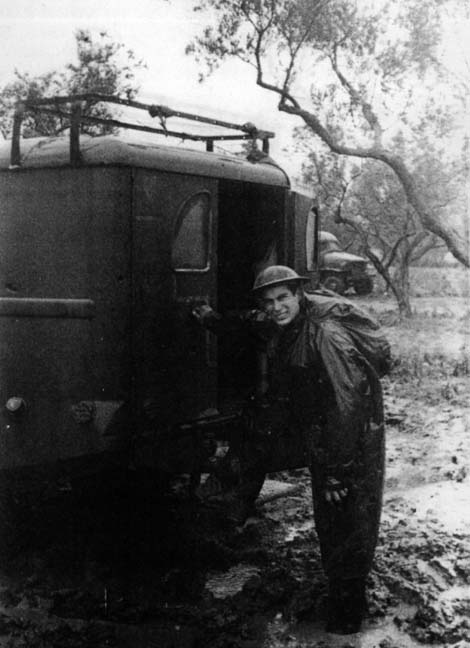
Our posting with the Canadians at San Vito-Ortona was short lived. On February 4 we of C Platoon, together with B Platoon, 60 ambulances in all, were notified of transfer to New Zealand Corps, then preparing for the second major assault at Cassino in the 5th Army Sector across the mountains to the west. I had written (letter dated February 11) without giving place names of course that "Our Platoon has been given a brand new assignment. We have been given the job, according to 567 Company Commander Charlie Snead, who told us that we were 'seasoned troops'. Although that got a laugh, still we all felt warmed by it. Most of us of have been overseas for more than a year ... That makes us 'veterans' by U.S. Army standards."
Our ambulances were called back to Platoon HQ on short notice to prepare for transfer. Our Canadian friends told us: "Sorry to see you go because of the comfort of our patients." Soon the Canadians themselves would be pulled back for needed rest and refitting. They had been in the line for months. They left behind 2,000 of their fellows, most of these killed in the house-to-house fighting in the sterile advance at Ortona during Christmas week, 1943. They are laid to rest in the exquisitely designed and reverently tended Canadian Military Cemetery just south of the rebuilt town.
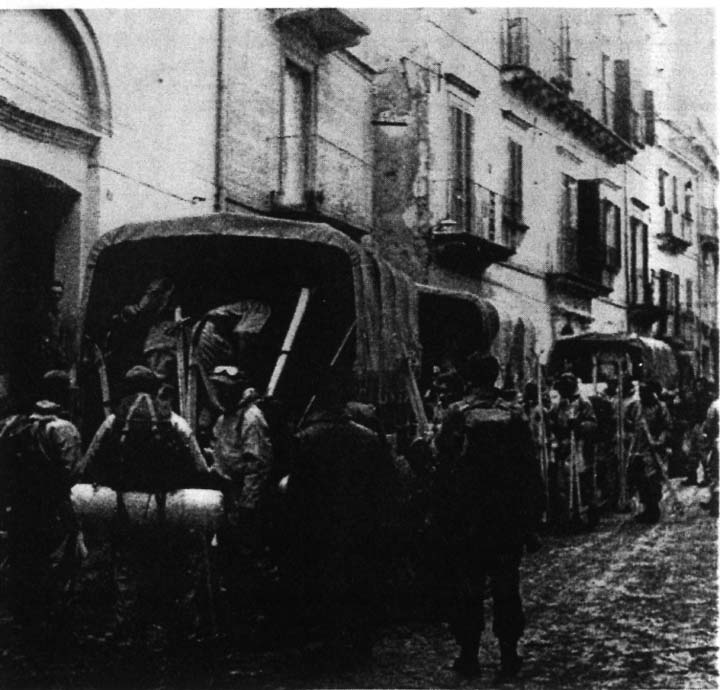
At first light on the morning of February 5 we formed our convoy at C Platoon HQ, facing a difficult two-day trek with little rest on narrow winding roads over and between snow covered mountains. Our destination was the New Zealand CCS at Presenzano, some miles to the south of Cassino itself.
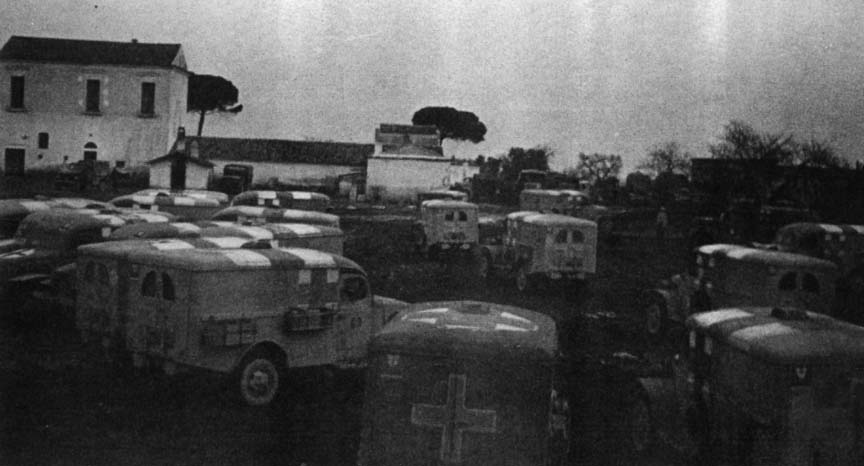
Monte Cassino, crowned by the famed Monastery established by St. Benedict in the 7th Century A.D., and the town of Cassino built at the base and slopes of the mountain, lay about 70 miles due west of San Vito. But we had to cross Italy's Apennine spine by narrow winding roads over high passes and through deep valleys. It was no easy task, compounded by the problems of maintaining a convoy of some 30 cars, keeping a distance of 50 feet or more between vehicles. We faced at least two days of difficult driving in conditions of snow and rain, in a passage of 250 miles.
As we headed south then west, with all our ambulances "on the march," each one of us sensed the excitement of those moments. It reminded us "veterans" of the march to Mareth at the start of the Battle for Tunisia. Again something of moment was "in the air." Some of the best and bravest of 8th Army --- New Zealand Division, 4th Indian, 78th UK, armored brigades, artillery --- were on the move to join with 5th Army to drive the Germans from Cassino and open the road to Rome up the Liri Valley. And we were part of this. After all, as "seasoned troops" in the words of our ACC Commanding Officer Charlie Snead, we had been "chosen" for this difficult assignment. And so it was with good spirits that we formed our long convoy in the chill glimmer of first light. Leaving the Sangro behind us.

Before reaching the mountain passes, our assigned routing took us across the relatively flat plain near Foggia, where we stopped for a short rest and lunch break.
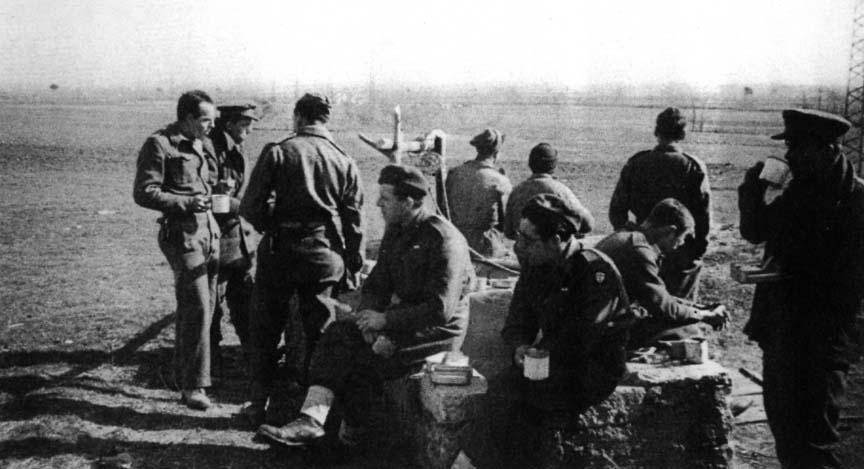
There would be another "dividend" for most of us: it was to be reunited again with the "Kiwis" with whom we had served and formed friendships on the Western Desert and in the Tunisia campaign. The Allied forces for the assault at Cassino in February had been formed into the New Zealand Corps under the command of New Zealand's admired General Freyberg, VC.
Late in the day, February 7, we reached our destination, the small hill town of Presenzano near the 1st New Zealand CCS. It was a secure position. Several miles and ranges of hills separated us from the Cassino front, generally obscured under lowering clouds. Roads were jammed with ordnance moving up for the forthcoming second major Allied assault. Tent cities had sprung up around sturdy stone farm buildings, and the CCS was one of these. Small tents housed CCS staff; the larger tents the wards and operating theaters.
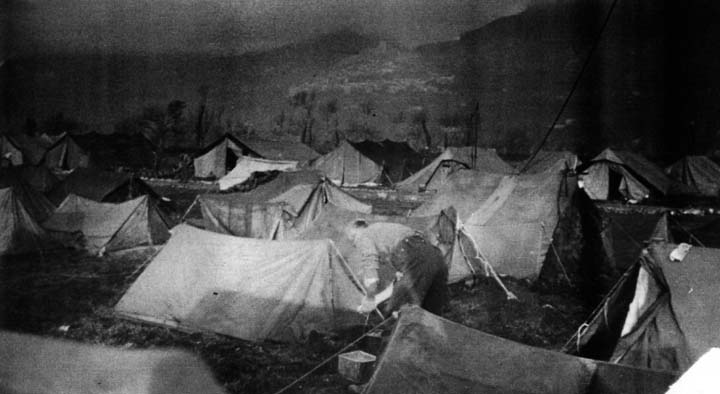
Our two Platoons, B and C 567 ACC, 60 ambulances, were but a fraction of the units of every branch of service, with troops in their thousands, as the NZ Corps moved across the mountains on narrow congested roads. These tested troops relieved the exhausted, battered, brave soldiers of 5th Army. The American 36th Division, for example, fought from Salerno to Cassino, then led the first attack against the town and the monastery in December-January, facing murderous resistance under atrocious conditions. They, all the American units, suffered terrible losses. Tom Hale, on page 50 of his account The Cauldron (see citation, my sources) wrote. "No troops could have fought better or more bravely than they, but they had confronted the impossible."
For NZ Corps to move into the front to relieve the American forces and prepare for the attack in force upon Cassino, was dangerous, difficult, and time-consuming. It was not completed until February 12. The Indian and French/North-African- troops took up positions in the mountains north and east of the Abbey, and the New Zealanders along the rivers facing the town of Cassino itself.
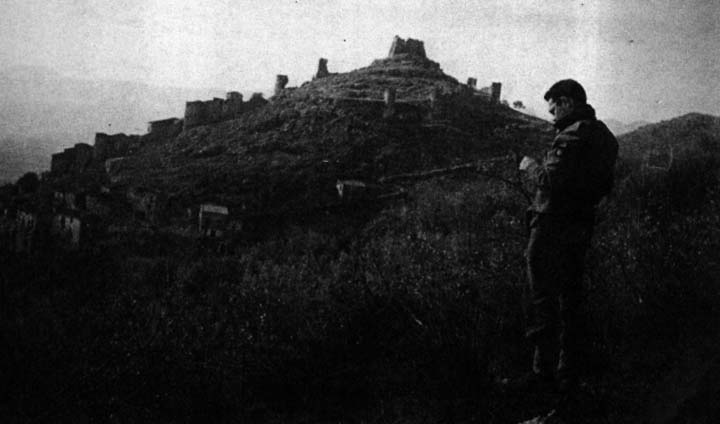
These preparations at the front provided time for us to rest and reconnoiter. Taking advantage of these delays, and a lull in the rains, some of us walked over to Presenzano, its hilltop location crowned by medieval walls and ruins.
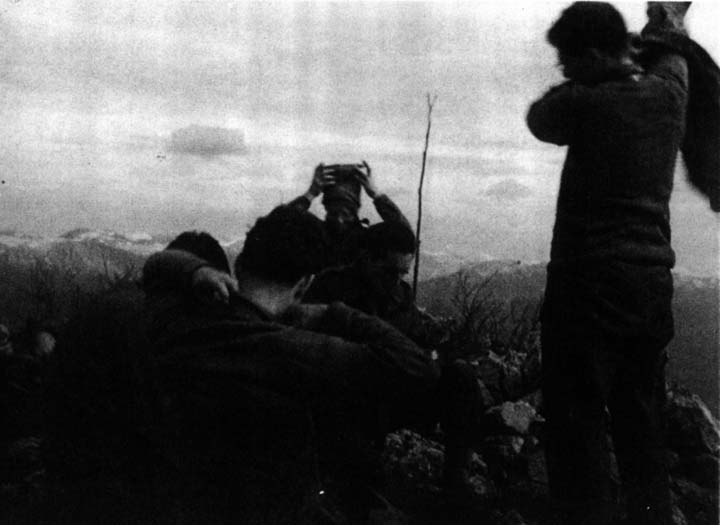
Others of us climbed a mountain, with the snow-covered ranges at the front dimly visible to the north. I was one of seven of us climbers, and wrote in a letter: "The trouble is, when you get to the top of one mountain, there are a hundred others all around. I never thought of Italy as a land of a million mountains."
 |  |
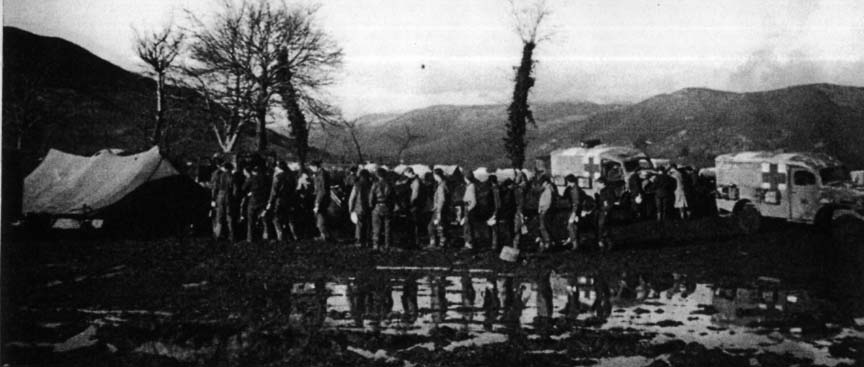
Platoon HQ, workshops, transport, and our four ambulance sections, had dispersed at farm fields separated by rows of trees near Presenzano. Given the constant rains and traffic, our leaguer was soon churned into a quagmire of mud. We had to navigate through the mud and around standing water to reach the mess tent. Keeping our boots dry was a problem.
Our four wheel drive ambulances managed to get through, with an occasional push. Workshop vehicles took up a fixed position, but other heavier supporting transport without four-wheel drive would get stuck in the mud when leaving the paved roads while bringing in supplies.
 |  |  |
Most of us of our "old" Section 3 which had been formed the previous year at Marble Arch, Libya, were together again at Presenzano. Howard ("Col.") Brooke had returned from home leave, and was assigned to my ambulance, Fox IV; he had also been my fellow Driver at Enfidaville. On the other hand, one of our "charter members" Art Ecclestone had taken sick leave to return home to recover from jaundice. Another charter member," George Collins now lead a Section of his own. However, he seemed "homesick" for our Section 3, as I reported in a letter, and "comes over whenever he has a chance to join us in some of our brew-ups which have become quite famous by now, along with our songfests."
Until receiving our postings by Sections, the entire Platoon set to work on evacuations back to the base hospital at Caserta during the first few days of our transfer to the Cassino front. Casualties were increasing. There were artillery barrages by day and night, and patrols in strength preparatory to the full-scale attack on February 18.
We awaited our postings with anticipation, and they came soon enough. Only one of our four Platoon Sections were given coveted front-line posts, and Section 3 was not one of them. Other front-line posts were assigned to Sections of B Platoon. Our remaining three C Platoon Sections continued to work out of 1st NZ CCS. This involved a shuffle system with evacuations from the forward MDS (Main Dressing Station) back to the CCS on the one hand, and then on to the NZ base hospital at Caserta.
We "veterans" of "Lucky 13" were content to work the rear echelons. There was less risk, but plenty of action night and day in difficult driving conditions over long distances. As the build-up for the attack continued, I had written in a letter dated February 20.
We've all been pretty busy the past week, but several of our Sections are stationed pretty far back with evacuations to base hospitals. That is strictly O.K. with us, because the novelty or "thrill" of being up ahead has long since left the "veterans" of Section 3!
Our fellow Drivers up front worked out of the 6th NZ ADS (Advanced Dressing Station) right under the "eyes" of the Abbey itself, visible through the rain and clouds on its mountain top. Until relieved almost two weeks later, they survived by means of a great deal of grit and luck the most harrowing experiences of their lives. Working around the clock without rest during the first full-scale attack by NZ Corps at Cassino in unimaginable conditions, they were under constant fire. Tom Hale, who had joined us in time for the Termoli-Sangro advance, and who we had "adopted" into our "Lucky 13" fellowship, was one of those drivers; Lucien (Luke) Kinsolving --- also "adopted" by us --- was another. Tom Hale's graphic account of their ordeal, pp.49-62 of his The Cauldron, is appropriately titled "The Valley of the Shadow."
As far as the troops could know, the shining Abbey above, erected as a monument to Peace, had been turned by the Germans into a deadly instrument of war. From its ramparts, it was thought, the Germans observed the troops below, and orchestrated the fire that rained down upon them. From this bastion, the Germans had countered and frustrated every Allied assault.
The life of a soldier was more precious than the priceless Monastery. It would have to go, a heart-rending decision taken by top command. On February 15 there was a break in the weather. The order was given. Army and Airforce commanders assembled on a near-by mountain to observe "pin-point" strategic bombing by day.
At mid-morning of February 15 (as I recall) we were startled by the drone of flights of bombers of 8th American Air Force in majestic array above and through the clouds, with fighter escort. It was the first time any of us had seen the storied B-17 "Flying Fortresses" in action. They passed high overhead. Then the thunder followed, and man-made clouds rose above the mountain where the Abbey once stood. At that time we on the ground thought that there was no alternative.
In retrospect (as documented above in Part VI)) we know now that the Abbey had not been occupied by the Germans or used as an observation post. Instead, the Germans had dug in several hundred yards from the Abbey to the east. Patrols of the Indian Division were approaching these positions, and the bombing which reduced the marble halls and walls to rubble made matters worse as the Germans moved in to better defensive positions. The bombing of the town had the same effect. Tactical bombing by smaller planes against the German lines away from the Monastery, which General Freyberg had requested, was not done.
Moderate weather held for a few more days, and the full-scale assault by NZ Corps was launched with high hopes (February 18); the New Zealanders were advancing across the Rapido into the town, the Indians and North Africans moving down onto Monte Cassino itself from the ridges to the east. Rumors as always accelerated, as well as the flow of casualties. My notes, based upon such rumors as well as posted bulletins and comment by patients, are terse; I quote:
Attached NZ Davison: Battle for Cassino, R.R. Station, Cassino itself, Monastery on hill directly above controlled by Jerry. Road to Rome curves north around Monastery hill. 1,000 tanks ready for break through. Feb. 16-19: Forts bomb Monastery, Maoris (the magnificent NZ natives who volunteer their services) hold flank of hill. Indians storm Monastery, Kiwis take R.R. station ford Rapido River. Indians lose Monastery (Jerry counterattacks) just before Engineers complete last gap for break-through of tanks: but tanks unable to break through to the plains leading to Rome, in support of Anzio beachhead. Rain and uncertain weather stall follow up attacks after three days.
The New Zealand Corps, having come so close, refused to quit, and regrouped for a second full-scale attack starting February 24. There was some advance against ferocious resistance, but this attack stalled in torrential rains, and had to be called off . The Allies had to withdraw from some points dearly won, but maintained positions and pressure all along the Cassino line until the final and successful full-scale attack could be carried in good weather by fresh troops in May.
In late February early March, New Zealand Corps, including our two 567 ACC Platoons, was drawn back to the Adriatic side. Everything and more that men and arms could do, had been done. It had been a gallant, if unsuccessful episode in the terrible history of the Battle for Cassino, World War II.
All of us, who had served with the New Zealanders in Africa, and with them in the advance to and beyond the Sangro, were delighted to be with them once more at Cassino. We admired, indeed loved them; they were as good friends, and as good soldiers too, as any of the Allied nations with which we served. We could not have wanted a better assignment than to the 1st NZ CCS.
It is one of the -ironies of war that some troops are thrust into the most horrendous of situations, while others of the same unit and in the same action operate in the relative security of the echelons behind the lines. Such was the case with three of our four Platoon Sections, including my own. And, as casualties lessened in the final week of February, there were opportunities for fellowship, even festive occasions, with "Kiwi" friends. For me there was a special "treat" --- reunion with fellows of the medical unit track team with whom I had run during track meets held at Tripoli, Libya during our "Summer of '43." In a letter dated March 3, I wrote:
The past month ... has been opportunity to renew old friendships and make some new ones, too. I believe I wrote ... of the medical track team of last summer in which we were joined by a New Zealand medical unit. I am now quite near these same fellows..."Robbie" (Roberts), Sgt. MacKenzie ( "Mack") --- Robbie was the sprinter and Mack the distance runner. Robbie works in an operating theater. I have dropped into his place evenings. Brew-ups of course served with N.Z. hospitality ... these fellows from the little country "down-under" are the most generous race of people I have ever met. One evening, with a white mask over my face, I assisted in two operations.
Robbie and Wally (his "running" mate) as well as Gordon Morris who was the cook of their unit, soon became close friends with all of us of Section 3. One evening Gordon invited us over for oyster fritters, more than even Chan Keller could down, and I, too, was stumped after the sixth one.
In the last days of February, 1944, our Platoon received orders --- effective March 1 --- to move back to the 8th Army front. My letter (written March 3) continued:
When the news came that we were to be re-posted to another sector, we engineered a farewell party to top all parties. Another "Foxhall" was built (two ambulances back to back as we had done at Marble Arch) and a good 20 fellows, Kiwis and Yanks, crowded into the "Hall." The party coincided with a chance issue of beer, and thus there was lubrication for our voices. Fortunately Jock Cobb had saved some of his gin and lime-cordial, and then there was tea and cocoa for "nightcap"...all you need is an empty ambulance or two!
On March 1 we formed our convoy out of Presenzano for the 250 mile return trek back to San Vito, going south to cross the lower elevations between Caserta, near Naples, and Foggia on the Adriatic side. The rains intensified as we drove, making the hair-pin turns through the mountain passes even more difficult. We paused at the Foggia plains, whose airfields supported US Airforce heavy bomber and fighter squadrons. Here tent-cities stretched for miles it seemed, interspersed with solid buildings. Our route took us through the town itself, now many miles from the sounds of war --- except for the constant sorties of the planes.
In my notes set down at that time, I wrote:
Orders come March 1 to move back to 5th Corps, 8th Army front. Convoy through Foggia. Gigantic Red Cross building and excellent USO show there. The Tommy has nothing like the recreation offered American troops. A month on the 5th Army front in battle dress, made me feel like an outsider viewing my own country men. New Zealand is like a good but closed club. We have made a nation out of every land on this earth. you could see all the different types in the Red Cross Club, Foggia.
These, and other notes, writing I had done in Africa, and an outline had been intended as source material for a possible book after the war, but ended up instead in my attic. Appropriately, I had titled the Chapter on our month-long transfer to the 5th Army front at Cassino, "At the Outside Looking In." In writing letters and notes, I was helped by a portable typewriter which had been shipped out for me with the Christmas packages received during our respite at Pollutri.
We reached San Vito after three days, and "camped" at the same farm house, olive groves and fields, we had occupied during our late January action with the Canadians. But the weather had improved, and there were signs of spring.
I had time to write a long letter home dated March 3, which includes a reference to "traveling" in such a way to escape the scissors of the censor:
Already there are signs of spring ... and that Italy is as beautiful as Mother said it would be. This morning there were birds singing. Winter wheat, planted between endless rows of gnarled olive trees, made the landscape fresh green with flashes of silver on the leaves as a warm bright sun touched the moist dew. In the background, creamy white and lined in shadow, was a snow-covered mountain mass half concealed behind the leaves of olive trees. This has been like a returning home ... for we were at this very spot when I wrote you of the chicken dinner ... which our Section had when I was cook for a few days.
Since then we have done some traveling, caught up in the vicissitudes of changing tactics and battle plans as our side probes for a weak place in Jerry's defense line built along the mountainous country of central Italy...
Speaking of a "returning home," the people here (Tomaso, a kindly old gentleman of 80 years, and "Mama" his wife, who is one of the nicest elderly ladies I have ever met, and their children) seemed very glad to welcome us back. Already we have plans for another spaghetti dinner!
This morning, stripped down to undershirts, we lugged stones from a near-by train track (which had been destroyed by the Germans) to fill in the mud-clogged driveway over which our ambulances must pass to enter the olive groves where we are parked. Soon the rains will be over: and then no more mud to worry about for a while. When the break in weather does come, our armies are confident of going ahead rapidly if only because of tons of superior equipment massed, and complete control of the skies. A Jerry plane is a novelty these days. We are even getting careless about the black-out. Rather a contrast to the desert, when he used to drone over every night dropping flares --- and bombs.
We were held in reserve at San Vito until March 12; then on the move again to relieve A Platoon which had been based at Lanciano. Lanciano, just ten miles west across another valley and then another ridge of hills, was the "hub" city of southern Abruzzo located between the great Maiella mountain massif, whose snows still gleamed white to the west, and San Vito/Ortona at the coast. It was an ideal location for our Platoon Headquarters and Workshops. From here, our Sections and ambulances fanned out to all the forward posts between the mountains and the sea.
This time, we came to stay --- until Rome was taken in June. Our three months at the Lanciano sector were the longest for our Section 3 and also C Platoon at any one location during the war, with the exception of the summer at Tripoli in 1943 when the Platoon had only just been formed.
The Adriatic front stretched for some 30 miles from the sea right to the steep flanks of the Maiella massif itself, where the Allied advance had stalled against the German Gustav line in December and could not break through until the following June.
5th Corps troops holding the line in this sector from the mountain to the sea included some of 8th Army's best: the New Zealanders, 4th and 8th Indian Divisions, 5th Canadian armored brigade, units of 78th UK Division, artillery and mortar companies. R.A.F. light bombers and fighters controlled the skies, virtually at will. The Italians, now organized as effective co-belligerents, brought in the 1st Italian Reconnaissance ("Brigata Maiella") for work in the mountains. In late March the newly organized "Nembo" Division was welcomed to Lanciano with joy, and took over one of the most dangerous sectors along the so-called "mad mile" west of Lanciano.
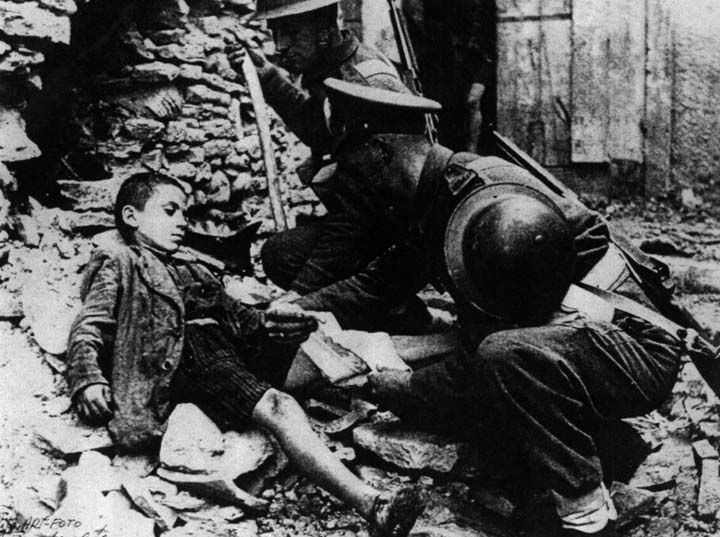
The city of Lanciano itself was only a few miles south of the front, whose ridge lines were visible on the horizon. It was within range of German artillery, and was shelled constantly. The people of Lanciano took refuge in the underground galleries of the stone buildings, as well as in caves and grottoes, as in the many villages of the region. These people had in fact been caught between the opposing armies in the fighting to cross the Sangro in November-December, as well as in the constant exchanges that continued all along the line into June ---eight months under fire.
Although essentially a "holding" action, there were patrols all along the line by both sides, some in strength. There were periodic feints by 8th army, bombings of German positions from the air, constant artillery duels and barrages. 8th Army had positioned three thousand artillery pieces all along the line ---light, medium, heavy--- also the mortar and machine-gun companies at the front itself. And there were the tasks of logistics, transport, and supply to arm and maintain thousands of troops of an entire Army Corps along a relatively short front for so many months, and also meet critical needs of civilian populations. An estimated 60,000 refugees had fled to Chieti, north of the Gustav Line, others had been evacuated to the south.
Two small cities well to the rear, Vasto and Campobasso, were used for backup army supply, housing and troop rotation. Lanciano, however, with close access to the front and midway between the mountains and the sea, was the logical "hub" or nerve--center for command, supply, transport, staging, storage depots, housing as well as field hospitals and amenities for the troops.
The people of Lanciano, the Lancianese, were justly proud of their city and its history. Older than Rome, named Anxanum in Roman times, Lanciano was allegedly founded by the legendary Aeneas two thousand five hundred and more years ago in what is now the Abruzzo region of east-central Italy. Here rivers, as noted, from the high mountains carve deep valleys between the many hills.
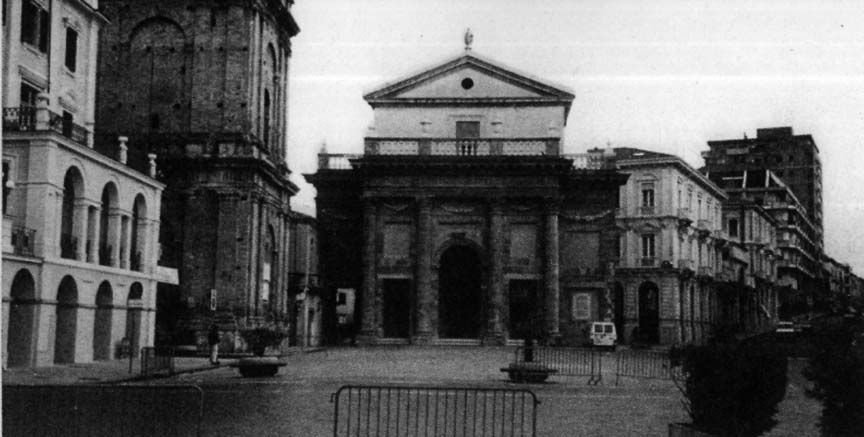
Lanciano was built on one such hill, surrounded by stout walls some of which still stand. Our workshops found safe haven behind one such wall. To the south, across a river gorge now partly filled in, is a plateau which has hosted international fairs since Grecian times. The Romans built a bridge over this river, where, according to legend, the Virgin Mary appeared after Constantine recognized Christianity. To honor Mary, the Lancianese constructed a huge brick viaduct over the bridge upon which they constructed their Cathedral, named La Madonna del Ponte (Lady of the Bridge). The sturdy Medieval arches and vaults of the bridge upon which this church stands, provided the perfect bomb shelter for hundreds of Lancianese during the war --- and today it is an acoustically perfect chamber for summer orchestra festivals.
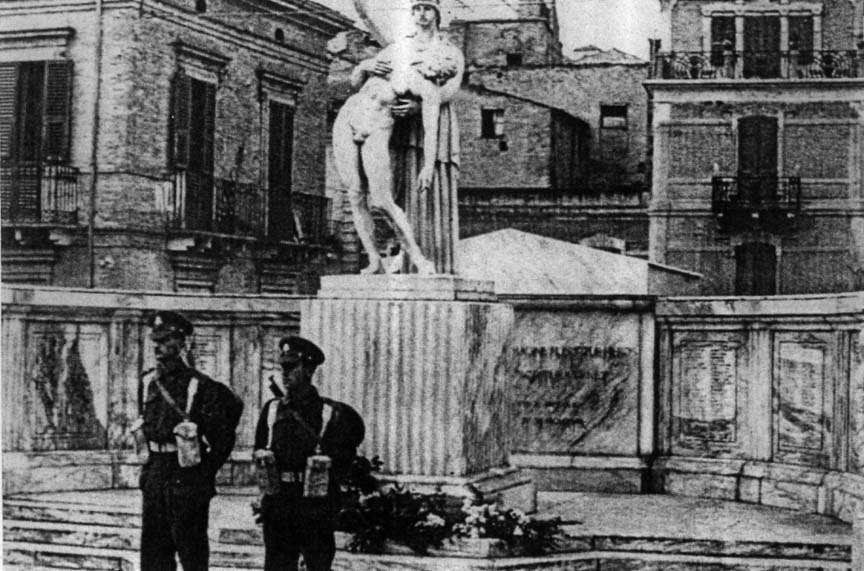
The filled land facing the Cathedral also formed the central square or "Piazza" where the City Hall stands; this Piazza leads into the principal avenue or "Corso" of the "new" city lined by beautifully designed buildings in baroque style. Where the old city joins the Piazza, a marble monument stands to honor Lanciano's war dead. For the months Lanciano was close to the front, this Piazza was jammed with military transport parked, or in transit. The British set up a NAFFI (snack bar, social center) at the ground floor of City Hall at the Piazza; they dubbed the Piazza "Trafalgar Square."
 |  |
 | 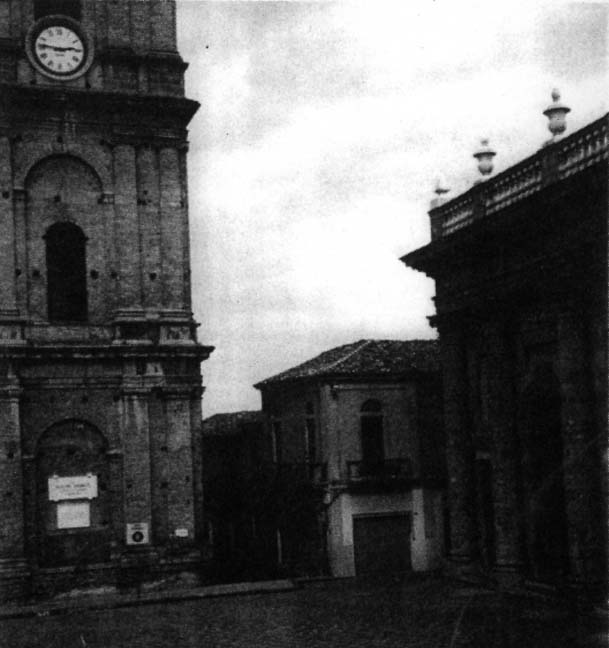 |
At the monument to Lanciano's fallen in war since 1914, the names of the dead are inscribed on panels in the walls surrounding the figure of a dead soldier held in the arms of Liberty.
These names include those of 24 of Lanciano's youths killed by the Germans, some tortured before execution. Young heroes against impossible odds, they had led a spontaneous revolt on October 6, 1943 against German plunder and occupation of their city. The armed rising had been premature as regards any possibility of succor from 8th Army, more than 50 miles back at Termoli.
It was no mistake that Lanciano had been the first Italian city to plan and stage an armed attack upon the hated Nazis who infiltrated the German armed forces. For this Lanciano was given Italy's highest award, the Medaglia d'Oro al Valore Militare (Gold Medal) presented in 1952 by the Republic of Italy's President Luigi Einaudi.
The Lanciano resistance had obtained light arms from sympathetic police and staged their violent and costly action against the Germans behind road blocks and fires in the narrow streets and alleys of the old city. The Germans had to use tanks to crush the resistance. Men and boys not able to escape were forced into labor camps. All inhabitants, except indispensable services such as medicine, were given three days to evacuate their homes and walk north. The looting, and demolitions, continued.
Advance patrols of 8th Army, the turbaned Sikhs of the 8th Indian Division, did not enter Lanciano until December 3, 1943 and found a deserted city. The next day Lanciano's mayor hung a hidden Italian flag at the City Hall to welcome the 8th Army liberators.
Many refugees were able to return, and as reported in Part VI above the Allied advance continued beyond the city in a vain attempt by the New Zealanders, Indians, British and Canadians to force the Gustav line along a 15 mile stretch between Ortona at the coast and Orsogna on a lateral road west from Ortona. Both towns were reduced to rubble. The advance reached just north of Ortona; the Germans held at Orsogna. Although our C Platoon had been pulled back to Pollutri December 15, and then transferred with B Platoon to Cassino in February, other AFS Platoons took over and continued on the Adriatic front at forward posts.
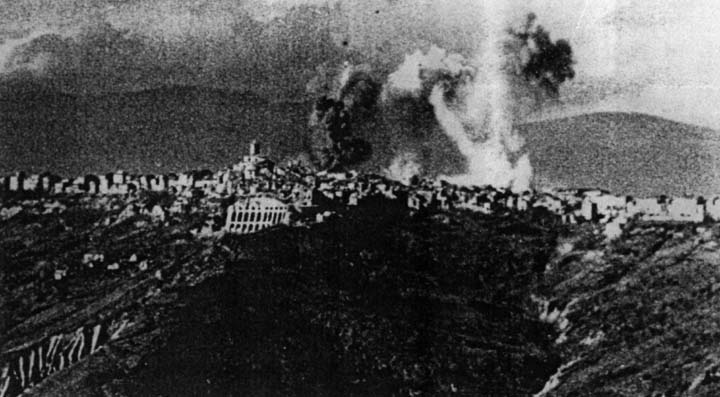
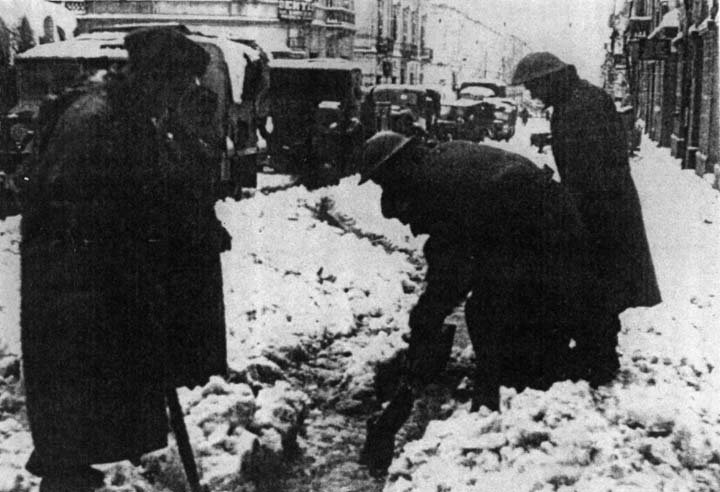
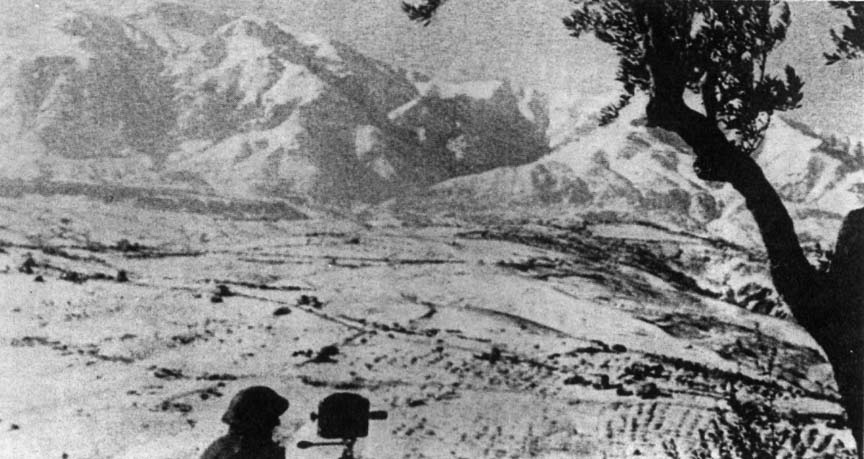
Orsogna, a hilltop town, dominated much of the Adriatic front. It had been a focus of 8th Army advance across the Sangro in December, but the Germans hung on. Because of its strategic position, the town remained a principal target of patrols, bombing from the air, threats of attacks in force even after the advance had stalled. There follow dramatic photographs from the Imperial War Museum, London, showing the Adriatic front at Orsogna in winter, and a bombing attack on the town itself.
 | 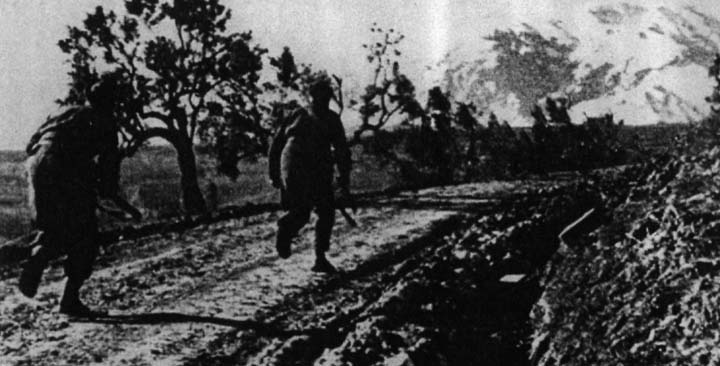 |
In the last two days of December, 1943 a huge blizzard had swept the region from the Maiella (background, photo below) to the Adriatic; operations stalled.
 |  |
Orsogna had been held hostage by the Germans as evidence for propaganda purposes that they would not be dislodged from Italy. It was not taken until June when the Germans were forced to withdraw all along the Adriatic front following the breakthrough at Cassino and the liberation of Rome, June 4, 1944.
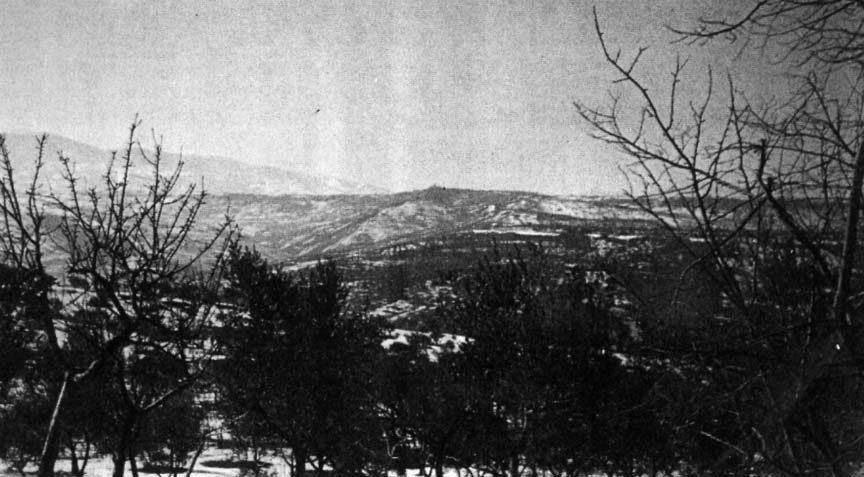
By March, 1944 snow in the valleys and among the hills was gone, and winter storms had subsided. Roads and tracks were generally good. We had orders to move up to Lanciano from San Vito on March 12, just ten miles from our farm house HQ at San Vito, to relieve A Platoon. A Platoon was assigned to the Poles at Campobasso south and west of us. Lanciano would become another "home base" for us for the next three months.
Before leaving San Vito Bob Blair (as noted above), who became acting Platoon Lieutenant/CO when Jack Hobbs was wounded, was named Commanding Officer, and Chan (Keller) --- charter member of our "Lucky 13" fellowship and Section 3 --- was appointed Platoon Sergeant or NCO. Jack went on home leave to recover from his wounds, and was able to return to action, but as Lieutenant of another Platoon.
There were other changes affecting our Section 3. For example, Jock Cobb had obtained Draft Board approval of his acceptance at Harvard Medical School, and would leave at the end of March. I wrote on March 13:
Looks like old Section 3 is getting busted up, for we lose Jock Cobb soon ... he is going home to medical school. I may be leaving the Section, too, because they want to scatter the "old veterans" among the newer fellows.
Without delay, all Sections and ambulances were posted to RAP's and ADS's of the 8th Indian Division, and to the many artillery regiments all along the front. One ambulance went to the Airborne Brigade, another to the 1st Indian Reconnaissance Squadron in the mountains. This was Jock's post, most remote of all, at a small mountain village, Civitella, where the only connecting road or track hugged the steep flanks of the Maiella itself.
My own post, in a totally different sector than Jock, was an infantry RAP on the ridge line of the next row of hills across a deep valley north of Lanciano. Jerry was just a "stone's throw" away. Fortunately, activity was limited to occasional patrols. Shells being lobbed from time to time in both directions passed over our heads.
In my letter of March 13, I added:
At present he (Jock) is at a post in another sector than Howard Brooke and myself. John Leinbach has been given a much deserved two weeks leave; while "Sgt." Chan Keller buzzes by on his motor bike every other day or so ... to bring mail, canteen supplies, news, good cheer. In Chan, and Bob Blair, our Platoon has two excellent leaders.
The authorities had requisitioned a choice headquarters building for us, the very opposite of our San Vito farm house and its farm family. Our Lanciano HQ was a solidly constructed villa or "palazzo," seat of an aristocratic family, that of the Baron Rino Cocco, his gracious wife Pina, and their young children. There was separate accommodation for the family at the ground level, leaving the beautifully appointed top two floors and the entrance way for the Platoon. At the entrance, a carved oak doubledoor. led into a heavily reinforced vaulted gallery, ideal for storage for spare parts.
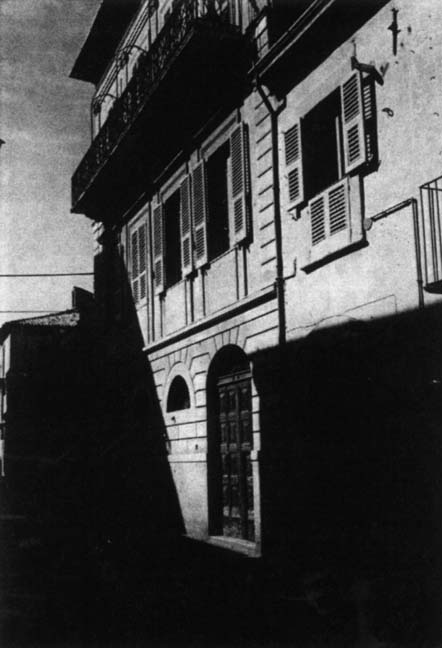
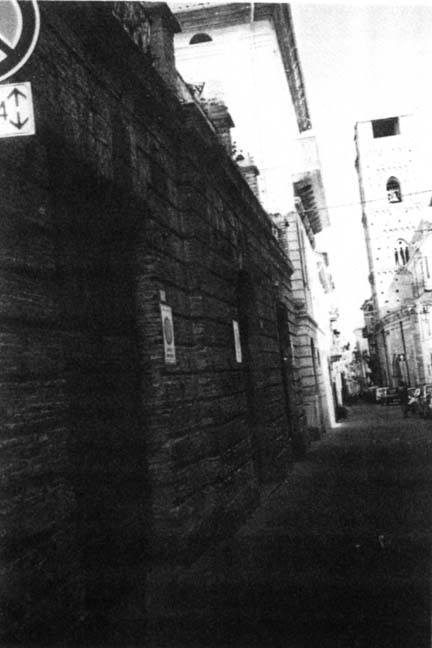
With facade of ornamental stone work and a balcony of filigreed iron, our villa was one of a row of upper class residences facing south along Via Garibaldi in a privileged section of the old city. Via Garibaldi ran along the northern crest of the high escarpment on which the old city was built. The rear or north walls of our villa, at least three feet thick, rose upon the escarpment one hundred feet and more above a steep valley below. The escarpment itself had been faced in brick since medieval times. From a recessed balcony built on the second floor of the north side, there was a spectacular vista of the valleys and rolling hills beyond all the way to the German lines, with the great mountains looming to the west and north.
In a carefree moment in late May, we staged a Platoon party on this balcony, and as the sun set behind the mountains we could see the flashes of the guns along the line. With three-foot thick stones walls, occupants at HQ felt reasonably secure.
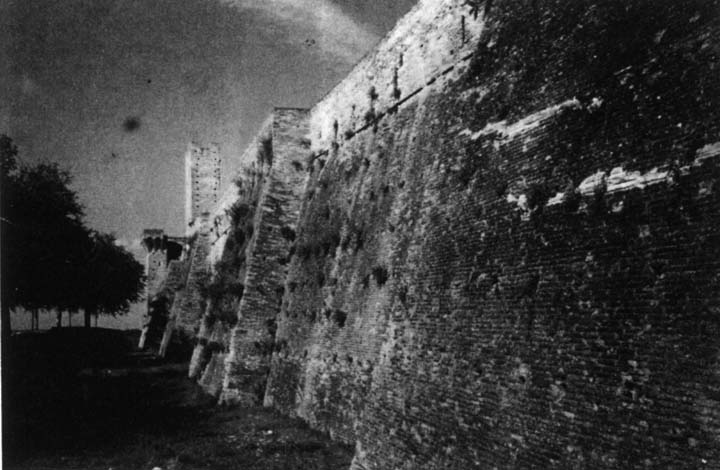
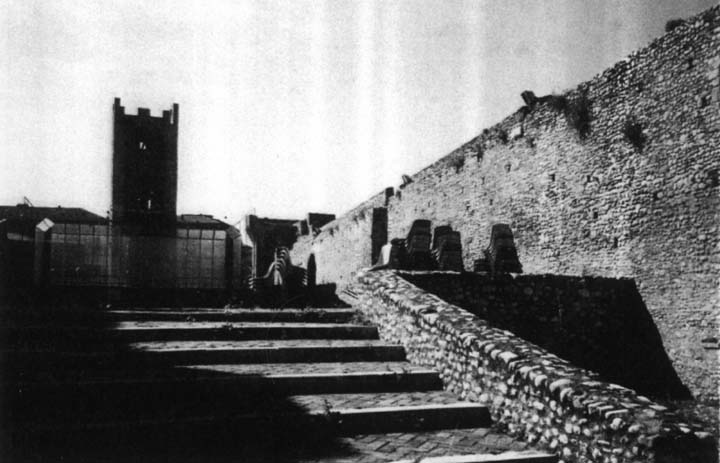
A few blocks to the west of our villa, Via Garibaldi exited at huge stone walls, towers, and battlement, the 11th Century "Torre Montonare," the largest remnants of the ancient walls that once surrounded the old city. The walls continued north, facing the front lines, then turned west at right angles to form a large protected space promptly taken over by our workshops.
 |  |
 |
Two blocks east of our HQ villa rose the bell tower of Lanciano's 12th Century Gothic church, "Santa Maria Maggiore." This was the highest point in Lanciano, and had been used to advantage for observation by both sides. Via Garibaldi continued straight and narrow to the east to terminate in remnants of still standing medieval gates at the end of the escarpment. By contrast, the narrow roads leading down into the city were a labyrinthian maze squeezed between stout stone structures, some a roads" just steps built into steep inclines and all leading to the central Piazza and the "new" city. Here larger roads could handle military transport; larger buildings were converted into storage depots, work shops, field hospitals.
Given its strategic location at the center of the line, and the staging of troops and supplies, Lanciano was a prime target of German artillery. Our forward posts fanned out from Lanciano towards the sea on one side, and to the Maiella mountain chain to the west on the other. An entire Section of our Platoon was based at or near the hill town of Casoli, about ten miles west of Lanciano on a direct line.
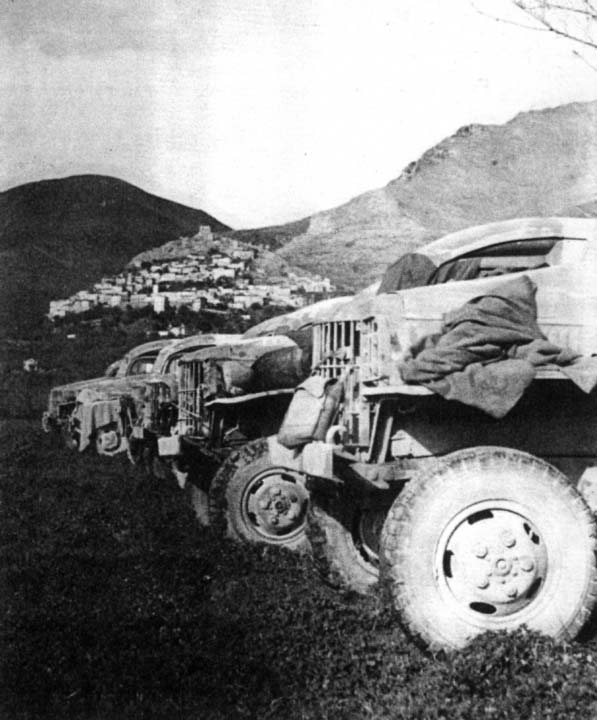
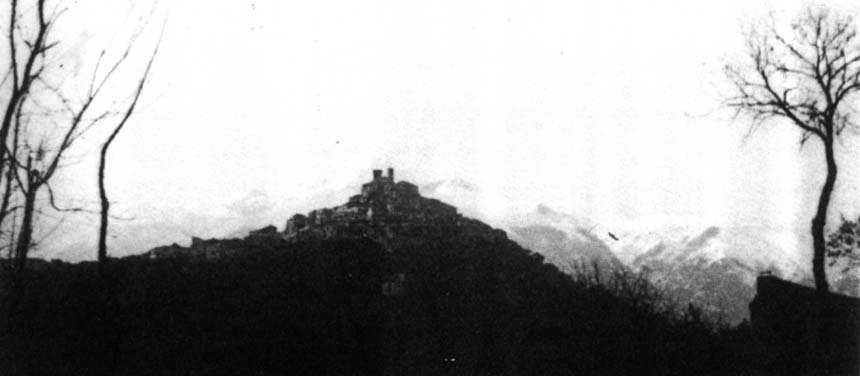
The traditional stone buildings of Casoli, high on a perfectly cone-shaped hill, appear to have sprouted from the hill-sides themselves. To reach the town, the road climbs steeply on hair-pin turns. The walls and towers of an intact castle crown the top of the hill, accessible only on foot by man --- or mountain goat. From this tower, it seems one can reach out and almost touch the sheer eastern flanks of the Maiella massif which looms so close beyond to the west; the deep valleys of the upper Sangro spread through hills to the east.
 |  | 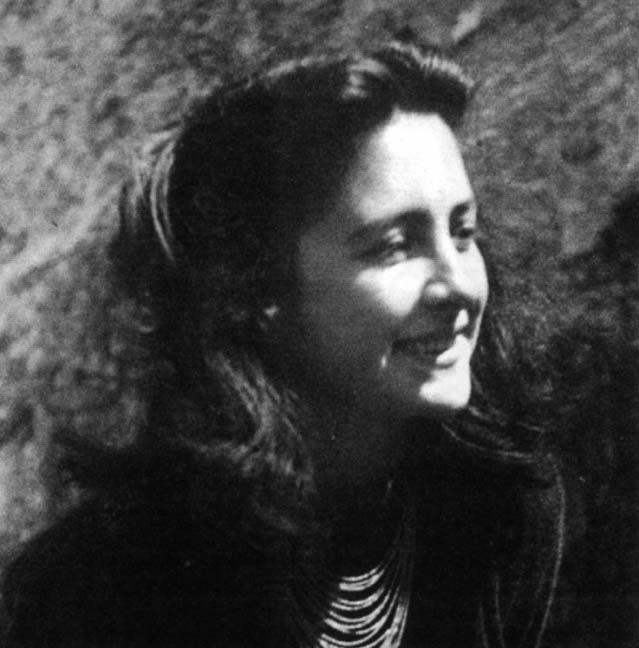 |
One of our fellow Drivers, Pierre Bourdelle, fell in love with Francesca --- alas an unrequited love, but can you blame him? Pierre was a gifted artist.
Evacuations from the Casoli sector to the field hospitals and workshops in Lanciano were difficult and dangerous. The valleys and roads near Casoli were sheltered from direct German fire by hills, but the road itself climbed these hills to a ridge and then down again into Lanciano. The ridge itself was directly under the eyes and the guns of the Germans at Orsogna, and this stretch of road quickly earned the dubious name of "the mad mile." Evacuations blacked-out by night were also risky. There were secondary roads out of view, taking a longer route down along the Sangro valley. In an emergency, drivers over the mad mile relied on the Red Cross, and luck.
It was now mid-March of 1944. The high mountains were covered with snow, but the foothills and valleys were clear. All our Platoon ambulances had fanned out to forward posts along the Adriatic front from the coast to the Maiella massif which loomed beyond Casoli. We of our "Lucky 13" Section 3 were dispersed at posts along this line. Jock Cobb was assigned to the most western of all, to an Indian Army "Reccy" outfit it at Civitella, a small mountain village.
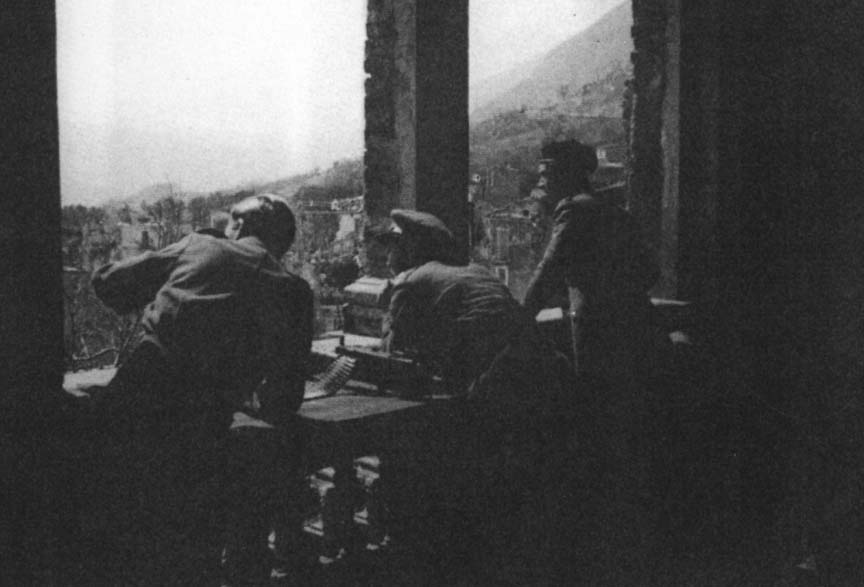
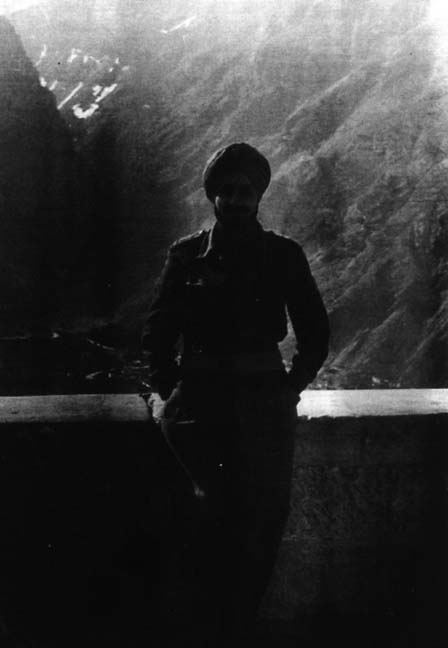
This unit was commanded by a Sikh officer, Captain Ragaul. Jock photographed the Captain standing against a stone retaining guard rail along the one road through Civitella, overlooking a steep valley and the sheer cliffs of the mountain. Jock's caption reads:
Civitella was one of a series of mountain villages within Jock's purview, including Fara San Martino near Civitella and Lama dei Peligni about 3 miles to the south. These and other villages had the misfortune to be built along the one roadway skirting the very mountain mass itself from the southern east-west passes below the Sangro all the way to the Pescara River and road to Rome on the north, and subject to German demolition. Jock's caption on Civitella reads:
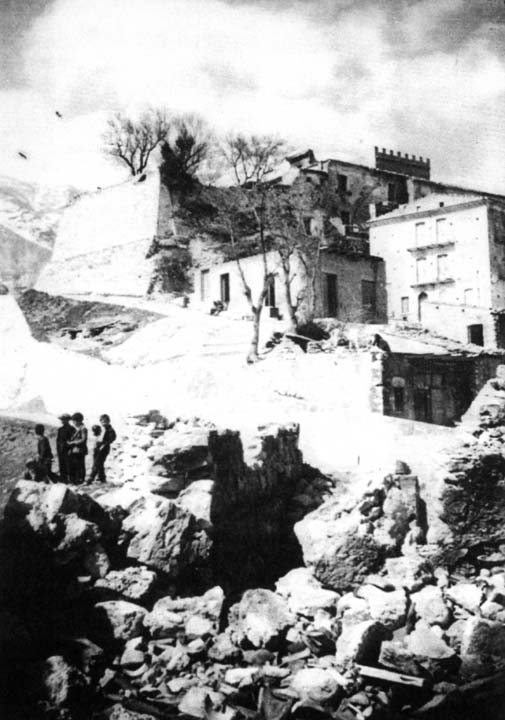
Civitella, and the other mountain villages, were linked by a narrow road, which wound along the very flanks and cliffs of the mountains. It was a marvel of road-building; it was also a possible route for 8th Army flanking operations in the advance from Termoli. To preempt any such action, the Germans demolished all villages along the way, thereby blocking the road with tons of rubble. This was done during the German "scorched earth" program which leveled the bridges, rail and electric lines, roads and abutting structures in the path of the advancing 8th Army.
Army tanks, fitted as bull-dozers, had cleared the rubble from the roads as the Germans were pushed back to their Gustav line, but the horror and effectiveness of the German demolition remained, as shown by Jock's photographs which follow.
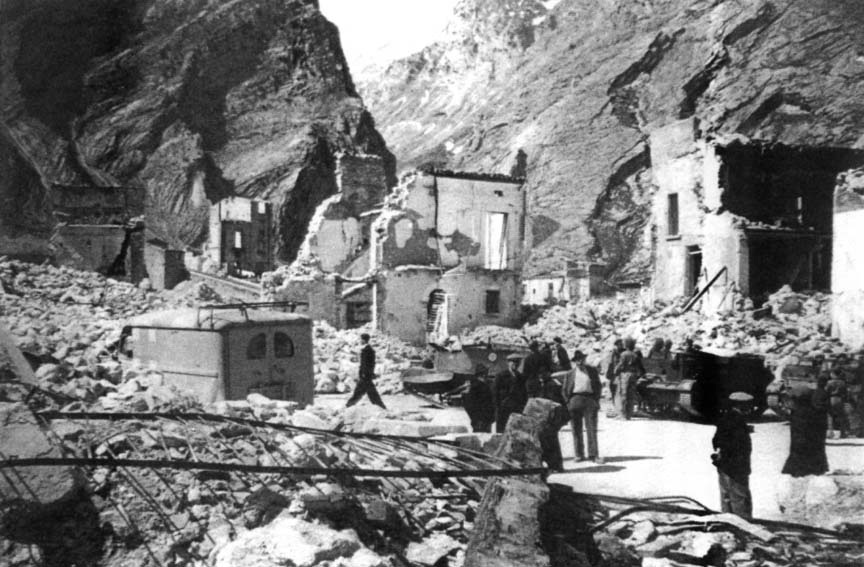
Ruins of Fara San Martino, a neighboring village to Civitella, were equally dramatic. Today Fara San Martino, at its lofty mountain perch, is a gem --- the prosperous center of production of the world's finest pasta made from pure mountain spring water and Italy's quality hard wheat.
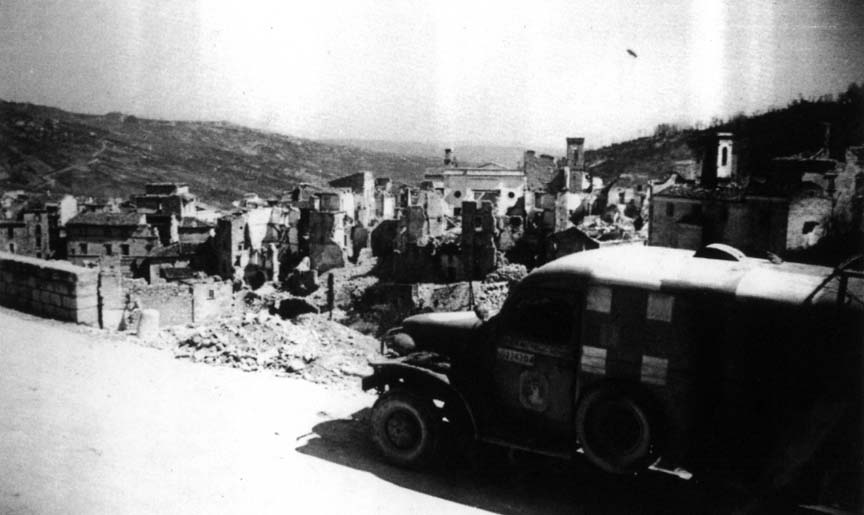
The sturdy people of the mountains had managed to return to their shattered villages, helping to clear the road, restoring structures as best they could, sharing living quarters such as they were in buildings still standing. There were of course few amenities such as running water, electric lights.
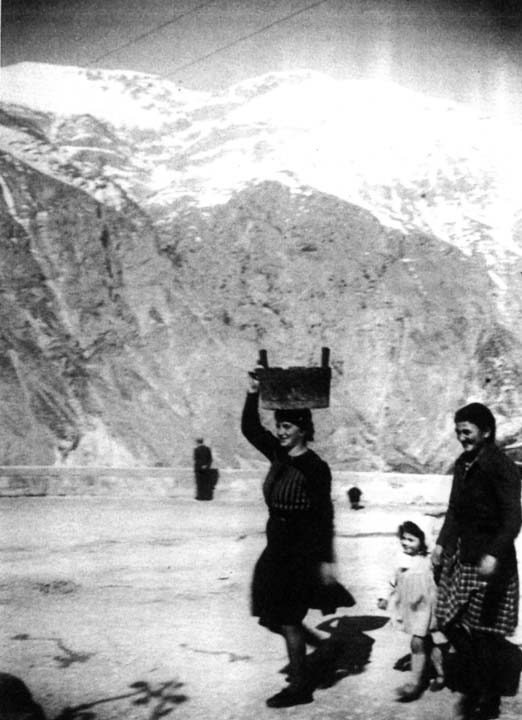
Jock photographed one of the young women of Civitella bringing in water in a large container carried on her head, and accompanied by another with child. In the background, two of the highest peaks of the Maiella, rising almost 10,000 feet.
Fortunately, action in the mountains in March 1944 had been light. In a letter dated April 14 from Naples, where he was wafting transport home, Jock had written: "I have almost forgotten the war, the post I left behind high in the mountains, a little village fortified by a few armored cars With nothing but a couple of patrols and the hugeness of the Maiella between us and Jerry."
By mid-March Jock and the rest of us of "Lucky 13" had completed almost 18 months overseas. Under contract with AFS, we had the option of terminating or taking home leave after one year of service, or at one of six month intervals thereafter. Having gained admission to Harvard Medical School and his Draft Board's "OK," Jock had decided to terminate in early April and return home.
His delight in this incredible opportunity for which he had striven for several months, was, however, tinged by a some regret. While "waiting for a boat to take me home" he had written from Naples (April 14) : "Too bad in a way because (Civitella in the Apennines) was the most interesting post I have ever had..."
This post became interesting, not because of assignment with an Indian Army unit, but because of a job, as he explained, "I got for myself ." It was a job working with an Italian Doctor, Dr. Sepal, assisting with the Doctor's civilian patients. Resourceful and determined Jock was not to be deterred by inaction on the military front when there was work to be done and great needs to be filled on behalf of the people of the villages. Jock explained in his own words, his letter of April 14:
I had been in that town (Civitella) attached to a reccy outfit, had met the civilian doctor, who was a grand feller and would walk miles every day to see his patients ... His wife had been taken away by the Germans and all his instruments and medicines were gone, but he managed to find enough odds and ends here and there in the ruins of the destroyed villages so that he could still be of great help to the civilians who have been badly off for several months, their towns completely destroyed, their food supply cut off, and serious diseases beginning to spread.
Jock's letter continues:
I met the AMG officer who was an American and glad to see another one. His job was to keep the civilians under control and cope with the very large number of refugees and escapees. When I told him he could probably have an ambulance to help him if he asked for one, he was delighted. With his help, and the help of a chap from the War Relief Branch of the American Red Cross, and after interviewing a number of other officers concerned, I finally fixed it up that I myself was attached to the AMG for the help of these civilians.
Jock and his ambulance, with AMG authorization, went to work with a will on behalf of these dauntless people of the mountain villages and their dedicated physician, Dr. Cipolla. He was able thereby to reach a number of villages along the mountain road, and where necessary evacuate to the better facilities at Casoli. In the few weeks remaining for him before his travel orders came through, Jock performed excellent service with Dr. Cipolla.
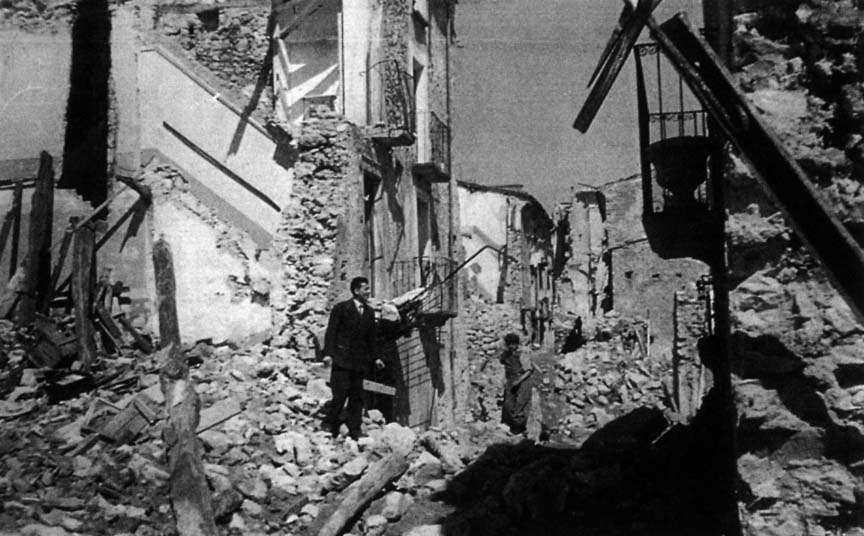
Jock observed at first hand the community spirit of these people of the mountains; he wrote from Naples (April 14):
Other groups have volunteered to work on the roads and to clear up the debris, still others have volunteered to work in the civilian hospitals without pay. In all, the spirit I met in this part of Italy is something entirely different from my previous experiences.
His appreciation of these people of the Apennines of central Italy is comparable to the encomiums in Eric Newby's memoir of his experience in the Apennines of northern Italy. Jock wrote further (April 14):
And so I was glad to do anything I could for those people while they in their gratitude for what little I could do, took me into their homes, lodged me, fed me, cheered me with wine, song, and even dance. It seemed odd and I could not fully appreciate their merrymaking, after seeing so much misery and suffering for which there was little help.
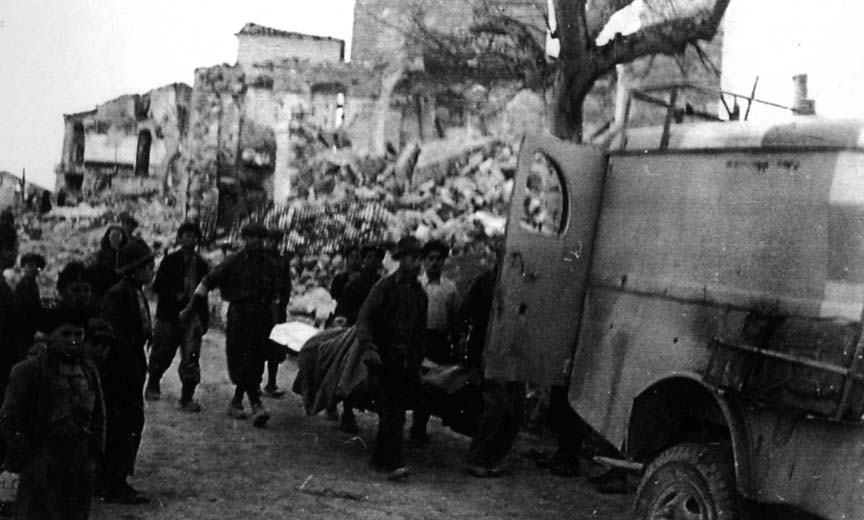
Jock also praised the fighting spirit he witnessed among these people in the mountains. He wrote (from Naples, April 14 following his service in the mountains):
Incidentally, in case you have not heard about the guerillas or patrioti as they call themselves, these are hardy civilians of these ruined towns who have banded together to help the allies. They wear civilian clothes, sneak around with guns, and do as much damage as they can. I admire their spirit, which is something that has been lacking ... in Italy. They have taken the initiative and have done something to help themselves.
One such band, well organized with responsible leadership, was the "Maiella Brigade" of Ettore Trillo who would one day serve as Prefet in the Milan of democratic Italy --- as reported above.
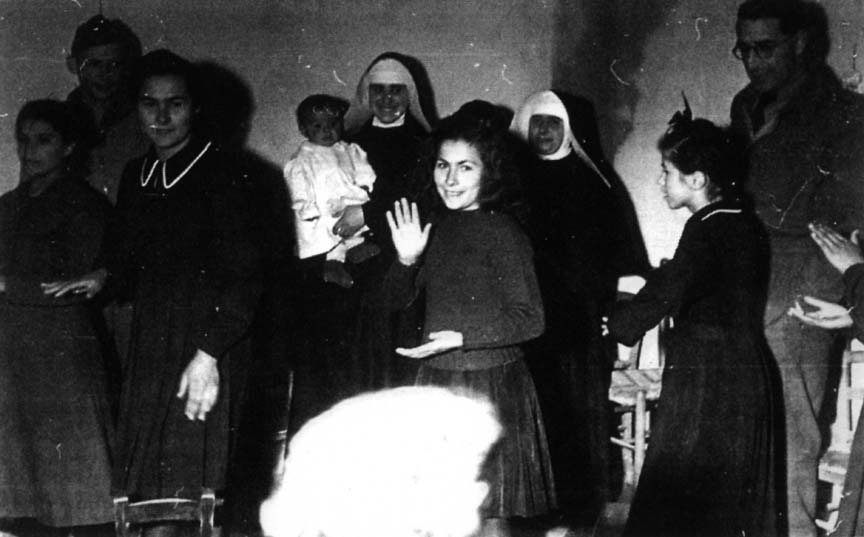
Although these people were resilient and self-reliant they had many needs, eased to the extent possible under conditions of war by their own nascent representatives assisted by Allied Military Government and the American Red Cross.
 |
 |  |
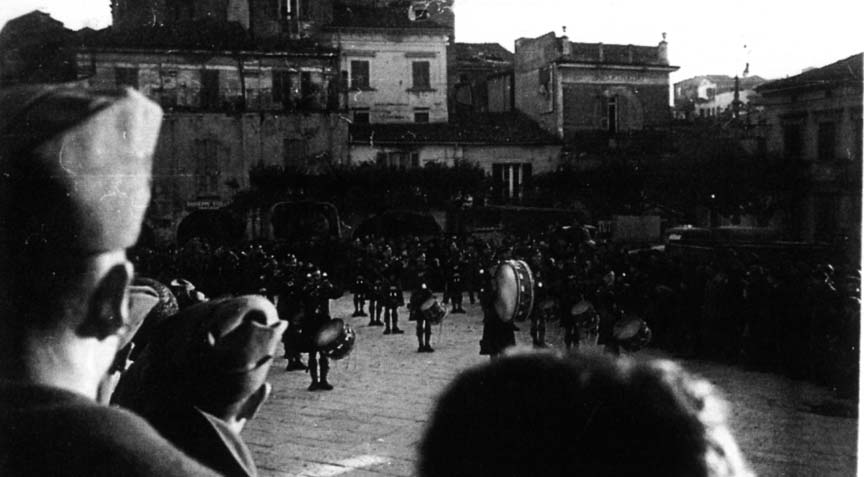
In early April 1944, Jock Cobb checked in his ambulance at Platoon HQ Lanciano, and obtained transport for Naples --- for home and Medical School.
Before departure, he managed to photograph a flourish of pipers with drums in the central Piazza of Lanciano, a stirring and ear-shattering experience:
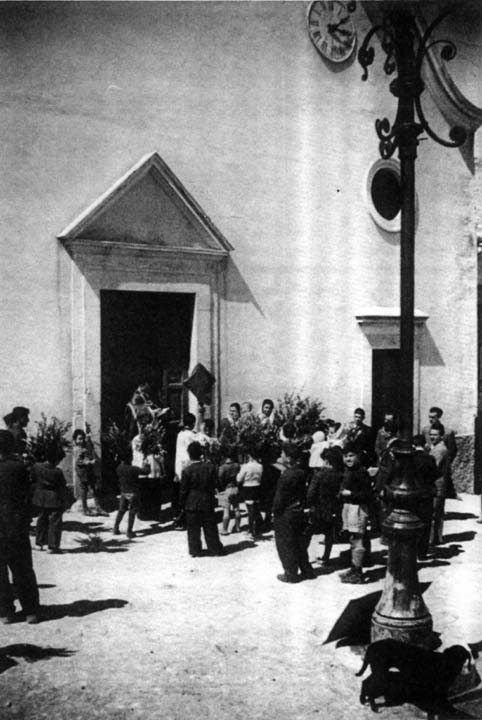
Appropriately, one of Jock's final acts at Civitella was to attend Palm Sunday service at the town church, one of few buildings spared demolition.
In addition to the postings at the Casoli area west of Lanciano, our ambulances were clustered at posts along the "mad mile" area near the center of the Adriatic front, and also along valleys and ridge lines of the Lanciano sector running north and east of the city. These posts were RAP's or ADS's of 8th Indian Division, which was relieved by 4th Indian Division in April.
I was initially assigned, with Fox IV, to one of these posts at the Lanciano sector, together with Howard Brooke as my alternate driver as at Enfidaville, Tunisia. We were joined by a second ambulance, that of Jay Nierenberg with Ken Brennan as his alternate. This posting turned out to be at an ADS, joined with an RAP just beyond, of the 86th Field Ambulance, 19th Punjab Brigade. Our Medical Officer was Captain Mascareena, a Christian of the Brahman caste based at the ADS; he was assisted by Lt. Ramadwah, Hindu, at the ADS and Lt. Bakt, Muslim, at the RAP --- all three physicians experienced in conditions of war. British medical orderly, Charley, was also based at the ADS. Needless to say, friendships blossomed --- as well as lively discussions on every aspect of the explosive situation brewing at that time in the restive Indian subcontinent
It was a short drive to this post, down a steep valley at the base of the north-facing escarpment of the city of Lanciano itself, then past a small village and on up one of the typical secondary switch-back roads to one of the abandoned farms along the next ridge where our post was located. A shallow valley separated us from. the German lines, visible behind mine fields along the lateral ridge between Ortona on the coast and Orsogna inland. The spring thaw had turned fields into the accustomed mud.
In abbreviated notes on my first impression of the ADS I had written: "Farm house with sand bags in front of door, World War I atmosphere." I wrote a more detailed description in a letter dated March 13:
You would enjoy seeing my new habitat. It is a pig-sty, I think, at least it is some kind of a stall. Around the little passage-way in is a comforting wall of sand bags. Inside is quite clean, and with a home-made stove to keep it warm. The MO just sent over some cocoa and milk, and so my primus (German, scrounged) will be doing yeoman service soon. Howard Brooke is here with me, and Jay Nierenberg is at a post a short distance away, and gets his meals here. At present Jay is basking in the sun on the hood of his car, and I am enjoying the sun, too, for it is another promise of spring after days of endless rain.
I added: "Lying in my bed-roll at night, snuggled up on my air-mattress (also German) with various sounds of warfare now and then breaking in on the stillness of the night." Other delights of this post were treats of rice and curry from the Indian rations. We felt reasonably comfortable and secure at this post, although close to the German lines.
Despite a warming sun, and other harbingers of spring, chill rains continued from time to time; I wrote (my letter of March 13):
The rain must have been snow in the near-by mountains, for today, now that the clouds have lifted, the great Maiella mountain mass is a solid and clean white beyond the rolling hills and deep river gorges. Naturally we are in hopes that spring has truly come. The rain and mud of the winter has gotten on our nerves. For example, when we all moved a few days ago, it took us four hours of pulling and pushing, up to our ears in mud, to get the cars out on the road.
Italian spring was not to be denied, however, and I had written (March 19):
I guess "Sunny Italy" and all it means, is really with us. I have been taking sunbaths the last two days ... which are more pleasant and I trust as potent as vitamin pills. Life in our sector remains quiet. Jerry patrols have discovered that this is a Medical Post, and do not shell or mortar it. New friends ... Indian medical officers ... are grand companions and open the horizons of my mind to another nation.
Most of the activity at our sector, indeed all along the front, was limited to patrols and artillery duels. Our patrols at night monitored the situation in no-man's land to counter any German penetration or preparation, check the mine fields, silence gun positions. These patrols occasionally turned into fire-fights between opposing patrols, marked by the clatter of rapid-fire guns and the bright streaks of tracer bullets. One of our first casualties was to a sentry at a neighboring post hit by a stray bullet that entered just under his World War I type British "tin hat" --- a freak accident! On rare occasions, our side mounted a patrol in strength backed by artillery as a feint to keep Jerry off balance. There were also efforts to "straighten the line" ---especially at the Orsogna salient.
In the constant artillery duels, day and night, our side sent over more than the Jerries sent back --- all of it passing above our post in both directions. However, the threat of the short range mortars was a concern; also being caught out on the roads during an artillery duel. This happened to me returning from an evacuation. Fortunately, I found cover in the lee of a farm house next to the road.
In short, although the Adriatic front was indeed a "quiet" front in the spring of 1944, there was some activity most of the time. To be sure the Allies and the opposing Germans had concentrated resources and action at Cassino; however, the road to Rome was still the major objective, and we "foot soldiers" in the mud were not privy to the details as to how this objective could be achieved. For all we knew, an attack could be mounted at any time from our sector.
The action that engaged us, however limited, was serious and dangerous business. Lives were at risk, and lost. Nevertheless, there were at times rather amusing incidents in such a relatively static front. In a letter dated March 20, 1 reported on several of these:
Warfare has turned into a genial series of Halloween-like sorties called "patrol activity." Genial, that is, until a patrol gets caught in a mine-field, or pinned down by enemy mortar and machine-gun fire. Some amusing anecdotes have cropped up during the past months of this patrol activity. A Canadian company used no-man's land as a place to dig in their privy. One morning, the officer of the company was surprised "on the seat" by a patrol lying in ambush there. He didn't even have time to button up his pants, and was marched off, one arm high in the air, the other arm supporting his "drooping" battle-dress. Occasionally, the Jerries get dressed up like Italian women, and snoop about at night to determine the nature of our positions. One Jerry spent the night in an ambulance. Unfortunately, he over-slept, and was found there the next morning. The other night some Jerries rapped on the door of Battalion HQ. And so it goes ... like Halloween night every day of the week: until the sudden angry burst of the Spandow, and the surer, slower answer of the Browning or Bren, tells you that it is war.
All of us at our post were involved in a difficult, risky and unexpected evacuation one night, as I wrote in a letter dated March 24. By this time, Captain Mascareena and I had become "good friends," exchanging views on war and peace, sharing in bits and pieces of each other's lives. In this letter (March 24) 1 had written about the Captain:
Yesterday I had a cup of tea with the MO as we sat together in front of the big stone hearth of the farm house. As he rose to offer me the cup, he bumped his head on the top of the open fire-place. I told him that his kindness had given him a bump on the head. He said that "there are many bumps in life." I asked him if he had had any such "bumps," since he was always singing and smiling. He replied, quite simply: "Yes, I loved a girl, and she died." This is why he came overseas, and is serving at the front.
On the night of the unexpected evacuation, an especially dark night, bad weather was threatening. We did not anticipate patrol activity. The Captain and I drove up in his jeep from the ADS along the dirt track to the near-by RAP for --- of all things! --- a game of bridge with the other two doctors, by the light of a log fire inside the snug farm house. A patrol had been out not tar from the RAP, and there was the "chatter of Jerry machine-guns sounding" as if "across the street."
There were casualties, all brought in and treated at the RAP. Fortunately only one required evacuation back to the ADS, and then by road to a field hospital following the initial first aid at the RAP. By this time, however, sheets of driving wet snow and sleet had turned the narrow track into slippery mud, and made it even more impossible to see anything in the total darkness. In an effort to get through to the ADS, both of our ambulances slipped off the track to be hopelessly stuck in the ditch. Not withstanding, we wrapped the patient in blankets and a poncho, rigged a stretcher on the Captain's jeep, and took off. I led the way, with a lighted cigarette in my hand to guide the jeep, feeling the ruts with my feet.
Just before turning into the ADS compound, I barked my shins on what I thought was a stone wall which I had not seen. However, I could hear the sound of pebbles falling into a deep well on the other side. Had the wall not been there, I would have plunged into one of the uncovered wells of the farm.
We were able to secure another ambulance for the evacuation of our patient from the ADS over the paved road to Lanciano. We also were able to rescue our two ditched ambulances in daylight, as the weather cleared.
The irony of the situation affecting our three Indian medical officers was palpable. They, and the thousands of their fellows, Muslim, Hindu or Christian of the 4th and 8th Indian Divisions, were thousands of miles from their homes in an alien land. Pay of an Indian soldier was six dollars a month plus rations, with no home leave. These two Indian divisions were among the best of 8th Army, taking heavy casualties in helping to lead the advances in Africa and Italy. These heroic men were laying down their lives for the freedom of Europe, and yet their own country, "the brightest jewel in the crown of the British Empire," was ruled by a foreign power.
However, even as these Indian troops waged war with the Allies against the Germans, another "war" was in fact raging in India, a "war" of non-violent resistance led by a living Hindu Saint, Mohandas Gandhi known as Mahatma, "Great Spirit," in all India and indeed, the world. The march to Indian independence had become a tidal wave, and nothing was going to prevent it. By 1944 it had become a matter of how it would be done, and when. The brave soldiers of India, fighting with the Allies in the cause of liberty and to rid the world of the scourge of Hitler, had also thereby contributed to the moral and psychological forces needed to rid the world of the scourge of colonialism.
The vast Indian subcontinent and its human masses were torn by horrendous problems: an underdeveloped, poverty-riddled economy; centuries-old and with rigidly enforced divisions of class and caste; and even more ominous, the yawning chasms separating the majority Hindu and the minority Muslim communities. Even the spiritual leadership and prestige of the revered Gandhi seemed unable to bridge or heal such overriding differences.
Before a fanatic Hindu assassinated Gandhi in 1948, the dam had burst, unleashing one of the greatest blood-baths and forced migrations of history. Independence came to India in 1947, but as two separate nations whose leaders, Jawaharlal Nehru and Mohammed Ali Jinnah, had already established themselves as partisans in the struggle for independence from Britain.
Needless to say, many of our discussions with our Indian friends, often in evenings during frequent lulls in action, concerned this paramount issue of Indian independence. Living in close proximity of three Indian doctors, each of a different religious community, provided an unusual opportunity for understanding.
Lt. Bakt, Muslim, was idealistic, warm-hearted, passionate about India's freedom, and bitterly opposed to measures outlawing India's Congress party. He was a self-made man, choosing medicine to help the people, but felt discrimination against the Muslims. In his view, non-violence had awakened the people, but could not go far enough. He admired Jinnah, but felt that a Pakistan-Hindustan division would be a mistake, and that Britain should set a date for an independent India and get out.
Captain Mascareena, the high-caste Christian, was older, and I suppose wiser and more balanced. He was well grounded in western letters and history as well as medicine. For him, public education was the crying need, for which Britain had done little. In a letter dated March 20, I had written about the Captain:
In all, there are three medical officers in close proximity. The Christian fellow is the older. He is a man of the world, who combines sympathetic tolerance and patience with an ability to see both sides, and to laugh when laughing is necessary. He is cultured, well read, and a good companion. He senses along with other Indians with whom I have talked, that India is awakening to all the factors which must in time create a free and powerful nation: the need for education, for cooperation among all Indians regards of caste or creed, for development by Indians themselves of the great riches in natural resources. Often times, in my chats with these fine men, there is a laugh tinged with bitterness, and a shrug of the shoulder which indicates the immensity of the task ahead of them in the road "Towards Freedom."
One evening our three doctor friends invited us for a drink; I wrote: "The other night we (Howard, Kenny, Jack Corse, and I) got together with them around a bottle of Scotch. These people make you feel at ease and at home, whereas first meetings with Englishmen can be stiff."
As in Jock's case in the mountain villages, this posting with the Indian doctors, although relatively brief, was one of the most interesting I had known.
Late March of 1944 marked the break-up of our "Lucky 13" Section 3 formed at Marble Arch one year before. Our Section leader for this entire year, and the very heart of our fellowship, Chan Keller, was now second in command of the Platoon. We had lost Vern Preble. Art Ecclestone, Jock Cobb, George Collins had left for various reasons, and others had or would take their places. Jay Nierenberg had been called home because of the unexpected death of his father. Jack Corse had come up in his place, and I would shortly turn over my ambulance, Fox IV, to him. I was acting Section leader at this time in Chan's place.
My own eighteen months overseas with AFS had been completed on March 21. I faced the options of signing on to continue under a new contract, or returning for home leave. As the time passed, I agonized over this decision in my letters home, turning one way and then the other. Chan, had decided to continue overseas and hoped that I would do the same. In this process, he had agonized with me and my inability to make up my mind. At one point, when it seemed I had decided to stay, he kidded me saying that "after March 21 there would be a sudden flurry of packing in the direction of my ambulance, and that would be me getting ready to leave."
In late March, and not able to put off my decision any longer, I was called back to Headquarters for a meeting with our Platoon Lieutenant, Bob Blair, and Chan. I had at this point decided to accept the tempting option of home leave, and assumed the meeting involved the formalities of these arrangements.
Coming into Lanciano I marveled at the charm of this old city, its sturdy stone buildings. many churches, narrow streets down steep passageways converging on the impressive central Square (Piazza) and main street (Corso). I relished my first hot bath in many weeks at the then public baths, and delighted in renewals with cherished "comrades-in-arms" at HQ, Bob Blair and Chan Keller. And of course I had thoughts of home again, at least for a short reprieve. I felt I had earned it.
To my surprise, an entirely different and unexpected option was presented to me. The American Army Officer, "Civilian Affairs Officer," in command of the Allied Military Government Occupied Territories (AMGOT or just AMG) based at Lanciano, had requested of Bob and Chan an AFS Driver with ambulance to fill an important vacancy in his staff, that of Public Health and Welfare Officer (PHWO/AMG). Bob and Chan had nominated me. When confronted "out of the blue" with this proposal, and with my hopes and heart set for home leave at last, my first reaction was not to accept.
Bob and Chan were persuasive, pointing to the opportunity for important service. to represent AFS to fill a significant vacancy. The next day, I accepted. Little did I know that this would be one of the most important decision of my life. In the next months not only would I meet and make Italian friends of a life-time with whom I served in Lanciano: I would also meet the young lady who would become my wife.
Although I was dubious as to my qualifications, Major Patterson, AMG Commanding Officer, seemed satisfied. I was reasonably fluent in Italian, and in addition to my 18 months with AFS had worked on public health projects in Mexico and Wisconsin. I think the Major also had his sights on an AFS Ambulance for work with the civilians. The Major, and Bob, as far as I could know, worked out the authorization details which also involved certain American Red Cross functions.