
AMG moved forward with each military advance, having helped restore civilian authority; its services were especially needed as urbanized areas were liberated and many troops coexisted with local populations.
I was billeted in AMG officers' quarters in the top story of an apartment building at the central square of the city. It was vastly superior to a slit trench, but one of the worst possible locations considering the frequent shelling. My room-mate was Lt. Jesse Gulitti of Connecticut, AMG Transportation Officer. Other AMG Officers, British and American, handled with their Italian counterparts public safety and police, judicial functions, information, public works, housing etc.
I hit it off nicely with Major Patterson, our Commanding Officer AMG, who was a kindly, experienced, unflappable officer with a Midwest twang; he gave me his full support. His counterpart was the Mayor of Lanciano, Guido Lotti. My own counterpart was Doctor Giuseppe Carabba, Public Health Officer of Lanciano. We shared an office in the town hall, but spent most of our time in the field. Both men and their families would become friends for life.
Many residents had returned and enjoyed the comparative safety of the vaulted stone cellars under the buildings. With a civilian population of 40,000 and thousands of troops in and around Lanciano and stretched along the front, public health was critical. My duties included sanitation and malaria control, supply for the civilian hospital and dispensaries, supervision and supply for the center for the refugees still seeking shelter: they were given food, medicines, clothing, and transported to safe havens to the south. There were also staff meetings to attend, reports to prepare.
The Refugee Center was housed up a flight of stairs in a sturdy stone school building in the old section of the city, and was staffed by volunteers --- young women of the charitable Society of St. Vincent. Licia Sargiacomo was one; her friends Vera Mercadante and Maria Toni were others. During my first weeks "on the job" as PHWO, I was taken by my counterpart for a tour of my responsibilities. I remember climbing the stairs of the Refugee Center, meeting the young women, and being invited for tea in the small kitchen. It was Licia who handed me the mug with the tea in it.
This is how I met Licia Sargiacomo. Neither of us could have imagined that within the next three months we would become engaged to marry.
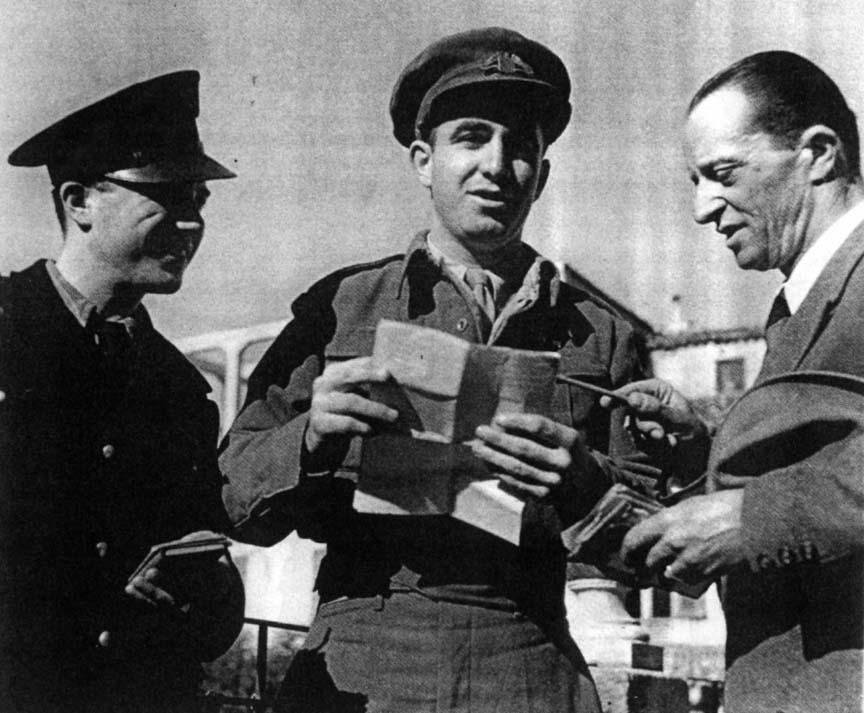
| Charles Edwards (Center) Public Health and Welfare Officer, AMG. Lanciano, April-May-June 1944 Dr. Giuseppe Carabba (right) Public Health Officer. Lanciano Trieste. Municipal Guard (left) |
My first weeks on the job as PHWO were busy and critical, and I had other things than a courtship to consider. The work had to be taken in hand and accomplished. I had to establish good working relations with and earn the respect of my counterparts and my superiors starting with our AMG Commanding Officer Major Patterson and his counterpart Lanciano's Mayor Lotti. Our C Platoon Commanding Officer Bob Blair had "risked his neck" when he proposed me for this job!
My counterpart City Public Health Officer Dr. Giuseppe ("Peppino") Carabba and I worked closely with other physicians, notably Dr. Lorenzo Lotti, who served as Director of the city hospital. Lorenzo was Guido Lotti's brother.
We AFS ambulance-driver "medics" serving the front lines under the Geneva International Red Cross Convention were respected by the Italians, and we were from America where many Italians had relatives. America was their promised land. I spoke Italian, and I had Italian roots on my Mother's side going back to the Pastene family of Genoa. All this was to my advantage in taking hold and doing the job, and my experience with malaria control and sanitation in Mexico, as well as British Army medical services, helped.
There was work to be done under the trying conditions of war. The two opposing armies, bogged down in mountains and mud, had become stalemated along the German Gustav Line which bisected Italy south of Rome (as previously explained) . There was constant shelling of Lanciano day and night by the German long range 210's, the shells sounding like freight trains passing overhead. There were patrols and fire-fights along the front and an occasional intense barrage at selected targets. In the city the narrow winding roadways or alleys flanked by sturdy stone buildings built on huge vaulted basements provided some protection during the day as well as bomb shelters day and night clearly marked.
Some buildings lined an alley behind the city's ancient Bell Tower and were built upon the edge of the steep ravine at the south side of the old sector of the city. Several large subterranean rooms had been carved out of the cliff side under these houses. Each room housed 20 persons, women in one and men in the other. There were mattresses or straw on the floors for bedding at night.
One of the largest and most secure shelters was inside the massive viaduct upon which the Cathedral had been built, it doubled as a market during the day. It has now been converted into an acoustically perfect concert chamber for Lanciano's international summer music festival.
We adapted to the shelling, which was more sporadic holding action of stalemate rather then aggressive battle. Lanciano, although under siege, was a busy place by day with military and civilian traffic of all kinds.
Our Allied forces controlled the air, and our troops and civilians became careless throughout the city, especially along the main street, the Corso. and the Central Square, Piazza, called "Trafalgar Square" by the troops. Here a British army commissary, NAFFY, had been establish at the Town Hall. Each day rows of army vehicles parked close together, and there were lines of soldiers outside waiting to be served or inside the building. There was traffic at all times passing through.
At high noon, April 20 Hitler's birthday, the Germans carried out a surprise attack. Several German fighter-bombers flying low from the south under the cover of Allied air patrol. and at first cutting their motors, came in right over the city catching vehicles, troops and civilians crowded and undispersed. Suddenly there was a violent explosion and clouds of smoke and flames from the burning trucks as the Square was hit; then other explosions as more bombs fell and buildings were demolished.
According to Nativio's account, there were 300 soldiers and 45 civilians killed in the Square itself, terribly burned or blown to pieces; others were killed elsewhere by bombing in the city and in the suburbs and by strafing. George Rock reports 400 soldiers killed, and many more wounded.
The High School on the main street, which had been converted into a hospital for the Indian divisions, was hit and split in two. A building on the narrow street just across from the Refugee Center was demolished, and some AMG supporting staff housed there buried in the rubble. The infant child of a friend of Licia's was killed while being held in the mother's arms near the square; and the infant son and husband of another of Licia's friends were killed by fragments which entered their apartment overlooking the square. The Section of AFS ambulances based near Lanciano was rushed in for services for the rest of the day.
I was driving through the Square seconds before the bombs fell. Hearing the planes, I raced up the side street near the Refugee Center and managed to get under my ambulance. Had I been a minute later my car would have been under the bombs. As it was, the building next to my car took a direct hit and was demolished in piles of rubble and my car was hit. At that moment, the entire Piazza was covered in smoke and flame, concealing the casualties. It was the worst moment for Lanciano during the spring "stalemate" of 1944. The Refugee Center had been spared. I remember frantically clearing my ambulance to do what I could on the civilian side, speeding to the Civilian Hospital which had also been spared. Following this raid, I had to make a day's run to the Red Cross depot out of range in the south to replenish medical supplies for the civilian hospital and dispensaries.
In addition to the shelling and the possibility of attack from the air, we were all at risk, military and civilian, from malaria and dysentery. Anopheles mosquitoes multiplied as spring thaw and rains converted frozen mud and snow into stagnant pools of water. Flies feasted on piles of refuse accumulating along the narrow streets.
My four-wheel drive all-terrain Dodge ambulance had been transferred with me to AMG. It was a God-send as Dr. Carabba and I, with supporting staff, roamed the city and country-side to treat malaria-breeding waters with paris-green, flit, or even discarded crank-case oil. This was not strictly an ambulance function, but helped prevent military as well as civilian casualties to malaria.
On March 15 the 8th Army also launched an anti-malarial campaign for all troops. In addition to my AMG duties, I prepared a two-page general order for antimalarial and also dysentery preventative measures. This was for all four of our Platoons of AFS 567 Ambulance Car Company for distribution through our commanding AFS officer, Major Bert Payne. I included a personal note to Bert.
Dr. Carabba and I also tackled the dysentery problem. With the help of an assigned spotter plane we mounted a "War on Flies" campaign (Lotta Contro le Mosche ) printing and dropping thousands of leaflets; these outlined ten guidelines for sanitation such as for the construction of privies; they also helped us introduce a system for disposal of refuse to help, for example, curb the infestation of flies.
With the aid of an army workshops unit we converted used petrol barrels into trash barrels, and deposited these throughout the city using my ambulance for some of this work. I had been on such a "run" in fact when the German dive-bombers hit Lanciano April 20. The Lancianese jokingly changed "Lotta" to "Lutto" and referred to this campaign as Lutto per le Mosche --- "mourning for the flies."
In George Rock's History of the American Field Service. 1920-55 (cited in "Front Matter XIII Sources") he wrote (p. 339).,
Some of C Platoon's most valuable work was with the local civilian population ... The most spectacular was probably Edwards' long tenure as Public Health Officer in Lanciano ... which lasted until the Platoon moved west. It was this expanse that turned the Platoon's isolation from exile into an experience of great satisfaction and so firmly integrated it into the life of the town that it felt "uprooted" when the time came to move west (June 23, 1944).
Years later I prepared a thorough documented and notarized. report of my AMG experience; it is dated September 23, 1985 and presents a complete and detailed record. This was included in the successful application (July 1990) by the AFS Veterans Committee for authorization for US Army veterans-status for AFS Drivers applying for it (unfortunately this did not cover all Drivers). I mailed this as requested by the Committee to Alfred Parsell, Committee chair I believe, as well as to AFS Historian Jody Brinton. My report is also filed with AFS Archives. . --
George Rock also included in his History... the he following capsule on my work p. 339); he had asked me to write this for his book:
I feel I know this town better than its inhabitants. I know where all the .broken pipelines are, the historic buildings, the various institutions for which I oversee food and medicine and hygiene (civilian hospital, isolation hospital, maternity ward, old-folks home, orphanage, school, ... ). I have been over a thousand miles the last three weeks, visiting the neighboring townships and preaching the gospel of cleanliness next to godliness. People bitten by mad dogs, insane people, people who want unexploded shells and bombs removed from their grounds, people needing to travel outside the commune area, soldiers' graves that need to be dug deeper, blankets to disinfect, and always doctors coming from outside communities to obtain medicines at our AMG warehouse, which is the center of all supply for the province.
George added that "all these activities made Edwards the busiest person in Lanciano."
On a lighter note while PHWO Lanciano, I saw to it that the indispensable town clock high in the Bell Tower was restored in response to a request written in English, in which the words "I pray you..." were spelled "I prey..." Throughout Italy even today and for centuries past, the Bell Tower clock has been the principal keeper of time.
Needless to say, I wrote letters home about these and others of my experiences with AMG and with my Italian counterparts. They bring those moments back to life.
I managed from time to time a more conventional use for my ambulance as an adjunct to the Refugee Center to pick up refugees north of the city near the front. To help in these evacuations I obtained a permit from my AMG CO Major Patterson in the name of Licia Sargiacomo, volunteer at the Center.
During one of our "runs" we were caught in a furious anti-personnel barrage in a valley north of the city where troops were dug in. We managed to get out of the ambulance and find shelter in the "lee" of a stone stable until the action stopped. At another time on a dirt road just north of the city walls a courier (dispatch-rider) drove by on his motorcycle even more covered with dust than we were. It was my "comrade-in-arms" Chan Keller on his "rounds" as NCO for the Platoon, and it was the first glimpse he had had of Licia. He managed to wave as he sped by.
My arrangement for Licia was legitimate for assisting the refugees, although Licia wondered why I had selected her. One afternoon in late March when it was still chilly, I deposited her at the Refugee Center after one of our runs, and there were tears in my eyes. She felt then that I truly loved her. Years later I confessed that my eyes tend to water in the chill. However, a relationship had grown; I was indeed in love.
Evenings there was time to visit with my fellows of the Platoon, and to introduce them to my new Italian friends --- my counterparts, and also the volunteers of the Refugee Center including Licia and her family. Licia's elder sister Antoinetta and her husband Ugo lived in a remnant left standing of the historic Sargiacomo residence that had been destroyed during the Allied bombing against the German occupation. Ugo was a musician, and somehow his piano had survived. On several occasions AFS friends based at Lanciano joined Licia and me at Ugo's blacked-out studio for an evening of classical music. We also met at times at the residence of Licia's elder brother Vincenzo near the Piazza . Chan Keller, in the inimitable style of his diary, records one of these evenings. He wrote: "Wonderful dinner, wine and fooling around with "Lisa" who is the Fox's gal friend. Then records on a nice radio-victrola, Lili Marlene, etc. Home at eleven-thirty P.M." Bob Blair, John Leinbach, Art Ecclestone and others joined in.
Another less boisterous account of such family occasions was written by Bob Blair, our Platoon CO. Bob wrote: "We were to spend our free hours now and then at the Centro soaking up the language, where Licia, Vera, Maria and others arranged ... for refugees. Thus, by and by, we all became one happy family and came to use the house of Sargiacomo as a second home. It made for pleasant evenings." Indeed, in such ways we "became integrated into the life of the town ////"in the words of George Rock
Even more incongruous was a reception at C Platoon HQ on a bright evening in late May. Licia attended with me. This palazzo of Barone Cocco stood on the northern brink of the city at a walk-way on top of the abutments and steep retaining walls built into the ground that plunged down into the deep valley below.
A spacious roof-top balcony overlooked the valley and on to the German lines on a ridge of hills a few miles north. This balcony was the location of the reception and dance. As evening deepened, we could watch the flash of the German guns and tracers, and the answering salvos. It was a real "fire-works" display.
One memory must be told of a dinner party at the home of Mayor Guido Lotti and his wife Elita. This was done for Major Patterson. Licia was invited with me, and I was asked to escort the Major.
The Lotti's four story Palazzo fronted a small piazza inside a remnant of 14th century walls called Torre Montenare. Giudo's brother Lorenzo Lotti, M.D. head of the Civilian Hospital, also attended, as did the two Lotti children: Ninno, now a physician in Genoa, and Luciana, then a delightful little girl who now lives in Rome near her children. For our desert Elita, a beautiful and gracious lady, had baked a cake shaped and frosted as an American flag. Chan Keller, in his diary, records another such dinner that he attended at the Lotti's.
And so the days sped by. The great mountain loomed to the west white with snow, but the once fallow and tortured fields of war had come alive again in Italian spring as those farmers out of range of the guns went back to work. And there were wild flowers. I picked a bouquet for Licia.
By May 1944 the seeming endless stalemate in Italy could not long endure. As detailed above, on May 13 Polish troops and French Senegalese (the "Goums") in the mountains and Indian, UK, Canadian and NZ troops on the ground below broke through at Cassino together with the American 6th Armored Division, with 5th Army nearer the coast. By May 23 the Anzio beachhead was reached and relieved. The way to Rome was open up the Liri valley and Rome was occupied effectively June 4. The Polish Military Cemetery at Cassino on the mountain near the Abbey is witness to the sacrifice of these sons of Poland in the struggle for freedom. Their own quest for a free Poland would be ruthlessly crushed by Joseph Stalin. Today, however, Poland is free.
After the Gustav Line had been broken at Cassino the Germans would have to pull back all along the line. Before retreating from the Adriatic front, the Germans unloaded a fierce barrage concentrating on Lanciano. Eighth Army responded with a massive barrage on June 8 preparatory to advancing north. These were the last acts of more than eight months of battle affecting Lanciano.
Orsogna, so bitterly contested for six months, was taken followed. by Chieti and Pescara on June 10 by troops of the 4th Indian Division as well as the two Italian Divisions that had been posted on the line. The Italian troops marched into Chieti and Pescara with flags flying to the cheers of the people. Nine C Platoon Drivers served with the Italians on this advance to June 20. Polish Corps came over to lead in the advance all the way up the Adriatic coast.
C Platoon would be on the move again, with orders to go west near Rome and then north. Most of the AMG cadre would move north with the two armies, leaving behind a skeleton administration in Lanciano now free of the guns of war.
It was late June. I rejoined my Platoon. I said goodbye to my counterparts and to Licia and her family become so dear. There would be no possibility of communication with Lanciano for some time.
In the previous Section #4 of this "Chapter" I explained my transfer to Allied Military Government (AMG) Lanciano in late March 1944, and the opportunity to have met Licia Sargiacomo and her family. Licia was a volunteer at the Lanciano Refugee Center. One of my AMG responsibilities was to assist the Center. I had remained on the job with AMG until late June, when I had rejoined my Platoon after the Allied breakthrough at Cassino and the liberation of Rome (June 2), when the Platoon advanced north, reaching Lago Trasimeno about 75 miles north of Rome in late July.
Before I left Lanciano in late June, Licia and I had become engaged to marry.
Mine, ours, was the most unlikely of marriage engagements. Because when Licia Sargiacomo and I became engaged to marry in May 1944, we and the entire world were involved in another sort of engagement, the Second World War (1939-1945). To be sure, it was already the fifth year of war, and in another year it would be ended. And planet earth would never be the same again, especially because of the "big bang" which helped to end it all. But even as historical events of great moment unfold, the lives of individuals go on. And a magical love story, ours, was born despite the guns of war.
Licia and her family, indeed ail the people of Lanciano, had had more than their fill. As recounted above, the people had risen against the German occupation in early October 1943 and suffered terrible reprisals. They had been given just three days to take what they could carry and go north as best they could, leaving their homes and city to pillage, bombings, and demolition. Licia's home, and many others, became rubble. Their city had been fought through in our advance across the Sangro River south of Lanciano November-December 1943, and had remained under the German guns on into June 1944 until the Gustav Line could be broken. It had been a city under siege for nine months.
Units of 8th Indian Division and the 78th UK Division, British 8th Army, had been the first to enter Lanciano December 2, 1943. After this, many refugees were able to return to the city although still within range of the German guns; others had made it to Chieti beyond the Gustav Line to the north. Chieti had been declared an "Open City."
My appointment as Public Health and Welfare Officer (PHWO/AMG) had been arranged between AMG Commanding Officer, the Civil Affairs Officer Major Robert Patterson US Army, and our two C Platoon leaders, Commanding Officer Bob Blair and his second in command, NCO Chan Keller. This was when my 18th month enlistment with AFS had been completed and I could have been on a troop-ship heading for home-leave.
By late March the civilian population had reached about 40,000 as refugees returned, and there were thousands of troops in and around Lanciano and stretched along the front. Eighth Army 5th Corps, with UK. Indian, Canadian and other troops held this Adriatic sector. Public Health was critical. In addition to sanitation, malaria control, supply and support for the civilian hospital and dispensaries, my responsibilities at Lanciano included support for the Refugee Center. Refugees were still coming in, given food, shelter, medicines, clothing and transport to safe havens to the south. Conversely, there was a reverse flow of displaced persons wanting to return to their homes as conditions seemed to improve in spite of the constant shelling.
This Refugee Center became the source of what I now refer to as "my luckiest day." As noted above in the previous Section, the Center was housed up a flight of stairs in a sturdy stone building of the old city, and it was staffed by volunteers. Licia Sargiacomo was one, her friends Vera Mercadante and Maria Toni others.
On my initial visit there I remember climbing the stairs into the Center itself, meeting the young women, and being invited for tea in the small kitchen. In recounting this story many months later, I remember having followed a young lady up those stairs and was introduced. Her name was Licia Sargiacomo. And it was Licia who handed the mug with the tea in it.
I was touched, and with reason. Daughter of an old and esteemed family of Lanciano, Licia's late father had been a city magistrate noted for his even-handed administration of justice and his anti-Fascist feelings. He was also noted for his love of family, friends and music including his ability to extemporize on the piano. He was the life of every party. Alas, I would never know him, he died suddenly in 1942. Licia's Mother, Ida Bellarmino, was as gracious, loving and caring as she was beautiful. An elder brother, Vincenzo, had joined the Partisans; another brother, Vittorio of the elite Italian Carabinieri was at that time cut off in Rome in hiding from the Nazis and Fascists. An elder sister Antoinetta, a younger sister Amalia, and two younger brothers Filippo and Antonino completed the family circle.
More than forty years later Vera, who married Licia's brother Vittorio in 1948, recounted for us her own impressions of my first meeting with Licia, giving a touch of comic opera or fairy story to it because of the way I seemed to have been "smitten." Vera wrote that when I saw Licia for the first time, I appeared to have been confused. So much so that I completed my visit hurriedly, left, closed the door, reopened the door as if to return, closed it again --- then finally had sufficient courage to return to the room where Licia was. Neither of us could have imagined that within the next three months we would become engaged to marry.
Vera adds a nice, fairy-story touch to her account, concluding that after this first meeting we were destined to live together happily ever after!
Licia had become the strong right arm for her remarkable Mother. The worn simple black dress Licia was wearing in mourning for her father, whose long sleeves covered the bites of lice and fleas from the nights on straw in the bomb-shelter under her brother's home, could not disguise her poise, strength and beauty. Licia, then in the bloom of her mid-twenties, had experienced the ravages of war, the forced expulsion by the Germans, and also the sadness of the premature death of her father. With penetrating green eyes and high cheek bones, her blonde hair seemed Germanic and she was rarely taken for an Italian in later years in America (partly because of the mistaken stereotype that all Italians were dark Sicilian).
It was she who organized the forced evacuation of the family in October from their spacious home in the old city, burying precious heirlooms and possessions, or having them walled up under the stairs hopefully hidden from the Germans or looters. She had marshaled the preparation of food and clothing for the exodus north. Sadly almost the entire house of sturdy stone, more than 20 rooms with inner courtyard and vaulted ground floor base over foundations, was almost totally destroyed by heavy bombs from the air, but many of the buried and hidden valuables were found beneath the rubble when the family was able to return in December. They had experienced harrowing days and nights in "no-man's land" caught between the two armies and taking frightened refuge inside a farm stable of cement and stone in a deep valley north of the city. She remembers the thunder of the final ear-splitting barrages by both armies as the Germans were forced back and Lanciano liberated.
Yes, I suppose I was "smitten." The Italians call it "the thunderbolt." I was an impressionable 25 years of age and vulnerable. I had just come out of weeks up front in the mud and cold of a men-only army where civilized discourse over a cup of tea with a gracious young woman and her attractive friends happened only in one's wildest dreams. All of this was reason enough to be "smitten," but I was also lucky. This meeting just after I had turned down my opportunity for home-leave, was indeed "my luckiest day." Within three months Licia would become my fiancée, engaged to become my wife. As I write these words, my wife of more than fifty years.
But the last thing that Licia wanted or expected at that time was a suitor; nor had I expected under such circumstances to become a suitor, so far from home, in a foreign country, and in the midst of war. In the next weeks a challenge loomed ahead of me which demanded all of my time and attention in order to master and perform an important job in difficult conditions.
On the face of it under such conditions a courtship was absurd, and there were seemingly insurmountable obstacles to any suit of a refined young woman, daughter of a prominent family in a small and historic Italian city. I wore a British Army uniform, the two-piece winter battledress with jacket similar in style to the Eisenhower jacket. No self-respecting Italian woman would socialize privately or publicly with a foreign soldier.
I was unknown to Licia's family and older brother who had assumed the role of Pater Familias following the premature death of her father. Had her father lived he would have opposed my courtship until after the war, and in the better part of prudence and wisdom he could have been correct.
The bonds of family run deep and wide in Italian communities. This provided a challenge to me as suitor, but also a unique opportunity. As an AMG officer I was not in a conventional military mode, and I had good working relations with the Mayor of the city and with the leading doctors and pharmacists some of whom were relatives of the Sargiacomo family. I myself had Italian roots going back to Genoa on my Mother's side and I spoke Italian. I had unique opportunities indeed, but first I would have to prove myself at the top levels of Lanciano society and government were I to have a remote chance to seek and earn the love of Licia Sargiacomo.
In retrospect there could have been no wedding for Licia and me (August 3, 1944) had not three men and their wives given their support. They were: Mayor Guido Lotti and his wife Elita, my counterpart Dr. Giuseppe ("Peppino") Carabba and wife Adele, and Dr. Corrado Marcini and wife Giulia. And they would become after the war as dear for Licia and me as friends can be.
The weeks from March into June 1944 have become a blur of activity in my memory; however, I kept detailed and documented records as recorded in section 4 above. There was the satisfaction of responsible service in difficult circumstances, and also the exaltation of an unfolding love.
The Sargiacomo home in the old city had been almost totally destroyed, and the family had moved into the home still standing of the wife of elder son Vincenzo. This faced an alley next to the 14th century Bell-Tower of the central piazza, and was built upon the edge of the steep ravine which marked the south side of the old city. Several large subterranean rooms had been carved out of the cliff side under this and other similar houses forming safe havens against the shelling and the bombs. Here women in one room men in another slept in safety on straw pallets.
Were I to proceed with my courtship, it was essential to meet Licia's family. One noon in the bright sun of April, with my heart in my throat and with unaccustomed bravado, I followed Licia to her home at a discreet distance. I stood at the front door, in the shadow of the great Bell-Tower, and knocked.
Traditional Italian courtesy prevailed. Licia's Mother invited me to lunch according to protocol and, according to protocol, I was supposed to politely decline. Not being aware of this convention, or perhaps overly anxious to be with Licia and to meet her family, I accepted. Food was in short supply; years later I learned that my portion had to be taken from the ration of others.
The meal was delicious for me, especially when compared to British army fare. Somehow skimpy rations garnished by fresh produce had been converted by olive oil with a touch of garlic and herbs into ambrosia. Subsequently, I contributed my own allowable "bully-beef" ration for conversion to tasty meat-balls when invited to the Sargiacomos.
After this my first lunch I inadvertently committed another cultural gaffe. Having been trained by my Mother to help out with the dishes after meals, I volunteered to do the same, unheard of in class-conscious prewar Italy. However, after having barged in on the family meal in such an inauspicious way, I did eventually become a welcome guest as my courtship and Licia's response towards me deepened.
And so I met the family: Mother Ida, elder son Vincenzo then 30 years old who had gone underground with the partisans in the October 1943 uprising, and elder daughter Antoinetta whose husband Ugo was a composer and pianist.
Licia's younger siblings were brothers Vittorio, Filippo, Antonino, and sister Amalia. Vittorio, then 24 years old, was an officer in the elite Carabinieri who had been sent to the Russian front. There was no way to contact him at that time, and the family hoped he had gotten back to Rome and in hiding from Nazis and Fascists.
"Tonetta" and Ugo lived in the one standing remnant of the Sargiacomo residence that had survived the bombing, and somehow Ugo's piano had also survived. In the previous section 4 above, I had written of evenings at Ugo's blacked-out studio devoted to music, or to gatherings at Vincenzo's home to which in both cases I had invited friends of "Lucky 13" Chan Keller, John Leinbach, Art Ecclestone and others based at HQ including Platoon Commanding Officer Bob Blair. Chan had written in his diary about one such occasion: "Wonderful dinner, wine and fooling around with 'Lisa' who is the Fox's gal friend. Then records on a radio-victrola. Lili Marlene etc. Home at eleven-thirty P.M."
Bob Blair had written: "We were to spend our free hours now and then ... soaking up the language ... Thus by and by we all became one happy family and came to use the house of Sargiacomo as a second home." Indeed, in such ways we "became integrated into the life of the town..." in the words of George Rock. We had enjoyed comparable cross-cultural associations at Pollutri, Tripoli and to some extent Syria. The Lanciano experience was more enduring, reinforced by our relative isolation from the rest of our AFS Company.
I managed from time to time a conventional use for my ambulance as an adjunct to the Refugee Center to pick up refugees north of the city near the front, or to provide transport for some who had abandoned their homes and were able to return to them away from the fighting. To help these evacuations I obtained a permit from my AMG CO Major Patterson in the name of Licia Sargiacomo, volunteer at the Center.
An incident during one of these "runs" stands out in our memories. We were caught in a furious anti-personnel barrage at the small village of Frisa in a valley north of the city where troops were dug in. We managed to get out of the ambulance and find shelter in the "lee" of a stone stable until the action stopped.
At another time Licia and I were driving along in a cloud of dust on a dirt road just north of the city walls, when a courier (dispatch rider) drove by on his motorcycle even more covered in dust than we were. It was my cherished "comrade-in-arms" Chan Keller on his far-flung "rounds" as NCO for the Platoon, and it was the -first glimpse he had had of Licia who was sifting in the seat beside me. As the saying goes, he almost "dropped his teeth," but managed to wave as he sped by.
My arrangement with Licia was a legitimate permit for assisting the refugees, although it seemed to reflect my Platoon nickname of "Fox." And Licia wondered why I had selected her, as she continued to believe that a courtship could not exist between us. One afternoon in late March when it was still chilly, I deposited her at the Refugee Center after one of our runs, and there were tears in my eyes. She felt then that I truly loved her. Years later I confessed that my eyes tend to water in the chill. However, as the days and weeks sped by and a relationship had grown, I was indeed in love.
Even more incongruous was a reception at C Platoon HQ on a bright evening in late May. Licia attended with me. A spacious root-top balcony overlooked the valley and on to the German lines on the ridge of hills a few miles north. As evening deepened, we could watch the flash of the German guns and tracers and the answering salvos. It was, a real "first-works" display
One memory must be told of a dinner party at the home of Mayor Guido Lotti and his wife Elita. Licia was invited with me, and I was asked to escort Major Patterson to the dinner. For our desert Elita, a beautiful and gracious lady, had baked a cake shaped and frosted as an American flag.
The days sped by. As it says in the song, Licia and I had grown "accustomed" to each other, and we had shared in unforgettable moments of war and peace. May had arrived and the once tortured fields of war had come alive again in Italian spring. There were wild flowers. I picked a bouquet for Licia.
At Cassino beginning May 11, 1944 Polish and French Senegalese and Moroccan troops coming down from the mountains made initial breakthroughs as 8th Army's 13th Corps drove across the Rapido below with units of 5th Army crossing to the west. Cassino and the Abbey were taken May 18, with the Germans in retreat and the road to Rome open. The Gustav Line had been broken at long last. Rome was taken June 4. My unit, C Platoon of 567 Ambulance Car Company, would be on the move again in the advance and I would join them. My days with AMG were numbered.
I now faced the most important decision of my life. I decided to ask Licia to marry me. My counterpart, Dr. Carabba, I called him "Peppino," together with his wife Adele agreed to accompany us when I proposed. We four drove to a small meadow near the coast. Licia and I strolled hand-in-hand and sat together on the grass high above the sparkling Adriatic sea. I proposed. She was taken by surprise, but she did not turn me down, and she would decide soon. That evening at the Carabba's apartment, Peppino uncorked a special wine he had set aside for such an occasion, and Adele cooked a small steak to perfection. Such fare was still unheard of, but Peppino explained the presence of such delicacy in this way: "a cow broke a leg" (una vaca ha roto una gamba ). This became a sort of "pass-word" for us in future years when we visited Lanciano, in itself a "special occasion;" and it reminded us of that beautiful moment.
A marriage to a relatively unknown American did not sit well with elder brother "Vinc," or Mother Sargiacomo who was concerned. But by this time I had a devoted group of responsible Lanciano associates who would "speak" for me. And, unknown to me, Vinc had made inquiry about the Pastene and Edwards families in America through U.S. authorities in Naples. Apparently he obtained a good impression.
Notwithstanding legitimate family reservations, Licia, who was and is strong-willed, had made up her mind to marry me even at the risk of long separations in America from her family and her home. There were no transatlantic jets in those days, nor even reliable transatlantic telephone service.
Licia and I were in our mid-twenties. Caught up in the trauma of war, we had each survived devastating and life-threatening experiences. Out of all of this we had found each other. As a young couple in love our commitment to each other was paramount. But there were also "practical" factors, for only as a registered "war bride" could Licia obtain transport to the United States approved by the authorities and there would be no other transport for some years.
We decided to complete the civil and military formalities before I would have to leave Lanciano. We also agreed, in a meeting with the Archbishop, that our children would be baptized in the Catholic faith, a commitment which we kept. We could make no specific plans, but we hoped for a wedding in summer or fall depending upon circumstances.
In retrospect, it might have been more prudent to have waited until after the war, as Licia's father would have demanded. But at that time the end of the war seemed remote. Rome was not occupied until June 4; the Normandy invasion was not launched until June 5, 1944. The "Fortress Europe" of the Nazis had to be overcome, and beyond that the Japanese Empire.
The matter of securing a passage for Licia to the United States, and the issue of the future duration of the war, were not the principal reasons we decided to become engaged and hopefully marry before the year ended. We loved each other. We wanted to begin a life together despite the obstacles. We looked forward to our own children and our own family in the future when there would be peace. There was risk that one of us, or both, might not survive the war itself. I did in fact experience more first-line duty. We accepted the risks, and we did not doubt our love.
I do not remember the exact moment I rejoined C Platoon as we prepared to move north on June 23 with our advancing armies. AMG would leave only a skeleton administration behind. Lanciano was free; law and order were being restored. I said goodbye to Licia and her family become so very dear, a wrenching goodbye for both of us. There would be no possibility of communication with Lanciano for a time. Licia and I agreed I would return when I could obtain a short leave and by what means I could find. Somehow we did not doubt that we would be together again. Licia and her family made preparations for a wedding for which there was and could be no date.
The opportunity for our wedding day came sooner than we expected. By late July the Company and Platoon had reached the Lago Trasimeno vicinity in the heart of Italy's Umbria Region about 75 miles north of Rome. There was a lull in the wake of the rapid advances north of our two armies, the British 8th and the American 5th. We would be held for some weeks near Trasimeno pending new assignments for the massive assaults against the Gothic Line itself which would begin August 25.
In late February I had forgone home-leave after my 18 months overseas with AFS to take on the AMG assignment at the request of our Platoon leaders Commanding Officer Bob Blair and NCO Chan Keller. And so it was not difficult to obtain a short leave of about two weeks in order to return to Lanciano for my wedding.
I also secured Bob Blair's agreement to be our "witness" (best man equivalent) in the Italian marriage ceremony, and to bring other close friends of our "Lucky 13" with him using his staff car and one ambulance. They would bypass Rome, and go directly across the mountains via Aquila in the Abruzzo to Lanciano. It would be a breathtaking trip for them, as reported by Chan Keller in his diary.
As for me, I would take my chances to hitch a ride on army transport going down the main east-coast route to the south where Bari was the principal port. With luck and connections I would make it in four days, with another three days for wedding preparations. I hoped to reach Lanciano by July 31, and so the wedding would take place on August 3, 1944. Bob and the others taking a direct route and in their own cars would take less time. All this was hypothetical as there was no way to communicate these plans to the intended bride and her family. Our only understanding when I left Lanciano was that she and they would complete the formalities and stand by for such time as leave could be granted. Nevertheless, it "worked."
Being on good terms with "Lofty" and "Whitey," our two faithful British cooks, I "flogged" (took) a large bag of flour and a large sack of sugar, together with my own kit, and left, generally riding on top of the loads of the trucks heading south in convoy. I reached Lanciano covered with the dust and dirt thrown up by the trucks, and announced to a startled but happy Licia, Mother Ida and family, that they now had three days to prepare for the wedding.
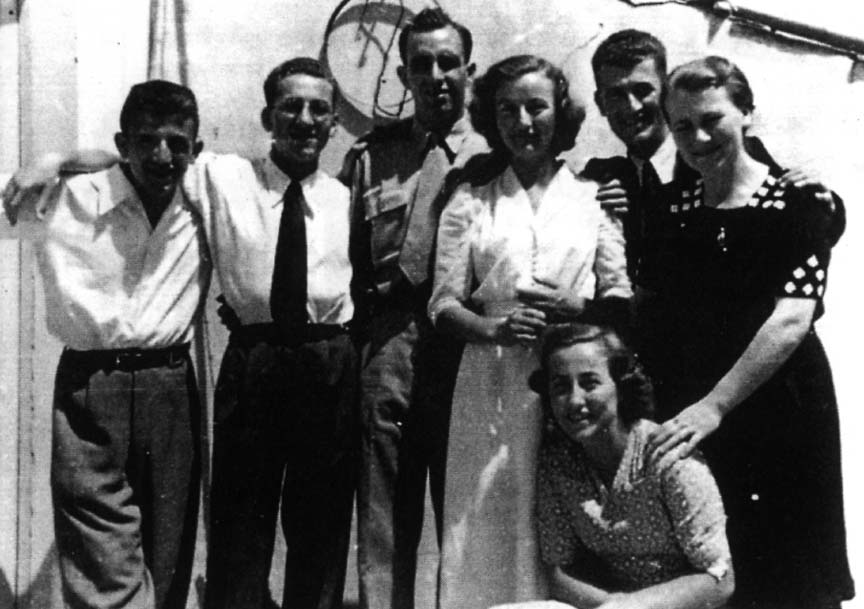
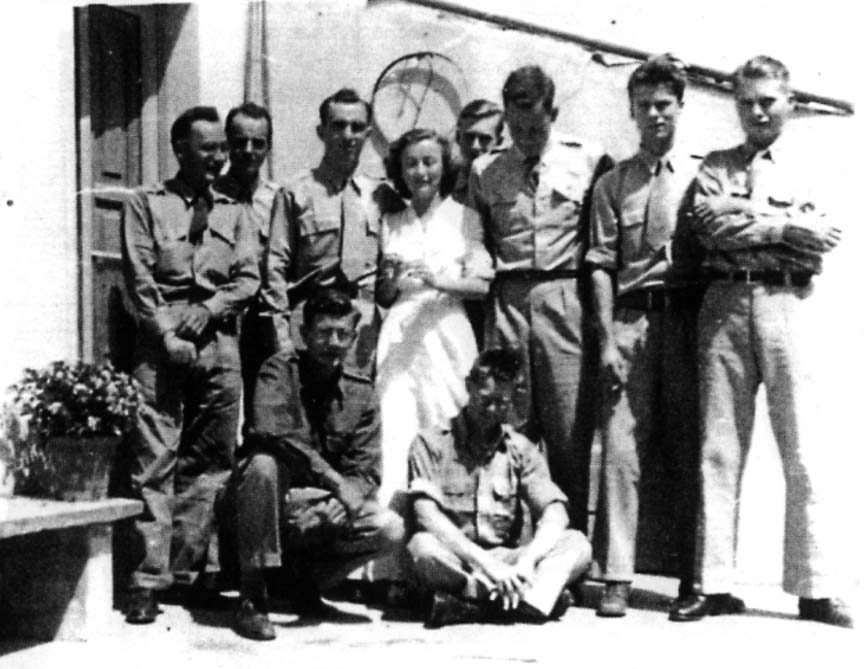
Having made this announcement, was unceremoniously invited to plunge my begrimed body into a wine vat filled with hot soapy water. Bob Blair arrived the next day; the others arrived the day before the wedding. In addition to best-man Bob, the wedding party of eight included my dearest fellows of "Lucky 13" Chan Keller, John Leinbach, George Collins, Art Ecclestone, and Howard "Col." Brooke joined by Luke Kinsolving, Kenny Brennan.
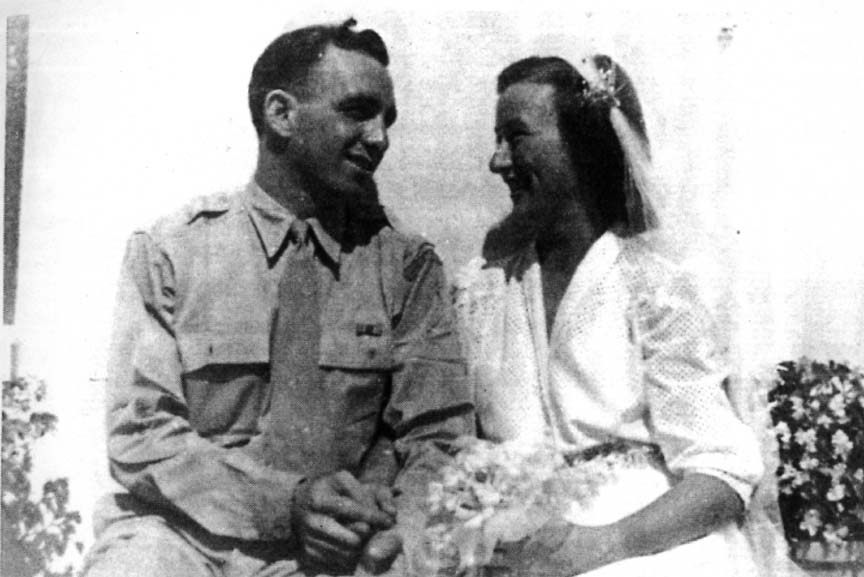
In three days of frenetic activity, Licia and Mother Ida, assisted by family and friends, completed preparations for the wedding. As I was not a Catholic, the wedding ceremony would take place in the morning of August 3 at a temporary altar in the dining room of brother Vincenzo's home. The kindly aged pastor of the family church would lead the service. Elita Lotti donated the material from daughter Luciana's first communion for Licia's bridal dress. A close friend of Licia's who had lost husband and child in the sneak German April 20th bombing, donated her wedding veil. Mother Ida magically assembled and prepared foods for a delicious dinner with toasts the evening before the wedding, and somehow ice-cream was made for the wedding reception the next day.
Thanks to Bob's staff car, Licia and I scouted the coast below Lanciano, locating an abandoned villa for our honeymoon; its fields and orchards being cultivated by the farm family who had taken it over living on the ground floor.
For the prenuptial dinner the evening before, a long table with 22 settings in the dining room included Licia's three brothers and two sisters then in Lanciano; in-laws; a few close friends such as Maria and Vera of the Refugee Center, our eight AFS guests; and of course Mother Ida, Licia, and me. The Platoon presented the perfect wedding gift: a matched, hand-painted tea-set of traditional Deruta ceramic which Chan and the others had chosen in Perugia. This much-travelled set now graces our Hyannis Port china cabinet. The mood was festive, with music and dancing.
As for the wedding and reception itself, the accounts by Bob Blair and Chan Keller quoted below tell the story better than I could. Our special wedding guests included Mayor Guido Lotti, his wife Elita, and their two children; my counterpart Dr. Carabba and his wife Adele; Dr. Corrado Marciani and his wife Giulia.
 |
 |
 | 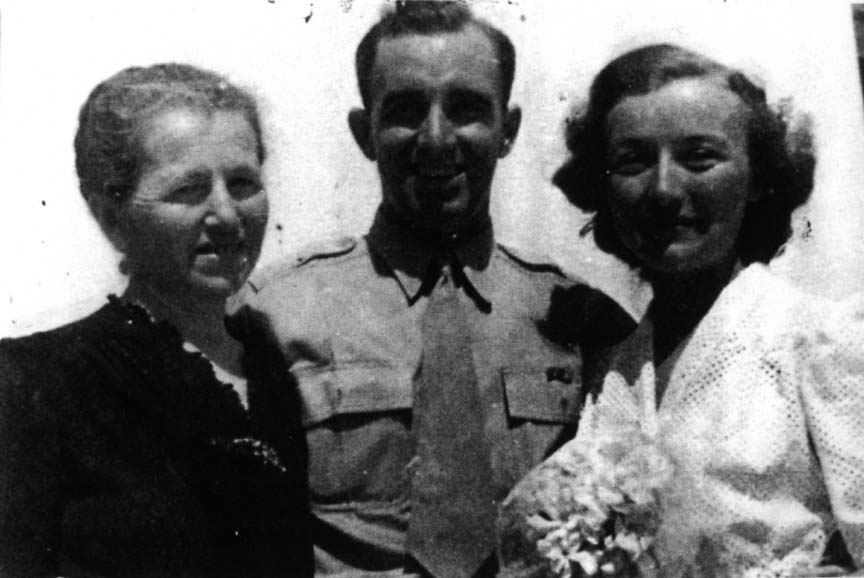 |
As we gathered for the reception in the bright noon sun on a terrace overlooking the Piazza where that sneak devastating German bombing raid took place April 20, the acclaimed Fenarole Band of Lanciano, now restored, assembled below to salute us with a concert of vibrant Abruzzo music as well as Wagner's wedding march. All our hearts were lifted. For a magic moment, there was no war.
As we were about to leave, a miraculous event took place: the unexpected arrival of Licia's marvelous brother Vittorio. He had somehow survived the Russian front, hidden from Nazi and Fascist hit squads before the liberation of Rome, escaped the Ardeatine Caves massacre of Italian officers by these squads. It was the perfect conclusion for our special day, and a propitious omen for our future happiness. Vittorio, who married Vera in Lanciano two years later, would become heart and soul for all of our families on both sides of the Atlantic. Two of our grandchildren now bear his name.
It had been a story-book courtship and wedding in the midst of war. Bob Blair drove us in his staff car to the abandoned villa we had found for our honeymoon. Our one-week honeymoon which followed in its rustic, idyllic simplicity on the Adriatic coast far from thoughts or sounds of war, surpassed any that could have been planned in time of peace. When it was over, I would disappear into the north and war, the "fairy prince" in reverse.
On the second floor of "our" honeymoon villa, we had two rooms and a vine-covered balcony high on the hill-side overlooking a magnificent sweep of coast And sea. A steep path led down to a pristine beach of white pebbles. At night a full moon blazed a golden trail. My captured German primus stove served as kitchen. There were fresh eggs and fruits. Chan Keller had donated a Christmas package of canned pineapple. Henceforth pineapple for us became "the fruit of Giuseppe" (Chan's figuratively translated name in Italian).
There was an upright piano in the family quarters below. One of the little girls of the farm family had learned to play "Ramona, I'll meet you by the waterfall..."; apparently it was the only tune she knew. She serenaded us incessantly; I can hear the sounds to this day.
One day we had a special guest: somehow Dr. Corrado Marciani navigated on his bicycle the steep and winding road of 12 miles down the escarpment from Lanciano and up the coast to our villa, bringing a happy smile as well as cakes prepared by Giulia. A medical doctor, he was also the recognized living authority of Lanciano's rich medieval history; his library and publications were donated to Lanciano and organized by Giulia after his death. How he managed to make it back up over that difficult way before night I never learned. During trips to Lanciano after the war, we visited "Corradino" and Giulia; they were Sargiacomo family cousins---dearest friends.
Had it not been for Platoon Commanding Officer Bob Blair, his second-in-command Chan Keller, and the assignment they arranged for me with Allied Military Government, I would never have met Licia Sargiacomo and her family and our wedding day would never have happened. Therefore, it is appropriate to quote from Chan's diary about the wedding and the drive back and forth from the Platoon "camp" at Lago Trasimeno; as well as from the report on the wedding by Bob Blair. I also include a copy, with translation, of the poem composed by Guido Lotti, Lanciano's Mayor, for presentation at the wedding by Guido's young daughter Luciana.
First, I quote an account from Chan Keller's diary written Friday August 4, 1944:
"Monday Bob Blair, Art Ecclestone, Luke Kinsolving left for a non-stop trip to Lanciano. Collins (George) took John (Leinbach), Howard "Col." (Brooke), Ken (Brennan) and me. We left about 9:00. Stopped in Perugia to bring the Fox a tea set and a few trinkets. [Note: my Platoon nickname is "Fox"). Then on to Assisi, a lovely town where we had delicious lunch in an albergo and bought a few more trinkets for the Fox. I got a tiny silver funnel for primus stove. Arrived at Aquila about 6 p.m. following a lovely ride through steep mountain valleys ... dinner of thick green pea soup --- so thick it "stood" on plate, --- meat, fresh mushrooms, coffee and fruit... John and I decided to sleep in the ambulance. George, Col., and Ken went off to boarding house.
"At 4 a.m.. I was awakened by the Col.... to point out the need for an early start. I told him to see Collins. He woke Collins --- George came running out, under the impression we were all waiting for him. At six we went to the restaurant for breakfast. They had our sugar and butter supply ... Saw several lovely churches before breakfast: S. Maria di Collemaggio and S. Maria di Paganica. Both had rose windows and lovely Romanesque doorways.
"...Lanciano where we got settled in billets at AMGOT. Had lunch with Maj. Burke and a yank Lieut. and English Captain. Afternoon at the beach and a big party at Licia's. Swell time. They present a fine meal. Luke gave us a laugh by dancing with Amalia and falling down on the dance floor.
"Nice wedding at 10.00 a.m... at Licia's house. Ceremony performed by local Monseignor in Italian. Fox and Licia kneeled before him. I took a lot of pictures with Bob Blair's camera. More fooling around with Maria (Toni) at reception and lunch afterwards. They served delicious ice-cream. After lunch George, John, Luke, Col. and I started our drive back to Aquila... We picked up a pleasant and intelligent Pole at Pescara. This ride over an excellent macadam road is really a superb one. We arrived at Aquila at 6, and this time we stopped at the Albergo Grande an officer's hotel run by AMG. Bed with sheets 20 Lire Dinner 20 Lire Breakfast 20 Lire.. boost for our morale.
"After dinner of soup, meat, potatoes, pastry ... walked around town and wound up at a Luna Park amusement center---just like Coney Island. We spent about an hour in the electric car concession --- the place where you drive around in rubber-bumpered cars and collide with one another. Then at 2 lire per 3 throws we invested in trying to knock 10 tin cans off a board with baseballs."
Chan's diary continued:
"Had a difficult time sleeping in a bed with such a soft mattress. Breakfast of pineapple and tomato juice, bacon and eggs, corn and coffee. Had a shave and at the barber's directions called on the Presidente delle Commune. He phoned the tourist center for me so that when I went up there they gave me two nice guides to Gran Sasso and Aquila Province. Purchased lots of postcards at one lire the card."
Second, I quote from the report by Lt. Robert Blair, commanding C Platoon, AFS, 567 Ambulance Car Company, British 8th Army, Italy, August 6, 1944:
"Just back from the wedding of C. and Signorina Licia Sargiacomo of the town of our winter. [Note: military censorship would prevent location names on a report)
"Perhaps I first ought to refresh your memories with some history: C. worked for AMG during most of our stay in said town --- a part of his job was to keep a watchful eye on the local Refugee Center, where Licia, Vera, Maria and others arranged menus, beds and paper and what-not for refugees on their way thru town. We were wont to spend our free hours now and then at the Centro (Center) or the Sargiacomo home soaking up the language. Thus, by and by, we all became one happy family and came to use the house of Sargiacomo as a second home. It made for pleasant evenings.
"Eight of us wangled a few days off and trekked over for the celebration. A. and I arrived a bare 8 hours after the groom. There being no means of communication the family had had no advance warning, so the scene we burst in on was a confused one of hectic preparation ... the ceremony was only 48 hours away ... had to be as C. had only two weeks leave. We did what jobs we could, helped mostly by staying well away from the furniture-polishing, curtain-hanging, cake-baking, dress-making dervish and out of the path of calling congratulators. A. and I stayed at Vera's, ate supper there that night. visited with other friends, and went swimming the next day with a sort of bachelor gathering on the beach ... back to Licia's for a big dinner with just close friends and family.
"The wedding happened about 10:00 the next morning in the house of Licia. The strange thing was that it did just happen .... I was supposed to be a witness (one of four -- two for the bride, two for the groom) the nearest thing to best man. So it was lucky that I was in the room near the kneeling business when of a sudden Licia appeared looking for pretty; then C. was at the altar kneeling and before I realized what was up the old, almost blind Monsignor was rattling off in Italian and Latin the meaningful words -- it was a double-ring ceremony ... simple, rather nice, certainly full of color and over as suddenly as it had begun. Then much kissing on both cheeks, while I signed some papers I couldn't read, then food and drink and picture-taking for several hours, then another big dinner for the same select group, eight or ten of the family and eight of us, Maria, Vera, another Maria, etc.
"Later I drove the happy couple to their seaside villa -- two small rooms and a large vine-shaded veranda with a magnificent view, small and on a high hill. They were very happy and it was infectious. We had a 'super' time."
Third, there follows a copy with my English translation, of the poem written for our wedding by Guido Lotti, Mayor of Lanciano. It was presented to us at our wedding by Guido's daughter Luciana then aged ten.
| "Fiore di serra: | "Delicate flower. |
| I1 sol dal buio, del pianto il riso venga, | From darkness comes sun, from tears laughter, |
| l'amore vostro sboccia dalla guerra. | your love blossoms from war. |
| "Fior d'erbe rare: | "Exotic flower so rare: |
| I vostri cuori corrono all'amore, | Your love courses through your hearts, |
| come l'acqua del Fiume corre al mare, | as the waters of the river flow to the sea. |
| "Fiori marini: | "Flowers of the sea: |
| I cuori siano d'allegrezza pieni, | Your hearts are filled with joy, |
| s'empia la casa di tanti bambini." | as your home will be filled with children. |
Happily, I do not now recall the wrenching departure we must have known following our unbelievable, all too brief, but real-life "fairy story." My leave was over. Licia and I came back to Lanciano for goodbyes with the family, and I returned to my unit as I had come to face action in forward areas in the massive advance to and into the German Gothic Line. Licia would stay behind, and there could be little communication between us while the war continued.
We would face other wrenching departures during the next year and beyond even after the war had ended. It was as if we were fated to live and relive those haunting lines of Lili Marlene, the universal song and lament of the soldier of World War II: "goodbye little one, sweet love, I will hold you forever in my heart." It was as if the pain of such separation was the just price levied upon us because of the unbelievable joy we had forged out of the ravages of war.
In October I was able to complete my shortened home-leave at Lanciano, to return to Platoon and Company facing the Gothic Line several hundred miles north of Rome. By December 1944 Licia had moved to Rome where Vittorio (Captain Sargiacomo of the Rome Carabinieri) had obtained a villa at #11 Via Luigi Belotti Bon. For the "duration" this became another C Platoon "home away from home" for Platoon and other AFS transients; also an informal Platoon "liaison office" and "rest home" where many of my Platoon fellows took short leaves.
In Rome, Licia volunteered for service with the American Red Cross Officer's Club at the Piazza Barbarini, located at the foot of Rome's celebrated Via Veneto. She continued at Rome until finally obtaining passage to the United States as "war bride," December 1945, on board MS Gripsholm.
Thus far in war I had survived, at times by the narrowest of margins. Licia's life too had been subject to the guns of war and had been spared. Somehow our blessings continued to the war's end and beyond. Our own lives and those that our love would create had been hostage to blind chance, or a merciful Diety; and the threads that have linked all our lives had been at times as slender as threads can be.
Had these slender threads been cut, I could not now narrate this story, An AFS Driver Remembers, for the three children and seven grandchildren of our marriage; and for AFS Archives, now portion of AFS Intercultural Programs world wide.