 1. Overview, Gothic Line Broken, German Surrender,
June 1944-May 1945 2. Italy, Ally Reborn ---
More than Co-Belligerent, September 1943-May 1945 3. C Platoon, 567, Action and Inaction, July 1944-April 1945
"One More River". Incident in the Battle to Break the Gothic Line 4. My Transfer to 567 Company HQ.
November 1944-April 1945 5. C Platoon AFS Liaison Office. Rome (Unofficial) #11 Via
Belotti-Bon 1. Overview, Gothic Line Broken, German Surrender,
June 1944-May 1945 2. Italy, Ally Reborn ---
More than Co-Belligerent, September 1943-May 1945 3. C Platoon, 567, Action and Inaction, July 1944-April 1945
"One More River". Incident in the Battle to Break the Gothic Line 4. My Transfer to 567 Company HQ.
November 1944-April 1945 5. C Platoon AFS Liaison Office. Rome (Unofficial) #11 Via
Belotti-Bon |
Rome was liberated June 4, 1944 after one of the bloodiest series of battles of the entire war commencing early in the previous September. However, taking Rome was obscured by the news of "D-Day" launched along a 50 mile stretch at Normandy by two Army Groups (American, British) of 170,000 troops, 5,000 ships, 1,200 planes --- the largest armada ever assembled. These landings took place just two days after General Mark Clark's entry into the eternal city led by General Truscott's 1st Armored Division and Keyes' 88th, and accompanied by a covey of newsmen and photographers.
Italy would become a "Forgotten Front." The irony of this could not have been lost upon Clark, whose self-centered quest for hero status and public acclaim as the liberator of Rome---comparable to the stature of Eisenhower, Bradley, Montgomery, Patton--- had been preempted by Normandy, and at great cost.
As reported above Part VII, in his dash to Rome with 5th Army's best, Clark had in effect nullified the plan of General Sir Harold Alexander, CMF Commanding Officer, to link with 8th Army before advance on Rome in order to encircle Kesselring's retreating army in the Liri valley between Rome and Cassino. In his recent book (1998) L'Italia Invasa, 1943-1945, Gianni Rocca wrote that Clark's option for a "rapid conquest of the capital" had "sent up in smoke" the "project of encirclement of the German 10th Army withdrawing from the Gustav Line." Alexander, according to Rocca, had "lost control" of Clark. Rocca devotes an entire chapter in his book to Clark's action, Chapter XXI, "L'Occasione Perduta "(lost opportunity).
To add insult to injury (according to Rocca), neither General Leese (8th Army Commander) or his troops were invited to participate, or march through, in any ceremony on the liberation of Rome, nor was 8th Army's role recognized. 8th Army had played as significant a part or more so, and taken as many casualties as the 5th in the long Cassino winter. The final breakout in May had been gained by 8th Army troops in the mountains. Clark's affront was not forgotten, and relations between the Commanding Officers of the two armies, Clark and Leese, were strained.
In the combined Cassino and Anzio breakouts starting in May, the Germans had lost some 35,000 killed, wounded, prisoners as well as 250 tanks, 300 artillery. Nevertheless, the bulk of Kesselring's army had escaped. The result was bitter fighting north all the way to the mountain barrier which stretched from the gulf of Genoa to Pesaro on the Adriatic. Here the Germans fortified another "winter line," their Gothic Line, and where they made a final stand into May 1945. Alexander's strategy to trap the German forces may not have been successful, but we will never know because of Clark's courageous but mistaken dash to Rome.
For us in Italy in June and July of 1944 there was optimism, abetted by the warm Italian sun. The liberation of Rome, the Normandy landings and the massive Soviet advance on the east contributed to this feeling. We felt that Germany would be defeated before another winter. Alas, this was not to be. Indeed, there was to be another winter of the war in Italy before the German surrender, May 5, 1945, with as much mud, rain, snow and cold through mountainous terrain as in the previous year.
North of liberated Rome the Germans controlled many miles of the Italian "boot" where Italy's greatest treasures were located. On the west the American 5th Army was joined by two 8th Army Corps, 10th and 13th, with the British 5th Corps taking the Adriatic coast. Our hopes for a speedy end of war in Italy continued for a time, at least until the rains of September with the Germans still holding at the Gothic Line.
The initial allied advance for the first 50 miles north of Rome beyond Orvieto went well, with units of 5th Army together with 8th Army's 10th and 13th Corps of "desert rat" renown in hot pursuit of the bulk of Kesselring's army. Kesselring was under orders from Hitler to hold at all costs until the Gothic Line could be fortified and the autumn rains would slow the allied advance. As in 1943 he executed a series of holding actions along river valleys, exploiting the hilly terrain, and holding initially along the Tiber in late June where there was stiff fighting near Lake Trasimeno.
The Germans held next on a line between Siena and Avezzano more than 100 miles north of Rome, with a major battle to break through at Avezzano July 12-16. The Germans then held along the river Arno and a line between Pisa and Florence more than 150 miles north of Rome. The Futa pass was another 20 miles beyond Florence. This pass bisected the Gothic Line's chain of mountains; it was the most direct route to Bologna and the plains of the Po Valley, the pianura Padana, which the Germans could not have held for long.
By July 19 units of 5th Army occupied Livorno on the coast; the strategic port had been reduced to rubble by German demolition. Pisa was reached in late July, and to his credit General Clark forbad shelling of the famed Leaning Tower. 13 Corps entered the outskirts of Florence August 1, first crossed the Arno August 12, but the Germans --- finally outflanked from the east --- did not withdraw from the north of the city until early September. There had been heavy fighting.
All the bridges over the Arno were destroyed except the Ponte Vecchio, spared amazingly by Hitler; but all buildings on both sides of this historic bridge had been reduced to piles of rubble making passage impossible. Indeed the medieval buildings along the Arno, the Lungoarno passage, had been similarly reduced. Until Bailey bridges were thrown up, the only crossings were by boat or raft.
Some treasures of the Renaissance were damaged in the fighting within the city such as Palazzo Strozzi, San Lorenzo, Santa Croce, Palazzo Pitti.
Florence, city without peer, the pearl of the Renaissance, held in the heart of all humanity, had survived. There had been damage. The population had suffered greatly, and rose up against the Germans and Fascists, together with Italian partisans as well as soldiers of the newly formed Italian Arno Division who infiltrated and began to flush out the Germans in early August. On August 13 8th Army Indian Division troops entered the city in force. The heroic action of Italian forces, and the prompt, spontaneous establishment of responsible self-government by the people was notable, and an example for all Italy.
On the Adriatic side the Germans, outflanked, withdrew in haste along this front once so bitterly held, with 8th Army 5th Corps, General Anders' Polish Corps and the Italian Nembo Division in hot pursuit. Chieti and Pescara about 20 miles north of Lanciano were occupied in quick succession by June 10. The Italian troops marched into both cities with flags flying. C Platoon Drivers taking part in this action noted the contrast between the relatively unscathed ground north of the Gustav Line and the terrible devastation along the line and south. The Polish Corps entered the important port city of Ancona, 100 miles north of Pescara on July 18. Ancona was only 30 miles south of Pesaro which was the eastern terminus of the initial Gothic Line fortifications at the Adriatic coast.
AFS/HQ CMF remained in Naples until the end of the war. Lines of communication, supply, transport etc. were stretched to the limit. Liaison Offices were required along these long lines.
Our C Platoon of 567 Company was assigned, drove in convoy west then north, starting June 24, passing through Narni north of Rome. The Platoon leaguered with other AFS units at Orvieto (July) not far from Company HQ, then near Lago Trasimeno in late July. The "isolation" of the Platoon east of the high Apennines since February 1944 was over, an isolation that had actually promoted Platoon solidarity. Symptomatic of this were the horseshoes we painted white, tipped on their sides, and wired on our radiators as "C's."
At this stage in the Allied advance (July and early August) the Platoons of 567 Company were committed to evacuations to and from the CCS's back to rear areas over long, crowded, hot and dusty routes in terrible condition. Many of our aged ambulances were now beyond repair.
By contrast, our sister 485 Company, attached to 10th and 13 Corps on the west, was in the thick of the fighting all the way north through Arezzo and Florence. This gallant Platoon, led by Liv Biddle and attached to the "desert rats" of 6th Armored Division leading the way, recorded one of the most outstanding sagas of the history of the AFS in action, World War II. So much so that the Platoon was accorded honorary membership in the Division with members authorized to wear the Division shoulder patch.
Logging some 75,000 miles with 20% casualties (killed, wounded), B Platoon carried "a great percentage of the Division's wounded." When the Arno had been crossed and the Platoon was to be withdrawn, George Rock records that over 100 officers and men of the Division give a farewell party for the Platoon with gifts (embroidered shoulder insignia) in token of the esteem earned and the friendships established by the Platoon.
Thus far, through August 1944, 5th and 8th Armies had achieved a remarkable advance to the Gothic Line itself, covering as much as 7 miles a day. Both Armies were then poised by late August to make an all out, coordinated attack on the Line itself. The objective: to reach Bologna and the vast plains of the Po River (pianura Padana) and end the war in Italy in 1944, accelerating thereby the defeat of Germany.
Meeting in Orvieto in mid-July, Alexander with his Chief of Staff Harding conceived of a massive one-two punch at the center of the Gothic Line through the shortest passes involving both Armies, 5th and 8th. This tentative plan was opposed by Leese and his 8th Army staff, who proposed, in addition to attack by 5th Army at the center, a "left hook" by the bulk of 8th Army up the Adriatic coast to outflank the Gothic Line and take advantage of the less severe terrain and easier access to the plains along and from the coast. They also argued that the Germans, anticipating Allied attack at the center, would have concentrated their forces and fortifications there. Leese was also convinced that 8th Army could break through all the way to Venice in such a strategy, and that the glory denied by Clark at Rome would be his.
Also an Adriatic initiative on to Ravenna and Venice by 8th Army had support at the highest levels, that of Winston Churchill. For him, it might be the first step in a thrust through Trieste, along the Danube to Vienna to preempt Soviet control. By late August 1944 the Soviet Army had occupied Romania and was moving towards Hungary. Churchill met with Marshal Tito of Yugoslavia in Naples, August 12-13 for understandings on this, and indeed, some 8th Army units were already being withdrawn for transfer to Greece --- weakening the forces in Italy. Churchill's hoped for Allied thrust along the Danube to preempt the Soviets was never realized.
Leese's plan won the day. In meetings in early August, Clark agreed to this strategy, while demanding however that 13th Corps continue with the 5th Army at its west side. This meant in turn that important reserves for breakthroughs along the Adriatic would be denied 8th Army. Clark's reason for this demand was that seven of his divisions (three American, four French) had been taken from him, including his best mountain troops, the Moroccans. In partial compensation, a newly arrived division from Brazil and the 92nd American Division (the first black soldiers, with white officers) were assigned to Clark.
All in all, Alexander's 15 Army group in Italy had been reduced to 18 divisions on the eve of a massive strike intended to end the war in Italy. Notwithstanding, it was a potent force exceeding that of the hard pressed Germans, and it enjoyed total command of the air. But the Germans held the mountains of the Gothic Line.
General Clark's opposition to the weakening of his army notwithstanding, priority at the highest levels (Roosevelt, Marshall ) went to operations in France. Indeed, an invasion of southern France had been proposed at Teheran to reinforce Operation Overlord at Normandy. On 15 August the Franco-American 7th Army under General Patch including Clark's seven divisions landed near Marseilles (Operation "Dragoon") and sped up the Rhone valley reaching Alsace virtually unopposed. In retrospect, the seven divisions would have better served the Italian front.
For the assault on the Gothic, speed, secrecy, and surprise were essential, before the Germans were fully prepared or aware, and before the autumn rains would freeze on the mountains, flood the rivers, and turn the valleys and tracks into quagmires of mud. It was to be a delayed one-two punch, with 8th Army making the initial punch up the Adriatic coast and then some weeks later 5th Army and 13 Corps at the center would strike (the second punch) through the Futa and Giogo passes after the Germans had diverted their forces to counter 8th Army.
It seemed like a repeat of the strategy which eventually broke the Gustav Line. But in contrast to the previous year, a major defeat of the Germans in Italy would also reinforce the Allied advance in France and accelerate the fall of Germany. Indeed, Paris was liberated the day before the push to breach the Gothic Line in force began.
A major logistics problem faced 8th Army before it could move to carry out the Adriatic punch. Most of its divisions had fought up the center and west, and were located along the Siena-Arezzo line. They had to be moved by night in the hills towards the Adriatic coast. Secrecy held, but rumors of a "secret" move were rite, and considerable regrouping of units took place.
The assault code named Olive, touched off August 25 led by 5th Corps with some old friends of AFS, the tried and true "desert rat" divisions (Indian, UK, Kiwi) as well as Canadian, Polish, and South African units. C Platoon, all AFS 567 Platoons, were brought into the action with many forward postings. In the first weeks of the attack, two AFS Drivers were killed, four wounded, one POW.
The Germans were caught by surprise at the outset. Urbino in the foothills was taken; then Fano followed by Pesaro on the coast about 30 miles north of Ancona was taken by Polish Corps on August 30. The advance continued up the coast road towards Ravenna, through Riccione and then Rimini (another 25 miles beyond Pesaro) which was taken September 21.
By now fighting was heavy. The Germans had brought in reserves, and also held along a series of successive "winter lines" exploding the steep river valleys coming down from the mountains near the coast. The tide of battle peaked in mid-September, with many long and difficult evacuations back to Pesaro and Ancona. In this, AFS was handicapped because new Dodges had not yet arrived to replace the old, and large two-wheel drive Ford ambulances brought in as substitutes were useless for front line work and not much better for the longer evacuations.
The rains commenced September 6, but came down in earnest September 26 and then on into October until the snows of winter. And so the rush of battle with casualties was over by October. The advance ground on slowly until both Faenza and Ravenna were taken in December, with help from the partisans. This was beyond the eastern terminus of the Gothic line. But the line had held at the Center, and the Germans in the east held on throughout the winter at a line of rivers a few miles beyond Faenza. A and C Platoons, had performed nobly in front line work as well as the long evacuations, and were replaced by B and D. C Platoon withdrew to Pesaro in early October and continued there at rest through December.
General Leese and his 8th Army had not taken the prize of Venice. Availability of fresh reserves to exploit the offensive might have made a difference. Nevertheless, 8th Army had driven the Germans back to the beginnings of the Po delta, pending the outcome of the second punch of the Alexander strategy. This was the offensive by 5th Army and 13th Corps at the Futa and Giogo pastes between Florence and Bologna
This attack, the second of the one-two punch, got underway September 12, under cover of massive air and artillery bombardment, while the Germans were heavily engaged on the Adriatic The initial thrust carried the Allies to within ten miles of Bologna with the plains of the Po in reach. Clark was at first optimistic, although the fighting was intense and casualties heavy. By October Kesselring had brought in reinforcements. Exploiting the mountains and the weather, which had turned into freezing sleet, the Germans held --- as they had on the Adriatic. On October 27 Clark called off the offensive, going into winter holding operations.
The Allies had failed by the narrowest of margins to break through the Gothic Line with Venice, Bologna, Milan for the taking. There would indeed be another winter of German occupation and war in Italy.
The strategy to break the Gothic Line almost "worked." On the Adriatic and at the center, the Germans, terribly mauled, outgunned and outfought, conducted a series of strategic retreats all along the line, taking advantage of weather and terrain, until the Allies were less than ten miles from Bologna and occupied Ravenna in the Po delta.
The assault on the Gothic might have worked had not both 5th and 8th Armies been weakened by the diversion of troops to France and Greece. And it might have worked had the rains not begun early on September 6, then massively September 26 followed by the mud, snow, sleet of winter's deep freeze. There would be one more winter on the battered soil of Italy. Nevertheless, it was an heroic "try."
The remnant of Italy north of the Gothic Line, with Mussolini installed at Milan, was all that was left of Mussolini's so-called "Republica di Salo, dating from when German paratroopers "rescued" Mussolini on September 12, 1943, from his incarceration on the Gran Sasso. Under German escort, he had announced on Radio Monaco, September 18, 1943, the formation of a new Fascist state. Mussolini and his Fascist followers were in fact vassals of the Nazis. Mussolini's humiliation had been complete, with the Italian people exposed to Nazi and Fascist atrocities.
By December 1944 the German command in Italy had one final use of Mussolini, taking a leaf from the surprise and brutal German counterattack at the Ardennes forest which had an initial success. Mussolini proposed a counterattack against the Gothic Line, specifically on the west where the new American 92nd had been posted. Both Hitler and Mussolini hoped that such actions might persuade the Anglo-Americans to join with them in an anticommunist alliance against the massive Soviet advance already approaching Poland.
Speaking in Milan on December 16, Il Duce displayed his former charisma and oratorical skills at an enthusiastic rally promising a Republic for all Italy reaching out from the Po Valley which would never be lost. He promised a combined Italo-German counter offensive to begin on Christmas eve to maximize surprise. The first days of this offensive carried ten miles to Barga just across the mountain chain on the west.
Allied intelligence had obtained advance warning. Indian and Gurkha troops of 8th Army were brought in by General Clark to hold, and then reclaim the lost ground. Thus ended the last vain, misguided action by Mussolini.
The lines, locked in a winter freeze, remained fairly static until the spring thaw. The attack by both armies began April 9, 1945. There were four 8th Army Corps in action, with Italian divisions, 100,000 troops in all, assigned to three of them. The Germans resisted along river fortifications on the south side of the Po which was crossed April 24. After this the cities and towns of the region, including Turin, Milan, Venice were taken with little resistance, many liberated by the partisans who had captured the fleeing Duce. The German armies surrendered in Italy May 2 and a few days later in Germany. Truman and Churchill proclaimed V-E day May 8, 1945.
All of AFS 567 Company including our C Platoon, had been transferred to Germany starting April 10. The one remaining AFS Company, 485, performed heroically in this final act of the seemingly endless war in Italy.
It is important to take note of the role played by the Italian people and authorities in the tide of war taking place at such cost in their own country. Anti-fascist, having replaced Mussolini (July 1943) with the Badoglio government and status as co-belligerent against the Germans (September 1943), they were determined to erase the stain of Fascism while fighting for the liberation of their country from the Nazi invasion and occupation. Their efforts, in turn, materially supported the Allied action, increasingly throughout the war to final victory.
A good example was the liberation of Florence during the month of August 1944, in which Italian partisans and Italian army units took part. In the final year of the war AFS ambulances were posted near or with reconstitute Italian divisions. Five Italian divisions participated with 5th and 8th Armies in the April 1945 offensive into the Po Valley and for the surrender of the German command.
An even more significant military action in support of the Allies was by the partisans. There were 60 well organized and equipped Brigades who literally claimed the Apennine mountain chain in the final year of the war with devastating attacks on German supply and logistics. After the fall of Rome, Kesselring was forced to divert thousands of his troops to counter the partisans. To General Alexander's credit, he was one of the first to recognize the military role the Italians could play, and to help in training and equipment. One of the first units was the Maiella Brigade led by Ettore Troilo operating in the Maiella mountain chain in the winter and spring of 1944 not far from Casoli in Abruzzo where one of C Platoon's Sections was based.
In August of 1943 Italy was without responsible central government; there was chaos. anarchy. Two huge army groups with as many as 20 divisions each, one invading at the south, the other charging down all the way from Germany to a line south of Naples, were about to meet in total war by land, sea, and air. It was a war relentlessly waged for almost two years all the way north to the plains of the Po and on both sides of the Italian "boot" leaving in its wake death and destruction. The resurgence of Italy as de facto ally before the war ended is remarkable. That it happened from absolute ground zero is a miracle.
Today as I write Italy stands tall, a democratic constitutional republic, a member of the elite "club" of the seven more powerful industrial countries, charter member of the new European economic and monetary community, its artistic and cultural contributions unexcelled.
It is a story worth telling, and of which we AFS Drivers often uniquely witnessed. And to tell this story it is necessary to return to ground zero, July 25, 1993.
Gianni Rocca's book (1998) provides new insights on the events in Italy of July 1943 which toppled Mussolini --- but tragically accelerated the German occupation of Italy, and in turn led to almost two years of war across this treasured land.
In brief, by July 1943 Mussolini's days of power were numbered. His unholy alliance with Hitler brought humiliating defeat in North Africa and the occupation of Sicily by July 20, with an Anglo-American invasion of Italy itself imminent. The Italian people, anti-Fascist, had had more than enough, as had the Governmental "Grand Council" in Rome and the heads of the armed services. Following secret meetings, the King dismissed Mussolini on July 25 as Head of Government, to be replaced by General Badoglio. Mussolini was taken to house arrest on the Gran Sasso. Badoglio commenced secret negotiations to conclude an armistice with the Allies. There followed a game of secrecy and lost opportunities, won by the Germans.
Newby (Love and War in the Apennines) records the euphoria in Italy when the Mussolini was toppled. Hopes for a prompt armistice, even alliance with the Allies, were high --- before Germany would be able to invade from the north to reinforce the seven German divisions already in Italy.
Badoglio began secret negotiations with Anglo-American representatives involving channels through Lisbon and Algeria. Openly he announced "the war continues" in an attempt to preempt German occupation. The Germans, however, anticipating Italian defection, had already prepared a detailed plan to occupy Italy. By mid-August the Germans, alarmed, put this plan in motion under orders from Hitler himself. The Panzers began to pour through the Brenner pass reaching beyond Naples by early September. Rome and its airfields were surrounded before a plan to land an American airborne division under General Ridgeway could be carried out.
Meantime the secret negotiations between the Italians and the Anglo-American authorities dragged on, involving the highest civilian and military levels which slowed down the process while the Germans were gaining control. The Allies had announced "unconditional surrender" terms against the Nazi "Axis" in advance. These terms did not fit the circumstance presented by the overthrow of Mussolini. The Anglo-American negotiators also required assurances. The armistice was finally announced by radio on September 8, 1943 by radio from Eisenhower's HQ, Algiers just one day before the Anglo-American landings at Salerno south of Naples. Italy was accorded "cobelligerency" status, but the chance to preempt the German invasion was gone.
Also. by contrast to the speed of the German reaction, the Badoglio government proved ineffective. There were no plans set in motion, no orders for the 500,000 Italian troops posted throughout Italy, and in Yugoslavia and Greece. Thousands of soldiers simply buried their uniforms and took refuge in the high mountains. In time, unless captured, they would become effective partisans and armed divisions. British, and American prisoners of war were released, to fend for themselves.
As reported (Part VI, above) the bulk of Montgomery's 8th Army entered Italy across the Straits of Messina September 3, and at Taranto in the next week. Clark's 5th Army, with a few British units, landed at Salerno south of Naples on September 9 with the Germans already dug in. The landing was hotly contested for nine days, followed by the agonizing Anglo-American advance on the west and the east until held at Kesselring's Gustav Line midway between Naples and Rome.
In panic, on the night of September 8, 1943 the royal family, Badoglio and general staff crossed Italy to Pescara and escaped by Italian corvette to Brindisi. This was indeed ground zero. Short of establishing a presence, the Regno dei Sud, in southern Italy at Salerno after that city had been cleared, opportunities for initiatives by an Italian national government were limited until the liberation of Rome.
Nevertheless, the difficult rebirth of a viable and democratic Italy able to contribute to the war effort advanced on two fronts: the political and the military.
On the political front, a number of Italy's most respected statesmen, led by Count Carlo Sforza, returned from exile and formed the influential Italian Committee of National Liberation (CLN) at Bari (January 1944). The Committee conducted a series of assemblies, and strongly influenced the government. The acclaimed Philosopher-Historian Benedetto Croce was a member.
Churchill and Roosevelt sent representatives to the Badoglio Government, Macmillan and Murphy respectively. Stalin and Badoglio exchanged Ministers in March, when Palmiro Togliatti also came to Naples from Russia to lead a nascent communist party committed to the struggle against the Nazis and Fascists. In March the administration of Sicily, Sardinia and the provinces of Bari and Salerno were turned over to the Italians.
The King, the aging Badoglio, and his Chief of Staff Ambrosio had been discredited by their failure to organize a resistance in the previous August followed by their flight in panic from Rome leaving the country in chaos. The CLN demanded a more vigorous and respected administration, although Churchill continued to support the Badoglio government.
The King abdicated in April 1944 in favor of his son Umberto, and a second Badoglio Government was formed. These measures were insufficient. After the liberation of Rome, a younger, more respected leader, Ivanhoe Bonomi, replaced Badoglio with the support of the CLN and President Roosevelt. Italy had the beginnings of an effective national government, but the final constitutional structure would have to wait until after the war.
At the local level, elected municipalities of the leading citizens were formed almost spontaneously, as the Allies advanced and Fascist holdovers were eliminated. AMG assisted this process in the forward areas. An outstanding example of this took place in Florence. My own intimate experience with the municipal government of Lanciano, and that of our C Platoon during our long stay there, was positive witness to this process and the democratic character of the Italian people.
The resurgence of Italy on the military front was significant until by war's end Italy had become an authentic ally. The process gathered strength after the liberation of Rome. The Italian war effort involved regular armed units, and partisans.
To train and equip Italian troops, and to integrate them into the Allied action, would take time. Early on General Alexander recognized the contribution Italy could make. A few Italian troops took part in the break through at Cassino before Rome was taken. On the Adriatic, one of the first divisions formed, the Nembo, was welcomed by the Mayor and citizens of Lanciano in April 1944, and took up positions along the "mad mile" sector at the center of the line between Lanciano and Casoli. It was one of the "hottest" positions of the front, as our Drivers getting through it on evacuations could testify. Nine of our C Platoon Drivers were posted with the Nembo, and continued with the Italian troops in the first weeks of the breakthrough in June.
The Nembo and Utile Divisions within an expanded Italian Liberation Corps (CIL). continued forward with Polish Corps in the late June offensive after the Gustav was breached, entering Chieti and Pescara with flags flying and advancing through Teramo all the way to Ancona then Pesaro at the eastern terminus of the Gothic Line. Eventually, Alexander was authorized by Churchill, July 1944, to equip seven more Italian divisions, according to the Rocca book, published in 1998.
Italian troops were in action in the liberation of Florence, August 1944. Four Italian divisions distinguished themselves in the final break through at the eastern sector of the Gothic Line, and then on to the German surrender, May 2, 1945.
Perhaps even more instrumental against the Germans than the Italian armed forces for the liberation of Italy, were the Italian partisans. It was a spontaneous, indigenous force which raised havoc with the Germans. It was one of the great stories of the war in Italy. Gianni Rocca in his book devotes an entire chapter to it (XXIV, "Una Sorpresa Per Kesselring"') as well as portions of other chapters.
In the final year of the war in Italy, Rocca reports there were in time 100,000 partisans organized in 60 Brigades of about 1500 men each, under elected Commanders. Alexander himself, after Rome was taken, encouraged their formation by radio broadcast. The partisan movement accelerated after the fall of Rome to the end of the war.
The partisans could not have operated without the support of the Italian people who took who took enormous risks and suffered atrocious reprisals. These acts of horror strengthened their resolve. This is a story of courage, patriotism, and determination to erase the stain of Fascism. The partisans took shelter and bases in the high mountains and snows of the Italian spine. Coming down from their havens often by night, they attacked the extended German rear echelon depots, logistics, supply lines and communications in surprise hit-and-run tactics, sometimes in pitched battles with German troops.
General Clark recorded in his diary, when he was on advance reconnaissance by jeep in the rugged hills north of Rome, suddenly encountering a band of armed Italians, whose leader identified himself and them and saluted the General. Clark wrote of the "grand help" the Partisans gave.
Rocca's book (1998) documents the impact upon the Germans which reached all the way to Hitler. According to Rocca, in one three month period there were an estimated 5,000 Germans killed, perhaps an additional 2,000 missing, and many more wounded. The partisan tactics kept their own casualties to a minimum.
In addition to their campaign of attrition from the mountains, the partisans were instrumental in such actions as the liberation of Florence on the west, where the partisan leader was killed; and also at Faenza (December 17) and Ravenna (December 4) at the edges of the Po plains on the east. During the final weeks of the war, Rocca records that villages, towns, cities throughout the Po region were liberated by the partisans as our own forces advanced, It was the partisans who interdicted Mussolini in his attempt to escape, in disguise, to Switzerland or Austria.
In an admittedly inexcusable act of savagery brought on by the passions of the moment, Mussolini and his mistress were tried, convicted, shot by the partisans, and hung upside down in the principal Piazza of Milan. Mussolini's corruption of power in his unholy alliance with Hitler had helped unleash that monster upon the world and to make of the Italian nation a disgraced hostage to be ravaged by the flames of war. Mussolini had indeed become a tyrant, and a fool. But he was not a Hitler.
The first, and one of the most celebrated actions by partisans against the occupation and pillage by the Germans of a small city, was that in Lanciano, October 6-7, 1943 when our troops were still too far south to assist (as noted, Part VII above). Lanciano was awarded Italy's highest order, Medaglia d'Oro, by Italy's distinguished and revered first postwar President, Luigi Einaudi. In the following spring, 1944, the Maiella Brigade led by Ettore Troilo operated just west of C Platoon postings in the high mountains of the Adriatic front . After the war, Troilo rose to the highest rank of regional government, a Prefect with offices in Milan. He was representative of the quality of the partisan leadership.
One of the most brutal episodes of World War II, equaling the holocaust in horror if not in scope, and unexcelled in the annals of brutality, were the reprisals and atrocities committed by the Nazi psychopaths upon the Italians. These were ordered by Hitler down through the Command in Italy using Nazi units of the SS and Goering divisions, but even by regular elements of the Wehrmacht which was exceptional.
Because Italy had signed an armistice with the Allies (September 8, 1943) its people were declared enemies of the German Reich. Reprisals began in the first months of the war, and there were scores of them some unprovoked documented by Rocca. Older men, women and children were massacred. Able bodied youths and men were shipped off to slave labor in Germany; most never returned.
As the partisan campaign became effective, the horrors increased, with orders issued by the SS Generals. One order was that for every German killed by partisan action, there would be ten Italian lives taken. In Rome, whole neighborhoods were burned to the ground in retaliation, their inhabitants killed or shipped off to Germany for slave labor. Italian Jewish populations were seized by the Nazis, destined for the concentration camps of the "final solution"". Rome, "Open City" in name only.
The German reaction to the uprising of the people of Lanciano, October 6, 1943, was extreme. Twenty-four young partisans had been killed in the fighting. Others, captured, suffered the most agonizing tortures before their death, and the entire population, except essential medical personnel, were given three days to gather what few belongings they could and evacuate the city on foot heading north. Lanciano memorializes each October 6 the bravery and sacrifice of these young partisans.
One of the most notorious and eventually publicized massacres took place at the Ardeatine caves outside Rome. Thirty-three Germans of the military police had been killed in a district of Rome March 23, 1944 alarming the German military command as to the strength of the partisans in the city and their popular support. The command ordered an immediate reprisal the next day when 335 Italian civilians and former army officers were brought into the caves and shot, five at a time.
As the partisan activity accelerated in the final year, so did the German atrocities. Kesselring ordered his commanders and their Nazi executioners to conduct a counteroffensive against the partisans and their popular support using "all means." Rocca documents numerous such actions many taking the lives of hundreds of men, women, children. People were herded into pens, stables, dwellings --- even churches and cemeteries --- to be mowed down by machine-gun fire or unbelievably burned to death in flames. We saw evidences as we entered newly liberated towns, but had little idea of the extent of this at the time. Nazi brutality, however, had been revealed.
Before the war had ended a resurgent, democratic Italy had in effect taken its place in the free world as a respected ally in fact if not in name.
After the liberation of Rome (June 4) central Italy lay exposed up to the chain of mountains in the north between the Gulf of Genoa on the west, and Pesaro on the Adriatic coast. This was where the Germans established their Gothic Line, their second "winter line" of the war in Italy. Until the approaches to this line were reached in late August it had become a war of mobile action over long distances requiring adjustments in troop displacements and locations. And as they advanced with, the armies, there were also considerable comings and goings affecting AFS units.
Italy was no longer the alternative "second front" of the Anglo-American forces. We in Italy jokingly called ourselves the "D-Day Dodgers" --- words taken from the first lines of a rollicking ditty "Oh we're the D-Day Dodgers ... on holiday with pay ... the Germans brought the band out to greet us on our way ... " In fact, some of the bitterest battles of the war continued in Italy as Hitler ordered Kesselring and his troops to hold at times in fierce rear-guard action along the way and at all costs at the Gothic Line.
Throughout July and into August the bulk of 5th and 8th Army forces were engaged at the broader western slopes of the -Italian spine against Kesselring's retreating army, encountering stiff resistance at Arezzo, Pisa, Florence.
On the Adriatic front 8th Army with Polish Corps and other units advanced rapidly up the coast after the Gustav Line had been broken. Our C Platoon of 567, which had returned to the Adriatic front in late February, participated in the initial week or so of this advance. Nine C Platoon Drivers served with units of the two Italian divisions who were in the action with Polish Corps on this breakthrough.
The poet wrote "What is so rare as a day in June..." He could have had in mind Italy after the fall of Rome. I rejoined my Platoon as we received orders to move west and then north. Our "isolation" from the rest of our Company was over. AMG would leave only a skeleton administration behind. Lanciano was free, above all free of the incessant combat that had raged through and just beyond for almost nine months.
By June 24 our Platoon pulled out from Lanciano, which had become for us a "home away from home." It was a wrenching departure for me, recently engaged to marry Licia Sargiacomo, with no possibility of any communication for some time.
An AFS Platoon in convoy is a major undertaking. It consists of up to thirty ambulances in four to five Sections led by staff vehicles, plus transport for workshops, supplies, petrol, rations, water, cooks --- these latter on assignment to us from what was euphemistically named "British Army Catering Corps." We drove during the day strung out over miles of narrow roads winding over mountains, across valleys, past antique villages of stone.
There was now little risk of attack from the air in contrast to our convoys in North Africa. Our routings and overnight stops were marked by advance parties. Our first memorable glimpse of Rome was at the outskirts as the road rounded and turned north into Umbria. Thus far, evidences of war were few north of Rome.
Much of this is a blur as we advanced over some of the most storied regions of Italy. I remember vividly one overnight stop as we dispersed across an incredibly green meadow below an imposing stone villa on the brow of a hill. The air was soft, filled with the sounds of evening in the country. There were no sounds of war. Some of us began to toss a baseball. Even the bully beef, cheese and tea of our British army cooks tasted good. The sun set to the west across the rolling hills of Umbria, each topped by a village or town which seem to have sprung from the earth itself.
By early July we reached the plains below Orvieto about 50 miles northeast of Rome where all four Platoons had leaguered not far from 567 Company HQ and many ambulances on the plains below the city. Here Major "Bert" Payne replaced Major "Charlie" Snead who had led our Company since our summer of '43 at Tripoli. Bert, a popular, able, even dashing officer, commanded our Company on through the long winter to April 1945.
In spite of the increasing distances, AFS HQ CMF remained in Naples for the duration with Col. Ralph Richmond continuing as Commanding Officer until replaced by Major "Bill" Perry in April 1945. Major "Fred" Hoeing was Col. Richmond's Adjutant at Naples until his assignment to lead 567 Company to Germany in mid-March. Major John Nettleton commanded 485 Company in Italy until appointed as Bill Perry's Adjutant at Naples in April 1945. One of the most versatile, respected and unassuming of our AFS officers, John was the last to leave Naples in October 1945 after completing the close out of AFS CMF.
Our AFS senior officers, many of them rising from the ranks, were dedicated, able and experienced; all commanded our respect and loyalty, indeed affection. They operated in the most challenging of circumstances with a minimum of overhead, earning the respect, indeed friendship, of the Commanding Officers of the many different nationalities with whom we worked.
We of C Platoon were based for several weeks with our fellow Platoons at Orvieto before moving up near Lago Trasimeno in late July between Umbria and Tuscany another 20 miles north. It was at Trasimeno where the incomparable Latin poet Virgil sojourned to escape the rigors of Imperial Rome.
Our fellow AFS 485 Company had "leap-frogged" ahead with 8th Army's 13th and 10th Corps taking the forward posts against the fiercely contested German retreat. I have noted above the heroic service by Liv Biddle's B Platoon of 485, which was accorded honorary membership by 6th armored division.
The increasingly long evacuations back to CCS's and base hospitals were assigned to 567 Company. Initially, our C Platoon was assigned for evacuations to 15 CCS southwest of Orvieto.
During the rapid July advance, and on into August, supply and evacuation lines as long as 80 miles were stretched to the breaking point over congested and badly damaged dusty roads. The evacuation work was difficult, and our ambulances, many in their third year, began to break down beyond repair. They were one of few vehicles that could navigate the narrow hilly tracks and roads year round regardless of weather. In this month of July 1944 George Rock reports that our 567 Platoon ambulances on the line of evacuations from 10th and 13th Corps logged just under 200,000 miles taking our more than 12,000 patients "the greatest patient-mileage totals to date." In a letter back home I had written about my newly assigned ambulance, "Fox IV", and that "we have been moving good distances each day now..."
Nevertheless we of C Platoon found time to visit the magnificent cathedral of Orvieto high on the city escarpment with its striped marble facade (dark green and white), and its Signorelli fresco depicting the last judgment --- said to be the model for Michelangelo's masterwork of the same name in the Sistine Chapel. Art historian George Collins, of our "Lucky 13" fellowship, took us in tow --- also later on to inspect the famed frescos attributed to Giotto at the glorious St. Francis Cathedral in Assisi. It was as if the clock had been turned back to the early Renaissance itself.
While at Orvieto, most of us took advantage of brief leaves to visit Rome. My own "leave," commencing July 12, stretched on to six days in the care of British Army "sisters" (nurses) and in the comfort of the officers' ward in an elegant hospital in the center of Rome. This respite was thanks to two impacted wisdom teeth that put a serious crimp on my ability to eat and had to come out. I reported my stay in Rome in three letters at the hospital July 12, 13, 17. 1944. After a shot-in-the-arm of sodium-pentothal I awakened minus teeth, with a sore mouth and a swollen, lop-sided face. One of the offending teeth took 20 minutes to excavate.
It took considerably longer to obtain discharge through British Army procedure, and so after a day or so of pain I settled down to enjoy my surroundings, with time at last to write three letters home and to read a number of books. There were bouts of bridge with my fellows, one of them a delightful Captain Ali of one of the Indian divisions. The meals were sumptuous in contrast to our Platoon fare. On one occasion, we had corn-on-the-cob, having found some sweet corn growing in the flower gardens that surrounded the hospital and doubtless planted by an enterprising "Jerry" or "Eyetie" during the occupation of Rome. Evening dinner was lamb chop, potatoes with gravy, coffee, and "duff" ( an ubiquitous "pudding") which I was able to enjoy as soon as I could move my jaw.
I had written about my engagement to Licia and promised a cable if and when there was to be a wedding, which at that time was "up in the air."
After several days, I was given can afternoon pass, "walking for miles along wide, clean streets lined with flowering trees ... apartment buildings of ornamental stone. A truly beautiful city." I wrote that the Roman ruins " weren't as grand as I had imagined." But the magnificent St. Peter's Basilica took my breath away. I wrote to a sister:
The most marvelous thing is St. Peter's. Anything you read about it, or any pictures you may have seen fall so far short of the ornate immensity of the actual church that it is almost useless for me to describe my first impression. As Mother said, the thing is so well proportioned that the only way to appreciate its size is to climb it. That's a job that makes going up Blue Hill seem like level ground. You can even squeeze up into the brass ball under the cross on the top of the cupola. I remember reading someplace that the weight of the dome is so great that the sandstone blocks beneath are being crushed. These thoughts weren't very comforting looking far down from inside the ball. (Note: climbing inside the ball is now prohibited).
The nicest thing about the pass was that I was able to locate Licia's cousins, whose address Licia had given me, and through them Licia's magnificent brother Vittorio who had been restored to his service and rank as Lieutenant, Carabinieri. It was actually he who located me at the hospital the next day, arriving with his tiny staff car to drive me around Rome. I wrote that "he seemed pleased to meet me, and was most anxious for news of his family who he has not seen for some time." Indeed, it had been for a long time. He had gone "underground" during the German occupation of Rome and had barely escaped the massacre at the Ardeatine Caves. There had been no way for him to communicate with Lanciano, nor would there be for a while longer.
Before discharge papers came through, I was able to spend two afternoons with Vittorio, "buzzing around the town in his little car and visiting several of Licia's cousins who have been most hospitable, and somewhat curious to see me."
I could not have had a better guide than Vittorio, who knew and loved Rome so well. In those days, there was no public transportation in Rome. Small pickup type trucks had been converted by their enterprising owners into taxis or buses. There were wood benches in the bed, which was covered by canvas stretched over hoops. One entered by wooden steps at the back.
Although anxious to return to the Platoon, I wrote from the hospital that "they are not in the least hurry to discharge people from the hospital ... which. is O.K. by me as the type of work to which the Platoon has been assigned ... is not too interesting, and is different from the work to which we are accustomed, i.e. at the front."
In this same letter (to Mother, July 17) I wrote that my college, Bowdoin, had organized an employment bureau to assist its returning graduates and that I had registered, setting down "my interests in future employment as journalism, teaching, business in that order of preference." This may have seemed premature, but we did not anticipate then that the war would drag on until May of 1945.
Obviously thoughts of my engagement with Licia, and our hopes for a wedding during the summer, were constantly close to my mind and heart. On this matter I concluded this letter with the following paragraph:
One thing of which I am completely certain each day of separation, is that my love for Licia is the "real thing." We have wanted this separation to be a proof, and I trust she is finding it so too. Yes, it is selfish to seek happiness of so sacred a nature in these conditions of war. The answer of course is that love between two persons is a selfish thing, and I am selfish enough to think that I have earned it.
If the wedding takes place, in accord with our original hopes within the next few weeks, it will be quite simple and in Licia's home... I have changed my mind about going home ... if the opportunity were to present itself in spite of Licia's willingness that I should, even if married. (Note: AFS gave home leave for those having served two years or more).
I returned to my ambulance and Platoon at Orvieto in time to move up on July 19 to our next location, Castiglione del Lago near Lago Trasimeno. It was a pleasant post, and we used tent billets (as well as our ambulances) for sleeping. We were about 20 miles north of Orvieto, with evacuations back to Orvieto. C Platoon, as well as B and D of 567 Company, would continue there through the August preparations for the big push up the Adriatic code named "Olive" which kicked off on August 25.
As detailed in Section 1 above, this was the first of the "one-two" punch of the Alexander-Harding-Leese plan, which Clark also endorsed while protesting the transfer of seven of his best divisions to the landings at southern France August 15. To make up for this, Clark demanded that 8th Army 13th Corps continue with 5th Army at the center of the Gothic Line, and 8th Army had also lost some troops to Greece.
It was hoped that after the 8th Army surprise offensive up the Adriatic, Clark's delayed punch at the center starting September 12 would be able to break through and together with the 8th Army end the war in Italy before the winter freeze. And it almost "worked." The "lost" divisions could have made the difference.
By late July 5th Army and 8th Army (10 Corps and 13 Corps) had driven the Germans back to the approaches of the Gothic Line, although some fighting continued at Florence into August. On the Adriatic side units of 8th Army had taken Ancona July 18, only 30 miles from Pesaro and the Adriatic approaches to the Gothic Line.
The fighting and with it the flow of casualties slowed; huge problems of logistics and regrouping of units had to be undertaken and resolved to prepare for the big push August 25, and all of it with maximum secrecy. The entire 10th Corps had to be moved across the Italian spine to take up positions on the east for the Adriatic assault.
485 Company would remain on the west, but now 567 would be in the thick of the Adriatic advance at the forward posts---but not until after August 25. These assignments had to be worked out by our AFS officers with their 8th Army counterparts, and new postings planned. However, for most of August our 567 Company Drivers had little to do except for the occasional evacuations.
And so the opportunity for the wedding day Licia and I hoped for had arrived, sooner than anticipated. I had forgone home leave in March to take up the AMG assignment at the request of my Platoon leaders (and dearest friends) CO Bob Blair and NCO Chan Keller. And so it was not difficult to obtain a two-week leave pass from Bob Blair to return to Lanciano on or about August 1, for our wedding August 3, 1944. 1 also secured Bob's agreement to be "witness" ("best man") and bring others with him (including five of our "Lucky 13" fellowship) using his staff car and one ambulance. They would bypass Rome and go directly across the mountains via Aquila to Lanciano. Of course there had been no way I could have informed Licia in advance.
I tell the story of the magic moments in the midst of war of our "Courtship and Marriage. AFS Intercultural Wedding, August 3, 1944" in Part VII, Section 5 above. Somehow I had managed a three-month courtship in the midst of my frenetic tenure as PHWO/AMG, then returned for the wedding August 3 followed by a short honeymoon in an abandoned villa. Eight of my dearest fellows of C Platoon were wedding guests.
I must have been good at catching rides by military transport; there was no other way. Indeed, in a letter of mine finally written September 23, I had written about "winding a devious course over a good bit of Italy ... all of it by the 'hitch-hike' method." My contacts with AMG may have helped. I made it back to my Platoon in ample time before the massive attack on the Adriatic side was launched by 8th Army August 25.
The attack went well over the next six weeks, peaking during 9-15 September, but with many casualties with an average of 3,000 per week taken out by all four Platoons. In the first weeks, two Drivers were killed, four wounded. About half of C Platoon Sections had forward posts, the balance evacuating the CCS's and all working around the clock. Postings kept shifting, as did the various army units in the rapidly moving battle. Urbino in the foothills, and Fano on the coast were taken in the first three days; then Pesaro on the coast was cleared by the Poles September 2. Riccione and then Rimini on up the coast were cleared by September 21, outflanking the east terminus of the Gothic Line. One of our AFS Drivers reported a "deathlike stillness" at Rimini just after it had fallen. This renowned resort on the Adriatic had been pounded into rubble. There was the stench of unburied bodies.
The advance continued to inch its way along the Via Emilia reaching Forli then Faenza December 17 on the plain only 25 miles on a straight line from Bologna. But the Germans held at the rivers just beyond Faenza in the deep freeze of winter.
As in the Abruzzo the previous year, Kesselring took advantage of the terrain and the weather to hold along the series of rivers plunging down from the mountains and hills which rimmed the Adriatic littoral. Heavy rains beginning September 6 slowed the initial advance; then the rains came down in earnest September 26-28; turned rivers into torrents and the hillsides and tracks into mud churned up in the tide of battle. All the bridges were blown, replaced by the Bailey bridges or the horrendous diversions. The snows and ice of winter made things worse.
Clark launched the second punch of the one-two strategy on September 12, smashing more than half-way through the Gothic Line passes at the center in the first two weeks to within 10 miles of Bologna and the Po plains. Delayed by the rains, and without reserves, he called off the offensive October 27.
We of C Platoon were posted with units of some of our favorite Commonwealth Divisions leading the advance: 4th and 10th Indian, 1st Canadian, also UK 1st Armored, 46th and 56th (the "Black Cats"). George Rock documents commendations by Medical Officers for some of our "old hands" including Bell, Collins, Morris, Wright, McKinley, and the "gallant Johnny Meeker." There was no task too dangerous or difficult for John Meeker who was one of our elders in age, but led us all in youthful cheer; he had been in action starting with Mid-East Unit 1.
By the end of September "the rush of casualties was over." C Platoon was pulled back in early October for rest at Pesaro until December 21, 1944; then was posted up the coast at Riccione just below Rimini for the winter. This was some distance from the front. There would be little action, and few evacuations.
As to my own postings, I have found no letters of mine from Italy between July 17 at the hospital in Rome and a letter dated September 23, which I may have written from Platoon or Company HQ after the offensive had peaked. Nor did I find any notes. To be sure it had been a busy time for me: my unbelievable marriage to Licia Sargiacomo August 3, hitching back to my Platoon and Section near Trasimeno, and action in the massive offensive beginning August 25, 1944.
I did, however, find a vivid description I had written of an "Incident" on the South bank of the Foglia River just beyond Urbino where I had been posted with the Lancashire Fusilliers at an infantry Car Post in the front line area. No dates or names of units were permitted by the censor; I had written the name in pen-in-ink on the blank place I had left in the typewritten carbon copy I had kept. I called it "One More River, Incident in the Battle to Break the Gothic Line."
Urbino had been entered only one day after the battle began September 25. I must have been in action in the preparations for the offensive, and in the first week or so. According to the September 23 letter I had been evacuated to a hospital with "fever ... and a dysentery of several days duration." It was for several days because by September 5 I had "wrangled my way" out of the hospital feeling "more ill with the bad conscience of the unheroic role I had been playing just when things began to hum."
The September 5 date of my discharge had enabled me to reach Company HQ in time for goodbyes to Chan Keller and a few others of my closest friends whose AFS enlistments were completed after two years and who had qualified for home leave. This was about "the last remnant" of our fellows of Unit 26. Several of them (as did I) "had had some very close shaves," which only "doubled their elation." Considering where we Drivers worked, it's a wonder that most of us "made it" through the war. It would be a long but reasonably safe journey for them by ship from Naples.
In addition to those leaving for the States from Company HQ, or transferring to India/Burma, there were new men coming each month, and the new Dodge ambulances began to arrive to replace the bulky Fords and our doughty but worn-out Dodge relics of many a campaign.
Of the remnant remaining in Italy of our "Lucky 13", George Collins, who qualified for home leave, stayed on, as did Jay Nierenberg and Art Ecclestone (both of whom had been back to the States). Bob Blair, who had taken over the Platoon at Cassino and Lanciano, continued until he went home in late December when Chan returned as Platoon CO. Chan and the others would travel to and from the States by ship from Naples, Art Ecclestone, now Platoon NCO would continue so under Chan.
I also qualified for a month's leave after the conclusion of my two years, and would return to my new home in Lanciano for the month of October. Instead of traveling with Chan and the others as far as AFS HQ Naples, and from there to Lanciano, I requested to stay on for a time to rejoin my Section (Section 3) for "my final opportunity for ambulance driving in this or any war." I had written that my Section, which I had turned over to Dunc Murphy who was "driving Fox IV", had "landed some good posts with one of our favorite Empire divisions".
In short, according to the above chronology, I saw action at or near the front in the first week of the battle to and beyond Urbino, followed by a few days in the hospital (fever, dysentery). Then, secondly, I rejoined my Section for a week or so in mid-September between the rains. In early October the Platoon withdrew to Pesaro for the next three months. In October I was on "home leave" in Lanciano, and returned to 567 Company in early November and a new assignment as "Company Clerk."
My story "One More River, an incident in the Battle to Break the Gothic Line," follows in the following pages,
One More River An Incident in the Battle to Break the Gothic Line Pesaro (delayed) I returned to the south bank of the Foglia just two days before the successful crossing of the river. Some of the burned out tanks beyond Urbino had been moved; and a column of confident Shermans crossed the road as I approached. They were cutting their own way across the hills, and dipped down to the right between the road and the sea. The unexpected sun had baked hard the track leading to the Car Post beside the railroad bridge where the ADS had been bogged down for the last four days. I was able to disperse my ambulance on some raised ground beside a ploughed field, and covered the windshield to conceal the glint of the setting sun upon it. The medical orderlies advised me to dig a slit trench.
I did not finish my trench. The Medical Officer of the Lancashire Fusilliers sent over for an ambulance, and so I followed his little truck back across the hillside track which ran parallel to the river.
It was dark when I arrived at the little stone farmhouse perched up on the ridge above the track and I had backed my car between comforting haymows. But the darkness did not quite hide the cheerful flicker of a cooking fire beneath top-heavy, smuggled pots full of potatoes, meat, and tea. The Tommies of the Battalion were queued up before the sweating cooks, eating their big meal of the day under cover of night.
The popular conception of the infantry soldier is that he is the "man on foot", the slogging, mud-grimed soldier who engages in a sort of primitive warfare, and so we at once compare him adversely in our minds to the romanticized "Flying Fortress" pilot, or the daredevil commander of a Sherman tank. But even the Infantry, "queen of battles" has become "streamlined" in these days of mechanized war.. A full-strength infantry battalion numbers 1,000 men, but of these almost half are "experts" trained to a specific task far different from charging with fixed bayonets or handling rifle and grenade. These specialized troops are lumped into "Battalion Headquarters" and take orders directly from the Colonel in command. The remaining assault troops, or "rifles" as they are called, are divided into five companies of 100 men each, with a major or less in command of each company.
The Aid Post ambulance works out from Battalion HQ; and it was the "specialists" --- the anti-tank gunners, signalers, mechanics, spotters, stretcher-bearers etc. --- that I found myself dining with during the soft evening darkness when the excitement of the day is forgotten and the noises of night attack not yet begun. The men assembled in little groups around the haymow to chat or smoke after the meal; and then drifted off to the slit trenches dug in the hill-side where a grove of trees straggled down to the road. The sound of men's voices in harmony came sweetly from an anti-tank gun post dug in against the brow of the hill.
The stillness of these moments, as is often during the case in battle, was short-lived. The Field Regiments behind us, ranged in the five-mile gunline along the track which bisected the shallow valley between the infantry and the artillery, commenced the final series of barrages which announced the long-delayed crossing of the river in strength. Batteries of the "25-pounders" a scant hundred yards behind us, sent their salvos booming up the slopes and the flashes from their guns leaping lightning fashion, across the hills.. Our position was of course now revealed to the enemy.
Towards midnight a Tommy, shivering and sleepless, asked for the loan of one of the ambulance blankets. Aside from rifle or tommy-gun, ammunition belt and bayonet held in a scabbard at the left side, the infantry man is allowed only one pack. In this he carries mess-tin and water bottle, emergency ration of concentrated chocolate and biscuit. a change of stockings, combination ground-sheet rain and anti-gas cape, and a single blanket. A simple webbing worn over the winter battledress supports the pack, and the soldier may also carry his great coat in that way if he does not wish to wear it. His "home" is a slit trench dug with the help of a simple folding hoe which is carried much as an axe. He keeps shaved and washed with the aid of a shaving kit tucked away in one corner of his pack; and he manages to squeeze into another corner odds and ends picked up on the battle front. An iron cross, a German division sign, a medal taken from a fallen enemy, a special book: these are the individual property of the soldier. He keeps pictures of his wife, his kids, friends and family, in a generous-sized wallet, and on his webbelt he tacks the collection of battalion, brigade, and divisional badges which he swaps with the "yanks" or trades with his comrades-in-arms. He lugs a large and cumbersome respirator on his chest. His tin hat, with a camouflage net holding twigs, assumes a jaunty angle as he trapes Indian-file to the attack, shuffling silently with the nine men of his immediate group. He may spend days, weeks, or even a month "in the line" without relief. Unless he is lucky, a shell or mortar-bomb, a mine or machine-gun bullet, barbed wire or the angry whine of a bomb, waits for him at the end of the line.
Next day I lay beside the haymow and let the sun drive out the cold of the night before. A score of Tommies were lounging in the sun, much as I was. Magazines of all kinds and funny papers strewn across the foot of the haymow around the haphazard groups of soldiers in drab battledress, lent a "Coney Island" flavor to the scene. A colonel, two majors, and a captain formed a close-knit group of neat uniforms and bright-colored regimental field caps against the shabby background of the farmer's home. A golden-haired child played in the dirt before the worn doorstep.
No one noticed the lazy drone of an airplane. The sound of the plane swelled abruptly, and suddenly all the surrounding air was filled with the roar of it. We ran, instinctively perhaps, for there is no way to tell whether a fast-diving plane is friend or foe. Sometimes a soldier will dive for the nearest trench as if guided by a sixth sense and without having identified the plane. An uneasy silence, a hunch, a sudden restlessness is sufficient when there is no confirmed advance warning of danger. One man leaping for his trench is enough provocation to "start" a score of men within a matter of seconds. This time we "scrambled," no questions asked. I vaulted into a trench and buried my head against the dirt bank just as the staccato jabs of small arms fire and the swelling burst of the Bofors guns confirmed our suspicions that the approaching planes had not behaved quite right. There were two "ME's" strafing and dive-bombing, winging close to the ground before the high-circling Spits could drive them away.
Tommy-guns, Bren-guns, and the heavier bark of the Bofors rose skywards in an angry crescendo, seeming to fill the air with a pattern of steel through which the Jerry planes heedlessly charged, bat-like, undamaged, clawing the trench-infested ground with brief bursts of sharp machine-gun fire clearly defined against the Allied anti-aircraft attack. Then the noise of the bombs. The first one, falling alone, with an explosion that seemed long-drawn out in the sweat of expectancy. And the others, following in quick succession, in a mounting tempo of hateful sound as the planes darted away leaving the earth shaking, and men clinging foolishly to the ground, faces down, minutes after the all encompassing silence had marked the end of the raid.
It must have been a matter of seconds before the Spits gave chase to the Jerries in a giddy dog-fight across the Adriatic sky. It seemed like hours.
I rose on all fours and-stuck my head above the ground level. Other heads showed themselves in similar fashion from the trenches farther along the hill slope and below me. The ploughed slope had given birth to a crop of heads clothed in tin-hats, mushroom like. A black column of smoke rose high in the air on the hill opposite, and angry red flames licked at the base driving the smoke higher.
A gun-pit had been hit. I took off with an orderly. Two men had been killed. Behind me the gaudy magazines lay, ruffled by the wind, along the loose straw at the foot of the hay mow. Groups of soldiers in drab battle-dress were already lounging once more in the sun among the bright colored books.
I have no further record, or memory, of my actions with this Car Post at the river crossing and beyond during the next week. After this, I was laid low for a few days by a fever and dysentery in early September.
As noted above, I had no record of any letters home between July 17 and September 23, 1944. My September 23 letter had been written in the comparative comfort and safely of 567 Company HQ, at the "luxury of the AFS Villa, far from the strife of battle, etc." George Collins, who would be going down to AFS HQ Naples to help train the new arrivals, "is at this very moment basking in the luxury of said AFS Villa with me." I was in a good mood. The action on the front had "peaked." Our C Platoon would shortly pull back for a long and needed rest. And I had qualified for a month's furlough to return to Lanciano, having completed my two year enlistment.
Instead of going down to AFS HQ Naples with the others who were heading for home leave USA, and then going over to Lanciano from Naples, I had written (in the September 23 letter) that "I had decided to stay for at least a week more, and if possible join my Section ... Dunc (Murphy) has taken over the Section and is driving Fox IV." I was in fact able to locate my Section within the shifting chaos of the forward areas, work for a time with close friends, and drive my ambulance for the last time. I had found Dunc at an ADS in the sector held by the 4th Indian Division.
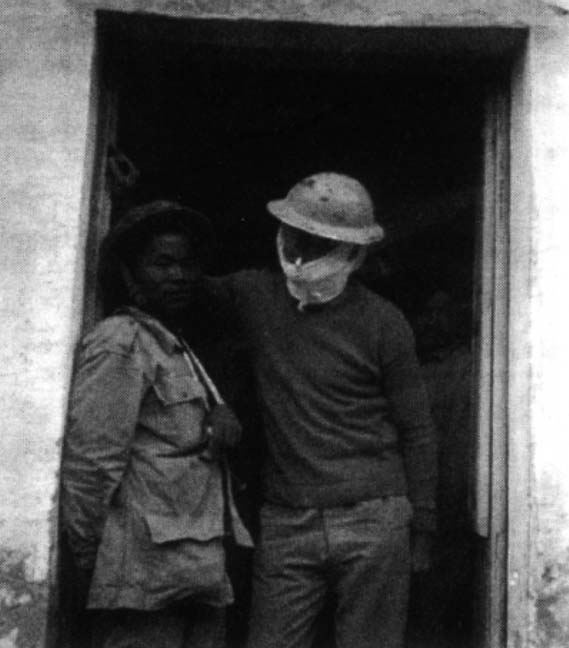
In the process, I got lost in some difficult and exposed terrain; I also sprouted a crop of boils which subjected me to bandaging by the Royal Army Medical Corps (RAMC), giving me the appearance of "Head-case, Urgent."
My letter of September 23, 1944 is a colorful vignette of the situation at the Adriatic front of the Gothic Line that September, and also about some rather unusual perils in the life of an AFS Driver (me). I quote as follows from the letter:
I had decided to stay on for a week or so more and if possible join my Section ... My good intentions were to be temporarily baffled, however, for the next few days were of rain and mud (sad reminder of last winter!) which washed out all the deviations and kept me stuck on the wrong side of the river from Dunc Murphy, Ken Brennen, and Howard Brooke (who are now the standbys of Section 3). Coupled with the rain, I started sprouting a veritable crop of boils (some ten in all) in various parts of my neck and face (most unpleasant) which just about "drove me nuts." Imagine trying to sleep while trying to hold your head in midair! The incident resulted in a rather amusing bit of bandaging by the RAMC, which left only my eyes, nose and mouth uncovered (and which somewhat swelled my prestige in the eyes of the uninitiated by placing me in the category of "head-case, Urgent...") Be this as it may, I finally arrived at Dunc's bailiwick in said condition in a jeep bringing up mail and canteen supplies etc.
Again there were the incredibly numerous and enchantingly beautiful vistas of endless hills and steep valleys, small winding tracks, deserted torn towns, tracks along the very tops of ridges, and then twisting down ... an occasional dead pack-mule along the way.
The light ADS where Dunc was, was situated down one such valley, but our jeep took the wrong turn and got messed up with some ammo-trucks under observation. Lt. Ham Goff (whose jeep it was) and I lost no time in locating a cave fortunately placed near the side of the road ... and nobody bothered to make off with the temporarily abandoned jeep in our absence. After a lull in the fire-works, we zipped out of that particular area, and located the track leading down to Dunc's post. Ken was also there, and in spite of my strange appearance they were glad to see me. And I was pleased to feel once more the sincere good-fellowship which can only be known in that particular and peculiar way among a small group of men working together at a post of that nature. It was noisy my first evening and night there, but the only damage was shattered window-panes of the little stone house where the Medical Room had been set up.
Next day was quiet and bright ... in fact the good weather followed for several days and a ridge from which Jerry had been observing us was taken back ... I drove Fox IV on evacuations for the last time, and on return brought up a spare tire and tube for Dunc on the following evening; I had also managed to get over to the sector where Howard was, this time also by jeep with Ham Goff. Howard and I had planned to be together, but my previous sickness had prevented joining him. Nothing "exciting" on that trip; but it was damn swell to see Howard before going on my furlough ... it only as a reminder of our days with Alex Turner and the others at Enfidaville.
Incidentally, during my wanderings in the divisional area, I had lunch with Colonel Raymond, Divisional Director of Medical Supply, and with whom I had carried out some anti-malarial measures last spring when with AMG. I felt a bit embarrassed at lunch in my "bandaged" condition ... but the Col. is a "good egg", and incidentally knows Licia who had tea with him at his HQ last June. He was very pleased to hear about the marriage, but threatened to "cut me off" considering the condition of my physiognomy.
 |  |
I made it to Lanciano, having become adept at "hitching" rides across Italy, making the most of AFS transport and my AMG connections. The chill fog and rains of October at Lanciano east of the Abruzzo mountains could not dampen the joy of our reunion, and of being together with family and friends no longer hostage to war. Lanciano had become and would always be my second home.
Everything was in short supply. Rubble had to be cleared away before any building could start as it would after the war. Public services such as electric power, steady supply of drinking water, transportation --- most of it destroyed by the battles if not by the bombs and demolition --- would take time to be fully restored.
Plans for international relief were already underway. When shipping was eventually restored, my family USA sent packages of medicines and clothing to Licia's Italian family for some time after the war.
The people of Lanciano exceeded if anything the enormous resilience of the Italians, their pride in their home towns and in their country. The proud Lancianese had already begun to make their way out of the nightmare that had fallen upon them, led by their popular Mayor Guido Lotti. Proof positive were the newly formed football (soccer) squads of their beloved national sport. The reconstruction of Lanciano is as remarkable as that of any city of post-war Europe.
In brief, as I write more than fifty years after, Lanciano is a proud, bustling, beautiful city in every way. A "new" sector of Lanciano of tree-lined walks and roads; villas. apartment buildings, hotels, shops and supermarkets of brick and marble, flows out in all directions from still standing hilltop Medieval walls of the historic "old city" or sector, older than Rome. The charm of this old city of narrow, winding, up-and-down roads and walks, often with stone stairs, is enhanced by the beautifully restored and maintained Baroque and Romanesque stone and marble villas that line them. The celebrated Canadian College of Italy. has selected one of these villas for its classrooms, others for dormitories.
At the valley of the Sangro, where the massed armies of Montgomery engaged those of Rommel then Kesselring in one of the classic confrontations of the entire war in that first autumn and winter of 1943, there is an industrial park today featuring such industrial giants as Honda, Fiat, BP. The valley is filled with row on row of orchards on the lands owned by the farmers, thanks to land reform after the war. They live in brick and marble villas, and send their kids to world class schools and universities --- tuition, thanks to the tax-payers.
Each summer Lanciano hosts an international music festival. Every fourth year, Lanciano's international trade fair grounds are bursting with displays and representatives of industrial and technological developments world-wide.
When Licia and I arranged for our two AFS "brothers" Chan Keller and John Leinbach and their wives to visit Lanciano and the Sangro with us in 1991, they could not believe their eyes so great the contrast from what they had known in 1943-1944.
But there is mute and tearful witness to what had happened there in October and November 1943: the row on row of more than a thousand white marble headstones, each inscribed with an engraved name and tribute, each with its garland of living flowers, all on the hillside at the Commonwealth Military Cemetery, Torino di Sangro, looking down on the valley below.
Unhappily one of my most vivid memories of my October 1944 furlough in Lanciano were the fever and chills --- and boils --- that had plagued me following my bout with jaundice the previous year. In a spacious sick bed covered with linen sheets and a huge down puff, I was tended by the two mischievous and totally delightful preteen daughters of Licia's oldest sister who plied me with hot soups as well as pranks, and plenty of giggles and laughter. It was the best medicine. They are to this day two of our most cherished nieces.
Licia and I once more faced a wrenching departure, as I made my way in early November back to the distant north. This time, however, although being in a war zone, I would not be exposed to the risks of evacuations during battles in the forward areas had there been any such battles. Indeed, I had been assigned to a new position for me, that of Company Clerk at our 567 Company HQ, where Major Bert Payne had taken over as Company CO in June.
In a letter home dated November 15 I told of my "official post as Company Clerk, pronounced 'Clark' British style, or 'Knobby' in Tommy lingo." I detailed more fully in a letter dated December 8 what this involved.
At Rome, Licia's brother Vittorio (now Captain) had managed to rent a spacious villa within a walled compound on Belloti-Bon street in the Parioli, one of Rome's nicest residential districts. Vittorio's heart, and his concern for his family and friends, was even bigger than his courage and his vitality. Thanks to Vittorio's generosity, Belloti-Bon would become in the next year the unofficial rest and recreation home for many of our dearest friends of C Platoon, as I explain in the next and final Section of this "Chapter" (Part VIII).
Somehow in November or December of 1943 Licia managed to make it over the mountains to Rome and the villa at Belloti-Bon, possibly driving with Guido Lotti who made frequent trips. There was as yet no public transportation. In those days, going through and over the passes of Italy's highest Apennine mountains by narrow and winding roads, was the adventure of a day. There had been. some peril from homeless refugees of war, especially in the distant mountains, demanding food and help from passers-by. Security would soon be restored, and relief provided.
While in Rome, Licia visited the American Red Cross Officer's Club from time to time at my suggestion to capture some exposure to things American. The Club was at the Piazza Barberini at the entrance to Rome's noted Via Veneto, the location of Rome's fashionable hotels and also the American Embassy.
A younger brother, Filippo, followed Licia to Belloti-Bon in 1945 to once more take up studies interrupted by war. He would complete his studies in civil engineering. A grandfather of theirs, also Filippo Sargiacomo, is Lanciano's most revered city architect and engineer, serving in this capacity into his 90th year until 1922. It was he who designed and implemented the master plan for Lanciano's spacious Central Square (Piazza), the principal central avenue (Corso), the beautiful Baroque buildings that line it, the water and sewage systems, some of its principal public buildings and magnificent private villas. A small square has been set aside to his name and honor. Our brother Filippo has also served with distinction as city engineer.
Italy's network of super highways begun in the 1970's, is further evidence of Italy's reconstruction. Rome is now only two hours away from Lanciano by automobile or motorpullman. A divided highway runs through a dozen or more tunnels and over an equal number of soaring viaducts with steep valleys hundreds of feet below. It is a breathtaking experience. This one, and other cross-country super-highways, connect with two equally spectacular highways that run the entire length of the peninsula along both coasts. Ground where we Drivers once inched along in days, is now covered in seconds. Florence-Bologna are linked by Italy's and one of Europe's longest tunnels; the longest tunnel of all joins Italy to France right under the Alps' tallest mountain.
After my October 1944 furlough, I had made it back to AFS HQ to take up my new job as Company Clerk. In April 1945, shortly before the end of the war in Italy when the entire 567 Company with all Platoons had been transferred to Germany, I remained in Italy to take over a similar position as Clerk at AFS HQ, Naples, for Commanding Officer Major Bill Perry.
At the time of my return to the Company in early November 1944 there was not much activity anywhere along the line except for Mussolini's counterattack at the western flank of the Gothic Line in late December. This attack advanced for about ten miles, but was promptly contained and turned back by units of 8th Indian Division. 485 Company had seen some action in this, otherwise there was little for AFS to do.
George Rock wrote in his History... (p.388) that after Faenza on the Adriatic side was taken December 17 on the Via Emilia road to Bologna everything virtually shut down in winter's deep freeze and the Germans held at the frozen tributaries of the Po only a couple of miles beyond Faenza. Faenza was about 30 miles north west of Rimini.
I quote from George Rock's account as follows:
The whole front was static throughout the winter. There was little action and almost as little excitement. The work was steady but never pressing. The big effort for both companies was to avoid boredom and discomfort. In spite of leaves for small groups in Florence or Rome, there was not enough entertainment to go around. The cold of December and January brought on the big scrounge --- for wood or anything that could be converted into warmth.
The cold and chill in the north was even more severe than the previous winter along the Gustav Line and had shut down all but the most limited of holding operations along the front. My fellows of C Platoon faced a winter of inaction at their billets just below Rimini on the coast. I had occasion to stop by several times on my rounds.
I was especially anxious to embrace the new Commanding Officer of C Platoon, Chan Keller, who had returned to his leave in late December replacing Bob Blair. Art Ecclestone continued as NCO. These two stalwarts of our "Lucky 13" and Unit 26 led the Platoon into Germany in the final weeks of the war. Bob Blair, in poor health, would remain in the United States. He was one of the finest men I would ever know.
The Platoon, all the Platoons, settled in for the long cold winter of 1945 at posts at Riccione, Rimini, Forli along the Via Emilia. It was indeed one of those long periods of "intense boredom" of which the late great General Smuts had spoken.
Fortunately for me I had as much and more than I could handle at Company HQ. Even more, there was the opportunity for an occasional quick visit to Rome, on "official" Company business of course thanks to my new "boss" Major Bert Payne.. Bert was one of the most colorful, dynamic and considerate of our officers and a true southern gentleman. He was a veteran of the Mideast and the Western Desert, a member of one of the very first of the AFS units, ME 4. When I was with AMG, Lanciano, Bert had asked me to prepare a general order for all four of our AFS Platoons on measures to contain malaria. We had corresponded.
This is the story that follows, the next Section, Section 4 of Part VIII below.