
Our winter of 1945 in northern Italy was truly for us a "winter of discontent," at least for the "old men" (George Rock's words) many of whom had survived the campaigns of the previous years in southern Italy, Tunisia, the Western Desert. The Allied offensive had ground to a halt. Except for holding actions, and Mussolini's brief foray on the west in late December, the "whole front was static throughout the winter" in the words of George Rock's History... Actually we all made the best of the situation; there are always some "good" things happening when there is AFS.
There was not much to do, even for the new arrivals. Fortunately for those completing two year enlistments there was to be a "flurry" of home-leaves. The cold was damp and chilling; the sun rarely shone. Initiative was required just to keep warm, one example being the fabrication of "space heaters" for the billets using discarded oildrums. These, said to be an invention of the engineers, burned wood, coal, or diesel oil and were called the "Rimini" stove for the town where first introduced.
The enthusiasm and hope for a speedy ending of the war in Italy was gone. Indeed, the Germans still managed to hold on throughout the winter against the massive onslaught of the Soviets on the East, and the Anglo-American juggernaut on the West --- even mounting a deadly counterattack at the Ardennes Forest December 16, 1944-January 16, 1945.
In early September 1943 the Allied landings on Italy had been the first penetration by Anglo-American forces on the continent of Europe. They were landings in force by two large and tested armies, the British 8th and the American 5th--- the first to breach of Hitler's "Fortress Europe." The prize of Rome seemed at hand. Morale and hopes were high, only to be dashed in the bitter and chill stalemate along the Gustav Line through the winter and spring of 1944.
Once again, in the first week of June 1944, hopes were high. Rome was taken; at the same time the massive Normandy landings had broken into "Fortress Europe" at the French coast, on the most direct line to Berlin. There followed for us in Italy the gallant and rapid advance by our Anglo-American forces up to the Gothic Line, followed in turn by the prompt execution of General Alexander's "one-two" punch by both armies (5th and 8th) beginning late August. The initial surprise and success of this attack seemed to justify our hopes at that time that the war in Italy would be ended before the rains and snows of another winter, with significant impact upon the German heartland itself.
Once again, this was not to be. The "old men" of every unit had "had it." In contrast to us, however, and regardless of the perfidy and atrocities of the Nazi rulers, one can only sympathize with the German foot-soldier holding on to the bitter end in such a disastrous lost cause.
Following my furlough at Lanciano in October, I did not return to C Platoon in early November which was then at rest at Riccione on the coast. instead, I had a new job---that of Company Clerk for 567 Company the Company HQ for all four of our Platoons including C. This appointment I must assume, was thanks to my new "boss" Major Bert Payne, our Company Commanding Officer.
Company HQ would shortly move for the winter to a spacious villa at Forlimpopoli on the Via Emilia, the principal coast highway which led northwest to Bologna on the plains of the Po. HQ was fairly central for all the Platoons. It was only about ten miles from the forward posts at Faenza; the rear echelon Platoon locations were strung along the road some distance south.
With the exception of taking over forward posts for a month (February-March 1945) C Platoon continued at Riccione about 25 miles south of Company HQ for the entire winter. According to George Rock, this was its "second isolation." Short of a few long evacuations each day down to base hospitals, there was little work. There were also rumors that the Platoon was being held for a "glamorous" assignment.
By now, all the C Platoon ambulances including the new ones arriving to replace the old carried the distinctive white horseshoe tipped on its side to form a "C" and wired to the radiator grill. These, representative of Platoon solidarity, had been "invented" by some of the Platoon's "old men" the previous June following the long "isolation" on the Adriatic front where Platoon HQ was at Lanciano.
On December 29, 1944 a week or so after his return from home-leave, Chan Keller succeeded Bob Blair as Platoon Commanding Officer, Lieutenant, replacing Bob Blair who would return home. Chan had been Platoon Sergeant/NCO under Bob since the previous February, and before that Chief of our "Lucky 13" Section 3. Another one of our "Lucky 13" veterans, Art Ecclestone, would continue as NCO having taken over this important task during Chan's home-leave.
The joy with which Chan's appointment was greeted by his Platoon fellows, indeed all of us, was tinged by the sadness of goodbyes said for Bob Blair. And Bob would not return to us, in part because of medical problems that would become more serious in later years.
Bob, with rare poise, courage, dignity, and fairness had earned the respect and affection of all. Gentle, kind, unassuming, unflappable, a natural born leader who commanded loyalty and devotion to duty by example, he was always a caring, supportive, honorable friend. He had carried the Platoon through a long and difficult journey commencing when our CO Jack Hobbs was wounded at Ortona in early February, 1944.
In a letter home dated December 19, 1944 as Bob was preparing for his departure, I had written:
Chan is taking over the Platoon and Bob is going on his leave. He is planning to spend several days with Licia (in Rome) on his way through, which will be the first of next month. Bob's sister Nancy is a freshman at Wellesley, and he is planning to go out to Wellesley when he gets home sometime in February I should imagine. I told him the best way to go to Wellesley is to call and hitch a ride with Dad (since Dad wrote he is saving gas for occasions like this). I am most anxious for you to meet Bob. He is one of my closest friends, and knows Licia as well or better than anyone else over here --- our "best-man," remember? You will be able to judge the sort of fellow we have over here ... I hope you will be able to meet him.
Bob did stop off with Licia at Rome, sending me a pen-and-ink note partly in Italian dated "13 Gennaio 45." It reached me courtesy of George Collins before Bob sailed from Naples. George, training new arrivals at GHQ Naples, would stop by at Rome when en route to our 567 HO. Bob's note: "Caro amico Carlo --- Ti mandiamo tanti saluti da questa tavola rotonda intomo a cui there are several friends of yours finishing a buon pranzo of polpette, insalata, ecc. prepared by la polpetta for me. This is the last of 5 memorable days spent in and about 11 # V. B. Bon. All the best, Roberto. "
The reference to "la polpetta" (the "meat-ball") is to the nickname we of the Platoon had lovingly (and jokingly) bestowed upon Licia for her skill in converting the tasteless British Army staple bully-beef into ambrosia. Number 11 Via Belotti-Bon ("11# V.B. Bon) is the address of the villa Licia and her brother Vittorio generously opened to members of the Platoon and others on leave or en route through Rome --- our "C Platoon AFS Rome Liaison Office (Unofficial)."
In retrospect, the Company Clerk assignment was a break for me. In contrast to the inaction of my Platoon fellows I had all I could handle. I first wrote home about my appointment as Company Clerk in a letter dated November 15. In this letter I noted my official post as 'Coy Clerk' pronounced Clark ...or just 'Nobby' in Tommy lingo."
In recent correspondence with Art Howe (a former Commanding Officer of 567) he wrote about the Clerk position that "we always had such people with that title who were keeping our records, handling mail, and serving as administrative assistants to the officers on all sorts of assignments." He added that British Ambulance Car Companies had Clerks, which indicated a formal table of organization covering these positions. Incidentally, in its administration, AFS performed as well as any of the comparable national military units with which we were associated with far less staff and overhead. Company Clerk was a legitimate and significant position.
As I got into the work, I soon found out the responsibilities involved; I wrote on December 8:
It's giving me a new slant on the way an army works, and on the way the Field Service works too. Bimonthly nominal rolls, monthly war diary, daily strength reports, stamping mail, incoming and outgoing baggage and mail, the general "bumpf" (paper-work) involved in office work of this nature.
On the matter of the "bumpf" (paper work) I took some good natured ribbing from my fellow Drivers. "Bumpf" was associated in our minds with another pejorative aspect, that of being a "base-waller" pushing papers in the comparative comfort of the rear echelons. It was not the job we had signed on for. Nevertheless, my conscience which had so pricked me in the past, was tranquil. Given the inactivity all along the line, and especially imposed on my C Platoon fellows, all of us were in a sense "base-wallers." I had not been accorded a special privilege. And as I grew into my new job, I confessed that I was a "desert-rat" turned into a "base-waller" --- and "liking it."
For us "old men" of Platoon and Company with two or more years of service overseas, it was not just the relative inactivity at the front or behind it that affected us. The novelty, the enthusiasm, the sense of "crusade" had worn thin. George Rock noted "little exhilaration" among the "old men." And there was not the excitement of advance and the hope of victory, as we had known for example in North Africa or even when Rome had been liberated. Doubtless such excitement, such sense of "crusade" was known to our relatively fresh fellows in France. Indeed; Supreme Allied Commander General Eisenhower titled his memoir Crusade in Europe. But Italy had become a "forgotten front."
But, for us the "old men" of AFS, there was another factor making acceptable our relative "inactive" status, inactive as regards the principal duty for which we had volunteered. For us there was, in George Rock's words, a "self-protective impulse." Considering what we did and where we worked at least some of the time, all of us had become hostage to incredible good fortune. Each one of us had escaped death or serious injury on more than one occasion by the narrowest of margins. Each one of us had known the terrible pull at the pit of the stomach, those moments of "intense fear" of which General Smutts had spoken.
One question now had became dominant in our mind, it was: "when would our luck run out?"
To be sure, there were others of our "G.I. Generation" in World War II whose lives had been at greater risk than ours: the first wave at Omaha Beach, the Rangers going up the cliffs, the Marines at Iwo Jima, the Paratroopers leapfrogging the landings, the infantry foot-soldier in any engagement.
However, for every one of these brave young men at the front, there were at least ten and more in support at the rear --- and many more to man the long supply lines reaching back to the home front far beyond. We had not been one of these. We had operated at the front. And we had had enough.
I gave expression to these understandable feelings of war-weariness in a letter home dated December 8, 1944:
Well, the old war as far as the "States" is concerned has plugged on like a three-ring circus all right, or a three act play ... but as far as I'm concerned this is the fifth or sixth act, and that's too many! Unfortunately the Jerries still seem to get a "kick" out of it, at least they're doing a good job ... from their point of view."
And in another letter (early 1945) I had written that "...the war goes on forever."
As the Nazi dictatorship held on to its "Fortress Europe" at all costs and the war years ground on and on, American Field Service New York authorized home-leave programs for Drivers completing enlistments to provide "R and R" and also incentives to encourage re-enlistment. AFS obtained transport with the military authorities; it was up to the Driver to obtain Draft Board authorization.
I had already forgone, with some agony, two such opportunities, the first when at Tripoli (September 1943), and the second when at the Adriatic Front (March 1944). The agony of this second time, when I had accepted transfer to AMG/Lanciano, had turned to the joy of my engagement to Licia Sargiacomo.
And now the third possibility for home-leave to the States had come for me in September 1944. This time, instead of going home in October (along with Chan Keller and others) I had continued on in Italy where I had been given a month's furlough at Lanciano (as described above). To be sure, Lanciano had become for me a true "home away from home." A wife and her family in Italy was a blessing, but also an added source of worry and concern during war. And as the war dragged on, I would once again turn down another home-leave possibility in March of 1945.
And so I continued to agonize about not going on leave to my home USA when I might have had the chance (assuming Draft Board approval). And of course I continued to desire reunion with my parents and my sisters as the war years never seemed to end. I had written to Mother: "this process (of turning down home-leave possibilities) is not getting me very far into your loving arms and family circle, if only for a brief spell."
In another letter (March 7, 1945) I had written to Mother: "Your love is wanting me to turn homewards on March 21... the longing for home is very strong in me; it has been ever thus since the train pulled out of South Station 2 1/2 years ago. I wonder how long our separation is meant to be!"
In view of the virtual brotherhood we had achieved among our "Lucky 13" and indeed C Platoon fellowship, I had at least prevailed upon some of my "brothers" on home-leave to stop by at my family home (Milton, Massachusetts) or telephone. In this way, perhaps a piece of me had also come home. Bob Blair, Tom Hale, Art Ecclestone, Chan Keller, Howard Brooke, Jay Nierenberg, did in fact telephone and a few of them managed a visit, given the limited time available to them.
In expressing this increasing longing for home, and that I understood that my separation was as hard on my family as on me, I had suggested there might be some surcease in just keeping busy: "...my defense mechanism against heart-ache is simply to keep as busy as I can and let the days roll by without having to urge them on ! My job does keep me busy, and I am beginning to feel rather attached to it in spite of the fact that I am not with the Platoon."
Actually my "defense mechanism" must have worked. Those final five months at Company HQ in north Italy (November into April) apparently rolled by so rapidly for me that it is all a complete blur as I write down this memoir more than fifty years after it all took place. Had it not been for these many letters, from which I now quote, I could have written little.
And I hadn't realized what a burden my letters (all our letters) must have been for our patient AFS officers. To qualify for our APO privilege, every single letter had to be read and was subject to censorship and the signature of the officer concerned. Although we took pains not to reveal sensitive information, there would sometimes be gaps in our letters where words and entire sentences had been cut out.
As reported above following my October furlough, I did not return to C Platoon but to my new assignment as 567 Company Clerk. I do not believe my new status as married man affected this appointment. Given the relative inaction all along the front affecting 567 Company and my own Platoon in particular, I could have done little as Driver and there were more than enough new men --- and new ambulances --- ready, willing, and able. I had written in March 1945 that "the Platoon has changed considerably from the days when I was one of its members ... the turn-over in the Field Service the past six months seems to have been at a greater rate than I ever before remember."
I can not deny, however, that the most delightful and initially unexpected "dividend" of my new job was the opportunity for me of an occasional short passage to Rome and back by means of an HQ vehicle, or on one occasion by train! There was "official business" for the Company Clerk to perform in making these trips (dispatches and packages, canteen supplies, cashier, personnel transport etc.). All in all, there would be three such missions, one by a newly restored train.
My new "boss" at 567 HQ, Major Bert Payne, was most generous and sympathetic; as was true also of Major Bill Perry CO at AFS/HQ Naples when I was transferred there in the final weeks of the war.
My wife Licia was already well known and loved by those of our "Lucky 13" fellowship. Joining brother Vittorio (now Captain of the Carabinieri) at his villa in Rome on the Via Belotti-Bon, she and Vittorio made available and presided over what would become our unofficial "C Platoon Liaison Office, Rome." Here Bob Blair spent his "5 memorable days" while en route for this return to USA in October. Quite a few others would follow as --- as detailed below in the final Section of this Part VIII.
In November I went to work with a will at 567 HQ, enjoying the relative comfort of the HQ Villa, as well as the esprit of the fellows at HQ. Two officers, both good friends of mine, where the principal assistants for Major Payne in running the Company; they were Captain John Harmon second in command and Manning Field. My desk at the Company office was next to Manning's.
Lt. Manning Field had led B Platoon through the Trigno-Sangro and across the Sangro in the previous year, and also briefly C Platoon. He had been wounded at that time. One of our very first (ME Unit 1) he was awarded the British Empire Medal. His Mother, Dorothy Field, decorated for her services 1941-1945 at AFS New York, devoted the rest of her life to service on behalf of the AFS Intercultural Program. She was in this sense "Mother" for us all, and her son equally known and loved.
With regard to the set-up at Company HQ in these final months of the war, Manning had written: "Harmon to do bumpf, Field leg work, and Payne concentrate on operations." When the great mail sacs arrived, John and Manning would pitch in to help me sort it. The AFS Finance Officers worked out of the Headquarters, and of course "Q" our Company Quarter-master Staff-Sergeant and his men; also Staff-Sergeant Jack Oxley who headed our Workshops detail. I don't remember all the staffing specifics, except that we operated with far fewer than the table-of -organization for an Army Car Company.
I was by no means confined to Headquarters, and in the course of the next five months drove on missions to each one of the Platoon HQ's, also to the AFS Liaison Office in Florence, and to Rome.
Some missions were to accompany the Field Cashier; others for transport for leave purposes; still others involved dispatches, canteen, etc. I drove Howard Brooke, Mort Wright after their "recent leave" to Platoon billets in a "former hotel ... quite nice." On another occasion, Lt. Gerry Griffin CO at A Platoon, treated me to canned oysters for lunch. Gerry was one of our ME Unit 26. I completed "rounds" at all of the Platoon HQ's, to be warmly welcomed.
I wrote home (January 7) that Chan Keller "pops in every other day with mail, bits of 'bumpf' etc. He is no slenderer as a result of his trip to the States, perhaps because of the qt. of ice-cream he ate per day. You should have received a letter from him by now." As noted above, Chan had fittingly taken over as CO C Platoon.
Another factor which may have worked to my favor with Bert Payne to secure the job was fluency in Italian, also contacts with AMG; these also worked to the favor of the Company. I wrote (December 15) of "engaging in several 'deals' (vino, coal, turkey- hunts, etc.) all for the benefit of the boys, you understand..."
My knowledge of things Italian enabled good terms with our chief Italian cook "Mimo,". whose excellent dishes of local fare far surpassed the accustomed Army offerings we had known.
I had written in this same letter that "one of my jobs seems to be lugging the home-made bread and cakes to the oven (bakery) in town ... and of course taking samples to see that they are done just right. 'Mimo' is a great fellow ... especially popular when he brings you your breakfast in bed. It's a great war."
In this letter (December 15, 1944) I expostulated upon my "dealing and wheeling" for the "benefit of the boys, you understand"; I had written:
This latter seems to be a sort of 'extra-curricular' to my official post as "Coy Clerk." ...In connection with such deals as may be afoot, I have established contact once more with one of the fellows of the AMG team of last spring, Major Steve Mavis. The Major dropped around the other evening, and was impressed by the offerings of our two Italian cooks. It was somewhat of a coincidence to run into Steve; even more so to find "Nudge" Needham ... Nudge was medical orderly of the well-known 58th, "my" Regiment (at Enfidaville). He and I have spent quite a few moments together in and out of fox-holes (along with "Col." Brooke), and were overjoyed to toast the good fortune of the past months and years that has kept us both alive and well. It was like... a page out of a book read long ago suddenly turned back as it by a gust of wind.
I also reported (in my letters) that my contacts with AMG had really "paid off." One example was the desperately needed supply of coal I had helped to obtain; any form of heating was in short supply:
Several of the fellows with whom I worked last spring with AMG/Lanciano are AMG officers in this area. Through their help we wangled a ton of coal a week for the Company ... which should keep us warm throughout the winter. And boy (!) the "humidity" and fog in this neck of the woods has London beaten according to our British personnel. Incidentally, we inherited two very good cooks with the establishment. Tonight there is turkey, and spaghetti.
One of the benefits for me of my new job as Company Clerk was my billet at Company HQ, quite a contrast to a slit trench, or an ambulance. I had written (December 8) about my new job:
I am learning new things ... and more comfort ... is afforded than in the old ambulance-driving days. I am beginning to appreciate comfort ... a raised stretcher to sleep on, a stove in the room, hot water to shave with and clean clothes ... Our present billet is a 'castle' or 'palace'... the large villa of landed gentry, built in Renaissance style with a little medieval thrown in ... most impressive when viewed down the long tree-flanked drive. My knowledge of Italian is standing us in good stead, as it already has led to introductions to the quite attractive daughter of the chap who owns the place. Don't misunderstand, I'm simply acting as interpreter...
Our Headquarters villa was indeed an impressive building, on a rise entered by a long driveway between two rows of pine trees. It was located on the Via Emilia at Forlimpopoli, just south of Forli (location of some Platoon HQ's) with Faenza about ten miles beyond and the Germans dug in only two miles beyond Faenza. What action there was for the Company during the winter, took place in the Faenza area.
The comparative comfort at HQ (compared to the inside of an ambulance, or a slit-trench) and the offerings of our two Italian cooks, must have benefited one of my constant (to that date) and unpleasant ailments: boils (ferruncolosis is the medical term I believe). Following my bout with jaundice at the Base Hospital Naples, I had been forced back into the hospital in December (1943) by boils on my shoulders and neck. Boils had been with me on and of ever since --- once even lodging at the end of my nose! Fortunately they had laid low when Licia and I were married August 3.
I assume that the condition of my blood or liver after the jaundice, plus the many months of British Army rations, may have had something to do with the boils; also something to do with the fevers and diarrhea that occasionally laid me low.
During my final week in action on the Gothic Line in September 1944 I had "sprouted" a virtual "crop" of boils on neck and head, subjecting me to the bizarre bandaging by RAMC and giving me the appearance of "Head-case, Urgent."
In my letter home written December 8, 1944 after I had taken over as "Coy Clerk," I had written "my energies are devoted to a never ceasing warfare against boils! I've tried just about every other remedy ... now at the earliest possible moment I shall ask for some penicillin injections."
My plight, previously reported, had aroused sympathy and response from my long suffering family. They had already dispatched a box of vitamin pills which reached me in mid December. I had written (December 15) that "nary a boil has dared raise its head in the past two weeks..."
The vitamin pills, more kept on coming, plus the comfort and good food at HQ were having an effect. On January 7, 1945 1 had written (to Dad):
These indications of latent energy ... may notify you that my 'bilious' or better 'boilful' baleful condition is much improved.. vitamin pills no doubt assisting ... I had to have one boil cut out of my hide the other day, but it went through its various phases with much less gusto than previous visitations.
Life at Headquarters was indeed good for my health, and I began to feel stronger, although in this same letter of January 7 written "to Dad" I confessed that I did not yet feel up to one of those long walks through the Blue Hills of Milton that he and I used to take. This January 7 letter also gives insights into the camaraderie we "AFSers" enjoyed, as well as the comfort of our quarters at HQ --- and the weather in North Italy.
I prefer to sit at my desk, puffing pipe, and watching the elements raging outside the window. Several of the fellows outside are helping the elements to "rage" with an old-fashioned snow-ball fight. I occasionally lean out the balcony to drop some snow on the head of an unsuspecting "Vol." The decorative pine-trees surrounding our "castle" drive-way, are like those after a good Milton ice-storm. Inside it is warm, with the help of a kerosene stove. We even have electric lights now which will make reading and writing feasible during the -long winter evenings.
Electric lights (!), an unheard of luxury. I can only assume that some of our enterprising attached AFS "fitters" had rigged a generator. I assume also, but do not remember, that we continued to observe black-outs at night covering the windows.
The other side of the Jan Christiaan Smuts' equation which defined war as "long periods of intense boredom" never seemed to apply to us of AFS no matter how inactive a battle front could be. Life for me and us at Headquarters was no exception. With some Christmas money I had purchased a "brand new battledress" at the Officer's Shop and had my old trench-coat "done over." This was done in part with the hope of securing an assigned mission to Rome and to impress Licia thereby; but my new finery also came in handy at one of the several social functions planned during the winter months; I had written in a letter home January 28:
I tried out my new clothing last night. Jack Oxley (Staff-Sergeant of one of the British Workshops that keep our ambulances going), invited me over to his mess for dinner: the occasion being to get fortified (both solid and liquid) for one of the dances which Workshops has been running these winter months. "Q" (Quarter-master Staff-Sergeant of our Company) drove me over to the dinner, and we all piled over in "Red" Murray's jeep to go to the dance. ("Red" is CO "tenente"" of D Platoon).
The music was supplied by a ten-piece band, and quite good. The floor, being of cement wasn't too danceable ... I trust Licia was doing better on the excellent wooden floor at the ARC Club.
On this latter point, I actually had received some good news about Licia at the ARC Club. adding in this same letter that:
Licia seems to be doing "all right" down there. One of the fellows in D Platoon (who doesn't know her) returned recently from a leave to Rome. He mentioned that he had noticed a very attractive girl at the information desk chatting gaily with several of the "GI's". I took out my lone photo ... and it was Licia. Art Ecclestone should be back from his leave in a few days with more news.
A somewhat more genteel form of entertainment and diversion also took place, and to be expected where AFS Drivers were involved when on "inactive" status. In a letter (January 12) I gave an account of such an evening
A very pleasant interlude last night: one from the fellow in D Platoon (Bill Congdon, an artist and friend of J.C. Cobb and CPE), had an Italian string quartet to play for a small and "select" group at his rooms. A program of Chamber Music: Hayden, Mozart, Schubert, Beethoven, interspersed with some good cognac and sandwiches with sandwich spread à la Christmas Package, made a delightful mixture. John and I returned at 2:00 AM in the morning, driving through a decidedly cold ice storm.
This was one of several such concerts that Bill, together with Jay Guenther who shared his rooms, arranged. Such delightful evenings must have taken place at the historic town of Forli just north of our Company HQ where D Platoon had its billets. My reference to driving with "John" was to John Harmon, second in command to Bert Payne of our Company, and a good friend.
Bill Congdon passed away April 1998 in Milan, at the Benedictine Monastery. He reached the pinnacle as one of America's top expressionist painters. With studios in Venice, later Assisi as well as Milan, he traveled widely throughout Italy and indeed the world, leaving behind his incredible collections. One of our AFS "elders" of ME Unit 20, decorated by Polish Corps, he also served with C Platoon, and assisted at Bergen-Belsen.
We also engaged in somewhat more boisterous diversions, notably "good old" football and. baseball USA. One of the few actual memories I retain of those days to this day is of tossing a football back and forth with John Harmon in preparation of taking on A Platoon's team; a few lines from my letter on the last day of February 1945 follow:
The coming of sunny days has brought out our foot-balls and baseballs from "cold storage" (the true signs of spring). Last Monday our HQ team took on A Platoon, much to the misfortune of the latter. Several days before I practiced a bit with Chan and the others while visiting at C Platoon. My "worn out old track-man's legs" have fewer aches than I would have expected. In fact I'm, going to jog a bit before breakfast with our British QM. I shall return to you the picture of health ... and a living proof of the vitality of the vitamin pill !
It was mid-March, and there would be lovely spring days in northern Italy. I had written of the perfect weather for a New Englander, cool nights with bright stars and clear sky. and a warm sun during the day. My contacts with C Platoon continued close. On March 11, I had written of spending an evening with Chan Keller, now a full lieutenant with "two pips," at his HQ; and that Art Ecclestone (Platoon NCO) had come by on his motor-bike. George Collins continued at AFS/HQ Naples, training the new arrivals and replacement units now up to Unit CM 96 !
We four had been stalwarts of our "Lucky 13" fellowship. Our Unit, ME 26, now seemed ages ago because of all that we had been through. I had written "I can still remember when we were all driving ambulances together. That is still the best job in the 'Circus"'. ("Circus" was one of our terms of endearment for "Field Service.")
I was now completely "on top" of my job as Company Clerk. Our admired and indeed fondly held AFS officers who led us through thick and thin in conditions of war and also handled all of the manifest management routines and responsibilities incumbent upon any Service, proudly did so with a fraction of the staffs carried by our sister organizations of any of the armed forces. The Americans had the most.
My experiences as Clerk of a Headquarters Company brought this fact home to me in a personal way. AFS indeed managed with little overhead, and apparently I had been doing the job of as many as five personnel of a routine army rear echelon establishment. This was the view of no less authority than our experienced Company Adjutant Lt. Manning Field. On March 11 on this point I had written to Mother:
My job does keep me busy, and I am beginning to feel rather attached to it in spite of the fact that I am not with the Platoon. (The Platoon has changed considerably from the days when I used to be one of its members ... ) You may be interested to know that were we a "pucker army mob" (British vernacular) there would be about five characters doing the various odds and ends which keep me going most of the time. Under these circumstances, Manning tells me that I should be a Sgt. I prefer of course. being a "Driver" or "Vol." ...although perhaps this latter title can be a bit ostentatious. I have always been somewhat proud of it, however. Manning is the son of the lady who wrote to you about the poem; he is "tenente"' Adj. of the Coy. and spends a good bit of the morning at the desk next to mine.
Late March also brought major and unexpected changes in my own situation; also that of the entire company. Having mastered the job of Company Clerk, I was about to lose it. In late March Major Bill Perry, who had taken over from Col. Ralph Richmond as Commanding Officer, AFS/GHQ Naples, had requested my services at GHQ working for him in a somewhat similar capacity as my role as Clerk. It was a break for Licia and me. The months of almost total separation and of agonizing departures since our wedding would be over, at least for a time.
There had been rumors afoot for months about an important "secret" assignment for C Platoon, which had been held in "resting" mode most of the winter. This assignment became reality in late March, but it involved the entire Company which would be transferred to the German Front.
Most importantly, not only for us but for the entire world, the seemingly endless years of a world at war would be over sooner than we had supposed. And the war would be ended in glorious Allied Victory --- but a Victory that had brought our world to the very brink of annihilation.
In this sudden way, our little lives had been commanded by destiny far beyond the limits of our own capacity to control it or them.
Before turning to the final actions of this Memoir --- my transfer to Naples, my former Platoon's transfer to Germany --- there is another episode to narrate in Section 5 of this Part VIII which follows below. This episode concerns our "C Platoon AFS Liaison Office, Rome (unofficial)," and it is a joyous episode. .
As detailed above 5th and 8th Armies strove valiantly to break through the Gothic Line to end the war in Italy in 1944. All our Platoons had been engaged, and taken casualties.
This was the Alexander-Harding "One-Two Punch" of August-September that almost "worked" before the front was deluged by the rains of October and then frozen in solidly until the following April. This might have worked in the view of some --- such as General Clark---had not more than seven crack Divisions of both Allied armies British and American been diverted chiefly for the invasion at southern France, and the build-up for Greece. These were the essential reserves needed to exploit the remarkable breakthroughs achieved by both our Allied armies in August- September. In retrospect, the landings and uncontested advance from Marseilles accomplished little. But "hind-sight" and "might-have-beens" accomplish even less.
The fact of the matter was that, in George Rock's words "the whole front was static throughout the winter. There was little action and almost as little excitement." The fact of the matter also was that there were thousands of troops of the two large armies of the Central Mediterranean Army Group ("CM," or "CMF") with little or nothing to do.
For all four of our AFS 567 Ambulance Company, and in particular C Platoon (my own true AFS "home"), the months of October-December 1944 and January to April 1945 were months of inactivity, limited to the routine evacuations required for any huge gathering of personnel. With the exception of a few weeks in mid-winter relieving A Platoon at the Faenza front (which had been frozen into a static condition) C Platoon spent the entire winter in a "resting" mode at Riccione just south of Rimini and well over 20 miles south of Faenza.
In George Rock's words (p. 388 of his History ... ) "the big effort of both (AFS) companies was to avoid boredom and discomfort." Confinement to temporary billets in the in the bone-chilling fogs, rains, sleet, ice and snows of winter in northern Italy on a staple of British Army rations was not a pleasant prospect.
Under these conditions, programs of leave-rotations for all AFS Drivers to visit the comfort and inspiration of Florence and Rome, even Naples-Ischia, had become paramount. But there was another factor equally paramount: an acute shortage of overnight accommodation in Florence and Rome for AFS.
Visits to these two treasures of Italy, and especially Rome, were wanted by every one of us; but for those of us on the Adriatic Coast across the mountain chain, Florence and Rome were too remote to take advantage of day leaves which could be granted as frequently as possible.
Initially AFS had not been on either the American or British leave schedules, but obtained a place in the British scheme. Eighth Army generously included officer accommodation for us as might be available.
Florence was in the 5th Army sector and although liberated by the Partisans and 13 Corps "desert rats" 5th Army moved in initially to take over choice accommodations until the central command of both Armies, 15 Army Group, in George Rock's words "moved up to Florence and the city was deluged by generals and their staffs indeed of suitable palazzi.." There was in short, no overnight accommodations for those of us on leave.
AFS HQ had to remain at Naples; however, AFS was able to secure space for an essential Florence Liaison Office complex. It became the principal channel for all finance, supply, mail and baggage, spare parts, transport etc. between AFS Naples and the two field Companies, 485 and 567. Major C.H. Coster (AFS Unit ME 5), generously made his apartment in Florence available for staff accommodation, and 485 workshops were attached to the Liaison Office. The Liaison Office could provide accommodation for personnel passing through on business, but not on leave.
AFS also secured the Villa Gordon-Mann in Florence as a Convalescent Home, similar to the one at Naples. This was helpful. Located on the hill at the Viale Michelangelo on the south side of the Arno, it overlooked the entire city. One could immediately step back into the glory days of the Italian Renaissance. Lorenzo the Magnificent, and the greatest collection of artists of all the forms of art ever gathered together in one little city in all of history, must have smiled upon AFS.
Our fellow "C-Platooner" Bob Orton (who had been with "Jock" Cobb at his Enfidaville post) presided over this "Rest Home" with the rare charm of a Cincinnati Gentleman. I managed to stop by on one or more of my own missions on behalf of 567 Company. I was entertained by a feast of Italian cooking beautifully served by candlelight on the ornate carved inlaid dining table. For my first pilgrimage into Florence I drove down into the sleeping city in my ambulance deep into the night, with only soft white snow flakes gleaming in the moon-light as my guide.
I found myself in the tiny Piazza del Duomo, gazing with total awe at the marbled Gothic- Renaissance facade of Brunelleschi's magnificent Cathedral Santa Maria del Fiore, with Giotto's Bell Tower on my right, and Ghiberti's "Doors of Paradise" of the Baptistery behind me. It literally "blew my mind", and I have never gotten over it. I had been "wounded in the heart" for life at Lanciano; and here was yet another "wound" from which I have never recovered. It was quite a war --- for me.
Although the vast metropolis of Rome, to which "all roads lead," was no a small city like Florence, overnight accommodation was still in short supply --- that is at least for us of AFS and hence of 8th Army.
It will be remembered that General Mark Clark and his 5th Army men, ignoring General Alexander's plan to converge with 8th Army to entrap Kesselring's retreating German Army after the Cassino breakthrough, had instead dashed on into Rome as the conquering liberating hero of the Eternal City, to claim Rome as his prize --- and with the prize, the best accommodations the city had to offer. In the ironic juxtaposition of events, the occupation of Rome only two days before the Normandy landings, had obscured General Clark's costly moment of glory.
But I have digressed. The above is the context within which to place our "C Platoon Liaison Office, Rome (Unofficial)". Given the shortages of overnight accommodation and even accommodations for a day, our "Liaison Office" was a godsend. A good number found overnight accommodation for needed rest, delicious home-cooked meals, and discovery of the "grandeur that was Rome.". It also became a pit-stop" for transit between GHQ Naples and our 567 Company in the north.
We owe this to the generosity of one of the most remarkable men it was ever my privilege to know, Vittorio Sargiacomo. He was the brother of my wife, Licia. We owe this also to the concern my wife felt for our "brothers" of C Platoon and others of AFS. It was she who prepared and cooked the delicious meals, and managed the housekeeping at Number 11 Via Belotti-Bon in Rome's fashionable Parioli district.
This villa had been rented by Vittorio. Fortunately, Vittorio's assigned orderly was on hand to help Licia at the villa and shopping although everything in Rome was in short supply. Those of us of AFS coming to Belotti-Bon made available some of the abundance of our packages from home.
The lovely villa was surrounded by flower-beds and lawns within the compound of an imposing stone wall, pierced by entrance gates of ornate iron-work . "Belotti-Bon" would become another "term of endearment" in the lexicon of our C Platoon memory. Our three children growing up loved to hear stories about it. When Licia and I went to Rome in 1959 for their first visit, we took them to gaze upon this place of fond memory --- only to find it had been swept away to the claims of "development" with an imposing highrise apartment building where it once had ruled and known much joy.
Vittorio's odyssey to reach Belotti-Bon and make it available for us for the winter of 1944-45 was a miracle. He had trained for a career in Italy's elite Carabinieri at the Corps' prestigious Academy. Strongly anti-Fascist, duty and loyalty to the Monarchy (the origin of the Carabinieri service and tradition) brought him to the Russian front. Seriously ill there, he had providentially been evacuated to Rome. He was in Rome when Mussolini was overthrown, partly by action of the King, followed by the German invasion of Italy and the bitter ten-month occupation of Rome by Nazi troops.
It should be noted that Rome during the war, although declared an "Open City" for safe haven in respect of the Papacy, had been an Open City in name only. Roberto Rosselini's sensational "Rome, Open City" ---the first of the realistic post-war movies --- had been shot only weeks after the Germans had fled and the war still raging in north Italy. Actual scenes, and victims of Nazi atrocity were extant.
In his review of The Adventures of Roberto Rossellini (New York Times Book Review, February 7, 1999) Alexander Stille had written that during the German occupation "Rome became a theater of mass arrests and narrow escapes, of desperate anti-Fascist resistance and bloody Nazi reprisals..." and that "Rossellini sprang into action. Collecting anecdotes and stories heard during and after the occupation ... created a fictional film with real incidents and real people... the movie captures the pain, anger and humiliation of the occupied city..."
In disguise and hiding in Rome during the long and bitter occupation, Vittorio had been reduced to arranging trades for valuable heirlooms on behalf of clients in order to nourish himself. He had managed to escape the Nazi drag-net bringing some of his dearest colleagues into the massacre at the Ardientine Caves. My contact with him at the hospital in Rome, July 1944, had provided the first news of his family in almost a year. They had almost given up hope that he could have survived. When he magically made it to our wedding on August 3, the relief and joy of his own family knew no bounds.
Being a Lieutenant of the Carabinieri in newly liberated Rome in 1944-45, and in command of a unit of Italy's most trusted national police force, was no easy task. In bruised and battered Italy, whose people had suffered death, atrocity, devastation and deprivation imposed upon their entire country from south to north by two years of total war, people in the cities and especially Rome without access to the farms were desperate. It was vital to restore law and order as soon as possible after the Allied armies moved on. This was the challenge to the Carabinieri. In Rome, Vittorio had courageously exposed the operations of black markets, faced down angry mobs, restored order where gangs had taken root.
In those few magical days of our "AFS Intercultural Wedding" he had met my own AFS "brothers" then in Italy of our "Lucky 13" and Platoon. Their friendships with him deepened as in actual fact each one of them made it to Belotti-Bon.
George Collins was a frequent visitor on his passages between Naples and our 567 Company. Closest of all to him in location of his post near Rome as well as heart was Sterling Grumman, our very own "Stalino" named so by us during our Pollutri days of December 1943-January 1944.
Sterling, an ardent skier and man of the mountains, together with Clarence Reynolds, had been posted in the high Apennines at Terminillo east of Rome for evacuation duties with the Tenth Mountain Division. One of my own missions to Rome was to bring them their mail and canteen supplies.
Sterling's runs brought him into Rome and Belotti-Bon almost weekly, and with more opportunities during his leaves. A rare occasion for Sterling was Easter weekend at Belotti-Bon when Vittorio had somehow managed to obtain lamb for dinner. Vittorio and Sterling became bonded friends for life.
For a glorious week in the summer of 1977 Sterling was together with Vittorio as Vittorio's special guest at Lanciano. They together climbed one of the highest of the Apennines. Vittorio was the last one of us to be with Sterling before Sterling's fatal fall in the Himalayas that autumn. My poem to Sterling and short essay in Part XI below is my tribute to one of our most beloved members of C Platoon, and one of the very dearest of friends ("brothers" in AFS) for Licia and me.
I had not referred above to Vittorio as my "brother-in-law". In one of my letters home after Licia and I were married, I wrote that I had found not only my wife, but also my brother. From the very first time we met when he had found me at the hospital in Rome (July 1944) I knew this would be. And our love for each only deepened.
He was heart and soul of the Italian family. A younger brother Filippo took up residence at Belotti-Bon for engineering studies as one of many examples of this. Vittorio was also one of the dearest of my own immediate family USA. For my children, when studying in Rome, he had been a second father. When our three children took their honeymoon trips to be with family in Italy, it was Vittorio who arranged the details. Two of our grandchildren bear his name.
In 1948 he had wanted me for "witness" when he and Vera married. (Vera, one of Licia's dearest friends, had been a Volunteer at the Lanciano Refugee Center). My career with the Foreign Service took Licia and me through Rome during many assignments, and always to stay with Vittorio and Vera. There were more opportunities for visits after my retirement in 1980. In October 1984, just after our visit of two months with Vera and Vittorio at Lanciano, the terrible news came by telephone that he had been killed in an automobile accident The entire city of Lanciano closed down in mourning. Carabinieri came from all corners of Italy for highest honors in memory of General Vittorio Sargiacomo. But our own hearts had been broken.
This Memoir whose immediate focus is the story of our C Platoon "Lucky 13," would not have been complete without an account of the participation and generosity of Vittorio Sargiacomo. He was truly one of us to make his home at #11 Via Belotti-Bon available for us in a time of need during the winter months and early spring from November 1944 to April 1945. Vittorio, the brother of my new wife Licia, and my own brother to be, was one of the very best men I would ever know. He was the epitome of the finest quality his Roman, Renaissance, Risorgimento forebears bequeathed our world.
Blond, handsome, filled with life, full of fun, a friend to many, the "life-of-the-party" of any gathering, the very heart and soul of all our families, he also knew how to command. He commanded by his example, integrity, courage and presence as well as knowledge of his craft. Rising through the ranks to General in Italy's unique and elite national police, he commanded with firmness and justice in some of Italy's best known cities. On one Christmas, when Licia and I were on home-leave travel from Africa, our two families including our children celebrated the season as his guests at Verona.
Shortly after his retirement he was taken from us in 1984 in a terrible accident on the superhighway from the Rome he treasured to the Lanciano he loved. He enjoyed few things more than to show family and friends the treasures of these places.
He had just completed in Lanciano one of the dreams of his life: a magnificent six-story villa on family land in one of the "new" districts. Brother and engineer Filippo had assisted in the design. On the ground floor there was space for offices and shops around a lovely court-yard; there were spacious apartments for purchase on each floor with first choice for family. From the pent-house apartments, his and Vera's and for Vera's Mother and sister, the clear blue of the Adriatic was visible to the east, the towering grandeur of the Maiella Massif to the west. The great mountain is known to the Lancianese as Madre Maiella. Making his beautiful homes available for family and friends had been nothing new for him.
My new "little wife" Licia, just a bit the elder, could not have been closer to any brother than to Vittorio, nor he any closer to any sister than to Licia. She had kept house for him as a novice Lieutenant at Bologna. They were brother-sister perfection. Like him, she was a charmer --- and she shared his qualities of courage and strength and these had been tested for both of them by war. She was the perfect "hostess" to manage the spacious and lovely villa he had made available for us. In a letter I had written March 11, I had told with pride how Licia "has made things bright and beautiful for any of my friends who happened by the 'Rome Liaison Office' on their way north and south." And since we in AFS were all friends, that applied to everybody (although for "Lucky 13" and C Platoon there was special consideration.)
Early on in the winter, I had received an unexpected note from Ted Chapman after his visit to Belotti-Bon. Frederick T. Chapman, one of our "new arrivals" (ME Unit 88) was a sweet, gentle friend and a gifted artist. He had written:
Dear Fox, I don't know what you have done to deserve it, and of course you don't quite realize it, but you have a great treasure in your beautiful and charming wife.
It is true, we take too often for granted our gifts and blessings. But if I could, I would give Ted a hug and a "thank-you," and tell him that of course I realize it --- and it's been 54 years and still counting.
On the face of it, a "C Platoon Liaison Office, Rome" in time of war when we were all hundreds of miles from Rome seems like fantasy --- something out of Grimm's fairy-tales, or out of my over-active imagination; but it was "for real."
In reviewing fifteen letters I had written home between December 1944 to April 1945, 1 was amazed to find the names of 18 who had visited, some for several days. As for me I made three visits (on "official business") myself which was one of the "dividends" of being Company Clerk. Licia also wrote fifteen letters to me over the same period of time, and I learned from her about these visits and visitors. Others told me of their visits or wrote to me, and I must have missed a few. Had it not been for my letters written during the war, and hers, I could have remembered very little.
Some of the fellows of GHQ Naples as well as of our 567 Company HO stopped for a delicious meal and a rest on the long drives to and from Naples, as did George Collins then training new arrivals in Naples. George (Giorgio) was in fact a frequent visitor including overnight stopovers.
In addition to George, other original and charter members of "Lucky 13" including all our wedding guests still in Italy found their way to Belotto-Bon. Some took leaves of several days and more including Bob Blair and Art Ecclestone (each five days), Paul Morris and Skip McKinley (four days together), Howard Brooke and Ken Brennan, Chan Keller, Luke Kinsolving ( a day or so each).
And so our C Platoon "Liaison Office" Rome had also served as "Rest Home" at times. For Paul and Skip some of whose leave kits had been stolen, it was a Refugee Center of sorts as well!
Sterling (Stalino) Grumman came in frequently on evacuations and for his leaves from the deep snows at Terminillo where he was posted with a mountain division together with Clarence Reynolds also a visitor. Another very frequent visitor was Fred Wackernagel who must have been posted near Rome.
From GHQ or Company HQ there was John Harmon (our Company Captain), Ralph Paddock (Captain, GHQ), Arnold Motz (Lt. Field Cashier) accompanied by Dave Ford. Another welcome guest was John Williams of Texas, US Army Mess Sergeant, who became a good friend, and helped replenish Licia's larder when it was bare.
And not to forget Licia's own family, her younger brother Filippo studying engineering at the newly opened University, an older brother Vincenzo seeking parts for his bombed-out wool processing plant, and eventually Licia's Mother. Vittorio was away at times on assignments to Florence and Palermo, but Licia was not often alone.
Supplies of everything and especially food and toiletries were critical and hard to get in Rome. Some of the fellows would bring Licia items from their Christmas packages, or canned goods (courtesy of our Quartermaster). All relished her kindness and her laughter, her exquisite pasta dishes and cakes (she called them "very cakes"), and her delicious trademark meat-balls for which she had earned her affectionately bestowed Platoon nickname "La Polpetta" ("meatball," double entendre not intended). Believe it or not, she fashioned these out of 8th Army's lowly "bully-beef" ration.
Most importantly Sterling, George and Fred helped as conduits for mail between Licia and me, or Fred would take Licia's letters to me to the Base Censor for time-consuming clearance and eventual shipment north. Sometimes one of these three picked up Licia in the evening following her voluntary service at the American Red Cross Officer's Club. Sterling escorted her to concerts, and to a performance of Aida at the spectacular ruins of the Caracalla Baths. Rome was coming back to life especially in the perfection of the warm days of early spring in Rome.
All in all a score and more of my AFS friends and fellows found safe haven and "home away from home" at Belotti-Bon to alleviate those five final months of our war in Italy, some of them more than once. It remains to tell the story of my own visits to Belotti-Bon most importantly to my new "little wife" (I used the diminutive "Moglietina "in an expression of my own boundless love). And on my own visits I came loaded bearing gifts, many thanks to my American family, some thanks to our Company Quartermaster.
As I reread her letters to me and some of my own letters written more than a half century ago, I can not keep back the tears --- nor can she, although she prefers to replace tears with the laughter of happy memories. She did not conceal the terrible pain of separation, concern, and loneliness at times --- but that it made her happy just to think about me.
In her letters, she poured out her love for me in those most beautiful words with which the Italian language can embrace the heart and the soul, and also in her brave efforts to master the troublesome English syntax which she (and everyone of another country) finds so difficult. I was her "joy and her life" And in moments of light-hearted jest she was for me "la Polpetta tua" in deference to the nickname ("meatball") she had earned with us by her prowess in transforming bully-beef into ambrosia.
Ours was (and is) a love story, as beautiful and even more miraculous as any work of fiction had conceived, and ours was real. There was the miracle of how we met and fell in love, when I could have been on a troop ship heading for home-leave. It is a story of how we both survived the shelling and bombing during our service to the people of Lanciano in the final three months of the war in Italy at the Adriatic front of the Gustav Line. It is a story of total faith and trust, at times when there could be no communication between us.
It is the story of a magical wedding during a lull in the fighting in the north when I had been able to return unexpectedly, and when eight of our dearest friends of my "Lucky 13" and Platoon were our wedding guests together with Licia's family reunited at last, as well as the Mayor and leading physicians of Lanciano and their families. And indeed, the whole town had toasted us with the music of its celebrated band now restored after Lanciano's nine months at or near the front.
Although I had gone into the unknown north after our wedding, and would experience some action at the front in the initial assault to break through the Gothic Line, Licia missed me terribly but did not doubt that I would return one day. Perhaps it was her great love that saved me, or a merciful destiny. As the offensives closed down, and went into a deep freeze for the winter of 1944-45, our lives in the north were not much at risk, and I enjoyed the added security of an assignment at Headquarters.
This somewhat eased the separations, but they were not easy. Commencing with our wrenching separation after my week's leave for our honeymoon in an abandoned villa overlooking the azure Adriatic in early August 1944, we would know the joy of four reunions, but the ever increasing agony of four separations until April 1945. Between May and July 1945 we would have a halcyon three months together in Naples, but then a five month separation until Licia would finally obtain passage as a "war-bride" to the United States in time for Christmas.
And so it is also the story in the year-and-a-half after our wedding of joyful arrivals and reunions, of all too few moments together, and agonizing separations each one more difficult than the last one. I had written in a letter that our love only became stronger as the separations became more difficult. She had also written "ad ogni nuovo distacco sento quanto sia piu forte il mio amore per te (at every new separation my love for you becomes so much stronger)."
In retrospect, we owe our love and our marriage to the most horrendous of circumstances, total war --- a war unsurpassed in the totality of death and destruction visited upon our planet Earth. Why should Licia and I have been so blessed when there had been so much horror and pain? When others even at my side, and hers, had been killed, and we spared? You may be sure that my troublesome conscience gave me a hard time to find a satisfactory answer for this question.
But before I try answer this question there is another: does our love story have a place in this account of the AFS units to which I had been assigned during three years of World War V.
Surely it does, because our love and marriage would not have happened had it not been for AFS; specifically because two of my dearest fellows in AFS, Bob Blair and Chan Keller, had arranged with Major Patterson for my temporary transfer to Allied Military Government in a place called Lanciano.
Eight of our brothers of "Lucky 13" and C Platoon were our wedding guests, and we shared our happiness and good fortune with Platoon and Company. We had become "Licia and Carlo" in their eyes, and our lives and love helped to brighten their own lives too, as witness Belotti-Bon; as witness the many reunions of C Platoon after the war we helped to sponsor.
To tell our love story is an appropriate portion of my account of our "Lucky 13" and C Platoon of AFS in World War II, 1942-1945. And it is portion of the emphasis and achievements of the AFS Intercultural Programs after the war which we Drivers helped to establish.
There is also an answer to the question posed above, the question that Licia and I should have been so blessed during a time of war, and others destroyed by it.
In spite of World War II, the most titanic of upheavals that our world history and our own folly has visited upon us humans, the lives and loves of individual men and women and their families and their children go on, must go on during war as well as during peace, and with hope for something better. Some do survive, and with hope. Otherwise there would be no future for any of us on planet Earth.
This is the true dynamic as history unfolds. This is the answer, or an answer, to my question above. And it has made me treasure the miracle and mystery of life and love all the more.
I try to probe this question more deeply in the final Part of this story which begins back in the summer of 1942. This is Part X, Epilogue, Reflections on War and Peace.
There follow some pages first based upon Licia's residence at Belotti-Bon November 1944-April 1945, and then based upon my own letters home to tell of my visits to Belotti-Bon during this time.
As in the other "Parts" of this story, these letters which miraculously "came to life" in that "trove of letters" I had discovered in hiding in the dust of my attic, help "bring to life" my own fading memories and the pages of this narrative of more than one-half century ago.
Most of Licia's 15 letters to April 1945 were in Italian, which she expressed so lovingly; however; there were a few letters in English which she immediately and courageously set about to learn as her new first language to be. The very first letter I received, written only 14 days after I had once again disappeared to the north, this time after our wedding. She had help in her English from a tutor, also a close friend. (At that time, late August-early September I saw action at the Gothic Line.) In this letter she confessed that she did not believe that she was "Signora" instead of "Fidanzata." She wondered if I was feeling like "husband."
Her next letter in Italian was written from Rome dated December 3. This was after I had foregone home-leave a third time, taking instead a furlough at Lanciano that October (when I had become ill). After this, we had both gone on to Rome, she to take up house-keeping at Belotti-Bon on behalf of Vittorio, and all of us, I to connect with transport going up to 567 Company HQ and my new assignment as Company Clerk. There was no public transportation by train or bus in those days, and we could have obtained a "ride" from Lanciano either with AMG or Mayor Guido Lotti on one of his missions to Rome.
When in Rome for a day or so waiting for transport north, I had taken Licia over to the American Red Cross Officer's Club at Rome's fashionable Piazza Barberini. The kindly manager, who Licia would refer to as her "Mistress," invited Licia to visit when she could to help learn English and things American.
Henceforth, when not having house-guests, Licia was want to visit "the Club" from 3:00 to 8:00 PM in the afternoon and early evening. In time, she had some lessons there, and also was invited to help out as a volunteer hostess. Needless to say on my own visits to Rome "the Club" and its ice-cream and dance-floor was one of our favorite places.
Rome was swarming with eager soldiers on leave, and it was no place for an unescorted attractive young lady to wander around, especially at night. When Vittorio was not on one of his frequent missions to Florence or Palermo, his orderly "Toni" would pick her up at the Club in Vittorio's small Fiat staff-car.
Also when in town Sterling (Stalino) or Fred (Wackernagel) would be her escort. According to her second letter (December 3) Fred had taken her to the Club for a visit and ice-cream, and she had invited him for dinner at Belotti-Bon. When it came to the Italian language, dear Fred wasn't very good at it, but with her "scattered English" Licia managed to make him understand. But it didn't take much for anyone to understand" her cooking after a regimen supplied by the British Army Catering Corps.
She had written in this letter of her impossible dream of Christmas together with her Carlo. In her very next letter (December 14) she had received a letter of mine I had addressed to "cara moglie mia" with the wonderful news that I had been given leave for Christmas in Rome. She had hastened to write a return letter (courtesy of Fred) that my "simpatico Maggiore " (Bert Payne) must grant me more than a day because the grief of a new separation ("distacco") so soon would more than cancel out the joy of just a few hours together.
In this same letter she had written that she had gone to a "Signor Bota" to receive some documents sent from Lanciano. Presumably he was a "Base Censor," and it was this system of the military and the military connections throughout Italy that made it possible for mail and messages among the troops and their dependents.
Either in response to Licia's plea, or to his own kindness, Bert Payne did in fact grant me several days leave for Christmas in Rome, and I would be taking a Company car for personnel in transit and support for postings in the Rome area. This trip gave me the opportunity to bring some gifts, and also needed supplies for the "Rome Liaison Office." Licia requested powdered eggs, soap, American canned goods. She was worried about having to go to the black market for food. Everything was in short supply, and rations for Italian units such as Vittorio's were limited.
Our Christmas together 1945 were magic moments that as always sped by too fast, some of it at the festive American Red Cross Club; it was Licia's first taste of an American-oriented Christmas. Here we had a photo taken of us together, and we listened spell-bound as Bing Crosby sang "I'm Dreaming of a White Christmas." We shared some of the holiday with Skip and Paul, including a dinner at one of Rome's newly opened restaurants. The photograph of this (thanks to Skip), and of us are copied below. Skip and Paul stayed at Belotti-Bon after my own short leave. I will describe more fully below our "Christmas of 1944" based upon my own letters.
There were four letters for me from Licia in quick succession during the month of January. Some of these would take more than two weeks en route, and she worried that special thoughts she was sharing together with me in a letter would no longer be a part of "us" because of such delay. In retrospect, I am sure we were both grateful that there was any communication by mail under the then circumstances of our lives.
Licia and my Mother, "Mamma d'America" were already exchanging letters in Italian, which Mother wrote and spoke perfectly. Licia was also trying to write in English with help from her "mistress" at "the Club." Some of the Christmas packages and letters sent for Licia had begun to reach her, and she was in rapture about the beautiful and practical things that had been sent for her and which had been denied her during all those months and indeed years of war. She marveled about the thoughtfulness of my Mother to so well understand the needs of Licia, her new 27-year-old "baby", and about the love that my family had showered upon my "little wife." I had brought down some of these gifts for her which had come in the APO mail-bags for 567 Company, and will describe the contents which I had detailed in one of my own letters. Other things for Licia, especially letters from America, had reached her courtesy of "Base Censor."
The hands-across-the- sea between our two families and our successive generations would only strengthen with the passing of the years, abetted by the telephone, the jet, e-mail and the Internet.
She enjoyed Roberto's (Bob Blair's) five day visit in January, about which Bob had written to me separately. Before coming to Rome, Bob had managed to spend some time at Lanciano, where he also had good memories and friends.
During Roberto's visit after the New Year Giorgio (George Collins) came by for supper at Belotti-Bon bringing along David Hartley of the American Friends Service Committee (and some bully-beef). The Friends Service Committee was planning a reconstruction project in the Abruzzo, probably to be based at Lanciano. George had told David of my experience with AFSC in Mexico, and David wanted me with Licia of course for the Abruzzo project. It would have been a "natural" but I did not accept. The war was still on and I doubted I could not have obtained a deferral or demobilization through my Draft Board until it was; nor did I want to continue away from home any longer after the war. There was a practical matter, as an "old" married man (already five months!) my days on skimpy Volunteer allowances would have to end. Licia agreed on the need for "much money" -- especially if there were to be "babies."
Although I did not respond positively to George's initiative on my behalf with AFSC, Licia wrote (in a letter dated January 19) that he and Bob had provided her with an escort of two "gallant men" for such delights as gelato at the Club, and visits to some of Rome's majestic treasures. Rome, which enjoys one of the best climates of any great city, was beginning to blossom with first touches of spring-like weather. She had written, with sadness in her heart, that I had not been there to enjoy with her such beauty, but it had helped when "Arturo" (Art Ecclestone) came by for a visit in late January bringing my present for her birthday (January 21).
After the joy we had known together at Christmas 1944 there would be (for us) a seemingly endless separation of more than a month until I came to Rome on February 13, believe it or not by train. Service had been restored principally for army logistics, but it was a sign of Italy's recovery. The train had been a day later than my promised arrival. Licia had spent a sleepless night, but her welcome more than made up for the delay. Once again I managed a short trip to Rome by jeep on March 20. This was a complete surprise, and Licia's greeting for me staggers the imagination.
Licia wrote that she had been worried about a permanent transfer to Florence for Vittorio. It didn't happen, but instead he was called away for a number of missions to Florence and to Palermo, his orderly with him.
There were four letters for me from Licia from mid-February to March. In these letters she was "happy" just thinking of me and knowing I would come back some day. Next time George stopped by, he told of an AFS fellow who had married a girl from Florence. We were not the only "intercultural" couple. Licia's friends (at the Club I think) who had seen them told her "e tanto piu bella la coppia 'Licia e Carlo.'"
She wrote that she was going to the Club fairly often with Fred to escort her back home, that she loved me her "Volpe" (Fox); and that there were many wolves (lupi) at the Club, but that they couldn't hurt her. Licia had written in time for Arturo (Art Ecclestone) to bring some of her letters to me following another of his visits.
The girls at the Club had been gentle and sweet towards her, but that she was "sad" because they still "not understand" when she tried to speak English and that her English teacher, her "mistress," had left. In another letter she wrote of letters from Mother Edwards, she was trying to respond in English, and trying to imagine the laughs her letters in English must have caused!
In late February the weather in Rome was perfection. In the afternoon Licia would walk all the way to the Club through the vast and beautiful Villa Borghese park with its lovely gardens, tree-lined paths and walks, then on down Rome's renowned Via Veneto to the Barberini itself and the Club. The American Army had taken over the luxury hotels along the Via Veneto, where was also located the Palazzo Margherita, --- our American Embassy.
She also had the opportunity for visits with two cousins and her best friend all living in Rome who were very close in their affection for her, also towards me.
On one of my leaves, when strolling along the Via Veneto with Licia, we met Captain Ray Hinton, a fighter pilot of 15th Air Force command, and a dear friend I had known at Hyannis Port. He was as surprised and thrilled as I, and even more surprised and thrilled to met Licia. Ray was already married to a childhood friend of my Hyannis Port summers and we had all been together during my "Summer of '42."
On a lovely spring-like evening in late February, Stalino (Sterling) had taken Licia to a performance of Aida at Rome's famed Baths of Caracalla, followed by an evening at the Club. He had wanted to dance, but Licia hadn't felt like it in the absence of her Marito Mio. Sterling would continue as one of Licia's and my dearest friends for life until his tragic death in 1977.
In her final letter of February she had written that our visits together were like a dream, she hoped that I wouldn't be shipped off to Japan or China, and that she would "do very cakes" for my next visit which she was counting on for Easter in late March.
Two letters in early March followed, urging me to have a word with my Maggiore about Easter, when she hoped Mother Sargiacomo would also come. She already felt part of my own family and the love they had shown for her. Fred would be sending along to me her latest letter (March 8), and in it she had written that our love was even more beautiful than spring in Rome.
There would be no more letters from my "little wife" coming to me from Rome to 567 HQ, north Italy.
On March 21, General Sir Richard L. McCreery, the very model of the British Officer-soldier who had commanded the "desert rats" of 13 Corps (and some of us with them) in the Battle for Tunisia and had taken command of 8th Army from General Leese, reviewed 567 Company. We were arrayed for once in "spit and polish" perfection as the General announced the detachment and transfer of the entire Company to "another theater of war." It was to the British Army Group in Germany.
I had also been transferred. In my letter dated March 28, 1945 to Licia, I had written (with that ubiquitous Base Censor in mind) that I had moved as regards mail "three to four days nearer" to her, and in fact was installed in "office work" at "the very source where mail comes and goes." In short it can not be safely written, without worry about the Censor, that I had been transferred to AFS/GHQ Naples on appointment by AFS Commanding Officer Major Bill Perry.
These had been unexpected developments, materially changing my own life and Licia's, and the lives of all our fellows of C Platoon, This is the topic of my next Part or "Chapter," Part IX which follows. In time of war, and even in times of peace, our little lives and our destinies are often taken out of our own hands. This can be "for the best," as it was for Licia and me when I had accepted a transfer to AMG. I take comfort in a few lines of poetry about such matters, as in "There is a destiny that shapes our ends, roughhew them as we may..." Such lines mean much when by William Shakespeare.
But first, to complete the story of #11 Belotti-Bon, the unfolding love story of "Licia e Carlo " and to do so in the words of my own letters which follow as the conclusion of this "Chapter."
In Section 4 above I reported on my good fortune to have been requested by Major Bert Payne, in command at 567 Company, for Company Clerk, a position I held from November 1944 to April 1945. There were benefits and comforts from an assignment to HQ, although the frozen stalemate all along the lines that winter had put us all pretty much "in the same boat" as regards risks.
The principal benefit for me at HQ was that I was extremely busy, much more than had I continued as Driver under the then circumstances of the war. Manning Field, good friend and our third in command, had complimented me on doing the job of five people. Newly married, I of course missed my "little wife." I had also continued to forego chances. for home-leave (September 1944, March 1945) to the distress of family back home and at the expense of my own longing for home.
Keeping so busy on my new assignment was the best antidote for the heartache of separation.
But there was also an unexpected dividend that added immensely to my good fortune. I had written in a letter (December 8) that "one of the beauties of this present job is that I may be able to zip off to see Licia for Christmas, or thereabouts." All in all, thanks to my kind-hearted "bosses" (Bert, John, Manning), I was granted a few days leave for Christmas, and then two short leaves, one to travel to Rome by train on February 13, and another by jeep on March 20. In each of these, there had been a component of "official business" as Company Clerk.
Licia had also kept busy. She was fully engaged numerous times as "hostess" at Belotti-Bon. Also, during her free afternoons, she was welcomed at the American Red Cross Officer's Club to practice English, meet Americans, and later on as a volunteer receptionist. I'm sure this helped to make the time pass by, as did the visits of her own dear friends (and mine) of "Lucky 13" and the Platoon.
Communications back and forth via "Base Censor" in the conditions we faced were a risky business with much delay. Fortunately our Platoon fellows taking leaves at Belotti-Bon, and others in transit via Rome between Naples and Company HQ, helped Licia and me to keep in touch. They sometimes also brought gifts.
In her letters, Licia had poured out her love for me and how she missed me, as I am sure I had done in letters to her although I do not have these at hand as I write. On the other hand, in my letters to Mother and others of family, I shared with them the rapture Licia and I experienced when we could be together, as well as the ambiance of those three visits of mine in the "Eternal City" of Rome December 1944-April 1945.
By all odds, being together with Licia in Rome during the holiday and Holy Day of the Christmas Season was the highlight of those three leaves to Rome. It was also one of the most joyful times we would know together until another Christmas, 1945, when she had at long last reached her new home USA.
In my letter home dated December 19 I had announced the good news that would be ours for Christmas:
The most wonderful news! Bert Payne (our Major and CO of the Coy) has given me leave to jog down on the next truck in order to spend Christmas, and a few days before with Licia! At this moment I am all packed, and will be leaving tomorrow morning. I should judge that about half the Christmas packages have arrived (maple sugar... one containing the beautiful under-things for Licia; three packages from you and the family for both of us (shoes, stockings, socks, salt, soap, cocoa-powder, medicines, vitamins, Lux etc.). The doll for Luciana [Mayor Lotti's little girl) has not yet braved the mail system in spite of all your efforts to find the right kind of doll. At any rate, I have a large white duffel full of stuff for the most part for Licia. It will be a wonderful Christmas for her: and I hope she will be as glad to see her husband as to open the wonderful gifts from all of you.
I had expounded in a previous letter of mine (December 15) the contents of the packages, and in particular the one for Licia having accidentally opened it:
Having received thus far four Xmas packages, and having peered into them with afore-mentioned mouth watering for cookies, chocolate, fruitcake, gum etc., he (me) was slightly taken aback! He was greeted instead by ladies "comfort shoes," ladies stockings, dainty socks, various bits of intimate ladies-ware (very lovely to look at I must say, with lace-trimmings) soaps, talcs, creams: the whole emanating a scent more suited to the boudoir than to the soldier-billet! I say "peered" into the packages, at once gleaned their contents and for whom they were directed, with a deft hand removed a pipe and some razor blades (certain these items could have been meant only for me), and packed up the rest as neatly and as beautifully (almost, anyway) as when it left your loving and thoughtful hands. The packages will be delivered to the proper source at Christmas time; meanwhile I am beginning to adjust myself to the back seat allotted to all husbands of charming wives. It all gives me a remote idea of how much I shall be appreciated when the first heir comes along. (Don't worry, it won't be for a while yet).
The moments of that Christmas of 1944 which we spent together more than a half-century ago, are now for both Licia and me a dream of which we remember little as in dreams. Rome, having emerged from the nightmare of war, was in festive mood with many soldiers celebrating their leaves. There were crowds at St. Peter's, and I believe. it was then that we had gone to the majestic hall above the entrance of this greatest of all churches which the Pope had set aside on behalf of the soldiers for collective audiences. Seeming frail, austere, ascetic, in rich robes and carried in on his sedan chair, he had slowly circled the chamber on foot to bless each one of us.
We were certain that victory would be ours, which added to an authentic sense of Christmas, and we hoped it would come soon. Only a remnant of Italy remained in Nazi hands. Our Allied Armies had reached Germany's West Wall, the gates to the German heart-land itself although temporarily turned back by the Ardennes counter-offensive. The massive Soviet army had breached Poland and reached the Vistula, only to stand cruelly by while the Nazis destroyed the Polish resistance and razed the city. This was the fist evil omen of trouble with the Soviets that lay ahead.
One memory stands out: the beautifully decorated and festive American Red Cross Officer's Club which had become a haven for Licia. She marveled that I was able to consume so much ice-cream, and so rapidly! She also found out what a good dancer I was in those days.
We two fell deeply in love all over again as Bing Crosby sang for the first time "I'm Dreaming of a White Christmas" which brought tears to the. eyes of all of us present. Now, whenever we hear this song, we are back once more in each others arms at "our" special Club at Piazza Barberini, Christmas, 1944.
It is one of the cruel and ironic incongruities of war and the capricious turn of the wheel of our destinies, that while some of us were enchanted and inspired by the spirit of Christmas in Rome, others of our heroic fellows were fighting to the death at the "Battle of the Bulge," Ardennes forest, 16 December 1944-16 January 1945.
One thing of which I am certain, the impact upon her of the gifts from my family in America and their thoughtfulness to select them. They were seemingly routine household effects such as soap, salt, cocoa, stockings, slippers, talcs, creams, cologne, under-garments, vitamins, medicines, some packaged foods.
For Licia, they were pure gold. When I had first met her, she and her family had lost everything to the bombs, or the pillaging Germans, as had most of the people of Lanciano. There were few replacements for clothing, toiletries, pharmaceuticals although the farms had begun to provide some of the staples. Even then, the lack of a balanced diet with proper nutrition and vitamins had taken its toll and would have an effect for some time. It would take her first years in America to make up all the deficiencies.
While at "our" Club (American Red Cross) we had some photographs taken of us together by the Club photographer which I mailed home. There is a copy of one of these on the following page, and below it with both of us at dinner at one of Rome's newly opened Clubs together with C Platoon's "Skip and Paul" (Skip McKinley and Paul Morris). Skip and Paul, en route to Naples and home-leave, had most of their travel kits stolen while in transit from 567 HQ to Rome. They had fortunately reached Belotti-Bon and safe haven shortly before my return trip to the Company, to stay on another four days. Skip sent me the photograph from home, and also a package for Licia.
I had not been able to stay on to celebrate the New Year, which would be the final year of World War II. Nevertheless, I had written home (December 31):
Best news for us at Christmas time was the fact that the newspaper has published categories of those who can now travel from Italy to the States. This includes Licia, which means that both or one of us will be in all probability coming to you by spring time. However, if the war in Europe is still on then, I may have to stick it out until it does end which must be certainly some time this spring or summer."
This hope for Licia's travel to the USA in the spring or summer, or even in the fall was to be dashed repeatedly until I was forced to take action through the Chairman of the U.S. Senate Armed Services Committee --- but this is another story to be told later on. It explains, however, why it was not until Christmas 1945 that she reached her new home --- and me, demobilized there since August.
I do know that my abrupt departure back north by Company truck a day or so after Christmas was as wrenching as any we had known. It was the fourth "good-bye" for us, counting when I had rejoined the Platoon and gone north (June 24, 1944), disappeared once again into the unknown circumstances of the north after our wedding (early August), and again after my furlough (early November).
"Each one of these good-byes gets increasingly difficult to say," I had written, but that "We seem to have been made for each other."
Licia had not been alone after Christmas, and perhaps the company of good friends had helped. In addition to Skip and Paul, it was in early to mid-January that Roberto (Bob Blair) spent the "5 memorable days ... in and about #11 V. B. Bon" of which he had written to me January 13, 1945, partly in Italian. I quoted Bob's note in full above. During Bob's visit, Stalino (Sterling Grumman) had written that he had "run into Bob and Licia at the A.R.C." He added that on his "next run to Rome, Clarence (Reynolds) came with me. I spent the night, returning to Terminillo yesterday. Today I came in for the fourth time this week with an appendicitis case. We've had four snow storms this week, over a foot fell in the storm we had last night
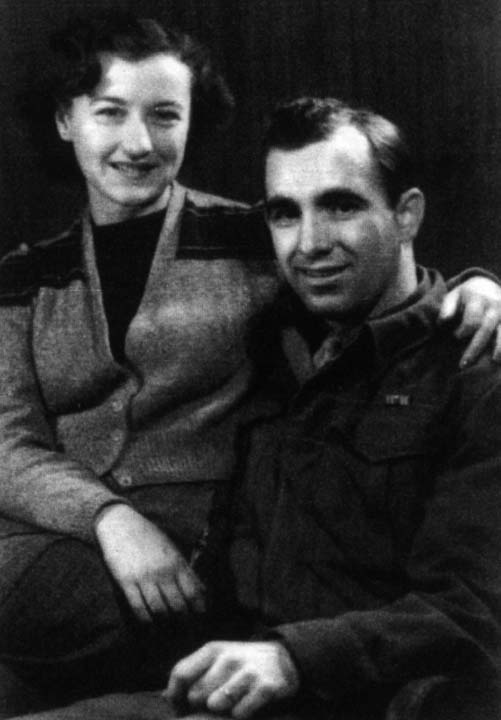 | 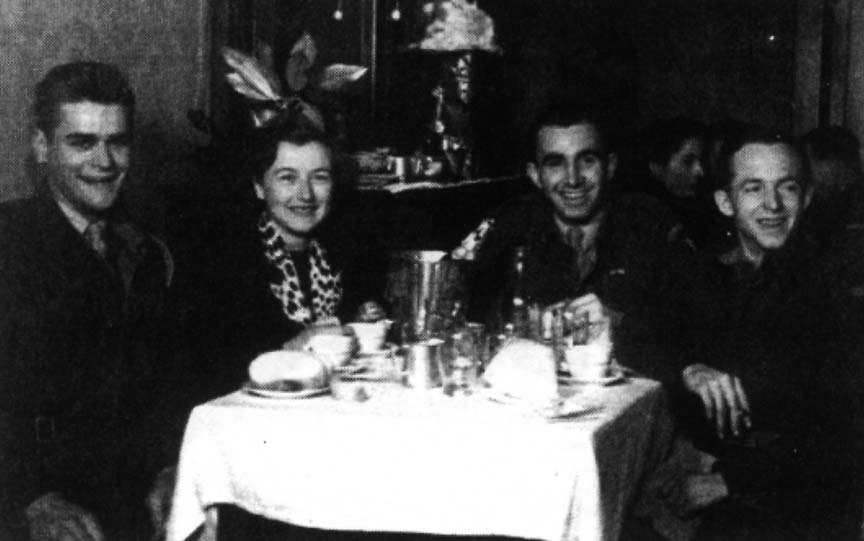 |
There would be two more missions for me to Belotti-Bon, on Company business of course, until my eventual transfer in late March to Naples (as explained above). Each one of these missions provided only two to three days in Rome, but infinitely worth the long trip and the agony of two more departures. I quote in full from the two letters I had written home about these visits. These letters provide insights into our respective activities, and especially all that Licia was managing to do for so many of us and for me at Belotti-Bon and in difficult circumstances. These letters also illuminate the ever increasing warmth and joy of our love for each other.
The first letter was written on February 13, 1945, when I wrote to Mother that "I have celebrated the coming of spring and St. Valentine's Day in a most wonderful manner. I have just returned from a hurried two days with Licia., The letter continued:
I went down to Rome on the leave train, making a long week-end of it as it is an 18 hour trip each way. It was the first time I had been in a train since a rough trip from Cairo to Haiffa in 1942 ... It was very comfortable with the continental method of compartment seating and cushioned seats. A hot meal (a can of meat and veg ration which belies the name "meal" but nevertheless .... ) is served on the way, and you arrive at an early hour in the morning. I left the train-station just as the Big City was wakening ... a crisp morning. My luggage was filled with the canteen supplies for Grum (Stalino) and Clarence (I made the trip on "business" you see to bring money and Canteen to the two boys who evacuate to this area), and with food supplies for the "Rome Liaison Office." My duffel bag, as well as two kit-bags were laden with bully, sugar, coffee, cans of beer, chocolate, fruit-cake from Chan and Luke for Licia (C Platoon looks after Licia), soap, the contents of the last package from home, some canned milk. The food items were ostensibly my "ration" for the voyage, but the "Q" gave me an ample store indeed. Lucky it was that I came so equipped, for I found the cupboard bare ... and you can imagine how expensive living is in any big Italian city these days.
Accordingly, I climbed into a horse-drawn carriage and surrounded by my precious load, set sail for #11 Via Luigi Belotti-Bon feeling most happy and excited. Actually it was the first time I "returned from the wars" to Licia looking presentable and minus the ailment of the past six months (boils). I was indeed a "uomo gallante" (as I am wont to call Vittorio jokingly), complete with delightful silk scarf a most treasured gift from Dad, and the new battledress purchased with Christmas money. All was still at the house, and I walked around back and called in at Licia's window (softly "polpetta, polpetta" as I remember). She had expected me a day early (I had signaled down to Grum of my coming, and so she was not sleeping very soundly and soon burst out of the front door to greet me.
My letter of February 13 continued:
She warned me never again to let her know just when I was coming because she counted the days, hours, minutes ... which made it rather difficult to sleep! However, her having been forewarned was beneficial from my point of view, for such an array of delicacies: a light chocolate cake, jam pie and fruit cake, ravioli, spinach-and-cottage cheese pie, as never before greeted the hungry husband. Licia certainly knows one of the shortest routes to the heart of her husband, to wit through the stomach. We shall have to plan a cooking contest on my return home: you four and Licia... I the happy judge, with Dad to corroborate my decision!
Licia is well now, and very decidedly beautiful in the blue sweater you sent her and which she loves to wear. We opened the new packages together, and found that the mysterious gift was a set of "undies" with a little card from the three girls. Licia has written several letters to tell you her version of the Christmas gifts and how thrilled she was to receive them. Bob and Skip are entrusted with letters and pictures for you. In addition, four letters from you have reached Licia (plus two from Mother S. to me for Licia), and I may say dear Mother that your command of the Italian language (after your stated forty years without practice) is incredible! Licia is more impressed with her new Mother after each new thoughtful deed, and accordingly her love for you is becoming as real as can be without having actually met you. She is making some progress with her English in her Red Cross work, but is still a bit shy to try her wings... especially after the wondrous letters you have written. Licia is reading the story-books you have sent her, and I was quite proud to show Licia as well as Vittorio and Filippo the Boston prints. She is also busy with the knitting yarn, and has already had much service out of the moccasin shoes (which fit perfectly), and the blue house slippers and the stockings. I gave her a little silver Field Service pin, which she wears while calling herself "the wife of the American Field Service." Indeed, a good portion of the fellows of C Platoon and AFS HQ have known the hospitality of her home (and sampled her culinary prowess as well! Art [Ecclestone] recently spent a five day visit at the "Rome Liaison Office," and I have already told you of the visits by Bob, George, Skip and Paul. Chan and John Harmon plan to be going down next month. Licia gave me a wallet with one of the wedding pictures for me and a woolen scarf. Every day we are ten-times as much in love ... something which I never thought possible and which must defy all the laws of nature in her slow and orderly processes. I am now an "old" married man ... over six months, and I must confess we were meant to be husband and wife. This last visit seems like a wonderful dream... I hardly seem to have gone it has happened so quickly, and yet for an instant I stepped into another world.
This letter of mine concluded with references to the gifts Mother had chosen and sent for Luciana Lotti, the delightful preteen daughter of Guido and Elita Lotti. It was in the name of Luciana that Guido had written the beautiful poem he had presented on our wedding day. Mother had also sent a gift for Mother Sargiacomo (both gifts representative of the thoughtfulness of the Mother I adored, and who would also become a true Mother to Licia in America). These were my concluding words:
You will be pleased to know that doll, sweater, and little socks have reached Luciana and a reply has already been drafted. The gift for Mother S. has also reached its destination. I have a great longing to return to "my" city [Lanciano], where life is calm and peaceful now, and where I have many friends. Licia and I will do so before sailing for the States; we will have to say "good-bye" to our villa as well. I am planning to stay on this March, and I think Licia and I will be able to sail together when the European war is over. It can't be too long now..."
And yes, there was yet another painful good-bye and separation for us after those all too few moments we had stolen from the slave-master of war, when we had somehow for an instant "stepped into another world." I had written (February 28) that "As you know the train brought me down to Licia's last time, and very calmly and cruelly carried me off again. Licia wrote about trains just what you implied ... that the going away in them causing a separation is sad if only because trains do their dirty work in such a business-like and inevitable manner. Once they start there's no stopping them (by contrast to the Edwards family getting off to church, or the opera .... ).
And I had added (March 11) that "We never seem to get over the pain of these separations... it takes about two months to dull that pain, and then it must needs begin all over again. And do not think there have not been unhappy moments for me from this other separation of 2 1/2 years from my family." I wrote a special pen-and-ink note to Mother telling her "the longing for home is very strong in me, it has been ever thus."
There would be one more long letter from me at 567 Company HQ, and one more visit for me to Belotti-Bon (and my "little wife") before the sudden, hitherto secret, and totally unexpected plans announced on March 21, 1945. On this date General McCreary 8th Army Commanding Officer inspected 567 Company and announced that the entire Company would be detached from 8th Army and "removed to another theater of war." Actually, it was the entire Company minus me; my orders were to report to AFS GHQ Naples and Major Bill Perry, Commanding Officer AFS Italy.
Coincidentally, March 21 was 2 1/2 years since HMS Aquitania had pulled out of New York harbor with me (and "Lucky 13" ) on board. This date represented yet another opportunity for me for home-leave under AFS regulations. Weighing options and responsibilities, Licia's situation too, and the possibility of a prompt ending of the war and the as yet unresolved issue of demobilization from AFS, I had signed another contract with AFS, but had come "the closest ever" to returning home.
Shortly before these dramatic events, I had actually completed a surprise visit to Rome. It had happened like this, according to my letter home dated March 20:
Last Friday Arnold Motz, Field Cashier, decided it would be a good plan to pay off the two boys of our Company on detached duty to the South. I of course agreed to this plan since the "Rome Liaison Office" was to be our base of operations, and received permission from Bert and John to make the trip. Accordingly I bundled up in the back of Dave Ford's jeep, and in the cool of early moving we three set forth. It would be a complete surprise for Licia as she was not expecting me until a promised leave at the end of my present contract. it was over a month since we had last been together on my brief visit of the first part of February. Because it was to be a surprise, she would not have "very cakes" waiting for me as she did that last time. Needless to say, that would not prevent my taking the chance to see her in spite of my gluttonous habits when it comes to her cooking! Licia opened the door to my knocking when we arrived, and such a welcome!
Vittorio and Filippo (who had just done very well in an exam in Engineering at the University) were also at home for we had timed our arrival for the lunch hour. Arnold, David and of course CPE needed no urging to down Licia's minestrone followed by fried eggs and bacon. Lunch was followed by warm baths at the Red Cross, and shaves and hair-cuts for we somewhat travel-worn "veterans from the Field." My bushy red mustache was trimmed to a rather sporting model by the Barber. Licia thought it would be embarrassing for her two guests to make me take off my mustache, since both of them were wearing similar growths! I promised her that next time I should please her by making the necessary sacrifice.
Friday evening we three dined with Licia at an American Army restaurant; and since we were to spend all day Saturday, Licia chose the Sat. noon meal to demonstrate her skill as a cook. Home-made spaghetti followed by her husband favorite: a pie filled with mixed cottage-cheese and spinach for the main course. Then one of her cakes to top it off. Sterling Grumman (Stalino as Licia would say) came down from his post to be with us. He is one of the older "C" Platoon men: he has taken good care of my Licia all winter, paying her frequent visits, helping out in getting our mail back and forth, taking her to an occasional opera, etc. He will be going home to the States soon, and so you may be hearing from him. Another fellow who has helped (especially from the point of view of rations for the "Rome Liaison Office") is an American Army Mess Sergeant. His name is John Williams from Texas, and he is going to the States soon. I gave him your address as he may land in Boston. It he does you, will hear from him.
My March 20 letter continued:
Sterling is one of the two fellows working in this area and for whom we are making this trip. The noon meal was a jolly affair with everyone in good spirits, and Vittorio breaking out some of his stock for toasts. We dined out again that evening as there is little cooking-gas after noon, and to give Licia a break from having to feed four hungry men.
In my letter I thanked Mother for her beautifully written letters in English which Licia was able to understand, and that Licia was trying to respond in English as well. We hoped Licia's letters were getting through to the States via the recently opened "civilian mails" --- another sign of the progress of reconstruction. Licia was amazed by the practicality and generosity of the gifts coming in from my family, and delighted to receive a birthday package with a dictionary (Italian- English) from Dad and much needed woolen undershirts I requested on her behalf shoes for Filippo, same size as mine, and to take the cost ($60 ) out of my own account --- a considerable sum in those days assuming the shoes could have been found. I also asked Mother to keep the flow of vitamin pills coming. for her "two children" in Italy. Licia like me was having trouble with boils --- doubtless signs of nutritional and vitamin deficiencies.
I wrote that Mother Sargiacomo hoped to come to Belotti-Bon for Easter, and that Vittorio had managed to obtain a lamb for Easter dinner in which Sterling was able to join before his return to the States.
I concluded this final letter of mine concerning Belotti-Bon: "It will be good for Licia to have her Mother with her, as it has been rather hard work for her running the house for her brothers, going to the Red Cross each day --- and of course acting hostess of the "Rome Liaison Office" has been somewhat hard on her too."
But within the next few weeks of late March and early April, our C Platoon with the entire 567 Company would gather in convoy for the long trek by sea and land to the German front, and I to a new assignment at AFS HO Naples where my "little wife" could join me.
The very real and pressing need for an AFS location in Rome for liaison and rest, given the crowded conditions of the city and the distances between AFS HQ Naples and Company north Italy, was no more.
These unexpected events affecting me, C Platoon and the entire 567 Company brought to an end the five months of winter 1944-1945 when our "C Platoon Liaison Office, Rome (unofficial)" had opened its doors, its hearth, and its heart to most of us of C Platoon as well as others of Company and Naples HQ.
Our "Rome Liaison Office" had been a significant chapter in the life of C Platoon and also AFS overseas. It had been possible because of the generosity of a young officer of Italy's elite national Carabinieri, who had willingly made his villa at #11 Via Luigi Belotti-Bon haven in crowded Rome for C Platoon of 567 Company, and indeed for some of us of AFS Company and Country Headquarters. His name was Vittorio Sargiacomo.
It had also been possible because of his sister Licia Sargiacomo Edwards. And it had became a living reality especially because of her courage and capacity as "hostess" and "manager" at #11 Belotti-Bon in that difficult time when Rome was rising from the trauma of its occupation by the Nazis. And it had become a loving reality not only because of her love for me as my new "little wife," but also because of her love as "Big Sister' to all of those then in Italy of our "Lucky 13" and C Platoon fellowship. And in return, she was accepted by them as one of us.
A fitting tribute to Licia was written by Ms. Renahan, the Directress at the American Red Cross Officer's Club where Licia had volunteered that winter. This was in the form of a letter of recommendation; I quote with great pride:
During this time she has endeared herself to everyone by the charm and sweetness of her nature. We found her to be a person of great character, cultivation, and intelligence who will unquestionably contribute much to America as a citizen. It is a pleasure, and a privilege, to recommend her in every way.
I now prepared to leave my fellows of Company and Platoon for a new assignment at AFS GHQ in a new city, Naples. At last in Naples Licia and I could establish a sort of "house-keeping" at this entrancing and vivacious place located on the shores of one of the most beautiful of bays of the entire world, and with roots deep in the histories of classical Greece and imperial Rome. But once again the fates of war would tear us apart in July 1945 for what would become the most agonizing and unjust separation of all until the following December.
It was only until I had intervened in person with the Chairman of the Armed Services Committee of the United States Senate that repeated actions of pulling rank to deny her authorized place on sailings as "war-bride" was ended. The "grand finale" for our love story was when we were reunited in December 1945 on the docks of the Port of New York City. With an assist for transit to Boston by Chan and Sterling I brought her to our family Christmas USA 1945. But all of this is another story as a portion of the final episode of A Driver Remembers which I report in Part IX which follows.
In one respect our little lives and our love story out of war and final reunion when there was peace, was but an inconsequential blip on the world's stage overwhelmed at that time by three of the most titanic events of our turbulent 20th Century. On May 5, 1945 Hitler's "Thousand Year Reich" came crashing down in unconditional surrender. It had brought our world to the brink of total devastation as it committed the most horrendous atrocities to the eternal shame of the evil that can transform mankind. On August 6 the atom bomb was dropped on Hiroshima and for the first time on our Planet Earth self-inflicted Armageddon became reality. On August 15, 1945 Emperor Hirohito announced Japan's surrender. The most devastating war of History was over.
To be sure our individual lives were as nothing compared to such titanic events, but if men and women did not have the courage to love and to marry even in time of war, and to bring into the world new life, there would be nothing --- no titanic events, no events at all.
Indeed, World War II was in some respects a war of the little people of our world, a people's war, and the courage of people was made manifest. In World War II the distinction between "military" and "civilian" was blurred. At the outset, it was the people of Great Britain who stood fast and alone against the German Blitz. All across the continent of Europe the bombs, mines and battles of total war took their toll on the people, old and young, men women and children. In the Soviet Union, the people endured the brunt of Nazi aggression and the slaughter of civilians reached its apogee; also to some extent by Japan's aggression in China. In France, Italy, elsewhere the people rose up in resistance to the Nazi atrocity and helped to turn the tide for Allied victory.
Although America was spared war's bombs and battles, the American home front was no less a major factor for Allied victory in the defense of freedom. It was the American women, epitomized by "Rosy the Riveter," as well as men too old for combat, who manned the factories and shipyards, and endured the sacrifices and shortages of the American "Arsenal of Democracy" without which the war could not have been won.