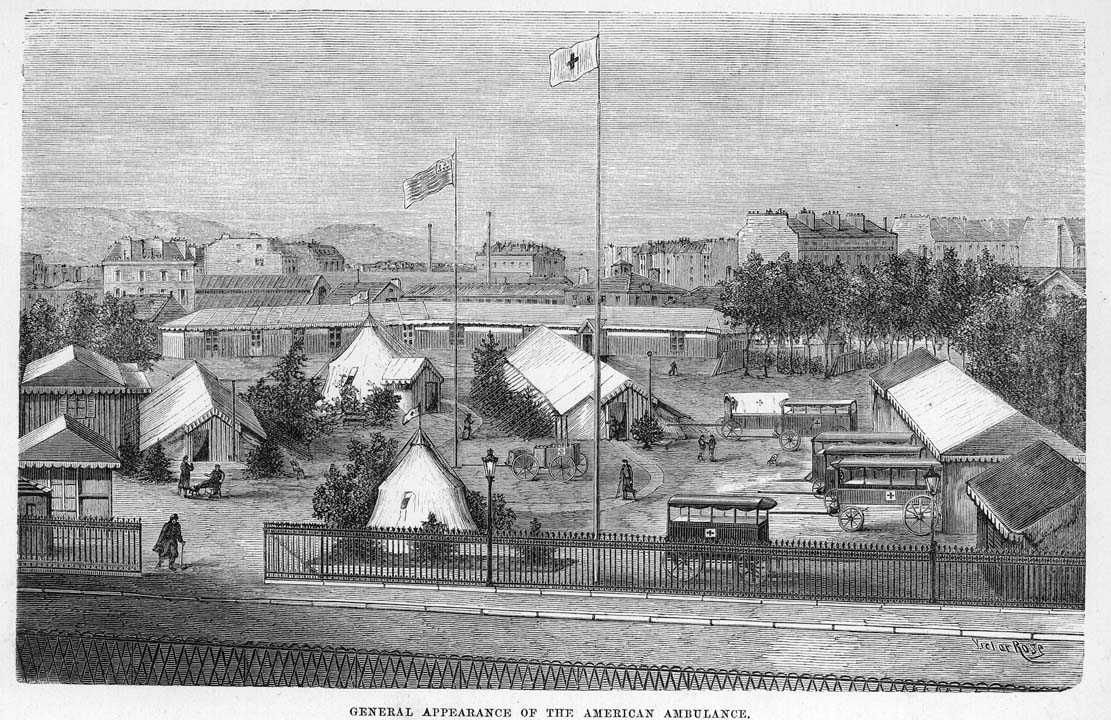
WATER SUPPLY.---A hydrant existing on the premises, it seemed desirable for several reasons to have a water supply at various points in the ambulance. Pipes were accordingly laid down, which placed the hydrant in communication with each one of the wards, as also with the kitchen. It is scarcely necessary to say that, apart from contributing to the security of our property in case of fire, and effecting a great saving of labour, the arrangement contributed much to the comfort and well-being of our patients, as also of our nurses.
The importance of having a sufficient supply of good water near an ambulance, is so considerable as to have sometimes induced writers to attribute to such a supply more of relative importance than properly belongs to it among the several requisites of a good locality. Certainly, wherever water is unobtainable, it would be impossible to establish an ambulance, and wherever the water is unsuitable for drinking, it would be unwise to establish one. But it is rarely difficult in most civilized countries to find, pretty nearly everywhere, water which is fairly potable. Whatever, in certain cases, may be the relations of water to health and disease, as a rule, too much importance is popularly attributed to the specific properties of certain potable waters; and Pinel long ago very justly said:---"a residence in large towns, like Paris and London, is apt to induce diarrhoea at first among strangers, much less, however, on account of the water than by reason of a combination of many other causes."(74)
The evil repute which has been attached to many waters has often resulted from overlooking certain agencies, less apparent but far more potential in their influence upon health. The water at our ambulance was thus once pretty generally pronounced to be the cause of a tendency to diarrhoea that declared itself. This tendency was afterwards, I believe, quite satisfactorily shown to have had another cause; not until, however, a large filter had been adjusted to the hydrant, which subsequently served the double purpose of clarifying the water, and reassuring such persons as had suspicions as to its wholesomeness.
The water used on our premises was that generally used in Paris. Until within a few years, the drinking water of the city was furnished almost entirely by the Seine. Even at the present time, nearly half of the water daily used is obtained from this source, and is issued to the public after having been mixed with aqueduct water. The service of the aqueducts was interrupted during the siege, and the population of Paris was reduced to have recourse, for the most part, to the Seine for its water supply. That there should have been a reduced consumption of water during the siege is not remarkable, but the absolute reduction was remarkably great; and not the least surprising fact is, that even the amount of Seine water distributed was scarcely more than half that usual in ordinary times, as appears from the following statement, in documents published by the Prefecture of the Seine:---
|
|
|
|
|
|
|
|
| Seine |
2,595,559,000 |
1,348,274,000 |
| D'Ourcq (aqueduct) |
3,089,657,000 |
|
| De Midi (springs) |
23,023,000 |
|
| De Nord " |
3,234,000 |
3,546,600 |
| Grenelle (Artesian well) . |
10,726,000 |
11,226,000 |
| De la Dhuis (aqueduct) |
494,015,000 |
|
|
_____________ |
_____________ |
|
|
6,220,214,000 |
1,363,046,600 |
|
| Marne (river) |
641,929,000 |
. |
| Passy (Artesian well) |
213,373,000 |
211,380,000 |
The water of the Seine contains solid matter, and, as is the case with most rivers, in very variable quantities, according as the waters are troubled by rains, freshets, &c. The solid matter per litre, when the waters are most disturbed by the causes mentioned, amounts to as much as 5 decigrammes per litre, or 35 grains per gallon: it is, however, generally much less, and averages only about 8 grains of sediment per gallon. According to Letheby, the water of the Thames contains, during the winter, on the average, 83 grains of sedimentary matter per gallon. It is difficult to determine the exact quantities of organic matter in any given measure of water, but the relative quantities present may be estimated by the amount of ammonia in equal measures of water. A litre of water, taken from the Seine just before it enters the city, was found by Boudet, in 1861, to contain 0.000,08 grammes of ammonia; another litre, taken just after it had left the city, was found to contain 0.000,28 grammes; and a third litre, taken from just below the point where the sewers discharge, was found to contain 0.002,30 grammes, or, in other words, it contained about twenty-nine times as much organic matter as the first sample.
The principal mineral which enters into solution in Seine water is the carbonate of lime, derived from the chalk formation through which the river passes. This carbonate is present in the water in the proportion of about 10 grains to a gallon.
The following analysis of Devile shows the minerals and the amounts of each contained in 100 litres of Seine water:---
| Silica . |
2.44. |
grammes | Chloride of sodium |
1.23. |
grammes |
| Aluminium |
0.05 |
|
Sulphate of potassium. |
0.50 |
|
| Oxide of iron |
0.25 |
|
Nitrate of soda . |
0.94 |
|
| Carbonate of lime |
16.55 |
|
" magnesia |
0.52 |
|
| " magnesia |
0.27 |
|
______ |
|
|
| Sulphate of lime |
2.69 |
|
|
25.44 |
|
A large proportion of the organic matter in the water, as well as a certain part of the mineral matter existing in the water not wholly in a state of solution, is precipitated by standing in the reservoirs before distribution, as also by the partial filtration to which it is there usually subjected. During the siege, however, a large part of the water, used even for drinking purposes, was distributed without having been filtered.
I do not know if French opinion, whether popular or scientific, concerning the special qualities of the water of the Seine, has much changed since the time of Parmentier, who replies to all the objections which can be raised against its use, by saying:---
"The constant wholesomeness of the water of the Seine has been the subject of numerous theses sustained in the universities; its good effects have been celebrated by the most distinguished poets; the immortal Boerhaave, a most respectable authority, felicitates the Parisians on the possession of a water which unites all the qualities which could be desired to make it agreeable to the palate, light in the stomach, and favourable to digestion. In fact, the Emperor Julian in his time expressed the same opinion, which, indeed, has always been confirmed . . . . The Parisians are therefore not wrong if they regard themselves as favoured by nature, if they never end their eulogiums of the Seine, if they are proud with the delight of seeing it divide their city, if they contend, in short, with assurance, that this river is the most admirable of all rivers, and its waters the best of all waters."(75)
If it might be difficult to justify all these praises, it would certainly be equally difficult to prove that the waters of the Seine act, or have ever acted, in a general way prejudicially to the public health.
Apart from the supply derived from the Seine, Paris is usually chiefly furnished with water from the Ourcq. The waters of this stream are charged with magnesian salts, and have been thought of doubtful salubrity.(76)
The water from the aqueduct of the Dhuis also exhibits the presence of a larger amount of mineral matter than the water of the Seine. Paris was deprived of water from these two sources during the siege.
I do not believe the practice of obtaining directly from the Seine, and near or within the city, a large portion of the drinking water served to the population of Paris, is a commendable one. Still, until some conclusive evidence is offered that it is inferior to the average drinking water of modern cities, we must conclude not only that our ambulance had a sufficient water supply, but that it had a tolerably good one as well.
KITCHEN.---The kitchen (Plate I, No. 8 B.), was a room 17 or 18 ft. square, and contained two 30-gallon boilers for making soup, two ranges, a table, side table, and shelves for the necessary utensils. It was supplied with water from the hydrant. I do not know if this establishment was in any way remarkable. Like the barrack wards it had no ceiling, and as only a single thickness of canvas was used to close the opening under the eaves, the kitchen was always rather distinguished for the excellence of its ventilation. It was one of the first constructions erected and was centrally placed---a matter of much importance, not only for convenience sake, but because the food sent from a kitchen so situated, is more likely to reach the patient in a proper state.
The service of our kitchen was well performed by a head cook, two aids, and several subordinates.
WINE Room.---This room (Plate I, No. 7 G.), was used as a store room for the ordinary wine, which was here bottled for daily distribution and use.
PROVISION STORE.---( Plate I. No. 8 C.) The meat and provisions were here kept in store ; those for the day were also here weighed, and afterwards sent to the kitchen.
The supervision of this room and of the wine room were confided to the same person.
LINEN ROOM.---This room (Plate I. No. 10 A.) was in the extreme end of barrack No. 10, and separated from the office of the superintendent by a thin canvas partition, the door through which was almost constantly open; it was thus kept warm and dry, while the character of the construction itself encouraged a free ventilation. No room connected with a hospital stands more in need of a well assured ventilation than that in which the linen is stored, and I could not better explain the reason than by translating a passage from a paper written by M. Émile Michel.
"The linen room," says that writer, "was almost the only dangerous spot in the Polygon; to have kept it from leaking, it should have been built more hermetically tight than the other barracks. The linen brought back imperfectly washed and not entirely dry, in spite of all the instructions on those points, kept up a muggy and insalubrious atmosphere, which the draughts of air established whenever the weather permitted, were powerless to change. Several employés, some female domestics, and the sister of charity charged with the superintendence, fell sick there one after the other. A young man attached to this service died a victim of his assiduity at this dangerous post.
"The same sad results showed themselves elsewhere-in several other ambulances---at Metz; and it was frequently that we were compelled to regret the sickness or the death of persons appointed to a service which, being less exposed, seemed sheltered from every peril."(77)
Our linen was washed principally at a laundry in the suburbs of Paris. In the month of December a washing-machine was established behind barrack No. 8, and certain articles were afterwards washed on the premises, employment being thus furnished for one woman.
STORE ROOM.---(Plate I. No. 17 A.) This room was used principally as a dépôt for mattresses and bed sacks, and the moss (crin végétal) and sea-weed which were used to fill the bed sacks and pillows. But few hair mattresses were used in the ambulance, sea-weed and moss having been almost exclusively employed to fill both pillows and bed sacks. Whenever one of these articles became soiled, the contents were removed and burnt, either wholly or in part, while the sack, after having been washed, was refilled. One person was almost constantly employed in this room in preparing and refilling mattresses and pillows.
KNAPSACK Room.---Very soon after the opening of the ambulance, the need was felt of having some secure place where the effects of the soldiers could be stored. A room was set apart for this purpose in one of the first barracks erected, but, as the room was soon required for other uses, a larger room (Plate I. 17 B.) was especially arranged as a store room for knapsacks, clothing, arms, &c. The effects of each soldier were ticketed, and placed in separate compartments. The door of the room was kept locked, and the window was protected by a grating. Money, watches, and articles of special value were placed in a safe kept in the administration room.
OPERATING ROOM.---This room (Plate I. No. 7 A.) was in the southern end of barrack No. 7, and was well lighted by a large broad window, nearly as wide as the room itself, that fronted the south, as also by an ordinary window in the western side of the room. The entrance from without was through a door, guarded by a vestibule; a door also communicated with the adjoining ward, to which, after severe operations, the patients were frequently transferred. The furniture of the room consisted of a large heavy operating table, one or two small side tables, and two or three racks attached to the walls, to receive bottles, dressings, &c. The operating room was warmed by hot air, taken from the trench of pavilion No. 4. In describing the system of heating, I said that it was occasionally necessary to shut off the hot-air current, by closing the damper placed in the trench behind the furnace; whenever this was done, a quantity of heat was lost. Barrack No. 7 being near the furnace of pavilion No. 4, it was suggested that it might be worth the trouble to place the trench in communication with the barrack, so that when the hot air was shut off from the pavilion, it might be turned on to the barrack and thus utilized. The suggestion was adopted, and proved to have been a valuable one.
DORMITORY.---A small building (Plate I. No. 19) was erected to serve as a dormitory for the male nurses. Most of the persons employed as nurses, whether males or females, slept out of the ambulance, but a few not having rooms in town, and that they, might be accessible at any moment, were provided with quarters on the ground.
TRANSPORT SERVICE.---The stable (Plate I. No. 18 A.), the shed. (Plate I. No. 18 C.), and the salon (Plate I. No. 17 C.), were created rather in the interest of the field transport service, than as dependencies of the ambulance proper.
BATHS.---If no bath room was established on our ground, it was not because we under-estimated the importance of baths in connection with hospitals. Our ambulance, at first an assemblage of a few tents only, was intended to be used as a field hospital; subsequent circumstances somewhat changed its character, until it was transformed into a sedentary ambulance. After the tents had been pitched it grew up gradually by the addition of constructions, one after the other, in an order determined strictly by necessity. First, the latrines were made, then the kitchen, next the rooms A, B, and C, in barrack No. 10; then barrack No. 7; afterwards the rooms C, D, and E, in barrack No. 8, were built; and thus additions were made until the middle of February, when the last construction---the kiosk over the coffee wagon---was completed.
The presence of a bath-house on the ground at no time seemed to be indispensable---1st, because the permanency of our occupation was never assured; 2ndly, because, with the existing scarcity of fuel, the expense and difficulty of keeping it constantly ready for use would have been great; and 3rdly and principally, because baths could be otherwise obtained.
In the house used as an annex to the ambulance---or rather, forming a part of it, were several bath rooms, which were at our service. Portable baths, prepared according to the French custom, were also occasionally brought into the ambulance from a neighbouring établissement de bains.(78) A very large number of our patients---who, it will be remembered, were nearly all wounded---were most of the time not in a condition to take general baths. Recourse, therefore, was commonly had to local bathing, which was systematically practised in the case of each patient. Great attention was paid to the subject of personal cleanliness; and one of the first duties of the nurses, before putting the patient in bed, was to see that so much of his person was washed as the condition of his physical strength permitted. Together with frequent spongings of the surface of the body, such baths were daily repeated, and, while in a large number of cases the only kind of bath it would have been possible to have employed, they answered nearly every hygienic end that could have been secured in a bath room itself.
Perhaps I could not quote, in support of the truth of this opinion, a better authority than Miss Nightingale, who---(retranslated from French into English)---speaks upon the subject of baths as follows:---"The skin can be kept cleaner with a glass of warm water and a rough towel, than with soap, sponges, and the whole apparatus of a bath, without rubbing. The sick, even on a long journey, when they could not be removed from their beds, and a large quantity of water could not be obtained in a basin, have in this simple way been kept as cleanly as if they had had at their disposition all the conveniences of home."(79)
SINKS.--- If cleanliness is of the greatest importance in all hospitals, by reason especially of sanitary considerations, it is perhaps a condition which should be regarded as still more indispensable in a field hospital. Here opportunities are constantly occurring where the rules of the administration may be violated with impunity, while the inmates of such a hospital always feel as if they were, to a certain extent at least, free to act without reference to laws of conventional propriety. Unless a place for everything, as well as means for doing everything, are carefully provided, no amount of doctrinal instruction will prevent many things being done "which ought not to be done," or result in a service which is not, at least, inefficient---perhaps intolerable. In a word, it will never do to let the servants of a field hospital manage the police service themselves, on a simple order that the tents and grounds are to be kept constantly neat and clean. The refuse matter of various kinds, dirty water, &c., should all be disposed of regularly and systematically, each kind of refuse in its appointed place.
Among the things most likely to infect a hospital are soiled articles of clothing. These should be removed from the wards as quickly as possible. Linen that can be cleansed by washing should be taken to the dirty-linen room, from which it should be sent without delay to the laundry ; all textile articles which may not be worth cleansing, or which may have been so soiled as to render them possible vehicles of contagion, should be burned. In the corner of our ambulance, near the latrines, a small furnace had been placed for the purpose of accomplishing the necessary incinerations. Near by, a deep trench was opened: here the dressings, and the water soiled during the dressings, were daily buried; protosulphate of iron was also thrown freely into the trench; when filled, another was opened by the side of it. In each ward there was a metallic sink immediately beneath the water-cock, into which it was permitted to throw soapy water, soiled by the washing of hands, etc. ; this was conducted by pipes into the street whence it ran into the common sewers. Behind the kitchen was a deep square pit, which served as a sink for the kitchen; this was covered by a trap, and communicated through a pipe directly with the street sewer. All the garbage from the kitchen was removed regularly from the premises by the scavengers. To dispose of any kind of refuse, in any other way than that especially provided for it, was positively forbidden. The general police of the grounds was maintained by two men, charged solely with this work.
This service, if apparently simple, is one of the most difficult of execution connected with a camp or field hospital; it requires of the servant some labour, but principally watchful care ; he must be constantly on the alert, and pretty nearly everywhere present, if he would not have the first "inspector," or chance visitor, unpleasantly anticipate him in his discoveries.
It is only justice to Mr. Meaks, who directed this service towards the close of our ambulance, to state, that he was the only person who ever succeeded in giving to it a practical efficiency which left absolutely nothing more to be desired.
LATRINES.---The difficulties connected with properly establishing and properly maintaining these offices in civil constructions are well known. If in camps and field hospitals the difficulties are less in certain respects, they are in other respects even greater. A proper sanitary condition must be maintained by constant disinfection, or by a frequent removal of the offensive accumulations, while the installation itself must necessarily be simple. Again, the careless habits of troops are to be taken into consideration, and effective measures employed to guard against them.
In American camps and field hospitals the custom has been to establish, at a point as far removed from the tents as convenient--generally at a distance of about two hundred yards---a trench ten or twenty feet long, two feet wide, and six or eight feet deep, before which is placed a bar resting on cross sticks. This installation is screened with shrubbery. Each day, during the time the trench is in use, a few shovelfuls of fresh earth are thrown into it, until it is filled up, when another similar trench is opened.(80) Very rarely have any so-called "disinfecting agents" been used in these camps and hospitals; nevertheless, the system adopted is really one of disinfection. Common fresh earth acts powerfully as a deodorant when thrown, even in small quantities, upon fæcal matter, while it possesses the advantage over all other deodorants of being everywhere obtainable at little or no expense. The disinfecting properties of earth depend upon its power to absorb and fix gases. It acts in this respect precisely as charcoal does, and if not quite so effective, theoretically, as that agent, is much more so practically, as its use is less frequently limited by considerations of cost. It may be inferred from a certain Levitical ordinance that the special properties of fresh earth to which I allude were long since known.(81) It is very certain, however, that it is only recently that they have become so well known as to lead to any systematic effort to utilize them in the interests of public health and public comfort. The completeness of the deodorization obtained in the "earthclosets," so extensively used at the present time in private residences both in England and the United States, leaves really little to be desired. The special advantages of this system over the "water-closet" system, from an economical point of view, do not now concern us.
Fresh earth is certainly one of the best, if not the very best, disinfectant that can be used in a latrine trench;(82) hence the American system, which is also the one common to most armies, is a good one, and not only especially appropriate for field service, but one which fully responds to the object had in view, except when cholera or pestiferous disease in a camp or hospital may cause the trenches themselves to become sources of special infection. In this event recourse must be had to disinfectants, which, acting chemically upon the contents of the trenches, may destroy any existing germs of disease, or interfere with the conditions necessary to their development.
The employment of earth, however, as a disinfectant was not attempted at our ambulance, and if I have spoken at some lengths of such an employment, it is because, had our ambulance been established in the field, we should certainly have used the trenches described, and probably depended entirely upon the deodorant properties of the soil near by for their disinfection.
Trenches, however, could not be used, as the ground plot which was given to the Committee was small, as well as unsuitable, from its town surroundings, for such installations; while, had we adopted the "earth-closet" system, we should have incurred, in consequence, expenses for special apparatus, and expenses additional on account of the necessarily increased bulk of vidanges, to be removed at a fixed price per cubic foot---outlays of money which, at the time, we did not feel justified in making. We concluded therefore to adopt another plan---to employ a number of fosses mobiles, and maintain a proper sanitary condition of the latrines by frequent removal from the premises of all fæcal and urinary matter.
The place selected for the latrines, if determined to some extent by considerations over which we had no control, was nevertheless, perhaps, the best that could have been chosen. Partly shut in by trees and shrubbery, it was not in immediate proximity with any pavilion, and was yet not far removed from the court of the ambulance and the doors of the wards. It occupied a position at once central and out of the way. Its relation to the wards and principal offices may be seen by consulting the Ground Plan of the ambulance.
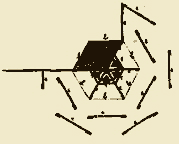
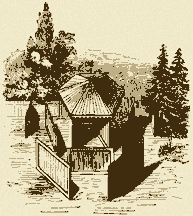
The cabinets, six in number, were arranged in a circle, and separated one from the other by partitions six feet high and five feet wide, all radiating from a central post; over the partitions was placed an hexagonal roof. In the angles formed by the partitions, cylindrical zinc boxes---the fosses mobiles of the Company Le Sage---each having a capacity of perhaps twenty gallons, were sunk into the ground the proper distance. These boxes, armed with handles to facilitate their removal, were also each provided with a funnel-shaped, wide-lipped basin. A resting bar was placed from partition to partition about sixteen inches from the ground, and a little above and in front of each basin. Fifteen inches above this bar, and two or three inches behind it, was placed another bar, the importance of which will soon be explained.
A seat was substituted for the lower bar in two of the cabinets, which were reserved; in other respects, except in having been furnished with doors, they were arranged in a manner conformable with the description.
In front of the cabinets were placed screens, arranged in a double series, so as to serve the purpose for which they were erected, and at the same time leave the way open to the enclosures within.
 |
 |
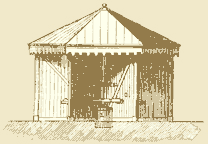 |
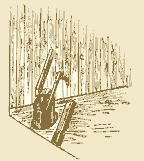
A ground plan of the installation I have described is shown in Fig. 46, which will give a very correct idea of the position of the cylinders (a a a a a a), of the angles (b b b b b b), the partitions (cccccc), of the bars (1, 2), and of the screens (e e e e e e). Figs. 47 and 48 show in perspective one of the cabinets. In these sketches the form of the fosse mobile, the mode of locating it, &c., will be seen, as also the relative position of the two bars. A more complete and general view of the kiosk and its surroundings is presented in Fig. 49.
The urinals were zinc cylinders capable of holding thirty gallons, and provided with side basins, as also with handles for their removal. They were three in number, and stood upon the ground, side by side, between the cabinets and the first line of tents, sheltered on three sides, and exposed on the fourth side, which fronted upon the path leading from the court of the ambulance to the cabinets. The exposed position of the urinals was intended to contribute to the propriety of the cabinets.
It is generally understood that whenever it is possible to separate the urinal from the cabinet this should be done. But it is of great practical importance, in order to secure the chief object of the separation, that the urinal should be at the same time the nearest and the most visible office. It is singular how frequently this simple rule is neglected in the construction of latrines. It is probably to be ascribed to the fact that the "système diviseur," as it is called, was originally proposed rather for the purpose of separating matters which possessed a certain intrinsic value from those possessing less, than from any influence it might have upon conditions of salubrity and cleanliness. But a disposition of the urinal such as I have indicated protects the cabinet against its first and most frequent degradation. Whenever it is possible to place the cabinet at a distance considerably more remote than that of the urinal, it is very seldom that the two offices are misappropriated; and nearly equal security against misappropriate usage may be obtained by making it difficult to reach the cabinet without passing by the urinal, so exposed as that it must attract attention.
The misappropriate use of the cabinet to which I refer, and the wet and uncleanly condition of the bar or seat, resulting from such a use, leads inevitably to another evil---that of climbing upon the bar or seat instead of sitting upon it, and thus still farther soiling and degrading a place which should always be kept most scrupulously clean, not more from sanitary considerations than as an evidence of respect for the maxims of common decency and common courtesy. Standing upon the seat of the cabinet is even, a graver abuse than the one to which I have just alluded, as it is utterly impossible to keep a cabinet in a cleanly state when daily used in this manner by a considerable number of persons. Without the most constant watchfulness on the part of the attendant it would become an abomination. Such a cabinet will always more or less be abandoned, with the result of most unpleasantly increasing the difficulties of policing the grounds around, and of maintaining the encampment itself in a state such as shall not do violence alike to the laws of propriety and of sanitary science.
Unquestionably the first cause of standing upon the seat is the evident uncleanliness of the place; another cause is a fanciful fear lest a direct contact of the seat with a certain portion of the person may communicate specific forms of disease. Another cause is custom. The principal and practical cause is the facility with which the custom can be adopted when no mechanical measures are taken to prevent it. I regret to say that---so far as my experience may be taken as a guide---the causes I have mentioned are superior to all ordinances, whether general or special, which may be issued for the purpose of preventing this abuse in cabinets open to the public. Constant vigilance on the part of the attendants may remedy the evil, but it does not prevent it---indeed, I know of nothing which can effectually put a stop to this practice, which does not render any and every attempt to execute it physically impossible. One might almost be tempted to believe that if a round bar, two or three inches in diameter, was substituted for the conventional seat, it would be difficult to realize the position referred to. The difficulty, however, will be found to depend entirely upon the length of the bar and the absence of proximate support. In camp the long bar answers very perfectly its purpose in this respect. In town, or wherever it is for any reason desirable to restrict the limits of the latrine, the bar will speedily be discovered to be no insurmountable obstacle. Indeed, the only way to cause the seat or the bar to be used properly is to fill up the space behind it, to such an extent as to render standing upon the same, à la turque, impossible. This may be done by sliding a shelf, or placing a bar between the lateral walls of the cabinet in such a way that a line between the anterior edge of this bar and the front of the seat or lower bar---fifteen inches below and two or three inches in front---shall form the base of an angle of 70° or 80°, the apex of which shall rest upon the posterior border of the basin. Such a disposition is shown in Fig. 47, which moreover exactly represents the system adopted in the cabinets attached to our ambulance.
When a bar is placed between the two sides of a cabinet, as represented in the woodcut, it will not be found to incommode in the least whoever may have occasion to sit upon the lower bar, while it will baffle the most persistent efforts to assume with the feet on the lower bar any half-standing, half-sitting position.
I consider that the use of this second bar or shelf furnishes one of the simplest as well as one of the most effectual methods of preventing the most frequent cause of the degradation of public cabinets. Indeed, almost the only objection which can be offered against the employment of the upper bar is that it forces whoever would use the cabinet to sit upon the seat even should it be soiled. But when the urinal is separated from the cabinet and located properly, as I have already indicated, the cabinet itself will rarely bear the marks of misusage; a very little attention on the part of the attendant will certainly be sufficient to constantly keep it in a state of irreproachable cleanliness.
I should hardly have alluded to the possible soiling of the bar in a specific way, or rather, to the apprehension said to exist in the minds of certain persons upon this subject, whenever compelled to make use of a public cabinet, but for an observation made to me by a French surgeon after he had examined the system adopted at our ambulance. "Yes," said he, "you keep your cabinets in this way very clean; but are you not afraid your system may occasionally be the means of transmitting disease?" My reply was:---"Not in the least. I am not aware if the diseases to which you refer are less frequent in my own country than in yours; but the idea that they may be contracted in the way to which you refer is considered absurd by our medical authorities, and so far as my knowledge permits me to speak, is rarely entertained by the people." But the observation was nevertheless significant. I believe the opinion that specific diseases may be contracted in cabinets d'aisance is very much more generally entertained in France and Southern Europe than in England and the United States. If the too-frequently disgusting condition of these offices in French towns is in any way dependent upon this fact, I can only hope the people may soon be better informed. Well-founded fears of disease---those based upon a connaissance de cause---may exert a wholesome influence upon society; but absurd fears are, as in this case, generally productive of evils, far more serious than those from which immunity is sought.(83)
The installations which I have here described as those adopted for our cabinets and urinals, answered most satisfactorily the purpose for which they were designed. They were simple, they occupied little room, and the kiosk in particular always had a neat and tidy appearance on the outside which rarely failed to represent that on the inside. Outside respectability may be in itself of little consequence, but it usually exerts a reflex influence upon the state of things within too considerable to be neglected, even in the establishment of latrines.
An attendant was required to visit the cabinets and urinals several times each day, to see that they were in order, and to remove from them whatever might be offensive to the sight. Each forty-eight hours the cylinders were themselves removed by agents of the Company Le Sage, and replaced by empty and clean ones. This frequent removal of the contents of the fosses---which were scarcely in use except during a part of the year when the processes of decomposition were controlled by almost constant frosts---rendered. systematic disinfection quite unnecessary, although from time to time a little chloride of lime or protosulphate of iron was thrown into the fosses, or upon the ground in the neighbourhood of them. The ground around was moreover every few days sprinkled over with fresh gravel, for the double purpose of keeping it dry and clean.
DEAD HOUSE.--This building was erected in an extreme corner of the grounds; it was also shut off from the public by a screen. A single room (Plate I. No. 16) was set apart for the dead; it contained a post-mortem table, and was lighted principally from above. The room adjoining (No. 15) was used as a dépôt for soiled linen. The two rooms were ventilated by long narrow windows, placed horizontally immediately beneath the eaves; they were almost constantly open, and were protected by iron gratings.
The positions of several of the installations, which, if considered as necessary dependencies of the establishment, were still perhaps remarkable in no special respect, may be seen by referring to the Ground Plan accompanying this Report.

 N constructing an ambulance two
important points are to be considered.
N constructing an ambulance two
important points are to be considered.
1st. The suitableness of the construction for the purpose it is to serve.
2nd. The cost of the construction.
Whenever the word ambulance is restricted in its signification to those hospitals immediately attached to an army, and which are intended to follow it in its movements, the suitableness of the construction---other things being equal---must be determined by its transportability. Our experience has shown us that results may be obtained when the wounded are placed under tents as satisfactory as those obtained in permanent and sedentary hospitals especially constructed for their treatment. The great advantage therefore which the tent hospital has over such hospitals, whether built of stone or of wood, is its transportability. It is far easier to move tent shelter sufficient for a thousand men a certain number of miles, than it is to transport a thousand wounded men an equal distance. Moreover, as I have before observed, the transportation of the severely wounded is attended with such risks as render it one of those extreme measures which never should be had recourse to except in the absence of suitable shelter near the battle-field. Again, an ambulant hospital possesses a special advantage too important to be overlooked in this connection. It begins its work afresh on every new field.
After a hospital has been established a certain length of time, it becomes more or less impregnated with the specific exhalations attending the processes of decomposition, as well as emanating from the subjects of disease, and the hospital itself soon begins to act as a morbific agent upon its inmates. Sanitarians are quite unanimous in assenting to the truth of this statement when applied to permanent hospitals. If this special evil and cause of disease may exist in temporary hospitals in a less degree, it nevertheless exists. Generally in temporary army hospitals, the means and the organization for maintaining that irreproachable cleanliness required by the laws of sanitary science are much less complete than in permanent establishments; such hospitals are consequently likely to become much more rapidly insalubrious. Whenever tents are employed in the construction of such a hospital they form practically a camp; and it will be found impossible to entirely avoid those causes of pollution which it is notorious speedily render camping grounds unwholesome.
I believe that one of the principal causes of the success obtained in the United States, when the sick and wounded were treated under tents, is the fact that the tents seldom remained more than a few weeks upon the same ground. If they had been erected for the shelter of the wounded, when these had all been properly cared for, the tents were struck and sent away, leaving behind them nearly everything---the earth, the floors, the straw bedding, &c., that might have become a source of infection had the hospital been long maintained.
It should be particularly observed, that if our own tents were established on the Avenue de l'Impératrice en permanence, we always had it within our power to pitch them elsewhere, had it for any reason seemed expedient; we also had taken special measures to protect our material as well as our grounds from the common sources of infection in hospitals and camps. And it should also be observed, that if in making our experiment it was an object to show that men could be successfully treated in the autumn and in the winter under tents, in maintaining them upon the same ground for more than six months, and in receiving within them convoys of wounded from September until February---thus mingling together the newly wounded and the convalescent, those whose systems were broken down by exposure and want of food, and those received when the vital power of the army of Paris was at its maximum---we subjected our tents to an unusual test.
The question of cost is one of great practical importance---is second only to that of suitableness in the construction of an asylum for the sick. I have remarked elsewhere that the use of public and private buildings for hospital purposes was apparently expedient for economic reasons. I am not able to say what the average cost of transforming such buildings into ambulances may have been in Paris during the siege. It probably was not great; but when compared with the expense of any special construction for the use of the sick, that incident to the purchase and installation of tents is very small.
The tent shelter we employed at our ambulance cost us less than 100 francs per bed; and by this statement I mean to say that the original outlay or first cost was less than 100 francs per bed. As, however, our system of hospitalization was a mixed one, since we used both tents and tent-barracks, and as our barracks were mostly erected for office purposes, and thus indirectly increased the capacity of the tents, it is better perhaps that I should present an estimate of the expenses incident to the establishment of a complete and independent hospital under American tents.
Suppose this hospital or ambulance to contain fifty beds. An American hospital tent is not overcrowded when it contains five beds---at least this number may be considered as a suitable average for each; we should consequently require ten hospital-tents. We should also require for the attending surgeon a shelter---an "officer's" tent; also for the stores and material of the ambulance another tent of nearly or quite the same size; and for the attendants, two small common ("wedge") tents.
Such an allowance of shelter would be found to be quite sufficient for the establishment of an independent hospital of fifty beds.
The cost of such an installation may be approximately stated in francs as follows:-
|
|
|
|||
| Ten hospital tents at | 462.89 each |
|
Amount |
4,628.90 |
| Two officers' " | 400.00 each |
|
|
800.00 |
| Two common " | 150.00 each |
|
|
300.00 |
|
|
5,728.90 |
According to this statement, the average expense of the shelter for each bed would amount to 114.55 fr. If, however, floors are laid down in the tents, should it be necessary to purchase these, the expense will be increased about five francs for each bed. The expense of putting in a heating apparatus, should the season require one, if like the one employed by us, would involve an additional outlay of 7.21 fr. per bed. The maximum expense, therefore, necessarily incurred in the establishment of an ambulance of fifty beds, under such tents as we employed, would not exceed 126.82 fr. for each bed; while the minimum expense, should the surgeon and attendants be provided with quarters elsewhere, and should we be able to dispense with the purchase of floors and of a heating apparatus, would be but 92.56 fr. The average expense therefore incidental to the establishment of such a tent-hospital may fairly be estimated not to exceed the sum of 109.69 fr. per bed.
The economy to be effected by using tents in place of permanent constructions, in the establishment of a hospital, may be made perhaps more evident by a reference to the usual cost of such constructions. The Chestnut Hill Hospital at Philadelphia, erected on the pavilion or barrack system, contained 3,320 beds. It cost the sum of 1,250,000 francs, an average of 376.50 fr. for each bed. The location of each bed in our own tent-barracks, although most economically constructed, cost over 200 francs. The barrack-hospital erected on the American plan at Passy, by the administration of the ambulances of the press, involved a total outlay---including that for a part of the furniture---of 540,000 francs; as there were 420 beds in the hospital, the cost of each was nearly 1,300 francs.
The tent barrack-hospital organized in the park of St. Cloud, in June, 1871, by the French "Société de Secours aux Blessés," involved an outlay of over 200,000 francs. It contained 200 beds. The shelter for each bed, therefore, cost over 1,000 francs.
An examination of the expenses incurred in the construction of the celebrated hospital Lariboisière, the model civil hospital of France, shows an average outlay for each bed of the enormous sum of 10,982.20 fr.---or more than one hundred times the sum expended in providing the shelter for a bed at the American ambulance---not including the expenses of furnishing the hospital, which involved an additional outlay of 990.09 fr. per bed.(85) But enormous as is the cost of a bed at the Lariboisière, it sinks into insignificance when compared with the estimated cost of a bed in the new Hôtel-Dieu of Paris. This building is intended to contain twenty-five wards, and to be occupied by 400 sick. Over 13,000,000 of francs have been already expended upon unfinished walls; the system of heating and ventilation is to cost 1,200,000 francs; and the total cost of the establishment, when completed, is estimated at 45,000,000 of francs---an average of 112,500 francs, or over 22,000 dollars for each bed! It is not surprising that a popular journal should have suggested that the model of this hospital was designed for distressed millionnaires, and that the medical press should have never ceased to pronounce it "a detestable hospital." Notwithstanding the immense sums already squandered upon this building, it is evident that whatever the amount of money expended upon it, it never can, from its surroundings and the principles of its construction, serve but very imperfectly the purpose for which it was created.(86)
It is hardly necessary, in advocating the general employment of tents in the construction of field hospitals and sedentary ambulances, that I should discuss further the economy of such a measure as compared with any which may have in view the construction of special shelter for the sick, since no one can deny that the tent affords, nearly everywhere, by far the cheapest means of establishing such shelter. No one can deny, moreover, that its transportability is an advantage in its favour of the greatest practical importance. Indeed, the only question which can be raised is this, viz., are the results obtained, when the sick and wounded are placed under tents, as good as those afforded when they are treated within the wards of a permanent hospital? As I have already considered this question at length, I can only express the hope, in closing my Report, that the facts bearing upon it which I have presented, derived partly from our own experience and partly from the experience of others, may have appeared so conclusive as to induce you to believe, as they have caused me to believe, that when the hospitalization of the sick and wounded under tents shall have become an accepted and general practice, a veritable reform will have been accomplished in the sanitary service of armies---a reform not greater, because it would diminish the suffering and mortality to which armies are frequently subjected, from the complete absence of suitable shelter, than because it would place the organization of the hospital under the control of the surgeon, and enable him to realize everywhere those hygienic and nosocomial conditions which a long experience has taught us are of the greatest importance in the treatment of the sick.