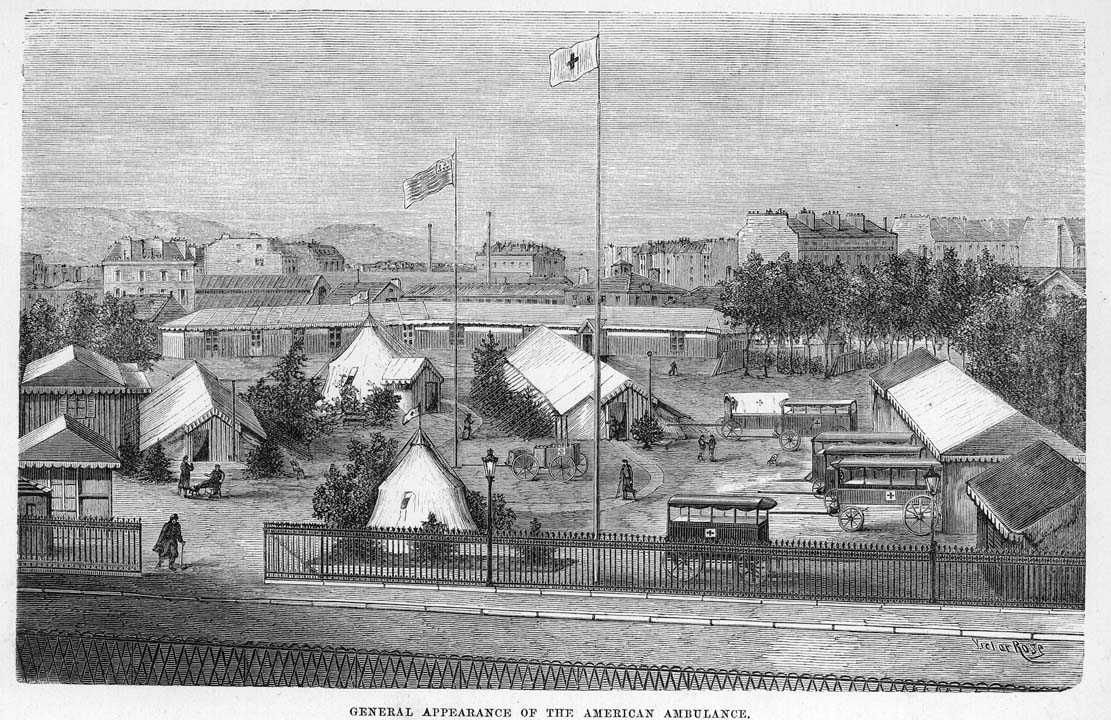
LOCATION: CHARACTER OF THE GROUNDS.---Before speaking of our tents and tent-barracks it may be well to briefly notice the general situation of the ambulance, and the character of the grounds upon which it was placed. In some respects the situation was a good one, in other respects it was a bad one. On the north side of the Avenue de l'Impératrice, about half way between the Are de Triomphe and the Bois de Boulogne, was an open lot, containing nearly an acre and a-half of ground; it was partially shut in by houses, but fronted directly upon the wide beautiful avenue so well known to all who may ever have been in Paris. Although within the walls of the city, this quarter of Paris is quite suburban, and is covered principally with villas, small parks and gardens. The air was consequently to a considerable degree free from the impurities common to it, where the population is dense. This part of Paris lies, however, in the valley of the Seine, and has always seemed to me to be more subject to inundations of fog from the river than even the central portions of the city through which the river passes. From the Arc de Triomphe the ground slopes gently to the fortifications, from which it spreads out in a low alluvial plain quite to the Seine. As nearly the whole region is unpaved, the special influences upon health of such a formation are much more likely to be exhibited than in the more strictly metropolitan portion of the Paris basin. I certainly do not wish to say that this most delightful part of Paris is unhealthy as compared with other portions of the city, since special causes here contribute to a condition of general salubrity which perhaps it would be difficult to find elsewhere in Paris; I only wish to say, that I should not, from theoretical considerations, select such a location as one possessing the best conditions for the installation of a permanent camp, and a fortiori, for the establishment of a permanent field hospital. Unfortunately, theoretical considerations had but very little if any weight in the determination of our choice. Early in September it became absolutely necessary to pitch our tents somewhere, and get ready for the conflict which was daily becoming more imminent. The great question was not so much where could we find the best place for the tents within the walls of Paris, as of whom could we obtain the privilege of using a plot of ground sufficiently large for our purpose. A lot upon the Avenue de l'Impératrice was generously offered to us, and we immediately accepted the offer. The plot was by no means prepossessing; it was flat, covered with a rank vegetation, and had the appearance of a rich but neglected garden; and I may add that previously to our occupation it had been used for a dog show---several hundred dogs having been encamped there, during a considerable part of the summer of 1870.
The soil was to a certain extent artificial, the plot having been filled in, to a height of ten feet or more, to bring it to a level with the avenue. Unfortunately, this soil contained so large a percentage of clay as to be quite impenetrable to water; inasmuch as the surface, moreover, was almost perfectly level, it became exceedingly difficult to properly drain it; indeed, during rainy weather this most important service was only indifferently accomplished by conducting the drains around the tents to pits sunk in the ground at various places.
The ground was perfectly dry all winter long at a distance of two feet below its surface. The only chance of escape for the water which fell upon it was by evaporation, a process almost infinitely slow under the sombre sky of a Paris winter. The consequence was, that we were always in the midst of moisture, and what was apparently far worse, of mud. In fact, this was the greatest inconvenience, resulting directly upon the nature of the soil and the character of the location, to which we were subjected, the whole surface of the ground at every rainfall having been converted into a veritable slough. Plank-walks enabled us for a time to pass dry-shod from tent to tent; but as the season became wetter, during the thaws of December and January, it was almost impossible for either men or carriages to cross certain portions of the ground. The loads of gravel which we threw upon certain places disappeared almost immediately, and it was only after the worst spots had been paved with large stones, and hundreds of loads of gravel, sand, and tan had been distributed over its surface, and I may also say after the weather itself became dryer, that the condition of the ground could have been pronounced satisfactory. Not only was the mud a source of inconvenience, but it made it frequently quite impossible for us to preserve that tidiness, both without and within our tents, which was desirable, not more as an evidence of our regard for well known sanitary requirements than as an evidence of the orderly and systematic execution of our police service.
To what extent the condition of the ground, to which I here refer, may have acted upon the health of those treated at the ambulance, I am unable to say ; it may, however, have been the more or less direct cause of several of the cases of bronchitis, pleurisy, and pneumonia---some of them fatal---which occurred when the subjects had so far convalesced from their wounds as to be able to leave the tents, and even to walk about the enclosure Still, whatever may have been the unfortunate degree of humidity existing in the surface soil without the tents, the earth was always kept dry within them, by means which I shall elsewhere explain.
The geometrical form of our grounds, if a much less serious cause of inconvenience, nevertheless, greatly interfered with any attempt to establish the tents and barracks in accordance with a plan which should give symmetry to the whole installation. Indeed, since the removal of the constructions, having had occasion to re-examine the location, it has been a constant subject of surprise to me, that we ever succeeded in placing our tents and barracks upon it, in a way which shocked the harmonies of proportion and position so little.
While the tents and barracks were arranged so far as possible---consistently with having the freest circulation of air between them all---with reference to convenience and symmetry, and various efforts were made to keep the earth dry and. firm, something also was done for mere appearance' sake. Plots here and there were railed in and planted with flowers and shrubbery.
In the month of September a large number of trees were cut down in the Bois de Boulogne to unmask the approaches to the city. Among these were many ornamental evergreens---pines and firs; a fine selection from these was made, and the trees were soon replanted around our tents and walks. This shrubbery retained its dark green colour during the entire winter, and added much to the picturesqueness of the grounds; although we never attached to its presence the sanitary importance entertained by some of our visitors, who, impressed by whatever was novel or unique in the organization of the ambulance, seem to have been fully persuaded that "those singular Americans" had discovered in the balsamic properties of the fir-tree a specific against the invasions of hospitalism.
THE TENTS: HOW ARRANGED.---I have elsewhere had occasion to speak in a general way of the mariner in which our tents and tent-barracks were distributed over the ground, as also how our hospital tents were arranged. I have said that five or six tents were joined together, end to end, in such a way as to form a long rectangular pavilion. I have described also how an American wall-tent is pitched. I may however, in this place, direct your attention to several points, each of some importance.
The tent pavilions (see Ground Plan, Plate 1) were placed parallelly to each other, their ends facing northerly and southerly, the prevailing winds thus sweeping freely between them. Just behind them, and possibly a little nearer than desirable, stood the tent for wounded officers. The tent-barracks for the wounded, Nos. 7 and 10, were placed on each side of the area behind the pavilions. These wards were as far from each other and the pavilions as possible. Barrack No. 8-in which were the kitchen, salle à manger, pharmacy, &c.---was built nearly at right angles with the barracks Nos. 7 and 10. It was separated from No. 7 by a free passage-way, and from No. 10 by a covered passage-way. Barracks Nos. 15, 16, 17, 18, and 19, occupied the eastern side of the plot. All the constructions were thus detached as well as separated from each other, so far as convenience and the extent and conformation of the ground permitted.
Our organization having assumed from the first a certain character of permanence, the ground within each-one of the tents, as well as barracks, was covered with a floor formed of strips of board laid side by side, and nailed to narrow (two and a-half inch or three inch) string pieces, which rested on the ground.
While this floor answered its purpose very well, for aught I know, I can hardly recommend it when tents are to be kept long standing. The cracks between the boards permit dirt of all kinds to sift through and accumulate on the ground beneath, where it may become in time a source of pollution. To guard against such an occurrence, our floors were once entirely taken up. After the earth beneath had been to a certain extent removed, and the tents closed and thoroughly fumigated with chlorine, the soil was sprinkled with proto-sulphate of iron and the floors relaid. These precautions were doubtless wise, but the necessity for them might have been in a measure avoided had the flooring been covered by some impermeable stuff---oilcloth, for example---which would have had the additional advantage of being susceptible of frequent cleansings.
The trenches which were dug on the sides of each pavilion were a foot broad and about eight inches deep, the earth being thrown towards the tents and banked up against a narrow strip of board, that preserved the canvas from immediate contact with the soil.
The entrance to each tent in which the wounded were treated was guarded by a vestibule, or tambour, which was entered by a door closed by a pulley and weight. The principal object of the vestibule was to prevent the too direct entrance of cold air; it was however very useful in several respects; it added to the capacity of the tent, and served as a convenient closet for many utensils in daily use. In the field, a substitute for it, so far as it served to keep out currents of cold air, may be obtained by suspending one or two blankets outside or inside of the tent door.
TENT- BARRACKS.-When our ambulance was first established, we did not propose to make use of any shelter for the wounded except that afforded by tents. For reasons which I have elsewhere stated, it seemed desirable at a later period to increase the number of beds. Suitable tents could not be obtained in Paris for this purpose, and our only alternative was either to place the additional beds in some one or more neighbouring houses, or erect upon our own grounds constructions which might properly be used for the shelter of our patients. The benefits to be derived from the use of tents in the hospitalization of the sick seemed to us to be so considerable, as to warrant the attempt to secure some of them by the erection of temporary constructions possessing several of the desirable qualities special to tents. In my general description of the ambulance I have stated how these constructions-tent-barracks-were made; that they were made of simple frameworks, boarded up on the sides and at the ends, and roofed with canvas. They were built, however, much less for the purpose of showing a system of hospital construction than with the intention of obtaining, what seemed to be an immediate necessity, an airy shelter for the sick. The buildings were consequently rude, while they were defective perhaps in regard to certain details, which would have been made the subject of a more careful consideration had not everything been put up in a hurry.
Our tent-barracks were certainly preferable to houses for the treatment of the sick; they were new buildings, which had never been occupied, and the fresh air supply was tolerably well secured; but I have always considered them as offering less favourable sanitary conditions than tents. In the first place, they were not as impermeable to water. Three thicknesses of canvas (French) had to be put upon the roofs before they fairly kept the water out, and yet during the whole winter they were constantly leaking at certain points. This leakage was doubtless partly attributable to the quality of the canvas, but it was also partly attributable to the fact that the canvas rested upon a framework of rafters. Had the best American duck been used for a roofing, it would unquestionably have occasionally leaked had it been so supported. The use of two or more thicknesses of canvas for the purpose of securing impermeability to wet, resulted in rendering the roof to nearly the same degree impermeable to air; if the roof is really impermeable to air, such a construction cannot properly be called a tent-barrack, it is simply a barrack; whether a roof is covered with impermeable zinc or impermeable linen is a matter of no moment so far as ventilation is concerned.
It was more difficult to maintain a proper temperature in our tent-barracks than in our tents. It is true they were heated with stoves; but so was tent No. 21. The air entered them at various irregular openings, and escaped to a considerable extent in the same manner. The principal ward-barrack was ventilated by a shaft; but the two ward-barracks were rarely free from the odour peculiar to hospitals. It was thought necessary once or twice to whitewash the walls and rafters within, if partly to improve the light, partly also for sanitary reasons. The only advantages our barracks possessed that our tents did not I have elsewhere mentioned as special to barracks in general. They were roomier than tents, had windows and doors which could be locked and barred, and afforded a sense of security to persons, and afforded a real security for things, which the tents did not. They consequently answered much better than tents for the various offices connected with the ambulance.
LIGHTING.---The tents were lighted at night by oil lamps provided with chimneys and shades. A lamp was fixed in each tent to one of the upright standards; candles were used for movable lights.(55) In the tent-barracks and offices similar lamps and candles were used. The grounds were also well lighted by oil lamps furnished with strong reflectors. The charge of the lamps gave constant employment to one man. Not one of the least remarkable sights connected with the ambulance was its appearance at night when lighted up; the tents and pavilions, and tent-barracks even, looking rather like immense Chinese lanterns than the habitations of men. The moving lights of the attendants, the coloured signals, the grotesque shadows which appeared and disappeared as suddenly---all these strange effects of light often gave a singular and almost weird-like animation to our little encampment after nightfall. By day the barracks were fairly lighted by windows shaded with muslin curtains. The tents only received such light as was diffused through the canvas, and yet I doubt if, during the day even, the tents were less well lighted than the barracks. The absence of windows has been considered an objection to the use of tents; not so much, however, because windows let in light, as because they afford to patients occasional opportunities of relieving the tedium of their confinement by looking out of doors. It is a fact, however, not unworthy of remark, that nearly all our patients manifested a decided preference for the tents, and few, if any, were transferred from them to a barrack who did not express an anxious desire to get back to their old quarters. The barracks lacked something of the cheerfulness which seemed to belong always to the tents, and which was probably largely owing to the uniform diffusion and the softness of the light within them.
FURNITURE.---I have elsewhere referred to the furniture of the tents; and, although briefly, with perhaps sufficient detail. Beside each bed was a chair or a small table. A table also stood near the water-cock, while at the end of the pavilion was a buffet in which were kept the bandages, medicines, feeding cups, and various articles which the nurses might have occasion to use. The wooden furniture in the wards was all of white unpainted wood of the simplest and plainest kind.
The iron bedsteads which we made use of have been occasionally criticised. As the patient is lifted from the floor scarcely more than fifteen inches, even when lying on the mattress, they have been considered too low, especially as the position they force the attendant or surgeon to assume often becomes painful.
But it must be remembered that these bedsteads were proposed and constructed, not as model bedsteads for general hospitals, but as bedsteads for campaigning and for use in field-tents. It was very desirable that they should be as light as possible consistently with strength, and also that they should be low, in order to gain head room.(56)
It would have been difficult to have used a much higher bedstead in our tents. To have increased the height of the bed would have involved increasing the height of the tent walls; and the objection to adding to the height of these walls in portable field-tents has already been indicated. Moreover, if a low bed is sometimes inconvenient for the attendant, it is always very convenient for the sick man, and his interest should be first considered. Miss Nightingale has expressed the opinion that the bed for the sick should never, "under any pretext," be higher than a common sofa. Otherwise the sick man is unable to help himself in many respects, and is additionally fatigued every time it becomes necessary for him to get up or lie down. And it is very singular, she remarks, that persons who only get in and out of bed once a day forget that these efforts are frequently made by the sick, and are often followed by much fatigue. These considerations are of great importance, and may well lead us to the conclusion that our beds were not too low, notwithstanding the criticism referred to, and which I may add---although repeated to me many times by French surgeons---I never once heard from the lips of a French patient. Indeed, I believe that the height to be given to a hospital bed should rarely exceed eighteen inches.
If the American field hospital iron bedstead has any real fault it is its want of strength---a want of strength shown, however, rather by the breakage from rough handling in transportation than from breakage in actual use. Not one of the hundred and twenty-five iron bedsteads used at the ambulance by patients and nurses was broken or seriously injured, during the six months' service to which they were all subjected.
SYSTEM EMPLOYED FOR WARMING AND VENTILATING THE TENTS.---One of the most serious questions that has arisen in connection with winter encampments has related to the best and most practical method of securing a comfortable temperature for those who are placed under canvas.
The general practice in camps since the very earliest times has been to rely upon the heat of fires burning in the open air and outside of the tent.(57) Sometimes they have been placed near the tents---so near as to elevate the temperature of the air within: them; but generally they are too far away for this result,---the object in view having always been rather to warm the soldier than the quarters assigned him.
Indeed, it is very rarely that an attempt has been made to warm the quarters of the common soldier. Even when huts were used in former times, the soldier was forbidden under any pretence the use of fire in his lodgings.(58)
It has been an occasional custom in camps---and one very prevalent during the eighteenth century---to construct special quarters where the soldier might pass a portion of the day, returning to his tent at night only to sleep. These were often subterranean excavations, roofed with earth, in which fireplaces with chimneys had been placed.(59) But whatever may be said in favour of such practices in general encampments, it is obvious that they are inapplicable wherever the soldier---whether well or sick---is forced to be a permanent occupant of his quarters. In such cases---if the soldier is to be made comfortable---measures must be taken with a view to the warming of the air within those quarters. But the difficulty of maintaining a proper temperature within tents during the colder months of the year has always been recognized, and has been made even a serious objection to their use, especially---as we have seen---for the hospitalization of the sick. Incapable of storing up heat within their walls, as more solid constructions do, it is impossible to make tents comfortable except by providing in some way for a constant evolution of heat within them. The great difficulty has always been to properly regulate this heat supply. It is very easy to put in a tent a common sheet-iron camp stove provided with a few joints of pipe (and this, by the way, is the usual practice), and with a little wood build a fire sufficient to warm the air within the tent; but generally after a few minutes the temperature will be found to be most uncomfortably warm. If the ventilators are raised, or the doors thrown open, the warm air rushes out, and the cold air rushing in produces a violent perturbation in the temperature, which will generally be found only to have become so comfortable as to permit the closing of the doors when the fire shall have nearly died out in the stove. The consequence is, that the occupant just at the moment he may suppose himself to have at length succeeded in "regulating" the temperature, will probably be warned by a rapidly-increasing sense of chilliness that his fire has gone out, that more wood must be put into the stove, and his experiment repeated over again. However often one may have occasion to build a fire in this way in a tent, he will rarely succeed in securing within it, except for a very transient interval, a really comfortable and satisfactory temperature.
If the fuel used be coal instead of wood, much better results may be obtained, especially if the tent be large and the stove of appropriate size. As coal burns slowly and very steadily, with sufficient care the evolution of heat may be tolerably well regulated.
The chief practical difficulty, when coal is used, will consist in making all parts of the tent at the same time quite comfortable if the fluctuations of temperature within the tent are not rapid, the air in the immediate vicinity of the stove will often be found disagreeably warm, while that in the remoter parts of the tent may remain unpleasantly cold. But whatever advantages coal may possess as a fuel for heating tents, the opportunities for obtaining it and using it in camps are altogether too infrequent to give them much practical importance.
In proposing any really useful system of warming tents, we must rely for our heat upon the common fuel of the world---wood.
Several methods of warming tents have at different times been suggested or adopted which I may mention. Sir John Pringle says:---
"It will be found useful to burn spirits in the evening, in order to warm and correct the air in the tents."(60)
It is probable, however, that the old army physician makes the suggestion rather for the purpose of correcting the air, than for the purpose of warming it. One of the most ancient as well as common methods is that of placing within the tent, on the ground, upon a flat stone, or in a brasier, a quantity of red-hot coals. If the danger from asphixia is less under canvas than within the close walls of a room, the unwholesomeness of the practice sufficiently condemns it. A modification of this method is thus described by a writer quoted by Capt. Galton.(61)
"When living in a tent in New Zealand, during a severe winter we were perfectly numb with cold at night, until we adopted the Maori plan, which is to dig a hole about a foot square in the clear, to cover the bottom with a stone or stones, and fill it at night with red-hot cinders from the campfire, and lastly to close the tent excepting a small opening near the top. The cinders are not nearly burned out by morning. They diffused a pleasant warmth through the tent and rendered us comfortable all night. There is no danger of suffocation unless the tent be closed up very tight indeed."
This plan seems to me scarcely less objectionable than the one previously stated, and for the same reason, notwithstanding the assurance of the writer that "there is no danger."
M. de Presle, as I have elsewhere remarked, speaks of putting within the tent "a little fire in a chimney made of turf." This is certainly a much better plan than either of the two I have just referred to, and it may be really all that is needed to make an ordinarily large tent perfectly comfortable, if the fireplace is sufficiently large and the supply of wood not deficient.
A much better plan is that of warming the tent by means of a fairly well-constructed fireplace and chimney; this is a very common method in modern camps, and was sometimes practised in the last century.
In Grose's "Military Antiquities " there is a sketch of an English marquee as pitched a hundred years ago. Outside of this tent may be observed a large brick or clay chimney; the fireplace evidently opens into the tent, and a very curious detail in the sketch is the representation of an empty barrel upon the summit of the chimney. The draught of the chimney seems to have been found defective, and a means of improving it suggested which during the War of the Rebellion I had always regarded not only as an original, but as an indigenous invention.
The fireplace and chimney were very frequently used as a means of warming tents in the Federal army during the War of the Rebellion, particularly in permanent camps. I remember having passed several weeks during one winter in a wall-tent, at the back and outside of which a fireplace had been built of stones and mud, surmounted by a chimney some 12 ft. high, made of small sticks, laid crosswise, and well plastered on the inside with mud. The fireplace opened directly into the tent, the canvas having been raised and properly readjusted at its top and around its sides. The cold was quite severe, but as we had a good draught and plenty of wood, our fire was generally a bright one. So far from having suffered in any way from the inclemency of the season, I shall always remember those days as among the pleasantest I have ever spent in camp, if partly by reason of personal associations, not a little from a sort of local attachment to the cheerful chimney corner, which I knew however stormy it might be without, was always in reserve, warmly waiting for my coming at the close of the day.
A fireplace, however, never can be employed without a great waste of heat. Its use in camp presupposes therefore an abundance of fuel, as also that it shall only be erected for the warming of tents of moderate dimensions. The consequence is, that whatever its excellences in certain cases, they are altogether too dependent upon special circumstances to permit their general utilization.
If one can employ with advantage for the warming of tents neither stoves nor open fireplaces, it would almost seem as if any attempt to secure for them a comfortable interior temperature would lead to equally unsatisfactory results. The problem to solve is certainly a difficult one. A mass of air is to be maintained at a certain temperature, while the walls investing it have little power to store up and return back by radiation the best subtracted from it. All heat, once having left the mass of air in question, is lost for ever; and not only is this true, but the in vesting walls interpose but a slender barrier to the heat within, which passes rapidly through them by conduction, or is carried out in the rarefied air which oozes through a thousand pores and fissures in the network of the tissue. The best idea of the rapidity with which heat escapes from a tent, can be obtained by going on a cold day in the winter into a tent provided with a sheet-iron stove: put in the stove two or three newspapers; in a few moments the atmosphere will have become quite uncomfortably hot, and then after a few moments the temperature will have almost as rapidly descended to the degree indicated by the thermometer before building the fire; and the experiment may be repeated again and again, with the same result---that is to say, without any apparent permanent elevation of the temperature, except that produced by the presence of the persons who may have been in the tent.
To warm a tent successfully some method must be adopted which may enable us to store up a portion of the heat generated in excess of that immediately necessary to make the tent comfortable, and to store it up in such a way as that it shall gradually and uniformly escape into the air within the tent. When a fireplace is used it warms the air not only by throwing the heat directly into the tent, but also by being itself a reservoir of heat for some time after the fire may have been extinguished. A tank or two of hot water, such as is used in railway carriages, will in this way often warm a common tent very perfectly; so even will a box of hot sand. But fortunately we have another and much more practical means of providing tents with such a stock of heat. If the air within a tent is enclosed on nearly every side by walls incapable of retaining heat, on one side it rests in contact with a deep solid wall---the earth. It only remains to contrive some ready method by which the ground shall always take up and hold in reserve a large store of the heat generated for the warming of the tent, and our problem will have been solved. The question then is, how can we at the same time warm the air in the tent and the ground under it? There are several ways of doing this. One of these ways is to dig a sort of cellar under the tent two or three feet in depth, and to then place in it a common stove. The cellar adds much to the capacity of the tent, and its walls, warmed by the stove, serve as a reservoir of heat, which contributes in the way indicated to the steadiness of the temperature within. It was quite a common practice for the officers of the English army to warm their tents in this way while encamped before Sebastopol. A section of a tent so arranged is shown in Fig. 44. It is difficult, however, always to keep the ground when thus prepared sufficiently dry, and experience has shown that tents when so arranged are lacking in salubrity.
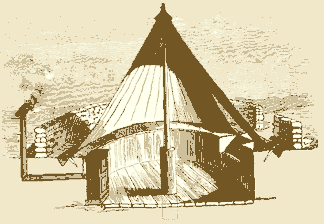
| FIG. 44.---Sectional diagram, showing the form of the excavation and the interior arrangement of a Crimean tent. |
Another method is to employ a stove, the pipe of which, turned downwards, enters the ground, forming the floor of the tent, and laying horizontally, a few inches below the surface, is joined outside of the wall by a vertical section of pipe that serves as a chimney. Stoves so arranged were also used by the English in the Crimea. Only a small part, however, of the ground surface is warmed, and very slightly, by this method, most of the heat of the smoke being lost in the air, as when the pipe passes outdoors through the canvas in the usual manner.
When with the army of the Potomac, in 1862, I became acquainted with a system of warming tents by heat transmitted through the ground which was certainly not wanting in originality. The heating apparatus was called a California stove; and if I regret my being unable to give the name of its inventors, it is only just to myself, in view of the system of heating tents, employed at the American ambulance, that I should say that the system I am about to describe was never extensively used in the American army. I remember having seen it adopted but in a few instances, and in no case were the details of the installation alike. I may also observe that General Sheridan---and no one is more familiar with American camp life than he---remarked, when examining the system of heating adopted at the American ambulance,---that "it was the first time he had ever seen an attempt made to heat tents through the ground."(62)
I shall describe two methods of applying the system, with which I became acquainted in 1862. In the first the arrangement was as follows :---A hole, about 18 in. deep and 1 ft. square at the top and bottom, was sunk in the ground near the centre of the tent; a trench was then dug, about 8 in. deep and 1 ft. wide, from this hole to a point outside of the tent, and 2 ft. or 3 ft. from its wall; the trench was then covered with fiat stones along its whole length, except at the extreme end out of doors ; over this open end a chimney of sticks was built up with clay or mud to a height of 8 or 10 ft. The excavation in the ground within the tent served as a fireplace; the trench formed the horizontal part of the chimney. The top of the fireplace was covered with a flat stone or a piece of sheet-iron, leaving only a small aperture through which to introduce fuel and regulate the draught, the strength of which depended principally upon the height of the vertical chimney. A heating apparatus thus constructed, after having been used a day or two---the walls of the fireplace and trench having been thoroughly dried and baked---worked perfectly; the consumption of fuel was much less than had a common stove been used, and the air within the tent was maintained steadily at a most comfortable and agreeable temperature.
The second method differed from the first in this respect, viz., the fireplace was outside of the tent, and not within it; the trench was continued from the vertical chimney quite across the tent, and terminated in an excavation in the ground in front of the door, and a few feet beyond it. The excavation or fireplace was shallow, and the fire lighted upon it burned to a large extent in the open air, only a portion of the heat and smoke being drawn into and through the trench. The tent, however, was well warmed by this arrangement, which was less difficult to manage than that first described. At the Exhibition in 1867, I showed, by a model, how this system was applied to a tent. The model is exhibited in the accompanying engraving, Fig. 45, reproduced, with certain corrections, from a sketch which appeared in the "Études sur l'Exposition de 1867," published by M. Eugène Lacroix.
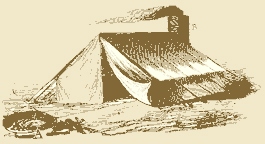
The system I have described will be readily understood by referring to the engraving. The fireplace (A), the chimney of sticks (B), the trench (b), the flat stones covering the trench (a a), are the essential elements of this very simple system or apparatus, commonly called in American camps a "California stove." The method represented in the sketch is the one to be recommended when two or more tents are united to form a pavilion. When, however, more than one hospital tent is to be warmed, it will probably be found necessary to deepen the fireplace, as also perhaps to cover it over, so as to convert it into a close fireplace or furnace; otherwise too little heat may enter the trench to warm sufficiently the portion of the pavilion nearest the chimney. By closing the fireplace a great economy in the consumption of fuel would also be effected, a matter of small consequence in America, but of great consequence in Europe, or wherever fuel is obtained with difficulty.
The tent pavilions at the American Ambulance were heated by an arrangement which was a modification or improvement upon the method last described, a modification determined partly by the consideration that our tents were erected en permanence, and partly by the circumstance of our being in a great city where it was possible to have any apparatus made which might seem best designed to obtain the result wished---a suitable and uniform temperature within our pavilions.
Beneath the first tent, at the northern end of each pavilion, a cellar was dug about 6 ft. deep and 6 ft. wide; its length at right angles to the axis of the tent was 8 ft. at the bottom, and 15 ft. at the top ; the walls were vertical on three sides; on the fourth side, as the dimensions given will indicate, the wall had the form of an inclined plane. This inclined plane was outside of the tent, and was furnished with steps leading to the bottom of the cellar; it was moreover covered, to keep the rain out, with a wedge-shaped wooden roof. The cellar space beneath the tent was therefore represented by an oblong solid 6 ft. high, 6 ft. wide, and 8 ft. long, and its position under the tent may be said to have been central and lateral ; that is to say, a section halving the tent transversely, if prolonged, would halve also the cellar on a line corresponding with its long axis, while the cellar extending 8 ft. under the tent, projected 6 in. beyond a section halving the tent longitudinally.(63) From this cellar, and along a line 18 in. distant from and parallel with the long axis of the pavilion, a trench was dug to a point about 2 ft. beyond the last tent, a distance of 76 ft. in the pavilion of six tents, and of 62 ft. in the pavilion of five tents. The trench was 3 ft. 3 in. deep where it entered into the cellar; at the distal end it was 16 in. deep; its bottom thus formed a slightly ascending inclined plane. At the top it was 20 in. wide, and at the bottom 8 in. wide; it therefore represented in section a blunt wedge. (See Plate IX. Appendix.) Having thus prepared the cellar and trench, the heating apparatus was introduced.
This consisted of a stove and certain accessories. The stove was very simple in its construction; it was of cast iron, 28 in. high, 18 in. diameter, and arranged for burning either coal or wood. The stove was placed on the floor of the cellar, with its back directed towards and. against the open end of the trench; an elbow of 6-1/2 in. pipe was adjusted to the chimney, the under surface of the horizontal branch of the elbow resting on the bottom of the trench; straight sections of 6-1/2 in. pipe were now laid the whole length of the trench to the point where it terminated ---2 ft. beyond the last tent; here an elbow was attached to the pipe, which rose perpendicularly out of the ground to the height of 13 ft., where it was crowned with a water cap.(64) The apparatus for heating the pavilion having been established in the way described, a fire might have been built in the stove; the draught would have been found excellent, and the amount of caloric thrown into the tent altogether sufficient. The heat, however, would have been very unequally distributed, as also subject to great waste. To regulate its distribution, as also to economize it, something more was necessary. The first thing done was to cover over a considerable part of the trench, beginning near the stove. This was accomplished by inserting thin plates of iron into the walls of the trench about 6 in. below the surface of the ground, and covering them with earth (Plate IX.); 45 ft. of the trench were thus covered over. The effect of this operation was naturally to create an air-current, drawing most of the heat from the stove into and through the trench, to the extreme end of the pavilion, where it arose into the tents from the uncovered portion of the trench. In order, however, that the heat might be introduced directly into the tents (the three) nearest the stove, a grated opening (register) communicating with the trench was placed in the floor of each (Plate V); this could be opened or closed at pleasure; when open, a portion of the hot air arose from the trench directly into the tent; when closed, the hot air was forced on to the next tent, where, if the register was also closed, it passed to the next---until, in fact, it found a free opening from which it might escape into the pavilion.
By covering a portion of the trench (the whole might have been covered, but it was not really necessary), and by the introduction of registers, a proper distribution of the hot air coming from the furnace was provided for. To economize all the heat generated, and to secure a constant draught of hot air along the trench, and in the right direction, brick walls were built up around the stove, completely enveloping it, except on the lower half of its front, and except also, I should say, behind, where it was backed against the trench (Plate III.). This envelope formed a sort of air-chamber, and its object, as M. Bréhan has very well said, "was to force the exterior air to lick the metallic surface of the stove, and take up a part of its heat, and thus send it into the trench, where along its whole length the hot air is constantly in contact with the stove pipe, which also adds to its temperature."(65) To the mouth of the brick envelope was attached a sliding iron door, by which the air supply was regulated. To prevent the tents becoming at any time over-heated by the current of hot air, a cut-off, or damper, was placed in the trench 4 ft. from the stove; it was simply a long thin plate of iron, attached to a perpendicular spindle; when open, its planes were parallel with the long axis of the trench; on turning the spindle one quarter of the way round, the plane of this plate being at right angles with the axis of the trench, the trench was closed and. the current of hot air cut off. That the heat of the stove in this case might not be wasted, in pavilion No. 2, an 8 in. earthen pipe had been let into the top of the brick envelope, and laid in the ground outside of the tent; this pipe ran under the nearest barrack, into which it opened through a register placed in the floor; the hot-air chamber surrounding the stove was thus connected with a barrack in such a way that whenever the heat generated by the furnace was more than sufficient for the pavilion, the damper being turned so as to prevent the hot air entering the pavilion, on opening the register in the barrack the current of air from the furnace was let into that building. Our heat was thus economized, and a considerable saving of fuel effected.
I believe this general description of the heating apparatus used in the tent pavilions of the American ambulance will be sufficiently intelligible. I would, however, call your attention to the Plates accompanying my Report (Appendix), which represent with great exactness most of the details of this special installation. The explanations attached to the diagrams will cause them to be readily understood.
The system of heating which I have here described was found, when applied to our tents, to perfectly accomplish the object had in view.
It was easy to maintain, by means of it, a temperature within the tents comfortable and uniform in the coldest weather. Says M. Bréhan, in the paper from which I have already made an extract:---
"The thermometer out of doors standing at 29° Fah., we found the following temperatures existing within the tents at 5 ft. from the floor.
| "At the entry of the | first tent (over the furnace) | 57° Fah. |
|
|
second | 59° |
|
|
third | 61° |
|
|
fourth | 59° |
|
|
fifth (farthest from the furnace) | 55-1/2° |
The hot air as it issued from the first register---the one nearest the stove---showed a temperature of 122° Fah."
This memorandum is interesting, showing as it does the uniformity of the temperature in every part of the pavilion. The five observations show the average temperature to have been 58.4° Fah. and in no part of the pavilion did the temperature at 5 ft. from the floor differ from the average to the amount of 3° Fah. I may remark, however, that M. Bréhan observed the temperature but on a single occasion, and when it was below the average usually maintained, which was a little over 60° Fah.
"I have many times myself been a personal witness to the fact, that during the rigorous month of December, when the cold was ranging from 14° Fah. to 10° Fah. the temperature within the tents was maintained from 54° to 59° Fah. and that without forcing the fire."(66)
Often, however, I have seen the temperature raised during the severest days of the winter to 65°; indeed, we never had any difficulty in raising the temperature to any desirable degree, and maintaining the same in every part of the pavilion, so long as we were supplied with fairly good fuel.
In this connection also it may not be uninteresting to learn that, in the two tent pavilions erected in the garden of the Luxembourg in imitation of our own (and in each one of which the heating apparatus was an exact copy of that I have just described) similar results were obtained as regards both the distribution of heat and the steadiness of the temperature. M. Cottard, the interne of the ambulance, reports that for about a month, from the middle of February until the middle of March, he conducted a series of thermometrical observations, noting the temperature every two hours in different parts of each pavilion; and he states that he found the variations of temperature very slight, and that they were produced quite insensibly---"Les variations étaient minimes et se produisaient insensiblement." The general average temperature ranged from 56° to 58° Fah.
The only difficulty we ever experienced in heating the tent pavilions dated from the time (January) when it became impossible for us to obtain in Paris any fuel but coal-dust of the most worthless quality, and greenwood from the Bois de Boulogne so charged with water and with sap as to be nearly incombustible.
After this fuel had been used for a few days the draught became defective on account of the condensation, in the more distant portions of the smoke-pipes, of the products of the distillation rather than combustion which was taking place in our furnaces. The deposit left upon the pipes was highly hygrometric, and water rapidly accumulated, particularly in the vertical sections of the pipes; running down, it entered the horizontal portions of the pipes, and soon flowed nearly to the fires. The result was naturally an almost complete arrest of the draught, and a fall of the temperature within the tent; coal smoke began even to enter the tents in a manner very disagreeable. A partial remedy for the evil-the defective draught---was found in burning out the pipe (in each pavilion), and replacing it, after having attached a receiving-box to the angle formed by the junction of the horizontal and vertical sections; an opening was made in the lower face of this elbow, that communicated directly with the box, the bottom of which was also perforated, that the fluid running into it might escape into the ground.
The arrangement will be understood by referring to Plate IV., where the receiving-box indicated by the letter k may be seen in its place. Although we never saw any necessity for the use of such a box so long as we had either coal, coke, or dry wood for fuel, our experience has proved it to be one of those accessories which may prove most useful ; at any rate, I would recommend, whatever the fuel to be used, that the lower face of the elbow be perforated with a few holes half an inch or an inch in diameter, and that in laying the pipe a small cavity be left in the earth immediately beneath these holes, at the angle of the elbow. Such an arrangement would probably be quite sufficient to prevent the accumulation of fluids in this part of the pipe.
Another practical suggestion I may be permitted to make. It would greatly facilitate the cleaning or burning out of the horizontal portion of the pipe, should it be necessary to resort to this expedient, if small traps were cut in the pipe which could be reached from the openings in the floor in which the registers are set. Such an arrangement would cause the interior of the pipe to be always fairly accessible, and obviate the great inconvenience of taking out the pipe each time it is to be cleaned.
Should it be proposed to give to the installation a character of permanence---to organize a hospital for the winter---perhaps the simplest and most effective method of securing a good draught would be that of placing a small sheet-iron stove at the extremity of the pavilion, near the vertical smoke-pipe, and fitted with a two-inch pipe made to enter the smoke-pipe near the ground. The occasional lighting of a small fire, the burning even of a newspaper in this stove, would be probably all that would be found necessary to secure for the furnace a sufficient draught.
I have said that the temperature within the tent was not only sufficient but uniform, and I have partly explained how this uniformity was obtained---by the sliding door at the mouth of the brick air-chamber, which increased or reduced the quantity of air brought in contact with the hot surfaces of the stove, and consequently the volume as well as the rate of movement of the hot air current; by the registers, established at different points in the pavilion, which could be opened more or less completely at will; and finally by the damper, which enabled us to cut off entirely the hot-air current whenever it might seem desirable. While the difference in the temperature of the air in the several tents forming the pavilion was in no case remarkable, it may have been observed that, according to M. Bréhan's memorandum, the two coldest tents were the first and last---the one nearest the fire, and the one the farthest removed from it. That the tent beneath which the furnace itself was placed should have been colder than the others may seem at first remarkable; the reason, however, is quite apparent. Most of the heat of the furnace was driven by the air current into the trench; the consequence was that the tent over the furnace was dependent for a large part of its heat upon that given off by a slow radiation from the stove, its brick envelope, and the warm earth beneath it. Nearly all the heat developed in the stove was swept into the trench by the current of air, and was either discharged through the registers into the tents, or served to warm large mass of earth beneath the tents, and along the line of the trench. Two important facts I may state: the cellar, mall as it was, was never hot; while the vertical piece of pipe rom which the smoke escaped, outside of the pavilion, was always cold to the touch quite to the ground. We thus, while forcing nearly all the heat to follow the course of the chimney, lost no heat by the chimney. In fact, nearly every unit of heat generated passed into the tents either directly or indirectly, either as hot air, or through the ground by a slow radiation. I have stated how we regulated the temperature in the pavilions. The means described, however, were chiefly intended to equalize the distribution of the heat. To equalize the rate of the heat supply was an object not less important, and one which I have already said within tents is attended with special difficulties.
This object was accomplished, as you may have already foreseen, by having on hand a large reserve of heat, that was constantly, slowly, and steadily being discharged into the pavilion along its own length. The hot air in its passage along the trench gave up a portion of its heat to the earth, which in turn gradually, by conduction and radiation, gave up its heat to the floor of the tent, as also to the air within it. Sand, clay and. earth have a high capacity for heat, and, like all bodies possessing such a capacity, are poor conductors of caloric,---that is to say, yield up their heat slowly. The warm temperature within the pavilion was therefore maintained partly by the direct introduction of hot air, and partly by the evolution of radiant heat; the air gave out its heat quickly; the earth gave up its heat slowly; the air was a transient source of heat; the earth might almost be said to have been a permanent source. If I may use an illustration suggested by the laboratory, the warm earth beneath our pavilion bore the same relation to the air within it that the sand bath does to the contents of a retort which the chemist may be heating---it served to regulate the distribution of the heat, as also, and more particularly, to equalize the rate of its evolution. Had our tents been warmed solely by the introduction of hot air, it would have been impossible to have maintained within them a steady temperature. Suppose the thermometer out of doors to have marked 14° Fah. and within the pavilion to have marked 65° Fah., the pavilion being at the same time dependent for its heat entirely upon a supply of hot air: on cutting off that supply the interior temperature would have rapidly, and within a few moments, fallen 5°, 100, 15°, 20°, 30° (Fah.). Now, when this difference existed between the temperatures without and within, we found, that when the hot-air current was entirely shut off from the pavilion, the heat entering the tents by radiation and conduction from the hot earth maintained the temperature within them for a long time above 50 Fah., and that the rate of the refrigeration was so slow that hours must have elapsed before the thermometer would have marked a loss of 30° of heat.
I may now mention another great advantage obtained by warming tents through the ground. It keeps the earth constantly dry beneath the floor of the tents, or---no floors being used---beneath the beds of the patients. The humidity which may arise from the ground within tents has been with surgeons a constant cause of fear as well as of complaint, and whenever it may have been present it has most unquestionably neutralized in a measure several of those good qualities which I have endeavoured to show were peculiar to tents. By the employment of a system of heating such as that used by us at our ambulance, the surface of the ground upon which the tents stand will be found to have soon become so thoroughly deprived of its moisture as to cease to be a source of either danger, or apprehension to anyone, whether patient or surgeon.
There is a close relation, as everybody has learned, between the heating of an apartment and its ventilation. Whenever the temperature of the air within a chamber is raised to a degree above that existing in the air without, the natural ventilation of the chamber is improved; in other words, the confined air escapes more rapidly by the windows, the doors, and other usual apertures of the room, and is more rapidly replaced by the counter-currents set in motion from without. As the ventilation of all apartments in which men dwell is a subject of the greatest importance, and as the means employed for heating them always contribute to a certain extent to their aëration, efforts have been made to so construct heating apparatus that they should accomplish, at the same time and to the largest degree possible, two objects: First,---the maintaining of a comfortable temperature within the apartment occupied; and secondly,---a sufficient renewal of the atmosphere within it.
The relations of heating to ventilation have been most carefully studied, particularly within the past thirty years, by Angiboust, Peclet, Ried, Duvoir, Morin, and many other scientific men, and the practical as well as theoretical conclusions which they have drawn from their experimental researches are not only highly interesting, but of great value.
A consideration of this subject from a general point of view would scarcely be in place in this Report. Nevertheless, the way in which the air within our tents was expelled and renewed may be more clearly understood by keeping in mind a few of the most important facts connected with the general subject of ventilation. There are commonly said to be two kinds of ventilation---natural and artificial; that is to say, ventilation accomplished by natural forces, and ventilation accomplished by forces created by art.
The walls of few rooms are absolutely air-tight, and gases pass through them by diffusion, and more or less slowly according to their porosity. But most habitable rooms are provided with a variety of openings---doors , windows, and chimneys---and where these openings exist diffusion takes place more rapidly. Here the principal motive force is the difference in specific gravity between the diffusing gases, or, to speak generally, between masses of air having unequal temperatures. The wind, however, must be counted as one of the most active natural ventilating forces. It penetrates even solid walls, and everywhere exerts its influence by increasing the pressure of the exterior atmosphere. The air within our railway carriages would often become dangerously offensive but for the powerful action of the wind.
Of artificial methods of extracting the air from rooms, the simplest illustration is a chimney with a fire in it. In this case artificial heat is used as a motive force; the heated air ascends the chimney with great rapidity, and. extracts or pumps the air from the room; while to re-supply that which has been extracted, a corresponding amount of fresh air is drawn into the room through various openings. But the outlet of the chimney in common apartments is not well placed, nor can it be easily increased or diminished to better serve the purpose of ventilation. For this reason it is found that shafts in which an ascending current is created by hot-air pipes, or any simple heating apparatus, extract the air more uniformly, as their outlets may be placed above the floor or in the upper part of the room, and may be opened and shut more or less completely according to circumstances. A certain correspondence, however, should always exist between the position of the inlets and outlets for the air. Where the principal inlets are windows and doors and the cracks beneath the doors, the fireplace, as an outlet, is badly placed. Where, however, the inlets are from above, the fireplace may be well placed. In fact, one of the best systems of ventilation, in which heat is used as an extracting force, is that known as reversed ventilation, where fresh air is introduced from above, and the outlets of the cheminées d'appel are on a level with the floor.(67)
There are two other well-known systems in which artificial force is employed as a means of obtaining fresh air. One of these has been called ventilation by insufflation, and the other ventilation by induction. In the first system, fans are employed to force a current of air into a large pipe furnished with numerous small branch pipes for its final distribution. In the second system, compressed air is discharged into pipes by nozzles so arranged as to communicate with air ducts, through which the air is drawn into the main pipes by rapid and forcible jets of the compressed air. But mechanical devices for obtaining a change of air, however ingenious they may be, are generally very inefficient. The conclusion arrived at by General Morin, after numerous experiments made at the Lariboisière (hospital), where the fan was used in connection with the cheminée d'appel, was that the fan expelled about fifteen per cent. of the air evacuated, and that the balance, eighty-five per cent., passed out through the cheminée d'appel.(68) In short, the two methods of ventilation first mentioned---ventilation through natural openings, and by extraction by heat---are the most efficient methods now known for effecting a change of air in rooms, and they are in principle the same; that is to say, the motive force used in each is the difference of pressure between the air within a room and the air exterior to it, a difference of pressure which results generally and principally from a difference of temperature.
One of the practical difficulties in ventilation has always been to regulate the supply of fresh air : it is not only necessary that the air of an apartment should be frequently changed, but it must be changed regularly, and in such a way as not to give rise to currents or draughts of air. Draughts are inevitable in buildings where natural ventilation is resorted to. Draughts are also inevitable in all apartments where the air escaping must be replaced by air entering through a limited number of apertures of a limited size; in these cases the rapidity of the moving currents will be inversely as the number and size of the openings, and the inconvenience of the draught will be felt in proportion as the apartment is small. Indeed, it is almost impossible to maintain a proper degree of atmospheric purity in small apartments, occupied by a number of persons, by means of natural ventilation, on account of disagreeable draughts.
Of artificial methods of extracting foul air, the simplest, as I have already remarked, is a chimney with a fire in it. But here again, in the application of this system, particularly in small apartments, we find it giving rise to draughts; and, notwithstanding the great sensible movement, the air is often imperfectly renewed, the currents sweeping along the floor, while the air in the upper part of the room gets close and disagreeable.
A partial remedy for draughts is found in warming the air which flows into apartments to take the place of that which has escaped. The currents may still exist, but when the air has been warmed they cease in a measure to be disagreeable.
Probably the best system of artificial ventilation for an ordinary room is that which combines the evacuation of the vitiated air by a shaft or cheminée d'appel, with a provision for a corresponding supply of warm air. Unfortunately the evacuation of the air is usually much more rapid through the shaft than the injection of warm air, and, in consequence, the balance of the air supply is drawn in irregularly through various openings.
This system in its simplest form was used in our tent-barracks. A horizontal air shaft was laid under the floor; outside the barrack it terminated in a vertical section which served as an inlet; inside the barrack the shaft opened beneath a stove. This stove was surrounded by a metallic jacket pierced with holes the heat of the stove, and the general evacuation of vitiated air from the ward, caused a strong current of air to enter the shaft, while the air was forced to pass around the hot surface of the stove, before entering the ward through the openings in the jacket. The cheminée d'appel was a vertical shaft which received, and was heated by, the ascending stove pipe.
This method of ventilation may be occasionally wanting in power, and its use is limited to the winter season; but for temporary barracks in the winter, I believe it to be equal if not superior to all other artificial methods of ventilation. It is incontestably superior in two or three respects---it is simple and easily applied; it involves a very trifling expense(69) and, what is by no means its least merit, it is sure to work in the direction intended---a fact which will be appreciated by those who have witnessed that special kind of ventilation renversée which is too frequently incident to more complicated systems. This system was employed in nearly all the American barrack hospitals, and has been used perhaps more frequently than any other in the German barracks since erected.
But to return to the ventilation of our tents. How was this accomplished, and what relation to it had the system of heating employed? It is very evident that they were indebted for their ventilation almost wholly to the action of natural forces. Strictly speaking, no artificial means whatever were used within the tents either for the purpose of expelling foul air or of introducing fresh air. There were no cheminées d'appel, nor had permanent inlets for fresh air been provided. A strong current of fresh air did at times enter the trench and escape as hot air through the registers into the pavilions ; but it should be observed that this current of air was introduced for the purpose of obtaining a more equal distribution of heat rather than for the purpose of obtaining a supply of fresh air. As a source of fresh air the trench was doubtless of service, but this service was incidental. The hot air which came from the trench was necessary to the maintenance of a uniform temperature through the whole length of the pavilion, but it was not necessary to the maintenance of atmospheric purity within the pavilion. Much, if not most, of the fresh air which entered the tents, entered through other channels. I have elsewhere stated that air can pass through the walls of all habitations, and that it does so more or less slowly according to their porosity. Sometimes this diffusion takes place very slowly, as through walls of plaster ; it is more rapid through walls of brick and wood; it is still more rapid through walls of canvas.
The canvas of a tent, when interposed between two gases, is a porous diaphragm, or septum; and if interposed between gases of different densities, these would diffuse into each other inversely as the square roots of their densities. But aside from this porosity or capillarity of canvas, which causes it to be everywhere permeable to air and gases, canvas is often largely provided with what may be called natural openings. An examination of a piece of the best linen canvas shows it to be full of small but quite visible apertures. The number and size of these apertures vary greatly with the quality of the canvas, and it is difficult to estimate the exact space they represent in any piece of canvas; but it may be safely said that such apertures represent in their aggregate for each square yard of canvas an opening rarely containing less than four square inches,(70) and often exceeding a foot square. Suppose they represent an opening two inches square in each yard of canvas; in a tent like the American hospital tent, the walls and roof of which contain about 70 square yards of surface, these little apertures would represent in the aggregate seventy openings, two inches wide and two inches long. Now, a room of a capacity equal to that of an American hospital tent, although occupied by five or six persons, if provided with two windows properly disposed, of such a size as to represent the aggregate surface of the seventy openings just mentioned, could not fail to be well ventilated, if the difference between the temperatures of the interior and exterior air was 20° or 30° Fah.---a minimum difference whenever it is necessary to resort to artificial heat.
These statements will cause it to be understood why tents are so much more susceptible of natural ventilation than ordinary rooms. Indeed, it is not impossible that the question may have occurred to you, why is it, if the small apertures represent in the aggregate so large an opening, the air should so frequently become close within tents when special means of ventilation are not resorted to, when the walls are not raised, &c.? And this leads me to observe: First,---that the size of the apertures varies very much according as the canvas is wet or dry. After the tent coverings are wet with rain or dew, as is often the case at night, when ventilation is generally most required, these little apertures are to a great extent closed up. Hence, as I have elsewhere remarked, the importance of employing a double roof, and, as I may here remark, one of the advantages of warming tents, the canvas being permeable to air very much in proportion as it is free from moisture. Secondly,---the air generally escapes from and enters into a tent or room much more rapidly through a few large openings than through a great number of smaller openings; and the principal reason is because the wind, which is one of the most powerful of our ventilating forces, acts much more effectively through large openings than through small openings. The force of the wind is broken by the coarsest canvas, and although the currents of air find their way through the small interstices of the tissue, and thus assist in ventilating the tent, the volume of air thus brought into a tent is much less than would be introduced under the same circumstances through two or three open windows of a moderate size. We must regard, therefore, the little apertures visible in canvas of a fairly good quality simply as outlets and inlets for the escape and entrance of air by diffusion. Through them any gas confined within a canvas covering will be diffused into the surrounding atmosphere, in accordance with the law stated above. Now, gases at different temperatures diffuse into themselves in conformity with the law which regulates their diffusion at the same temperatures into each other. As with simple gases, so the bulk of a mass of air varies with its temperature. How much it varies we learn from Regnault, who proved its dilatation to be for every degree of Fahrenheit 1/491th part of its bulk; that is, 491 cubic inches of air at 32° Fah. become at 65° 524 cubic inches, its volume having thus been increased about 7 per cent., which percentage also indicates its diminished density and its power of diffusion.
These statements concerning the mechanical qualities of canvas and the physical properties of air will indicate how the ventilation of tents may be accomplished even when they, are shut up---by the simple diffusive power of atmospheres at different temperatures. A canvas tent within which the air is warmed by a fire is the best illustration which can be suggested of effective natural ventilation. Neither special inlets nor outlets for air, nor shafts, nor driving fans are needed ; the elevation of the .general temperature necessary for the comfort of those within the tent in the winter season, with the free action of the wind without, is all that may be required to maintain a ventilation in every respect satisfactory---satisfactory, not only because it is sufficient, but because it is accomplished regularly and without draughts.
If a free ventilation can be secured without draughts in a tent pavilion, it is because in canvas walls the openings are not large enough to admit the air in currents, and have been uniformly distributed and vastly multiplied over a wide surface. No principle of ventilation is more generally accepted or more frequently repeated by writers on the subject, than that the number of both the outlets and inlets should be multiplied as much as possible. "Hygiene demands," says M. Piron, "that the air should be renewed constantly and insensibly---not through a large opening, but through the greatest possible number of bouches---inlets---only so large that the velocity of the air currents may in nowise prove uncomfortable to the sick. This velocity cannot exceed 1m. 25 per second; for if moving at the rate of one metre per second the wind is scarcely perceptible, at two metres per second it becomes a light breeze." (71)
If the openings through the canvas are very minute, the number of the apertures compensates for the smallness of each, and all that is necessary, in order to establish a circulation between the interior and exterior atmospheres, is to create a difference in their pressures, and this difference will always measure the rapidity and completeness of the interchange---an interchange which has been compared to the phenomenon of osmosis, but which is more strikingly like that special interchange of gases which is constantly being accomplished through the walls of the pulmonary vesicules, through which are diffused in outgoing and ingoing currents, the gaseous products of respiration, and the fresh air which is essential to life.
I feel confident, indeed, of the truth of my assertion,---that no system of heating a special dwelling has ever been proposed which may have contributed more powerfully to the abundant ventilation of the same, than did the system of heating I have just described, and which was used at our ambulance during the winter of 1870-71. When heat is introduced into an apartment it warms the air within, and at the same time tends to ventilate it. These two effects are the principal effects sought; to obtain them we use our heat. The heat at any time present in the tent pavilions served to make the air within them comfortable, and at the same time, by rarefying it, powerfully contributed to its rapid expulsion through the tissue of the canvas. The very fact that the canvas, as I have before remarked, offered but a feeble barrier to the escape of the warm air, became now an important condition in the maintenance of the purity of the atmosphere within the tents. That which, when the common means of heating tents are employed, is an evil---the rapid escape of the heat---became, on the introduction of our system of heating, an unqualified excellence; we had heat enough to make the tents comfortable, and, in addition, enough to expel the foul air, and thus make them healthful.
As I have said, nearly all the heat generated in the furnaces entered the pavilion; the cellar was cool, the vertical smoke-pipe was cool; very little heat was lost; nearly the whole amount was necessarily used, either to warm the tents or to ventilate them; and as the temperature within the tents seldom rose much above 85° Fah., it will be readily understood how powerful a motive force we constantly derived from our furnaces, for the expulsion of the air from the tents, and its induction from without.
But it has been sometimes asked:---"How do you know that sufficient air enters by the doors, and, especially, that large volumes of air pass out and in through the canvas, either directly or by a sort of exosmotic and endosmotic action---that, in short, your tents are well ventilated?"
One distinguished scientific gentleman said to me that he should be much better satisfied about this matter, when the rates of the expulsion of the air from the tents, and of its renewal within them at various degrees of interior and exterior temperature, had been determined by a series of carefully conducted experiments; and the gentleman left our grounds convinced, I presume, that it was at least very probable we were deceiving ourselves as to our air supply, because we could not furnish him with anemometric tables in proof of our affirmations.
I have just spoken, and perhaps at sufficient length, of the tendency of gases at the same or different temperatures to diffuse into each other when not enclosed by impermeable walls. In order, however, that the diffusive power of gases may be fully exercised, it must in no way be obstructed; and whenever gases are enclosed by canvas walls, those walls are certainly obstacles which interfere more or less with the rapidity of their escape and dispersion into the surrounding atmosphere. To what extent the canvas walls of tents may hinder the tendency of the outer and inner atmospheres to diffuse into each other,---or to express the idea more clearly, at what rates, under the usual differences of temperature, the air may pass out of a tent by diffusion, and how many cubic feet of air may thus in return be supplied to each patient per hour, are certainly interesting questions. I may observe, however, that it would be very difficult, if not impossible, to determine with exactness the facts desired; and furthermore, that. if a quantity of air having been completely shut in by canvas walls, the rates of its diffusion were noted at certain exterior and interior temperatures, such rates of interchange would be absolutely valueless as a means of establishing the rates where the same conditions did not exist; and it is scarcely necessary to add, that the conditions essential to an exact experiment never obtain in tents, especially when in use. The conclusions of transcendental mathematics are as inapplicable to special cases as their premises are absolute; logic, if less certain in its premises, often opens to us the nearest and the surest way to truth, and generally possesses the great advantage of being more direct in its applications.
One fact is very certain; if the canvas covering of a tent opposes in any way the free passage of air through it, it is, nevertheless, exceedingly permeable; that it furnishes innumerable outlets and inlets for air, is a fact revealed by the most careless inspection. I shall therefore answer the question "How do you know your tents were well ventilated?" as follows:---In the first place,---re-stating in a general way the inference from the physical properties of the atmosphere and the qualities of canvas, because we know the quantity of heat introduced into the tents was great, as also that its escape from the tents was rapid;---now as cotton is not a rapid conductor of heat,(72) and as the canvas covering our tents was a porous reticulated tissue, very pervious to air, it is more probable that most of the heat escaping from a tent passed out with the ascending rarefied air, than that it was lost by conduction. In the second place,---it is highly probable that the ventilation was sufficient, because odours were rarely perceptible in the tents, and never were persistent. This is a fact of the greatest importance. Chemistry furnishes few and poor tests of the salubrity of an atmosphere; it can detect the presence of few of those exhalations which have an organic origin; and which are often, at the same time, the chief causes of insalubrity, and perhaps the principal factors in what is known as an atmospheric epidemic condition. The sense of smell does what chemistry fails to do; it detects the presence of many of these exhalations, and enables us to make a qualitative analysis of the air in a hospital ward, sufficiently complete to permit us to pronounce with tolerable certainty as to its purity. In the third place,---because it is a well-established fact that typhus is a disease produced by dwelling in an atmosphere greatly vitiated by animal exhalations; now I believe I may safely say, that an epidemic of typhus was never known to break out in a hospital under canvas; in any event, typhus has rarely been known to originate in such a hospital: it therefore follows that within such hospitals, the air is not greatly vitiated by animal exhalations. It should be observed, moreover, that the amount of air space given to each person in a tent is necessarily very small. An American hospital tent, when pitched, contains but 1,627 cubic feet of air; when five persons are placed in one, each has but 325 cubic feet of air; counting the air displaced by furniture, &c., each patient has an air space of scarcely more than 275 cubic feet. Now, if a number of persons were shut up in a room, 14 ft. long, 15 ft. wide, and not 8 ft. high, and without either windows or a chimney, we should naturally expect the most serious consequences; such results did not follow when the air space was thus limited in our tents: the inevitable conclusion is, that the air supply was better---in a word, that the air was being constantly renewed within them.(73)
As I have elsewhere spoken of the general means taken to secure for the tents a sufficient fresh-air supply, by raising the walls, and opening the doors and ventilators placed in the roofs, it may not be necessary to again revert to them.
By means of the system of heating, adopted at the American ambulance, a comfortable temperature was maintained in the tents during the coldest and severest months of the winter; the ground upon which they were pitched was deprived of its dampness, and the air within them kept fresh and pure, to a degree unusual in any hospital, and to a degree remarkable in view of the small cubage of the pavilions and the large number of patients and attendants constantly within them. I believe that a considerable part of the success attending the surgical treatment at our ambulance must be ascribed to conditions which could not have been maintained within the tent pavilions, had any of the usual modes of heating tents been adopted. I do not know how it would have been possible to have secured by any other system or apparatus such freedom from dampness, such a comfortable and uniform temperature, and a ventilation so perfectly satisfactory. I cannot therefore insist too strongly upon the special merits of our system of warming tents. The attempt made at the American ambulance to treat the wounded under canvas during the winter months, and in the belief that better results might thus be obtained than could be hoped for, were the wounded placed under the shelter of more substantial constructions, undoubtedly seemed to many persons hazardous. The experiment in its relations to military surgery was certainly one of the most important which has ever been made, and an unusual degree of interest has naturally existed among sanitarians to know the final results. These results our surgeon-in-chief has presented in his report.
I believe the world will pronounce them to have been even more than satisfactory when compared with the results obtained elsewhere in Paris. If this be the conclusion of those most competent to judge---as to whether we succeeded or failed in our attempt to treat the wounded in tents during the winter---I shall again give it as my opinion, that our success in this respect was largely attributable to the very effective system of heating adopted.
Having described the heating apparatus, and considered its merits as a means of warming and ventilating tents, it were perhaps well if something should be said with reference to the economy of using it. I have already alluded to the fact that very little heat was lost. This economic fact, very important in view of a permanent installation, may be of less consequence when the installation is only temporary. The question in this case might be, at what expense could the apparatus described be furnished? As the cost of the apparatus will naturally depend somewhat upon special circumstances, the question may best be answered by the following statement:---
The cellar and the trench for each one of our pavilions were prepared by our own attendants (infermiers). We consequently paid nothing, directly, for the labour, which represented, perhaps, the work of one man for three days. For each stove and the accompanying apparatus, pipe, registers, brick-work, and the labour of setting up the same, we paid out two hundred francs (the labour may have represented one man's work for two days).
All the labour, however, connected with the work of preparation, as well as of the installation, could very easily have been done by five or six men in one day. The apparatus is one, consequently, which can be introduced into a pavilion of tents without loss of time. It required on our part, a cash outlay of two hundred francs, in one case, for a pavilion of five tents, in another, for a pavilion of six tents. The average cost of the apparatus having therefore been but thirty-six francs for each tent, the apparatus must be considered as having been extremely cheap.
If the tents be pitched in the field, where stoves, iron pipe, &c. cannot be obtained, and should it be thought desirable to make use of the more primitive system which I have described on a preceding page, the only cost it would entail may be expressed by the time or labour expended in its construction. Two or three men in one day could very easily prepare the fire-place and trench, and build the chimney for a pavilion of four or five tents. With regard to the material, in this case, for the construction of the apparatus, we may be quite sure that everything really necessary will almost always be found near at hand. It will rarely be difficult to find a sufficient number of stones to roof over the trench. In countries where stone cannot easily be obtained, clay will answer for this purpose very well. If it be impossible to obtain either stone or clay, the vertical chimney may be built of turf or sticks plastered with mud, and the trench covered with mud or turf supported by sticks, to within a distance of a few feet of the fire-place. It will be necessary to support the earth covering the remaining portion of the trench with scraps of iron or some other incombustible material.