
 FEEL confident that the facts
and the opinions, both European and American, which I have presented,
will convince you that in proposing to establish an ambulance
under the shelter of canvas, not simply as a temporary, but, if
necessary, as a permanent installation, we acted almost, if not
entirely, without precedent. And I believe you will be equally
convinced that the successful maintenance of our ambulance during
the whole period of an exceptionally cold winter in a besieged
city, where the general suffering from a want of fuel was even
greater than that occasioned by the want of food---where, subjected
ourselves to the supreme necessities of the siege, we were often
forced to see our fires go out without the possibility of renewing
them---has at least shown that, contrary to the common opinion,
the use of tents is not necessarily limited in temperate climates
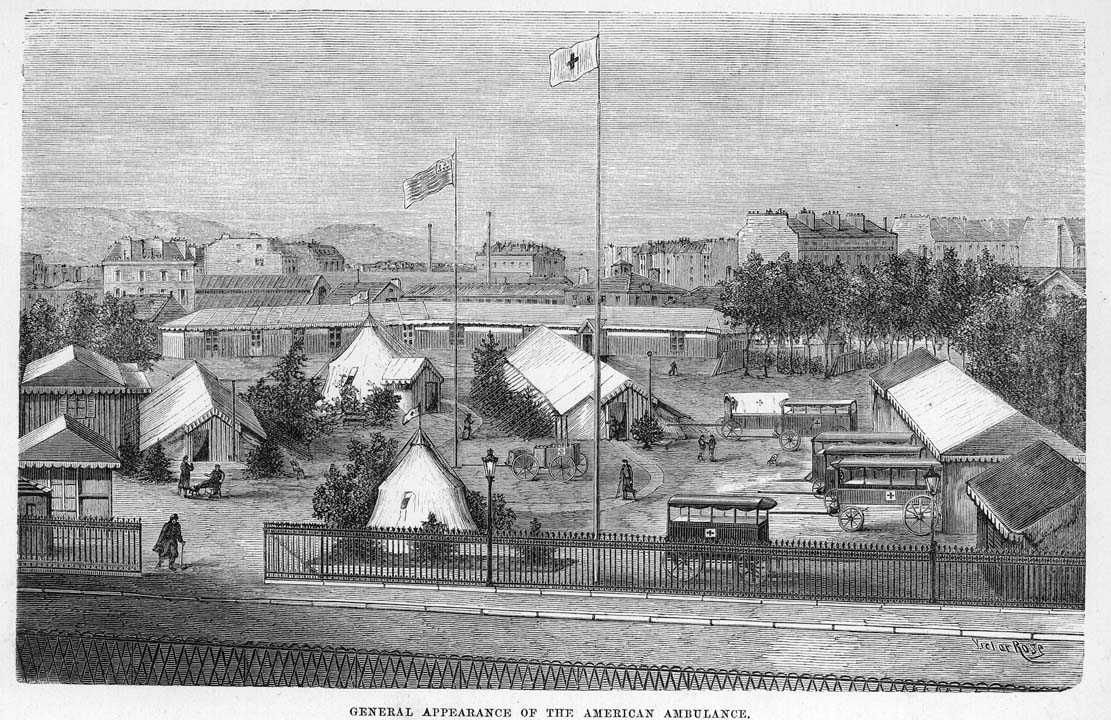
to a few months in the year. I have said that our tent-hospital
was established on the avenue de l'Impératrice, because
we were convinced that tents might be employed alike in winter
and in summer in all temperate latitudes. I also said something
more---I said we proposed to erect our tents, believing them to
be better fitted at all seasons of the year for the treatment
of the wounded than more permanent constructions. This evidently
was the most important part of our proposition; and whatever originality
we may ever be credited with, admitting our experiment to have
succeeded, will depend, first,---upon our having had the courage
to refuse the numerous convents, hotels, and palaces which were
generously placed at our disposition, and the audacity---if I
may use so forcible a word-to establish our ambulance for the
winter under canvas alone; and, secondly,---upon the means used
to make our establishment one suitable for the treatment of the
wounded---so suitable as to have been at the time warmly commended
by nearly all those who visited it, as also to have been pronounced
by the Governor of Paris "une ambulance modèle."
FEEL confident that the facts
and the opinions, both European and American, which I have presented,
will convince you that in proposing to establish an ambulance
under the shelter of canvas, not simply as a temporary, but, if
necessary, as a permanent installation, we acted almost, if not
entirely, without precedent. And I believe you will be equally
convinced that the successful maintenance of our ambulance during
the whole period of an exceptionally cold winter in a besieged
city, where the general suffering from a want of fuel was even
greater than that occasioned by the want of food---where, subjected
ourselves to the supreme necessities of the siege, we were often
forced to see our fires go out without the possibility of renewing
them---has at least shown that, contrary to the common opinion,
the use of tents is not necessarily limited in temperate climates
to a few months in the year. I have said that our tent-hospital
was established on the avenue de l'Impératrice, because
we were convinced that tents might be employed alike in winter
and in summer in all temperate latitudes. I also said something
more---I said we proposed to erect our tents, believing them to
be better fitted at all seasons of the year for the treatment
of the wounded than more permanent constructions. This evidently
was the most important part of our proposition; and whatever originality
we may ever be credited with, admitting our experiment to have
succeeded, will depend, first,---upon our having had the courage
to refuse the numerous convents, hotels, and palaces which were
generously placed at our disposition, and the audacity---if I
may use so forcible a word-to establish our ambulance for the
winter under canvas alone; and, secondly,---upon the means used
to make our establishment one suitable for the treatment of the
wounded---so suitable as to have been at the time warmly commended
by nearly all those who visited it, as also to have been pronounced
by the Governor of Paris "une ambulance modèle."
In view of the many accidental and exceptional difficulties incident to a siege, which were constantly embarrassing our efforts, the results of the, experiment have shown more completely than we had the right to expect the advantages which may be gained by the treatment of the wounded under canvas at all seasons of the year. While no ambulance or hospital existing at Paris during the siege, in which any considerable number of wounded were treated, escaped an invasion of hospitalism in some one of its forms, the immunity from this evil was in ours so complete as to have enabled our surgeon-in-chief to state in his report:---"There have been no well-marked cases of pus-poisoning." He also reports that, having performed seven amputations of the thigh, three were followed by complete recovery, and that: ----"Among the two hundred and forty-seven surgical cases treated at the ambulance, there were one hundred and twenty-six cases of compound fracture. Notwithstanding this great number of fractures, and the causes prejudicial to health and convalescence previously mentioned, only forty-seven, or a little over 19 per cent., have died of their wounds." Certainly no better results were obtained elsewhere in Paris.
Nevertheless, our success was not more remarkable than that which may have been obtained by others who have preceded us in the use of tents. M. Michel Lévy, speaking of the experiment at Varna, says:---
"While at the general hospital, from the 10th of July to the 18th of September, 1854, there were 1,389 deaths among 2,314 cholera patients; that is to say, 100 deaths for every 376 sick; in the three tent-hospitals established at the same time, there were but 698 deaths out of 2,635 cholera cases; that is to say, 100 deaths for every 376 sick. During the time the cholera patients were being treated in the tents not a single new case occurred."(33)
Chantreuil, after having observed that it was quite impossible to judge of the influence of tent hospitalization upon the wounded in the Crimea, on account of the little time the wounded remained under canvas---it having been the custom to evacuate them as speedily as possible on to other hospitals---nevertheless says:---"Quesnay and Pirogoff are in accord with M. Lévy in admitting that the accidents to which surgical cases are exposed were less numerous in tents than in the hospitals, or even in barracks." (34)
Chantreuil also refers to certain experiments made by Kraus in Hungary. That writer, it would appear, reported in 1861 that he had not only never seen a case of hospital gangrene developed in a tent, but that the wounded attacked by this affection, when placed under such shelter, rapidly recovered.
Says Dr. Hammond, in a work published during the War of the American Rebellion, and while the author was Surgeon-General of the Armies of the United States:---
"It will, perhaps, not be out of place again to insist on the great advantages of these temporary field hospitals over those located in permanent buildings in towns. Nothing is better for the sick and wounded, winter and summer, than a tent or a ridge-ventilated hut. But in one instance that has come to my knowledge has hospital gangrene originated in a wooden pavillon hospital, and in no instance, as far as I am aware, in a tent."(35)
Fischer, Roze, Boerwindt, Stromeyer, and other German surgeons, have indicated the very excellent results obtained when the wounded and those sick with typhus were treated in the open air, or under the shelter of tent-barracks.(36)
Boerwindt had established at Frankfort-on-the-Main, in the summer of 1866, three tent-barracks each containing fourteen beds. These were occupied from the 22nd of July until the 2nd of October by eighty-eight different patients, among whom were fifty-three cases of wounds and thirty-one of typhus. During this period of time four of the wounded died, while of those ill with typhus three died, showing a mortality from wounds of 75 per cent., and from typhus of 96 per cent. Of forty-seven cases of wounds implicating the bones, and occasioned by fire-arms, forty-two recovered ; and yet these cases were more than usually grave. There were two wounds of the head, followed by trephining; two penetrating wounds of the lungs; two of the pelvis; two cases of excision of the shoulder, and two of the elbow ; five wounds of the thigh, with lesions, more or less grave, of the femur; two wounds of the knee-joint, with one excision; nine wounds of the leg, with one amputation; and finally, five amputated---one a case of amputation of both thighs---who had been removed from the hospitals of Obermain to the tents at Frankfort.
Chantreuil very justly remarks:---
"If we think of the gravity of all these cases, of the miasmatic exhalations which must have come from the liquids bathing the surfaces of these wounds, the sloughs, and the dejections, one can understand how only an abundantly renewed aëration could have prevented the formation of sources of infection ; and when we see the success obtained among these wounded, who seemed placed under circumstances the most unfavourable---the cures accomplished of cases which the experience of ordinary hospitals would lead us to consider as hopeless---one is almost forced to attribute the difference in the result to the difference in the nosocomial conditions."(37)
The results obtained by Boerwindt were certainly very remarkable, and were apparently even more conclusively in favour of the open-air, tent, and tent-barrack treatment, than the results obtained by us at the avenue de l'Impératrice.
Two facts, however, must be considered in comparing our results with those obtained elsewhere
1st. The respective general hygienic conditions to which the inmates of the several ambulances were subjected.
Our surgeon-in-chief has himself very clearly pointed out in his report the causes of disease which after the 1st of December began to weigh heavily upon the whole population of Paris. The army was especially exposed to these depressing influences, which seriously diminished the probability of recovery in every case, whether of disease or of wounds. It was at this time that the mortality in the city of Paris rose from an average of 981 deaths per week, to an average of nearly 3,000 deaths per week, a mortality rate which still rapidly rose until even after the close of the siege. Dr. Swinburne says in his report:---"From the beginning of the siege to the 30th of November above sixty wounded men were treated; of these but two died, and the immediate cause of their death was tetanus." If this statement is remarkable, it is certainly not remarkable that as the general sanitary condition of the city grew less tolerable our results became less favourable; that, in a word, when we closed our ambulance on the 26th of March, 1871, we were compelled to acknowledge that our mortality rate had amounted to over 19 per cent.(38)
2nd. The period of time during which the ambulance or hospital may have been maintained, and the results of treatment subject to observation.
Mortality rates based on a month's experience at an ambulance are evidently worthless; and yet there are surgeons who do not hesitate to speak confidently of the results of treatment after a period of observation thus limited. Boerwindt admits that he lost four more of his patients after he removed them from the tents. It is certain, therefore, if 9 per cent. represented the rate of mortality which existed within his tent-barracks, 92 per cent. did not represent the rate of recovery; this would range between 92 and 87 per cent., according as the removal from the tent-barracks may or may not have acted as the determining cause of death in the four last cases. The American ambulance was in operation more than six months, and no person reported "cured" died afterwards from his wounds at the ambulance, nor has any such person since died from his wounds elsewhere, within my knowledge.
A cause of great uncertainty in appreciating the statistics of most ambulances and military hospitals is the pernicious practice of evacuating the sick from one to another. Of the 1,545 French soldiers who died after amputation of the thigh during the Crimean War, nearly one-half died en route to some hospital, and nearly the whole number died after having been "evacuated." What a relief to certain hospitals---the elimination of these frightful figures from their mortality records!
But the vitiating effect of this practice upon statistics is special as well as general. For example: 436,144 cases (of wounds and disease) were entered at the French hospitals during the Crimean War. The losses of the army by death were 95,615; deducting those killed in battle or who died before coming to the hospitals, the deaths amounted to 80,639, or 18.50 per cent. of the cases entered at the hospitals. But, says Chenu:---" The reported number of cases entered does not represent the real number of the wounded and sick, which did not exceed 225,000, since many of them, taken first to an ambulance and thence evacuated into one of the hospitals of the Bosporus, and from thence to Gallipoli, Nagara, or even to France and Algiers, figured in the tables of every hospital establishment attached to the army of the East." Now let us suppose a case: A hospital receives five soldiers wounded in such a way as to require in each instance an excision of the head of the humerus; the five soldiers are treated in this hospital during several weeks, at the end of which time we will suppose them all to have died. The records of this hospital would show the mortality after excisions of the head of the humerus to have been 100 per cent. If, however, these five cases had been so evacuated as to appear in the records of five different hospitals, although each case had proved fatal, a consolidated report might show that there had been twenty-five cases of excision of the head of the humerus, and but five deaths ; or, in other words, that the average mortality in such cases had been 20 per cent.
The surgical statistics of the Crimean War published by the English Government are among the most valuable with which I am acquainted, and yet they are vitiated to a considerable extent by the causes alluded to. Thus 12,094 wounded officers and men were during the war received into the hospitals in the Crimea; of these 1,840 died, or 15.2 per cent., and 3,573 were invalided home; that is to say, 29.5 per cent, were sent home more or less cured. Chenu expresses some curiosity to know what may have been the mortality among this class of cases after they were sent from the hospitals, a curiosity probably rather increased than diminished by a statement made in an obscure foot-note attached to one of the published tables, viz., "A very large proportion invalided returned to duty subsequent to their arrival in England." Of the 3,573 men sent home, "thirteen men and three officers died on the passage;" but the statement is almost incredible, that "only four deaths took place among men under treatment for wounds in the general hospitals after their arrival in this country," unless the proportion of these men who reported themselves at the "general hospitals " for treatment was relatively small.(39)
Indeed, it is far more difficult than one may at first suppose to find in the records of military surgery statements of those filial results from which alone satisfactory conclusions can be drawn. Sometimes the period of observation has been too brief, sometimes the evacuations have been so numerous as to invalidate the tables ; and often these two causes of inexactness are so combined as to render hospital statistics worthless in many respects. Thus we are told that at the French military hospital at Dolma Bagtché, 2,753 wounded were treated from the 1st of May until the 1st of November, 1855; that 741, or 27 per cent., had died of their wounds before the 1st of November; and that 2,009 had left the hospital by "billet" or " evacuation" (73 per cent.).(40) Now this statement gives no idea of the proportion of deaths and recoveries among the wounded;---741 had died before the 1st of November; how many died afterwards? This is the important question. It is as useless to tell us that the hospital at Dolma Bagtché "offered conditions of salubrity more satisfactory than several of the other hospitals near Constantinople," as it is to inform us that the wounds there treated were of more than usual severity. These were conditions which doubtless influenced the results; but what were the results?
The ambulance opened at the "Corps Législatif" on the 19th of September, and closed on the 31st of January, 1871, was one of the most successful ambulances in Paris. The total number of the wounded treated there, during the four-and-a-half months it remained open, was but 136, and the ambulance was closed about the time the causes influencing the general health of the city had reached their maximum development. In the report of the Director, published January 31st, 1871, twenty-one deaths are detailed, showing a mortality rate of 15.5 per cent. Of those who had been received at this ambulance, 115 are reported as "cured or convalescent." An analysis of the "état nominatif" annexed to the report shows, however, that nearly all the 115 persons, sent from this ambulance, were simply transferred in a condition of more or less complete convalescence to some one of the numerous ambulances of Paris.
It is hardly necessary, except for the purpose of showing how difficult it is to compare the results obtained in two ambulances, even admitting the wounds in each to have presented an equal gravity---that I should state that of the 136 wounded received at the "Corps Législatif," forty-five came "from other ambulances."
Now, what distinguishes the statistics of our ambulance, what gives to them an especial value, is the fact that they relate to cases under our care from their beginning to the end. We received no wounded man from any ambulance, and we sent no wounded man to any ambulance. Those who left our ambulance left it either cured or dead.
Four amputations of the thigh had been made on or previously to the 23rd of October; before the end of the following month three of these cases might have been discharged as "cured." We preferred, however, to retain them under our care four months longer, until the closing of the ambulance, although, as every surgeon knows, by so doing our statistics were in constant danger of being seriously damaged.
In the almost complete absence of official reports from those who may have had the direction of ambulances and hospitals during the late war, it is impossible for me to establish many comparisons between the results obtained in them and those obtained by ourselves. It may be of interest, however, to make a few additional comparisons, which, fortunately, I am able to do.
The ambulance "Rothschild" was opened at Paris early in October, 1870; its hygienic conditions were exceptionally good:--"A building erected the year before, but which had never been occupied, was arranged in the following manner: On the ground-floor were six large rooms containing fifty beds; on the second-floor were twenty-five beds in twenty-five rooms, quite isolated from each other; on the third floor were also twenty-five beds, distributed as on the second. Arrangements were made that a certain number of beds should always be vacant, that the bedding might be aired, and overcrowding avoided." The hospital was established on high ground near the Bois de Vincennes. "At no time during the rigorous winter, notwithstanding the scarcity of fuel, did the rooms cease to be suitably warmed by furnaces, while the ventilation was as complete as could be wished." As for the kitchen, "by reason of our abundant supplies we were able to furnish vegetables, both fresh and dried, long after they were exhausted elsewhere." At this ambulance---certainly one of the best in Paris---fifty-six wounded soldiers were treated during the siege; of these ten are reported as having died of their wounds---a mortality of 17.9 per cent. But several important facts should be considered in appreciating this result. The wounds were generally not severe. Thus, there were seven cases in which the wounds were produced by fragments of shell, and all recovered; indeed, four of these wounds were only contusions. "Most of the severely wounded were kept at the central military hospitals; from these were sent out to their dependent ambulances those cases which seemed, in appearance at least, most transportable." Still four capital operations were performed---three amputations of the arm, and one resection of the humerus; all these operations resulted fatally. But the most remarkable statement is the following:---"All the wounds involving the bones, except of the fingers and toes, proved extremely grave; but two thus wounded recovered. In one case there was only an erosion of the external border of the humerus; in the other, a comminuted fracture of the cubitus and radius."(41) Of the ten deaths, eight were ascribed to purulent infection; two were from tetanus.
An ambulance was established by the Administration of the ambulances of the Press in the École des ponts et chaussées---a building containing nine large halls, fronting upon a garden and a court-yard, with windows opening to the east and west, and occupied by seventy-six beds. This ambulance was exclusively devoted to surgical cases, and was under the immediate personal direction of M. Demarquay, the surgeon-in-chief of the ambulances of the Press. A special room was also here set apart for M. Guérin, who was promising magnificent results from the treatment of wounds by the occlusion of air---l'occlusion pneumatique. The ambulance received its first patient on the 24th of September, 1870, and was closed on the 1st of February following---a considerable number of the inmates having then been transferred to the barrack-hospital at Passy. During this period the ambulance received 281 wounded; of which number 63, or 22.4 per cent., had died---before the 1st of February. Of sixteen wounds of the upper extremities, involving the bones, thirteen proved fatal, and the immediate cause of death in each case was attributed to pyæmia.(42)
In speaking of one of the ambulances of the Press, Dr. Gordon says:---
"There were thirty-five cases of wounds of the thigh; of these, twenty-five simple, and no deaths; complicated, ten, and ten deaths."
And he observes, in commenting on wounds of this class:---
"In cases involving fracture of the femur, the object sought to be attained was to preserve the limb; unfortunately, however, the results---at least in hospitals and appropriated buildings---were little favourable, although, with the advantages possessed by the American ambulance, the success was relatively considerable."(43)
From the 19th of January to the 24th of June, 1871, there were received into the barrack-hospital at Passy, 1,486 wounded; of these 347 died, or 23.3 per cent.
These returns unquestionably represent very fairly the mortality rates existing in the ambulances at Paris during the siege, at least wherever severe wounds were treated. In several of the large hospitals the death rates are said to have been much higher than any here given. That they were so has never been denied, and the evident anxiety to conceal the facts, in certain instances which might be mentioned, furnishes us with all the confirmation of the truth of the statements referred to, which is practically necessary.
The "First ambulance" of the "Société de Secours aux Blessés" established a hospital at Metz on the 21st of August, which was maintained until the 28th of October. "Of the 250 wounded there treated," says Surgeon Liegois, "ninety-six died (38.4 per cent.); perhaps the number was greater, for when we left we transferred eighty-three of the wounded to the military hospital. As may be seen, the mortality, in our little ambulance was considerable---I shall even say frightful; but if I may judge from the conversations I had with a great number of surgeons at Metz, it was not so great as that existing in many other hospital establishments in that city. Among the causes of death I shall mention first purulent infection. This cause carried off three-fourths of our wounded; afterwards came dysentery, diarrhoea, typhoid fever, gangrene, and tetanus."(44)
Dr. Gross informs us that during the siege of Strasbourg (from the 12th of August to the 27th of September) 383 wounded men, women and children were received into the civil hospital of that city; of this number 146 died of their wounds, or 38.12 per cent.(45) Among the men the mortality was 41.7 per cent., among the women 40.3 per cent., and among the children 26.4 per cent. One of the immediate causes of death is said to have been erysipelas, which, however, only made its appearance towards the close of the siege, "when it attacked a considerable number of the wounded." Septœmia was common:---"A large number of my severely wounded," says Dr. Gross, "were speedily taken off by acute poisoning of the blood. Eleven died of pyæmia." Tetanus was observed four times, and resulted in three deaths.
The hospital in which the wounded were received offered the ordinary conditions of a civil hospital, although at times the wards were somewhat overcrowded. Two circumstances, doubtless, contributed largely to the high rate of mortality in this hospital. First,---The character of the wounds, which were occasioned for the most part by shells, bombs, and shrapnels; and, secondly,---The nervous excitement and moral depression which resulted not only from the siege, but from the exposed position of the hospital itself; this was struck no less than thirty-eight times by shells, between the 23rd of August and the 27th of September.
In several important respects, however, the wounded in Strasbourg suffered less than those in Paris. While, as Dr. Gross says, "the alimentation differed in no respect from that in ordinary times," few of the wounded had been previously exposed to the depressing influences of military service, and the city capitulated before cold weather had begun to act upon the general population as a predisposing as well as a direct cause of mortality.
M. Stutel, in his "Histoire de l'Ambulance du petit Séminaire de Strasbourg,"(46) reports the entry at that establishment of 215 wounded, with fifty-two deaths, or a mortality rate of 24.2 per cent.
The buildings occupied by this ambulance were of recent construction, and the wards are said to have been large, airy, and susceptible of an easy and abundant ventilation. "Food never failed for a moment to be abundant---was ample during the whole length of the siege." But here again the effects of the bombardment were often painfully felt, and on one occasion compelled the transfer of all the wounded to the cellars of the establishment. Still, M. Stutel observes that:---"After this time the men were in a certain way habituated to this kind of life," and there was little evidence of any special nervous excitement or depression from the cause alluded to. "We had, nevertheless, and notwithstanding our entirely exceptional hygienic conditions, to contend against the most terrible complications of military surgery---hospital gangrene, purulent and putrid infections." Out of seventeen deaths which followed thirty-nine operations, fifteen are attributed to these causes. Three cases of tetanus are also reported, all having their habitual termination.
Says Dr. Gordon, in his "Lessons in Hygiene":---
"During the late war the general results of operations have been very unfortunate; in some cases extremely so. Thus in one ambulance within Paris, although the wounded had the advantage of surgical skill of the highest order, the mortality numbered fourteen out of fifteen operations, including excisions, resections, and amputations; of these seven being primary with six deaths, and eight secondary, all fatal. With regard to the mortality elsewhere, we learn, from the reports of Ambulance No. 7, that in twelve cases of operations, including amputations, resections, and ligature, collected from Sedan, Balan, and Daigny, the mortality was seven, or 63 per cent. At Beaugency, the rate of mortality from operations of all kinds was 82.1 per cent.; at Asfeld, of sixty operations, including amputations and resections, thirty-five were fatal, or a proportion of 58 per cent.; and among the German wounded treated at the Château of Versailles, out of seventy-five capital operations the deaths were fifty, or 64 per cent.; the recoveries twenty-five. These rates of, mortality are no doubt extremely high, in some instances at least higher than they were even in the hospitals of the Peninsular War; and it may be here observed, simply as a point of comparison, that according to the statistics given by Mr. Guthrie, of operations performed in those of Vittoria, Santander, Bilboa, Passages, and Vera, out of 584 cases of capital operations there died 287, or 49 per cent. Thus it is much to be feared that in this respect at least we have made relatively small progress in the art of saving life."(47)
It will be seen from these statements that the statistics of the surgery of the late war quite justify the popular opinion which prevailed in Paris during the siege, that recoveries were more frequent in our ambulance than elsewhere. Dr. Gordon himself, while deploring the high mortality rates which existed pretty nearly everywhere, seems to dwell with no little satisfaction on Dr. Swinburne's cases of conservative surgery, and concludes his appreciation of our experiment in hospitalization by declaring that:---" Within Paris we had, however, in the American ambulance undoubtedly the most favourable results of any."(48)

HAVE elsewhere said that the ratio
of the mortality consequent on wounds in general invariably increases,
in proportion as the respirable air of the apartment or locale
in which the wounded are treated differs in its composition from
the mass of the atmosphere at large. If most satisfactory results
have followed the treatment of the wounded and sick in tent-hospitals,
it has been principally because they are more completely capable
than any other hospitals of a constant and natural ventilation.
Formed of a tissue permeable to air and gases, the vitiated air
within them is constantly passing out, and is constantly being
renewed by fresh air, which enters not only through certain openings,
but passes freely through the network of the covering itself.
During a considerable portion of the year the doors may be opened,
and the walls of the tent so raised as to enable the patient to
pass many hours of each day in the open air. In the colder seasons,
when it may be necessary to warm the tents, the air within them
may be maintained even more constantly pure ; since whenever the
temperature of the air within a tent is raised to a degree above
that of the air without, the air within the tent begins to escape,
or rather is forced into the surrounding atmosphere, from which
in turn it is necessarily renewed; and the rapidity of the outgoing
and ingoing currents of air will increase with the difference
existing between the temperature within the tent and the temperature
of the atmosphere at large.
This circulation is maintained partly through certain openings, some of which in a tent it will be found difficult to perfectly close. But (in my opinion) in cold weather, when the difference between the interior and the exterior temperatures is from 30° to 60° Fah., most of the vitiated air passes out through the tissue of the tent. However this may be, it is certain that at our ambulance, where we maintained a constant temperature of about 60° Fah. night and day---when we had fuel---the atmosphere within the tents seemed to grow purer as the weather became severe. Never at any time was a persistent odour to be perceived in the tents, except that of tobacco smoke ; and it may be interesting to observe, that while this odour clung to the tents during the mild days of the winter, it rapidly escaped whenever the weather was frosty.
I believe the greatest advantage, from a sanitary point of view, to be derived from the general use of tents in the hospitalization of the sick and wounded, depends upon the facility with which the atmosphere within them may be kept pure and wholesome, and the common results of overcrowding avoided.
Another very probable cause of the excellent results obtained in tents may be attributed to the circumstance of their occupants being constantly more or less exposed to the influences of direct light. When the sick are treated in the open air the influence of light upon them must be very considerable. How important a factor this agent may be among the several known to be indispensable, in order to have the best sanitary condition, it is difficult to say. We know, however, that without light the maintenance of health for any considerable time is impossible, and that its invigorating effects upon organic life in general hear a very constant relation to the directness or indirectness with which the light may reach it. If it be true that the light within a tent is not at any time, strictly speaking, direct sun light, the light within a white cotton tent not only is in great part direct light, but the light is stronger---the tent being in the sunshine---than it generally is in any room receiving its light indirectly, and by reflection, as nearly all rooms do. The light of common rooms is also for the most part polarized light---light which has acquired special and remarkable properties, and which must exert an abnormal influence upon those who are constantly exposed to its action.(49)
Tent-barracks, in common with tents, are capable of being easily and naturally ventilated, and whatever reputation they may have obtained, they owe almost entirely to this fact. While, however, the air within a tent-barrack during the summer season may be kept as pure and free from odours of every kind as it may be possible to keep it within a tent, such is not the case during the winter. When the weather is cold and inclement, it is necessary to keep the walls closed. Tent-barracks are heated with stoves, and ventilation accomplished in connection with them, by means similar to those employed in the wards of common hospitals, is scarcely more complete.
The conditions under which the wounded were treated at our ambulance differed in no essential respect from those existing in the other ambulances at Paris, except in so far as the patients were more directly exposed to the influence of the open air. The food used by us was no better than that employed elsewhere; the medicines were the same, and the surgical treatment was essentially the same. It would be impossible to believe a priori that a more or less constant and complete exposure of patients to the open air should have no influence upon their health; that the more direct exposure of our patients to the out-door air did not unfavourably affect their health, the surgeon's report abundantly shows; indeed we all, who are familiar with the class of cases treated, are well convinced that it powerfully contributed to enable them to resist the depression occasioned by wounds, the want of suitable food, and the epidemic influence which for several months showed itself---less perhaps in an increased deathrate from semi-pestilential forms of disease, than in the enfeebled vitality and reduced powers of resistance exhibited by the whole population of Paris.

N the First and Second Parts of
my Report I have had occasion to notice, with some detail, many
facts very closely connected with the experiment made by us during
the winter of 1870-71. It remains, however, for me to speak more
at length of the general conditions under which the experiment
was conducted, of the principal material characteristics of the
ambulance, and of the arrangements special to it which I believe
to have had the greatest influence upon the results obtained,
or at least to be most worthy of notice.
SANITARY STATE OF PARIS.---Probably the most important condition which affected the surgical history of the American ambulance was the general sanitary state of Paris during the whole period of its existence. The surgeon's report reveals no fact more clearly than this ; indeed, it is the only condition between which and the surgical results it would be easy to prove a direct connection, the influence upon these results of nearly every one of the conditions special to the ambulance itself being only more or less probable.
The sanitary condition of Paris had become bad when we received our first patient, and it continued to grow worse rapidly, until in the month of January, when we were treating the largest number, it had become well-nigh pestilential. Improving slowly during the months of February and March, when the ambulance was closed, March 26th, the mortality among the general population was nearly three times greater than usual.
The average number of deaths in Paris for the week ending on the 11th of September, during a period of five years, the four years preceding, and the year following 1870, was 889. For the week ending on the 11th of September, 1870, it was 981. The excess over the average was wholly owing, however, to an epidemic of small-pox then prevalent, and which caused 116 of the deaths reported. Aside from this epidemic the general health of the city was above' the average from the 4th to the 11th of September, 1870. During the week ending on the 18th of September the city was then invested---the mortality had risen to 1,263; in the week ending October 23rd the mortality had risen to 1,746. The deaths reported during the week ending October 30th were 1,878; during the week ending November 20th, 2,064; during the week ending December 18th, 2,728; during the week ending January 1st, 1871, 3,280; during the week ending January 14th, 3,982 ; during the week ending January 28th, 4,376 during the week ending February 4th, 4,671. Now the average mortality for this last week, the week ending February 4th, during the five years just referred to, was but 951. On the 4th of February, the death-rate being at its maximum, the first train of provisions entered Paris under the terms of the armistice. After this time provisions came in abundantly and the death-rate slowly but quite steadily declined. The deaths reported for the week ending February 11th were 4,451; for the week ending February 18th, 4,103; for the week ending February 25th, 3,941; for the week ending March 4th, 3,500 ; for the week ending March 11th, 2,993; for the week ending March 17th, 2,576.
From the fall of the Empire until the establishment of the Commune---from the 4th of September until the 18th of March---the total number of deaths within the city, not including those who may have died in the army outside of the walls, was 77,231. The average aggregate mortality of the twenty-eight corresponding weeks during the period of five years, already referred to, was 24,928---a difference of 52,303.
As the population, civil and military, of Paris may be fairly reckoned at 2,000,000 of souls, it appears that death carried off about four per cent. of the whole population in a period of twenty-eight weeks. The exact per cent. was 3.86; but the percentage of the death-rate in ordinary times is only 1.31. Or to state the fact in another way, during the period mentioned, among every 10,000 persons there were 386 deaths, while in ordinary times during the corresponding weeks, among 10,000 persons there are but 131 deaths.
For the great mortality existing during the siege there were many causes. The most obvious cause was the absence of proper food. Milk, eggs, and butter had disappeared from the markets after the first fortnight-all highly important elements of food, as well for the sick, as for the very old and the very young.
Nor after this time were fish, chickens, or game of any kind to be obtained in quantities sufficient to exert a sensible influence upon the health of any portion of the population. Vegetables had disappeared from the markets by the end of November, or were sold at high prices in pieces---half a carrot, a bit of beet, a leaf of cabbage, &c. The rationing of meat began on the 8th of October, 100 grammes (a trifle over 3 oz.) being the daily allowance fixed for each adult; and this ration was rapidly reduced to 33 grammes, the daily allowance for some weeks preceding the capitulation.
Bread was not rationed until the middle of December; but its quality, from various causes, had steadily depreciated from the beginning of the siege. About the middle of December flour and grain of all kinds were requisitioned, and bread was made and issued by the municipality at the rate of 300 grammes daily per head. The quantity of this ration was maintained until the close of the siege, but its quality grew rapidly worse by mixing with the flour, barley, oats, rye, buckwheat, rice, &c. These grains, especially the rice, were very imperfectly ground, and caused the bread made from them to be as disagreeable to the taste as it was unpleasant to the sight. The unusual qualities of the bread gave rise to more frequent and bitter complaints than did the complete withdrawal from the alimentation of the city of such important articles of food as milk, butter, and vegetables, or even the short rations upon which the whole population was placed. And these complaints were not limited to the people; they made their appearance even in the medical journals. Says the "Union Médicale":---
"The bread, the principal aliment of the French people, has become impossible. Examined under a microscope, or even with a lens, there may be found in that compact, heavy, and blackish mass that is distributed to us every morning a complete vegetable encyclopædia; all the grains in creation are there represented, not only by their farinaceous principles, but by their husks and stalks . . . We cannot understand what hygienic council was consulted previous to the decree of the Government which fixed the ration of bread at 30 grammes. We should be glad to believe that no hygienist had given such advice, nor counselled the distribution for a month to two millions of people of that shapeless and chaotic mass ironically called bread."
Notwithstanding these facts, I am inclined to believe the general population of Paris did not suffer to the extent usually supposed from the want of food. Certain articles were always abundant; wine, animal fats, vegetable oils, coffee---even bread, such as it was, was never scarce---while the stocks of sweetmeats, pickles, dried fruits, canned meats and vegetables, and quite a variety of edible articles which the shops contained, were by no means exhausted when the city capitulated. An important fact, also to be observed, is that the disappearance of an alimentary substance from the market did not indicate its non-existence Nearly everybody laid in a certain stock of provisions, and the aggregate amount of food thus stored was enormous. It was scarcely before the 1st of January that any persons in comfortable circumstances, or who had been in the least degree thoughtful, began to find their daily bills of fare seriously curtailed.(50) Again, the effect of being deprived of special nutritive elements would only be manifested after the lapse of a certain time.
With regard to the poor, it was often said, and not without reason, that they were better fed during the siege than in ordinary times. Large numbers of this class were enrolled in the garde nationale, and, by their withdrawal from the workshops, the general demand for labour was to the same extent increased The municipality, however, from various motives, among which were perhaps reasons of political expediency, watched over the physical interests of this class with unusual care.
It is a noteworthy fact, that whatever diseases may have prevailed, few cases of scurvy were reported, either in the army or among the civil population. Again, the excessive mortality fell principally upon three distinct classes---the very young, the very old, and the army; and those who suffered most, were those unused to camp life--soldiers in the garde nationale and the garde mobile.
These facts are revealed in the following tabular statement.
| Ages. | During the six months Sept. 1st to Feb. 28th 1870-71 | During the six months Sept. 1st to Feb. 28th 1868-69. | Ratio of the Deaths during the first period to those during the second period |
| Under 5 |
|
|
|
| 5-15 |
|
|
|
| 15-25 |
|
|
|
| 25-40 |
|
|
|
| 40-60 |
|
|
|
| 60 and above. |
|
|
|
We see from this table that while the deaths under five were nearly three times greater than usual, those between fifteen and twenty-five were over six times as great as usual. Now it was the class of persons between these ages who were most strongly represented in the army of the defence, and who were moreover least able to resist the hardships and exposures of a life to which they had been wholly unaccustomed. But the whole case is not presented in this table. A classification of the deaths according to sex shows that, during the six months from September 1st to February 28th, 1870-71, the deaths of males between the ages of fifteen and twenty-five were nearly ten times greater than usual (9.85); while the deaths among females between these ages were less than three times greater than usual (2.85),---less, in fact, than the average increment in the mortality among the whole population. But among the general population between the ages of forty and sixty the death-rate was 2.38 times greater than usual, and among women between those ages it was 2.27 times greater than usual. The remarkable exemption of women from disease and death during the siege may be shown by another statement. Excluding children under fifteen, the total number of males who died during the month of September was 1,328 ; but in January the number reported was 6,551. On the other hand, the number of females over fifteen years of age who died in September was 1,116, while the number reported in January was only 2, 82. That is to say, during the siege, in the population, excluding children, the mortality had increased among the males five times, while it had scarcely more than doubled among the females.
But it should be observed that the mortality was not wholly owing to causes directly connected with the siege. An epidemic of small-pox, which broke out in 1869, raged for eighteen months "with a violence," says M. Bouchardat, "unknown since the generalization of vaccination." Having partially died out in August, 1870, with the introduction into Paris of 100,000 mobiles from the country, and the crowding in of nearly 200,000 refugees, driven in from the suburbs by the investing armies of the enemy, fresh material was furnished, and the epidemic broke out again with new fury. From week to week the death-rate increased until the 1st of January, when, for the week ending on that day, 454 deaths were reported from small-pox alone. During the siege proper, from the 18th of September to the 28th of January, 48,752 persons died, and of these 6,663, or nearly fourteen per cent. (131), died of small-pox.
However important this fact may be from a general point of view, it has a special importance to which I wish to call your attention. The presence of this disease in Paris was accidental, and not necessarily connected with the siege. It showed no special preference for either sex, and consequently was relatively a large element in the comparatively small mortality among females. Had there been no small-pox in Paris, the death-rate among females would have been scarcely more than double that usually existing. This fact is very significant, as it shows that aside from mere want of food, other causes must have been active in producing the heavy mortality rates which obtained among the population. Want of food contributed to these heavy rates, by depriving a certain class of delicate persons of the food to which they had been accustomed, and by forcing them to use that instead which was not easily assimilated. A cachectic and adynamic condition followed which predisposed to disease, and when disease came, favoured a fatal termination. Indeed, the want of proper food was felt vastly more in the hospitals and among the sick than among the population at large; and if the mortality was higher than usual, it was rather because the death-rates among the sick were extraordinarily high, than because the sickness-rates themselves were excessive. I do not wish to be understood to say that the sickness-rates were not excessive, but simply that the death-rates were still more so---that the health of' Paris during the siege, measured by the amount of absolute sickness existing, did not differ so much from its usual health as the mortality rates seem to indicate.
It is perhaps not surprising, for reasons already given, that the disappearance of certain articles of food from the markets and the successive reductions of the municipal ration should have had no visible immediate influence upon the mortality. Thus, after the first rationing of meat in October, and the requisition of vegetables early in November, the death-rate did not bound up at once. In fact, while on the eighth week of the siege 1,878 deaths were reported, on the week following there were but 1,762, an actual reduction of 116. Again, while on the eighth week---the week ending on the 30th of October---there were 1,878 deaths ; on the twelfth week, the week ending on the 27th of November, the mortality had only risen to 1,927, an increase of forty-nine deaths during the month. One month after, the weekly deaths had risen to 3,280, an increase of 1,353. What was the cause of this great difference in the mortality rates of the two months ? The answer is very easy to give. The immediate cause of the great rise in the mortality during the month of December was the cold weather which then prevailed.
The relation of existing atmospheric temperatures to the rise and fall of the death-rate is one of the most remarkable of the phenomena which appeared during the course of the siege. Whenever the temperature fell the mortality rates immediately increased ; whenever the temperatures rose the mortality rates immediately diminished. Thus, at the end of the eighth week the thermometer rose, and the ninth week showed a falling off in the mortality. On the tenth and eleventh weeks the temperature fell, and the mortality rates increased. Again, on the twelfth week the temperature rose, and was maintained at an average of nearly five degrees centigrade above the average of the week preceding, and the mortality of the twelfth week was only 1,927, while the deaths reported the preceding week had been 2,064. But however remarkable these relations, they were less so than those which immediately followed. Up to the middle of the thirteenth week---the 2nd of December---the mean daily temperature had not been below the freezing point; on that day it fell below the freezing point, and there remained for a fortnight, and the deaths reported on the thirteenth week numbered 2,023, on the fourteenth week 2,455, and on the fifteenth week 2,728. In twenty-one days the mortality had increased by eight hundred deaths per week, while in the month preceding, after twenty-eight days, the increased weekly mortality was only forty-nine.
But it may be said the want of food did not immediately show its influence on the public health, and that with the supplies of food known to exist in Paris, it could hardly have been before December that famine could have begun to appear as a powerful factor among the causes of mortality. Indeed, it might be added that the disappearance of vegetables a month before, and the rationing of meat six weeks before, and the appearance in the public markets of such questionable meats as those of the dog and cat, would fully account for the rapid rise in the death-rate which marked the first weeks of December.
This reasoning is theoretically excellent. A single fact, however, shows that the causes just mentioned were not sufficient to account for the increase in the death-rate referred to. On the 13th of December the temperature rose, and during the seven days which followed the average temperature was never below 6 deg. centigrade. But in the meantime provisions were growing more and more scarce each day, and it was during this week that the ration of horse meat was reduced to thirty grammes, and the whole population was put on a bread ration of 300 grammes. The rationing of bread, considered as a sort of official declaration of the desperate state of affairs, caused great consternation, and profoundly affected the morale of the city. Famine had never before pinched so tightly. The week preceding the deaths had numbered 2,728---the heaviest weekly mortality yet reported. An immense augmentation might have been expected in the mortuary returns for the week. But such was not the case: the deaths reported for the week ending December 25th were 2,728, exactly the number reported the previous week. A mortality increasing at the rate of three or four hundred deaths per week had been suddenly arrested---by what? But a single answer can be given. All the general conditions capable of appreciation which influenced the health of the city had changed only for the worse, except one. The weather had moderated, a mild and pleasant week had succeeded a period of constant frost. This was the only respect in which the situation had been altered, and the conclusion was irresistible that its relation to the arrested mortality was that of a cause. Had there been any doubt in the matter it could not have existed long. On the 21st of December the weather became cold again; the temperature fell below zero, and it remained below the freezing point at a mean average of 6 deg. centigrade for sixteen days. Immediately with the fall of the temperature the mortality increased, rising from 2,728 to 3,280 for the week ending January 1st, and it continued to steadily increase as long as the cold weather continued, until the deaths reached the number of 4,465 for the week ending January 21st. But the next week shows a falling off in the number of deaths---but 4,376 were reported; and on looking at the temperature of the period we find an upward curve corresponding with the reduced mortality. On the 27th of January the temperature fell again below the freezing point, and there remaining several days, the mortality rapidly increased, and culminated, in the week ending February 4th, in 4,671 deaths, the largest number reported for any week during the siege. On the 4th of February the first train of provisions reached Paris from without; but it is a remarkable fact that the death-rate had again begun to decline two or three days before the arrival of this train, and, as always, in correspondence with a rise of the temperature. But the temperature continuing to rise for nearly ten days, and provisions beginning to come in abundantly, the mortality continued to decline.
From the 28th of January until the 18th of March the temperature fell below the freezing point but once, on the 11th of February and curiously enough its effect was almost immediately shown by a partial arrest of the decline of the mortality; the average reduction per week in the deaths from the 4th of February to the 18th of March having been 349, while for the week following the 11th of February it was but 255.
In tracing the influence of cold upon the population of Paris, it should be observed that the winter of 1870-71 was an unusually severe one. For twelve days on one occasion, for sixteen days on another, and for seven days on another, the temperature scarcely rose once above the freezing point, ranging from this point down to --11° centigrade (12° Fah.). In ordinary times the influence of such a protracted period of cold, as that which marked the end of 1870 and the beginning of the year 1871, would have been revealed in the weekly bills of mortality. But the population of Paris suffered unusually from the cold, not more on account of its actual severity than from the absence of fuel. The city was invested before the winter supplies of fuel had been brought in. A large portion, even of the provisions which had been made, lay en dépôt outside of the French lines. The small stocks of coal and coke were rapidly exhausted, and wood was requisitioned on the 1st of November. The same month the municipality began to issue coal-dust and green wood obtained by cutting down the shade trees in the parks and avenues. During the severest weather of the winter these two last-mentioned kinds of fuel were alone to be obtained by the mass of the population, and for several weeks before the capitulation, in quantities so small and under conditions such as to be almost worthless, except perhaps for cooking. One of the most painful and, once seen, never to be forgotten spectacles of the siege of Paris, was the distribution of the fuel ration to long lines of shivering men and women, who stood for hours in the cold, bleak streets waiting each their turn to obtain perhaps two or three little pieces of green wood, almost as incombustible as the ice beneath their feet. During the sharp wintry days of January the fuel famine was more keenly felt than the want of food, and every day of sunlight and warmth was as welcome to the distressed people as would have been the arrival of a train of fresh provisions. A large part of the population during some of the severest weather of the winter had no means whatever of warming their rooms by artificial heat. The poor kept warm by huddling together in their already over-crowded quarters; and the rich even, rather by shutting out the cold and the fresh air than by the heat of fires.
The hospitals, if generally better supplied with fuel, were nevertheless compelled to be rigidly economical in its use, an economy followed by a proportionally defective ventilation, with its usual consequences.
To appreciate the full extent to which cold influenced the death-rate, the remarkable correspondence between the mortality rates and the existing atmospheric temperature must be associated with the fact already stated, that the deaths among males between the ages of fifteen and twenty-five, that is to say, among those enrolled in the Garde Nationale and consequently most exposed to the influences of cold, were nearly ten times greater than usual, while among females at a corresponding period of life, among those least exposed to these influences, the deaths were only a little over twice as great as usual.
The effects of cold and exposure, as a cause of disease and death, were certainly never more remarkably exhibited. Aside from the epidemic of smallpox, cold was most unquestionably the direct cause of by far the largest part of the mortality during the siege. But it may be said that cold weather does not commonly appear to be so prejudicial to the public health.
Certainly not ; there was a cause, a general condition which revealed or let loose its destructive influences. That cause was undoubtedly the want of proper food, and the condition was what the French have well termed la misère physiologique---the physiological poverty---the defective nutrition, of the whole population. Badly nourished, deprived of milk, butter, and easily assimilated animal fats---compelled to resort to a diet deficient in hydrocarbons, or difficult of digestion, the power of resisting the evil effects of cold was greatly reduced by the diminished evolution of animal heat; the fires of life burned dimly, and the blood and tissues had been chilled before even the winter frosts came. It was in this way that the want of proper food produced its worst effects during the siege, not directly by causing starvation or any very near approach to it, but indirectly by limiting the evolution of animal heat, and thus depriving men of the power of resisting the impressions produced by prolonged exposures to the cold.
Every one is familiar with the increased demand and craving for food during the winter, as well as in cold climates; the precise consequences of not responding to this demand, to this natural craving, were never known in all their fearful reality until the publication in the Records of the Department of the Seine of the essential facts connected with the terrible physiological experiment to which Paris was subjected during the siege of 1870-71.(52)
The diseases which principally prevailed and proved most deadly were, as might have been expected from the causes at work, diseases of the respiratory organs. Until, however, the fourteenth week---the 11th of December---the proportional mortality from these diseases was less than usual, but 215 deaths having been reported from bronchitis and pneumonia for that week, in a total of 2,455 deaths. On the fifteenth week the deaths from these diseases suddenly rose with the cold weather, which then set in, to 321, and they rapidly increased by nearly two hundred a week, until on the twenty-second week they were the cause of 1,092, or 23.6 per cent. of the 4,671 deaths reported. The mortality from these two diseases, especially that from bronchitis, followed in the closest manner the changes in the temperature-rising with each fall of temperature, and falling with each rise.
Typhoid fever was a prominent contributor to the general mortality, although it fell far behind even small-pox. The largest number of deaths from this cause, 375, was reported on the twentieth week. The mortality rose from 39 deaths on the first week, to 103 on the twelfth, to 221 on the sixteenth, and had only descended to 229 on the twenty-eighth week. Relatively, however, typhoid fever was the most fatal of all the diseases directly occasioned by the siege, as will appear from the fact that during the twenty-eight corresponding weeks of the year 1869-70 the weekly deaths from typhoid fever, never exceeding thirty, ranged between that number and fifteen.
Typhoid fever did not apparently follow in its ascending and descending course the variations in the temperature. This was to have been expected from a disease having a specific character, and which, from the period of its incubation, passes slowly and regularly through its different stages. The heavy mortality of February and March was produced by disease which was germinated when the general mortality of Paris was greatest and its sanitary condition worst.
Diarrhoea and dysentery follow next in order among the fatal diseases. The largest number of deaths from these two diseases ---240---were reported on the twenty-sixth week. Nearly all the general facts mentioned as peculiar to the history of typhoid fever characterized also these diseases. They contributed relatively to the general mortality much more than positively, the deaths from them having only ranged from nine to twenty-five during the twenty-eight corresponding weeks of 1869-70. They did not appear to be greatly influenced by the prevailing temperature, and they did not contribute their maximum quota to the mortality until some weeks after the general mortality had begun to decline.
From the special facts here presented, a general idea may be formed as well of the sanitary condition of the city at different periods of the siege as of the causes which were influencing it. I regret, however, my not being in possession of a sufficient number of data to attempt to show the influence of these causes upon the wounded, whether by increasing the actual death-rate, or by developing typical forms of hospitalism among this class of patients.(53) One fact is certain, the army was more exposed than any other part of the population to all the depressing causes special to the siege. It was put upon shorter rations; it was subjected to greater fatigues; it was crowded into closer and more ill-ventilated quarters, and was more exposed to night air, rain and frost.
A large part of the mortality from disease during the siege was contributed by the army, and resulted from the general causes just referred to. The soldier, suffering from their effects when wounded, would under any circumstances have had his chances of recovery diminished thereby; but unable to escape from their continued action---an action which day by day became more and more severe---it is by no means surprising if the mortality among the wounded in all the ambulances of Paris was unprecedently heavy, and recoveries among the severely wounded proportionally rare.
It is fortunate that we are seldom called upon to treat either the sick or wounded under circumstances so painful. We were forced to see large numbers of persons die after wounds not usually considered dangerous; and the deaths occurred frequently even after the wounds had nearly or quite healed.
If our mortality rate was unusually high, the most evident and efficient cause---the general sanitary state of Paris---must be taken into consideration when establishing comparisons between our results and those obtained under other general circumstances. Indeed, the only just comparisons are such as may be made between our results and those obtained in other ambulances and hospitals opened in Paris during the same period, and receiving the same class of patients.
I will close this section of my subject by appending two tables copied from the essay of M. Sueur, which show the relations between the weekly mortality and the mean temperature.
|
|
Average of 5 years (1866-7, 1867-8 1868-9, 1869-70, 1871-72.) | ||||
| 1st week | Sept. 4 to Sept. 11, | 981 | . | Sept 4 to Sept. 11, | 889 |
| 2nd " | Sept. 11 " Sept. 18, | 1,263 | Sept. 11 " Sept. 18, | 852 | |
| 3rd " | Sept. 18 " Sept. 25, | 1,272 . | Sept. 18 " Sept. 25, | 821 | |
| 4th " | Sept. 25 " Oct. 2 | 1,344 | Sept. 25 " Oct. 2 | 766 | |
| 5th " | Oct. 2 " Oct. 9 | 1,483 . | Oct. 2 " Oct. 9 | 754 | |
| 6th " | Oct. 9 " Oct. 16 | 1,610 | Oct. 9 " Oct. 16 | 737 | |
| 7th " | Oct. 16 " Oct. 23 | 1,746 | Oct. 16 " Oct. 23 | 761 | |
| 8th " | Oct. 23 " Oct. 30 | 1,878 . | Oct. 23 " Oct. 30 | 754 | |
| 9th " | Oct. 30 " Nov. 6 | 1,762 | Oct. 30 " Nov. 6 | 767 | |
| 10th " | Nov. 6 "Nov. 13 | 1,885 | Nov. 6 "Nov. 13 | 781 | |
| 11th " | Nov. 13 "Nov. 20 | 2,064 | Nov. 13 "Nov. 20 | 780 | |
| 12th " | Nov. 20 "Nov. 27 | 1,927 . | Nov. 20 "Nov. 27 | 793 | |
| 13th " | Nov. 27 "Dec. 4 | 2,023 . | Nov. 27 "Dec. 4 | 833 | |
| 14th " | Dec. 4 "Dec. 11 | 2,455 . | Dec. 4 "Dec. 11 | 833 | |
| 15th " | Dec. 11 "Dec. 18 | 2,728 . | Dec. 11 "Dec. 18 | 884 | |
| 16th " | Dec. 18 "Dec. 25 | 2,728 . | Dec. 18 "Dec. 25 | 854 | |
| 17th " | Dec. 25 "Jan. 1 | 3,280 . | Dec. 25 "Jan. 1 | 856 | |
| 18th " | Jan. 1 "Jan. 7 | 3,680 . | Jan. 1 "Jan. 7 | 838 | |
| 19th " | Jan. 7 "Jan. 14 | 3,982 . | Jan. 7 "Jan. 14 | 902 | |
| 20th " | Jan. 14 "Jan. 21 | 4,465 . | Jan. 14 "Jan. 21 | 903 | |
| 21st " | Jan. 21 "Jan. 28 | 4,376 . | Jan. 21 "Jan. 28 | 936 | |
| 22nd " | Jan. 28 "Feb. 4 | 4,671 . | Jan. 28 "Feb. 4 | 951 | |
| 23rd " | Feb. 4 "Feb. 11 | 4,451 . | Feb. 4 "Feb. 11 | 955 | |
| 24th " | Feb. 11 " Feb 18 | 4,103 . | Feb. 11 " Feb 18 | 974 | |
| 25th " | Feb. 18 "Jan. 25 | 3,941 | Feb. 18 "Jan. 25 | 995 | |
| 26th " | Feb 25 "March 4 | 3,500 | Feb 25 "March 4 | 984 | |
| 27th " | March 4 " March 11 | 2,993 | March 4 " March 11 | 1,020 | |
| 28th " | March 11 " March 18 | 2,576 | March 11 " March 18 | 975 | |
| 77,231 | 24,928 | ||||
| Days |
|
|
|
|
|
|
|
| 1st |
|
|
|
|
|
|
|
| 2nd |
|
|
|
|
|
|
|
| 3rd |
|
|
|
|
|
|
|
| 4th |
|
|
|
|
|
|
|
| 5th |
|
|
|
|
|
|
|
| 6th |
|
|
|
|
|
|
|
| 7th |
|
|
|
|
|
|
|
| 8th |
|
|
|
|
|
|
|
| 9th |
|
|
|
|
|
|
|
| 10th |
|
|
|
|
|
|
|
| 11th |
|
|
|
|
|
|
|
| 12th |
|
|
|
|
|
|
|
| 13th |
|
|
|
|
|
|
|
| 14th |
|
|
|
|
|
|
|
| 15th |
|
|
|
|
|
|
|
| 16th |
|
|
|
|
|
|
|
| 17th |
|
|
|
|
|
|
|
| 18th |
|
|
|
|
|
|
|
| 19th |
|
|
|
|
|
|
|
| 20th |
|
|
|
|
|
|
|
| 21st |
|
|
|
|
|
|
|
| 22nd |
|
|
|
|
|
|
|
| 23rd |
|
|
|
|
|
|
|
| 24th |
|
|
|
|
|
|
|
| 25th |
|
|
|
|
|
|
|
| 26th |
|
|
|
|
|
|
|
| 27th |
|
|
|
|
|
|
|
| 28th |
|
|
|
|
|
|
|
| 29th |
|
|
|
|
|
|
|
| 30th |
|
|
|
|
|
|
|
| 31st |
|
|
|
|
|
|
|