

| "The benefit of a discovery extendeth to the whole race of man; that of a civil or political reform, only to a particular place. The latter lasteth not beyond a few ages, the former through all time. Moreover, the reformation of a State in civil matters is seldom brought about without violence and confusion; whereas discoveries carry blessings with them and confer benefits without causing harm or sorrow to any."---BACON. |


 T
is particularly in times of war that the necessity for military
hospitals becomes apparent. To meet this special and immediate
necessity it has been the custom to organize hospitals on a temporary
footing, and to such hospitals most of the sick and wounded of
armies have been taken. The welfare and comfort of the sick and
wounded, and the chances of their recovery, have always depended
in a large measure upon the suitableness and excellence of these
provisional establishments. No law of sanitary science is more
absolute than one which may be formulated as follows: The ratio
of the mortality among men, whether sick or wounded, invariably
increases in proportion as the respirable air in the apartment
or place in which they are sheltered differs in its composition
from the mass of the atmosphere at large. This general proposition
is a practical one---it is fundamental---the whole subject of
hospitalization rests upon it. Indeed, since many years its importance
has been recognized in the construction of civil hospitals, and
it has also been regarded in the construction and disposition
of permanent and sedentary military hospitals as well.
T
is particularly in times of war that the necessity for military
hospitals becomes apparent. To meet this special and immediate
necessity it has been the custom to organize hospitals on a temporary
footing, and to such hospitals most of the sick and wounded of
armies have been taken. The welfare and comfort of the sick and
wounded, and the chances of their recovery, have always depended
in a large measure upon the suitableness and excellence of these
provisional establishments. No law of sanitary science is more
absolute than one which may be formulated as follows: The ratio
of the mortality among men, whether sick or wounded, invariably
increases in proportion as the respirable air in the apartment
or place in which they are sheltered differs in its composition
from the mass of the atmosphere at large. This general proposition
is a practical one---it is fundamental---the whole subject of
hospitalization rests upon it. Indeed, since many years its importance
has been recognized in the construction of civil hospitals, and
it has also been regarded in the construction and disposition
of permanent and sedentary military hospitals as well.
Unfortunately, however, the idea has been very commonly entertained that it was impossible to realize in temporary field hospitals those conditions now generally considered indispensable in more permanent establishments. This idea was not entertained by the American International Sanitary Committee, which was founded in Paris immediately on the declaration of war in 1870; on the contrary, their belief was that temporary field hospitals offering all the shelter necessary in the treatment of the sick, and at the same time permitting that abundant ventilation which experience has taught us is so important, particularly in the treatment of the wounded, could be easily and cheaply established. They also believed that the forced transportation of the wounded long distances was often prejudicial in the extreme, as well as costly and unnecessary, and that the welfare of the wounded and the welfare of the army--that the interests of humanity and science alike---could, in principle, be protected best by sending the hospital to the soldier, rather than the soldier to the hospital.
At the very first meeting of the Committee it was "Resolved: That this committee organize a field hospital for the treatment of the wounded, which may serve as a public expression of their opinion with regard to the requirements of such an establishment." It was also "Resolved: That this hospital be established under American tents;" such tents, in the belief of the committee, having been already proved to be especially and most admirably adapted to the hospitalization of the sick and wounded on the field, while promising with a proper organization a still wider application in the construction of sedentary army hospitals.
Circumstances of expediency, which have been elsewhere stated, induced the committee to fix their experimental hospital at Paris, where to the writer of this Report was finally entrusted its immediate organization. A location had been selected on the avenue de l'Impératrice, No. 36, and several of the tents erected, on the first day of September, 1870. From this date until the close of the siege, tents, tent-barracks, offices, and establishments of various kinds were added as necessity required, or as increased pecuniary resources enabled us to enlarge the hospital. Thus, when we began our work, it was proposed to establish a "tent-hospital" containing about forty beds, but on the 1st of January we had so enlarged upon our original plan as to be able to report to the Intendance one hundred and fifty beds, occupied and unoccupied, sixty of which were in tent-barracks that we had constructed upon the ground, or in tents which, liberated by the construction of these barracks, from services connected with the administration, could be attached to our wards.
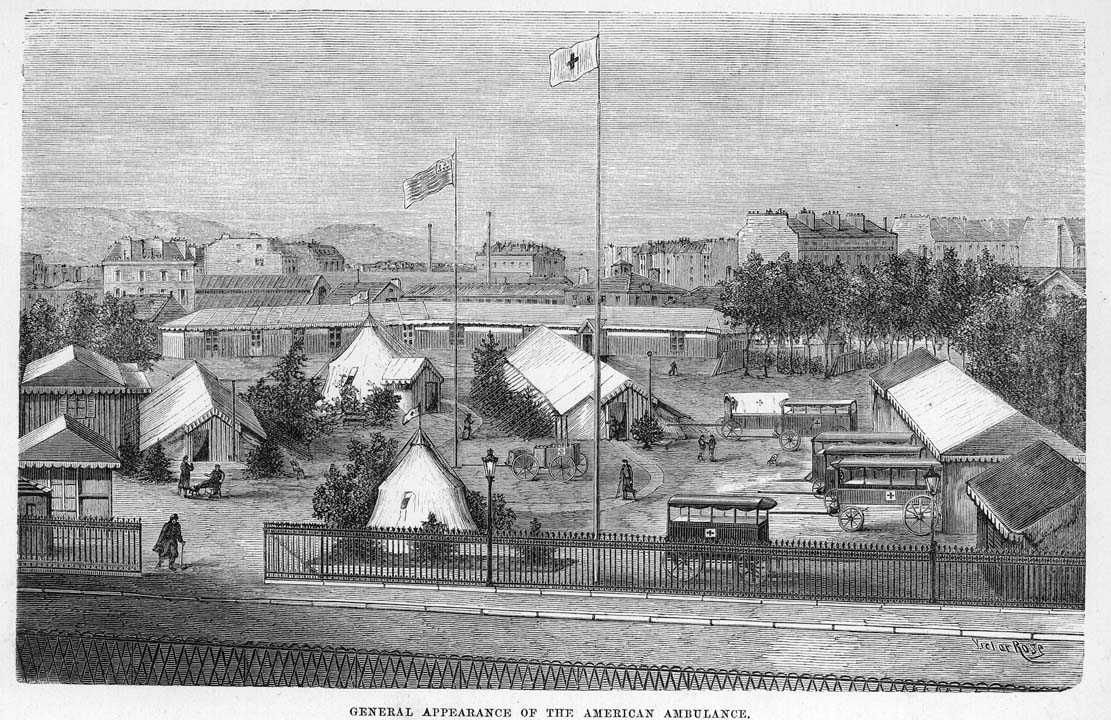
It will be seen from this statement that the Ambulance was from time to time so changed in its appearance, as a consequence of development and growth, that a description of it made at any time much before the close of the siege would be necessarily imperfect. I shall consequently describe it as it existed at that time. My general description will be brief, particularly as an engraving accompanying this Report (and which serves as a frontispiece to this volume) will give a much better general idea of the appearance of the Ambulance than it would be possible for me to convey by a verbal statement, while most of the details of the installation may be seen and easily understood by consulting plate I. (Appendix), which exhibits a ground plan of the Ambulance.

 HE first impression produced upon
a visitor, on arriving at the American Ambulance, was generally
one of surprise. It was difficult for a person only familiar with
the hospitals of Paris and the ambulances organized in the city
during the siege---nearly all established in monumental public
buildings, or in hotels and private residences---to understand
how such a collection of tents and barracks, as we had erected
on the avenue de l'Impératrice, could be made to serve
as an ambulance. And yet the first impression made upon the visitor
was almost always an agreeable one. The white tents in the square,
enclosed by long white-roofed barracks, the bright-coloured awnings
of the barracks and tent vestibules, the gravelled walks, the
grass plots and the beds of flowers, the little grove on the right,
and the fir-trees planted in the central portion of the grounds,
formed in their ensemble a pleasing picture---one that failed
at least to bring to mind those unpleasant associations so frequently
awakened when we pass by the gates of hospitals which have had
long histories, and which somehow always seem to stand in the
heart of great cities rather like sombre fortresses, in which
generation after generation is expected to make its final struggle
for existence, than as houses of charity, pity, and succour. We
intended that our ambulance should always look bright and cheerful,
not only to our occasional visitors, but to the wounded who might
be the subjects of our care; and I believe all who may have seen
it will be ready to admit that we were very successful in the
execution of this purpose.
HE first impression produced upon
a visitor, on arriving at the American Ambulance, was generally
one of surprise. It was difficult for a person only familiar with
the hospitals of Paris and the ambulances organized in the city
during the siege---nearly all established in monumental public
buildings, or in hotels and private residences---to understand
how such a collection of tents and barracks, as we had erected
on the avenue de l'Impératrice, could be made to serve
as an ambulance. And yet the first impression made upon the visitor
was almost always an agreeable one. The white tents in the square,
enclosed by long white-roofed barracks, the bright-coloured awnings
of the barracks and tent vestibules, the gravelled walks, the
grass plots and the beds of flowers, the little grove on the right,
and the fir-trees planted in the central portion of the grounds,
formed in their ensemble a pleasing picture---one that failed
at least to bring to mind those unpleasant associations so frequently
awakened when we pass by the gates of hospitals which have had
long histories, and which somehow always seem to stand in the
heart of great cities rather like sombre fortresses, in which
generation after generation is expected to make its final struggle
for existence, than as houses of charity, pity, and succour. We
intended that our ambulance should always look bright and cheerful,
not only to our occasional visitors, but to the wounded who might
be the subjects of our care; and I believe all who may have seen
it will be ready to admit that we were very successful in the
execution of this purpose.
On entering the grounds by the gate that opened upon the avenue, and passing the sentry-box to the left, the first building which usually attracted attention---as it was nearest the gate---was known to us as the "Administration." It contained two apartments---a reception room for visitors, and a committee room. But the tents were, of course, always the chief objects of interest; and accordingly we commonly conducted our visitor almost immediately to the pavilion nearest to the administration. Generally before reaching this pavilion, however, our visitor had had time to ask many questions---how the rain was kept out of it in stormy weather, and how the tents were kept warm and comfortable when it was cold, &c., &c.? And this led us frequently to speak of the qualities of the material of which the American tents were made, of the uses of the double roof or "fly," of the special system of heating that had been adopted, and of many subjects considered at length in another section of this Report. The pavilion, which we are presumed to be now examining, was formed by joining together, end to end, five United States' regulation hospital tents. It was 80 feet long, including the vestibules attached to each end, and covered an area of nearly 1,200 square feet. Each hospital tent was considered sufficiently large for six camp bedsteads; but while several tents contained this number others did not, the reserved spaces being filled with tables, buffets, and other articles of furniture. Thus, in this pavilion, there were never more than twenty-six beds, although there was room within it quite sufficient for thirty beds.
The iron bedsteads used by us, although made in Paris, were exact copies of those so extensively employed by the Medical Department of the United States Government during the War of the Rebellion. Upon each of these bedsteads were placed a mattress (a bed-sac filled with seaweed), a pillow filled with seaweed or crin végétal (moss of the live oak, Tillandsia), simple linen sheets, and a sufficient number of blankets. Each bed was numbered, and by the side of each was a table, or a chair, and a nécessaire, for the toilet articles belonging to the patient.
The tents were all floored, and several of them were neatly carpeted. Opening one into the other, they were warmed by a single furnace, the heat from which was thrown into the tents through registers placed at intervals in the floor.
Leaving these tents by the rear vestibule, which served as a closet for the vessels in daily use in the pavilion, but which had been erected principally---as were also all the vestibules placed in front of the doors opening into the wards---for the purpose of preventing a too direct admission of cold air at every opening of the door, we come to the tent barrack known in the Ambulance as No. 4, and indicated on the Ground Plan by the figure 7.
This pavilion was made after the type or model adopted for all the buildings intended to supplement the tents. A light framework was planted in the ground having a height of nine feet from the ground to the roof, with a width of about seventeen feet---its length depended upon the room we wished to obtain. The sides of the frame-work were covered with boards, from the ground up to within eighteen inches of the eaves; from this point to the eaves the covering was of canvas only. Doors and windows were inserted in convenient places, and a floor was laid upon string pieces resting upon the ground. Over the whole construction was now thrown a double canvas covering, which, supported by light rafters, formed the roof. The roof projected over the sides of the building about two feet; the canvas covering being turned under the projecting edge, to which it was securely attached by a blue and red hanging border, that served at the same time as an awning. A tent-barrack constructed in this way was divided into rooms, according to the requirements of the service, the division being effected either by a wooden partition or by a simple curtain, as in the case might be thought best. The finish given to the room, as well as the character and quality of the furniture in it, depended upon the use to which the room was to be put. In the administration rooms, as also in all the bureaux and salons, the walls were covered with hangings, and the floors carpeted, while a canvas screen was used as a ceiling, for the double purpose of hiding the nakedness of the rafters overhead, and effecting an economy in the consumption of fuel.
Pavilion No. 7 was sixty-six feet long, and contained--- 1st. An operating room, having a southern exposure, and well lighted. 2nd. A ward, containing twelve beds, and such furniture as I have before described. That the air-space might not be reduced, this ward was without a ceiling overhead, in which respect it resembled our second and largest tent-barrack ward. It was warmed by a common coal-burning stove. 3rd. A store-room, used as a wine closet. Two vestibules, covered with red, white, and blue canvas, were erected for this pavilion ---one before the door leading into the operating room, the other before the door leading into the ward.
Pavilion No. 8, fronting upon the central court of the ambulance, was seventy-eight feet long, and resembled No. 7 in external construction, except in having a somewhat greater projection of its roof; intended to protect a side walk which was laid on the ground on the side fronting the court, the whole length of the building. This pavilion contained---1st. A servants' salle à manger. 2nd. The kitchen, in which were placed two cooking ranges, and two large boilers, as also a number of tables, buffets, shelves, &c. 3rd. The salle à manger for the surgical staff and their associates. 4th. A surgical-staff bureau, and 5th. The pharmacy. This little apartment was furnished with the necessary special furniture, and besides containing the drugs and medicines, for which fortunately we had little use, was used as the store-room for most of our surgical apparatus. A covered passage way separated Pavilion No. 7 from the next pavilion (marked upon the Ground Plan by the figure 10). This construction---No. 10---was the largest upon the ground, being over one hundred and thirty feet in length, and contained---1st. A linen room, which opened upon the passage-way. 2nd. An office, opening also upon the passage way. This office was occupied by the superintendent of the linen room, and was used also as a drawing room by the lady volunteer nurses. 3rd. A provision room. 4th. A ward, in which were placed twenty-five beds. Although this ward, known as "No. 5," contained a smaller number of beds than either of the tent pavilions, covering as it did a superficial area of 1,557 square feet, the interior cubic space was much greater than in any other one of the wards. It was furnished precisely as were the other wards, except in having been heated by two stoves so arranged as to contribute to the ventilation of the apartment, in accordance with a modification of the Péclet system introduced into American barrack hospitals by Dr. W. H. Hammond.(1)
Leaving this pavilion, we come to "ward No. 1," formed by a series of six regulation hospital tents, and arranged both externally and internally as the tents of the first series already described. A plank walk, passing to the left of these tents, led from the court of the ambulance to a small grove, nearly in the centre of which the latrines were established. Continuing in the same direction, we come to the first of a series of four constructions occupying the eastern side of the ground. This building was small and contained but two rooms; in one all the soiled linen coming from the wards was placed and arranged before being sent to the laundry; the other was used as a dead-house. The second construction was much larger and contained three rooms, one used as a store-house for articles in bulk; another, provided with shelves, racks, &c., served as a depository for guns, knapsacks, clothing, and other effects of the inmates of the ambulance; the third room was the salon or drawing-room of the aids volunteer. As the gentlemen who had offered us their voluntary aid in the service of our ambulance waggons were compelled to pass a considerable part of each day at the ambulance, in order to be able to respond promptly to any call that might be made upon us, either for waggons, stretchers, or stretcher-bearers, it became necessary to provide them with suitable quarters. The apartment given to them was one of the largest in the ambulance, and the aids volunteer themselves so furnished it as to make it by far the handsomest and most attractive. The third building was erected to serve as a stable and a shed; the stable contained seven stalls---four for horses, and three for our cows; the shed, open on the front, was sufficiently large to shelter four or five carriages. A fourth building---a dormitory for the hired male nurses, completed this series of constructions, which extended to the avenue de l'Impératrice.
Between the stables and the administration, and bounded on the one side by the tent-pavilions, and on the other by the avenue de l'Impératrice, was an open space, the front yard, if I may so call it, of the ambulance. Several of our waggons were generally stationed upon the part near the stable ; here also our coffee-waggon stood, under the shelter of a kiosk, in the centre of a small garden. Two flagstaffs had also been erected upon this portion of the ground ; one near the avenue supported, quite a hundred feet aloft, an immense "red-cross" flag ; the other, less lofty, bore an American flag until long after the close of the siege Not far from the middle of this space stood a circular tent occupied by the chef de service. Passing to the right, on to the walk leading from the gate to the court of the ambulance, we come to a large round tent, nearly thirty feet in diameter, standing almost in the centre of the encampment. This tent contained ten beds, and was reserved for the treatment of wounded officers. It was furnished with a vestibule, was supplied with water, was heated by a stove, and provided with tables, buffets, chairs, &c., but aside from its size and special use, and that it differed from the square tents in being unprovided with a double roof, it represented no principle of interest or value not elsewhere shown. Upon the side of the ambulance bordering upon the rue Villejust, were two small buildings which stood side by side; one sheltered and protected a hydrant and filter; the other was used as a bucket and hose-room. A water supply had been secured for each pavilion, by a series of pipes communicating with the hydrant, but the combustible materials of which the ambulance was constructed, and the serious consequences that might be apprehended from a fire, rendered it expedient to take unusual precautions against such a calamity.
It will be observed, that the five wards we are presumed to have visited, contained an aggregate of just one hundred beds. Our "field hospital," in a word, was capable of receiving 100 wounded, and was supplied as well with all the accessory offices necessary to a complete and independent hospital. As the limited extent of the grounds rendered it inexpedient to attempt to treat in tents, or tent-barracks erected upon them, a number of wounded exceeding 100, we therefore---when we found, in the month of December, that it was quite possible and, as it also seemed, desirable, to extend our work---attached to the ambulance as a dependency a large house in the immediate vicinity. In this house, No. 27, avenue de l'Impératrice, were placed fifty beds, many of which were reserved for the use of those who might be brought in from the field but "slightly wounded," while a considerable number always furnished us with the means of providing for such convalescents as we wished to keep under our own care and direction, until their health might be fully reestablished. The American ambulance was therefore really composed of a "tent hospital," a "tent-barrack hospital" and "a house converted into an hospital," and which contained altogether the one hundred and fifty beds which we were able to place at the disposition of the "Intendance."
I may remark, however, that although special circumstances gave to the ambulance many of the features of a sedentary hospital, it was always essentially a sedentary ambulance---that is to say, the house and the barracks were never considered as other than mere dependences of the tents, which always held the post of honour, not only topographically, but from the higher hygienic importance attached to them. If the tents were fixed, and remained six months upon the same spot, it was simply a necessity which resulted from the investment of the city. Had the siege been raised---had the French army been able to leave Paris, our ambulance would have been able to follow. It became a sedentary ambulance, therefore, by the force of attendant circumstances, but never at any time lost its essential and distinct character of a field hospital. Nearly the whole value of its history depends upon this fact being clearly and perfectly understood.
I believe I have alluded in this brief description to nearly every construction in the ambulance, which would be likely to interest the common visitor. I have also thought it best in this general way to introduce a more comprehensive account of its organization, an account which shall give its history as an exponent of certain principles of hygiene, and indicate the value of the material measures employed by me to put those principles into practice.

 F the American ambulance during
the siege of Paris awakened the liveliest interest among those
who visited it, if before the close of the siege it became more
extensively, certainly more favourably, known than any other ambulance
in Paris, it was not so much because it was regarded as an expression
of international sympathy and good will, as because it represented
a system of ambulance construction unlike in many respects any
that had ever before been employed. At the American ambulance
it had been proposed to erect a number of tents, and there, under
such shelter as canvas alone might afford, to treat the wounded
who might be brought from the field. And this system had been
proposed, not from any want of buildings nominally suitable for
hospital purposes, but from the conviction that tents were better
fitted for the treatment of the wounded, than more permanent constructions,
not only in mild climates, or during the warmer portions of the
year in central Europe, but alike in winter and in summer in all
temperate latitudes.
F the American ambulance during
the siege of Paris awakened the liveliest interest among those
who visited it, if before the close of the siege it became more
extensively, certainly more favourably, known than any other ambulance
in Paris, it was not so much because it was regarded as an expression
of international sympathy and good will, as because it represented
a system of ambulance construction unlike in many respects any
that had ever before been employed. At the American ambulance
it had been proposed to erect a number of tents, and there, under
such shelter as canvas alone might afford, to treat the wounded
who might be brought from the field. And this system had been
proposed, not from any want of buildings nominally suitable for
hospital purposes, but from the conviction that tents were better
fitted for the treatment of the wounded, than more permanent constructions,
not only in mild climates, or during the warmer portions of the
year in central Europe, but alike in winter and in summer in all
temperate latitudes.
If I have said that the system proposed and finally adopted at the American ambulance was one unlike in many respects any ever before employed, this statement is. so important that I cannot leave it without explanation and support. I have certainly not wished to say that at our ambulance tents were for the first time employed in Europe or elsewhere to give shelter to the sick and wounded, nor did I intend to convey the idea that they had not occasionally been so used in armies at all seasons of the year.
Since the time of Louis XIV., tents have been regarded as more or less indispensable in most European armies. They have served at times both in summer and in winter to give shelter to troops in the field, and have occasionally been used for the hospitalization of the sick and wounded when other shelter could not be procured ; but when other shelter could be obtained for the sick it has almost always been employed in preference.
The first establishment of what may properly be called "a tent hospital," of which we have any exact and scientific account, was made at Varna, in 1855,(2) and as the results were unexpectedly good, and have obtained some notoriety, several writers who have recently spoken of hospitalization under tents have referred to that installation, not only as the first, but as one established with a clear understanding even of the principles which the American ambulance was intended to represent. M. Michel Lévy, however, under whose direction the ambulance at Varna was organized, says:---
"From the month of June the increased number of our sick (mostly cholera patients) compelled us to treat a part of them in tents."
Referring in 1862 to the "good results" of this measure, he adds:---
"The tent hospital, as a permanent installation during the summer season, is a novelty of the Crimean War," . . . and that, "with necessary precaution and suitable weather (l'opportunité de la saison), the treatment of the sick under tents is unattended with the risks and inconveniences of overcrowding."(3)
And he moreover has elsewhere said:---
"As soon as the weather grows cold, the tent becomes a shelter insufficient for the sick, and not less liable to infection than shut-up barracks, if it is closed almost hermetically, according to the custom of soldiers ; and it is even still more pernicious if the earth is excavated within, en taupinière, as was done in the Crimea."(4)
It will be observed from these passages that M. Levy considered the advantages to be derived from the use of tent-hospitals as necessarily limited by the circumstances of climate and season; and such has been the opinion also of those French and German writers who have since most earnestly advocated the open air treatment of the sick. The apparent impossibility of maintaining within tents during cold weather a comfortable temperature has been accepted as a fact unquestionable, the logical consequence of which has been the limitation of their use, so far as possible, to the warmer months of the year. Scrive, speaking of the use of tents during the siege of Sebastopol, says :---
"The tents, the only means of shelter for our hospital, were insufficient to protect effectively against the cold our poor sick, whose toes became frost-bitten, and whose feet even became gangrenous almost without their perceiving it. It was truly a deplorable spectacle; but where everything was wanting, what material preventive was it possible to offer as a remedy for these evils? Moral consolations, this was what medicine was reduced to !"(5)
Testimony such as this, in the absence of any rebutting testimony, could hardly be regarded as other than decisive. It is not remarkable, therefore, that opinion in France on this subject should have commonly been expressed as follows:---
"In those countries where we cannot make use of that precious resource, abandoned houses, we are forced to establish the ambulances under tents. But in the winter and in cold climates the shelter furnished the wounded by the tissue of a tent is insufficient."(6)
"The American hospital tent, very much simpler, and certainly less costly, than the English tent, is worthy of a serious examination. For ambulance purposes it is greatly superior to the French tent, and would seem to be perfectly suitable for the establishment of temporary hospitals, during the milder portions of the year (la belle saison)."(7)
"The simple tent is out of the question, the sick are suffocated in it in the summer, and suffer from the cold during the winter. The tents at the hospital in Frankfort are quite abandoned; one our learned colleagues who visited that city last year in the month of August found them empty, although there were in the hospital many sick, who, according to theory, ought to have been in them. Hospital tents and barracks realize much better the conditions sought, but they also present certain noteworthy defects. They are formed of absorbent materials which rapidly become infected in spite of an abundant ventilation; they protect the sick incompletely against variations of temperature, often sudden; it is almost impossible to warm them, which it is frequently necessary to do in April and October. If everything is shut up in order to make the heating practicable, we have substantially only the ward of an ordinary hospital."(8)
Chantreuil, the writer of the first and perhaps best French monograph upon the open-air treatment of the sick and wounded, says:---
"Unfortunately, hospitals under canvas can only be used during the summer months."(9)
M. Le Fort, an earnest advocate of tent-hospitals, and the first person in France to seriously urge their annexation to the hospitals of cities, for the treatment of wounds, and certain diseases occurring among the civil population, felt himself compelled to admit that "the tent is warmed with difficulty, and it is scarcely possible to employ it during the four or five winter months."'(10)"I think," he afterwards adds, "that neither tents nor barracks should be employed except for summer hospitals."
I cannot, however, more fairly represent recent European opinion upon this subject than by quoting from the "Compte Rendu" of an International commission appointed in 1867 for the purpose of studying and reporting upon the ambulance material placed on exhibition at the "Exposition Universelle."(11)
At the twenty-second meeting of this commission, the subject of field hospitals having come up for discussion, the president, Baron Mundy (a delegate from the Austrian War Department), said:--
"In my opinion, tents offer such inconveniences as to afford the last kind of shelter (le dernier abri) to which we should have recourse. Their dimensions are necessarily limited, on account of the difficulties attending the transportation of very large tents, and yet these are the only ones admissible. The ground upon which the tent is pitched is a grave objection, on account of the humidity which it retains and the emanations it exhales. Cleanliness is here necessarily impossible, while ventilation is inevitably defective. The consequence is that in such a place gangrene is easily developed."
Count Rohan-Chabot supported this statement, and quoted to the same effect a passage from a publication by Dr. Appia. Baron Mundy then spoke in favour of the employment of barrack-tents, such as had been used by Stromeyer at Langensalza---a slight modification of the system proposed by Vaidy in 1818, and by De Presle in 1769. The same subject being under discussion at the next meeting, Dr. Ring, the delegate for Sweden and Norway asserted "that the worst houses are preferable to tents." Count Serrurier, the Vice-President of the General Commission of Delegates, was of the same opinion. At the twenty-fourth meeting, the President concluded some remarks upon modes of ventilating and heating field hospitals, by affirming that it was useless to consider any methods which might have been suggested for the warming of tents, inasmuch as tents were completely unsuitable for the shelter of the sick and wounded during the winter season.
And if evidence of an official character may carry with it more of weight, I may add, that on the 3rd of June, 1868, the Prussian Minister of War issued a circular which contains the following passage:---
" Not only is it unnecessary to make a floor in the tents intended for the sick, since tents should be thus used only temporarily; but the floor is absolutely useless, and would be replaced with advantage by a layer of sand well packed down, if there should be any occasion to use the tent more than four weeks."
The citations which I have made will very clearly indicate the opinions held by the most eminent hygienists on the continent of Europe concerning the employment of tents in the hospitalization of the sick.
But I should by no means fairly present this subject without making more than a general reference to the conclusions which have been reached by those English sanitarians and medical officers who also have been recently occupied with the questions that relate to the best methods of obtaining quarters for the sick of armies. Public hygiene is emphatically, an English science ; and the principal advances that have been made in modern times in the art of applying to populations those laws of health which limit in a general way the rates of mortality and disease have been founded largely upon English inquiries, and have been secured to the world by the results of English practice.
The importance of maintaining a pure atmosphere within buildings or apartments occupied by numbers of men, whether well or sick, may have been long since recognized ; but the first practical measures for maintaining within such apartments a desired degree of atmospheric purity were adopted in England; while from the time when Hales' clumsy machines were introduced into some of the London hospitals until the present day, ventilation and the various methods suggested for preventing the evil consequences of impure air in hospitals, military as well as civil, have been made a subject of the most careful investigation.
It was, however, only after the outbreak of the Crimean War that the attention of English sanitarians was immediately directed to a consideration of the best methods of hospitalizing the sick of armies. Previously to that war, quarters had generally been provided for the sick in British armies in accordance with those principles and that practice which I have in the First Part of this Report spoken of as then common in European camps. In one important respect, however, there was a difference. Since a very long time it had been a practice in the British army to maintain a regimental hospital or infirmary. This was always practically an ambulance; it followed the regiment in its movements, and as buildings were not always accessible, it was occasionally established under one or more tents. The practice of maintaining the regimental hospital under canvas was indeed quite common some time before the Crimean War. This war, opened while the season was still pleasant, and conducted in a country almost totally destitute of houses of any kind, led almost immediately to the hospitalization of large numbers of men under tents. The hospitals so established, it is true, were nearly all regimental, and were only intended for the treatment of the slightly ill, or to shelter the more serious cases previous to their removal to some general hospital ; nevertheless, this extensive use of tents of various kinds for hospital purposes led to a serious investigation of the merits and defects of tents when employed as a shelter for the sick, and called forth an expression of opinions, as well official as unofficial, of the very highest importance.
Occasionally the tents were spoken of as furnishing fairly good quarters for the sick in pleasant weather, but they appear to have been very generally considered as quite unfit for a winter service.
Assistant-Surgeon Wyatt, of the Coldstream Guards, reports that:---
"The tents have been found a most imperfect protection from the rainy weather, the ground within being often converted into a complete quagmire; and I do not consider the men in their debilitated state will be enabled with safety to occupy tents during a cold winter. I believe that if the sick are to be treated during the approaching winter in a field hospital, some kind of wooden hut will be absolutely necessary."(12)
The Surgeon of the 41st Regiment says, writing in December, 1854:---
"I have eight circular tents for the accommodation of the sick, at this season of the year totally unfitted for their reception, as the weather side is never water-proof. To endeavour to obviate this as well as the cold, I obtained old tents as coverings, which in some measure answered the purpose; but, on the other hand, they rendered the atmosphere so close that I am in doubt which of the two evils is less injurious."(13)
Dr. McKinnon, Surgeon of the 21st Royal North British' Fusiliers, says:---
"In fine weather the shelter given by the marquee is excellent, but these tents from their great size are apt to be blown down. It is at all times a difficult matter to preserve them from smell. They soon acquire a tainted odour, which it is difficult to eradicate. It is also no easy matter to regulate the ventilation; there is either too much or too little ventilation."(14)
To certain "Queries contained in the Director-General's circular letter of June 30th, 1856," Sir John Hall replies as follows:---
"Question 7: Best method of sheltering wounded after an action?
"Answer: Houses, if they can be obtained, are the best shelter for wounded, but where they are unattainable, hospital marquees answer very well.
"It may even be necessary to resort to the common bell-tent, for want of better accommodation; on service it is not always what is best, but what is available at the time, that must be used."
"Question 20 : What description of shelter, in the absence of I houses, is best for soldiers and sick, when required to remain stationary during the winter, &c.?
"Answer: Huts, either wooden or wattle and dab.
"When tents are used in winter they should be double, and have a ventilator in the top." (15)
Similar quotations might be multiplied almost indefinitely from the several Parliamentary Reports which were published upon the Crimean War. It will be observed that, while the objections to the employment of tents, particularly in the winter, are very clearly stated, one of the best authorities on sanitary subjects, although giving a preference to houses, yet affirms that "hospital marquees answer very well" for sheltering the wounded; and he even goes so far as to suggest that they may be used in the organization of stationary hospitals, and that even in the winter time.
This opinion was doubtless founded principally upon the then recent experience of a considerable number of regimental surgeons, who had treated their sick in hospital marquees during the two preceding winters with fair success. Nevertheless, the general verdict was that some sort of wooden hut was indispensable to the organization of a stationary field-hospital under the best conditions; and it is well known that, after the first winter before Sebastopol, the field and division hospitals, as well as most of the regimental hospitals, were established in barracks.
The various reports upon these barrack hospitals and the statements of the plans devised to secure the best sanitary conditions within them, which have in England since emanated as well from individual observers as from official committees of inquiry, have presented the general principles to be observed in the construction of military hospitals in the most complete and exhaustive manner. And no one can fail to remark, in examining the more recent writings of those investigators who have made the health of armies a special study, an increasing disposition to regard with favour a hospitalization of the sick which shall secure, to the largest extent practicable, the benefits of a constant and unlimited supply of air.
Dr. Parkes, in his work on hygiene, says:---
"Both regimental and division hospitals move with the force, and are best made of tents. It is now quite certain that good, well-ventilated tents are much better than any buildings which can be got.
"In the rear of the army is the field general hospital. The Austrian experience seems to be in favour of making it of tents, moving it up with the army. It must be of great advantage to have it made of tents ; they have all the advantage of separate houses, both as to ventilation and separation of patients ; have excellent ventilation, if well made ; can be shifted from ground to ground or place to place ; erysipelas and hospital gangrene are extremely rare in them.
"In rear again of the field general hospital other hospitals must be organized . . . . It seems now quite clear that these hospitals should not be the ordinary buildings of the country organized as hospitals. Such a measure seldom succeeds, and the mere adaptation is expensive, though probably always imperfect. Churches should never be taken, as they are not only cold, but often damp, and there are often exhalations from vaults. The French(?), Austrian, and American experience is in favour of having the hospitals in rear made of tents or wooden huts. The huts are perhaps the best, especially if the winter be cold."
In conclusion, he says :---
"To sum up the hygiene of field hospitals in war. The movable field hospitals (regimental, division, and general in rear) to be made of tents; the tents being well constructed, of good size, thoroughly ventilated, the flaps being able to be raised so as almost, if desired, to make the tent into an awning. The stationary general hospital in rear should be of tents or wooden huts, but never of converted buildings or of hospitals used by other nations."(16)
Dr. Parkes has in the passages which I have quoted recommended, quite without qualification, the employment of tents in the construction of "hospitals in war." It should not be forgotten, however, that since a long time it has been the custom in the British service to issue tents to expeditionary corps in numbers sufficient at least for the presumed needs of the regimental hospital. With regard to the establishment of a field general hospital under tents, Dr. Parkes would seem to think favourably of it on account of "the Austrian experience." This, it will be remembered, was an experience limited to the summer months.
As he says not a word upon the subject of warming tents, the natural inference is that his preference expressed for them would be controlled by the circumstance of season even in temperate climates, except possibly for the establishment of the regimental infirmary. Indeed, for the organization of stationary hospitals, this writer states that "huts are perhaps the best, especially if the winter be cold." While condemning the custom of converting churches and other buildings into military hospitals, and recommending the employment of "tents or wooden huts" in the construction of such establishments, Dr. Parkes has certainly scarcely specified, with desirable precision, the conditions which, in his opinion, should determine a choice of tents.
Although, in so far as it is my purpose to show that the experiment made at the American ambulance was in several respects quite a new one, I should confine myself to a presentation of such opinions concerning the employment of tents in the hospitalization of the sick as were prevalent anterior to the war of 1870-71, the results of every new war in their relations to this subject are of too much interest to be passed over in silence.
While, in the still existing absence of official and other trustworthy reports on the ambulance service as conducted during the late war, it may be premature to affirm that neither in France nor in Germany was the use of hospital tents then regarded with more favour than formerly, it may be safely said, that in no instance were they selected for the organization of a permanent hospital where a sufficient number of so-called suitable houses or barracks could be obtained.(17)
Probably the most extensive tent hospital organized by the French during the war was that at Metz; at least, this hospital had a less transient character than several which were only established to respond to some special emergency.
The following extract will show how this establishment was regarded, and the conclusion its history was presumed to teach :---
"At Metz the number of wounded had so increased, that it became necessary to place on the Esplanade and, the open gardens adjoining 100 circular tents (tentes coniques), in each of which were placed six or eight men selected from among the slightly wounded.(18). This hospital was one of the first it became necessary to break up. Thus, hospital tents should be considered only as a resource wholly extraordinary and provisional, suitable only for ambulances on the battle-field itself---des premières lignes---where the wounded may be placed during the action, before their evacuation."(19)
But a more detailed statement, as well as a more authoritative opinion, is given by M. Grellois.
"On the 15th of August," says this writer, "our beautiful promenade the Esplanade was covered with tents, and had all the appearance of a camp. On the 1st of September tents were also pitched in the Garden of Boufflers. These two ambulances, in fact, formed but one . . . But the bad weather and the cold which penetrated the tents forced us to suppress this double ambulance early in November. . . . Towards the middle of November the cold became so severe under the tents (which still remained), that several cases of frostbite of the feet, and of the toes especially, were seen."(20)
M. Grellois says:---"The tents became so infected, as early as the 21st of September, that it was a matter of urgency to repitch on new ground as many as possible." But it is only remarkable they did not become infected even earlier, from the account which he gives of the surrounding sanitary conditions. "On this day" (21st September), "I called attention to the extreme filthiness that existed around the tents." The sick were lying on the ground, the most hygienic plan according to M. Grellois(21) ---four, six, and even eight under a tent---a common army tent, and one totally unfitted for hospital purposes, except possibly in warm and rainless weather. "But what aggravated the situation was "---a circumstance which one would suppose impossible in an army where the least discipline existed---"the tents were filled at times with marauders, who, escaping the guards, and in disregard of all authority, crawled into them during the night to slip out at daybreak and recommence their life of vagabondage." The straw was changed in these tents "as often as considerations of economy permitted;" but finally straw became so scarce that it became necessary "to allow it to become infected."(22)
Notwithstanding the unfortunate circumstances enumerated, the results appear to have been even more than satisfactory. The surgeon in charge, M. Leplat, reports but 176 deaths among 5,500 treated for wounds as well as diseases. Relatively to the number treated the mortality was small. M. Leplat observes:----
"We had hospital gangrene and purulent infection, as they were everywhere; but these complications were only seen in cases of extensive wounds or after capital operations. Hospital gangrene seemed to yield readily to applications of perchloride of iron. Never have we felt the ill effects of overcrowding; never did any febrile affection take on the form of petechial typhus. Nor was any one of the surgeons or nurses attached to the ambulance attacked by this disease, the propagation of which among the personnel of hospitals is unfortunately too common."(23)
And that full value may be given to the final statements, it should be remarked that typhus appeared with considerable severity in number of the hospital establishments of Metz during the siege.
But having presented the essential facts connected with the tent ambulance organized at Metz, I will here reproduce the leading conclusions which M. Grellois draws from the experiment.
"A hospital built of stone, well constructed according to certain rules---according to certain forms and dispositions, interior and exterior, determined by hygiene and the art of construction---is assuredly the best asylum that one can offer to the sick and wounded.
"Buildings exceptionally used as hospitals, having been constructed for other purposes, are generally defective. Nevertheless, there are many degrees between the good and the bad.
"I know not why certain hygienists reject in a general way the dormitories attached to lyceums, boarding schools, and seminaries. A certain infatuation has lately taken possession of physicians in favour of barrack hospitals. The results obtained in America by this mode of hospitalization are seductive, I confess, but they have not led me away. The army of the United States was exempt from epidemics due to infection, and the credit of this has been attributed to the practice of placing the wounded in barracks. Had the wounded been placed in good stone hospital, would they have been less fortunate? I do not know, but I think not.
"Barracks have but a single advantage; it is an important one---it is the rapidity with which they can be built.
"In the summer, barracks are disagreeable to live in ; in the winter they are utterly uninhabitable. The single board which separates the inside from the outside is not a sufficient nonconductor of heat. In cold weather the stoves are barely able to maintain a supportable temperature even for those in their immediate vicinity. The pine wood generally employed in these constructions is one of the most hygrometric of woods; it imbibes moisture and sweats it out within the barrack; it swells, and then so contracts when it becomes dry as to leave openings between the boards.
"The floor is subject to the same inconvenience, and opens passages to the wind from without, and to liquids from within which soak into and contaminate the soil; and it makes little difference in this respect whether the floor is laid directly upon the ground or fifty centimetres above it, as was the case in the pavilions erected at Metz.
"A roof made of boards is bad from every point of view. Is it to be covered with zinc ? It then becomes a good shelter against rain, but it augments the inconveniences of the heat and of the cold. With regard to infection---a matter that particularly interests us---the barrack, however it maybe constructed, is bad. To resume, barrack your sick and wounded when you are forced to, but be careful not to do it in bad weather.
"Tents have had and still have their warm partizans. These people, I believe, have never inhabited a tent. As a very last resort, or in some exceptional cases, I admit it ; but this sort of shelter, whether it be for well men or sick men, is very far from having my sympathies. The inconveniences resulting from atmospheric influences are felt to the very highest degree under tents. Shall I point out the grave inconvenience occasioned by the wind coming up in gusts under the canvas, and covering the food with dust and everything it brings along with it?
The tent is no less than the barrack subject to infection. The canvas imbibes miasms with great facility, and the soil which it covers is soon contaminated with morbific products of every sort."(24)
Such are the conclusions which M. Grellois draws from the experiment at Metz!
A number of the ambulances organized at Paris by the "Société de Secours aux Blessés" were sent into the field provided with a few tents. These tents were designed to be used on the field as a shelter while the first dressings were being made, or, in case of an emergency, to be used as an annex to some sedentary hospital. They were, however, not constructed with reference to a winter service, and disappeared with the coming of the first frosts. Nevertheless, it may be remarked that M. Le Fort, who served as surgeon-in-chief of one of these ambulances, does not hesitate to affirm that the tents answered admirably so long as the season permitted them to be occupied.
In Germany, where the tent and tent-barrack system of hospitalization was first applied in the summer of 1862, no serious attempts have been made to use tents during the winter months. The German tents are generally very large, heavy, and difficult to transport, and tent-barracks have been thought to possess most of their special advantages.
The common practice among the Germans during the late war was to establish the field ambulances in the nearest buildings, from which the sick were evacuated to the rear as speedily as possible. Tent hospitals were rarely employed except quite in the rear of the active armies, and such hospitals were almost without exception closed on the approach of winter, the sick being transferred to buildings of various kinds, which had been turned into hospitals, or to barracks constructed as described in the First Part of this Report. Indeed, so far as I am able to form an opinion from the reports which have come to me concerning the German field hospital service during the late war, there was a decided preference from the outset for some sort of barrack, whenever a hospital was to be especially constructed. The German army took the field, almost wholly unprovided with tents of any kind; and if unable to find houses suitable, or in sufficient numbers to serve as a temporary shelter for the sick, huts were constructed, in the most hasty manner, of rough boards; they were often unprovided with windows, but were capable of being opened on the sides all the way around by means of louvres, or movable walls.
Where a more permanent establishment was proposed, either tent-barracks were employed such as I have described in the Second Part of this Report, or recourse was had to well-constructed wooden barracks, similar in all their more essential characteristics to those so extensively used in the United States during the War of the Rebellion. In fact, Fischer, who has been one of the most prominent German advocates of the open-air treatment of the wounded, strongly urges the importance of using barracks and barracks only, for sedentary hospitals:---
"We can only commend the barracks," he writes; "they possess in the summer all the advantages of tents; they are less hot within, and the ventilation is much better; they protect the sick better in bad weather, and they can be put up in a month or six weeks, which is the time generally occupied in preparing for war."(25)
"The want of suitable hospitals has led to the erection of a large number of temporary buildings of wood, as well as to the use of tents. Neuwied, Frankfort, Mannheim, Heidelberg, Darmstadt, and Aachen, afford some very good examples of hospital wards of this nature. In all these the effect has been to give the patient as much fresh air as possible. The sides are in many cases capable of being entirely opened, and are so kept. Along the ridge is a very large space devoted to the admission of air. Where the sides are continuous and there are windows, a large opening for fresh air is reserved along the eaves, and frequently along the floor. The floor is raised from 2 ft. to 4 ft. off the ground. In a few cases only are the arrangements for the removal of foul matter so perfect as they should be. There are no doubt exceptions to this good form of ward construction, but the general result will, I believe, form an era in hospital building. I must, however, add, I saw with regret some of the best being prepared for the winter in a manner to prevent any access of fresh air. The surgeon of one hospital at Mannheim said he would prefer to keep the wounded in the open air till December, but that the nurses would not stand the cold."(26)
It would be impossible to convey more clearly the general German opinion, with regard to the expediency of placing the wounded under a canvas shelter during the winter, than by quoting the statement of Miss Lees:---
"Also, I must add," says she, "that whilst attention is paid to hygiene in France, so far as my experience goes it seems to be ignored altogether in Germany, where most military hospitals had double windows, which in cold weather were never allowed to be opened (!), and where, when they adopted the American wooden barrack system (as at Berlin, Frankfort, Nancy, &c., for reserved lazarettes), they carefully had all the windows nailed up at the commencement of winter, leaving only one or two small ventilators movable at the top of the building. At Nancy (where temporary wooden barracks were erected, at an expense of 36,000 florins, for fevers and contagious diseases) the air was so utterly foul and corrupt that a feeling of utter nausea came over me each time I entered one of them. Upon asking if they never opened any of the windows, I received a look of indignation and surprise, and was answered, 'Of course we do; that is to say, the windows themselves are nailed fast to prevent draughts; but there are ventilators in the roof, and we open one or two of them every day for one and sometimes even two hours.' This was in February, and they found it difficult to heat them to the degree which German surgeons generally think necessary."(27)
Admitting this statement to have been somewhat exaggerated, any one, who is acquainted with the popular prejudices that prevail in Germany and Northern Europe upon the subject of draughts and cold air, will understand the many practical difficulties in the way of conducting an experiment in hospitalization, an essential condition of which is that an almost unlimited supply of fresh air shall be given to the sick. In matters of hygiene German theory is certainly greatly in advance of German practice. Theoretical considerations have determined the construction of numbers of tent-barracks and barracks, very admirably arranged for the hospitalization of the sick. Such establishments have been successfully used in the pleasant portions of the year; but their employment in the winter has scarcely been regarded with the favour one might expect from the excellence of the plans adopted; and one of the principal reasons has been that, with every means for obtaining an abundance of fresh air, there has existed an exaggerated fear of the evil effects which might result from its admission.
Barracks prepared for the winter as Captain Galton and Miss Lees have described are probably inferior even to common houses, and there could be but little occasion to have recourse to them except in the absence of such houses.
The British Aid Society chose to employ its vast resources rather in aid of the hospitals established by the belligerents than in attempting to organize hospitals of its own. In fact, but one ambulance was sent out from England under its direction. This, known as the "Woolwich Ambulance," was equipped in the most complete manner. Among an immense quantity of stores were included "twelve hospital marquees complete, with water-proof flooring, and twenty-one bell-tents for personnel, officers, kitchen, and latrines."(28) But from some cause, probably the lateness of the season, the tents never appear to have been used. Indeed, the only allusion to these tents the chief surgeon makes in his report, relates to a bell-tent "of great service" as a lodging-place for the servants, and he adds, "the only tent in the Prussian division" to which he was attached.
If European opinion has, upon theoretical grounds, been unfavourable to the establishment of tent hospitals during the cold months of the year, European practice has furnished no example within my knowledge of such an establishment, except it may have been determined by the absolute impossibility of obtaining other or sufficient shelter, and for the purpose of meeting an immediate and temporary necessity.
In the United States, at the outbreak of the War of the Rebellion in 1861, everything had to be provided for. The Federal armies were about to operate in regions of the country sparsely inhabited, where the shelter constructed was often scarcely sufficient even for the necessities of the resident population. To supply an anticipated deficiency of available permanent shelter, tents were not only liberally issued to the troops, but were given out with an equal liberality to meet the wants of the medical service. To a regiment of 800 men three hospital tents were allowed, each capable nominally of sheltering eight men, while in addition each division surgeon had placed under his control a considerable number of reserved tents, for the purpose of enabling him to establish a division hospital should it be necessary.(29) In addition to these liberal provisions in view of the immediate necessities of the troops in the field, arrangements were made for the establishment of "General Hospitals," on a more permanent basis; during the first months of the war, in large public and private buildings, and afterwards in wooden pavilions or barracks.
During the winter of 1861-62, tents were not used, at least in the army of the Potomac, except for the regimental hospital or infirmary; in this hospital only the slightly sick were treated---the severer cases being almost without exception transferred to the division or general hospitals established in buildings at Washington or in its vicinity. The regimental hospitals were heated as a general rule by simple sheet-iron cylinder stoves, the fuel used being wood; and the difficulty of maintaining a comfortable and uniform temperature within them was a subject of frequent complaint on the part of the attending surgeons. Filling, as I did at the time mentioned, the office of an Inspector for the United States Sanitary Commission, and having had occasion in that capacity to visit the hospitals attached to more than 100 regiments, I think I may say with truth that I never heard the tent hospitals spoken of as other than most unsatisfactory places within which to treat the sick. The discomfort occasioned by the ever-fluctuating temperature within them was an objection, at that time unmodified by any opinion based upon a comparison of the mortality rates obtaining in tents and permanent hospitals, among those sick with the same diseases. It was only after the opening of the Peninsular Campaign, in the spring of 1862, that division and general field-hospitals under tents were employed in the army of the Potomac. They soon began to be favourably regarded, especially for the treatment of the wounded, and were established at a number of convenient points in the immediate vicinity of the field of military operations.
One of the largest hospitals of this kind was organized by Dr. John Swinburne at Savage Station on the 27th of June. Over 2,500 wounded were there treated with most excellent results, as compared with those obtained among the wounded of the same army who had been "evacuated" into the general hospitals established in buildings at Fortress Monroe and elsewhere.(30) Again, after the battle fought at Antietam, September 17th, 1862, a considerable portion of the wounded, who were nearly 12,000 in number, were treated under tents, with results much more satisfactory than those obtained in the churches and farmhouses near the field of battle, or in the sedentary hospitals at Hagarstown and Frederick; and yet many of the tents were maintained, without being provided with heating apparatus, throughout the month of October and a part of November, until in fact nearly all the wounded had been discharged as cured, or had so far recovered as to be in a condition to be transferred to some convalescent hospital. It should be observed that the weather, although at times frosty during the months of October and November, was at no time severely cold.
The only serious attempt made during the War of the Rebellion, which I now remember, to treat the wounded under tents during the winter season, was made in December, 1862. The army having reached Fredericksburg, in anticipation of a battle, a large number of tent hospitals had been established on the right bank of the Rappahannock. After the unfortunate battle which occurred on the 13th of December, most of the wounded were brought immediately to these hospitals. The weather was very severe, both cold and stormy; and the difficulty of keeping the long tent pavilions properly warmed with stoves induced the Medical Director to convey the wounded with the least possible delay to the general military hospitals at Washington and Point Lookout. Two weeks after the battle occurred nearly ten thousand wounded had been thus transferred.(31)
Several instances might doubtless be referred to in which small tent-hospitals have either been established or maintained during the winter season in the United States. It was generally the case, however, that these establishments owed their existence either to the comparative mildness of the winter climate in a considerable portion of the country, or to the impossibility of obtaining near by what might have been considered better shelter. To a few of the general military hospitals an annex of tents was made, which was maintained all the year round; as, for example, at the Lincoln Hospital in Washington. These tents were heated with stoves during the winter, but they were almost invariably reserved for cases which, for special reasons, it seemed desirable to isolate. The results obtained in them, if satisfactory, never, however, seem to have induced any one to suppose that during the winter season the treatment of the sick and wounded in general could be conducted more successfully, or even as successfully, under canvas, as within the wooden barracks of the general military hospitals.
Indeed, one of the special characteristics of the tent-hospital in the American army was its want of permanency. It suddenly made its appearance on the eve of a battle, was maintained for a few weeks until it had fulfilled its mission, and then, joining the column of the army to which it was attached, reappeared, if necessary, on some new field to render a like service.
In brief, American opinion, derived from the experience obtained during the War of the Rebellion, may be expressed as follows. The treatment of the wounded under tents during the milder portions of the year is followed by the very best results; cases of pyohemic poisoning are less likely to make their appearance within them than even within wooden barracks, however well constructed. During the colder portions of the year the special advantages of tents are more than compensated for by special disadvantages, such as render it generally expedient to place both sick and wounded under the shelter of more permanent constructions.(32)