The frequency with which canvas, whether of flax or cotton, is destroyed or seriously damaged by mildew, has led to various attempts to protect it from this special cause of injury. Generally the object in view has been to preserve the sails of ships; but so far as I have learned, attempts in that direction have met with a comparatively limited success. During the War of the Rebellion the American Government made a considerable number of experiments, the object of which was to test the value of certain preparations that were said to have preservative qualities when applied to tent canvas. But I have been officially informed that these preparations all proved to be of little, if of any, value. Still, the end to be gained has appeared to be of so much importance as to recently induce the Government to commence a new series of experiments, and "with the promise of more favourable results."
A few years since, the house Husson, of Paris, which is largely engaged in the manufacture of coverings for vans, &c., adopted a process which they assure me has been very, if not entirely, successful in protecting such coverings, whether of cotton or linen, against mildew. These coverings, if not worn out, are affirmed to last eight or ten years. The process employed by the house Husson consists essentially in passing the canvas through a bath containing a solution of the sulphate of copper. Canvas so treated shrinks, and becomes more dense, and to the same extent more impermeable. It also takes a light green colour; but the principal and most important alteration effected is said to be a very greatly diminished liability to rot and mildew.
The cotton canvas employed in the construction of the tents used as an experimental hospital by M. Le Fort, in the grounds of the Hospital Cochin, had been prepared by the house Husson in the way mentioned; and it is perhaps not one of the least interesting facts connected with M. Le Fort's experiment that after four years' constant exposure the coverings of his tents were still in excellent condition.
With regard to the other causes of destruction (accidents, &c.), they act with nearly, if not quite, equal force on cotton and linen tents.
The single respect therefore---so far as durability is concerned ---in which linen coverings would seem to have an advantage over those of cotton is their greater tenacity---their smaller likelihood to be torn. But linen loses its strength all the while much more rapidly than cotton; so that after a limited service there is really very little difference, even with regard to tenacity, between the two tissues.
The question of first cost is one of scarcely less consequence. In the United States, since the great extension given to the culture of the cotton plant, nearly all cotton fabrics have been considerably cheaper than corresponding fabrics of flax. Tent coverings, as well as the sails of ships, are now made in the United States almost exclusively of cotton. The small quantity of linen canvas used is of foreign production, and, paying a duty, costs in the market about 10 per cent. more than cotton duck of a corresponding grade.
In certain countries however, the most immediate evidence of the comparative cheapness of using linen tent coverings has appeared in their smaller first cost price as compared with the price of corresponding cotton tissues. In Europe, the price of cotton per kilogramme has always been greater than that of flax; and one of the results of the American Rebellion was an enormous increase in this difference in cost.
Undressed Belgian and Picardy flax has cost, in France, for several years, from 130 to 140 francs per 100 kilogrammes. In 1861, the price in the French market of short staple Georgia cotton ranged from 198 to 216 francs per 100 kilogrammes; but in 1863 the price of the same grade ranged from 580 to 640 francs per 100 kilogrammes. Since the American War, the prices of cotton have fallen, and the quality specified now ranges in price from 220 to 250 francs per 100 kilogrammes.
While, however, the first cost of a pound of cotton is now considerably greater in Europe than that of a pound of flax, the manufacture of a given weight of cotton is attended with greatly less waste of raw material, and is accomplished with much less labour. In short, cotton is converted into cloth much more economically than flax.
If in 1861 raw flax cost in France 135 francs per 100 kilogrammes, and cotton in bale 209 francs per 100 kilogrammes, canvas of equal weights could have been manufactured as cheaply from cotton as from flax.
It is in France generally estimated that the manufacture of flax into tent canvas is attended by a waste in the course of dressing, carding, &c., of from 40 to 45 per cent. Thus, 100 kilogrammes of raw flax are generally found to be composed as follows :---
|
|
|
| Long fibres |
|
| Tow |
|
| Shives, Dust, &c |
|
|
|
But the waste of dressing is also increased from 15 to 18 per cent. during the operations of spinning, weaving, &c., so that 60 kilogrammes of long fibres---representing 100 kilogrammes of flax before dressing---only furnish an average of 0 kilogrammes of tissue.
I am not able to give the exact amount of waste attending the conversion of given samples of American cotton into tent duck. It is certain, however, that raw cotton contains proportionally greatly less waste than either flax, hemp, or wool. According to M. Alcan, the better qualities of cotton yield a maximum waste of from 5 to 7 per cent. in being prepared for the carding machine, while the waste in carding ranges from 6 to 9 per cent.(268) In short, we have a waste of perhaps 10 per cent. attending processes which are followed by a waste of 40 or 45 per cent. when flax is used. The small amount of foreign non-textile matter in raw cotton not only results in an immediate economy, but reduces the expense of the processes preparatory to spinning and. weaving. But even these processes are more cheaply conducted. The cost price of spinning 1000 metres of No. 18 cotton yarn is in France, according to M. Alcan, 0.14 francs, while the cost of spinning an equal measure of flax yarn of the same number is 0.17 francs---a difference of 3 per cent.(269)
So many special circumstances affect the prices of textile fabrics, that it is almost impossible to establish a just comparison between the nominal prices in different countries of even quite similar grades of tissue; moreover, the commercial or contract price in no case represents the net cost of production. Nevertheless certain facts relating to the prices of linen and cotton tent tissues may not be without a certain interest.
The French Government now pays for regulation (flax) tent canvas 1 franc and 70 centimes per metre.
English regulation (flax) tent canvas costs the Government 9-1/2 d. per yard.
Italian regulation (cotton) tent duck costs the Government 2 francs per metre.
American 8-oz. (common tent) cotton duck costs in the market 25 cents currency (about 20 cents gold) per yard.
American 14-oz. (hospital tent) cotton duck costs in the market 45 cents currency (about 37 cents gold) per yard.
That is to say:
|
|
|
|
|
| 8,000 square centimetres of French tent canvas (flax) cost |
|
|
|
| 6,260 square centimetres of English tent canvas (flax) cost |
|
|
|
| 6,498 square centimetres of American (14 os.) canvas (cot ton) cost |
|
|
|
In other words, the relative prices of equal superficies of French, English, and American tent tissues of the specified qualities are to each other as 31 = 23 45. It should be observed, however, that the French and English tissues are lighter than the American, a circumstance which reduces somewhat the apparent difference in the prices. Thus, 6,498 square centimetres of American 8-oz. duck cost but 20 cents (108 francs, or 10d.).
But, on the other hand, 7,500 square centimetres of Italian 7-1/2-oz. (cotton) canvas cost 37 cents (2 francs, or 19d.), the relative prices of equal superficies of American and Italian canvas of nearly the same grade thus being to each other as 23 to 37. The causes of the relatively high price of the Italian duck cannot be attributed even principally to the relatively high price of raw cotton in the Italian market. But it is not my purpose to investigate this subject.
We may conclude from the facts here presented that canvas of a given quality can, at the present prices of the two raw materials, be made in the United States more economically of cotton than of flax; as also that where, as in France at the present time, the price of raw cotton is not more than 60 or 70 per cent. higher than that of undressed flax, canvas of a specified weight and quality can be manufactured from the one substance nearly, if not quite as cheaply, as from the other.(270)
An inquiry concerning the relative merits and demerits of tissues of cotton, flax, and hemp, when employed as coverings for tents, will show that they depend for the most part upon the mechanical structure of the tissues and the physical properties of the materials of which the tissues are made.
It seems to be very difficult to weave the large, hard, and inelastic threads of flax and hemp in such a way as to completely close the meshes---at least, without fabricating a tissue excessively stiff. In any event, linen tent canvas is never very closely woven, and is filled with almost innumerable visible apertures. Hence its great permeability to rain, to the rays of the sun, and to wind. Linen tents promise a shelter, and they oftentimes furnish none. The slightest rainfall sifts through them to an extent not only uncomfortable but prejudicial as well to the health of those under them. Nor is this the only evil which arises from their permeability to rain. It often becomes very difficult under linen tent coverings to keep the food, clothing, and arms of the soldiers from being spoiled or seriously damaged. Even in dry weather the occupants of linen tents are constantly liable to be incommoded by humidity---so much so, indeed, as to make it necessary to have recourse to special precautionary measures.(271)
During the War of the Rebellion, and after the price of cotton had become excessive, a considerable number of linen tents were purchased by the American Government. But their issue was soon discontinued, and for the very sufficient reason that, to use the words of the Quartermaster-General, "American soldiers will not use linen tents without grumbling." The Government therefore concluded, and most wisely, to issue tents which, although then purchased at nearly three times their usual cost, should fairly answer the purpose for which they were intended.
Another objection to the use of linen tent coverings is that they furnish a less complete protection against both excessive heat and cold. The rays of the sun strike through the imperfectly closed meshes of the canvas, sometimes with almost unabated force. That such tents are hotter in the summer than those of cotton is also partly owing to their colour; and this is one of the reasons why white cotton tents are almost universally preferred in tropical or semi-tropical latitudes. That linen tents are at times colder than those made of cotton results also from several special facts. While linen tissues are more pervious to water and sunlight than those of cotton, they are also more pervious to air, and from the same cause. American sailors will tell you that their sails hold the wind better than foreign sails. And their assertion is true. The cold, dry wind readily penetrates through linen and hempen tissues, and thus renders tents made of them very uncomfortable quarters during blustering, wintry weather.
Again, while linen is a better conductor of caloric per se, its hygrometric properties often increase its heat-conducting capacity. The water held in the tissue of a tent covering contributes to a loss of heat principally by requiring for its evaporation a considerable quantity of heat which is in this way constantly being abstracted from the interior of the tent. And it should be remembered that all bad conductors of heat, when more or less saturated with water, dry very slowly, while good heat conductors dry rapidly. Thus, cotton tents when wet dry slowly, while linen tents when wet dry much more quickly, and, consequently, abstract the heat from whatever body may be near them much more rapidly.
But the statement which I have made on a preceding page, that the open meshes of linen canvas cause it to hold more water when wet than would a similar surface of cotton canvas, may be denied. It may be said that linen threads swell when wet, and that most of the apertures visible in dry linen canvas cease to be visible when the canvas is wet. It is quite true that after French regulation canvas has been rained upon for a while nearly all the meshes are closed up---that is to say, cease to be visibly open. But the hygrometricity of the material causes the water to penetrate through the canvas and diffuse itself over the inner surface. When wet upon one side, linen stuffs soon become wet upon both sides, while cotton stuffs, when wet on one side, remain dry on the other. The hose of garden-engines is occasionally made of cotton or linen canvas. Hose of good linen canvas leaks at first; the meshes close up as the canvas becomes wet, and it ceases to leak rapidly; but the surface of the hose continues to sweat profusely. Hose of good cotton canvas does not leak immediately, and either does not sweat or sweats under the same pressure, greatly less than that of linen.
Again, it may be said that a given weight of cotton canvas will absorb or hold in suspension more water than an equal weight of linen canvas. I readily admit that cotton cloth will hold in suspension more water than an equal weight of linen cloth; and this fact needs a word of explanation.
There is a great difference between the hygrometricity of matter and its power to hold water in suspension. Hygrometricity is a word used to express the property which matter possesses of absorbing the vapour of water. Substances possess this property in very different degrees; but this property, whether possessed in a high or low degree, is no measure of their capacity to imbibe or take up water when they are immersed in that fluid. Cotton tissues, if immersed in water for a certain length of time, will take up and hold in suspension---by what is termed interposition---more water than similar linen tissues. Thus, while according to Coulier's table, cotton cloths for linings absorbed in a given time hygrometrically 0.084 grammes of water for each gramme of cloth, and each gramme of linen linings in the same time absorbed hygrometrically 0.153 grammes of water, after immersion the cotton linings were found to contain 0.903 grammes of water to each gramme, and the linen but 0.580 grammes of water to each gramme.
So in an experiment made by myself. On taking a piece of French regulation canvas containing 40 square centimetres, I found it weighed, when dry, 2.2 grammes ; at the same time, a piece of American 14-oz. duck, containing an equal number of square centimetres, weighed, when dry, also exactly 2.2 grammes.(272) After having immersed both pieces in a tumbler of water for ten minutes, on weighing them---after the water had ceased to drop from them---I found the piece of linen weighed 3.6 grammes, and the piece of cotton 3.9 grammes; that is to say, the piece of linen had taken up 1.4 grammes of water, and a piece of cotton canvas of an equal weight and an equal surface had taken up 1.7 grammes of water. This fact---the water-holding power of cotton---is not surprising ; it is a natural and inevitable result of the relative looseness and elasticity of cotton tissues. Woollen fabrics, which are still more elastic, as a consequence take up and hold mechanically a vastly greater relative quantity of water.
The facts now stated would seem to militate against some of the special advantages claimed for cotton tissues. But it should be remembered that the property of holding water in suspension by interposition is quite independent of the penetrability or impermeability of the substance possessing that property. Good cotton canvas coverings, when exposed to the rain, are rarely wet through---are rarely saturated with water. Good linen canvas coverings are easily wet through and saturated; and it is precisely because they are so easily saturated that the beating of the rain or the flapping of the canvas shakes the fine spray from the inner surface of linen coverings. When used as a tent covering, with one surface exposed to the rain, French canvas contains more water per square metre than American duck, as well in a state of interposition as hygrometrically. As a result, therefore, of its mechanical and physical qualities and properties, French linen canvas is damper in fair weather and wetter in rainy weather than American cotton canvas.
The facility with which hemp and flax absorb moisture results in another objection to the use of tissues made of these materials for the construction of tent coverings. In proportion as they become damp and wet they shrink, and become hard, stiff, and disagreeable to handle. It is difficult to pitch tents when wet, and also difficult to pack them ; when pitched it is frequently impossible to close the doors and windows from the same cause.(273) The shrinkage also is often so considerable as to endanger the stability of the tent, the tent pins being frequently drawn out of the ground, and the canvas torn at the points where the cords are inserted. Cotton canvas also shrinks when wet, but it shrinks much less than linen.
An objection has been made to the use of cotton canvas on account of its whiteness, which, it has been suggested, might in camp be provocative of certain affections of the eyes.(274) I am inclined to believe such an influence to be quite theoretical; moreover, cotton canvas, when exposed to the air, soon loses its whiteness, and if such was not the fact, some tint might easily be given to it by the manufacturer.
In view of the facts here presented, I shall not hesitate to affirm that cotton tissues are intrinsically greatly to be preferred to those of hemp and flax for tent coverings; and I believe also that an extended experimentation would show that, taking all the causes into consideration which deteriorate tents, tents made of cotton stuffs are more durable than those made of linen. Flax tent tissues can be furnished in Europe at the present time undoubtedly somewhat more cheaply than those of cotton; still the very important question arises---is the small economy secured by this fact an equivalent for the inferior quality of such tissues? I am very much inclined to doubt if it is in any case; ---it certainly is no equivalent when these inferior tissues are employed in the construction of hospital tents, where impermeability to rain and wet is one of the first and most indispensable of conditions.

 MAY resume this account which
I have given of the characteristics and qualities of the tents
now in use by indicating in general, and in brief, the qualities
which a hospital tent should possess.
MAY resume this account which
I have given of the characteristics and qualities of the tents
now in use by indicating in general, and in brief, the qualities
which a hospital tent should possess.
Its form should be well adapted to its special use ; it should have walls as high as compatible with solidity, and it should be rectangular, that each tent may, the occasion permitting, serve as a unit in a series. It should be covered with material fairly impermeable to rain, while not impermeable to air. It should have a double roof, as much to shelter it from the sun as from the rain. Proper ventilation should be secured; first,---by two doors facing each other; secondly,---by so disposing the walls that they can at any time be easily raised; thirdly,---by a sufficient number of openings at the ridge. It should be easy to pitch, and stand sturdily in its place ; it should be easy to strike, and so light as to be but a small burden for a horse or a mule. It should be simple in its construction, and be provided with no fixture which, if broken or lost, cannot anywhere be extemporized. The standards should be as few in number as possible, and of wood. rather than metal. The pickets and pegs should be made of hard wood, and no more cordage should be used than is absolutely indispensable for the security of the tent. The cordage also should be so arranged as to incommode as little as may be those having occasion to walk near the tent; the doorways especially should be unobstructed by stay-ropes. And, finally, the tent should be made of the very best materials, each of the best quality, and all fitted together in the most skilful and conscientious manner. Indeed, these conditions cannot be insisted upon too strongly. The whole result---the success or the failure---in every attempt to hospitalize the sick in tents, will depend upon the fidelity with which these final conditions have been observed in their construction.
The form of the tent, as well as many of those architectural dispositions upon which I have spoken at some length, have merely a secondary importance, since the very best model might be worse than worthless if constructed of unsuitable materials.
One of the principal objections to the use of tents has arisen solely from the poor quality of the canvas which has too frequently been used in their construction. Much of the complaint in the English camps in the Crimea was occasioned by this fact. "We cover," said the correspondent of the "Times," "numberless vans and railway waggons at home with durable tarpaulin; we cover our soldiers abroad with tents made of porous canvas such as Pickford would scorn to use." The immediate consequences of the use of tents made of such material were certainly deplorable, but scarcely more so than some of the conclusions loosely drawn from the experience.
Unfortunately the tendency to reason from particulars to universals is so strong, that few men can form an idea of anything which belongs to a class, without attributing to it all the properties which they themselves have observed in certain individual members of that class. Those who have only seen leaky tents, suppose that all tents must leak. Those who have only known uncomfortable tents, suppose that all tents must be uncomfortable. Indeed, it is often painful to hear the opinions upon tent hospitalization of persons who never saw a good tent, and who, because they may have known certain miserable sick to have been deluged by autumnal rains under the worthless canvas of some single-roofed troop-tent, rush to the conclusion, that tents in general are responsible for results, which can only justly be attributed to the most flagrant faults in their construction.
If the sick are to be treated under tents, particularly if it is proposed to establish a comparison between the results there obtained and those obtained where other kinds of shelter are resorted to, it is quite indispensable that the tents employed be fairly suitable for the service in which they are to be used, or at least that the tents selected for the experiment be not the very worst specimens of tent architecture that ignorance and parsimony may have constructed.
In selecting a spot upon which to pitch the tent---presuming that the general location of the camp or hospital shall have been chosen so far as possible in accordance with sanitary laws---a hard, gravelly soil is to be preferred. Such soils are naturally dry, and are the most amenable to drainage. Gardens and smooth lawns should be shunned above all places. This is a point which can scarcely be sufficiently insisted upon, since they are of all places the most attractive in bright, dry weather ; but they are generally difficult to drain, and at the very first heavy rainfall the artificial soil with which they are covered will be seen oozing through the smooth green turf, to finally convert, should the season be wet, the whole surface around into a quagmire, that will probably baffle every effort to suppress it. This is a serious inconvenience; but perhaps the gravest objection is that such soils contain more or less decomposing matter, and may possess all the necessary conditions preliminary to becoming the chief factors in the propagation of camp infections.
Again, a hard gravelly soil gives to the tent a more solid footing, and the tent pegs once driven into the ground will be found to hold firmly both in wet and dry weather. It is well to secure a place which has a slight slope, as it also occasionally may be to profit by the protection afforded against some prevailing wind by the brow of a hill or a grove of trees; but the attainment of such conditions is secondary to that of securing a spot where the character of the soil itself is least objectionable.
It has often been recommended that tents be placed under trees.(275) The object, of course, is to obtain a shade. In dry tropical climates tents may be so placed; but such locations are generally in temperate latitudes highly objectionable by reason of the constant dripping from the trees during wet weather, and the relative humidity which always exists in their immediate neighbourhood. A location under single trees is also objectionable on account of the eddies of wind which they create---to say nothing of the special dangers they may invite in countries where thunderstorms are common. Moreover, direct sunlight not only exerts a hygienic influence of great value, but it is a most powerful disinfectant, and hospital tents should be fairly exposed to its action. By using tents with flys, and capable of being freely opened on all sides, the solar heat will only very rarely in temperate climates be an occasion of discomfort.
In pitching a tent the pickets should be pointed well towards its walls, and driven deeply into the ground. The cords and stay-ropes should be so adjusted that they may be easily tightened or slackened to correspond with the variations in the tension of the canvas occasioned by the presence or absence of atmospheric moisture; and I may add, that the coverings of tents when first pitched should be left rather too slack than too tense. '
The ground should be ditched to correspond with the lines of he watershed,(276) as also properly prepared within the tent. Some sort of flooring should be employed if the tent is to remain long in the same place. In any event, the earth within it should be well beaten down, or what is much better, if one has the time and means, the surface soil should be removed and be replaced by gravel or sand. In placing the beds or other articles of furniture in a tent, care should be taken that they do not press upon the walls or even rest against them, and no object should be suspended from any part of the canvas.

 HE various objections which have
at times been urged against tents have induced certain persons
to recommend the abandoning of attempts to hospitalize the sick
and wounded under canvas, except in the absence of other means
of shelter; while other persons, recognizing that a canvas shelter
may possess certain advantages, have endeavoured to remedy the
faults presumed to be special to tents by modifying their construction,
by building them more solidly, and giving to them some of the
characteristics of ordinary habitations. Such modified tents have
usually consisted of frame-works, covered with canvas only in
part, the remaining portions of the construction---the roof or
the sides, as the case might be---being formed of boards or some
other substantial covering. These constructions ---half tent and
half hut, like some of the old Roman tabernacula---have received
the name of tent-barracks. Indeed, the reinventors of tent-barracks
have proposed something more positive than a mere correction of
the faults of tents; they announce that these constructions, when
used as hospitals, unite all the special advantages of tents with
all the special advantages of barracks.
HE various objections which have
at times been urged against tents have induced certain persons
to recommend the abandoning of attempts to hospitalize the sick
and wounded under canvas, except in the absence of other means
of shelter; while other persons, recognizing that a canvas shelter
may possess certain advantages, have endeavoured to remedy the
faults presumed to be special to tents by modifying their construction,
by building them more solidly, and giving to them some of the
characteristics of ordinary habitations. Such modified tents have
usually consisted of frame-works, covered with canvas only in
part, the remaining portions of the construction---the roof or
the sides, as the case might be---being formed of boards or some
other substantial covering. These constructions ---half tent and
half hut, like some of the old Roman tabernacula---have received
the name of tent-barracks. Indeed, the reinventors of tent-barracks
have proposed something more positive than a mere correction of
the faults of tents; they announce that these constructions, when
used as hospitals, unite all the special advantages of tents with
all the special advantages of barracks.
The following are said to be some of their principal advantages. They can be opened to the air much more freely than barracks; they can also be erected considerably more cheaply. It is not necessary to transport them from place to place; they can be erected when and where they are needed; they can be easily built so as to afford more room than can be obtained in tents; the interior space can be arranged more conveniently, and can be more completely furnished. Tent-barracks stand more steadily than tents, and one is less troubled within them by the swaying, rustling, and flapping of canvas; they moreover suggest to their occupants more of security than tents do, and they really afford greater security in several respects. They are not only not as easily blown down, but they are not as easily broken down. They are provided with doors and with windows, &c. &c. Some of these relative advantages which I have specified I believe to be rather nominal than real. The tent-barrack certainly has one advantage over the tent---it has windows. If this be a circumstance of no great hygienic consequence, it is nevertheless of considerable importance. People, whether sick or well, certainly do like to look out of doors; a window, next to a fireplace, is generally the most cheerful spot in a room. We can get along without windows just as we can without fire-places, but most people would prefer to have both in an apartment where they were to remain a long time.
But if something can be said in favour of tent-barracks, much also can be said against them. They are non-portable constructions, and it requires some time to erect them and fit them up as hospitals. They must, consequently, be prepared in anticipation of occasions, of opportunities of special usefulness which may never occur; their use is thus limited to sedentary establishments.
A tent-barrack exposes to infection more material than a tent does, while it is much less easy to cleanse and thoroughly disinfect it. Not being portable it cannot be easily removed to a new locality should the outbreak of an epidemic render such a movement desirable. Should it be removed, it would be almost certain to carry the germs of the infection with it. It is quite as difficult to properly heat a tent-barrack as it is a tent, and from the same cause---the rapid loss of heat. Where the same means of heating are employed, the heat will generally be found to be more equally distributed at any given time within a tent than within a tent-barrack. The air escapes from a closed tent, as it also enters it, equally over a large surface. The cold air enters a tent-barrack very unequally---in short, its natural ventilation when closed is inferior to that of a tent. Always more subject to draughts and currents of air than tents, tent-barracks are quite as likely to become disagreeably warm in the hot sunshine, while they are, through the joints of careless carpentry and loosely fitting curtains, even more permeable to wet than cotton tents. Nor do they realize a single important advantage possessed by barracks over tents. Barracks protect both persons and property, in several respects, much better than tents. But tent-barracks, as well as tents, may be torn, broken down, perhaps overturned. Canvas is by no means a sure protection even against projectiles thrown by hand. A person without difficulty may enter or escape from a tent or tent-barrack clandestinely, through the door, or by raising a wall, or pushing aside a curtain; valuable articles cannot therefore be kept with safety in such constructions. But barracks cannot be easily entered except by the doors, and these can be bolted or locked. Barracks can be made comfortable by ordinary means of heating-by common stoves and fire-places. Barracks can be divided into rooms which afford privacy to their occupants. Now a tent-barrack commonly lacks quite as much as a tent the special qualities to which I refer, qualities which have caused barracks to be very generally preferred to tents in the organization of military hospitals, and always, I believe, for the different offices connected with such establishments.(277)
Nevertheless, there are undoubtedly many competent judges who believe that tent-barracks are not only better than tents for office purposes, but that for the hospitalization of the sick they possess nearly all the special advantages of tents, while free from some of their peculiar disadvantages. In short, the tent-barrack has been considered as an establishment which combined in itself the merits of both the barrack and the tent, to the exclusion of the defects peculiar to each. To what extent this opinion is well founded I shall leave you yourself to judge, after I have described the three or four forms of tent-barrack now best known.
One of the earliest models (represented by Fig. 36) was used by the Prussians during the Austro-Prussian War of 1866. It consisted of a framework supporting a wooden roof with a double pitch. The roof projected laterally, and was open at the ridge the whole length, the opening being shielded by a false roof. The gable ends were boarded down as far as the tie-beams; a floor elevated above the ground, about a foot, was put in the construction.
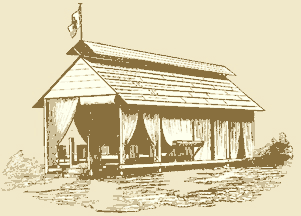
This barrack was characterized by its walls, both on the front and on the sides; these were formed of canvas curtains permanently attached to the plates and tie-beams. By means of the curtains the interior of the barrack could be completely enclosed, or it could be thrown open to the air more or less completely by pushing the curtains aside or by rolling them up and securing them at the top by buttons.
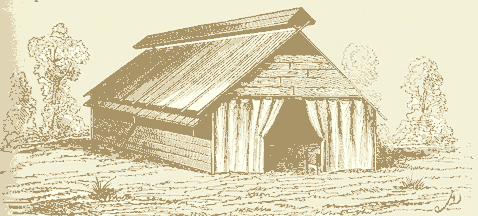
Another form, in some respects simpler, also used during the same war, is described by Fischer.(278) It differed from the one represented in Fig. 36 in being unprovided with a floor and in having lateral wooden walls, the upper halves of which were movable. In this barrack the ends alone were furnished with curtains, as shown in Fig. 37.
During the Austro-Prussian War the experiment was made at Trautenau by Volkmann of employing, for the treatment of the wounded, a sort of shed-barrack---something like, in its general appearance, the sheds occasionally used on farms. The experiment was pronounced highly successful. At the suggestion of Baron Mundy, of Vienna, and in accordance with plans furnished by him, the "Société de Secours aux Blessés" organized in the Park of St. Cloud, in June, 1871, a shed tent-barrack hospital containing two hundred beds; each ward-barrack contained twenty-five beds. By referring to Fig. 38, which represents one of these barracks, it will be seen to differ in several respects from the two forms I have just described. It was practically a long shed, the front of which was or might be closed by canvas curtains; it was 98-1/2 ft. long, 16 ft. 4 in. wide, 19 ft. 7 in. high in front, and 13 ft. high behind. The barracks were frameworks, covered with boards, battened both on the sides and on the roof; the roofs were covered also with impermeable tarred paper. They were painted black the outside with a heavy coating of coal tar; on the inside the walls were whitened. Each barrack was floored with matched boards, and in each the rear wall was pierced with eight movable windows; the curtains---of which there were ten---were attached above by rings to iron rods; at the sides and the bottoms they were secured when closed by buckles and hooks; when opened they might be pushed aside, or they might be braced out by means of poles, as shown in the sketch. As the curtains depended from the ridge, the interior of the barracks could thus be completely exposed to the open air in fine weather, and without that liability to draughts existing in constructions open on all sides. One or two of the ward-barracks were divided into apartments by lateral side curtains. The barracks were all supplied with water, as they were also with the furniture common in permanent hospitals.
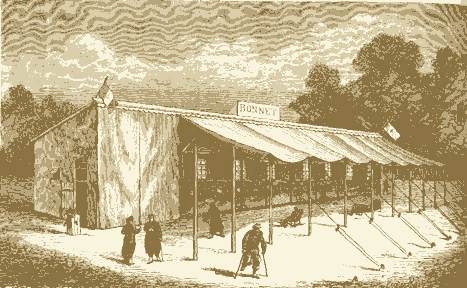
| FIG. 38.---Perspective view of one of the tent-barracks of the Ambulance organized by the "Société de Secours aux Blessés," in the Park of St. Cloud, in June, 1871. |
They were solidly built, and were unquestionably the most elaborate examples of tent-barrack architecture which have yet been constructed. It may be observed that in these constructions the barrack predominated over the tent; it was a circumstance which added considerably to the first cost of installation, and may also have been the occasion of a less active aëration, when the curtains were all closed, than at times may have been desirable,
As no heating apparatus was used in these barracks, there was no means of forcing the air to circulate within them, and its purity was only maintained, as it might be in almost any apartment, by keeping a large number of doors and windows open.
If the roofs of the barracks had been of canvas permeable to air, an interchange between the interior and exterior atmospheres might have been constantly going on through the tissue, and one of the advantages of using tents thus secured; but as the curtains were disposed, I am inclined to think that generally when closed very little air passed through them. The air which then entered and escaped from the barracks probably accomplished these acts principally by creeping under the curtains or through the folds of their loosely fitting sides. As the curtains were only raised during the day, and when the weather was fine, the portion of the time during which the barracks were open was really very small. It was necessary to close the curtains also whenever the wind blew strongly against the front of a barrack, and in this event, the air pushing past their imperfectly fitting borders circulated in gusts in the interior.
As these shed-barracks, while roofed and floored as ordinary barracks, were thus greatly exposed on one side, it was impossible to place within them but a single row of beds. This fact alone will always prove a most serious economical objection to their construction. They were condemned while in use by some of the most competent French sanitarians, as a "contre-sens hygiénique et économique." We have not learned that the surgical results obtained were remarkable in any respect; and as the experiment is never likely to be repeated, this verdict may be accepted as final.(279) Where, during the summer season, it may be impossible to construct a suitable cover from a want of the proper material, or of sufficient time, a roof or awning may be adjusted to some wall already built, and a shelter thus extemporized, which is better than none, for the sick, and which, as an annex to a general hospital, might prove useful in the treatment of convalescents or of special cases. These considerations can alone warrant the construction of shed-barracks.
In 1868 M. Le Fort erected a tent-barrack as an annex to the Hospital Cochin, that possessed more characteristics peculiar to the tent than to the barrack. In fact, it offered (to those who might be treated within it) all the sanitary conditions special to a tent with double walls. This construction, which is still in use, and appears in fairly good condition in the fourth year of its service, I shall now describe. I would, however, first call your attention to Fig. 39, which will give a general idea of the barrack; the front wall has been entirely removed, and one lateral wall lifted up in such a way as to exhibit the interior. The frame is supported by six posts on each side, and distant from each other 4 metres, thus giving to it a length of 20 metres; its breadth is seven metres. The posts are of light wood, square in form, 10 centimetres thick, and 2 metres 25 centimetres high above the ground. To each one is attached a principal rafter, a solid plank 4 metres 80 centimetres long ; this crosses at the summit of the roof, in the form of an X, the rafter from the post opposite. The upper branches of the X, which are very short, give a support to the false roof or lantern. Each rafter is united to its neighbour by a plank 4 metres long, 15 centimetres wide, and 34 millimetres thick; these planks, placed lengthways and edgeways, form the ridge. A similar plank passes from post to post in such a way as to form the eaves of the tent, the canvas bending over it being continued to the ground as a lateral wall. Four or five light rafters are placed between the principal rafters, to complete and sustain the roof. The principal rafters are kept from spreading apart by a tie-beam and a king-post. By this arrangement a light but pretty solid framework is obtained. The canvas is now put on in the following manner:---First, the outer covering---cotton canvas prepared by being immersed in a solution of sulphate of copper---is adjusted. This consists of two large sections, one for each side of the barrack. Each section is drawn up to the summit of the framework, and each is fastened to the other by means of straps, which, passing over the ridge-board, are secured to buckles on the inside of the corresponding section.
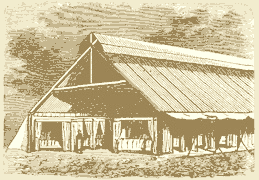
| FIG. 39.---View in perspective of the tent-barrack erected by M. Le Fort as an annex to the Hospital Cochin in 1868. (280) |
The sections of canvas are therefore not directly joined together, but are separated by an interval of about 6 in. The false roof is now covered by a hood or band of canvas, which falls down upon the roof on each side, but is gathered up in such a way as to permit the free exit of the air which may arise through the opening between the two sections forming the roof. The canvas on each side is now drawn down to the angle of the roof, where it is attached by straps to the horizontal bar or plate which passes from post to post. The bottom of the canvas is furnished with loops, by means of which it is attached to hooks screwed into a piece of timber buried in the ground along the whole length of the barrack. The inner tent is now arranged: it is made of white cotton cloth, and consists of two parts, a ceiling and side walls. The ceiling extends horizontally the whole length of the barrack, just under the tie-beams, and is held in its place by cords and wires, which, fastened to the framework above, pass through a series of rings sewed upon the upper face of the cloth. The ceiling is formed of two lateral sections, between which is an interval of 3 in. or 4 in., corresponding with the interval or opening immediately above, between the two sections of the outer covering. The walls of the inner tent now slope down, following on the inside the course of the rafters, to the horizontal bars or plates, to which they are attached. To these bars curtain rods are fastened, from which the perpendicular portions of the walls hang in sections or curtains.
When the weather is fine, the inclined walls of the outer tent may be raised, as shown in the sketch. They thus form a sort of covered gallery, where the patient may walk or sit, at the same time protecting from the sun the interior of the tent.
The perpendicular curtains of the inner tent can be more or less completely opened, according to the weather, so as even to place the patients, whenever thought proper, quite in the open air. This construction is not floored, but the ground was carefully prepared, and the surface dressed with coarse gravel; gutters lined with bitumen conduct the water, shed by the outer roof, to the street near by. The shelter thus obtained is considered by M. Le Fort sufficient for eighteen or even twenty-four beds. Although two stoves are placed in it, the construction was not designed to be used during the colder months, and it has been regularly abandoned each year when the weather has become frosty.
The earliest use of permanent barrack-tents with double walls appears to have been made at Berlin. In 1864 Dr. Fischer described one which had been attached to the Charity Hospital of that city. A plank floor was laid, supported by a series of posts several feet from the ground. Its length was 114 ft. and its (interior) breadth 23 ft. A framework was erected upon this floor, with two rows of wall posts on each side; a tarpaulin weighing nine or ten hundredweight was placed upon the roof as a covering. The outer edge, provided with gutters, was secured to a plate, resting upon the outer line of posts supporting the roof. Canvas curtains were let down from the plates supported by the first row of wall posts quite to the floor, so as to form the inner (true) walls of the pavilion; around these was a gallery covered by the projecting roof. At the outer edge of the floor of this gallery---a lateral extension of the floor of the pavilion---curtains were placed which could be pulled up by means of pulleys, so as to quite shut in the gallery. This construction was therefore a wooden framework roofed by an impermeable water-tight and air-tight covering, and enclosed on the sides by two lines of curtains distant from each other the width of the gallery. The pavilion was divided into two wards by partitions, between which were a bath-room and water-closet. Each ward contained twenty-one beds.
It will be seen from these descriptions which I have given of tent-barracks that there are two kinds or types. In one of these the construction is essentially a barrack, in the other it is essentially a tent. Nevertheless, in the barrack type many of the special advantages of the barrack are lost; as I have already remarked, it affords no security as regards the safe keeping of either property or persons, neither can constructions of this class be easily and economically warmed; they have consequently only been proposed and used for summer hospitals. Their only advantage over common barracks---aside from their somewhat smaller cost---seems to be the possibility of throwing them widely open at the sides. Whether, in order to obtain this object, it is wise to give to barracks a special form which unfits them for service during a considerable portion of the year, I am much inclined to doubt. It seems to me preferable to construct barracks in such a way that they may fulfil every purpose for which such buildings are erected, that they may be used at all seasons of the year, but so arranged that during the warmer months they may be freely opened to the air by means of movable walls, or some other device. As for the tent-barrack which preserves the essential features of the tent---which, in fact, scarcely differs from a marquee, except in being more solidly supported within---I can only say that it seems to me to be the preferable form. It would certainly be very difficult to realize more completely than M. Le Fort has done, in the large tent annexed to the Hospital Cochin, the best conditions to be obtained under a shelter of canvas, not simply during the summer, but as well during the winter; and I may here again remark that such a tent is much more easily warmed than any one of the more barrack-like constructions I have described. The difference in cost between this tent-barrack and those of the first class, if neatly built, is also usually in its favour.
It seems to me expedient, whenever the occasion may require the establishment of a military hospital that in all probability will be used for a year or more, or even for several months, to employ two kinds of construction---well-built barracks, and large, strongly-secured tents. The barracks will furnish quarters for the attendants, can be used as offices, and will afford suitable store room. They also, if well constructed, if so arranged that they may be opened freely, will offer to the sick sanitary conditions scarcely inferior to those obtained, in the finest portions of the year, in the barracks which most closely resemble tents. The large tents will completely secure for the sick whatever advantages may be derived by treating men under canvas, advantages which I believe I have elsewhere satisfactorily shown to be both real and important.
In constructing a tent for use in the field as a campaigning tent, its size must necessarily be limited. The tent and its fixtures must be easily transportable, while it should not offer to the wind so large a surface as to be blown down, when supported and fastened by the fixtures and pegs which belong to it and are presumed always to go with it. In constructing a tent for a special service, a service which gives to the installation more or less of permanency, the transportability of the tent is a quality of less consequence, as is also its solidity, if fastened in the usual manner. There are a variety of ways by which a tent not excessively large can be fixed strongly in its place the moment it is decided to give permanence to the installation. Still, in the construction of a large tent not intended to be frequently transported and re-pitched, lightness may be a desirable condition. It should only be so large as to secure within it a convenient interior, and the necessary sturdiness should be obtained for it by the employment of such fixtures only as are absolutely indispensable. It should also be made of as few pieces as possible; the type to be preferred is the simplest one.
The tent proposed by M. Le Fort, although one which would answer very well in the construction of a military hospital upon the plan I have suggested, since in the fulfilment of sanitary conditions it leaves scarcely anything to be desired, nevertheless seems to me to possess certain defects which. can, perhaps, be partially remedied. It is a double tent, one tent being placed within another larger one. This mechanical fault I have elsewhere noticed. The framework is altogether heavier than is necessary, and there is too much gearing about the tent ; moreover, it cannot be closed up tightly. The employment of numerous curtains attached to sliding rings, and of sidings fastened by buckles and thongs is objectionable ; unclosed apertures exist everywhere, which let in the air in currents. If it be said that these apertures serve to ventilate the tent, I can only reply that this mode of ventilation is often undesirable. In cold, windy weather, the fewer irregular holes and apertures in the walls of a tent the better, providing the ventilation is properly maintained, as it should be, by openings in the roof, and a circulation of air through the canvas forced, if necessary, by means of a well-contrived heating apparatus. I should prefer also for a permanent installation a different floor. If an earth floor is to be used, coarse gravel is perhaps the best material which can be employed; but however easy it may be to remove and renew the gravel in places where it may have been soiled, such a floor must, sooner or later, become unclean, as well from the detritus of one kind and another which daily falls upon it, as by reason of its capacity to absorb gases. Where tents may at any time be repitched, an earth floor may be sufficient ; but if the installation is to be permanent, some other kind of floor should be used both as a matter of convenience and of health.
If large tents can be employed with advantage in the organization of sedentary hospitals, I know of no better form than that of the American hospital tent, a pavilion covered by a sur-tente, or "fly." The pavilion may be made large enough to be sufficiently convenient within, and may be strengthened by a framework strong enough to give it the necessary sturdiness. It can, moreover, be modified in such a way as to permit its being more easily opened to the air and light than are the American field tents.
In plate X. (Appendix) may be seen a sketch of a tent designed by Dr. Thomas W. Evans, and in the construction of which, while endeavouring to secure those qualities particularly desirable in an installation that is to have a certain permanence, he has sought to remedy, so far as it might be done, the mechanical faults I have noticed in speaking of M. Le Fort's tent, and several of which are more or less likely to be reproduced in any attempt to construct a large, strong, sturdy tent, intended to be used as a sedentary hospital. The pavilion proposed by Dr. Evans is constructed in the following manner:---Six posts, square, 4 in. thick, 8 ft. 7 in. long, are sunk into the ground 2 ft. on lines which are to correspond with the side walls of the tent. The second post is placed 14 ft. from the first; the third, 14 ft. from the second; the fourth, 4 ft. from the third, for a reason which will appear ; while the fourth, fifth, and sixth, are 14 ft. apart. The sides of the tent are therefore 60 ft. long.
The upright posts are united on each side by square bars, rounded on the upper and outer angles, 4 in. thick; these are placed horizontally from the top of one post to that adjoining. The extremities of these bars are secured to the posts by means of sockets.
The two lines of posts are now united at each extremity by a cross-bar, which is square, 4 in. in diameter, and 20 ft. in length. The two bars complete the enclosure of a quadrangle 60 ft. long by 20 ft. broad. Each one of the end bars is propped by two upright posts, similar to those on the sides, placed 4 ft. apart. These posts enclose the doorways. A vertical pole 9 ft. 5 in. long is now erected over the centre of each doorway, its foot resting in a metallic socket. This standard is 5 in. in diameter at its base, and 3 in. at the top, which is armed with an iron spindle ; it is flattened on its outer face. Two masts, 6 in. in diameter at the base, and 3 in. at the top, and 17-i ft. long, are sunk in the ground 1-1/2 ft. on a line corresponding with the long axis of the quadrangle, 20 ft. apart. These masts are connected at the top one with the other, as also with the vertical standards over the doorways, by ridge-poles, three in number, and each 20 ft. in length; the ridge-poles are rounded on their upper faces. The two end ridge-poles are fastened to the upright standards by being passed over the terminal spindles with which the standards are armed. The middle ridgepole is attached to its fellows by means of sockets. The skeleton or framework of the tent is now complete. I have not remarked, however, an arrangement of considerable importance. Each one of the sixteen upright wall-posts, of the end standards, and of the ridge-poles, is furnished with a row of fixed metallic rings, whose diameter is about 3/4 of an inch. These rings are screwed into the outer faces of the posts, 6 in. or 8 in. distant one from the other, and all facing in the same direction upwards and downwards ; on the ridge-poles they face each other horizontally. (See Figs. 40 and 43.) Such a framework having been erected, it remains to be provided with its covering. This consists of two sections, which are to be united, when erected, at the ends and at the ridge. Each section forms one long roof, two triangular gable ends, two end curtains, and five side curtains.
The curtains are all sewed on to the edges of the roof, and also to the edges of the gable ends. The sides and bottoms of the curtains are provided with button-holes, so also are the vertical edges of the gable ends, and the superior edge of the roof; a narrow lapel projects beyond the line---the angle of the roof---where the roof and curtains meet; into this lapel are inserted the tent-ropes, 2 ft. 3 in. one from the other. In erecting the tent, the sections are unrolled on the ground within the enclosure, the wall curtains being drawn out towards the side-posts, while the long straight edges of each---the edges containing the button-holes---are laid parallel to each other in the middle of the enclosure, along the line of its length.
The long edge of one of the sections is now lifted up, and, beginning at one of the extreme ends, the first button-hole is slipped over the spindle at the extremity of .the standard over the doorway; the button-holes are fastened one after the other over the rings on the upper surface of the ridge-pole, until the edge of the section is adjusted along its whole length.
The body of the section is then lifted up and over the horizontal bars---the plates---of the framework, the curtains falling on the outside. The button-holes in the vertical edge of the gable end are adjusted to the rings in the standard over the doorway. The roof is drawn out by the cords attached to the lapel, and pegged to the ground in the ordinary way, or attached to parallel bars, as shown in Plate X.
The curtains are now buttoned on to the rings in the upright posts, one curtain edge over the other on the sides, the buttonholes on the lower edge being passed over rings which are placed in the outer string pieces on which the floor rests (see Fig. 40). I may here say that, presuming it may not always be convenient to use a floor, the lower edges of the curtains are furnished with a series of loops, by means of which the walls can be pegged to the ground in the ordinary way. The canvas is held fast, and is prevented from slipping off the rings by passing a cord through the series, or by means of small keys, as shown in the illustrations.
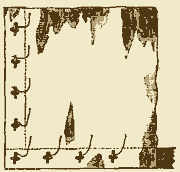
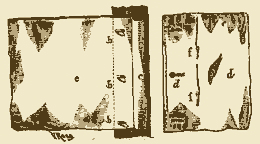
I have elsewhere objected to the use of straps, buckles, &c., for curtain fastenings, because of the openings which almost always exist, where such fastenings are employed; it is partly to reduce the number of such openings that the curtains have been attached permanently to the roof; it is for the same reason that the edges of two adjoining curtains have been buttoned, one curtain over the other, the edges of the curtains overlapping slightly for this purpose. In the curtain which rests upon the face of the post, the buttonholes are four or five inches from the edge; the free border forms a roll beneath the outer curtain, in which the button-holes are close to the edge. The two curtains being pressed down solidly by the keys or the cord passed through the rings, this roll breaks or fills up the joints which would otherwise exist.

The arrangement will be readily understood by a reference to Fig. 41, where one curtain e is shown buttoned over the ring b in the post a. The edge of the second curtain d is also buttoned upon b, and. will be observed to have been rendered slightly convex by the free edge of the curtain e. Fig. 42 shows a section of the curtain e buttoned over the rings b b b, with its free edge e rolled up. The curtain d may be brought forward and buttoned over b b b, as shown in Fig. 41.
It is now necessary to arrange the fly. This is in three sections, each 20 ft. broad and about 30 ft. long. It is in sections---first, ---that it may be the more easily adjusted; secondly,---that the air between it and the roof of the tent may have a free outlet; this is desirable not only because a better ventilation within the tent is thus maintained, but because the strain to which the fly, were it in one piece, would be subjected whenever the wind is high, is greatly lessened; thirdly,---that, the season permitting, one or more sections may be advanced so as to form an awning in front of the tent.
The three sections of the fly are placed upon the portion of the roof, which we are presumed to have erected, each folded outside in; that is to say, each section being in its place, one half resting upon the portion of the tent it is to cover, the other half being thrown back over it. The fly having been thus placed for the moment, the section of the tent still supposed to be on the ground is lifted up, and beginning at the extreme end, the first button-hole is slipped over the spindle at the extremity of the standard over the doorway, and the button-holes one after the other are fastened to the rings in the ridge-pole as already described. Before, however, the second section has been adjusted far, a small perforated block or ball, two or three inches in diameter, is pushed down upon the spindle just mentioned, and the fly is pulled up, and the hole which will be found near its outer edge and corner is passed over the top of the spindle; as the second section of the tent is attached to the ridge-pole, the fly is drawn up and over on to the same side. Balls are placed on the spindles of the three remaining standards, after the two sections of the tent have been united upon them, and the flys are adjusted as has already been described. The section of the tent is now brought forward over the framework, to which it is fastened, as in the first instance, and stayed out by cords similarly attached. The fly is then pulled down on either side and fastened by cords to pickets driven into the ground, or to a bar, as shown in Plate X. The fly is adjusted as in the common American hospital tents, except in not resting directly upon the ridge-pole; the balls placed on the spindles, separating the fly from the tent, permit the air to circulate more freely between it and the tent. (The ball is represented in Fig. 43 by the letter e; its effect to separate the fly from the roof of the tent b will at once be seen.) The tent as now pitched has four large unclosed openings; those at the ends are intended to be closed by light swinging doors, those at the sides with windows---not however necessarily; as will be seen by looking at Plate X. a curtain can be drawn down to fill the space intended for the window, should it for any reason be difficult to obtain one. Ridge ventilation is provided for by louvres which can be opened or shut at pleasure.
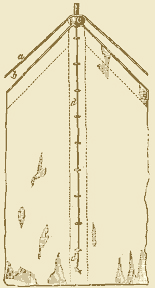
The ventilation, however, will be chiefly secured during cold weather by the heating apparatus. During the warmer portion of the year the side and end curtains can be rolled up as shown in Plate X.; they are sustained by straps, which are employed when the tent is closed to attach the roof to the bars or plates which connect the upright posts.
The floor, if one is employed---and one always should be, if possible, in a permanent installation---it will be best to prepare before the tent is erected.
The ground should be levelled ---in fact, it would be well to move six or eight inches of the top soil, and replace this with coarse gravel.
String pieces are then to be laid down lengthwise on the sides of the tent, to furnish an attachment to the lower borders of the curtains, the other string pieces should traverse the tent; they should only be large enough to support the floor, and should be forced into the gravel until their upper faces are level with its. surface. When the flooring is laid it will therefore rest directly upon the gravel.
The floor will be made of rough unmatched boards; and it should always be covered by an impermeable oilcloth over its whole surface. Such a floor is perhaps as perfect as it is possible to have in a temporary hospital. It is solid, not dusty, contains no dead air beneath it, no foul matter can accumulate under it, it is non-absorbent of gases, and can always be easily and very perfectly cleansed.
But some one may ask:---Why not allow the outdoor air to circulate freely under the floor, as it did beneath the American barrack hospitals ? This arrangement, permitting the outdoor air to sweep them on every side, was supposed to contribute much to their healthfulness. But if the floor is impermeable and contains nothing offensive under it, there is no reason why it can be desirable to secure a constant change of the air beneath it. Another and more weighty reason is this: if the outdoor air were permitted to circulate freely beneath the floor of the tent, our ground heat during the winter would be lost. When the weather becomes cold, the tent should be heated by the introduction of hot air in the way described at length in Part III. of this Report. How important a factor this ground heat is, in the maintenance of a steady temperature within a tent, will there be shown. The doors, the upper portions of which may be furnished with windows, may be protected during the winter months by portals or vestibules. Paved gutters should be placed on each side of the tent. It will be found advantageous to fix the tent in the manner indicated in the Plate, by attaching the tent-cords to parallel bars; not only is the inconvenience of cordage avoided, but the stability of the tent is thus assured. The tent is intended to accommodate sixteen patients. There is room for eighteen beds, but it will generally be found convenient to suppress two of these to gain room for furniture, &c.
A tent constructed like the one described would be greatly superior to the American hospital tent, for the organization of sedentary hospitals. It is much more spacious, and is relatively less costly.
To form a pavilion 56 ft. in length, four United States hospital tents are required. The canvas of the six ends which meet is superfluous---it is more than this, it is decidedly objectionable. It serves to form dead corners, and offers a large amount of material to be impregnated and infected by miasmatic exhalations.
I believe Dr. Evans' tent to be superior in construction to M. Le Fort's tent, on account of its greater simplicity. There are seventy-one pieces in the framework of M. Le Fort's pavilion; there are but thirty-three in the model I have just described and would commend.
While not designed to follow an army in all its movements, it is not too heavy, including the framework, to be occasionally carried in the train. In well-timbered countries a part, or even the whole, of the framework may be left behind; it would require but a small amount of labour to prepare a framework sufficient to sustain the canvas, which is the essential part of the construction.
This model is also peculiarly well adapted to serve as an annex to a civil hospital, not only for the treatment of surgical cases, but to meet the requirements of certain epidemics---cholera for example, the mortality incident to which disease is largely controlled by the general sanitary surroundings; and this fact was never more strikingly illustrated than in the Crimea, in the very first large tent-hospital ever established.