The tents now in use in the Turkish army are of two kinds. The one used by officers is a large conical tent, varying in diameter from 14 ft. to 20 ft. It is supported by a central mast, and is stayed by ropes attached to pickets. From the base of the cone a wall or curtain drops vertically to the ground, a distance of from 2 ft. to 4-1/2 ft. The covering is made of strong cotton canvas, and the inside is generally lined with some coloured stuff also of cotton. The tent furnished the troops is in form quite similar, although generally somewhat smaller. It resembles very closely the French "tente conique;" it differs from it, however, in being made of doubled widths of cotton canvas, instead of linen canvas of a single thickness, and in having walls which lap widely over each other at the doorway, thus securing the inside more completely against rain. The ventilation is also better provided for than in the French tent, the opening at the top being larger and more controllable. The Turks have employed also a hospital tent, which is thus described by Major Rhodes:---
"It is of a long oval shape, supported by a pole at each end, and having a ridge-pole or rope connecting both together; long ropes fastened to the sides at about three feet off the bottom, and then pegged to the ground, secure the tent. It is made of a doubled white cotton canvas."(249)
The Prussian "troop tent" is very similar to the English bell-tent. It is 14 or 15 ft. in diameter, and is supported by a central pole 11 ft. 8 in. high ; it is intended to shelter fifteen or eighteen men, and weighs 80 lbs. The Prussian "hospital tent," as specified by the Regulation of 1862, is constructed as follows:---
"It has a rectangular base 64 (English) ft. long, by 25 ft. 9 in. wide. The base is divided into three parts ; the middle one is 53 ft. 9 in. long, and the parts at the ends are about 5 ft. long. The middle space is intended for the beds; the end compartments are designed to lodge the personnel, and furnish a place for the necessary utensils. On a line running down the middle of the tent are four posts, 16 ft. 6 in. high, intended to support the ridge-pole, which holds up the roof. The roof is covered with sail-cloth tightly stretched, that the water may rest at no point and thus filter into the tent. Impermeable canvas may be employed, but it has the inconvenience of impeding the circulation of air, and of increasing the heat to an insupportable degree. Sail-cloth is therefore preferable."(250)
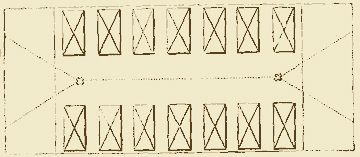
This tent is intended for fourteen beds, which are arranged as shown in the diagram (Fig. 25). It is supported by a wooden framework of standards and plates, and is stayed by a multitude of ropes attached to strong pickets, including eight storm-ropes fastened to the main standards. The tent is not provided with a double roof. Its general appearance when pitched is very well presented in the illustration (Fig. 26).
I remember having seen at the Exposition of 1867 a model Prussian hospital tent, somewhat smaller than the one described, but very similar in its construction. It was an oblong wall tent, 43 ft. 8 in. (English) long, about 20 ft. wide, and 14 ft. 3 in. high. The side walls were 5 ft. high. It was divided into three compartments as is the regulation tent, and was supported by a tubular iron framework within, and by cords and pickets without. Two circular ventilators were placed in the roof. The tent had a second roof or fly, which was attached to the roof, on the line of the angle of the side walls, by a series of buttons. The canvas covering was of brown linen of fair quality.
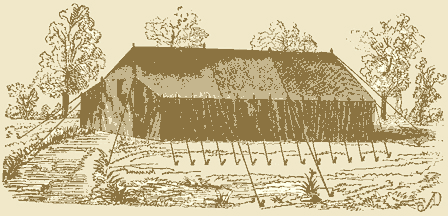
This tent was the subject of much criticism; nevertheless in November, 1867, the Prussian Government resolved to adopt it, with certain modifications, as will be seen from the following account of the "Field hospital tent for twelve beds," which I reproduce substantially from the official account then published. The tent is house-shaped, 28 ft. (Prussian) long by 20 wide. The side walls are 5 ft. high, and the distance from the ground to the ridge is 13 ft. It is supported by a framework composed of straight sections of wrought tubular iron. The disposition of this framework is shown in the accompanying sketch (Fig. 27). Three large iron standards a a a support the ridge pole h h, and each is fixed by a collar to a flat cruciform plate g, which rests on the ground. The connection between the standards and the ridge-pole is strengthened by four jointed braces b b b b. Each standard terminates superiorly in a cap c, mortised to receive the ridge-pole and the rafters, and bearing a terminal spindle to support the flags. There are five posts on each side, e e e e e, each resting upon a ground plate g, and each terminating in a wormed spindle. Two bars, each in four sections, connected by hinged joints f f f f, unite the side posts, the spindles of which pass through holes pierced to correspond. The rafters are the six rods d d d d d d, which are fitted to mortises in the side posts and the caps c c c of the principal standards.
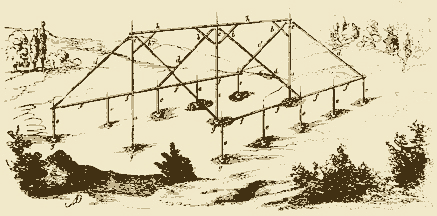
| FIG. 27.---Diagram showing the framework of the Prussian hospital tent for twelve beds. |
The covering may be said to consist of four distinct parts, the side walls, the end walls, the roof, and the sur-tente.
The side walls are of common sail-cloth (linen), and are provided at the lower borders with bands of tarred cloth, six or eight inches wide; along the upper borders are five leathern straps and a few strings, by means of which they are fastened to the plates f f f f ; the lower borders are secured by pegs driven into the ground.
The roof is of ordinary canvas, and, stretched over the rafters, is brought down to the plates and passed over the spindles of the posts e e e e. The borders of the roof, however, overlap the side walls quite a foot, and thus close the imperfect joints existing between the side walls and the plates to which they are attached.
The end walls, which serve as doors, are simply two pairs of curtains, of material similar to that used in making the roof, and to which they are tied by a number of strings.
The sur-tente is made of very heavy sail-cloth, which rests directly upon the roof, and is stretched down and kept in its place by nine cords attached to pegs in the ground.
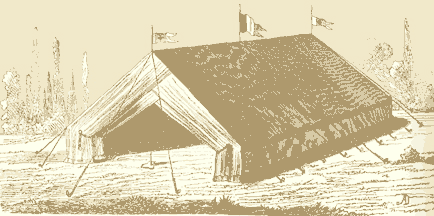
The tent is moreover stayed by six storm-ropes, two of which are attached to each main standard; they are fastened to the ground by iron pins; eighty additional pins are required to hold in place the several parts of the tent. At one end of the tent a small ante-room is made by suspending a second curtain about four feet from that which serves as the outer door.
The construction is surmounted by three flags, two hospital flags and the national flag; and its general appearance is very well shown in the sketch (Fig. 28).
The total weight of the tent is about 440 kilogrammes, or a little less than a thousand pounds.
Qualities. ---These hospital tents are all roomy, may be fairly well ventilated, and under many circumstances would furnish excellent quarters for the sick. They all, however, possess several radical faults. They are too large---indeed their size renders them wholly unsuitable for campaigning. Their transportation is always difficult, and frequently impossible, on account of their great weight; while the surface they expose to the wind when pitched is quite incompatible with security. They are even much less sturdy than the English marquees. The model at the Exposition of 1867, although pitched en permanence, with every precaution, and in a particularly sheltered spot, was quite a wreck before the close of the season; it had been partly or wholly blown down a number of times, and its iron framework twisted and bent into the most inconceivable forms. It would have been difficult to have furnished a more complete illustration of the impracticability of issuing to any service in an active army large house-shaped tents. Although recently these tents have generally had a second roof or fly, the advantages to be derived from this, whether as a parasol or a parapluie, have been almost wholly lost by placing it in close apposition with the first roof.(251) An iron framework is most objectionable : it is liable to rust, and when rusty it soils everything which it touches, it is liable to get out of order, and when out of order, in the field, can neither be easily replaced nor repaired.(252) The plan of lodging the nurses, as provided by the Regulation of 1862, is a bad one, aside from its adding needlessly to the already excessive size of the construction.
A tent employed by the Prussians during the late war is shown in Fig. 29. It is a small square construction intended to contain but two beds, and to be used especially for the treatment of those suffering from contagious hospital diseases. It is supported by a light wooden frame of standards, plates, and rafters, and is braced with cords attached to pickets. It has a projecting pyramidal roof; and the covering is made in sections. It can be opened on all sides, while the curtains, on the two sides proper, are so constructed as to be rolled up or down as the occasion may require.
Qualities.---This tent is certainly a convenient and excellent tent, especially for the purpose it was intended to serve, but the model is evidently too complicated as well as too heavy to be suitable for campaigning. Although I have no measurements of this tent, it would appear from the sketch to give a much larger cubic space to each patient than could be allowed to each patient generally, without increasing the burden of transportation to a degree quite impracticable.
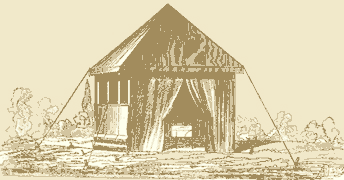
The old-fashioned Austrian and Italian "long-tent," in use in the Austrian service until quite recently, was a wedge-shaped tent 40 ft. long and 13 ft. high; it weighed 900 lbs., and was intended to shelter fifty soldiers.
A few years since the Austrian Government adopted a form of tent proposed by Capt. Theurekauf, a sketch of which may be seen in Fig. 30, and which Major Rhodes describes substantially as follows:(253)--- It is a large single-poled tent, in length 22 ft. and in width 26 ft. inside ground measurement. It has triangular-shaped door ends; the top of the triangle from the ground is 7 ft. 6 in., and its extreme width at the bottom is 12 ft.; the end walls fall perpendicularly. The canvas side walls are 3 ft. high, and are fastened on the inside by hooks. The tent-pole is of one piece of wood 4 in. in diameter; its length is 13 ft. 6 in.; it is inserted into the ground 1 ft., and is there retained by a block of wood. Eight feet distant on each side of this pole is placed another pole 3 in. in diameter and 8 ft. 6 in. long, to be sunk in the ground 1 ft.; a "bread-shelf" rests on the tops of the short poles. The stay-ropes are fastened to the central pole and secured to the "bread-shelf." The doorways are ventilated by two circular openings.
There are twenty-four small wooden pegs for the walls and entrances, and eighteen large pegs for extending the roof. This tent weighs 387-3/4 lbs., and costs about 100 dollars. An officers' tent is used, made after the same general model.
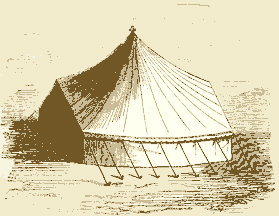
Qualities.---The tent is roomy, and stands solidly ; it is said never to have been blown down. It has few and short ropes. The storm-ropes are all on the inside.
But the tissue with which it is covered---hempen canvas---is loosely woven and quite permeable to rain. It is, moreover, a single-roofed tent, and its form is not well adapted to the use of an awning or fly.
Another tent used at the present time in the Austrian army is known as the "marching tent." In form, it somewhat resembles the French "bonnet de police." It is 18 ft. long, 14 ft wide, and a little over 7 ft. high. It is supported by a central pole 7 ft. high, to the top of which a bar, 5-1/2 ft. long, is fastened in the form of a T. To each extremity of this bar two cords are attached and pegged to the ground, 9 ft. from the foot of the central pole. To the top of this pole also two cords are attached and fastened to the ground, one on each side, and 7 ft. from its foot. Over the framework of cords the canvas covering is now thrown, and secured to the ground by wooden pegs. The tent has a door at each end; it weighs 69 lbs. (English), and accommodates 10 men.
Qualities.---It will be observed that in this tent, as also in the one just described, the "weather lines" are on the inside of the covering---an arrangement which certainly results in some advantages. The lines support the covering, as well as give steadiness to the standard, and thus become not only additionally useful, but at the same time cease to interfere with people in their movements around the tent. The horizontal bar which forms the ridge is, however, weakly supported, and liable to get out of order.
In the Austrian army, no tent has been especially provided for hospital purposes. But the large soldiers' tent is presumed to furnish ample accommodation for 8 sick, and the "marching tent" for 2 sick. They are, however, badly adapted for the treatment of the sick, as well on account of their forms as the quality of the material of which the coverings are made.
The tents employed in the Italian army are "shelter-tents," "conical tents," and "marquees." No special hospital tent is used.
The shelter-tent is formed of three rectangular sections, each 1 m.77 in length and 1 m.70 in breadth; they are thus a little larger than the French sections; they are fabrics of strong linen canvas---although attempts are now making to employ cotton tissues for this purpose; the sections weigh a trifle over a kilogramme each. The system of support has already been alluded to. This tent is furnished to soldiers and non-commissioned officers.
Conical tents are issued to officers.; but when the sick are treated under canvas it is usually in these tents. The Italian conical tent is a modification of the Turkish "tente conique;" it is also made of strong white cotton canvas. The upper part of the tent is doubled with blue canvas. The covering is supported by a central mast, and is retained in place by 44 pegs and pickets. The tent complete weighs 42 kilogrammes, and costs, according to the Government estimate, 157.60 francs. It is presumed to be capable of accommodating five sick persons.
Qualities.---For common field service the Italian conical tent is greatly superior to those generally used in European armies; made of fairly good cotton canvas, it is a comfortable water-proof tent. It possesses also whatever advantages are special to its form; but the conical form is not a good one for a hospital tent---it is in fact a very bad one, and for reasons which have already been indicated. I may, however, mention in this connection, one objection applicable to all "bell," "conical," and "circular" tents, ranging from ten to twenty feet in diameter: the circular ground plan renders any convenient disposition of the beds quite impossible. If the tent is small---less than 15 ft. in diameter---but one or two beds can be put in it; if it is somewhat larger, the centre of the tent is so obstructed as to very much interfere with the common duties of the attendants.
The marquees have generally been employed by superior officers---a few have been used for hospital purposes; but this use was for the most part during or immediately subsequent to the Crimean War.
The Russian "infantry" tent is 14 ft. square, with side walls 7 ft. high; it is supported by a centre pole and four corner poles. It is intended to shelter fourteen men, although occupied generally by a smaller number. The side walls can be raised more or less completely. The officers' tents differ in no way from the infantry tent, except that their roofs are usually made of double canvas, or are covered with impermeable rubber cloth.
The Russians have no special hospital tent, but the infantry tent is roomy, and its form is well adapted for hospital purposes. It is, however, unprovided with a double roof, and offers too large a surface to the wind.
In the United States a variety of tents have at different times been employed---"wall-tents," "bell-tents," "umbrella-tents," "wedge-tents," &c. Those most commonly issued to the troops have been the wedge, the shelter, and, the Sibley tents.
The wedge-tent differs in its form in no essential respect from those already described under that name, and represented in the woodcut on page 322. The United States tent is 6 ft. 10 in. long, 8 ft. 4 in. broad, 6 ft. 10 in. high, and cubes 194 ft. It is supported by two standards and a ridge-pole, and is not stayed by cords. The covering is of common cotton canvas. The tent is intended to furnish a shelter for five or six men. It is unprovided with ventilators, is made with but a single entrance or door-way, and is, as generally constructed, a poor tent for any purpose.
It should always have a window or two, covered by a flap, or louvre, placed in the upper part of the roof.
The shelter-tent was issued to the troops during the last years of the War of the Rebellion, to the exclusion of nearly every other model.
The United States shelter-tent in form, size, and manner of support, resembles the French regulation tente-abri. Each man carries one section (a third of the tent) and a stick. Each section is about 6 ft. long by 5 ft. 6 in. broad.
During the War of the Rebellion, however, the sections, instead of having been made of linen canvas, were made of strong firmly-woven cotton cloth, rendered impermeable by a covering of caoutchouc. They could thus, if not forming a part of a tent, be used as blankets on the ground, and often rendered in this way most excellent services. Moreover, each section had in the middle a short transverse slit, through which the soldier might pass his head, and thus use the section in rainy weather as a cloak (poncho). Each section of an American shelter-tent was therefore a part of a tent, a water-proof blanket, and a cloak.
The shelter-tent in American camps was frequently pitched in a way unlike that employed in French camps. Thus two or three sections of tente-abri were sometimes placed together side by side, their upper ends fastened to a ridge-pole, and their lower ends stretched out and pegged to the ground. A screen was thus made which formed the back and roof of the tent. The triangular spaces at the two ends were each closed by another section. The front of the tent was left open; on the ground before it a fire was built up, the heat from which, reflected and concentrated by the roof and sides, as in the old-fashioned kitchen utensil known as a "baker," made this form of tent very comfortable. These constructions were sometimes called "baker-tents," "half-faced camps," &c.
I am sorry, however, to feel compelled to destroy the illusion, which doubtless exists in the minds of most Americans acquainted with army life, that the half-faced camp is a "Yankee invention." Capt. Marcy certainly speaks of it as "a method practised a great deal among mountain men" in the far West;(254) but many people have discovered, as Capt. Galton has justly observed,(255) that "the main object before sleeping out at night is to secure a long wind-tight wall, and the next is to obtain a roof ."(256) And he afterwards states that a very common means of accomplishing this object has been thus:--
"Support a cross-bar by two upright standards; against this cross-bar a number of poles are made to lean; on the back of the poles abundance of fir branches are laid horizontally; and lastly, on the back of these are another set of leaning poles, in order to secure them by their weight."
But the half-faced camp is not even a very modern invention. The sketches of German camps of the time of Charles V., in Fronsperger, show numerous examples of such a shelter. Sometimes a square piece of canvas or a blanket was arranged in the manner I have described, and sometimes the sloping shield was formed of boards or of poles thatched with straw or some similar material.(257)
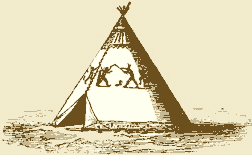
The Sibley tent is a modified copy of a Comanche lodge. (See Fig. 31.) This lodge, or wigwam, is made by covering a framework of straight slender poles with skins. Three poles about twenty feet long are tied together near the top; they are then raised up, and their large ends are planted upon the circumference of the circle which the lodge is to cover. A sufficient number of poles are now set up on the same circumference, their tops dropping into the forks of the first three. The frame is now covered in, a place being left open for a doorway, above which is suspended a blanket, that may be drawn down when necessary. The lodge is also open at the top, or, rather, each side of the apex is covered with a flap of skin or cloth, that to the windward being generally propped out by a short pole. A constant draught is thus maintained, especially when a fire has been built upon the ground within.
 |
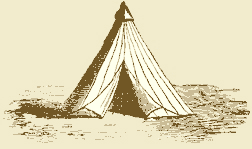 |
The Sibley modification dispenses with the numerous poles. A single central mast, resting upon an iron tripod, supports the covering, which is of cotton canvas. The tent has the form of a cone, is about 13 ft. high, and has a diameter at its base of 18 ft. It cubes 1,102 ft., and will shelter comfortably twelve or fourteen men. There is a large opening at its apex, over which is a hood which can be raised or closed at the sides by cords that hang down within the tent. The covering is supported solely by the mast and the pegs which fasten it directly to the ground. When the doorway is closed, the canvas overlaps within and without. (See Fig. 32.)
The Sibley tent cost in 1881 63.71 dollars (gold.) It has since ceased to be an article of equipment in the United States army. Although originally intended to serve as a troop-tent, the Sibley u was occasionally used as a shelter for the sick.
Qualities.---The Sibley is one of the best conical tents with which I am acquainted. The material of which it is made is fairly impermeable, it stands firmly, and its elongated form gives more headroom than is usually found in conical tents. Ventilation is also well assured. The objections to its use, as a shelter for the sick, are its form, and the absence of a second roof, which if not absolutely necessary to keep the rain out, would---could it be applied---make it far more comfortable, particularly in the summer, as its walls cannot be easily raised.
The wall-tent used by the United States Government as a hospital tent is thus officially described:---
"Hospital tents must in future be made according to the pattern of the present tent, and of the same material, but smaller, and having on one end a lapel, so as to admit of two or more tents being joined and thrown into one with a continuous covering or roof. The dimensions to be these: In length 14 ft., in width 15 ft., in height (centre) 11 ft., with a wall 4 ft. 6 in., and a 'fly' of appropriate size. The ridge-pole to be made in two sections after the present pattern, and to measure 14 ft. when joined. Such a tent will accommodate from eight to ten patients comfortably."(258)
As this description may be considered scarcely satisfactory, at least by one unacquainted with the "pattern of the present tent," I shall furnish some additional details. The tent, like the old French "cortine," is shaped like a "small house;" it is nearly square, with vertical ends and with vertical side walls; its roof has a double and quite steep pitch. It is supported within by two perpendicular poles, 12 ft. long, to be sunk in the ground a foot, and united together by a ridge-pole, which, notwithstanding the "official" statement, is generally a single pole. When pitched, the canvas is stretched into position by fourteen cords, each 8 ft. long, attached to wooden pickets or pegs; the side walls are fastened at the bottom each by seven pegs, and each vertical end wall by five. Two storm-ropes attached to the tops of the upright poles secure the tent. Over the tent is thrown a sur-tente, or "fly," overlapping about a foot the angle formed on each side by the roof and wall of the tent.
To be still more specific, I should say that the poles are made of light, strong wood (ash or cedar); the standards terminate at each superior extremity in an iron spindle, intended to pass through holes corresponding at the ends of the ridge-pole. When the ridge-pole has been attached in the way indicated to the standards, the framework is completed. It will be observed, however, that the iron spindles project through the ridge-pole three or four inches. The covering which forms the tent proper having been laid upon the ground and unrolled upon its side, this framework is passed within it, and the spindles are pushed through two small holes, which will be found at the upper and outer angles of the covering. The large square piece of canvas which will be discovered rolled up with the tent is the "fly," or second roof. Upon examining it, two holes will be found in it, each one in the middle of an outer border. Suppose the tent to be lying flat upon the ground, and the framework to have been properly introduced. The fly may now be drawn under it until the hole in each border reaches the corresponding spindle, over this it is slipped, when the outer half of the fly is brought forwards over the ridge-pole, enveloping it, as well as the tent. Two places having been properly prepared in the ground, into which to sink the standards, the tent is raised, and a few pickets having been driven into the ground, it may be temporarily stayed by slipping over their heads the nooses of the bracing cords. The pickets are afterwards permanently placed at such a distance as shall permit the tent being drawn out so as to cover a rectangular ground surface 15 ft. wide. The side and end walls are then pegged to the ground; and the fourteen cords of the fly may be attached to the fourteen lateral tent pickets, double-notched for the purpose, or to fourteen pegs, seven of which are driven into the ground on each side, and a little beyond those which secure the tent. The fly is supported by the ridge-pole, but it nowhere in its descent touches the roof of the tent, and is separated from it at the angles of the roof and the side walls about 10 in
I may here call attention to the way in which the cords are attached to the pickets. The cords, 8 ft. in length, are doubled upon themselves, forming long nooses; these are simply dropped over the heads of the pickets. The tent is stretched out by pulling upon that part of the noose which forms the short part of the cord, and which, passing through one end of a small oblong piece of wood, terminates in a knot; the long part of the cord passes through a hole in the other end of the same piece of wood; this piece of wood completes the noose. When held at right angles to the cords, the long cord slides freely through it, but its tendency when left to itself is to assume a position parallel with the cords, thus locking the noose firmly. As all tents are more or less loosened or tightened by the hygrometric state of the atmosphere, this simple contrivance for securely holding and tightening and loosening the tent, as the occasion may require, is most convenient. The way in which the key acts will be at once understood by referring to Plate IX. (Appendix).
Doorways 8 ft. high are cut in each vertical end of the tent, and are closed by overlapping canvas secured by strings. The covering is made of cotton canvas (duck) firmly woven, which weighs 14 oz. to the yard (28 in. wide). The tent proper contains about 74 square yards of canvas, and therefore weighs, when made of 14-oz. canvas, 83 lbs. 4 oz.; the fly contains about 32 square yards of canvas, and weighs 36 lbs., thus giving a total of about 120 lbs., exclusive of poles, pins, and cords, the weight of which maybe estimated at about 35 lbs.; the complete tent therefore weighs about 155 lbs. Such a tent complete cost, in New York, in 1870, 100 dollars currency. But the cost, as well as the weight of the tent, are considerably reduced by using lighter grades of duck; and this is sometimes done, although the advantages are perhaps more than counterbalanced by the faults special to inferior materials.
Qualities.---The tent has a good form; it is roomy, and there is no lost space in it. It has the proper size for a field tent; it is perfectly transportable ; a pack mule can carry one with the poles and pickets. It does not offer so large a side surface to the wind as to be easily blown down. Whoever may have designed this tent, evidently proposed a practical compromise between a desirable roominess and a desirable steadiness. Shorten the side walls and the tent will stand more firmly, but its interior will be more inconvenient; whatever may be added to their height makes the tent more roomy, but at the same time it weakens its power to resist storms. As a campaigning hospital tent, I believe that nothing could really be gained by altering in any way either its form or size. The pitch of its roof is sufficient to shed water well, but its impenetrability to wet---one of its principal excellences---is to a great extent a property of the tissue of which it is made. A piece of firmly woven cotton canvas is water-tight ; rain collected in its folds will not filter through even slowly; it does not tamise except when the rain beats with the greatest violence, and even then but slightly. But the superiority of the American hospital tent depends largely upon its outer roof. I have already, when speaking of the marquee, had occasion to mention some of the advantages of a second covering or roof, and. I have elsewhere said that no hospital tent should be unprovided with such a roof. It is a protection against rain and dew, and is a protection against the direct heat of the sun. These are obviously important considerations. By sheltering the tent beneath from rain and wet, the outer roof also accomplishes indirectly an object of great importance. Air passes through wet canvas with difficulty. The air, consequently, within a damp, wet tent, becomes impure much more speedily than when the canvas is dry. Moreover, the canvas when wet attaches to itself a much larger proportion of organic molecular matter---in short, becomes more speedily infected---than when dry. A large fly, therefore, by keeping the tent beneath it dry, assists in maintaining the purity of the air within the tent. In this connection I may mention an advantage it possesses over the outer covering of the marquee. This outer covering protects the inner tent from becoming wet ; but it becomes itself, especially when wet, a great obstacle to the circulation of air, hence the frequent complaints of the heat and mustiness of the air shut in between the walls of the marquee. The fly, on the other hand, while protecting the tent from wet and dew, obstructs in no way the exit of the air from within. As a parasol, also, the fly is greatly superior to the outer tent of the marquee, and for the same reason, since it allows the air to be constantly swept from beneath it. The American tent stands in the shade of its fly, which constantly catching the wind, and flapping and drawing as would a sail, encourages an active circulation of air between itself and the tent. Admitting that the principal use of the fly, as also of the outer covering of the marquee, is to protect the tent beneath or within from rain, and that the ventilation of a marquee may be made as complete as is desirable, an advantage which will always rest incontestably with the fly is this. containing less than one-half the number of square yards of canvas entering into the tent itself, it covers and completely protects against rain more than half of the tent. To cover a tent completely by an outer covering, as is done in the English marquee, requires nearly double the number of yards of canvas necessary to make the tent itself. To state the principle generally: the American fly at one-fourth of the expense gives nearly or quite three-fourths of the shelter obtained by the outer tent of the English marquee.
As the question whether a field hospital tent should be protected simply by a fly, or covered entirely by an outer tent, is really an important one, I wish to discuss it with the most perfect fairness. A tent completely covered by another tent is certainly better protected against the wind, and is warmer than a tent placed under a fly. This is a fact about which there can be no doubt. I may remark, however, that when an outer covering is used, the warmth of the inner tent is only obtained by interfering with its natural ventilation, and that the evil resulting from this interference probably often quite compensates for the particular advantage referred to.
As a rule men within tents are much more likely to suffer from excessive heat than from excessive cold; and unless it could be shown that single canvas tents were necessarily uncomfortable except when placed inside of other tents, I should object to such a procedure for the reasons already given. I shall show elsewhere how single canvas tents can be kept sufficiently and comfortably warm during the winter in temperate climates. But I may observe here, without reference to any system of heating, that if it is considered of such paramount importance to be able to say, this or that tent is warmer than other tents, it would be well if the constructors of such warm tents paid a little more attention to the materials of which their tents are made---at least, before attempting to make them warmer by means which are objectionable in principle, besides being enormously costly, especially when we consider the small positive advantage usually gained.
It should be particularly observed that the fly is not simply an outer roof. It is a roof disposed in a particular manner, with a free, clear interval between it and the roof of the tent itself. This is a most important point; it involves well-known principles which are represented in the umbrella and parasol. A thin tissue stretched out overhead may serve as a very effective protection alike against rain and the rays of the sun. If the same tissue were applied directly to the body, it would be found to have lost nearly all its special powers of protection. Simple an evident as are the principles involved, they have been more than once overlooked by the constructors of tents; and one of the most remarkable and singular instances of such an oversight is to be seen in the new Prussian regulation hospital tent.
A large fly, one which projects well over the sides of the tent, and applied, as I have explained, so as to leave a free space open to the wind between itself and the tent, protects a tent admirably both as an umbrella and as a sun-shade.
But the fly is often of great value for another purpose; it may be used, whenever the season permits or occasion requires, as a supplementary or independent tent. If it be desired to increase the capacity of the tent, the fly is simply brought forward, the hole in its posterior edge slipped over the spindle in the top of the first standard, a new ridge pole and standard improvised, and the fly itself stretched out on either side; it now forms a most convenient awning or verandah in front of the tent.
If tents be wanting where flys are used, a series of large wedge-tents may be at any time extemporised ;---and I may add that this was done again and again during the War of the Rebellion, not so much because of the want of tents, as because the fly alone seemed to furnish all the shelter required. Another advantage possessed by this American tent is of such great importance, that I am surprised it has been so universally overlooked by those who may have in times past interested themselves in tent architecture. In accordance with the official regulation :---" It must have on one end a lapel, so as to admit of two or more tents being joined and thrown into one, with a continuous covering or roof." In a word, each American hospital tent, while complete within itself, is a component part of a large tent or pavilion, the size of which may be determined at will. Generally in the establishment of field hospitals four or six of these tents are united together, so as to form a long pavilion; the doors are thrown open between them, and the vertical walls which separate the tents are rolled back on either side; a long ward is thus formed, each tent opening freely into the one adjoining. The general advantages of this practice are great. First,---the sick are more easily and better taken care of in a large open ward than when they are isolated, and it is necessary to visit them from tent to tent ; secondly,---they are less exposed to draughts of air from the constant opening of the doors ; thirdly,---they are more completely sheltered, the tents protecting each other ; fourthly,---the tents stand more solidly ; fifthly,---the tents are more easily and economically warmed ; sixthly,---the ground space of the camp is economized.
Conical and pyramidal tents cannot be thus united; and if it were said either of the Prussian tent, or the English marquee, that it is large enough for any hospital tent, my reply would be, admitting this to be true---while large enough to be conveniently spacious within, they are each so large and heavy, that the difficulty of transporting a single tent is a constant source of inconvenience as well as of misfortune. The American tent, it will be seen, is at the same time small and large; small, whenever it may be necessary to transport it, and, when pitched, as large as one may choose to make it. I believe the American tent to be the most valuable model yet offered for the hospitalization of troops in the field ; an opinion which, expressed by me in 1867, when as delegate to the Conference of the International Société de Secours aux Blessés, I had the satisfaction of seeing sustained almost unanimously by the members of that Conference.(259) I believe that both in size, and form, and disposition, it is better fitted than any other model with which I am acquainted to serve in the field as the unit of a simple and efficient system of tent hospitalization. I do not wish to say that I believe this tent is perfect---it can most undoubtedly be improved. The extent of such improvements, however, must be largely a matter of opinion, depending on the relative importance attached to the realization of the conditions desirable in a hospital tent. I have already said that, however desirable it may be to increase the height of the side walls, this cannot be done without diminishing the sturdiness of the tent ; and several of its faults are similar in this respect, that any attempt to remedy them would be quite certain to result only in the substitution of one fault for another. I believe the chief defect in the American hospital tent is the absence of suitable provisions for its ventilation ; as now made, the only direct method of renewing the air within it is by opening the doors and raising the side walls, both of which procedures are objectionable in the winter, and may be at any season of the year. They besides assure no regularity in the supply of air; this at one time may be excessive, and at another, particularly at night, is likely to be quite shut off. Two or three openings near the ridge ought to be cut in each tent; these should be covered with a flap to which a short prop is attached---the extremity of which may be inserted in a pocket fastened to the lower edge of the opening, whenever it may be desirable to open one of the apertures. I may add that the tents used at the American ambulance were all thus furnished with ridge ventilators. The objection to its straggling cords is one applicable not only to it, but to all wall-tents. Unlike most, however, the American tent is amenable to treatment with regard to this evil. As the tent is stayed out at the sides alone,(260) the pickets may be replaced on each side by a bar placed parallel with the angle formed by the roof and side walls, on a level with it, and but a few inches from it. To this bar the stay-ropes may be tied; the space in front of the tent, as also that in the rear, thus remains open. Whenever it is probable that a tent may remain for some time on the same ground, if possible, this is the best way to pitch it, as, while avoiding the inconvenience of the cords and economizing the ground surface, the tent itself is rendered much more secure than when held only by pickets.
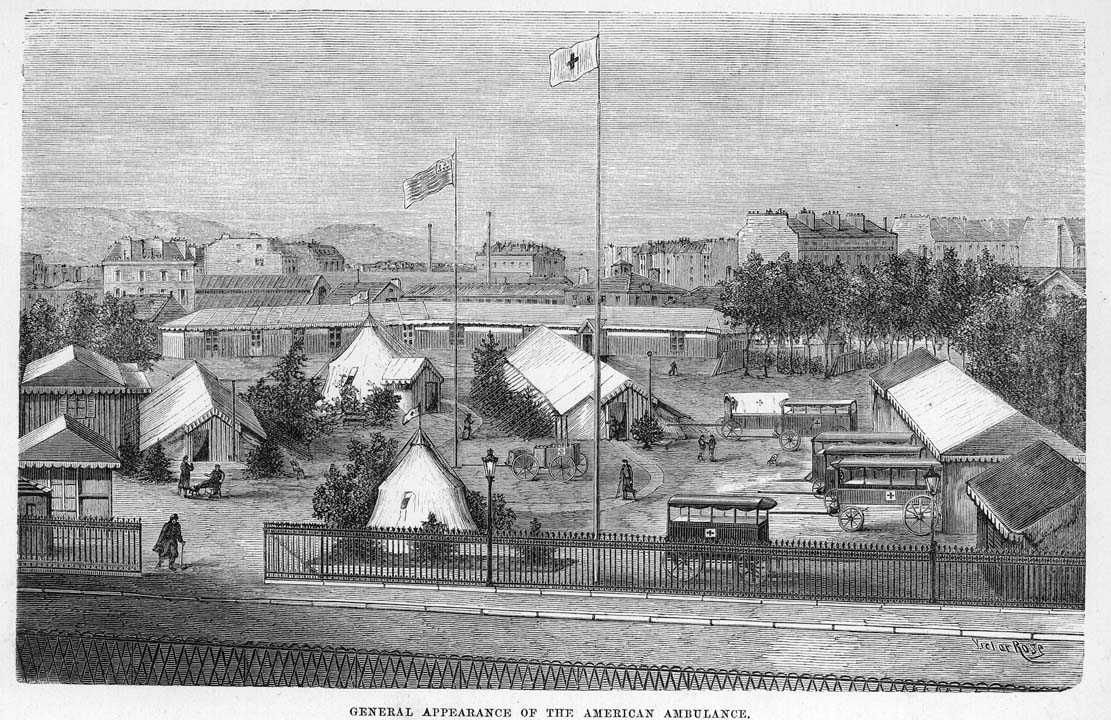
In the summer of 1867 I had the opportunity of directing the attention of a number of scientific gentlemen to the excellences of the American tents exhibited by Dr. Thomas W. Evans, at the Exposition Universelle, and forming a part of his remarkable "sanitary collection." Among these gentlemen was Professor Le Fort of Paris, who then expressed without hesitation his belief that the best results might often be obtained by treating the wounded under canvas. A year or two afterwards he proposed a tent which has many merits ; a description of it I shall here give, and in his own words.
"By a special arrangement, I have been able to get up a model free from the inconveniences belonging to the American tent. The arrangement consists in the employment of a compass offering a point d'appui, to form the roof, and serving at the same time to establish and permanently maintain the separation of the two coverings.
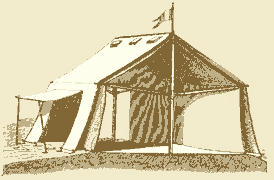
"The skeleton of the tent is composed of two upright poles united at the summits by a horizontal bar slipped through a sheath made in the first roof. The two coverings descend parallelly, (as may be seen in Figure 33,) to the edge of the roof, they then reach the ground, where they are fastened by a few pickets. The vertical walls corresponding to the gables are also formed of double canvas, and are each pierced with a double door, which is opened by rolling up the canvas on itself, and fixing it by a couple of straps. The outer roof has on each side, on a level with the ridge, three whistle-shaped windows; the inner roof is pierced on the same level with a considerable number of openings. The circulation of air between the two coverings and the interior of the tent is very complete, guarantees against any elevation of temperature, and assures a constant and active aëration, especially when the doors are open. The compass is formed of two wooden poles joined at the centre upon a metallic cylinder, which slides freely along the length of the vertical support. The free extremity of each limb of the compass terminates in an iron spindle provided with a screw point and a couple of nuts. This spindle passes through holes pierced in the border of the canvas on a level with the inferior angle of the roof; the interior covering rests upon the shoulder formed by the extremity of the wooden pole; the exterior covering rests upon a nut screwed down twenty or twenty-five centimetres upon the metallic spindle; the second nut, not shown in the design, and which, moreover, is not indispensable, prevents the covering from slipping off the compass. The borders of the two coverings, from the ridge to the ground, are bolt-roped, as are sails; these ropes, attached to pickets, assure the solidity of the tent, for they are more or less put upon the stretch, according as in lifting up the centre of the compass the free extremities of the limbs are separated. Another cord runs horizontally from one end of the tent to the other, fixing and marking the edge of the roof. That of the outer roof terminates in a free end, to be attached to a picket sunk in the ground; it steadies the roof, and prevents the distortion of the compass by the tension of the canvass. It may be observed en passant, and without entering into details, that a few girths sewed on to the canvas may be used to advantage in place of the bolt-ropes, which are greatly affected by the hygrometric state of the air. Besides the two doors placed in each end, a wide door opening as an awning is cut in the sides, which form the lateral walls.
"A very simple modification, and one which neither increases the cost of construction nor the difficulty of installation, allows a disposition to be given to the tent shown in the following sketch (Fig. 34)---an arrangement by means of which the patient can be placed in the open air during the heat of. the day, without being exposed to the rays of the sun. It is only necessary to divide the interior covering into two parts, one of which shall form the roof, the other the lateral walls; these walls are made to slide as curtains upon a horizontal cord, running from one end of the tent to the other and attached to the braces; they may be thus gathered in towards the angles. An inspection of the designs will enable one readily to understand the advantages this ambulance tent, which we have used the past season, has over the American tent. The clear space (and consequently the quantity of air allowed to each patient) is greatly augmented by reason of the vertical walls ; far from . being obliged to stoop on approaching the beds, one may go into any part of the tent, even with his hat on, without hitting the roof anywhere.
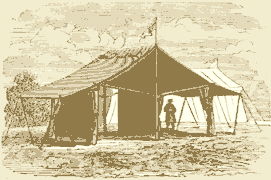
"The circulation of air, as well between the coverings as within the tent itself, is as complete as one could wish, and it may be increased or diminished according to the state of the weather.
"The hygrometric state of the atmosphere incessantly modifies the tension of the coverings. Raising or depressing the compass suffices to remedy these modifications; nothing of the sort is possible in the American tent.(261) The canvas being double at every point, the sick are much more completely protected, as well against the heat of the day as against the cold during the night.
"The ambulance tent which we have proposed measures five metres on each side; that is to say, it covers a superficies of twenty-five square metres. It can receive without being overcrowded six beds, with an interval of a metre between each; and the cubage to be allowed to each patient is not to be estimated in a hospital under canvas as in an ordinary hospital. Each tent made by the house Husson, of canvas 'hystasaspes,'(262) costs about 800 francs. The cost amounts, therefore, to 133 francs per bed. The weight of the tent is a little over 100 kilogrammes (220 lbs.). By uniting together end to end several of these tents, wards may be made for ten, fifteen, twenty, or more sick. The wards will communicate by the doors in the vertical ends, or they may be divided into separate sections by closing the doors. To hold the tents together, all it is necessary to do is to place a clamp pierced with two holes over the spindles of the two free and contiguous branches of the compass."(263)
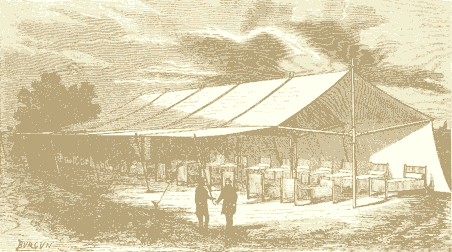
At the commencement of the late war a considerable number of tents were made by the house Husson for the French "Société de Secours aux Blessés," and several kindred associations. Constructed nominally in accordance with the plan proposed by M. Le Fort, they differed in certain respects, as the accompanying sketch will show (Fig. 35). The tents were united together end to end; they were destitute of a double roof, and the quality of the canvas made of flax was so inferior to that used by M. Le Fort in the construction of his own tents, as to greatly invalidate the conclusions drawn from their experimental use.
Qualities.---The tent originally proposed by M. Le Fort is an excellent one; it not only has a double roof, but it has double sides; it is roomy and impermeable. As regards ventilation it could scarcely have been made more perfect. It has, however, in my opinion, several defects---and in making this statement let me say, that it would be impossible to make a tent which should not have defects ; it will necessarily be more or less perfect in some respects, and more or less imperfect in others; it will be found that certain desirable qualities cannot be secured without sacrificing others of almost equal importance, or which, if not really so, may seem to other constructors of tents of equal or even greater importance. The best tent, as the best instrument of any kind, is the one in which the excellences greatly overbalance the faults---is best, if you will permit me to say it, in spite of its faults. But I am now to speak of the defects of M. Le Fort's tent. Its framework is too complicated, each tent is supported by seven poles, and four of these are jointed---that is to say, liable to break, get out of order, and become useless. It should also be said that to reduce their weight all the poles have been made so slender as to be easily bent out of straight lines, as also to be in constant danger of breakage. The material of which the covering is made is cotton stuff of a good quality; to make it, however, according to M. Le Fort, still more impermeable (fairly good cotton canvas requires the application of nothing to make it impervious to wet), it has been steeped in a solution of sulphate of copper. The tissue charged with sulphate of copper, if theoretically less pervious to rain, unfortunately becomes to the same degree less pervious to air. M. Le Fort might reply that the measures which he has taken to secure the aëration of his tent are sufficient to allow him to shut up the pores of the canvas, should he choose to do so. If such is the fact, it would perhaps have been better to have applied to the canvas a coating of caoutchouc, or some other substance which would have given to it complete impermeability. The superiority of good cotton canvas when used as a tent covering depends upon its possessing the two invaluable qualities of impermeability to wet and permeability to air. The only motive which can justify the application of any preparation to a cotton canvas tent covering, is the desire to give to it increased durability. Should the canvas hystasaspes prove to be considerably more durable than unprotected tissues, the objection now offered to its employment could scarcely be maintained. The Le Fort tent stands by no means securely; it relatively offers to the wind a surface greater than that of an English marquee, and this, without either bracing-lines or storm-ropes; in a word, it is a fair weather tent. Entertaining the idea that the American tent could be improved, M. Le Fort has certainly succeeded in realizing his idea, in so far as he may have produced a tent roomier and more accessible to the open air. He has, I believe, however, failed, in so far as his tent is much heavier, much more costly, less secure when pitched, and more likely to get out of order.

 S will have been observed, the
coverings of modern tents have been made of quite a variety of
strong, heavy tissues of hemp, flax, or cotton, or of these materials
mixed; such tissues also have occasionally been especially prepared
by the application of certain substances to insure greater impermeability
or durability.(264)
S will have been observed, the
coverings of modern tents have been made of quite a variety of
strong, heavy tissues of hemp, flax, or cotton, or of these materials
mixed; such tissues also have occasionally been especially prepared
by the application of certain substances to insure greater impermeability
or durability.(264)
There is but one kind of canvas now employed by the French Government in the fabrication of tents---tentes coniques, and sacs tentes-abris. The tissue is made of Picardy or Belgian flax; it is known as toile trois fils---of three threads---and should weigh. 500 grammes per metre of 80 centimetres breadth. The Government, however, recognizes a minimum weight of 400 grammes per metre; and it may be here remarked that the hygrometric properties of flax cause all coarse unbleached tissues made from it to vary quite 20 per cent. in weight, according to the amount of humidity present in the atmosphere.
A piece of French regulation canvas 4 centimetres square, and containing 16 square centimetres, is composed of 120 threads (maximum), 70 of warp and 60 of woof; as the threads of the warp are double, the total number of threads is 200. The two threads of the warp are parallel (untwisted), and each of the two rather heavier and more firmly twisted than the woof thread. The threads, however, of both warp and woof are wanting in regularity.
According to the official specifications, a square centimetre of this canvas must contain 32 or 33 warp threads and 14 or 15 woof threads. The tissue must respond also to a dynamometrical test---viz., a strip 40 centimetres long and 5 centimetres broad should sustain a weight of 240 kilogrammes in the direction of the warp, and a weight of 160 kilogrammes in the direction of the weft. French tent canvas is pliable, but feels rather harsh to the touch; its colour is a dark brown, the natural colour of the flax.
Hemp has occasionally been used in the fabrication of French tent coverings,---"but only exceptionally; the high price of the best qualities of the material which it would be indispensable to select for this purpose, the great difficulties to be overcome in weaving---dans le tissage à sec---a thread No. 16, regular and free from knots, so as to arrive at the production of a tissue well closed and uniform, the waste attending the different processes of manufacture, are so many causes which have determined the Government to prefer flax to hemp in the fabrication of tent coverings." These reasons seem to have had no less weight with other Governments, as hemp is at the present time rarely employed in Europe in the fabrication of tent canvas.
English (Government) tent canvas is now made of the "best long Baltic flax;" it weighs 10-1/4 oz. to the yard (27 in. wide), and, although lighter, is more closely woven than the French canvas. The thread also is finer, more uniform, and of a clearer colour than the French thread, and the quality of the tissue is apparently superior to that used in France. The quality of the canvas is determined by its weight, the number of threads in a square inch, and its general appearance, but no strength test is used.
Austrian (Government) tent canvas is made of flax-thread No. 16 and No. 10, and weighs 20-3/8 loths (306 grammes) per metre, of the breadth of a Vienna ell (78 centimetres). The tissue must contain nineteen threads (weft) in each quarter of a square inch, and is, moreover, subjected to a dynamometrical test.
The flax tissues used for tent coverings in different countries vary considerably in weight, strength, fineness, colour, &c.; they all possess, however, certain common characteristics. The linen fibre is about 1/2000 of an inch in diameter, is cylindrical, with little knots or swellings at intervals; it is roughened also by the frayed and partly detached elementary fibres composing it; it is hard and strong, although perhaps not harder than the cotton fibre.
Linen, as well as hemp threads, are hard and stiff, not regular, smooth upon their surfaces, and inelastic. The meshes between the threads are seldom perfectly closed, as may be seen by looking at almost any piece of linen canvas held up before a window. By examining the canvas more closely with a lens, the threads may be seen crossing each other like wires, or, rather, like sinewy cords of catgut, leaving distinct interspaces at each crossing.
There are several qualities of cotton canvas used by the United States Government for making tents; these are commonly distinguished as 8-oz., 10-oz., 12-oz., and 14-oz. "ducks," the specification being derived from the weight of the tissue per yard of 28 in. width. While the 8-oz. and 10-oz. ducks are used for making common tent coverings, hospital tents are generally made of 12-oz. or 14-oz. ducks.
A piece of American 14-oz. duck 4 centimetres square, containing 16 square centimetres, is composed of 125 threads, 75 of warp and 50 of woof; but the warp threads are each formed of three distinct threads, and the woof threads of two distinct threads; thus the total number of threads in such a piece is 325. A square yard weighs about 18 oz., or 17. oz. more than an equal measure of French canvas---a difference equivalent to about 4 per cent. When the cotton threads are unravelled, they look considerably larger than the flax threads of the French tissue, on account of their greater elasticity ; the result is that, although a square yard of 14-oz. cotton duck weighs but a trifle more than an equal measure of French regulation tent canvas, it seems to have considerably more body than the French canvas.
American duck is pliable, smooth to the touch, and, when new, has the colour of common unbleached manufactured cotton; its whiteness is never dazzling, and, after a little exposure, it assumes a drab colour. Its quality is determined by its weight and the number of threads in a square inch. No dynamometrical test is employed.
Cotton canvas is no longer used in the British army for tents. That formerly employed weighed 7 oz. to the yard, 27 in. wide.
The Italian Government employs cotton canvas almost exclusively for the construction of large tents. The tissue used is 75 centimetres broad, and weighs 245 grammes per metre---that is to say, about 7- oz. to the yard, 28 in. wide.
The several varieties of cotton canvas which I have mentioned : resemble each other in certain essential respects. The fibres of cotton vary, according to the quality of the sample, from 1/1000 to 1/4000 of an inch in diameter, and appear, under the microscope, like flat twisted ribands; they are smooth, have a certain strength, and are very hard. Cotton thread is very regular, is pliable and elastic, and has a soft downy surface. These qualities of the thread make it easy to fabricate tissues quite free from visible meshes. Indeed, under a lens it will be difficult to find an open mesh in a good piece of American duck. American canvas is probably not woven as closely in the loom as French canvas, but the meshes will be found to have been packed with minute fibres pushed in and constantly held in place by the elasticity of the threads.
Very widely different opinions are entertained at the present time with reference to the respective merits of cotton and linen tent coverings. I presume, however, that few persons would venture to affirm that cotton tissues were inferior to linen tissues for tent coverings per se,---at least, the argument in favour of using linen is usually expressed by a single word---cheapness. Coarse linen tissues have generally been thought to be more durable than those of cotton, while at the same time they have commonly been offered in the market at a smaller first cost.
These points are of sufficient importance to be considered; and if we find that the durability of such linen stuffs is very much greater than that possessed by corresponding cotton stuffs, and that their first cost is, as a rule, very much less, we shall certainly have to admit the justice of the argument, unless we can finally prove that the use of linen canvas is attended with disadvantages which are at least an equivalent for its relative cheapness.
I believe, however, that the durability and cheapness of linen tissues, as compared with corresponding cotton fabrics, have been commonly greatly over-estimated. The destructive influences to which canvas is exposed when made into tents are various and numerous; and although linen may wear better under. special circumstances than cotton, under others it is certainly no more durable.
It may be summarily said that tents are destroyed---(1) by the wear of actual use; (2) by the wear and tear of transportation ; (3) by exposure to the weather ; (4) by mildew ; (5) by a variety of accidents to which they are exposed, such as being torn by bodies pushed against them from within or without, "sparks of fire from camp fires and stoves," &c., &c.
With regard to such wear as comes from ordinary use and handling, cotton fabrics are not inferior to linen. If linen fabrics are believed to wear better than those of cotton it is usually only a priori conclusion from the well-known fact that linen fabrics are, when new, much stronger---that is to say, can resist, without being rent, a greater tractive force than similar cotton fabrics. But it is not altogether easy to ascertain the relative strength of flax and cotton fibres, or of flax and cotton threads, the strength---tenacity---of these threads depending greatly upon the relative amount of twisting they receive ; and cotton usually requires more twisting than flax to develop a corresponding degree of tenacity, as the flax fibres are long and knotty, and consequently hold together better. One fact is certain: American 14-oz. duck, when new, will by no means respond to the French dynamometrical test.
In reply to a question, concerning the relative durability of cotton and linen sails, addressed to an American sail-maker of large experience, I received this answer:--- "Cotton sails generally wear three years; after this time they are not to be depended upon. Linen sails generally wear two years, with more mending than cotton. Linen sails grow thin by wear. After a time cotton sails grow weak, but they do not grow thin by wear." This statement is not surprising, for although linen canvas when new is stronger than cotton canvas, its inelasticity and hardness cause it to wear out much faster when subjected to the same use. Linen canvas becomes with use both thinner and lighter; cotton canvas grows lighter with wear, but it does not become in the same proportion thin, on account of the elasticity of its constituent fibres. "A fibre," says M. Alcan, "of a given strength, but without elasticity, would be much less suitable for making thread or cloth than one of less strength but sensibly elastic. This last property, although less generally appreciated than the first, is therefore quite as useful." (265) The hardness and stiffness of linen and hemp tissues are particularly noticeable when they are wet or even damp. A small piece of French tent canvas, if immersed in water, will curl up like a piece of leather when heated, and its hard, horny surface then greatly exposes it to wear from friction. And I may here remark that it is a well-known fact of common experience that linen articles of apparel will not stand frequent washings better than similar cotton articles. The smooth fibres of cotton slip over each other easily, the knotty and gummy fibres of flax and hemp slide over each other with more difficulty, with more friction and more wear.
With regard, therefore, to two of the principal causes of the destruction of tents---the wear of actual use and the wear resulting from transportation---I presume there is very little, if any, ground for preferring flax to cotton as the material from which to make tent coverings.
Probably the principal cause of the destruction of tents is their liability to become damaged by exposure to the weather. Such damage is shown by a loss of strength in the tissue which, without losing substance, grows weak, and becomes, as it is popularly expressed, rotten. This condition is so directly connected, however, with one of the specific causes of the destruction of tents---mildew---as to be hardly separable from it.
To what extent tissues of cotton are more or less exposed than those of linen to "rot" and mildew, it is not altogether easy to decide, in the absence of careful comparative experiments, which alone can definitively settle the point in question. One fact is certain, that especially in damp, hot, coast climates, unless great care is taken, tents both of linen and of cotton are liable to become mouldy, and are perhaps more frequently condemned on account of being rotten than because unserviceable from actual wear.
I doubt, however, if there is generally much difference in the durability of linen and cotton tents when both are pitched permanently and exposed only to the destructive influences of the weather. The common opinion among the French fournisseurs whom I have consulted has been, that a regulation French tent (tente conique) should last, if pitched permanently in such a climate as that of Paris, two or three years. In reply to the question addressed to the English War Office:---"How long might an English hospital marquee be expected to remain serviceable if, pitched permanently, it was exposed only to the destructive influences of the weather---say in such a climate as that of Aldershot (England) ?" the reply was, "Eighteen months." To a similar question, the reply received from the Surgeon-General's Office at Washington was as follows:---"A tent of cotton canvas, if pitched permanently, and exposed only to the destructive influences of the weather, in such a climate as that of Washington, could not be expected to remain serviceable more than three years." To a similar question, the Italian War Office replied generally:---"There is no doubt that these tents (of cotton canvas) thus exposed would remain for a long time in a satisfactory condition. The average service life of a tent (tente conique) is four years." To a like question the French Intendance also replied generally:---" The present tente conique cannot be used more than four months without undergoing repairs. This four months' lastingness would doubtless be sensibly reduced if the tent were subject to numerous transportations and repitchings. Three successive campaigns of four months, separated by long intervals during which the tent is repaired, usually result in so much wear as to indicate the necessity of replacing it."
It is an opinion among certain French fournisseurs and fabricants of awnings that linen canvas, when exposed to the weather, lasts about a third longer than cotton. Per contra, the opinion of American sail-makers is that linen "rots quicker" than cotton, and "because of its tendency to absorb water."
Now it is a well-known fact that flax and hemp are exceedingly hygrometric, and imbibe water rapidly whenever it is present in the atmosphere. Coulier found that common cotton and linen sheetings imbibed moisture hygrometrically in the proportion of 0.084 and 0.153 to the gramme of each;(266) that is to say, linen showed nearly twice the moisture-absorbing power of cotton. Coulier also established the fact that the hygrometric properties of linen tissues increased in proportion to their coarseness. But this is not all : not only do the hygrometric properties of the flax fibre cause linen canvas to absorb more moisture than cotton canvas would do under the same circumstances, but the structure of linen canvas, the openness of its meshes, causes it to hold a still larger proportion of water when exposed to dew, mist, and rain; while cotton canvas similarly exposed, to use the expressive language of one of my correspondents, "sheds water like a board."
Moreover, flax and hemp, especially the latter, contain much more organic matter than cotton in addition to the purely textile libres, and even these are always more or less glued together by a gummy, resinous substance known as pectin. So that instead of being composed as are the fibres of cotton, of simple elementary cells, the linen fibre is composed of cells soldered together by foreign matter---matter which is moreover soluble in water.(267)
The hygrometricity of hemp and flax, and the large proportion of organic matter they contain, cause these substances to be very liable to ferment and rot when brought together in large quantities, as on board of ships and in warehouses. The danger thus sustained by cargoes of hemp is often very great, and it is a rule among shippers never to take on board hemp in damp, wet weather; special precautions also are always adopted to preserve the cargo from dampness and subsequent heating.
These facts would certainly seem to indicate that flax and hemp tissues are more affected by climatic conditions than those of cotton, and that linen fabrics are more likely to become rotten when long exposed to dampness.
Mildew, or the development of cryptogamia in the tissue of the canvas, is only a name given to a way in which canvas becomes rotten; but its chief predisposing cause appears to be moisture, and where this is associated with a warm temperature the disease is pretty sure to soon manifest itself. This is one of the chief specific causes of the destruction of tents in certain climates, and every one acquainted with the subject knows that, even in France, one of the difficulties connected with preserving tents arises from their liability to become covered with les piqûres. Indeed, the physical qualities of linen would seem to especially expose it to such attacks.
We may fairly conclude, therefore, that if in exceptionally dry climates, or where great care is taken, linen is more durable than cotton, the advantage in this respect would be quite on the side of cotton when exposed to moisture or the climatic or special conditions which favour the development of cryptogamic spores.