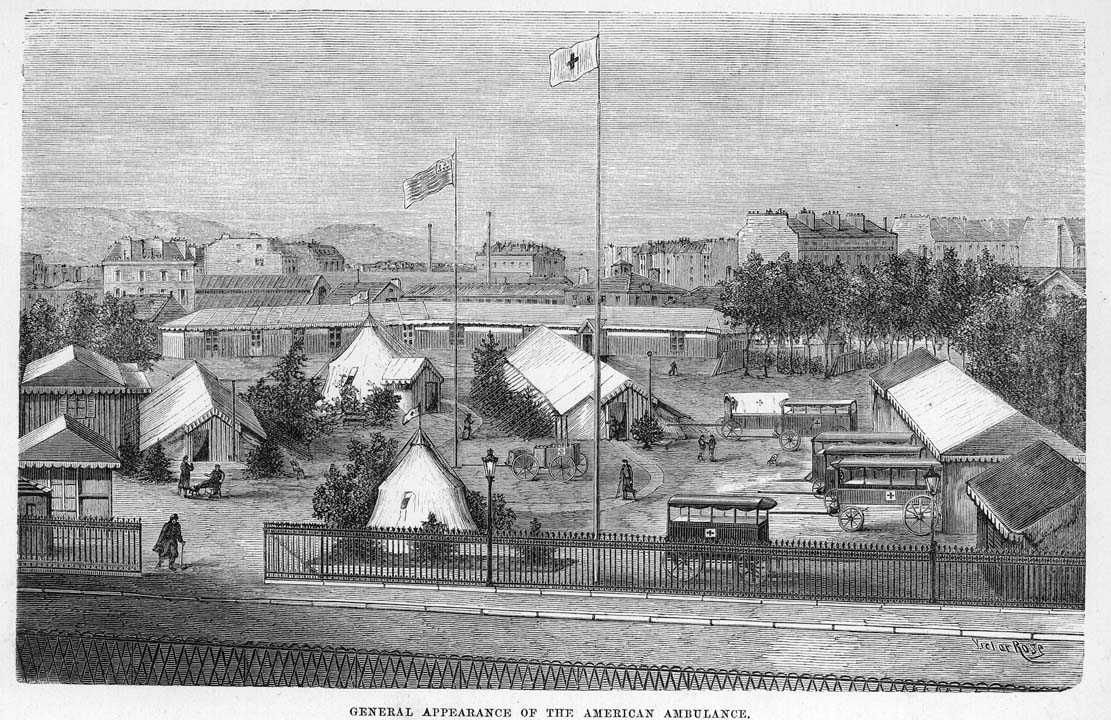

 F in this general account which
I have given of tents as used, principally in war, from the earliest
times to the present, I have only spoken of them when use as a
shelter for those who are well, it has been for the reason that
it is only very recently, that their advantages as a means of
hospitalizing the sick have been made a subject of serious consideration.
F in this general account which
I have given of tents as used, principally in war, from the earliest
times to the present, I have only spoken of them when use as a
shelter for those who are well, it has been for the reason that
it is only very recently, that their advantages as a means of
hospitalizing the sick have been made a subject of serious consideration.
In another part of my Report, I have stated that the first hospitals organized under tents, of which we had any accounts of sanitary or scientific value, were those established in the Crimea in 1855. While this statement is quite correct, and the hospitalization of the sick under canvas may be said, very truly, to date from the time of the Crimean War, since the first experiment was then made which clearly proved the value of the system,---still, in treating of tents and their uses historically, we must admit that long before that time, tents had occasionally been employed to furnish quarters for those who might have been disabled in war; and if I have chosen to present in this place such historical facts as, relating to this use of tents, appear to me to be most interesting, it has been partly to avoid digressions and detached allusions to a specific use, and partly because I have believed they might here very naturally serve to close the general account which I have given of the tents formerly employed, as also, to introduce the special account which I shall give of those now in use.
It is very certain that among those people who have been accustomed to dwell under temporary shelter, such shelter has served alike for the sick and the well. So also, in armies in ancient times, the quarters given to the troops, whatever may have been their character, were occupied alike by the sick and the well. After tents had been introduced into the Roman army, each soldier considered the tent occupied by his contubernium, as his home; if he was ill he retired to it, if he had been wounded, he sought a refuge in it.(199) Nor was the custom of thus regarding the army tent peculiar to the Romans, as may be inferred from the many instances in which the older historians, both Greek and Latin, speak of the large numbers of sick and wounded found in the tents of captured camps. Often these accounts are quite specific, and show that the wounded, there received, were the subjects of special care and solicitude. The learned Freinshemius, in his supplement to the life of Alexander, by Quintus Curtius, doubtless had the proof in hand when he said:---"He (Alexander) treated his wounded with extraordinary care, he visited them from tent to tent, even the common soldiers, and assuaged the sufferings of such by presents, by praises, and by promises."(200) And Amyntas speaks as if it was a common practice in Alexander's army to treat the wounded in their tents.(201)
It is evident also from the account which Thucydides gives of the raising of the siege of Syracuse by the Athenians, that the sick and wounded had been very generally taken care of during that siege in their tents.(202) And, according to Livy, during the war which the Romans carried on against the Samnites, about the year 321 B.C., Papirius Crassus, wishing to gain the esteem of his troops, visited the wounded in their tents.(203) So Tacitus, in the account which he gives of the civil war between Otho and Vitellius, and of the sharp conflict between the legions Rapax and Adjutrix, says that after the action, "in the same tents, relatives, friends, and brothers dressed each other's wounds."(204) The statement is also made by Lampridius (A.D. 222), that Alexander Severus visited his sick soldiers "who were in tents," and encouraged even the humblest by his kindness:---Ægrotantes ipse visitavit per tentoria milites, etiam ultimos.(205)
But it would be quite impossible to say, in view of this practice of permitting the sick and wounded to take refuge in their tents, that these were used as a means of hospitalizing the sick. It was only long after the establishment of the Roman Empire, that the importance of maintaining an infirmary or hospital, in the army or legion, was even suggested. It has been inferred from a passage in the treatise on Castrametation, written by Hyginus Gromaticus in the time of Trajan, that the Romans were then in the habit of treating their sick in camp in hospital tents. And Hyginus certainly speaks of the place where the valetudinarium (infirmary) should be established in the camp, at a distance from the veterinarium and workshops:---ut valetudinarium quietum esse convalescenti bus possit.(206) Masquelez, in commenting on this passage, the substance of which I have given, repeats the opinion of Lange, that, as none of the writers preceding Hyginus, not even Josephus, have made mention of the hospital, when speaking of the camp, the valetudinarium was probably a creation of Trajan's time ;(207) while Colombier says that he was "acquainted with no (Roman) writer, after Hyginus, who alludes to the valetudinarium,"(208) and therefore doubts very much if at any time it was considered essential to a camp.
The valetudinarium, of which Hyginus speaks, was very probably only a sort of convalescent hospital intended for convalescentibus---those who, having been ill, had rejoined the legion before they were able to endure all the hardships of the camp, or for such as, suffering from trifling ailments, might have been fairly classed with the valetudinarians.
But in view of the entire absence of the details necessary to an appreciation of the character of the valetudinarium , and the importance accorded to it in the Roman army, it is very doubtful if it was anything more than a temporary device. The Roman troops were probably treated, when ill, only in quarters, which were sometimes houses and sometimes tents, but never hospital tents.(209)
I have already had occasion to speak of the slight attention paid to the sick and wounded during the middle ages. Military hospitals were then quite unknown, and the helpless victims of war were commonly abandoned to their fate, and the chance of obtaining succour from the personal charity of those to whom they might be able to appeal. As among the Romans, doubtless the quarters of the troops, whatever they may have been, were the habitual places of refuge for the sick and disabled, who were permitted to remain in them, if likely to recover speedily, or were subject to be discharged, if considered effectively hors de combat.(210)
I have found but a single instance, in the course of my own reading, in which a hospital organization is said to have been maintained in camp, before the close of the sixteenth century, and curiously enough, this relates to a tent hospital.
In the "Chronicle of the Conquest of Granada," from which I have already made several extracts, it is said that:---
"In the spring of 1484, the ancient city of Antequera again resounded with arms. In a little while there was a chosen force of six thousand horse and twelve thousand foot assembled in Antequera, many of them the very flower of Spanish chivalry, troops of the established military and religious orders, and of the Holy Brotherhood.
"Every precaution had been taken to provide this army with all things needful for its extensive and perilous inroad. Numerous surgeons accompanied it, who were to attend upon all the sick and wounded without charge, being paid for their services by the Queen. Isabella also, in her considerate humanity, provided six spacious tents, furnished with beds, and all things requisite for the wounded and infirm. These continued to be used in all great expeditions throughout the war, and were called the Queen's Hospital. The worthy father Fray Antonio Agapida vaunts this benignant provision of the Queen as the first introduction of a regular camp hospital in campaigning service."(211)
This passage would certainly seem to support the truthfulness of the proverb, that there is nothing new under the sun, at least in so far as the mere use of tents in the hospitalization of the sick is concerned. But admitting it not to have been one of those "weeds of fable" with which Irving confesses this tract of history was too much overgrown, the principal value which we can accord to the establishment of Queen Isabella, is its right of priority. Whatever may have been the good results obtained by it, they bore no fruit. The experiment was nowhere repeated, and would have faded from the memories of men, but for the indefatigable industry of some Spanish monk, to whom no detail was too insignificant, which might add to the glory of his country, or the honour of its sovereigns.(212)
The medico-military literature of the sixteenth and seventeenth centuries passes over, almost in silence, the whole subject of field hospitalization. From it one can obtain very little information concerning even the quarters of the troops, or any of those conditions which most directly influenced the health of the army. That the historical and military "mémoires" of the period should have been equally silent, is scarcely surprising; indeed, the whole subject of hospitalizing the sick of armies was so little thought about, by the class of writers who produced these works, as to have scarcely been made the subject of a passing remark. Sickness and death were considered the inevitable conditions of war, and the mortality from disease, the tribute demanded by an inexorable fate alike from the victor and the vanquished. Few general officers conceived that they could possibly do more, in behalf of the sick, than discharge them from the service, or consign them to such quarters as chance, necessity, or an ignorant parsimony had provided.
We only learn that a few hospitals, such as they were, existed somewhere, and that the sick were occasionally taken care of in camp; and it is not improbable that tents may in some instances have been especially assigned to the treatment of certain cases. But it may be safely said, that at the close of the seventeenth century, the care of the sick in camp was the subject of very few fixed regulations in any army in Europe. So far as the French service is concerned, this fact is very well shown in a passage in Bombelles, which is as follows:---
"The sergeants should never take soldiers to the hospital on their own responsibility; they should do this, only by the order of the surgeon-major, and by that of their officers, who frequently prefer to have them treated in a separate tent, at their own expense; for every soldier who goes to the hospital runs a great risk of never coming back, either by reason of death or desertion."(213)
Thus it appears, that at the time of which I speak, officers (company or battalion) could have the men taken care of at their own expense, in a tent, if it so pleased them.
Indeed, this state of things continued very generally, until the middle or latter part of the eighteenth century. The infrequent references made to tents by nearly all writers on medico-military subjects until towards the close of the eighteenth century, is certainly very remarkable. No allusion is made to them by the author of the "Mémoires concernant les Hôpitaux Militaires," presented to the Council, July 31, 1736. The "Ordonnance du Roi portant règlement général concernant les Hôpitaux Militaires," of the 1st of January, 1747---up to which time there had been, as regards the hospitals, according to Bardin, nothing but "arbitraire, désordre et dilapidation "---is silent upon the subject of tents. Chennevière reproduces this "Ordonnance" in the second volume of his "Détails Militaires," published in 1750 ; and although adding much curious information concerning the organization of hospitals both fixed and ambulant, he refers to the use of tents for hospital purposes, neither in this volume, nor when he again wrote upon the organization of army hospitals, in the 5th volume of his "Détails," published eighteen years later. The " Encyclopédie," in the article on " Les Hôpitaux Militaires," which appeared in the Supplement of 1777, makes no mention of the employment of tents. Nor does Daignan, in his treatise on military hospitals, even allude to the existence of tents.(214)
Munro is, in fact, one of the earliest medical writers who refers to the use of tents for hospital purposes. In an "Essay" published in London in 1769, he says:-" The sick soldier should be sent either to the regimental or general hospital; or at least, if these hospitals are far off, and it be impossible, from any cause, to convey the sick to these places, they should be put under tents." This recommendation, in his book, of the use of tents for hospital purposes, is supported by a foot-note, which is as follows:--
"Certain surgeons-major serving in Germany always took with them, on going into the field, a number of reserved tents, which followed the regiment with the medicines; and whenever their soldiers fell sick in camp, if they were not near villages where they could establish the regimental hospital in a house, they directed the reserved tents to be pitched, and the ground to be covered with a plenty of straw, and with blankets, that the sick might lie there and be taken care of, until there should be a favourable opportunity of sending them to the general hospital."(215)
Although no date is given to indicate when "certain surgeons-major" served in Germany, that very circumstance makes it probable, that a reference is made to facts connected with the campaigns---which occurred a few years before the publication of the Essay---between 1757 and 1762. As the Prussian army is said to have been "regularly provided" with tents, some time before the general employment of such shelter in the French service, it is not unlikely that in Germany tents were first made use of on the Continent, as a means of sheltering the sick, as also, that the use of tents for hospital purposes in English armies, may have been adopted from their allies, as were a multitude of still existing English military usages, during the campaigns in Flanders and Germany of the first part of the eighteenth century. Munro also, in speaking of hospital ships, says:---
"They ought to take on board when receiving their provisions, a number of large tents suitable to lodge the sick and wounded immediately on making a landing, in those places where the troops are to remain some time. When, however, a siege is anticipated which may last some time, and it may not be possible to have suitable places for the sick until the close of the siege, it is well to attach to the fleet a vessel or two, loaded with wood or other materials suitable for constructing temporary, pavilions or huts for the sick, if such materials cannot be obtained where the troops are to operate. Such pavilions or huts covered with thatch, are very necessary in warm climates, because the rays of the sun, which fall perpendicularly upon the canvas of the tents, render their interior insupportably hot."(216)
M. Bégue de Presle, in a "discourse preliminary" to the work of Munro, to which I have referred, and of which he was the French translator, alludes to the use of tents as follows:---
"The neighbouring villages are selected for these hospitals (hôpitaux ambulans), the farm-houses, churches, and barns serving as wards. If these conveniences cannot be obtained, the sick are placed under tents. If the sick are put under tents, every precaution must be taken to render a sojourn there as little injurious as possible. The earth should be beaten down and sprinkled with sand; the beds should be placed upon shavings or straw; earth should be thrown up around the edges of the tent, which should also be surrounded by a ditch; the tent should be covered with several pieces of canvas ; perfumes should be burned within it; a little fire should be placed in a chimney made of turf, or at least one should be lighted outside of the tent. There ought to be several supplementary tents, into which might be put apart, those sick with contagious diseases. It would be profitable, however, to establish in place of the tents light frame-work barracks, which might be easily and quickly put up, as also taken down."
The first instance, within my own knowledge, in which the use of tents was recommended---without reference to the existence of other means of shelter---in the organization of hospitals for the sick and wounded, may be found in a work published in the year III. of the French Republic. After the observation, that it is customary to establish the ambulant hospitals in large buildings---generally convents---and that these buildings are very rarely suitable for such a purpose, these statements follow :---
"The proportion of deaths to the sick in the field hospitals is commonly sixteen per cent. ; in the sedentary hospitals, the proportion is three per cent. This difference in the ratio of the deaths to the sick, depends upon the comparative facility with which pure air may be obtained in the sedentary hospitals.
"The way to correct this vice of the hospitals which follow armies, would be to organize them under tents---sous des tentes---instead of establishing them in buildings. The happy results which have recently been obtained at the camp infirmary of the School of Mars---au camp de santé de l'École de Mars---should be an inducement to multiply these establishments. By means of such a system those successive lines of hospitals might be dispensed with, as also the repeated transportation of the sick, which employs a large number of waggons and horses; and in fact, those epidemics which are brought from camps into the interior of the country by convoys of the sick."
And again, in another chapter, it is observed:---
"The air must always be considered as the first agent in accomplishing a cure, as that, without which, all other assistance must be ineffectual. This fact should make every one feel how important it is to form in the rear of armies camps de santé, and to treat the sick under tents where the air can renew itself easily and completely."
And the statement is added:---
"It is only in the winter, or in seasons especially rainy, or in special cases of disease, that the sick should he sent to hospitals or placed in barracks."(217)
No recognition of the value of tents in the hospitalization of the sick could be expressed more clearly than this; and the reasons assigned for such a use are as valid and as comprehensive as had they been founded upon the results of an extensive experience. That they were not so founded is, however, certain.
Unquestionably, towards the close of the last century, a hospital was once organized under tents at the École de Mars, and with a "succès heureux ;" but as I have found no allusion to this experiment in any contemporaneous writer, and have been unable to obtain any details concerning the installation, or in fact any statements concerning it, except those which I have here reproduced, I can only infer that it attracted very little attention at the time, and that the propositions of the writer, luminous and meritorious though they be, are to be considered historically rather as the motives of a project than as the inductions from practice.
A few years later, the use of tents for hospitals was recognized by the French Government in an official decree, from which shall make a few extracts.(218)
"Should there be no place for a field hospital (hôpital sédentaire), or should the place be unsuitable, the Commissaire can have the sick barracked, or put under tents; he can also have tents pitched or barracks constructed for an ambulance (hôpital ambulant), which may seem likely to remain a considerable time at a fixed post." (II. Sec., Art. 2.)
In the same decree we are told how the divisions of the ambulances appointed to follow the different columns of the army were to be organized;
"and in such a manner, as to form in the field one or several hospitals of first relief, even under tents, in the absence of buildings." (IV. Sec., Art. 27.)
Again, we find that:---
"Soldiers affected with simple itch, or gonorrhoea uncomplicated, shall be treated under tents, to wit: in the armies of the South from the 21st of April until the 23rd of September, and in the armies of the West and North from the 21st of May until the 23rd of September. In the camps, and attached to each army corps, there shall be a certain number of tents set apart for the treatment of the itch." (VIII. Sec., Arts. 75-7.)
These extracts present everything said upon the subject of tents, in this ordinance of the French Government relating to hospitals ; and in fact, Articles 2 and 27 state, substantially, everything which has since been said in official ordinances. It was very seldom, however, that the terms of the decree were acted upon, as we may learn by consulting Larrey, Percy, Desgennettes, and other officiers de santé under the First Empire. At least, except at the École de Mars, no one appears to have discovered that a hospitalization under tents possessed any special advantages, or was to be considered in any other light than as a substitute for the inaccessible or unavailable shelter of more substantial constructions.
Larrey seems to have been particularly unfortunate in his experience. "At the battle of El A'rich," he says, "the wounded were placed under tents upon the wet earth, exposed to the continual rain which fell during the siege of this fort. Eight were attacked with tetanus, which assumed every form, and was followed by death in each case." Referring to this incident in another place, he informs us that "the tents were bad," and moreover, that numbers of the wounded were only under the cover of palm leaves, "alike unprotected against the rain and dampness."(219) These are the only allusions Larrey makes in his " Mémoires" to the use of tents.
Dr. Hennen, who served as an army physician during the Peninsular campaign of 1812, says :---"Marquees are excellent as hospitals in good weather."(220) But I can only conclude, after having consulted the writings of Guthrie, Faulkner, Millingen, and other English surgeons, that during the early part of this P century, tents were rarely used even in the British service---except perhaps for the regimental infirmary---at any season of the year, when other shelter could be procured. Indeed, until the time of the Crimean War, they were employed in no European army as a means of hospitalizing the sick, except occasionally and in very limited numbers.
The description which I am about to give of the tents now in use in the armies of some of the principal military states, will show with sufficient clearness the character of the shelter which has been provided for the sick and wounded of modern armies, when it has been thought expedient to place them in hospitals under canvas; and that my account may be in this respect as complete as possible, I shall indicate the qualities of each tent model with special reference to what I believe to be one of the most important and useful services, which may be secured by the employment of portable shelter in the field.

 EFORE attempting, however, to describe
in detail the tents of the present century, those now used in
the construction of camps, and more especially of hospitals, it
may not be improper to present, in a general way, the essential
facts derived from an historical study of tent architecture.
EFORE attempting, however, to describe
in detail the tents of the present century, those now used in
the construction of camps, and more especially of hospitals, it
may not be improper to present, in a general way, the essential
facts derived from an historical study of tent architecture.
The greatest differences in the construction of tents, have been occasioned by the more or less abundance of the materials from which a temporary shelter could easily be made. Thus, where the common arts of life are unknown, grass, the bark and branches of trees, and even earth, are used, to obtain a temporary shelter and in such a way as generally to result in the erection of non-portable constructions, which are to be considered huts rather than tents. So the impossibility of obtaining materials from which a portable shelter can be made, has often forced modern armies to have recourse to equally primitive means of defence against the inclemency of the weather. Wherever the materials from which tents might be constructed have existed in abundance, a preference has generally been given to that material which was supposed to answer the purpose best at the least cost.
If the Romans used skins, it was because they were cheaper than woven stuffs, and because they better protected, from the rain, both the men and their arms. If the Syrians used, and still use, tents of cloth, it was---it is, because woven fabrics have long been easily obtained in the East, and because, while lighter than skins, they afford a shelter quite sufficient, in climates mild and comparatively rainless. Indeed, the Tartars and the nomads, of the more rainy portions of Asia, have always used tent coverings of felt or of skins.
The Syrian tents of woven fabrics were only introduced into Europe, when the materials from which they were made had become abundant and relatively cheap, and when the importance of using, for military purposes, the lightest and most portable tents, began to be understood.
The permeability of canvas coverings to rain, has always been considered an objection to their use in Europe, and a variety of special remedies for this evil have been adopted as well as suggested. A sharper pitch than is common in Syrian tents, has generally been given to the roof of the European tent. In the East, wherever the weather is generally fine, probably the most common form used is that of the rectangular pavilion; the pitch of the roof is frequently wholly one way, and is commonly very slight. In the West, wherever the pavilion form may have been adopted, the roof has not only had a double pitch, but the angle enclosed has been quite sharp. So also, it has been found expedient in the West to adopt the Eastern sur-tente, or "fly," but curiously enough the fly, having one principal object in view as used in the East, was adopted in the West, principally for another purpose: in the East, the fly is rarely used except as a sun shade or parasol, in the West, the fly is rarely used except as an umbrella.
An attempt has been made to render the common single canvas tents of the troops less permeable to rain, by restricting them to wedge-shaped or sharply conical forms. It has been often stated, although originally, I believe, by Di Marsigli, that the Turks were in the habit of making their tents very low and flat-roofed, because, accustomed to sit upon cushions on the ground, there was no occasion that their tents should be lofty in any part. Now the Turkish conical tent is certainly flatter than are the conical tents most used in Europe and the United States, but the reasons for the flatness of the roof are, because the roof is less frequently called upon to serve as a watershed, and because, by making it less sharply conical the tent stands more securely, and a considerable economy is obtained in the ground-surface covered.(221)
The material of which modern tent-coverings have been made has always been some sort of woven stuff, and generally the tissue has been of linen. Toile is the common word used to specify it by French writers of the eighteenth century, and this word was applicable to "any simple tissue composed solely of linen or hemp."(222) I have elsewhere stated that the cannonière was made of toile d'Alençon; and Colombier says, this was assez épaisse ---moderately heavy. Tents were sometimes said to have been made of coutil; but this was only "grosse toile," used for "bed-ticks, bolsters, pillows, and tents."(223)
The "Encyclopédie," in speaking of the use made by the Tartars of felt, in the construction of tent-coverings, proposes the employment of that material in the construction of tents for military purposes; but the suggestion would never appear to have been adopted.
Puységur, however, seems to have successfully suggested that tent-coverings might prove less permeable and more durable if made of a sort of oil-cloth;(224) at least it is said that, towards the close of the last century, heavy canvas, made of flax or tow, and covered with a composition principally of wax or resin, was occasionally used "to cover tents, gun carriages, waggons, and carts for the army." (225)
It is very difficult to ascertain now the exact grades or qualities of the tissues most commonly employed in the French service for tent coverings, even during the first half of the present century. Occasionally hemp canvas---or rather, toile écrue---has been used for the tents of the superior officers, although these have generally, more recently, been made of coutil; and often this ticking has been striped with blue, in which case the tissue has been made partly of cotton. The troop-tents have generally been made of light flax canvas.
M. Michel Lévy and E. Boisseau have concluded a summary account of tents, by observing:---
"The subject of tents, which has been greatly complicated, is in reality very simple; their construction has been determined by a few general principles only. The frame-work is evidently the essential part, since it establishes the form and capacity of the tent, and no rational classification can rest on any other basis. From this point of view tents maybe divided: first,---into tents having a single mast; secondly,---into tents having two masts, with or without ridge poles; thirdly,---into tents having several masts or props; fourthly and finally,---into tents without masts."(226)
This classification is, however, wholly impossible, as it would bring into the same group the marquee and the wedge tent, constructions entirely unlike each other, not only in form and capacity, but in several other specific respects. The fact is, that the mechanism of the frame of a portable tent is quite a secondary matter, and one which commonly, both practically and in principle, has very little to do either with the form, capacity, or value of the tent. The writers quoted have, however, remarked with great justice, that the question of tents has been much confused by the disposition shown by every inventor of the slightest modification, to attach his name to the tent thus modified
But setting aside minor differences, tents cannot be well classified on any one basis. If classified according to form, the groups might be named the "wedge," the "conical," the "pyramidal" and, for the want of better words, the "tower-shaped," and the "house-shaped." Under the tower-shaped would be included the dome-crowned pavilions of antiquity and the middle ages, and small circular tents with flat roofs, like the modern French tente de conseil, nouveau modèle; under the house-shaped, marquees, rectangular pavilions, and many of the so-called "wall-tents." When classified according to the materials of which the coverings are made, we should have in separate groups, tents of skin, of felt, and of cloth----those of the last group, subdivided according to the nature of the cloth, into goat's hair, woollen, linen, cotton, impermeable water-proof coverings of oil-cloth, &c. &c. If classified according to a very important point in construction, tents might be divided into double tents, single tents, and single tents with double roofs. Or they might be divided into two great and widely-different groups---into tents having perpendicular walls, and tents having inclined walls; or into tents drawn out and sustained by cordage, and tents which maintain their form and steadiness without cordage.
It will be seen at once, how difficult it is to classify objects which, although possessing certain features in common, yet differ from each other in so many very essential respects. If the writers referred to have failed to establish a satisfactory classification of tents, I do not propose to offer in this place a better one; but in considering the qualities of a tent, I shall refer to them in their relations to the several classes of tents---as determined by form, material, and other special peculiarities of construction---to which the tent under consideration may be assigned or compared.

 HE first tent, now in use, which
I shall describe, is the one known in the British service as the
"marquee," or "hospital marquee." This tent
is a very old one, and its form is so exactly represented in Fig.
17, page 325, that verbal description of it will be readily understood.
As has been already observed, the "marquee" is a double
tent, a large outer tent completely enveloping a smaller one---the
true tent. The average distance between the two tents is about
eighteen inches. The inner tent is 28 ft. long, 15 ft. wide, and
12 ft. high.(227) The inferior
part has the form of an ellipsoid, enclosed by walls 5 ft. high;
from the line where the walls join the edge of the roof, the interior
space has the form of a triangular prism, to the ends of which
are attached two hemicones. The tent is supported within by three
standards and a ridge-pole, each formed of two pieces. The standards
are planted in the ground on a line in the plane of the long axis
of the tent, one in the middle of this line, and one on each side
of the central standard, and 7 ft. distant from it. The ridge-pole
is 14 ft. long ; and it supports the outer tent. The ridge of
the inner tent is held up by a series of" slings" fastened
to the ridge-pole. The outer and inner roofs are stretched out
by cords attached to pickets ; forty cords, or "bracing lines,"
hold the inner roof in its place; forty-two cords are used for
the outer roof; in addition to these there are two "weather
lines," each 90 ft. long. The inside walls are made of four
separate pieces, as are also the outside walls. The inside and
outside walls are hooked on to their respective roofs, and fastened
by means of loops to wooden pegs driven into the ground. One hundred
and eighty-four pegs, large and small, are used to retain the
marquee in position.
HE first tent, now in use, which
I shall describe, is the one known in the British service as the
"marquee," or "hospital marquee." This tent
is a very old one, and its form is so exactly represented in Fig.
17, page 325, that verbal description of it will be readily understood.
As has been already observed, the "marquee" is a double
tent, a large outer tent completely enveloping a smaller one---the
true tent. The average distance between the two tents is about
eighteen inches. The inner tent is 28 ft. long, 15 ft. wide, and
12 ft. high.(227) The inferior
part has the form of an ellipsoid, enclosed by walls 5 ft. high;
from the line where the walls join the edge of the roof, the interior
space has the form of a triangular prism, to the ends of which
are attached two hemicones. The tent is supported within by three
standards and a ridge-pole, each formed of two pieces. The standards
are planted in the ground on a line in the plane of the long axis
of the tent, one in the middle of this line, and one on each side
of the central standard, and 7 ft. distant from it. The ridge-pole
is 14 ft. long ; and it supports the outer tent. The ridge of
the inner tent is held up by a series of" slings" fastened
to the ridge-pole. The outer and inner roofs are stretched out
by cords attached to pickets ; forty cords, or "bracing lines,"
hold the inner roof in its place; forty-two cords are used for
the outer roof; in addition to these there are two "weather
lines," each 90 ft. long. The inside walls are made of four
separate pieces, as are also the outside walls. The inside and
outside walls are hooked on to their respective roofs, and fastened
by means of loops to wooden pegs driven into the ground. One hundred
and eighty-four pegs, large and small, are used to retain the
marquee in position.
The tent has two doors facing each other, one on each side. The walls or curtains, both on the outside and on the inside, can be raised up or detached if necessary. There are besides four hooded ventilators, or openings in the roof. The English Government has also provided the marquee with a waterproof floor-cloth made of painted canvas. The material of which the coverings are made is light brown linen canvas of good quality; 362 yards of this are required for each tent. The weight of the marquee (including pegs) is 507 lbs.; the waterproof floor-cloth weighs 145 lbs.; the total weight of the tent is therefore 652 lbs. The Government estimate of the cost of a marquee complete is £28.
Qualities.---This tent possesses certain merits. It is large and spacious, cubing sufficient space for a considerable number of sick---twelve or fourteen. The outer covering renders it quite impermeable to rain. It is easily kept warm---more easily even than a common camp hut. In no hospital tent can better conditions be maintained for a limited number of men than in this, although it is not always easy to keep it as well aired as may be desirable. "The usual method of ventilating marquees is by opening or raising the sides; but this can hardly be said to be sufficient, even in favourable weather, and still less is it so when from rain or high wind the sides cannot be opened. Even in fine weather it was remarked that the air under the roof of the marquee was hot and stagnant, although the sides were open, because there was no provision for its escape above. What is really wanted to render the ventilation sufficient is to make large and properly protected apertures around the top of each pole; were this done a marquee would be rendered far more suitable for a field-hospital than it is at present."(228) It is probable that were the suggestion here made adopted, the evil referred to might be obviated. It is I evident that a tent completely shut in by another, an air space intervening, must ventilate itself slowly---the air stagnates between the walls; and even when the sides of the tent are raised, a stratum of foul air may rest constantly overhead, or infection may lurk in the coins morts of the folds of the canvas.
But the chief disadvantages of the marquee are its size, its great weight, and its cost. It offers too much surface to the wind. It was constantly being blown down in the Crimea, and will always be exposed to this accident on temporary camping grounds where the soil is loose, or it may be impossible to have recourse to special means of support. Its great weight renders it difficult of transportation. It was for this reason that few of the regiments in the British army in the Crimea were able to obtain their hospital marquees, embarked with them on shipboard, until long after their arrival before Sebastopol, the surgeon making such use as he was able, in the meantime, of the miserable shelter of "one bell-tent."(229) Such an experience enforces in the most practical way the importance of not making tents so large and heavy that the transportation of one even may become a burden. I have also a theoretical objection against the English marquee: its construction does violence to one of the first principles of common economy. The exterior tent serves only to render the shelter less permeable to rain, wind, and frost. Now this exterior tent is twice as large, twice as heavy, twice as difficult to carry, and twice as costly as the one it protects. Great impermeability, to wet especially, is certainly an excellent property in a tent; but each degree of such impermeability has an absolute value, and whoever may pay in various ways for a high degree of this special excellence more than it is absolutely or relatively worth, is sure to make a bad bargain. If one has a jewel, it may be desirable to have a case to keep it in ; but it is a poor jewel which is worth less than its casket.
The "bell-tent" used in the British army is a troop-tent, and I has been used for hospital purposes only in emergencies. Its form is indicated by its name: it is a round tent, with perpendicular walls, one or two feet high, and a conical roof, supported by a central pole and short stay-ropes (see Fig. 18) ; the diameter of its base is 14 ft., its height 10 ft., and the area of its base 154 square feet. It cubes about 512 ft., and is presumed to be capable of sheltering on the march from twelve to fifteen men. It weighs when dry 65 or 70 lbs. The covering is of linen canvas of fair quality, although it has occasionally been made of cotton canvas.
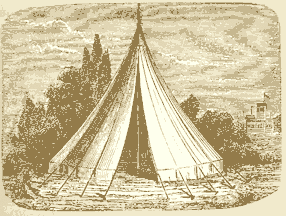
Qualities.---As originally constructed the bell-tent was quite without means of ventilation; "now a few holes are made in the canvas near the pole;" but these apertures are of little service. During the middle of the day in warm weather the tent is hot and uncomfortable, and even when unoccupied, the air within it soon loses its freshness and becomes close and oppressive to those entering the tent.
Captain Galton, in speaking of this tent, says:---"It is so peculiarly objectionable, as to make it a matter of surprise that it was ever invented and used. It is difficult to pitch, it requires many tent-pegs, it has ropes radiating all around it, over which men and horses stumble, and it is incommodious and ugly."(230) The regulation bell-tent has been the subject of various modifications, the most important of which has been an addition to the height of the perpendicular walls. The interior of the tent is thus made more convenient, and as the sides can be looped up, the tent is much better fitted for service in tropical climates.
A number of tents have, since twenty or thirty years, been "invented" in England, some of which possess real merit although I believe I am correct in stating that none of these inventions, whether "patented" or not, have been on any occasion adopted by the English Government.
One of these is known as "Edgington's three-poled tent." This tent is supported by three poles, sunk in the ground on the same line, a central tall pole, before and behind which are the shorter poles. The tent when stretched out has two ends and six sides; the ends are short vertical isosceles triangles; the sides are formed each of one tall inclined isosceles triangle and two tall inclined scalene triangles. (See Fig. 19.)
These tents are made of different sizes : that of medium size covers a ground surface 14 ft. 6 in. square, is designed to accommodate fourteen men, with knapsacks, rifles, &c., and weighs when packed with its fixtures 172 lbs. This tent has but two exterior stay ropes, and the covering is fastened to the ground by a small number of pegs.
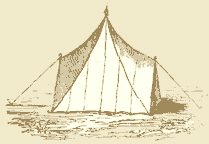
In some of Edgington's tents the central pole is so contrived as to be used as a stove-pipe, while an opening at the apex of the tent is designed to serve as a ventilator.
The material of which these tents are made is linen canvas, coloured or uncoloured. A lining is often employed, which, forming a sort of inner tent, makes the construction warmer in the winter and cooler in the summer.
Qualities. ---Edgington's tent stands very firmly, and is undoubtedly one of the best single-roofed tents now used. Its chief fault is, that its pointed form and the pitch of its roof are such that it must always remain a single-roofed tent; no awning can be placed over it. This fault it has in common with conical tents. It has also, although in a less degree, a fault peculiar to them, as also to all tents with sloping walls---a want of space in the upper part of the tent, with a waste of space in the lower part. Moreover, the two storm-ropes by which the tent is stayed are highly inconvenient. They are fastened just where such ropes should not be---obstructing the entrance of the tent. One or two straggling ropes attached to a tent are a cause of accidents more frequently than the numerous stay-ropes of a marquee or wall tent, which may be seen, and thus avoided.
The provisions for securing ventilation are also very imperfect and insufficient.
Major Godfrey Rhodes, the author of "Tents and Tent Life," has invented a "patent" tent, in the construction of which he states that he has had especially in view solidity, roominess, &c. Major Rhodes's tent is a sort of "umbrella tent," that is to say, his tent is not stretched out by cords and pickets, but is stretched over a framework, either circular or oblong. This framework is made of bamboo poles, the number depending upon the size of the tent. In his "field " tent they all spring from a central ring, as the ribs of an umbrella. The ends of the poles when forced into the ground, form a dome-shaped framework, which supports the covering. This is held down by the poles themselves, which pass through the loops of a twisted cord, that lies in a circular form upon the ground, and to which the covering is attached by straps.
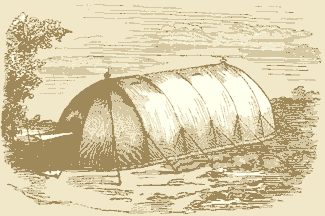
In the oblong "hospital" tent---a sketch of which is shown in Fig. 20----the bamboo poles are united together in a series of semicircles. No central poles are employed in these tents, and only a small number of pegs are used; the "field" tent is quite unprovided with pegs and stay-ropes. The coverings are of cotton canvas. The "hospital" tent is 30 ft. long, 15 ft. wide, and 10 ft. high, and weighs 395 lbs. It is intended to give accommodation to twenty sick.
Qualities. ---These tents are well shaped to resist the wind, and are remarkably roomy. The tents, in a word, are unquestionably good ones; but I am inclined to doubt if they are as sturdy as Major Rhodes would have us believe. I remember once having had an occasion to use a tent constructed on the same general principle, that is to say, without outside pickets and stay-ropes, and without a central pole, but supported by perhaps a dozen light ash ribs, at the foot of each of which was a flat perforated metallic plate holding an iron pin nearly a foot in length, and forced into the ground when the tent was pitched. This tent was constantly being upset by the wind, and the only way I could keep it overhead was by attaching to it two or three storm-ropes, after which it behaved like any other well-regulated tent. One fault of Major Rhodes's "patent" is, that its sides cannot be conveniently raised; but its principal and fatal fault is to be found in its excessively complicated construction.
With reference to the impermeability to rain which these tents may possess, I may make a general remark : the fewer points of support a piece of canvas covering touches, other things being equal, the less permeable it is. A piece of cotton canvas (duck), when stretched out, if unsupported, is quite impermeable to rain; if it rest, either by design or accident, upon a bit of wood, or any hard substance, the water, if it rain, will soon almost certainly be seen oozing through the canvas and trickling down the side of the support. I could not confirm the accuracy of this statement more completely than by referring to an observation which Baron Larrey incidentally makes when speaking of the leakage to which the French tente conique is liable :---"The strings even, that serve as cordage within, become so many conduits along which the water flows."(231)
The number of poles used to support the hospital tent---twenty, exclusive of the ridge-pole---is inconveniently great. The "bamboo," or other special poles, are liable to get broken, lost, &c., and can in the field only be replaced by common heavy poles. This tent is, moreover, single-roofed---a hospital tent should always have a double roof. Major Rhodes, since having written his book, seems himself to have been convinced of the existence of numerous faults in the construction of his "hospital tent," as I learn it has been superseded by "Major Rhodes's patent hospital marquee," which appears to differ in no way-judging from the advertiser's wood-cut and specifications---from the Government marquee, except in having a "special frame." This frame consists of four upright posts, supporting rafters, which are united by a ridge-pole. The "curvilinear formed frame," the "pliable ribs," the "double twisted ground-rope," the " metallic socket-pieces," all the distinctive features of Major Rhodes's really original tent have thus apparently been relegated to the limbo of impracticability, by the inventor himself.
Mr. George Turner has also invented a tent, which he commends highly for its stability, ventilation, &c. (See Fig. 21.) This tent is circular in form; it is 10 ft. high, and 16 ft. in diameter; it has a roof and walls. The roof is in the form of a cone, 16 ft. in diameter at its base, from which the walls fall perpendicularly to the ground. The tent is supported by a central pole, and a framework of stays made of galvanized wire cord; these stays radiate from a metallic collar adjusted to the top of the pole, and are fastened to the ground by iron pegs, from nine to twelve inches long. The stays are three-sixteenths of an inch in diameter, and each one will stand a strain of 600 lbs. The roof is made of "mineralized india-rubber double texture fabrics;" the walls are of common cotton canvas. Mr. Turner has provided his tent with an arrangement for the suspension of hammocks:---"By means of light wooden struts or rods, one end being attached to a loop or eye fitted to the wire rope stays, and the other hooking into a flange fitted at a convenient distance from the bottom of the pole." Mr. Turner suggests the use of the hammocks as "ambulance litters." The tent is heated by means of a stove, the pipe of which forms the pole of the 'tent. It is ventilated through an opening at the top, which is shielded by a hood. This tent is designed to afford shelter for eighteen men. With the waterproof covering and the fixtures complete it weighs nearly or quite 300 lbs.; the covering alone weighs 100 lbs.
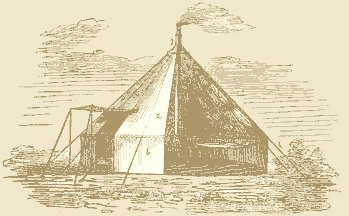
Mr. Turner also speaks of a "novel and peculiar adaptation of his system" for a general field hospital. He would cause six or eight marquees to branch off from a common centre, in the form of a star, so as to embrace a number of wards in connection, yet separated one from the other:---"A construction of this nature, with six wings each 60 ft. long by 16 ft. wide, would afford accommodation for beds, and possess ample means for warmth and ventilation, and effect a great saving in weight over the same number of marquees containing equal accommodation if fitted separately."(232)
Qualities.---Mr. Turner's tents are doubtless very good tents; still, a number of objections can be offered against them. With their fittings they are heavy and complicated ; the metallic stays, whether supporting the tent or folded up with it, are constantly wearing the canvas; the iron pegs are heavy and liable to be lost, and, as has very justly been said of iron pegs:---"Their value to natives is so great, that to prevent loss by theft is next to impossible."(233) The India-rubber fabrics of which the roof is made are objectionable from their impermeability to air. The idea of using the mast of the tent as a stove-pipe is not an original one. The suggestion was once made---and I believe to some extent it was acted upon---that the mast of the U.S. "Sibley" tent could be so used ; it was, however, soon found to be impracticable. A pipe which is solid enough not to bend or be broken is altogether too heavy to form a part of a tent ; moreover, a stove-pipe is too dirty to be packed or stowed with a tent; while if the pipes are stowed separately, one is exposed to all the inconvenience which might arise should they not arrive on the camping ground with the tents.
The British army has, up to the present time, made but very little use of shelter-tents, although probably quite as large a number of models have at different times been proposed in Great Britain, as have been exhibited in countries where such tents are more generally employed.
One of these models is described thus:---
"Each man carries a canvas sheet, made up of a quadrangular (5 ft. 9 in. X 5 ft. 3 in.) and of a triangular piece (2 ft. 8 in. height of triangle X 5 ft. in. base). Buttons and button-holes are sewed along three sides, and a stick (4 ft. long and divided in the middle) and three tent-pegs and rope also are provided. Two or four of these sheets can be put together, the triangles forming the end flaps. A very roomy and comfortable shelter-tent, 4 ft. in height, is formed, which will, with a little crowding, accommodate six men, so that two sheets can go on the ground."(234)
This tent weighs 6 lbs. 14 oz. per man.
Another quite similar tent has been proposed. The tent is formed of two sections---oblong pieces of canvas, which in shape may be said to be square pieces (about 7 ft. in length and breadth) elongated by attaching to the opposite ends triangles having from base to apex a length of about 4 ft. The sections are furnished with rows of buttons and corresponding button holes on their inner edges; and they are supported by two sticks or standards 4 ft. 4 in. in length, and an inch in diameter; each one is divided into two sections that it may be the more portable. When the tent is pitched the triangular flaps close the ends of the tent snugly, overlapping widely if they fall perpendicularly; but they are generally stretched out so as to form a cul-de-lampe, or porch, at each end of the tent. Thus arranged, the tent is 4 ft. 4 in. high, 7 ft. in breadth, and 10 ft. 8 in. in length. This tent affords plenty of room for two men. A section, one of the tentpoles, and half of the pegs, weigh 8 lbs. 2 oz.(235)
Without entering into a special discussion of the merits of these models, I may state that I believe them both to be good ones They are somewhat larger and heavier than shelter-tents in general. But the principal defect of shelter-tents is their very small size; they are, when pitched, not only not comfortable, but they are also often scarcely inhabitable, by reason of the open ends. The two sections of both the tents just described form a complete tent; and although the latter model weighs twice as much as the French tente-abri, it is, as a shelter, incomparably superior. The equipment of an English infantry soldier weighs 56 lbs. ; of a Russian infantry soldier, 60 lbs.; of a Prussian infantry soldier, 63 lbs.; of a French infantry soldier, 69 lbs. As a principle, the soldier should carry the smallest possible weight, and "should not be made," as the Crown Prince of Prussia once remarked in my presence, "a beast of burden." I believe the weights generally carried by soldiers may be reduced with advantage.
Nevertheless, it is evident that a difference of a few pounds above or below the weight fixed upon as the proper average to be carried, is a matter of no great consequence if any important object is to be attained thereby ; and I know of none more important than that which has in view the assurance of a suitable shelter for the soldier.
I may conclude this account of English shelter-tents by mentioning a portable shelter highly commended by Parkes as "an improvement over the French tent and better than the American poncho tent." Each section or sheet is prepared with a hood, and is intended to be worn as a cloak on the march. Two sections form a tent for three men, the third sheet being spread on the ground. Sticks, pegs, &c., do not form a necessary part of the equipment; rifles, &c., being used to support the tent in the absence of sticks.
I have never seen a specimen of this tent, and am consequently unable to appreciate its merits. It has, however, obvious defects.
A great number of attempts have been made to construct tents of cloaks, overcoats, &c. One of the first tents of this kind---the tente Reveroni---was proposed as early as 1726, and one of the last figured in the collection of war material exhibited by the Dutch Government at the Exposition of 1867. These tents have all proved to be failures. An instrument made to serve a great number of purposes is generally not well adapted for any one of those purposes. A simple sheet of canvas forms a better tent section than if a hood or any other attachment, foreign to its use as a tent, be fitted to it. Common canvas is speedily ruined if laid upon the ground. The use of rifles, swords, and bayonets as supports is inadmissible; from a material point of view it is as necessary they should be protected against wet as it is that the soldier himself should be.(236)
Passing from English tents to French tents, and continuing my special subject, I may observe, first, that the tente-abri has in principle been long employed. Rhodes says the Macedonians used small tents intended for two men, but he gives no authority for his statement; in any event, it is highly probable that such tents may have been used in ancient times, as may be inferred from the existence of the diminutives of σκηνὴ and tentorium (σκηνίδιον and tentoriolum).)
But to come down to more modern times: in an engraving, which I have, representing an attack upon a town and camp on the Ems, and bearing the date of 1568, there are quite a number of representations of small wedge tents which could scarcely have sheltered more than two persons. As every soldier had at this time to provide himself with a shelter as best he could, it is very probable that tents were often made of small pieces of woven stuff, which the soldier himself could carry, and which, propped up by some simple framework, afforded a cover at night, not unlike that which is still a favourite domicile among the Gipsies.
One of the earliest, certainly one of the most singular, accounts of the use of shelter-tents, is that given by Patten in a description of the Scots mode of encampment, just after the battle of Pinkey, in 1547:---
"Here now to say sumwhat of the maner of their campe: As they had no pauilions or round houses, of ony commendable cumpass, so wear theer fewe oother tentes with posts, as ye used maner of makying is: And of these fewe also, none of abooue xx. foot length, but most far vnder; for the most part all very sumptuously beset (after their facion) for the love of Fraunce, with Fleur-de-lices, sum of blue buckeram, sum of black and sum of oother colours. These whyte ridges (as I calld them), that as we stood on Fauxsyde Bray, dyd make so great mouster toward vs, which I dyd take then to be a number of tentes; when we cam, we found it a lynnen draperie of the coorser camryk in dede, for it was all of cannas shetes, and wear the tenticles, or rather cabayns and couches of theyr souldiours; the which (much after the common bylding of their countree beside) had they framed of iiii. sticks, about an elle long a pece, whearof ii. fastened toogyther at one end aloft, and the ii. endes beneath stict in the ground, an elle a sunder, standing in facion lyke the bowe of a soowes yoke: Over ii. such bowes (one as it wear at their bed, thoother at their feet) they stretched a shete doun on both sides, whearby their cabain becam roofed lyke a ridge, but skant shit at both endes, and not very close beneath on the sydes, onles their stiks wear the shorter, or their wiues the more liberal to lend them larger naperie: Howbeit, win they had lyned them, and stuft them so thick with strawe, when they were couched, thei wear as warme as thei had bene wrapt in horse dung."(237)
The French account of the origin of the tente-abri is sufficiently curious to be worthy of mention. It seems that after the abolition of tents in the armies of the Republic, the disastrous effects of prolonged bivouacs became so evident, that a somewhat singular practice was not only permitted, but was officially recognized and encouraged. There was always a necessity in the army for a considerable number of long strong sacks, called sacs à distribution, for the transportation of bread, vegetables, grain, &c. These the soldiers, in the absence of other shelter, began to use, whenever they could get hold of them, as sleeping bags. The Ordinances of 1778 sanctioned this novel use of the sacks. By an Ordinance of the year II., one sack was issued to each man ; it soon became known in the army as the sac de campement, and was subsequently extensively used by the troops as a shelter in all active campaigns. The armies which were sent to Algiers from 1830 to 1840 were supplied with such sacks. But the discovery was made by certain soldiers engaged in those expeditions that the sac de campement was much less serviceable as a sleeping bag than when used as a roof. That they might the better make these roofs, the soldiers were frequently permitted to rip open their sacks ; and shortly after whole regiments were to be seen camped in the little tents which they were thus enabled to construct. This sort of shelter was in very general use in the French army, when in the field, until the invention was recognized by the issue of the regulation tente-abri in 1848.
The tente-abri of the French army is formed of two rectangular pieces of canvas, 5 ft. 9 in. long (1 m. 76) by 5 ft. 4 in. wide (1m.64). These two pieces are buttoned together longitudinally, and the canvas, raised upon two sticks (bâtons), the ends of which pass through two small holes in the outer edges of the canvas, is stretched out by its lower borders so as to form wedge-shaped roof open at both ends. The weight of one section, one support, and three pegs, is 1 kil. 690 grammes---or about 3 lb. 11 oz. As each soldier, on entering upon a campaign, furnished with a section which he carries as a part of his "kit," he is able to form at any time with one or more of his comrades a shelter, that is certainly vastly better than none.
For active campaigning a tent of this sort is almost indispensable. Its uses are, however, very strictly limited to furnishing a shelter for soldiers who are well. It is not necessary in this place, therefore, to consider at length either its merits or defects. One of its defects is very apparent---the rectangular piece of canvas is too small ; the consequence is that the tent is both too narrow and too short ; it is not long enough to cover the body of a moderately tall soldier.
This defect has been the occasion of numerous attempts to construct other models of tente-abri, some of which in several respects are certainly improvements upon the regulation model. One of these---M. Waldéjo's tent---is made of lozenge-shaped pieces of canvas, the sides of which are 2 metres long. When two of these are buttoned together and propped by a central stick, the canvas forms a pyramidal tent about 4 metres high, resting upon abase 2 metres square. With four pieces a much larger tent can be made; indeed the unitary section and its buttons and buttonholes are arranged for a variety of combinations. Although this tent has never been adopted by any Government, the tests to which it has been put have been the occasion of a number of favourable official reports to the French Government. Its great merits are that, without being heavier it is much more roomy than the common model, and that with two sections a completely closed tent can be made.
As early as 1860 M. Barbe proposed to give to the ordinary section of a tente-abri the form of an isosceles triangle, with a base breadth of 1 m. 76, and a height or length of 3 m. 28.
By uniting three or more of these triangular sections, pyramidal tents could be constructed offering conditions quite similar to those of the Waldéjo model. Whatever the advantages of the modifications suggested, the simplicity of the rectangular sheet has always been so strong a point in its favour, that it has been nearly everywhere adopted as the best section for a shelter tent.(238)
Inasmuch as in the campaigns of 1866 and of 1870, the Germans entered the field unprovided for the most part with tents of any kind, the suggestion has recently been made by certain writers that the shelter-tent could, with advantage, be dispensed with. Such an opinion I cannot entertain. During the whole war of 1870 the German armies suffered immensely from being deprived of shelter. The waste of men from diarrhoea, pneumonia, rheumatism, and fever, caused by avoidable exposure, would have often put a stop to the movements of these armies had they not been constantly strengthened by reinforcements, and to an extent unparalleled in modern war. Germany proposed a short campaign, and men were the cheapest part of her war material, while to France they were the most costly. To have engaged upon a campaign where half or two-thirds of the army on both sides should have been disabled in a month, simply by excessive fatigue and exposure, would have subjected France to the power of Germany without a battle.
This consideration shaped in part German tactics, which, under the special circumstances, may have been quite justifiable from a strictly military point of view. It would be impossible, however, to deduce from an exceptional fact a general rule. Moreover, the practice of quartering troops---a whole army---upon the inhabitants of the towns, villages, and cities, in the country where the war may be conducted, is an abomination. It is in the end subversive of military discipline, is demoralizing and brutalizing to the soldiery, is an invasion of those personal rights recognized by the laws of modern war, and, by debauching the morality of the people, becomes an arm of warfare only worthy of savages.
No tent of special construction has yet been allowed by the French Government for the shelter of the sick of its armies. Three troop-tents of different models are now in use in the French service, which are employed, whenever it may seem necessary, for the hospitalization of the sick.
The "tente nouveau modèle," or "bonnet de police," is the most ancient, having been authorized by an "Instruction" of the year III.
This tent has the form of a triangular prism, to the ends of which are joined two hemi-cones. It covers an elliptical ground surface 19 ft. 8 in. long and 13 ft. wide ; the tent is 9 ft. 10 in. high. The covering is supported by two standards and a ridgepole ; the ridge-pole is 6 ft. 8 in. long ; a shelf also---planche à pain---is placed between the two vertical poles, steadying them, and forming a convenient place upon which to put, or from which to suspend, the effects of the soldiers. The canvas is fastened to the ground by short looped cords attached to twenty-three wooden pickets. Two curtain-shaped doors give entrance to the tent; the doors are closed with straps and side-buckles, or may be opened, and held out horizontally by two small props. The tent weighs 130-1/2 lbs., cubes 24 metres, and was originally intended to accommodate sixteen men. It was made of brown linen canvas for the troops, and of striped cotton and linen canvas for the officers.
Qualities.---It is well-formed and fairly solid; it is secured by few tent-ropes; it is not heavy, and can be readily pitched and struck. The objections to its use, particularly as a hospital tent, are these :---First,---its permeability. French tent canvas is almost uniformly of an inferior quality; it is not firmly woven, and the rain is sure to sift through a single roof formed of it, in the most uncomfortable manner. Secondly,---no sufficient precautions have been taken to have the tent well aired. Baron Larrey, speaking of this tent, has observed:---
"When the doors are closed, and the tent is thus shut up, the air becomes rapidly so close and hot as to interfere with respiration; at the same time it becomes infected with the odours of straw, leather, and emanations of various kinds. Hence spring the pernicious consequences of overcrowding, and the diseases which break out among men who remain seven or eight hours out of twenty-four surrounded by such an atmosphere."(239)
The "bonnet de police" is at present little used, none having been made for the Government since several years; the reputed cause of its having been condemned was a want of solidity, exhibited particularly in the Crimea, on the 14th of November, 1854, when the tents of this model, then largely used by the troops, were nearly all blown down.
The "tente Tacconet," or "tente elliptique," was introduced into the army about forty years ago. It is claimed to be an invention of the house Tacconet of Paris, "fournisseurs ;" and, as a sample of tent architecture, was presumed, when adopted, to have left scarcely anything to be desired, as may be inferred from the following rather florid encomium :---
"Their researches, precious discoveries, and unfaltering zeal, have gifted France with a camping material unequalled in Europe; our camps of instruction have become objects of curiosity and envy. The house Tacconet has furnished models to almost all the Powers of Europe. Turkey and the Barbary States have in their turn wished to have our tents; and even the Dey of Tunis has asked for one, which has been made for him expressly. In short, our castrametation has become an art." (240)
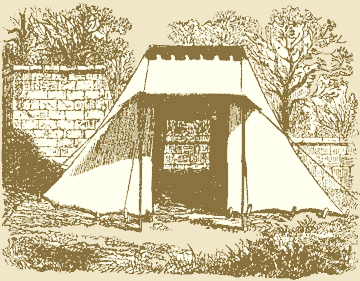
It is but proper to say that this tent is only a slight modification of that just described; it had nearly the same form, was supported in the same manner, and sheltered the same number of men ; in one respect it was inferior---the officers' tents of the nouveau modèle having been provided very generally during the early part of the century with sur-tentes, or double roofs. It possessed in general, however, the same qualities. During the Mexican war the "tente Tacconet" was used quite exclusively by officers. Although it is still to be seen in French encampments, the Government has ceased since several years to give orders for its construction. A sketch of this tent is shown in Fig. 22.
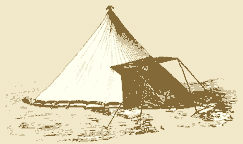
The "tente conique," or "marabout," is a copy, with slight modifications, of the circular tent used by the Turks. It is supported by a single pole, and, when stretched out, has an interior diameter at its base of 18 ft. 8 in., and a height of 10 ft. 8 in. It has a curtain or wall 14 in. high (36 centimetres), which drops down vertically around its base, and is pegged to the ground on the inside of the tent. To each breadth of canvas, at its junction with the curtain, is attached a short cord, which, fastened to a picket, serves to stay out the tent. The extreme diameter of the tent from picket to picket is 6 m. 80, or about 22 ft. 4 in. There are two doors in the tente conique, arranged as in the bonnet de police and the tente elliptique. At the summit of the mast is a cap, that overhangs an opening in the top of the covering, formed by a metallic ring, about twelve inches in diameter, over which the canvas is sewed. The opening is intended to serve as a ventilator, and is regulated by lifting up or depressing the cap.
The material of which this tent is made is brown linen canvas; its weight is 72 kilogrammes, about 158 lbs.;(241) and its cost, 239 francs.(242) It cubes 30 metres, and is intended to furnish a shelter for sixteen men. (See Fig. 23.)
Qualities.---The conical form is the one which insures the greatest stability to a tent; a fact of importance in itself, and of additional importance since the stability given by the form alone enables one to dispense with the use of long and inconvenient stay-ropes. The tent can be easily ventilated by raising a section of the curtain, while the opening at the top always permits a certain escape of air. The tente conique is easily pitched and struck. It is a good troop-tent, and, if made of less permeable stuff, would be an excellent one.
Its great fault, especially when considered as a hospital tent, is its permeability. The canvas is not sufficiently close, and is also too pliable; the rain sifts through it, or if caught in its loose folds, filters through into the interior.(243)
The "appel d'air" at the summit of the tent is not sufficiently large; moreover, at one metre (39.37 inches) from the centre, it forces the men to stoop in moving about.(244) In a word, it lacks roominess, a fault which it has in common with all conical, wedge, and pyramidal tents. When such tents are used by troops, the space within their outer borders may be almost wholly utilized, and the inconvenience resulting from the pitch of their roofs may be of no great consequence ; but when the sick are treated in such tents, either the space represented by the apex of the ground angle is almost wholly lost, or the inconvenience of the sloping roof will be found by the surgeon quite intolerable.
Moreover, in addition to the difficulty of being always able to use advantageously the space within conical tents, their interior cubic capacity, as compared with the ground they cover, is in reality considerably less than that of tents having other forms.
The conical form is the most expensive form which is employed in the construction of tents. The "tente conique" with a diameter at its base almost equal to that of the long diameter of the "bonnet de police"---and requiring in its construction nearly twice as much canvas---has a capacity only six cubic metres larger than the "bonnet de police."
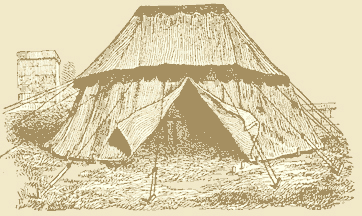
The French also occasionally use a "marquise." It is designed, however, especially for general officers, and as a place of council; an "Instruction" of the year XII. gave to each colonel or commander of a regiment such a tent in addition to the tent used as a lodging.(245) This marquee has a double roof and double walls ; the walls are about a yard high, and the outer roof, bordered with a festoon, projects over them. It has the same size as the "tente Tacconet."(246)
Qualities.---It can be fairly well ventilated by raising the walls by means of a double system of cordage:---
"It is the model the best designed for the purpose had in view, and might with certain modifications itself serve as a model for a large division ambulance tent."(247) (See Fig. 24.)
More recently a council tent has been introduced under the name of "la tente de conseil du nouveau modèle." This construction may be described, in a word, as an umbrella tent. It is a conical tent supported by a central mast 11 ft. 6 in. high, from the upper part of which radiate eight horizontal bars, each about 6 ft. in length, that serve to prop out the walls of the tent. The diameter of the tent at its base is about 20 ft. Two doors placed in opposite walls face each other.
Qualities.---This tent is spacious and roomy, and well adapted for the purpose it is intended to serve. It is made, however, of light and inferior canvas. Singularly enough the coverings of the two council tents or "tentes d'officier" I have described, are made of "coutil "---ticking, while the soldiers' tents are "en toile"---canvas.
A hospital tent made by M. Le Fort in 1869, and adopted to some extent by the French "Société de Secours aux Blessés" during the recent war, merits notice. As this tent, however, is said by its inventor to have been designed with the purpose of remedying certain defects peculiar to "la tente américaine," I shall reserve my description of it until 1 have indicated the character and qualities of the tent, the inconveniences of which M. Le Fort proposed to avoid.
Quite recently a model "surgeon's tent" has been made by the "Dock du Campement "---a Paris house---for the "Société de Secours aux Blessés," and in accordance with the following specifications, furnished by a committee of that society:---
The tent must he solid, light, portable, easy to pitch, and so roomy that a surgical service of eight or ten persons can move about within it, and work without inconvenience.
There should be room also for at least two amputation tables, stretchers, cantines, instrument boxes, medicine cases, &c.
The ventilation should be sufficient for the escape of all emanations, and the air within it should be renewable at will.
The light within should be sufficient for operating-even if the tent is entirely closed.
The tent must be capable of being rapidly cleaned-freed from straw, dirt, and detritus of all kinds.
It is also necessary that the access to the tent be made easy for the stretcher-bearers, who should be able to go in and out readily without difficulty, and without interfering with each other.
In accordance with these specifications a tent was constructed which very closely resembled the "tente elliptique" just described---in fact, scarcely differed from it except in certain matters of detail. The tent is at its base 8 metres long and 6 metres wide; it is 3 metres high. The framework, of pine, is composed of six pieces---square---10 centimetres (4 inches) thick, fitted with sockets, so as to form two standards, each 3-1/2 metres high, and a ridge-pole 3-1/5 metres long. The covering is supported wholly by this framework, and is secured simply by the pegs, which fasten its border to the ground, no cords of any kind being employed.
The tent has two doors; the one in front is 3 metres high, and nearly 6 metres broad; when closed it forms a side wall, when opened and supported by two props it forms a sort of portico in front of the tent (see Fig. 22); the second door in the opposite side wall is smaller, and, fitted with straps and buckles, is usually closed.
For purposes of ventilation, and that the tent may be the more easily kept clean, at each end two large openings (baies) have been cut quite down to the ground; these are each 80 centimetres wide and 90 centimetres high. The baies are so arranged as to be readily opened or closed.
To increase the means of ventilation, four louvres (lucarnes) have been inserted, two being placed in each end near the summit of the tent. These openings are covered by raw hide hoods. Four windows are also placed in the tent, partly as ventilators and partly to secure light. The windows are placed---two at each end---a little over a metre from the ground---about half-way between the baies and the lucarnes; they are closed by curtains, to which weights are attached, that slide down on pulling a cord.
The tent is made of the best French regulation flax canvas (du type ministériel), weighing about 500 grammes (1 lb. 1-1/2 oz.) per metre of 80 centimetres width.
The weight of the tent is about 110 kilogrammes (242 lbs.) when rolled up it forms a bale 2 metres long, with a diameter of 65 centimetres.
The tent plainly made without inscriptions or ornaments of any sort costs 575 francs.
Five persons should be able to pitch the tent in ten minutes.
Qualities.---This tent is intended for a special purpose---to be used on the field by the ambulance volante simply as an operating room. The form of the model is well adapted to the object in view; it assures a fair degree of solidity, without cordage, and makes it relatively easy to pitch and strike. The dimensions render it to a certain extent free from a great objection to tents with sloping walls---want of head room.
The provisions for opening the tent, whether for entrance, exit, or the purpose of ventilation, are abundant.
Its special faults are these: The covering is made of linen canvas, which, being only of a single thickness, is quite permeable. It is particularly desirable that the interior of a tent for the ambulance volante should be kept dry, as well for the preservation of the instruments and the surgical and medical material there assembled, as for the comfort of the persons who may be within it. If it is not thought expedient to employ a fly, the covering of such a tent should be made of cotton canvas. The lucarnes are not sufficiently large to assure the ventilation, if it become necessary, on account of wind or rain, to close the doors, baies, and windows. This objection might be partially obviated by changing the place of the windows, which are now at the end and about half-way between the ground and the ridge---inserting them in the roof above the doors.
A general objection to this tent might be offered on the ground of its being limited to a special service. It is not a good hospital tent on account of its permeability, and because it fail to respond to certain conditions desirable in such a tent. The numerous baies, windows, and doorways, serviceable as they may be in an operating tent, are objectionable in an hospital tent, as it is impossible to perfectly close them, and in cold, wind weather they serve as inlets to disagreeable currents of air.
Altogether the model is an excellent one for the purpose intended, and had it been made of cotton canvas instead of linen, would scarcely have left anything to be desired.
Among the tent models exhibited at a "concours" of the French "Société de Secours aux Blessés," opened in February, 1873, was one contrived by M. De Moulnier. This tent was said to have been intended to serve as a troop-tent, and also as a hospital tent. The model was circular; it had walls 5 ft. high, and was covered by a conical roof; its extreme height was 15 ft and its diameter at the base 16 ft. It was supported by a central pole, and by its walls. The walls consisted of 18 solid wooden frames, 5 ft. by 3 ft., within which sheets of canvas were inserted These frames, jointed together and set up in a circular manner, formed the walls. The roof was fastened to the sections of the wall by means of loops and hooks. The framework employed in this tent was strong and heavy, and the constructor appears to have had recourse to it as a means of obtaining a secure support for hammocks, sixteen of which were exhibited in the tent suspended between the walls and the central mast.
Qualities.---The model was constructed quite regardless of weight---a terminal ornament on the mast weighing ten or twelve pounds, and apparently in utter ignorance of the most important principles to be observed in the construction of an army tent.
At the same "concours," M. Couette exhibited a number of tents, one of which is, perhaps, worthy of notice. It is a hip-roofed tent, 10 ft. high and 18 ft. broad, its length to vary according to circumstances. It is propped up by a series of supports about 6 ft. apart, and united by a ridge-pole, in sections. The supports are each formed of four limbs---two long ones and two short ones. The long limbs are united at the top by a hinge; when opened, they form the branches of a compass, and when planted in the ground are separated at their points by a distance of 4 ft. 6 in. From each branch of the compass, 6 ft. 4 in. from the ground, springs a strut about 6 ft. long. The struts are united to the branches of the compasses by hinges. All the limbs are made of strong elastic wood, and are faced with a strip of iron; being square in form, they fold up together compactly. When the compasses have been erected, and the tent covering has been thrown over the ridge, the struts prop out the covering, giving to it the form represented in Fig. 33. The roof has, however, a second angle, as the covering is made with perpendicular side walls, nearly a metre high, and is stayed out by cords which emerge from the tent, on the lines upon which the side walls are attached. The cords are bolt-roped across the inner face of the roof.
Qualities.---This tent would be simplified and improved by suppressing the perpendicular side walls and the stay ropes. The only noteworthy characteristic it possesses is its system of support. This, in principle, is a very good one. The numerous hinges are, however, objectionable; and iron sockets ought to have been placed above each strut hinge, into which the foot of an extemporized stretching piece could be put, should the hinge be broken or the strut itself lost. M. Couette has placed in his tent a number of net-work windows, which can be closed by curtains. The advantages of this arrangement are questionable.(248)