Perhaps the most remarkable accounts of camps and camp life in the middle ages, are preserved in certain Spanish manuscripts which Washington Irving has attributed to one Fray Antonio Agapida, and which he at least has made a part of our own literature, under the title of "A Chronicle of the Conquest of Granada."
There we are told:---
"While the holy Christian army was beleaguering this infidel city of Baza, through the wonderful activity, judgment, and enterprise of this heroic and magnanimous woman (Isabella) a great host encamped in the heart of a warlike country, accessible only over mountain roads, was maintained in continual abundance. Nor was it supplied merely with the necessaries and comforts of life; the powerful escorts drew merchants and artificers from all parts, to repair as if in caravans to this great military market. Here might be seen cunning artificers in steel, and accomplished armourers achieving those rare and sumptuous helmets, and cuirasses richly gilt, inlaid and embossed, in which the Spanish cavaliers delighted; saddlers and harness-makers and horse-milliners also, whose tents glittered with gorgeous housings and caparaisons. The merchants spread forth their sumptuous silks, cloths, brocades, fine linen, and tapestry. The tents of the nobility were prodigally decorated with all kinds of the richest stuffs, and dazzled the eye with their magnificence; nor could the grave looks and grave speeches of King Ferdinand prevent his youthful cavaliers from vying with each other in the splendour of their dress and caparaisons, on all occasions of parade and ceremony.
"While the Christian camp, thus gay and gorgeous, spread itself out like a holiday pageant before the walls of Baza, while a long line of beasts of burden, laden with provisions and luxuries, were seen descending the valley from morning till night, and pouring into the camp a continued stream of abundance, the unfortunate garrison found their resources rapidly wasting away, and famine already began to pinch the peaceful part of the community. Cidy Yahye had acted with great spirit and valour, as long as there was any prospect of success, but he began to lose his usual fire and animation, and was observed to pace the walls of Baza with a pensive air, casting many a wistful look towards the Christian camp, and sinking into profound reveries and cogitations. The veteran Alcayde, Mohammed ben Hassan, noticed these desponding moods and endeavoured to rally the spirits of the prince. 'The rainy season is at hand,' would he cry; 'the floods will soon pour down from the mountains; the rivers will overflow their banks and inundate the valleys. The Christian king already begins to waver; he dare not linger and encounter such a season, in a plain cut up by valleys and rivulets. A single wintry storm from our mountains would wash away his canvas city, and sweep off those gay pavilions like wreaths of snow before the blast!'
"The Prince Cidy Yahye took heart at these words, and counted the days as they passed, until the stormy season should commence. As he watched the Christian camp, he beheld it one morning in universal commotion. There was an unusual sound of hammers in every part, as if some new engine of war were constructing. At length, to his astonishment, the walls and roofs of houses began to appear above the bulwarks. In a little while there were above a thousand edifices of wood and plaster erected, covered with tiles taken from the demolished towers of the orchards, and bearing the pennons of various commanders and cavaliers; while the common soldiery constructed huts of clay and branches of trees, and thatched them with straw. Thus, to the dismay of the Moors, within four days the light tents and gay pavilions, which had whitened their hills and plains, passed away like summer clouds; and the unsubstantial camp assumed the solid appearance of a city laid out in streets and squares. In the centre rose a large edifice, which overlooked the whole, and the royal standard of Arragon and Castile, proudly floating above it, showed it to be the palace of the king."
In this description reference is made to nearly all the kinds of shelter common to camps at that period, the prodigally decorated tents of the nobility, the canvas city of the soldiery---which, as the siege continued and the season of storms approached, gave place to the edifices of wood, the quarters of the officers, and the huts of clay and branches of trees thatched with straw, occupied by the common soldiery.
One of the interesting facts noted in this extract, is the presence in the Spanish camp of "cunning artificers" and merchants with "sumptuous silks, cloths, brocades, fine linen, and tapestry." The natural inference is that many, perhaps most, of the tents were made in the camp itself. Indeed, this custom would seem to have prevailed very generally at the time of which I am speaking.
In an old manuscript,(136) which contains a schedule of the rates of pay accorded to the several services in the army of Edward before Calais, there is an entry as follows:---"314 masons, carpenters, locksmiths, machinists, tent-makers, miners, armourers, cannoneers and artillerymen." The tent-makers thus appear to have constituted a special service in the well-organized and equipped armies of the period.(137)
The age of chivalry was pre-eminently an age of individualism, whoever had power showed the world he had it; while those who had wealth or physical strength, were held in estimation very much in proportion as they were prodigal in the use of these possessions. A knight, distinguished for his courage, strength and skill, was no less honoured by the splendour of his arms. An ostentatious rivalry was thus encouraged, the result of which was that every assembly of armed men became a pageant, and every camp a theatre of semi-barbaric magnificence and display.
We have just seen how, in their camp before Baza, the Spanish cavaliers vied with each other in the splendour of their equipments; but this rivalry was not limited to a single occasion; splendid armour, costly trappings, and magnificent tents were to be found in every camp in Europe, and were even considered the indispensable insignia of royalty and of rank. Thus in the Chronicle of Fray Agapida, from which I have just made an extract, we are told that the camp before Granada "made a glorious appearance in the setting sun. The warriors' tents of the royal family and attendant nobles were adorned with rich hangings, having sumptuous devices, and with costly furniture, forming, as it were, a little city of silk and brocade, where the pinnacles of pavilions, of various gay colours, surmounted with waving standards and fluttering pennons, might vie with the domes and minarets of the capital they were besieging. In the midst of this gaudy metropolis, the lofty tent of the Queen domineered over the rest like a stately palace. The Marquis of Cadiz had courteously surrendered his own tent to the Queen. It was the most complete and splendid in Christendom, and had been carried about with him throughout the war. In the centre rose a stately alfaneque or pavilion in Oriental taste, the rich hangings being supported by columns of lances ornamented with martial devices. This centre pavilion or silken tower was surrounded by other compartments, some of painted linen, lined with silk, and all separated from each other by curtains. It was one of those camp palaces which are raised and demolished in an instant, like the city of canvas which surrounds them." (138)
One might well suppose the worthy Father Agapida, in describing these pavilions, had given to them all the grace, beauty, and fairy-like magnificence peculiar to the old Moorish capital itself; or that he had innocently sketched, according to his own fancy, a kingly encampment in some happy land of enchantment, which he would fain believe had appeared for once as a reality beneath the walls of infidel Granada. But no, the old chronicler has only stated the facts, and the loftiness of his style even, was probably partly occasioned by a profound sense of the richness and dignity of his subject. On referring to contemporaneous French and English history, we find frequent accounts of similar exhibitions of the fondness for ostentatious display which characterized those times. Thus we are told by M. de Barrante, that Charles the Bold set out upon his campaign against the Swiss in 1476 "with the finest train of artillery that had ever been seen. As for the baggage of the army it was immense. His tents and pavilions were resplendent with gold and silk. His own tent was surrounded by four hundred others, where lodged the seigneurs of his court and the attendants of his house. Without, shone his coat of arms adorned with pearls and precious stones; within, the tent was hung with red velvet, embroidered with foliage in gold and pearls; windows in which the glass was framed in bars of gold had been put into it; within, was the chair of state, where, seated, he received the ambassadors and held meetings of ceremony; it was of massive gold. His coats of armour, his swords, his poignards, his lances mounted in ivory, were wonderfully worked, and their handles sparkled with rubies, sapphires, and emeralds. His seal weighed two marcs of gold, his portfolio, bound in velvet, contained the picture of the Duke Philip and his own; on his collar of the Fleece of Gold, the flashes of the guns were represented by rubies. All these objects were within his tent, as well as an infinite number of articles of furniture and precious jewels, which fell into the hands of the Swiss.
"His chapel tent contained almost as many things of value. Here were the shrines and the relics which had excited the admiration of Germany two years before; the twelve apostles in silver, the shrine of St. Andrew in crystal, and an ostensoir of marvellous richness."(139)
A hundred years before, Philip the Hardy had made a display of tents at Lelinghen almost equally remarkable. "Here," says M. de Barrante, "the Duke found a new occasion to show all his magnificence. His tent, made of boards and painted canvas, had the form of a castle flanked with towers. His whole suite, numbering 3,000 persons, were provided with lodgings in the neighbourhood, these lodgings were separated by streets, so that his encampment had quite the aspect of a city."(140)
And still earlier, in the war between Charles, King of Naples, and Conradin, son of Conrad, Emperor of Germany, which took place in 1268, not only were all the troops well supplied with tents, but many magnificent ones appeared upon the field; and so rich were some of these, that on the defeat of the Germans, it is said, the King gave orders that each soldier should guard the booty he had taken, he himself being quite satisfied to receive, as his share, the splendid tent of Conradine, which was supported by ten columns, and the treasure within it.(141)
And who has not heard of the interview, which took place in 1519, between Francis the First and Henry the Eighth, near the little towns of Ardres and Guines, on a spot which, from the richness of the tents there used, was afterwards known as the "Field of Cloth of Gold?" Here were pitched several hundred tents, all the finest and most magnificent it was possible to behold:---"For there was nothing used but cloth of gold, and silver, and velvet; and all were emblazoned with the arms of the Princes, and the lords, and ladies, to whom they belonged."
"The principal ones," says the Maréchal de Fleurange, "were of cloth of gold frisé inside and out, both rooms, halls, and galleries; and the whole field was covered with tents of cloth of gold ras, and stuffs worked in gold and silver."
The tent which was pitched for his Most Christian Majesty, was sixty feet long by as many wide, with a pavilion at each of its four angles; the outside, was covered with cloth of gold and finely embroidered stuffs, and the inside, was lined with blue velvet. Upon the highest point of the tent was an image of St. Michael, gilded with the finest gold.
The tent of the King of England, although perhaps less magnificent, did not fail to agreeably surprise those who saw it. It was built of wood, and covered with tapestry; it was divided into four great apartments, so arranged as to be lighted from all sides, since there was nothing but glass between the columns which supported it, which were painted in imitation of various coloured marbles. The interior of this tent was also magnificently furnished.(142) Strutt has given representations of these tents, taken from an illuminated manuscript in the Cotton Library. "The English tent," he says, "was made of a rich crimson, embroidered and wrought into ornaments of gold; and all around, at the bottom of the roof, is a rich fringe of gold and crimson silk; above the fringe is a narrow compartment like a moulding, which runs all around the tent, in which is written in letters of gold, DEV ET MON DROIET: SEMPER VIVAT IN ÆTERNO; and on the top is a running ornament carved and richly gilt, with the lion, the hart, the greyhound, and the dragon, alternately holding little banners, with the crown and the fleur-de-lys at the top; on these little banners are the arms of England, roses, and the portcullis.(143)
It may be interesting to compare these descriptions with one to be found in Gladwin's "Khojeh Abdul Kurreern," but which I reproduce from Major Rhodes' "Tents and Tent-life."
"Nadir Shah, out of the abundance of his spoils, caused a tent to be made of such beauty and magnificence as to be almost beyond the power of language to describe. The outside was covered with fine scarlet cloth; the lining was of violet coloured satin, on which were representations of all the birds and beasts in the creation, with trees and flowers, the whole being composed of pearls, diamonds, rubies, emeralds, amethysts and other precious stones; and the tent poles were decorated in like manner. On both sides of the peacock throne was a screen on which were figures of two angels in precious stones. The roof of the tent consisted of seven pieces; and when it was transported to any place, two of these pieces, packed in cotton, were put into a wooden chest, two of which chests were a sufficient load for an elephant. The screen filled another chest. The walls of the tent, the tent poles, and the tent pins, which latter were of massy gold, loaded five other elephants, so that for the carriage of the whole were required seven elephants."
The same writer says, in another work:---
"The bargah (royal pavilion) is of such magnitude, as to be able to contain ten thousand persons; and the erecting of it employs one thousand serash (camp-colour-men) for a week, with the help of machines. One of these bargahs, without any ornaments, costs upwards of ten thousand rupees. They are sometimes finely ornamented with tin. From the price of a plain one may be formed a comparative estimate of what would be the expense of making other kinds."(144)
In a fine old engraving which I have, representing the "total ruin" of the Turks in the great battle fought on the Danube in 1687, are representations of several magnificent Turkish tents, superbly ornamented, and embroidered without and within with arabesque devices. Their richness and beauty will be understood from the following account of an encampment in the time of the Sultan Mahomet IV.:---
"The encampment was about four miles from Constantinople. The tents were about two hundred in number, ranged without order, only the grand seignieur's seemed to be in the midst and to overtop all the rest, and well worthy of observation, costing, as was reported, 180,000 dollars, richly embroidered on the inside with gold, and supported by pillars plated with gold. Within the walls of this pavilion were numerous offices belonging to the seraglio. There were retirements and apartments for the pages, chiosks and places of pleasure, and although I could not get admittance to view the innermost chambers, yet by the outer and more common places of resort, I could make a guess at the richness and greatness of the rest; being sumptuous beyond comparison of any in use among Christian princes.
"On the right hand was pitched the Grand Vizier's tent, exceedingly rich and lofty, and had I not seen that of the Sultan before, I should have judged it the best that my eyes had seen, the ostentation and magnificence of this Empire being evidenced in nothing more than in the richness of their pavilions, sumptuous beyond the fixed palaces of princes erected with marble and mortar."(145)
Indeed, in reading these accounts, we can more readily believe them all to be descriptive of the ceremonial customs of Eastern princes, whose magnificence is the never-ending theme of Arabian story-tellers, than that they can refer to the habitations in the field of those iron-handed warriors, whose hardy prowess and restless love of adventure maintained in Europe, for several centuries, a state of perpetual war.
I have already alluded to the love of display which was almost universal during the middle ages, but this love was scarcely gratified by exhibitions of wealth alone. Solemnities and ceremonials were appreciated very much, as they were addressed to the sensuous tastes which pre-eminently characterized those times. I very much question if there was ever a time when brilliant colours have been more admired. The common costumes of the nobles were in scarlet, and blue, and green, and purple.(146) The houses of the rich were adorned with the most superb draperies; while on all days of public rejoicing, the exhibition, at the windows, of silks, cloths of gold and silver, and the richest tapestries, was equally held as an indication of respect for the day, and of personal consideration.(147)
The sails of ships were often of scarlet or purple, or satin dyed in grain.(148) Even the architecture of this period was strongly marked by the same taste, which built of mosaic Giotto's tower and the noble duomo beside it, and flooded the interior of the cathedrals with those splendid colours derived from arts which are to-day almost lost. But perhaps in medieval encampments, more than anywhere else, were to be found the very richest effects obtainable by varieties in colour, shade and tint. The tents differed from each other in form, but more especially in colour; one was red, another purple, another blue, another white; while in others was used a variety of brilliant tints, which, with the brightness of the numerous ornaments, the richness of the tissues employed, and the elegance of the forms given to the pavilions, often resulted in the creation of the most brilliant and even imposing spectacles.
In Fig. 11, is a representation of a tent which I have had copied from an illuminated manuscript of Froissart, in the Bibliothèque Impériale (No. 2,643).
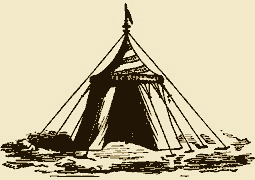
It represents the tent of a French knight or baron of the fourteenth century. In form, it may resemble the papilio of a Roman officer; but it would be quite impossible for me to give an idea of the richness of its colours. It was probably made of silk; the walls are purple; the scalloped border running around the line of junction between the walls and roof is red, and richly trimmed with gold; the roof is of purple silk or damask; the. spiral band on the roof is in gold, and contains perhaps some inscription; the cords and stay ropes are of finely twisted gold, while an ornamented lance-head, bearing an emblazoned pennon, surmounts the whole. Tents quite like this may be found in English manuscripts of the time, two or three of which have been copied by Strutt.
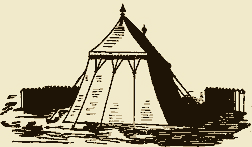
In Fig. 12 may be seen another tent, which I have had copied ,also from the same manuscript of Froissart.(149) Although perhaps more graceful, it has a certain resemblance in its form to our modern tents, but the resemblance is one of form only. The stuffs of which it was made must have been exceedingly costly---of silk or damask of a rich crimson colour; the cords were probably of the finest linen, and the trimmings of gold and silver; the two standards terminated in elaborately carved and gilded lance points; while the monogram of the occupant was emblazoned, in letters of gold, on one of the walls.
One certainly may not be a little surprised to learn that tents were so beautifully made, so many hundred years ago; and the surprise is, perhaps, even greater after one has examined the, splendid representations of these tents, with which the old copyists sometimes embellished their manuscripts.(150) But the means for gratifying the general love for displays of material magnificence existed, during the middle ages, in a much larger degree than has generally been supposed. To speak only of the industry most essential to tent-making the art of weaving was intelligently and extensively practised in western Europe during the thirteenth, fourteenth, fifteenth, and sixteenth centuries. Even long before, coarse fabrics of wool and linen were in common use, and by no means expensive ; of such stuffs the sails of ships and tents were generally made. But, shortly after the time of the First Crusade, an extensive commerce had been opened with Constantinople, Alexandria, and the markets of the East, and silk, velvet, cloth of gold, taffeta, damask, and a great variety of costly stuffs, were distributed throughout Europe, where very soon the fabrication of these tissues was commenced. Manufactories were established, first in Italy and Spain, and afterwards in France and Flanders. So early as the thirteenth century, in Spain, and in the single district of Jaen, there were three thousand villages occupied with the raising of silkworms; while, in the Moorish city of Seville alone, there were six thousand looms engaged in weaving silks.(151) Indeed, during the fifteenth and sixteenth centuries, these industries, which scarcely contributed to any end, other than the gratification of individual habits of luxury and the popular taste for display, had attained a development almost incredible. Says a Venetian writer of the time:---"Within a period of fifty years, the industry of weaving has so much increased, that the Government of Venice draws from it an annual revenue of 500,000 crowns, Reggio, a revenue of 10,000,000 of crowns, and Sicily a still greater one; for, to say the whole in one word, this art is now the very nerve of trade, and silk cloths are made which were quite unknown to the ancients."(152) And Thomas Mocenigo, when Doge of Venice, is represented as having said to the Senate:---"The Lombards buy of us every year, of cloth of gold and silk, to the amount of 250,000 ducats; and bear in mind, that every year also, Verona takes two hundred pieces of cloth of gold, silver and silk, Vicenza, one hundred and twenty, Padua, two hundred, Trevisa, one hundred and twenty, and Frioul fifty."(153)
The influence of those displays, special to encampments and tent-life during the middle ages, are still curiously evident in certain existing customs. Every pavilion bore one or more gaily-coloured pennons, or was surmounted by a gilded figure of an animal or a bird, or by some emblematic device.(154) As it was often convenient to use symbols of rank, these tent ornaments were frequently selected for the purpose. Thus the flag taken from the tent was entitled to so much of the consideration which belonged to a pavilion, as to finally receive that name---a name which, as applied to a flag, has through the shifts of time become much more familiar to our sailors than to our soldiers.(155) So many of the animals, once used only as terminal ornaments for the tent standards, have been preserved in the coats of arms which the heralds subsequently invented. The Dukes of Brittany are said to have placed upon their tents a red cap lined with ermine, as a token of their love of independence and liberty---a token which has certainly lost none of its ancient significance.
Perhaps one of the most curious vestiges still existing of that sovereignty, once represented in the field by pavilions of silk and gold, may be seen in the armorial emblems of certain families, which are placed under a drapery, the curtains of which fall by the sides of the insignia. These curtains represent the open doorway of a pavilion, and are alike the symbols of princely rank and military strength.(156) The arms of France, and of several other states, are thus placed, and may be seen by any, one, on the reverse of certain gold and silver coins.
So the dais, and the lit de justice, beneath which kings are, represented as sitting in the presence of their parliaments, are to be considered not so much ornaments of the throne, as the emblems of the ancient custom of sovereigns to meet their people, and administer justice, at the doorways of their pavilions.

BUT perhaps I have already occupied your attention too long with subjects which, whatever may be their historical interest, throw little light upon tent architecture in its more practical, relations to military life; It is tolerably certain, however, that few if any changes were made in Europe in the methods of encamping active armies, already described, before the middle of the seventeenth century. Ambroise Paré has given us a facetious but graphic picture of the imperial encampment before Metz, in 1552. The whole German army was there lodged in holes in the ground, which were only covered over with a little straw:---"Nevertheless," as the snow lay on the ground two feet deep, "every soldier had his camp-bed strewn with glittering and brilliant stars, more sparkling than had they been of fine gold. And every day they had white sheets where they lodged -at the sign of the Moon. They had no need of combs to get the down and feathers out of their hair and beards, and always had white napkins at hand,"(157) &c.
In the edition of Fronsperger, published at Frankfort in 1566, there are a number of engravings representing scenes common in German camps at that time, and among others, there is a large eau-forte by Joste Ammon, which exhibits the disposition of a German camp. The different quarters are numbered, and an explanation accompanies the plate; but nearly all the tents, many of which are richly ornamented, are assigned to officers connected with the administration of the camp. Letters, upon a few open spaces, indicate the positions assigned to certain bodies of troops---infantry, cavalry, and artillery. A few screens, or rude huts of boards, bushes, and straw, are the only quarters occupied by troops, shown in the sketch, which unquestionably represents with fidelity the usual appearance of a German camp in the sixteenth century.
According to certain writers, the Austrians and Hungarians would appear not only to have made use of tents, earlier than most of the German people, but to have been better provided with them, at the time of which I am speaking. Basta, who wrote towards the close of the sixteenth century, speaks of the troops being generally encamped "in cabins and tents;" but he observes that in Hungary, the cavalry was not lodged in town as in the Netherlands, but in the field "in many pavilions." In a plate which he gives, showing how a camp should be entrenched, the whole force---infantry, artillery, and cavalry---are represented as having tents; those for the troops being wedge-shaped, while those of the officers are circular pavilions with dome-shaped roofs.(158)
In 1568, De la Noue regrets, that it was necessary to lodge the troops scattered about in various places;(159) and he is said to have recommended a provision of tents for common soldiers. But the soldiers still continued to be quartered in their logis, as in Froissart's time, as may be seen by consulting De Saulx and subsequent writers.
The Princes of Orange are said to have first put in practice, De la Noue's project, by generalizing the use of tents among the troops of their armies. But the statement has been controverted, and would appear to have been based upon the efforts made by Maurice of Nassau, towards the close of the sixteenth century, to establish some order in the arrangement of his camps. Stevin and Solemne, in their accounts of the camps of Maurice and Frederick, represent the troops to have been quartered in framework huts covered with straw; and we may infer from them, that the use of tents was limited to officers. The huts were small--generally about eight feet square and eleven feet high---and were intended for two soldiers only.(160)
In but one instance does Solemne mention the use of tents by troops---at Oppenheim, in 1620:---"The regiment of militia of Col. Wynenbourg had tents instead of huts. These were twelve feet wide and twenty feet high; each company of 200 men had twenty tents; the tents were placed in a line, and ten soldiers were put in each tent, and each soldier had with his comrade a woman; and they had a bed four feet wide, and, above in the middle of each tent, there was a piece of wood fitted with pegs where the soldiers suspended their muskets most conveniently. On these tents were written the names of the villages or the cities to which they belonged, and the tents covered very little ground, as compared with the huts of straw used by the other regiments."
Solemne declares that:---"The très-illustre Prince d'Orange, Maurice, de très haulte mémoire, so excellently well ordered the lodgings of his army, that there was not an officer, great or small, or the humblest soldier, who would not confess that he had ample room in his quarters."(161) And an examination of the magnificent engravings which accompany his work---showing the disposition of the different parts of a Dutch camp, the rich pavilions and tents of the officers, the huts of the infantry, cavalry, artillery, and vivandiers---will convince any one that whatever improvements may have been introduced into the art of castrametation, the ordering of encampments has since gained nothing in mere geometrical regularity.
Indeed, it is very certain that camps were nearly everywhere in Europe regularly laid out, some time before the use of tents became general. Thus De la Fontaine and M. de Gaya(162) give rules for the establishment of camps quite similar to those even now in use; but the only tents they mention are those of officers, and in fact, they both expressly state that the troops were to be quartered in barracks and huts;(163) while Le Blonde gives it as his opinion, that the troop-tent became well known to the French service, not before the treaty of Riswick, in 1697.(164)
Towards the close of the seventeenth century, after the great defeat of the Turks before Vienna, the imperial armies appear to have been generally well supplied with tents. Di Marsigli says, the troops of the Emperor Leopold were abundantly provided with tents, immense numbers having been taken from the Turks; but that the Turkish tents, made of cotton and lined, were thought to be too heavy; and that for this reason tents were made of German canvas (linen), which was much lighter, as also that these tents were made smaller, and more portable. And he also says, the German officers used tents which they called marquees, and that they improved them by adding curtains, which falling perpendicularly to the ground, formed a sort of gallery between the sides of the tent, which served as an equal protection against the heat and the cold; and that the Turks finally imitated them in this.
Still, Di Marsigli thinks, the most important military information communicated by the Turks, was that which concerned the manner of using tents.(165)
The common Turkish army tent of that time---the tent generally used by the Janissaries---was conical in form, and supported by a single mast. The covering was drawn out by cordage attached about two-thirds of the way up its sides. "In the Levant," says the "Encyclopédie," "tents were made of heavy cloth (canvas) firmly woven, which sheds water easily. The covering was supported by a single mast, and was fastened down, around its border, by cords hooked over iron pins driven into the ground. At two-thirds the height of the pavilion, were attached cords which were stayed out straightly, by means of other pins set farther from the mast than the first; the cords pull out the top of the pavilion, giving to it a sharp angle, like that of a mansard roof."(166) This description, intended doubtless to represent the old Turkish conical tent, is correct except in the last statement, which is likely to mislead.(167) The walls of this tent did not fall perpendicularly from the line of the insertion of the cords, but were fastened to the ground, quite close to the outer row of pins; the cords, when pulled out, did not give therefore to the top of the pavilion a sharp angle. In its outlines, this tent represented a cone---or more exactly, it represented a cone surmounted by the apex of a second cone, having a slightly larger base. These tents were always lined on the inside with some sort of cloth-generally of cotton; at least, the upper part or dome of the tent, was lined.
The marquee appears at this time to have been used rather by officers than by common soldiers. The marquee was a house-shaped tent, covered by a second or upper roof; it was sometimes used without the second roof; still retaining its name. A peculiarity of the second or outer covering was, that it only covered the roof of the marquee, projecting a little over the ends and sides of the tent. The roof and even the sides of the marquee were lined.
The tents of this kind, which belonged to the principal officers, were always very handsomely carpeted. These officers also, in addition to their marquees, often made use of a sort of square tent, closed on three sides and overhead, but entirely open in front. The Turks were also in the habit of establishing their latrines behind canvas screens, which invariably formed a part of their camping material. In fact, however primitive an idea this people may have had, at the close of the seventeenth century, of castrametation as an art, their camping material left very little to be desired either as regards its abundance or its quality; and its excellence was undoubtedly one of the causes of the very general disposition, shown at that time throughout Europe, to place armies in the field under the shelter of tents. Still, the credit of having created and fashioned the camping material of Europe can scarcely be accorded to the Turks. For centuries the Turks had only repeated the knowledge which they had acquired from the Tartars, the Arabs, and the various Oriental races with which for a long time they were closely allied and assimilated. In the East, one may still see tents constructed of nearly every kind of material, and of almost every conceivable form; and there is scarcely any reason to doubt that the types most frequently, seen to-day, were those employed hundreds, even thousands of years ago, as also, that they have served as models as well in the construction of the splendid pavilions of the Crusaders and the knights of the middle ages, as of many of the less imposing and more serviceable tents, under which European armies have encamped in more recent times.
The "Encyclopédie" and De Chesnel give to Louis XIV. the credit of having first issued tents to the troops of modern armies; but there is no evidence that tents were furnished by the French Government during the long reign of that king, except to la maison militaire du roi, and to certain corps privilégiés;(168) and although Turenne and Montécuculi speak of tents in their "Mémoires"(169) as if they formed a part of a military outfit during the Franco-German wars which took place in the reign of Louis XIV., there existed in the French service, until as late as 1732, very little uniformity as regards either the form and qualities of the tents employed, or the number allowed to a company. I am quite aware that De Bombelles, who wrote towards the close of the reign of Louis XIV., speaks as if the soldiers had tents, and as if these tents had a fixed size and form---that is, he says they were two paces wide, and that each company was presumed to have eleven.(170) But, inasmuch as the officers still bought their own tents, and the regiments provided themselves with shelter as best they could, it is probable that De Bombelles' account applied rather to a theoretical or model camp, than to one occupied by an active army at the time he wrote. In some of Van der Meulen's battle pictures, may be seen representations of, the camps and tents of the time of Louis XIV., which are unquestionably historically accurate. The camps were evidently laid out with very little order, and the tents represented are of nearly every imaginable kind. One may see, side by side, the splendid pavilions of the noblesse, the tents of the officers---square, round, conical, wedge-shaped---the make-shift tents of the men-strips of canvas, or blankets stretched over poles, or attached to the sides of waggons, to secure a better shelter from the wind beneath them---and an endless variety of booths and bowers.
Previously to the eighteenth century, the troops in English armies were commonly quartered by billet, or were encamped in "baraques and hutts."(171) I have already described, with sufficient detail, the quarters furnished these troops while actively employed, during the fourteenth and fifteenth centuries. In the time of Henry VIII., while the tents and pavilions of the king and his courtiers were, as we have seen, magnificent "beyond description," soldiers would appear to have been generally quartered in huts.(172) There is a manuscript of the time of Elizabeth, in the Harleian collection (No. 7,364), and referred to by Grose, in which the statement is made that:---"In a companie of 100, the souldiers are lodged in two rowes of cabbans, with a street of eight foote running betweene; which row of cabbans containe each of them five and twenty cabbans of eight foote square," &c.
But in a manuscript in the same collection, dated almost a hundred years later,(173) I find quite the same rule for the encampment of the troops:---
"To a companye of foote of 100 must be allowed 2 rowes of huttes or cabbans, each file or row 200 feet deep & ye breadth thereof 8 feet with a street of 8 feet broad betwixt the two files, into ye which ye doors of bothe ye rowes of huttes must open, each door opposite one against ye other."(174)
This manuscript throws much light upon the character of English encampments of the time. The general's tent, and the character and disposition of the constructions around it, are quite similar to those shown in Solemne. The tent is formed of four pavilions, placed at the extremities of a cross of canvas covered passage-ways. A sketch of the general's head-quarters, which accompanies the manuscript, is described as follows :---
"Ye figure A denoteth ye Generals owne tentes for his privacye, ye others next to it are his dinning room, his chamber of audience and ye common hall. All ye other lesser quadrangles which stand about his pavilions betwixt ye letters C and B, are ye several officers belonging to ye court, vid: ye Secretaryes tent, ye Stewards tent, ye Gentlemans tent, ye common hall for ye serving men, ye Kitching, ye Butterye, and so forth. C denotes a row of huttes in which are lodged ye under officers and servants of ye court."
Indeed, there are reasons for believing that the proportion of tents used in encampments at a very early period of English history may have been even greater than it was several centuries subsequently. Lord Orrery evidently regarded the hutting of troops as in his time---the latter part of the seventeenth century---a comparatively modern invention. "In ancient times," says he, "they used tents, instead of huts, for then the way of making war was in the field, and armies were daily in motion, and in such cases, straw, rushes and flags to cover, and wood to make stakes and roofs, were not alwayes at hand, nor to form the roof easie, but now that for the most part war is made in the besieging of strong places, or in standing camps, both officers and soldiers use to hut, which is more warm and lasting than tents."(175) But if huts were extensively used in Lord Orrery's time, tents had then by no means been abandoned. Says Evelyn, in his "Diary," under the date of June 20th, 1686:---"An extraordinary season of violent and sudden rain. The camp still in tents." And in the same month of the following year we find this entry:---"The camp was now again pitched at Hounslow, the commanders profusely vying in the expense and magnificence of tents."(176) This statement is interesting, as it shows that costly tents were still objects of admiration among English officers as late as the close of the seventeenth century, and moreover implies that tents were personal property, a fact which would inevitably lead to ostentatious displays on the part of the wealthy, and a reliance for shelter and cover upon every possible makeshift on the part of the heedless and poor. From such books and documents as are now accessible to me, I am unable to find that troop-tents were considered as essential to the outfit of an English army much before the middle of the eighteenth century. Several forms of army tent were then in general use, sketches of which are given by Grose in his "Antiquities," and to which I shall soon have occasion to refer more particularly.
Bardin says that the Prussian army was, first regularly provided with soldiers' tents, and that it was in imitation of this provision, that tents were given to the French infantry. This statement is probably correct, at least M. de Gisor informs us that in the Prussian service, in the latter part of the seventeenth century, each company of infantry had two tents for the subaltern officers, and twenty-two for the soldiers. Each tent was intended to shelter five men; and a regulation also provided that each tent should have in it two blankets, "His Majesty wishing to preserve the health of his soldiers."(177)
If one may judge of the form of these tents, from representations in a ground-plan of a camp (Plate VIII.) in M. de Gisor's book, they were the prototypes of a tent, very frequently mentioned, after it became a practice to place troops in regularly constructed camps, and which was extensively used in the French army during the eighteenth century. This tent, known as the "Cannonière," was wedge-shaped, and was supported by two upright poles and a cross-piece; it was about six feet six inches high, six feet eight inches wide at the base, and six feet six inches long. It had, however, what was termed a cul-de-lampe, that is, the rear wall was so formed that it could be stretched out at the bottom of the tent in a semi-circular manner, some three feet and four inches beyond the second standard, thus adding to the interior of the tent considerable space of a hemi-conical form. The canvas was stretched out from the ridge-pole on each side, and pinned to the ground, through rings, served with cord, in the lower borders of the canvas. The front of the tent was vertical, and triangular in form; a perpendicular opening, from the apex to the base, formed the door-way. It will be seen that this tent was simply a wedge tent, enlarged by bulging out one end. (See Fig. 13.) It took nine and one half French ells of cloth ("toile d'Alençon,") one ell (1-1/5 yards) wide, to make a cannonière. The cannonière was intended for seven soldiers, and covered about fifty square feet of ground surface, thus allowing to each soldier but seven square feet. This small cannonière was, if an opinion may be expressed from an examination of the plans of encampments in the works of Puységur, Le Blond, and other military writers, the model troop-tent in the French service during nearly the whole of the eighteenth century.
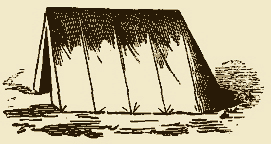
But, as I have already remarked, there was evidently a good deal of variety among the troop-tents first used, while nearly all the descriptions which I have seen of the tent d'ancien modèle, are unsatisfactory if not confused. They would appear, however, to have been wedge-shaped, and to have been supported by two upright poles forked at the top (fourches), to hold the ridge-pole. They were unstayed by ropes, the canvas coverings, of a single thickness, being simply drawn out and pegged to the ground along the lower borders.
It is certain that the cul-de-lampe was never an indispensable feature of the common troop-tent. And although, as I have remarked, it is not improbable that the cul-de-lampe may have been a characteristic of some of the troop-tents first used in the Prussian service, they certainly are very rarely represented with this appendage in German paintings and engravings, of a date anterior to the reign of Frederick the Great. They oftentimes, from the sketches which I have examined, would seem to have been formed of nearly square pieces of canvas stretched over a ridge-pole, in such a way, as to leave both ends of the tent quite open---that is, without vertical end walls; but as the breadth of the canvas was frequently considerably greater than the length of the ridge-pole, the ends of the tent might be closed, when necessary, with the surplus canvas. Doubtless cords were occasionally attached to the tops of the upright standards and fastened to pegs driven into the ground, a few feet from them; the free canvas at the ends, being thus supported, would enlarge the interior of the tent, and give to one or both of its ends a hemi-conical form. Indeed, it is very probable that the cul-de-lampe owes its origin to this fact. Nevertheless, the troops then occupied not unfrequently wedge tents provided with vertical end walls, and similar to that shown in the sketch below (Fig. 14). Sometimes the ridges of these tents are represented covered with double roofs, or hoods, and it is a very interesting fact, that the hoods are often, in form and appearance, exactly like those I have spoken of as peculiar to the Roman tentorium, the only difference being one which leaves no doubt as to the meaning of the horizontal line in the representation (Fig. 9)---two or three cords passing from the long line which shows the limit of the lower border of the hood, to the same number of pegs, planted in the ground a short distance outside of the line of pegs which secure the lower border of the tent itself.(178) Simple wedge-tents, such as that shown in Figure 14, are also to be found in sketches illustrating the movements of the armies under Turenne, Condé, and Maréchal Saxe; and Grose represents tents of this form as having been in use in the English army in the middle of the eighteenth century. Indeed, I may again remark that the simplest as well as most primitive form which can be given to a tent, is that of an inverted wedge. Such tents were used by the ancients, and they are still extensively employed among those people who cling most tenaciously to their ancestral customs, as also wherever simplicity is sought, and the object is to obtain the best results with the least trouble.
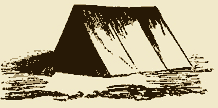
In some engravings which I have, representing certain Chinese military operations in the years 1756 and 1758, a number of encampments are shown; in these, nearly all the tents are wedge-shaped, and but for the peculiar distribution of the tents, the encampments would be at once supposed to belong to European armies.
Le Père Amiot, in his book entitled "L'Art Militaire des Chinois," published in 1772, says the tent used by the Chinese "is five feet five inches high, fourteen feet long, and six feet wide; it is wedge-shaped, and has triangular doors." To continue his description:---
"The exterior covering is of coarse white canvas; the tent has an inner lining of common blue cloth; sixteen pieces of iron (sockets) hold together the frame-work, which consists of two upright poles and a ridge-pole. The tent is. secured to the ground by eighty wooden pins, which are driven through loops attached to the border of the canvas. The cost of this tent, together with its fixtures, is 110 francs."(179)
In French encampments in the time of Louis XIV. the canvas was sometimes thrown over a long bar, one end of which having been raised, was supported by a single fourche. Such long, sloping wedge-tents may occasionally be seen in old engravings; Denon has given representations of them in his "Egypt," and they are still to be met with in the East.
Another tent, frequently mentioned by writers of the period of which I am speaking, was the cortine, or courtine, an oblong square tent used by officers (see Fig. 15). This tent was sometimes covered by a sur-tente or "fly." "They were," says Bardin, "cénacles, made of ticking (coutil), covered by a second roof fastened to the ground by pickets. If the second roof had walls, the tent was called a 'marquise.'"(180) When these "cortines," "pavillons,"" pavillon à mansarde," used by officers, had simply the double roof, they occasionally closely resembled the "hospital" and "officer's" tents now used by the United States Government. The following description of the officer's tents used in the French service in the middle of the eighteenth century may be of interest:---
"The tents of the subaltern officers are cannonières, but larger than those for the soldiers. Those of the superior officers are pavilions five, six, or eight feet square, made of ticking; the roofs are seven or eight feet high; they have four curtains, which are called walls. The pavilion is covered by a second roof, which extends five or six feet beyond it, and terminates in a cul-de-lampe (hemi-cone) at its rear end. Walls are sometimes added to this second roof; the tent is then called a marquise. The second roof is stretched out, by cordage attached to pegs planted in the ground, as is the roof of the pavilion; the walls are also fixed to pegs by cords. The rain passes easily through the canvas and the ticking (coutil), of which the common tents are made, and falls inside in fine drops; this is what is called tamiser---to sift. The marquise prevents this, except during a very heavy rain; moreover, it diminishes the heat, which is frequently very great under the cannonières."(181)
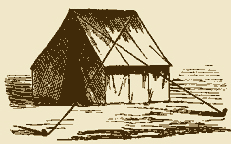 FIG. 15.---A cortine or wall-tent of the seventeenth century. |
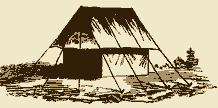 FIG. 16.---A cortine covered by a sur-tente or fly, and frequently called a marquise. |
Fig. 16 shows a pavilion, or cortine, with a sur-tente. Sometimes the sur-tente was furnished with walls, which nearly or quite enveloped the tent. A tent so covered is shown in Fig. 17, which represents an English marquee as constructed in the middle of the last century. This tent is apparently similar, in every respect, to the marquee now used in the British army for hospital purposes.
De Perrin considers the marquee to be the lineal descendant and representative of the splendid pavilions, used in ancient times and in the middle ages; indeed, he suggests that its very name was derived from the rank of those who brought it into use. In respect to the origin of the name,(182) De Perrin may be quite right; but I may observe that outer coverings have very rarely been employed except as a means of more effectually protecting those within tents from the excessive heat of the sun, and from the rain; as also, that if the use of such coverings is very ancient, it has been by no means strictly limited to persons of rank.
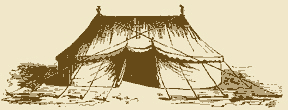
The Byzantine Emperor Leon (A. D. 900) directs that the troops I about to engage upon an expedition "shall take with them their cantines and their double tents, if there is occasion, of which one part serves as a roof or sur-tente to the other."(183) The Emperor Maurice (A.D. 590), in speaking of the tents used by the Turks and Arabs, commends them as both handsome and commodious; and M. Maizeroy, in noting this fact, does not hesitate to accord to those peoples the credit of having invented the double roof or "fly."(184) "The Turks," says Di Marsigli, "who possess great wealth, have convenience and elegance always in view, in their encampments. Their tents are impenetrable to rain, to the sun, and to the wind. The general officers and subalterns, as well as the pashas, have double-roofed tents."(185) So the Jewish tabernacle is represented as having been provided with a roof of skins placed, as a protection, over the covering of the tent.(186) Indeed, it has been a common custom in the East, since a very remote time, to employ a second covering for tents. The ordinary private's tent now used in Bengal, in the English service, has an outer "fly" consisting of three folds of cotton cloth, while the inner roof itself is double. The sepoy's pall consists throughout of three folds of cloth.
From the descriptions which I have given of some of the tents employed in European armies, during the eighteenth century---and although tents were then at certain times issued to the troops as liberally as they may have been at any time since(187)---it must not be inferred, that they were ever regarded as other than expedients---as substitutes for more desirable quarters. They were very rarely employed during the winter months.(188) Colombier,(189) after having indicated the precautions to be observed by men under canvas, says:---
"I have thus far spoken of armies encamped during the summer, for it is only at this season that they encamp, except when obliged to do so, since sometimes it is necessary to remain in the field during the other three seasons, despite the rigour of the weather, as was the case at the Zell, where several regiments were under tents in the month of December, and in the French and allied armies before Giessen (1760), in the months of October and November.
"One can easily understand, that it is in these circumstances that troops suffer the most in camp; the rain, snow, and hail---everything tends to multiply the dangers of the situation."
And yet, curiously enough, he admits that the mortality is then generally less, under a good administration, than when the troops are encamped during the months of August and September. But he goes on to say:
"When the camp is no longer tenable, to avoid the rigour of the season, it is customary to place the troops for a month or six weeks in cantonnement before they go into winter quarters."
And here again, he observes that often the assembly of large numbers of men in the same village leads to dangers greater than those they would have encountered, had they remained in camp. "Towards the middle of November winter quarters are assigned the troops." These, however, differed in no way from the cantonnement just mentioned, except in the establishment of a few defensible posts, which, with the presumed inactivity of the enemy, permitted perhaps a larger dispersion of the troops among the neighbouring villages.
But sometimes it was necessary to remain in a fixed camp for the winter, and then "barracks were ordered, or at least permitted." This arrangement, by which the troops were sheltered from the cold and the vicissitudes of the weather, "consists in building up of branches, earth, straw, or dung, a sort of hedge around the tent; while excavations are made (outside of the tent) for the kitchen, and that the soldiers may warm themselves. Although these barracks protect one very little against humidity, they at least serve to keep off the wind. Sometimes a roof is put over the tent. When it is solid, and sheds water well, it is an advantage, as it is a greater protection against the cold and rain; but as the soldiers are allowed to make excavations, I should prefer to let them remain in these, during the day, and make them sleep in their tents, barricaded as I have described."
These dispositions, narrated by Colombier, were those generally employed in camps during the reigns of Louis XIV., Louis XV., and Louis XVI.(190) But shortly after the commencement of the wars of the Revolution, the use of tents in the French service was almost wholly abandoned. Hoche assured his troops that it was "more soldier-like, more republican, and more glorious," to take the field without tents than with them. During the great wars of the Empire, the difficulty of obtaining cloth, and the difficulty of transporting shelter, for the immense armies which were then created, resulted so far in the disuse of tents, that although they are constantly referred to in the Ordinances of the period, as constituting an essential part of the army équipage, as a matter of fact, even the generals themselves were rarely provided with them. Nevertheless, the consequences of bivouacking were fearfully disastrous. General Rogniat declared it to be "one of the principal causes of that frightful consumption of men during the last wars;"(191) and Biron affirmed that "this mischievous manner of carrying on war, caused more soldiers to perish than the fire of the enemy."(192) A partial remedy for these evils was found, in permitting the soldiers in stationary camps to construct huts; but it was so late as 1793, before a French army was fairly quartered in huts. The most celebrated camp of this kind was that at Boulogne (1803-1805). Here an army of 160,000 men had been encamped, at first au bivouac; but the soldiers, taking the initiative, began to build huts for themselves, until finally the whole army was thus provided. This camp was subsequently embellished with gardens, arbours, columns in stucco, &c., until, in the language of an historian:---"The austerity which should reign in a camp was united with the elegance which is the ornament of cities."(193)
Under the Restoration, stationary camps were generally established in huts.(194) Indeed, it was only so recently as 1830, at the time of the Algerian War, and after years of peace had enlarged the resources of France, and the army had been reorganized, that tents began to be regularly and systematically issued to the troops.
In the English army, after the use of tents had once been adopted, it would appear to have been adhered to much more uniformly, than has been common in Continental armies; and on more than one occasion during the wars of the Empire, their number is said to have offered an unpleasant sight to the comparatively badly quartered French troops. During the last great war in which the English have been engaged, that of the Crimea, as has frequently been the practice in sieges prolonged into the winter, the troops were for the most part placed in huts.
During the first year of the American War of the Rebellion, the Federal troops were furnished with tents most liberally; but as the war continued, the company tents were replaced by tentes d'abri, and to such an extent, that long before the close of the war, the troops were rarely provided with any other shelter.
Probably the most remarkable instance of an abandonment of troop-tents during a campaign, in modern times, occurred in the late Franco-German War, and on the part of the allied German armies. Very few of these, on entering upon the campaign, were provided with troop-tents of any sort. During the months of July, August and September, their quarters were generally au bivouac; and as the season grew later, the troops were quartered in the houses of the country, or, if in tents, in those captured from the French.
In speaking of the interior arrangement of Roman tents, I observed, that beyond covering the ground with straw, nothing was commonly done to make them habitable. The practice of thus furnishing the interior of military tents, has almost universally prevailed down to the present time. Where straw could not be procured, dry grass, leaves, herbs, and the fine branches of trees have been used as bedding.(195) In cold countries, and where tents are employed by the whole population, the occupants of tents have very generally made their beds of skins. The Persians, Arabs and Turks are perhaps the only races who have in their tents systematically used carpets or floor-cloths, as a matter of health and convenience.
The fear of dampness, from a direct contact with the earth, has been the occasion of many devices and suggestions. In the United States during the War of the Rebellion, whenever the size of the tent permitted, bunks were built, often one above the other, as in the cabin of a ship, and this practice has occasionally been employed elsewhere; but as a rule, in military life it has been necessary for the soldier to sleep upon the ground, with or without the intervening straw. The risks of such a practice are considerable at every season of the year. That they might be partially avoided, M. Jourdan Le Comte was induced, many years ago, to propose the use of a square piece of oilcloth which was to form an accessory part of each tent, and which was to be laid on the ground before the straw was brought into the tent; and it is a matter worthy of note, that among the many advantages he enumerates which might be derived from the use of such a cloth, is this, --those serving as scouts and at outposts "could lie down on the naked earth wrapped up in their cloaks without having to fear the dangers of dampness."(196) The proposition of Le Cointe was not adopted. Quite recently, however, the English Government has so far recognized the wisdom of the suggestion, as to provide the hospital marquee with such a floor-cloth. Soon after the outbreak of the civil war in the United States, the Federal soldiers were provided with an india-rubber poncho which, among its many uses, served excellently as a floor-cloth within a tent, or as a blanket, upon which the scout could lie down on the ground, in the open air, without the fear of dampness.
As may be supposed, it is only after the middle of the eighteenth century that any criticisms are to be found, concerning the qualities of tents used in encampments. Colombier, who was one of the most intelligent sanitarians of his time, has, however, pointed out certain defects in the cannonière, which perhaps will be found none the less interesting, because applicable to some of the tents still in use. As has already been observed, tents were never considered in the eighteenth century as suitable quarters for troops, except during the milder portions of the, year.(197) Hence Colombier says:---
"Except towards autumn, when the nights and mornings are sometimes cool, the soldier under the cannonière suffers much less from the cold than from the heat. He can protect himself from the cold by packing the earth around the border of his tent, or by pinning the border down more tightly, or by stopping up the holes with straw; but it is more difficult to find a remedy for the heat. The sun beats through the canvas, and becomes sometimes almost insupportable. The cavalryman has a remedy for this, as he can spread his cloak over the cannonière; the foot-soldier can only make use of leaves. If he had only some blankets given him, he might at times use these as the cavalryman does his cloak.
"I would have the cannonière so made that it could be opened at both ends, in such a way, that when it became hot, the end towards the sun might be closed and the other opened. In this way we might always get a current of air, which would diminish the force of the heat."
"The cannonières of the soldier are all ordinarily of a very angular form, low and narrow; it is into these strangled sacks that a number of men pile themselves at night. The pestiferous air within them in warm weather frequently causes them to be dangerous."(198)
And he repeats the recommendation of Colombier, that the tents have an opening at each end, since "tents which only open at one end, are always infected by suffocating odours or vapours, which éause the men to suffer cruelly during the night,", and even "to mutually poison each other when they are crowded together, as in an ant-hill, in, a sack, every issue and entrance to which is carefully shut up."
The wishes of Colombier and Jourdan Le Comte, were practically realized by an Instruction of the year III., which authorized the tents of the nouveau modèle. These tents had the form and size of two cannonières brought together front to front. The doorways were on the sides, and when open, left a free passage through the tent.