
| Quam pulchra tabernacula tua, Jacob, et tentoria tua, Israel! ut valles nemorosæ, ut horti juxta fluvios irrigui, ut tabernacula quæ fixit Dominus quasi cedri prope aquas."---Liber Numerorum, cap. xxiv. |


 S I wish to direct your attention
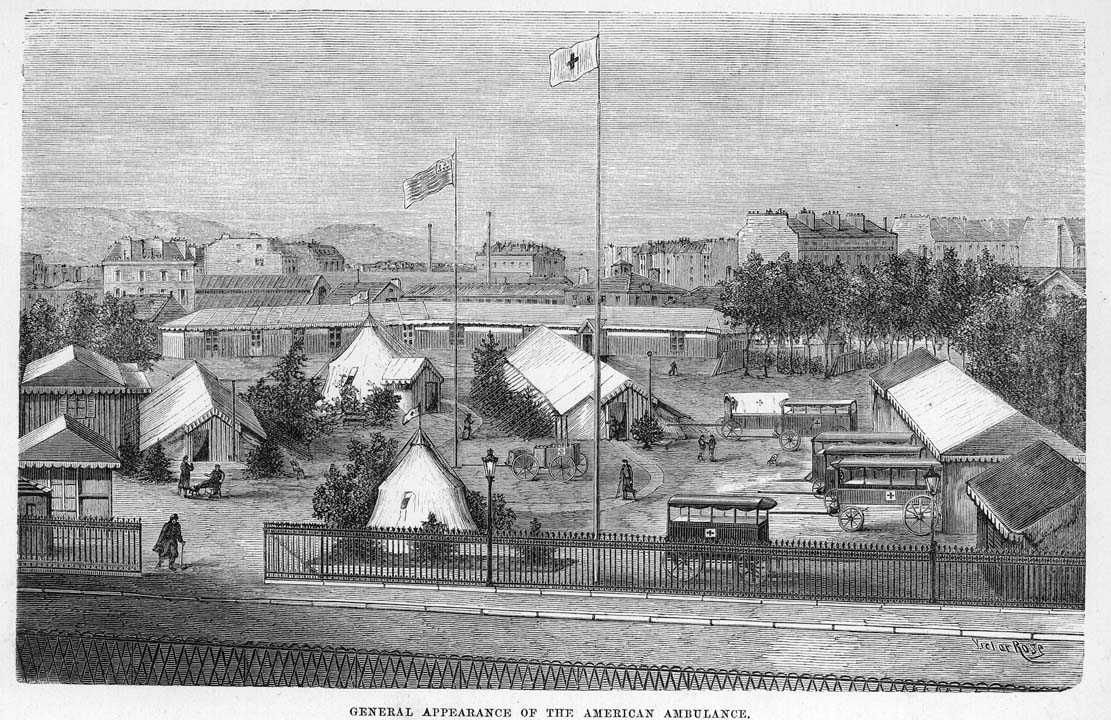
particularly to the material means employed at the American ambulance,
for the purpose of accomplishing the object had in view---the
establishment of a hospital under canvas, which might equal in
sanitary excellence the best permanent hospital,---in taking up,
in the order of their importance, the several subjects which I
propose to discuss, I am naturally led to speak first of tents.
As what signally characterized the American ambulance was the
use there made of tents and tent-barracks, and as the employment
of such shelter, for many purposes at least, has been known since
a very remote time, it has seemed to me preferable to present
in a general way the history and characteristics of these constructions;
and I am also encouraged to do this, from the fact that very little
exact information is to be found in any work, with which I am
acquainted, as regards either the tents now in use or those formerly
employed.(1) But while it
has seemed to be highly desirable that a Report upon a special
tent-service, should contain at least a fair summary of our present
knowledge of tent architecture, such a dissertation would have
appeared disproportionately voluminous, had it found a place under
any title, in an account of the material organization special
to the American ambulance itself; I have therefore preferred to
introduce it as a separate part, preliminary to a detailed account
of the principal material characteristics of the ambulance.
S I wish to direct your attention
particularly to the material means employed at the American ambulance,
for the purpose of accomplishing the object had in view---the
establishment of a hospital under canvas, which might equal in
sanitary excellence the best permanent hospital,---in taking up,
in the order of their importance, the several subjects which I
propose to discuss, I am naturally led to speak first of tents.
As what signally characterized the American ambulance was the
use there made of tents and tent-barracks, and as the employment
of such shelter, for many purposes at least, has been known since
a very remote time, it has seemed to me preferable to present
in a general way the history and characteristics of these constructions;
and I am also encouraged to do this, from the fact that very little
exact information is to be found in any work, with which I am
acquainted, as regards either the tents now in use or those formerly
employed.(1) But while it
has seemed to be highly desirable that a Report upon a special
tent-service, should contain at least a fair summary of our present
knowledge of tent architecture, such a dissertation would have
appeared disproportionately voluminous, had it found a place under
any title, in an account of the material organization special
to the American ambulance itself; I have therefore preferred to
introduce it as a separate part, preliminary to a detailed account
of the principal material characteristics of the ambulance.
I shall, in this part of my Report, present the conclusions to which I have arrived concerning the forms or models of tents best adapted for the construction of temporary hospitals; I shall also consider the advantages to be derived from the use of tent-barracks in the hospitalization of troops, and finally shall describe at length several of the forms recently proposed for such constructions.

 F the word tent is used to signify
a portable shelter, the use of tents is probably nearly coeval
with the origin of man. In Genesis iv. 20, we are told that Jabal
was the father of such as dwell in tents.(2)
Noah, Lot and Abraham are said to have been dwellers in tents.
Indeed, from early Bible history we may infer that for many centuries
nearly all the inhabitants of Palestine and Syria dwelt in tents.(3) As in the
earliest ages, so among the primitive and uncivilized tribes which
now inhabit the earth, provisional or temporary shelter is chiefly
made use of; but in the earliest ages, as among the savage races
of to-day, a tent was an establishment, often very different from
that which the word now generally suggests to us. Derived from
the Latin verb tendo, a tentorium; tent, conveys
to our minds the idea of a shelter stretched out, or of
one afforded by some material which is capable of being stretched
out at will. It also, almost invariably, suggests to us a construction
made of canvas or some woven stuff. Among all primitive people,
however, the "tent" only represents that provisional
and more or less portable shelter which they may have the habit
of constructing to protect themselves against the heat of the
sun, or the vicissitudes of the weather. In the East, where time
has wrought few changes in the customs of the people who inhabit
those countries whence come our earliest traditions, the tents
of Jabal and of Abraham may still be seen. The writer of this
report has a most unpleasant remembrance of a compulsory study
of the architecture and merits of one of these constructions among
the Bedouins of the Jordan. The tent---the subject of his painful
inspection---was about ten feet square, and six or seven feet
high, and was formed entirely of sticks and the branches of trees;
with the latter it was thatched overhead, and covered on three
sides---the fourth served most conveniently as a doorway, being
always wide open; on the ground within was a bit of dirty carpet.
It was a rude hut en bivouac, that only served to keep
the sun out by day and the dew by night; and although the hospitality
of its proprietor left nothing to be desired, except perhaps a
less avaricious thirst for backsheesh, a day passed within
it, pretty effectually destroyed all the associations of romance,
which he may ever have entertained in connection with tent life,
whether among modern or patriarchal Bedouins.(4)
The "booth" which the prophet Jonah is said to have
made and sat under, on the east side of Nineveh, was probably
a construction of this sort.
F the word tent is used to signify
a portable shelter, the use of tents is probably nearly coeval
with the origin of man. In Genesis iv. 20, we are told that Jabal
was the father of such as dwell in tents.(2)
Noah, Lot and Abraham are said to have been dwellers in tents.
Indeed, from early Bible history we may infer that for many centuries
nearly all the inhabitants of Palestine and Syria dwelt in tents.(3) As in the
earliest ages, so among the primitive and uncivilized tribes which
now inhabit the earth, provisional or temporary shelter is chiefly
made use of; but in the earliest ages, as among the savage races
of to-day, a tent was an establishment, often very different from
that which the word now generally suggests to us. Derived from
the Latin verb tendo, a tentorium; tent, conveys
to our minds the idea of a shelter stretched out, or of
one afforded by some material which is capable of being stretched
out at will. It also, almost invariably, suggests to us a construction
made of canvas or some woven stuff. Among all primitive people,
however, the "tent" only represents that provisional
and more or less portable shelter which they may have the habit
of constructing to protect themselves against the heat of the
sun, or the vicissitudes of the weather. In the East, where time
has wrought few changes in the customs of the people who inhabit
those countries whence come our earliest traditions, the tents
of Jabal and of Abraham may still be seen. The writer of this
report has a most unpleasant remembrance of a compulsory study
of the architecture and merits of one of these constructions among
the Bedouins of the Jordan. The tent---the subject of his painful
inspection---was about ten feet square, and six or seven feet
high, and was formed entirely of sticks and the branches of trees;
with the latter it was thatched overhead, and covered on three
sides---the fourth served most conveniently as a doorway, being
always wide open; on the ground within was a bit of dirty carpet.
It was a rude hut en bivouac, that only served to keep
the sun out by day and the dew by night; and although the hospitality
of its proprietor left nothing to be desired, except perhaps a
less avaricious thirst for backsheesh, a day passed within
it, pretty effectually destroyed all the associations of romance,
which he may ever have entertained in connection with tent life,
whether among modern or patriarchal Bedouins.(4)
The "booth" which the prophet Jonah is said to have
made and sat under, on the east side of Nineveh, was probably
a construction of this sort.
The branches and bark of trees, reeds, and grass, have always been largely used by the constructors of temporary shelter. Many of the nomadic tribes of Siberia still make their huts or tents of the bark of trees; among these, may be mentioned the Kalmucks, the Tungoosians and the Buraets, who employ birch bark for this special purpose. This bark being very flexible, is sewed together piece by piece, and is often very handsomely embroidered.(5) Many of our American Indians were also in the habit of using bark as a covering for their "wigwams;" they also occasionally used reeds and grass for this purpose, as do the Hottentots of this day, who, weaving these materials into mats, make of them a shelter, somewhat as Cæsar informs us the soldiers of his legions, whom he had embarked into Africa, constructed for themselves tents arundinibus scopis que contextis.(6) Achilles' tent, if more imposing, was only a slight improvement upon the same style of architecture.(7)
Herodotus mentions a peculiar people living on the confines of Scythia, "who dwell all the year round under trees. During the winter they cover these trees with a sort of felt, made of white wool; this covering is taken off as the season becomes warm."(8) During the Peninsular campaign (1811-14), the English troops, when unprovided with canvas tents, were in the habit of constructing for themselves a kind of shelter, which is thus described by Luscombe :---
"The plan pursued was to select a tree (generally a cork tree or an evergreen oak) which had wide-spreading branches; a lower branch was then nearly cut through, so as to allow the extreme points to drop to the ground; other branches were then cut from adjoining trees, and fixed in the ground, so as to form nearly a circle of sufficient dimensions, placed nearly upright, and with the upper branches resting on that branch of the tree under which the hut was to be constructed, and which had been dropped towards the ground. Smaller branches were then interwoven to thicken the walls of the hut, which was afterwards lined on the inside with the broom plant, in the manner of thatching. Care being taken that the door of the hut should have an aspect of nearly due east (so that the sun might pass over it before reaching the horizon), a very agreeable residence was thus provided during the day."(9)
It is described, however, as cold at night, and as probably prejudicial to health.
The first real improvement in the construction of temporary shelter, dates from the time when skins began to take the place of the branches and the bark of trees, reeds, and grass. Constructions made of the latter materials are scarcely portable; and although "leafy bowers" may, furnish a shelter better than none, it is not to be compared with that obtained by the use of skins, of which material probably was made the first construction that could with accuracy be called a tent. The first instance on record in which skins were used to furnish a shelter, is in Exodus xxvii. 14:---"And thou shalt make a covering for the tent of rams' skins dyed red, and a covering above of badgers' skins." The tent here alluded to was none other than the Tabernacle.(10) Indeed, the Israelites, immediately they escaped from their Egyptian servitude (B. C. 1531), reverted to their ancestral habits of living, and adopted the general customs of the neighbouring nomadic races. "The children of Israel journeyed from Rameses to Succoth."(11) The meaning of the word Succoth is The Tents.(12) Their tents were probably made of skins, as also of coarse tissues of goats' hair, camels' hair, wool, and linen. Whether skins or woven fabrics were most commonly employed by them for tent coverings, it is difficult to say, although probably, as is now the case in the East, coarse fabrics were generally employed in the construction of their temporary shelter.
The tents now most common among the Arab sheiks are made of camels' hair or goats' hair cloth, and are of a dark grey colour ; they are sometimes even quite black.(13) They are oblong in form, from twenty to forty feet in length, from ten to twenty feet in depth, from eight to twelve feet in height, and are supported by numerous poles within, and pickets and cords without. The walls are tied on to the roof, which generally slopes one way---back from the front, which is almost constantly open.(14) The tent is usually divided into apartments by means of curtains. The inside lining of the tent is generally of some bright-coloured cloth, and the floor is often richly carpeted. These tents have frequently been said to resemble the hulls of ships upside down; but the similitude was probably first suggested rather by a remembrance of Sallust's description of the Numidian "mapalia"--- "quasi navium carinæ sunt"(15)---than by the appearance of the tents. The Arab tent can at any time be easily increased in size by stretching out the main coverings, and attaching, if necessary, curtains, at the same time replanting the pins and lengthening the cords. It is in allusion to this very ancient practice that the prophet Isaiah exclaims:---" Enlarge the place of thy tent; and let them stretch forth the curtains of thine habitations; spare not, lengthen thy cords, and strengthen thy stakes."(16) These tents, however, vary very much in size, quality, and elegance; conditions usually dependent upon the wealth of their owners; but the more imposing examples of Arab tent architecture are so far suggestive of the construction described in Exodus, as to render it highly probable, that they represent similar phases of life in the history of civilization. Not only were tents used by the nomadic tribes dwelling in Syria during the earlier periods of Jewish history, but there is reason to believe that they were subsequently, to some extent, used even within the walls of cities, or, as has been suggested, it is not unlikely that the dwellers in cities, at certain seasons of the year, were in the habit of resorting to tents. This at least was a Jewish custom,(17) and one which, from the general life of the surrounding population, could hardly have been peculiar. The Egyptians are said not only to have used tents in war, but to have pitched them upon their house tops. So representations of tents are to be seen on some of the sculptures found at Nineveh, together with articles of tent furniture, many of which are quite similar to those still thought most essential to common life in the East.(18)
Harmer informs us that Tamasp, a Persian monarch, passed his winters at Cashbin, and his summers in tents, at the foot of Mount Alouvent, a place celebrated for its coolness and its delightful scenery; and he states that the custom of this monarch was maintained in Persia until the time of Abbas the Great, who established his court permanently at Ispahan.(19) Paxton supposes that "the curtains of Solomon" were tents to which that great king retired in the heats of summer,(20) and Pococke and other travellers(21) have mentioned the summer villages of canvas, or of reeds and boughs, still to be met with in the East, occupied by people whose winter houses stand empty for the time in the neighbourhood.(22)
Long after a certain civilization had been attained, many of the races of Central Asia cared very little for permanent shelter, as may be inferred, from the statements of several ancient writers who have spoken of tents mounted upon wheels, to be drawn by horses or cattle, as among the peculiar institutions of some of the more wealthy and prosperous of these races.(23) Such statements are, however, evidently exaggerations resulting from the fact that these nomads have occasionally dispensed with all shelter, except that afforded by carts or waggons covered with bark, felt, or stuffs of wool or goats' hair.(24) A very good idea of the construction of the dwellings used by vast numbers of Asiatics, whether in ancient or modern times, may be derived from Atkinson's description of a Kirgis yourt. "The yourt was formed of willow trellis-work, put together with untanned strips of skin, made into compartments which fold up. It was a circle of thirty-four feet in diameter, five feet high to the springing of the dome, and twelve feet in the centre. This dome is formed of bent rods of willow, one and a quarter inches in diameter, put into the mortise-holes of a ring about four feet across, which secures the top of the dome, admits light, and lets out the smoke. The lower ends of the willow rods are tied with leathern thongs to the top of the trellis-work at the sides, which renders it quite strong and secure. The whole is then covered with large sheets of voilock, made of wool and camels' hair, fitting close, making it water-tight and warm. A small aperture in the trellis-work forms a doorway, over which a piece of voilock hangs down and closes it; but in the day time this is rolled up and secured on the top of the yourt. Such is the dwelling of a great and wealthy chief in the steppe."(25)
In general, it may be stated that tents of various kinds have been extensively employed as domiciles, by a considerable portion of the whole population of Western and Central Asia, since a time almost immemorial.
Nor has the habit of dwelling in tents or temporary domiciles been limited to that quarter of the globe. A large part of the human family has been reared in tents, and is still acquainted with no other kind of shelter. In construction, these temporary habitations have varied with the climate and products of the country, and with the necessities and special tastes of the races using them. An almost endless variety may be found described in books of travel. But whatever interest may be connected with many of these descriptions, my present object is rather to consider the use which has been made of tents in war.

THE Greeks are said to have encamped in tents at the siege of Troy; and they were at that time undoubtedly acquainted with the use of tents of skins or woven fabrics. The large fleets, which seem to have been constantly lying before the Greek camps during that memorable siege, sufficiently show, that there was no lack of those materials from which tents as well as sails are made. But, curiously enough, although Homer alludes frequently to the camp quarters of the Greeks, he never mentions the use of tents of canvas, or skins. The word [κλισίη], which he almost uniformly employs,(26) when speaking of the lodgings of the chiefs, as well as of the common soldiers, signifies a hut or a cabin, rather than a tent. Thus, as we have already seen, the tent of Achilles was a sturdy framework, thatched with grass; and Homer speaks of it even, as if it were divided into separate apartments.(27) Indeed, early Greek writers have perhaps spoken less frequently of portable shelter than would have been the case, had the employment of such shelter been considered by them, at any time, as indispensable to an army.
Herodotus does not allude to the existence of tents in the Greek armies, and refers but twice to their use in war by the Persians; from one of these references, however, we may infer that they were not only numerous, at the time of his writing, in Persian camps, but that they were not wanting in any of the adjuncts and appurtenances of barbaric splendour. After the battle of Platæ, Pausanias forbade, in a proclamation, any soldier to touch the plunder which had been captured from the Persians, and at the same time, ordered the Helots to bring it all together into one place:---"And they went through the camp finding tents, resplendent with gold and silver;(28) beds, covered with gold and silver ornaments, vases, goblets, and other drinking vessels of gold; and in sacks, loaded upon waggons, gold and silver kettles."(29) The magnificence of the Persian camp equipage at this period is confirmed by the statements of other writers. Thus Plutarch says, that Aristides did not disappoint those who held him in estimation, on being left at Marathon to guard the prisoners and the booty captured from the Persians:---"For although gold and silver were scattered here and there in the tents (ἐν ταῖς σκηναῖς), and the ships that had been taken were full of magnificent articles of clothing and countless riches, he not only did not appropriate any of these things to himself, but kept others from so doing."(30) Xenophon mentions the capture of the tent (ἠ σκηνὴ) of Teribasus, in which were found beds with silver feet, and drinking cups, as also servants, who reported themselves to be his bakers and cup-bearers.(31) Xenophon also speaks several times, in his account of the expedition of Cyrus, of the Greek "soldier's tent;" and he moreover says they were made of skins. Coming to the Euphrates, the soldiers crossed over it in the following manner:--- "They filled the skins, which they made use of for tents, with dried hay, then joined and sewed them together so close, that the water could not get at the hay; upon these they passed the river."(32) Arrian also informs us that Alexander crossed the Oxus, by making use in a similar way of the skins of the soldiers' tents.(33)
That the Greek soldiers who set out upon the expedition of Cyrus, were well supplied with tents, may be inferred from a circumstance which took place after the death of Cyrus, and when, Xenophon having been chosen to command the Greeks, it was resolved to return to Greece. In a speech made to his soldiers, Xenophon said:---
"In the first place I think we ought to burn all the carriages, that the care of them may not influence our march, but that we may be directed in it by the advantage of the army. After that, we ought to burn our tents(34) also, for they are troublesome to carry, and of no use either in fighting or supplying ourselves with provisions . . . . And after he had said this, they all rose up, and departing, burnt their carriages and tents."(35)
With regard to the size of the Greek tents, and their forms and qualities, we are quite ignorant, as we also are of the whole art of castrametation, as practised by the ancient Greeks and Macedonians. To what extent the use of tents among the Greeks may have been adopted from the Persians, it is difficult to determine; it is very certain, however, that the use of splendid tents came as one of the results of the Asiatic conquest of the Greeks. We first hear of them in the Greek cities of Asia Minor, and Plutarch particularly notices the magnificent tent, which the Ephesians erected in honour of Alcibiades.(36) I have already alluded to the wealth found in the captured camps of Xerxes' armies. His successor, Darius, was not less prodigal in the equipment of his troops, and his own royal pavilion is spoken of as a wonder, full of everything which luxury could suggest or wealth obtain, while above the pavilion, where all could see it, "flamed an image of the sun set in crystal."(37) Alexander seems at times, if we can credit the accounts which have reached us, to have even surpassed Darius in the magnificence of his pavilions. At least, the splendours of Alexander's tent, "tabernaculo adornato quod centum lectos caperet,"(38) held their place, even among the legends of popular mediæval romance.(39)
In the second book of the "Deipnosophistæ" of Athenæus, is an account taken from Masurius or Callixenus Rhodius, of the splendid fêtes given by Ptolemy Philadelphus, in celebration of the apotheosis of the first Ptolemy (Soter). A tent (σκηνὴν) of marvellous beauty was erected within the citadel of Alexandria; it was fifty cubits high, and supported by wooden columns, some of them so carved as to represent the foliage of palm-trees, while others imitated the thyrsus. The ceiling of the tent was of purple cloth, embroidered with white, while all around hung draperies festooning the supports, the spaces between which were filled with various emblematical pictures. The ground was covered with Persian carpets, inwoven with the figures of animals. In one of these tents were one hundred golden beds, with sphinxes' feet, arranged in a circle on the sides, and overhung with purple tapestry of velvet. And here also were placed two hundred tables, fitted with silver shelves. At the end of the tent, below the beds, were one hundred silver basins and ewers, and farther down, upon a superb sideboard, were vases and goblets and the splendid service of the feast, of wonderful workmanship, in gems and gold.
Athenæus estimates at ten thousand silver talents, (over 7,500,000 dollars,) the value of the vases and goblets alone, used upon these tables; and this without counting either the cost of the workmanship, or the precious stones which might have been set in them.(40)
But I have perhaps dwelt sufficiently upon constructions which rather illustrate the ancient wealth and prodigality of the East, than the common life of the armies which have become famous in its history.
From a passage in Livy, it has been inferred that tents were adopted in the Roman army during the second year of the siege of Veil, in the 349th year after the foundation of Rome. These tents were said to have been made of skins or leather. There are reasons for believing, however, that tents were used by the Romans before this time. If we can trust the statement of Dionysius of Halicarnassus, the cities of Latium, which were engaged in almost perpetual wars with the Romans, after the expulsion of the kings, were rich and even highly civilized. Dionysius frequently alludes to the presence of tents in the armies sent by these cities against Rome.(41) In the 300th year of Rome, in the campaign which Siccius conducted against the Æques, Siccius having captured the enemy's camp, "set fire to the tents, (τὰς σκηνάς) which were full of arms, and corn, and goods, and munitions of war, and burnt up all the plunder and wealth which had been stripped from the Tusculans."(42) In the first year of the 83rd Olympiad (306th year of Rome), the Romans again declared war against the Æques, and were in turn defeated. In narrating this defeat, Dionysius for the first time speaks of Roman tents:---
"The enemy plundered their tents, carried off their beasts of burden, their silver, their slaves, and all their munitions and apparatus of war."(43)
Moreover, Livy does not say that tents were first used by the Romans at the siege of Veii; he says, the Roman generals then first caused winter quarters to be built---hibernacula etiam œdificari cœpta, res nova militi Romano.(44) The words hibernacula and œdificari would hardly have been used had it been proposed to provide only tents. It is true that the demagogical tribunes made the continuance of the campaign a pretext for complaining that the whole army was thus forced to pass the winter in tents ---sub pellibus durare;(45) but this expression, even, implies that the army had long been more or less accustomed to be sub pellibus in summer encampments; and the inference is confirmed by the statement of Florus, that at this siege of Veil, the Roman army first passed the winter under tents made of skin---tunc primum hiematum sub pellibus.(46)
Of the form and qualities of the tents used in encampments, in the earlier periods of Roman history, as also of the proportion of the tents to the troops in the field, we know almost nothing. There were times when their use is said to have been forbidden even in the winter,(47) and the Roman military authorities seem always to have considered tents as an impediment, and to have not unfrequently dispensed with them altogether. Probably Ovid's lines very accurately represent Roman encampments, as they existed for a long time after tents first began to be used:--
"Sub Jove pars durat; pauci tentoria ponunt; Sunt quibus ramis frondea facta casa est."(48)
Camped a few in tents, some in the open air,
While bowers and booths were well-nigh everywhere.
It is evident, however, that as the Roman armies became larger and better organized, and were sent upon more distant and longer campaigns, the necessity of sheltering the troops becoming more and more apparent, tents began to be regarded as an indispensable part of a soldier's equipment.
Livy, in his "History of Rome," speaks of tents or huts---tentoria, tabernacula---perhaps twenty times; but the words, unfortunately, generally occur quite unaccompanied by any account, either direct or indirect, of their forms, construction, or qualities.(49) After the defeat of the Romans by the Etruscans (300 B. C.), Valerius Maximus is said to have found, on visiting the Roman camp, the cohorts which had lost their standards, outside of the stockade and destitute of tents.(50) The obvious inference from this statement is, that the cohorts at the time mentioned were habitually provided with tents; and we are told that when Pyrrhus, about twenty years later, during the war of Tarentum, having taken a considerable number of Roman prisoners, gave these up without ransom, the Roman general, wishing to punish these troops for having been taken prisoners, degraded them all, and among other punishments, refused to the foot soldiers the use of their tents.(51)
Livy also informs us, that less than a hundred years after, the regularity and order observed in laying out a Roman camp were such, as to particularly excite the admiration of those who were then first made acquainted with the Roman system of castrametation. Thus Philip of Macedonia, when he first saw a Roman camp, and observed the regularity with which the tents were pitched, and the width of the streets, said:---"Such a camp cannot be the camp of barbarians."(52) In the war which followed against Perseus, each soldier had his tent;(53) and Scipio Asiaticus, when carrying on war against Antiochus, informed his soldiers, that unless the campaign was brought to a speedy close, they would be compelled to winter in their tents---aut sub pellibus habendos milites fore.(54) It is certainly a little surprising that Polybius, who, in a work written about 150 years before the Christian era, devotes a chapter to the description of the Roman system of castrametation, should enter into no details relating either to the form of the tents used, or the materials of which they were made. His description, however, of the position of the tents occupied by the generals, the tribunes, and the troops of each class, makes it perfectly certain that portable tents had been regarded as essential to well organized camps long before his time.
Cæsar gives us to understand, that his troops were generally well provided with shelter in tabernaculis,(55 as also, that even the sutlers who followed his armies had their tents, on the borders of the camp---sub vallo tenderent mercatores.(56)
Caesar also tells us, that the tents were sometimes used as a roofing to other constructions. Thus, on one occasion, his men were quartered partly in houses and partly in constructions covered over with skins and thatch---atque in tecta partim Gallorum, partim quœ, conjectis celeriter stramentis tentoriorum integendorum gratiâ, erant inœdficata, milites contegit.(57)
And finally, at a later period, we find Vegetius laying down the rule, that, if the health of the army is to be considered, not even in the summer should the soldier be without a tent---ne sine tentoriis œstate milites commorentur.(58) Indeed, mere allusions to the presence of tents in Roman armies, may be found as frequently in contemporaneous writers, as allusions to a similar means of encampment, are to be found in the literature of our own time, for they are by no means confined to the purely historical writers. Thus Lucan speaks particularly of Cæsar's tents,
"Deseruere cavo tentoria fixa Lemanno,
Castraque quæ Vogesi curvam super ardua rupem."(59)
And again, ---
"Et subitus rapti munimine cespitis agger
Præbet securos intra tentoria somnos."(60)
But to multiply these citations is needless; what is principally to be regretted is, that with all the abundant and even inexhaustible evidence of the almost constant presence of tents in Roman encampments, at this time (that of Cæsar), scarcely a word is to be found descriptive of them, while even the bas-reliefs and medals, in which their outward forms may have been repeated, have probably disappeared for ever.
Reticent as have been Roman historians on nearly every subject, which directly concerned the administration of their own military service, we can hardly expect from them much information concerning the measures adopted by foreign states for maintaining and supplying active armies.
Cæsar gives no account of the manner in which the Gauls, Germans, or Britons, were in the habit of sheltering themselves during their campaigns; except, perhaps, when speaking of a certain Roman camp, he says the cabins of the troops were covered with straw, in the Gallic fashion.(61) In but a single instance, however, does he refer to a Gallic tabernaculum, that of Teutomatus ;(62) and as for the Germans, he only says, in speaking of the Suevi, that they were a nomadic people, who never remained longer than a year in one place.(63) There can be little doubt, however, that both the Germans and the Gauls, accustomed as they were to the use of various kinds of temporary shelter, were acquainted with that furnished by light and portable coverings. It is scarcely necessary to refer to the well-known readiness of the Gauls, in particular, to imitate their enemies in the use of everything which promised to be of the least service in war;(64) the immense amount of baggage which constantly followed their armies, and the frequent presence in their camps of the women and children of the whole tribe which might be at war, are the indirect but sufficient proofs that such coverings were used by them.(65) Plutarch, moreover, distinctly asserts that the Gauls used tents, during their wars with Cæsar; and that their tents were true tents of skin, or some kind of cloth, is evident from the fact, that at least on one occasion, they formed no inconsiderable part of the plunder brought into the Roman camp.(66)
Two or three passages in Livy have fortunately preserved for us the fact that the expeditionary armies of Carthage were provided with portable tents. We are told that when Hannibal crossed the Alps into Italy, the weather was severely cold, and that his troops were in the habit of building up fires before their tents---ignibus ante tentoria factis.(67) But this statement is followed by another even more explicit; it substantially proves that the tentoria above mentioned were carried on the march, and that they were moreover made of skins or some kind of cloth. Shortly after Hannibal had broken up his winter camp, his troops, while crossing the Apennines, were overtaken by a great storm followed by cold and windy weather, which occasioned sufferings, if possible, severer even than those which had been endured in crossing the Alps; and the principal or direct cause of these sufferings, is said to have arisen from the circumstance that the tents, soaked by the rain, became so stiff when it grew cold as to make it nearly or quite impossible to unroll them, while a violent wind blew down everything which was set up.(68) Hannibal also is said to have occasionally deceived the Romans by leaving some of his tents standing on moving out of his camps.(69)
Again, Asdrubal's army in Spain is represented as encamped in tents, in which the soldiers quietly reposed---quietos in tentoriis suis.(70)
But the most remarkable account which Livy gives of a Carthaginian encampment, relates to certain winter quarters occupied by Asdrubal, after Scipio had carried the war into Africa. These winter quarters were made for the most part of light and unsubstantial wood, the materials having been brought in very hurriedly from the surrounding country; those of the Numidians, especially, were made almost entirely of reeds and coarse matting, and were scattered about without order.(71) The camp being thus composed of frail cabins, Scipio burned it up---proximis casis injectus ignis hæsit.(72) A similar encampment is said to have been formed by Nabis, King of Lacedemonia, during his war with the Romans (192 B. C.)(73) As this camp was likewise destroyed by fire, we may well doubt if constructions of the sort described, were much resorted to by the Romans after, engaging upon wars of conquest, they had established their armies upon a permanent footing. It is true that Tacitus speaks of Corbulo's army wintering in Cappadocia raptim erectis tuguriis ;(74) but the Romans unquestionably preferred, as well for strategic reasons as from considerations of convenience, small solidly constructed huts, tabernacula, for their stationary or winter camps; and for their flying or summer camps, tentoria, tents made of skins.
Bardin says that "when campaigns were inevitably prolonged, the huts and barracks, which were called tabernacula, were replaced by tents made of skins."(75) This would seem to be an inversion of modern practice in the method of sheltering troops. It will be understood, however, that as these huts, or booths, were constructed of boards, the branches of trees, or even turf, they were seldom transportable, and that in consequence, tents of skin were greatly to be preferred for active campaigning.
The Romans rarely carried on war in the winter, but were accustomed to take up their quarters, as soon as the season became inclement, in hibernis. The character of the constructions within which the troops dwelt, in these winter quarters, is very rarely indicated in Latin authors. It is occasionally evident, however, from the context, that the troops were then often quartered upon the inhabitants of the towns and cities at or near the seat of the war.(76) Probably, in most cases, the army passed the winter in huts, tabernacula, while occasionally, as we have seen, they continued to remain, notwithstanding the inclemency of the season, sub pellibus.
It is very certain that the Romans in their winter camps, stativa hiberna, generally hutted their troops, and that the use of tents of skin in the winter, was always considered a hardship. Thus Tacitus, referring to the strict discipline of Corbulo, says:---
"The whole army was kept in tents, sub pellibus, although the rigour of the winter was such, that the earth, covered with ice, would not without digging afford a place for the tents."(77)
And Frontinus, among the numerous examples which he gives of the exercise of a strict and even severe military discipline, states that:---
"The Senate ordered the consul Valerius to lead his defeated army to Serinum, and there establish his camp, and pass the winter under tents."(78)
The only details we possess, concerning the form and size of Roman tents, date from the time of Trajan.
On the column erected to commemorate the Dacian campaign of this Emperor, are representations of the equipage used by the troops engaged in that expedition. Among these, are the figures of huts and tents. If the bas-reliefs on this column faithfully represent the several kinds of shelter used by Roman armies, at the beginning of the second century, it would seem as if small framed houses were then more employed as a shelter than tents, while even of the tents, most appear to have had wooden frames and roofs, the walls alone being made of skins or canvas; but as Montfaucon has observed, the relative size of these constructions was evidently not regarded in the designs, and it is equally probable, that the forms the artist most frequently chose to delineate were not those most common in Roman camps.

The first figure to which I may call attention (Fig. 6) is that of a small wooden building, which was very likely intended to represent a well-constructed tabernaculum, or soldier's hut. It will hardly do, however, to infer from the sketch that the Roman troops were habitually quartered, even in permanent camps, in such well-built barracks; it is by no means improbable that these strong wooden buildings were used chiefly for storehouses; whatever may have been the uses to which they were put, there is an artistic finish about the relief which was probably absent in the model.
Fig. 7 represents also a tabernaculum, but one made on a different principle. A frame-work of wood, surmounted by a roof covered with shingles or boards, is enclosed on all sides by curtains of some flexible material impermeable to rain. These are so arranged as to be opened, or even rolled up and attached to the roof, the weather permitting. This tabernaculum is in principle a very excellent example of the constructions now known as tent-barracks.
Vopiscus may have referred to such constructions when, in his "Life of Aurelian," he speaks of the skins prepared for the tabernacula and tents---pelles ad tabernacula et tentoria paratœ.
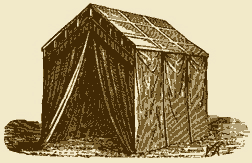 FIG. 7.---A Roman tent-barrack, tabernaculum. From the column of Trajan. |
 FIG. 8.---A Roman tent or tabernaculum. From the column of Trajan. |
Sometimes the frame-work was made lighter, the roof as well as the walls being covered with skins or canvas, as was probably the case in a tent represented on the column of Trajan, and of which a sketch is shown in Fig. 8. To that construction, Livy's words might be applicable ---nautici tabernacula detendunt.(79)
The characteristic peculiarity of the tabernaculum seems to have been its frame-work; it might be covered with boards, on turf, or skins, or canvas, and have various sizes and shapes, but it would appear always to have been supported by a skeleton of posts and rafters, and often, in this respect only to have differed from the tentorium.
Isidorus says, the tabernacula were so called, because the coverings stretched out with cords rested upon a frame-work, which sustained the tent---Dicta tabernacula, quod cortinæ funibus distentæ tabulis interstantibus, appenderentur, quæ tentoria sustinerent.(80)
 FIG. 9.---A Roman tent, tentorium. From the column of Antonine. |
 FIG. 10.---A Roman tent, papilio. From the column of Trajan. |
Among the designs on the column of Antonine, is one shown in Fig. 9, which was evidently intended to represent an ordinary soldier's tent; its primitive form is proof sufficient of this. Doubtless, the form and size of the common soldiers' tentorium varied more or less at different periods of Roman history, and according to special circumstances, but it is almost certain that the sketch in the figure, representing, as it does, one of the types of tent construction most common to all ages and to all countries, also shows one of the forms most used by the Romans, not only of Trajan's time, but during many preceding centuries, and conveys to us the best idea it is possible now to obtain of the character of the shelter Roman troops were provided with, when they were said to be sub pellibus.
This tentorium very closely resembles the so-called "wedge-tent" of the present time; it was probably supported by two upright standards and a ridge pole, while the covering stretched out at the sides, and perhaps also at the bottom or rear of the tent, was pegged directly to the ground, along the line of its lower border. As from the shape of the tent, but a small surface was exposed to the direct force of the wind, stay ropes were not needed, a great advantage from many points of view. Indeed, the tent would appear to have been chiefly commendable for general usage, by reason of the simplicity of its construction. It may seem as if a tent which requires three poles to sustain it, is less simple than a tent supported by a single pole; but this is not the case. No tent can be supported by a single mast, the covering for which has not been previously prepared with reference to such a support; while wedge tents may be made by throwing almost any kind of covering over a bar, lifted at one or both ends from the ground, and drawing out and fastening to the ground its dependent borders.
It would appear from the sketch, that the ridge of the Roman tentorium was protected by a special covering of some sort. What may have been the particular object of such an arrangement, I am by no means ready to affirm. I may observe, however, that although the dimensions of this tent are unknown, it was probably intended to be occupied by eight, perhaps ten soldiers; it must therefore have had a width and depth of at least ten feet, with a corresponding height.(81) Now, if this tent had such dimensions, it is very evident, that covered as it was with skins, no single breadth of these would reach from the ground to the ridge-pole. It is by no means improbable, therefore, that this kind of tent was made in two or three sections---side pieces, reaching up from the ground to within a foot or two of the ridge-pole, laced together at the rear of the tent, and fastened to the ridge-pole above by slings, and a roof piece, which serving as a hood, completed the covering. Such an arrangement would have greatly facilitated the transportation of the tent coverings, which, had they been made in a single piece, as are our modern canvas tents, must have been very heavy and cumbersome. Moreover, as these tents were made of a material absolutely impermeable to air, it would have been quite impossible to have placed a number of soldiers within one, had no measures been taken to ensure a natural and permanent place of exit for the air, heated and vitiated by such an assemblage of men. Supposing the upper part of the tent to have been covered only by a loosely fitting hood, it will be easy to understand how greatly such an arrangement must have contributed to the comfort as well as the health of the occupants of the tentorium.
On the arch of Constantine may be seen, in outline, two conical tents which in form, as well as by reason of hood-like coverings at the summits, strikingly resemble some of our modern tents.
Another Roman tent has been pictured upon ancient monuments ; it was round in form, and covered with a sort of dome, from which the walls fell almost perpendicularly to the ground, while an ornamental border frequently concealed the line upon which the roof and curtains met. (See Fig. 10.) This tent would appear to have had a special name, and to have been perhaps the most important and considerable of all the tents used in the later Roman encampments.
Tabernaculum and tentorium are the only words used by the purest Latin writers, when they may have wished to specify the kind of shelter employed in encampments.(82) Even Frontinus, who wrote on the "Stratagems of War" (A. D. 86), when speaking of tents, employed only the word tentorium. Some time, however, within the thirty years which followed the work of this writer, the word papilio seems to have come into very general use, either as a name for a special kind of tent, or as a term applicable to tents in general. The origin of the use of this word, whether as the name of a special tent, or as a generic term for tents, is very uncertain. Pliny, I believe, is the first author who uses the word papilio, but neither he nor those writers on military subjects---Hyginus, Modestius, Vegetius---who gave this new word currency, have taken the trouble to describe the papilio, and singularly enough, they have not even employed a chance expression suggestive, in any respect, with regard either to its origin or. its essential and distinctive characteristics. The statement of Isidorus, a writer of the seventh century, that tents were called papiliones from their resemblance to butterflies,(83) has generally been repeated in subsequent explanations of the meaning of the word papilio, generally with the additional observation, however, that the resemblance existed particularly when the walls of the tent were drawn out on the sides at the doorway, in a wing-like fashion, as shown ante, Fig. 10.(84)
It is by no means certain that this presumed resemblance was one wholly of form. That the papiliones were sometimes highly ornamented, is evident from an expression---aurati papiliones- used by Trebellius Pollio ;(85) it is therefore not improbable that certain tents may have been first called papiliones, from their resemblance to butterflies, as well in the richness and variety of their colours, as in the form sometimes given to them. But it has been more than intimated that the papilio possessed a quality in some respects even more distinctive than those of form and colour. If Pliny's statement, Numidœ vero nomades, a permutandis papilionibus,(86) is suggestive of lightness,---of the facility with which these constructions were moved, or rather flew, like butterflies, from place to place,---a passage in Tertullian attributes this quality to the papilio quite explicitly. "In time of war, no soldier," says that writer, "is surrounded with luxuries, nor does he go forth to battle from his couch, but from the snug and swiftly moved papilio "---sed de papilionibus expeditis substrictis.(87)
Papilio and tentorium, and even tabernaculum, having been apparently used as synonymous by Latin writers of the brazen age, it has been inferred that there was really no difference in the objects represented by these words. Hyginus does not certainly indicate any distinction between them, and this has led Schelius to say, that papilio was but a common camp name for both the tentorium and the tabernaculum.(88) Now, with all due deference to the authority of that learned but somewhat heavy German commentator, when we remember that the word papilio suddenly came into use, and within a period not exceeding fifty years, nearly excluded for a time from the Latin speech those common words previously used to indicate tents or the portable shelter employed by troops, it becomes quite impossible to entertain the opinion be has expressed. If papilio is simply a synonym of tentorium and tabernaculum, it is not probable that its introduction into the vocabulary of the language would have resulted in a temporary suppression of words previously used to indicate the same object; this, at least, would have been an exceptional case in the history of any language. If papilio, shortly after its introduction into the Latin vocabulary, was used as a synonym for tentorium and tabernaculum, it was most probably because it first represented a peculiar kind of tent, and because the new word representing the new tent was popularly accepted as the symbol for a class of objects of which it primitively represented but a single type.
If two thousand years hence, most of our literature being lost, a discussion should arise as to the meaning of the French word chassepot, it is not unlikely that the weight of written evidence would incline to the opinion that it was a synonym of the word fusil. The two words, certainly, as now popularly used, are nearly or quite synonymous, but the essential difference between these words is as well understood to-day, as are the special circumstances which have given to a specific name a signification, in France, broad enough to include all the fusils with which modern troops are armed.
Whoever has studied carefully the processes by which languages are formed---whoever will reflect upon the circumstances attending the introduction of many of the words newly placed in the vocabularies of living tongues, will understand how readily and naturally even the name papilio, given to a new kind of tent, may have been used in the course of a few years to indicate a tent, without reference to its special form or qualities. To suppose that a new name was given to an old object, is highly improbable---as improbable as that a resemblance to a "butterfly," so striking as to cause that name to be given to the tent, and to be immediately and universally adopted, had never been observed by any one, during the three or four hundred years preceding, during which Roman armies had habitually encamped in tentoriis.
Moreover, during the middle ages, the words padiglione, pavillon, and pavilion, which are the Italian, French, and English derivatives of papilio, were always used by the chroniclers of those times, when speaking of the tents of the nobles---tents alike remarkable for their size and elegance; but were never used to indicate the tents of the common soldiers. This fact is important, as it is hardly probable, had papilio never signified anything more than the tent used for several centuries by common soldiers, in the Roman and Gallo-Roman armies, that its immediate derivatives would have been employed only when a reference was made to the large and richly-furnished tents of officers.(89)
As for the kind of covering employed in making the tents first called papiliones, no information has reached us. All we may say is, that from the time of Hyginus (A. D. 120), until after the fall of the Empire, Roman armies, when encamped, were said to have been sub papilionibus, perhaps more frequently than they were said to have been in tentoriis, or even sub pellibus. It does not necessarily follow that skins were no longer used in the construction of tents ; but if the term papilio was first suggested by the peculiar form, or colour, or lightness, of a certain class of tents, it is also highly probable that the material of which the coverings of these tents were made, was unlike that used in the construction of the common tentorium. It would have certainly been difficult with a covering of skins, to have obtained these graceful effects of drapery, presumed to characterize the papilio; nor would it have been easy to have given to skins, that diversity of colour which might readily have been obtained by the employment of woven fabrics; and above all, it would have been impossible to have secured that lightness so indispensable to their easy and rapid transportation.
Now, it is a very remarkable fact, that no writer, who may have written previously to the period in which the word papilio began to be used, has spoken of Roman tents made of any woven material. It is true that Cicero, in his second oration against Verres, accuses Verres, among other corrupt practices, of having, late in the season, and as a matter of mere luxury, "commanded tabernacula of fine linen to be pitched along the shore, just as he was accustomed to do in the summer."(90) But it would be forcing the translation to say that he commanded linen tents to be pitched. As the tabernacula were not erected for military purposes, but simply for the pleasure of Verres and his associates, Cicero may have only referred to a kind of summer-house provided with linen awnings.
Nor are Virgil's lines
"Nec procul hinc Rhesi niveis tentoria velis
Agnoscit lachrymans" "(91)---("The tents of Rhesus next his grief renew,
By their white sails betrayed to nightly view."---Dryden.)
to be accepted as authority for stating that the camp of the Rhetians, before Troy, was composed of linen tents. Niveis tentoria velis is only a poetical expression, although the tents might well have had "white sails," without being of canvas.
Again, in the third Georgic these lines occur :-
"Cinyphii tondent hirci, setasque comantes;
Usum in castrorum et miseris velamina nautis."(92)("Meantime the pastor shears their hoary beards;
And eases of their hair the loaded herds.
Their camelots, warm in tents, the soldier hold,
And shield the shivering mariner from cold."---DRYDEN.)
Dryden has, doubtless, perfectly rendered the meaning of usum in castrorum, although the expression has been supposed to refer to the employment of goats'-hair cloth in the construction of tents. Indeed, De Perrin seems to have felt, so confidently, that such was its meaning, that he makes it the text for quite a dissertation on the "two kinds of coarse cloth used by the ancients in the construction of tents," felt, and the pannus cymatilis, and concludes that it was customary to employ tents of woven stuffs in camps established in the summer, while tents of skins were employed in the construction of winter encampments.(93) But the three citations which I have here given, are the only ones which I have been able to make from the whole body of classic Latin literature, in which cloth is stated, either directly or indirectly, to have been used by the Romans in the construction of tents.(94)
The Roman soldier's tent in the armies of the Consuls and of Caesar was made of skins or leather, whether for summer or winter use; and it should be observed that this tent was never spoken of except as a tabernaculum or tentorium.
There is every reason to believe, as I have elsewhere remarked, that tents of woven stuffs were in general use among the populations of western Asia, during many centuries before the Christian era; at least, the art of weaving not only originated in the East, but had there been extensively practised from a very remote period; while among the Romans, at no time, does it appear to have held any considerable place among the industries of common life. It was only after their Asiatic conquests that the various fabrics, for which the East had long been famous, became among them articles of use and common traffic.
The vast magnitude which this commerce assumed under the Empire, is well known to those acquainted with Roman history.(95) It becomes highly probable, therefore, that one of the results of the increased distribution, at this time, of the products of Eastern workmanship, was the employment of certain kinds of woven stuffs in the construction of tents, which, lighter, more graceful in form, and richer in colour than the old tents of skins, may have received the new name of papiliones. Such tents may have been first used by officers; doubtless the largest and richest models were always employed by them alone; but it is probable that, very soon after the introduction of the officers' papilio, tents similar to that construction, in many general respects, began to be issued to the troops, and that, as a consequence, and almost immediately, the words tabernaculum and tentorium fell into disuse, and the new word papilio became a generic name for tent in the written as well as spoken Roman language.(96)
In speaking of the form of the papilio I have elsewhere referred to fig. 10, on page 276. It is very probable, for the reasons already given, that this figure may represent its primitive form. And tents of this form have even been supposed to be those most common in Roman camps;(97) but the tent represented in the figure would seem to be less fitted for common service than for the use of officers of rank; even its form would indicate such a usage, for we have it on the authority of Josephus, that "the tent of the general was like a little temple,"(98) a vague description, I certainly, but we know that Roman temples were commonly round and surmounted by dome-shaped roofs. Indeed, it is by no means certain that fig. 9 on page 276 does not show the form of the papilio in most common use among the troops of the Empire, or at least the one to which Hyginus refers when he says:---" It is ten feet wide and ten feet deep, each shelters eight men; ten must be allowed to a centuria of eighty soldiers."(99)
It is a curious fact that the Romans seem never to have imitated, either the people of the East or the Greeks, in the use of magnificent tents. A passage in Suetonius has been referred to,(100) in which Julius Cæsar is said to have taken with him, on certain expeditions, mosaic floorings, as if these were to be used to embellish his prœtoria or pavilions (101) but I remember no instance, in the course of my own reading, in which classic writers have mentioned the use of such tents by Roman generals. Even Claudian refers to the painted and begemmed tents of the East with a sort of contempt,(102) and tells us, that Honorius did not use gilded awnings in his camp to keep the sun off.(103)
We have descriptions of the splendid tents of Herod, King of Palmyra, and of Antiochus, and of other kings, at war with Rome; but Roman tent architecture would appear to have always been very strictly limited to a realization of the forms most useful and serviceable in the field.
Of the interior arrangement of the Roman soldiers' tent, we know very little. The soldiers probably made themselves as comfortable as they could in the straw which, according to Pliny, was at least occasionally spread upon the ground,(104) and the generals also, are said to have had sometimes no better furnished quarters.(105)
Lipsius laughs at the idea of any special bedding, and begs his interrogator not to bother him with such nonsense.(106) Indeed, it is only after the establishment of the Empire of the East, the relaxation of military discipline, and the general enervation of the people, that we learn the soldier no longer used, as formerly, a stone for a pillow, but feather-beds and spring mattresses.(107)
 HERE are many reasons for believing,
that tents continued to be considered an indispensable part of
the equipment of Roman armies, until the fall of the Western Empire
(A. D. 476). It is probable also that the Gothic kings, who adopted
in a measure the Roman tactics and arms, made use of tents for
the shelter of their troops.
HERE are many reasons for believing,
that tents continued to be considered an indispensable part of
the equipment of Roman armies, until the fall of the Western Empire
(A. D. 476). It is probable also that the Gothic kings, who adopted
in a measure the Roman tactics and arms, made use of tents for
the shelter of their troops.
In the Empire of the East, where many of the arts of life continued to flourish, and where for a long time Roman military customs were at least nominally observed, tents always appear to have been considered as essential to the proper equipment of an army. The Emperors Maurice and Leon, and other Byzantine writers, distinctly state that the whole imperial army was, at the time of their writing (A. D. 590-900) provided with tents.(108) So in that curious old Greek "Chronicle of the Wars of the French in the Morea"----wars carried on from 1204 until 1296---we learn that tents were used by the imperial troops, as also that those of the chiefs were more or less imposing.(109)
Whether, at the time of the fall of the Western Empire, and for several succeeding centuries, tents of skins or canvas were in general use in the armies of the several warlike races, then inhabiting central and western Europe, is very doubtful. The Goths would appear at times to have made use of tents; while the Huns, perpetually on horseback, had little occasion to use them.(110) Indeed, Jornandes makes but a single allusion to a tent---intra tentoria serica---that, in which the body of Attila was placed after his death.(111)
Ammianus Marcellinus speaks of the presence of tents in German camps, at the time of the expedition undertaken by Jovian in the year 367(112) , and other writers have spoken of tents in describing the historical events special to Germany and Gaul at a later time. But very little is known of the shelter employed, even in the armies of the Merovingian kings. Tents are sometimes mentioned, as if their use was known, but they appear to have often been mere booths, ex ramis factis, as described by Gregory of Tours.(113) Nor is it certain that the troops of Charlemagne were better sheltered, although it is probable that in the time of that sovereign, princes made use of tents, and even of splendid tents. At least, we are told that on a certain occasion, Haroun-al-Raschid sent many rich presents to Charlemagne, among which were a wonderful clock, an elephant, and a magnificent tent;(114) and it seems the elephant and the clock were regarded as the greater curiosities.(115) It is most probable that, until the eleventh century, feudal troops were generally encamped au bivouac, or quartered upon the inhabitants.(116)
According to Strutt the Anglo-Saxons were acquainted with the use of tents, and he has reproduced sketches of two rude bell-shaped tents from an old Anglo-Saxon manuscript. "From the appearance," says he, "of these tents in the delineation, I should fancy they were covered over with a thick strong cloth or leather."(117) It is quite probable that tents of skin, possibly of cloth, were occasionally made use of by the Anglo-Saxons; perhaps even they may have been used by the Britons. It is very certain, however, from the almost complete absence of allusions to tents in English chronicles written previously to the eleventh century, that their use must have been very limited.
The general use of tents, in the armies of western Europe, probably dates from the time of the first Crusade; although there are many reasons for believing, as I may subsequently have occasion to show, that if the practice of encamping under tents was not borrowed directly from the Byzantines and the Saracens, it was at least during the Crusades generalized in the Christian armies, by the local circumstances of climate and custom, as well as by the discovery of varieties in tent architecture, with which the west was previously unacquainted.
Among the evidences of the enthusiasm with which the project of Peter the Hermit was welcomed, it is said, that everywhere might be seen the assembling of horses, the making of tents and pavilions, and the preparation of arms; and, that speedily this enthusiasm became so general, that:---"There was no route, no city, no plain, which was not covered with the tents and pavilions of a multitude of barons and knights, and men and women of all conditions."(118)
We are told that the Franks invested Antioch from October to June (A.D. 1097), "pitching their tents around the walls."(119) And again, on Baldwin's march to Jerusalem, the troops are said to have suffered severely, and especially from the rain. "For," says the old chronicler, "in that country it pours down like a torrent, in the winter months only. In consequence, these poor wretches, having no change of garments, died from the severity of the cold, never getting under cover during several successive days. For this calamity, indeed, there was no remedy, as there was a deficiency both of tents and of wood." (120) A hundred years later, the army of Richard encountered a similar hardship, on nearly the same spot:---"Then the rain and hail began to beat upon the men, and killed many of their beasts of burden. The storm was so violent, that it tore up the pegs of the tents, drowned the horses, and spoiled all their biscuit and bacon. The armour and coats of mail also were so rusted, that the greatest labour was necessary to restore them to their former brightness; their clothes were drenched by the wet, and the men themselves suffered from the unwonted severity of the climate."(121) At the dawn of day, the men with the tents were sent forward, and the rest of the army followed. This day was the 20th of January, and they encamped for the night, every man as well as he was able."(122) These two passages, taken from Geoffry de Vinsauf, show very clearly that the whole army of Richard Coeur de Lion was furnished with tents. Indeed, the chronicles of the period are full of allusions to tents, although they generally refer to a class of which I shall soon have occasion to speak. It is said that William the Conqueror, when he landed at Hastings, encamped his army in tents.(123) We are alike ignorant, however, of their number, and of their special qualities; it is only at a somewhat later period, that we begin to obtain the details necessary for a just appreciation of the character of mediæval encampments.
The camp of King Edward II., at the time of his expedition to Scotland, in 1301, is thus described in an ancient French poem, the "Siege of Caerleverok :"---"The army being drawn up, and the mareschal having marked out the ground, and assigned to every one his proportion, then might be seen to arise houses of various fashions, built without the assistance of carpenters or masons, and composed of white and dyed linen; there many a cord was stretched, and many a pin driven into the earth, and many a large tree felled to build huts, whose floors within were strewed with leaves, herbs, and flowers gathered in the woods."(124) It is difficult to say whether tents or huts were most numerous in this particular camp; at any rate, the number of tents must have been considerable.
These tents would appear also to have been, according to the custom of that time, furnished at the expense of those using them, since in the account which Froissart gives us of "How (in 1327) the King of England left the city of York with all his host to go into Scotland," orders were given by the King, that every one should prepare, during a week's time, waggons and tents for the field:---"And then each one provided himself as best he was able, according to his estate."(125) That most of those who were engaged upon this expedition were, however, without tents, soon becomes evident from the sufferings they endured from the exposure, consequent upon their inability to find a shelter of any kind.(126) Froissart, however, alludes very frequently to the use of tents in European armies, from 1325 to 1400, the period which furnishes the incidents of his Chronicles; but they would generally appear, as at the siege of Caerleverok, to have been associated with huts, and bowers, and a variety of temporary expedients to obtain a shelter.
Indeed, Froissart, Monstrelet, and the French chroniclers of the fifteenth and sixteenth centuries, generally speak of the lodgings of the troops---leurs logis; and they very often, in speaking of an encampment, refer to the lodgings and tents; as, for example, "chacun saillit hors de sa tente et de son logis."(127) From the incidental statements and expressions of these writers, we may quite rightly infer that tents in mediaeval camps were very generally the property of the nobles, and that the troops were usually quartered in the houses of the country or in temporary huts, or bowers of bushes and the branches of trees.
Whenever sieges threatened to be of long continuance, huts certainly seem to have been preferred. Thus, when Edward III. laid siege to Calais in 1346, he ordered "hotels and houses" to be built between the city and the river, made of planks, and roofed with straw and broom, and "as well placed and arranged in streets, as if he had intended to remain there a dozen years." There was, moreover, in this new city, which the King called Ville-Neuve la Hardie, everything necessary to a host; and besides, a market-place, merceries, meat-shops, cloth-shops, bakeries, and "all other needful things, which one could easily get for money."(128) So, in 1386, the French making gigantic preparations for an invasion of England, the Constable assembled an army in Brittany; and "Everything was on such a grand scale, that in order to lodge the troops on landing in England, a wooden city had been prepared, all the parts of which could be united on the spot."(129) But the expedition failed and the "belle ville de bois" fell into the hands of the Duke of Burgundy.
Again, at the siege of Granada, in 1481, it is said that the camp of Ferdinand was of a quadrangular form, "divided into streets like a city, the troops being quartered in tents, and in booths constructed of bushes and branches of trees."(130)
But if huts were preferred, under many circumstances, tents appear to have been occasionally used by the troops, as well as by their commanders. Thus, we are told that the Duke of Orleans was compelled, in 1406, to abandon the siege of Guienne, because, among other reasons, the rain had destroyed the tents---les pluies avaient pourri les tentes(131) According to Monstrelet, when John, Duke of Burgundy, was about to lay siege to Ham (1411), he obtained from the cities of Flanders fifty thousand fighting men, well armed and equipped. They had twelve thousand waggons and carts to carry their baggage. The Duke awaited the assembling of his forces under the tents and pavilions which he had pitched on a plain near Marguion. He was particularly interested in watching the coming in of the Flemish communes, which made a great show, and encamped in the most orderly manner:---"To see their tents, the number was so large, one would have thought the encampments to be real and great cities."(132)
So Drayton, in referring to the immense booty captured by the English at Agincourt, in 1415, says:---
"Wagons and carts were heaped until they crackt
With arms and tents, there taken in the field."(133)
On Edward's crossing into France, in 1475, his camp equipage seems to have been remarkably complete:---" Nothing could be finer than the English army, supplied with trains of every sort, tents, waggons, and workmen to pitch the tents and take care of the camp."(134)
In the wars between the Hungarians, the Tartars, and the Turks, in the thirteenth, fourteenth, and fifteenth centuries, tents appear to have been largely used by the combatants on all sides. In 1241 the Tartars are said to have pitched their tents only a few miles from Buda, and in 1345, to have moved again on Pesth "in such numbers that their tents covered a space of eleven miles."(135) The Hungarians would seem also to have been well provided with tents at this time, as they are mentioned very frequently in connection with their movements, and in such a way, as to leave the impression that they were scarcely inferior, either in number or excellence, to those used in the Turkish armies.
Indeed, the use of tents during the middle ages, appears to have been most considerable in those European armies, which were brought most frequently and immediately in contact with the Turks and Saracens.