
 ILITARY hospitals may be divided
into two classes, viz., the permanent and the temporary.
ILITARY hospitals may be divided
into two classes, viz., the permanent and the temporary.
Permanent hospitals are established principally in the interest of standing armies in times of peace.
In war, army hospitals are for the most part temporary establishments prepared to receive the sick and wounded, at points more or less remote from the fold of active operations, or within the army itself. Those temporarily established at remote points belong usually to a group called sedentary hospitals; those existing at the seat of war or within the army itself may be either sedentary or ambulant.
A sedentary hospital is one which has been created at a particular place, for no long indefinite time, but on such a foundation, that its existence may be continued so long as the circumstances themselves exist which caused it to be created. Sedentary hospitals are established on lines of embarkation, which speedily become what the French term lines of evacuation ---that is to say, lines of transit for those returning from, as well as for those going to, the seat of war. They are created at those places where supplies, munitions, &c., converge, and which are termed bases. They are created also within the lines of armies occupying for a time a fixed position---as in the siege of fortresses, in the military occupation of posts, and in winter quarters.
Ambulant hospitals, ambulances,(146) are field hospitals, those hospitals which follow the movements of an army. The French divide them into two classes---the ambulances volantes (ambulance depôts of the U. S. Reg.), and the ambulances sedentaires (general, corps, and division field hospitals). The ambulance sedentaire is not, strictly speaking, a sedentary hospital, since it is sedentary only as the army to which it is attached is sedentary, and is always in a condition to move with that army.
Hospitals, whether permanent or temporary, are established partly from reasons of convenience. The duty of extending succour to the disabled and helpless, once recognized, that duty can be discharged most easily as well as most completely, by bringing the infirm together where they may be the constant subjects of care and attention. Some kind of shelter is necessary for men whether well or sick, in peace as well as war. In the establishment of hospitals, use may be made of such shelter as may have been previously constructed, or shelter may be created either because better fitted for the special object in view, or because of the absence of suitable or sufficient shelter.
The primary idea to be attached to the word hospital is that of a shelter; a hospital, strictly speaking, is neither a service nor a charity, nor a remedy for disease, nor a place ; it is a shelter or asylum---a construction prepared to protect its inmates---hospites ---from the inclemency of the weather. If men were unaffected by exposure to atmospheric influences, however subject they might be to disease, and however much they might need medical care, there would be at least no occasion for hospitals. This is an important fact, since, if the object of a hospital is to protect those who are to be brought together for medical treatment from atmospheric exposure, it should be built with the immediate purpose in view of accomplishing that object---and nothing more. At least, that accomplished, there is little occasion for anything more so far as the general interests of the sick are concerned. It will of course be understood, that, as in the construction of everything to be used, it may be expedient to pay attention to various matters of detail which may make its use more easy, convenient, and agreeable. But it should be observed that all such points of construction are of secondary importance, and that whatever the special advantages to be gained by their embodiment in the work, they are to be objected to in principle, just in proportion as they. interfere with the most simple realization of the primitive and more important object.
Briefly stated, the principle involved is this: since a shelter is the object of a hospital, and as buildings and other constructions are used for hospitals because they afford a shelter, the simpler the building, if it affords a sufficient shelter, the better the hospital.
It is unnecessary to attempt to present in this place, in an exhaustive manner, the general principles which should be observed, more or less completely, in the establishment of every hospital, whether permanent or temporary Although purely military considerations may often determine by a force majeure, the spot selected for the establishment of a hospital, and although it may be quite impossible from a want of material means to either organize, furnish, or maintain the hospital in the way theoretically the best, there is at the present time very little, if any, difference of opinion among those competent to give opinions upon sanitary questions, with regard to several of the principal rules to be observed in connection with the creation and management of such establishments. Fortunately, the single principle which underlies all, and is more important than all the others, has lately become an accepted fact of sanitary science, and the chief difference which now exists among those acquainted with it, only concerns the best method of putting it into practice.
It has long since been noticed, in a loose and general way, that where the population was most dense and men were most crowded together, the sickness and mortality rates were highest; the fact was observed, but the cause was unobserved. In hospitals, men are necessarily crowded together, and the mortality in these establishments, was very soon observed to be far in excess of that obtaining among those who, when attacked with disease, were treated in places distant from each other.
This fact was too evident to be ignored, and finally gave rise to strong sentiment against these establishments, which found a expression in various ways. Many eminent men towards the close of the last century did not hesitate to declare that hospitals, instead of being institutions of public utility, were productive of more evils than benefits; that the number and size of such establishments should be reduced, and that even their suppression altogether would contribute to the general welfare.
Had it been possible to provide for the treatment of the sick separately, undoubtedly, this would have been done long ago. But this could not conveniently be done; and a high death rate in hospitals was considered as one of the evils incident and inseparable from, human society. How heavily it weighed upon the population is shown by a curious fact. Very shortly after the creation of civil hospitals---houses for the sick alone---the mortality rates became so frightfully great in them that the sick poor began to refuse to enter them, and this reluctance speedily grew to be so general, that it was thought expedient in France, to give back again to these establishments the earlier and more euphemistic name of hospices. The name was changed; but the conditions remaining the same, the new hospice proved as deadly as the old hospital.
In the early military hospitals, the state of things was no better---if possible, was worse. The enormous number of men, sick, wounded, and worn out by fatigue, who were constantly crowded into these hospitals---crowded into the same room ---crowded into the same bed---is almost incredible. Well might a writer of the time despairingly exclaim:---"Military hospitals are an unfathomable gulf; the source of their horrors appears to be inexhaustible."(147) Soldiers could scarcely be induced to go to these establishments, and the repugnance with which they were regarded was universal.
For a long time the principal cause of the great mortality existing in hospitals was not clearly and fully understood. It was believed by some, to be attributable largely to the constitutional vices of the sick, occasioned by, poverty or by the hardships and fatigues peculiar to camp life. Others, while recognizing these as possible causes, believed that the excessive mortality was more immediately occasioned by a deficiency of medicines, food, and clothing, and a want of care and attention on the part of all those whose duty it was to provide for the sick. In short, faults of special and general administration were made the chief subjects of criticism, by those who during the past century were interested in reforming military and civil hospitals.
One fact could not, however, escape general notice, viz., that the space within hospitals was altogether insufficient for the numbers who were continually brought to their doors. As it was rarely deemed possible to refuse sheltering these homeless applicants for charity,(148) rooms were crowded with beds, into which, that all might share alike, it became necessary to place rarely less than two patients, and these, occasionally, seriously ill or severely wounded. The mere physical discomfort and distress resulting from such a practice can scarcely be imagined.(149) The atmosphere in these rooms, often close and cell-like, badly lighted, and destitute even of fire-places, speedily became so charged with vitiated emanations of every sort as to be quite insupportable, except to those habituated to it. While the impossibility of cleanliness in such circumstances, or even of an observance of the commonest decencies of life, resulted in abominations which shocked every sense, and, blunting the finer sentiments alike of patients and attendants, converted these places into sinks of moral as well as physical filthiness.
It is not surprising, therefore, to find over-crowding among the numerous faults specified as peculiar to the hospitals of the past century. But if it was observed that where the over-crowding was greatest the mortality rates were highest, the cause of this relation was not well understood, and the ill consequences were commonly very vaguely spoken of.
In former times there was a great fear of contagious diseases, and it was believed, very justly, that they were likely to prove most destructive where men were brought most closely in contact with each other.(150) Diseases were also believed to assume often a more virulent type in an atmosphere already corrupted by the presence of disease. But that air once respired, whether by a man in health or disease, was unfit for respiration, was an active propagator of disease, was itself a poison, were facts not generally known. One of the earliest statements which I have found in which these facts are clearly recognized is expressed in the form of an aphorism in the preface to a little treatise by Van Swieten. It is as follows:---"The lodging of a number of men in a place wanting in space should be avoided with the greatest care; but should it at any time become necessary, the air must be renewed there as often as possible---whether the men who are lodged together are well or sick, for it is from a want of ventilation that the most dangerous diseases arise, including even those which are contagious."(151)
So, Sir John Pringle, referring to outbreaks of "hospital fever" (typhus), says:---
"On these occasions it is common to look out for close and warm houses, and, therefore, to prefer a peasant's house to his barn, but experience has convinced us that air more than warmth is required. It may be received as a maxim that the more fresh air we let into hospitals the less danger there will be of breeding this dangerous distemper."(152)
Nor have a larger experience and a rigorous study of the causes which influence health and disease led, in recent times, to conclusions more just than these:---
"In fact, as the experience of every time has shown, it is in war and in the midst of camps and great hospitals, that those diseases are seen to spring up, which transported spread like a torrent among mankind. To limit and circumscribe the contagion within a small district, there should be formed in the vicinity of camps a quartier de santé, provided with everything needful, but where the sick should be treated under tents, or in barracks constructed of the branches of trees or of boards. Not only is the danger of infection, so frequent in the wards of hospitals, thus avoided, but the sick are spared the fatigue of transport, and the spread of the contagion is prevented ; while if the place is well chosen, the freshness and purity of the air, and the action of the light contribute to the cure, and render convalescence more prompt, relapses less frequent, and the result less disastrous."(153)
It is very rarely, however, until near the close of the century, that we find allusions to the importance of keeping the air pure and fresh within hospitals. In fact, it was not until in 1786, a committee having been appointed by the French Academy of Sciences, to investigate the means of obviating the effects of overcrowding in hospitals, that the subject of ventilation appears to have received in France, any very serious attention.(154) Lavoisier, the celebrated chemist, was a member of this committee, and to him we owe the first scientific formula of the amount of air consumed by a man, and which consequently it was necessary to replace each hour.(155) During the period which immediately followed, the importance of paying attention to the atmospheric condition of hospitals, was still more clearly revealed by La Rochfoucauld-Liancourt, Pastoret, and other earnest investigators. But singular as it may seem, the efforts of these inquirers appear to have been expended principally in proving the disastrous consequences of over-crowding, rather than in ascertaining the specific causes of the danger, or trying to discover practical expedients whereby they might be avoided; whatever ameliorations were effected by them were reduced practically to an enlargement of the space---an increase in the number of cubic metres of air---allowed to each patient. With regard to measures having a direct relation to ventilation itself; that is, to the expulsion of foul air and the introduction of fresh air, very little was for a long time accomplished by anyone, and the internal atmospheric conditions of French hospitals remained quite what they had previously been, excepting only as they might have been improved by a reduction of the absolute number of patients shut up in a given space, until as late as 1846, when the first ventilating apparatus which was ever used, in Paris or in France, was introduced as an experiment into one of the pavilions of the hospital Beaujon.(156)
That no special arrangement should have been made, previously to this date, for the ventilation of hospitals is all the more remarkable, inasmuch as some of the very systems of artificial ventilation now found most effective had long before been suggested, and were by no means unknown during the whole century, which preceded the experiment, at the hospital Beaujon. In 1741, Sutton proposed a method of expelling foul air from ships, by means of pipes which were to pass from different parts of the ship to the cooking galley, where the fires were to obtain their air supply through these pipes, so arranged as to open into the fires. This very effective and excellent plan never came into use, although it has been many times strongly commended, and was substantially the one adopted by Dr. Mapleton, for the ventilation of the hospital ships used by the English in the Chinese war of 1860.(157) A modification of Sutton's plan for ventilating ships was recommended a few years later by Munro, as applicable to hospitals. Holes were to be cut in the ceiling, six, eight, or ten inches in diameter, opening into a wooden box or pipe, the extremity of which was to enter into the chimney of the ward, just above the fire. By means of such pipes, the air was renewed---or rather, the foul air was drawn out of several of the wards of St. George's Hospital in London in the middle of the last century. About the same time M. de Premenil de St. Malo suggested a method of ventilating rooms, where there were chimneys, by dividing each chimney into two funnel-shaped compartments, one of which was to serve as a conduit for the smoke, and the other for fresh air. Hales, an English contemporary, suggested for obtaining a fresh-air supply, in public buildings and ships, the use of a kind of bellows to be worked by hand. Hales' idea nearly a hundred years later, was modified and improved by Dr. Arnott, and to some extent adopted in England. A plan for obtaining a fresh air supply by mechanical means, which has recently been extensively adopted, was proposed by Desaguiliers as early as 1734. Desaguiliers proposed to drive the air by means of a fan into a conduit, from which it was to be distributed through branch pipes into the rooms where it might be needed. Yet, notwithstanding a variety of plans for renewing the air in apartments were suggested during the last century, it was only after the observations of Lavoisier and Tenon, and the committee of the Academy of Sciences, that the importance of ventilation began to be recognized, and fifty years more were allowed to pass away in France, and without reference in the meantime to the results of English experience, before any serious attempt was made to improve the interior atmospheric condition of hospitals.
Certainly the position of the patient was vastly improved by the additional room given to him, but the idea of remedying the evil results of overcrowding, by a simple increment of the space assigned each patient was false in principle.
"Capacity," says M. Felix Leblanc, "can only retard the moment when ventilation shall become necessary,"(158) and it may be said with quite as much truth, that the special importance which has been ascribed to cubic space, has only served to retard improvements in general ventilation.
The reason why overcrowding is destructive to life, is not because ten men, instead of one, are shut up in a room containing 2,000 cubic feet of air, but because any enclosed space in which men are placed, where the air cannot be renewed, speedily becomes infected and pernicious. Mere space is simply a question of comfort and convenience, while atmospheric purity---the presence of fresh and uncontaminated air---is an essential condition of health.
This point is a very important one, and one which is still not well understood, notwithstanding what has been written and said on the subject of ventilation during the past thirty years. Hygienists still often speak of the danger of placing a large number of men in a small apartment; while even in the English army medical regulations---the indication of the specific means of securing a proper ventilation is limited to the ordering of a certain cubic space for each sick soldier.(159) Now, a room may be filled with people, without danger from a want of space providing the vitiated air is expelled, and replaced by fresh air with sufficient rapidity and completeness; whereas a single person in a close room, however large it might be, would sooner or later die, poisoned by his own exhalations, as well as from an insufficient supply of oxygen. A man might be boxed up in a packing-case, and yet not suffer in the slightest degree from what is popularly termed overcrowding. Overcrowding is not necessarily connected with an atmosphere soiled by animal exhalations and the products of organic decomposition, and the word should not be used to represent such a condition. It came into use when the cause of the occasionally observed insalubrity of apartments, occupied by considerable numbers of people, was not well known; now that we know the cause, we should state it clearly and call it by its right name---a want of ventilation.
The whole subject is practically expressed by the single word ventilation, which signifies the expulsion from an apartment of contaminated impure air, and a corresponding introduction of uncontaminated pure air. General Morin has very well said that the principal object of ventilation, from a hygienic point of view "is to extract vitiated air from the spot where it is produced;"(160) and he even takes occasion to observe, that those persons who have been principally concerned with the means of supplying fresh air in places needing purification, have committed a logical mistake, and have reversed the question; and that, pre-occupied with the means of assuring a supply of fresh air, they have more or less neglected the measures necessary to get rid of the foul air.(161) Whatever may be the truth of this observation, the principal object of ventilation is, unquestionably, to discharge from the atmosphere of spaces more or less confined, and occupied by men or animals, those exhalations and products of exhalations and of organic decompositions which, remaining in the atmosphere, change its normal character, render it unsuitable for respiration, and impart to it absolute properties prejudicial to health and destructive even to life.
Practically, it is unnecessary to enter into a consideration of the causes why air charged with animal exhalations is prejudicial to health. However interesting such inquiries may be, they are attended with great difficulties, and a solution of many of the questions at issue is remote, if not impossible. It may be useful, however, to remember that if crowded habitations are usually unhealthy, it is not in general because of the presence of a certain proportion of this or that gas, or this or that organic impurity, or from the absence even of a certain proportion of oxygen, but because an atmosphere, in proportion as it is charged with the products of decomposing matter, sets at work decomposing forces, which attack the structural forms, of living as well as dead animal matter; or it may be said, that an atmosphere thus impure, becomes a condition which favours the liberation or increased activity of the germinal principles of disease, whether these principles exist without the body or within it.
With the understanding, therefore, that it is not overcrowding but impure air which is to be feared, and that we are not to measure the degree of impurity present in any given atmosphere simply by the proportion of carbonic acid or some other gas, or the amount of dust or molecular matter existing in it, but by its influence on health, the subject of hospital ventilation so entirely comes within the limits of common observation, as to promise to those who would investigate it immediate and practical results.
Since the introduction of efficient systems of ventilation, the condition of our public hospitals has certainly been greatly improved, and nothing has contributed more powerfully towards this improvement than the constantly reduced death-rate that has followed every successful measure which has been adopted, to increase the purity of the atmosphere within the wards of these establishments. The statistics bearing upon this subject---overwhelming in number---are quite irrefutable; and at the present time no truth of sanitary science is more universally recognized, than that the salubrity of hospitals and their fitness to be used as asylums for. the sick, are to be estimated principally by the degree of atmospheric purity which can be and is constantly maintained in them.
It has moreover been observed, that the wounded are particularly subject to be influenced by the condition of the atmosphere around them. A close, ill-ventilated apartment is even more prejudicial to them than to the sick, while the best surgical results which have ever been obtained, have been obtained when the wounded have been treated in separate houses or in places thrown widely open, where the ventilation in fact was most complete and perfect.

 HE expediency of constructing and
maintaining permanent military hospitals, whether on a large or
on a small scale, must be determined entirely by circumstances
special to each state. Where large standing armies are supported,
such establishments are indispensable as well in times of peace
as of war. The plans, which have been adopted in the construction
of such hospitals, have usually differed in no essential respect,
from those thought best, at the time, in the construction and
disposition of the buildings intended for permanent civil hospitals.
It is evident that as they are designed to serve---from a sanitary
point of view----a nearly or quite identical purpose, the same
principles of construction should be observed in each class. The
importance of a proper location, of sufficient room, light, ventilation,
&c., are all now theoretically recognized, and means of obtaining
these conditions are adopted similar to those used in civil hospitals,
and with like results.
HE expediency of constructing and
maintaining permanent military hospitals, whether on a large or
on a small scale, must be determined entirely by circumstances
special to each state. Where large standing armies are supported,
such establishments are indispensable as well in times of peace
as of war. The plans, which have been adopted in the construction
of such hospitals, have usually differed in no essential respect,
from those thought best, at the time, in the construction and
disposition of the buildings intended for permanent civil hospitals.
It is evident that as they are designed to serve---from a sanitary
point of view----a nearly or quite identical purpose, the same
principles of construction should be observed in each class. The
importance of a proper location, of sufficient room, light, ventilation,
&c., are all now theoretically recognized, and means of obtaining
these conditions are adopted similar to those used in civil hospitals,
and with like results.
One of the finest permanent hospitals in Europe, is the French military hospital at Vincennes. This hospital, which was opened in 1858, consists of a central building, occupied by halls, bureaus, &c., and two long pavilions built perpendicularly to the ends of that building.
The central building, which forms the front of the construction, is 68 metres long, about 13 metres deep, and four stories high. It is surmounted, for architectural effect, by a belvedere and gallery. The pavilions or wings are each about 130 metres in length, four stories high, and contain each four large wards, one above the other, besides several small wards, and various bureaus, pharmacies, kitchens, pantries, &c. The constructions enclose three sides of a square open upon the south. The wings are, however, entirely separated from the front building---except as connected on the first floor by a corridor which runs around the three sides of the square, and shut in by glass windows, furnishes a promenade for the convalescent, in rainy as well as in pleasant weather; the roof of this corridor forms a balcony overhead, which serves as a means of communication between the buildings. The whole establishment is thoroughly well lighted, and the pavilions are ventilated by a system of steam pipes and air shafts, in such a way as to secure 60 cubic metres of fresh air to each bed per hour.
The military hospital at Bayonne is composed of five buildings arranged around a quadrangular court, but separated one from the other. The wards are most of them in one building, 70 metres long, 15 metres wide, and three stories high. Each of the six principal wards contain 116 beds. The space allowed for each bed is 2867 cubic metres.
Larrey said of this hospital in 1862:---
"The military hospital of Bayonne is the most complete model of modern construction of the kind---the best conceived and the best executed---and responds perfectly to all the more essential indications of hygiene. The appearance of the whole, and the harmony of the details, the roominess, and the provisions for securing a ventilation of the wards and a proper distribution of the beds, the arrangement of the subordinate offices, and the working of the service, all have been united to create the very best conditions of salubrity."(162)
These two permanent military hospitals are, probably, equal if not superior to any of the kind in Europe, and a study of the details of their plans will indicate very clearly, that if they are in no way inferior to the very best civil hospitals of the same class, it is because they have been constructed upon the same general principles.
It is unnecessary, therefore, that I should occupy your attention long with this special subject. I cannot, however, refrain from making a few observations, as they have a general as well as special application.
The chief fault of nearly all the permanent hospitals that have been constructed, whether in past centuries or more recently, has arisen from an ill-defined idea of the objects to be attained in the construction of hospital buildings, or, at least of the relative importance of these objects.
The principal object to be kept in view should be the construction of the best permanent shelter for the sick. Another object, of some importance, is that this shelter should be conveniently disposed---first, for the sick; secondly, for the attendants. Presuming the place selected to be a suitable one, these are the only general objects which should be regarded in the construction of such hospitals, and the hospital plan which most completely realizes them will always be the best.
Unfortunately, however, when any large public building is to be erected, a variety of interests are immediately concerned quite independent of the principal object of the construction itself.
The idea of permanency is commonly brought very prominently forward. A provision is to be made not only for the sick of to-day, but for the sick and needy of all future generations; the buildings should, therefore, be of the most substantial character, and if they are to last for ever, should not only be so constructed as to finally become memorials of ancient beneficence, but should be made monuments as well of the taste of their founders, as of the architectural skill of the age, and of their builders. Nearly every proposition to construct a large building at the public expense, is seized upon as an occasion for the perpetuation of a multitude of human sentiments, more or less honourable, but which might not unfrequently have been better expressed in some other way. So long, however, as sentimental modifications in no way interfere with the usefulness of the building as an instrument for a specific work, we may have no reason to object to them; and this is generally the case. In the construction of most of our public buildings the architect should be free to expend the public money in the production of the noblest forms of his art; with churches, offices of state, and the innumerable buildings created for innumerable purposes, he has a field opened sufficiently wide as well for his special genius as for our gratification. We protest, however, against his attempting to dictate to us the forms of our hospitals. No architect ever yet constructed a permanent hospital which did not prove to be a monstrous failure, and the few redeeming merits which may be found within his piles of stone and brick are but the shattered fragments of systems, which from some cause he was unable to completely crush.
It is the business of sanitary science, and of sanitary science only, to determine the theoretical forms and dispositions most suitable for hospitals, and it is the business of the architect to realize these forms and dispositions literally, so far as he is able to do it. Of architecture as a fine art, sanitary science is ignorant, and if the builders of hospitals were equally ignorant, whatever the external appearance of hospitals, their interior condition would be much less frequently a subject of reproach and opprobrium, while the object sought would be attained with an immense saving in cost---both immediate and remote.
Temporary hospitals are indispensable in time of war; and not only are they indispensable, but most of the sick and wounded during campaigns must, of necessity, be taken care of in such establishments. The sick and wounded must be taken care of either within the army itself, or at places remote from the army. It would be inexpedient to attempt to provide hospital accommodation for all who might be sick, within the lines of an active army; it would be equally inexpedient to attempt to treat the sick only at points very far distant, and consequently difficult of access. The transport of the sick, and particularly of the wounded, over long routes is often highly objectionable; and in principle long transportations are to be avoided, because of their prejudicial effects upon those transported, and because they entail an enormous expense, which increases rapidly with the distance traversed. Hence the expediency of creating in the rear of armies those temporary establishments known as hospitals of the first and second line-general, or sedentary field hospitals. Formerly it was the universal practice to establish these hospitals in such public and private buildings as could be obtained for the purpose; but it has not always been easy to obtain, in the places where it may have been desirable to have such hospitals, buildings which could be readily converted into establishments uniting the essential conditions of a fit and suitable shelter for the sick; and it has been much more difficult in modern times to find such buildings, because our standards of fitness and suitableness are more exacting than formerly.
Indeed, this difficulty must be considered as one of the principal reasons for the construction of temporary establishments intended especially for the sick of armies. Churches, hotels, convents, and private houses, are often badly located, badly lighted, and incapable of being well ventilated. Grave surgical operations rarely succeed in military hospitals established in these buildings, and the common mortality rates from diseases are in such hospitals notoriously in excess of those obtaining either in private dwellings or in public hospitals; rarely in military hospitals has the mortality rate among the sick fallen below ten per cent. The average mortality rate among the sick, for the whole period of the war in the United States, scarcely rose above three per cent. and the most obvious cause for this low rate was the excellent and efficient system of hospital organization adopted by the American Government at the very beginning of the war. The immediate influence of the character of the hospital accommodation upon mortality rates, was even still more remarkable in the Crimea, where, while improperly sheltered, nearly the whole English army perished---the survivors learning that, with proper shelter and care, the mortality in the field might be reduced to a rate scarcely, if at all exceeding, that common to the home service.(163) To these results of recent experience, we are therefore chiefly indebted for the increasing favour with which governments as well as sanitarians have entertained the idea of establishing hospitals in constructions erected with reference to the special use to which they are to be put. Fortunately, it is comparatively easy to secure in such establishments those general conditions, which experience as well as theory has pronounced most essential to the welfare of the sick. The locations can be selected; the buildings, designed only for a temporary use, can be erected almost solely with reference to furnishing a shelter for the sick; an abundant aëration can thus be obtained by the simplest and cheapest mechanical devices; outlets and inlets for the air can he placed wherever they may be needed, in order to obtain the largest and most constant interchange between the interior and exterior atmospheres; while the very rudeness and imperfection of the construction often serve to fit it, all the more completely, to be used as a shelter for a large number of sick; and it is not a little remarkable that the very earliest wise and practical conclusions, concerning the relative fitness of buildings to serve as hospitals, were the results of the accidental use of constructions generally supposed to be wholly unfit for such a service.(164)
Says Richard Brocklesby :---
"In October 1758, a greater number of the sick were landed out of the transports on the Isle of Wight, than all the spare out-houses, barns, and empty cottages which could be procured for money or the sake of humanity, at Newport, were capable of containing. In this distress, some gentlemen of the hospital proposed to erect a temporary shed with deal boards upon the open forest, and to have it thatched over with new straw, thick enough to keep out wind and rain, and capacious enough to hold 120 patients or upwards, for doing which and the use of the wards, the country workman who was undertaker exacted forty pounds. Although the hovel was finished in a manner the most slovenly and apparently inadequate to the end proposed, upon trial it was found that, notwithstanding much extraordinary cold as well as moisture which the sick there lodged had suffered, remarkably fewer died of the same diseases, though treated with the same medicines and the same general remedies, than died anywhere else ; and all the convalescent recovered much sooner than they did in any of the warmer and closer huts and barns hired around Newport, where fires, and apparently better accommodations of every sort could be provided for them."
"This fact, so remarkable," induced Brocklesby in 1760 to make the experiment himself of treating the sick in temporary huts. The results he then obtained were such as to induce him to say:---
"I hope to see due provision in time previously appointed, to have a large ship or two from North America, or elsewhere, with lumber and boards always attending the fleet, and whenever a landing is once made good in any warm climate, occasional huts, such as I have described, may be constructed at proper distances from the fleet and army, instead of being under the necessity of huddling officers and common men, in the same wretched holds of hospital ships hereafter."(165)
Munro says he was told by Dr. Hume, that a malignant fever having broken out on board of some men-of-war, conveying troops to America in 1755, the fever spread rapidly during the voyage, but that on arriving at Halifax, the sick "were lodged in tents, or very old shattered houses that admitted the air very freely, which put a sudden and effectual stop to the disorder." A number of instances such as these might be cited, in which the beneficial effects upon the sick of occupying buildings open to the air had been observed before the close of the last century. Still, no serious attempt was anywhere made to profit by these observations, and the establishment of sedentary hospitals for the sick, which might realize the special excellencies of the open constructions referred to, scarcely dates farther back than the Crimean war. Wooden barrack hospitals were for the first time made use of on a large scale during that war. The results of the experience then obtained were satisfactory, and moreover, a spirit of inquiry was created, which led to the announcement of many important principles connected with the hospitalization of armies, in reports and writings which appeared a short time before the breaking out of the war of the Rebellion in the United States, in the spring of 1861. It is therefore not without reason that M. Michel Lévy has said:---"The experiments which we made in the East, in 1854-55, with hospitals in tents and barracks, certainly gave to our confrères in the United States the idea of testing the same system upon such an immense scale."(166) So also, in a report issued from the office of the surgeon-general of the United States army, it is said:---"The introduction of these pavilion hospitals was not the work of any one man. Originally suggested by European experience, they were erected in all parts of the country, under the direction of various medical officers, some by order of the surgeon-general, others by the authority of local commanders."(167) But these statements are incomplete ; what ever support the constructors of American barrack hospitals may have derived from the Crimean experience, the real, the principal reason for the construction on a large scale, of special temporary hospitals, in the United States, was the impossibility of finding in many parts of that country buildings available for hospital purposes. This indeed was the original and principal cause of the creation of such establishments in the Crimea.
The unsuitableness of common buildings, churches, hotels, &c., was only thoroughly well understood after it became possible to compare the results obtained in buildings, which had been especially erected to serve as temporary hospitals, with the results obtained in those, which had only provisionally been converted to that use.
In short, the establishment of special constructions, to be used as hospitals in the rear of armies, dates from the time of the Crimean War, and received its largest and completest development in the United States, during the War of the Rebellion. Since that time the system of employing special constructions for the hospitalization of the sick, has been partially adopted in practice by the Austrians and Prussians, and in principle by the English. By the French, the system has not yet been adopted, either in practice or in principle, the administration still relying upon the shelter furnished by the ordinary buildings of the country, in the establishment of its temporary hospitals.
The general character of the sedentary hospitals, which have been recently especially constructed to receive the sick and wounded of armies, may be summarily stated. Each hospital, of this class, is usually a group of detached pavilions built of wood, a portion of which are erected to furnish bed room for patients, while another portion are intended to serve various purposes in connection with the general administration of the establishment. The unit of the organization is the pavilion, or ward for the sick.
As, however, wooden pavilion or barrack hospitals hold a very important place among the provisions now made for the care of sick soldiers, it may be well to here indicate some of the special characteristics of these establishments, as also some of the modifications in construction which have been at different times either adopted or suggested.
According to a circular-order issued by the United States War Department,(168) the unitary building, or ward-pavilion, should be 187 feet long, 24 feet wide, and 14 feet high, from the floor to the eaves---the pitch of the roof varying according to the materials composing it. At each extremity, two small rooms were to be partitioned off---those at one extremity to be used as a bathroom and water closet, those at the other, as a medicine closet and nurse room. The intermediate space---165 feet long---was to be occupied by beds, 30 being placed on each side of the room. About 1,000 cubic feet of space were thus allowed to each patient. The pavilion was entered by four doors, one at each extremity, and one in the middle of each side; it was lighted by 36 windows, 16 being on each side. The ventilation of the ward was also intended to be partially obtained by means of the doors and windows, especially by the windows, which faced each other, and could be let down at the top. Ventilation was, however, principally effected, in the summer, through an open ridge, protected by a false roof or lantern. In the winter, the extraction of air was accomplished by means of four cheminées d'appel---shafts---heated each by a stove pipe. Each of the stoves (four in number), surrounded by a perforated metallic jacket, was placed over the opening of an air-box, which was intended to furnish a supply of fresh air. The order directed, that the floor of the ward be at least 18 inches from the ground, with an open and free passage for the air beneath it.
Except as regards the dimensions of length, breadth, and height, the pavilion wards of the American barrack hospitals seldom differed in any essential respect from the description here given. They were built, however, with occasional slight differences in solidity, although the type of the building was a wooden construction with a floor, walls, and roof, made of a single thickness of boards. The joints in the walls were battened on the outside, while the roof was covered with tarred paper, or some other cheap water-proof covering. In the organization of a hospital, from ten to fifty pavilions, similar to those described, were grouped together "en échelon" parallel to each other, on two converging lines forming a V; or as radii from the periphery of a circle, ellipse, or rounded oblong. The buildings were to be separated from each other at least 30 feet ; and the accessory buildings---in general construction quite like the ward-pavilions---were to be conveniently placed within the lines of the V, or in the centre of the circular plan. The pavilions and principal : accessory buildings were commonly united by corridors.
The number of sedentary hospitals constructed in the United States during the war of the Rebellion upon the general plan here indicated was very large. Most of the 202 general hospitals existing in 1864 were of this class, and within them were also placed most of the 136,894 beds for patients, then at the disposition of the Government.(169) Since the reduction of the Federal army to a peace footing, and. its distribution over the country in small garrisons, the United States war department has recommended, for hospital purposes, the construction of small wooden barracks, which are in many respects similar to those now commonly used for military hospitals in the English service. These barracks are warmed by double fireplaces ; but the systems of ventilation, for summer and winter, are in principle the same as that employed in the long pavilions during the war.
The English model hospital-barrack is small as compared with the large American pavilion. Its walls are double ; this is a very considerable advantage, as the barrack is thus warmer in the winter and cooler in the summer. The building is raised above the soil so as to permit a free circulation of air beneath he floor. The inside walls are made of hard material, which can be washed, while the floors are made of planks of dense wood, the joints between which are filled with cement. The floors are to be kept clean by waxing. The wards are warmed by radiant heat from open fireplaces, and are ventilated naturally through outlets and inlets. The pavilions, when grouped together, are to be separated from each other by intervals equal in width to twice the height of the pavilions; and they are to be connected by corridors. The hospital-barracks now in use in England are frequently two stories high,---a fact of some economical importance in building, but objectionable from a hygienic point of view, as it has been shown pretty conclusively that the mortality rate among the sick increases with the number of the superposed stories.(170)
During the Crimean war single-storied pavilions or "huts" were generally used. Most of the "huts," constructed especially for hospital purposes, had double walls, and were provided with a ridge ventilation.(171) They varied considerably in capacity, holding from fourteen to fifty beds, and although essentially the earliest samples of barrack hospital construction, they are doubtless still in some respects the best. They were found to answer well the purpose for which they were intended, and have since been commended for sedentary war hospitals by English hygienists.
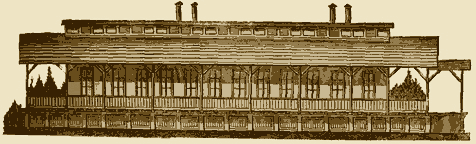
FIG. 1.---Side view of the Experimental Barrack erected by Dr. Esse
in 1867, as an Annex to the Charity Hospital at Berlin.
Before the Franco-German war, the theory of the barrack system of hospitalization had so far been received into favour in Germany, as to have been in several instances adopted in connection with the civil hospitals of large cities. One of the earliest and most remarkable of these constructions was erected, as an annex to the Charity Hospital at Berlin, by Dr. Esse in 1867.
Constructed confessedly as a result of American military experience, although itself a civil establishment, some account of it may not here be out of place, especially as I am not aware if any description of it has yet appeared in English.(172)
A good general idea of the appearance and form of the building may be derived from the sketch (Fig. 1), which presents a lateral view of the barrack, and which exhibits to the eye several of the details of construction I shall have occasion to allude to. The size of the establishment was limited by a want of ground space; it consists therefore of a single barrack, 84 feet long and 29 feet wide, with two covered side galleries, or piazzas, 4-1/2 feet wide, and a verandah at each end, projecting about 10 feet. The total length of the building is thus 104 feet, and its total breadth 38 feet. The lateral walls are 131 feet high, the height from the floor to the ridge being 19 feet. The roof projects over the side galleries, and also covers the end verandahs. One of these verandahs---that to the right in the sketch---serves as an ante-chamber, and is fitted up with seats and benches; the other contains six beds to be used by patients, whenever the weather permits.
As the barrack was intended for use in the winter as well as in the summer, special precautions were taken to make it a secure shelter against cold and wet. The walls of the barrack were accordingly constructed as follows :---A thin wooden wall having been erected, on each side of this, parallel with and a certain distance from it, were placed two additional walls of boards set up vertically and battened. There were consequently two free spaces between the middle and the outer and inner walls. The outside space was filled up with small fragments of brick---a substance for certain reasons thought preferable to peat, tan, straw, and other non-conductors. The inner space was left open for a purpose which I shall soon explain, remarking however in this connection, that the roof and floor were formed, as were the walls, so as to enclose two compartments---the outer filled, the inner free. The barrack rests upon dies, which hold it up quite five feet from the ground---much higher than has been usual in erecting such buildings. The roof is covered with slate, but is open along nearly the whole line of the ridge, which is protected by a lantern, called an American roof or Reiterdach. The lantern differs however from those which were generally placed upon American pavilions, in being wider and higher, as also in being furnished on each side with a row of moveable windows. The barrack fronts to the south, and the steps at the entrance are covered by a marquee, or small projecting roof. The galleries on the sides are closed in by railings, which extend the whole length of the building, while on the lines of these railings posts support and strengthen the roof. Fastened to the top of the railing, and between each pair of posts, is a roll of canvas, which, when drawn up, forms a curtain. By means of these curtains the sun and rain can be quite shut out of the galleries when desired. The barrack is lighted on each side by twelve windows, opening outward. The ward-room within the walls of the barrack contains twenty beds, each placed three feet from the walls, a free space of ten feet remaining between each bed. At the north end of this room, two small chambers, nine feet square, were partitioned off-one, serving for the watcher, the other, for a wash-room and water-closet. The wash-room is supplied with hot and cold water delivered from the reservoirs of the hospital; a gas stove is also placed here as a matter of convenience in the preparation of dressings, &c. The verandah fronting on the south, furnished with chairs and benches, was intended as a place where the sick might sit in the open air, or repose after having walked or taken exercise within the side galleries. The side galleries were intended to be used by the patients in pleasant weather as a promenade, and also at the same time to furnish a place for beds, where certain sick or wounded could take the air in pleasant weather. The north verandah, capable of being enclosed on the sides with curtains, is occupied by six beds, and is used in the summer as a tent-barrack. The ventilation in the summer is maintained by the doors and windows, but more particularly through the opened windows of the lantern. In the winter, the building is warmed and ventilated as follows :---Two stoves are placed on the long axis of the floor of the ward, about equidistant from each other and the ends of the ward. These stoves are each enclosed in a porcelain envelope, that also includes a portion of the smoke pipe; this is coiled, to increase the evolution of heat from it, before it ascends vertically through the roof. The porcelain envelope also contains another pipe, which ascends parallel with the smoke pipe, and the function of which we shall presently see. The hot air enters the barrack, through registers inserted in the porcelain envelope, and is distributed through the ward. But it will be remembered that between the walls, and the floors also, there is a space that envelopes as it were the entire ward. Now an arrangement has been made by which the warm and vitiated air of the ward shall escape into this space through openings which communicate with it near the floor, and the circulation is forced or drawn in this direction by the second pipe, which I have spoken of as enclosed in the porcelain envelope, and which, communicating with the space beneath the floor, constantly acts as a cheminée d'appel. This system of heating and ventilating has the advantage of being not only efficient, but of being exceedingly economical. The floor of the ward is surrounded with warm air, and very little heat fails to be utilized.
This experimental barrack has proved most successful, and has yielded surgical results highly satisfactory to those who created it, and which have strongly tended to commend and make popular, in Germany, the treatment of the sick in barracks. During the late war, barracks on this plan were constructed in considerable numbers, at Berlin and other cities of Germany.
The Friedrich's Hospital at Carlsruhe, which was considered second to none in Germany, consisted of six wooden ward-barracks, each 151 feet (German) long, 29 feet broad, and 23 feet high; they contained each 32 beds. The six barracks complete cost 71,000 florins, and were very handsomely finished and furnished. They were heated and ventilated, as were also the barracks erected at Heidelberg, almost precisely as were the American pavilions.(173) Still most of the German sedentary war hospitals were built on a simpler plan---were reproductions in all their essential details of the Crimean hut or the American pavilion. In fact, the chief differences between the German and American systems were these: the German barracks were smaller, contained fewer beds than the American, were grouped together in smaller numbers, and were usually even more hastily constructed. The barrack hospital at Tempelhofer, near Berlin, contained 1,500 beds; but this was almost the only instance in which a very large general hospital was created during the war. And yet the fifty barracks which formed this hospital were arranged in three separate groups, and directed by three distinct administrations---the War Department, the City Government, and the "Société de Secours"---each having its own model barracks and plan of grouping the same.
The ward-barrack of the Prussian service for thirty patients is thus described by a regulation of 1867:---
The barrack should be so placed as that one of its sides may face the south or south-east. A dry location should be selected where the air is free to circulate. The sward, should there be any, should be removed from the spot the barrack is to stand upon, and be replaced by a covering of gravel or coal-cinders six inches deep. Three lines of dies are to be set up in masonry. These dies should be a foot wide and a foot high, and four feet apart on the lines corresponding with the length of the building, and ten feet apart on the lines of its breadth; so that the building shall be eighty-eight feet long, and twenty-one feet wide, and be supported by sixty-nine dies. Upon these dies, or columns of support, the traverses are to be laid for the floor, as also, the plates upon which rest the lateral walls. These walls shall be ten feet in height. The outside walls of the barrack are to be formed of a frame-work of posts and plates, to which the covering-boards are to be nailed vertically. The roof shall be fifteen feet above the floor, and three openings shall be left in the ridge for ventilation. The roof is to be covered with a lathing of pine boards an inch thick, upon which is laid a course of bituminous paper, to be whitewashed in hot weather. The roof is to project over the walls, everywhere, from a foot to a foot and a half. In the west end, there is to be a door seven feet high and four feet wide; in the east end, a door ten feet high and ten feet wide. On each side, there are to be ten windows, four feet by six, and four feet above the ground. On the south side, six of the windows are to be closed with sashes and curtains; the remaining four are to be closed simply by means of canvas curtains. On the north side, all the windows are to be furnished with sashes and glass. The windows and doors are all to open outward. On the inside of each door there shall be a canvas screen to prevent draughts. At the western end, two small rooms shall be made-one for the linen, the other for the nurses and the preparation of the medicines; these rooms are to be covered over, seven feet from the floor, so as to form a sort of loft, where various articles may be stored. The latrines shall be in a special cabinet built outside, and shall be placed in communication with the ward by means of a corridor closed by a double door. The fæcal matters are to be received in a trough tarred on the inside, and mounted on wheels, so that it may be easily drawn out from its place, after having been disinfected and closed by means of a tarred cover. Before putting back this receptacle after it has been emptied, it is to be one-fourth filled with the Süvern mixture.(174)
The barrack may be built directly upon the ground if either time or the materials are waiting to construct the dies, but in this case, the ground should be covered with a thick layer of gravel or slag. The kitchen should be in a separate building. If watercolours are at hand, the barrack should receive a coating of wash.
A very ingenious system of barrack construction was employed at Minden (Prussia) to furnish hospital accommodation for the French prisoners quartered in that fortress. (See Fig. 2.)
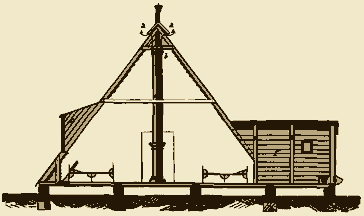
| FIG. 2.--- Transverse section of a Minden Prussian barrack --- a a. False roof covering the ridge; b. Openings in the ridge; c. Window; d. Ventilating shaft, enclosing the stove pipe; f. Water-closet. |
The buildings were wedge-shaped, the roof forming at the same time the walls; a barrack thus resembled a long prism resting on one of its faces. Each barrack was slightly elevated from the ground; it had two doors, one at each end, and was lighted by dormer windows. The ridge was open, and covered by a false roof or lantern. The ventilation was, however, effected principally by a modification of the system which I have already described, when speaking of the barrack at the Charity Hospital, in Berlin. The walls and floors of these wedge-shaped barracks were double; the exterior covering of the wall was made of plain boards, covered with tarred paper; the interior was formed by a wainscoting of clap-boards. The ward was thus enveloped by an air-chamber, which communicated with the ward by an open seam, on each side, along the line of the floor. The barrack was heated by four stoves, the smoke pipes from which entered shafts communicating with the air space beneath the double floor. The character of the construction, and the system of ventilation, will be made evident by a reference to the accompanying diagram. (Fig. 3.)
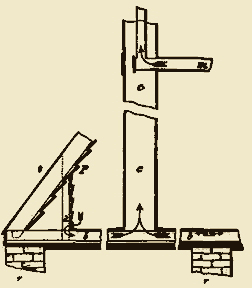
| FIG. 3.---Diagram, showing the system of ventilation as applied to the Minden barracks---a. Open seam for the escape of foul air; b. Air chamber beneath the floor; c. Ventilating shaft; m. Stove pipe; r. Dies of bricks supporting the barrack. |
At the front entrance of the barrack were two rooms for the service. The water-closet was a separate room, built out in the middle of the barrack, and at right angles to its long axis. (See Fig. 2.)
Several large barrack (sedentary) hospitals were erected in France during the war of 1870-71.
The first of these owed its existence to the personal efforts of M. Michel Lévy, who had the honour of being the earliest and at the same time the ablest French advocate of the open-air system of hospitalization. This hospital was established by the War Department in the garden of the Luxembourg, and was designed to contain thirty-two pavilion wards, with the accessory buildings; but twenty-two of these pavilions were erected, and as each contained but twenty beds, the capacity of the hospital was thus limited to 440 patients.
The wards were simple wooden pavilions 124-1/2 feet long, from 30 to 32 feet wide, with side walls 13 feet high; the height, from the centre of the floor to the top of the lantern, was 26 feet. The lantern formed a bay in the centre of the roof, along about one-third the length of the ridge, nearly ten feet wide, and five feet high or deep. About thirteen feet was reserved at each end of the pavilion, for a bath-room and water-closet at one end, and for attendants' rooms at the other. But twenty beds having been placed in such a ward, nearly 3,600 cubic feet of space were given to each, or almost four times as much space as was given to a patient in an American pavilion. The Luxembourg barracks were elevated above the soil about eighteen inches, and consisted of frame-works covered with a single thickness of pine boards, battened both outside and inside. The roof was boarded over, and covered with tarred paper. As after the erection of these buildings they proved to be neither air nor water tight, the roofing was doubled in certain places, and the walls lined on the inside with coarse canvas and paper, as also partially wainscoted. The ventilation was intended to be maintained during the summer by the doors and windows. Ten large windows were placed on each side of a pavilion, and the sides of the lantern were fitted with windows, balanced upon horizontal pivots, so as to open by their own weight.
The barracks were heated by stoves, covered with envelopes and furnished with an air supply from without. But no shafts were used for the discharge of the vitiated air, the only outlets in a ward, constantly open for the escape of air, being two longitudinal crevices, each about one and a half inches wide, left open at the base of the lantern.
The water-closets and bath-rooms were all fitted in a very complete and admirable manner.
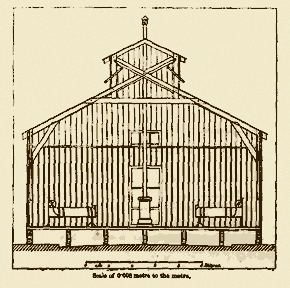
Practically the only differences between these barracks and the American pavilions were : 1st. The Luxembourg barracks were much more spacious; everything pertaining to them was on a larger scale, the doors were larger, the windows were larger, the walls higher ; the beds were also at the same time much larger and much farther apart. 2nd. The barracks were unprovided with ventilating shafts.
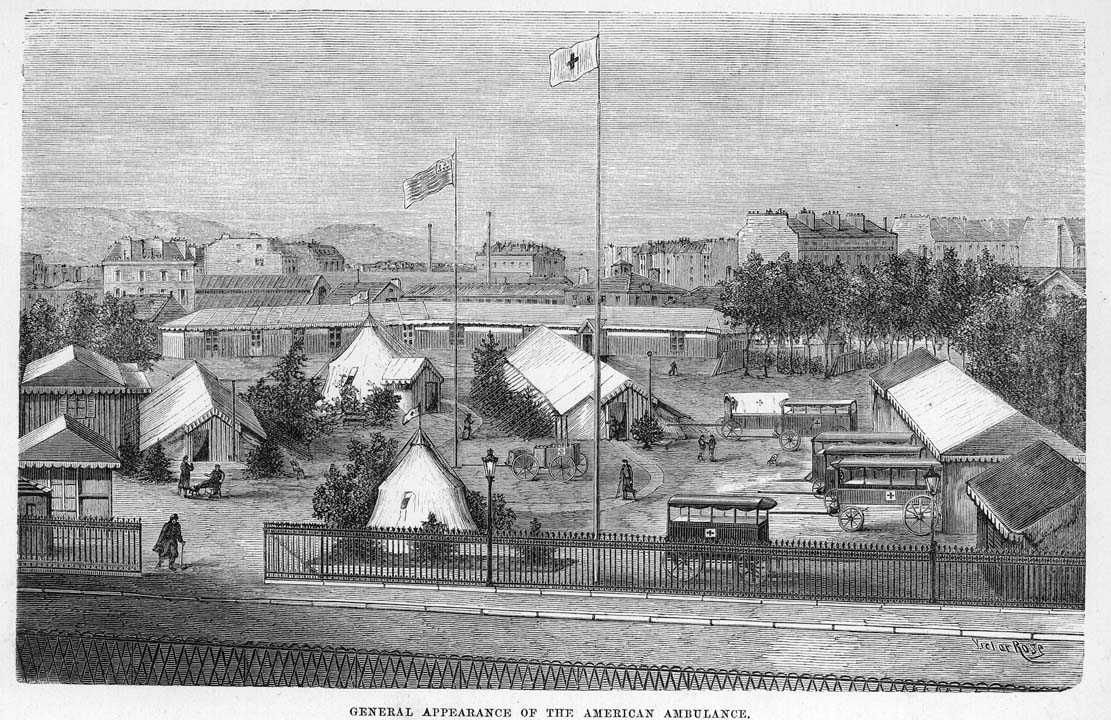
The barracks were badly grouped at the Luxembourg; the kitchen and pharmacy were quite at one side of the grounds, and far distant from several of the wards. Certain points in the construction, as well as in the general interior arrangement of these barracks, are shown in the accompanying sketches.
The plan adopted for the Luxembourg hospital, served also for one, containing nearly the same number of pavilions, which was erected---also by the War Department and at the suggestion of M. Lévy---in the Jardin des Plantes, and was opened for use at about the same time.
During the winter of 1870-1, the Direction of the "Ambulances of the Press" constructed a barrack hospital at Passy, similar in all essential respects to those previously organized by M. Lévy at the Luxembourg and the Jardin des Plantes.
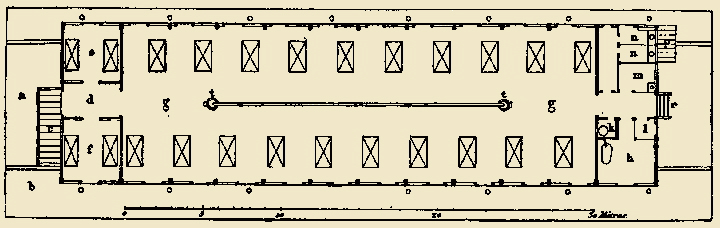
| FIG. 5.---Ground plan of a Luxembourg ward barrack---a. Road way; b. Side walk; c. Moveable bridge; d. Vestibule; e. f. Rooms for the sisters of charity and the nurses; g g. Ward for the sick; h. Bath-room; k. Heating apparatus; 1. Dirty linen room; m. Wash-room; n n. Water-closets; p. Vault; r. Steps; t t. Stoves. |
The "Société de Secours aux Blessés" also began to construct during the siege---and to finish only after its close---a hospital in Paris, near the Palais de l'Industrie, which although closely resembling those at the Luxembourg and at Passy, yet differed in some respects from them. The walls of the ward-pavilions were double, and special inlets and outlets were arranged in them, to better serve the purpose of obtaining a constant and natural ventilation.
One of the largest barrack hospitals constructed by the French during the war, was that at Metz. This hospital was designed to be an almost exact copy of the Lincoln hospital at Washington, both as regards its unitary ward-pavilion, and the disposition of the pavilions upon two converging lines. The pavilions at Metz, however, instead of being placed parallelly to a line bisecting the angle enclosed by two converging lines, were slightly inclined outward, a disposition which was supposed to facilitate the circulation of air between the buildings, and at the same time adapt them better to the covered corridor. The hospital was composed of thirty pavilions, each containing fifty beds. The unitary pavilion was very lightly and imperfectly constructed, even the frame-work being to a considerable extent made of boards, while both the walls and roof were covered with but a single thickness of overlapping boards. The pavilion was open at the ridge, and was ventilated also by an opening under the eaves on each side, about a foot-and-a-half wide, extending the whole length of the building. This opening was partially closed by the windows which were inserted in it, and could be entirely shut up by a series of trap-doors, which when closed, formed the piers between the windows. It was intended that, during pleasant weather, the side opposite the wind should always remain open beneath the eaves, the windows and piers being hoisted up by cords arranged for the purpose.
This hospital was constructed in a great hurry, was filled up with patients before it was finished, and gave proof, frequently during the winter, by leaking, &c., of its imperfections. It was chiefly remarkable from having been the occasion of an excellent treatise on the construction of temporary hospitals, by the architect M. Demoget, as also from its having been the only temporary hospital constructed, during the war, in France, of which we have as yet a detailed statement of the cost of construction. M. Demoget reports the total cost of the hospital, as having been for material and work of all kinds, 163,000 francs. The location of each bed having thus incurred an outlay of 108 francs. But at the close of the war, the material was sold for 80,000 francs; thus reducing the actual cost incurred for the location of a bed to fifty francs, a sum astonishingly small.
If any advance has recently been made in the theory and practice of barrack hospital construction, we are certainly indebted to the Germans for it. In constructing the German barracks, means have never been neglected to secure a constant ventilation in summer, and also in winter, when a winter use may have been anticipated.(175) The open ridge, numerous doors and windows, outlets and inlets, and the employment of shafts, and the use of heat as an air-extracting force-these means, have all commonly been combined in each barrack, for the more certain attainment of the object in view, a constant and sufficient pure air supply. But this is not all, the German barracks have been generally so built, that they could be thrown widely open on every side, during pleasant weather. The windows of the Prussian regulation barracks were, on the south side, only closed with canvas curtains, and in fact, frequently the sides of these barracks were only built with a fixed covering, up to the line of the window sills; the section remaining between this line and the eaves, being occupied by moveable windows, curtains, or hinged sections of wall. This arrangement made it possible to thoroughly aërate the wards, as also to bring the fresh outdoor air to the beds of those who needed most its health-restoring influence, but who were too feeble to have obtained it otherwise. Not only were the German barracks so constructed as to be opened freely on one or more sides, but the well-being of the patients was often still more completely provided for, by the erection of side galleries, and projecting verandahs, protected and screened by canvas curtains, where the convalescent might take exercise or repose, and even the sick not unfrequently be treated with the very best results.
The system of winter ventilation employed in the Minden and also in some of the Berlin barracks, was simple and excellent. It seems to possess the great advantage over the American system, whether as formerly applied or more recently modified,(176) of maintaining a better distribution of warm and fresh air in the ward.
One of the chief faults of the typical American pavilion, results from its having walls of only a single thickness; it is consequently liable to be excessively hot in the summer and excessively cold in the winter. The walls of the German barracks, of the best class, were generally formed of two or more coverings of boards, enclosing one or two air-chambers; they were thus less likely to leak, and the buildings were much more comfortable both in winter and in summer. Perhaps the most formidable objection urged against the use of wooden barracks, as well as tents, is the imperfect protection they offer against the direct heat of the sun. Barracks built of a single thickness of boards are certainly, during the summer months, often intolerably hot. Partial relief may be obtained by a free ridge ventilation, but the most effective remedy for this special evil, is the addition of another wall, in such a way as to envelope the ward with a thin cushion of air; and it is not even necessary that the inner wall should form a solid partition; if constructed of coarse oil-cloth, or even strong paper, it often serves its purpose very satisfactorily. Paper is quite impermeable to air, is one of the best non-conductors of heat known, is cheap, and easily applied as well as removed, and, for these as well as other reasons, is perhaps the material best suited for the doubling of walls in temporary barrack-hospitals. Indeed, paper was extensively used for this purpose in the German barracks, and particularly in order to prevent the entrance of currents of air, and to increase their warmth during the winter. This use of paper had previously been made, with the very best results, at St. Petersburg, in converting summer barracks into winter hospitals. Indeed, a knowledge of the use of paper, and of cloth sized and painted, in the construction of inner walls and ceilings, is one of the chief acquisitions relating to temporary hospital construction, to which we are almost wholly indebted to recent, and more particularly German experience.