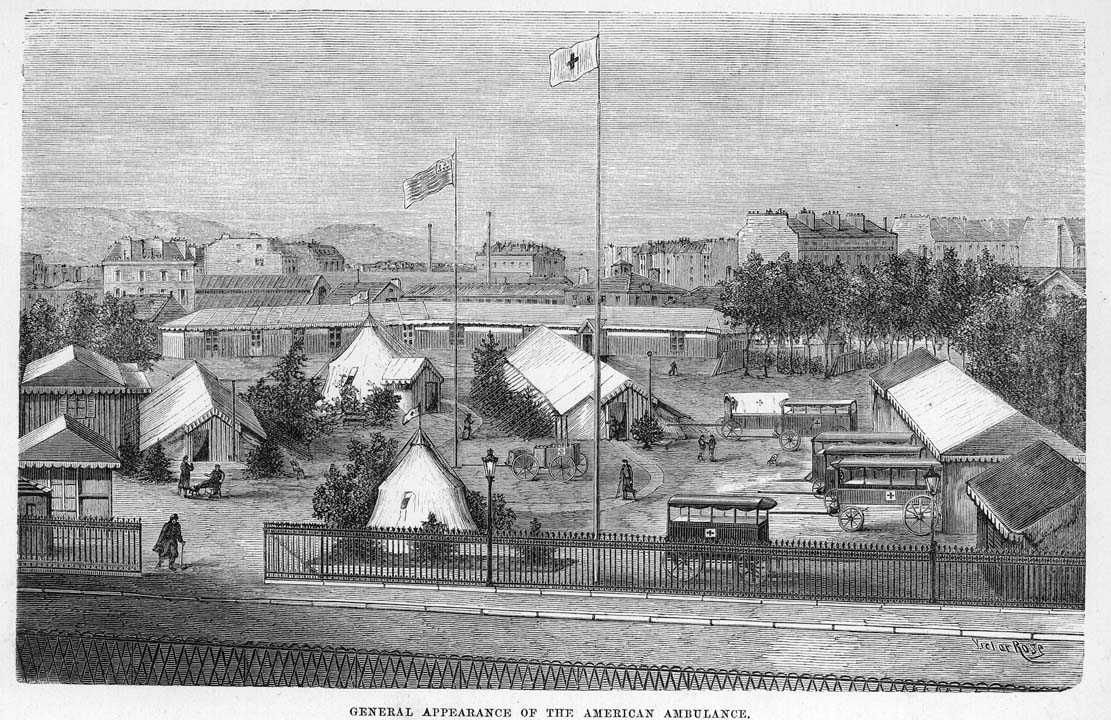
During the early part of the reign of Louis XV. the service de santé in the French army was the subject of various ordonnances, which, if they added very little to its efficiency, began at least to develop the outlines of what shortly and suddenly, in 1746 and 1747, under the administration of Count d'Argenson, became a minutely systematized service.
By the "Règlement General" of January 1st, 1747, the military hospitals were divided into the fixed, the sedentary, and the ambulant; and the functions of each class are pretty clearly defined. Those of the ambulant hospital are very well indicated in an "Instruction for the Commissary in charge of the Ambulant Hospital," prepared by d'Argenson in 1746:
"When an army moves from one place to another, the commissary ought to go with the camping material to establish the hospital in its assigned place, in order to be ready to receive the sick who may be sent in from the army.
"Before the action commences, the commissary should establish the hospital in the nearest and most suitable houses, and should get the surgeons and nurses together, as well as everything necessary for dressing the wounds. He should neglect nothing to remove the wounded from the field, and to secure for them the promptest succour.
"In the case of a siege, he should choose the most suitable places, and those nearest to the trenches, for the ambulant hospital; he should have beds placed within it, and everything prepared for receiving the wounded. One is almost always obliged to have recourse to barns, and in this case it is well to have a floor laid down, should the nature of the ground and the season require it, as also to have sashes put into the windows, in order to protect the sick against the vicissitudes of the weather. A separate ambulant hospital should be maintained at each point of attack,"(99) &c., &c.
An order, "to be observed on the march by the employés of the ambulant hospital," issued by Marshal de Belle-Isle in 1759, shows a completeness at that time, in the organization of this portion of the hospital service of the French army, which is certainly surprising. The hospital was to move with an escort, divided into three corps, one at the head of the convoy, another at the rear, the third being distributed along the line---all under the charge of a sub-director, "whom they are expressly enjoined to obey."
"The architect, the captain of the workmen, at the head of the joiners, the masons, the locksmiths, and the other workmen of the ambulant hospital, will precede the vanguard, to repair the road, fill up the hollows and the ruts, and cut the wood necessary for their reparation, but they will pay great attention that they spare the fruit-trees. Each workman will carry in his hand the tool of his trade, which he can use to the best advantage en route, in order that this tool may make known who he is, and that he always may be ready to work usefully.
"When the convoy approaches the place where it is to pass the night, and its march may no longer be retarded by bad roads, the architect and captain of the workmen, conducted by one of the clerks, who shall have reconnoitred the country, will go to the place selected, to make, with all diligence, the reparations necessary, and render the place where the sick are to be received the most suitable, according to the season.
"Two of the best mounted employés will march every day in the rear of the troops, whose line of march may be within reach of the convoy, for the purpose of picking up the sick soldiers whom they may find upon the way, in the woods and thickets and in the houses of the villages, on the right and on the left, to the distance of a quarter of a league. They will visit carefully the houses, one beginning at one end of the village, the other by the other end, and without exposing themselves. They shall have, each one, under their orders an infermier-major and twelve infermiers (nurses or hospital corps men), carrying two stretchers. In case the infermiers are not sufficient for the transport, they shall obtain the aid of well disposed soldiers, whom they shall pay reasonably for their service. The sick shall be placed upon carriages, or empty caissons prepared to receive them, and which shall form the line of the convoy. Those who accompany them will take care to give the sick, immediately, the assistance which they are expected to give.
"As soon as the sick are thus disposed of, the two employés will make a new search, and always separately, except there be in a single place enough sick to occupy both at the same time. If they have occasion for one or several waggons to go after the sick, they will demand the waggons of those who have charge of them; they will understand how contrary it would be to humanity to abandon by negligence any of these poor sick, or to fail to treat them with the gentleness which charity and their situation require.
"The infermiers shall be divided into squads of twelve---a ward clerk and an infermier-major shall be at the head of each squad. The infermiers-major and all the others shall wear in the button-hole of the coat a tin slip, marked "H," to indicate who they are. Those who shall conceal this mark shall be subject to a fine of six livres on the first offence, and shall be expelled in case it is repeated. The sub-director shall distribute the squads at the head, in the rear, and along the line of the convoy---that they may watch the things placed in the waggons, cause these to follow without intervals, aid the drivers when the waggons are stuck in the mud---and principally, that they may give prompt succour as well to the sick who are in the convoy as to those who may be brought to it," &c., &c.(100)
I have here presented some of the most interesting passages from the forty-two articles which compose this order, and which indicate the duties of the chief director, the sub-director, and the inspector, the employés, officers, and stretcher-bearers, domestics, teamsters, butcher-boys and drovers, master-butchers, architect, captain of workmen, carpenters, joiners, masons, locksmiths, chaplains, (3) infirmiers-major, bureau clerks, heads of bureau, cashiers, aid-major-surgeons, students, captain of equipages, lieutenants, farriers, harness-makers, cartwrights, head storekeeper, storekeepers' aids, storekeepers' boys, coachmen, chief baker, master-bakers and boys, chief butler, coopers, apothecaries, washermen and washerwomen, sutler ; escort and officers.
The duties of each person attached to the ambulant-hospital, as also the several functions of the establishment, are described with great detail.
This organization was evidently altogether too complicated and unwieldy; but a more complete and elaborate system it would have been very difficult to have created. The modifications which have since been adopted in France have added nothing to the organization; with certain simplifications it represents the system now existing.
Formerly the surgeon-in-chief had under his orders all the other surgeons, whether attached to hospitals or regiments, and an engagement being imminent, those surgeons not absolutely necessary, either in the hospitals or among the troops, were called together at head-quarters, and assigned to the ambulances---or corps for field service.(101) During the wars of the first Empire, the surgical staff of the ambulance corps became an independent branch or section of the general service de santé.(102)
The transport service was improved by Larrey and Percy, who introduced special and lighter waggons, and partially reformed its personnel; indeed, it is in this respect more than in any other that the ambulance system has been improved, since the beginning of this century. Perhaps I could not better show how little the constitution of the French Ambulance service has changed since 1759, than by giving the personal composition of the ambulances organized by the French "Société de Secours aux Blessés," in July, 1870.
The ambulance corps which were then, successively, sent from Paris, to join the army of the Rhine were formed as follows :---
1 Surgeon-in-chief.
4 Surgeons.
9 Assistant surgeons.
10 Sub-assistant surgeons.
1 Apothecary.
1 Book-keeper (comptable).
2 Assistant book-keepers.
1 Quartermaster.
1 Draughtsman.
3 Chaplains.
6 Corporals and sergeants.
1 Overseer.
1 Farrier.
10 Waggon drivers and cooks.
60 Infirmiers (nurses and stretcher-bearers).111 Total strength of the corps.(103)
An ambulance company such as this, however theoretically complete it may be, has within it all the elements of disorder and inefficiency, which will speedily make their appearance after the corps is sent into the field. A hundred years' experience had nevertheless, not convinced the French of the impracticability of the organization ; it had dazzled the eye of whoever had heard of it, or read about it, with a show of having provided one or more persons for each special service connected with an ambulant hospital, while its mobility, its co-operative power, and its capacity for work, have always been pretty much inversely as the numerical and apparent force of the corps. The disastrous campaign of 1870-71, showed, at least, the worthlessness of such complicated organizations. They were found not only too clumsy to be anywhere efficient, but unprovided with an amount of hospital material proportionate to their personal strength, the services rendered by them were almost always simply primary without breaking up the corps by details, it was found impossible to maintain a field hospital or sedentary ambulance. The result was, that these enormous companies were most of the time, until disbanded, either marching about the country, or idly waiting for a battle to furnish them the occasion for a little short-lived activity.
On the 4th October, 1870, the "Société de Secours aux Blessés" disbanded the thirteen ambulance corps which it had sent into the field. Several of the corps were, however, immediately reorganized on the following basis, viz: The personnel was to consist of one surgeon in chief, ten surgeons, one chaplain, and five stretcher-bearers or nurses. The material was to consist of one two-horse waggon, a small one-horse carriage, and a saddle-horse. In the waggon, all the baggage and surgical and medical appliances were to be carried ; the small carriage was to be used on the field, to convey rapidly from point to point assistance and supplies for the wounded ; the saddle-horse was employed by the surgeon, who served in the ambulance as a scout. An ambulance corps thus constituted was divided into two sections.(104)
It is very evident that much more of mobility must have been secured by this simplification of the organization. These new corps were, however, not provided with sufficient material, they had no ambulance waggons, properly speaking, they could carry but few surgical supplies in their two-horse waggons, and there were few if any well organized and well provisioned depots accessible. Moreover, their relations to the military administration were quite undefined, and consequently unsatisfactory.
Whatever improvements may have been introduced into the field service of the British army from 1750 to 1815, indeed I might say down to the present time, have been of a character rather general than special. In the first place: more and more official importance has been attached to the duties of the army medical officer, and more respect has been shown him personally. It may be true that, so late as 1788, the surgeon was sometimes overlooked on ceremonial occasions. Indeed this seems to have been a cause of great grief to Hamilton, who takes the special pains to tell us that "when his Majesty, in the year 1788, reviewed the camps, no surgeon was allowed to kiss his hand"(105)---a dishonour considered all the more intolerable, because even the chaplain was considered worthy of this osculatory favour.(106) Nevertheless, the position of the surgeon had greatly improved. His pay had been increased,(107) and with the prospect of rising in his profession, he actually possessed, if not the companionship of kings, at least that of such men as Munro, Rob, Home, Hamilton, John Bell, and of one greater than all---John Hunter. The necessities of the great continental wars, in which the English Government was shortly after engaged, led to a variety of liberal concessions which enabled it to secure the services of many able and skilful surgeons. Sir James Macgrigor, after having alluded to the difficulty of obtaining well qualified surgeons at the outbreak of these wars, a difficulty which forced the Government to have recourse to advertisements in the newspapers, the posting of placards in the great cities of England, and the adoption of a very low standard of professional requirement, yet was able to say at the end of the wars:---"In the ranks of the medical officers of the army, men are to he found upon a level, at least, with those in the Colleges of Physicians and Surgeons of London, Edinburgh, and Dublin," and that, "taking the profession in civil life generally, there are comprised in the body of the medical officers of the army not fewer men of literary attainments and university education, than in the ranks of civil life."(108) Indeed, since the beginning of the present century, the English army medical officers have been, as a body, both better educated and of a better class, and a higher social tone has obtained among them. A singular evidence of this is shown in the practice, quite common among them at the close of the last century, of obtaining, in addition to the medical commission, a military commission which secured not only rank to the holder, but placed him in the line of regular promotion.
In the second place: medical and surgical stores have been more abundantly furnished.
One of the faults of the old system was, that surgeons, although miserably paid, were nevertheless expected to provide, at their own cost, the medicines, &c., to be given to the sick ; and they seem, at a time not very remote, to have been even expected to pay out of the meagre pittance allowed them, the hire of buildings used as hospitals.(109)
At the close of the eighteenth century, the surgeon received an allowance of £30 per annum, for the rent of the regimental hospital, and £70 per annum for the purchase of medicines, and that, in addition to a medicine chest furnished by the government.(110) Subsequently, the hospitals were furnished with medicines, clothing, and food even, through a purveyor's department; although the English hospital surgeon has very generally enjoyed the liberty of making purchases at discretion, to supply the wants of the hospital, a relic of the old system, with this difference---if justifiable, such purchases have been allowed by the government. Thirdly: as early as 1756, the army medical service was placed under the control of a hospital board; in the words of the ordonnance "for the medical service of the army intended to take the field, that under their constant direction this part of military service (relating alike to medicines, hospital stores, and every other requisite provision for the sick) might be carried into execution with ability, regularity, and despatch."(111) Two years later, inspectors and deputy-inspectors of hospitals were created, who assumed the administrative functions of the hospital or army- medical board. Subsequently, in 1810, a director-general was appointed.(112) Before the late war with Russia there were in the English army:---
| Inspectors -general of hospitals |
5 |
|
| Deputy inspectors-general |
8 |
|
| Staff surgeons, 1st class |
31 |
|
| Staff surgeons, 2nd class |
49 |
|
| Staff assistant surgeons |
83 |
|
| Apothecaries |
4 |
|
| Dispensers |
0 |
|
| Regimental surgeons |
140 |
|
| Regimental assistant surgeons |
226 |
(113) |
Since that war a few changes have been made in this return, but they are non-essential.
The regimental surgeons have been subordinated to the staff surgeons ; while all have been subject to the orders of the principal medical officer ; who has detailed, as occasion seemed to require, the subordinate officers to the various duties connected with the general service---such as the giving of first relief, the superintendence of transportation, or executive or administrative work in the brigade, division or general hospitals. Thus, for more than a hundred years, the medical service in the English army has been directed by medical officers, and since a time almost equally remote, the expenses incurred by the establishment and maintenance of army hospitals, have been supported by the state, and not by the surgeons.
Fourthly: the condition of the hospitals has steadily improved, as well from a clearer understanding of their just relations to an army, as by the general diffusion of more enlightened views upon sanitary subjects.
The regimental hospital has always, since the organization of regiments, been a very important establishment in the English army, and here a large part, often the largest part, of the soldiers have been treated, whether for disease or wounds.(114) It was, however, to Sir John Pringle that the English service was principally indebted for the system of treating the sick within the regiment. Pringle had a great and wholesome fear of general hospitals, and strenuously advocated the dispersion of the sick in small establishments, and that, so far as possible, under the direct superintendence of their own medical officers.
"Regimental hospitals," he observes, "are of the greatest consequence . . . and regimental surgeons are to treat as many as they can conveniently attend or accommodate in the regimental hospitals. As for the general hospital, let it receive such only as the regimental ones cannot conveniently contain, and the sick that cannot be moved with the army."(115)
Says Sir James MacGrigor, in his account of the Peninsular campaigns:---
"The divisions of the army composed of from eight to fifteen or sixteen regiments, under the command of a lieutenant-general, were each of them under the medical superintendence of an inspectorial officer, to whom the surgeons reported and who regulated all the medical concerns of the division. It was his duty to see that, however short a time a batallion or corps rested in one place, a regimental hospital was established, indeed, as they carried with them medicines, bedding, stores, and all the materials of a hospital, a regiment might be said to have its hospital constantly established even on the march. It was frequently established in the face of an enemy, and nearly within reach of his guns. When a regiment halted, after getting the men under cover in some building, and constructing chimneys, the first object was to make bedsteads, getting at the same time additional mattresses of straw, rushes, &c. It was really surprising to see with what rapidity this was done; so much were regiments in the habit of it, that latterly I found the hospitals complete in everything, and the men most comfortably lodged in a few days after a regiment had halted. In short, by making every corps constantly keep up an establishment for itself, we could prevent the general hospitals being crowded; much severe and acute disease was treated in its early and only curable stage, and no slight wounds or ailments were sent off from the regiments, by which means the effective force of the army was kept up, or perhaps increased by several thousand men." (116)
The motives which induced Pringle and MacGrigor, to advocate the establishment and maintenance of regimental hospitals, have equally influenced the opinions of a large part of the officers, who have since had charge of the health service in the English army. The regimental hospital has always been intended, however, for the sick rather than the wounded, as also for the treatment of mild rather than severe cases.(117) For the care of the latter, general hospitals were created. Of these, Pringle says, there "are two kinds, viz: the flying hospital attending the camps at some convenient distance, and the stationary hospital which is fixed to one place."(118) The flying hospitals were generally attached to divisions, or special corps and like the regimental hospitals were for the sick rather than the wounded.
To meet the requirements of the wounded, special hospitals have been created under the direction of the principal medical officers. These hospitals have sometimes been intended to serve the whole army, although commonly they have been created for each division, or brigade, and have accordingly been placed under the immediate direction of the respective division or brigade staff-surgeons.
Millingen, who served in the Peninsular war, commends the following dispositions for the field service, which are substantially not only those accepted at the close of the last century, but are also those at the present time generally observed in the English army.(119)
"Staff-surgeons of brigade will minutely inspect the field equipment of the regimental medical officers under their orders, &c.
"In the rear of each brigade, and within range of musketry, will be stationed a proportion of the hospital corps with their bearers ready mounted, and their canteens filled with water. They will be under the medical direction of an assistant surgeon, one being selected for this duty in every brigade. This officer will not delay the wounded for the purpose of dressing them, but merely check any alarming hemorrhage, and accelerate their removal to the rear.
"The drummers and pioneers of regiments, that can be spared, will assist the wounded from the ranks to this first station .
"In the rear of the first line of assistance, and out of the range of musketry, should be established the brigade hospitals. . . . These hospitals should be attended by the surgeons of regiments and their assistants, and when practicable be formed under cover. Here will be assembled the spring-waggons, long cars, and surgeons' bat-horses, the wounded be dressed, cases requiring immediate operation attended to, the transports loaded, directed to the divisional hospitals, and the bearers immediately sent back to the first line.
"In the rear of the centre of each division will be established a divisional hospital, out of the range of artillery. These will be attended by the staff-surgeons of brigade and their assistants. Here the wounded will be operated upon, and assembled for the time being."
From thence, however, he directs that all cases that can be moved, are to be sent off, as soon as possible, to the general receiving hospitals, which it is presumed have been opened at some base, still farther in the rear; while those who cannot safely be removed, are to be made "as comfortable as circumstances permit" at the field division hospital.(120)
The ambulance, in the sense of a special organization for the care of the wounded in the field, has had no existence in the English army. Field work has usually been done by details of regimental and staff-surgeons, selected for each occasion while the stretcher bearers and hospital attendants have likewise commonly been detailed from the ranks, accordingly as there seemed to be a necessity for their services.
"At the close of the last century, when troops were on active service, if a man fell wounded, the officer commanding his company, ordered one or two of his comrades to take care of him to the rear, or, if the troops were actively engaged, he remained unheeded on the ground until the fighting was over. It was not only in the field that no regularly trained men were provided, for meeting the wants of disabled soldiers, but no special corps until recently existed, for ministering to the wants of the sick or wounded, or for assisting the surgeon in attending upon them, even in the stationary military hospitals; the only plan was for a certain proportion of soldiers from the ranks to be sent as occasion might require, to act as attendants upon the sick." (121)
Indeed, the principal defect of the English organization, appears to have existed in the transport service ; while the absence of a trained corps of hospital nurses, has also, not unfrequently, been seriously felt; it would have been even more so, had not the details for hospital work been made from among regularly enlisted men. And I may take this occasion to observe, that one of the faults of the French ambulance has arisen from the circumstance that the infermiers have often been men not regularly enlisted in the army, and who in case of a neglect of duty, could only be fined or expelled from the service.
If English armies have been unprovided with ambulances, whose functions were similar to those attached to French corps, they have usually possessed a hospital service, perhaps not less important but which has obtained a comparatively small development in the French army---I refer to that represented by the convalescent hospital.(122) This is an establishment to which have been sent, from both regimental and general hospitals, all those persons so far recovered from disease or wounds as to no longer require constant medical or surgical attention. The active hospitals of all classes have thus been relieved, and the more rapid recovery of the patient assured.
In this brief account I have shown, perhaps with sufficient clearness, the general system in accordance with which the medical field service has been conducted in the English army in modern times. In the United States army, the medical department has been organized and conducted after the English plan. The hospitals bearing the same names, have the same relations to each other, and have been directed by a similar administration. The work of the French ambulances volantes has also been done in the United States army by special details of surgeons, organized by the "Medical Director" as the occasion seemed to require. The experience, however, of the war of the Rebellion, by exposing the defects of a system which drew from the ranks, for each occasion, stretcher-bearers and hospital attendants, led to the formation of special "Ambulance corps" for field and hospital work. These corps differed somewhat, for a time, in the several armies; but on the 11th of March 1864, Congress passed "An Act to establish a uniform system of ambulances in the armies of the United States." The character of the system is shown in the first two sections of the Act.
"Sec. I. Be it enacted by the Senate and House of Representatives of the United States of America in Congress assembled: That the medical director, or chief medical officer of each army corps shall, under the control of the medical director of the army to which such army corps belongs, have the direction and supervision of all ambulances (waggons), medicine and other waggons, horses, mules, harness, and other fixtures appertaining thereto, and of all officers and men who may be detailed or employed to assist him in the management thereof, in the army corps in which he may be serving.
"Sec. II. And be it further enacted, That the commanding officer of each army corps shall detail officers and enlisted men for service in the ambulance corps of such army corps, upon the following basis, viz.: one captain who shall be commandant of said ambulance corps; one first lieutenant for each division in such army corps; one sergeant for each regiment in such army corps; three privates for each ambulance (waggon), and one private for each waggon (medicine or other)."
As by the terms of the same Act, three ambulance waggons were "allowed and furnished to each regiment of infantry of 500 men or more," the regimental ambulance corps consists of nine privates and a sergeant.
Comparing the several organizations for the administration of the health service, which I have had occasion to notice, I may observe, that in England and the United States, the army health service forms a free and independent department of the war office. In France, this service has been a mere adjunct of a department, which unites under one control, everything connected with the subsistence, clothing, pay, &c., of an army. Again, in looking over the almost innumerable "Règlements sur le service des hôpitaux militaires," which have been issued in France since 1747, one cannot fail to be impressed with the exactitude with which the functions of this service have been defined; no detail seems to have been so small as to have been overlooked, no possible contingency to have been unanticipated---a law has been laid down for everything. On the other hand, the regulations of the English and American army medical service haves entered comparatively seldom into administrative details, these, having commonly been left to be determined by circumstances, and particularly, by the intelligent judgment of the officers who were immediately responsible for the efficiency of the service. The great object in England and the United States seems to have been to secure an efficient administration. The great object in France appears to have been to secure an economical administration. The English system has been reproached, in France, as one encouraging extravagant outlays, as one which from an absence of control leaves a door open to peculation, &c. The English system is certainly much more costly than the French; not so much, however, because surgeons as a class are less honest than quarter-masters, as because, in France, hospital stores have been issued in accordance with a system of rationing, which would appear to be the legacy of some siege or famine, rather than the normal supply schedule of a well-provisioned army. Indeed, the mania for saving has been carried to such an extent, as to pretty nearly stop all movement.(123)
Hampered, also, as it has been by endless clerical forms, checks, and contrôles, which repress all individual initiative as well as destroy all sense of personal responsibility, it is questionable if the French system does not so completely fail,---is not so entirely impracticable---as to defeat its own object---as to be extravagantly costly, however modest the estimate which appears in the annual budget.
On the 4th of January, 1871, the French minister of war, then at Tours, issued a decree, and with the following preamble:---
"Whereas the multitude of private ambulance corps in our armies, outside of the superintendence and control of the military authority, is calculated to lead to grave abuses, and, it is possible to prevent them, by causing these corps to be represented by a single society duly qualified ; and whereas, important services have been rendered to the cause of humanity, by the 'Société Internationale de secours aux blessés des armées de terre et de mer'---It is decreed:
"Article 1. All the volunteer field ambulance corps, and other societies, having in view the care of the wounded on the field of battle after the conflict, are henceforth placed under the direction and the responsibility of the International Society for aiding the wounded, which accepts the obligation and charges resulting from this commission. . . .
"Article 2. The field ambulances corps, French or foreign, once accepted, shall be subject to the orders of the general and of the chief intendant of the army, who in concert with the general delegate (of the "Société de Secours aux Blessés") at the War Department, shall assign them the places where their services may be required. . . .
"Article 9. The minister of war shall have the right of nominating, with the assent of the Society . . .
It is not my purpose to criticise the terms of this decree. I wish here only to say, that the provisions of the decree were most necessary under the circumstances existing, and, that it has, I trust, initiated a much-needed reform. I say designedly "initiated," for it only announces a beginning. It has permitted the ambulances to be represented in the council of the administration, that is to say, the field hospital service is not by virtue of this decree, subject to the sole and absolute control of the intendance or quarter-master's department. Those most directly concerned and responsible for the care of the wounded, are not only to be consulted as to the disposition of the field hospital corps, and the organization of hospitals, whether ambulant or sedentary, but the general and chief quarter-master are to act in concert with the officer representing them.
In one respect, the organization of the health service in the armies of Great Britain and the United States, has differed radically from that which has hitherto found favour in France. English and American medical officers have long been comparatively independent, as much so, perhaps, as the officers of any special corps in the army. They have been subject only to the general orders of the military officer commanding the post, or the force to which they may have been attached,---they have had the full direction---so far as is possible in a military organization---each one of his own service, and have been held directly and personally responsible for the proper and efficient conduct of the same. Of the hospital, once established, whether regimental, brigade, division, or general, the American army surgeon is not simply the administrator, but he is the commanding officer in the most absolute military sense of the expression; while the whole hospital service of the army is under the direction of the surgeon-general, who is immediately responsible solely to the Secretary of War.
The medical service in all armies, has always been, and will always be, greatly dependent upon the quarter-master's department. It is this department which moves its material, and furnishes the means for transporting the sick. It is this department which provides the medical service with the necessary shelter, as also with much of the material indispensable to its efficiency and even existence. But the extent to which the Service de Santé in the French army has been and still is subordinated to the Intendance or Quarter-master's department, is quite incredible. It may not be unprofitable to state in this connection, specifically, some of the relations of the Service de Santé to the Intendance. It may prepare the way for a clearer understanding of the causes which led to the creation of an organization, to which I have already alluded, and which during the late war played no inconsiderable role in the direction of the French health service.
The functions of the Officiers de santé en chef, in relation to the Intendant, are thus officially defined:---
"The chief health-officers attend the chief Intendant on the field, they execute all the missions with which he charges them, are consulted by him as to the salubrity of the places to be converted into hospital establishments, and report to him on everything concerning the service under whatsoever head it may come.
"Every order which they give is to be submitted to the chief Intendant."(124)
If it is a question of the duties to be discharged during an action, the regulation establishes at length, and with precision, those of the officer of administration---an intendant---charged with the affairs of the ambulance ; he is nominally responsible even for the service of the barley-water and the catnip tea. The regulation also shows how these officers of administration, the head-nurses, and stretcher-bearers, are placed in the rear with the stretchers to pick up the wounded; "it gives in detail what the officer of administration, chief of the ambulance, is to do in order to insure a speedy evacuation of the wounded on to the neighbouring hospitals ; it goes even into such minutiæ as to point out the precautions which this same officer should take in burying the dead in certain soils. This part of the regulations has anticipated everything, there is but one thing wanting, the health-officers are not even named." (125)
In the ordonnance on the general organization of the army and its staff, issued May 3rd, 1832, there is no mention made either of the chief medical officers of the army, or of their subordinates, nor is there even an allusion made, either directly or indirectly, to the Health Department, in the detailed index at the end of the ordonnance. In accordance with this ordonnance, "all the employés and details connected with the administration," were subjected to the control of the agents of the intendance, that under their immediate orders the execution of the different services connected with the administration might be assured. "In the event of a siege, the chief of staff is to take measures with the quarter-master (l'intendant), that means are organized for the transportation and care of the wounded, and should stretcher-bearers and nurses be wanting in the army, they will be taken from among the inhabitants."(126) It will be seen that by the first passage, which I have quoted, the medical officers are classed with "all the employés," and subordinated to the control of any acting quarter-master, while in the second paragraph they are altogether ignored. Nor is this all, in the 136th article of the ordonnance, the duties of quarter-masters, and under quarter-masters are specified as follows:---" The quarter-masters (les intendants), and under quarter-masters (sous-intendants), are responsible for the Health Department. They are charged with the bringing together of the means of assistance and transport for the wounded. Before and after the action they should be occupied with these important duties; they are to report to the general officers." In fact, the French army-surgeon is entirely under the control of the chief quarter-master of the column or hospital to which he may be attached. This official is the judge of the surgeon's professional skill, and assigns him to any special duty he may choose. In matters concerning camp hygiene, it is he who decides as to the value of this or that sanitary measure. Every hospital is administered by a sous-intendant, or officier d'administration comptable, an officer of a minor grade; he directs everything; the surgeon, whatever his rank, is not able even to punish a nurse for a neglect of duty; the case must be brought before this quarter-master.
Moreover, the diet list and the medicines to be employed, are strictly limited to certain formulas. For example, hospital surgeons are forbidden to serve more than five cutlets, on any one day, in a ward of fifty sick, no matter what their condition; and it is said that M. Leuret, a medical officer of high rank, was compelled at the close of the Italian campaign, to pay to the Government 1,500 francs for the supplementary cutlets he had served to his patients; while M. Lacronique, a medical officer of equal rank, was found in debt to the Government 84 francs for omelettes not provided for in the regulations.(127) There is no such thing as prescribing at the bed of the patient. Formulas have been prepared, anticipating all possible complications, and to these the physician must limit himself. The rule is absolute.(128)
These formularies enter into the minutest details, and inform the physician to whom sugar and water may be given, and to whom it shall not be given.(129)
Not only is the army physician bound by such restrictions, but the autocratic assumptions of the intendance, and the power which it possesses, even as regards his personal independence, are almost incredible. Says M. Le Fort:---"While I was at Milan in 1859, the chief physician of the hospitals of that city, M. Cuveiller, now inspector of the Service de Santé, thought it to be his duty to write a letter of thanks to the physicians of the city who had assisted us in taking care of the wounded. One morning all the army physicians in Milan were summoned to meet at the hospital San Ambrogio, the sub-assistants included, of whom I was one, and, doubtless, that the glory of the intendance might be the better established, the Italian civil physicians attached to the various hospitals. The object of the meeting was soon explained. The sous-intendant, De Lavalette, came forward and began to read a letter, commencing in terms nearly as follows:--- 'An army physician has thought he could address a circular'---'I beg pardon,' replied our eminent confrère, 'that letter written by me is not a circular.' 'You shall have fifteen days' arrest for that observation.' Such was the reply of Monsieur le Sous-intendant."(130)
It is scarcely surprising that, crushed by such despotic restrictions and assumptions, the Regular Medical Department of the French army should have had, at the outbreak of the recent war, neither the ability nor the courage to assume to provide for the multitude of sick and wounded, which it was certain would have to be taken care of during the campaign. The result was, that before a blow had been struck, the Regular Medical Department had so far resigned what might well be presumed to be its special prerogative, as to leave to the "Société de Secours aux Blessés," a civil society, the work of organizing nearly all the ambulance corps, intended to follow the moving columns of the army into the field and assist in the active work of battle-field relief; as also to resign to this same society, and kindred societies, and private charity, the organization of most of the sedentary hospitals which it might become necessary to establish in the towns and cities of France. Not only have these civil associations and private individuals, sent into the field ambulance corps and organized local hospitals, but they have supported nearly all the expenses incident to such establishments. The salaries of the surgeons, and the wages of the nurses, the cost of the material necessary, houses, hospital furniture, waggons, horses, medicines---even the food, of the sick and wounded treated in these hospitals---all these have been furnished largely, if not principally, by private charity.(131) It will be seen from this statement, that during the recent war, the rôle of the French Sanitary Associations was not that of supplementing any existing military service; so far as they acted they supplanted, not only the Medical Department, but the Government itself; they supplanted the Medical Department completely, and the Government,---to speak exactly I should perhaps say the Intendance---to this extent, that just in proportion as it yielded to the demands made by private charity to assist in taking care of the sick, it abandoned to such charity its responsibility (to the public) for the care and treatment the sick and wounded might receive.
A cause, which also powerfully contributed to this result, was the absolute poverty of the regular service de santé, when in the field, with regard to the material means for hospitalizing the sick. No hospital establishments were especially created for it. "The organization of the regular medical service in the French army stops at the ambulance of head-quarters"(132)---a field hospital established in the most accessible churches, houses, or barns. If this is unable to receive the wounded, on account of their numbers, they are sent back to the first towns, and thrown in upon the civil hospitals, or, these not existing, are placed in such buildings as can be used temporarily as hospitals. Such hospitals as English and American General Hospitals, and the Prussian Etappen Lazareth Hospitals, regularly organized at important points behind active armies, provisionally created to afford relief to the field hospitals, and to obviate the necessity of distant and rapid transportations, are unknown in the French service. The sedentary hospitals, the so-called hospitals of the second and third line, are always established in public or private buildings, hastily appropriated to the purpose. In speaking of them, M. Michel Lévy says:---
"Indeed, it is a piece of good fortune when one can, as in Italy, count upon a vast group of richly furnished establishments, civil hospitals and asylums, convents and palaces, scattered through a series of great cities and rich towns, united by railways," &c.(133)
It will be understood, therefore, that when voluntary associations had opened sedentary hospitals---"ambulances"---in all the principal cities and towns of France, those nearest to the field of action, or on the lines of evacuation from it, were eagerly accepted by officers who, burdened with convoys of wounded, were often utterly ignorant as to where they were to be placed, and were thankful for the first opportunity to relieve themselves from a heavy charge, and an irksome responsibility.
I have said, that the admission of a delegate from the "Société de Secours aux Blessés" to the councils of the administration, initiated a reform ; it certainly did, it was a blow struck at an old tyranny. But, as might have been inferred, the evils incident to the system, or rather want of system, which grew out of this arrangement were immense.
In the first place, the "Société de Secours aux Blessés" possessed no special qualifications for the direction of the ambulance service of an army. In fact, it was thoroughly incompetent. Founded in 1864, nominally to assist in taking care of the wounded of armies, always feeble in numbers---without funds---unrecognized officially---it was sleeping in a cataleptic repose when the declaration of war in July, 1870, like a sudden peal of thunder, startled all France. The council of this society was composed when the war broke out, of a body of gentlemen, with a single exception, wholly unacquainted with military life and the machinery which moves an army, and this exception was a medical gentleman, who moreover was the only person in the council whose name was possessed of any scientific reputation whatsoever. The council had had no experience of any kind, had projected no plans, and for the simple reason that it had no clear ideas of its own mission.
But war had been declared, and it was necessary that something should be done. The society, accordingly, offered its services to the Government; it offered to take care of the wounded, and also at the same time to furnish for that purpose its own surgeons, nurses, waggons, and hospitals; it thus volunteered to assume at once the functions of a department.
These offers were vaguely accepted by the French Government, and the Society immediately began to organize and send off its ambulances.
Coming into the field as a volunteer organization, forming no essential part of the military hierarchy, largely ignored by the intendance---whose prerogatives it had encroached upon, but upon whom it was necessarily dependent, not only for its information, but for its means of moving, and even of existing---the efficiency of the society was immediately paralyzed by the abnormal and false position it occupied. It was almost constantly ignorant of the necessities of the several armies in the field; it, at least for a long time, neither possessed nor could furnish any exact information on those very subjects, a knowledge of which was most essential before any intelligent executive measures could be adopted. Even the position of the different corps and divisions, as well as the means of reaching such sections of the army, was unknown to it. Ambulances were sent off one after the other to grope their way, as they might, to the corps to which they had been assigned, or to hunt up some special field of usefulness. Everything was done in the dark, and while the majority of the ambulances were wandering about the country, signal services were rendered only by the few which blundered into usefulness.
"On the 27th of August, the eighth ambulance left the Palace of Industry, about three o'clock in the afternoon, and took the train at the Northern station, about ten o'clock in the evening. It was to go by way of Hirson to Mézières, and thence join as it could---comme elle pourrait---the corps of General Félix Douai.
"No one had, in fact, any information as to the position occupied by that general; it was only known that he had left Belfort to rejoin Marshal MacMahon, who was himself, probably, on his way to Metz, where Marshal Bazaine had been shut in."(134)
And as this ambulance left Paris, so they all left, although they did not all find their way back again, as this one did, a fortnight after, and only to there repeat its first experience.
"September 10th, 11th. After a day of rest at Paris, the ambulance, anxious as it was to be at its post, received the order to go to Lagny. We were told, that in the direction of Meaux there was a French corp d'armée, and that there, certainly, we should find an occasion for being useful. We arrived rapidly at Lagny by train, and assured ourselves personally that it was impossible that any engagement could have taken place. There was scarcely even a mobile or a scout in the country.
"September 12th, 13th. Our Lagny campaign was not a brilliant one; the ambulance, impatient to do something, has received the order to go to Villeneuve Saint Georges.
"It was thought, that there would be an engagement in that direction. The Lyons road being cut, we took the Orleans road as far as Juvisy. We were able to assure ourselves that the absence of French troops was as complete on this side as on that of Lagny."(135)
Says M. Le Fort, in his account of the first ambulance:---
"The 4th of August had been fixed as the day of our departure. Nancy was to be our first halting place ; this destination had been indicated to us by an order from the imperial head-quarters. What had passed was substantially this : our situation in the army was very badly defined. The ambulances of the society, as well as the society itself, pretended to be independent, and not to receive their orders from the administration, that is to say from the intendance. This was equivalent to a resolution from the very beginning, never to be seasonably informed of the military movements of the army. To avoid as much as possible such an inconvenience the understanding was, that M. Conneau, the Emperor's surgeon, should be our intermediary at head-quarters, our guide, our counsellor, and if it was necessary our chief and our protector. Doctor Anger, associated with Doctor Conneau, was to transmit to us the opinions and the orders of our eminent confrère. At the time of our leaving Paris, the army was scattered all along the frontier; to what place should the ambulance go, to what corps should it by preference be attached?---this was the problem to be solved. M. Nélaton had gone to Metz, and after having held a conference at head-quarters with M. M. Larrey, Conneau, and Wolf, intendant-general, it was decided that we should go to Nancy and await the army there . . . . Sunday passed and not a single wounded man arrived at Nancy. . . Our situation became more and more embarrassing. On the 7th of August, in the evening I directed M. Couttolenc to proceed to Metz, and demand instructions from Dr. Conneau. This undertaking was utterly fruitless, I was unable to obtain advice, even that which was unofficial. In fact, it would perhaps have been difficult to have answered my request, for no one then knew, when disasters at every instant were being reported, what direction might be given to the army. I was therefore left to my own initiative as also to my perplexities, and they were great, since I had to divine, in some sort, events from reports which were contradicted at every instant." (136)
M. Le Fort finally concluded to go on to Metz. The society after having sent the ambulance to Nancy, had nothing more to do with it, until after the surrender of Metz, when the ambulance was disbanded.
The second ambulance, under the direction of M. Seé, left Paris on the 11th of August with the order to go to Metz ; on arriving at Frouard, it was found that the railway was cut; after wandering about in a vain attempt to reach Metz by another route, it strayed within the German lines, where the personnel were made prisoners, and from whence they were sent back to France, by way of Coblentz and Belgium, ten days later.
The third ambulance was also captured a few days after it left Paris. Says the surgeon of the sixth ambulance:---
"Without instructions, without control, our ambulances whether attached to army corps or free, wandered about at hazard, and the services which they rendered were due principally to the initiative, the talent, and the courage of the chief surgeons who directed them."(137)
The story of the Odyssey of each of these ambulances is nearly the same; with the exception of the sixth ambulance, which did succeed in finding MacMahon's head-quarters, which it had received orders to join, of the twelve or thirteen ambulances sent out from Paris by the "Société de Secours aux Blessés," scarcely one ever reached either the corps or the place to which it was ordered.
By the assumption of this Society to direct the field ambulance service, the regular medical officers of the army were to a great degree not only relieved of their proper responsibilities, but many of them were practically deposed and left either in idleness or to the uneventful office of prescribing for the daily ailments of the troops. There was no uniformity in either the special or general treatment which the sick received---this varied as the opinion of the surgeon-in-chief, and as the liberalities at the disposition of the ambulance. Irregularities of every sort were inevitable in such a hospital organization ; neither medical officers nor attendants could be held to any fixed term of service, or punished for any neglect of duty not in itself criminal. The nurses, generally recruited among the most worthless portion of the population, too poorly paid to be controlled by considerations of profit, and outside of civil as well as military discipline, could be depended upon for nothing.
The records of the hospitals thus established so varied in their details as to be quite incomparable; their completeness and even accuracy depending upon the fidelity and scientific habit of thinking, personal to the surgeon in charge. Another evil existed, viz., the impossibility of ascertaining the exact number of available beds in any city or department ; frequently, no one knew how many men it would do to send to a certain city or even ambulance. Nor was this the only unfortunate result of not knowing what hospital accommodations might have already been provided ; ambulances (sedentary hospitals) were needlessly multiplied as well as frequently established in places where they could render no service. Indeed, the feverish zeal with which school-houses, convents, and public and private buildings were converted into ambulances, without reference to those already organized, was such, that a ministerial circular, issued for the purpose of moderating this excessive activity, had little effect. "I saw," says a surgeon, "on the 18th of February---that is to say during the armistice and just before the conclusion of peace---a requisition, that had been sent to a convent, which it was proposed to seize for the purpose of converting it into a hospital, and this at a time when, in the town, there were more than 150 vacant beds, and when, in the neighbourhood, there was no accumulation of troops which might lead one to anticipate any new necessities."(138)
The number of available beds in a department was moreover constantly liable to be over estimated, from the extent to which the red-cross flag and the word ambulance were used for no other purpose than as a protection to property.(139)
The selfish motives, which prompted the opening of ambulances, were often revealed in places where they were to have been least expected. Says M. Tardieu:---
"At the time of our arrival, two Dominicans alone remained in their establishment the reception they gave us was most cordial. We were to finally learn that interest counted for much in this reception, and that very frequently, during this sad war, the international flag has been desired rather as a protection to property than as the mark of a friendly refuge for the unfortunate wounded . . . . We received at the same time the offers of service of the sisters of Cachan . . . . Alas! the relations, which we had at first, with these sisters, were as excellent as those which we had had with the monks. Our ambulance learned to find out later that convents are not entered with impunity." (140)
Few saw during the war a private ambulance opened for the sick, nearly all were for the wounded. For the vast multitude of sick little popular interest was shown. The sick soldier was left by the wayside, while often a crowd of zealous philanthropists, impelled by a love of dramatic effect, gathered around the wounded man, and contended among themselves for his possession.
"All Paris remembers . . . the long line of carriages of every form and hue which used to go out as far as the ramparts, or a little farther, and then return in triumph when they had found a wounded man,---for there was a time, when it was à la mode in Paris to have our wounded man. A sick soldier ! No. It must be one wounded, and above all, lightly wounded---in the arm, for example. What a sad sight such an abuse. How much power---how much admirable devotion came to nothing, by reason of pretenders of every sort, coming from no one knew where, who paralyzed everything by their contact?"(141)
Every little coterie was ambitious to have its ambulance, which it could direct and talk about. Hospitals had their "lady managers," whose sole qualifications were rank, wealth, and the unconquerable determination to keep at the head of fashion, through whatever singular paths it might lead. In these private establishments "the doctor" often played only an inconsiderable rôle. He did what he was told to do; he was obedient and submissive; he was necessary---and so was the scullion.(142)
The very name which the chief French Volunteer Society assumed---"Société de Secours aux Blessés"---was unfortunate, as it tended to create and direct popular sympathy and charity for the victims of war, almost wholly in the direction where there was really least occasion for it. The sick were forgotten, the prisoners were forgotten, and most of the suffering special to sieges and a war of invasion, except that resulting from wounds, which in comparison was trifling.
The sketch which I have given of the operation of a volunteer ambulance system, is certainly not a pleasing one. For many reasons I wish I could have stated the case differently. To have done so would have been impossible. The evidence of the complete inefficiency of the volunteer system as applied in France, during the late war, is irrefutable, and the most remarkable circumstance is, that this evidence is supported by the statements, and nearly unanimous conclusions of those surgeons who had the direction of volunteer ambulances. If M. Le Fort, of the first ambulance says:---"The experiment which has been tried by the international society has proved a complete failure"(143) --- so M. Championnière of the fifth ambulance, concludes as follows:---"I might endeavour to show the improvements of various kinds of which the volunteer ambulance corps are susceptible. I shall, however, not go into these details, as I believe that civil ambulances, so far as battle fields are concerned, have played their rôle, and that this rôle, is finished." While M. Piotrowski of the sixth ambulance, a member of the Council of the French Society, affirms as the result of his experience, that "the sanitary service of the army should have an organization wholly military, and in no way civil, especially upon the battle-field." (144)
Indeed, I might multiply almost indefinitely these results and conclusions after a bitter and sad experience.
One inference, from the facts just stated, must be, that the disorder in the administration of the health service of the French army in 1870-71 was complete; such an inference would be just. Another inference may be drawn, that the "Société de Secours aux Blessés" was principally and immediately responsible for this disorder; such an inference would be unjust. The "Société de Secours aux Blessés," I presume, always did as well as it could, and unquestionably quite as much as any similar society could have done, had it assumed the same position. At least, the administration of the society always appeared to be anxious to do what it could, and all it could, to accomplish the overt objects of its mission; and numberless instances of the most heroic devotion on the part of its agents might be mentioned. The real cause of the confusion was the introduction into the administration of the army of an irresponsible agency, whose active functions were wholly undefined; and the responsibility for the consequences which followed, properly belongs to those who first accepted it, and subsequently permitted it.
Whatever the blame, however, which may be attached to those persons, the excuses which may be offered in their justification are many. The inefficiency of the regular service de santé was notorious---the principal cause, unfortunately, had not been equally so. Having emasculated this service by depriving it of authority until it was to the last degree impotent, and that by the confessions of the most eminent men in the service,---it was too late, after war had been declared, to discuss reforms in its administration. The horrors of the Crimea, of Magenta, and Solferino, the French people did not care to see repeated---nor did the Government either, if there was a possibility of avoiding them. The proposition made by the representatives of popular charity to take care of the wounded, and provide for all their wants without embarrassment, as also without cost to the Government, was alike too magnificent and too generous to be hastily rejected. Moreover the popular political effects of a general and sympathetic movement on the part of the whole French nation in behalf of the wounded of its armies could not be overlooked. France needed in the struggle into which she had rashly thrown herself all her strength---moral as well as physical---and thus, the proposition of the "Société de Secours aux Blessés" came to be accepted, although for a long time the action of the society was tolerated rather than officially recognized.
The responsibility, however, for the general confusion in the administration of the health service, which reigned under the Republic as well as under the Empire in the armies of France, must still be assigned to those who, in time of peace, were strong enough to strip of its just prerogatives an essential arm of military service, and who in the presence of war were weak enough to confer them upon the first claimant.
It is quite impossible to maintain the efficiency of any service without a competent and responsible direction. The regular service de santé in the French army is competent, but has never been invested with the attributes of direction, and is consequently responsible only for its competence. The "Société de Secours aux Blessés," on the plea of the inefficiency of the regular service---an inefficiency most deplorably manifest---succeeded ultimately in obtaining from the general administration a concession of several important privileges---including a part of the right of direction---which constantly claimed, have been as persistently withheld from the regular service; while at the same time it evaded nearly all administrative responsibility, on the ground of being an extra official organization.
The French army hospital service was established, therefore, during the late war, on substantially the following basis. The regular service de santé retained its competence with such responsibility as might be connected therewith, but, conscious of its feebleness, consented to stand aloof. The Intendance retained its responsibility (to itself), but transferred to the "Société de Secours aux Blessés" a portion of its authority; as a special qualification for the exercise of this authority, the "Société" combined something of the competence of the service de santé with something of the authority of the intendance---and both, in about equally small measures. When this triple repartition had been effected, the organization, such as it was, was complete. It will be observed that the "Société" added no strength to it---it gave nothing---it took everything it possessed---it took from the intendance its authority, and from the service de santé its opportunity to act. The result was inevitable---a more chaotic and wretched state of things could scarcely be imagined than that which followed this singular division of attributes, the union of which, under one head, was alike indispensable and imperative.
The name which is given to an Army Medical Department is of little consequence ; it may be called a "Sanitary Commission," or a " Société de Secours aux Blessés," or a "Service de Santé," or by any other name; it must, however, form an integral part of the machinery of the army, be represented by a single person, and be made directly responsible, through that person, for all its acts to the chief of the War Department.
Made officially responsible for its acts, the "Société de Secours" might have taken the place of the service de santé. With something of that liberty of action and administrative independence which was conceded to the "Société de Secours," the regular service de santé would have left no place for the "Société de Secours" in any work of administration. Such being the position, the course which should have been pursued is too evident for discussion.
There can be no place in any well regulated army for a volunteer health service. It is as anomalous a creation as would be a volunteer ordnance department, or a volunteer commissariat; and not one of the least remarkable, I might say astounding, facts connected with the late war was the recognition of voluntary ambulance corps as constituent elements of active armies, and that, by a Government presumed to be pre-eminently skilled not only in matters of military art, but in the general science of organization
The French "Société de Secours aux Blessés" completely mistook its own proper vocation. It misconceived, apparently wilfully, the true province of voluntary effort in behalf of the sick and wounded of armies; and a new field, once opened to it, seemed even, at times, to be led on rather by an inordinate desire of securing to itself official and popular power, and the brilliant insignia of a new order of Hospitallers, than by a desire to fulfil in the most effective manner the conscientious duties of charity and citizenship.
Mr. Stillé, the official historian of the United States' Sanitary Commission, in stating the causes which led to the formation of that Commission---risks to which the soldier was exposed, the apparent helplessness of the Government to provide adequate remedies, &c., says:---,
"It was determined by some enlightened men, most of whom had been taught by their profession the value of preventative hygienic measures, to try the experiment of infusing some of the popular enthusiasm and popular sympathy into the cumbrous machinery of Government. This was to be done not irregularly, or in the way of embarrassing intervention. but strictly in aid of the Government plans; as far as possible, through Government means, and wholly in subordination to the great object which the Government had in view in prosecuting the: war. This was the germ, the original conception of' the functions of a Sanitary Commission ... They were not disposed to supplant the Government as the proper and most efficient care-taker of the army, but simply so to mould the popular will that it should aid, encourage, and uphold whatever was undertaken by the Government in the direction of humane and careful guardianship of the soldier . . . Into the untried future, with all its fearful dangers, they hesitated to cast what might prove in practice an additional element of confusion and embarrassment to an already sorely pressed Government."(145)
It was one of the glories of the United States' Sanitary Commission that it never became a piece of political machinery; nor did it ever propose to do any part of the work which the Government had undertaken to do, better than the Government was doing it. It only proposed to aid the Government---supplement its deficiencies, and encourage it. It never attached to a division or to an army corps a body of surgeons; it directed no hospital, and it never owned even an ambulance waggon. It offered its services whenever and wherever there seemed to be an occasion for them, whether in camp, in the hospitals, or elsewhere; but always in complete subordination to every department of the military hierarchy. Whatever power it or its agents exercised was simply moral power, which was all the more real and conspicuous, free as the Commission was from even the suspicion of seeking to attain objects of personal interest and ambition, by impeaching the competence of any established bureau, or the capacity of any person connected therewith.
In war there may be large and frequent opportunities for the exercise of private charity and benevolence, but an unlimited exercise of these sentiments must often be incompatible with the public welfare, the welfare of the army, and with a wise humanity itself. The army medical service has been created for the sole purpose of giving succour to the sick and wounded; if composed of the proper personal elements, when clothed with sufficient power, and provided with the necessary means, it would serve the purpose of its creation as perfectly as is possible---certainly much more perfectly than a heterogeneous society of civilians, foreign to the army, slightly acquainted with its necessities, and uncontrolled by its discipline.
So much of the suffering incident to battle-fields as may have been unnecessary, as might have been avoided, is not to be considered conclusive evidence, as superficial observers would have us believe, of the necessity of organizing volunteer hospital corps in time of war. It simply shows that the regular medical service from some cause may have been unable to afford all the relief necessary. This cause should be carefully sought, ascertained, and removed. If it was obviously through some radical defect in the organization of the service, the want of certain authority---correct this defect, and accord the authority necessary;---was it because sufficient material means may never have been furnished by the central administration?---such means should be placed at the disposition of the service;---was it because the service was deficient in personal strength?---increase the number of its agents;---was it because of the personal incompetence of those charged with the service?---replace them by men who are able to discharge its duties.
"Sociétés de Secours aux Blessés" have in principle, no raison d'être, while in practice, the "Sociétés de Secours" for which there is the largest need, are au service de santé. This service in certain armies needs help, that it may be rehabilitated with the consideration and rights which naturally belong to it, and may be invested with the authority necessary to its efficiency; while the regular medical service in all armies may be aided with advantage by contributions of those material means for taking care of the sick and wounded, which may be deficient in the best equipped armies in great emergencies.
To assist the army medical service in the accomplishment of its arduous and painful duty, to replenish its exhausted depôts, and aid it in the accomplishment of its task, as a servant, and at the same time as a counsellor and a friend, and by so doing, to convey to the wounded encouragement, and that sympathy which the great heart of the nation feels for those who suffer in nobly defending its honour, its soil, and its life---such should be the mission of every volunteer association for the relief of the misery of battle fields.
But there is another way in which a national voluntary association may powerfully contribute to the welfare of the army,---by investigating and stimulating the investigation of sanitary laws, as well as those inquiries which concern the most practical methods of enforcing such laws in camps,---by determining the relations of the soldier's food, clothing, shelter, and general and special surroundings, to health and disease,---by ascertaining the effects of different systems of hospitalization upon those suffering from disease and wounds,---by devising improved systems of transporting the sick,---by advocating such reforms in the general organization of the army health service as may be required to give to it greater efficiency,---by becoming, in short, the educator and organ of that public opinion which, in every state, when taught how to act, strips from individual men their arbitrary personal power, and re-assumes its ancient and divine right of sovereignty and control in every governmental service.
It was not my purpose in writing this report to present any special criticisms concerning the personal and material organization of the French army medical service in its several relations to the regiment, the ambulance, and the hospital. It has seemed desirable, however, that the place held by this service in the military hierarchy should be indicated, as also some of the general causes which have partially paralyzed its force, as well in former campaigns, as in that which has more recently closed.

 N the foregoing summary of the
leading facts connected with the history of the hospitalization
of sick and wounded soldiers, the general insufficiency of the
means used to protect armies against the ravages of diseases and
the losses consequent upon wounds received in battle is painfully
evident, although I have purposely avoided any special references
to the frightful results of official neglect, which darken nearly
every page of human history. Perhaps the most remarkable fact
is the absolute indifference with which the fate of the sick and
wounded was generally regarded, for many centuries. When that
indifference began to give place to a more humane sentiment, the
exercise of this sentiment was for a long time practically obstructed
by the conviction, that it was useless to attempt to avoid the
perils peculiar to war. This conviction has manifested itself,
everywhere, in a feeble and inefficiently organized sanitary service.
The medical and surgical staff has been numerically insufficient,
and has rarely been invested with those official attributes indispensable
to an administrative service. Medicines, surgical apparatus, clothing,
and even food, have seldom been provided with liberality; barely
sufficient, even in the uninstructed opinion of the time, where
the necessity for them was the least, when the want has been greatest,
many of these supplies have been absolutely unobtainable. Until
the middle of the eighteenth century, no organized service for
the transport of the wounded had ever been proposed in Europe,
and it is only a hundred years earlier that the first references
are made to the establishment of hospitals for the wounded. Nearly
a hundred years, however, passed away before military hospitals
were established on a permanent basis, and we have seen how imperfectly
all these hospitals even fulfilled the object for which they were
nominally created.
N the foregoing summary of the
leading facts connected with the history of the hospitalization
of sick and wounded soldiers, the general insufficiency of the
means used to protect armies against the ravages of diseases and
the losses consequent upon wounds received in battle is painfully
evident, although I have purposely avoided any special references
to the frightful results of official neglect, which darken nearly
every page of human history. Perhaps the most remarkable fact
is the absolute indifference with which the fate of the sick and
wounded was generally regarded, for many centuries. When that
indifference began to give place to a more humane sentiment, the
exercise of this sentiment was for a long time practically obstructed
by the conviction, that it was useless to attempt to avoid the
perils peculiar to war. This conviction has manifested itself,
everywhere, in a feeble and inefficiently organized sanitary service.
The medical and surgical staff has been numerically insufficient,
and has rarely been invested with those official attributes indispensable
to an administrative service. Medicines, surgical apparatus, clothing,
and even food, have seldom been provided with liberality; barely
sufficient, even in the uninstructed opinion of the time, where
the necessity for them was the least, when the want has been greatest,
many of these supplies have been absolutely unobtainable. Until
the middle of the eighteenth century, no organized service for
the transport of the wounded had ever been proposed in Europe,
and it is only a hundred years earlier that the first references
are made to the establishment of hospitals for the wounded. Nearly
a hundred years, however, passed away before military hospitals
were established on a permanent basis, and we have seen how imperfectly
all these hospitals even fulfilled the object for which they were
nominally created.
We have seen, nevertheless, that since the importance of making some special provisions for the care of the sick and wounded first began to be recognized, such provisions have been if slowly, yet steadily increased and perfected. An immense field for improvement is still open; would that governments were not less conscious of this than philanthropic individuals, that all might unite their efforts in order to accomplish those reforms in the sanitary service of armies, which are demanded as well by the social and material changes which have affected the relations of armies to states, as by the more enlightened and humane sentiment of the age!
Whoever would discover the extent to which it may be possible to ameliorate the condition of sick and wounded soldiers, and reduce the mortality rate in armies---whoever would take into serious consideration the practical measures necessary to the accomplishment of this object---must be prepared for an investigation of many difficult and most complex problems. Indeed such a variety of knowledge is required in the investigation of this general subject, that a complete and substantial reform in army sanitation, and in the means of dispensing succour to the sick and wounded, can only be obtained through the joint labours of many. It will be necessary to examine each question from several points of view; the laws of health and disease are not alone to be considered; while a variety of conditions, which may be classed somewhat generally as political and military necessities, will often influence very materially the results of each inquiry.
The best final results, whether special or general, can however only be reached by combining the facts of individual experience. Every serious experiment, made for the purpose of arriving at the truth, upon any one question which intimately concerns the welfare of the sick soldier, has therefore a positive value.
I am acquainted with no subject connected with the service of armies which is more important than that relating to the hospitalization of the sick, and a brief general history of which I have given. I was accordingly greatly gratified to find that the American International Sanitary Committee entertained this opinion also. Formed, as soon as the late Franco-German war had been declared, and with the intention of engaging with similar associations upon a general work of active charity and beneficence, by preparing and sending out to the sick and wounded the means of immediate relief, wherever the want might be greatest, this committee saw very soon the importance of so directing its work that the facts observed by its agents might be made to contribute in the largest degree possible to the general improvement of the present army sanitary service; and the special question in connection with this service, which presented itself to the committee as the one whose solution was perhaps most immediately important, related to the best practical measures which could be adopted for the hospitalization of troops in the field. The question in its terms was very simple. Do not tents afford the best shelter which can be used in the establishment of field hospitals?---are not the advantages peculiar to such hospitals when established under canvas much greater than have been supposed, and are not the disadvantages peculiar to such hospitals much less than have been supposed? In a word, would not the sanitary service in European armies be more efficient, and the mortality in those armies be greatly reduced, if, when field hospitals were to be created, recourse was less frequently had to public and private buildings, and a use was more frequently made of well constructed portable tents ?
Here were questions which the committee was quite at liberty to examine in an experimental way, upon its own ground, and without the possibility of ever finding its work obstructed and its usefulness imperilled,---as must have been the case had it ventured within the uncertain lines of moving armies, where international privileges are unrecognized, and volunteer hospital corps are peculiarly out of place.
The Committee decided to establish a tent-hospital at Paris. The results, as well as the special conditions under which the experiment was subsequently conducted, I shall finally show. The service which the ambulance rendered will be better appreciated, however, after I have exposed more fully certain facts relating to the hospitalization of the sick in modern armies.