


 HEN, on the 15th of July, 1870,
war had been virtually declared against Prussia by the statement
made in the French Legislative Chamber, by the Duke de Grammont,
I was strongly impressed with the importance of giving, in the
struggle thus suddenly precipitated between the two great military
powers of Europe, a practical demonstration of the value of the
improved methods of treating the wounded, whose results, as illustrated
by the experience of the "United States Sanitary Commission"
and the American Government, I had been endeavouring for many
years to bring to the knowledge of the friends of sanitary reform
throughout the world. I therefore determined to call a meeting
of American citizens, resident or sojourning in Paris, for the
purpose of devising such measures as should best enable the friends
of the cause to work together to that end, and thus render effectual
and practical assistance to the French and German Ambulance Service,
in the event of Franco-Prussian war.
HEN, on the 15th of July, 1870,
war had been virtually declared against Prussia by the statement
made in the French Legislative Chamber, by the Duke de Grammont,
I was strongly impressed with the importance of giving, in the
struggle thus suddenly precipitated between the two great military
powers of Europe, a practical demonstration of the value of the
improved methods of treating the wounded, whose results, as illustrated
by the experience of the "United States Sanitary Commission"
and the American Government, I had been endeavouring for many
years to bring to the knowledge of the friends of sanitary reform
throughout the world. I therefore determined to call a meeting
of American citizens, resident or sojourning in Paris, for the
purpose of devising such measures as should best enable the friends
of the cause to work together to that end, and thus render effectual
and practical assistance to the French and German Ambulance Service,
in the event of Franco-Prussian war.
After I had conferred with the leading members of the American colony in Paris, a call for a meeting was immediately issued; and the, meeting, attended by twenty or twenty-five gentlemen, was held in my rooms, 15, Rue de la Paix, on the 18th of July. I was requested to take the chair, and Dr. Crane was called upon to act as secretary. The chairman opened the meeting with a brief address, in which he alluded to the imminence of war, and the painful results which must necessarily follow the breaking out of a military conflict between two such nations as those that were preparing to take the field; he referred to the eminent services rendered by the Sanitary Commission during the Civil War in America, and pointed out the importance of initiating some definite plan of action to the same end, in view of the approaching struggle, not merely as a means of providing additional succour for the wounded, but as the means which might seem most likely to shed light upon the more important problems connected with volunteer relief in war, and which might at the same time give a new impulse to popular charity, by setting a fresh example of international sympathy and assistance; and he defined the object of the meeting to be the consideration of the means to be employed for organizing this assistance, and rendering it beneficial.
The chairman called the attention of the meeting to the desirability of organizing a collective action of the Americans in Paris, in view of the approaching conflict, which seemed about to offer an excellent opportunity of showing the practical operation of the American system in providing for the transport, shelter, nourishment, and medical and hygienic treatment of the wounded. And he particularly insisted on this consideration, viz., that one of the chief objects with Americans, under the circumstances of the case, should be to make known to European sanitarians by practical examples, those systems of hospital construction, transportation, and appliances for the care of the wounded, which had received the sanction of American experience as most suitable in war; observing, that such an addition to the sanitary knowledge of Europe would be far more valuable and useful than any mere giving of material aid to either French or German ambulances, even though it were possible to collect millions of francs for that purpose; and that, therefore, a special aim of the proposed action on the part of the Americans in Paris should be the organizing of one or more model Field Hospitals, with their accessories, on the plans which had been found so satisfactory during the: American war, for the purpose of demonstrating the superiority of the methods, adjuncts, appliances, and arrangements that had been suggested by the experiences of that great struggle, over those which were still employed in the official ambulances of Europe. And, finally, he, urged the meeting to take immediate action, in view of the impending events, by forming a Committee which might begin the work, which he had every reason to believe the "American International Association for the Relief of the Misery of Battle-fields," would ultimately conduct in the name of the whole American people. "It was," he said, " our duty and our privilege, here on the ground, to make, in behalf of our fellow citizens, the first response to any call for assistance in aid of the wounded."
Mr. Tucker then made a few remarks, expressing approval of the views that had been brought forward, and concluded by offering the following resolution:---
"Resolved, that under the existing circumstances, it is deemed expedient by this meeting to appoint a Committee of five persons, including the chairman and secretary, with power to add to their number, to act in connection with the 'American Association for the Relief of the Misery of Battle-fields,' the 'Société Internationale,' the 'Société de Secours aux Blessés,' and other kindred societies, for the purpose of relieving the wants and sufferings of soldiers during the war which is now anticipated between France and Prussia."
This resolution having been unanimously adopted, Drs. Evans, Crane and Pratt, Col. James McKaye, and Mr. A. L. Ward, were elected to constitute this Committee---Dr. Evans being named President, and Dr. Crane Secretary of the same. The meeting then separated.
The first step taken by the Committee was to issue the following Appeal:
"HELP FOR THE WOUNDED OF ALL ARMIES! AN APPEAL TO CITIZENS OF THE UNITED STATES, RESIDENT OR SOJOURNING IN PARIS.
"The Committee appointed at a meeting of citizens of the United States, held on the 18th inst., at the rooms of Dr. Thomas W. Evans, to act in co-operation with the 'American Association for the Relief of the Misery of Battle-fields,' in procuring help and care for the wounded of all armies in the impending war, deem it their duty to appeal to their fellow citizens for pecuniary aid.
"In the great war recently waged on the other side of the ocean, the appeal of the 'United States Sanitary Commission' to the humane men and women of Europe, for help for our wounded, met with a hearty and generous response
"In their name, and in the name of a common humanity, we ask you to contribute, to a like great charity, such amounts as you may feel yourself willing to give, in money or in kind.
(Signed).
THOMAS W. EVANS, M.D., President.
EDWARD A. CRANE, M.D., Secretary.
COL. JAMES MCKAYE.
ALBERT LEE WARD.
THOMAS PRATT, M.D.Paris, July 19th, 1870."
It having been decided at the first meeting of the Committee to establish, as a practical expression of its contemplated action, a field hospital for forty or fifty patients, combining and exemplifying all the improvements which it desired to bring to the attention of the heads of the sanitary service of the French army, the Secretary wrote, on the 19th of July, to the President of the "American Association, for the Relief of the Misery of Battle-fields," setting forth the motives which had determined the formation of the Committee, and the objects it proposed to effect, enclosing a copy of its "Appeal," and expressing the hope that, for the furtherance of the ends it had in view, the Association would give its co-operation to the Paris Committee.
The text of this letter was as follows :
" 15, rue de la Paix, Paris,
"July 19, 1870."Henry W. Bellows, New York. "MY DEAR DOCTOR,
"Long before having received this letter you will have learned that, living in what seemed at least a state of peace fairly well secured, we have been startled by a sudden declaration of war.
"It is not necessary to consider the causes, either remote or immediate, which have brought this great calamity upon Europe. Whatever they may have been, we are now stupified by the consequences.
"As in America, when the rebellion began, so here, we have our hopeful ninety-days' prophets; but there is an opinion, and I am inclined to entertain it myself; that the war will assume a character much more serious than such a limitation might imply. Aside from the numerous complications which may arise, this war once begun can never be terminated until the military ascendancy of one of the two states---France and Prussia---shall have been definitively established. This can be effected by no single victory, however decisive. I believe the war will be a long one---it can hardly fail to be a most serious and disastrous one.
"If coming events should justify this opinion, our different 'Sociétés de Secours' will have a wide field open to them for the exercise of that charity, for the proper direction of which they have been organized. 'La Société Française' held a meeting a few days since, and under the special patronage of the Empress, has commenced its preparatory work. An appeal has been issued to the people for contributions in money and in kind, and a warm response has already been made. The German societies, having had the experience of the war of 1866, are undoubtedly ready to meet, generously and efficiently, any demands which may be made upon them.
"But you will remember that our 'Sociétés de Secours' are leagued together---that they have been so organized that, in the event of a war, they may co-operate for the better accomplishment of a common good.
"Dr. Evans, as the chief American representative of sanitary work, in Europe, has felt that some immediate action on his part was necessary for the purpose of making known, not only his own interest in the welfare of the wounded of the contending powers, but the willingness of the American Association to contribute its share in the great work before us. Accordingly, a meeting was held yesterday at his office, for the purpose of organizing an 'American International Sanitary Committee.' At this meeting-attended by some of the most influential American residents of Paris---a Committee of five persons was appointed, viz.: Dr. Thomas W. Evans, Dr. Edward A. Crane, Col. James McKaye, Albert Lee Ward, Dr. Thomas Pratt. Dr. Evans was appointed President, and myself Secretary. This Committee was authorized by a resolution to act in connection with the 'Sanitary Association of the United States,' the 'Société Internationale,' the 'Société de Secours aux Blessés,' and other kindred associations, and was also empowered to raise money by subscription or adopt such other measures as might seem necessary to best effect the object for which it was created.
"You will observe that we propose to call ourselves a Committee, as also in accordance with the terms of the resolution referred to, that we propose to act in connection with the 'American Association.' I write to you, the President of that association, to-day, for the purpose of securing, first, your cooperation.
"Dr. Evans and myself, as members of the Executive Committee of the American Association, are confident that our action in the present emergency---when time is all important---will receive the fullest approbation of our colleagues. Indeed, we cannot feel that the American Association will hesitate to regard our Committee as, at least for the time being, its representative.
"You will naturally watch with interest and sympathy all movements in behalf of the sick and wounded during the coming contest. That you should offer some visible and permanent evidence of such interest and sympathy to the European societies with which you are allied is most important. This may be partially accomplished by having representatives here; but something more may be necessary. Hence it is that, in the second place, we wish to secure your material support.
"I do not know to what extent we may be able to follow the armies in the field; but, should any great engagement occur, the number of the wounded will be much larger than the regular 'Service de Santé' can provide for. The hospitals must consequently be dependent, to a very considerable extent, upon voluntary aid, not only such as may be furnished by surgeons and nurses, but that which is represented by clothing, food, &c.
"We wish to furnish such material aid, and, moreover, we wish to introduce, if possible, what we believe to be the most practical and effective system of hospital management, the merits of which are most clearly shown by the remarkable military statistics of our late war. We would establish, for example, a tent hospital, or one or more pavilion barracks, put the same under the direction of American surgeons, and treat the inmates as we treated our own soldiers, confident that we should obtain the same results. We believe it to be the time, aside from considerations, of practical beneficence, which I am sure cannot be without their proper influence upon us, to effect a work of sanitary reform, that may lead to benefits as substantial and permanent as they' will certainly prove creditable to those who may have contributed to them.
"But it is impossible for me to-day to enter much into details. As I am greatly hurried at the present moment, I shall defer much that I should like to say until at least the next mail. We wish the American Association to take some immediate action in view of the troubles which now threaten us, and we have no doubt it will.
"Believe me,
"Yours very truly,
"EDWARD A. CRANE.
"P. S.---Should a great battle have occurred before you receive this, or immediately on receiving this, could you not send us a few hundred dollars' worth of condensed milk, Borden's beef, desiccated egg, &c. &c ? We will be responsible for the payment in any event. We have to-day telegraphed to New York for ten American hospital tents. With these we will make a beginning. ---E. A. C."
On the 27th of July, the Committee, through its Secretary, again addressed the President of that Association on the subject of its intended action.
This second letter was as follows:---
"Paris, 15, Rue de la Paix,
"July 27, 1870.Henry W. Bellows, New York. "MY DEAR DOCTOR,
"I wrote you by the last mail a brief account of what we Americans were doing in view of the present war, and of the opportunities we probably shall have of affording aid to the wounded. I also at the same time solicited, through you, the support, as well as recognition, of the 'American Association for the Relief of the Misery of Battle-fields.'
"I could not, however, give you at that time a clear statement of what we proposed to do, since our action was necessarily contingent upon such dispositions as the Ministère de la Guerre might make in favour of voluntary aid, whether patriotic or foreign.
"I am scarcely better able to-day to tell you, in what way we may be able to accomplish, during the present war, the greatest good with the means we may have at our disposition.
"We know this much-that we shall be needed, and that we shall have an opportunity, at least, of showing what we can do.
"As we have offered to the French society ('Société de Secours aux Blessés') our support, we shall receive in return their cordial co-operation. When ten thousand wounded Frenchmen and Germans are to be cared for somehow, we shall have no difficulty in obtaining from the French Government every facility we can reasonably ask for. The French Society proposes to send to each corps d'armée a volunteer ambulance---that is to say, a medical and surgical staff, with attendants, waggons, stretchers, tents, and other material, sufficient for the maintenance of a field hospital of one hundred or more beds. It seems to us best to attempt something similar, on a scale proportionate to our means. Should a great battle occur, we would like to establish, on or near the field, a hospital, to be under our own special direction, and for the management of which we might become responsible. We shall have no difficulty in securing here the best American surgical skill, nor shall we have any difficulty in obtaining the funds necessary to begin our work with.
"Dr. Evans telegraphed Mr. Ely (22, Pine Street, New York) a few days since, to send out immediately ten United States' regulation hospital tents ; these could not be obtained in Europe, and they seemed to be almost indispensable to the establishment of an American field hospital. The iron bedsteads, stretchers, &c., &c., we have ordered to be constructed here, but after American models.
"Should our tents arrive before any great blow has been struck, we shall go to the field prepared. Should a great engagement be announced this week, we may go forward with such means as we have, and do the best we can under the circumstances.
"I hope the American Association will consider carefully and conscientiously what it ought to do, not forgetting that every similar Association in Europe expects something to be done by it. The English and Austrian Associations are each preparing for the work before them; and we shall doubtless soon have the generous concurrence of the Associations of all the neutral powers.
"We have formed here a Ladies' branch committee, consisting of about twenty members, of which Mrs. Anson Burlinghame is the President, and Mrs. Thomas W. Evans, Vice-President. A well-attended and interesting meeting was held by the ladies yesterday, and we shall obtain from them a warm-hearted support, both in Paris and at the front, should any occasion require them to be there.
"Mr. Ely telegraphs to-day that our tents have been shipped by the 'Scotia.'
"Believe me, my dear Doctor,
"Yours very truly,
"EDWARD A. CRANE."
To these letters the Secretary received the following reply :---
"Walpole, N. H.
"Aug. 13, 1870."MY DEAR DOCTOR,
"Your favours, of July 7 and July 19, have both reached me, although somewhat behind time, by reason of my absence in the country in this terrific summer, which has debilitated and scattered everybody. Never were our citizens so hard to get at! I am too feeble to do much myself at present, being more than usually worn out and unable to work, and am going to the Adirondacks on Tuesday to see what effect the open air and a colder climate will have. But I have written to New York, urging Dr. Agnew and Mr. Strong, in the absence of our colleagues of both Societies (the U. S. San. Com. and the American Association) to take the responsibility of appealing, under our own signature, to the public for help for the battle-fields of Europe. I can't say what they will do. I am also in correspondence with Dr. Harris on the same subject. A formal meeting is out of the question until October 1. If we act, it must be informally.
"I fear that the Sanitary Commission may think you have exceeded perfect truth and propriety in calling, in their name, upon American citizens abroad for assistance ; but I trust the circumstances will be fully taken into account, and the license be allowed to pass without question. But I know the just sensitiveness of my colleagues to their own rights and duties, although I cannot speak officially for them.
"When I hear from them, I will write again. It is impossible to say what they, on the ground, in New York, may think feasible or judicious to do. But I hope for prompt action.
"Meanwhile I send you the expression of my earnest sympathy with all neutral endeavours for the relief of battle-fields. I have to-day written to the Count de Flavigny, President of the Paris Association at the Palais d'Industrie.
"Commend me to Dr. Evans, and believe me,
"Very truly yours,
"H. W. BELLOWS.
"P. S.---I can pay no direct attention, I regret to say, to your orders for condensed milk, except to forward your letters to Dr. Agnew at New York."
This letter, although expressive of a certain personal interest in the work which the Committee had engaged upon, was not encouraging. Nothing could be done before the 1st of October ---and that when every moment was of vital importance. Indeed, there were many reasons for believing the war might be finished before the 1st of October. In short, the purport of the letter was nearly equivalent to:---"Do not count upon our assistance or our co-operation in any way with the work you have undertaken." The letter, however, is chiefly remarkable for a singular misconception, which exposed the first public act of the Committee to a gratuitous criticism, and doubtless deeply prejudiced the supersensitive members of the American Association against the Paris Committee from the very outset.
The parties in whose "name," in conjunction with "the name of a common humanity," the Paris Committee appealed to their fellow citizens for help in their undertaking, were not the "United States Sanitary Commission" (a Commission no longer having an official existence), as erroneously supposed by Dr. Bellows ; but "the humane men and women of Europe," from whom, the appeal of that body for help during the American war is stated, in the "appeal" of the Paris Committee, to have "met with a hearty and generous response," and the remembrance of which "response," the Committee hoped, would suffice to call forth, on the part of the American Association, and, through it, on the part of the American people, a corresponding tribute of "hearty and generous" aid to the suffering soldiers of Europe.
Moreover, as if this misconception might not sufficiently arouse a sentiment of prejudice on the part of the American Association towards the Committee, another misconception would appear to have been brought forward. Dr. Bellows says:---" I can pay no direct attention, I regret to say, to your orders for condensed milk, &c." Who could have supposed that the following postscript in the Secretary's letter of July 19th, should have been construed as an order addressed to the Association, and, consequently, as presumptuous, impertinent, and offensive?
"P.S.---Should a great battle have occurred before you receive this, or immediately on receiving this, could you not send us a few hundred dollars' worth of condensed milk, Borden's beef, desiccated egg, &c., &c.? We will be responsible for the payment in any event."
The Committee never had for a moment entertained the idea of supplanting the American Association in any portion of the circle of its legitimate duty, and had only assumed the position which seemed to be required alike to maintain its existence and its usefulness ; its single purpose was to make itself useful in the largest way, and to initiate at the very beginning of a threatened war the repayment of that debt of obligation which European generosity during our own war had imposed upon us as American citizens, and long continued European hospitalities had no less imposed upon us as American residents in France and Germany.
In pursuance of the same endeavour to interest the American people 'in the great conflict then pending, the Committee next addressed itself to Dr. Elisha Harris, who had formerly been one of the most influential members of the United States Sanitary Commission. This gentleman replied as follows:---
New Brighton,
"Staten Island, New York.
"August 24, 1870.To the Secretary of the 'American International Sanitary Committee.' "My DEAR DOCTOR,
" The friends of humanity in our country yearn, with deepest sympathy, for the wounded in the terrible struggle now in progress in France. Our sympathy would find expression in earnest activities were not the Atlantic between us. And even now we must act.
"Neutrality is enjoined; but we can give money, and I hope our people will be so fully informed of the precise methods of succour, and the actual demands for pecuniary means and personal aid, that you shall not neglect to do any service you ought to do, or possibly can do, for humanity.
"Of course we must be kept fully advised regarding the methods, facilities, and demands for your volunteer aid to the sick and wounded. The 'American Association for Relief' will meet as soon as its members return to the city. We are now widely scattered, have no funds, and only an organization and a plan.
"But until this association shall have begun its good work---say in October---I will freely do, individually, all in my power to aid your Parisian Association for succour. I can secure for the ambulance and hospital service much skilled and experienced personal aid-persons who read and speak French. Have you means for employing or securing engagements for such surgeons?
"The raising of funds would not be difficult, if it were to be known that all this voluntary aid is neutral and common in its administration. Is not the Parisian Association able to give some assurance of this kind ?
"Every city and hamlet in France ought to have a perfect system of co-operation for succour. It was universality, catholicity, and patriotism, that gave us our wonderful control of material aid and unbounded sympathy in the United States, as you know. Our hearts bleed for the 100,000 wounded that have already fallen between the Saar and the Moselle. God grant that an honourable peace, and the preservation of the national rights and autonomies may soon be vouchsafed! My heart is with your association in all its endeavours and anxious labours.
With most friendly memories,
And my lasting respects,
"I remain yours,
"ELISHA HARRIS."
This answer was so warmly approbative and cordial, that the Committee felt itself justified in regarding it as the prelude to the "responsive" co-operation so greatly desired by it, on the part of their fellow-citizens. But the pleasing illusion was destined to be dispelled in the sequel; for, as will be shown in this history, not one particle of assistance, either in money, kind, or counsel, was ever received by the Paris Committee---notwithstanding their repeated appeals, during the entire duration of the Franco-German war---from those who had been the representatives of a magnificent example of civilian philanthropy, and who had also themselves received such generous European aid, during the great struggle in the United States.
In striking contrast with the indifference manifested by the American Association to the efforts made by the Paris Committee to popularize, in Europe, the important reforms which the Sanitary Commission had been largely instrumental in introducing into the ambulance service of the United States, were the promptitude and efficiency with which the Government of that country responded to the call telegraphed to it by the Paris Committee, on the 19th of July, for ten of its hospital tents. These tents, through the kindness of General Meigs, were immediately forwarded to the Committee, and reached Liverpool within a fortnight of the sending of the telegram. And curiously illustrative, also, of the dilatoriness of proceedings in the Old World is the fact that, although eleven days had sufficed to bring the much-desired tents from Washington to Liverpool, and although the shipping agents in that town had been instructed to forward them to Paris, immediately on their arrival, by the speediest route, regardless of expense, such and so many were the delays occasioned by custom houses, transshipments, and railway arrangements on both sides of the Channel, that these tents, which were, in fact, the indispensable pivot of the Committee's undertaking, only reached Paris on the 22nd of August---that is to say, after several great battles had already been fought.
The Paris Committee, disappointed in its hope of obtaining pecuniary assistance from their countrymen in America, had in the meantime set diligently to work to obtain funds and aid from Americans in Europe. They published urgent appeals in various newspapers, issued circulars, and addressed demands for help to individuals in every direction; but they had only succeeded in obtaining, during the months of July and August, about 19,000 francs. Determined, however, to carry out its programme by "hook or by crook," the Committee appointed Dr. Marion Sims to be the surgeon-in-chief of its future hospital, with authority to organize the requisite surgical staff; it purchased materials of every kind, laid in stores of food, medicines, &c., and pushed on its various preparations for fitting up its hospital as soon as the tents should arrive.
An attempt was made to organize a "Ladies' branch committee," as a cooperative and subordinate association. But many of the ladies who had intended taking part in it were forced to leave town, and the "Branch" as a distinct organization soon ceased to exist. Nevertheless a good many ladies used to meet daily for the purpose of giving their aid to the cause, in the rooms of the Committee in the Rue de la Paix, where they made ready a liberal supply of linen, lint, bandages, clothing, &c., for the forty or fifty beds of the ambulance which the Committee proposed to establish. Conspicuous for zeal and perseverance in this group of lady workers were Mrs. and Miss Parnell, and Mrs. Koch, and Miss Benson, among its American members, and the Misses Bewick among its English ones; but all laboured diligently and. effectually, and rendered valuable service in preparing the instruments of the benevolent work upon which the Committee was anxiously desirous to enter, while several of them continued to give welcome and efficient assistance to the Committee to the end of its labours.
The undertaking, which the latter had carried on under so many difficulties was, meantime, gradually assuming a definite form. Its tents had at length reached Paris, and the exertions of the Committee had succeeded in getting everything ready for organizing in them the hospital accommodations required for the reception of the patients, for whose treatment the proportions of this first American Ambulance had been combined. In addition to the objects obtained and prepared by the Committee, the president had placed at its disposal the whole of the large and valuable sanitary collection exhibited by him in 1867, and which had subsequently been maintained as a permanent exhibition, comprising four tents, six ambulance and medicine-waggons, medicines and medicine-panniers, surgical instruments, apparatus, and appliances, hospital-furniture, bedding, clothing, &c., &c. The Committee had also procured a large quantity of anæsthetics (especially of ether), and had laid in a good supply of stores, including wines, preserved beef, biscuit, candles and candlesticks, though it had not burdened itself with the addition of
which the traditional "regulations" of the French ambulance system would probably have attached to its "establishment."
The exceeding cumbersomeness and consequent inefficiency of the French ambulance system (which is still, in the main, what it was a hundred and fifty years ago), had, indeed, suggested serious doubts to the organizers of the attempt whose history is here recorded, as to the possibility of any practical co-operation on their part with the official and extra-official arrangements made for taking care of the wounded, and led them to anxiously consider whether they would not be better able to carry out their special design by retaining a footing of complete independence. The cumbrous nature of the system alluded to, and, yet more, the utterly insufficient numerical proportions of its medical staff, render it entirely incapable of grappling with the formidable difficulties which we have seen to be inseparable from the results of a hostile encounter between the enormous masses of men brought together for purposes of mutual slaughter, by the vast developments of modern strategy; while the official routine of the French army, requiring each ambulance to follow the movements of the division to which it is attached, often compels the surgeons to leave their patients after a short period of treatment, so that they rarely witness the completion of any of the cases whose treatment they have begun, and have perhaps carried on to a certain point.
It was evident, therefore, that even if the American ambulance could obtain official permission to attach itself to the sanitary service of the French army (a permission which, being composed of foreigners, it was by no means sure of obtaining), it could not do so without sacrificing the special object which it had proposed to itself to accomplish, and to the realization of which the permanence of its hospital, to an extent which might enable it to carry on the treatment of the same patients to the completion of their cure, was an indispensable condition. The Committee, therefore, determined to retain the independent footing accorded to it and to other international Associations by the terms of the Convention of Geneva, which had been formally adopted by the French Government; and to go forward to some suitable locality, as soon as the theatre of the war should have been marked out with sufficient distinctness to allow of its ascertaining the precise spot most desirable for the establishment of its hospital. But the Committee soon found that it was by no means easy to decide where that spot was to be found.
Moreover, when the war first began, everyone supposed that the conflict, whatever might be its issue, would be waged on German soil; and the Paris Committee, sharing the general illusion, had expected to establish its hospital at some convenient point on the eastern side of the Rhine. But the progress of events soon rendered it evident that the war, instead of being carried into Germany, would be fought out on the territory of the presupposed invader; while the successive defeats of the French forces, the incessant changes which, as will be remembered, occurred from week to week, and almost from day to day, in the scene and direction of the military movements which succeeded one another with such startling rapidity, rendered it impossible for the Committee to fix upon any locality in which it might hope to effect such an establishment of its hospital as would enable it to accomplish the aim it had mainly in view---viz., the offering to the inspection of the governments and army surgeons of Europe, a practical illustration of the value of the modifications which had been introduced into the sanitary service of the United States, during the War of the Rebellion, by the joint action of the civilian and official elements. The Committee sent out agents to Châlons, Metz, and other places which were assuming importance as possibly destined to be the scene of more protracted operations than had hitherto taken place. But the French forces were constantly falling back, and the tide of war seemed to he so steadily setting in towards Paris, that it became a question whether this city might not prove, after all, to be the best place for the contemplated establishment of the American ambulance.
The Committee, however, notwithstanding these uncertainties, worked on as diligently as though its path were already marked out for it; being quite sure that, whether in or out of Paris, it could not fail to find a fitting field for the rendering of all the aid it would be in its power to give. By the 22nd of August all the preparations for an ambulance were fully completed; its packages were made, and its personnel and belongings were ready to start for any point of the compass at an hour's notice. From the 22nd to the 26th, the one question most anxiously discussed by the Committee was, "Shall we go, or shall we stay ?"
The surgeon-in-chief was most impatient to leave Paris, as were also the persons attached to his staff. The theatre of war, just after the bloody battles of Gravelotte and Saint Privat, was irresistibly attractive to those curious to experience in their own persons the sensational excitement of witnessing the scenes of the terrible drama which was then being acted. Something of the surgery of the war might also be seen with profit to themselves, however uncertain might be the chances of their rendering any substantial aid to the wounded and the suffering. Two members of the committee---one himself attached to the surgical staff---were also in favour of going "somewhere to the front," although not one of those who were so impatient to go somewhere, had the slightest notion of where there was a probability that his services might be needed, or ventured to suggest where he really wished to go, or even possessed one particle of information with regard either to the probable relations which a foreign volunteer ambulance might establish within the lines of an active army, or to the means of transporting its material and personnel a single mile over a military road. The president, uninfluenced by those motives which were acting most powerfully upon the surgical staff, concerned chiefly about the interests of the ambulance itself, and responsible for the success of the ambulance, not only to the public by reason of the contributions then received, but also largely personally responsible for its eventual maintenance and support, was decidedly of opinion that the greatest chance of usefulness might be secured by waiting in Paris for some seasonable and favourable opportunity.
First; because of the rapid and incessant shifting of the theatre of the war, which threatened to necessitate a perpetual shifting of the ambulance, from place to place.
Secondly;. because of the extreme excitement and exasperation of the public mind, which, suspecting a Prussian and a spy in every one not officially connected with the army, and particularly in every foreigner, might have seriously compromised the safety of the personnel of the ambulance, as well as its usefulness.
Thirdly; because of the smallness of the pecuniary resources at the disposal of the Committee, which, on the one hand, rendered it unwise to waste those resources in moving about the country at a venture, on the changing track of forces whose probable position it was impossible to foresee from day to day; and, on the other hand, would render a large additional outlay indispensable, unless the ambulance was to be broken up and dissolved, after a few days of amateur campaigning and sight-seeing.
Fourthly; because it was necessary for the ambulance to preserve its independence, which it could not do if attached to a division or corps d'armée; a position, it may be observed, which, although claimed, it is highly improbable would have then been accorded to it.
Fifthly; because of the wholly undefined relations, to the intendance and military authorities, of the volunteer ambulance corps, whether national or foreign.
Sixthly; because in an interview which he had the honour of holding, on the morning of the 26th of August, with the Minister of War, and the representative of the Government at the Foreign Office, he was assured that no guarantees could be given of the recognition of the ambulance as an "American Ambulance" at the headquarters of any army corps; as also, that no special passports could be accorded to it, and that any movement to the front must be made at the risk and peril of the ambulance, as well in regard to its material as to its personnel.
Seventhly, and finally; because of the constantly increasing probability that Paris, and its immediate neighbourhood, would become the scene of the final and most sanguinary act in the terrible drama of the war.
On the 26th of August the question of "going" or "staying" was once more thoroughly and anxiously discussed. Those who were desirous of making an immediate dash to the front, set forth their view of the case, and urged an immediate decision in its favour. More than ever convinced of the impolicy of moving at the moment when the German armies were rapidly converging upon Paris, when "the mountain" in fact "was coming to us," the president was, nevertheless, willing to let the question be decided, then and there by a vote of the majority.
The question was accordingly put to the vote ; but the result was a tie, half the members voting for an immediate move, the other half voting not to move, but to await in Paris until events should have more clearly revealed the course to be pursued. The question was, therefore, undecided. Those who were in favour of going forward now advised that application should be made to the French "Société de Secours aux Blessés" for funds, and the ambulance be thus made subordinate to that Association; a proposition which was disapproved by the rest of the Committee, as alike fatal to its own independence, and to the very aim the ambulance was mainly intended to subserve. If it was found to be impossible to maintain a distinctly American organization, it appeared to them that the sooner the Committee was dissolved the better, and for the very sufficient reason that it had been created for a specific purpose, and had delegated to it no powers to act in any other way than as the visible and immediate agent of American sympathy and benevolence.
It was particularly unfortunate, at this time, when the Committee needed all its strength, that one of its five members---Colonel James McKaye, was compelled to leave Paris. This gentleman having had a large experience in administrative affairs, would have been a wise counsellor, and thoroughly convinced as he was, of the inexpediency of engaging upon any doubtful and uncertain movement, would at least have relieved the Committee by his vote, of the awkward embarrassment of an equal division. On the 31st of August, Colonel McKaye wrote to the secretary from Geneva, warmly endorsing the resolution which had been supported by the president and himself; as the only one which could have reasonably been entertained, in view of the special and general circumstances which were influencing the action of the Committee, and which it would have been impossible to ignore.
"I am entirely," says he, "of the opinion that, in the present state of the war, and with the almost perfect certainty that the seat of the war will be shortly transferred to the vicinity of Paris, our hospital had better be set up in that city. If you had the means, and could without delay reach the field of the battle which is probably now going on, between MacMahon and the Crown Prince, you might do a great service, but as you have not the means of doing so, I advise you to prepare and wait, for my opinion is that you will have need of all your means and all your efforts, before many weeks, within the walls of Paris."
The divergence of opinion which existed within the Committee was destined, however, to be definitively settled by the incidents of the meeting referred to. One member of the Committee, and the whole of its surgical staff withdrew.
As it may perhaps seem to the reader that these passages in the general history of our Committee have been presented in too strong a light; it should be observed that they not only relate to matters which, at the time, threatened the very existence of the Committee, but that they also bring into relief those principles of action, which subsequently became the ground-work of whatever successes the ambulance may have finally attained. History, in determining the wisdom of a plan, seldom cares to know anything more than its results; but the plan which was considered by a majority of the Committee to be, under the circumstances, the wisest and the most expedient, as well as the motives by which they were influenced, should be clearly stated---and this, we trust, has been done.
The three gentlemen who were now left to represent the Committee, having very soon decided to remain in Paris, and to proceed immediately to the organization of an ambulance in that city, addressed a letter to Dr. John Swinburne, then in London, inviting him to come over to Paris, and take charge of its surgical department.
Having decided to make Paris the scene of its operations, the Committee communicated its intentions to General Bosq, general-in-chief of the French Intendance, and to Dr. Michael Levy, chief health officer to the French army, both of whom felicitated the Committee most warmly on the decision arrived at, and assured it, that its efforts would in all probability be far more useful in Paris than they could be elsewhere.
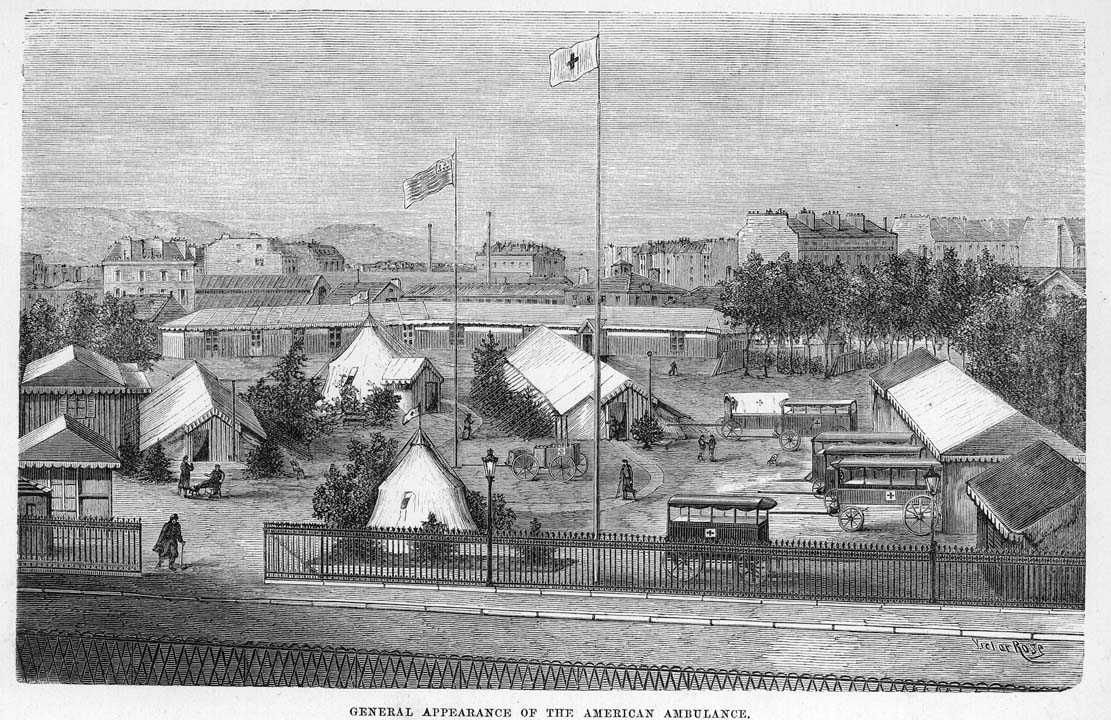
The use of a fine plot of ground, of over an acre, in the Avenue de l'Impératrice, No. 36, had been obtained from Monsieur Le Prince and Madame La Princesse de Bauffremont; and upon that ground, the Committee had the satisfaction of setting up, on the 1st of September, its two rows of roomy and airy tents, with its "Round Tent" advantageously placed in the centre of the plot.
As a precautionary measure, in view of the increasing gravity of affairs at the front, the rapid advances of the German armies, and the excitement and panic which prevailed in Paris in consequence of the threatened transference of the field of conflict to its immediate vicinity, it was now proposed (and by virtue of the clause in the Resolution passed on the 18th of July, empowering the Committee to add to their number) to increase the Committee by the addition of two more members. Mr. J. W. Tucker and the Rev. Wm. O. Lamson were accordingly elected members on the 2nd of September; the first as Treasurer of the Committee, the second as its Storekeeper. It was also resolved to make another appeal to the Americans in Paris, not only for pecuniary aid, but for the formation of a corps of volunteer stretcher-bearers and nurses from among the young Americans whose social position might enable them to devote their services, gratuitously, to the task which each day's events were so evidently bringing nearer and nearer.
The fateful 4th of September, 1870, will not soon be forgotten by those who spent that day in the capital of France. The weather was magnificent. The beautiful city, in all the pride of its stately architecture, its broad thoroughfares, its long lines and clusters of noble trees, was arched over by a sky of cloudless azure, radiant with the glory of a warm autumnal sun. The Boulevards were thronged with promenaders, the Place de la Concorde was crowded; but the usual gaiety of Paris on a sunny day was replaced by the restlessness of anxious presentiment, apparent in every countenance. For the glowing, transparent air was thick with dark shadows of impending trouble, and heavy with conflicting rumours of some great disaster; shadows and rumours destined to be merged, as the day went on, in the certainty of a catastrophe so immense, so complete, so overwhelming, that the annals of the world could scarcely show a parallel to it. The rage of the great city, the downfall of the Empire, the establishment of the "Government of the National Defence," at three o'clock, at the Hôtel de Ville, the irruption of the yelling and infuriated crowd into the Tuileries, and the flight of the Empress, are matters of history, yet---however dramatic, however closely identified with the fortunes of the American ambulance---they are beyond the scope of this report.
Suffice it to say, in this place, that the illustrious Lady, who, from the date of her elevation to the throne of France, had taken so warm and active an interest in the relief of every form of suffering and distress, whether in hospitals or in the homes of the poor, and who had given to the plans and efforts of the International Sanitary Associations an amount of protection and support second only to that which had been bestowed upon them by the Queen of Prussia---on the afternoon of the 4th of September, deserted by all around her, found herself alone, save a single companion, at the eastern gate of the Louvre, and in the midst of a mob wild with the first frenzy of revolution. Nothing but her own brave self-reliance at the moment saved her. She immediately sought and found a refuge in the house of the writer of this narrative. Unfortunately it could offer no assurance of permanent security; this could only be obtained by an escape from France---and the success of such an undertaking would evidently depend principally upon the promptitude with which it might be conducted. Whatever the claims of private interest might be---with whatever of regret the abandonment of a work which had enlisted all his sympathies might be attended---here was a still stronger claim for sympathy, and one which appealed as well to the commonest sense of duty and of honour.
The Empress had entrusted her personal safety to him, and more than willingly, he accepted all the responsibilities it involved. He suddenly left Paris, without giving a word of explanation to any one, and after a few days happily succeeded in conducting Her Majesty, in safety, to the more secure and peaceful shores of England.
Dr. Crane was kind enough to accompany the writer a little way on this eventful journey; and, owing to various special circumstances, he only reached Paris on the following Thursday, where the sudden and unexplained absence of the president and secretary had plunged the Committee into a sea of wonderment and uneasiness that may be readily imagined. The position of the members of that body, in the absence of those by whom they found themselves, as it appeared to them, so unaccountably abandoned just when their presence was most necessary, was in fact, sufficiently embarrassing. Left without direction or means of action, and their new surgeon not having yet arrived, it will scarcely be wondered at that the secretary, on returning to his post in the Rue de la Paix, should have found that the work of preparation had come to a standstill, and that the members of the Committee were half inclined to consider the undertaking as being virtually at an end!
Nor was this all, the apparently sudden disappearance of the president, which for reasons easily to be understood, could not be immediately explained, gave rise to various scandalous imputations as to the motives of his mysterious departure. These aspersions, which found their way into the public press of Europe, and even of America, were, however, much less a matter of personal concern to him, than a subject of regret in so far as they might call in question the honour of others, and expose the work of the Committee itself to the attacks of the malevolent.
Fortunately, the return of the secretary, and the arrival in Paris of Dr. Swinburne, restored the action of the Committee to its former vigour, and the work of organizing its ambulance was carried on with the utmost activity, in the confident expectation that the speedy return of the president would place the undertaking upon the satisfactory footing which its appeals to the generosity of the public had hitherto failed to secure.
The president, on his side, so unexpectedly called from Paris in the discharge of an unforeseen responsibility, had no idea that his absence from that city would extend beyond the few days required to secure the safety of the illustrious lady who had confided to him the care of ensuring her escape.
He had, accordingly, when separating from the secretary, advised him principally concerning such action as might be immediately required on his return to Paris. But in order that the work might in no way be compromised by the hazard of a prolonged absence, the president as a precautionary measure, gave to the secretary a written authorization to act as his representative in the council of the Committee, and in the direction of the ambulance.
On reaching London, the president wrote to the secretary announcing the fact of his safe arrival, and at the same time his purpose of speedily returning; but, being greatly occupied he did not write to him at length, as he fully intended to return to Paris in the course of a few days. But the preparations for the siege rendering it every day more and more doubtful, whether, if he returned to Paris, he would be able to get out again (as the prosecution of the original plans in regard to the action of an American International Sanitary Committee, rendered it imperatively necessary that he should be able to do), he was compelled to linger in London, waiting, from day to day, for such indications of the probable course of events as might enable him to come to a decision as to the feasibility of his return. But the unexpected rapidity with which the operations for laying siege to Paris were carried forward, and the increasing probability that the Germans would succeed in their attempt to compass an investment which, when their plans first became apparent, appeared to all onlookers to be an utter impossibility, speedily convinced the president that, even if he could succeed in getting back to Paris, it would be vain to hope he could leave it again; and be therefore determined to remain in London, in order to secure the personal freedom of movement essential to the carrying out of his intended action in relation to the sanitary interests of the war. In order to guarantee the Paris ambulance against any crippling of its energies through lack of funds, in view of his unexpected absence from the field of its labours, he sent a carte blanche authorization to the secretary to draw upon Messrs. de Rothschild for any amounts that might be required for the fullest development of its possibilities of action during the siege. But although the completion of the investment was not officially announced until the 18th of September, all communication between Paris and the outside world was virtually cut off some days before that date; and the letter, containing the authorization alluded to, only reached the secretary some time in December. That gentleman, on his side, wrote repeatedly to the president; but his letters, like those addressed to him, were only received towards the middle of the siege, and then irregularly, so rigorously was the suspension of postal communication maintained throughout its duration.
Uncertain, under this suspension, whether his authorization had, or had not, reached Paris, the president made three subsequent attempts to convey to the secretary, through different channels, the authorization alluded to. But none of these succeeded; and not a word was received by either party from the other until the month of December.
Finding that no action was being taken by the American Association in regard to the great struggle that had so suddenly broken out in Europe, and being more desirous than ever of obtaining the valuable assistance which that body was presumed to be so well qualified to give, the Committee in Paris, in view of the new aspect assumed by the war, determined to make one more attempt to enlist the active sympathy of their countrymen in behalf of the ambulance ; and, to this end, passed the following resolutions:---
"Resolved,---That circumstances having prevented the removal of the staff and material of this Committee from Paris, it now finds itself, in view of the threatened siege of the city, in the immediate prospect of the largest need of all its resources, and to greatly extend and prolong its work, large expenditures would be required, far exceeding the means remaining in the treasury. It must, therefore, at once take a decision either to remain quite inadequate to the requirements of the wounded during the threatened siege, or to go forward boldly with firm confidence in the ample support of the friends of humanity in the United States. They prefer the latter course, feeling that their confidence will be fully justified, and that the contributions, for which they cannot wait, will be readily offered to pay the debts which must be incurred to carry on the great work of charity to the wounded and suffering which now lies before them. They beg, therefore, that prompt and vigorous efforts may be set on foot by their friends at home, in order that their obligations may be fully met, and that the American people may show themselves second to no other in generous response to this loud call upon the sympathies of the world."
Resolved,-" That the secretary be instructed to communicate the foregoing resolution, accompanied by an urgent appeal from himself, to the proper parties at home for publication."
The secretary accordingly drew up a new and pressing "appeal" for pecuniary aid, as eloquent and forcible as he was able to make it, which, with a copy of the foregoing resolutions, and the following letter, was sent to Dr. Elisha Harris---with the request that the resolutions be published in the American papers:---
"Paris, 15, Rue de la Paix,
"Sept. 16th, 1870."Dr. Elisha Harris, New York. "My DEAR DOCTOR,
"Your letter of September 1st has much interested us. We thank you very much for your kind expressions of sympathy for the unhappy victims of this fearful war, as also for the good-will you manifest towards us, who have endeavoured to do what we have felt it to be our duty to do, not only as Americans, but as men.
"It is impossible for me in a single hurried letter to fully explain to you our present position, or at least the causes which have occasioned it. We have all believed that more or less success would attend the French army during this campaign. Our preparations were made in this belief--- How we have been disappointed all the world knows!
"A series of remarkable defeats and retreats---the dead and wounded left in the hands of the Germans invariably; the volunteer ambulances of the French society unable to act, constantly under orders to fall back upon Paris, and crippled from the beginning by their subordination to an intendance as despotic as it was inefficient; our relations as an independent foreign ambulance undetermined; a subscription list so small that I should be ashamed as an American to report it; an attack upon Paris itself, constantly expected by the government, which was employing all its resources to meet it. These facts have caused us to feel, that the wisest course for us to pursue was to remain in Paris, and establish our hospital here. I may also say that our conclusion was partially determined by the advice given to us by officers of the government, several of whom have urged us by all means to establish our hospital in Paris. .
"Our tents, fourteen in number, have been pitched on a beautiful piece of ground, just within the walls of the city, and before to-morrow night, we shall have fifty beds prepared to receive the wounded who may be sent from the fortifications. The French medical inspector who visited us to-day expressed very warmly the satisfaction which the inspection of our installation had afforded him, and referred to it as a substantial expression of sympathy from the great American Republic towards her younger sister. I am afraid, however, unless our friends at home come forward to help us, we shall fail to do all that is expected of us.
"We have been prevented from going forward with the army, to a large extent, by a want of the means. I certainly should be unable to conceal my mortification, if our modest proposal to maintain a hospital here, should fail to meet with any response from the people of the United States---so many of whom have enjoyed, in happier times, the hospitalities of this imperial city.
"Enclosed I send you some resolutions, &c.
"Believe me, my dear Doctor,
"Yours, very sincerely,
"EDWARD A. CRANE."
To this new attempt to obtain help from the United States no answer was ever received.
The Paris Committee, meantime, exerted itself diligently to maintain itself in activity. Reduced, by the circumstances referred to, to the lowest degree of impecuniosity, and having found that no sufficient help was to be obtained in the form of donations, the Committee was under the necessity of resorting to the expedient of borrowing money, and contracting debts, making themselves jointly responsible for their repayment. But the loans thus raised were soon expended. The purchases of bedsteads and blankets, of surgical apparatus, and other objects of elementary necessity for the completion of the arrangements of the ambulance, absorbed nearly the whole of the amounts thus obtained; and the enterprise would have been brought to an end, just when its material conditions had been entirely completed, had not the secretary determined to lay the state of the case before Colonel Lloyd Lindsay, Chairman of the British National Aid Society (who had succeeded in obtaining an entrance into the beleaguered city about the middle of October) and endeavour to obtain from the ample funds which the English subscription had placed in his hands for the relief of the French wounded, the loan of a sum sufficient to enable it to go on with its undertaking. This application was received in the kindest and most liberal manner by Colonel Lindsay, who desired the secretary to name the amount he thought necessary, and handed to the latter, at his request, a sum of 20,000fr. which the receiver expressly stipulated should he regarded only as a loan, to be repaid as soon as possible. This seasonable aid enabled the Committee to continue its efforts for a time; and, moreover, the return of Colonel Lindsay to London offered to it an opportunity of communicating its condition to the president, who at once repaid to Colonel Lindsay the sum he had advanced to the secretary, and took new measures to transmit to that gentleman an authorization to draw on him personally, through the house of the Messrs. de Rothschilds, for such sums as might be necessary to carry on and complete the work. This authorization did not arrive, however, until the sum advanced by Colonel Lindsay had been exhausted, and the Committee had been compelled to effect a new loan to the amount of 20,000 francs, contracted with the house of Mallet Frères---for whose obliging generosity in this matter, the Committee will always feel under deep obligations.
Towards the close of December, the president received from Dr. Elisha Harris the following letter:
New York,
"Dec. 7th, 1870."To Thomas W. Evans, M.D. Ph. D., President of the American International Sanitary Committee, London and Paris. "DEAR DOCTOR,
"In the terrible struggle of the French for the salvation of their nationality, your grand endeavours to give succour to the sick and wounded, under the Red Cross, will become a Chapter in the story of the war;
"We, in America, rejoice that your efforts have not been thwarted by the siege, and that, while in England, you are still able to press forward the cause of humanity, which finds its brightest illustration in the American Ambulance in the Avenue de l'Impératrice.
"We began to collect funds for the Red Cross Service, but soon found that it was better to urge on the contributions through the channels which the two nationalities concerned in the war had formed. This was an imperative decision of the moneyed representatives of our cause. And although it now prevents us in New York from contributing to the international funds, the aggregate result of American contributions is increased. If the siege of Paris continues, New York must send donations to the American Sanitary Committee in Paris. And if the siege should be raised soon would not your ambulance and the Committee require even greater resources? I am of the opinion that an appeal from you, as president of the American Committee at Paris, would insure a rich return to the cause from your countrymen in America. Whenever the good time comes for the return of the French soldiers from Germany---from distant hospitals---we hope that your ambulance waggons and railway ambulance trains will be on duty. The benedictions of ten thousand homes will be showered on you, sir, for the grand endeavours and munificent gifts by which your faith in a good cause has been expressed and illustrated.
" With cordial regards,
"I remain, truly yours,
"ELISHA HARRIS, M.D."
Induced by this letter to believe, that a direct appeal to the American people for assistance might lead to some substantial expression of interest, at least in the special work of the Committee in Paris; the following appeal was prepared for publication in the American press.
"London, Jan. 1st, 1871.
"ACTING on the earnest and pressing recommendations contained in a letter recently received from Dr. Elisha Harris, we avail ourselves of the opportunity which it affords us of appealing to ' the sympathies of the United States, in support of the efforts of the American International Sanitary Committee.
"It is unnecessary for us to enlarge on the results already achieved by its labours. The disinterested testimony of the correspondents of the leading English and French journals has kept the world regularly informed of the extent to which it has succeeded in alleviating the sufferings of the dying and wounded of both armies. Our compatriots cannot but be deeply gratified at this, and they must feel additional pride in the personal gallantry and devotion of the American medical officers and assistants engaged in this perilous but glorious service. Great, however, as is their zeal or that of the Committee, they will unhappily be unable to meet the increased demands which will be made on their resources during the remainder of the campaign. Dr. Harris's active and far-seeing benevolence has enabled him to appreciate the fact, and therefore inspired by his suggestions, as well as impelled by the exigencies in which our Committee is engaged, we urgently ask such further aid as the ever active sympathies and benevolence of our compatriots on the other side of the Atlantic may be disposed to afford us.
We are all the more entitled to their co-operation, from the fact that our society is the only one in Europe, now giving succour to the wounded, which can be said to be distinctively American.
Subscriptions in furtherance of our labours will be received by the owing banking houses.
(Signed).
| "THOMAS W. EVANS, M. D., | President. |
| "EDWARD A. CRANE, M. D., | Secretary. |
| "COL. J. McKAYE | For the Committee." |
| "JAMES W.. TUCKER. |
It is doubtful if this appeal was ever published---it is certain that it elicited no reply. Indeed, not a dollar was ever sent from the United States in aid of the American ambulance, whether in response to private or public calls for help. That it is possible to make such a statement, is not the fault of the American people. Let the responsibility rest with those to whom it belongs ---with those who assumed at the time to be, in the United States, the organs of American international charity.
For any personal effort which Dr. Elisha Harris, of New York, or any individual member of the "American Association," may have made in their behalf, the Committee will always entertain a grateful appreciation.
It may be as well to state in this place, by way of completing the pecuniary history of the American ambulance, that, although the Committee was frequently assured of receiving support from various quarters, it seemed always destined in the end to be disappointed. Thus encouraged to believe that it would receive "its proportional share" of the large donation of 500,000 francs sent by the British National Aid Society, "for distribution among the ambulances of Paris," sharing as probably did most of the independent ambulances in this generous international liberality, it got nothing, unless it may have been concealed in occasional gifts on the part of the French "Société de Secours aux Blessés" of a little wine, a few pots of jelly, pairs of shoes, and other objects of similar character, the whole of which, however, were not worth in any sense more than three or four thousand francs. With the exception of this trifling aid and the sums collected by the Committee on its first formation, and a few thousand francs' worth of articles of clothing and food, contributed at various times by the charitably-disposed residents of Paris, and the generous and unsolicited gift (5,000 francs), of an English gentleman---Sir Richard Wallace---the entire cost of maintaining the ambulance from first to last, was met by the president, who was also left to assume the liquidation of the debts contracted by the Committee. This is not said with any desire to call attention to the amount of pecuniary aid which the president may have extended to the ambulance, but to show how completely it was abandoned by those upon whom it had the largest claim for sympathy and support, whether considered simply as a benevolent enterprise, or as a work which, from an international point of view, was reflecting while in operation---which always will reflect---more credit upon the American people, than has come from all the gifts combined which were aimlessly sent from America to France, during the continuance of the Franco-German war.
The writer of this report can never forget, that when the gentlemen who had formed the Executive Committee of the "United States Sanitary Commission" having declined to make an exhibit at the Exposition Universelle of 1867, he offered to make, at his own expense, an exhibition of the hospital and sanitary appliances used in the United States during the War of the Rebellion, he was said by certain persons to have "brought himself too prominently forward," one of the commissioners even pronouncing the proposition, with a singularly patriotic appreciation, to be---"A sharp Yankee trick?' Such is the "generous response" which men often accord, when an attempt is made to accomplish single-handed, what they themselves have abandoned!
When a meeting of American citizens was called on the 18th of July, 1870, to consider what action should be taken in the matter of offering relief to the sick and wounded during the then impending war, the call was made with the sincere wish and intention of merging individual liberalities and personal interests, in a general co-operative and patriotic work. If the financial history of the American ambulance brings into relief too strongly any one person, such a position was never sought, and the fault, should it be considered one, must be answered for by those who would have suffered a work of charity to die, and who, by their indifference, would have been instrumental in turning what had already become a national honour into a national disgrace. Whatever may be the satisfaction of the writer himself in having contributed in any way to the relief of the suffering incident to the late war, in having endeavoured to improve the ambulance service of European armies, by maintaining in the field an active American hospital---such satisfaction will always be diminished when he remembers that some of his own countrymen at home were so deaf to every appeal as to leave to a few Americans abroad, the responsibility as well as the honour of sustaining a work, which always must old a memorable place in the history of the siege of Paris. But to return to the more immediate purpose of this Report.
The fine, open character of the large piece of ground on which the American ambulance was established, enabled its organizers to give to it a gay and agreeable aspect rarely found to be associated with hospital-work. Its white tents, surmounted by the American, French, and International flags, its beds of gay flowers, its orange and pomegranate bushes in green tubs, its little grove and scattered trees, its two lofty flag-staffs, one of which displayed the star-spangled banner of the United States, while from the other floated the Red Cross flag, made up a picture as inviting as the usual aspect of a hospital-encampment is the reverse.
Besides the tents devoted to the reception of wounded soldiers, the round tent, in the centre of the plot, appropriated to the use of wounded officers, the kitchen, store-house, washhouse, &c., there were the large and handsome tent-barracks, set apart for the offices of the surgeon, the committee, the aids-volunteer, and the ladies who lent their valuable aid to the common cause. An ingenious system of drainage, and a cheap and simple, but extremely efficacious system of heating, by which every tent was constantly supplied with a current of fresh warm air, had secured the most excellent sanitary conditions for all the habitations of the ambulance.
Another marked feature of the establishment so beautifully located, and so well provided with the most essential elements of sanitary success, was the gratuitous character of the services rendered by nearly the whole of its personnel.
When the Committee originally decided to establish a field hospital, an essential part of its plan had been the formation of a volunteer transport corps, not simply as an adjunct to the hospital, but as an independent organization for general field service. Ten or twelve ambulance waggons, a large number of stretchers, and all the material necessary for the transport and care of the wounded en route, had been especially prepared with reference to this object.
Several young Americans, resident or sojourning in Paris, having expressed to the committee their desire to take part in the labours of the ambulance, the offer had been most gladly accepted; and these young gentlemen, to the number of nearly thirty, were formed into two "volunteer squads," each having its; own captain---one being headed by Mr. Joseph K. Riggs, the other by Mr. William B. Bowles. The two squads divided between them the work of taking out the ambulance-waggons, collecting and bringing back the wounded, distributing provisions, &c.---in a word, all those duties which are usually discharged by an ambulance corps. Each squad was on duty every other day, assembling in the volunteers' headquarters at 8 A.M., and remaining on duty until 6 P. M., ready to turn out on receipt of a note to that effect, and being, in fact, almost constantly employed. But though the two squads thus alternated their discharge of the duties assumed by the corps, the whole body of the members generally assembled there each day; and, as the restaurants in the neighbourhood were nearly all closed, and they had come to feel quite at home in their tent-barrack, they usually breakfasted at the ambulance, paying for their repasts. Composed entirely of young men of property and standing, this corps of aids-volunteer not only added a new and invaluable element of strength to the personnel of the ambulance, but served as a sort of connecting-wire between it and the whole of the American colony in Paris.
It has been already stated that several ladies gave their zealous help and co-operation to the ambulance throughout its entire duration. Eighteen ladies gave their valuable services to the ambulance, and of these some eight or nine were always there. Some few of them became so much interested in the undertaking that they took up their abode in the quarters appropriated to them. It is needless to say that they nearly all proved to be excellent nurses; and that the linen, the cooking, and other branches of the hospital arrangements (no small matter where the wants of a daily average of a hundred persons had to be provided for during a period of several months), were admirably managed under their active superintendence.
With the exception, therefore, of a corps of thirty-one paid servants (twenty-seven men and four women), whom it had been necessary to engage for the discharge of the most distinctly menial offices, and of one or two persons of higher social position---but compelled, by their want of means, to accept a small payment from the Committee---the entire work of the ambulance was done as a labour of love, and with all the zeal and devotion, that are only called out by the action of motives superior to considerations of pecuniary gain. But, even in the case of those who received ostensible wages, the modest amount of the latter was so utterly disproportioned to the amount and quality of the services rendered by them, that they, too, may justly share the praise of having acted from those higher motives.
In order to render the attendance of the aids-volunteer as little wearisome to themselves as was compatible with the nature of the arduous duties they had taken upon themselves, the Committee placed a fine roomy tent-barrack at the disposal of the corps; a second tent being appropriated, in like manner, to the use of Mrs. Conklin and the other ladies who took part in the work of the ambulance. Both these tents were comfortably and handsomely fitted up with furniture, lent for that purpose by their respective occupants, and were declared, by common consent, to be a very satisfactory species of "headquarters." The salon of the aids-volunteer was particularly well furnished; its walls being hung with pictures and mirrors, and its ample dimensions being well provided not only with chairs, lounges, tables, &c., but with books and newspapers, with chess, and other means of amusement, including a piano. The encampment possessed, moreover, several singing-birds which were the pets of its entire personnel, a tortoise-shell cat, and a yellow dog---which, having had the remarkable fortune of having been born at the ambulance, always held a high place in the general favour---as also, four cows, and several horses---lent for the service of its waggons by friends of the enterprise; a number of whom also used to send their carriages out with the procession of its ambulance-waggons, to assist in picking up, and bringing in, the wounded left outside the walls, after the desultory but almost continuous fighting that went on round the city. The theatres and all other places of public amusement were closed; the "Washington Club" was shut up; the parlours of the American bankers, usually places of rendezvous for their countrymen in Paris, were entirely deserted; and everything like visiting and social enjoyment had come to a end through the painful pre-occupations of the siege. Under these circumstances the ambulance of the Avenue de l'Impératrice (or, of the "Avenue d' d'Uhrich," as the broad and beautiful approach to the Bois de Boulogne was then called, in honour of the defender of Strasbourg), naturally became an important social centre, not only for the Americans cooped up within "the circle of iron and fire," but for many foreign residents, who constantly dropped in to relieve the tedium of the time by a visit to the quarters of the aids-volunteer, where something interesting was always to be seen or heard; where the latest news was sure to be promptly known, and the latest rumour to have found an echo; and where the adventures of the "squad" of the previous day---recounted by the heroes of each stirring tale, while the alternate "squad" was taking its turn of adventurous duty outside the walls---afforded an unfailing supply of excitement, in the shape of narrative, description, incident, comment, inference, or surmise. The piano, also, was in frequent request; and, as several of the aids-volunteer were good singers, familiar strains, lively or pathetic, as the case might be, were frequently indulged in, by the squad not on duty; and, occasionally, when things were quiet in the town, and in the military zone outside it, the two divisions of the corps united their forces, and gave musical parties in their tent, performing duets, glees, choruses, &c., greatly to the satisfaction of the performers, and affording as beneficial an amusement to the wounded in the ambulance-tents, as to the guests assembled in their hospitable quarters.
For several weeks the American minister, Mr. Washburne, was a daily visitor at the ambulance; the consul-general for the United States, General Reed; used frequently to come in General Burnside, General Sheridan, and nearly all the Americans admitted into the city during the siege by special passes, or who entered shortly after the surrender, also made it a point to show their sympathy with the undertaking of' their countrymen by friendly visits. The ambulance was also visited by General Trochu and his staff, General Thomas and his staff, by the Archbishop of Paris, and many other French and foreign notabilities, military and civilian; while General Ducrot and Admiral Duquilo, the commandant of the 5th military secteur in which the ambulance was situated, were almost daily visitors.
Many Catholic priests were constant in their attendance on the wounded of their church, who, of course, were in the majority; a few Protestants were visited by a minister of their own faith. All the wounded, without exception, were, however, attended with equal kindness and devotion by the ladies of the ambulance, who read to them, wrote letters for them, which took their chance of getting out in the mail bags sent off in the postal-balloons--- and sometimes relieved the monotony of convalescence by playing a game of draughts or backgammon with those who were well enough to be amused by such pastimes.
One of the most widely known and most eminently popular of the "properties" of the American ambulance was its peripatetic "coffee-waggon," an ingenious arrangement of enormous coffeepots, and other reservoirs for tea and soup, with receptacles for sugar and for crockery, and three large boilers for heating water. The whole was set upon wheels and was drawn by two horses; it was provided with a seat for the driver and distributors, and with a fire-place so judiciously contrived beneath the boilers, that the fire, kept alight by the current of air created by the motion of the "establishment," brought the water to the boiling point, by the time the vehicle reached its destination ; when the coffee and tea being placed in their respective receptacles, the welcome brew was ready, in the course of a very few minutes, for distribution among the multitude of eager applicants that never failed to gather around it on its passage.
This "coffee- waggon," the especial pride of the American ambulance, had been constructed by Messrs. Dunton, of Philadelphia, for the "United States Christian Commission "---an organization, set on foot during the war of the Rebellion, for the purpose of administering religious admonitions, consolations, and publications, to the soldiers of the Federal army, but which, finding its special ministrations to be at a rather considerable discount among the latter, was fain to supplement these with gifts of creature-comforts, and, having found that warmth was the quality most feelingly appreciated by the recipients of the latter, devoted its benevolent energies, with the aid of this ingenious contrivance, to the work of distributing the hot drinks of tea and coffee, and the basins of steaming soup, that won for it the hearty gratitude of so many thousands of cold and weary soldiers. The waggon in question, had ended its original career of usefulness at the Battle of Appomatox Court-house, the final struggle in which the surrender of General Lee brought the great conflict to a close.
On the conclusion of the war, the "coffee-waggon" was broken up, and its various constituent portions were sold to different parties. When Dr. Crane was travelling through the United States in search of the various objects which formed a part of the "sanitary collection" of the Paris Exhibition, he heard of the famous "coffee-waggon," its patriotic and humanitarian exploits, and the ignominious conclusion of its brilliant career, and forthwith determined to hunt up its scattered members, and to perform, in regard to them, the feat of "putting together again," which, in regard to the "Humpty-Dumpty" of the nursery-rhyme, "all the king's horses and all the king's men" are said to have failed to accomplish. Fired with this bold resolve, that gentleman set off to a factory in the interior of Pennsylvania; where he had learned that the boilers of the "coffee-waggon" were doing duty in the manufacture of soap; traced the forewheels to a village in New Jersey, the hind wheels to another point, the coffee-pots to a third, the fire-place to a fourth, and so on, gradually picking up the disjecta membra of the useful public functionary whose services, he felt, should have ensured for it a more honourable treatment. Having thus succeeded in recovering the various portions of the "coffee-waggon," with the exception of one or two small pieces that could not be found, he put the whole into the hands of a clever carriage-builder of Philadelphia, who supplied the lacking bits, and restored the whole concern to its primitive state of serviceable completeness.
The resuscitated coffee-waggon, having figured with all due honour in the Paris Exhibition, was destined to render admirable service during the siege of the great capital; it accompanied the ambulance waggons when taken out on their sad errand among the victims of the battle-field, and distributed its welcome largesses among the shivering crowds that hailed its appearance with demonstrations of satisfaction whose sincerity could not be a matter of doubt. By a singular coincidence, in keeping with the rest of its career, the "coffee waggon" was taken out by a party of the aids volunteer, to distribute its comforting beverages at the battle of Montretout, which wound up the last of the ill-omened sorties from Paris, and induced the surrender of the capital. As at the battle which concluded the American war, so at this concluding act of the sanguinary drama of the Franco-German campaign, the "coffee-waggon" worked bravely all through the fight; and it had the honour of numbering Baron Larrey, surgeon-in-chief to the French army, among those to whom it furnished coffee on that eventful day, and of calling forth from him enthusiastic expressions of admiration and approbation. And as though to complete the parallel in both cases, this vehicle, which had once more escaped the dangers of the conflict, was doomed to be again broken to pieces after it was over. It is not unlikely its strange and sinister appearance, its black smoke stacks, from which, from time to time, rolled out a still blacker smoke---may have caused it to have been taken for some monstrous engine of destruction, which was "firing up" for its deadly work. However this may have been, as the waggon was most pacifically standing at the close of the day in the neighbourhood of the little village of Rueil, a German battery suddenly opened upon it, and with such success, as to explode a second or third shot immediately under the waggon. Whereupon the terrified horses started off at a gallop, and tearing back into Paris, dashed it to pieces on the way ; when they reached the ambulance, only the fore-part of the waggon was left. All the rest of the mechanism had been broken up, and had disappeared. But Dr. Crane having declared his fixed determination to regain possession of the pieces, a detachment of aids-volunteer set out at once to look for them, and succeeded in finding them, scattered in different places along the road, punctured with shot, and twisted and bent up, but, singular as it may appear, none were missing.
The various parts of the vehicle, thus again collected together, were put once more into the hands of a skilful carriage-builder, and in forty-eight hours the coffee-waggon was brought back to the ambulance, so thoroughly repaired and rejuvenated, that it is now in better and stronger condition than ever, and ready for another campaign should the scourge of war be again let loose in Europe.
Desirous of rendering as much service as possible to the French wounded in the midst of the disasters of the time, the Committee had increased the capacity of its hospital to 100 beds. Some of the neighbouring landowners had also placed their villas at the disposal of the ambulance, for the reception of the wounded. It was thus able to receive a total of 150 patients, who were treated with an average of success that rendered abundantly evident the superiority of the system pursued, and, in the opinion of the most competent judges, settled the question of the relative merits of tents and of solid buildings, as receptacles of the wounded, decisively in favour of the former. Dr. Swinburne's highly successful exemplification of the beneficial action of conservative surgery, and of the re-formation of bone, excited the greatest interest among the medical men who visited the ambulance, in which oakum was employed in preference to lint, on account of its antiseptic qualities, and compresses of hot and cold water were mainly employed for dressings, to the exclusion of many of the usual applications. Of seven cases of amputation of the thigh, only four resulted in death ; while at the ambulance established in the Grand Hotel---with deficient ventilation, with carpets and hangings that absorb the impurities of the atmosphere, and thus generate gangrene---nearly every case of amputation terminated fatally, just as is always the case in one deadly ward of the great hospital of the Hôtel Dieu (the largest and oldest in Paris) where scarcely a patient amputated has ever yet escaped death from gangrene or pyæmia.
At the ambulance of the Grand Hotel the deaths have been said to have exceeded 45 per cent. of the number of cases treated. However this may be, the administration up to the present time has declined to make public its record. Now, in the far more economically conducted American ambulance, the proportion of deaths, before the engagement of Bourget, was only 3.33 per cent. After that date, fuel and provisions growing short, and cold and hunger killing many of those whose wounds were healed or healing, the death-rate in the ambulance rose to an average of 19 per cent. But even this greatly increased mortality, due to circumstances beyond the control of the ambulance, and altogether independent of its system of medical and surgical treatment, still gave a result immensely in favour of the latter, when compared with the proportion of deaths and cures in nearly every other hospital of Paris. A comparison of the results obtained in the American ambulance with those obtained in all the other ambulances of the capital shows, therefore, that the aim which its organizers had mainly in view in setting it on foot, viz., that of demonstrating the superiority of tents over solid buildings in the treatment of wounds, the immense importance of hygienic conditions as means of preventing disease and facilitating cures, and the excellence of the surgical system developed in the United States through the experiences of the great American war, was completely attained. And lest he may be thought to advance rather his own opinion, or the opinion of those personally connected with the ambulance, the writer will here present certain extracts from articles which appeared from time to time in the Paris press, during the winter of the siege; and he does this with all the more satisfaction, since he is confident that while our pleasure and pride, as members of the American ambulance, will not be lessened by "seeing ourselves as others see us," he shall have also added to his narrative a few pages which may increase its historical value, and which may perhaps, at the same time, make better known to many of our countrymen the character, relations, and general importance of the ambulance and of our organization, when regarded simply from an international point of view.
Shortly after the battle at Chevilly, the editor of the "l'Electeur Libre," M. Picard, writes:---
"Yesterday we visited the 'American ambulance' . . is it necessary that we should dwell upon the scrupulous cleanliness of this ambulance, on the assiduous care with which our wounded are there treated. It is truly touching to see foreigners of wealth thus giving themselves up without reserve to this humane work. We have seen these gentlemen assisting the surgeons in their difficult work---holding the limbs of patients, engaged in all the details of dressing wounds, and that, after having yesterday been even under the fire of the enemy, to pick up these same wounded. These generous men would be unwilling to have us give their names to the public; all that we are able to say is, that their benevolent devotion and their indefatigable ardour assure to them the gratitude of France, whose friendship was long since gained by the States of the American Union."(1)
In another journal published about the same time, we read:
"A vast ambulance has been established by our American colony, whom neither the prospective bombs of M. de Bismarck, nor the dreary and desolate Grand Hotel, where the grass is now growing between the flagstones of the court, nor the want of butter and fresh eggs, nor that dire extremity---which we are already beginning to touch with our finger-ends---of being reduced to eat horseflesh, instead of truffled partridges, have driven from our walls. Never was a sacred work of sacred humanity better conceived, or better put in practice, than by this band of generous and devoted men, who, able to find security everywhere else, for themselves, their families, and their fortunes, have preferred to remain in our midst, to encourage us by their presence, and with open hearts and open hands, to give us their sympathy, their aid, and their succour---fraternal and so practical ---in the terrible crisis through which we are passing."(2)
And we are told not only that the members of the ambulance were at work in the wards of the hospital, but that they were no less active in the field.
"For the third time," says the Abbé * * * "I went yesterday morning to Bourget, in the hope the Prussians would give up to us more of our wounded. In fact, the evening before, after having sent us a few, they said on dismissing us, 'Come back to-morrow, and we will give you the rest!' Upon the Flanders road, deserted and gloomy, obstructed at every step by trees which lay in the way, we met the American ambulance, always at the very front (au premier poste), whenever it was a question of comforting courage in misfortune. I stopped to salute it," &c.(3)
It was about this time also that the ambulance was the subject of a notice, which, although it cannot here be easily reproduced, is nevertheless quite worthy of being mentioned, as it brought to the eye of many readers the character of the installation, and several of its distinctive features in a way more effective, perhaps, than could have been done by words. We refer to the large woodcut engraving of the ambulance which appeared in the "Illustration," of October 22nd, 1870.
We soon, however, began to hear it admitted not only that the Americans were labouring most earnestly in a humane cause, but that unusual successes were rewarding their efforts.
"The American ambulance, established in the Avenue Uhrich, is one of those which up to the present time has given the best results in the curing of wounds. After the combat at Chevilly, Dr. Swinburne and his assistants obtained from the Prussians the restitution of a number of wounded French, all severely wounded, and their care has saved them all."(4)
The attention of the Government was now particularly directed to the ambulance, and it became the object of numerous official visits ; among these was one made by the Military Governor of Paris. His opinion has been recorded as follows:---
"Last Sunday General Trochu visited the American ambulance, and expressed his complete satisfaction with the admirable installation of the different services as well as with the care taken of the wounded."(5)
"On Monday, the 21st of November, the Archbishop of Paris(6) visited the ambulance, called American, because it was established by a society of Americans who have offered their services to France. In the tents we have a sample of an ingenious disposition shown at the Exposition Universelle; under these sails gracefully stretched out, so well ærated, so well warmed, our soldiers receive those cares for which we should show our gratitude. The skilful surgeon who performs the operations, and all those who aid him, bring as much of heart as of science to this generous work, to which their sympathy for our country has inspired them . . . . The archbishop' expressed his sincere thanks to the personnel of the ambulance, which he left after having blessed all the tents."(7)