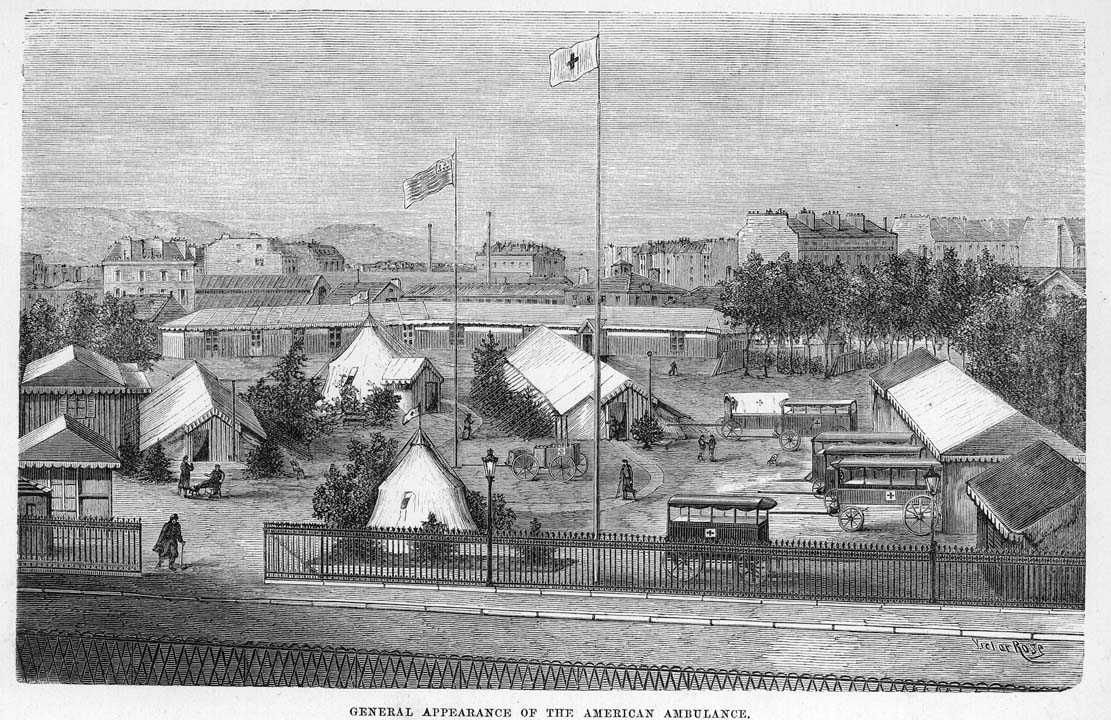
So much general interest now began to be awakened by the establishment on the Avenue de l'Impératrice, that the journals gave up whole columns to descriptions of the ambulance, its pavilions, its organization, different services, &c.
In one of these descriptions, the writer says:---
" The great American Republic was the first to recognize and salute her young sister---La République Française. If the doctrine of nonintervention in European affairs, which has been accepted as a principle by the statesmen of the New World, has not permitted the sending out of an army of succour to violently break the neutrality, proof is being offered at this very moment by acts that the sympathy of one people for the other is not affirmed solely by protestations and good wishes. Near the Bois de Boulogne, nobly mutilated, upon the right hand of that avenue which we used to call the Avenue de l'Impératrice, I do not know what they call it to-day, may be seen the 'Stars and Stripes' of the American Union. This pavilion floats over the entrance of the enclosure in which stands the American ambulance.
"During the long and rude trials which the terrible war of secession imposed upon them, the Americans had both the time and the occasion to study the most efficacious methods of taking care of the victims of battle-fields. It is the bloody fruit of their experience which they bring to us. Their ambulance may also be said to be a model of its kind. Setting out with the principle that hospital wards where the sick are commonly heaped together, are, to use the expression of Cabanis, magazines of corrupt air, the Americans have lodged our wounded under tents grouped together in picturesque disorder, yet separate one from the other . . . . The whole medical apparatus is carefully concealed, it only appears when indispensable. There are no herb teas, these are replaced by wine ; the drugs are purchased of the butcher, and the apothecaries are left to advertise.
"The ladies of high social position, who serve as nurses, give to these tents the appearance of drawing-rooms, they possess an amiable charity, and double by their grace the value of their services. They read to the sick, tell them stories, and do not refuse, in case of need, to play with them a simple game of écarté. If our wounded generals were not thirsting for revenge, there are some of them, I am sure, who would fear lest they might be cured too soon . .
"We have visited with grateful emotion the American ambulance, and we rejoice, even in the midst of our sadness, to see the knitting of those bonds, already so strong, which unite two great peoples. Let the benignant smile of peace fall upon us, and of this frightful catastrophe we will only preserve the remembrance of the generous sympathies of those who showed. themselves to be our friends in spite of all. It is the quarum meminisse juvabit of the poet, an expression profound-alike sad and consoling."(8)
A few days later, a remarkable editorial article, entitled "A Visit to the American Ambulance," appeared in the "Official Journal" of the French Republic. This article, which nearly filled the journal, extending as it did over two whole broadsides, entered into many descriptive details, which it is unnecessary to repeat here; its character and sentiment, however, will appear in the following extracts.
"Do you remember---so thoroughly has all Paris forgotten the way---do you remember that broad long avenue, to-day without a name, which from the Arc of Triumph leads to the entrance of the Bois, as we still lately said? It is there, upon that splendid and frivolous highway, a sort of neutral ground for the world of fashion, that as evening came on so many carriages used to pass, bearing---some towards the lake, and some towards the Champs Elysées---all those magnates, and all those parvenus, magnates by inheritance or through their own personal successes, parvenus by the politics of December, or by schemes of finance, interlope, or other. On the horizon, on the summit of a green hill, rose a large white mass, like one of those constructions which our Poussin loved to throw into the background of his landscapes ; the silhouette was beautiful to look upon when flooded with the golden mist of sunset; it still is---it will always be. The white mass is the noble fortress of Mont Valerien; and should you perchance go towards the Bois, where to-day are encamped so many brave and resolute troops, it is not unlikely you may hear the formidable reverberations which come from that now unwooded hill. . .
"In one of the largest villas, on the left of the great highway to the Bois, is the military hospital of Ducrot's corps, skilfully and intelligently directed by Dr. Sarrazin. Exactly opposite, on the other side of the avenue, you observe some tents and flag-staffs. 'What's that singular encampment?' you inquire, or perhaps even you ask in a careless way, 'What's that?'---indifferent, before you see the red-cross flag. 'That? That is the American ambulance, let us go in, and take my word. for it, we shall have there many things to see as well as to learn. . . When we first made this eminently profitable pilgrimage, by a chance fortunate for us, it was at the very time General Trochu was himself visiting the ambulance, distributing well-merited felicitations to those heroes who have been wounded before Paris, and putting one down for the military medal, and another for the 'Cross.' The day was declining; the attendants were passing holding in their hands the spherical lanterns, which they were about to hang up in the tents; and when, not having yet gone within them, we perceived without, the light shining through the walls of simple canvas, upon which were sketched even the profiles of the beds on which the wounded were lying, we were unable to refrain from exclaiming 'How is it possible to keep within these constructions a suitable and uniform temperature?' A Frenchman---let us confess it, in a whisper and entre nous--- a Frenchman could scarcely be a Frenchman, if he did not begin to doubt a little about the excellence of what he has not seen. We are all of us born with a critical sense extremely developed, and we are very fortunate, if it is not with a fixed determination to admire nothing which is not made at home. However low we may have pronounced these words, perhaps our guide may have overheard them; be this as it may, we were simply invited to 'Come in.'
"The day was sombre, cold and damp, nevertheless, the moment we had entered, we found that we were breathing an atmosphere pure but not dry, and at the same time comfortably warm. The temperature was uniform throughout the whole length of the pavilion, ranging from 15° to 18° (centigrade.)
"The atmosphere was healthful, as we have already said---and that is easily to be understood, renewed as it constantly is by an ingenious system of heating, and doubtless also by its easy passage through the thin walls ; thin---we admit it, but which only let the air escape which has been utilized in respiration, or rendered impure by vitiated emanations from a thousand causes readily understood, without permitting, the least in the world, that without to enter except by the ways desired and beforehand prepared. In fact, nothing could be simpler, or altogether more ingenious than the system of heating and of ventilation employed here, for it is the system of heating which secures the ventilation."
Here follows a long and very clear account of the system of heating and ventilating employed, after which the writer thus continues:---
"Is it now understood how it is brought about that one may breathe under the tents only an air warm and healthful and is there occasion for being astonished that, as a consequence, where the American system is applied, everybody should be absolutely ignorant, or as much as it is necessary to be, not only of what purulent absorption (scientifically called pyœmia) and hospital gangrene may be, but even of the fever, which is not a necessary consequence of a wound? In truth, none but those who have been really wounded are admitted to the tents ; no sick are received there, and this in the common interest of both. . . . . We have dwelt at length upon that single point aëration, and we do not regret it . . . . yes, this secured, the air constantly revivified and maintained at a temperature always uniform (we do not pretend to say that in France we have not sometimes obtained this desirable result by other and less simple means), this point secured, it was for us an assured guarantee that the rest of the American system was conceived in the same eminently practical spirit. Our anticipations have not been disappointed. Go there, if you will, in doubt, you shall leave with faith!
"To understand it all, you should go out with the ambulance waggons, pick up one of our wounded in the field, and sympathetically follow him day by day until, convalescent, he is sent to the branch establishment on the other side of the avenue. But how can we describe in all their details, which we ought perhaps to do, these ambulance waggons, so light, so comfortable, so simple, and so perfectly suspended that the jolts of the road are scarcely felt by the wounded? Whatever our desire to do this, it may suffice in this place to say, that each one of these waggons can carry anywhere in the field four men seriously wounded, and consequently lying down; that these men can be placed in the waggons without change from the stretchers and leather-cushioned seats, which become stretchers in the twinkling of an eye, by pulling out handles encased in telescopic slides at the four corners. The seats or mattresses are furnished with wheels, which, when the mattresses are open upon the floor of the waggon, rest on strong and flexible springs. The stretchers above are sustained by leathern thongs. The air circulates freely within the waggons, and finally there is a water tank in the side of each to provide a supply of water, that supreme demand at certain moments, and the indispensable auxiliary of the first dressings. .
"Every morning Dr. Swinburne, a gentleman as modest as he is well informed, accompanied by his aids, attends to the dressing of the wounded. Formerly Port physician of the city of New York, he was travelling in Europe when the war broke out; his devotion has kept him here, to assume the noble task which he is fulfilling with such admirable zeal. . . Aid nature, instead of affronting her, such is their device, and such is henceforth, we know, that also of our greatest French practitioners; it is for ever the admirable and simple expression of our own Ambroise Pare, 'I dress his wounds---God cures him !'
"Our helpful Americans do not make use of the common lint---that lint which so many charitable fingers here among us laboured painfully to prepare---theirs is made of a sort of tow, obtained from old ropes coarsely picked, the tar with which it is impregnated playing an important antiseptic rôle in the course of the cure.
"We hardly need to add, after all this, that at the American ambulance every one is a declared partizan of conservative surgery --- that delicate art which is, happily, also in honour among us.
"And now a word about those who extend these unremitting attentions to our wounded, who generously offer them these effective consolations, shall they find us indifferent? No. How could we fail to recognize that which they are doing for us, if it was only by showing how singularly practical are the ideas of those excellent surgeons, who have come from the other side of the Atlantic to place at our service, with so much generosity, their incontestable science and their indefatigable devotion ? How could we forget to thank them for their sacrifices and their humanity, those Americans of Paris, who have borne among themselves all the expense of this hospital establishment? How could we fail to find a word of grateful acknowledgment for those ladies of the American colony, who have remained in our invested capital, when they come to seat themselves by the pillows of our wounded, on whom they wait with all the affectionate grace which a sister could show a brother? Do we not know them all by name, these noble voluntary nurses, from whom we have so many times seen, and never in vain, our brave boys asking help with filial deference? We shall be excused for having passed over in silence many technical details to which we might have usefully referred, but we should not have accomplished, even now, half our task had we stopped, only to enumerate, the new curative expedients---perhaps still unemployed in France---in a word, the innovations of every sort for which hospital science is indebted to the Americans, who themselves were taught by that long and cruel war in the course of which Lincoln fell by the assassin's hand, and Grant became so illustrious." (9)
In another journal we read:---
"Among all these ambulances, whether old or new, which exist at Paris, there is one distinguished by its organization, and particularly by its system of installation, the American ambulance, No. 36, Avenue Uhrich. A rich and sumptuous residence was not selected for the establishment of this ambulance, but simply a large unoccupied plot of ground, now marked in the distance by two enormous flag-staffs, one of which supports the Geneva flag, the other the American national colours. Here, since the beginning of the war, a little colony of assistance and benevolence has been at work, which owes its origin to Dr. Thomas W. Evans, who, while in England preparing many things necessary for the completion of this ambulance, wholly American, was prevented from returning to Paris by the investment of the city.
"The grounds have been agreeably improved, by 'the setting out of a great number of pines, which have been brought in from the Bois de Boulogne. It is amongst this shrubbery that the tents have been pitched, and it is under these tents that every comfort for the care of the sick has been collected. . . A visit to the ambulance waggons is worthy of a special mention, by reason of the comfort with which the wounded are carried in them. The "Société de Secours aux Blesses" has, in fact, recognized and adopted the different ameliorations of this service. There is no occasion for us to render homage to the devotion of the persons attached to this ambulance, nor to the united efforts of the American colony which contributes to its support. The attentions which our wounded receive there are the best testimony to this fact. In front of the ambulance is a large house which serves as a convalescent establishment, for those who have been cured, and they are many." (10)
Another journal of nearly the same date observes:---
"It is but just to acknowledge how nobly the citizens of the United States have recognized and returned, during this war, the fraternal hospitalities which we have extended to them in times of peace. Neither the minister, Mr. Washburne, nor the First Secretary, Mr. Hoffmann, has left the American legation ; and this is saying not a little when, as is known, there is in Paris with the exception of the honourable gentleman whom I have I just named but one other foreign minister---M. Kern, of the Swiss Confederation. This, however, does not express the extent of the earnest goodwill of the Americans towards us; they have also established an ambulance for our wounded, and the curious construction of their improvised hospital brings to mind those which they so happily devised during the War of Secession. . . Everything is in the most perfect order, and the cleanliness is most exemplary. Here ladies take care of the wounded---ladies of society---and they tend our wounded with that earnest solicitude, that watchful and maternal attention, of which woman---in every country, in every climate---alone has the secret. These precious cares will contribute not a little to the healing of our brave soldiers. Among these American ladies who are taking care of our wounded, I have seen more than one still young and pretty---that which can do no harm, and may even singularly assist the cure.
"All are delighted thus to recognize the hospitality, which France has always so generously exhibited to all the world, and especially, in these later years, to the American people, who, it may be said, have made of Paris their veritable capital. As I was leaving the ground with emotion, after all I had seen, 'We owe you all this,' said one of the ladies to me; 'we are trying to pay off a part of the debt contracted by America with France in the time of Lafayette, and at the same time we wish to return something of the gracious hospitality which we have always found in Paris."(11)
M. Gustave Lafarge thus writes about "L'Ambulance Américaine" :---
"About half way down the Avenue de l'Impératrice, on the right, you perceive a number of tents, not a large number---a veritable little city of canvas---it is the American ambulance. You are at first surprised that the wounded can be treated almost in the open air, but if you enter you will very quickly change your first impression. It was in the United States, during the Secession War, that tent-hospitals, or open-air ambulances, were for the first time used on a large scale. There were not in that country, as in Europe, vast and ancient edifices, convents and churches---everything had to be created; and the portable tent---la tente volante---established in the rear of armies constantly in movement, played a very important rôle. It offered the double advantage of securing immediate care for the wounded, and of leaving these wounded, who are young and vigorous, in the same conditions as they were in previously---that is to say, in the free air, instead of heaping them together in close and badly-ventilated quarters. Let no one fear that bronchitis and other diseases of the respiratory organs have been occasioned by this practice. Facts have settled this question. Fresh air has, moreover, the effect of increasing the appetite; and in this way, consequently, has also contributed to re-establish the strength of the sick.
"The most exact statistics have confirmed what European science has been affirming, under every form, since the war in the Crimea. Dr. Evans liberally placed at the disposal of the American ambulance all the matériel exhibited by him, in 1867, in the section of the International Society; and through his efforts the ambulance of the Avenue de l'Impératrice was thoroughly organized. His fellow-countrymen, imitating his zeal, have outdone one another in generously consecrating their time and their labour to the relief of our wounded. Let our warmest thanks be given to all those generous foreigners who, in these times of trial, forget their nationality to listen only to the voice of the heart, to the cry of humanity."
After having described the tents, the heating apparatus, &c., M. Lafarge sums up the advantages secured by these arrangements as follows:---
"1st. The service of the establishment is carried on outside of the tents.
"2nd. All the heat of the stove---even that of the smoke, which is considerable---is utilized.
"3rd. One can at will, by means of the simplest registers---of sheet-iron, oil-cloth, and boards---regulate the temperature in all parts of the tent.
"4th. The temperature of the ground is equal to, if not above, that of the floor-it is constant, healthy, and free from humidity; the ventilation is perfect; the air is regularly displaced in every part of the tent.
"In the very coldest weather, a sufficient temperature can be maintained inside of these American tents. During the severe weather of December, when the cold was 10° or 12° below zero (centigrade), the temperature was maintained within the tents at from +12° to +15°, and. that without forcing the fires.
"The waggons for the transport of the wounded are of the most comfortable kind, and, by an ingenious system, can be rapidly fitted with either seats or beds. Double interior springs prevent the least shock.
"The American ambulance has been established by an American Committee, who have met all the expenses necessary to maintain it.
"Go and visit the American ambulance; not only will you meet there with the most gracious reception, but you will obtain from the lips of the wounded themselves the expression of their lively gratitude for the intelligent care they are receiving."(12)
As the ambulance became more and more an object of interest to the public, so more and more frequent allusions were made to the remarkably excellent surgical results obtained there.
"It is already possible, by comparing the results obtained, to perceive the relative inferiority of certain of our great ambulances, and of the infinitely preferable hygienic conditions of certain others. But it has been absolutely demonstrated to-day, to every one who does not shut his eyes to the evidence, that the constant renewal of the respirable air is the principal curative agent in all those places where large numbers of wounded are brought together. The good aëration of hospital shelter concerns us more than anything else. A place where the air is constantly renewed, with an indifferent surgeon, would appear to us greatly preferable to an infected establishment, in which the operations were performed by the most skilful practitioner of the day. We are of those who, a truth once established, hasten to the application of that truth. The day when, for example, it had been proved that the system of tent ambulances was the only one which rendered purulent absorption and hospital gangrene impossible, on that very day we should have established in Paris, cost what it might, fifty or a hundred encampments after the manner of that American ambulance, about which so much has been said during the last three months, but which it would have been much better to have simply imitated."(13)
In the course of a review of a work written by M. Augustin Cochin, entitled "Le Service de Santé des Armées, avant et pendant le Siège de Paris," the reviewer observes:---
"We shall close with this word 'virtues,' since every one in France has exhibited them in so far as the service of the wounded is concerned. There is room, however, for thanking M. Cochin for his book, which has accorded to each one the part which belongs to him in this humanitarian work. He has taken care, as a conscientious writer should, to obtain information about persons as well as things. Thus he has not attributed, as a journal recently did, the conception and the establishment of the American ambulance---that ambulance where the fewest wounded die---to any other than its founder, Dr. Thomas W. Evans."(14)
It possibly may be said by some cynically inclined person:--- "But these are mere newspaper compliments, and everybody knows as well how cheaply they are obtained, as how to appreciate them." The writer of this History can only reply that, although absent from Paris during the whole period in which the ambulance was the subject of these friendly criticisms, he has every reason to believe them, as well as the expressions of recognition already cited, to have been the unsolicited and spontaneous utterances of a people who, whatever their faults, possess a delicate and instinctive sense of justice, which never suffers a service to pass unrecognized, or a favour unrequited. No ; they are not merely casual newspaper paragraphs. Every one acquainted with French journalism knows that one of its peculiarities---one of its excellences it should be said---is that scientific subjects are rarely alluded to, even in the most trifling way, except by scientific men. There is scarcely a newspaper which does not have its scientific editor, who is responsible for everything which appears in his department. Many of the finest contributions, even to French general medical literature, have made their first appearance in the columns of popular journals. But he will not discuss further the value of these opinions. Fortunately, it is needless for him to do so, as the same opinions have been expressed, and by others whose sincerity, whose competence, and whose inability to be deceived by humbug, even though it come from America, can scarcely be called in question---by the physicians and surgeons of Paris, nearly the whole of whom---of those whose names are as well known abroad as at home---have borne personal testimony to the excellence of the system exhibited in the American ambulance, and to the efficiency with which it was directed. Larrey, Nélaton, Ricord, Gosselin, Verneuille, Daremburg; how many names might we not recall! But we must let these gentlemen speak for themselves, and, perhaps, such written testimony offered by them as we now possess cannot better be introduced than by some extracts from an article written for the "Temps" by M. Francisque Sarcey, a well-known and distinguished, French literary gentleman. If M. Sarcey writes, it will be observed that Dr. * * * speaks, and we can assure the reader that Dr. * * * is no literary fiction. Says M. Sarcey :---
"I met a few days since one of the thousand acquaintances which every Parisian, a little known, has upon the Boulevard---a physician by profession, distinguished, I might almost say celebrated, in a certain surgical specialty, and who like most of his confrères, is attached to one of our numerous ambulances. The conversation fell naturally upon the subject of ambulances. He was full of it, and it happened also that I was a little acquainted with it, being very intimate with one of those persons most occupied with the direction of the ambulances of the Press. I had also once studied with great care the remarkable work of Dr. Chenu, with the intention of making, in my turn, and with his facts, a campaign against the organization of the medical service in our armies.
"'You are interested in this ?' said he, 'very well; and you have probably visited the American ambulance?' I confessed that I had not. 'Then I must take you there. Ah! my friend, those people there are our masters. How simple, ingenious, and practical, in everything connected with its organization. It is made of nothing, as we should say. Their installation has scarcely cost twenty thousand francs, and they have a hospital the most healthful, the most convenient, and the best furnished with all needful things---the model hospital---the hospital of the future; and permit me---you can render a great service, you journalists.' What service do you allude to ? 'I will tell you. Our most eminent physicians have visited this ambulance. I have met there Nélaton, Ricord, Jules Guerin, Démarquais, and others. They have pronounced it excellent; but to get excited upon the subject, to burn resolutely the false gods, to create a revolution in our whole system, I will not say of ambulances, but of hospitals, this is a very different matter. Every physician in Paris should go and see, and convince himself with his own eyes of the superiority of the American installation. The public should come to the rescue, that administrative routine may be forced out of its absurd paths by a vigorous and irresistible pressure of opinion. We have long known these things by theory, and we have said them; but to-day the facts are before us---evident, and flashing light into the most prejudiced eyes. Profit by the opportunity, cry out in the journals---in yours; for the medical gazettes are only read by a profession which it is useless to convince. It is through the ignorant and the humble, through the crowd, that important reforms and great revolution are effected. Remark,' he added, 'what a distance there is between theory and practice. You have occasionally had the pleasure of talking with Dr. Chenu. You have read his great medical and statistical work concerning the wars of Italy and the Crimea. You know the conclusion to which he arrived, and which he has presented with marvellous force. He has demonstrated, and by an infinite number of invincible proofs, that every agglomeration of wounded shut up in close and badly ventilated places was exposed to hospital gangrene and death. He was the source in France of that great movement of opinion which has condemned vast sedentary hospitals. Very well ; he is now at the head of an ambulance, and where is it established? In the very heart of Paris, at the Grand Hotel! In rooms, which, on one side, only receive their light from passage-ways, and on the other, from a closed court covered with a glass roof. Observe that these: apartments are stuffed with curtains, which absorb and become impregnated with miasms; that the passage ways are covered with carpets, which perform a similar office; that the air circulates badly, and is unrenewed, and yet air is the first of our restoratives. What shall I tell you? I doubt if I ought to give you the figures, for they are terrible. There have been twenty amputations of the thigh at the Grand Hotel, and out of these twenty cases there have been twenty deaths. We cannot doubt the skill of our surgeons. I assure you, all false modesty aside, that we operate as well, not to say better, than our American neighbours. But the surrounding circumstances are unfavourable. You cannot imagine---you people of the world---the subtle influence of infection on open wounds. There is at the Hôtel Dieu a ward which faces the river, where hospital gangrene is endemic. Never has an amputation succeeded there.' Very well, said I, let them put the amputated somewhere else, that is very simple. 'Very simple ! I see you are still an innocent, my dear fellow. Nothing is simple in administration in our country. A sick man is brought in, there is an empty bed. The sick man has a number, and so has the bed. The sick man is put in the bed, and he dies ; but there is nothing to be said, the number was in its place, good order is preserved, and the register is correct. Everything is for the best in the best of administrations. And what if I told you that the rent of the Grand Hotel costs the 'Société de Secours' 500 francs a day,---500 francs! when for 30,000 francs upon the Trocadéro, or in any one of our avenues, these gentlemen could have established barracks, healthy, convenient, elegant even, as the Americans have done!'
"He said to me many things besides, which I do not repeat, some because I do not remember them, and others because I remember them too well, and all truths are not to be written out in a journal. The next morning, however, he took me in his carriage to the Avenue de l'Impératrice, and to the American ambulance. I had invited one of my confrères to accompany me, M. Armand Gouzien, who was the director of one of the ambulances of the Press, and was much occupied with their organization. I was very desirous that he should see with me these pretended marvels, and give me his opinion of them.
"The interior appearance is charming, it is that of a camp in a grove, the tents are pitched at intervals."
After describing the tents, barracks, heating apparatus, &c., the writer continues:---
"Nothing could be neater, more convenient, and I shall also say more beautiful, than this installation. On entering, you do not perceive that insipid sickening hospital odour, which occasions a nausea among those little accustomed to these places. It is clear that when dressings are being made, the gases which rise may be disagreeable, and it may require a little practice to get over the disgust which the spectacle occasions, but the odours escape quickly, thanks to the abundant openings, and it is scarcely, if at all, that they pass from one tent to the other.
"We were received by the surgeon in chief, M. Swinburne . . . and by M. M * * *, who speak our language with the greatest purity, and who gave us answers to all our questions with the, most perfect courtesy; and it would be impossible to accuse them of having had in view, by so doing, any publicity through the press. My name, I confess it very humbly, seemed to suggest nothing to them, and whatever special attentions were paid, were offered, as was proper, to my two friends, who were of the party. And they were in ecstasies over the admirable simplicity, according to them, of certain methods of placing the person in bed and of dressing wounds, which Gouzien declared he would have tried for certain cases of fracture in the ambulances of the Press. Not being learned in such matters, I must confess that I only half appreciated the ingenuity of these inventions; but that which struck me there was the evident fondness for practical methods, in the solution of the most complicated problems of surgery---methods which were at the same time convenient and elegant. To do much with little, without trouble and without expense, to employ that which is at hand, modifying it ingeniously to suit the case presented---this is the groundwork of their system; no outlay for the apparatus, none for setting it up---they have no other vanity than that of curing their patients.
"And here again my doctor spoke, 'When it was a question of constructing the Hôtel Dieu, the medical commission then consulted did, in fact, write a report condemning the project. But it was satisfied with this platonic and sterile protestation. We all should have had the courage to say, we have no wish to be the accomplices of the assassinations which are about to be perpetrated in that vast charnel house ; we shall, as a body, send in our resignations. Perhaps the proposition would have been withdrawn, and yet I am by no means certain of this; for in France, and this is a truth which cannot be too often repeated, hospitals are not constructed for the sick who die in them, but for the officials who live on them.
"'Of all the Parisian hospitals, the best arranged, the one which has been constructed with the greatest care according to all the rules of science, is the hospital Laripoisière, and the mortality there is frightful. In other words, it is a great hospital. It is in vain to ventilate, the miasms penetrate the floors, incrust the walls, dance in the air which is breathed, and transform in a twinkle an illness of little consequence into a mortal malady: The Cochin hospital, on the other hand, was devilishly built; but it is small; there are very few sick there, and they get well . . . . The Americans have given the last blow to the prejudice---the hospital as it exists in France, as routine has constructed and maintains it, must be killed, and we shall reach our end.'
"So spoke my friend, and with an eloquence of conviction which I cannot render. Is he right in all respects? this I am unable to affirm, but his ideas have appeared to me to be worth at least a public presentation. A visit to the American ambulance will, I have no doubt, prove useful to persons who are occupied with these questions, and they are now many. Already the Direction of the ambulances of the Press are about to establish on the Rue de la Pompe, barracks constructed on the same system, and they hope to derive from them excellent results. This deplorable war will have had at least the advantage of introducing into practice those principles of hygiene already commented by most of our great surgeons."(15)
"The approval with which my article in the "Rappel" on the ambulance of the Champs Elysées has been received, has convinced me that my opinion is one shared by the immense majority of the medical profession. The rôle of the physician should not be limited to a criticism of established things; he ought, above all, to seek out the means of doing better. Acquainted therefore with the admirable results obtained by American surgeons during their own late war, and wishing to examine, de visu, the means employed to obtain them, I went to the ambulance established by the American International Sanitary Committee, in an open lot on the Avenue Uhrich---ex-Avenue de l'Impératrice. Very cordially received, I have been able to see for myself all the details of the organization, concerning which the gentlemen in charge were anxious to give me every possible information, with a courtesy which I am here extremely pleased to recognize.
"This ambulance is composed of several long tents, in each one of which are twenty or twenty-five beds, disposed in two lines, and only separated from each other by a distance of about five feet. At first one is inclined to fear lest such a number of wounded, in so restricted a space, might produce a serious vitiation of the atmosphere. One is therefore not a little surprised on entering, to breathe an air absolutely pure, without any trace of odour, and maintained at a mild and uniform temperature---results which are scarcely obtained in the best kept wards of our Paris hospitals, and which offer a striking contrast with the disagreeable smells and frosty air of the wards in the Palais d'Industrie. This is due to the free circulation of air obtained by the construction of the tents and the system of heating.
"We may notice also the system of dressing wounds---oakum and warm-water dressings, covered with oil silk. Under these circumstances, we have in no wise been surprised, to find all the wounded with fresh, rosy complexions and cheerful countenances ---signs of a well-being which all were earnest to announce. All the men whom I questioned affirmed that the only fever they ad had occurred during the twenty-four hours immediately following the fight The chief surgeon and his aids are surrounded by their compatriots---rich for the most part---who, under their direction, go on to the field of battle to pick up the wounded (we know that their bearing and their zeal were much remarked during the action of the 21st), and who accept within the ambulance the humblest functions. The female nurses are American ladies, who, in a simple, unaffected way, take the most devoted care of our wounded, who acknowledge the same in never-ending praises . . . . We will not finish without saying a few words in regard to the means of transportation, and especially of the waggon (Evans's), in which the stretchers are suspended by means of leathern thongs. It can carry ten men slightly wounded, or four men seriously wounded, who can lie down comfortably and be lifted in and out upon their beds, without change or jolting. A water-tank under the seat supplies water, either for drinking or for use in the first dressings. The ambulance thus organized is capable of receiving one hundred patients, and yet all this material---tents, pharmacy, offices, &c.---cost only the extremely small sum of 25,000 francs. Let a comparison be made between these figures and those of the "Société de Secours aux Blessés," and especially let the results on both sides be compared, and it will be seen that, upon the matter of hospitalization, as well as in many other subjects, this people, so essentially practical, has the very best title to be considered as our model.
"France will owe to the intelligent and devoted efforts of the American colony the privilege of seeing many of her soldiers returning to the army after a short treatment, while many of the wounded will have preserved their limbs, which anywhere else would have certainly been cut off."(16)
As with the secular press, the praises of the medical journals were by no means restricted to the organization and administration of the hospital on the Avenue de l'Impératrice. The transport corps, the "aids volunteer," and their prompt and efficient services, were fully recognized. Represented at every battle or important skirmish in front of Paris, we have been told by the Abbé * * * how they were always first in the field; a medical writer has told us how they were the last to leave it. It was at the battle of Champigny; the corps had been out all day, having left the ambulance before daybreak; twice had the waggons returned loaded with wounded; the day was severely cold; the men were greatly fatigued, and the horses perhaps still more so for it had been impossible to obtain a change. Just after sundown a squad of volunteers left the ambulance on a third trip to the field. The results of this trip are thus alluded to:---
"The firing had ceased. We were not the only ambulance corps on the ground. The ambulance Chaptal, under the direction of M. de Pressensé, I think, and the American ambulance had there each their waggons and a squad. We went forward with the chief and two stretcher bearers of the American corps, one of whom, understanding German, served as our interpreter. It was dark, but we had a lantern and our flag, and we went on towards the Prussian outposts . . . . One of us cried out in French, 'Ambulance,' and our interpreter repeated this in German, and the Prussians permitted four of us to advance. The chief of the American squad declined to give his titles, and presented us as French doctors. We found a number of wounded . . . . The chief of the American squad was alone permitted by the Prussian officers, to go on farther . . . . He, however, soon returned, telling us he had found fifteen or twenty more wounded . . . but all our waggons were full, it was now ten o'clock, our stretcher-bearers were exhausted, and we were forced to return," &c.(17)
But to complete this incident, it may be said, that the "chief of the American squad" did not return, until he had placed in his own waggons several of the wounded whom he had found, and whom he conducted safely to the ambulance late at night.
In an article in the same journal, the "Gazette Médicale de Paris," Dr. de Rause, the editor, writes as follows:---
"There is a very general disposition in France to give credit to whatever may come to us from abroad. The American ambulance was therefore, from its very origin, destined to have a certain success. In the 'Gazette Médicale' we never yield to such considerations, but we like to be just towards every one, and to point out the good wherever we may chance to find it. We have visited the American ambulance twice."
The writer here enters upon a description of the matériel of the ambulance, &c., and observes, en passant,
"American surgeons are accused generally of an over fondness for operating, on the contrary, we have noted with pleasure the efforts---efforts crowned with success---of their conservative surgery. We have thus seen several cases of comminuted fracture of the femur in the course of cure . . . . M. Swinburne is the only surgeon at the ambulance (Dr. Johnson having the title and acting as consulting physician). His aids are for the most part gentlemen devoted to this charitable work, and who support it alike with their services and their fortunes. The artists appear to even rival the bankers, and we have seen one of the latter dressing a man whose shoulder had been resected---one of our internes could have done no better."
Dr. de Rause compares the results of his inspection of the various ambulances of Paris, and unhesitatingly awards the palm to the American tent-hospital in the Avenue de Uhrich. Having shown the superiority of its arrangements in regard to ventilation, temperature, and all the other details of its material installation, and emphatically affirmed the immense superiority of its hygienic arrangements, and of the results of its "conservative surgery," Dr. de Rause thus sums up his convictions on the subject:---
"A revolution in our system of hospital hygiene is therefore necessary, imminent, and, we may add, already begun; witness the tents just established in the Luxembourg Garden, the huts in the Garden of Plants, and those which are about to be inaugurated in the ambulances of the Press. Let us hope that this revolution will be complete, and that in a few years' time not a stone of our present hospitals will be left standing, unless, indeed, those buildings shall have been devoted to some other use."
The "Union Médicale" speaks of the ambulance as follows:---
"Not far from the barrack-hospital at Passy, in the Avenue Uhrich, formerly Avenue de l'Impératrice, is the American tent-hospital; we visited it recently."
After having described the construction and organization of the ambulance, the writer observes :---
" We entered all the tents, where were assembled a number of wounded relatively considerable, and we can assert that we noticed no disagreeable odour. . . Such, in a word, without entering into further details, is the American tent-ambulance. We have mentioned it in connection with the barrack-hospital near by to show our readers the differences in the two systems. We shall be able later to appreciate by comparison the services which each may have rendered. It was useful, it was desirable that an experiment should be made on a large scale as to the, value of temporary constructions for the sick and wounded, as: compared with convents, old buildings, and ordinary hospitals:. It was necessary to abandon the old routine, and to test the new system which had already been tried in the United States during a four years' war, and whose advantages had been recognized by all the surgeons of the country.
"Let us hope this new experiment will not be fruitless, and that it may confirm the results already obtained. While the genius of destruction multiplies its ravages and accumulates ruins, it is a consolation to believe that the genius of conservation---less powerful, alas---has been able at the same time to make a step forward. We shall be happy if in the midst of this bloody orgie of force we have been able to save a few lives more than usual."(18)
In a Thèse, entitled "A comparative Essay on the relative Merits of the Principal Military Hospitals established in Paris during the Siege of 1870-1," presented by M. Gustave Mousnereau on the 17th of March, 1871, to the Faculty of Medicine of Paris, the author, after alluding to the extreme obligingness manifested in almost every case on his visits to the various military hospitals of the capital, "and especially by the heads of the American ambulance in the Avenue de l'Impératrice," and having observed, that he reserves his remarks on the latter until the last, "its special arrangements demanding a special study," thus sums up the results of his examination:---
"I have reserved for the last, as being the most important, the American ambulance, for it has, in fact, appeared to me to deserve an attention altogether special, in consequence of the peculiar arrangements by which it is distinguished, arrangements which deserve to be studied, especially by those who in future would establish an ambulance.
"At the American Ambulance there are no houses, there are not even boarded barracks, excepting for the offices, pharmacy, kitchen, guard-room, &c.; there are only simple sail-cloth tents, supported in the centre by wooden standards, and fixed outside by ropes fastened to solid wooden stakes driven into the ground. The covering of each tent is double; the inner one is furnished with small square windows which can be raised outwards, and which, when thus raised, push apart the two coverings of the tent. The cloth (cotton-duck) of which these coverings are composed, is impermeable, and not a drop of water can penetrate it, even though it should remain for a long period exposed to the rain; but this impermeability to moisture does not prevent the air and the light from entering, and the tent is lighted only in this way. The air, passing through the entire covering of the tent, and not as in our best constructed ambulances, only through a few windows, is renewed incessantly but gradually, and without draughts of air; a renewal which is facilitated by the openings of the inner covering, and which, as there is no opening in the outer covering, cause none of the draughts which are so prejudicial to the sick." . . . .
After a detailed account of the system of heating, &c., the writer continues:---
"I feel justified in affirming that the American ambulance is the best of all the ambulances established in Paris . . . . This superiority of the American ambulance has been admitted by the most eminent surgeons of Paris, and an attempt has already been made, by Dr. Depaul, clinical professor of midwifery, and Dr. Dubreuil, assistant professor and hospital surgeon, to apply the American system by establishing two similar tent-hospitals, of thirty beds each, in one corner of the Luxembourg Garden; and these tents appear destined to give excellent results."
After alluding to the beneficial effects of the substitution of oakum instead of lint, and of the liberal system of feeding the patients according to the requirements of their state of health, and not according to wholesale regulations, often insufficient or wholly inapplicable, the author thus sums up his conclusions in regard to the subject of his essay:---
"At the American ambulance the deaths have been only five per cent.; of seven amputations only three have died; there has not been a single case of hospital gangrene, and not one case of purulent infection. These figures speak for themselves, and suffice to demonstrate the superiority of the American ambulance." (19)
In an article which appeared in the "Gazette Hebdomadaire de Médecine et de Chirurgie," entitled "Les Ambulances pendant le Siège---l'Ambulance Américaine---une Expérience sur les Hôpitaux Tentes," Dr. Hénocque writes as follows:---
"The American ambulance merits the special attention of the public and of the press. The installation of its little camp in the Avenue de l'Impératrice presents a most charming appearance; while its fine ambulance-waggons, drawn by superb horses, have carried the American flag to every point of the field on which an engagement has taken place. Several newspapers gave accounts of the successes achieved by this system of ambulances, and the favour of the public was speedily acquired by the tent-hospitals. But the winning of public favour was by no means the aim which the organizers of the American ambulance had proposed to themselves; what they wished to do was to demonstrate, by actual experiment, that tent ambulances are as suitable for the treatment of the wounded in a besieged city as in the wake of armies in the field. It is because the conditions of this experiment have been rigorously observed that it becomes our duty to call attention as seriously to the methods employed as to the results obtained by them . . . . The interest of the wounded, as well as that of science itself, demands this study."
After describing the peculiarities of the ambulance, and of the treatment adopted in it, Dr. Henocque continues:---
"Such was, in short, the nature of the establishment; but, to render evident its advantages, it was important to bring the wounded to it under the best possible conditions. We know how greatly the deathrate varies among the wounded, according to the longer or shorter time they have been left upon the field of battle---according to the degree of promptitude with which they have received a first dressing---according to the degree of temperature to which they have been exposed during their transport from the field---and according to the violence of the shocks (so often fatal) to which they may have been subjected during their transport. In regard to this last condition, thanks to Dr. Evans, the American ambulance has been able to make use of the most perfect methods of transport that have ever been seen in Paris. The waggons, which were offered to the examination of the public during the Exhibition of 1867, have excited equal admiration on the battlefield, by the rapidity with which they effected the carrying off of the wounded, and also by the eminently convenient and easy transport obtained by their method of construction . . . . One result of the siege must be to settle the question as to the relative value of tents, barracks, and ambulances established in large buildings. When this point is settled, we shall no longer have the right to be found unprepared; we shall understand the necessity of preparing, in time of peace, the elements of the most effective help that can be given to the wounded in time of war. . . In conclusion, I must be permitted to thank Dr. Evans, who has been the promoter and the support of the American ambulance, Dr. Crane, who has been its organizer, and Dr. Swinburne, for the extreme goodwill with which they have facilitated my examination of all the details of the experiment so skilfully conducted by them."(20)
Such have been the recorded opinions of the medical press. But we have mentioned the names of some who were our frequent visitors, and who are the most illustrious living representatives of French medical science---all expressed the interest they took in the experiment, and their gratification in view of the manner in which it was being conducted----how unreservedly, how completely, the simple lines written by M. Nélaton upon a card which he left at the ambulance, will perhaps best show:--- "You have here shown what great results may be obtained with small means." And Baron Larrey, when he declared before the Académie des Sciences, in June, 1871, that "the question of employing tents and tent-barracks seems to have been judged to-day by an experimental trial the most complete as well as the most favourable,"(21) bore testimony to the value attached to our labours so complete, that had we been able to record no other, we still should have felt more than rewarded for all our efforts to introduce into European armies an improved system of field hospitalization.
Indeed, the interest taken by the medical profession of Paris in everything which concerned the ambulance was very great. Scarcely a day passed during which some well-known name was not entered in the list of visitors--- during which some new testimonial of approbation had not been offered. No sentiment of professional jealousy was ever exhibited; no exclusive feeling of nationality was ever manifested. There was but one sentiment, but one feeling, among all: that inspired alike by an earnest desire that the history of the experiment might tend to the establishment of some new truth to the honour of science and the benefit of mankind, and by a generous recognition of the good-will which had prompted strangers, in a time of general gloom and disaster, to participate in their fortunes, and aid them and assist them in such ways as they could. And it would be unjust---impossible, indeed---for us, not to recognize our deep indebtedness to the medical gentlemen of Paris for their many amenities, for the uniform courtesy and the kindly encouragement they constantly gave us---us who had brought, with perhaps something of our national hardihood, the first fruits of a New World's experience, to the very shrines of venerated oracles, to there compete with the established principles of ancient tradition, and even with the practice of classic surgery.
Probably no special detail connected with the establishment of the ambulance attracted so much general attention as the system of heating there employed. "How can these tents be kept warm?" was almost invariably the first question which came to the lips of the visitor; and every one was anxious to see as well as hear the answer---for it was evidently the pivot upon which the success of the experiment of using a winter tent-hospital must necessarily turn. The system adopted was explained, as we have seen, in many of the public journals; but in the month of December, M. Charles Joly, the author of a popular work on "Heating and Ventilation,"(22) prepared a paper, illustrated with lithographic plates, for the special purpose of directing the attention of scientific people to the principles and practical details of the system, which he very pertinently called, "The rational system of heating tents." Greatly interested in this matter, especially as a means of improving the hospitalization of the sick, M. Joly distributed his pamphlet freely; shortly after the ambulance began to be visited by large numbers of architects and others interested in the general subject of ventilation, and various written inquiries and communications thereon began to be addressed to the Secretary, of which the following is a sample:---
"SIR,
" The American Ambulance has been pointed out to us as a type to be followed, as also a subject to be examined with the greatest care,---this we did yesterday, but we were disappointed in not having had the pleasure of meeting you there. I have the honour therefore of asking you to be so good as to complete our information upon a number of points, viz. &c. &c.
"Believe me, &c.
"DELPIERRE,
"Inspecteur des travaux de la Gare du Nord."
In the month of January, General Morin, the director of the "Conservatoire des Arts et Métiers," made the system of heating employed in the tent-pavilions of the ambulance the subject of a special study; and plans and sketches of all the details of the installation, in so far as they related to heating and ventilation, were carefully prepared by M. Brehan, under his direction, for the National Conservatory.
Several allusions have been made in the preceding pages to the waggons used by the transport corps of the Ambulance.
The model of these waggons was first shown at the Exposition Universelle in 1867, and was then pronounced, by nearly all who saw it, to be far superior to any other known model. It was a light four-wheeled carriage designed to carry ten persons seated, with the driver; or four persons lying down, and two seated with the driver. It differed from all other waggons which had been previously constructed to carry more than two persons lying down---principally, in having no mechanism in the interior which could in any way interfere with what must always be the most common use of an ambulance waggon---its use as a transport for persons seated. The seats were constructed in such a manner that they could be employed as stretchers, and also as mattresses, on the floor of the waggon. While a few straps had been so placed that any two common field-stretchers could be easily suspended above the floor, and so securely as to render any disagreeable oscillation impossible. The waggon was light, could be drawn by two horses over the most difficult roads, and was fitted with drawers, &c., for the carriage of the usual and needful accessories of an ambulance waggon.
The waggons made after this model, and used at the American Ambulance, attracted much attention during the early period of the siege; their theoretical excellence was often severely tested, and never did they fail to respond in the completest manner to the objects which their inventor had had in view. So excellent, so well adapted to all the contingencies of waggon transportation were they soon publicly shown to be, that the French "Société de Secours aux Blessés" ordered a large number of waggons to be constructed on the same model for its own use. After the 1st of January, the transportation of the wounded in the city of Paris was principally effected by means of these special carriages---whose introduction into the French service must always be counted as one among the many beneficial results of the establishment of an American Ambulance in Paris.
Nor was its influence, in introducing new methods and instruments of working, limited to those of the highest importance; many of a comparatively secondary value were thought to be useful improvements, and were at once adopted. Thus it was that the American stretcher---that model which has been described as the "pattern folding up lengthways, in which the poles are separated by folding iron braces "(23)----which was used by our transport corps, was introduced into the French service, as is shown in the following letter addressed to the Secretary:
"Gouvernement de la Defense Nationale. "Paris, December, 1870.
"SIR,
"I have the honour of returning the stretcher which you were so good as to loan me, and which has served as a model for those which I have ordered to be made.
"I take this occasion to thank you for the attention shown me at the time of my visit to your Ambulance, which is as beautiful as it is charitable.
"Believe me, &c.,
"Le Chef du Cabinet du Gouvernement,
"LEON BÉQUET."
Among the appliances more directly connected with surgical practice, the use of which the American Ambulance was largely instrumental in popularizing, may be mentioned the employment of oakum as a substitute for charpie. This substance, the virtues and merits of which were previously practically unknown in France, found great favour among the hospital and ambulance surgeons of Paris in the treatment of suppurating wounds.
The novelty of the system of hospitalization employed, the originality displayed in the installation, the excellence of the transport material, and the general efficiency of the whole administrative service, very early secured for the Ambulance the favour as well as the attention of the Intendance, that department which, in the French army, is charged with the direction of the service de santé and the administration of the hospitals. On no occasion, when a sortie was to be made, did the American Ambulance fail to receive official information that its services would be required; and on no occasion, it may be added, did the transport corps fail to respond to the call.
These several merits, exhibited alike on the field and in the wards of the Ambulance, are recognized in a letter, addressed to the Committee on the 3rd of January, 1871, by General Wolf, the intendant-general of the Army of the Defence, in which he says:-" Since its creation, the American Ambulance has rendered to the army substantial services---des services très-réels---which I was one of the first to recognize."
Nor among these general proofs and testimonies of efficiency and usefulness should we neglect to present one, which if coming from an humbler authority, is not less conclusive, and is certainly far more eloquent than any.
A few days before the Ambulance was closed, one of the three patients who had recovered after amputation of the thigh, the doyen among all our mutilated and convalescent, came to the bureau of the administration, and asked to see Dr. * * *. He seemed to be labouring under some emotion, which he was struggling to conceal, and hastily putting a paper into the hand of the doctor, hurried away. On opening the paper, it was found to contain the following letter, which is here given in the original, as it would be almost impossible to reproduce in English the naïveté of the sentiment.
"Je vous écris ces quelques lignes; c'est au nom de tous mes collégues pour vous remercier tous---des soins que vous nous avez prodigués. Soyez persuadé que dans nos cœurs il y aura toujours une place réservée à votre mémoire; car sur la terre, après nos parents, nous ne pouvons pas avoir d'êtres plus chers que ceux qui nous ont arrachés des mains de la mort, qui on disputé, heure à heure, notre existence avec les décrets celestes.
"Notre reconnaissance envers vous ne sera jamais assez grande, quoique nous fassions. Ainsi, Messieurs, recevez les remercîments que je viens vous offrir, en mon nom et au nom de mes camarades d'infortune.
"ALFRED DOUCET."
Just as the American ambulance was about to bring its labours to an end, an article appeared in the "Vérité," with which we shall close our citations from the press. The article explains itself:---
"We are happy to learn that Dr. Swinburne, the surgeon-in-chief of the American ambulance, and Dr. Johnson, physician-in-chief of the same ambulance, have just received the Cross of the Legion of Honour.
"The services rendered during the siege by the American ambulance are known. The devotion exhibited by the members of that ambulance is also known. In the accomplishment of their charitable work they have recoiled before no effort---before no sacrifice . . . . The distinctions which they may have received are the merited recompense of their zeal and their earnestness to aid those afflicted with the gravest misfortunes. We may add that long experience and great skill assured to most of the wounded confided to their care cures, often unexpected, and that the excellent system of tents, which had already been tested during the Secession War, has offered at Paris, as well as in America, the most surprising results. The leaders of the American ambulance have nobly proved their sympathy for France, and they have gained what is worth more even than honorary distinction---the esteem and the gratitude of all."(24)
Not including the honours conferred by the French Government upon several members of the Committee---no less than five gentlemen---Drs. Swinburne and Johnston, and Messrs. Joseph K. Riggs, and William and Emile Brewer, were made, in recognition of their services, KNIGHTS OF THE LEGION OF HONOUR. These unusual distinctions, which the French Government thought it proper to award to the members of the American ambulance, may fairly be considered as the official seals and vouchers to the justice of that popular opinion which obtained in Paris during the siege, in regard to the exceptional merits of the ambulance, and the devotion of those who served in it. And it may not be uninteresting for our fellow countrymen to know that these honorary recompenses were not only of a higher grade, but were greater in number than those awarded to citizens of the United States in connection with the great Exposition of 1867.
But the writer cannot let this occasion pass, while thanking the Government for the honours conferred by it upon the members of the ambulance, and for the unusual distinction conferred upon himself personally, without expressing his grateful recognition of the kindness and encouragement the Committee uniformly received during the whole period of their service from every one of its agents. To the officers of the regular "Service de Santé" and to the officers of the Intendance especially, with whom their relations were most constant, the Committee can never forget how deeply they were indebted for every opportunity of usefulness, and how their very name---American---instead of being suggestive of the foreigner and of national rivalries, seemed to serve as a pass-word everywhere, and to be itself a sufficient reason for granting every request.
Whatever of success may have attended the attempt to establish in Paris an American ambulance on the volunteer system, was largely owing to the earnest desire of every one who engaged in the work to contribute in every way in his power to the common end---the maintenance of a model ambulance service.
Of his colleagues, members of the Committee, whether within or without Paris, it is unnecessary for the president to speak. The task assumed by those shut up within the beleaguered city was not an easy one; but a disposition to shrink from responsibilities was never manifested, and the special work as originally forecast was in the end accomplished. To those members of the Committee who were without the city, the president must express his deep sense of obligation, as well for counsels given as for the unfaltering interest they took in whatever concerned our common undertaking. To have conducted a work so widely known, to have, each in his own special sphere, shaped its ends, is in itself an honour not soon to be forgotten, while in the results achieved we all shall find our principal satisfaction.
In securing the services of Dr. John Swinburne as surgeon in chief of the ambulance, the Committee was particularly fortunate. Dr. Swinburne was a surgeon par excellence. He had had an extensive professional experience, and had obtained a justly acquired and widely known home reputation. Thoroughly acquainted with military medicine, and the constitution and management of army hospitals, an earnest advocate of conservative surgery, an enthusiast even as regards the conservative treatment of compound fractures, a skilful operator whenever operations were required, he possessed a rare and highly valuable quality---a knowledge of the way to deal with men; in a word, he knew how to manage both his patients and his assistants ; and not unfrequently was he called upon to exercise this special knowledge.
Associated as he was constantly with a body of forty or fifty persons, all volunteers, holding a certain social position, uncontrolled by the restraints of a military discipline, all naturally ambitious to excel, and perhaps occasionally even over jealous of the successes of their fellows, Dr. Swinburne knew how to direct these energetic elements, obtain from them the largest amount of labour, and maintain in every department of his service his own personal ascendancy.
Dr. Swinburne was assisted by a surgical staff, who, although receiving no compensation for their services, were always prompt and indefatigable, faithful and zealous in the discharge of their duties, and as deeply interested in the issue of each case as the surgeon himself. To Mr. Cormac and the two Brewer brothers, to Mr. Riggs, to Mr. O'Connel, Mr. Louis Swinburne, Mr. Peet, and Mr. Du Bouchet, especial credit is due.
Dr. W. E. Johnston at an early day volunteered to serve in the ambulance as its physician, and to take charge of such cases of illness as might be received in it, or might declare themselves during the course of surgical treatment.
Dr. Johnston ably assisted Dr. Swinburne, and proved a judicious adviser in all those cases where the special knowledge of the physician could be of avail to the surgeon.
The two captains of the squads organized for the field transport service---Mr. William B. Bowles and Mr. Joseph K. Riggs---disciplined and directed their commands with great intelligence. The squads were drilled in the art of carrying the wounded on stretchers, in placing them in and removing them from the ambulance waggons. The waggons were kept in a constant state of readiness---everything in its place-stretchers, blankets, water, lanterns, &c.; every man having also his assigned place and clearly defined duty. One of the captains, in a note sent to the Committee, says:---" The squads, engaging to hold themselves in constant readiness, generally got the wounded home more quickly than the French Ambulance Corps did. We were present at skirmishes and sorties at Chevilly, Chatillon, Clamart, Malmaison, Champigny, Brie, Villiers, Bourget, Bondy, Rueil, Buzenval, &c., and we tried to do our duty." How entirely and unshrinkingly this duty was always done has already been shown.
It would be perhaps invidious, where all the members of a corps worked for so long a time faithfully, generously, and often heroically, to make any personal distinctions. It is only just, however, to say that, in the common opinion of all connected in any way with the ambulance, if a pre-eminence were to be indicated, it should be assigned to Mr. Joseph K. Riggs. A gentleman of fortune, married, and with a family, Mr. Riggs, before a wounded man had been received at the ambulance, offered his services to the Committee as an aid volunteer to go with the ambulance waggons and serve as a stretcher bearer. Shortly after he was named captain of a squad. On the 30th of September he went with his command to Chevilly, and brought off from the field a large number of wounded. This service, arduous as it was, was not sufficient for a nature, zealous and indefatigable, such as Mr. Riggs possessed. "I never shall forget," said a gentleman to the writer, "the surprise I felt on the very day of. the affair at Chevilly, at seeing Mr. Riggs in the operating-room assisting Dr. Swinburne, then engaged in amputating a thigh, and that with all the sang froid of a veteran surgeon." Such an interest did Mr. Riggs take in everything connected with the surgery of the ambulance, that, daily accompanying Dr. Swinburne in his visits, he soon qualified himself to discharge all the duties of a surgeon's assistant, was appointed to Dr. Swinburne's staff, was assigned a ward, Pavilion No. 1, became perhaps the most expert dresser in the ambulance, and continued to fulfil all the offices of a surgeon's aid in the most conscientious manner until the close of the ambulance, and all this without in the meantime in any way neglecting his special duties as a captain in the field transport service. These offices, which Mr. Riggs accepted, were no sinecures; they brought with them work, night watching, and exposure, they required a constant daily presence for duty, and were often exceedingly fatiguing. If it were in any way remarkable that a person whose previous life and social surroundings had been entirely foreign to surgery, should have been induced to assume the discharge of its simpler duties in the wards of a hospital, it is not less remarkable that those duties should have been performed so well, and with a zeal so conscientious, as to know no flagging.
Another name may be specially mentioned, that of M. Ranzi, an Italian by birth, an American by marriage, a scholar by education, and a gentleman by instinct. Ranzi was one of the first to enrol himself in the corps of aids volunteer. Endowed with all the enthusiasm of his race, energetic to a degree rare even among Americans, bold as his Roman ancestors, he was always ready for every sortie, and never shrank from exposing himself where the dangers were greatest. At Champigny he particularly distinguished himself. Having been out with the waggons all day --a bitter day of wind and frost---he returned to the field in the evening, exposed himself to the fire of the Prussian pickets, but succeeded in picking up several half-frozen wounded, whom, as the night shut in, the retiring ambulance corps had left to their fate.
Ranzi always had at heart the interests of the ambulance, and laboured for them scarcely less earnestly than, when the occasion offered, he did for the wounded themselves. He was always ready to do anything, charged himself with obtaining forage for our horses, searched the markets and the country around Paris for provisions, appealed to the municipal authorities in behalf of the ambulance for rations, and rendered various services of a similar character. Possessed of a generous sympathetic nature, Ranzi had many friends in the American ambulance, and all who may have known him will assent to the justice of this passing tribute to his memory. Ranzi is dead. Scarcely had the American ambulance closed its doors when Paris was again besieged by the investing army of the Government. Then followed those long, terrible weeks of ceaseless fighting---of incessant bombardment. Ranzi remained in Paris, and, ever ready to lend a helping hand to a wounded man, did not make that casuistic distinction between a Communist and an enemy which was too frequently entertained by the friends of the Government.
Daily he went wherever there was fighting, picking up the wounded and conveying them to some of the many ambulances in the city. On the morning of the 22nd of May the troops of the Government entered Paris, the Communists falling back towards the Garden of the Tuileries, and the barricades erected in its neighbourhood---the troops, in the meantime, pushing them actively with artillery. Shells were exploding at every moment in the Place Vendôme, around the Palais Royal, and in the quarter adjacent. Ranzi had entered the Rue Alger, to arrange for the reception of some wounded in a house in that street, when he was struck in the side by a large fragment of a shell, which, frightfully wounding him, caused his death almost immediately.
Mr. Rillet was well known to the corps of aids-volunteer as an active and indefatigable worker. An amiable young man, he attached to himself many friends during the winter of 1870-71. Rillet is also dead, but his good deeds will live in the memories of his associates.
Messrs. Gunther and Dreyer were always prompt and ready for any service, and the former distinguished himself by his coolness at Bourget, where for a time he was s target for the Prussian outposts. Messrs. May, McFarland, Piperno, Maleherbe, Duprez, Washburne, Pollock and Meslier were worthy of all the praises which may have been given to them.
Major Hutton always manifested a lively interest in whatever concerned the well-doing and the well-being of the ambulance, while Major O'Flinn not only rendered good service with the ambulance waggons, but seemed to have made it a point of honour, during the earlier weeks of the siege, never to return from an expedition beyond the walls, without bringing back in triumph the largest pumpkin he could contrive to find in the market gardens outside the town; a contribution to the hospital dietary, whose importance can only be truly estimated by those who have conducted the arduous work of treating the sick and wounded, under the constantly increasing scarcity of a siege. Unfortunately, the progress of the military operations restricted the limits within which the gallant Major could prosecute his foraging expeditions; and the pumpkin fields being ploughed up, and well-nigh obliterated by shot and shell, the Major's return from the front was no longer followed by the jubilant exhibition of the precious esculent which had been welcomed each day, with ever fresh enthusiasm, by the entire personnel of the ambulance, from the head-surgeon to the cook ; and this invaluable addition to the alimentary resources of the ambulance was brought to an untimely end.
Nor should we fail to remember the services rendered by Mr. Hugo and Mr. Meakes, who although not members of the volunteer corps, yet, as the executive agents of the administration, always discharged their respective duties with fidelity and intelligence.
Among the ladies who especially distinguished themselves in connection with the ambulance, it would be difficult to assign a first place to any one. Several devoted their whole time, during many weeks and months, to the difficult and uneventful work of nursing the wounded. The cares of this kind given to the patients at the ambulance were offered almost wholly by women, and were of a character such as to leave nothing to be desired. The system was this: a hired male nurse was attached to each ten or twelve patients both day and night; at night, a hired female assistant watched with the male nurse in each pavilion; during the day from five to ten patients formed the special charge of each dame volontaire. Never did men, sick or wounded, receive more personal attention, and never were these attentions offered with a larger desire to do for each one everything which could be done.
Miss Bewick associated herself with the ambulance before it I had been decided whether it was to remain in Paris or join the Army of the Rhine, and devoted herself during several weeks to the preparation of the bandages, compresses, &c., which it was presumed would be needed. On the opening of the ambulance on the Avenue de l'Impératrice, she asked to be received as a nurse, and was accepted and assigned to the officers' tent. Here she remained until the close of the siege, constantly occupied, always busy in attending to the least wants of those in her charge. Observant and thoughtful by nature, in manner quiet yet energetic, calm but always cheerful, and apparently happiest when the forced watchings were longest, Miss Bewick was, in all respects, a hospital nurse such as her own illustrious countrywoman, Miss Nightingale, might have chosen as an example of what a female nurse might be and should be.
Mrs. McFarland will long be remembered by the personnel of the ambulance, and perhaps longer yet by those who were the receivers of her kindly care, and to whom she was only known as la petite mère. Not strong physically, but with that strange power which generous natures seem to possess of never growing weary, she was always present and always doing. Mrs. Bowles and Mrs. Koch were in the same pavilion, where, if the patients seemed happier than in the rest, it could only have been because, there nothing was left undone which ought to have been done. In Ward No. 4, Miss Chandor and Mrs. Howland were most efficient, and in Barrack No. 5, equal services were rendered by Mrs. Huggard, Mrs. Ricker and Miss Cameron. The Marquise de Bethisy came daily to visit the wounded in Pavilion No. 2, as did also Mrs. Moulton and Miss Wissembourg. Mrs. Meslier and Miss Maas also rendered most valuable services in the same pavilion.
Too much praise cannot be given to Mrs. Conklin, and her two assistants the Misses Castri, for the efficiency with which they managed their departments, the linen room and special diet kitchen; both were most important accessories of the ambulance, and could not have been better directed.
A remarkable fact may be mentioned concerning all the ladies whose names have been mentioned: there were no backsliders among them. They remained in the ambulance almost without exception, from the very beginning of its history until its close. The interest which they took in it was neither sentimental, nor one which had its origin in a morbid curiosity; they came, one and all, with the serious purpose of making themselves useful, and in proportion as they found they were so, their interest in their patients and their interest in the ambulance grew strong.
Although the good accomplished by these ladies was great, in its immediate influence upon the well-being of the sick, another good effect resulted from these weeks of continued hospital service, which although personal to those who gave their time and strength to the sick, was scarcely less valuable---the direction given to newly awakened sympathies which in many cases must have led to an established conviction, that to every woman with a pure heart and willing hands a vast field of usefulness is open, which lies entirely within the limits of existing conventionalities.
This narrative would scarcely be complete did the writer fail to allude to operations with which the Committee had proposed to occupy itself, before its sphere of action had been restricted by the circumstances to which references have elsewhere been made.
On the 5th of August the following letter was addressed to the Queen of Prussia:---
"Paris, 15, Rue de la Paix,
"Aug. 5th, 1870."MADAM,
"I address your Majesty to-day for the purpose of informing you of the action taken by the Americans of Paris in view of rendering aid to the wounded during the present war.
"On the 18th of July an American International Sanitary Committee was organized in this city, and we have since received contributions, in money and in kind, to a considerable amount, in furtherance of our object, which is to give succour to the wounded alike of all armies.
"We have reason, however, to believe that its strictly international character may secure to our Committee the common favour of the Sanitary Associations of the belligerent towers, and that our agents may, on that ground, possibly have the means of being, occasionally, even more useful than the representatives of the German and French Societies.
"Should it, therefore, at any time seem desirable to you to have the representatives of any of the German Societies placed in communication with us, we shall be most happy to give them any information, or render them any aid in our power, which may not be in contravention to the laws of war.
"Should any one in Germany wish to know the condition of any prisoner, wounded or otherwise, within the French lines, if it is possible for us to ascertain the information requested, we shall be most happy to communicate it, if permissible.
"Should any one wish to send material aid to any wounded, we will charge ourselves with transmitting the same to those to whom it may have been given.
"We feel that various services of this kind can, occasionally, be rendered by us in a manner more satisfactory than may be possible with any other Association, and we shall consider that we have accomplished no small part of the object of our organization, should we be able to be a channel of communication between the Sanitary Associations of Germany and the wounded of your armies who may be within the French lines.
"We may also wish, either in our own behalf or in behalf of the French, to obtain information, or aid of a like kind, from the German Associations, and we shall be greatly pleased to establish a correspondence with these associations, which maybe mutually beneficial.
"Communications may be addressed to the 'American International Sanitary Committee,' 15, Rue de la Paix, Paris.
"Your Majesty will believe me,
With the profoundest respect,
"Yours most sincerely,"THOMAS W. EVANS.
"President of the American International Sanitary Committee."
To this letter Her Majesty graciously replied as follows:---
"Berlin, August 30, 1870.
"The Queen of Prussia has, with great satisfaction, seen from the letter which Dr. Evans has addressed to her as President of the 'American International Sanitary Committee,' that the Americans residing in Paris have devoted themselves to the noble task of giving succour to the wounded of all nations in the present war. The Queen is convinced that the Committee will be of great use, and particularly from being able to avail itself of the experiences of the American war. She has been anxious to give notice of Dr. Evans' communication to the Central Committee of all the German Sanitary Associations, which has been established in Berlin, and which expresses, in the enclosed answer, its readiness to give any information wished for by the American Committee. The Queen states, with satisfaction, that in the German army the care of the wounded is conducted strictly according to the articles of the Convention of Geneva; that, in all the hospitals established throughout Germany, whether by Government, by communities, or by private associations, all the wounded, German or French, are treated alike; as also that of the many hospitals founded for the war, the greater number have been built according to the American system, which has also been adopted for the Queen's own hospital (Augusta Hospital).
"To give an idea of the activity developed by the different associations formed in Germany for the aid of the wounded, the Queen encloses a list of objects sent from Berlin by the German Central Committee alone, by the side of which other associations are working, among which may be mentioned the Hülfsverein, and the Vaterlandishe Frausenverein, which was founded in 1866, and is now spread over all Northern Germany, and is assisted by three hundred and thirty-eight auxiliary societies.
"In spite of the co-operation of all these different societies, which are besides aided by the Knights of St. John and the Knights of Malta, by the sisters of mercy, both Catholic and Protestant, by many thousands of ladies of all classes, who devote themselves to the attendance of the wounded, and by a great many men---too young or unfit to serve in the army---who go out to render aid wherever it is required; in spite of all this, the Queen believes, that every accessory succour must be hailed with expressions of gratitude, and therefore begs Dr. Evans to convey her thanks to the Committee for the support which it promises to give to the wounded of the German army.
"To DR. THOMAS W. EVANS."
The communication to which Her Majesty refers in her letter, is as follows:
" Berlin, August 28, 1870.
"We have been informed by Her Majesty the Queen, our Gracious Protector, of the communication which you sent to her in the name of the 'American International Sanitary Committee of Paris,' on the 15th of August. It is with the greatest joy that we have heard of the spirit of sacrifice which has united your compatriots, in order to help the suffering in the two belligerent armies. This will surely increase the profound sympathies which exist all over Germany for the American people. We shall willingly do our best to contribute to your sacred work, and we are already prepared to put at your disposal everything which you may require from us, and which it is in our power to give.
"Receive from us the assurance of our profound esteem,
"R. VON SYDER,
For the Central Committee for the care of the wounded of the German army."
To Dr. Thomas W. Evans, President of the American International Sanitary Committee, Paris."
These letters mark out a circle of action and usefulness which seemed to the president most important, especially so long as he still cherished the hope of receiving the co-operation and aid of those who in the United States might be interested in a work of international assistance, and therewith an extension of the pecuniary resources at the disposition of the Committee. Indeed it was from a sense of the great importance of this more general work, that he had been principally reluctant to immure himself in Paris before the field had been so far explored as to render possible an appreciation of the needs within it, and of the value of the services which there might be rendered. One of his first resolutions, therefore, after the investment of Paris had been announced, was to proceed forthwith to the seat of military operations in Eastern France, for the purpose of ascertaining, so far as he might be able to do so, the general sanitary condition of the French and German armies, the character of the hospital accommodations provided, the action and character of the health service in the respective armies, whether voluntary or official, and the condition of the military prisoners, the number of whom, at this time even, had become enormously large. He accordingly, towards the close of the month of September, left England for the Continent on a tour of general sanitary inspection, in the course of which he visited Sedan and the hospitals in its immediate vicinity, Luxembourg and Thionville, the German army around Metz, and at the neighbouring posts, Pont à Mousson, Courcelles &c., the hospitals at Coblentz, Mayence, Carlsruhe, Heidelburg, Frankfort, Homburg, and vicinity, as well as many of the prison camps established on the lines of military transit between France and Germany. Although thoroughly convinced of the large opportunities of usefulness offered in nearly all these places to any independent and neutral association which might be willing to work in behalf of the sick and wounded, or in aid of the German associations---upon which a double task had fallen, as well from the immense numbers of French wounded and sick, who had suddenly become the most necessitous claimants of their charities, as from the entire absence of any organized measures of assistance on the part of the French for this class of their unfortunate countrymen---he was particularly impressed with the unhappy condition of the prisoners.
Feeling, however, that it would be impossible to engage in any general work of relief; even in a special direction, without the co-operation of others, he returned to London. Here, having called the attention of a number of benevolent ladies and gentlemen to the needy condition of the French prisoners, a society was almost immediately organized, under the name of "Society for Clothing the French Prisoners." Mr. Hankey, M.P., was pleased to accept the presidency of the society, and the writer of this history, nominated to fill the office of hon. secretary, at the same time volunteered to become its agent in the field. This offer he was prompted to make, because it opened to him an immediate field of active duty, at a time when his colleagues in Paris were winning golden opinions by their sacrifices and energetic and unselfish devotion, and promised very large opportunities for investigations and experience, which might prove of the greatest value to the American International Committee in the development and execution of its plans. Money and clothing were liberally sent forward as gifts to the society, and its secretary and agent was soon enabled to go forward upon his mission to the prison camps of Germany. But of their condition, of the sufferings assuaged, of the wants there supplied,---of the results of observations made, during voyages which occupied most of his time for many weeks, and even months, in the winter of 1870-71---it is not his purpose here to speak. And if he has alluded to this special labour in this history, it has been only because he is unable to consider it as anything but a part of that general work upon which the American International Sanitary Committee originally proposed to enter, and which he has no reason to doubt would have been as successfully and as gloriously conducted in all its operations, had it been properly supported, as it was in one---in that ambulance which, established and maintained in Paris during the siege of 1870-71, has, itself alone, secured to those who were devoted to it a nation's gratitude, and brought to us all, who bear even the American name, lasting honours.
Paris, 41, Avenue de I'Impératrice.
1872.