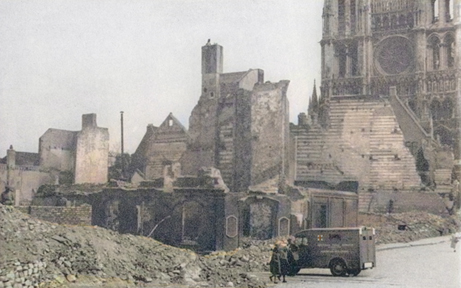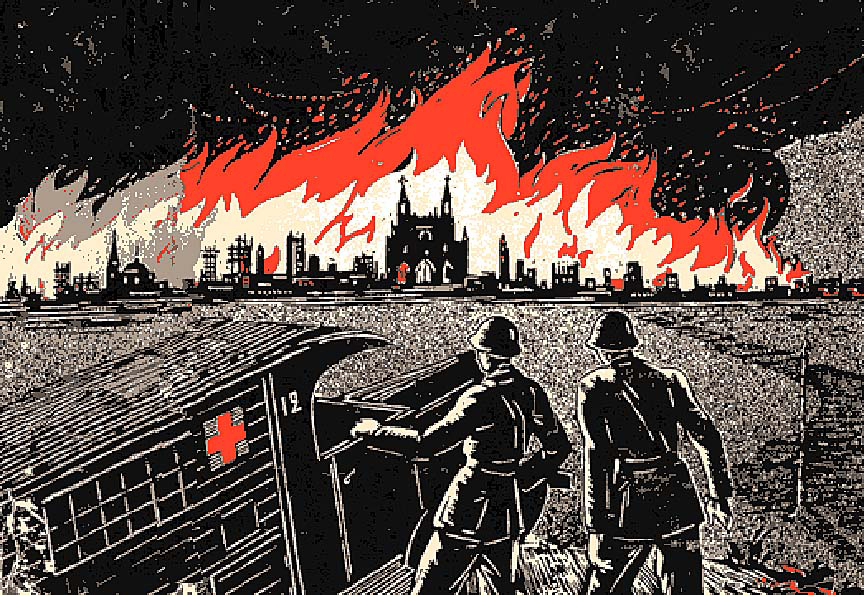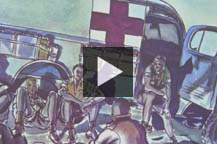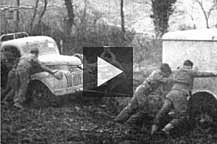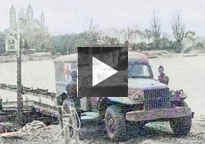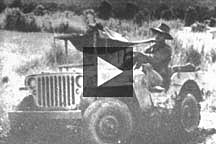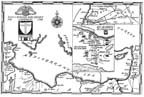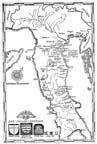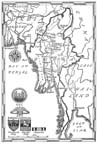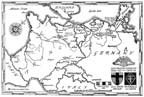
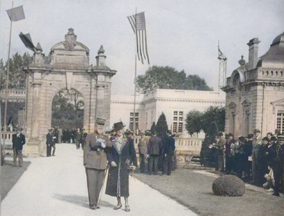
In September of 1938, AFS inaugurated the Pavilion of American Volunteers at the Museum of Franco-American Cooperation at Blérancourt. A year later, with war declared, it was time for action. Let’s do it again!” Enthusiastic efforts were made to revive the old service, with former drivers now in the role of organizers and recruiters, The first unit of AFS drivers arrived in Paris in early April of 1940. They were in the field by the third week of May, weaving through streams of refugees to serve in the badly hit Beauvais and Amiens areas. By the end of June, they were out of business, turning their vehicles over to the American Hospital of Paris.
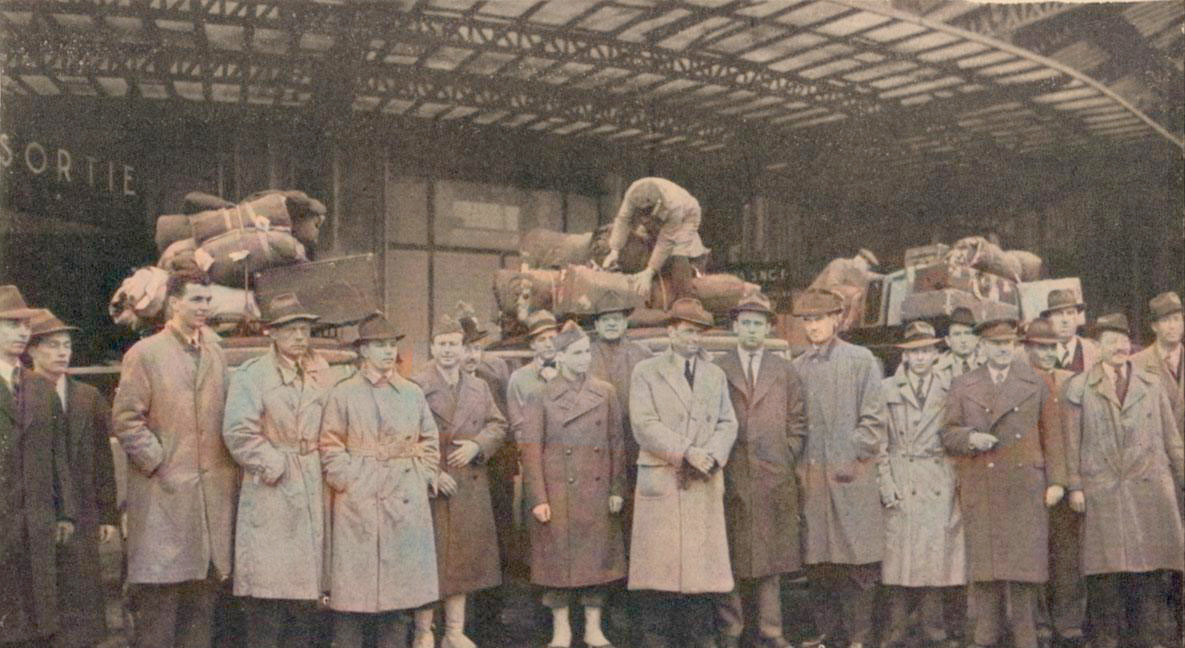
Fifty-three Americans saw active service for the A.F.S. before the French capitulation (some of those pictured here never got across). Although all are now reported safe, the story of what they did and how they came to do it is an adventure that can be written down beside that of the A.F.S. of the World War and the American Ambulance Service of 1870-71. The saga of the A.F.S. goes back to the evil times when Bismarck's Prussians were the conquering invaders. Dr. John Swinburne of New York led a score of young compatriots who galloped their horse-drawn ambulances between the front and the Paris Hospitals. (Barbara Hudnut Boston. "AFS Carries On." 1940.)
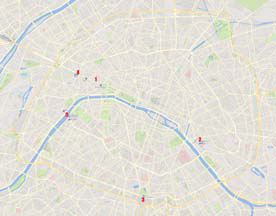
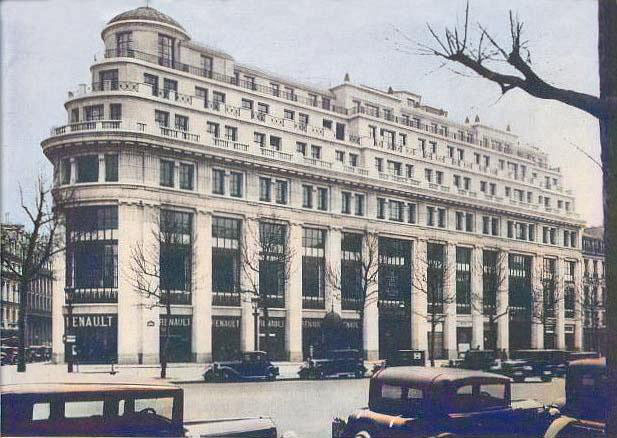
1: Office of the National City Bank,
52, avenue des Champs-ElyséesMr. Galatti requested Lovering Hill (SSU 3) to act as director in France. Reluctantly, Mr. Hill consented, with the stipulation that he be permitted to step down if, as the Service developed, someone better equipped for leadership should come forward. He first opened headquarters in his law office, moving in October to space at the National City Bank, 52, avenue des Champs Elysées, donated by Robert E. Pearce, Treasurer of the French organization. To help Mr. Hill came Mme. Renée Grimbert and Mlle. Germaine Bétourné, both members of the Paris staff during World War I (George Rock, History of the American Field Service, 1956.)
2: Gare de Lyon
The men fresh from America were met at the station at 9 AM on 3 April by French and American dignitaries, somewhat outnumbered by industrious representatives of the press and the newsreels. After breakfast at the Cité Universitaire, there was more posturing for the public eye, as harassed Mr. Hill found time to write the next day : “Dreadful scene after breakfast yesterday at 10:30 AM: Fox Movietones taken of the men with myself giving them two sentences of welcome in French and in English, long distance, close up, upside down, etc.” (George Rock , History of the American Field Service, 1956.)
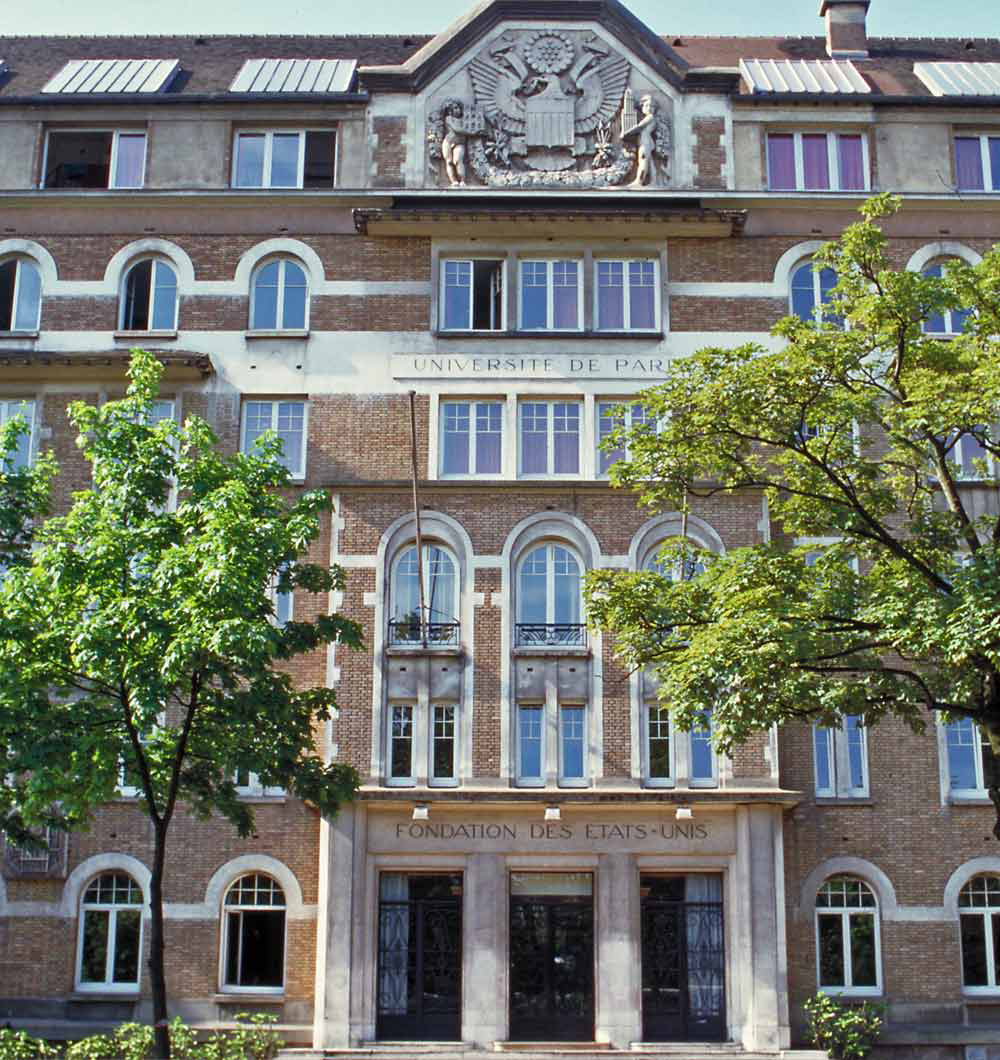
3: Cité Universitaire, United States House
In 1927 a commission headed by Senator Honnorat of France came to the Institute for advice. Associated with M. Honnorat was M. Auguste Desclos, the distinguished Assistant Director of the and an architect whose name I have forgotten. Senator Honnorat was one of the most attractive Frenchmen that ever visited the Institute---thoughtful, courteous and quick to perceive. M. Desclos was a scholar who spoke English admirably and had been a frequent visitor to our country. The commission wanted to learn as much as it could concerning the dormitory life of our colleges, including provision for lounges and recreation. Its report was to be the guide for the erection of the American House at the Cité Universitaire in Paris, of which I shall write more fully in the chapter on France. Before it started upon a circuit among our universities, I took the commission to Columbia University to visit one of the men's dormitories and to Barnard College to visit one of the women's. Miss Gildersleeve, the Dean of Barnard, accompanied us about the College. She showed us small rooms for individual students and suites containing bedrooms with a central room for study to accommodate two or more students. "I can understand the possibility of two men students living in harmony for a year," said Senator Honnorat, "but I can't conceive of that's happening with two women students." He probably learned a great deal about such matters upon his tour, for the American House at the Cité Universitaire is a splendid institution with rooms for men students and women students, some of them for two men and others for two women.(Stephen P. Duggan. A Professor at Large, 1943.)
* * * * * * *
On the first of April we moved out to United States House at the Cité Universitaire. This was to be our new headquarters, and while it was less amusing than the Odessa, it was a more dignified address. Two days later twenty-three of our volunteer drivers arrived, via Genoa, from America, and my work began in earnest. I was placed in charge of personnel, and later made leader of Section One. Donald Coster was named as second in command.
Our quarters were very comfortable. Each man had a room to himself, and there were showers with hot and cold running water. Also there was a library with an open fire. Here were installed banners of the old sections which served in World War Number One. They were stained with age and covered with decorations. Downstairs was the large refectory where we ate excellent food at a T-shaped table, the head of which was reserved for officers and guests. The building was new, and had been constructed for the use of American students in Paris. Now peace had given way to war, and students were replaced by ambulance drivers. [...]
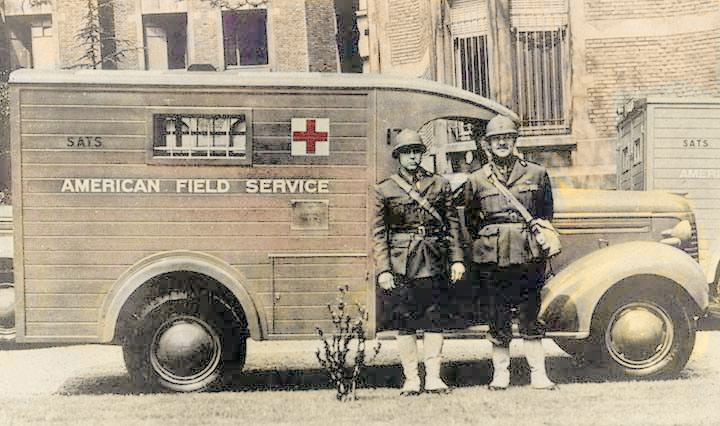
The cars began to be completed two or three at a time, and all signs of restlessness disappeared. The Section was getting nearer and nearer the front. The personnel was complete, and now the ambulances were coming in. As they were turned out by the body-builders we brought them to the Cité and parked them behind United States House. They were long, gray, sleek-looking cars, with AMERICAN FIELD SERVICE painted across their sides, and we were proud of them. The stretcher arrangements inside were most satisfactory, and we had won our point over the regulation French Army ambulance equipment by demonstrating that we could load and unload exactly three times faster than they could.
Every morning we practised loading and unloading "wounded," using drivers on the stretchers, and others to do the work. A car would dash up to a point designated as a first aid station where the "wounded" lay on stretchers, load up, swing down the road and back, to unload at the same spot, which had now become the field hospital. It was interesting work, and proved most useful when, not long after, we were thrown without preliminaries into the midst of war's flaming hell. (Peter Muir. War Without Music, 1940.)
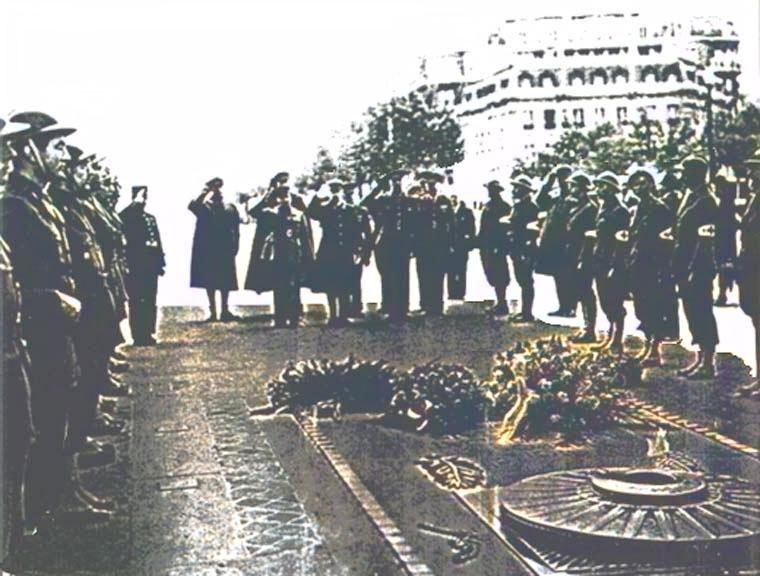
4: Ceremony at the Arch of Triumph,
7:30 AM, May 18 1940Headaches or no headaches, every man of Section One had his car lined up in numerical order in front of our quarters, and stood by ready to start, promptly at seven-fifteen on the morning of May 18. Alex Weeks had tuned up the motors and they purred silently, ready like the men to take the highroad to adventure, the difficult and uncertain road to war, where danger and hardships and even death lurked at every corner, at every turning. I have never been able to understand why men will voluntarily leave peace and quiet for the maelstrom of battle. I am always wondering why men do this, and I include myself. I fear that I shall never understand.
We rolled silently along the deserted streets of Paris, a long gray column in the dull gray light of morning. The few people who were abroad at that hour gave us a second glance, and stopped to watch us pass. Here was something new to these people who had seen so much---Americans going towards the front. Several waved tired hands at us by way of encouragement, and shouted, "Vive l'Amérique! " We in turn waved back, happy to be recognized, and answered, "Vive la France!" We felt very happy to think that at last it was going to be our privilege to serve what many of us considered the mother of civilized living and liberty---La France.
The convoy moved rapidly from the Cité to the Porte d'Orléans, across the Seine, unforgettably beautiful in the translucent half-light and mist, and up the Champs-Élysées to the Arc de Triomphe. We were punctual to the second, but our Paris staff, a few French officers and our friends were there waiting. Josette was there. We saw each other and waved. I swallowed hard and blinked to keep my emotion to myself. This was no time to show one's true feelings.
Brief commands under the huge arch where the eternal flame flickered, a moment's silence, men at attention and officers saluting, in honor of France's glorious dead, hurried farewells, and we were off. (Peter Muir. War Without Music, 1940.)
Section One received compliment after compliment from high French officials, during these distressing times, for its splendid work under continuous bombardment. And it is my proudest boast that there is not a single case where one of my men failed in his duty, not a solitary wounded or sick soldier or civilian, man, woman or child, that was not brought back by my drivers when they were instructed to do so. After the smoke of battle cleared away and the Armistice was signed. we found ourselves richer by three army citations for the Section, and eighteen individual Croix de Guerre citations for the men. In five weeks of active service our twenty cars (the two lost at Amiens had been replaced) handled the amazing number of twelve thousand five hundred sick and wounded, mostly stretcher cases. Sections during the last war rarely handled as many wounded in a year. But everything was like this in 1940---more terrible, more concentrated. (Peter Muir. War Without Music, 1940.)
* * * * * * *
"It is good to have made friends among you,
to have clasped some of your brown hands,
to have walked a little along the way with you.
Bonne chance, soldats de France"This touching epilogue was written to a history of the American Field Service in the last war. It is a heart-rending prologue to the unfinished saga of the American Field Service volunteers who drove for France in the present war until there was no more France to drive for. Since that time forty-six ambulances and surgical vans, which will be British-manned, have been donated to meet the next emergency. (Barbara Hudnut Boston. "AFS Carries On." 1940.)
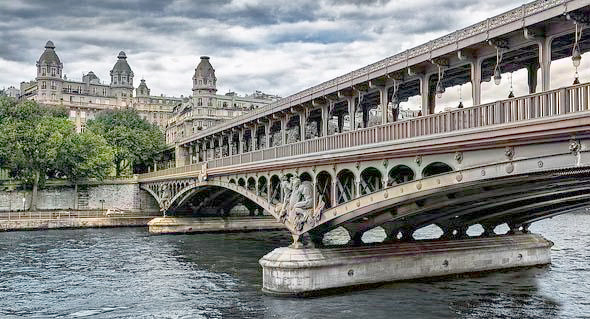
5: The Bir-Hakeim Bridge
After donating vehicles to Great Britain during the remainder of 1940, AFS took a first step towards getting its drivers back into the field. It joined the Hadfield-Spears Mobile Hospital.
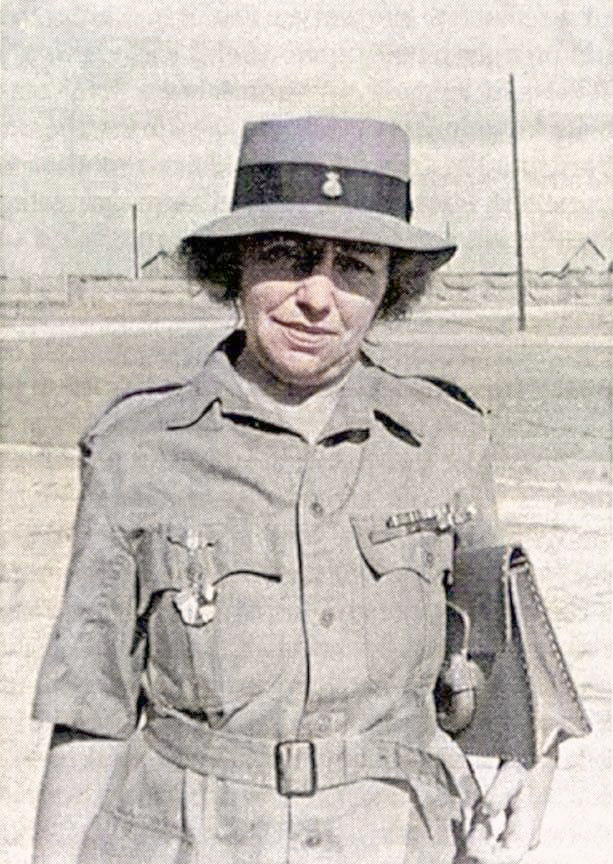
In 1915, Mrs. Mary Borden Turner had approached the American Ambulance to request drivers for her field hospital in France. In 1939, now the wife of General Edward Spears, Mrs. Spears revived her hospital which then led a parallel existence to that of the AFS unit in France. It should be noted that General Spears, Churchill’s representative in France, was the one who spirited Gen. de Gaulle to safety on June 17, 1940:
Whilst he was cogitating and reconnoitring, de Gaulle and I discussed a little act. He would behave as if he had come to see me off, and at the last moment I was to haul him on board. It was quite possible that amongst the many officers standing about there might be someone watching him, ready to prevent his leaving. [...]
We had begun to move when with hooked hands I hoisted de Gaulle on board. Courcel, more nimble, was in in a trice. The door slammed. I just had time to see the gaping face of the chauffeur and one or two more beside him. Gingerly we taxied till the pilot found the space he had located, then with great skill, in a very short distance, he took off. I opened a local paper. It contained a eulogistic article concerning de Gaulle. The subject of the article, on the other side of the gangway, looked straight before him. Churchill, no bad judge in such matters, has written that he "carried with him, in this small aeroplane, the honour of France." (Edward Spears. Two Men who Saved France: Pétain and de Gaulle, 1966.)
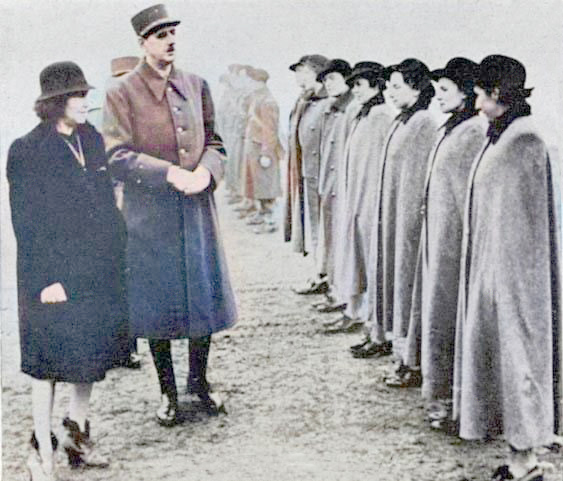
Now, in the spring of 1941, Mrs. Spears was ready to bring her hospital back in action, serving the Free French unit attached to the British Army. She needed drivers. AFS provided them and the results were twofold: first, while the “wild young millionaires from New York” proved to be incompatible with Mrs. Spears’ “mild British conscientious objectors”, the AFS presence in North Africa led to its adoption by the British Army; second, the American drop-outs from the Hadfield-Spears unit formed the nucleus of a small unit which would continue to serve the Free French, alongside the Hadfield-Spears.
It was this unit which was at Bir Hakeim.
AFS units serving with the British Forces are set up according to the British Army ambulance car company method; with our men being given the courtesy ranks of corresponding British officers. AFS has two ambulance car companies, one in Syria and one in the Western Desert. [...]
The AFS picture in service with the gallant Fighting French is somewhat different. The ambulance section with the Fighting French had an able leader in Alan Stuyvesant, who was captured by the Germans at Bir Hacheim. He came out to the Middle Fast a year before we did, and with a small group of volunteers, all of whom had sailed too late to serve in the Battle of France, served the Fighting French through the 1941 Syrian campaign and remained on. (Benefit Exhibition for the American Field Service, 1942.)
The fortress
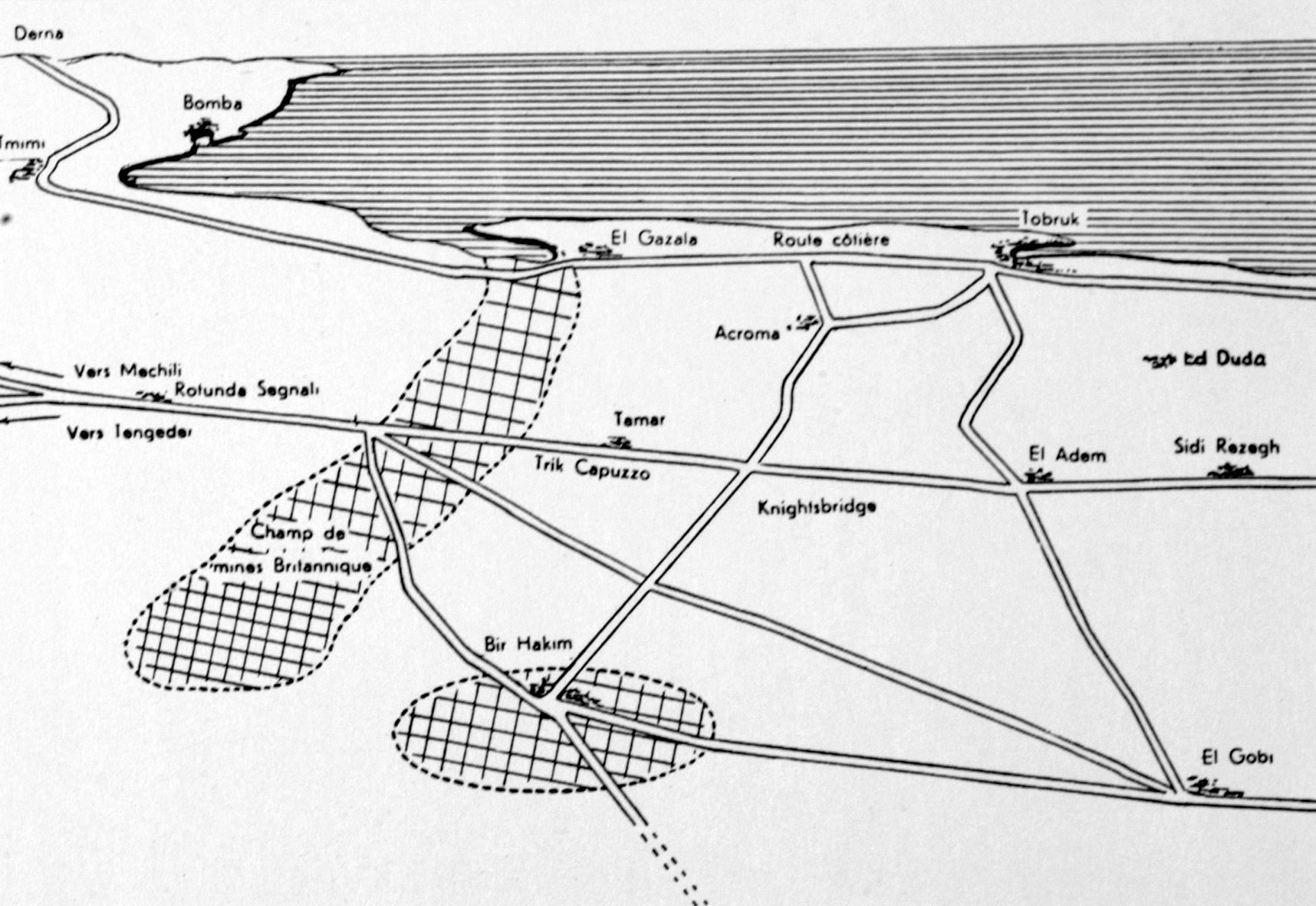
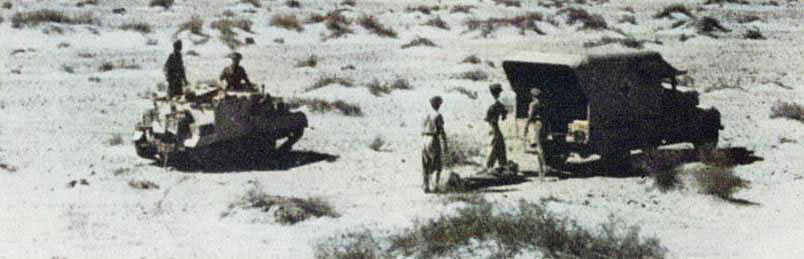
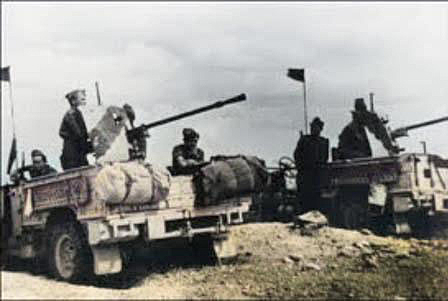
Bir Hakim was no more than a slight elevation in the vast desert. Once a small fort used for patrols against desert marauders, it was now an area of 2 to 4 square miles, heavily mined along its perimeter, containing gun and antiaircraft emplacements, an operating theatre and tents, Bren carriers, and trenches and dugouts for the 3,000 French troops plus legionnaires, British gunners, and Senegalese soldiers. With the French were 12 Field Service ambulances, widely dispersed, each with its slit trench. The AFS headquarters was in a Red Cross tent on the south side, just inside the minefield, a short distance from the operating theatre of the Hadfield-Spears Mobile Hospital.
The American Field Service unit with the Free French Forces had had 18 cars and 3 men (A.R. Stuyvesant, C. N. Jefferys, and LeClair Smith) since it had joined the French forces in July 1941. At the beginning of 1942 they had moved from their Syrian post to the Western Desert, where they worked 3 or 4 miles behind the lines, using members of the Foreign Legion to drive some of the cars, other cars being kept back as a reserve. (George Rock, History of the American Field Service, 1956.)
But Bir Hakim camp was most invigorating of all. And that to me was very important. For in Bir Hakim I found again the old spirit of the French Army of 1914-1918. Was it Koenig's doing? De Larminat's? Or was it that the handful of men who had cut themselves off from their nation were at last free, and had come in sight of their goal? They had fought their compatriots in Syria and gnashed their teeth, some had fought the Italians in Eritrea, now after months of waiting they were going to fight the enemy who had marched on Paris and turned a marshal of France into a coward. They were still only a handful of men, and at that a motley collection. Two battalions of the Foreign Legion, one regiment of Marines (Fusiliers Marins), one battalion of marine infantry, spahis, North Africans, blacks from the Pacific; but there was a spirit in them that made them alike and not like the men we had met in Lorraine. These men were tough, they were hard, they were aching for a fight and would know how to take punishment. They were like the poilus of 1914. (Mary Borden. Journey Down a Blind Alley, 1946.)
The battle
Rommel had started his attacks against Bir Hakeim on June 6, and they continued with growing intensity despite the valiant resistance of Koenig's First Free French Brigade. So grave did the situation there become that by nightfall on the 8th it was apparent that unless immediate outside support were given to the French garrison, it could not hold out. When a further two days had passed, the Army Commander ordered Koenig to evacuate Bir Hakeim. And the Free French were withdrawn during the night of June 10, escorted by Messervy's Seventh Armoured Division. (Antony Brett-James. Ball of Fire. 1951.)
It was the turn of Bir Hacheim. This fortress, once the left flank peg of the Gazala defences, was the last impediment to Rommel's resumed drive on Tobruk. For ten days under fierce attack, it now was assaulted by a major part of the Panzerarmee and the Luftwaffe. Once Bir Hacheim fell, Rommel would be able to roll up the Gazala line as far as Knightsbridge; Eighth Army would have to form a front parallel to its communications. Rommel therefore pushed on the attack in person. [...]
Meanwhile the men of the Free French garrison continued a magnificent but futile resistance. General Koenig, the garrison commander, however, was so much in favour of evacuation that he refused to accept supplies. While the German attack grew closer and closer to the web of foxholes, barbed wire and mines, and the French soldiers, stunned by endless bombardment and lack of sleep, fought on, the indecision continued. Koenig pleaded that he had no water or ammunition; finally Ritchie ordered the garrison to break out on the night of 10th/ 11th June. (Correlli Barnett. The Desert Generals, 1960.)
8 June was a grim but triumphant day for the Free French. The Luftwaffe reopened its attacks using over 100 aircraft, and the German artillery provided 90th Light's infantry with effective support. French resistance did not falter, but by dusk Koenig was forced to report his men were nearing exhaustion and eating their reserve rations. Ritchie issued a warning order to prepare for evacuation. Rommel, on his side, summoned 15th Panzer Division less its panzer regiment to reinforce 90th Light and ordered a new assault for 10 June. The air and artillery preparation for this assault went on during 9 June. 7th Motor and 29th Indian Brigade Groups forced 90th Light to turn and face them, relieving some of the pressure, but the German assault on 10 June, which was supported by Axis aircraft dropping about 130 tons of bombs, resulted in one German assault group gaining a foothold in the French positions. Ritchie authorised the evacuation that night. 7th Motor Brigade Group ran a large convoy of trucks to within five miles of the western perimeter of Koenig's Box ready for the break-out. 2,700 out of 3,000 Frenchmen reached safety, having created an epic which did much to re-establish the tarnished reputation of French soldiers. Koenig had bought precious time for Ritchie to regain the initiative, which he and Auchinleck talked about so much in their letters to each other, but proved so singularly incapable of achieving.( W.G.F. Jackson. The Battle for North Africa, 1975.)
AFS
The French decided to evacuate Bir Hacheim, and on the evening of June 10th, the four remaining AFS cars took their position in the line, to go through the opening in the deep Hacheim mine fields. This gap consists of a zigzag passage flanked with loose coils of barbed wire, about five hundred yards in length, and fifteen (at the widest points) in width. Jim Worden's ambulance was in the lead, followed by Tichenor, Semple, Kulak and McElwain in one car, with Stratton in the rear.
Because of the darkness and the uncertainty of the passage, progress was very slow; and the line was only just starting to leave camp when it was spotted by the Germans, who were entrenched on both sides of the exit from the mine fields. Instantly the whole scene was lit up by star shells, as they started to pour a murderous barrage of machine gun, rifle and light cannon fire into the long line of vehicles and foot soldiers. Semple's car became entangled in the barbed wire and despite his efforts it was impossible to disentangle it. (AFS Letters No. 6.)
* * * * * * *
Then our convoy started up again, and the fireworks began. They were shooting 20 m.m. Bredas from both sides of us, and from in front, so we drove through streams of fire. Anyhow, they were incendiary and tracer bullets, which was something, for you could see them coming. You could see the Bofors shells, too, flying low overhead. The grenades and trench mortars, the 50 m.m. canon shells, all burst with a noise and a flash, but they came blackly. It is horrible to be towed, and to have no control of your vehicle, but it happened too quickly for me to be afraid, just very busy. But I must have been terrified when the ambulance burst into flames, and I found that I couldn't walk or use my left arm and hand. Later on I counted thirty-five holes in me, and that doesn't include the pinheads. But I was very lucky, for the fragments had to go through the sheet metal wall between the motor and the driver's seat. (AFS News Bulletin No. 2.)
The aftermath
The story of the sortie from Bir Hakim came to us in fragments. It was brought by the wounded, by the men who had followed Koenig down the narrow lane between the wire and fought their way through the German lines with hand grenades and bayonets, to fall and be picked up in the lurid confusion and loaded pell-mell into ambulances, trucks, anything that was handy. We had it from excited mouths that were twisted with pain, it came in gurgles as the blood spurted, in soft whispers and savage ejaculation and it sounded through the ether masks of the theater; it was a story of triumph. [...]
I have become too accustomed to surgical wards filled with battle casualties to be easily moved; the visits of commanding officers have ceased to be events in our hospital life. But this was different from anything I had seen; this was not the visit of condolence of a general to men who had been sacrificed; it was a celebration. It was a meeting of friends who had waited a long time for the test that was to prove to them that they were what they claimed to be; now they had come through the test and had won the right to be called the fighting men of France. My eyes were wet as I watched the carnival of General Koenig with his wounded men. (Mary Borden. Journey Down a Blind Alley, 1946.)
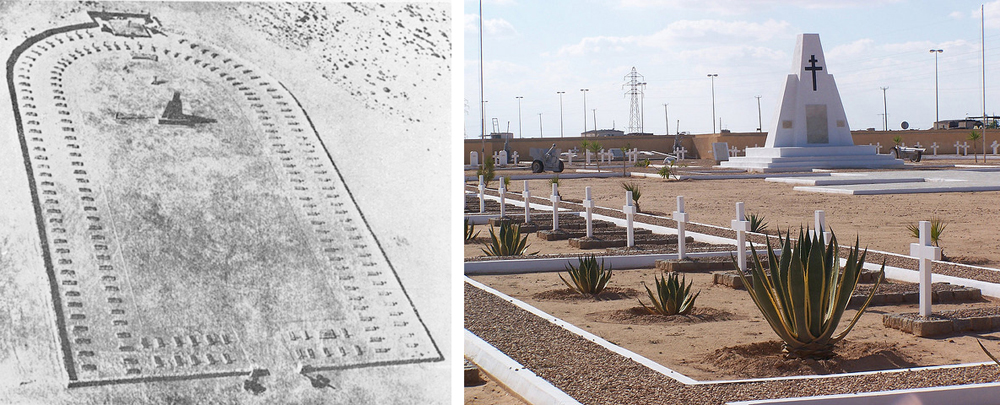
Memorial at Bir Hakeim
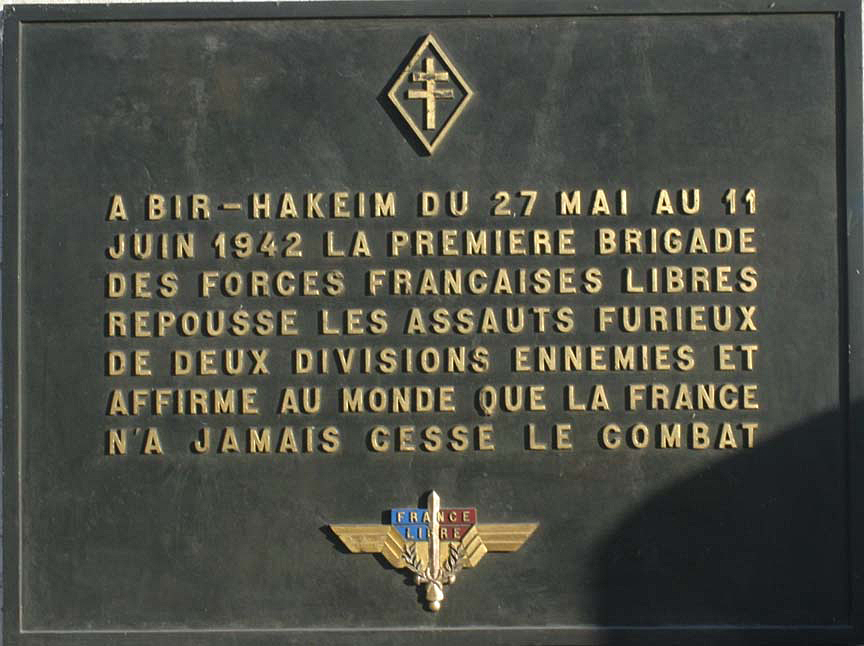
In the action at Bir Hakim, the American Field Service suffered 100% casualties to men and materials. Of 12 cars, 12 were lost. Of the 6 men, 2 were captured (one of them wounded), 2 were killed, and the 2 who managed to get away were both wounded. General Charles de Gaulle wrote of this record as "témoignant de l'actif dévouement avec lequel l'American Field Service s'est dépensé pour la France Combattante. . . . La France n'oubliera pas ses amis d'Amérique qui ont fait volontairement pour elle le sacrifice de leur vie."(George Rock, History of the American Field Service, 1956.)
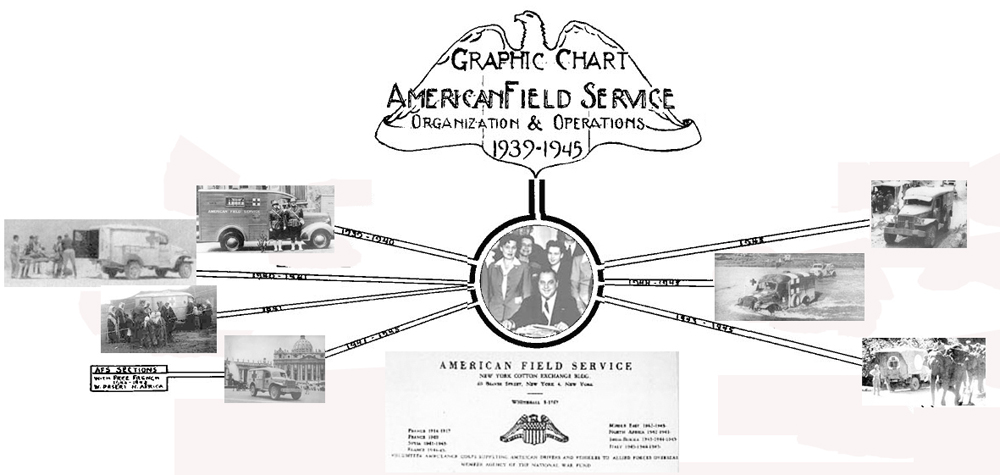
For a full appreciation of AFS’s work in WW2, to the name of Bir Hakeim must be added those of Knightsbridge,Tobruk, Mingar Quaim, El Alamein, Tripoli, Mareth Line, Enfidaville, Tunis, Cap Bon in North Africa; Termoli, Volturno, Garigliano, Sangro, Ortona, Anzio, Cassino, Gustav Line, Arezzo, Arno, Gothic Line, Serrio, Bologna in Italy; Tiddim, Kalewa, Shwebo, Meiktila, Mandalay, Pegu, Prome, Rangoon in Burma; and in the return to France, Vosges, Colmar, Lauter, Rhine, Black Forest, Stuttgart, Constance, Vorarlberg, Arlberg...
North Africa and Middle East
Italy
India-Burma
Return to France
Chapter Six
Table of Contents