|
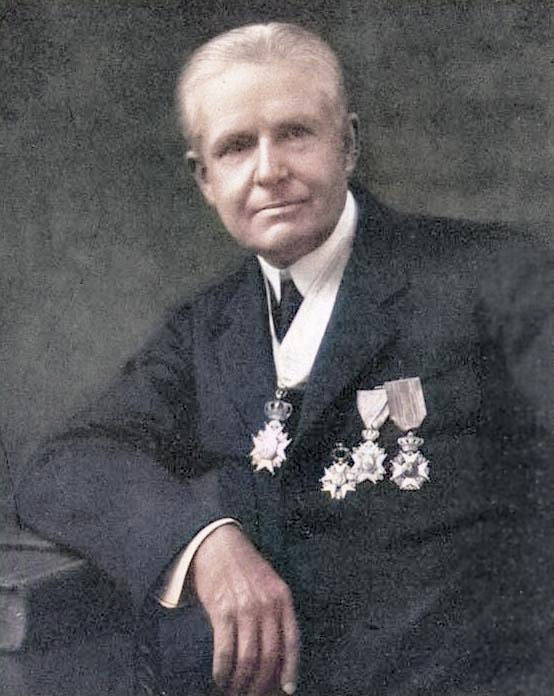
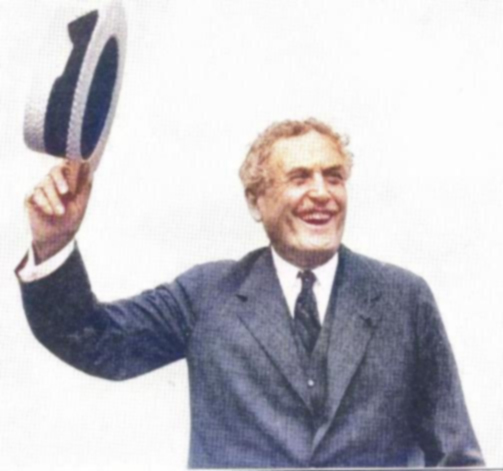
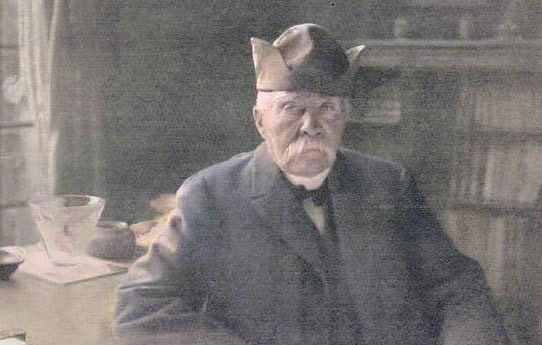
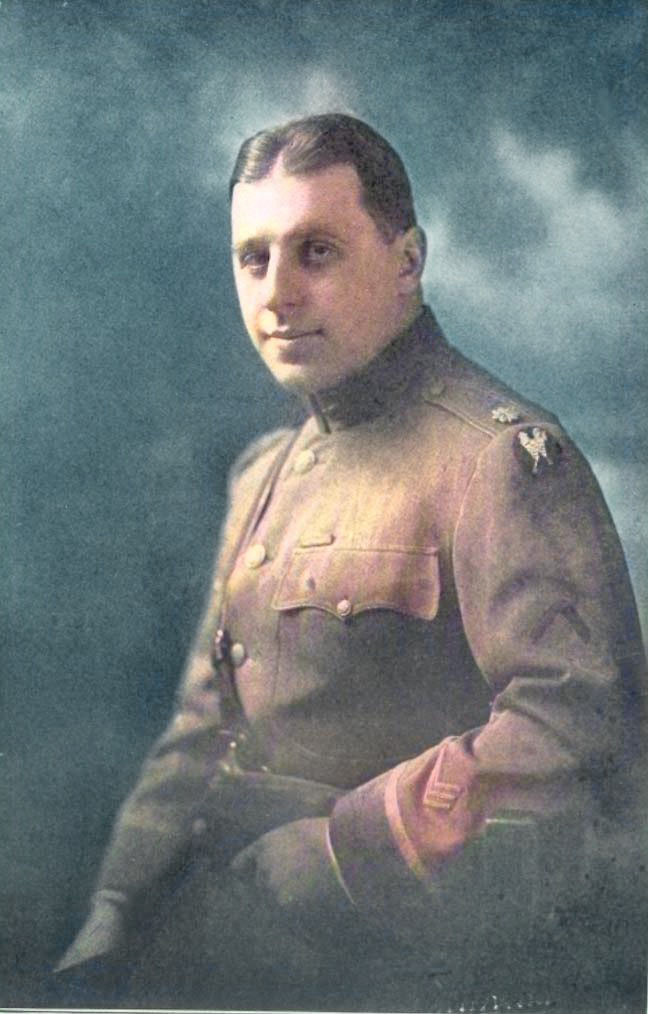
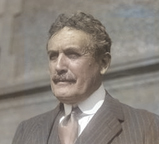
| With the outbreak of war, Ambassador Myron T. Herrick’s return home was postponed. He wasted no time in mobilizing the prime movers of the American Colony. |
metro; RER C, Gare des Invalides
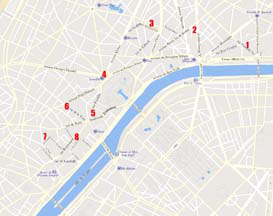
1: Rue François Premier
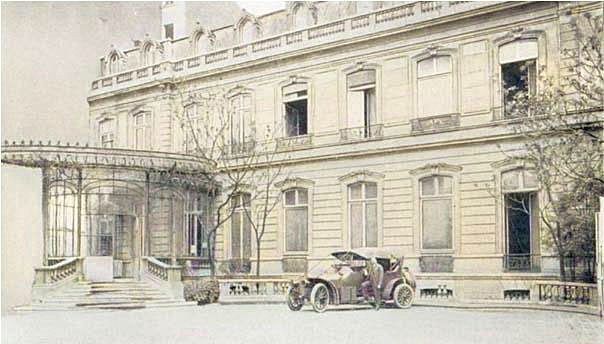
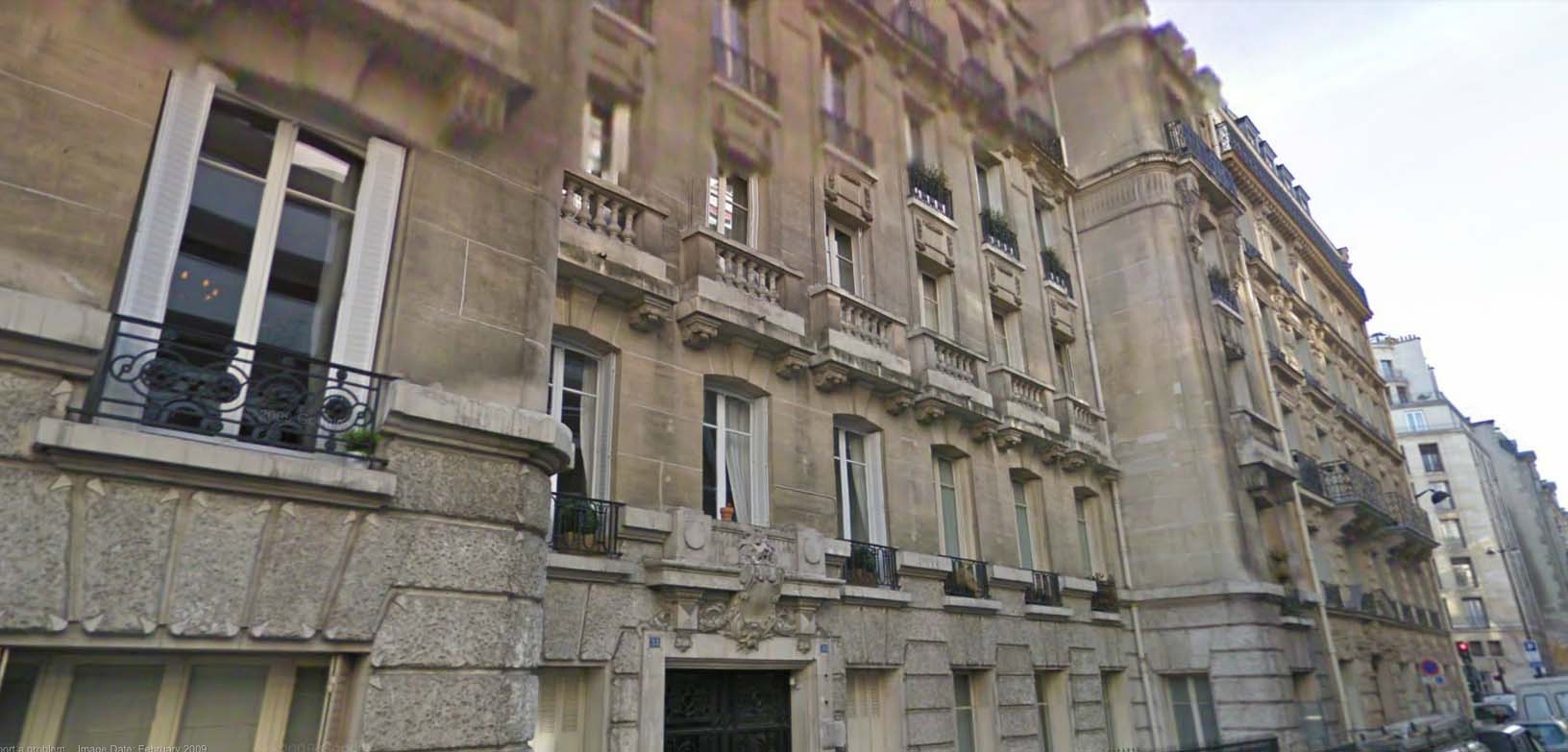
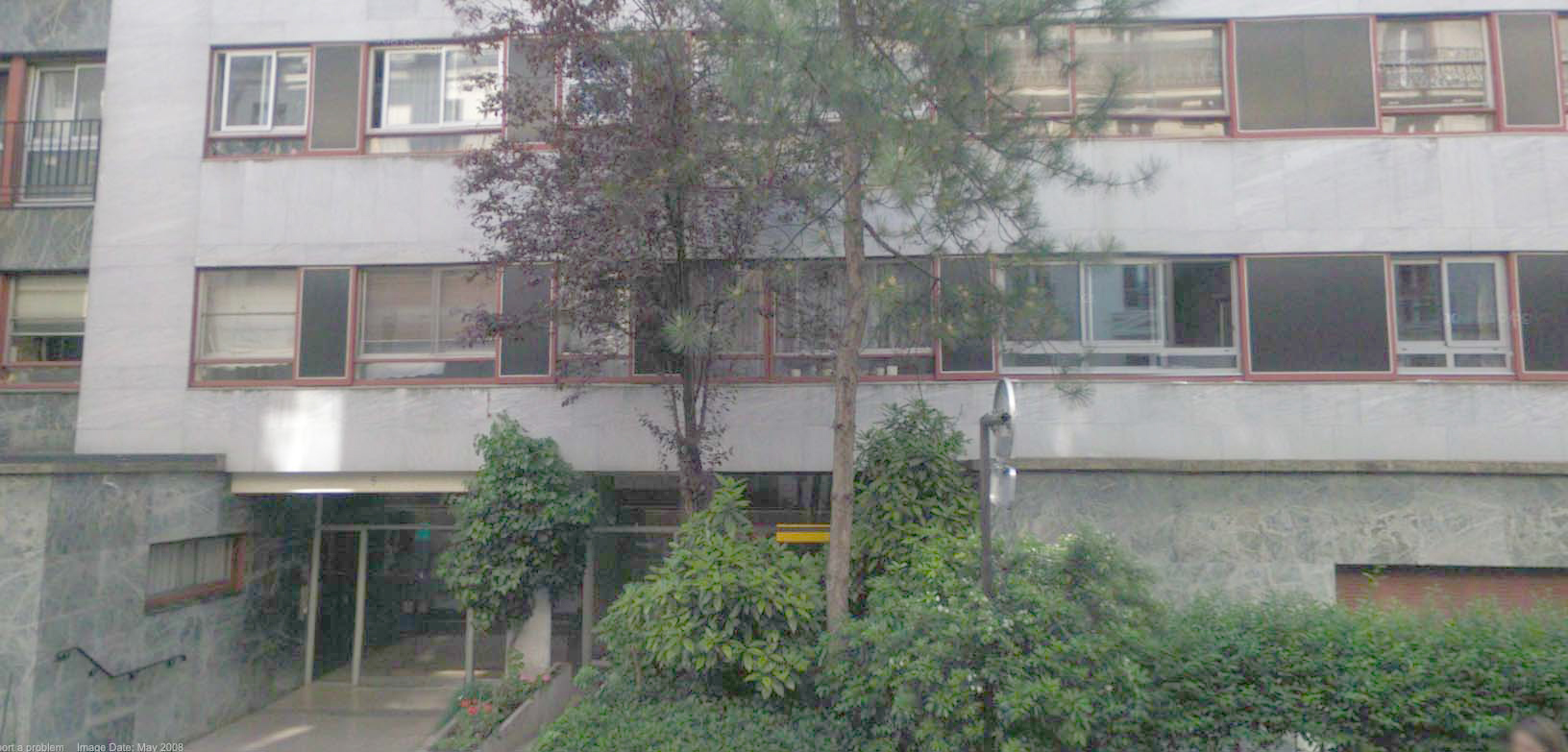
American Embassy, 5 rue François Premier (original building has been replaced)
Former hôtel of Mme. Ridgway, which was the residence of the United States Embassy from 1907 to 1914. President Theodore Roosevelt stopped here in 1910, from the 21st to the 28th of April, during the short stay which he made in Paris.(François Boucher, American Footprints in Paris, 1921.)
* * * * * * *
Later, at the American Embassy, Number 5 Rue Francois Premier, I found Ambassador Herrick arranging for a sort of relief committee of Americans to aid and regulate the situation of our stranded countrymen and women here. There are about three thousand who want to get home, but who are unable to obtain money on their letters of credit; if they have money, they are unable to find trains, or passenger space on westward bound liners. Mr. Herrick showed me a cablegram from the State Department at Washington instructing him to remain at his post until his successor, Mr. Sharp, can reach Paris. (Charles I. Barnard. Paris War Days, 1914.)
American Relief Clearing House, 5 rue François Premier
Mr. Herrick opined that the most effective safeguard and collaborator in the relief movement would be an institution corresponding in charitable work to a "clearing house " in banking. And he proposed the creation of a "clearing house" for relief material. He even recommended that it be called the "Clearing House," for he had thought out every detail of his project, down to the title of the organization. […] Offices were established at 5, Rue François I, vacated by the American Embassy. (Percy Mitchell. The American Relief Clearing House, 1922.)
* * * * * * *
Was, during the war, the headquarters of the "American Relief Clearing House" founded by Myron T. Herrick to co-ordinate the efforts of the charitable associations of the United States; this work forwarded to their intended possessors the innumerable gifts of American generosity, being, from November 1914 to June 1917: 150,000 cases, 12 millions in cash, and 86 millions in provisions of all sorts. In 1917 it forwarded its accounts to the American Red Cross directly the United States joined the war. (François Boucher, American Footprints in Paris, 1921.)
Having been replaced by Wilson-appointee William Sharp, who moved the embassy to Rue Eylau, Myron T. Herrick returned to America, sailing from Bordeaux on November 28th.
American Red Cross HQ, 7 rue François Premier
Arriving in Paris we went straight to headquarters, No. 7 Rue Francois Premier, French Headquarters of the American Red Cross in Paris. There we signed up for voluntary service with the French Army, and then started out to complete our equipment and obtain uniforms. Four glorious days followed, for Paris is great, even in war times, and we realized that we would not get back there for at least six months. (Edward R. Coyle. Ambulancing on the French Front, 1918.)
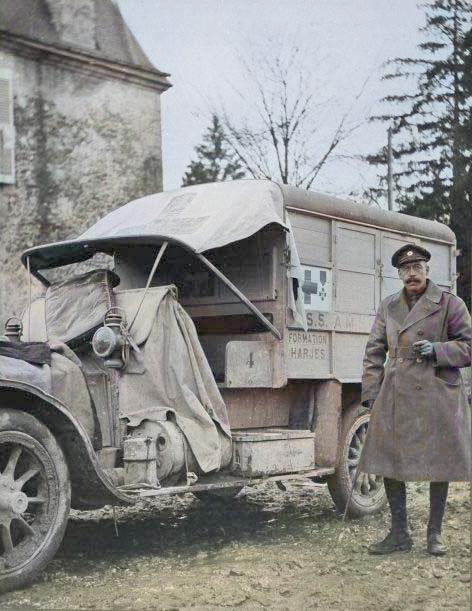
Herman H. Harjes
Morgan-Harjes, 7 rue François Premier
Mr. Bacon introduced me to Dr. De Bouchet, the head of the Ambulance, and Dr. Gross, the chief medical man. They told me that they would put me in the Ambulance Corps if I wanted to come. They are about to take on five more Ford Ambulances, to operate from various bases, twenty miles or so from Paris. This is more like the work I have been wishing to do. Another proposition, which seems even better, Mr. Bacon spoke of to-day: It seems that there is being organized at this moment, an ambulance service to operate in direct conjunction with the British and French armies in the field. This is being run by Mr. Harjes, of Morgan, Harjes & Co. Of course, it is exactly what I want and Mr. Bacon will get me into it, if he can. (Edward D. Toland. The Aftermath of Battle. 1916.)
American Volunteer Motor Ambulance Corps, originally headquartered in London, under the auspices of the British St. John's Ambulance.
The idea of the admirable enterprise was suggested to Mr. Norton when, early in the course of the War, he saw at the American Hospital at Neuilly scores of cases of French and British wounded whose lives were lost or who must incur life-long disability and suffering, through the long delay of their removal from the field of battle. (Henry James, "The American Volunteer Motor-Ambulance Corps in France,” 1918.)
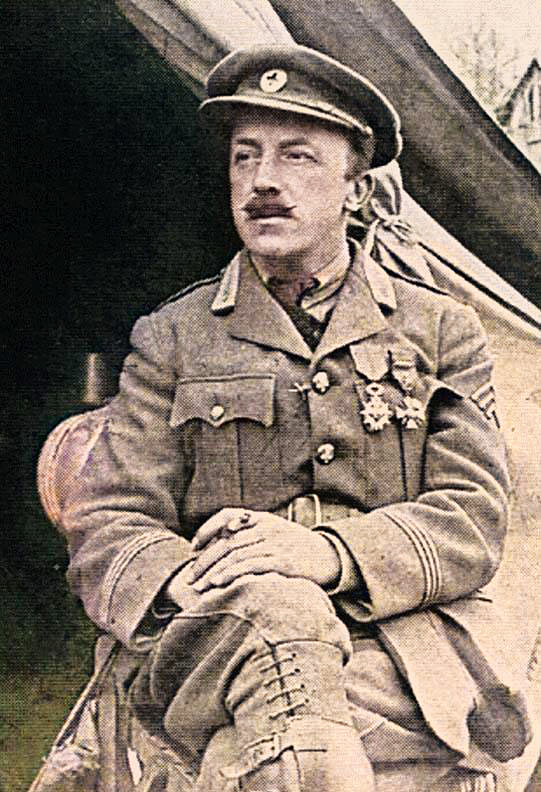
Richard Norton
The foremost figure among the scores of American university men who, in 1914, 1915, and 1916, gave their services to the ambulance corps in France, Belgium, and the Near East, was Richard Norton. Graduated at Harvard in 1892, the son of Professor Charles Eliot Norton, he had become an archeologist of note, and for eight years was director of the American School of Classical Studies at Rome. The Great War summoned him from these scholastic pursuits into active field-work in behalf of humanity; and his response to this summons was immediate. Soon after the war began he went to London and organized the American Volunteer Motor-Ambulance Corps. By October, 1914, ten of his ambulances were at work, at first under the auspices of the British Red Cross and the St. John Ambulance, the drivers being recent graduates of American colleges. (Edwin W. Morse. The Vanguard of American Volunteers, 1919.)
Norton-Harjes Units
Wartime Paris was new to Dos Passos. The City of Lights was dark and quiet when the ambulance men detrained at the little station on the Quai d'Orsay. He felt as though he was walking into the pages of a mystery novel when he stepped through black felt blackout curtains to enter the hotel assigned to the Norton-Harjes men. Early the next morning they reported to headquarters at 7 rue François Premier for swearing-in ceremonies led by H. Herman Harjes, the French banker who had donated thousands of dollars and many ambulances to provide French war relief. The millionaire banker had agreed to pool his efforts with Richard Norton, who launched the American Ambulance Corps in 1914 with two cars and four drivers. By the time Dos Passos enlisted with the Norton-Harjes, the service had grown to thirteen sections comprised of six hundred American volunteer drivers and three hundred ambulances." (Virginia Spencer Carr, Dos Passos, 1984.)
Samuel N. Watson
2: Church of the Holy Trinity, American Pro-Cathedral,
23 avenue George VIt was in August that I pinned the badge of the Ambulance on my husband's sleeve: a white band, with a red cross, the letters A. A. and the seal of the Military Government of Paris. [...]
On August 29th, 1914, the first General Order for the Ambulance was issued and this order was signed by Samuel N. Watson as Chairman of the Executive Board of the Ambulance Committee. September 14th, 1914, the first report was sent out. The linen for the hospital had been made up in the Ouvroir at the American Church. (Jeannette Grace Watson. Our Sentry Go, 1924.)
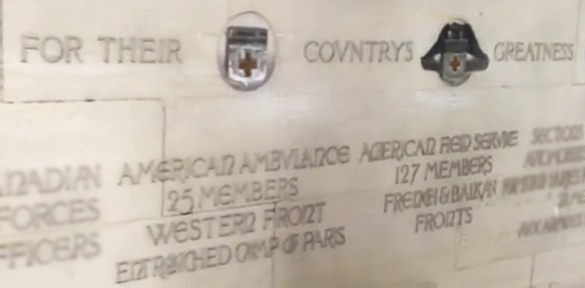
On 30 May 1923, a Memorial Wall in the church's cloister was inaugurated in honor of Americans who served in France in WWI. Present were President Poincaré, Marshal Foch, Ambassador Herrick.... An emblem on the wall represents AFS.
3: Place des Etats-Unis
Myron T. HerrickThis bust of the popular American ambassador, sculpted by Léon-Ernest Drivier, was inaugurated on February 12, 1937. Herrick had been at the heart of organizing American relief efforts at the beginning of WWI, notably, the creation of the American Ambulance. In 1919, he was instrumental in uniting two groups: the American Field Service Association and the Society for American Fellowships in French Universities, resulting in the creation of the AFS French Fellowships.
General Pershing has declared "Mr. Herrick was our first volunteer." Among the noble company of young Americans who followed his example many were killed in battle, and the memory of them all is honored in France as we honor that of Lafayette and Rochambeau. A beautiful monument commemorating their deeds stands in the Place des États-Unis, and every Fourth of July officials from all the departments of the French government assemble there and pay them grateful homage. (Col. T. Bentley Mott. Myron T. Herrick. Friend of France, 1929.)
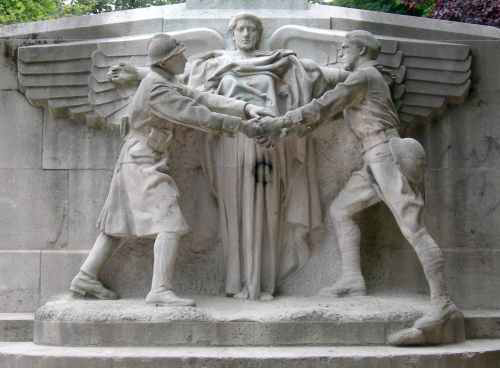
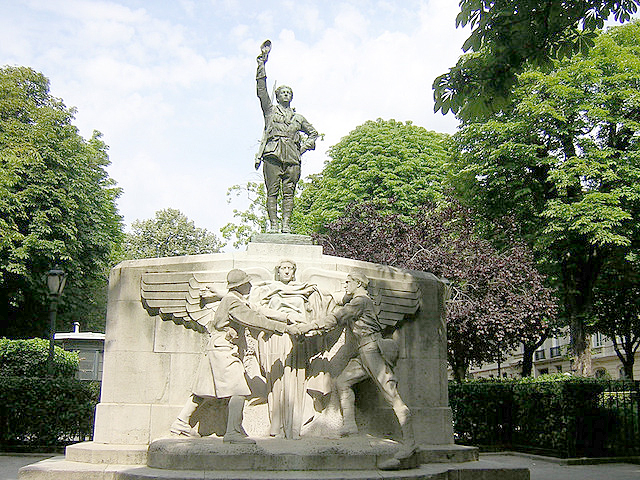
Memorial to the American Volunteers
On 4 July 1923, President Poincaré dedicated this monument--- in the form of a bronze statue on a plinth--- to the Americans who had volunteered to fight in World War I in the service of France. The sculptor, Jean Boucher, had used a photograph of soldier and poet, Alan Seeger, as his inspiration. On either side of the base of the statue, are two excerpts from Seeger's "Ode in Memory of the American Volunteers Fallen for France."
In 1923, at the Fourth of July dedication in Paris of the monument to the American volunteers who lost their lives in the service of France before our country had entered the war, we were represented by a group of Field Service men, with Alan Muhr, in uniform, carrying the S. S. U. 1 banner. Archibald Dudgeon, who kindly took the banner to France for us for this purpose, reported: "Altogether we felt that the whole affair was one of the most dignified, beautiful and impressive that we had ever seen. Section 1 flag has added to its history and fame. It stood out well and clearly marked the presence of members of the American, Field Service." (Bulletin of the AFS Association, May 1926.)
It might be noted that a memorial to the volunteers of the Lafayette Flying Corps (of whom many had first been AFS drivers) was inaugurated on July 4, 1928, in Marnes-la-Coquette, while a fountain in the memory of American Field Service volunteers was dedicated at Place Duroc, in Pont-à-Mousson, on September 27, 1931.
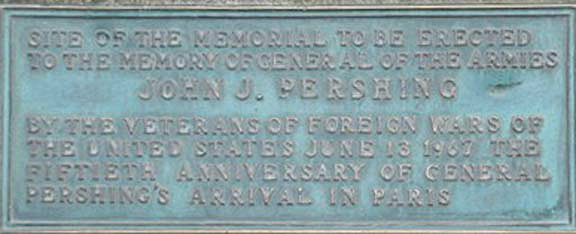
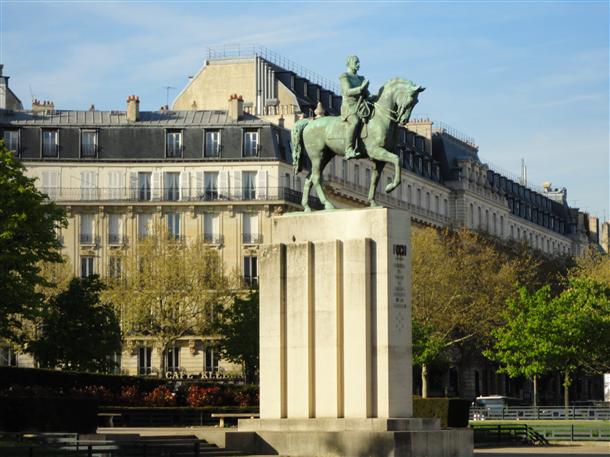
John Pershing
If many would-be historians credit the American Expeditionary Force for winning the war single-handedly in 1918, the French themselves are more circumspect---- witness this homage consisting of a pedestal without a statue.
For many years, the American general’s name was nonetheless celebrated at Pershing Hall, 49 rue Pierre Charron, where a large number of American organizations, beginning with American Legion Post #1, took up residence. This all changed when the US Department of Veterans Affairs, the owner, reevaluated its income from this prime piece of real estate. It then closed the building for renovations in 1992 (many historical objects being confided to the Museum of Blérancourt) and Pershing Hall was transformed into a luxury hotel.
4: Maréchal Foch,
place du Trocadéro et du 11 Novembre
Behind and to the west of the statue, the retaining wall of the Passy cemetery is adorned with a bas-relief in honor of the soldiers of the Great War. The statue of Foch evokes another : that of the Clearing of Rethondes, near Compiègne, where the Armistice was signed on November 11, 1918. (There is a little museum there worth visiting on your way from Paris to the Museum of Blérancourt.)Before the war Foch was well known as a professor in the military school at St. Cyr and his writings are standard works on military subjects. As Joffre's right-hand man he is recognized as the greatest strategist of the French Army. At the battle of the Marne General Foch commanded the Ninth army, and it was at the marshes of St. Gond that he executed his famous maneuver and sent his celebrated message: "My left is broken, my right is routed, therefore I will attack with the center."
We came very near having the distinguished general for a patient at one time. A hurry call was sent for an ambulance to go to an accident on the road not far from Meaux. When our ambulance arrived there they found a fine Rolls-Royce car badly damaged by a collision with a stout elm tree. The passengers were no less than the famous General Foch and his son-in-law. They were both injured but, as it turned out, not seriously. Traveling along the narrow road lined with trees, at a rapid rate, it had been a question of going into a tree or smashing into a peasant's cart containing some women and children, and the chauffeur chose the former. (James R. Judd. With the American Ambulance in France, 1919.)
5: Clemenceau Museum,
8 rue Franklin
So I finally got up my nerve and, in my beautiful French, tried to ask for a little bread, whereupon I was immediately invited to come in and have a regular meal. The lady in charge, who had the Croix de Guerre with the palm leaf, went to a lot of trouble for us and we had quite a feast --- beef, ham, bread and butter (a luxury), jelly, nuts, cheese, and figs. We were informed later that what was done for us was quite irregular, "though done for us with pleasure." The lady, who spoke English, said her mother was an American. When "Redpants" came up for us, he was overawed and must have thought us very, very big guns, for afterwards we learned that the lady with the Croix de Guerre, who had so kindly entertained us, was no other than the daughter of M. Clemenceau, the former Prime Minister of France! (History of the American Field Service in France. 1920)
* * * * * * *
One day when we were leaving the Field Service Headquarters in the rue Raynouard we saw a small Citroen car drive out of the rue Franklin and turn at the corner. A man stepped out of the vespasian and with a revolver fired a couple of shots into the back of the car. The driver turned round and raced down the rue Franklin as the assailant ran down a side street. We ran after the car and saw the driver helping out an old man who was slapping himself on the back and feeling of his chest. This old man was Premier Clemenceau, and he gave a laughing snort and declared as he was taken into the house: "Cette fois ils m'ont ratée." But he had a bullet in his back, and though he was not seriously wounded, the ball was never extracted. (Lansing Warren. Ambulancier, 1978.)
* * * * * * *
To every Field Service man the Rue Franklin brings to mind not only that great American who was our first Ambassador in France, but also,---and perhaps more vividly because the days of our own ambassadorship in France were so vivid as to temporarily obliterate completed history,---that great Frenchman whose home we so often passed. How incredible would it have appeared to us then could we have known that but a few years later, Georges Clemenceau, no longer Premier, would come to America as an unofficial spokesman for his country, and that his visit would bring to us, as a peace-time organization, the distinction of his endorsement, together with material aid for the furtherance of our purpose to commemorate those of our members who were not to survive the war! [...]
Coincident with the "Tiger's" arrival in this country, Robert A. Donaldson, S. S. U. 70, had telegraphed from California the suggestion that inasmuch as the proceeds of the tour were to be used in some way for the promotion of understanding between France and America, an effort be made to secure these proceeds for our Fellowship endowment. Acting upon this suggestion, Colonel Andrew, at Washington, put the matter before M. Clemenceau, and explained to him our hope in regard to the Field Service Memorial Fellowships. Although very many Franco-American organizations had requested for the carrying on of their work the funds resulting from his American lectures, M. Clemenceau decided to make us his sole beneficiary, and gave the reason for this decision in the following telegram sent from Philadelphia a day or two later:
"In memory of my student years in America I hope you will permit me to contribute the proceeds of my lectures to your fund for sending American boys to France and bringing our students here." (AFS Association Bulletin, January 1923.)
6: 35 rue de la Tour
In addition to the accommodations for men at "21" itself, and the Châlet, new accommodations were opened up in an apartment at 35 rue de la Tour. The living rooms were once more crowded. The dining room accommodated a hundred and fifty men each meal. After lunch in the sunshine of the wonderful April days you found them seated out on the terrace enjoying the view of the fine old garden, the silvery water of the Seine below and, in the distance, the sweeping outlines of the Tour Eiffel ; or at night watching the lights of Paris, seeming so stranger after these long days of war, shimmer in long streaks across the dark water. (AFS Bulletin April 1919.)
7: 5 rue Lekain
It seemed only necessary, however, to hunt somewhere in the spacious house and grounds, and new resources could always be found to solve the housing problems as they arose. These proved adequate for the Service, but with the extraordinary development in the spring of 1917, it was decided that, for the comfort of the permissionnaires, outside help must be sought. Again our generous donors came to the rescue and the accommodations for men returning from the front were transferred to the near-by property, owned by the same family, at 5 rue Lekain. This establishment under a separate housekeeper was. run as an annex to 21 rue Raynouard, which could no longer be used for anything except office rooms and quarters for the staff and servants, with the exception of the two living-rooms and dining-rooms where the men congregated. (History of the American Field Service in France. 1920.)
* * * * * * *
Section 14 was organized at Leland Stanford Junior University by J. H. Eastman, a Stanford student. It was the first section to arrive in France organized as a unit. Backed by a California society, the "Friends of France", the unit left San-Francisco on February 4th, 1917 and arrived in Paris on February 23rd, 1917, being the first section to occupy the Field Service quarters at 5, rue Lekain. (AFS Bulletin, March 19, 1919.)
8: 21 rue Raynouard
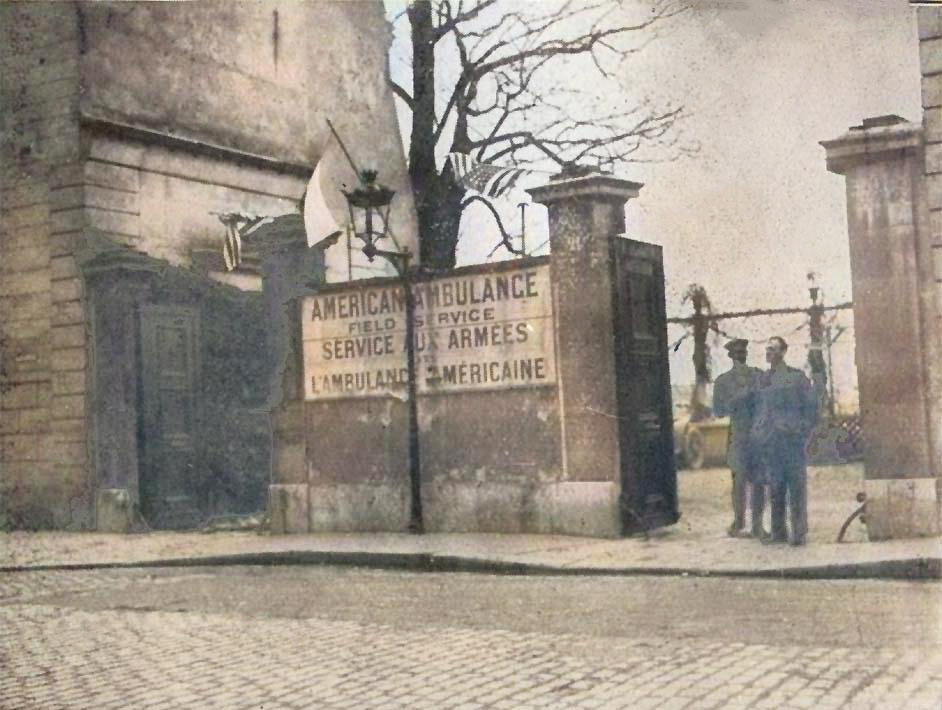
Nous avons l’honneur de vous annoncer que le Siège
Central des Sections Sanitaires de l’Ambulance Américaine aux
Armées (American Ambulance Field Service) a été transféré
du Lycée Pasteur, Neuilly-sur-Seine, au21, rue Raynouard Paris (XVIè)
Désormais, toute correspondance concernant ce service
devra être envoyée à cette adresse et toute communication
téléphonique faite à Passy 60-21 ou Passy 60-27.
Nous serions heureux d’avoir votre visite le Mercredi
23 courant entre 5 h et 6 h 30.Edmond L. Gros A. Piatt Andrew Stephen Galatti
 There was serious trouble at the American Hospital, where Dr. Gros and the members of the transportation committee were increasingly peeved at Andrew. As the months passed, Andrew's service, which was recruiting volunteer drivers from colleges in all parts of the country, began to attract more attention than the hospital itself. With an inborn instinct for publicity Andrew arranged for newsreels of ambulance activities in the field to be shown at university clubs in major cities across America. By 1916 it was clear to him that he would have to sever the ties binding his service to the hospital. But to do so he needed the consent not only of Robert Bacon but also of the redoubtable Anne H. Vanderbilt. The second wife of William Kissam Vanderbilt, she was a leading figure in the American community in France and wielded considerable power within the hospital hierarchy. (Andrew Gray. “The American Field Service.” 1974.)
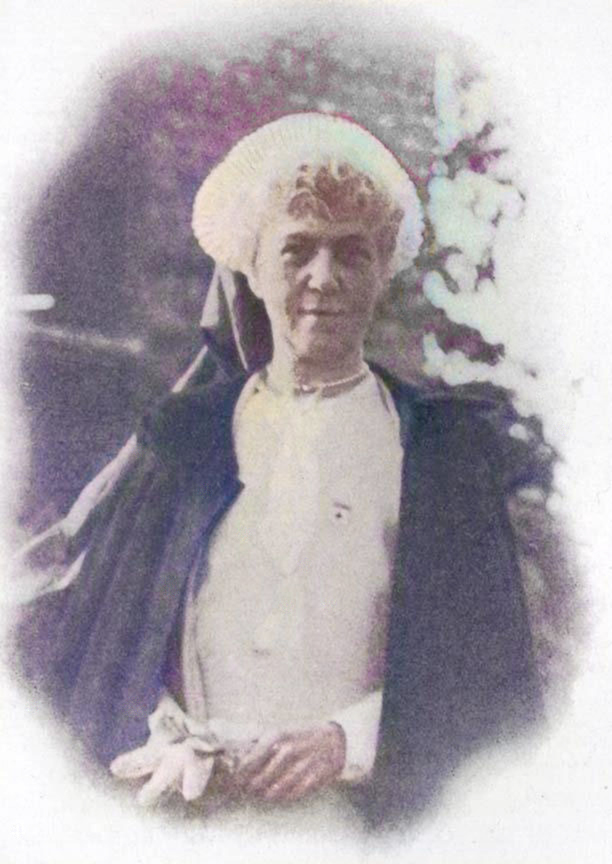
Anne Vanderbilt
In the late summer of 1916, the Field Service HQ left its cramped quarters at the American Ambulance and moved to Paris. It seems fitting to recall again something of what Mrs. Vanderbilt did for us in France (…) The severance of the Field Service from the American Ambulance, and its consequent unhampered development, were directly due to her. I crossed in June 1916, after a two weeks return to America, on the Lafayette, on which Mrs. Vanderbilt was also returning. I had the opportunity to talk to her and she promised to meet Andrew at lunch the day after our arrival. During the three hours after that lunch, Andrew described the whole situation to her, and she quickly grasped the problems. A few days later, she accomplished what months of arguing, bickering, and continual cross-purposes had been unable to do, namely, a complete working arrangement under the liaison of Dr. Gros which gave Andrew a free reign in the management of the Field Service and a complete demarcation of the funds contributed to it. (Stephen Galatti in AFS Association Bulletin, June 1939.)
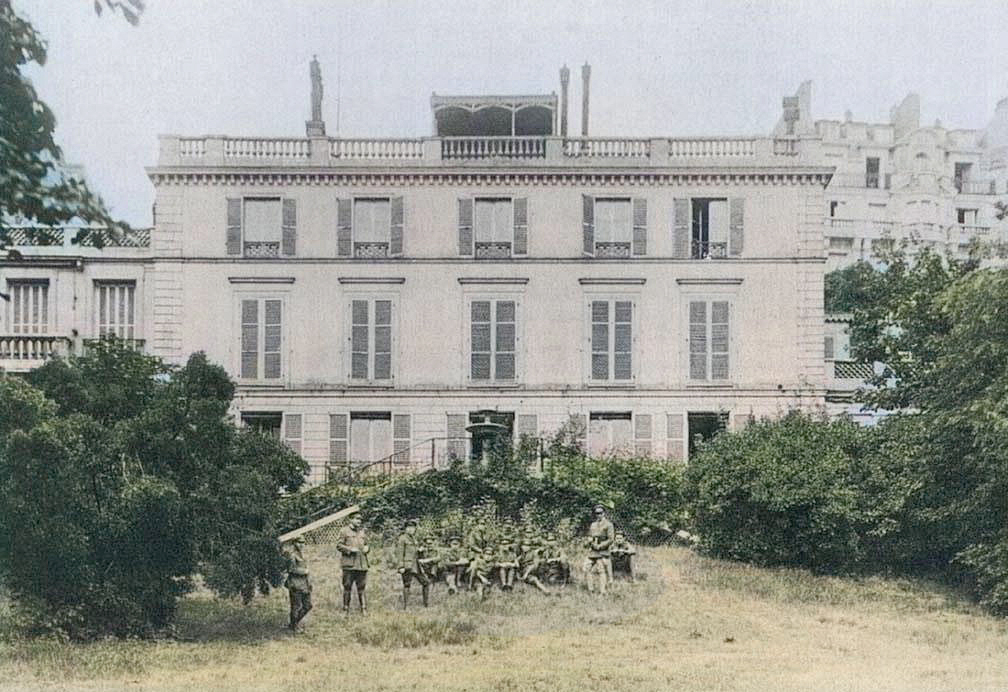
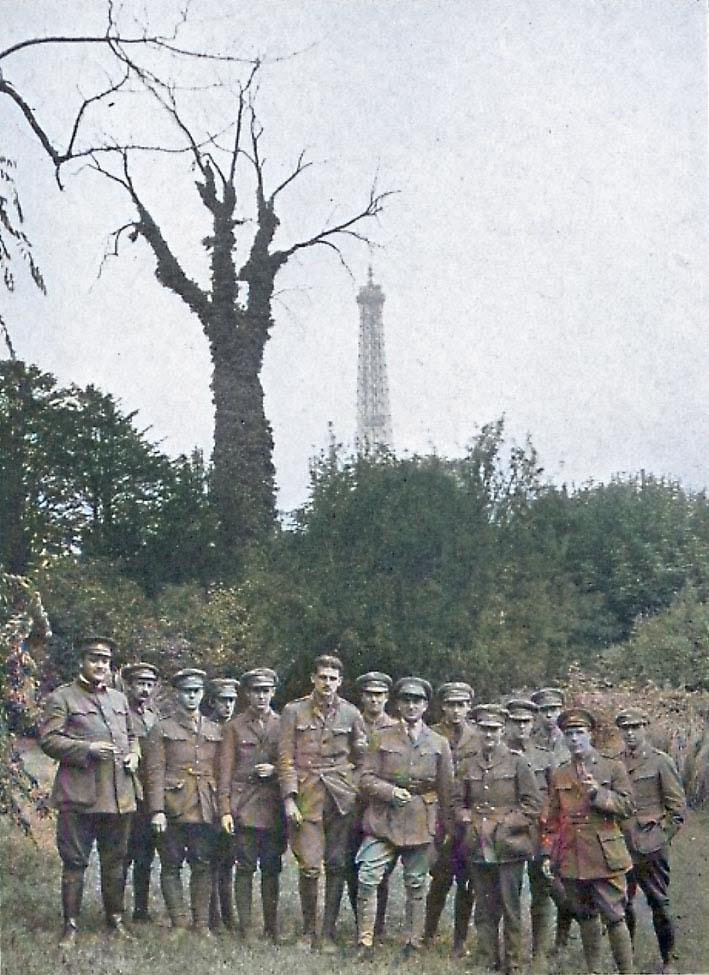
Twenty-one rue Raynouard ! What an echo these words will always arouse in the hearts of all of us who came to know the château and especially the beautiful park ! The American Field Service has had many generous benefactors, none of whom will be remembered with greater gratitude than the Comtesse de la Villestreux and the members of the Hottinguer family who, in August 1916, placed at our disposal this princely estate, which includes the largest and most beautiful private park within the fortifications of Paris. Those four or five acres of forest, gardens and lawns offered an ideal arrangement. The low part by the Seine provided easy ingress and egress for our ambulances, with plenty of space for a hundred and fifty or more at a time, under the protection of enormous trees. A winding drive led up to successive terraces, until one stood in front of the château, on the top of the hill of Passy. As one looks down from this point, one sees at the left the dense, dark foliage of the largest grove of chestnuts in Paris, and on the right the romantic chalet, with a glimpse of the orchard beyond. Between these extremes, paths wind about, leaving a broad lawn in the center. Above and thru the trees one catches sights of the sparking waters of the Seine ; while beyond the chestnut grove stands the lace-like Eiffel Tower. (Raymond Weeks in AFS Bulletin, Jan 12, 1918.)
The day after my baccalauréat, my father took me to the Rue Raynouard, to a charming Directoire house that no longer exists and whose gardens sloped down to the Seine. Great trees leaned over long, winding paths that twined like so many arms around vast lawns where it would have been delightful to sit at the end of a fine day. Everything spoke of times happier than ours. I was sensitive to the melancholy of a place, traces of which would be sought vainly nowadays in Paris. At the bottom of the gardens, drawn up neatly in front of the iron gate that led to the Quai de Passy, I saw some twenty ambulances painted iron gray and adorned by a red cross. The last of these cars was mine. (Julian Green. The Green Paradise, 1993.)
Escadrille Lafayette:
He might now return by the garden, and in turning toward the left he would notice a familiar clump of trees sheltering a Swiss chalet, installed there since his time, but years old in comparison with what he has just seen. He would go in, perhaps, to rest for a moment only to be greeted by a nurse in blue uniform standing by a table covered with various medicine bottles and glasses. She would inform him that the chalet was now used as an infirmary for Field Service men whose injuries or illnesses were not serious enough for treatment at a military hospital. (History of the American Field Service in France. 1920.)
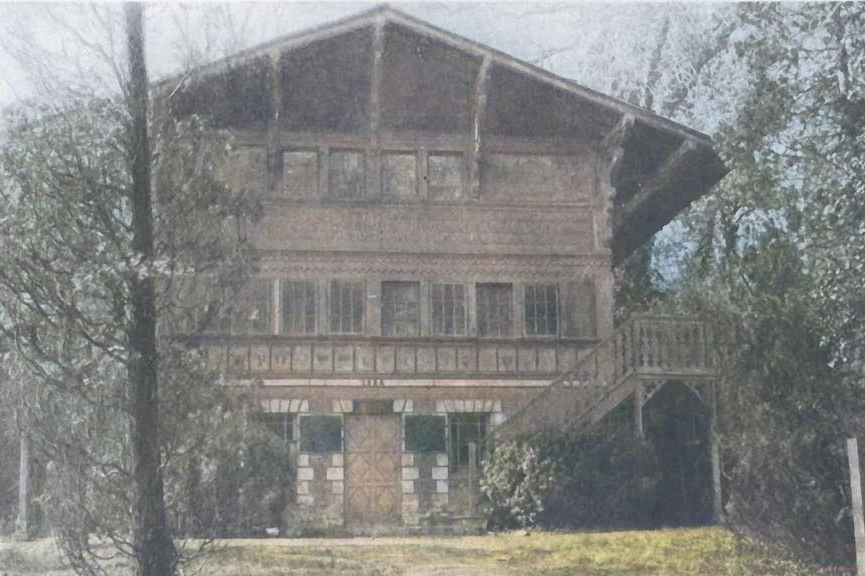
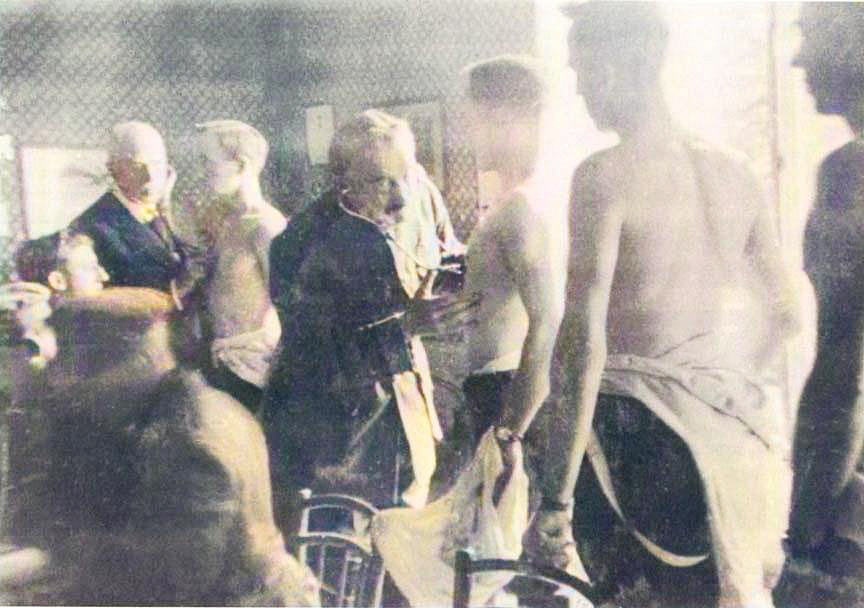
The man in charge of the Field Service infirmary was Dr. Edmund Gros of the American Hospital, who took full advantage of his rôle to recruit volunteers for an all-American flying corps---- with the result that the Field Service would provide almost one third of the pilots of the Lafayette Escadrille.
Concurrently, and independent of Prince's and the others' efforts, another Paris-based American named Dr. Edmund Gros, one of the men in charge of the American Ambulance Corps, had had a similar idea of organizing an American flying unit. He had thought that many of the volunteers he had met in the ambulance corps would be excellent candidates for pilots, and so he set about using his contacts and prestige in Paris to formulate a flying unit. (Philippe D. Rogers, L"Escadrille Lafayette, 2002.)
While “21” continued to be a home for Field Service men, two developments would expand its nature, once the United States entered the war in April of 1917. The first was the Réserve Mallet and the second was the absorption of the service into the United States Army Ambulance Corps.
Reserve Mallet:
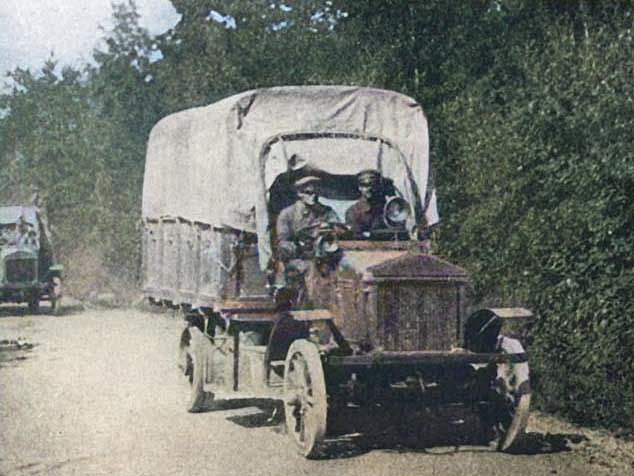
White truck
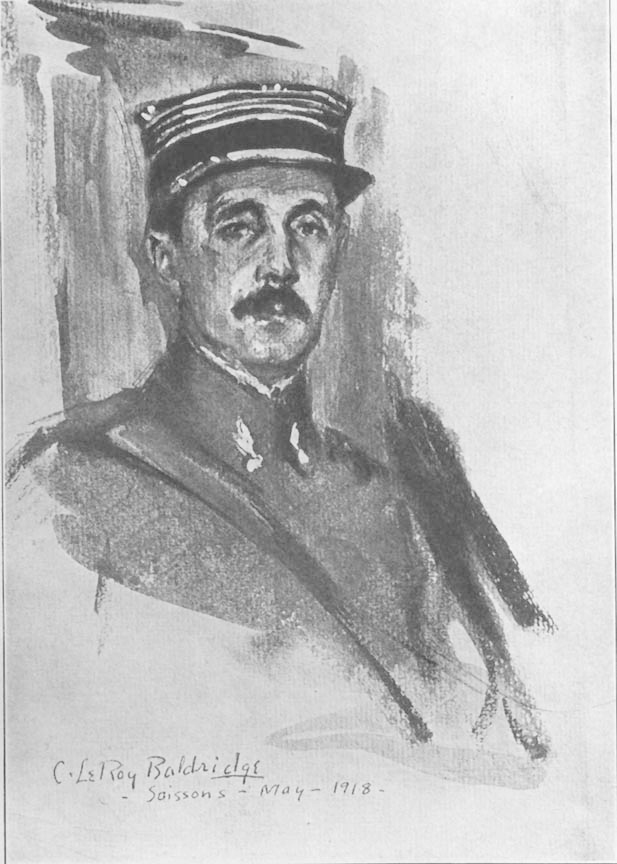
Commandant Mallet
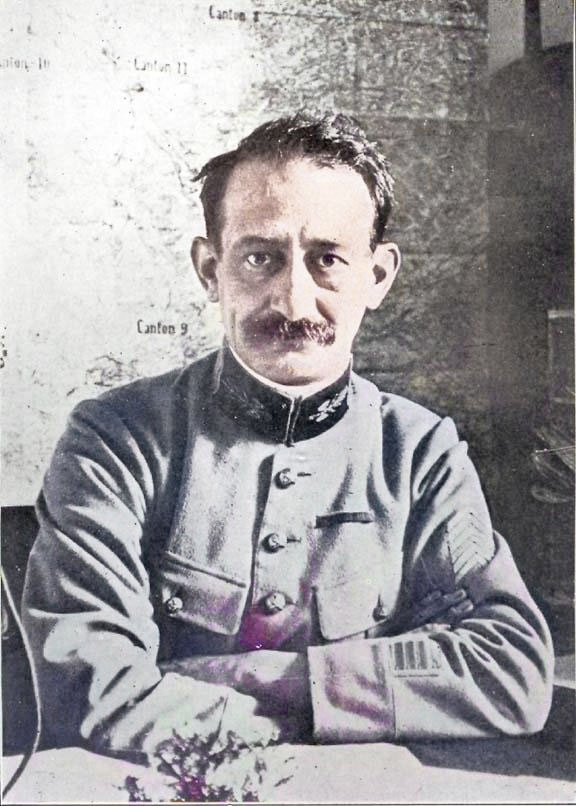
Commandant Doumenc
Nearly two years have passed since the day in April 1917 immediately after America's entry in the war when Commandant Doumenc, the Head of the Automobile Service of the French Army, telephoned to 21 rue Raynouard to ask whether American volunteers could not be secured to help in the work of transporting munitions and material for his armies. He said that at that moment the ranks of the Automobile Service were seriously depleted, that they lacked some 7,000 drivers to meet current requirements and that a large proportion of the remaining personnel consisted of old men who were scarcely fitted for the arduous and sustained effort incumbent upon them and who at the same time were greatly needed in their homes, after nearly three years absence, to cultivate their farms and to keep going the industrial life of the country. He proposed, if we could help him with men, to turn over to an American personnel one of the great automobile reserves whose functions were to assist the armies in the regions of heavy offensive and defensive operations, and in fact he proposed to turn over a particular reserve which had already made a record of serious accomplishment in the battle of Verdun and elsewhere, under the command of an efficient and tactful officer who understood Americans and spoke their language. He said that if the American Field Service really wanted to help France it could not render a greater service than by contributing to the plan which he had outlined. (AFS Bulletin, March 8, 1919.)
USAAC:
As soon as the US had entered the war in April of 1917, the British and the French sent official commissions to Washington to discuss priorities and methods of cooperation.
I explained that we had arranged to send 1,000 medical officers of the reserve group to be brigaded with the British forces in France, the request being the first that had been made by the Balfour Commission. I then turned to the French representatives and, as diplomatically as possible, asked them if there was some immediate assignment of a similar nature we could make to the French medical forces. Their spokesman, in vigorous English, declined to make a request, and definitely stated that their commission had not visited the United States with the intention of asking favors but to pay us a visit of respect and good will and discuss our common problems.
In responding I called attention to the reported shortage of medical officers in the French and English Armies and to the reported suffering of soldiers of the Allies wounded in the late drives, and urged that we had resources of men, materials, and hospitals that we could furnish at once, instead of waiting until our complete organization at a much later date could be trained and transported.
Secretary Baker, in his persuasive manner suggested that, while our efforts at this time would be of minor importance, he hoped they would be accepted as a gesture of good will and partisanship while we were preparing our larger force.
The French visitors exchanged a few words in their native tongue, and then asked the privilege of withdrawing for a few minutes for consultation.
It was evident that General Scott was out of sympathy with this irregular procedure. He sat with his back partially turned to our little group, looking out of the window over the Ellipse toward the Washington Monument. At each suggestion we made about sending men to France, he would change his position significantly, as if struggling to suppress a protest.
The French representatives and their spokesman rejoined our group, and with graciousness said that they would be glad to receive 2,500 ambulances and 5,000 enlisted men as chauffeurs for the machines. They respectfully requested that, if possible, the machines should consist merely of the chassis and that they be of the Ford make, and delivered at Brest within 3 weeks. This very definite request for materials as well as men (nonmedical men) and the short time for delivery were rather unexpected.
I immediately asked the Secretary of War if he thought the request could be fulfilled in the time specified. The Chief of Staid had turned in his chair and was facing us. The Secretary of War turned to him and casually, questioningly remarked, "General Scott, there will be no difficulty in executing this order? " The general abruptly remarked that he was not so sure about that.
"Who is going to pay for the subsistence of this force of 5,000 enlisted men? " he demanded.
The French delegate jumped to his feet, clicked his heels, and replied, "France can be depended on to care for the guests within her gates," saluted, and resumed his seat. (Franklin H. Martin. Digest of the Proceedings of the Council of National Defense during the World War, n.d.)
* * * * * * *
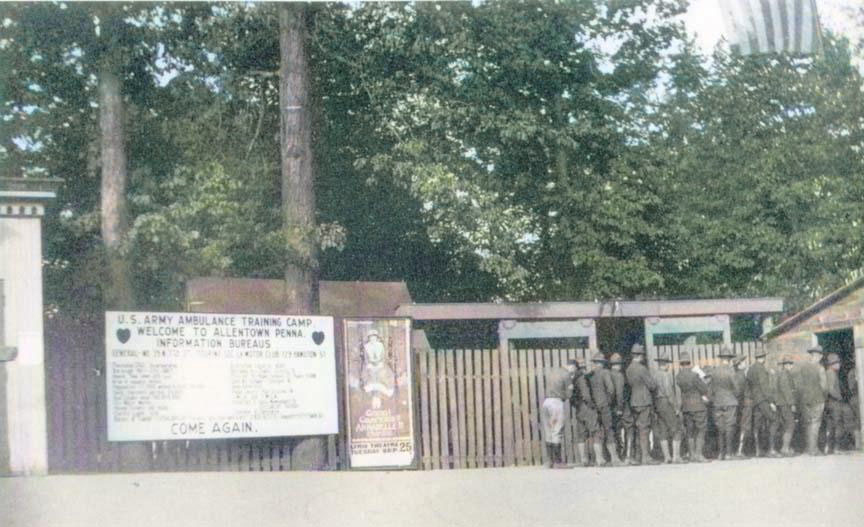
The most potent factor, however, necessitating our enrolment in the United States National Army, was that when the first French commission arrived in Washington in May, 1917, General Joffre was asked by Surgeon-General Gorgas what immediate service the United States Army Medical Department could do for France. His reply was a request that the United States should undertake, as far as possible, the responsibility of caring for the wounded of the French armies at the front. A more satisfying tribute could scarcely have been paid the Field Service than this request that the work it had carried on in France for more than two years should be supplemented and entirely assumed by Americans. As a consequence, General Gorgas authorized, through the Secretary of War, the organization of the United States Army Ambulance Service at Allentown. (Henry D. Sleeper, in History of the American Field Service in France, 1920.)
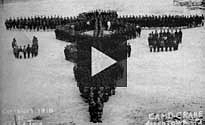
Camp Crane, Allentown, Pennsylvania
But what was to become of the American Field Service when the American Expeditionary Force reached French shores? [...] Neither General Pershing nor Surgeon General Gorgas was interested in the American Field Service. Command positions in the AEF, they insisted, would be given solely to professional soldiers and not to outsiders like Andrew. And so the United States Army established an ambulance organization of its own as part of its medical service. It was patterned on the field service but ten times larger in men and resources. The only concession to the existing organization was exemption of its volunteers from selective service. There was no commensurate position in the army table of organization for its inspector general. Andrew was offered the rank of major, Galatti a captaincy. The two men were then subordinated to a mixed bag of colonels appointed by the Surgeon General's office, none of whom had any practical experience with ambulance work or familiarity with conditions in France. Meanwhile a huge encampment was established at Allentown, Pennsylvania, for the United States Army Ambulance Corps, and during the next two years no fewer than twenty thousand men were trained there and sent to serve with the French and Italian armies. The American Field Service was formally merged with this organization in September, 1917. After the war the USAAC was summarily abolished. (Andrew Gray, The American Field Service, 1974.)
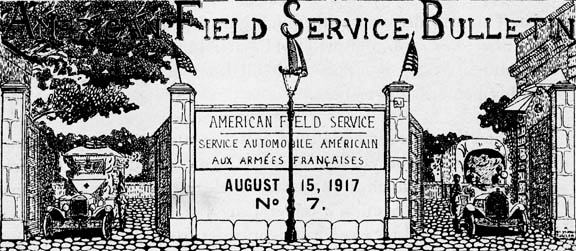
It was at “21”, beginning July 1917, that the AFS Bulletins were produced and where men from “AFS” units stopped by on leave in Paris. After AFS was absorbed into the USAAC, Henry Sleeper---- no longer needed for recruitment, fundraising and procurement of ambulances in America---came and took charge.
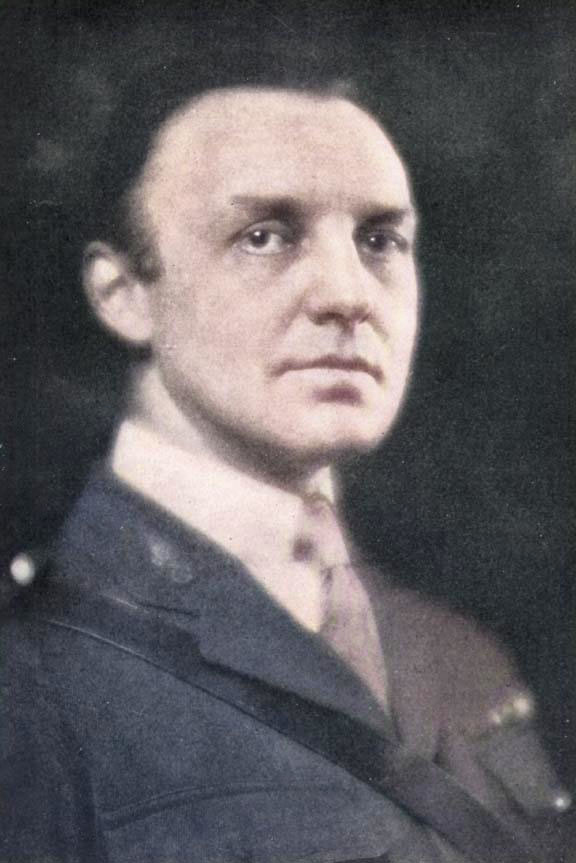
Henry Sleeper
In the autumn of 1918, Sleeper went to Paris, where he became director of American Field Service headquarters at 21 Rue Raynouard in Passy. After the armistice, he remained in Paris to assist Andrew in reconstituting the Service as a scholarship program for the exchange of students between French and American universities. The two men returned in mid-1919 to Gloucester, where Andrew set about editing the official History of the American Field Service in France, published in three volumes the following year. (E. Parker Hayden Jr. and Andrew Gray, ed. Beauport Chronicle, 1991.)
Stephen Galatti
And so we find the place that "rue Raynouard" filled never particularly defined, but always associated in some way with the men and their work. The affection which the men bore it marked it definitely as their home in France. This would have been sufficient, but beyond this were the opportunities it gave to add to the scope of the Service. In looking back over those years one wonders if it was not, perhaps, "rue Raynouard" itself --- and not only the surroundings, but the happy and unselfish spirit which reigned there, making light of heavy tasks ---that gave the necessary courage for continually furthering the scope of the American Field Service, and above all that made this Service such an important participant in the cause of France. (Stephen Galatti in History of the American Field Service in France, 1920.)
Chapter Five
Table of Contents