 George Rock
History of the American Field Service
1920-1955
George Rock
History of the American Field Service
1920-1955
CHAPTER XVI
During the spring of 1944, two more sections were being formed and trained in Poona---3 AFS MAS under Lt. J. K. S. Fearnley and Sgt. R. E. Paulson, and 4 AFS MAS under Lt. J. G. Birkett and Sgt. J. H. Dempsey. The Real Headquarters of AFS India-Burma had remained at 126 IBGH from the arrival of the first men from the Middle East in June 1943 until 1 May 1944, when 4 MAS was at last on its way to the front. Throughout the stay of the Field Service in Poona, Colonel Thomas I. Dun, OC 126 IBGH, continued to give his useful advice and to commit deeds helpful to both individuals and the Service. His patience and tact seemed limitless, and his generosity was unfailing. The Service must be forever grateful that he was pleased to consider himself the father of the Service in India---as he certainly was.
Most of 3 MAS was longer and more variously trained than the First Section, and the Fourth, like the Second, came out rather short. The long wait for 3 MAS began cheerfully amid the distractions of seasonal festivities:
"Christmas was all right---I guess," Captain Patrick reported to Major Ives. "Whyte and Ferguson tried to bring a 'tonga' into the canteen but only succeeded in getting the horse inside---who was, incidentally, the best behaved animal there. The rented-by-the-hour Christmas tree was decorated with the soggy garlands that sweepers (wet and dry) customarily drape around the sahibs' necks on Christmas (at a rupee a ring). No tree ever smelled as sickeningly sweet.
"Everyone showed up for Christmas breakfast (at 9 o'clock) sleek, shaken, but shaved---all except one, who looked as natty as a subway urinal in underwear and unbuttoned pants, with his weak little fist swollen and bloody from taking a sock at a soldier he didn't like at midnight Mass. At the nativity hour, our sergeants were singing too loudly (and plainly), so a sister came over from the officers' ward to quiet them---and stayed to drink and sing. Ah, me---when the cat's away, the mice act like rats.
"Someone tied a stocking on the foot of my bed, and I was pleased to find it stuffed with presents---even if they were all made in Japan, including a toy ship called 'Miss Nippon! Miller gave Craven a new recording of 'Soldier-let me read your letter,' which was almost as sickening as those goddam garlands. Spavin was justifiably homicidal at finding a cobra placed in his bed---even if it was dead. Whyte had brought it back after having killed the mongoose. It was later placed in front of Yankey's door, where it contributed to his Christmas pallor.
"Christmas noon, Craven gave a cocktail party in the library. Two hours late, Colonel Dun, a General, and their wives appeared. All had departed except Turney, who greeted them coming out of the door in the basket of the Military Dairy bicycle. He crashed down the steps, and the General's wife asked him to 'do it again'---and he 'did it again' . . . most engaging and amiable. . . . They departed---satisfied.
"Sir---please do not go away and leave me next Christmas. Mr. Galatti never told me. . . ."
The first vehicles, the Section's 3-tonners and station wagons, were obtained early in January, but, in spite of rumors (and stronger) that Army was eager for both 3 and 4 MASs, no ambulances were forthcoming for quite a while longer. Again this limited the amount of useful training that could be given. But there were other endeavors to fill in the time---such as the jungle (or B.B.) Buggy. Of this invention, Captain Patrick reported: "Birkett returned from the east with tales of the impotence of the First Section's vehicles as compared with the wonders that the jeeps can perform. . . . Barrett woke up in the night with the jungle Ambulance being born in his mind . . . an idea he had for converting a motorbike into a stretcher-carrier to go places where an ambulance could not. With Birkett's help, he scrounged an extra wheel and some iron bars and, after a few mistakes, completed the job. Total expense---8 rupees. I have ridden in it and find it just as comfortable as an ambulance. The carriage is simple to attach, and no alteration is made on the motorbike. Yesterday it was tested by Colonel Gibbons, OC FATC, who rode over the bumps of the course on his back and was so delighted that they had a hard time getting him off. He thought it was as comfortable as any Chev or Ford ambulance. Barrett, Birkett, Fearnley, and I are having dinner with the Colonel tonight. On the strength of what was done with the motorbike, he is giving us a jeep to play around with. When I say 'us' I mean the AFS, but all of the credit for initiative, inventiveness, labor, and success belongs to Barrett and Birkett. . . . We try to keep constructively occupied here in this limbo . . . and at the moment it looks like the AFS is having an opportunity here as well as at the front for being of use."
Toward the end of January, 3 MAS had a 2-day scheme, the drivers rotating between 3-tonners, station wagons, and motorcycles. Their Chevrolet ambulances were not issued to them until 24 March. In the interim, a number of men worked in different capacities for 126 IBGH, some 18 acting as orderlies for a while in March to help the Hospital during a period of shortage. More would have done so, had they not been involved by previous commitments to such various courses as small arms, Urdu, and even bomb-disposal.
Finally, on 5 April, after receiving the blessing of the Bishop of Poona, 3 AFS MAS started off for the front (4 MAS receiving its cars the same day). Its trip to Calcutta followed the route of the other sections. However, the experiences Lt. Fearnley reported along the way were unlike anything that had gone before. For example, there were his adventures in Benares:
"collecting rations from a very nice Sikh supply officer. When I asked for something else beside soya links, he said he thought Americans loved them since they made them. I told him they never ate them themselves---simply exported them to the British. 'He'd heard of passive resistance, hadn't be; well, that was ours! He laughed and we got our substitutions. That in spite of the fact that I broke his big clay water jug and flooded the room.
"Coleman and I were purified in the Ganges, and I'm not kidding. The IORs asked me to go down with them, and I had to be the first one in. I undressed right down to my undershorts on the temple steps ---collecting a goodly crowd of natives in the process---and then dived in, telling myself that anything that meant so much good could never make anyone sick. Kellogg said it was a beautiful gesture of two old men making way for tomorrow and that everyone was to line up for promotion as there would soon be two vacancies. There are no vacancies yet. The IORs were delighted, and I was pretty touched that they had asked me. They told me at the ration depot, when I inquired as to what it meant, that it was a sort of talisman and that the IORs undoubtedly believed that no harm could come to me after that."
From Calcutta, 3 MAS expected to go to Chittagong "and then on to 15 Corps in the Arakan. In Calcutta, however, Lt. Fearnley was told that, because of the direction of enemy action at that time, it would probably be sent to 33 Corps, which turned out to be the case. After a rugged train ride to Chittagong, 3 MAS drove north through Dhum, Comilla (Fourteenth Army HQ), Agartala, Sylhet, Shillong, and Nowgong to Jorhat and then south to 33 Corps HQ at Dimapur, which it reached on 6 May. The section was not immediately given the forward assignment it expected. There wasn't that much front at the time. The big Allied attack on Kohima was only begun on the day of its arrival.
During the latter part of April, as the enemy wasted itself in futile attacks on Kohima and Imphal, the Fourteenth Army defensive had gradually turned into offensive actions in both areas. The scheme of the action was very much like the earlier success in the Arakan. By bringing in parts of 3 divisions and 33 Corps HQ to Dimapur, sufficient strength was built up there to relieve Kohima and then to launch an attack down the road toward Imphal, some formations being diverted to the east to relieve Ukhrul. At the same time, 17th Division was engaged south of Imphal to halt any enemy advance, 5th Division pushed north from Imphal to meet 33 Corps, and 20th Division drove northeast toward Ukhrul. Operations to the east were continued, General Stilwell advancing on Myitkyina, toward which the air-dropped Chindits were still pushing from the south. The airfield at Myitkyina was taken on 17 May by Merrill's Marauders, and Mogaung fell on 16 June. The city of Myitkyina, however, withstood a 78-day siege before it fell on 3 August.
Each ridge retaken by Fourteenth Army put the enemy in greater danger of encirclement and annihilation. On 22 June the two corps joined forces on the Kohima-Imphal road. The 3-month siege of Imphal was broken---and so was the enemy offensive. The Japanese fleeing to the east were caught by the troops along the road to Ukhrul, which was retaken on 3 July, or by those protecting the flank farther to the east. It was a great defeat for the enemy. From the end of June 1944, the Burma campaign of Fourteenth Army was like the Eighth Army advance to Tunis. The enemy had to be pushed every inch of the way, but there were no offensive actions of any size to halt the slow march of victory.
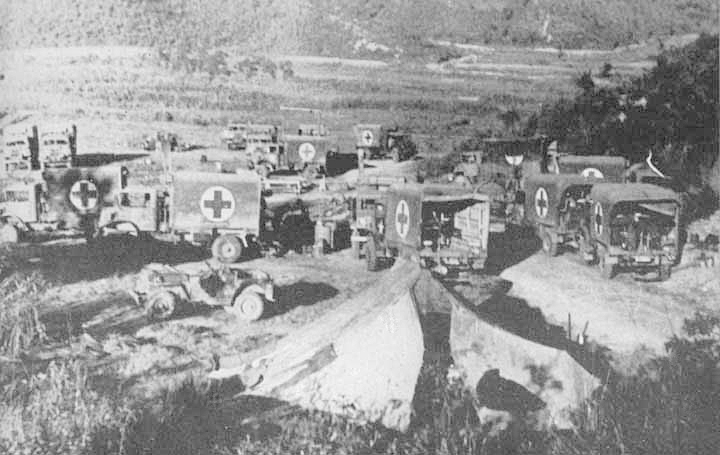
The American Field Service had sections active on several sectors of the central front in late April and early May. The Third and Fourth Sections were assigned to 33 Corps, 4 MAS arriving in the area on 7 June. The two older MASs continued with 4 Corps: Lt. Fenn's 2 MAS was assigned to 20th Division, which was shifted north from the Palel area, where it had halted after withdrawing from Tamu, to make the attack up toward Ukhrul; Lt. Parker's 1 MAS had assignments with both 47 Field Ambulance on the Ukhrul road and 17th Division, 18 miles southwest of Imphal at Bishenpur, where the Silchar track joins the Tiddim road.
The First Section had only 12 of its cars posted in mid-April, but increased the number at most posts during the next weeks, particularly at Bishenpur. There were two cars with the ADS of 59 Field Ambulance (32 Brigade of 20th Division, which had been sent to reinforce 17th Division). Evacuations were to 41 and 88 IGHs and 24 CCS in Imphal. As the attack continued, however, the number of cars there was increased to 8 and briefly to 14 toward the end of the month.
Through April the. Japanese kept up the attack on Bishenpur from the south and west. Frequently they shifted the point of attack or slipped around behind a defended point in an effort to cut it off. The pressure was greater and the situation more tense than at any other part of the defended area around Imphal, but the daily life there resembled in many respects---particularly the closeness and changeableness---what was going on throughout the whole area. The attack developed into what General Slim called "the most prolonged and desperate fighting of the whole campaign."
At one point, there were "so many shells overhead that it sounds like a swiftly moving brook," recorded T. Dolan IV, who went up on 24 April:
"Left to take Olmsted's place, who has to take Du Val's as MTO. Forman took my place at MDS on Ukhrul road. Up to MS 18 on Tiddim road, turned right for a few hundred yards, and found our cars parked under a great tree. One shell would have done them all. Also 5 yards from a petrol dump! Bunkers everywhere. We have a lot of guns, also tanks, waiting to go into action in the big battle tomorrow. Heard some planes overhead this afternoon, then everyone started running every which way. Bofors started, as well as Brens. Four sticks and strafing. About 15 planes over, diving every which way. Took a bath. Brigade sent around word of possible attack. Got some grenades. Had a rum. Bed.
"April 25:
Shelled us yesterday evening, though no closer than 200 yards away. All huddled behind the big tree. . . . For attack today, Gurkhas started going out about 3 A.M., then carriers and tanks. Got little sleep. Also hot. Really tired when I got up. Up to breakfast on hill by ADS. More shelling. Closer, and we had to flatten out on the ground in between every mouthful. . . . Battle called off because going so badly. Trouble was the village they were to take was empty, they went on and into an ambush of antitanks and rifles galore. Bennett and I each took 9 casualties down to 41 IGH in Imphal. . . . Back to HQ for tea, bread, and jam. Filled with water, petroled up, and off again. Tore back to give snipers less of a chance (the road had been closed this A.M. on account of snipers). . . ."Got back in time for supper. Lutman and I went up hill for 'khana.' Jap shells falling short of hill. Good supper of bully, string beans, and fruit---except we never got to much more than touch it. Had just sat down when Jap lengthened range its 105 had been firing. That godawful whistle got louder and louder; we were nowhere near a bunker so just hit the ground. Landed 10 yards from us, throwing dirt, leaves, and branches all over us. We got up and tore for a bunker. No more, so we came out again. Had killed one mule and laid open the complete right buttock of another. Poor thing, just standing there dazed. Shot it.
"Then all of a sudden a shot and that whistle, and about 5 of us dove all on top of each other into a bunker. I was last in, just as shell landed, and landed on all of them. That was close. Then for about 15 minutes the Jap pasted---every goddam one landing right near this bunker---one landing 2 yards from it on another bunker. Only dented it. Everyone in bunker huddling on top of one another, choking and coughing from the terrific dust and cordite smell. Seemed to be over, so out we came. . . .
"Met Olmsted, who had some mail. . . . Then more shells, but we got into RA bunker and they weren't landing so close. . . . Field and Dunwoody in an ambulance and Clark in his got back after going up where the Northamps and 3/8 Gurkhas were (west of Tiddim road in mountains across Silchar track). Machine-gunned and sniped at on way up. Had to turn back, then went up with convoy. Mortared. Clark got a bullet in his bedding roil on fender and one over head of where spare driver sits. Attack scare here again tonight after losing today's battle.
"April 26:
Couldn't sleep last night on account of heat and mossys which got in net and bit hell out of me. . . . Everyone looks and sounds so goddam tired. . . . Flies and dysentery, mosquitoes and malaria, all around. Dirt and filth everywhere. More shelling this morning, but fell on the other side of the hill. Air raid scare. Got to be careful of every plane out here, as no warning and can't tell until they're on you. . . . We finally got some rations from Imphal. Carriers on patrol at MS 7 said they saw 20 Zeros on way to Imphal. . . . Convoy going up Silchar track starts from where we park. Shelled at 4, when it was leaving. We were in a bunker of carrier boys. Some close ones. . . . Sudden call for all Ford ambulances, which went up with convoy. I took a load down to Imphal after 'khana' brew up of our rations. . . ."April 27:
Olmsted got in the middle of some carriers on way down which were being strafed by a Zero as it was crashing. Michaels got shrapnel through radiator at Tulihal in bombing---he was in trench. . . . Went back to Bishenpur right after breakfast. Worked on bunker all day. Outside perimeter and also in line of fire. No gun slits in bunker and awfully low. Carrier boys persuaded us to put one in near theirs. Till we get it built, we use theirs for shelling and bombing, and in attack 2 of us man slits and rest load mags. Jap started shelling us about 4 . . . after convoy again. Kept putting them over until about 7, when he put across quite a barrage for a few minutes, with them landing all around. Forman and I were heading to take a bath when it first started at 4. Between shells from the Japs, our mediums going off right next to us, and the rain soaking our clothes, it was a most hectic bath. . . . Hit my head a terrific whack on door getting back in when barrage at 7 came. We all ache all over from hitting the dirt and diving in bunkers all day. Could see Jap 105 firing from top of hill. . . . Japs have reinforcements and have put in road block just above water point. Dunwoody and Field cut off. We all slept with clothes and boots on next to bunker. . . ."April 28:
A quiet night, though we could hear battling on hill in spasms. Uncomfortable with boots on and couldn't stretch out, so not much sleep. Dug bunker all morning---in between shells. . . . [Took patients to Imphal.] Left all but Jap at 41, took him to 24 CCS, the POW pen for wounded. . . . Then to HQ for tea, supper, and petrol. Headed back after supper, but stopped at beginning of Tiddim road. No passage from 6:30 P.M. to 6:30 A.M. on account of snipers, so back here for night."April 29:
Beautiful sleep in pajamas between sheets. Up at 5:15---Had breakfast and . . . got to Bishenpur at 7:30. . . . Going to use Bofors against road block up Silchar track. . . . They had a quiet night here. Working on our bunker in morning and filling sand bags. . . . Doing well up on hill now. Had about 4 surprise shellings today: about 8 rounds each, all in a minute, giving you just about time to drop where you were. Some close ones too. Road block at water point opened, but another beyond it. . . . Expected attack tonight, so everything set for it. Warned that RA would register on perimeter at 5, so to be under cover---but instead they blew hell out of Jap with everything for 1 l/2 hours. . . ."April 30:
Slept beside door to carrier bunker. Rained a few times. . . . Left here with patients at 7:40. Looks like monsoon is really here. . . . [In Imphal] had a pukka lunch Krusi made up. Now have teacups and flowers on the table and a fellow with a string pulling 3 bamboo fans over our heads. . Had practically finished bunker when I got back, and what a job! --they got some tremendous logs from old RA bunkers. Could take any direct hit. . . ."May 1:
Field and Dunwoody got down last night. Road block open. . . . Shot up Field's right rear tire and left gas tank, plus a few more holes . . ."
C. B. Dunwoody and R. Field were attached to an ADS 22 1/2 miles west of Bishenpur on the Silchar track. They had gone a few miles farther to the contested waterpoint to pick up some 12 casualties collected there during the fighting. As the road was covered by a Jap bunker, the ADS had been unwilling to order them up. But when a member of the Northamptonshire Regiment returned from the water point and asked to borrow one of the AFS ambulances, Dunwoody and Field volunteered to make the run. They recovered all the wounded in two trips, Field's car being put out of commission on the first run. During the second run, the infantry assisted by putting in an attack against the bunker.
Dunwoody and Field each drove one trip, one driving and the other firing a rifle at the bunker to spoil the aim of the Japs. Dunwoody is said to have tormented Field, who was vulnerable in this respect, by asking "What if a half-shaft breaks now?" Dunwoody also sang "Coming in on a wing and a prayer" as he fired---which is perhaps what is referred to in the last sentence of his citation from the British for this activity: "Dunwoody's exhilaration in the presence of danger was particularly noticeable and inspiring to his comrades, and the attitude expressed by his comment 'They're not shooting at me' served to cool the apprehensions of others even when that attitude did not accurately reflect the facts."
On 4 May, Dolan recorded that an IAMC Colonel "thanked us fellows up here on behalf of the Brigade. Then he 'officially' thanked Field and Dunwoody for their work up the track. Also gave Field a rye and soda! Said he'd have a couple of us up for a bat one night when it is quieter."
It was some time before it was quieter at MS 18. As the Allied offensive continued down the Tiddim and Silchar roads, it took most of the troops and guns that had been concentrated at MS 18 and left the ADS relatively unprotected. With the enemy apt to slip through the jungle and attack at any point at any time, a 24-hour guard was maintained around the perimeter at MS 18 for the first week of May. The advance continued slowly, and on the 12th the 23 Field Ambulance (63 Brigade of 17th Division) moved a mile or so beyond MS 18. Several AFS cars were attached, and it was arranged that 23 FA would take the day casualties and 59 FA the night casualties. But 23 FA found itself "more or less in no-man's land" and had to move right back to its original position at MS 12.
On the same day, the village of Potsangbam (at MS 19) was taken at great cost, the Japanese continuing to hold one corner for the next week. That night MS 18 received a terrific shelling, during which Dolan reported them all "in the bunkers digging in with our noses." When it was over, he and N. S. Baskin discovered that their ambulances had been hit by shrapnel. "All we could do was laugh."
The situation continued uncertain. The Jap shellings continued, and troops were not allowed to take off their clothes at night. On 15 May the enemy attacked at MS 12. Potsangbam was cleared by the 18th, when cars from 59 FA drove up to evacuate casualties from it. By the next day, 48 Brigade (17th Division) had reached MS 32, and the offensive was going well, though the threat to the rear had in no way diminished. On the 20th the Japanese put in another attack, T. Dolan recorded, and during the next few days things were very tense:
" May 20:
Shelled by 'im in morning, again quite heavily after supper from two directions with mortar and shell. . . . More shelling. To bed in ambulance. We then put over a terrific barrage. Slept fairly well. At 2:30 awakened by those goddam bombs of the Japanese: Attack. Thank God not on our perimeter. Came in on the road junction of Tiddim and Silchar---20 there and 20 on Gunners' Box. When tracers started whizzing at me I ripped my pajamas off, into clothes, and into bunker as fast as I could. Most fighting went on between one and two hundred yards from us. Gave my revolver to Nort Baskin. Olmsted, Sanders, I, and Jock the RA 'pani walla' had rifles and grenades. Hearing nothing, however, we never got a shot. Continual firing, grenades, mortars, and Verey lights. At 4, heavy firing all around, and we thought we were surrounded and about to 'ave it. They have mortars north, south, and west of us. A damn mule broke loose and wandered all over, bumping into wire. The OC claims 1 mule equals 10 men---so no shoot."May 21:
Malaria is password for week. We stood-to from 2:30 A.M. till 5:30. Back to ambulance for sleep (kip), in spite of continued firing 100 yards from us. Firing in a dip, so stray bullets couldn't find us, although . . . about 5 tracers whipping up the road beside us. Slept soundly, dreamed of 138 Jap casualties, then of whistling mortars, which woke me and I found to be true. This was 7:30. Mortared and shelled us off and on all morning. Had a shave and a delicious breakfast of 2 fried eggs, bacon, toast and marmalade, and coffee. The Japs have taken over the old 5/5 RA bunkers. Have 2 light machine guns covering road, so we're cut off. Firing has been continual since 2:30 A.M. 100 yards from us, and even the tanks haven't shifted them yet. It's now 2. ADS is so full that patients have to lie outside. . . . Sounds like a Jap sniper about 50 yards from us. Even heard some close by ADS at lunch time. Japs blew up bridge at MS 12 on Tiddim road, making another road block. Boys up at 23 FA, 1/2 mile from us, had it hot and heavy with little protection. Ray Hauserman brought some casualties up to our ADS in his jeep and says men are lying all along the road. Feel tired as hell from no sleep . . . and weak from what I hope isn't dysentery. . . ."We're getting our wind pretty well up about tonight, as big attack is expected, and if it's on our perimeter God help us! We have about the most forward bunker, 10 yards from the wire with Indians on one side with a Bren and Sergeant George's gang on the right with a Bren. And apparently the little bastards don't yell if not detected and sneak right onto the wire. . . . To top off last night we had an air raid this morning, about 15 Zeros, who kept just out of range of our guns but strafed coming straight down up around Brigade HQ. The count is now up to 2 platoons of Japs at the bottom of the road here. More mortars this afternoon.
"May 22:
Bunker a mud bath, so slept in ambulance. Bullets flying all the hell around. We all got in the bunkers at 10, when it sounded like a pukka duffey [flap] starting in front of us. Snipers sounded as though they were practically under our ambulances. Stayed there for about an hour till it cooled off a touch. We were all so tired we went back to ambulances and didn't even get up for repetition of 10 P.M. at 4 A.M."At MS 12 (17 Div HQ) they went in to clear out Japs, found none there, found them sitting back up this way on Tiddim road over a 6-by-8-foot ditch they'd dug across the road. Through JIFC [Japanese Indian Fifth Column] captured we learned 150 Japs attacked and about half are gone. We blasted hell out of them all day with tanks, mortars, and everything we had. Sounded like there were snipers all around us all day. Even a couple sounded near us at mess up on hill, though God knows how they got there. This evening no firing allowed. Two platoons of 9/4 Punjabis going to comb the area across the wire from us with bayonets. Up the road a bit practically an entire company of Borderers wiped out: 12 left. Dunwoody and Hauserman working from Chothe Munpi [6 miles east of the road, opposite MS 30]. We may by-pass Tiddim road blocks by new track being made to the west.
"May 23:
Quiet night except for 25-pounders making a terrific racket. Action down the road a bit. Reckon we've killed 100 here. Pushed them to the other side of the road. Jap dead all over. Stench horrible. . . . Things on the whole not looking too sharp. Had Japs here all wired in last night. We went down to the battlefield this afternoon for souvenirs. What a sight! Couldn't walk 5 feet without stepping over some stinking dead thing. Must have been over 50 of our mules killed. Large number of Japs. . . . I got by far the most loot, most of which I found in third field, about 50 yards from where fighting is going on now."Road opened. Some more of our ambulances came up. Shelled where road block was by mountain at MS 12. When we went down with casualties, they mortared hell out of Japs so they couldn't stick their heads up to fire on us. However, Reppert got one through the door of the cab just over his lap. Forman had a fellow killed by rifle shot in top stretcher. Heath on way up took shrapnel from shell while lying on ground. Got it in the back and is in dock. . . . just before leaving in convoy today with casualties, a Tommy came up to me (I was in the lead) and asked me if I'd mind waiting a second, a friend of his was being buried. Took patients to 41. . . .
"May 24: . . .
Got some plum pudding for us up the road. just an old left-over can. Road cut again this morning by land mine. . . . Went up to Bishenpur at 3. Brought up more tarpaulins for bunker. Had a bath. Had our plum pudding . . . . Five flares went up around bedtime and a few shots. 'Bas.'"May 25:
Up half the night . . . . Up at 4 . . . an attack from Tiddim road. Too sick to get 'niche' [below], so just back to bed and prayed. Had a run in the morning. Shelling hell out of the loop below the RA box, so put up a smoke screen for us. One vehicle knocked out just before I got there. Got down okay. Had lunch. Back up with Pemberton. . . . One brass hat said they admired us greatly for our nerve at running the gauntlet of snipers, shell, and mortars along Tiddim road at 5 mph when jeep drivers don't feel safe at 50. We had tea with the MO. Some bitch about our not having the 8 ambulances required here, but settled. . . . 4/12 Baluchis putting in attack at MS 12 tonight. We put up terrific barrage. At same time Japs attacked us from 3 sides. We manned bunker for a time, then to bed and hope."May 26:
Last night Japs right opposite us attacking hill. Danger of our men shooting down on us. Roads out yesterday and supposed to be for all today. In attack two nights ago: captured 2 out of 15 and killed rest; 7 left in the morning in one bunker in the middle of us. Brought up tanks and Bofors to blast them. Like a cricket match. Spectators all around cheering, half of them in front of attacking infantry. When all over, they all just surged in for souvenirs. . . . Road open at 4:30. . . . Everyone nervous as hell as a lot of sniping along road, but we got through okay. Had a drink, supper, more drink. But too tired for much, so bed."May 27:
It's been raining for about 2 days now. . . . Started for Bishenpur after lunch. Got to MS 12 and found road cut around MS 14, blown-up bridge by shell. Only jeep can get over, and gun shelling road. Couldn't get through today, so turned back. Baluchis going in at MS 12 tonight. Also S & Ms along Tiddim road. . . ." May 28: . . .
Called about road block after breakfast. No soap. Again after lunch. Said when the road is dry to call back. Sergeant of 59 FA came in, having brought down 30 sitting cases in 7 jeeps. Said it wasn't a blown-up bridge but a bulldozer stuck in the road. Road so wet no vehicle can get enough traction to pull it out. . . ." May 29: . . . .
Road still closed this morning. Now some story about a Jap bunker 100 yards from road. Password for the week is Lucknow. . . . Road opened this afternoon, so up we went. Captain Marsh . . . came up. Had a 'toro' peg [long one] in the evening. Colonel Jackson told us that some time in the night we would move up to 'Pots'n'pans' [Potsangbam] and evacuate 48 Brigade's wounded, who are coming through. They are 300 yards from West Yorks, who are on this side. The Japs are in the middle, supposedly with medium tanks. To be a night movement, to avoid being shelled. Later, word came through that 48 didn't get through, so we no move."May 30: . . .
48 Brigade got through this morning, so off we went to Pots'n'pans for the wounded. Sure enough we'd just about gotten there (100 yards off) when he started putting the shells down in the middle of the road. An Indian ambulance got a direct hit. . . . When shells stopped, we went in. . . . Picked up a lot of wounded there, more from the mule convoy, and more at 23 FA ADS. Colonel Winyon bawling hell out of Colonel Byrnes of 48 for unnecessary risk of lives and ambulances. I got to where Omer had gone off the road the day before. Still there and he was looking for slit trench or something as Jap was starting to shell village right ahead. Manipuris running out from all sides. Got through it okay, though some of them sounded close. Our Lecs shelling town to west from the road and middle of field. Had to drive right past and what a racket. . . . Got down to Div, stopped, and a 25-pounder 10 yards from my bow fired across it and I damn near went through the roof. And did those Tommies howl! Then got hung up by a regiment of Stuarts coming up the road. Finally got down, went to 19 CCS by a good new road. Got in in time . . . to petrol up before dinner."
When Major King drove out to inspect the work on Tiddim road with Captain Marsh, carrying on with the tour he had started with Colonel Galatti, he noted: "Ray Hauserman, George Leonard, Calvin Dunwoody are doing the jeep work on this road. Ashley Olmsted, Henry Romberger, Tom Dolan, Jack Podret, Norton Baskin, Joe Puntil, John Maloney, Robert Burdick, Joe Latham, Ian Forman, and Jim Reppert are the men doing this particular run just now, and they are doing a swell job and getting all the excitement they could want." Although positions advanced during the following weeks, they did so slowly, and with no lessening of excitement.
Meanwhile, during the same period, Peters' subsection of 1 MAS was working northeast from Imphal on the Ukhrul road as well as deep in the country on tracks leading north from the Tamu road. Casualties were brought in to the latter road by Naga bearers, who took up to 3 days to cover the 25-mile trip back from the front. The fighting was on a small scale, close, and nasty. Progress through the hills on the edge of the Imphal plain was delayed by Jap bunkers, so placed as to be very difficult to dislodge, and by Jap snipers. A small enemy force was able to hold up, if only briefly, the larger number of 4 Corps troops and to inflict a great number of casualties. At this time, Field Service men included stretcher-bearing as part of their regular routine, having to walk---and often to climb---to the more forward RAPs. The hills were so steep that even men with bullet holes through their legs were considered walking wounded and struggled down to the car posts as best they might.
Along the Ukhrul road, AFS cars were posted at MS 3, with 45 FA at MS 8, and with 47 FA across the road from 45 FA and later just beyond MS IT On 13 April there was a rumor of a force of 1,000 Japanese troops advancing on Imphal from Ukhrul and then only 12 miles distant. Ambulances were sent up from Section HQ in Imphal, which kept a number of cars as a sort of Corps pool ready for special assignments for evacuations back to the central medical area. From the field ambulances, cars were sent forward to RAPs and Advanced Car Posts as needed. At different times in the early stages of the slow advance Dolan, I. F. Forman, L. H. Krusi, J. M. Nicholson, Jr., J. E. Puntil, J. A. Robinson, and P. M. Stewart were given assignments on this road. The sort of work it was likely to be was recorded by Dolan on 18 April, a more than usually active day:
"Krusi and I got off at 7:30. . . . Arrived at RAP at 8:10. just missed going up to get casualties from A Coy Suffolks caused by 4 of the medium shells falling short in the very heavy 7-7:30 barrage on the Sausage (5 killed, 8 wounded). The A Coy Tommy stretcher-bearers all wiped out; really shook the morale of the whole regiment. We then advanced, led by Major Smith, Acting OC of 45 FA, to farthest forward Car Post, where we camouflaged car against snipers. Walked forward to 2/1 Punjabi RAP, where we had 'char' with little MO . . . terrific pot, which shakes when he giggles, and two purple flowers in his bush hat. . . . Four tanks went in but could only make 2/3 of hill---too steep. Back to Car Post. . . .
"Heat quite bad, so we settled down in shade on hillside. Had no more got settled than Captain (who had replaced the Major) asked me *to take him up to the RAP. So back up we walked, then up further to foot of trail up the mountain. Then back. Attack to start at 12. At 11:30 mortars started. About then the Captain said we must beat it, as enemy not where we expected them. Typical! Back to Car Post where we usually have stayed. Then we started up that same climb with MO and 4 stretcher teams. MO wants to set up RAP near top, by B Coy. What a hiker he is! We never thought he'd make it before we started, and the little beggar didn't stop once. We stopped a couple of times, and it really wasn't bad this time.
"When we got to the top, just about at end of terrific barrage with shells tearing just overhead, Major Hill told us to go up to the lip of the hill overlooking the Sausage, where the Punjabis could be seen just going in. We were on the hill where they dropped petrol on the Jap bunker several days ago. The MO and bearers started down toward Sausage before we knew it. Off we went to catch up. Went past the bunker, where a charred, coal-black, stinking, bloated object of a Jap was protruding from the blown-up top. And flies! On a bit farther we came upon the Padre and several Tommies getting set to dispose of about 5 of their buddies. . . . The stench and the sound of the flies is the most horrible part of it all.
"On to A Coy pimple, moving right along on account of snipers. Caught up with MO and bearers there who hadn't gone in yet. MO then stayed behind and we followed bearers in. Picked up one fellow at base of Punjabi feature. Rest of bearers went ahead, and we went on with a fierce looking Punjabi as guide. Hadn't gone more than a few yards when a sniper put one right near us, so down we went with bullets whizzing over us. Meanwhile the mediums and mortars had started landing about 200 yards to the right of us where Japs held Pimple (approximately 30 Japs). Terrific racket and ricochets. That slowed up and no signs of snipers, so up we went.
"Reached feature and went to Coy CO to inquire about casualties and to return wounded man's rifle. He was in wireless but, we behind, when a sniper let go right through it. Dropped fast (we with no tin hats). He went up to inquire about bearers. Nobody seemed to know anything much, and we all figured bearers had pissed off. Just about to head back for stretcher for dying man when sniper went right over our heads. Down again. Then off again. . . . Arrived back to MO, and apparently bearers had brought casualties in and were heading back for more. . . .
"At A Coy one of the Tommies; made us 'char'. . . . Put out booby traps and mines at night. Back down the mountain (with a Punjabi with a mortar wound in his arm). An ambulance waiting there and we directed the driver back to our ambulance. Supposed to give patient more plasma, but had to be rushed off to MDS, so off we went. Started getting dark as we hit the corduroy main road. We found that there were no lights (didn't work) and as it is no one is supposed to drive at night on account of snipers. No moon, darker and darker, and we had to crawl due to patient. Then we started to dream up all the tricks the Jap uses---such as putting a vehicle block across the road or pretending to break down and need help. . . . About as jumpy as I ever hope to be again. . . . Then after at least 2 hours finally made it to MDS. . . . Didn't sleep well. Too tired."
This advance along the Ukhrul road had reached MS 26 by 27 April. The difficult fighting in the hills to the south and east had gone well, establishing a firm base for 20th Division's advance to the north. On the 23rd the cars of 1 MAS were withdrawn from the wretched tracks leading north from the Tamu road and transferred, with the Division, to the Ukhrul road itself. There they first worked from Kameng (MS 10) with 47 FA, continuing north until Ukhrul was retaken on 3 July. For the last weeks the work was a comparatively straightforward evacuation back down the line to Imphal.
Those returning from the front to the medical concentration or to the AFS Detachment HQ in Imphal did not always have the hoped-for relief from the noises of war. Like as not they suffered air raids, which were frequent through April and into May. Toward the end of April (on the theory that the Japanese must know about them) the morning and evening stand-to's were discontinued. By this time, the Japanese had been pushed some distance away from the perimeter, so that the danger of sudden attack was considerably less. The password to enter the AFS compound, required even of properly accoutered AFS men at the wheel of an AFS ambulance, was continued longer, to the outspoken exasperation of many. But the flaming question of arming the volunteers for defense passed, with the easing of the situation, from the realm of theory into that of common sense. Those who needed arms to protect patients carried them. Those with a mania for noisy toys went on collecting them. No dire accidents occurred, though there were exciting moments when some innocents discovered the unsuspected complexity of their deadly weapons.
The HQ set-up, with a large number of men and vehicles attached, was by this time quite comfortable, although it was later to be improved yet more by the considerable energy and inventiveness of T. Newbery. In anticipation of the 1944 monsoon, drainage ditches were dug around each basha, Major Ives giving muscular assistance for several days. "Some of the boys have objected that [Newbery's] signs, ditches, and bridges have made the place look like a miniature golf course, and the magnitude of his proposed projects and his wangling activities sometimes frighten me---but so far he has been one of the most valuable men we have," Major Ives wrote.
The petrol shortage in beleaguered Imphal demanded that vehicles be used sparingly. Any nonessential trips were forbidden. But convoys of patients were taken to the airstrips even in bad weather if it was considered at all possible that a plane might get off. Nearest to Imphal was the Tulihal strip (at first known as Tally Ho). The other major airstrip, through which most of the supplies for the large garrison came, was at Palel, 28 miles down the Tamu road on the edge of the plain.
Lt. Fenn's 2 MAS had stayed with 20th Division after its withdrawal to the area between Imphal and Palel. The Division was kept on the alert, as the biggest Japanese attack on Imphal was expected from this direction---where the enemy had built up its strongest assault force, including major artillery and armored formations. However, the Japanese were slow in getting around to the attack. As the days of tension passed into the first phases of the 4 Corps offensive, some said the Chevrolet ambulances would not be adequate for the work back along the Tamu road, which was surfaced only a little of the way beyond Palel. The cumbrous ambulances had been all right in dry weather, but the monsoon was approaching. While the monsoon would bring an end to the Japanese offensive, it would also bring the rains. Some jeeps were obtained, on loan, from one of the Division's brigades---the first for Lt. Fenn's use but quickly commandeered for ambulance work by N.M. Gilliam. When others were obtained, late in April, they were sent out on assignment as the need arose, and efforts were constantly made to get more.
The work on the Tamu road resembled what Section One was doing out toward Ukhrul. Both roads were inches deep in powdery dust, which obscured their many ruts and holes. By the end of April, having met with strong opposition, the Allied offensive had reached only to MS 42. There were AFS cars stationed at the Palel airstrip, with 24 FA at the Palel roadhead, with an ADS in the Shenam area (between MSs 36 and 40), and with several RAPs. Other assignments were to other field ambulances, to brigades, as well as to the 410 Gurkhas and 177 GPT Coy. On 15 May, 23rd Division took over the area. The ambulances stayed in more or less the same positions, but the Section HQ moved up to the old site of 14 CCS at MS 25 (Bull Box), where it occupied 3 good bashas (one of which was soon fixed up as mess, bar, and office) overlooking the airfield.
The Palel airstrip was vital for the supplies of the forces cooped up in the small area around Imphal; and the Shenam area, the last range of big hills overlooking the Imphal plain, was vital to its protection. Had the Japanese taken Shenam, they would have been able to take Imphal. However, it was not until 10 May that the Japanese began an all-out attack to break through the 23rd Division's defenses in the Shenam area and onto the Imphal plain. The attack increased in intensity until the 20th, when it very nearly succeeded in gaining Gibraltar, the highest of the peaks. The enemy continued its pressure along this front from 20 May until 10 June, when another heavy attack was launched. Their fruitless attacking, here as on other parts of the front, finally wore the enemy down, so that for 23rd Division defence of its position by mid-June had almost insensibly turned into offensive action. The Field Service was at work on this sector during the whole period, and for his part in it N. M. Gilliam won the George Medal.
As Gilliam had seen, jeeps were the answer to the problems of forward evacuations. The Second Section had 5 it could call its own, and on 6 May these were all on assignment to the 4/10 Gurkhas. The drivers were changed fairly frequently, as the sickness rate seemed to increase with the warmer weather. Ambulances were sent up from the MDS of 55 FA (Section HQ until the 15th) to bring casualties back, and they were then sent on to Imphal. When the heavy fighting began on 10 May, as there was no immediate prospect of AFS being used in action, Gilliam and Macgill saw the ADMS about getting an active assignment for the jeeps. The heavy attacks and bombing continued in the Shenam area on the 11th and 12th, giving lots of work for the whole MAS. Those at forward positions were very close to the fighting.
For the 12th, W. B. Brown wrote in the Section diary: "Grey, Elberfeld, and Kunkel evacuate from RAP back to ADS (42 FA) at Shenam. Swennson, Grey, Elberfeld, and Macgill work between RAP and ADS when the attack [took] positions on Scraggy. Grey does good work in carrying casualties from hill to road. Fowler, Wilson, Morrill, Robinson, Etbridge, W. Smith, Sam White, Horton, and Hendryx ran to 41 GH or 24 CCS. Fenn, White, and Brown looked over new campsite."
That this account exercises the habitual understatement of official records is shown by R. A. Grey's remarks of the same date. On 12 May he wrote: "From 3:30 A.M. until noontime Dick Elberfeld and I were under fire the greater part of the time. Until daylight we were about 50 yards from a bloody battle--too close for comfort. We both took a very dim view of the situation---what with mortar bombs dropping all around us and on the road. However, we got our casualties out without any trouble, by noontime. . . . Although it was frightening as hell, it was thrilling; and now that it's over with I think I rather enjoyed the continual suspense and danger." Elberfeld, whose reaction is unrecorded, soon had to bring his car in for repairs, as it had been partially smashed by rocks when the British blew up the road.
The tempo of the attack was slow in building up, and work continued at a steady pace. The next day Brown wrote: "Runs to Imphal as usual. Gilliam goes to Shenam." Then on the 20th, the "Japs put in another attack at Malta and Gibraltar at Shenam. Heavy shelling. Miller and Bragg caught by darkness on Gibraltar, were unable to return to ADS until 2:30 the following morning. Gilliam caught in heavy shellfire on Gibraltar. Gilliam, Macgill, Mayfield, Miller, Bragg, and Swensson go up early the following morning and evacuate casualties."
Gilliam didn't talk then of what he had done at Shenam, and later some highly romantic versions of his activities were told around. The following is taken from the official version, which almost certainly suffers from cautious understatement: Two companies were holding exposed positions. At 1715 hours the enemy commenced to shell the position very heavily with medium guns. Gilliam had a jeep ambulance at the position held by the Gurkha Rifles. Seeing that the position was being badly knocked about, he took his jeep and went to see what help he could give. Leaving his jeep on the road, he made his way to the HQ of the rear Company, which was being heavily shelled. There he was told that fairly heavy casualties had been sustained by the forward Company. He immediately moved off along what was little more than a goat track, on each side of which many shells were falling. He was only a few yards from the forward Company HQ when the Company Commander was killed by a shell. In spite of the heavy shells falling all around him, Gilliam attended to the wounded who were out in the open and then attended to those in the bunkers and trenches. Nowhere on this position was any crawl trench deeper than 18 inches. "His courage and cheerfulness set a splendid example to all, greatly contributing to the successful holding of the position."
Having seen to all the wounded, Gilliam returned to the rear Company "during very heavy shellfire," Jernadar Debi Singh reported (as an official witness), "and started attending to our wounded and transferring them back to Company HQ, often from positions which were completely exposed---devoid of any cover whatsoever, as the bunkers had received direct hits. All the time he was doing this, shells were falling very close around him. He then accompanied the Company Commander to 14 Platoon position, which we heard had been badly knocked about, and came back with their wounded, which he brought back just as the enemy started attacking our position and were throwing hand grenades at us. By this time the men were greatly impressed by his bravery, which they praised. I saw him off and on that night until 0130 hours, carrying wounded from C and D Companies to Company HQ and directing stretcher parties even when the firing was heaviest. His actions in the face of enemy artillery and small-arms fire were of the highest order and greatly inspired the men."
In the following days, more jeeps were acquired, and under Gilliam's direction all forward work was done by them. During daylight he remained on the road at forward positions to pick up occasional casualties and to notify the ambulances back at the ADS, under S.M. White, when they were needed forward. The road---as well as the hills known as Malta, the Pimple, and Gibraltar---was usually under shellfire from the enemy, and there were repeated attacks on the hills. At least 4 companies of infantry were fighting on this most forward range. They had precious little in the way of facilities for caring for the wounded, either supplies or personnel. Gilliam, with J. A. Miller, N. C. Kunkel, F. M. Mayfield, Jr., H. Swensson, A. J. Roach, and D. J. Bragg, undertook to supply their needs.
"That they are pressing needs is evident," Whiteside wrote. "An MO said that any battle casualty who still lived half an hour after being hit, and who could be operated on within two hours, was almost sure to survive. In other words, a good many lives may be saved if the wounded can be evacuated during the engagement or immediately following it, and treated almost as they fall. It is the practice Gilliam. has been following. . . . The good that has been done is enormous. Gilliam alone has carried over 250 patients and has undoubtedly saved scores of lives. A good number he has carried off the pimples himself, by stretcher or on his back. The other drivers have carried proportionately as many as the time they have been driving. The Gurkha officers can't do enough to show their thanks and state that the morale of their men has risen considerably in their knowledge that their wounded have been promptly and well cared for."
Toward the end of May the Gurkhas among themselves decided to give Gilliam a Japanese officer's sword captured in a recent action. The presentation was made by the Major in command of the battalion, in a brief ceremony at the front. Such a trophy would not have been given away casually, and this gift testified to the kind of work Gilliam had been doing among the Gurkhas. The sword itself was heavy, with a 3-foot blade, bronze hilt encrusted with seed pearls, gold tassel, both hilt and scabbard decorated with small bronze flowers in low relief. Gilliam's jeep, by the end of the month, was an interesting sight. "Half a dozen bullet holes," Captain Marsh noted, "including one through the steering column, received, as Neil puts it, as he was getting out of the car."
"There is also here now a fabulous character called Joe Miller," Major King reported at this time, "probably our most famous, locally, character ---being known throughout the area as 'de Moon' from commanding generals down to the humblest sepoy. He smokes large Indian cigars, teaches the Gurkhas to jive, and the other night got himself captured by some of our own Indian troops---who flashed knives under his throat and marched him off through a battlefield in the middle of a battle until a British officer, witnessing his predicament, obtained his release. The trouble arose, it seems, from Joe forgetting the password."
At the end of May, Lt. Ferin succeeded Lt. Parker in charge of 1 MAS, and J. Macgill was appointed officer of 2 MAS. They were assisted by "Sergeants" N. C. Baskin and C. M. Wright, respectively. At this time, Lt. Macgill commended J. W. Barrett for "excellent" and "tireless" work in keeping the vehicles on the road, and J. J. Baars, Jr., W. M. Cosgrove, R. A. Grey, F. M. Mayfield, Jr., W. T. Smith, and J. C. Wilhelm as having been "eager and willing to do more than the strict requirements of their duty."
The work of the jeep section continued through early June. On the night of the 9th/10th, the Japanese attacked and took Scraggy, next to the Pimple in the second rank of hills. The first two counterattacks failed to dislodge them, and it was not until the next day that the position was retaken. During this engagement, Gilliam again distinguished himself. He made many trips in his jeep into the dangerous area, driving slowly, in spite of the heavy shelling of the road, to cause the minimum of discomfort to the wounded he was carrying. Between trips, he left his jeep on the road and went up into the company position to assist in collecting and bandaging of casualties. Several times he went up to the-forward platoon (which was being battered by enemy artillery and mortar fire and which he described later as "all hell let loose") to search for casualties and bring them back.
Just after Gilliam had left the forward platoon, carrying a badly wounded man, the enemy attacked the position in force, throwing showers of grenades, many of which fell close to him as he continued slowly and carefully to pick his way down to the RAP. He then went back into the middle of the battle, where he was seen helping men to adjust their field dressings and assisting casualties along difficult passages of trench. Later, when the attack was over, he went out into no-man's land to within 10 yards of the enemy to bring back 7 more casualties.
Captain S. K. Rao, IAMC, reported that Gilliam
"was tireless in his efforts---at times climbing the hill with a stretcher on his shoulder, then running down carrying a wounded soldier on it, and at times creeping inside bunkers looking for wounded and digging them out. He did this for nearly three hours, till he was sure the field was clear of all casualties. All this he did in spite of the warning that he was running a great risk himself and should wait until the severity of the shelling was less. He was most cheerful, and many times I saw him offer his own cigarettes to the wounded to keep up their spirits."
On the 10th, before our counterattack, heavy enemy shelling and mortar fire again caused many casualties in the same position. Once more Gilliam left his jeep between trips back to the ADS in order to go into the fire-swept area and assist with the evacuation of casualties. It was reported that his ready smile, pat on the back, and "'Thik hai,' Johnny," had a cheering and settling effect on the men who were under heavy fire. During the attack and until the situation had stabilized, he was continually making trips into the most forward positions under heavy grenade fire. His citation for the award of the George Medal calls his work on this and the earlier occasion "beyond praise."
The Gurkhas, for whom Gilliam made such efforts, were described by R. A. Grey, who also drove one of the jeeps during this period:
"'Johnny' Gurkha is a little man---tall at 5 feet---smiling always. . . . He is the color, I suppose, of a Chinese with a tan . . . and is one of the best fighters in the world. The Gurkhas are funny little fellows. Their voices are child-like, and they talk with childish glee in a droll and ironic way. They grin like children. They are usually quiet and unobtrusive. Their idea of a big joke is to see someone else in a predicament that would be personally most unpleasant, perhaps fatal. But to see another person in dire straits is the funniest thing in the world to them. The other day, for instance, Neil slipped on an escarpment and slid almost straight downward into mud for 20 feet. If he had not been stopped by some barbed wire, he would have slipped another couple of hundred feet. The wire, it so happened, was full of booby traps. Oh, how the Gurkhas loved that! They jumped up and down and laughed and laughed and finally threw Neil a rope and pulled him up."
In the meantime, other members of 2 MAS had been evacuating back along the lines into Imphal. A group of 8 ambulances, under N. C. Kunkel, was sent between 10 and 13 June to serve with 20th Division on the Ukhrul road. These were followed on the 18th by 2 jeep drivers, requested by Colonel Franklin (ADMS 20th Division) for the use of 55 FA. Some of these went on to a new venture for the Service. The Section diary records that, on 24 June, "Beeber and Kunkel set out on pontoon boats with outboard motors to evacuate casualties on the Irill River back to 55 FA. They go as attendants on the first trip, but it is planned to have AFS men operate the boats. Baars and Feddeman, working out of 55 FA, given the same assignment." This work continued until 2 July, when it ceased---"due to low water and because the troops have moved farther on."
On 6 May 1944, the Allied attempt to retake Kohima began. On the same day, 3 AFS MAS joined 33 Corps at Dimapur. The Section was out of touch with the other sections during the successful drive south, and although it had its share of hard work and excitement in this campaign the beginning was not too auspicious. Casualties couldn't be got out during the first days of the battle, so the Section had a short time to work on its ambulances in Nichugard.
The first assignment was from Piphima, at MS 28 on the Dimapur-Kohima road, back to 22 CCS in Dimapur. At that time, 2nd Division's most forward point was MS 46, where it was just across a small valley from Kohima itself. There were several MDSs between MSS 42 and 36, but Corps had already assigned ambulances for the more forward work and 3 MAS had to wait its turn. The run from MS 28, if not exciting, was not easy.
"Those 28 miles were on a steep, twisting, narrow mountain road continually jammed with all types of transport, including gun and tank carriers," R. E. Paulson wrote. "Eight ambulances, supervised by Perce Gilbert, were always at MS 28. Sometimes, with the critically wounded, the average speed was about 3 mph. It was not unusual for a trip down to take from 14 to 16 hours. And on the days when attacks were put through, the drivers had but a few hours in base camp in which to service and maintain their vehicles before the return trip. Dinwiddie Smith, Paul Stott, Harry Pierce, Dick Williams, Fred Staples, Dick Ostenso, and Ernest Downing, among others, did fine work on this run."
Paulson's account, with perhaps some exaggeration, continued: "It was largely through our efforts that a semblance of efficiency and humanity began to appear at the receiving stations of the CCSs. The Indians could be unbelievably callous and sloppy. Except where they themselves were concerned, the life or comfort of others meant little to them. Sometimes they left critically wounded men in the hot sun, rain, or darkness for long periods of time, during which they were the helpless targets of flies, mosquitoes, gnats, fleas, and the variety of other insects produced by tropical areas." The beneficial results of AFS drivers were noted by 33 Corps Medical Branch, which wrote that after the arrival of 3 MAS "the standard of driving among Sikh drivers of 61 MAS was found to get better and better by force of the American example."
In the first few days in Dimapur, Corps made 3 jeeps available to the Section. With W. J. Moore in charge, G. A. Coleman, E. L. Downing, Jr., and T. M. Sawyer, Jr., were assigned to a detachment of 44 Indian Field Ambulance up Bokajan track. The area around Dimapur was defended by roadblocks in the form of interlacing trenches and bunkers established on the isolated sand tracks. There were many small but sharp encounters when probing Japanese patrols hit these barriers. The jeeps were used to evacuate from these roadblocks, and the men assigned to them in addition to normal duties had to stand guard, man guns during an attack, and get supplies when the larger trucks got mired in the wet tracks.
Twice Moore's group with the jeeps was attacked, Lt. Fearnley reported: "They manned the bunker and stood up under the most unpleasant conditions admirably---according to the OC of the post. Most of the men have seen some action, but the show up toward Kohima was a purely one-sided show, and you know how pleasant it is to watch a barrage when nothing is coming back. Parkhurst was in on a raid and had to dive, but that has been the rare occasion. Only the above-mentioned four have been in a really sticky position, and it apparently was a very sticky position indeed."
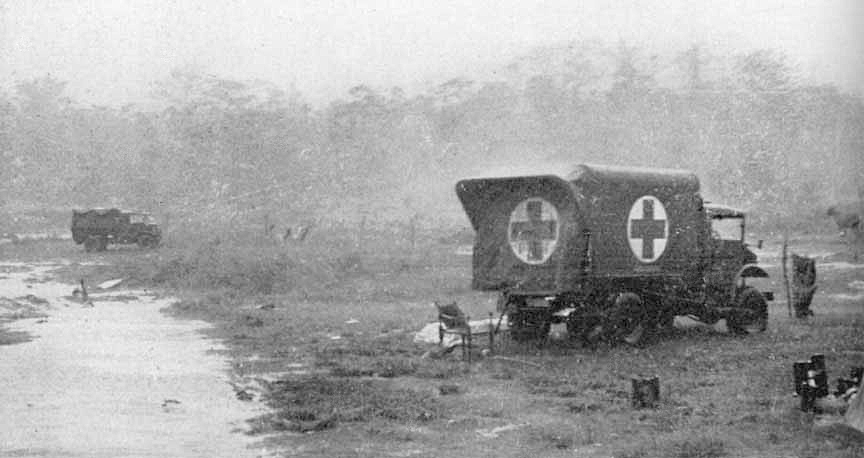
Kohima was re-entered on 14 May. Work for 3 MAS slacked off and the jeep section returned to Section HQ (keeping the jeeps). The Section had not been overworked during the attack, but in the lull following only 12 ambulances were needed for daily evacuations. While the work from MS 28 back to Dimapur continued, the monsoon approached and began. On 4 June, E. C. Custer wrote: "As we were going for the mail after lunch today, there was a tremendous downpour, the beginning of the monsoon I guess. The fields were immediately flooded. Tents and huts were surrounded by water, and trucks were up to their hubs. Before we got back to our campsite, the sun was shining brightly and everything was steaming and humid." The heat rose to great heights in the following days, with rain every afternoon. The flies were a terrible nuisance. A week later the monsoon had settled in, and the whole place was deep in mud and large puddles.
As there continued to be little work, many were able to devote a great proportion of their time to their personal comfort. Some methods were as picturesque as they were effective, according to the pen of H. L. Pierce: "You certainly would have called it a rest if you could have seen me lying in a mountain stream up to my neck, with cigarettes on a rock, a large hat and colored glasses on, reading the Literary Digest to keep cool. We must have looked funny, sitting around in groups. The temperature went up well over 120 degrees, but there was always the lovely stream."
The slack period was partly caused by the arrival of Lt. Birkett's 4 MAS, which, beginning work on 7 June, for a few days relieved 3 MAS. On the same day, Corps reorganized the evacuation scheme from Kohima to Dimapur. A pool of 10 ambulances from 3 MAS was kept at MS 31.2 (13 CCS), but 4 MAS was established at Piphima (MS 28) to do the main evacuations back to Ghaspani (MS 18), where the rest of 3 MAS was temporarily based. The work was steady if not strenuous. In its first 5 days of work, 4 MAS carried 192 lying and 607 sitting patients. This arrangement continued for 4 MAS, but after a few days 3 MAS moved to Hospital Hill in Kohima and handled all evacuations from there back to MS 31.2, where 4 MAS then kept a steady pool of 10 ambulances to handle all evacuations back to MS 18.
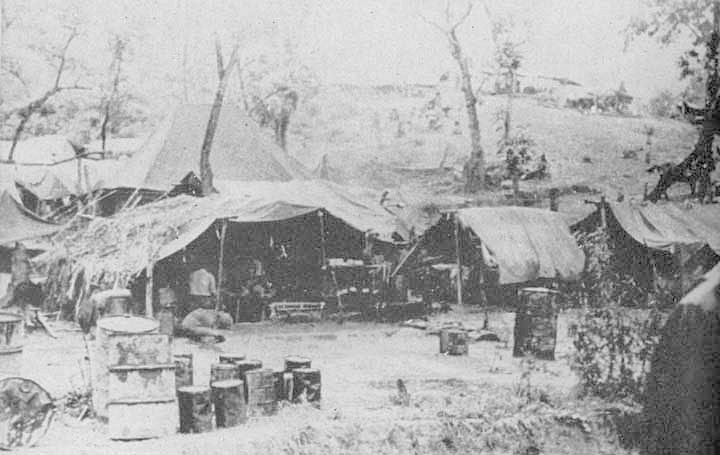
On 10 June, 3 MAS established its headquarters on what had been the grounds of 49 IGH in Kohima. The main portions of the site were occupied by 13 CCS and 7 MFTU (Malaria Forward Treatment Unit). A staging section was soon established in the parking lot. The site, J. B. Ferguson wrote, had recently been "a battlefield. To the right and left of us are hills in which Japs had dug in. The tops of these hills are brown from the blasting, and the trees stick up leafless and black in silhouette.
"Our HQ is an old residence in the center of an old gun battery emplacement. The house was not badly damaged---except for broken windows, plaster, and holes in the roof. We soon knocked down the remaining plaster and cleaned up the place, which is now quite a palace. There are 3 fireplaces (which work)---2 in smaller rooms which are the library and lounge, the other in a larger room which is our dining hall. It isn't just like home, but it is not too unpleasant.
"From our position on the hill we have a beautiful view down, far down, the narrow valley to the higher mountains in the distance. In one direction we can see the mountain where the Japs are still holding out. At times, when the wind is right, we can hear the big guns firing and the shell explosions. All in all, we have a nice location. There are gardenias, bougainvillea, and roses in bloom. Everything is nice and green and very beautiful. Because of the rain, there is quite a lot of mud. It is about ankle deep now."
At this time Moore's jeep section, known as the "Hell Patrol," was working with 7th Division on Jessami track, on the east flank of the Kohima-Imphal road. Assignment to it was rotated, and in mid-June J. W. Parkhurst, W. C. Schwab, and E. M. Spavin, Jr., were driving the jeeps. They were later succeeded by P. Gilbert, Jr., F. Kern, Jr., and D. Smith. "The General Commanding 7th Division," Lt. Fearnley reported, "complimented them and the whole AFS . . . for our work in these parts."
It was wet on the tracks, which became worse and worse. The monsoon had settled in, and it rained every day. Moore had to write asking that Kellogg "send up a dozen pair of socks. Everyone here has wet feet, and it takes quite a while to dry the socks."
As the drive advanced toward the south, the work was heavy and the load was made heavier by the great amount of sickness, particularly malaria, in the Section. At one point, only enough men were well to drive the 25 ambulances.
"During this period," Paulson wrote, "the Chevrolet ambulances were used in the evacuations from battles taking place on the Kohima-Imphal road for the relief of Imphal. The jeeps were used on narrow, muddy tracks fanning out into the mountains west, southwest, and southeast of Kohima. It was our job to locate isolated units and long-range jungle troops who had been dropped back of Jap lines months before and were slowly making their way back into our lines. These jeep tracks, as they were called, were churned and rutted from the monsoon rains that were then in progress. To add to the discomfiture of the men, the rains were cold, for we were nearly at an 8,000-foot elevation in Kohima."
Once the strong enemy positions in and around Kohima had been taken, the 5th Division moved south rapidly, meeting the troops advancing north at MS 109 on 22 June. The AFS ambulances were some way behind the foremost troops, but they found the pace fast and exhilarating.
"We are now working from a Transfer Point to a CCS," J. B. Ferguson wrote on 7 2 June. "So fast are we now advancing that when we were sent up here this was an ADS. The next morning that moved out and it became an MDS. That night the MDS moved out, and now it is just a Transfer Point. . . .
"We had some excitement the other day when two of us went out with the stretcher party to bring in 3 wounded Japs. We went up the road in our ambulances, then on foot up quite a hill to where they were. We got some natives to help us, brought them down the hill and got them into the ambulance. Then back to the ADS. They were looked after, then put into my ambulance together with another who had come in, and off I went. Of course, they were under armed guard. . . .
"The area is dotted with small villages, and the steep hillsides have been terraced to grow rice and tea. The land with its terraces looks like a topographical map come to life. The natives themselves are very colorful. Due to their hardy existence in the hills, they are good physical specimens. . . . These natives work for us as guides, stretcher-bearers, and road workers. They use primitive methods, and it is a strange sight to see them digging away a landslide with hoes and carrying the dirt in little baskets on their heads. It seems so slow in this fast-moving day---yet no landslide has held us up for more than a couple of hours."
Three days later Ferguson continued:
"The last few days have been busy ones for us. One day about noon the Car Post we were working from folded up and we were sent back to an MDS. I no sooner got there than I picked up a load of patients to go to a CCS about 10 miles away. Upon delivering the patients, I was loaded up with surgical supplies and sent back to the MDS. There I took on some more patients and started out for an MDS farther down the line. I arrived there about 1 A.M., then back to our camp. I crawled into the sack about 3:30. Most of the time we make one run a day, but once in a while things get a bit rushed."
On 1 July, 33 Corps moved its HQ to Imphal, taking over the area from 4 Corps, which transferred 20th and 23rd Divisions to 33 Corps command and withdrew to India to rest and refit. The Kohima-Imphal road had been cleared of snipers, and the enemy forces had been pushed far enough east so that there was no danger there of patrols. (General Stopford, 33 Corps Commander, apologized to General Slim for having taken so long.) The Ukhrul area still held trapped enemy forces that needed to be dealt with. To the south and southeast, however, Allied offensives were beginning to make slight advances. There were occasional periods of little or no activity for the ambulance drivers, but with the decision to continue the campaign in spite of the monsoon, Fourteenth Army maintained a steady, if sometimes slow, advance back into Burma.
On 1 July, 3 MAS was at MS 73 on the Kohima-Imphal road. After a spell of very heavy work, it was given a few days of rest, for maintenance. The jeep section continued down the Jessami track, bringing in members of the long-range jungle patrol (often referred to as "those bearded men"). Lt. Fearnley during the next week went to become Liaison officer in Bombay, for the expediting of men in transit to and from the United States. He was succeeded by Lt. Paulson, assisted by Sgt. P. Gilbert, Jr. Sickness continued to cause frequent turnover of personnel at the posts (at this time, 43 of the 45 members of the Section had or had had malaria), but from MS 73 only 12 cars were needed for the evacuation toward Imphal to MS 93, so all was if not well at least under control.
During this period, plans were set afoot to give the Section 6 more jeeps and 4 armored ambulances. By the 20th this largesse had grown into a scheme to turn 3 MAS into a pool of jeep and armored ambulances to serve 2nd, 7th, 20th, and 23rd Divisions. It was a grand plan, and Lt. Paulson was pleased that 33 Corps thought his section merited the honor. Planning for this eventuality filled the fairly idle days at the end of July, but nothing further came of it so far as 3 MAS was concerned. The jeep section worked out along the Palel track then, assisting Gilliam's 2 MAS jeep section in the Shenam area. Early in August the rest of Section 3 moved out that way, replacing 2 MAS, and established its HQ in cowsheds which the original inhabitants did not completely abandon.
While 3 MAS was doing this comparatively forward work, 4 MAS in late June had been left to languish near Dimapur---without much to do and that little of a routine nature. It had moved up from MS 28 to 31.2, but it got restless in the rear. However, in early July it leapfrogged 3 MAS, moving to MS 97 on the Kohima-Imphal road to do the evacuations the 40-odd miles south to Imphal. Here it had a nice location, with a river for swimming and one room in the MDS building for a lounge room. Although this was nearer the current activity by a good bit, there was still little actual work for the ambulances.
"Business has been so bad for 4 MAS," Lt. Birkett reported on 21 July, "that we have had to go out and drum up some new customers---among the Nagas. If there is anybody in trouble back in the hills, they send a delegate to lead us out. Sunday we had a call: some bad phosphorous burns from a leftover bomb. So Ronnies Bradley and I'Anson, who were visiting, and Jut and I packed a medical bag and went up and treated them. That took care of Sunday. While there we heard about a Naga woman, away the hell and gone off on another mountain, who had been hit in the leg by fragments of an air bomb. Early Monday morning, 8 of us plus one BOR started off with a stretcher to bring her in. We could have used an elevator to advantage, but by 3 o'clock we got to a point where we could see the village away off across another valley. At that point we knew we could never reach the village until after nightfall and also that we could never lug a stretcher down the way we had come up. That's all right, sir, we haven't lost it; we know exactly where it is---and came limping home. That more than took care of Monday. We planned to rest on Tuesday and try another route the following day.. . . Tuesday brought a signal to send 8 ambulances and 4 spare drivers up the Ukhrul road, so off I went again."
A. R. Matthew was in charge of the group sent up the Ukhrul road to Litan, a little more than 20 miles from Imphal to the northeast. If the group had had jeeps, it would have been sent farther along the track. But as it was, the job offered a change of scenery and some night driving over muddy, slippery hills back to Imphal. The average was about 4 trips per afternoon or early evening. There was not much excitement, as there were no Japanese around and the area was being evacuated.
On the 21st, another group of 10 ambulances was sent up under F. W, Scott. And on the 27th, the whole Section moved to MS 18 on the Ukhrul road.
"We were as far as ambulances could go on the road," wrote H. P. Chandler, Jr., of his experiences with this second group, "and the patients had to be brought to us on stretchers. We'd take them on to the MDS, where they'd be transferred to another ambulance and taken to a base hospital. We had a very easy time of it; not one battle casualty was brought in, and only about one or two ambulance-loads of malaria cases went out daily. The road we had to cover was terrible, however. In places the ruts were two feet deep, and one of the two plank bridges over brooks was almost washed away by heavy rains.
"Late on the afternoon of the first day, a Colonel rushed up in a jeep with two stretcher-loads of medical supplies he wanted delivered to an ADS 2 1/2 miles off---across a marsh and into the jungle. Five of us started with the two stretchers. The mud and water was up to our waists, and one of the fellows fell off a swaying bamboo bridge into the brook below. The water came up to his neck. It was just dusk when we reached the native village where the ADS was, and we returned to camp with the aid of flashlights. Not a very tiring trip, as the distance was short, but a wet one. After this expedition, we lived in luxury for a few days, as we had only a few patients daily."
In the meantime, 1 and 2 MASs had not been idle. Because of the immobilization of many of the Fords and the repatriation of a great number of the members of Unit 1, Lt. Fenn's 1 MAS had considerably restricted its activity, its only work being at Bishenpur until mid-July. Lacking these two special problems, Lt. Macgill's 2 MAS continued at Palel, with one group on the Ukhrul road and Gilliam and his jeep section chasing the troops that were chasing the Japanese back to Tamu.
At Detachment HQ in Imphal, Captain Pemberton had stepped down in favor of Captain W. L. Marsh as Second in Command. His time was up at the end of May, but he stayed on in Imphal to attend to some legal matters and planned to make the first arrangements for the foundation of an AFS China Unit before taking home leave. The expiration of the enlistment period of Unit 1 left , 1 MAS so short for drivers that some of its members volunteered to stay on until the promised replacements should arrive, just to keep the ambulances mobile in case of need.
"By the way, I was driving an ambulance last week," Captain Pemberton wrote in June at the end of a letter to Major Ives. "It seems that the oil gauge was registering unsatisfactory, so I began the old 1, 2, 3 that we were taught in Vehicle Maintenance course: (1) check oil---it was okay; (2) disconnect oil line at pump and see if it is pumping---it was. In doing (2) 1 damaged the line, which later broke and drained all the oil out. About 15 miles further in the car's life, Jack Barrett was driving, the rod broke. Jack, fortunately, recognized the trouble and stopped immediately. Verdict: Driver who damaged oil-pipe line should be charged cost of connecting rod ($2) and the cost of one oil-pipe line ($.50), or $2.50. This should be deducted from the July pay of Vol. Pemberton."
Through June the work of 1 MAS at Bishenpur continued hazardous and uncomfortable. The advances to the south and west were heavily contested by the enemy and went very slowly. Early in July the tired troops of the 17th Indian Division were replaced by 5th Division (33 Corps). At Bishenpur, 23 FA had replaced 59 FA and in mid-July was replaced by 45 FA. By the beginning of July, 1 MAS had only 4 cars forward, which, as there was not much else for the Section to do, were rotated. D. L. Lutman met a cobra in the latrine, and on the 9th D. D. Heath's ambulance was struck by a shell in the car park.
The push up the Silchar track had started on 11 July, taking a village and then running into stubborn resistance. As yet only two villages beyond Potsangbam had been taken on the Tiddim road. There were a series of small attacks, then on the 16th a huge barrage was followed by a major assault. The enemy had begun to retreat, however, and although 13 Japanese tanks were knocked out very few troops were captured. On the next day, Dolan and Heath were sent up to a combined Car Post and RAP just outside Ningthoukhong (MS 21) to take care of the casualties after the attack. For a couple of days there was lots of work. "Terrific 250-lb. bomb craters all over," Dolan recorded. "In the next village [Thinnungei] there's just utter chaos---where the barrage landed. Just mud and water, craters, a few Jap tanks, caved-in bunkers, and stench."
The advance continued to Moirang (MS 28) on the 20th, meeting little opposition. But the cars from 1 MAS were called back to Imphal. All the AFS sections were placed under 8 MT Regiment of 33 Corps. The First Section had a few runs from Imphal to Kohima or Dimapur with wounded Japs, but the run was long, taking well into the night for a car to make the round trip. In the name of efficiency, Corps insisted that 1 MAS transfer the patients to the cars of another MAS for the second half of the trip. Then there was very little for what was left of 1 MAS to do but sit back and enjoy the superlative mess managed by L. H. Krusi at Detachment HQ.
Lt. Macgill's 2 MAS had had better luck than the First Section. The advance along the Tamu road back into Burma went fairly well, crossing the border to take Tamu on 4 August. Gilliam's jeep section had continued its work out of 49 FA at Shenam. A new post with 24 FA at Wangjing had developed, and the men assigned to its Car Post east of Palel had dramatic as well as wet moments. In addition, the assignments to 55 and 42 FAs on the Ukhrul road were continued. S.M. White was put in charge of that group, which was soon replaced by 4 MAS, the 2 MAS group returning to Section HQ on the 18th and 19th.
The work with 24 FA had begun in mid-May with the assignment of a single ambulance to its ADS at the Palel roadhead. Additional cars were sent on the 29th. The work through June was routine, evacuations of casualties brought in by various means either to the Field Ambulance MDS at Wangjing or on to Imphal. A Car Post was established east of Palel, and on 5 July the cars went up to collect casualties---who refused to appear. On the 8th, however, the Section diary reported:
"Mitch Smith comes in and reports that Frank Mayfield deserves bouquets for his work yesterday with 24 FA---with the Maharattas near Lagun. There was a jeep manned by an IOR which was assigned to go from the gunposts below up a jeep track to the scene of the fighting on the ridge. The IOR refused to take the jeep up to evacuate casualties because of the dangerous condition of the trail. The Captain of the Field Ambulance ordered him to go forward, and he refused to do so. There were 14 casualties on the ridge who had to be evacuated. Mayfield volunteered to take up the jeep, made 3 trips, and got the casualties out. The jeep trail was just the width of a jeep, with an absolute drop of two to three hundred feet. The rain was pouring, and the trail was consequently very treacherous.
"Morrill has also done good work, as have Harry Searles and Mitch Smith under very difficult conditions. The roads are flooded, and the waters rise to the floor of the ambulance. Occasionally our drivers have had to wade up to their waists ahead of the ambulances to explore the roadbeds before driving the ambulances over them."
Five days later, the assignment became involved in catastrophe:
"Mayfield comes in in the morning and Harry Searles after lunch. The river at the ADS [Sengmai Turel] had risen so rapidly after heavy rains last night that the area was flooded. Mayfield came out on a raft with the MO. The raft was constructed from a tarpaulin and petrol drums. It capsized several times in the current, and Mayfield was forced to swim. Harry Searles and Mitch Smith came down later on another raft, which also capsized. Mitch was forced to swim and succeeded in reaching the shore. He walked thereafter. Harry continued on the raft. Mitch has not yet shown up. The ambulances cannot be moved from their location at present."
The next day, 14 June:
"Mitch Smith arrives in the afternoon, after walking out from 24 FA ADS. . . . Morrill remains with the ambulances." However, on the following day, "Morrill threw his kit on a mule and walked out from the head of the Sengmai Turel. Staff Captain indicates 4 days, at least, before the vehicles trapped up there by the rising water can be recovered."
At first the cars were abandoned, with the rest of those of 49 Brigade, to be recovered by 23rd Division. However, this decision was reconsidered, and they had all been gathered in by the 24th. On the 28th, 4 cars were sent to 24 FA at Wangjing (MS 19), where nothing dramatic was likely to happen.
The performance, as well as the opportunity, of the jeep section of 2 MAS had continued to be all that anyone could ask. On 25 June the Section diary recorded the continuation of this story:
"Yesterday the Rajputana Rifles, of which Gilliam is an honorary member, put in an attack on Lone Tree Hill beyond Saibon village (on the Sita track) and was repulsed. Casualties came back by stretcher-bearer, supervised by Gilliam and Wright---who went forward to the scene of the fighting. On Gilliam's suggestion, a jeep track was begun toward Lone Tree Hill. . . . Rai Rifs take Lone Tree Hill, renamed Raiput Hill, and casualties brought out by AFS jeeps from Shenam."
The next day:
"Gilliam comes down for a rest and repairs on his jeep. Mac Wright takes over in his absence at Shenam. . . . More fighting at Rajput Hill, with Gurkhas going in. New jeep track used. Night evacuation necessary, and W. T. Smith drives the narrow track with 5 casualties. Others drive from Saibom at dark. Two Japs caught, one of whom claims to be Chinese, and evacuated by AFS jeep and ambulance."
The jeeps, which could go almost any place, had the serious drawback that, when the stretcher attachments were in place, the patients got wet. The Field Service was not likely to allow such a situation to continue. On 9 July, the 2 MAS diary recorded: "Brigadier Crosby, DDMS 33 Corps, and Colonel Perez, ADMS 23rd Division, inspect Gilliam's jeep with the cover arrangement designed by Jack Barrett. They seemed impressed with it. The Brigadier promises to get us some jeeps." However, the rainy weather that flooded the waters of the Sengmai Turel brought operations east of Shenam to a complete standstill from the 17th to the 24th. In the meantime, 3 men from 3 MAS had arrived and, on the 24th, had been assigned to Shenam to work on the jeep evacuations under Gilliam's direction. Most members of 2 MAS at one time or another had a period with it, some of the better drivers doing long stretches there while others went up as replacements for short periods.
The drive east into Burma continued after the 24th with gratifying success. At the end of the month, Gilliam came back to Section HQ and reported that "the jeep evacuation in the advance went off well. On one occasion, at least, our jeeps were ahead of the forward patrols; 3 of our men were credited with the capture of Japs---Mayfield, Baars, and Gilliam. Our jeeps were, with a few tanks and Bren-gun carriers, the first vehicles to reach the Lokchao River [which crosses the Tamu road at MS 55]. This recalls that our ambulances, with tanks, were the last vehicles out of Lokchao during the withdrawal. Gilliam himself accompanied a patrol into Burma, to our old campsite when we were at 14 CCS [MS 69]."
July was a grand month for visiting brass. General Roberts, OC 23rd Division, frequently stopped in on 2 MAS, and on 13 July he accompanied General Slim to the MDS. Lt. Macgill and Wright were called for. General Slim "expressed his appreciation of the AFS and asked questions about the organization and status of the Field Service."
It is intriguing to speculate on the probable sequence of this and the General's two meetings with members of 1 MAS on Tiddim road, all reported as having occurred around the same time. On one occasion he saw a group lounging around a jeep, in suntans and T-shirts, and approached them jovially with "You must be my Americans." The other time he stopped a few volunteers to ask what unit they were with. When told, the General said "Oh, I didn't recognize the uniform."
Then on 31 July there was the visit of General Scoones, OC 4 Corps, to the Detachment HQ in Imphal. The General arrived at 4 P.M. to speak to a gathering of those who had been at the front since April. "You have contributed a very great deal in winning this campaign," the General said. "Through your skill and care in driving . . . many soldiers have been brought back with their morale not shattered through care and consideration shown." He went on to talk at length of the recent campaign, explaining the reasons behind some of the actions taken. The occasion was supposed to be followed by a tea for General Scoones, but he disappointed the group by leaving immediately after his talk, after again thanking all present.
The climax of the visiting occurred a week later, for those gathered together in Imphal. "Tom Burton went to Corps and arranged a meeting with Wavell," Major Ives recorded on 7 August 1944.
"At 4:30 23 of us went to the Residency of the District Commissioner, where the MP did not expect us and asked where I was born as a check on my identity. We waited until 5:45, when His Excellency showed up. His military secretary---a full colonel---got us lined up in two rows of strangely dressed and oddly assorted men, though all had on their cleanest clothes. Then I went out and met him. He looked at me silently with his one eye until I said 'My name is Ives of the American Field Service. We wanted to thank you for letting us be here in Assam! Then he shook my hand and seemed to be beginning to remember about us---recalled meeting Mr. Galatti in Washington and asked that I send his best wishes.
"He said a few words of thanks to everyone, then went down both lines asking: 'Where are you from? Do you like this country? How many men altogether? Where working? How many casualties? What is grown in the States? How is the mail situation? What work did you do in civilian life? What do you think of British rations? What kind of camera is that? How many were in the Middle East? Did you like the desert? Have you much sickness?' He started to go away, then turned and said, almost shyly, that if the men with cameras wanted to take his picture they might do so. He stood in the front row and Baars and Morrill took two shots each. Then he left. All his talk was low voiced and informal. . . . I think our people liked it. I did."
At the time of this interview, Major Ives had just come up to Imphal from the AFS GHQ, India, which had been transferred to Calcutta after the departure of 4 MAS from Poona. On 8 May it had opened for business at 93 Barrackpore Trunk Road, a small two-storey house with an extensive garden. As had happened in Naples, the house proved too small to house HQ offices, HQ staff, and the transients on business and convalescence. Calcutta was overcrowded, and rents were very high, but space for an AFS Club was finally found in the center of town at 36 Chowringee Road. Half an enormous automobile display room was taken, remodeled under the direction of Captain Craven, and opened on 16 September. For the next year, this was operated by a succession of volunteers, providing a refuge for AFS members bewildered by exotic Calcutta.
Although for the rest of the war, and then some, it played an important part in the lives of AFS members, Calcutta was not anyone's dream city.
"There is such a weird mixture of animal, native, and European life," one man wrote. "Horrible black crows are everywhere ---the nastiest birds you ever imagined in a nightmare---which can hop and fly like respectable birds but which often stagger from foot to foot and half sideways as if besotted. They are actually a part of the life. They mingle in everything, and they have no special city manners.
"Then there are the sacred cows, wandering the pavements as well as the open lots; and many building walls in the native districts are neatly daubed with round patches of cow dung pressed on to dry into round cakes, which you see being sold from piled-high baskets. Each cake has the clear imprint of a hand. No cows are killed. There is no selective breeding. The cows are thin, small, and have almost no milk showing.
"Through all this runs high-speed motor traffic. The natives pay no attention to it. They squat in their open stores, and the supple way in which they all can curl up or drape flaccidly over whatever utensils or unevenness may be underneath, or rest on three small points---two heels and a sharp behind---enable them to crowd together as much as need be. The trams are a sight, with three people sitting or squatting in every window and at least 20 crowded on the boarding step. If they get a toe on, it's enough. The buses are worse. They do it with flypaper.
"At night you get a welcome relief from the crows. Their cries, crooked waddle, and dirty black ugliness are obscene. If a crow here makes good, it becomes a vulture. At night you have only the bats.
"Water buffalo are used a lot for native transport. They complete the ugliness. Truly this is a scene to depress a man, and unfortunately it would take a European a long time to get acclimated and, after the first learning, to live in comfort; another long period to learn about the people and to come to appreciate their culture and arts and philosophy ---of which it is obvious they have a good deal, having become quite ancient and prolific without any European help."
Life in Calcutta during most of the year was more uncomfortable than at the front lines because of the climate. Letters from HQ tell constantly of indispositions or illnesses brought on by the heat or the wet or the tropical insects---or all together. Rashes and fevers came and went almost before they could be diagnosed, and fortunate indeed was the person who had only one trouble at a time.
"Wiley is again in hospital, this time to cure his dengue fever and ringworm impetigo," Captain Craven wrote gloomily in September. "Pembo has a fever of some type and again looks like hell. Yankey has dengue fever and food poisoning. Kneupfer is still in dock in Darjeeling. Drew is still at his bedside. Harry Pierce has a miserable cold. Jarvis is very slow in recovering from his malaria-jaundice bout. Neil Gilliam has about recovered from jaundice. Nort Baskin is back in dock with amoebic dysentery and dengue fever. Weiner was here for one day en route to a hospital (possibly Debra Dun). And so it goes. Pieter, Ed, Jack Barrett, Ted Kersting, and yours truly are still staggering around. Oh, yes: Tims is being kept in perfect condition with the aid of beer and gin."
GHQ had moved to Calcutta by the time the enlistment period of Unit IB-1 came to an end and a large number of its members were brought in for repatriation. One of them, George Alden Ladd, died in the Calcutta railroad station on 2 July 1944. The first group of repatriates had gone to the station late on the evening of the 1st. They waited for hours for their train to come in, Ladd brightening the wait with many jokes and stories. When the train finally came into the station, at about 2:30 in the morning, the weary men picked up their baggage and started for their allotted compartments. P. H. Sheridan, who saw Ladd fall, bathed his face and wrists in water for a while, then C. H. Horton and I. F. Forman gave artificial respiration during the hour or so it took to find a doctor. The train was delayed until an MO arrived and told Major Ives that Ladd had died immediately of heart failure. "Wish it could have been anyone else," one of his many friends wrote. "I have never respected a guy more."
Expiration of enlistment periods brought many changes to the HQ establishment. On the departure of Captain Patrick, Captain Craven took over the Personnel Department, with the continued assistance of Lt. P. E. Wiley. Captain P. S. Van der Vliet had charge of the Finance Department, assisted by Lts. M. S. Cheney, H. L. Pierce, and R. Simpson as Field Cashiers. Captain Marsh, as Second in Command, alternated with Major Ives between the Calcutta and Imphal HQs.
In Imphal, too, at the beginning of August there were changes. The personnel to replace the departed members of Unit 1 had not yet arrived, and although a few generously stayed on beyond the end of their periods there still were not enough men to keep the first two Sections up to strength. Therefore at the beginning of August they were combined into hybrid called 1 & 2 MAS and were issued the jeeps and armored ambulances that 3 MAS had expected. Lt. Macgill briefly and then Lts. Birkett and Spavin were put in charge of the new Section. Lt. Fenn, after a leave, took charge of 4 MAS.
At the same time the positions of the MASs were shifted: Section 2, replaced at Palel by Section 3, joined the remnants of Section 1 at Imphal. The combined 1 & 2 MAS came to be known as the Jeep Section for the 8 months of its existence, as its armored ambulances were long idle and then abandoned as impractical. The jeep Section directed the activities of the jeeps belonging to the other sections, too, much of the time. Further to break down the Section distinctions, personnel were transferred from 3 and 4 to the jeep Section at its formation, and a few months later, when Section 4 was having a long siege of inactivity, there was another large-scale interchange.
The monsoon campaign was extremely difficult and unpleasant. It succeeded against the greatest odds in gaining the essential bases for the winter offensive. Operations were twice brought to a standstill by the excesses of the weather---once at the beginning of the monsoon, when the men at some posts had had to swim out, and again in September, when such rain fell as was left and the monsoon finally broke.
At the beginning of August, the Tamu road had been cleared and Tamu itself retaken by 73rd Division (plus a brigade of 2nd Division), which was then withdrawn under SEAC as a reserve force. From Ukhrul, 7th and 20th Divisions pressed the enemy back to the Chindwin River and then were withdrawn to rest in Kohima. The Lushai Brigade, supplied by air, operated from the Aijal area across difficult and trackless land eastward against the Tiddim road, attacking various spots from MS 40 south in order to block reinforcement of, or retreat by, the Japanese. At the same time, 5th Division pushed south from Bishenpur toward Tiddim, reaching the Burmese border on 16 August.
After the fall of Tamu on 4 August, 11th East African Division replaced 23rd Division and drove on east to the Chindwin River, reaching Sittaung on 4 September and establishing a bridgehead across the river. Then it drove down the Kabaw Valley, while the 5th Division continued down the Tiddim road, both encountering stubborn resistance and all the difficulties the season could provide. Tiddim was retaken by a flanking movement in mid-October. Then 5th Division turned its attack to the east. After another month of difficult fighting, the 5th and 11th East African Divisions met on 14 November between Kalemyo and Kalewa, in the valley of the Myittha. Then 11th Division and the flow of battle again turned to the east.
Fourteenth Army's performance was fantastic---one considered impossible until it was actually accomplished. Without the close support of the air force---for supplies, medical evacuations, and supporting action against the enemy---it would never have been done. The 5th Division's struggles for the Chocolate Staircase and Kennedy Peak (where tanks had to be winched up the precipitous slopes of the 9,000-foot mountain) were more spectacular than 11th Division's steady slogging through 55 continuous days of rain. Both were demanding. Neither had been pleasant.
"Most of the fighting out here is patrol work up in the hills, with an occasional flap of some proportions," R. T. Hamilton wrote in early August. "These patrol soldiers are the toughest bunch of guys I have ever seen and have about the toughest life a white man could have. They climb these damned hills with full pack and armament, sleep in the rain and mud, exist on the scantiest rations, and have practically impossible conditions in case of a casualty. And, fittingly enough, they seem to do the least griping of anyone out here."
Although it had the only fatalities of the period, 4 MAS had a lean time during this phase of the campaign. It steadily lost work, and it lost drivers to the Jeep Section until by the end of October, when 15 had been transferred, three of the section NCOs were driving ambulances and one a water truck. It also had trouble getting forward work because of an unusual major who was reported not to like the AFS.
The Fourth Section, run by J. H. Dempsey during Lt. Fenn's leave in August, was on a hill near MS 18 on the Ukhrul track from the 7th through the middle of August. R. T. Hamilton had recently had two bullets through the cab of his car, just over his head, one arm receiving a nick from a bullet casing. It was uncertain what the source had been, but it was suspected and eventually proved that it had been some Tommies doing some practice shooting. There was not much to do---one convoy of 16 cars to Dimapur with POWs. Then the Section moved down onto the Tiddim road. All but 6 of its ambulances were on post there by 24 August, working forward as the road was cleared. On the 20th, Section HQ was established at MS 37 1/2, next to 5th Division HQ and 16 Indian CCS.
Except for the moves, August was relatively quiet. At the end of the month, all but 9 cars were with Section HQ on Tiddim road. Of the 9, 5 under T. C. Chase JMU 133) were further down the road with 75 FA at MS 54, 3 were still on the Ukhrul road with an RAP of 4 FA at MS 16, and 1 was with 20th Div HQ at MS 11 on the Tamu road. Despite the comparative inactivity, morale was kept up by rotating the men on post and by the acquisition of "records, radios, books, and spirits" from Calcutta. It was expected that the whole section would soon be on the Tiddim road, but this did not come to pass until the middle of September. Then the 6 forward ambulances were at MS 62 with 76 ISS. The rest were with Section HQ, doing the milk run to Imphal with great frequency. It was hard work, and many patients were carried, but it was work without excitement. At this time, WO Boswell joined the Section, succeeding WO F. Shaler, who had been incapacitated by illness. The weather was vile, and during the second half of the month it contributed nothing to the morale of the Section.
"For the last two weeks nothing but drizzle or whole-hearted downpours," T. W. Shephard wrote. "It should be finished in a week or two. Even my tent has begun to mildew, and some of my clothes fall apart to the touch---rotten.
"Yesterday we hiked 4 miles into the hills to the ex-Jap HQ for this area.. It used to be a Baptist Missionary village---20 well-built houses, gardens, stone walls, and bathtubs. There were no souvenirs whatsoever. However, we did take some good pictures of bombed-out buildings. Do you want a Jap skull?"
At the end of September, the 6 cars at MS 62 and another section of 8 under R. Vivian moved ahead to MS 82, attached to 13 CCS. There was still no excitement, and now there was little work. The group with HQ were depressed by both the weather and the boredom of inactivity. "Things couldn't get much worse," Lt. Fenn reported.
A large part of the discontent was due to the formation of the countryside, which imposed a peculiar pattern on the fighting. For one thing, there were "very few casualties," as Major Ives wrote.
"On the Tiddim road the practice has been for one battalion (there is only one RAP to each battalion) to make a frontal attack and another battalion to make a 'hook' through the jungle (on foot) and threaten the Japs in the rear. The Japs leave a few snipers and small parties and then get out. The practice in the Kabaw Valley is probably very similar. We lose very few if any men. The Japs lose more, but they are all dead. The Japs don't like to be taken prisoner, and we don't like to take prisoners. So there are practically no battle casualties to evacuate. However, all up and down the lines of communications there are malaria and typhus and dysentery cases. They aren't very exciting.
"We now have part of the jeeps and Section 4 on the Tiddim road, but pretty soon No. 4 will be pulled back to Imphal to do nothing for 5 or 6 or 8 weeks, because the Division on that road will go ahead without bothering to maintain the road well enough to keep up its LOC and to evacuate its casualties. It will take the sick and the few wounded with it until it meets the other Division in the Kabaw Valley. Then the whole Tiddim road will be abandoned, because it's too much trouble to maintain, and everything will go over one road---the Tamu-Kabaw Valley road."
In mid-October the whole Section was gathered at MS 38 on the Tiddim road, where all activity had ceased. There they waited to be withdrawn to Imphal, which finally happened on the 22nd. The idleness had been such that the move back was a pleasant diversion and, in Imphal, maintenance and the changing of 70 tires were welcomed as something to do. In the first two weeks of November, almost the whole Section took leave in Calcutta, where the new AFS Club was found and reported to be excellent.
The inactivity, however, had proved too much for some who wanted to do all they could to help. In this way R. E. Boaz and W. T. Orth lost their lives on 23 October. By then the 5th Division was receiving "all its supplies-food, petrol, medical supplies and ammunition-by air," Captain Marsh reported.
"The supplies are dropped by parachute onto prepared landing places near the various units. The aircraft crew consists of the pilot and copilot and two enlisted men who stand at the door and push the bundles out at the proper time. In order to assist these two, the aircraft carries two additional men whose duty is to push the bundles back to the door where they can be reached by the regular crew members. The additional men have been and are being supplied by volunteers from units stationed near the air strip (in Imphal). British officers and men and members of the AFS have volunteered for this very useful work, and it was on such a mission that Bill and Ralph were killed.
"They both had lunch here at headquarters and in the afternoon went down to the airstrip and signed on as additional members of the crew of a U.S. DC-3 that was to drop supplies to a unit stationed in the hills northeast of Tiddim. The supplies consisted of food, petrol, mortar ammunition, matches, and medical supplies for an ADS that was serving the unit and that happened to be stationed quite near to the dropping ground. Major Bramley Moore of the Canadian Medical Services says that the accident occurred as follows: The last bundle dropped from the plane on its swing-around over the dropping-ground failed to clear the tail, the parachute looping over the port side of the tail and the bundle swinging underneath. The aircraft headed north up the valley, trying to gain altitude, but without success. Suddenly the bundle dropped clear, but the plane, instead of rising, dropped behind a hill and disappeared from view. He received word from the battalion, who were higher up and could see the crash, of the location of the plane, and set out for it accompanied by some British and Indian personnel from the ADS. He was met by runners, sent by the headman of the village of Haupi, near where the crash occurred, who led them directly to the plane. It was still burning when they arrived," but all the men aboard were dead. "It is very sad. Both . . . will be much missed."
In mid-November, 4 MAS was joined in the rear area by 3 MAS, which was withdrawn after a strenuous few months in the Kabaw Valley to have its cars reconditioned in Palel, where they had started in early August. When 3 MAS HQ had moved to Palel on 8 August, the Section was strung out along the Tamu road on assignments to formations of 11th East African Division. There was lots of work before Tamu fell on 4 August, after which it diminished somewhat: the Section in the 10 days preceding the 8th carried 1,264 patients, of whom 433 were on stretchers.
The advance moved from Tamu in two directions---east toward Chittaung and south down the Kabaw Valley. Section 3 HQ moved up on the 24th to MS 68. Most of the cars were working ahead of there. Major Ives reported on this date, after a trip to the Section, that "it already has one ambulance (Freddy Kern) working from MS 16 on the Sittaung track back to MS 9 on that track---of which 3 miles are very rough, narrow, and dangerous from the standpoint of landslides and going over the khud. Two jeeps are working forward of him. Five jeeps are working from MS 9 on the Tamu-Kalewa road back to MS 69 on the Tamu road. This road is so deep in mud that two elephants are stationed at one point to pull the jeeps through when they get bogged. Eight of 3's ambulances are still in the Imphal plain [working back to 10 CCS at Palel] but may be expected to go forward any time."
At the end of the month, as a result of transfers to fill out the jeep Section, 3 MAS had the same sort of personnel shortage that Section 4 had had. As a result, the training of new men fell something short of the original standards for this theatre. A. R. Martin, for example, arrived fresh in Calcutta on the 13th and was rushed to Section HQ by about the 26th. Not until the end of a week did he find opportunity to write of his first few days in the field:
"I got to Section HQ about 3 days before I came up here (a CCP about 12 miles forward), so you can see how fast they put you to work. I really got a shock when we first came up to HQ, after a grueling journey in a truck for 4 hours. We got out, were pounced upon and shown which ambulance was ours, were told that it should be greased once a week---and that was our month's training. Slightly bewildered, I staggered over and looked my angry, huge, 3-ton adversary square in the headlights. God, it looked big! . . .
"Well, we, or rather I sat around two days rather bewildered until our OC came up and told me they needed a third man up here---that was all. Scared half to death, I got in and Red Bissler and Ed Peterson led the way. The first thing out of camp is a steep hill---a 200-foot drop on one side and a cliff on the other. There's mud knee deep all the way down. Well, you can imagine me skidding all the way down sideways in a 3-ton truck. After about a half-hour's driving, I got onto the hang of it, though, and now I can handle it pretty well---as well as a lot of them. In fact it comes quite easily now. We make a run from here back to the MDS, which takes about 2 hours, just about every day, so you get practice enough. The road's pretty tough---some places you can't even call it a road-crossing pontoon bridges and pontoon ferries ---two hours of that and back again is pretty tiring. Sometimes when we're very busy we have to make two trips, and over that road it's no joke.
"It's quite nice here, actually. There's just a Captain and a Staff Sergeant and their staff. You should see us at night under a---well, almost a tent, drinking rum and eating hors d'. . . . They call them 'toasties' (thank God-it's much easier to spell). And then they bring on the dinner. It's amazing what they can do with their rations. . . . It certainly isn't as 'rough' as I expected it to be. I imagined myself eating out of a tin can in a foxhole. We're sort of up in the mountains, and the climate's pretty nice, except for the monsoon. That's tapering off now. We sleep in our ambulances, and they really make pretty nice rooms---lights in the back and a stretcher to sleep on. It's pretty comfortable.
"There isn't much action going on. We hear an occasional booming of artillery and sometimes scattered rifle fire where they are cleaning up the bush. But outside of that there isn't much doing. The first night we got to camp they shot a couple of Jap stragglers about 1,000 feet from us down the valley. There are lots of skeletons up here and equipment left by the Japs. You have to just about kick your way through Jap skulls to walk around."
By the first week of September, most of the section was working down the track through the steaming jungle in the Kabaw Valley. The monsoon was working up to its final burst of wet unpleasantness. The roads, if solid, were rough---being made from the abundant teak logs laid crosswise over the mud tracks to provide a corduroy surface. Food was apt to be scarce. In addition, "for the past 3 nights baboons have come into our camp," Lt. Paulson reported. "One screamed outside my tent the other morning. Now I know how our early pioneers felt after hearing an early-morning war-whoop. There are also bears, black panthers, leopard, jackals, and deer around. An elephant company is near by to carry up guns and ammunition. Our forward ambulances and troops are fed by planes dropping food by parachute. Their rations have been light the past few days because rain and fog kept the planes from finding them."
Section HQ moved up the Tamu road to MS 71 later in the month, while the cars were as far east as Sittaung and as far south as MS 17 on the Tamu-Kalewa road. Driving conditions were such that Lt. Paulson estimated the cars could not last more than another two months. The rains continued and the poor roads became even worse. just before one period of intense rain in the second half of the month, Paulson went forward and was not able to get back for 10 days. Division HQ was supposed to move south to Witok or Sunle, but because of the weather this had to be postponed indefinitely. The rivers rose and washed away all the bridges. Forward units were out of touch with the rear except for the planes dropping their supplies. And the weather made this so difficult that the troops were again put on light rations.
In the midst of this came a rumor that New York thought the sections in Burma were idle. As this was a solid half-truth, Lt. Paulson was provoked to write the following summary of the lot of 3 MAS at the end of September:
"There has not been as much front-line action as in the desert because the front is so fluid: sometimes the front is 30 miles in depth, due to patrols. . . . At the present time, all of our 25 ambulances are busy and for the most part isolated due to a tremendous 5-day rain. I was on the Chindwin during this rain and the 'Chin' became impassable. In one 4-mile stretch of track there were 12 landslides. Food was scarce, because nothing could be gotten up. Air drops were impossible, as fog banks obscured the area. Water was always ankle deep in the tents and bashas. Clothing was musty and damp. Ever present the rancid, penetrating stench of the wet, rotting jungle. The ambulances are sent out in groups of three to help pull each other from the mire. Sometimes it takes 10 to 12 hours to go 5 or 6 miles.
Encampment near the Chindwin, 3 MAS"Actually, there has not been too much danger except from Jap patrols and pro-Japanese Burmese left behind. But it is very hard work under appalling conditions. . . . There are words in the English language to explain a person being tired, wet, and hungry---but it simply has to be lived to be realized. As tough as the Japs are, they could not stand it. A great number of their casualties were due to starvation and disease. There is hardly a basha or covered area along the road that does not contain Jap bodies. Their hospitals are littered with dead. . . .
"It is difficult to make an interesting picture out of a wet, hungry guy getting patients out of a mud hole, but it is still hard, unpleasant work. It is too bad the work of the Fourteenth Army has been obscured by other, more powerful and more important campaigns. The fighting here has been just as vicious and the living conditions more intolerable than on any other front."
The next week, of course, most of 3 MAS was idle. The cars could not move---"because of the mud and washed-out bridges," Major Ives wrote on 7 October.
"Sick men and other casualties stay put until they get well or die. I have just come back from visiting No. 3. Most of the ambulances were [at MS 71] just this side of Tamu, doing nothing and waiting for the rains to stop. Dick Paulson and I took a jeep one mile south of Tamu and then got into a Dodge weapons-carrier (which had to winch itself out of one mudhole). After a couple of hours we got to MS 9 1/2 (from Tamu), where we stayed in 3 of the Section's ambulances. The next day we walked (because there was no transport moving on the road) to MS 14, where there were 4 more ambulances, and then to MS 16, where there were another 4. All these ambulances had been in the same places for 3 weeks. We never got to see any of our jeeps, which were somewhere further south.
"There was a weapons-carrier which struggled to MS 9 1/2 with rations every day, but the people further south were all supplied from the air. Russ Quandt told me that before the rains became really heavy in the last 3 weeks it took him 14 hours to make a 7-mile trip. Frost told me that in his jeep (which he had been operating on the Sittaung track---a dead end) it took him 2 days (not including nights) to cover 19 miles. Of course, when the rains stop some time around the middle of this month, there will be a chance to build bridges and open up the Kabaw Valley road. And then the Division can move its artillery down toward Kalewa and the ambulances can move the casualties north."
On the same day, T. M. Sawyer wrote that he had just returned from an assignment:
"Danny Frost and I were the only AFS men out there. . . . I had to walk part way to this location, so I had to keep my kit very light---only a change of clothing, bedding roll, and cigarettes. It was a great deal of fun, rather like a camping trip except that we didn't have to do the cooking and all our clothes and bedding got wet, and we never really got dry till we came back in. After a couple of days of squishing around in wet socks, your feet look crinkly and dead. . . . We were the closest ambulance to the front lines, but I saw no shooting at all. Frost was out there some time before me and had some hair-raising tales to tell. . . .
"The country was very pretty, but wild and unsettled. At least, I saw no natives of these hills, and it wasn't till we got down on the plain that we saw some Burmese villages. . . . On the way up to this job, Ed Spavin drove me and Larry Barretto, who was doing some articles for Liberty and who had driven with the AFS in the last war. He was much impressed by the scenery but even more so by the roads. Driving in France was nothing like this, he said. The roads were highways compared to what we drive over, and there was practically no danger of being cut off, for the front was a stable line, and there was no danger of patrols of the enemy cutting your roads behind you as there sometimes is out here. We were amused by his amazement at the number of Jap skeletons along the way. We are used to it by now, and there is not much time or use to burying them. The rain would wash them right out again, and the ants and flies make a nice clean job of it anyway."
The rains did finally stop, and by the third week of October the Division was on the march again. The main group of 3 MAS cars was at Khampat, MS 37 south of Tamu. It had taken 6 days to do the trip by road, though only twice as many minutes by plane. All supplies for Khampat as well as positions farther forward were parachuted in. Most of the petrol dropped was high-octane aviation gasoline. On the 22nd, in order to go forward on assignment, 8 cars had to use a mixture of aviation gas and oil, all that the dump there could provide. P. Gilbert was then in charge of the Section, Lt. Paulson being on leave (during which Paulson flew over the hump into China and formed a gloomy picture of the likelihood of AFS operations there). He objected that the mixture would be bad for the motors. But from then on no other fuel was dropped. As the cars had to keep going, they used the concoction, fatal though it indeed proved to be.
Section 3 moved up to Yazagyo (MS 62 on the Tamu-Kalewa road) on 1 November. Here they were within range of Japanese patrols and defensive measures had to be taken to protect both camp and patients. Some of the men saw a lot of front-line action. In two camps they were visited nightly by Japanese patrols and were shelled and mortared night and day. Most were able to watch dog-fights in the air above them and were occasionally strafed. But the excitement lasted only a short while. On 12 November the Section was sent back from Yazagyo: "Section will undergo a short rest. Refit ready early move forward area," read the orders from 11th East African Division. The ambulances picked up some patients at 60 FDS in Khampat, took them to 26 CCS at Moreh, and then encamped again at Palel (MS 28).
While 3 and 4 MASs had been doing the rear work for 11th East African and 5th Divisions, respectively, the new 1 & 2 MAS was doing the forward work along the same roads. Lt. Macgill had postponed his repatriation in order to assist with its organization---which included the difficult acquisition of proper stretcher brackets, the slow issuing of new jeeps, and the transfer of the jeeps working for the other MASs. At the end of August, Lt. Birkett left 4 MAS and with the assistance of, Lt. Spavin took charge of the two groups of the jeep MAS---Lt. Birkett taking those operating down the Kabaw Valley and Lt. Spavin those down the Tiddim road.
The new vehicles were slowly issued to the Section. All were collected by the end of August only because of the ceaseless activity of Lt. A. W. Olmsted---who was finally at this period appointed MT officer. He had been working as such for almost a year, during which time he is alleged, among other things, to have found and obtained every Ford halfshaft in the theatre in his brave efforts to keep the original First Section cars on the road. It had been hoped that each Section officer would handle his own MT problems, but, as it turned out, fighting conditions were such that the problem of operations took all their time. If for nothing else, an MTO was needed to dispose legally of the surplus cars that were occasionally acquired.
In mid-September, Lt. Olmsted took a group of men to Dimapur to pick up the Ford armored ambulances for 1 & 2 MAS---which it was planned should consist of 25 jeeps and 10 armored ambulances. One "armored icebox" had already been issued to 3 MAS under the original scheme for the reorganization of that Section. They were not happy acquisitions, and once they had been acquired they were not sent out on assignment. The Army found no occasion after Kohima when it needed their particular virtues, and the AFS---after the near miracle of getting them to Kalewa---got permission to return its 10 to the Army dump. Some of the problems they presented were described by Lt. Paulson:
"They look something like the armored car which services banks, etc., but the ambulances are larger. The ambulances weigh about 7 1/2 tons, are about 8 1/2 feet long, about 5 1/2 feet wide, and 5 1/2 feet in height. The armor is about 1 inch in thickness. The driving compartment is not separated from the main body but is small and cramped with armored cab-over-engine. The driver and orderly have slits to see through, about 4 inches long by about 2 inches wide. There are iron doors front and back, which are heavy and hard to handle. It carries 3 lying or 8 sitting. These ambulances were used in Kohima, where part of the town was held by the British and part by the Japs. The armored cars had to pass within 50 yards of Jap bunkers on a place called Treasury Hill. The Jap machine-gun fire from these bunkers did not knock these carriers out. Due to their extreme weight, they must be used on tarmac roads (as the one in Kohima) or in the dry season over fairly good roads. We can't and don't use them now. . . . They are clumsy, difficult to drive, and fearfully hot. Sometimes when there was too great a strain on the body the cab doors would swing open. The driver had to try to control his cumbersome vehicle and close the doors. Many a cracked elbow resulted in the driver trying to make a sharp turn when one of these heavy doors slammed inward. A cracked elbow will never go down as a serious injury, but I don't know of anything more painful."
The formation of the jeep Section, because of the wholesale repatriation of early units at the end of their enlistment periods, required transfers of personnel from the other two sections. This was done slowly through the weeks, as the jobs and the jeeps were ready. In the lull after the relief of Imphal, H. A. Romberger, Jr., and a group of 12 on the Tiddim road were all of the Section that was working. During August, all 3 AFS sections continued in a state of considerable flux. In mid-August, Romberger's group was very busy, working from MS 36. These posts were soon taken over by 4 MAS. At the end of the month, while most still sat in Imphal waiting for the new jeeps to be fitted out with stretcher-brackets and roofs, only 18 cars of the jeep Section were working---6 up the Tiddim road and 12 in the Tamu area.
On 28 August, D. James was slightly wounded in the back of the head by a fragment from a Jap 105. The account by Major Ives, who had been up the day before, gives also a picture of general conditions at forward posts on the Tiddim road:
"It happened while he and Romberger were posted to the RAP of the forward battalion on the Tiddim road in jeeps, 86 miles south of Imphal. This was where the road begins to wind up into the high hills. The Japs had a 105 at the top of the ridge with a fine view of a good deal of the road we held. The gun was hidden well enough so that the Hurricanes couldn't find it, and it made something of a nuisance of itself from time to time. But it didn't usually shoot many shells, perhaps because it didn't have many shells to shoot. The RAP was also, apparently, a sort of battalion HQ. It was in a tent by the side of the road and was right next to that part of the road where a couple of our tanks parked between their trips up the road for a shoot.
"After [the shoot on the 28th], the tanks came back and were camouflaged with foliage-and then the 105 tried to hit them with about 20 shots. But it didn't hit anything except James and the Battalion Adjutant (who were both trying to get into a slit trench suitable for only one) and Danny's jeep . . . [which] got a flat tire and some harmless holes.
"The MO put a good many yards of bandage around James, and Romberger took him to the ADS. They passed Ogle on the way, and Danny told Ogle he had better go up and take his place. Al started his jeep and drove off without, Danny swears, saying a single word. (I can believe it. Perhaps you remember that Al took a big load of patients through the northern edge of the Qattara Depression at the time of the Alamein attack---the Depression is marked on maps 'Unsafe for loaded camels'---and turned up two or three days later with four words in his oral report: 'Sorry to be late!) . . . This was [James'] first crack at ambulance driving (he saddled himself with the thankless job of running the [4th] Section's mess for several months [before transferring to the jeep Section]), and he feels a bit browned off that he became a patient before he had a chance to carry one."
During the first two weeks of September, more assignments came in, until by the 14th there were 11 cars each on the Tiddim and Tamu roads, another working for Corps, and 5 operating from Shuganu on the east of the Manipur River. These last could go only 17 miles down the Shuganu track because of the very deep ruts in the road. F. M. Smith in charge, this group evacuated from MS 17 to MS 12, where W. C. Schwab directed the transfer of their patients to Indian 30-cwts, for the 40-mile trip north to Imphal. This assignment came to an end on 17 September, there no longer being any strategic need for troops east of the Manipur River. The 5 AFS cars then joined those on the Tiddim road.
By then, work toward Sittaung had become slack. F. C. Staples, Jr., however, was there in the earliest days when the first two companies of troops had managed to get across the Chindwin River (500 yards wide at Sittaung, at flood time, and in places wider). Only 3 small assault boats were available to bring men back across the river in case the enemy put in a strong attack. So Staples and an East African Padre named Devitt built a raft with the body of a Jap truck and some empty petrol tins and bundles of bamboo, to which they attached an outboard motor of sorts. Remarkably enough, it worked. But a rope got tangled in the propeller and they drifted half a mile down river before being rescued by one of the assault boats. Staples was later replaced by Sawyer at this post. Through the end of September there were 2 jeeps at Sittaung and 2 at MS 16.
The jeeps, most of which were not new anyway, rapidly went to pot. Some evacuations had to be made at an average speed of 2 mph, at which pace they soon began to "throw oil, carbonize their spark plugs, and ruin their clutches." Replacements were needed and, miraculously, obtained. Distributing the new jeeps added more shifts of personnel and posts to those already occasioned by the advance of the troops and regular trips to workshops. To keep track of this movement, Lts. Birkett and Spavin toured steadily up and down the wretched roads, at the same time distributing mail, candy, and liquor.
At the end of September, 6 jeeps were at MS 74 on the Kalewa track and 16 on the Tiddim road. The Section put additional cars on, bringing its strength up to 30 jeeps---and 10 armored ambulances without assignment. While 6 stayed on the Kalewa track, the number working on the Tiddim road was increased to 18. These were spread along the road at MSs 126, 134, 135, 137, 144, and 145 with units of 10, 45 and 75 Field Ambulances and some RAPs. The largest was a group of 8 with 10 FA at MS 126. By mid-October the most advanced jeeps were at MS 158 with RAPs of the West Kents and Dogras and the ADS of 45 FA. Major Ives went down the road at this time. He had left Imphal on the 10th, after seeing about
"3 jeeps going to Ukhrul. This had been laid on in the morning, when the message came from Corps. . . . Norm got his jeep from workshops and he and I left after supper. Sam White had taken mine up the Ukhrul road. . . .
"Oct. 11:
With Norm, stopped at MS 82 for a meager meal of stew at BORs' mess of the CCS there. Then over the road, muddy in spots and crowded in spots by landslides. A 'flying ferry' was working at the Manipur River, operated by Sikhs. Spent the night at CCS on the other side of river in a fly-infested spot. . . ."Oct. 12:
On in the morning and stopped at 134, where we saw James, Romberger, Hauserman, Bradley, Sweetnam. Left PX and mail. Then on, passing Chandler (in Ogle's jeep---Ogle having malaria) and a couple of other volunteers. Passed an air-dropping place and missed an unopened parachute by some 50-75 yards. Stopped at 75 FA, where Mike Ball was attached, and asked Colonel Stewart if things were okay. He said they were. Major Pilcher also there. . . . Went ahead, passing sweating West Kents going up Chocolate Staircase. More air-droppings around 151. Two guns going off occasionally. Reached an HQ or some such at about 158 and parked the jeep. Walked part way and got a lift part way another half-mile or so and found Spavin, ADMS, Major Slater, Scott, Angevin, Schwab, Marshall, and Taber (Taber had brought PX, Scott had brought Major Slater). We had passed Dodds washing his car at the foot of the Staircase. I talked a bit with Spavin . . . then walked up hill until told to get off skyline. Went back to the HQ spot and had lunch. Then turned back and kept going to 134. Visited Ogle and had rum with Captain there. Slept at 134 while Hauserman and Romberger argued about the assignment---of a jeep."Oct. 13:
Got going at a reasonable hour after breakfast. Held up at ferry for about 1 1/2 hours until the Sikhs pulled us across. The dead elephant was beginning to smell. The area at the river full of flies. Road not bad, though rough and some spots muddy because little slides had blocked the drainage ditch. Got to 82 at about 3 P.M. and had some food. Went on to 38, partly in darkness, seeing a couple of jackals."
A few days later Tiddim fell (19 October) and all medical units rapidly moved forward. The AFS jeeps were very busy during the bitter fighting for Tiddim and during the subsequent nasty tussling over Kennedy Peak they continued to have a heavy load of work. By the 23rd they were spread out from MS 134 on the Tiddim road to MS 8 on the Tiddim-Fort White road---doing, Lt. Spavin wrote, "all the forward and 9/10 the rear work." The line was again extended to 20 miles by the end of the month. The roads were narrow and the traffic was heavy. All the jeeps were beyond Tiddim, the most forward at MS 19. Lt. Spavin and Cndr. Bradley established an HQ at MS 21/4. Most of the jeeps were south of Tiddim at MS 14 with the ADSs of 10 and 45 FAs. One car, and later another, was sent 6 miles down the Saizang track to an air strip.
The front advanced rapidly once the dominating height of Kennedy Peak was taken. Fort White was taken with no opposition on 9 November, and on the 14th a patrol of 5th Division met, just west of Kalemyo, a patrol of 11th East African Division. The jeep MAS spread along the road in the wake of the troops toward Kalemyo and down the Kalemyo-Falam track.
The period had been just as busy and noisy with the part of the jeep Section working south from Tamu, which by mid-October had reached Yedok (approximately MS 48). Driving conditions were worse, as there was no road down the Kabaw Valley but only a track widened and to some extent flattened as the ground began to dry out after the monsoon. The jeeps working here deteriorated faster than the others, as a result of pulling each other out of the mud. (Wilhelm found it necessary to clean his spark plugs every 5 miles). One by one these cars collapsed, and by the end of October the whole Section was reduced, partly as a matter of policy, to 25 jeeps---and the 10 unassigned armored ambulances. New jeeps were acquired, and an improved standard of maintenance was seen (something that was literally never worthwhile on the old ones). At this time most of the cars were assigned to 5th Division---only 7 being with 11th East African Division and two in Ukhrul (which stayed there, never very busy, through mid-November).
On 26 October, Lt. Birkett went forward from 3 MAS HQ, at MS 37. He found the track beyond this point
"a series of rutted tracks through the jungle. The ruts in places are too deep for jeeps, so you take to the jungle and hope for the best." The next day he left Yedok, "traveling without armed convoy. Can make better time and are always within a few minutes of other vehicles. Road jammed with heavy equipment on the way forward. Arrived Yazagyo (MS 61) about 1500 hours. DADMS not in, so proceeded to MS 67 and landed in a heavy barrage. Colonel Langhorne of 10 Field Ambulance practically swamped. Scott, Taber, Boyd, and Wilhelm working forward. Four Third Section ambulances under Ed Turner arrived about 1900 hours and started evacuating back to MS 61. A separate mess has been set up to provide meals for our drivers at any time of the day or night."
The next day Birkett was,
"after a noisy night, up at 0600 hours for a run down the line with Colonel Langhorne. Our 4 jeeps working forward of RAP at about MS 69. Gave new jeep to Wilhelm and returned to Belgian Hospital at MS 61, where I met Major Ives."
He had flown up that afternoon from MS 37
"in L-5s (Stinsons), which worried me a bit because the plane seemed small and fragile. . . . We had supper by the ambulances, cooked by an African batman who had attached himself to our people to the annoyance of the officers he was supposed to work for."
On the 29th, Major Ives drove up to 10 FA at MS 67,
"There we found Ed Turney, Dinwiddie Smith, Francis, and one other. After chewing the fat a bit, we went ahead to about MS 69, where Wilhelm and Taber were. We met the Padre and MO and were invited to stay for lunch. Before lunch we watched an air strike for about 1/2 hour. A burst of machine-gun fire was the signal to the gunners that the planes were ready. Then a smoke shell was put over the target, 3 irregular streaks of smoke dropping from the shell burst. Then the bombs were dropped and, finally, the position was raked with airplane cannon fire. The officers at the mess seemed to think well of the Askaris, most of whom had been farmers and plantation workers at home. After lunch we went forward to MS 70, where the mortars were getting set and where Brigade HQ was established. . . . We were now within about a quarter of a mile of the hill that had been the object of the air strike. We found Scott and Boyd and chewed the fat a bit. There was to be an attack next morning, so we returned to the FA to spend the night. Colonel Langhorne invited me to dinner and we had rum. . . . Brigade telephoned us to be quiet at least 3 times.
"Oct. 30:
At 10 minutes of 6 there was a barrage for 5 minutes, ---then silence for 5, then another barrage. A couple of casualties came back after breakfast, but there was a total of only 5, and all those were from our own mortars and rifles. No Japs were on the hill except 2, who had been dead for a couple of days. Tom and I went up to see things and found Scott and Boyd waiting by the crater at MS 70. Tom went on to the hill. I walked down the road, thinking there was always a chance of finding a desperate Jap in the underbrush. I found only the skeleton of one. Six Honey tanks were settling by the side of the road. Men were cutting brush to make the track wider. The mortars went forward with barrels, ammunition, etc., balancing on Askari heads. Tom explored a bunker and found a Jap flag. I stayed on the road, having no interest in booby traps, though the hill was crawling with Askaris who, apparently, had been disappointed to find no Japs, though the officers were pleased. Scott and Boyd could hear them yell when they attacked."
The work along the track through the Kabaw Valley continued exciting. A short while later, in early November, F. W. Scott summarized the work he had been doing:
"I've had a taste of just about all there is to be had: we've been sniped at, shelled, machine-gunned, bombed, grenaded, and damned good and seared. We were waiting for business one afternoon and finally got a call for a jeep to pick up a wounded man who was being brought back by stretcher-bearer. So off I buzz. The road is barely wide enough for a jeep, the elephant grass almost meets over the top of the road. I was driving a short time when I heard machine guns chattering away. I finally caught up with the troops and was told the wounded were about another half-mile ahead.
"As I drove along, I, noticed that everyone was crouching by the side of the road, with the business end of their rifles pointing toward the trees. There I was buzzing along just as if I were on one of the highways back home. Finally an officer stopped me and told me to wait there. I wasn't sorry. I pulled off to the side and got out a book I was reading. About 5 minutes later I heard a very nasty 'zing!' In less time than it takes to tell, I was in the ditch. I asked the officer just where the Japs were. He took me over to the jeep and pointed to a hill about 400 yards down the road. Needless to say, I moved the jeep, but quick.
"The next afternoon, the troops ran into a bit of trouble, just as I went up to rejoin them; and our artillery, to prevent the Japs from crossing the road, put down what they called 'covering fire'---that is, they shelled one side of the road so our troops could take care of the other side and not worry too much about their flank. How was I to know what was going on? I would have sworn they were after me. It wasn't too bad at first, but when one landed a few yards to my right and I felt the blast of the explosion, it didn't take me long to decide to get out of there.
"The little yellow fellows have a cute little trick of sending out small parties of men at night to keep us awake and annoyed. These are called 'jitter parties! One paid us a visit. One of their tricks is to throw rocks around and give the impression that they are grenades. Someone started shooting, and I dove for the ditch. It sure sounded like a battle royal, what with bullets whistling through the trees and grenades going off and the air filled with whizzing splinters. There I was way down at the bottom of the trench, thoroughly convinced that all the Japs in Burma were but a few yards away. They, the Japs, were out to make a night of it and went around for the remainder of the night banging two pieces of wood together or just opening and closing the bolts on their rifles. Most annoying.
"Two days later I saw my first Jap plane. It sounds much different from ours. I don't know just how many there were. They spotted us and decided to drop in. Once again I dove for a ditch and made myself as small as possible. I could hear the roar of the motors, then they opened fire. As they dove for the second time, something hit me in the back of the neck with a terrific thud. I thought for sure I was hit, but it was only some fool who dove into the trench on top of me. . . . I wouldn't have missed it for the world."